
None in Three Inaugural Annual Conference
A
Published · 19 slides · 0 views

1 / 1
Description
None in Three Inaugural Annual Conference September 2021 Ethical Considerations When Researching Gender-based Violence. What can we learn from Feminist Researchers? Dr Nadia Wager The Neglect of Traditional Psychology Ali (2006) In
Related Topics
Share
Embed code
Download this presentation From Below
"None in Three Inaugural Annual Conference" is the property of its rightful owner. Permission is granted to download and print the materials on this website for personal, non-commercial use only, and to display it on your personal computer provided you do not modify the materials and that you retain all copyright notices contained in the materials. By downloading content from our website, you accept the terms of this agreement.
Presentation Transcript
01
None in Three
Inaugural Annual Conference
September 2021
Ethical Considerations When Researching Gender-based Violence.
What can we learn from Feminist Researchers?
Dr Nadia Wager<br>
Ethical Considerations When Researching Gender-based Violence.
What can we learn from Feminist Researchers?
Dr Nadia Wager<br>
02
The Neglect of Traditional Psychology Ali (2006)
In traditional psychology there has been a distinct neglect of the study social problems (e.g. homelessness, unemployment, substance misuse etc.) within an ecological framework, focusing specifically on the aetiological role or moderating influences of community, social and cultural factors.
The strive for ‘objectivity’ often conflicts with conducting socially responsible research.<br>
03
The consequence…. Not only have traditional psychologists neglected the inclusion of topics related to the oppressed, deprived and marginalised, they have also been guilty (on occasions) of misinterpreting research findings, typically as a consequence of decontextualising the experience, the outcome of which may be harmful to the researched population.
Examples:
Formulation of domestic violence as a problem of minority ethnic groups
Gender symmetry in domestic violence following the development of the Conflicts Tactics Scale.
Meta-analysis on the long-term effects of child sexual abuse
Victim- Blaming perspectives (Victim precipitated cases of paedophilia)<br>
04
Philosophy of Ethics Utilitarianism/ Consequentialism (Bentham; J.S. Mills) - focuses on the principle of well-being: ‘the greatest good for the greatest number’. ‘The ends justify the means’. It focuses on the cost-benefit analysis computed prior to commencement of the study. It considers the likely harms to the individual in relation to the likely benefits to both society and the individual themselves.
Deontology (Kant) - endorse the notion of autonomy or free will and thus the principle of informed consent emerges from this perspective. This proposes that if participants are given the appropriate information regarding the study they should be considered competent to make their own decision as to whether they wish to be involved.
Virtue Ethics - focuses on the qualities of the researcher: compassion, courage, honesty, humility, justice, and practical reasoning. (Schaffer, 2009) – Feminism and ethics of care<br>
05
Key ethical considerations Informed Consent
Avoidance of Deception
Right to withdraw
Beneficence
Non-maleficence (protection from harm)
Debriefing
Confidentiality
Social Responsibility
Competence
Non-discriminatory<br>
Avoidance of Deception
Right to withdraw
Beneficence
Non-maleficence (protection from harm)
Debriefing
Confidentiality
Social Responsibility
Competence
Non-discriminatory<br>
06
Farber (2000) -principles of ‘effective’ feminist research The relationship between the researcher and the researched should be collaborative and non-exploitative
The alienation of the researcher from the researched should be eliminated
The researched should be involved in the research process
Transformative research is the ultimate goal<br>
The alienation of the researcher from the researched should be eliminated
The researched should be involved in the research process
Transformative research is the ultimate goal<br>
07
So… what is feminist methodology? Sarantakos (2004) argues that it is not so much that feminist researchers use different methodologies, rather it is how they use conventional methods, to study particular issues such as; oppression, discrimination and marginalisation and, the manner in which they use their findings.
A core feature of feminist research is the use of reflexivity as a source of insight (Taylor, 1998).<br>
A core feature of feminist research is the use of reflexivity as a source of insight (Taylor, 1998).<br>
08
Ethical Principals In qualitative research, particularly action research, it is difficult (if not impossible) to pre-empt all of the issues related to ethical conduct at the outset of the study (e.g. proposal stage – ethical approval stage), since by the very nature of the research design the process evolves and changes.
Therefore the ethics of the study must be continually responsive to personal, social and contextual situations (Aita & Richer, 2005 in Hewitt,2007; Downes et al, 2014; Stout et al., 2020).
This is known as micro –ethics or ethics in practice (Warin, 2011)
Think for a moment about the impact the Covid-19 lockdown restrictions had on the conducting interview studies.<br>
09
Ethics in Practice The typical process of gaining approval from the relevant ethics committee make the process appear to be a one time event (prior to beginning the research)
The reality is that you will be faced intermittently with ethical dilemma’s (some minor others not so minor) during the course of your research. (Downes et al., 2014; Stout et al., 2020)
This will continue into the dissemination stage.
Thus you need to be both mindful of this, to be honest, seek advice from others, and inform the ethics committee of any deviations from the approved ethics protocol<br>
10
Trust and the potential to violate trust When researching issues such as gender-based violence it is important to be cautious against replicating the violation of trust which survivors may have already experienced in the context of their victimisation (Fontes, 2004).
Similarly don’t oppress the oppressed or further render powerless those who already lack structural power.<br>
Similarly don’t oppress the oppressed or further render powerless those who already lack structural power.<br>
11
Consent Since the research protocol is more dynamic and less predictable in qualitative research than it is in quantitative research, it is important to consider the implications this has for the notion of fully informed consent (Fontes, 2004).
Process consent (Ellis, 2007)
Contingency planning<br>
Process consent (Ellis, 2007)
Contingency planning<br>
12
The right to privacy Privacy within the research context has been defined as:
“having control over the extent, timing and circumstances of sharing one’s self (behaviourally, physically and intellectually) with others. The information belongs to the person”
(The Centres of Disease Control and Prevention and Agency for Toxic Substance and Disease Registry Scientific Ethics Training, 1999, cited in Fontes, 2004).
Therefore building rapport as a means to aid disclosure is an ethical issue. It can be seen as a manipulative tactic to encourage the interviewee to disclose more than they might have wanted to. This in turn increases the possibility of regret and for experiencing secondary trauma.<br>
13
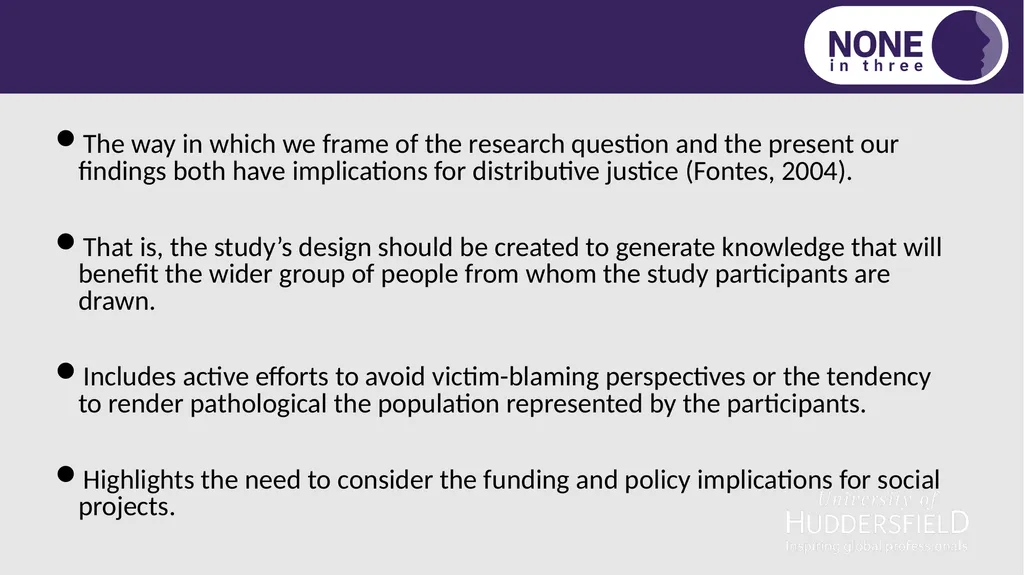
Promoting justice The way in which we frame of the research question and the present our findings both have implications for distributive justice (Fontes, 2004).
That is, the study’s design should be created to generate knowledge that will benefit the wider group of people from whom the study participants are drawn.
Includes active efforts to avoid victim-blaming perspectives or the tendency to render pathological the population represented by the participants.
Highlights the need to consider the funding and policy implications for social projects.<br>
14
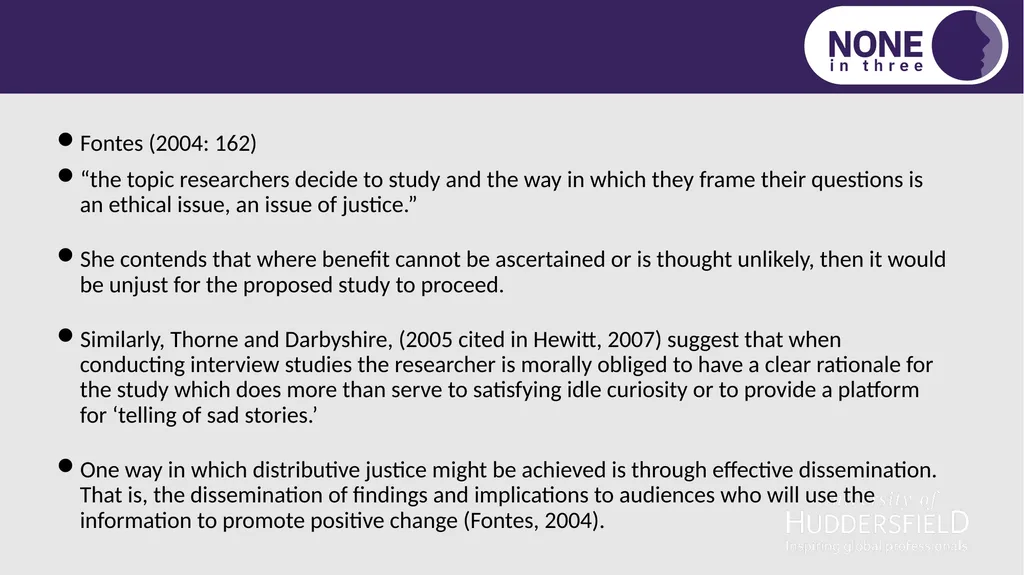
Fontes (2004: 162)
“the topic researchers decide to study and the way in which they frame their questions is an ethical issue, an issue of justice.”
She contends that where benefit cannot be ascertained or is thought unlikely, then it would be unjust for the proposed study to proceed.
Similarly, Thorne and Darbyshire, (2005 cited in Hewitt, 2007) suggest that when conducting interview studies the researcher is morally obliged to have a clear rationale for the study which does more than serve to satisfying idle curiosity or to provide a platform for ‘telling of sad stories.’
One way in which distributive justice might be achieved is through effective dissemination. That is, the dissemination of findings and implications to audiences who will use the information to promote positive change (Fontes, 2004).<br>
15
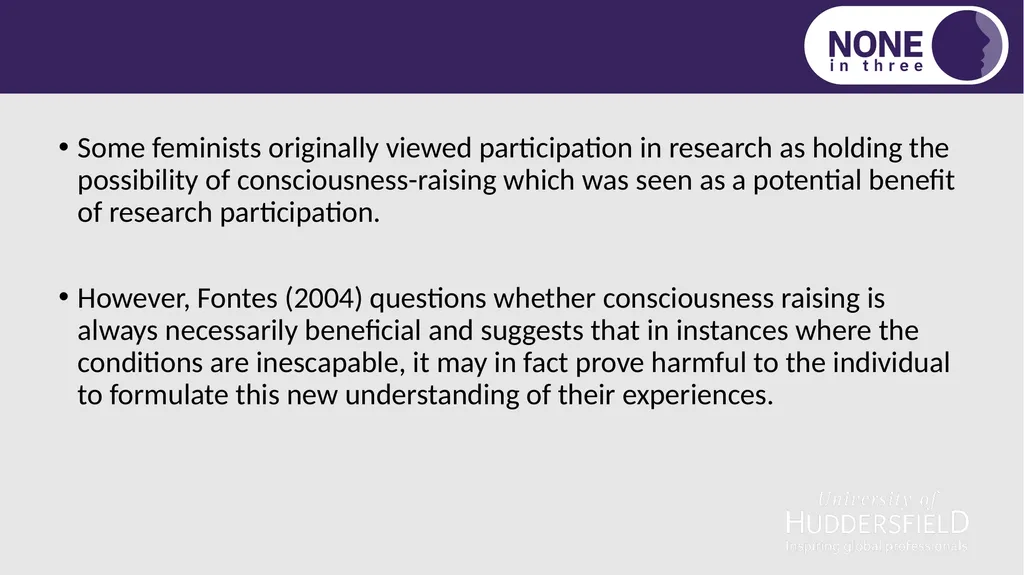
Protection from harm Some feminists originally viewed participation in research as holding the possibility of consciousness-raising which was seen as a potential benefit of research participation.
However, Fontes (2004) questions whether consciousness raising is always necessarily beneficial and suggests that in instances where the conditions are inescapable, it may in fact prove harmful to the individual to formulate this new understanding of their experiences.<br>
However, Fontes (2004) questions whether consciousness raising is always necessarily beneficial and suggests that in instances where the conditions are inescapable, it may in fact prove harmful to the individual to formulate this new understanding of their experiences.<br>
16
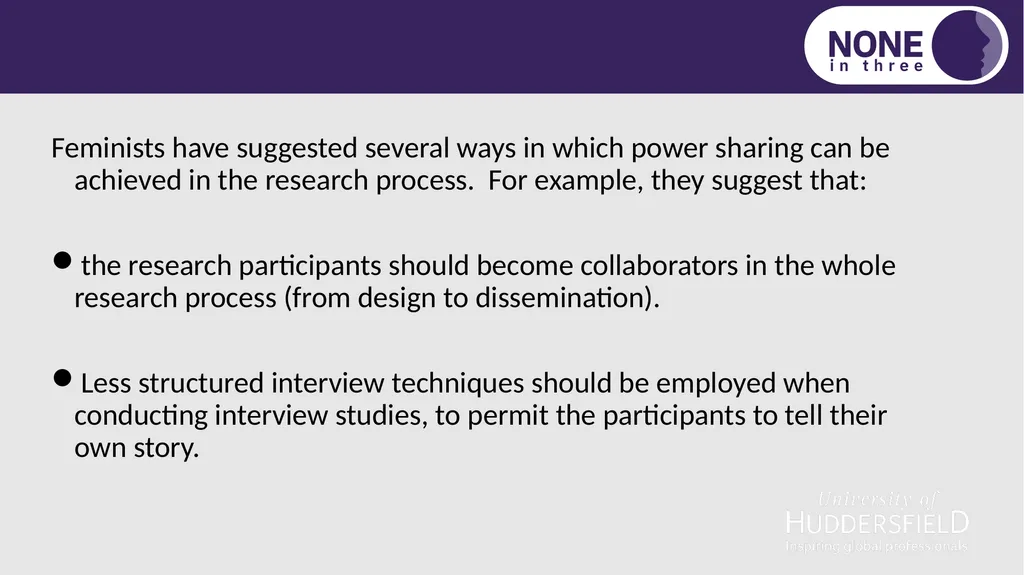
Rectifying imbalances in power Feminists have suggested several ways in which power sharing can be achieved in the research process. For example, they suggest that:
the research participants should become collaborators in the whole research process (from design to dissemination).
Less structured interview techniques should be employed when conducting interview studies, to permit the participants to tell their own story.<br>
the research participants should become collaborators in the whole research process (from design to dissemination).
Less structured interview techniques should be employed when conducting interview studies, to permit the participants to tell their own story.<br>
17
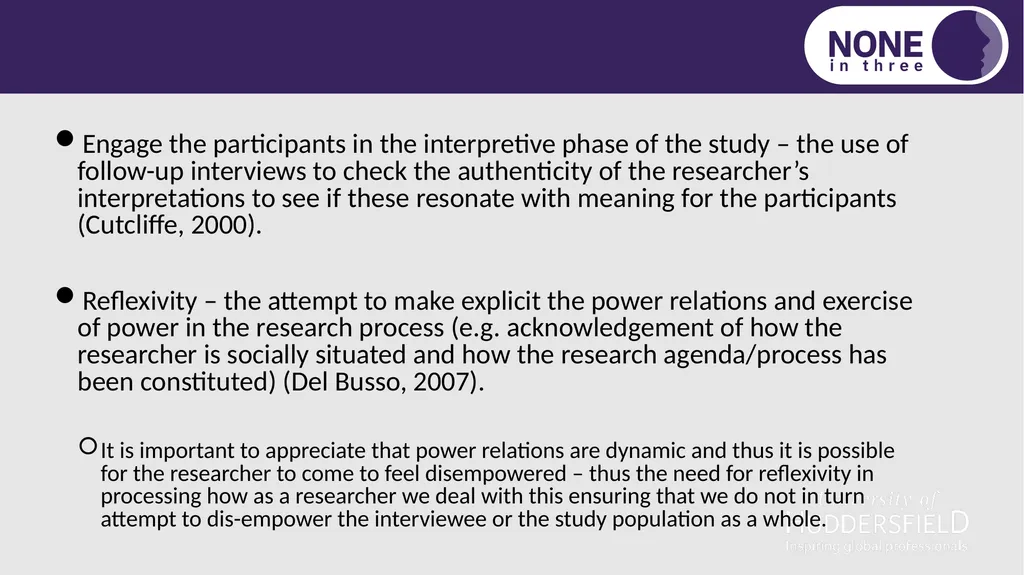
Engage the participants in the interpretive phase of the study – the use of follow-up interviews to check the authenticity of the researcher’s interpretations to see if these resonate with meaning for the participants (Cutcliffe, 2000).
Reflexivity – the attempt to make explicit the power relations and exercise of power in the research process (e.g. acknowledgement of how the researcher is socially situated and how the research agenda/process has been constituted) (Del Busso, 2007).
It is important to appreciate that power relations are dynamic and thus it is possible for the researcher to come to feel disempowered – thus the need for reflexivity in processing how as a researcher we deal with this ensuring that we do not in turn attempt to dis-empower the interviewee or the study population as a whole.<br>
18
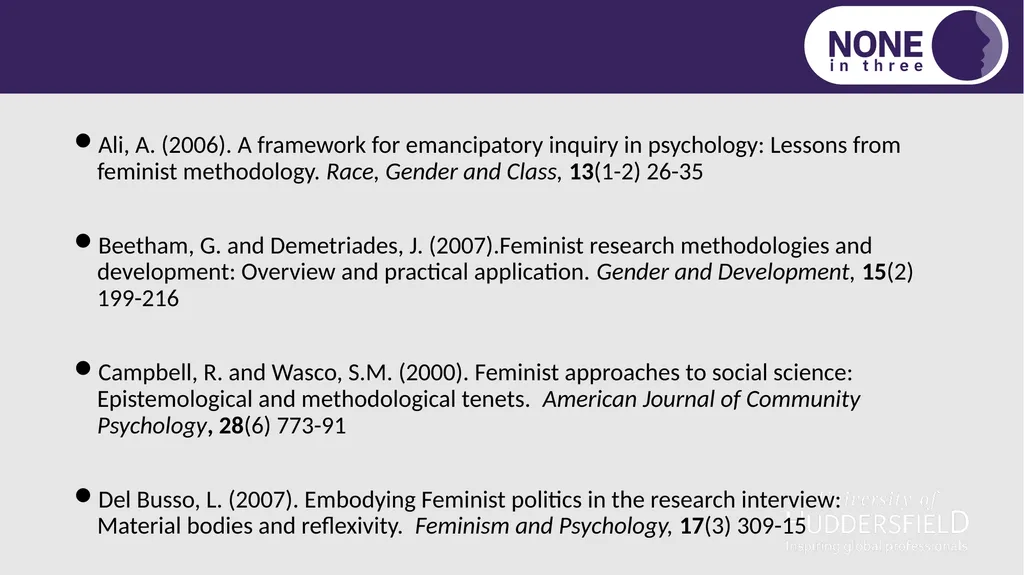
Suggested Reading and References Ali, A. (2006). A framework for emancipatory inquiry in psychology: Lessons from feminist methodology. Race, Gender and Class, 13(1-2) 26-35
Beetham, G. and Demetriades, J. (2007).Feminist research methodologies and development: Overview and practical application. Gender and Development, 15(2) 199-216
Campbell, R. and Wasco, S.M. (2000). Feminist approaches to social science: Epistemological and methodological tenets. American Journal of Community Psychology, 28(6) 773-91
Del Busso, L. (2007). Embodying Feminist politics in the research interview: Material bodies and reflexivity. Feminism and Psychology, 17(3) 309-15<br>
19
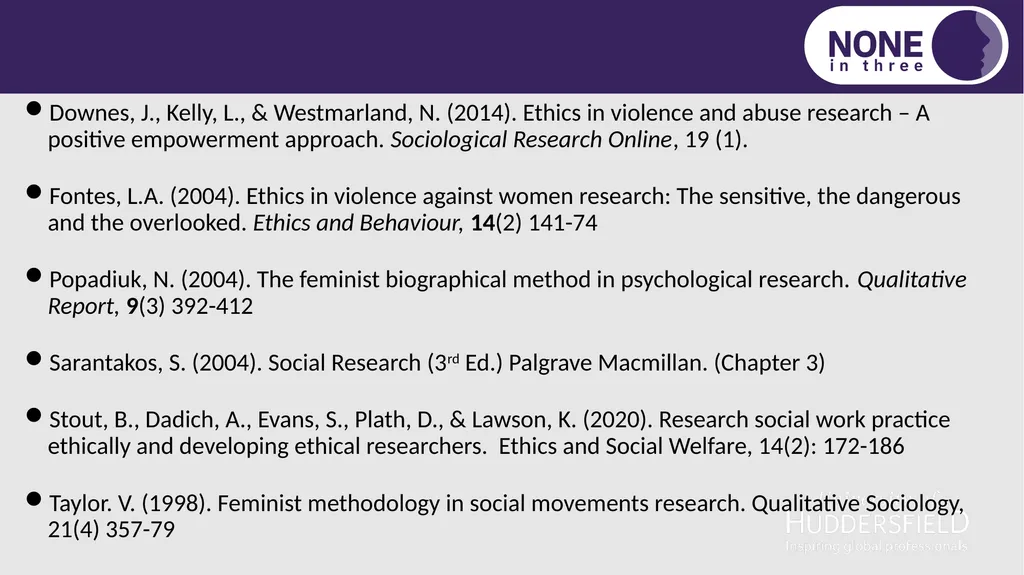
Downes, J., Kelly, L., & Westmarland, N. (2014). Ethics in violence and abuse research – A positive empowerment approach. Sociological Research Online, 19 (1).
Fontes, L.A. (2004). Ethics in violence against women research: The sensitive, the dangerous and the overlooked. Ethics and Behaviour, 14(2) 141-74
Popadiuk, N. (2004). The feminist biographical method in psychological research. Qualitative Report, 9(3) 392-412
Sarantakos, S. (2004). Social Research (3rd Ed.) Palgrave Macmillan. (Chapter 3)
Stout, B., Dadich, A., Evans, S., Plath, D., & Lawson, K. (2020). Research social work practice ethically and developing ethical researchers. Ethics and Social Welfare, 14(2): 172-186
Taylor. V. (1998). Feminist methodology in social movements research. Qualitative Sociology, 21(4) 357-79<br>