NORTH WEST DEPARTMENT OF AGRICULTURE AND RURAL DEVELOPMENT AGRICULTURAL DEVELOPEMNT SERVICES Ms. Kereeditse Mabel Qas, Pr. Sci. Nat. (Anim. Sci.) Production Scientist (Animal Science) Agricultural Research Services KMQasnwpg.gov.za Title:
"NORTH WEST DEPARTMENT OF AGRICULTURE AND RURAL" is the property of its rightful owner. Permission is granted to
download and print the materials on this website for personal, non-commercial use only, and to display it
on your personal computer provided you do not modify the materials and that you retain all copyright
notices contained in the materials. By downloading content from our website, you accept the terms of this
agreement.
Presentation Transcript
01
NORTH WEST DEPARTMENT OF AGRICULTURE AND RURAL DEVELOPMENT AGRICULTURAL DEVELOPEMNT SERVICES Ms. Kereeditse Mabel Qas, Pr. Sci. Nat. (Anim. Sci.)
Production Scientist (Animal Science)
Agricultural Research Services
KMQas@nwpg.gov.za
Title: Impact of Climate Change on Beef Production
Information day @ Letlhabile, Brits
31 August 2021<br>
02
Introduction The effects of climate change on beef production are indisputable > change in long-term weather trends.
Livestock are very unique - are affected by effects of climate change and also contribute to climate change through the enteric methane (CH4) emission.
Climate change is expected to have a more extreme effect on the developing countries and negative effect on beef production environments in these countries.<br>
03
Introduction The effects of global warming on sustainable animal production are related to following changes:
Ambient temperature which leads to heat stress, nutritional stress, lowered production/reproduction,
Rainfall, humidity, solar radiation, altered patterns of animal and plant diseases (threat of new disease, frequency of existing diseases),
Nutritional value of cultivated and natural pastures and change in pasture composition (growth, yield and stocking rate) and adaptation of animals to production environments.<br>
04
Effects of Ambient Temperature Heat stress is a major factor involved in reducing productivity and animal development.
Temperatures frequently rise above the comfort zone - livestock needs to adapt to these higher temperatures or management strategies must be in place to mitigate heat stress.
Adaptation of animals to rapidly changing weather conditions – unknown.
In any production system, it is important that the animals are within their thermal comfort zone<br>
05
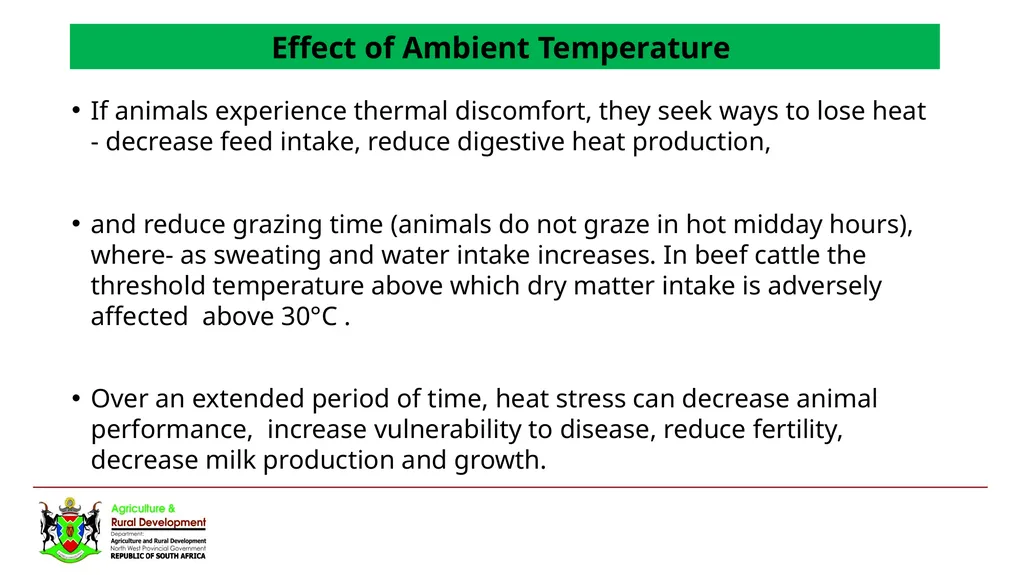
Effect of Ambient Temperature If animals experience thermal discomfort, they seek ways to lose heat - decrease feed intake, reduce digestive heat production,
and reduce grazing time (animals do not graze in hot midday hours), where- as sweating and water intake increases. In beef cattle the threshold temperature above which dry matter intake is adversely affected above 30°C .
Over an extended period of time, heat stress can decrease animal performance, increase vulnerability to disease, reduce fertility, decrease milk production and growth.<br>
06
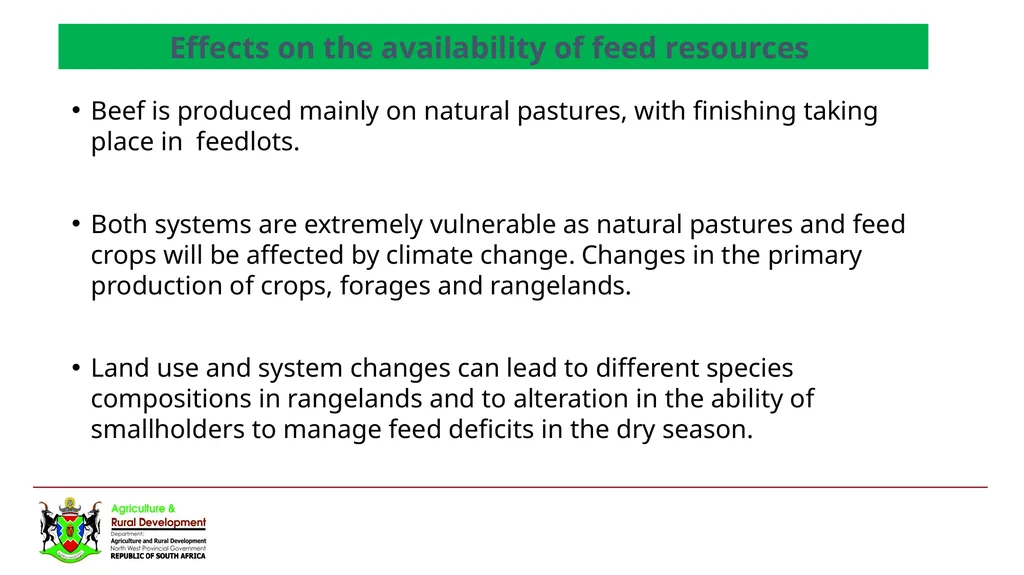
Effects on the availability of feed resources Beef is produced mainly on natural pastures, with finishing taking place in feedlots.
Both systems are extremely vulnerable as natural pastures and feed crops will be affected by climate change. Changes in the primary production of crops, forages and rangelands.
Land use and system changes can lead to different species compositions in rangelands and to alteration in the ability of smallholders to manage feed deficits in the dry season.<br>
07
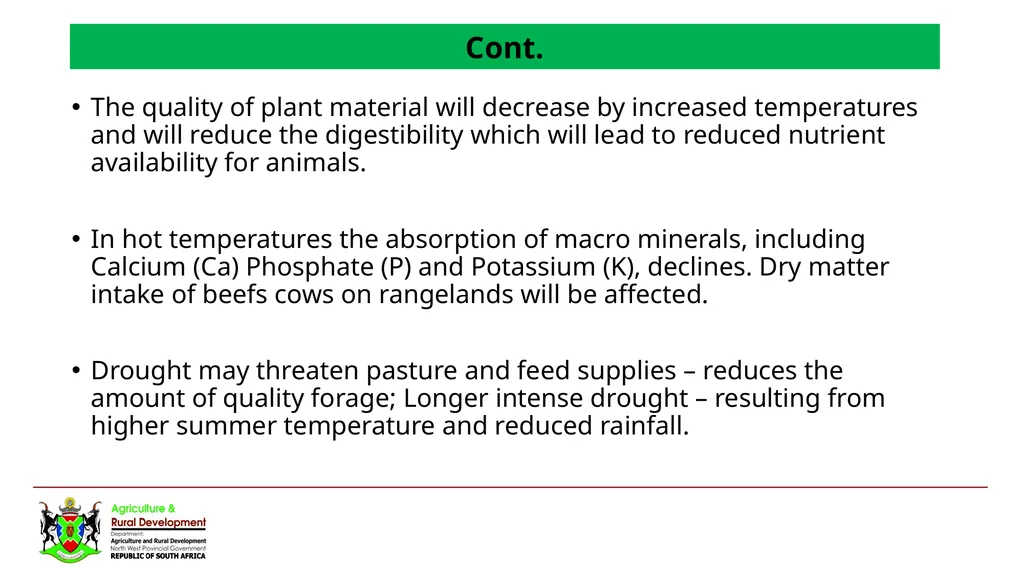
Cont. The quality of plant material will decrease by increased temperatures and will reduce the digestibility which will lead to reduced nutrient availability for animals.
In hot temperatures the absorption of macro minerals, including Calcium (Ca) Phosphate (P) and Potassium (K), declines. Dry matter intake of beefs cows on rangelands will be affected.
Drought may threaten pasture and feed supplies – reduces the amount of quality forage; Longer intense drought – resulting from higher summer temperature and reduced rainfall.<br>
08
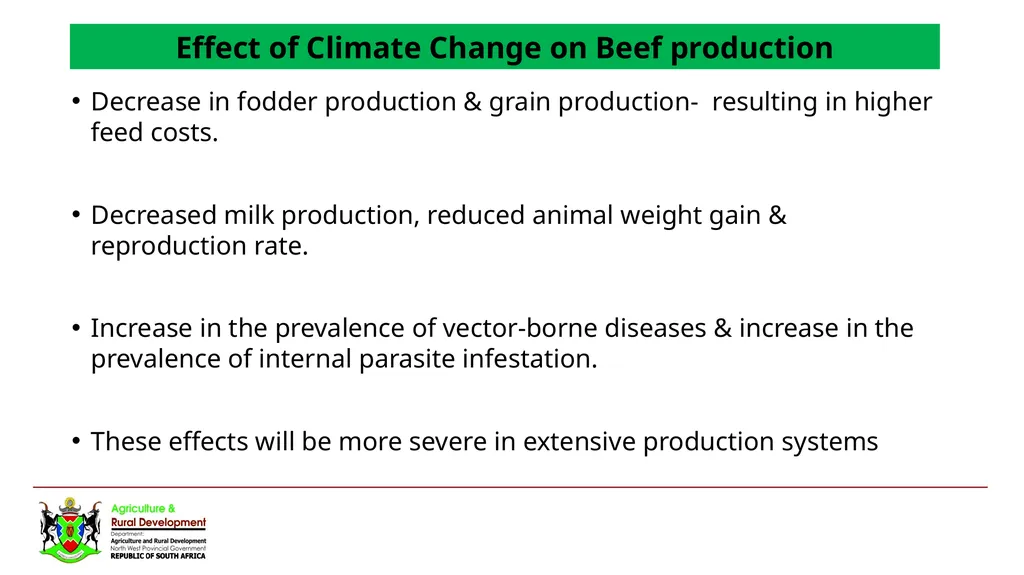
Effect of Climate Change on Beef production Decrease in fodder production & grain production- resulting in higher feed costs.
Decreased milk production, reduced animal weight gain & reproduction rate.
Increase in the prevalence of vector-borne diseases & increase in the prevalence of internal parasite infestation.
These effects will be more severe in extensive production systems<br>
09
Mitigation Improving the emerging beef cattle sector (higher output in the form of reproduction, survival, growth, lower stocking rates and better resource utilization)
The livestock industries have a responsibility to reduce the release of GHG (i.e. the carbon footprint) and water use (i.e. the water footprint) of livestock production.
An effective way of diminishing the carbon and water footprints from livestock is to reduce livestock numbers and increase the production per animal, thereby improving their productivity.<br>
10
Mitigation Increased production generates less GHG emission per unit of livestock product.
Production efficiency can be improved through appropriate breeding and selection
GHG emissions per unit livestock output can be reduced substantially if the comparatively low growth and efficiency (both pre- and post-weaning) and fitness (reproductive rate and longevity) can be addressed.<br>
11
Conclusion Climate change will result in increases in the frequency of heat stress, droughts and floods > adverse effects on beef production.
Ruminants are important since most of the world’s vegetation biomass is rich in fibre.
Only ruminants can convert this fibre-rich vegetation into high quality protein sources for human consumption.
Match the genotype to the environment and to develop appropriate selection criteria to ensure effective breeding management for sustainable production in changing environments.<br>