
NS101 Rules of the Road (1-19) Enabling Objectives
LD
Published · 39 slides · 0 views

1 / 1
Description
NS101 Rules of the Road (1-19) Enabling Objectives Know the U.S. Inland Rules of the Road and the International Regulations for preventing collision at sea to include: Rules 1-19 International These Rules shall apply to all vessels upon
Related Topics
Share
Embed code
Download this presentation From Below
"NS101 Rules of the Road (1-19) Enabling Objectives" is the property of its rightful owner. Permission is granted to download and print the materials on this website for personal, non-commercial use only, and to display it on your personal computer provided you do not modify the materials and that you retain all copyright notices contained in the materials. By downloading content from our website, you accept the terms of this agreement.
Presentation Transcript
01
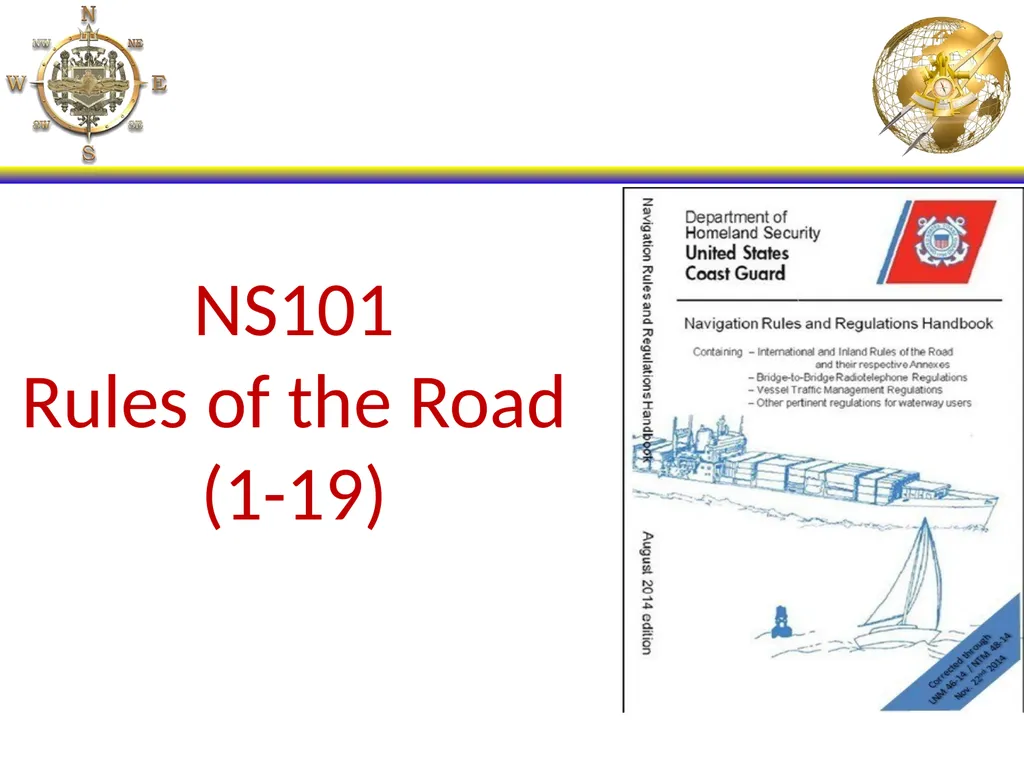
NS101
Rules of the Road (1-19)<br>
02
Enabling Objectives Know the U.S. Inland Rules of the Road and the International Regulations for preventing collision at sea to include:
Rules 1-19<br>
Rules 1-19<br>
03
International
“These Rules shall apply to all vessels upon the high seas and in all waters connected therewith navigable by seagoing vessels” Inland
“These Rules apply to all vessels upon the inland waters of the United States, and to vessels of the United States on the Canadian waters of the great Lakes to the extent that there is no conflict with Canadian law” Rule 1 - Application<br>
04
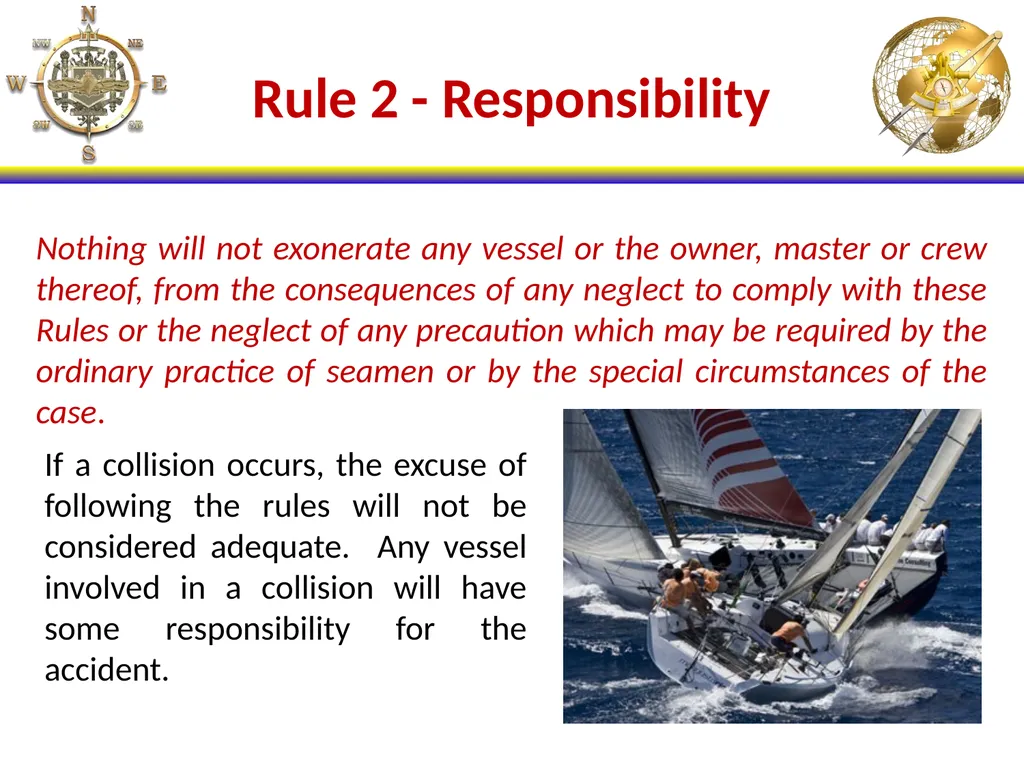
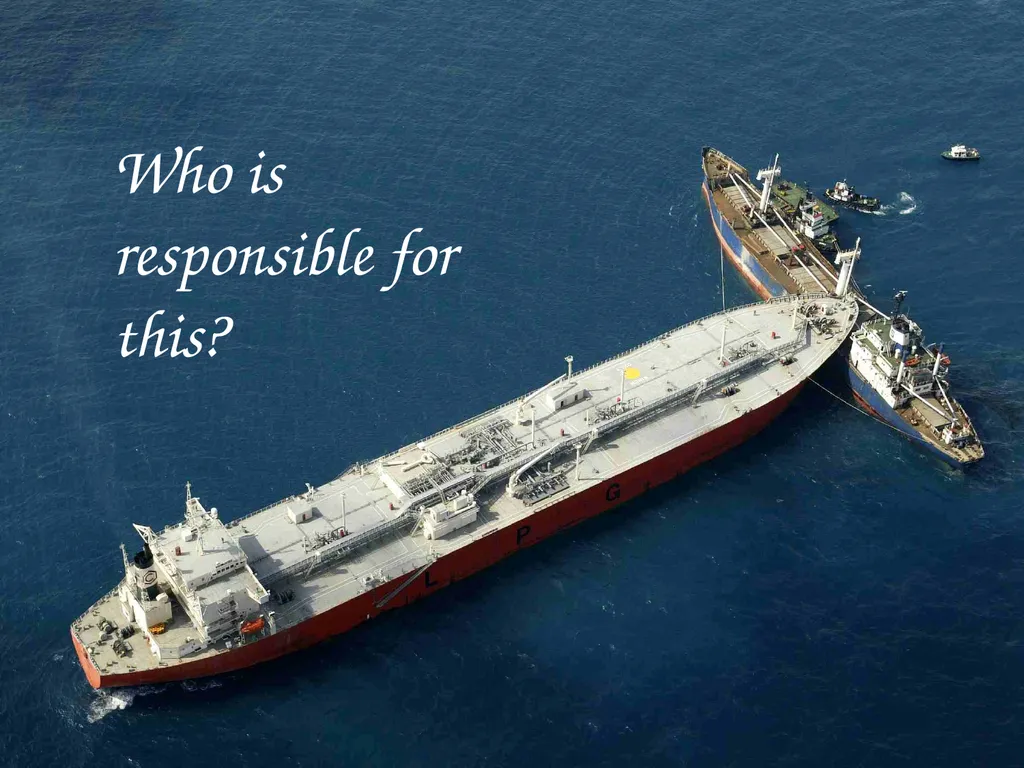
Rule 2 - Responsibility Nothing will not exonerate any vessel or the owner, master or crew thereof, from the consequences of any neglect to comply with these Rules or the neglect of any precaution which may be required by the ordinary practice of seamen or by the special circumstances of the case. If a collision occurs, the excuse of following the rules will not be considered adequate. Any vessel involved in a collision will have some responsibility for the accident.<br>
05
Who is responsible for this?<br>
06
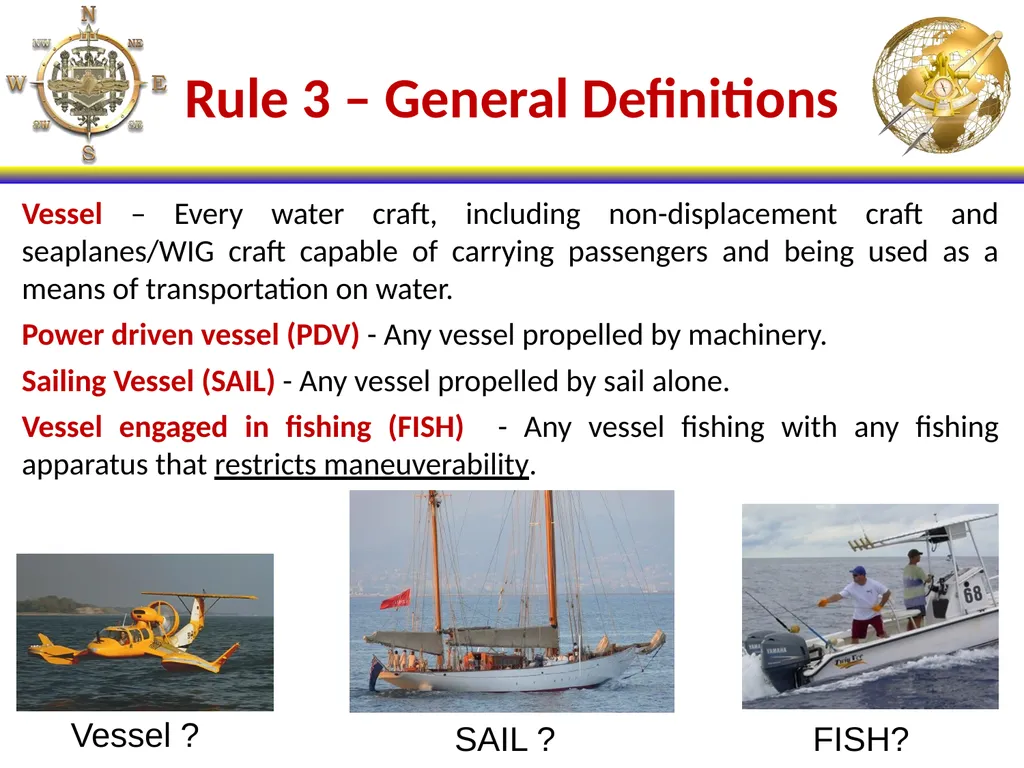
Rule 3 – General Definitions Vessel – Every water craft, including non-displacement craft and seaplanes/WIG craft capable of carrying passengers and being used as a means of transportation on water.
Power driven vessel (PDV) - Any vessel propelled by machinery.
Sailing Vessel (SAIL) - Any vessel propelled by sail alone.
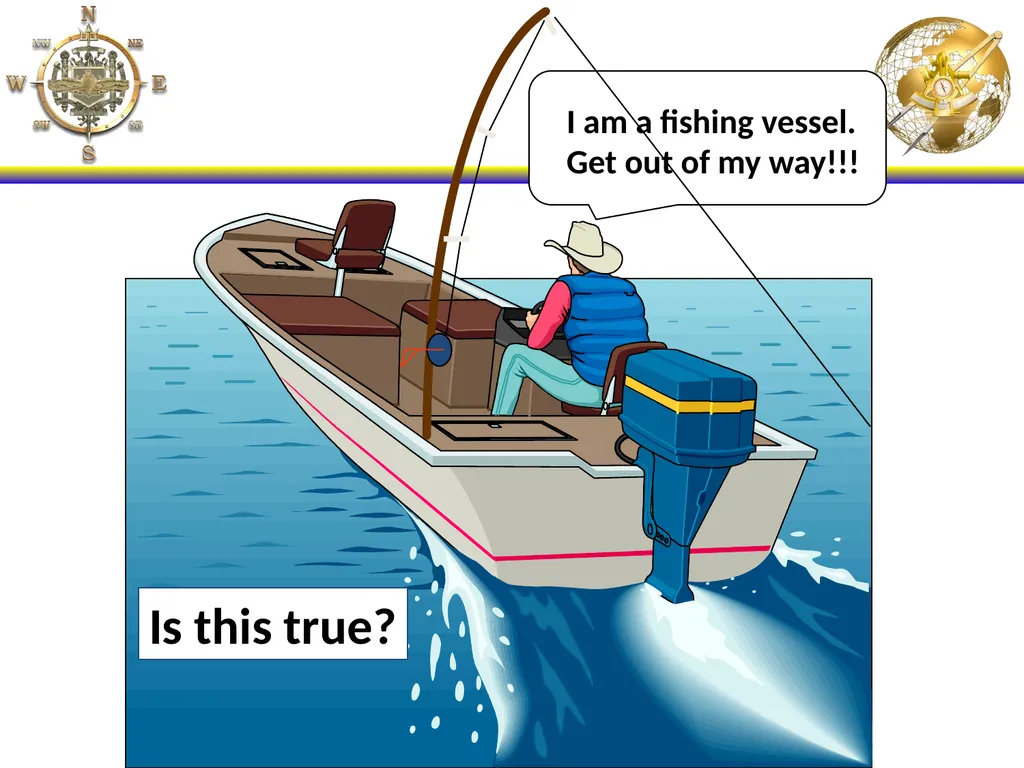
Vessel engaged in fishing (FISH) - Any vessel fishing with any fishing apparatus that restricts maneuverability.<br>
Power driven vessel (PDV) - Any vessel propelled by machinery.
Sailing Vessel (SAIL) - Any vessel propelled by sail alone.
Vessel engaged in fishing (FISH) - Any vessel fishing with any fishing apparatus that restricts maneuverability.<br>
07
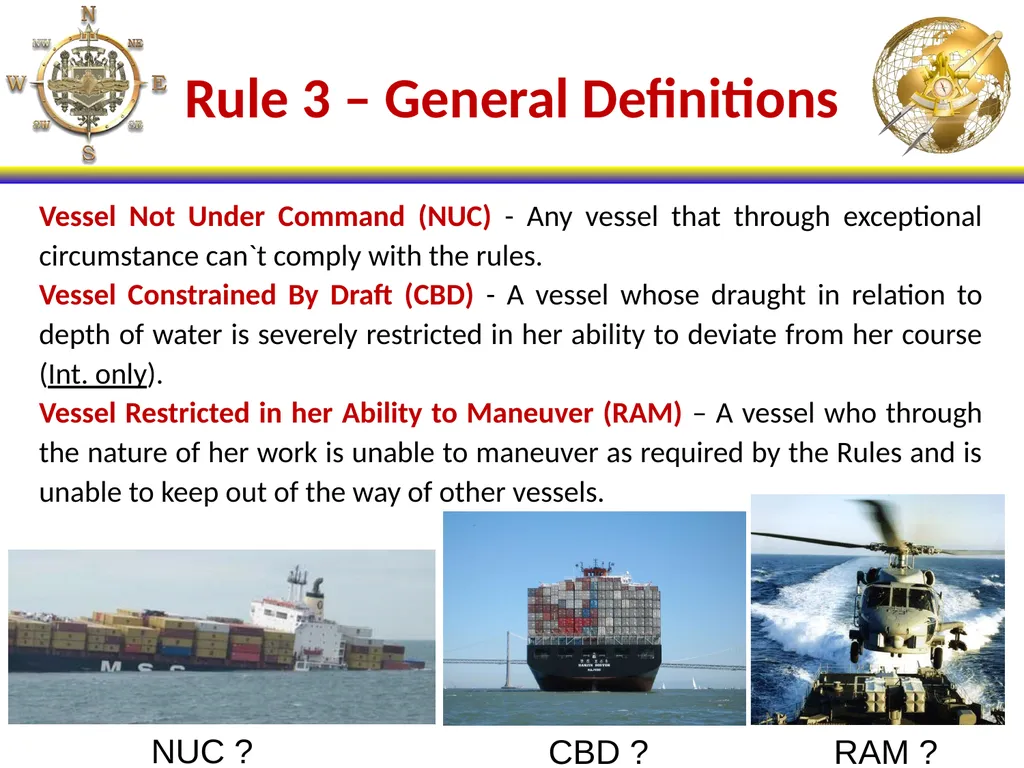
Vessel Not Under Command (NUC) - Any vessel that through exceptional circumstance can`t comply with the rules.
Vessel Constrained By Draft (CBD) - A vessel whose draught in relation to depth of water is severely restricted in her ability to deviate from her course (Int. only).
Vessel Restricted in her Ability to Maneuver (RAM) – A vessel who through the nature of her work is unable to maneuver as required by the Rules and is unable to keep out of the way of other vessels. Rule 3 – General Definitions<br>
08
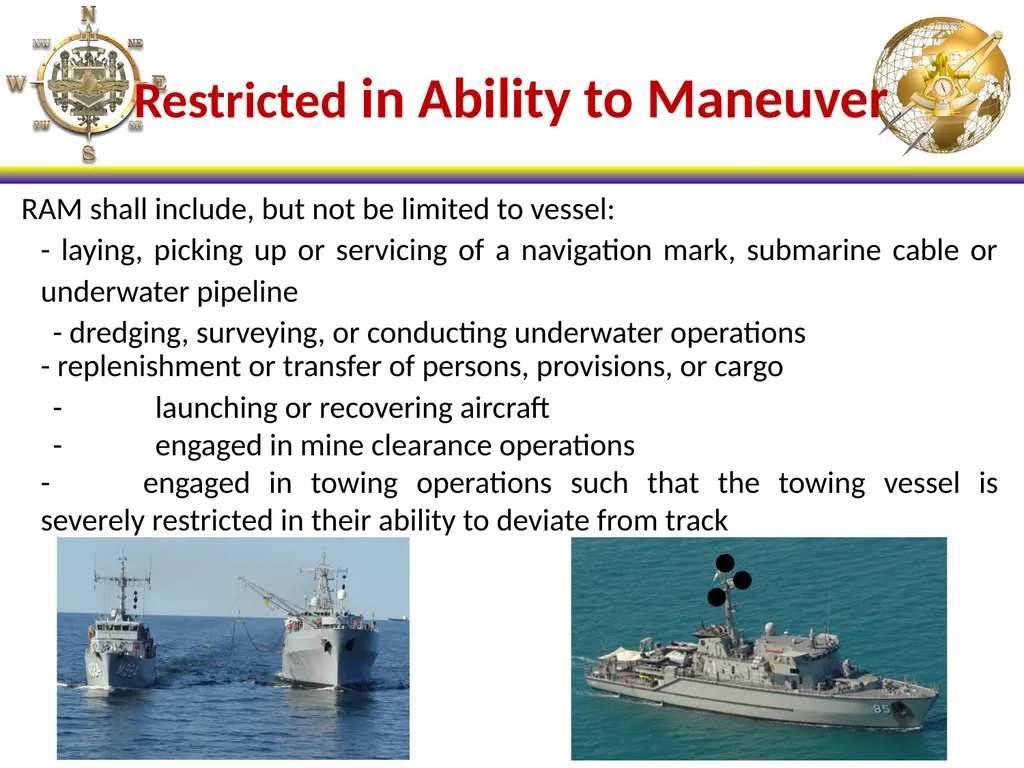
Restricted in Ability to Maneuver RAM shall include, but not be limited to vessel:
- laying, picking up or servicing of a navigation mark, submarine cable or underwater pipeline
- dredging, surveying, or conducting underwater operations
- replenishment or transfer of persons, provisions, or cargo
- launching or recovering aircraft
- engaged in mine clearance operations
- engaged in towing operations such that the towing vessel is severely restricted in their ability to deviate from track<br>
09
Underway – Not at anchor, or made fast to the shore, or aground.
Length and Breadth- Length overall and widest breadth.
Vessels in Sight of One Another – Each vessel can be observed visually from the other.
Restricted Visibility – Any condition in which visibility is restricted by fog, mist, falling snow, heavy rainstorms, sandstorms or any other similar causes.
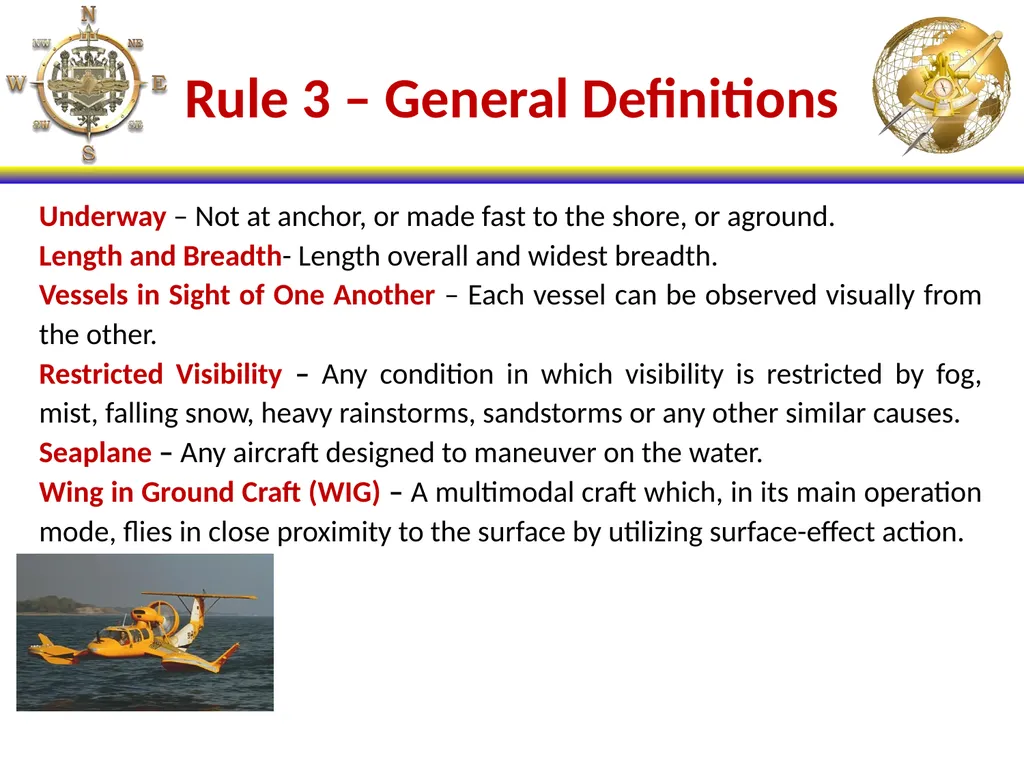
Seaplane – Any aircraft designed to maneuver on the water.
Wing in Ground Craft (WIG) – A multimodal craft which, in its main operation mode, flies in close proximity to the surface by utilizing surface-effect action. Rule 3 – General Definitions<br>
10
I am a fishing vessel.
Get out of my way!!! Is this true?<br>
Get out of my way!!! Is this true?<br>
11
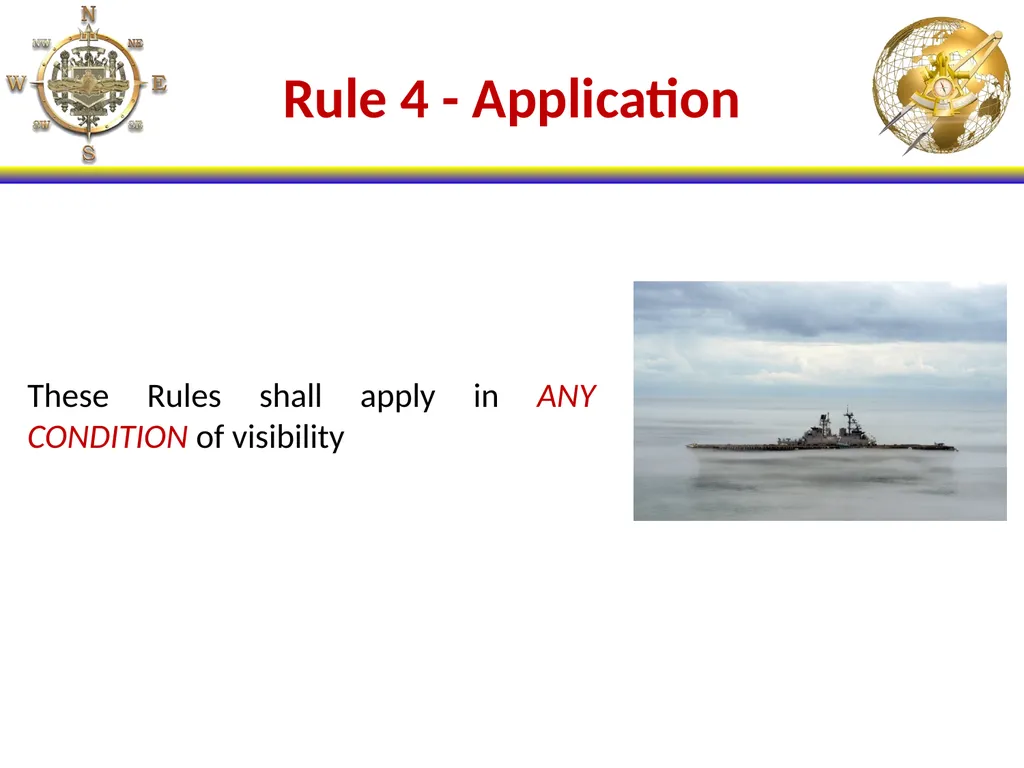
Rule 4 - Application These Rules shall apply in ANY CONDITION of visibility<br>
12
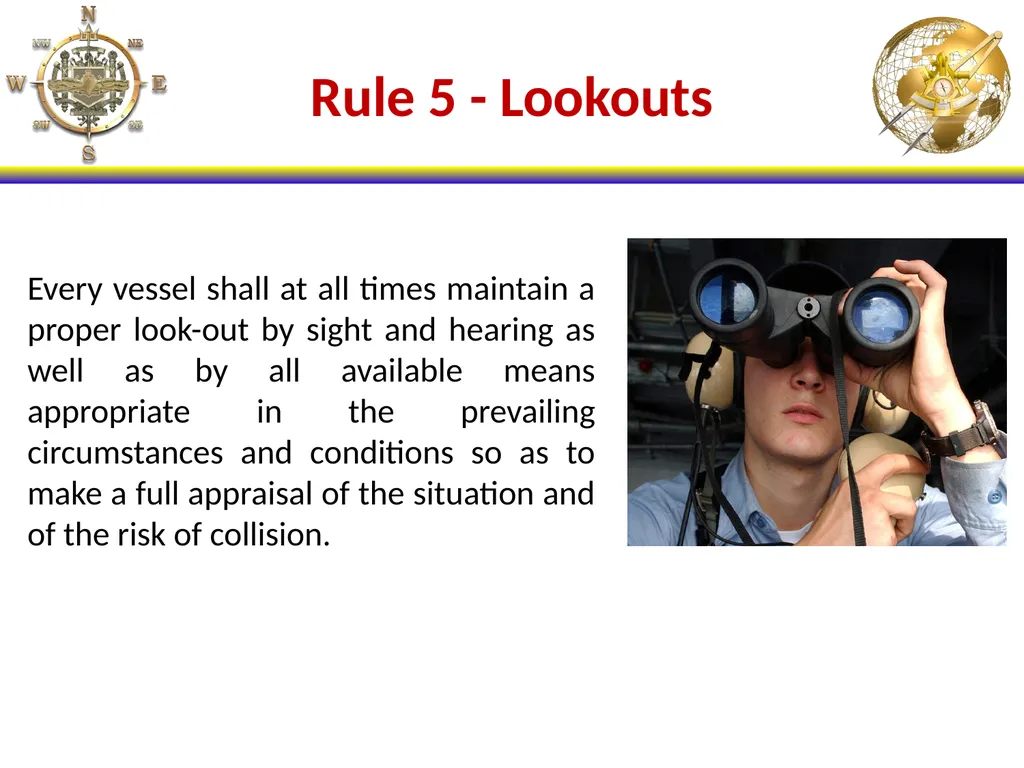
Rule 5 - Lookouts Every vessel shall at all times maintain a proper look-out by sight and hearing as well as by all available means appropriate in the prevailing circumstances and conditions so as to make a full appraisal of the situation and of the risk of collision.<br>
13
Rule 6 – Safe Speed “Every vessel shall at all times proceed at a safe speed so that she can take proper and effective action to avoid collision and to be stopped within a distance appropriate to the prevailing circumstances and conditions” Visibility
Traffic density
Maneuverability
Background lights
Wind, sea, current
Draft Factors Taken into Account by All Vessels<br>
Traffic density
Maneuverability
Background lights
Wind, sea, current
Draft Factors Taken into Account by All Vessels<br>
14
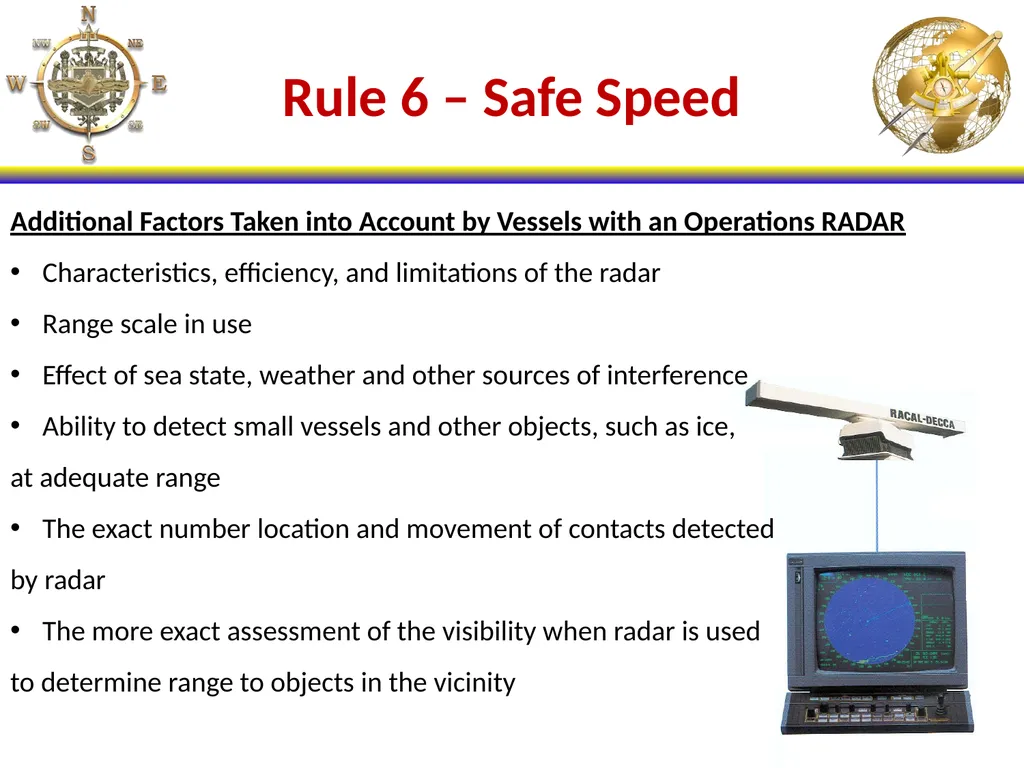
Additional Factors Taken into Account by Vessels with an Operations RADAR
Characteristics, efficiency, and limitations of the radar
Range scale in use
Effect of sea state, weather and other sources of interference
Ability to detect small vessels and other objects, such as ice,
at adequate range
The exact number location and movement of contacts detected
by radar
The more exact assessment of the visibility when radar is used
to determine range to objects in the vicinity Rule 6 – Safe Speed<br>
15
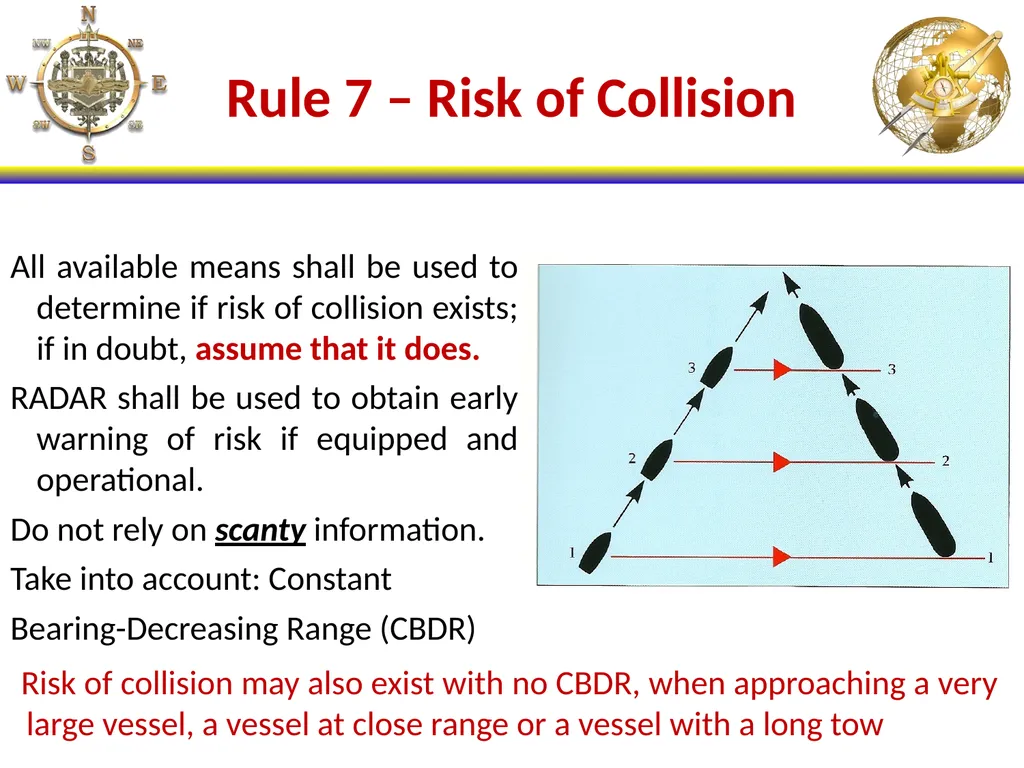
Rule 7 – Risk of Collision All available means shall be used to determine if risk of collision exists; if in doubt, assume that it does.
RADAR shall be used to obtain early warning of risk if equipped and operational.
Do not rely on scanty information.
Take into account: Constant
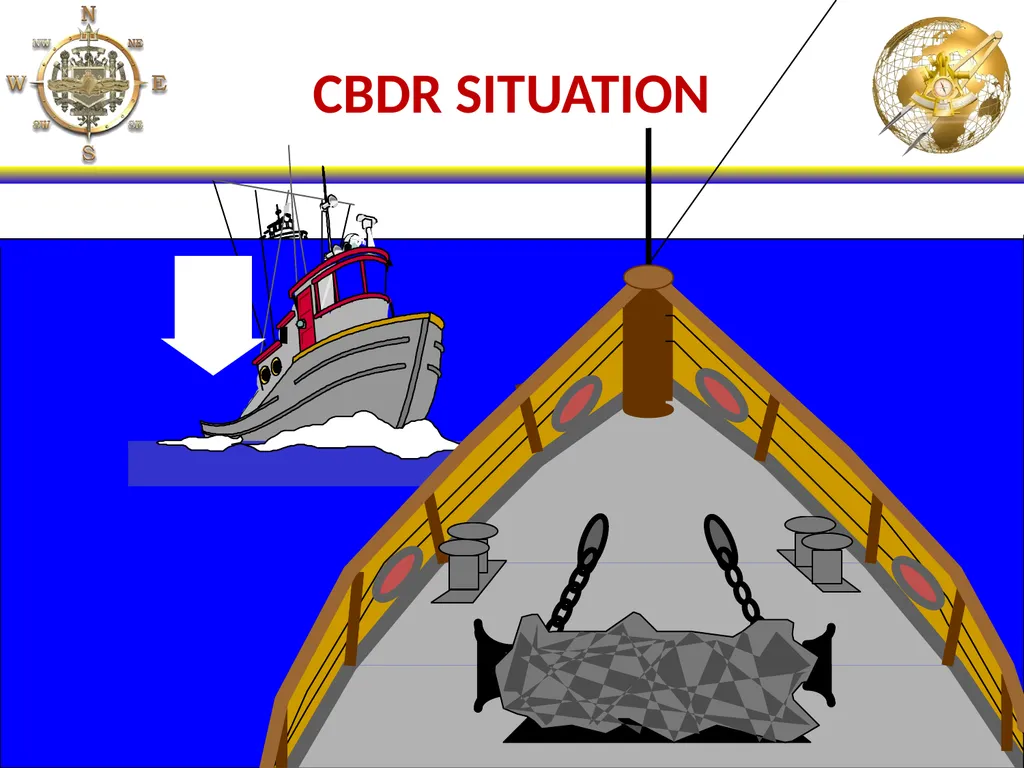
Bearing-Decreasing Range (CBDR) Risk of collision may also exist with no CBDR, when approaching a very large vessel, a vessel at close range or a vessel with a long tow<br>
16
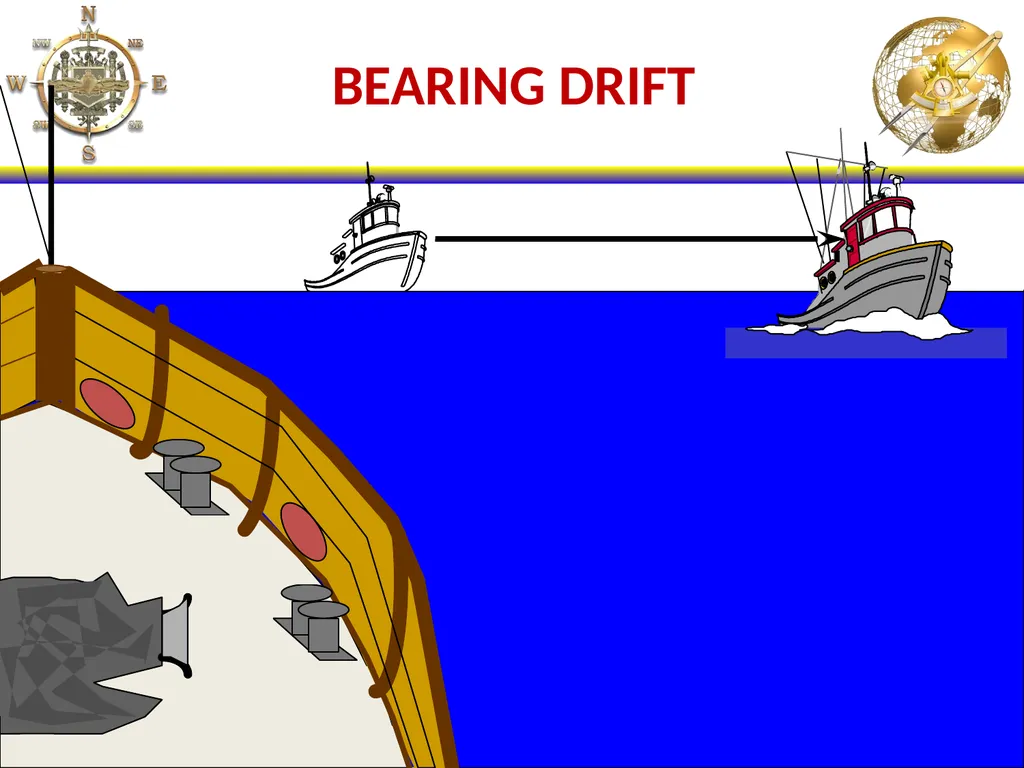
BEARING DRIFT<br>
17
CBDR SITUATION<br>
18
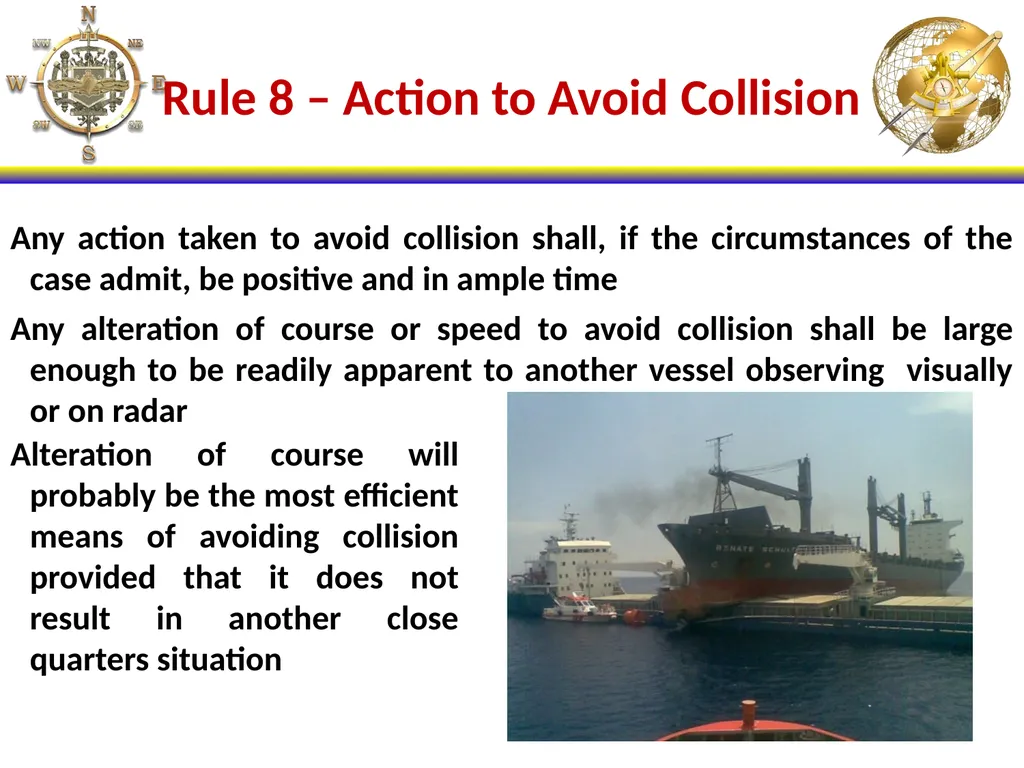
Rule 8 – Action to Avoid Collision Any action taken to avoid collision shall, if the circumstances of the case admit, be positive and in ample time
Any alteration of course or speed to avoid collision shall be large enough to be readily apparent to another vessel observing visually or on radar Alteration of course will probably be the most efficient means of avoiding collision provided that it does not result in another close quarters situation<br>
Any alteration of course or speed to avoid collision shall be large enough to be readily apparent to another vessel observing visually or on radar Alteration of course will probably be the most efficient means of avoiding collision provided that it does not result in another close quarters situation<br>
19
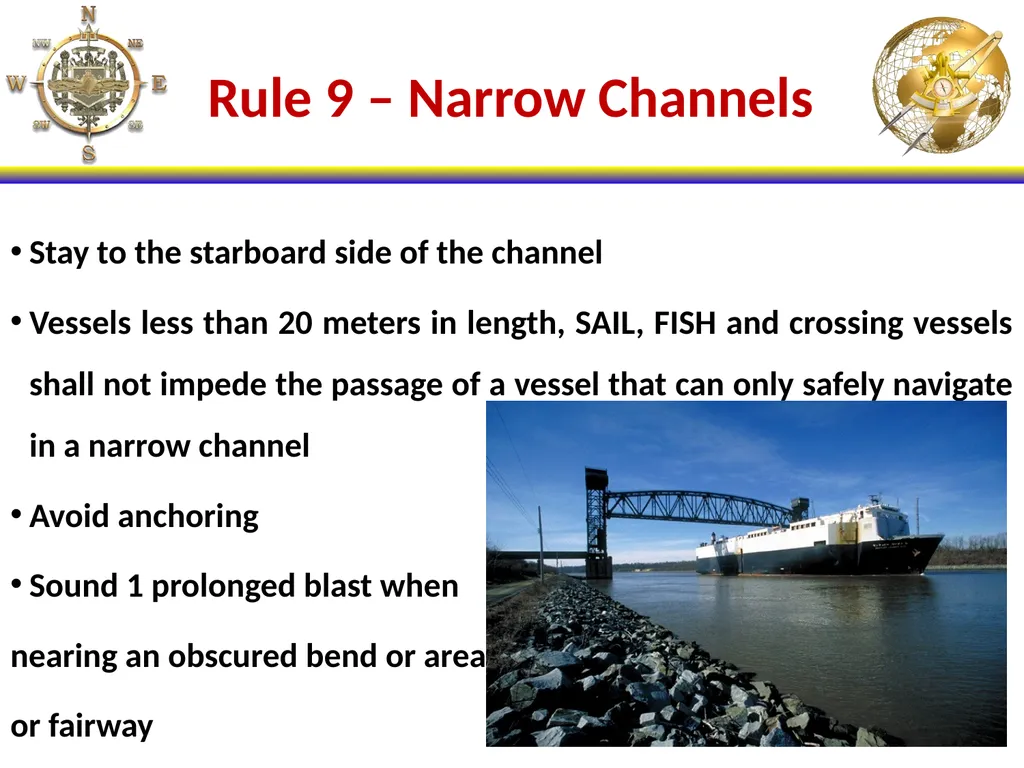
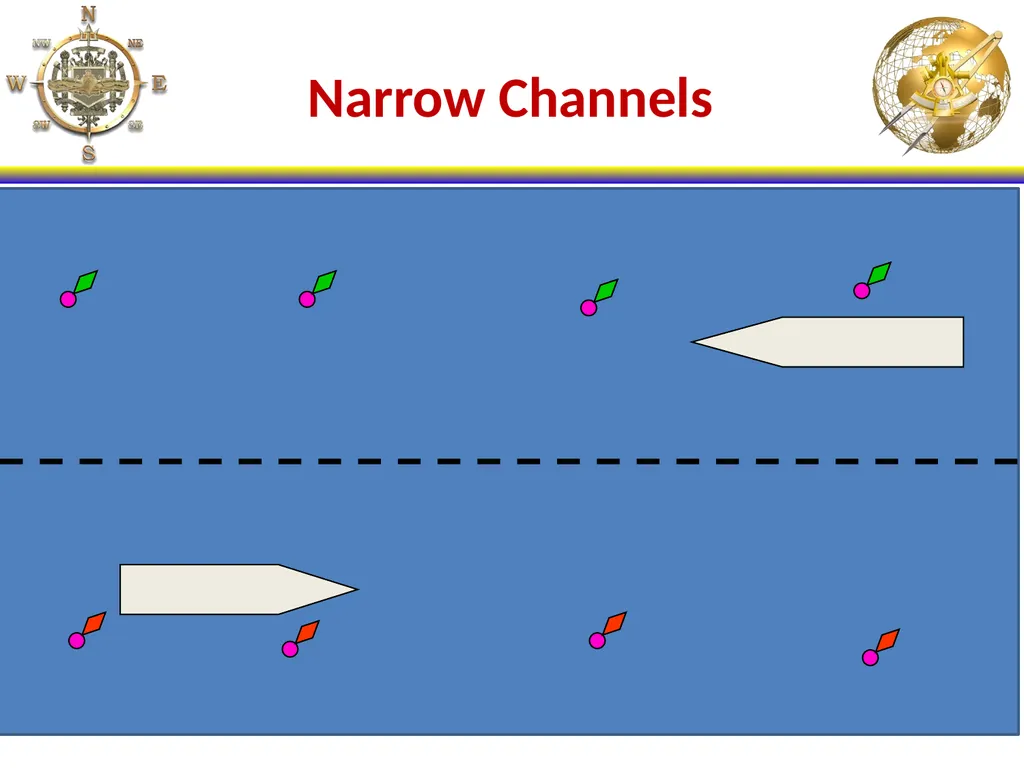
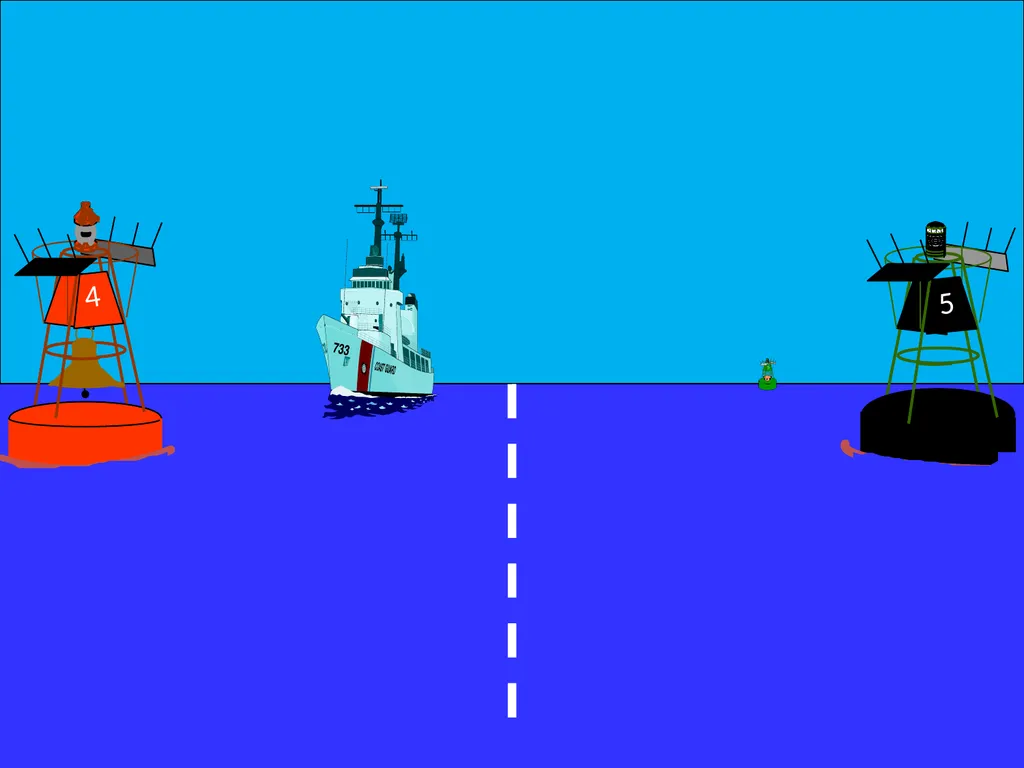
Rule 9 – Narrow Channels Stay to the starboard side of the channel
Vessels less than 20 meters in length, SAIL, FISH and crossing vessels shall not impede the passage of a vessel that can only safely navigate in a narrow channel
Avoid anchoring
Sound 1 prolonged blast when
nearing an obscured bend or area
or fairway<br>
Vessels less than 20 meters in length, SAIL, FISH and crossing vessels shall not impede the passage of a vessel that can only safely navigate in a narrow channel
Avoid anchoring
Sound 1 prolonged blast when
nearing an obscured bend or area
or fairway<br>
20
Narrow Channels<br>
21
4 5<br>
22
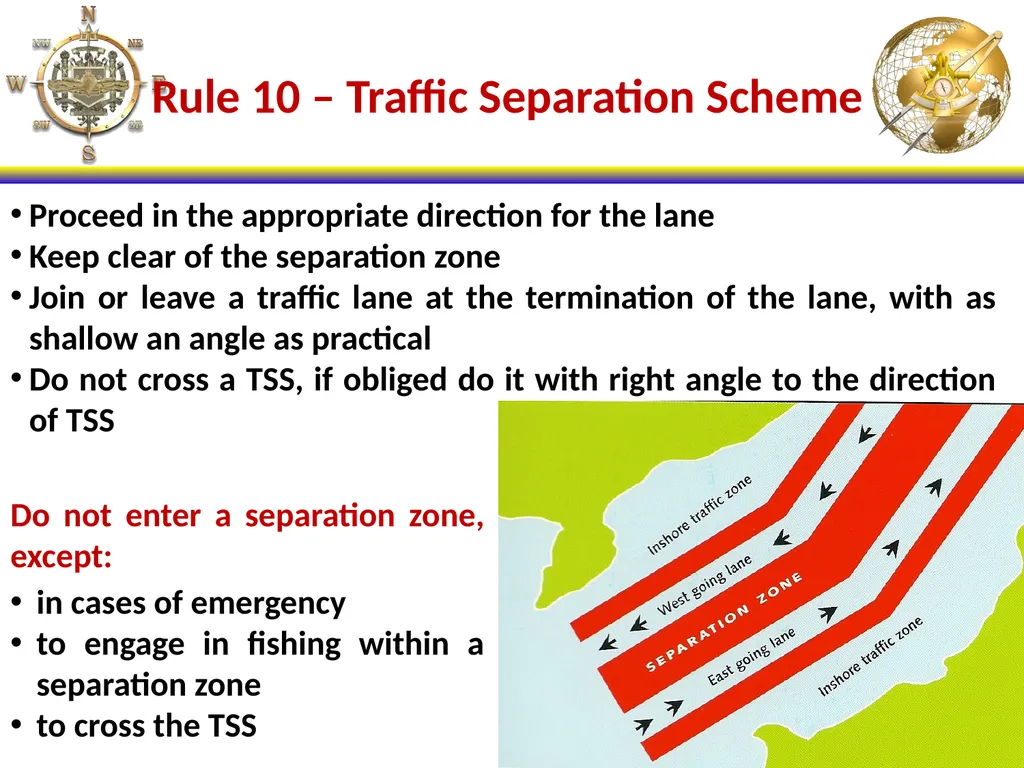
Proceed in the appropriate direction for the lane
Keep clear of the separation zone
Join or leave a traffic lane at the termination of the lane, with as shallow an angle as practical
Do not cross a TSS, if obliged do it with right angle to the direction of TSS in cases of emergency
to engage in fishing within a separation zone
to cross the TSS Do not enter a separation zone, except: Rule 10 – Traffic Separation Scheme<br>
23
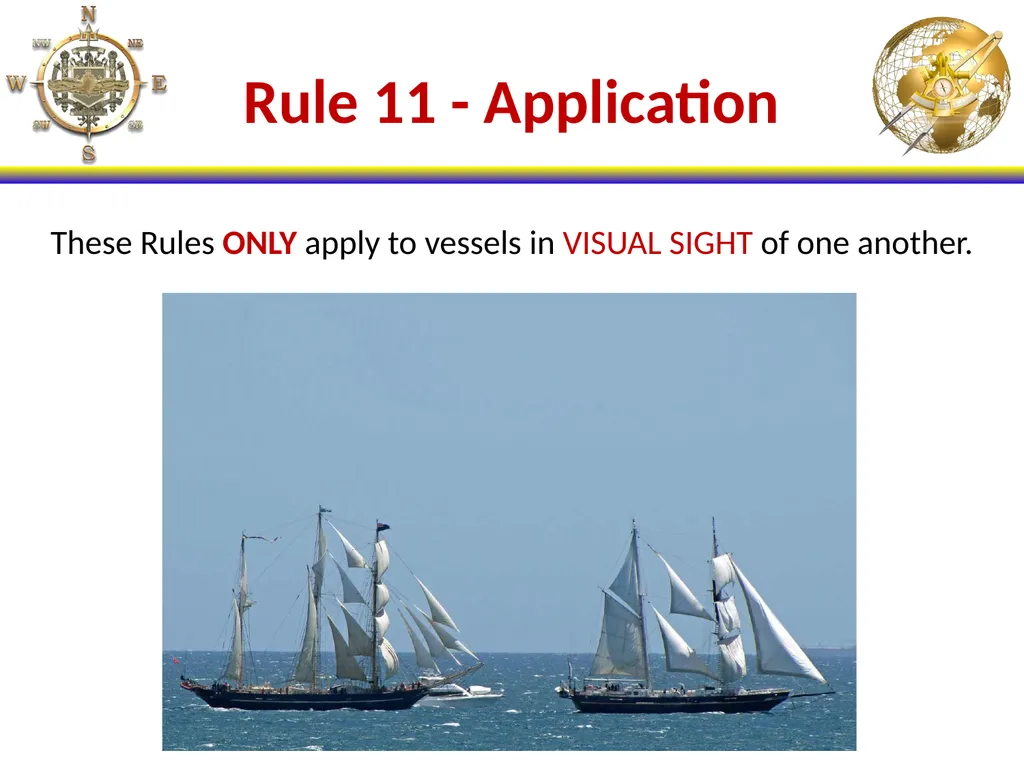
Rule 11 - Application These Rules ONLY apply to vessels in VISUAL SIGHT of one another.<br>
24
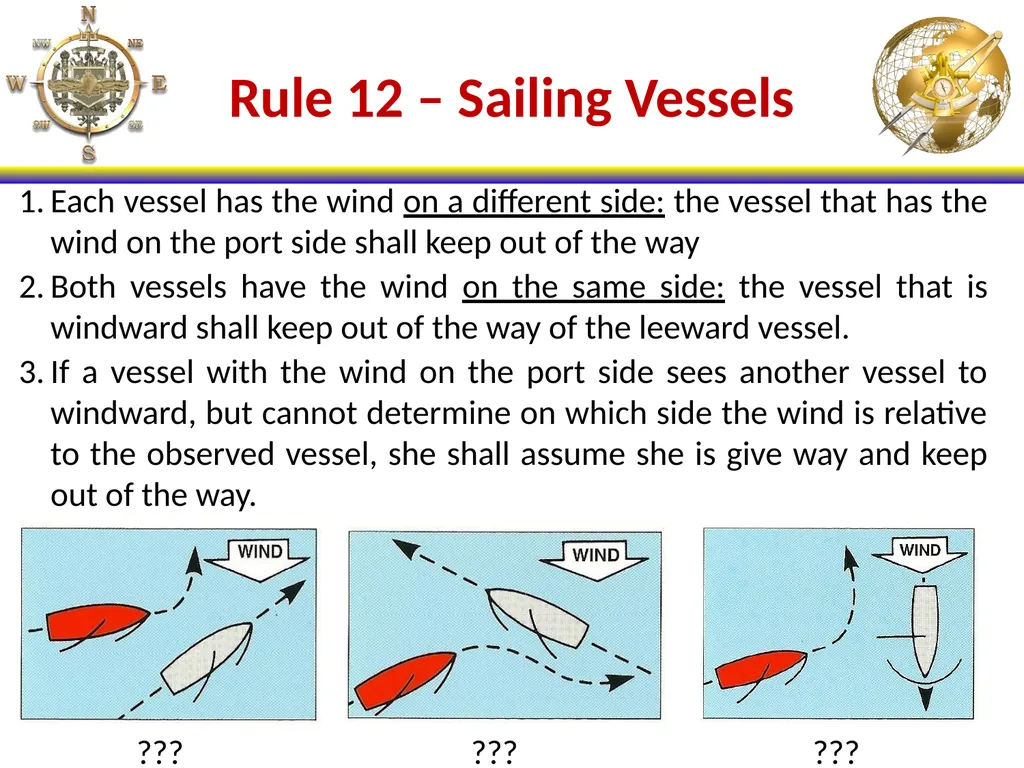
Rule 12 – Sailing Vessels<br>
25
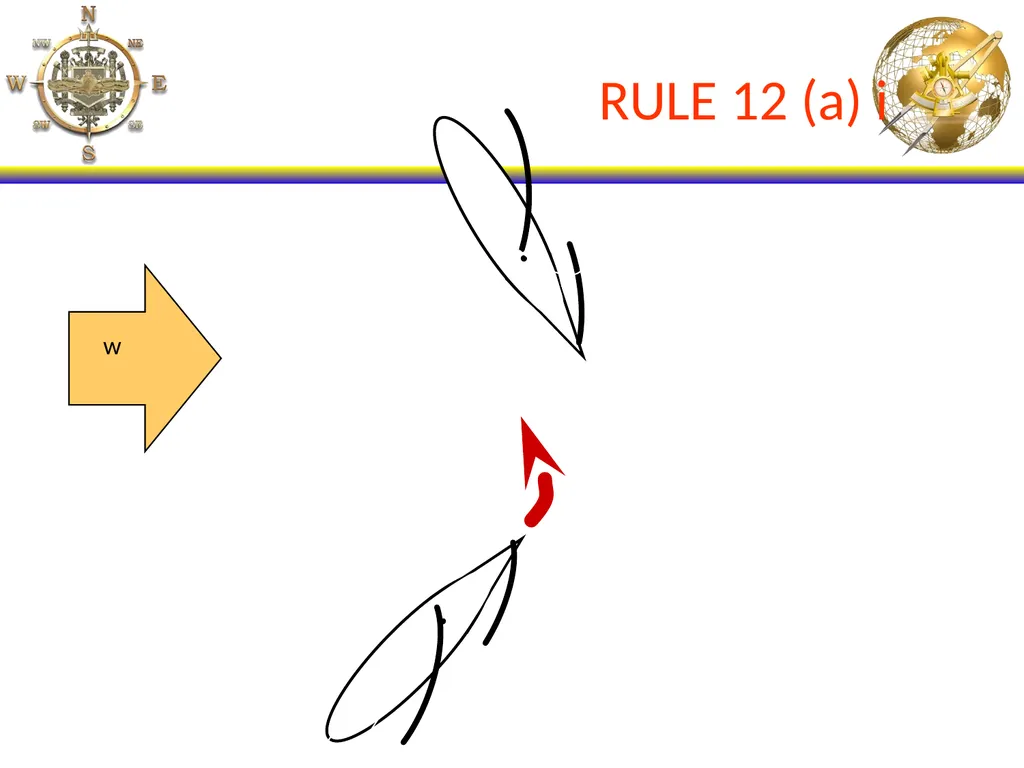
w RULE 12 (a) i<br>
26
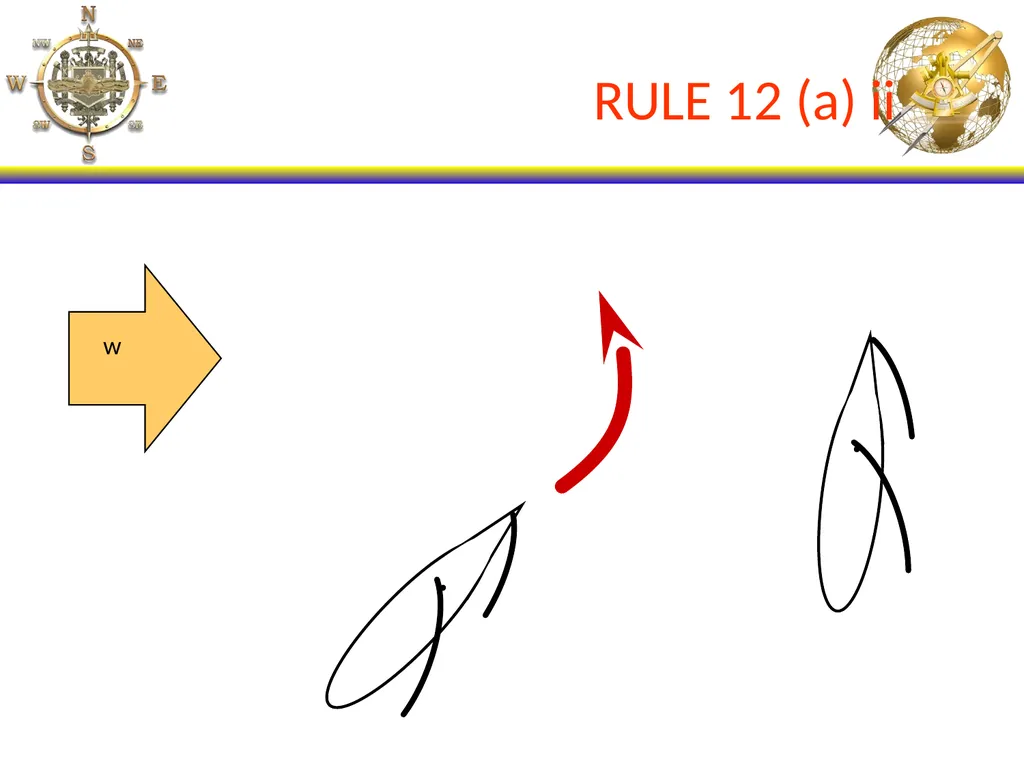
w RULE 12 (a) ii<br>
27
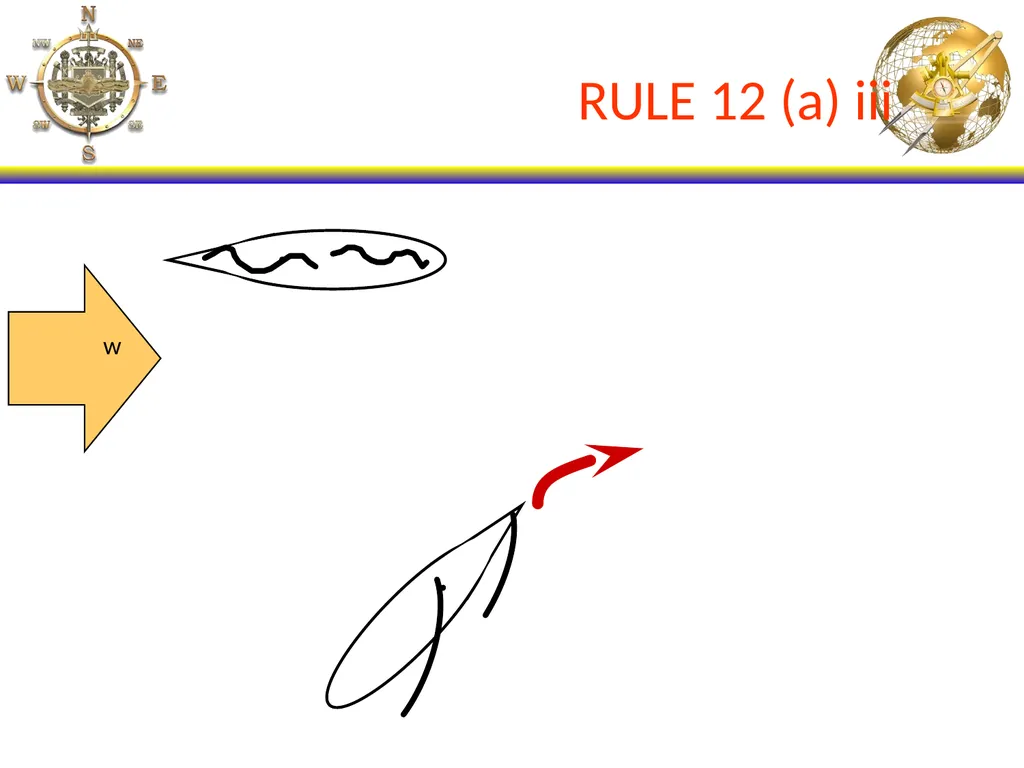
w RULE 12 (a) iii<br>
28
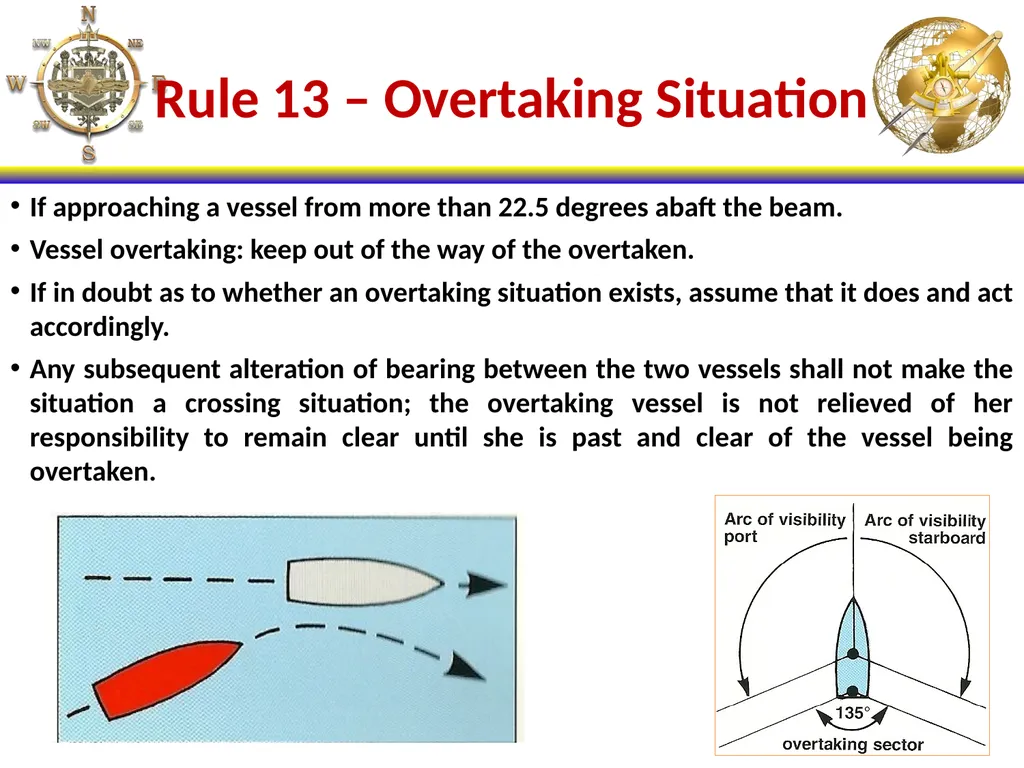
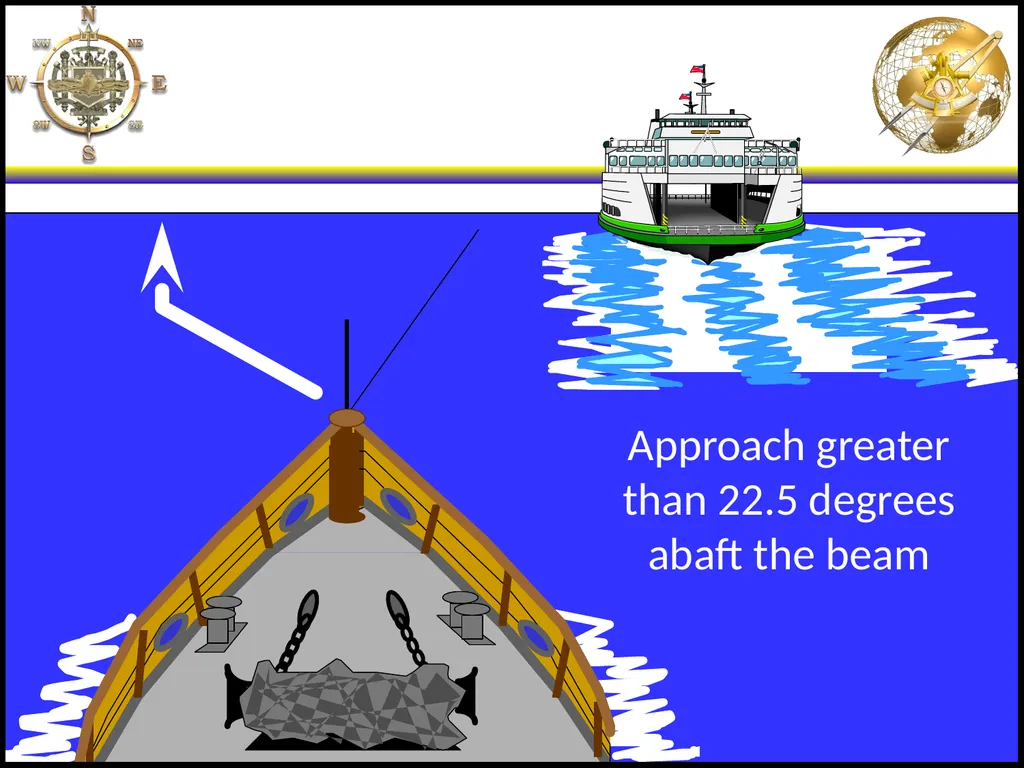
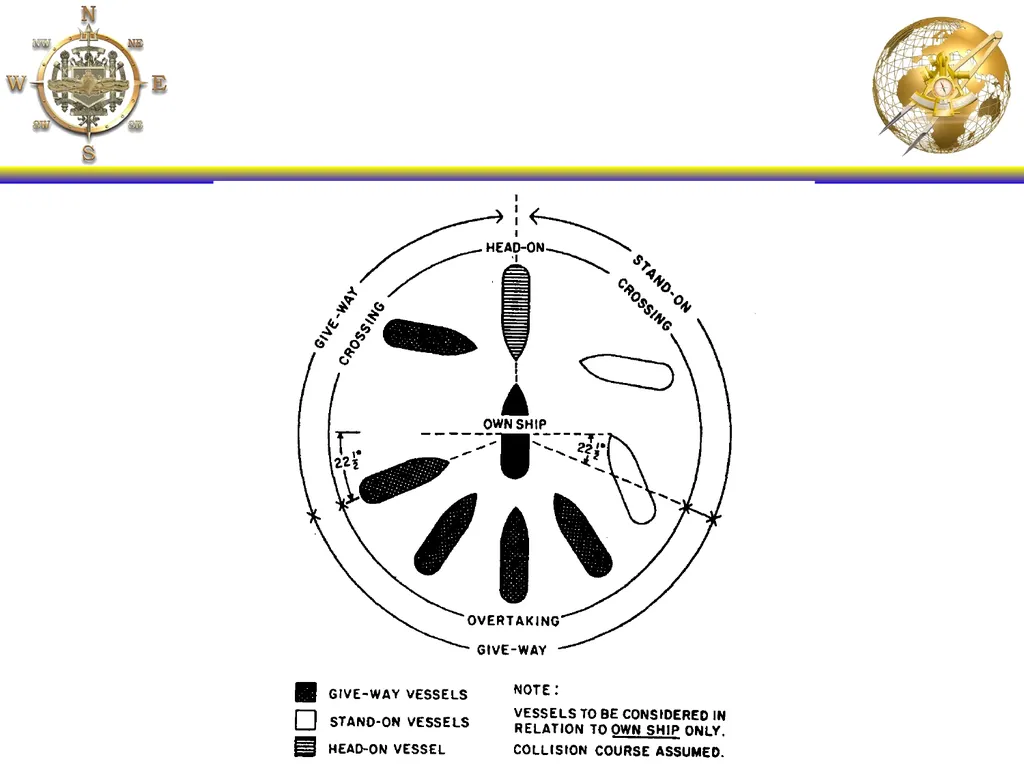
Rule 13 – Overtaking Situation If approaching a vessel from more than 22.5 degrees abaft the beam.
Vessel overtaking: keep out of the way of the overtaken.
If in doubt as to whether an overtaking situation exists, assume that it does and act accordingly.
Any subsequent alteration of bearing between the two vessels shall not make the situation a crossing situation; the overtaking vessel is not relieved of her responsibility to remain clear until she is past and clear of the vessel being overtaken.<br>
29
Approach greater than 22.5 degrees abaft the beam<br>
30
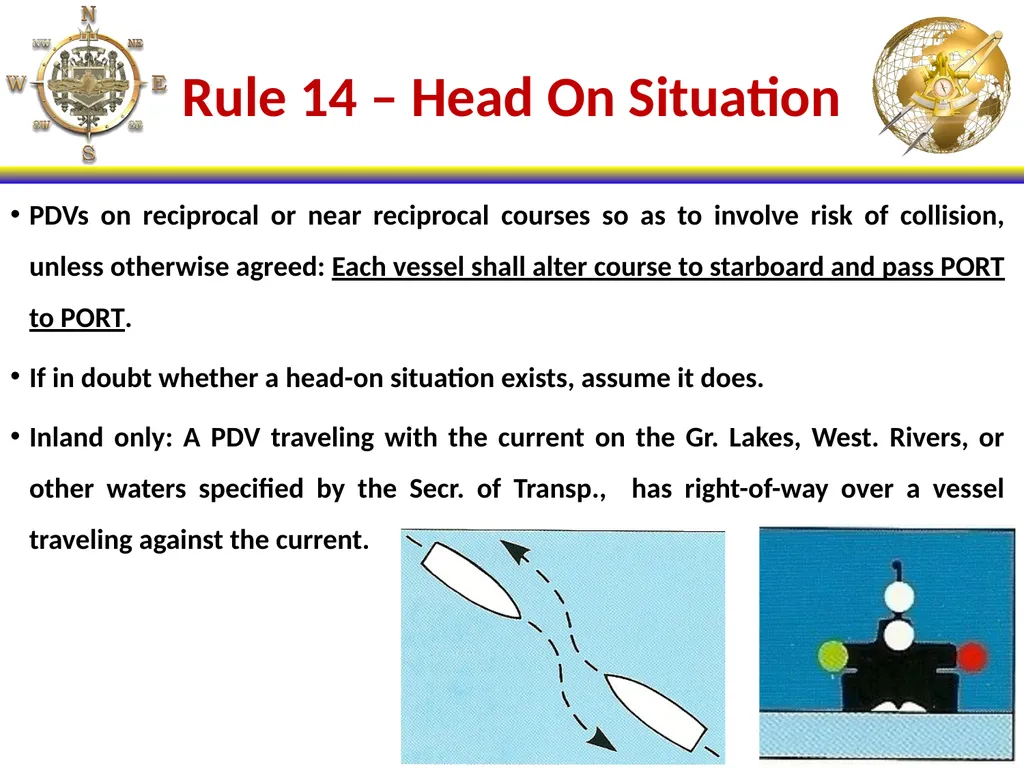
Rule 14 – Head On Situation PDVs on reciprocal or near reciprocal courses so as to involve risk of collision, unless otherwise agreed: Each vessel shall alter course to starboard and pass PORT to PORT.
If in doubt whether a head-on situation exists, assume it does.
Inland only: A PDV traveling with the current on the Gr. Lakes, West. Rivers, or other waters specified by the Secr. of Transp., has right-of-way over a vessel traveling against the current.<br>
If in doubt whether a head-on situation exists, assume it does.
Inland only: A PDV traveling with the current on the Gr. Lakes, West. Rivers, or other waters specified by the Secr. of Transp., has right-of-way over a vessel traveling against the current.<br>
31
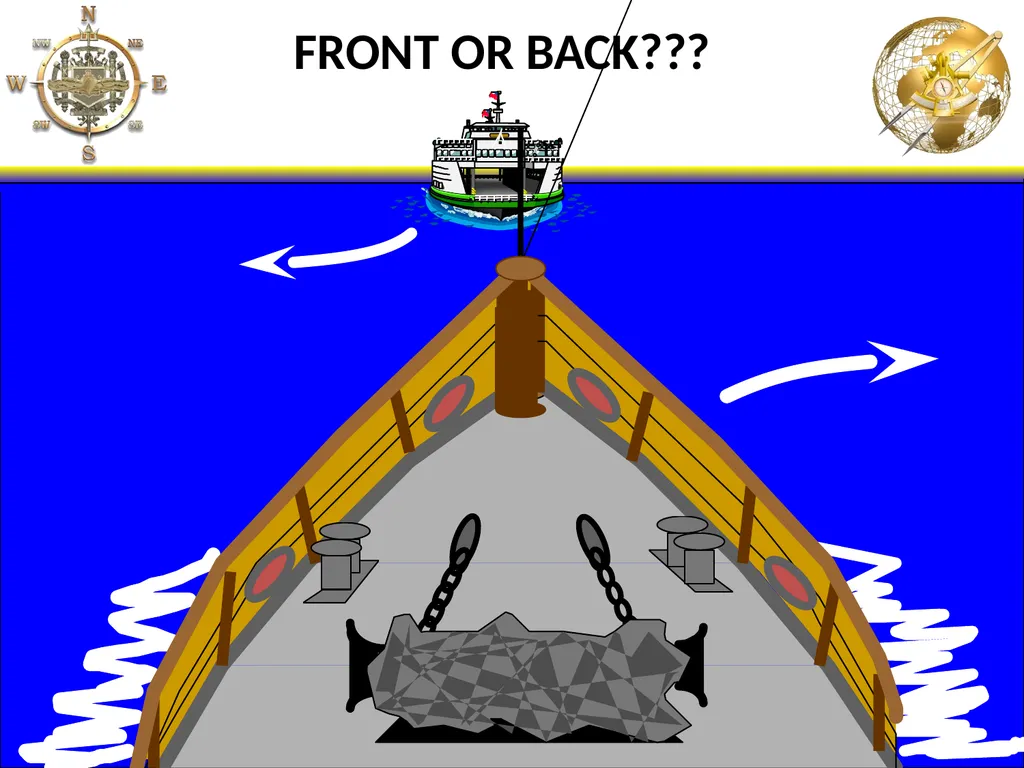
FRONT OR BACK???<br>
32
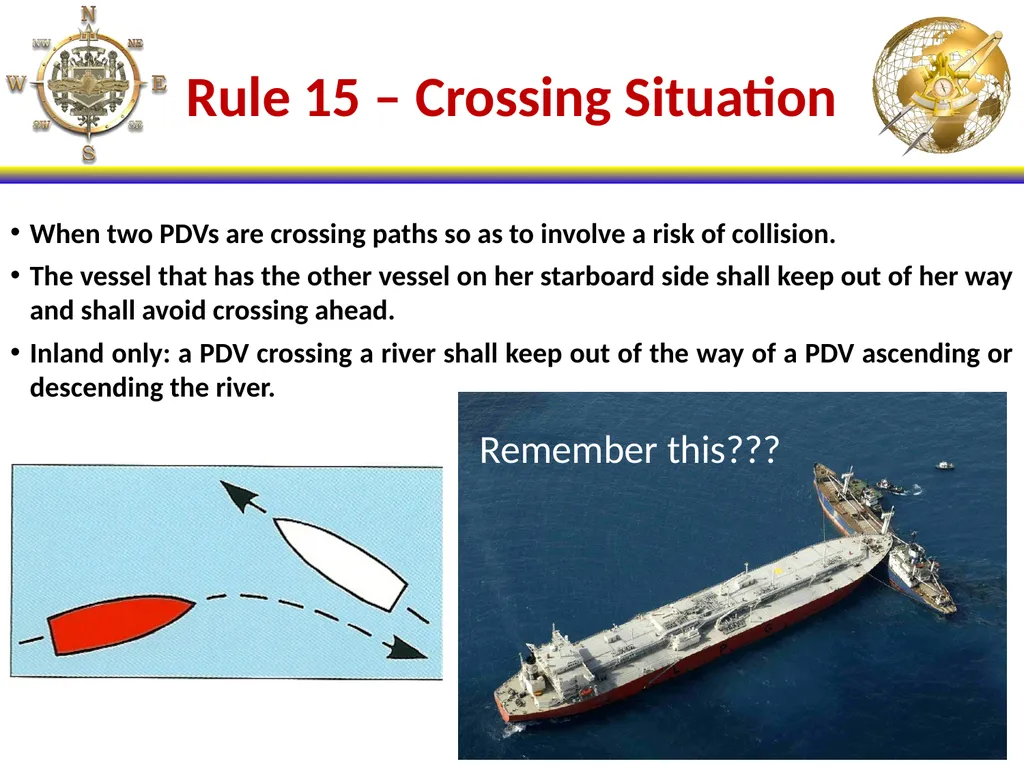
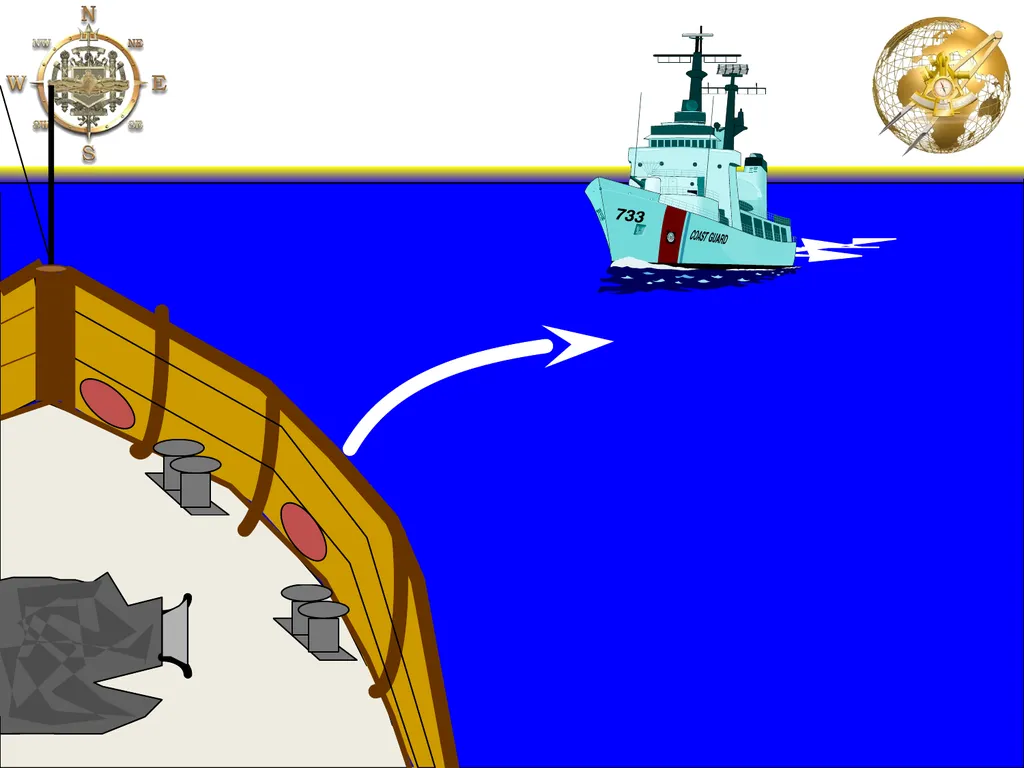
Rule 15 – Crossing Situation When two PDVs are crossing paths so as to involve a risk of collision.
The vessel that has the other vessel on her starboard side shall keep out of her way and shall avoid crossing ahead.
Inland only: a PDV crossing a river shall keep out of the way of a PDV ascending or descending the river. Remember this???<br>
The vessel that has the other vessel on her starboard side shall keep out of her way and shall avoid crossing ahead.
Inland only: a PDV crossing a river shall keep out of the way of a PDV ascending or descending the river. Remember this???<br>
33
Rule 16
Action of the Give Way Vessel Every vessel that is directed to keep out of the way of another vessel shall, so far as possible, take early and substantial action to keep well clear.<br>
34
Rule 17
Action of the Stand On Vessel Where one vessel is to keep out the way, the other shall maintain course and speed.
Stand-on vessel may take action to avoid collision, as soon as it becomes apparent that the give-way vessel is not taking the appropriate action in compliance with the Rules.
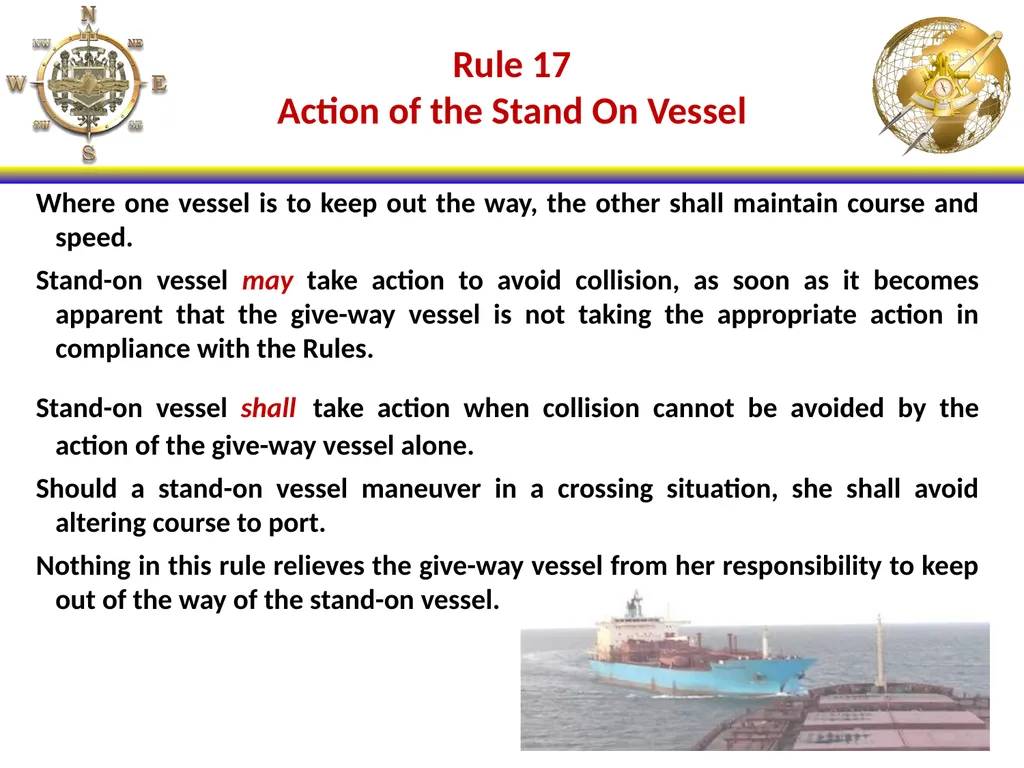
Stand-on vessel shall take action when collision cannot be avoided by the action of the give-way vessel alone.
Should a stand-on vessel maneuver in a crossing situation, she shall avoid altering course to port.
Nothing in this rule relieves the give-way vessel from her responsibility to keep out of the way of the stand-on vessel.<br>
35
Rule 18
Responsibility between Vessels This rule establishes the pecking order:
Not Under Command (NUC) (Least responsible)
Restricted Ability to Maneuver (RAM)
Constrained By Draft (CBD) (International Only)
Fishing (FISH)
Sailing (SAIL)
Power Driven Vessel (PDV)
Seaplane (SEA)
Wing in Ground craft (WIG) (Most responsible)
This rule applies only when not otherwise required by Narrow Channel, TSS and Overtaking rules<br>
36
Applies to vessels NOT IN SIGHT of one another
Every vessel must proceed at a safe speed adapted to the visibility. A PDV shall have her engines ready for immediate maneuver
Vessel Detected by radar alone: Determine if a close-quarters or CBDR situation is developing. If so, take avoiding action, but avoid:
- An alteration of course to port for a vessel forward of the beam (except a vessel being overtaken) should be avoided.
An alteration of course toward a vessel abeam or abaft the beam.
Vessel detected by fog signal alone: Except when there is no risk of collision, reduce speed to bare steerage. If necessary, take all way off and proceed only with extreme caution until the danger of collision is over. Rule 19 Conduct of Vessels in Restricted Visibility<br>
37
Questions?<br>