04
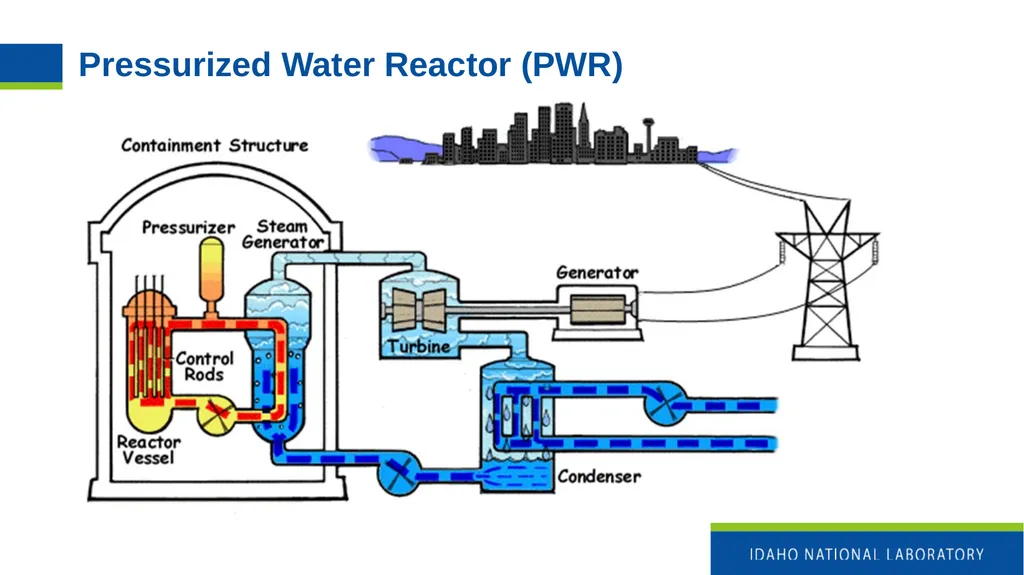
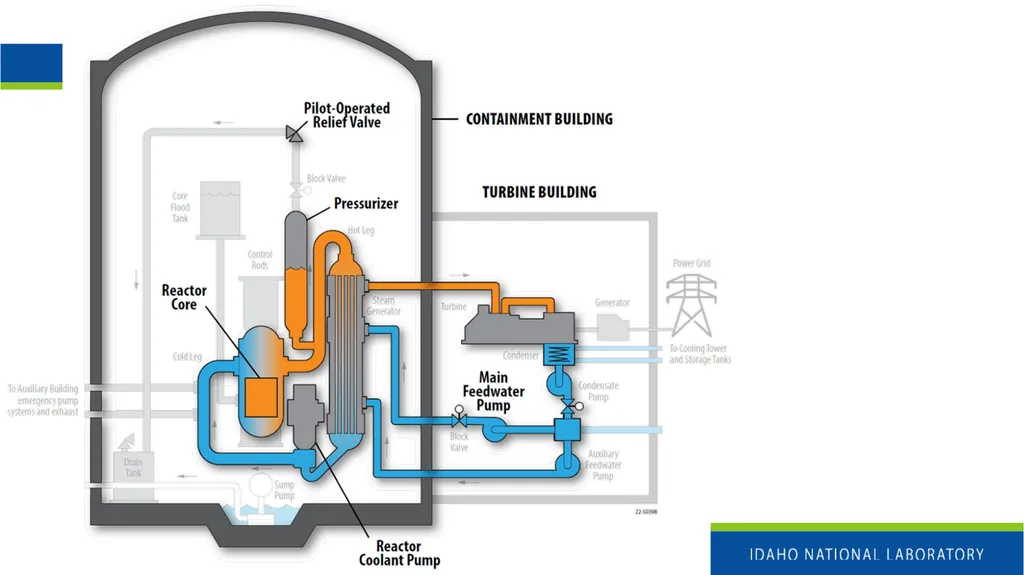
Pressurized Water Reactor (PWR)<br>
05
Some History:Three Mile Island<br>
06
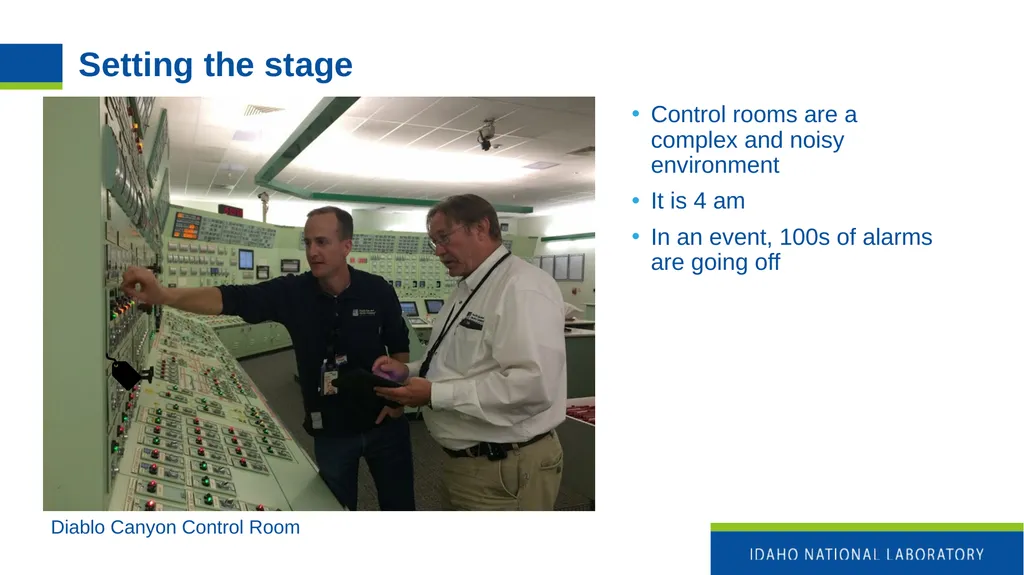
Setting the stage Control rooms are a complex and noisy environment
It is 4 am
In an event, 100s of alarms are going off Diablo Canyon Control Room<br>
07
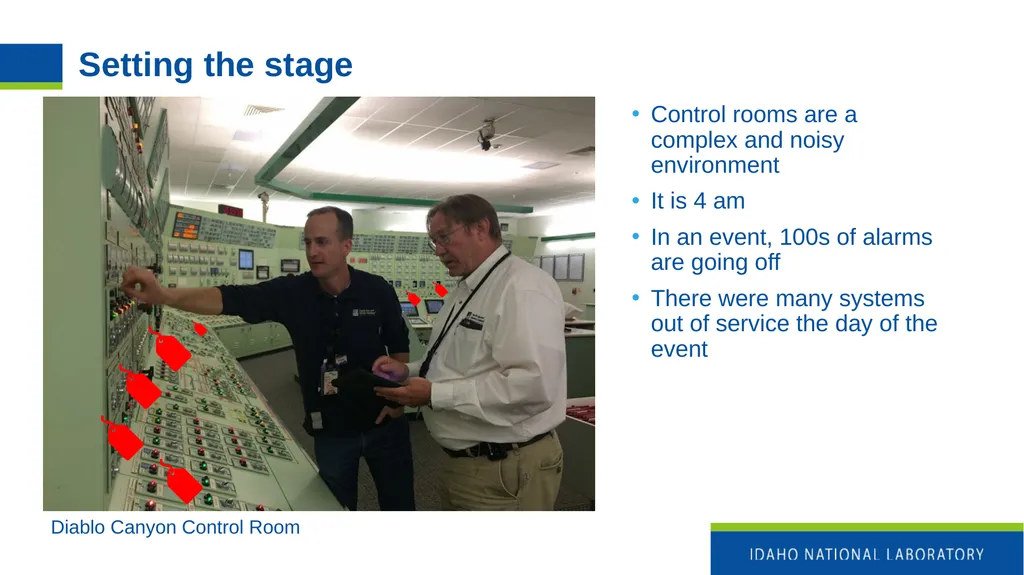
Setting the stage Control rooms are a complex and noisy environment
It is 4 am
In an event, 100s of alarms are going off
There were many systems out of service the day of the event Diablo Canyon Control Room<br>
08
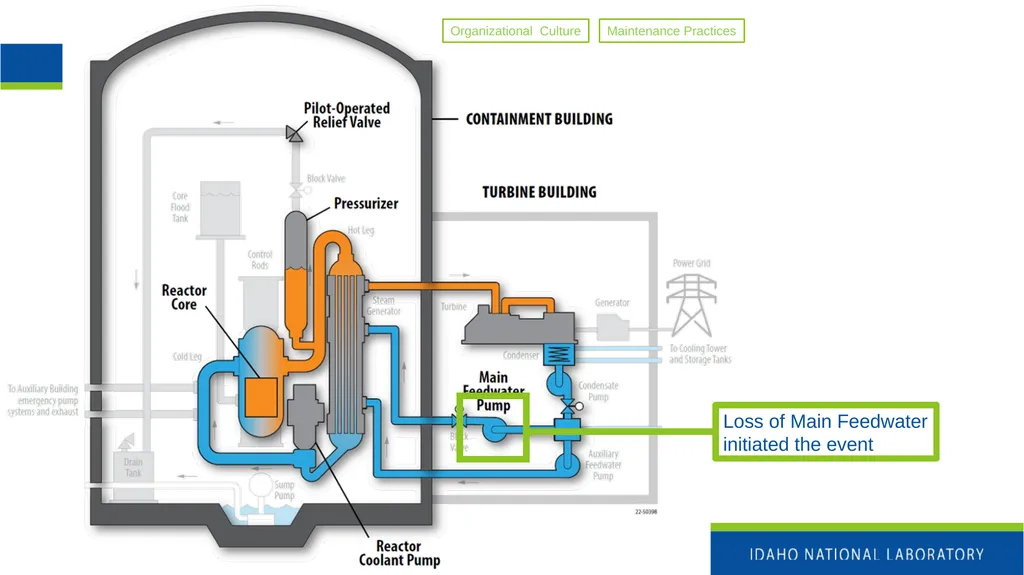
Loss of Main Feedwater initiated the event Maintenance Practices Organizational Culture<br>
09
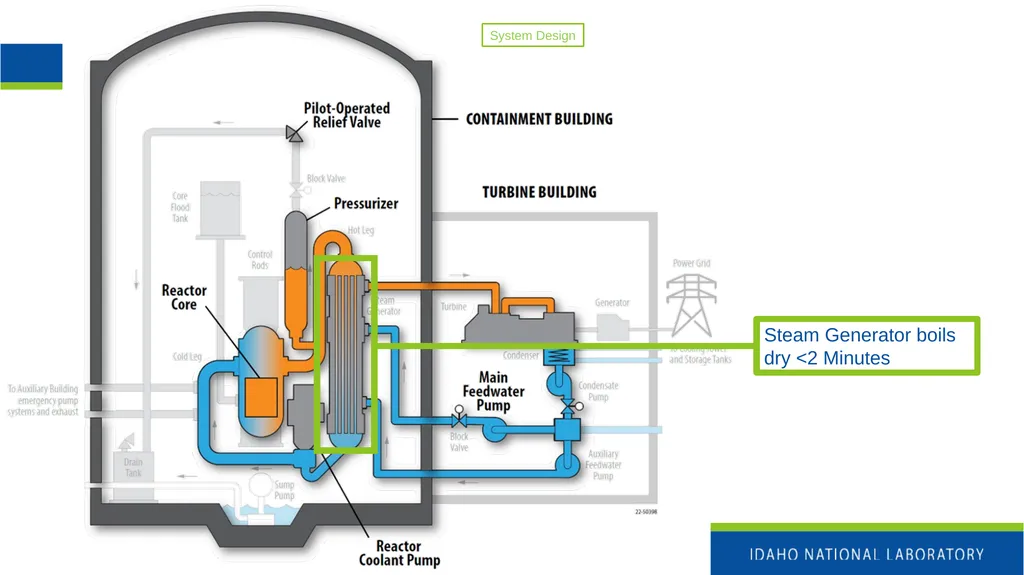
Steam Generator boils dry <2 Minutes System Design<br>
10
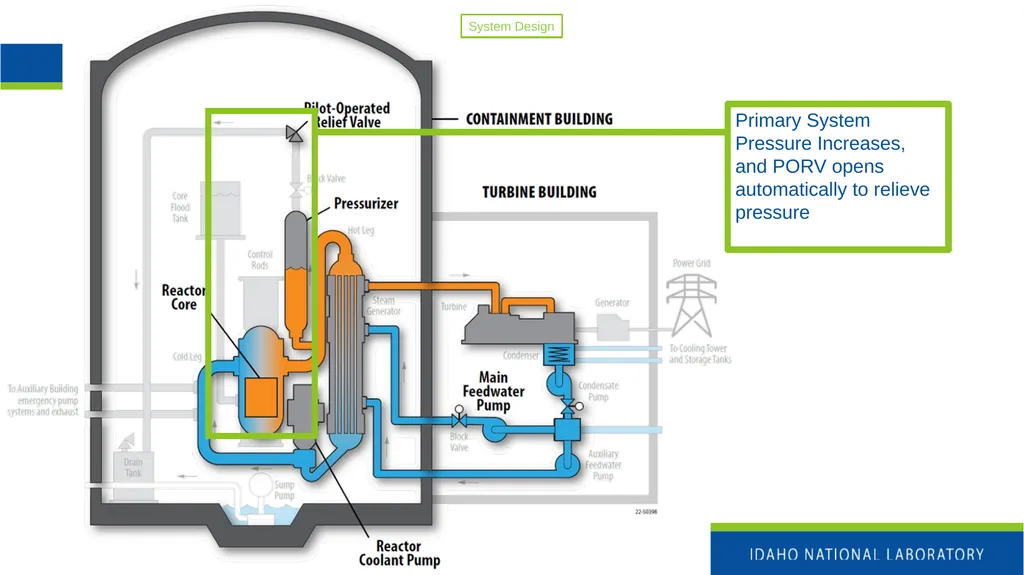
Primary System Pressure Increases, and PORV opens automatically to relieve pressure System Design<br>
11
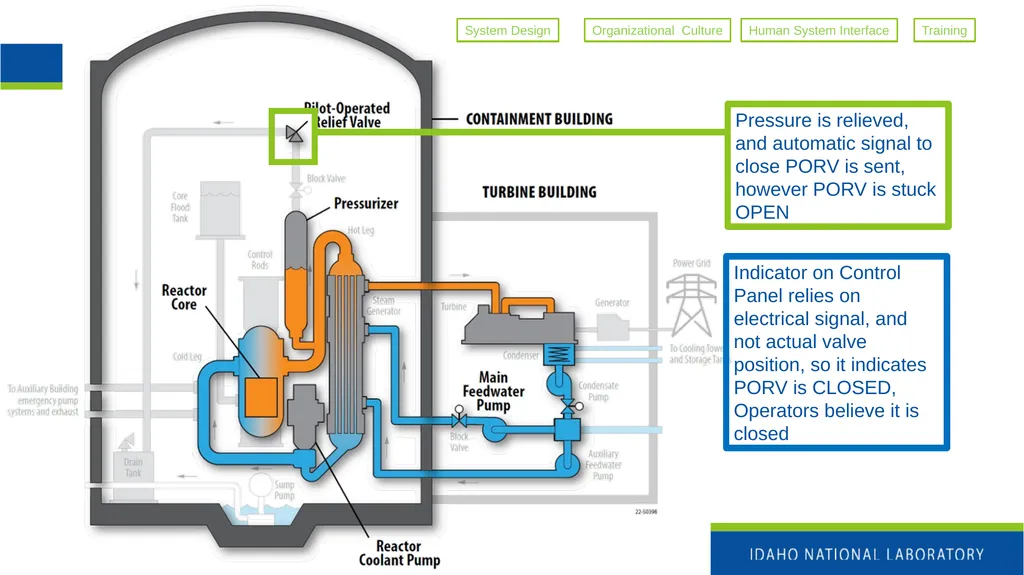
Pressure is relieved, and automatic signal to close PORV is sent, however PORV is stuck OPEN Indicator on Control Panel relies on electrical signal, and not actual valve position, so it indicates PORV is CLOSED, Operators believe it is closed System Design Human System Interface Organizational Culture Training<br>
12
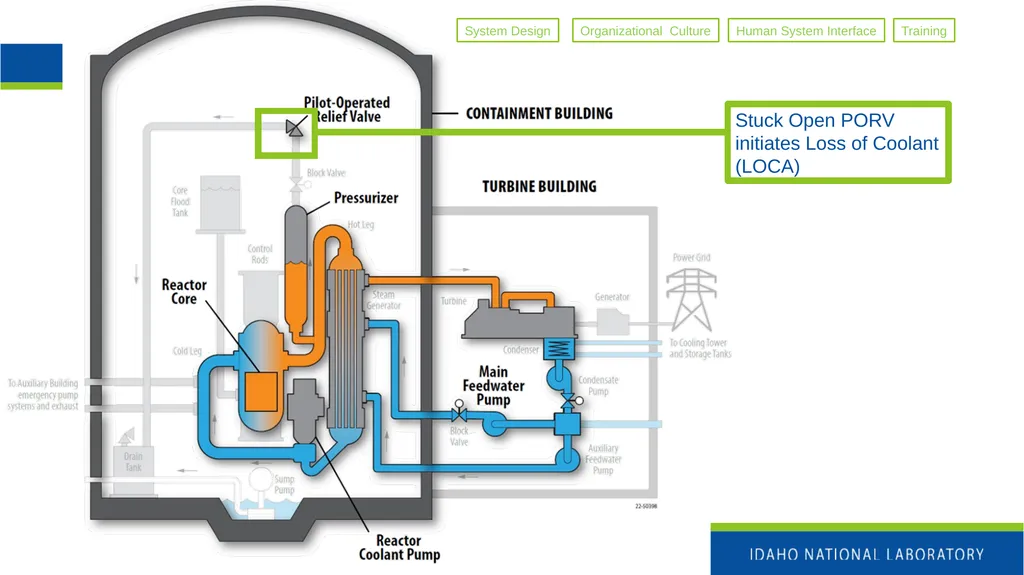
Stuck Open PORV initiates Loss of Coolant (LOCA) System Design Human System Interface Organizational Culture Training<br>
13
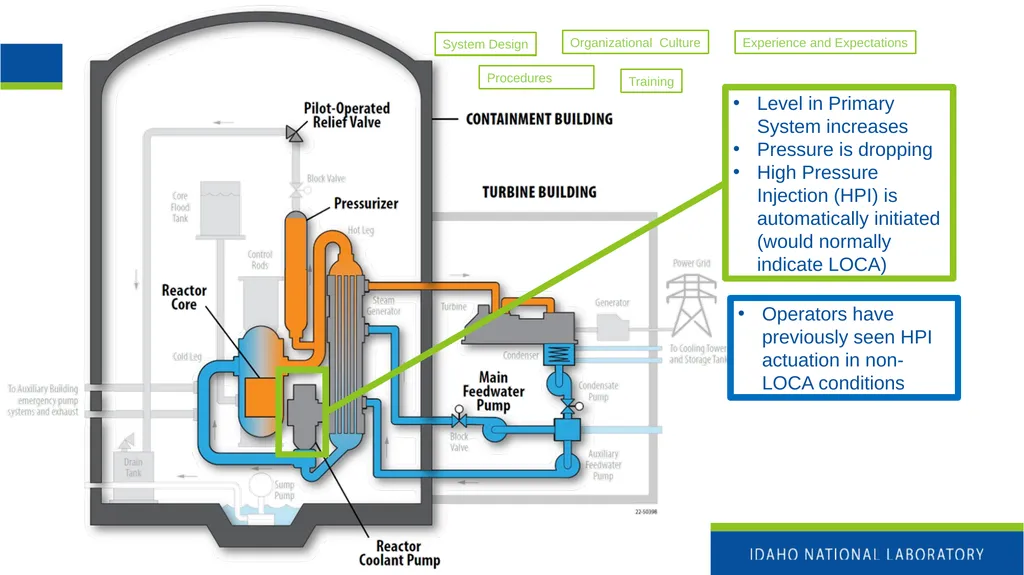
Level in Primary System increases
Pressure is dropping
High Pressure Injection (HPI) is automatically initiated (would normally indicate LOCA) Operators have previously seen HPI actuation in non-LOCA conditions Training System Design Procedures Organizational Culture Experience and Expectations<br>
14
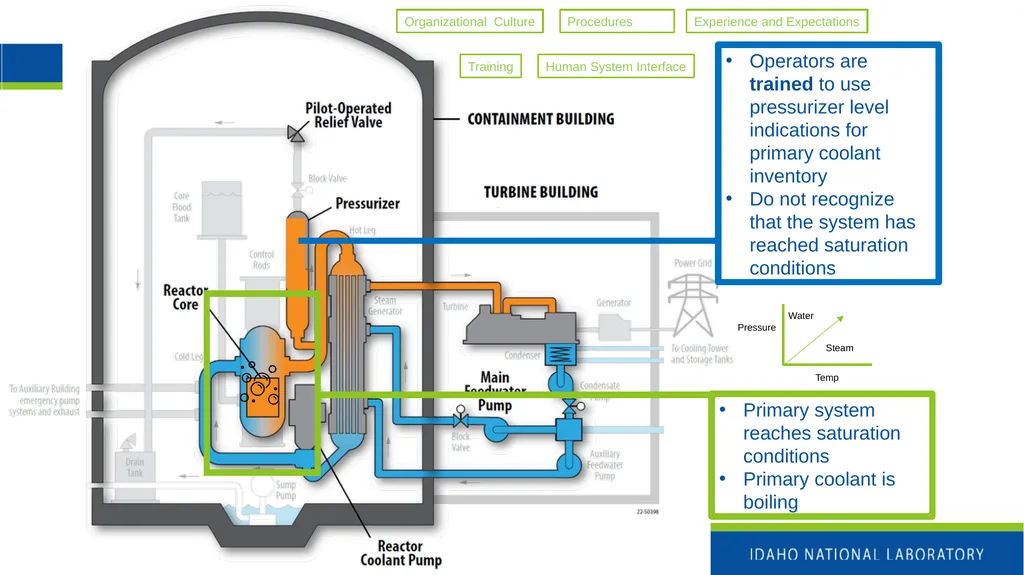
Primary system reaches saturation conditions
Primary coolant is boiling Operators are trained to use pressurizer level indications for primary coolant inventory
Do not recognize that the system has reached saturation conditions Training Procedures Organizational Culture Experience and Expectations Human System Interface Steam Water Temp Pressure<br>
15
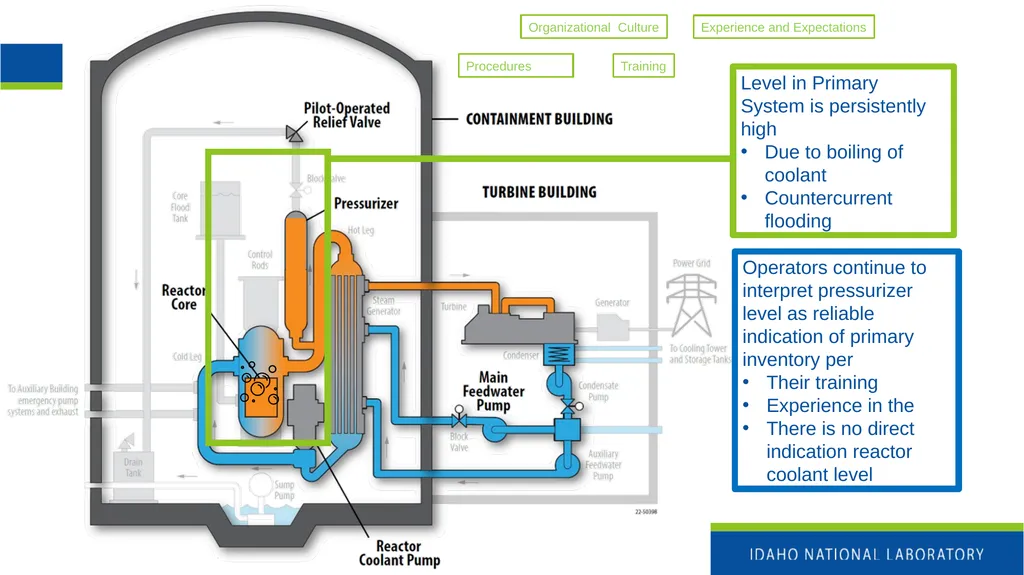
Level in Primary System is persistently high
Due to boiling of coolant
Countercurrent flooding Operators continue to interpret pressurizer level as reliable indication of primary inventory per
Their training
Experience in the
There is no direct indication reactor coolant level Training Procedures Organizational Culture Experience and Expectations<br>
16
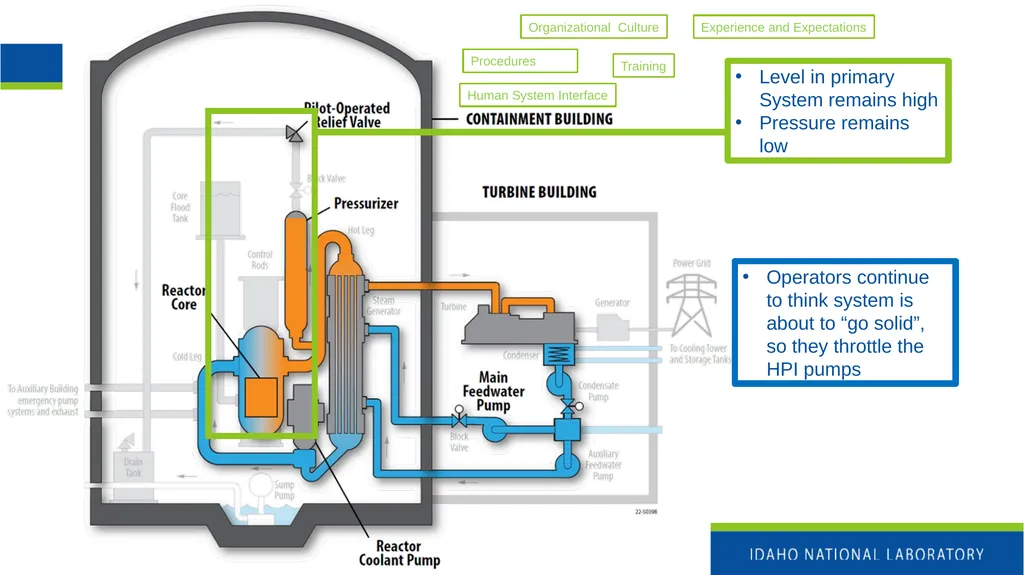
Level in primary System remains high
Pressure remains low Operators continue to think system is about to “go solid”, so they throttle the HPI pumps Training Procedures Organizational Culture Experience and Expectations Human System Interface<br>
17
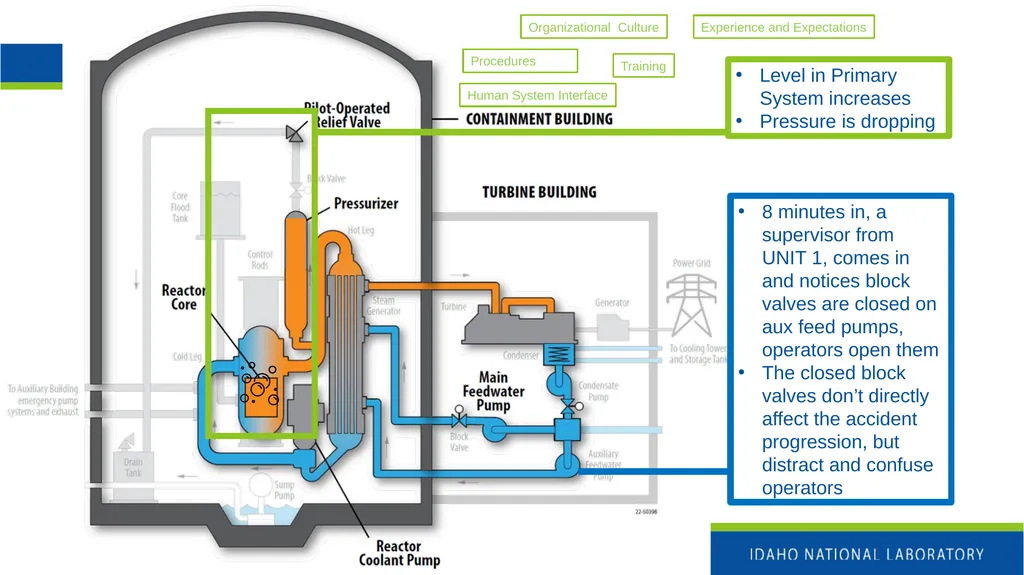
Level in Primary System increases
Pressure is dropping 8 minutes in, a supervisor from UNIT 1, comes in and notices block valves are closed on aux feed pumps, operators open them
The closed block valves don’t directly affect the accident progression, but distract and confuse operators Training Procedures Organizational Culture Experience and Expectations Human System Interface<br>
18
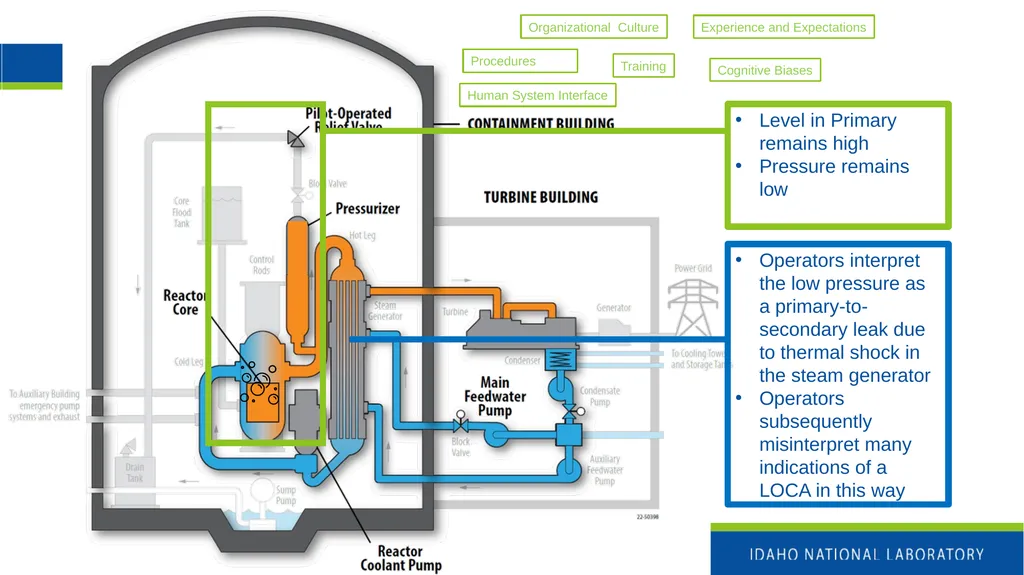
Level in Primary remains high
Pressure remains low Operators interpret the low pressure as a primary-to-secondary leak due to thermal shock in the steam generator
Operators subsequently misinterpret many indications of a LOCA in this way Cognitive Biases Training Procedures Organizational Culture Experience and Expectations Human System Interface<br>
19
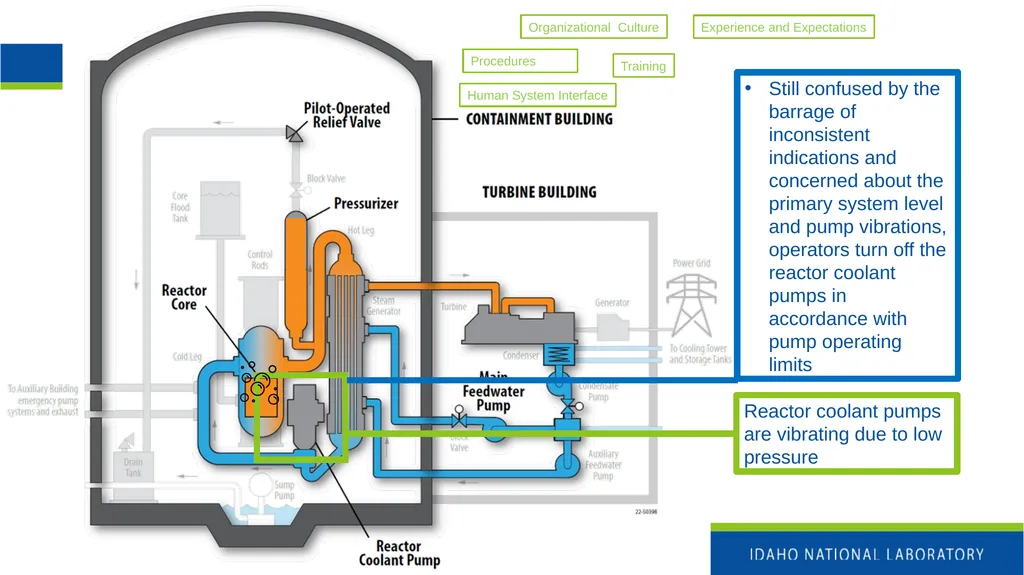
Still confused by the barrage of inconsistent indications and concerned about the primary system level and pump vibrations, operators turn off the reactor coolant pumps in accordance with pump operating limits Reactor coolant pumps are vibrating due to low pressure Training Procedures Organizational Culture Experience and Expectations Human System Interface<br>
20
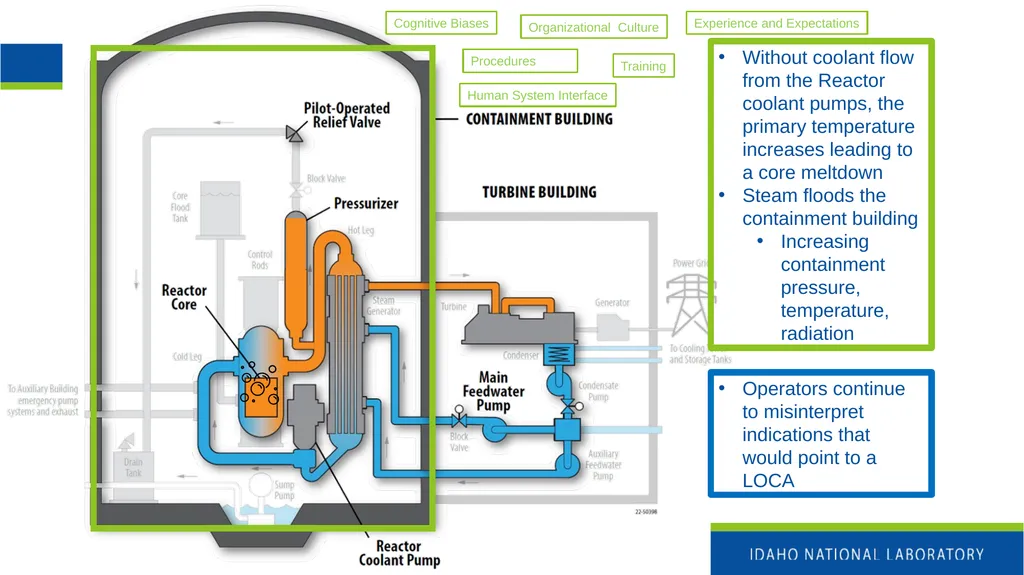
Operators continue to misinterpret indications that would point to a LOCA Without coolant flow from the Reactor coolant pumps, the primary temperature increases leading to a core meltdown
Steam floods the containment building
Increasing containment pressure, temperature, radiation Cognitive Biases Training Procedures Organizational Culture Experience and Expectations Human System Interface<br>
21
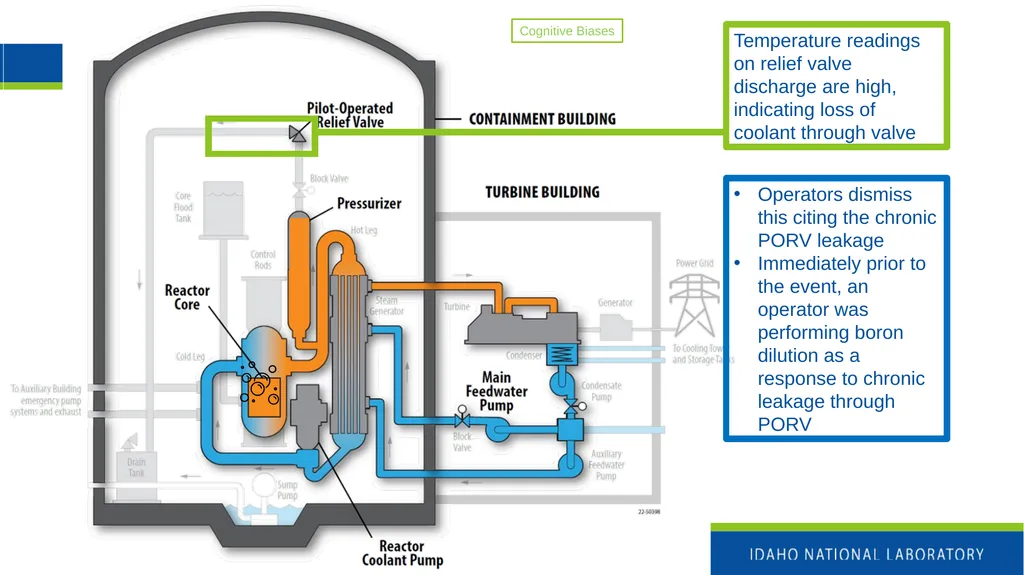
Temperature readings on relief valve discharge are high, indicating loss of coolant through valve Operators dismiss this citing the chronic PORV leakage
Immediately prior to the event, an operator was performing boron dilution as a response to chronic leakage through PORV Cognitive Biases<br>
22
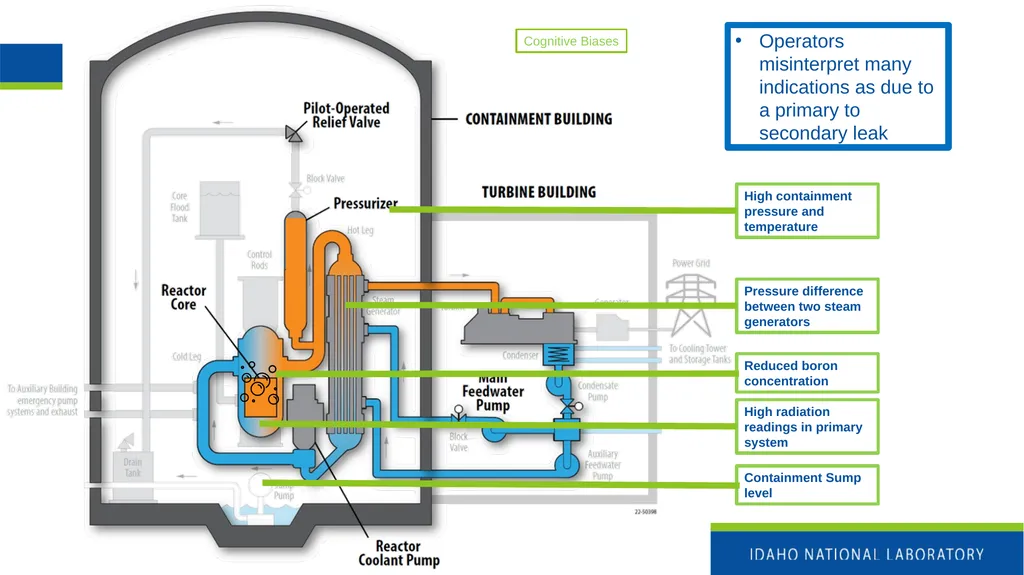
Operators misinterpret many indications as due to a primary to secondary leak High containment pressure and temperature High radiation readings in primary system Reduced boron concentration Pressure difference between two steam generators Containment Sump level Cognitive Biases<br>
23
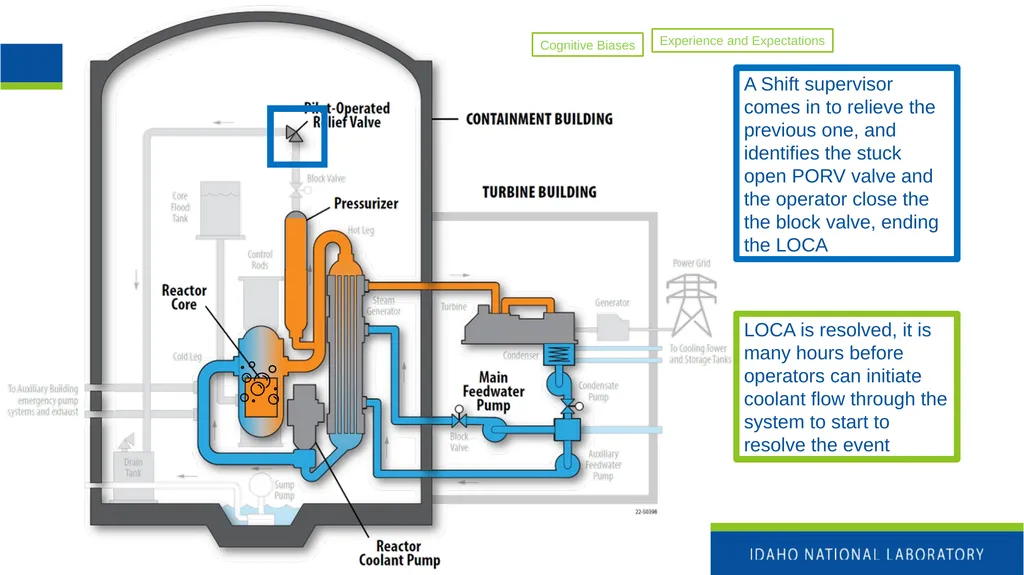
A Shift supervisor comes in to relieve the previous one, and identifies the stuck open PORV valve and the operator close the the block valve, ending the LOCA LOCA is resolved, it is many hours before operators can initiate coolant flow through the system to start to resolve the event Cognitive Biases Experience and Expectations<br>
24
Some more context on operator mindset According to Joyce, J. and Lapinsky, G. (1983),
When preconceived notions about plant behavior do not correspond to actual plant conditions, several things may happen.
Operators may tend to repeat their original, inappropriate information-gathering strategy.
In order to try to make actual conditions fit their preconceived notions, people often selectively disbelieve or disregard anomalous information.
When it becomes obvious that the situation does not fit their mental model, they regress to less effective forms of information gathering, for example, attending to all information regardless of its importance--looking for any clue at all that may be helpful.
Information overload usually results, further degrading the reasoning process.
Sub optional strategies such as information queuing, the dropping out of information, and cognitive fixation are the common under such conditions of stress and overload.<br>
25
Summary of Human Factors in TMI Organizational Culture
Failure to learn from operational experience
Davis Besse
Beznau
Oconee-3
TMI-2
PORV stuck open in a previous incident
Design
Operational philosophy was to prioritize avoiding reactor trip by using PORV, which led to frequent PORV actuation
Maintenance
Failure to correct known issues with condensate polishing system and leaky PORV
Large number of systems out of service<br>
26
Summary of Human Factors in TMI Human System Interface
Missing indications
Misleading indications
Obscured indications
Training
Training focused on normal conditions, but failed to prepare operators for the conditions they encountered
Training and procedures were valid for liquid, but not for saturation conditions
Strong emphasis on avoiding letting the pressurizer go solid made operators fixate on wrong problem
This came from the reactor designer, the site operations and training, and many of the operators’ Navy experience
Experience and Expectations
Complacency associated with leaky PORV and actuation of HPI under “normal conditions”
Cognitive biases associated with interpretation of indications
Operators persisted in wrong interpretation despite contradictory evidence
This isn’t their fault, it is how ALL humans work<br>
27
What does this mean for the future? Thankfully, we learned a lot from TMI
Sharing of Operating Experience
Improved Procedures
Improved Training
Including simulators
Staffing improvements
Shift Technical Advisor
Improved indication
Safety Parameter Displays
Human factors evaluation
Direct indication of reactor coolant level
We have implemented these lessons learned along with many more, and have an excellent safety record in the nuclear industry because of it<br>
28
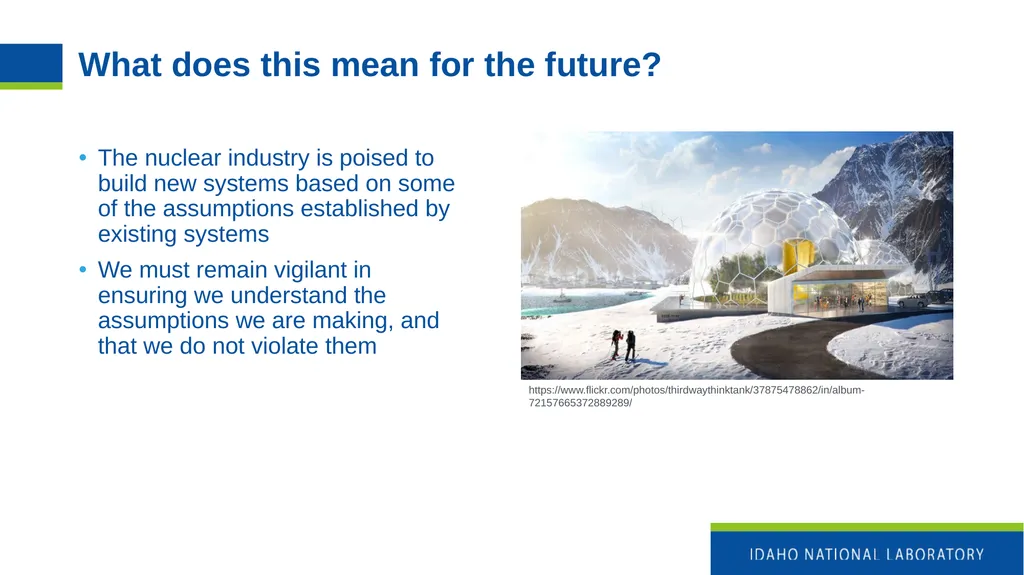
What does this mean for the future? The nuclear industry is poised to build new systems based on some of the assumptions established by existing systems
We must remain vigilant in ensuring we understand the assumptions we are making, and that we do not violate them<br>
29
Thank you! Questions?
Katya.leblanc@inl.gov<br>
30
References The Davis Besse Nuclear Power Plant Three Mile Island Accident Precursor Event. Mike Derivan, 2014
Insights from the Three Mile Island accident—Part 1: The accident. William E. Burchill Nuclear News. 2019
Three Mile Island: A Report to the Commissioners and to the Public, M. Rogovin, director of Special Inquiry Group, U.S. Nuclear Regulatory Commission (Jan. 1980).
Joyce, J. and Lapinsky, G. (1983). A history and overview of the safety parameter display system concept. IEEE Transactions on Nuclear Science, NS-30(1).<br>