
Nurturing Emotional Wellbeing in the Family
TG
Published · 27 slides · 0 views

1 / 1





Description
Nurturing Emotional Wellbeing in the Family Written by: Written by: Willie Oliver, PhD, CFLE and Elaine Oliver, PhD(c), LCPC, CFLE are Directors of the Department of Family Ministries at the General Conference of Seventh-day Adventists
Related Topics
Share
Embed code
Download this presentation From Below
"Nurturing Emotional Wellbeing in the Family" is the property of its rightful owner. Permission is granted to download and print the materials on this website for personal, non-commercial use only, and to display it on your personal computer provided you do not modify the materials and that you retain all copyright notices contained in the materials. By downloading content from our website, you accept the terms of this agreement.
Presentation Transcript
01
Nurturing Emotional Wellbeing in the Family Written by: Written by: Willie Oliver, PhD, CFLE and Elaine Oliver, PhD(c), LCPC, CFLE are Directors of the Department of Family Ministries at the General Conference of Seventh-day Adventists World Headquarters in Silver Spring, Maryland, USA. Presented by: (add presenter’s name here)<br>
02
Nurturing Emotional Wellbeing in the Family Statement of Purpose This seminar explores how family environment and interaction can impact an individual’s social, mental, emotional, and spiritual well-being across the lifespan.
This seminar will provide recommendations drawn from psychological, biblical and spirit of prophecy perspectives.<br>
This seminar will provide recommendations drawn from psychological, biblical and spirit of prophecy perspectives.<br>
03
Nurturing Emotional Wellbeing in the Family Introduction All parents want to see their children
grow up and succeed
Physically
Mentally
Intellectually
Spiritually
Socially<br>
grow up and succeed
Physically
Mentally
Intellectually
Spiritually
Socially<br>
04
Nurturing Emotional Wellbeing in the Family Introduction continued Most want their children to find fulfilling and purposeful work and contribute to the home, church, and society.
Therefore, the family is the primary center of nurture for the holistic well-being of individuals in the community.<br>
Therefore, the family is the primary center of nurture for the holistic well-being of individuals in the community.<br>
05
Nurturing Emotional Wellbeing in the Family Introduction continued Everyone encounters challenges in life. Some are unforeseen, and others are because of experiences, attitudes, and actions a child confronts in their home and other spaces, or other adverse childhood experiences, known as (ACES).<br>
06
Nurturing Emotional Wellbeing in the Family We must consider the child’s nature, temperament, and aptitudes in the education or nurturing given so that when the child grows up, she will feel competent and confident in navigating her world.
“Train up a child in the way he should go; even when he is old he will not depart from it.”
Proverbs 22:6<br>
“Train up a child in the way he should go; even when he is old he will not depart from it.”
Proverbs 22:6<br>
07
Nurturing Emotional Wellbeing in the Family “Fathers, do not provoke your children to anger, but bring them up in the discipline and instruction of the Lord.” Ephesians 6:4
“You shall teach them diligently to your sons and shall talk of them when you sit in your house and when you walk by the way and when you lie down and when you rise up.” Deuteronomy 6:7
“And that from childhood you have known the sacred writings which are able to give you the wisdom that leads to salvation through faith which is in Christ Jesus.”
2 Timothy 3:15<br>
08
Nurturing Emotional Wellbeing in the Family E. G. White writes in Child Guidance “In order for parents and teachers to do this work, they must themselves understand “the way” the child should go. This embraces more than merely having a knowledge of books. It takes in everything that is good, virtuous, righteous, and holy. It comprehends the practice of temperance, godliness, brotherly kindness, and love to God and to one another. In order to attain this object, the physical, mental, moral, and religious education of children must have attention.”
Child Guidance 297.2<br>
Child Guidance 297.2<br>
09
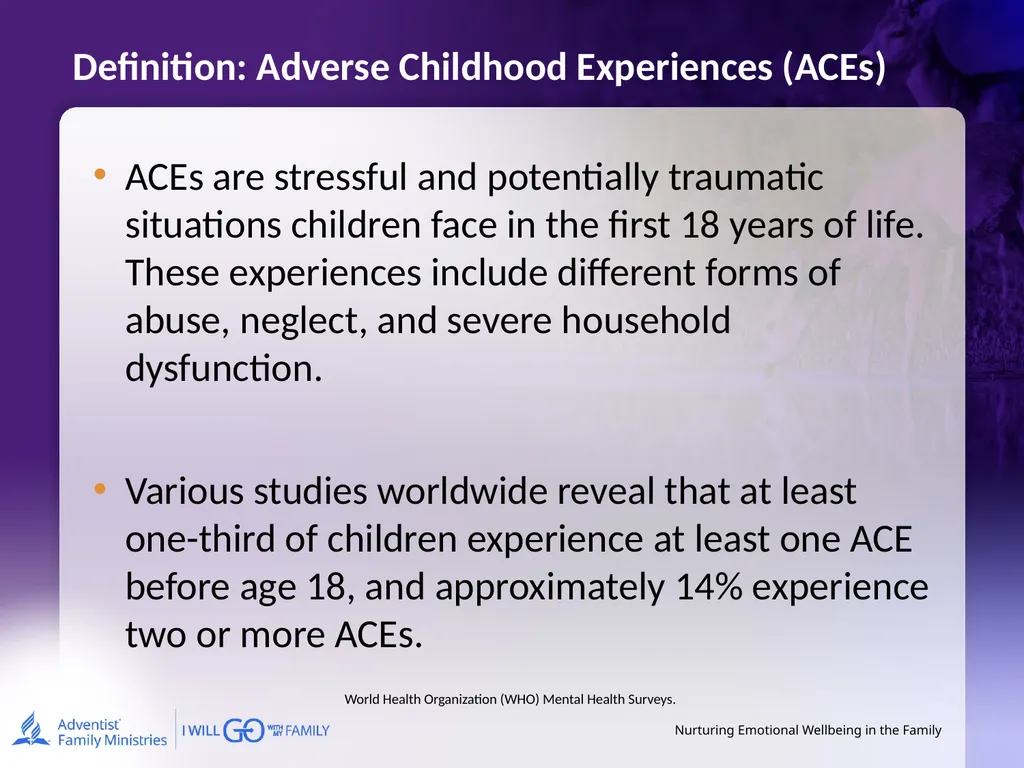
Nurturing Emotional Wellbeing in the Family Definition: Adverse Childhood Experiences (ACEs) ACEs are stressful and potentially traumatic situations children face in the first 18 years of life. These experiences include different forms of abuse, neglect, and severe household dysfunction.
Various studies worldwide reveal that at least one-third of children experience at least one ACE before age 18, and approximately 14% experience two or more ACEs.
World Health Organization (WHO) Mental Health Surveys.<br>
Various studies worldwide reveal that at least one-third of children experience at least one ACE before age 18, and approximately 14% experience two or more ACEs.
World Health Organization (WHO) Mental Health Surveys.<br>
10
Group Exercise Discuss examples of adverse childhood experiences in general and in your own personal experience<br>
11
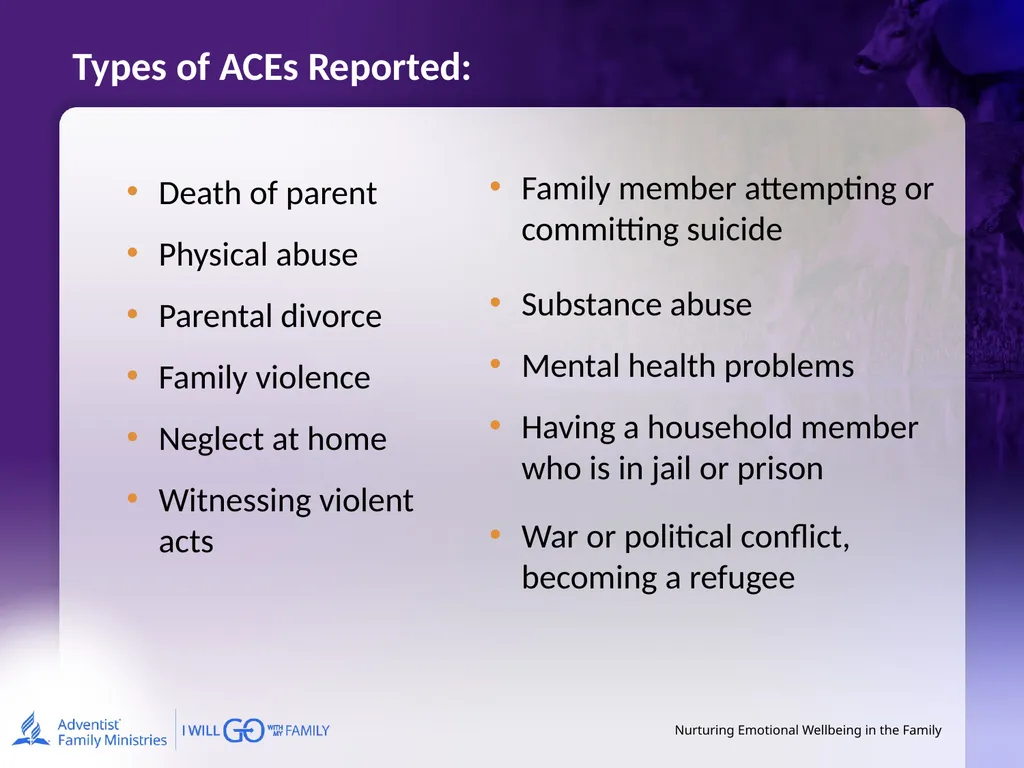
Nurturing Emotional Wellbeing in the Family Types of ACEs Reported: Death of parent
Physical abuse
Parental divorce
Family violence
Neglect at home
Witnessing violent acts Family member attempting or committing suicide
Substance abuse
Mental health problems
Having a household member who is in jail or prison
War or political conflict, becoming a refugee<br>
Physical abuse
Parental divorce
Family violence
Neglect at home
Witnessing violent acts Family member attempting or committing suicide
Substance abuse
Mental health problems
Having a household member who is in jail or prison
War or political conflict, becoming a refugee<br>
12
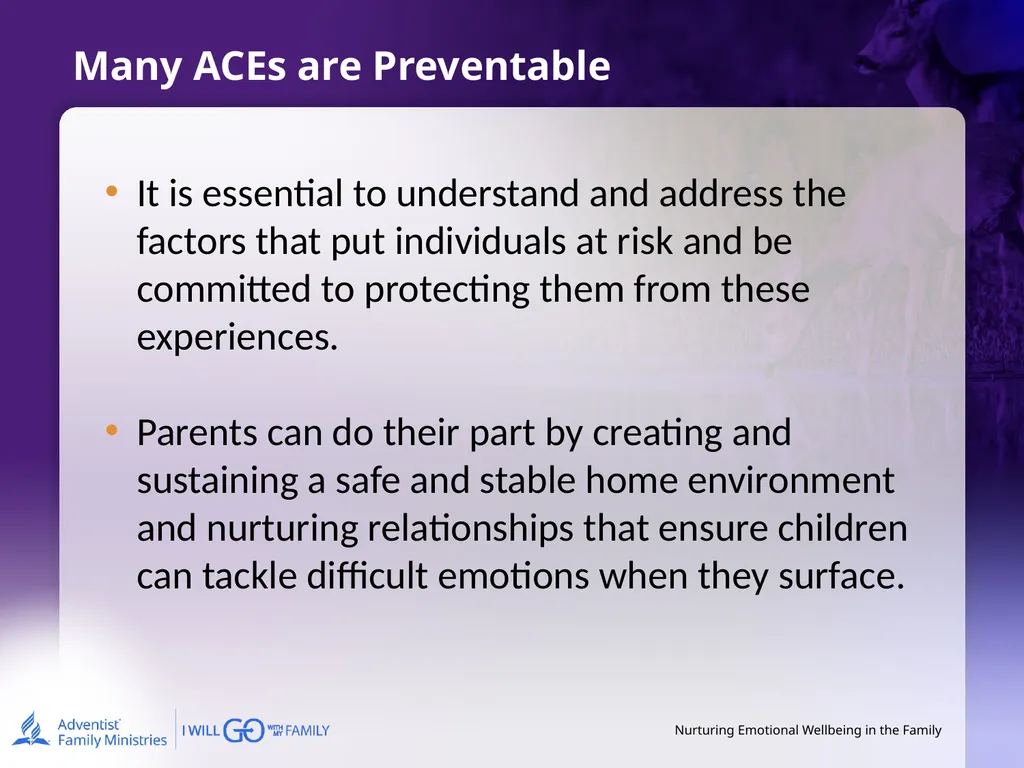
Nurturing Emotional Wellbeing in the Family Many ACEs are Preventable It is essential to understand and address the factors that put individuals at risk and be committed to protecting them from these experiences.
Parents can do their part by creating and sustaining a safe and stable home environment and nurturing relationships that ensure children can tackle difficult emotions when they surface.<br>
Parents can do their part by creating and sustaining a safe and stable home environment and nurturing relationships that ensure children can tackle difficult emotions when they surface.<br>
13
Nurturing Emotional Wellbeing in the Family E. G. White writes in Adventist Home “To a large extent parents create the atmosphere of the home circle, and when there is disagreement between father and mother, the children partake of the same spirit. Make your home atmosphere fragrant with tender thoughtfulness. If you have become estranged and have failed to be Bible Christians, be converted; for the character you bear in probationary time will be the character you will have at the coming of Christ.<br>
14
Nurturing Emotional Wellbeing in the Family E. G. White writes in Adventist Home If you would be a saint in heaven, you must first be a saint on earth. The traits of character you cherish in life will not be changed by death or by the resurrection. You will come up from the grave with the same disposition you manifested in
your home and in society.”
Adventist Home 16.1<br>
your home and in society.”
Adventist Home 16.1<br>
15
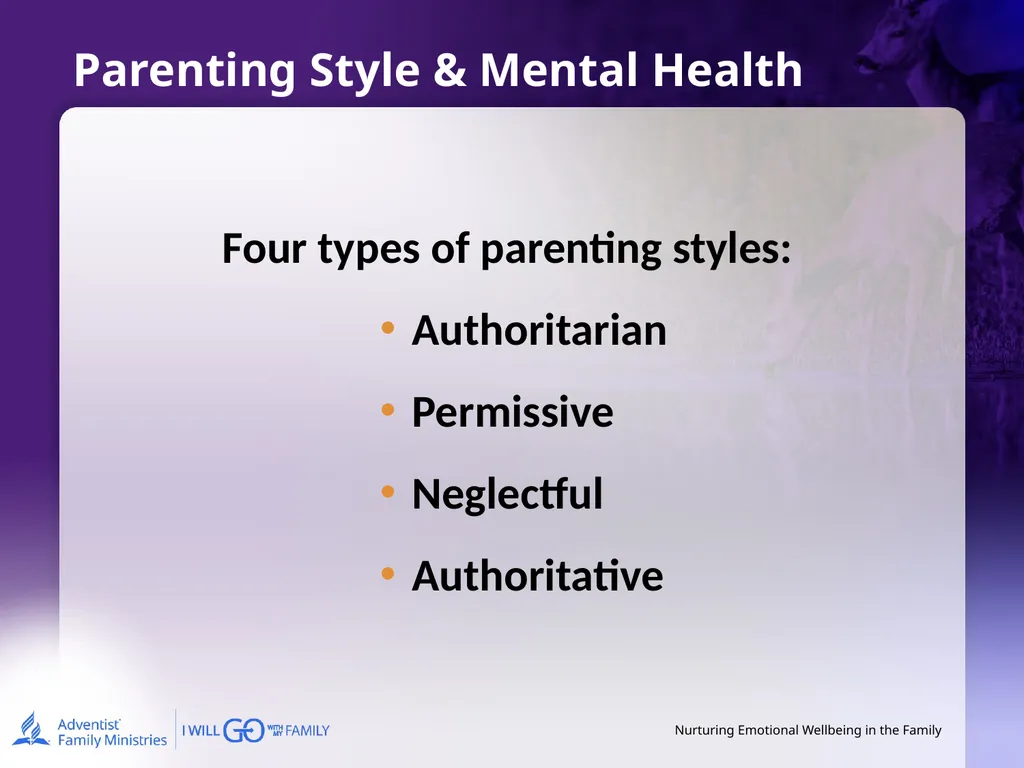
Nurturing Emotional Wellbeing in the Family Parenting Style & Mental Health Four types of parenting styles:
Authoritarian
Permissive
Neglectful
Authoritative<br>
Authoritarian
Permissive
Neglectful
Authoritative<br>
16
Group Exercise Discuss what type of parenting you were raised with compared to your style of parenting<br>
17
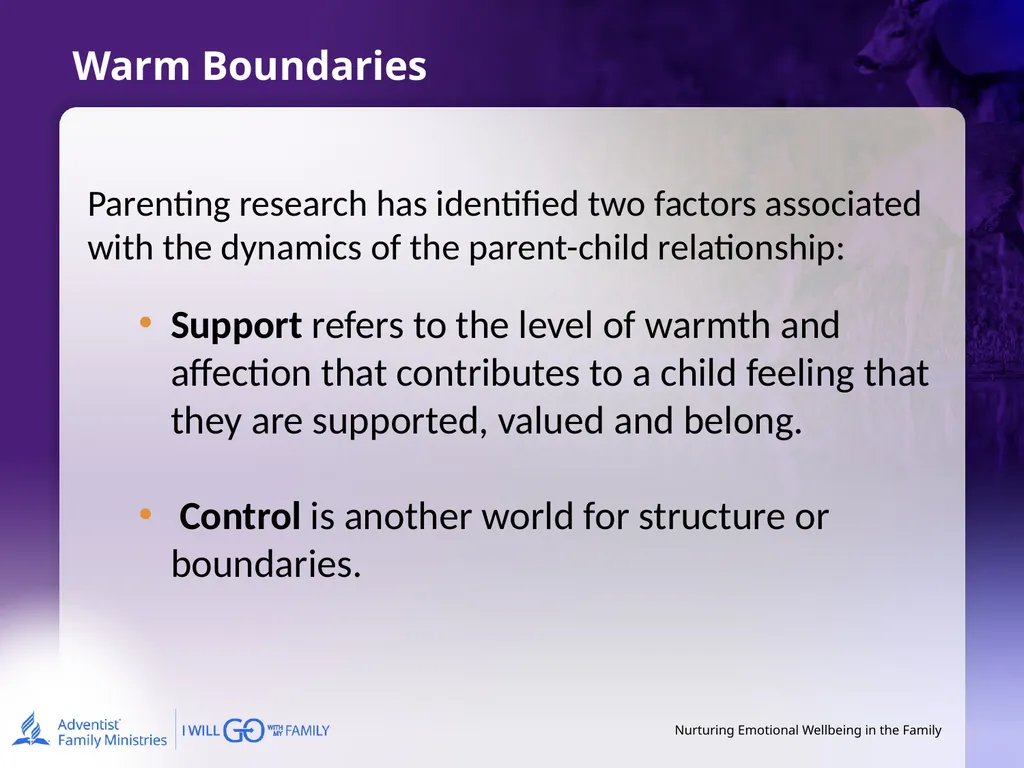
Nurturing Emotional Wellbeing in the Family Warm Boundaries Parenting research has identified two factors associated with the dynamics of the parent-child relationship:
Support refers to the level of warmth and affection that contributes to a child feeling that they are supported, valued and belong.
Control is another world for structure or boundaries.<br>
Support refers to the level of warmth and affection that contributes to a child feeling that they are supported, valued and belong.
Control is another world for structure or boundaries.<br>
18
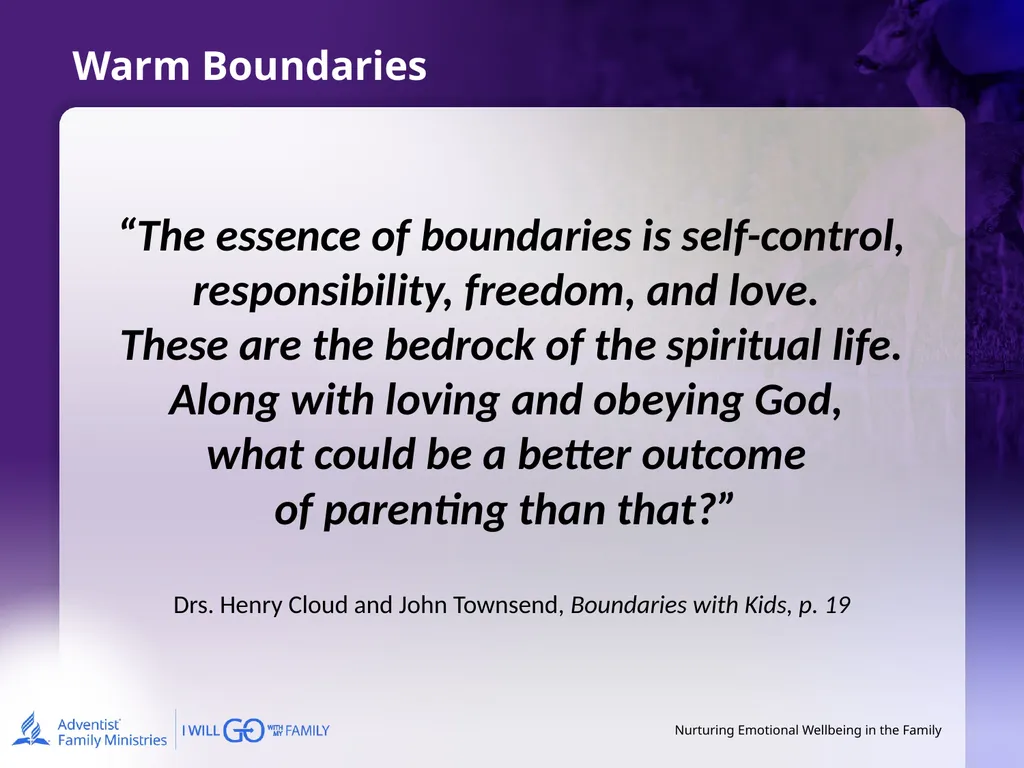
Nurturing Emotional Wellbeing in the Family Warm Boundaries “The essence of boundaries is self-control, responsibility, freedom, and love.
These are the bedrock of the spiritual life. Along with loving and obeying God,
what could be a better outcome
of parenting than that?”
Drs. Henry Cloud and John Townsend, Boundaries with Kids, p. 19<br>
These are the bedrock of the spiritual life. Along with loving and obeying God,
what could be a better outcome
of parenting than that?”
Drs. Henry Cloud and John Townsend, Boundaries with Kids, p. 19<br>
19
Nurturing Emotional Wellbeing in the Family Warm Boundaries Children are more likely to become responsible and emotionally healthy adults when parents have a healthy balance of warmth and boundaries (support and control). There is also a greater likelihood that they will accept parental values, develop morally according to age, and become socially responsible and caring adults.<br>
20
Nurturing Emotional Wellbeing in the Family Creating a Heavenly Atmosphere in Your Home “Home should be made all that the word implies. It should be a little heaven upon earth,
a place where the affections are cultivated instead of being studiously repressed.
Our happiness depends upon this cultivation of love, sympathy, and true courtesy to one another.<br>
a place where the affections are cultivated instead of being studiously repressed.
Our happiness depends upon this cultivation of love, sympathy, and true courtesy to one another.<br>
21
Nurturing Emotional Wellbeing in the Family Creating a Heavenly Atmosphere in Your Home The sweetest type of heaven is a home where the Spirit of the Lord presides. If the will of God is fulfilled, the husband and wife will respect each other and cultivate love and confidence.”
Adventist Home 15.3, 4<br>
Adventist Home 15.3, 4<br>
22
Nurturing Emotional Wellbeing in the Family 5 Traits for Nurturing Emotional Well-Being in Your Family 1. Healthy families create an atmosphere where angels want to dwell.
2. Healthy families practice good communication.
3. Healthy families have family bonding time.
4. Healthy families play and laugh together
5. Healthy families worship God together.<br>
2. Healthy families practice good communication.
3. Healthy families have family bonding time.
4. Healthy families play and laugh together
5. Healthy families worship God together.<br>
23
Nurturing Emotional Wellbeing in the Family Resilience Some families encounter more stress than others, but everyone experiences the ebb and flow of a life where births, deaths, divorces, stepfamily blending, economic crises, pandemics, or other life occurrences happen.
When the emotional wellbeing of family members is nurtured, including parents and children, the family becomes more resilient, and the individual members also become more resilient. Resilience acknowledges the trials but believes emotional wellbeing is possible despite the challenges.
Oliver, W. & E. (Ed.). (2021). I Will Go With My Family: Family Resilience. Resource Book 2022.<br>
24
Nurturing Emotional Wellbeing in the Family Closing In this seminar, we focused on parenting to show the lifespan of how adults develop emotional wellbeing. However, if one was not nurtured emotionally from childhood, there’s still the opportunity to begin the journey in adulthood.
Finding a good devotional that gives you hope for emotional wellbeing is an excellent place to start. Find a trusted Christian counselor to help you process past hurts, traumas, or neglect.<br>
Finding a good devotional that gives you hope for emotional wellbeing is an excellent place to start. Find a trusted Christian counselor to help you process past hurts, traumas, or neglect.<br>
25
Nurturing Emotional Wellbeing in the Family Closing “You keep him in perfect peace whose mind is stayed on you because he trusts in you.”
Isaiah 26: 3
Pray daily for God to heal your
mind and soul.<br>
Isaiah 26: 3
Pray daily for God to heal your
mind and soul.<br>
26
Nurturing Emotional Wellbeing in the Family Notes Spence-Jones, H. D. M. (Ed.). (1909). Proverbs (p. 422). London; New York: Funk &
Wagnalls Company.
Dybdahl, J. L. (Ed.). (2010). Andrews Study Bible Notes (p. 818). Berrien Springs, MI:
Andrews University Press.
White, Ellen G. (2001). Child Guidance. Review and Herald Publishing Association.
World Health Organization (WHO) Mental Health Surveys.
National Survey of Children’s Health.
Centers for Disease Control (CDC). www.cdc.gov
White, Ellen G. (2001). The Adventist Home. Review and Herald Publishing Association.
Gottman, John. (2015). 7 Principles for Making Marriage Work. New York, NY: Harmony Books.
See Baumrind’s Parenting Styles.
Cloud, Henry C & Townsend, John. (1998). Boundaries with Kids. Grand Rapids, MI:
Zondervan.
Oliver, W. & E. (Ed.). (2021). I Will Go With My Family: Family Resilience. Resource
Book 2022. Review and Herald Publishing Association.<br>