ON THE FACE OF IT Susan Hill Susan Hill was born on 5 February 1942 in Scarborough, England. is an English author of fiction and non-fiction works. Her novels include The Woman in Black, The Mist in the Mirror, and Im the King of the
"ON THE FACE OF IT Susan Hill Susan Hill was" is the property of its rightful owner. Permission is granted to
download and print the materials on this website for personal, non-commercial use only, and to display it
on your personal computer provided you do not modify the materials and that you retain all copyright
notices contained in the materials. By downloading content from our website, you accept the terms of this
agreement.
Presentation Transcript
01
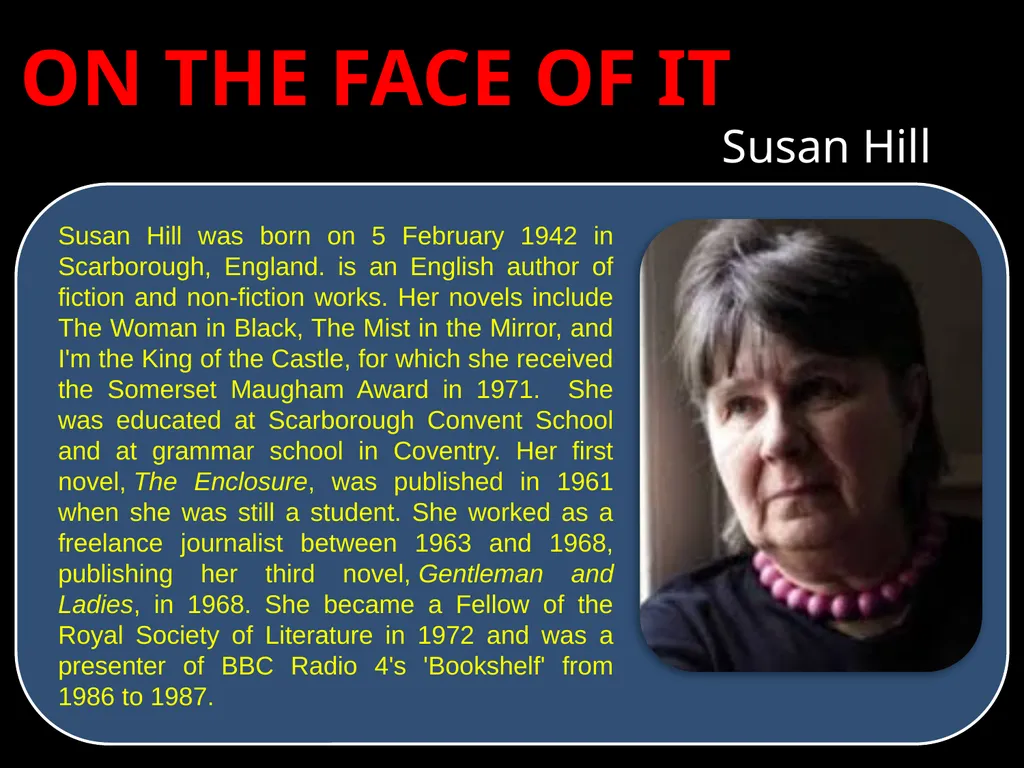
ON THE FACE OF IT Susan Hill Susan Hill was born on 5 February 1942 in Scarborough, England. is an English author of fiction and non-fiction works. Her novels include The Woman in Black, The Mist in the Mirror, and I'm the King of the Castle, for which she received the Somerset Maugham Award in 1971. She was educated at Scarborough Convent School and at grammar school in Coventry. Her first novel, The Enclosure, was published in 1961 when she was still a student. She worked as a freelance journalist between 1963 and 1968, publishing her third novel, Gentleman and Ladies, in 1968. She became a Fellow of the Royal Society of Literature in 1972 and was a presenter of BBC Radio 4's 'Bookshelf' from 1986 to 1987.<br>
02
ON THE FACE OF IT Susan Hill OBJECTIVES :
Thematic appreciation
Appreciation of play as a powerful medium of communication, reformation
Writing a one act play
Developing communication skills
Appreciation of values viz. patience, positive attitude, courage
Developing self-confidence, inter-personal skills through role play
Enhancing vocabulary<br>
03
ON THE FACE OF IT Susan Hill Previous knowledge :
a. Have you ever talked to a physically challenged person?
b. What is your impression of a physically impaired person?
c. What are the problems faced by a physically impaired person?
d. How does a physically challenged person want others to treat him/her?<br>
04
ON THE FACE OF IT Susan Hill Introduction :
The play depicts two individuals, who meet unfortunate odds but develop different attitudes while facing those odds. The two persons are Derry, a young acid-attack victim and Mr Lamb a much older man who lost his limb in a blast. Through the contrast in the outlook of both these survivor, the author tries to create a tale of overcoming odds and seemingly insurmountable difficulties and retaining hope in the ability to find happiness.<br>
05
ON THE FACE OF IT Susan Hill The play depicts beautifully yet grimly the sad world of the physically impaired.
It is not the actual pain or inconvenience caused by a physical impairment that trouble a disabled man but the attitude of the people around him.
Two physically impaired people, Mr. Lamb with a tin leg and Derry with a burnt face, strike a band of friendship.
Derry is described as a young boy shy, withdrawn and defiant. Video link - https://youtu.be/dQUHZdiPdf8
Audio Link - https://youtu.be/51JRuowYohw<br>
06
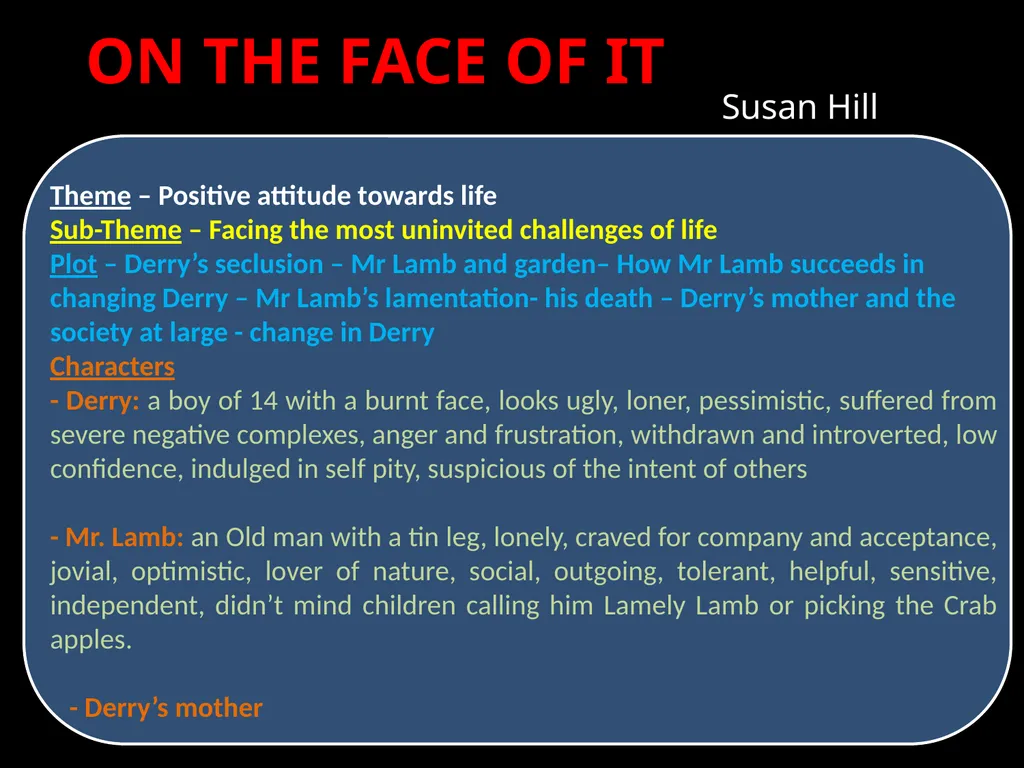
ON THE FACE OF IT Susan Hill Theme – Positive attitude towards life
Sub-Theme – Facing the most uninvited challenges of life
Plot – Derry’s seclusion – Mr Lamb and garden– How Mr Lamb succeeds in changing Derry – Mr Lamb’s lamentation- his death – Derry’s mother and the society at large - change in Derry
Characters
- Derry: a boy of 14 with a burnt face, looks ugly, loner, pessimistic, suffered from severe negative complexes, anger and frustration, withdrawn and introverted, low confidence, indulged in self pity, suspicious of the intent of others
- Mr. Lamb: an Old man with a tin leg, lonely, craved for company and acceptance, jovial, optimistic, lover of nature, social, outgoing, tolerant, helpful, sensitive, independent, didn’t mind children calling him Lamely Lamb or picking the Crab apples.
- Derry’s mother<br>
07
ON THE FACE OF IT Susan Hill Key points :
Mr Lamb’s garden
Derry’s entry
Conversation between them
Derry wants to leave the place
Mr Lamb’s hospitality
Derry’s defiance
Derry’s perception about others
Mr. Lamb revives the almost dead feelings of Derry towards life.
Derry’s face burnt by acid
He motivates him to think positively about life
How kids tease Mr Lamb
Leg blown off in war
His positive attitude
Everything appears to be the same but is different- e.g. weeds garden
The story of the beauty and the beast<br>
08
ON THE FACE OF IT Susan Hill Key points :
Derry’s concern - people fussing, showing pity
Motivation by Mr Lamb- bees buzzing
Accepting realities of life
Not paying heed to gossip
Derry influenced by Mr Lamb’s peculiar sayings
Derry’s acceptance of Mr Lamb’s friendship
Story of the fear stricken man who locked himself
Mr Lamb continues to motivate Derry
Derry’s liking for Mr Lamb
Mr Lamb’s views on those who come to his garden
Mr Lamb’s emphasis on the consequence of hatred
Acid ruined Derry’s Face
Hatred would ruin his life
How Mr Lamb enjoyed himself- listening, watching<br>
09
ON THE FACE OF IT Susan Hill Key points :
Derry’s affiliation to Mr Lamb
Derry leaves for home
Derry is inspired and promises to come back.
Mr Lamb’s loneliness
Derry’s mother warns him against his visit to the garden
Derry comes back to the garden
Mr Lamb found dead
When he searches a new foothold to live happily, he finds Mr. Lamb dead
In this way the play depicts the heart rendering life of physically disabled people with their loneliness, aloofness and alienation.<br>
10
ON THE FACE OF IT Questions to test comprehension :
1. How did Derry enter Mr Lamb’s Garden?
2. Why did Mr Lamb ask Derry to be careful?
3. How did Derry react when he saw Mr Lamb?
4. How did Mr Lamb welcome Derry?
5. What is your impression of Mr Lamb?
6. Why did Derry enter Mr Lamb’s garden?
7. How did Derry react to Mr Lamb’s hospitality?
8. What is Derry’s problem?
9. How does Mr Lamb try to change his attitude?
10. How does Mr Lamb react when kids call him lamey Lamb?
11. Why was Derry worried?
12. Why did Mr Lamb keep his house opened?
13. What did the people say about Derry’s face?
14. How does Mr Lamb accept life?
15. How does he advise Derry?
16. Why does Mr Lamb ask Derry not to pay heed to people’s sayings?
17. Does Derry like what Mr Lamb says to him? Why/Why not?
18. Why does Mr Lamb tell Derry the story of the fear-stricken man who locked himself in his own house?
19. How does Derry react to that?
20. What made Derry change his attitude to Mr Lamb?
21. Cite examples from the play to prove that Derry had changed his attitude towards Mr Lamb?<br>
11
ON THE FACE OF IT Questions to test comprehension :
22. Why did the man lock himself in his own house?
23. How did Mr Lamb differentiate the ruin caused by acid and hatred?
24. How did Mr Lamb enjoy his life?
25. How does Mr Lamb motivate Derry?
26. What was its impact on Derry?
27. Justify the title of the play.
28. Despite their disabilities, both Mr. Lamb and Derry look at life differently.
29. Elucidate with examples from the play.
30. Although the play ends tragically, it suggests an optimistic vision, a ray of hope. Discuss.
31. The play is an apt depiction of the loneliness and the sense of alienation experienced by people on account of a disability. Discuss.
32. What is it that draws Derry towards Mr. Lamb in spite of himself?
33. Draw a character sketch of Mr. Lamb.
34. In which section of the play does Mr Lamb display signs of loneliness and disappointment? What are the ways in which Mr Lamb tries to overcome these feelings?
35. The actual pain or inconvenience caused by a physical impairment is often much less than the sense of alienation felt by the person with disabilities. What is the kind of behaviour that the person expects from others?
36. Will Derry get back to his old seclusion or will Mr Lamb’s brief association effect a change in the kind of life he will lead in the future?<br>