Orthodontics Module 9 Aim of todays session is to gain a knowledge and understanding on Describing classifications of malocclusion Explaining the stages of orthodontic procedures Identifying instruments and materials used during orthodontic
"Orthodontics Module 9 Aim of todays session is to" is the property of its rightful owner. Permission is granted to
download and print the materials on this website for personal, non-commercial use only, and to display it
on your personal computer provided you do not modify the materials and that you retain all copyright
notices contained in the materials. By downloading content from our website, you accept the terms of this
agreement.
Presentation Transcript
01
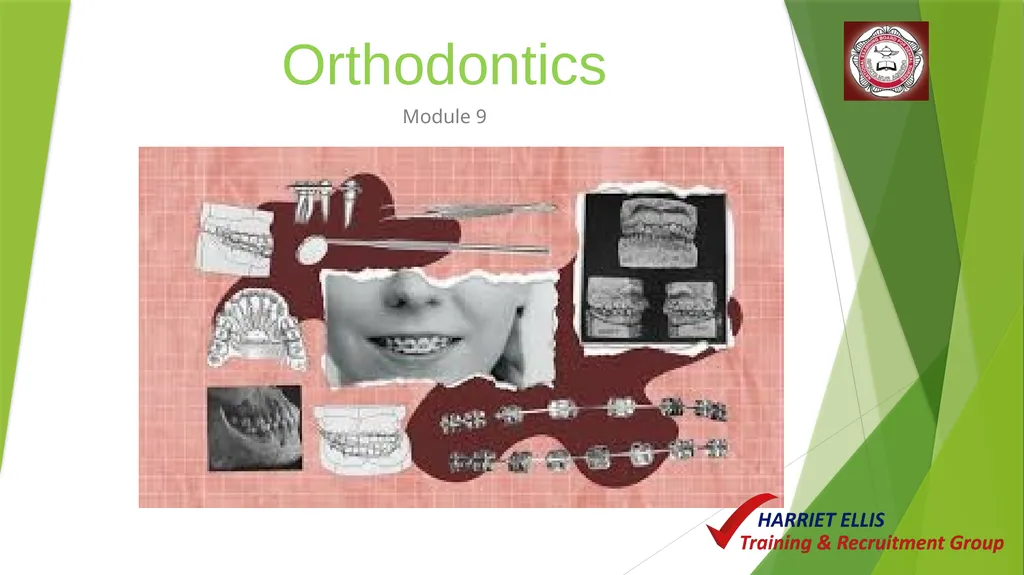
Orthodontics Module 9<br>
02
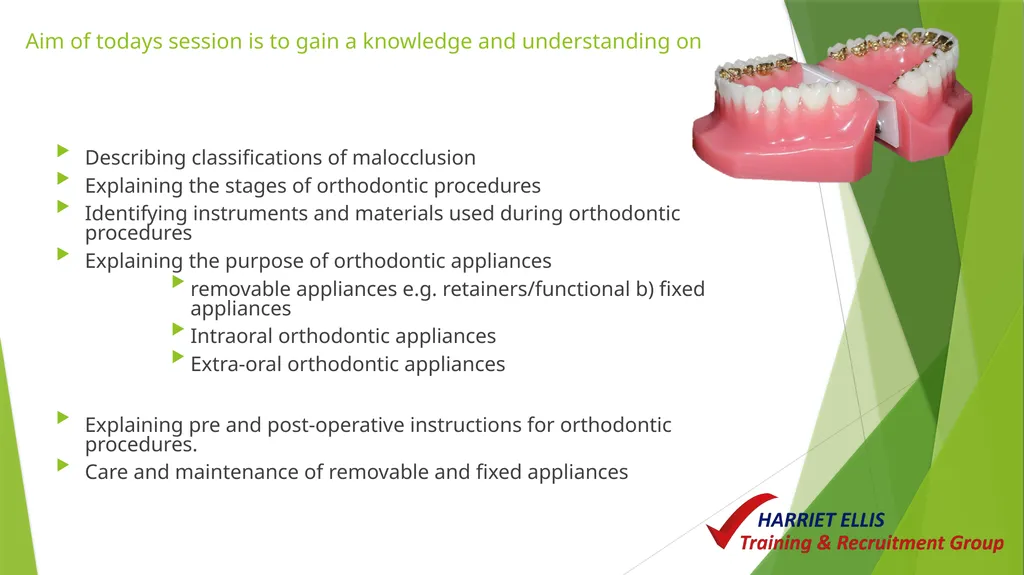
Aim of todays session is to gain a knowledge and understanding on Describing classifications of malocclusion
Explaining the stages of orthodontic procedures
Identifying instruments and materials used during orthodontic procedures
Explaining the purpose of orthodontic appliances
removable appliances e.g. retainers/functional b) fixed appliances
Intraoral orthodontic appliances
Extra-oral orthodontic appliances
Explaining pre and post-operative instructions for orthodontic procedures.
Care and maintenance of removable and fixed appliances<br>
03
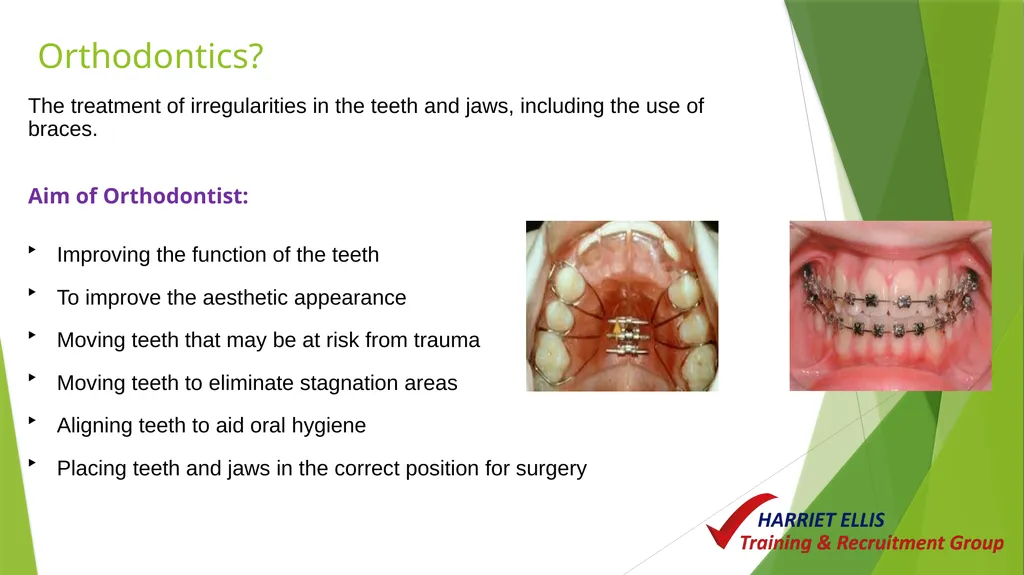
Orthodontics? The treatment of irregularities in the teeth and jaws, including the use of braces.
Aim of Orthodontist:
Improving the function of the teeth
To improve the aesthetic appearance
Moving teeth that may be at risk from trauma
Moving teeth to eliminate stagnation areas
Aligning teeth to aid oral hygiene
Placing teeth and jaws in the correct position for surgery<br>
04
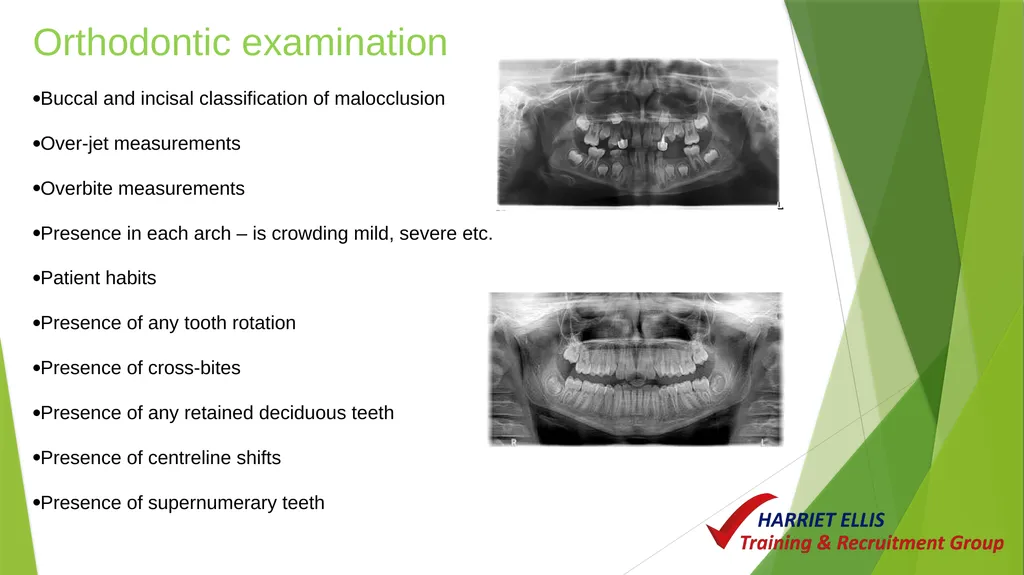
Orthodontic examination Buccal and incisal classification of malocclusion
Over-jet measurements
Overbite measurements
Presence in each arch – is crowding mild, severe etc.
Patient habits
Presence of any tooth rotation
Presence of cross-bites
Presence of any retained deciduous teeth
Presence of centreline shifts
Presence of supernumerary teeth<br>
05
Index of orthodontic treatment This is used to assess the need and eligibility of children under 18 for NHS orthodontic treatment
Grade 1 – is almost perfect
Grade 2 – minor irregularities
Grade 3 – greater irregularities but no oral health risk
Grade 4 – more severe irregularities with risk to health
Grade 5 – Severe dental health problems<br>
06
Orthodontics Orthos = straight Odons = tooth
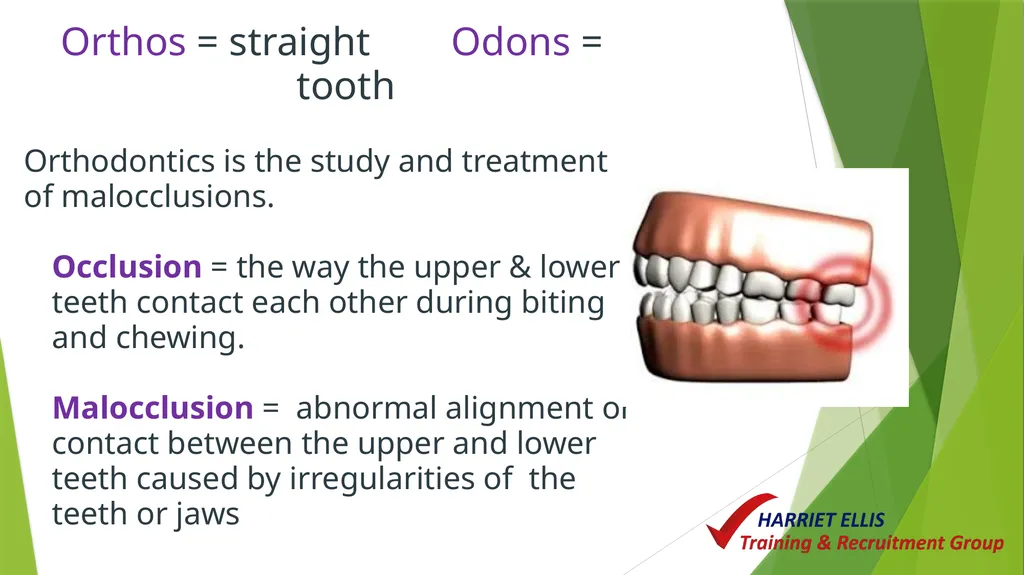
Orthodontics is the study and treatment of malocclusions.
Occlusion = the way the upper & lower teeth contact each other during biting and chewing.
Malocclusion = abnormal alignment or contact between the upper and lower teeth caused by irregularities of the teeth or jaws<br>
07
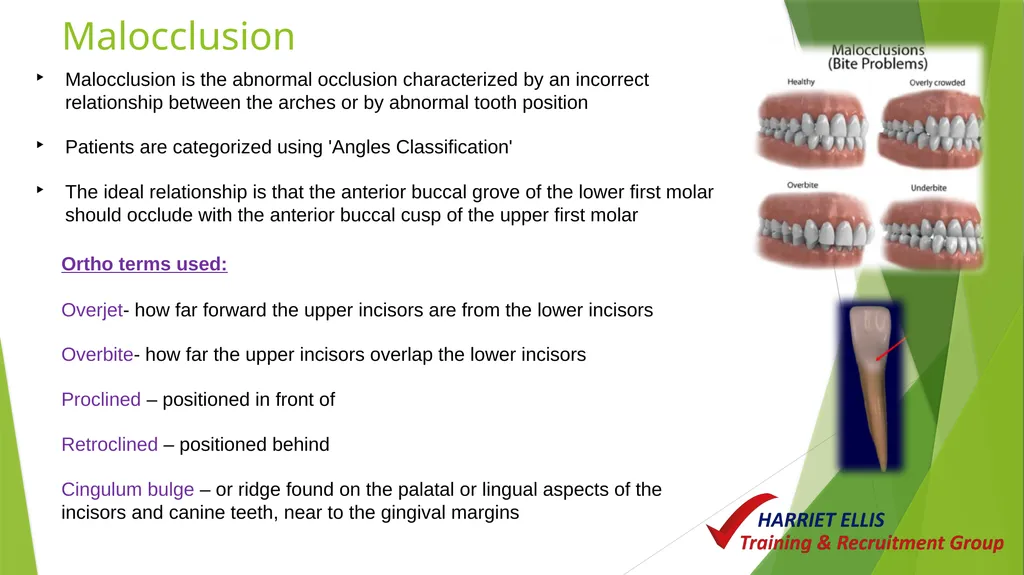
Malocclusion Malocclusion is the abnormal occlusion characterized by an incorrect relationship between the arches or by abnormal tooth position
Patients are categorized using 'Angles Classification'
The ideal relationship is that the anterior buccal grove of the lower first molar should occlude with the anterior buccal cusp of the upper first molar Ortho terms used:
Overjet- how far forward the upper incisors are from the lower incisors
Overbite- how far the upper incisors overlap the lower incisors
Proclined – positioned in front of
Retroclined – positioned behind
Cingulum bulge – or ridge found on the palatal or lingual aspects of the incisors and canine teeth, near to the gingival margins<br>
08
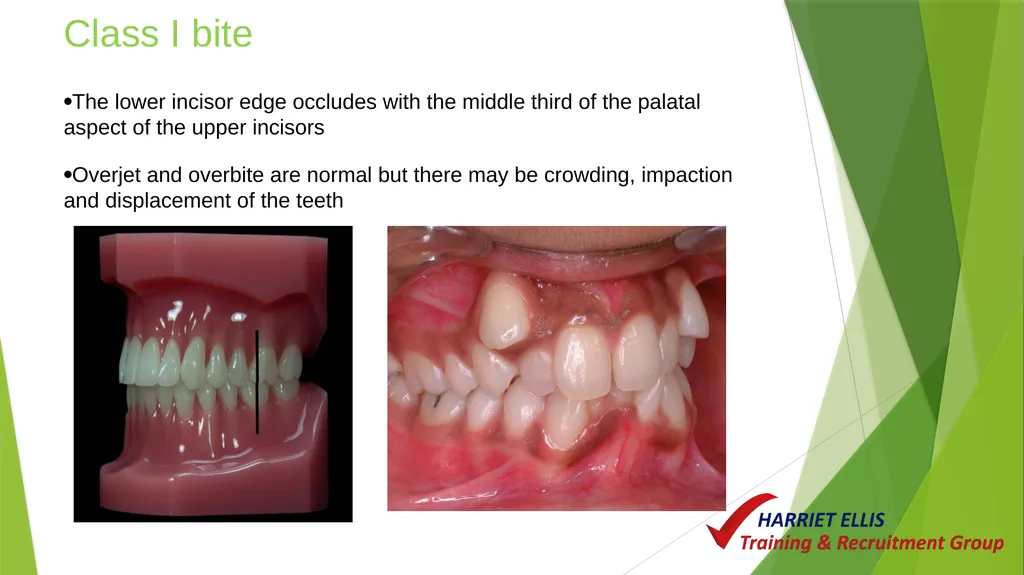
Class I bite The lower incisor edge occludes with the middle third of the palatal aspect of the upper incisors
Overjet and overbite are normal but there may be crowding, impaction and displacement of the teeth<br>
09
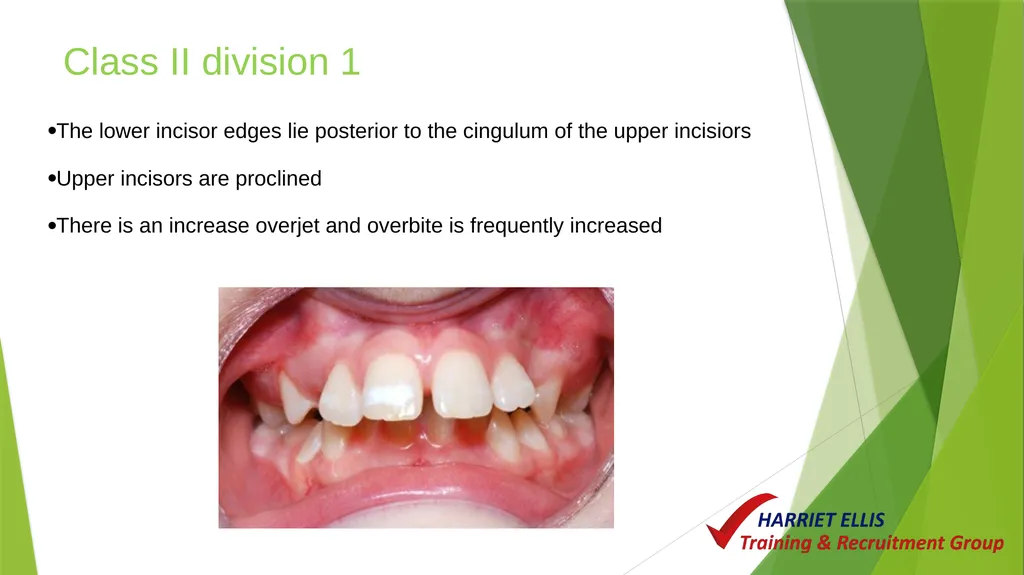
Class II division 1 The lower incisor edges lie posterior to the cingulum of the upper incisiors
Upper incisors are proclined
There is an increase overjet and overbite is frequently increased<br>
10
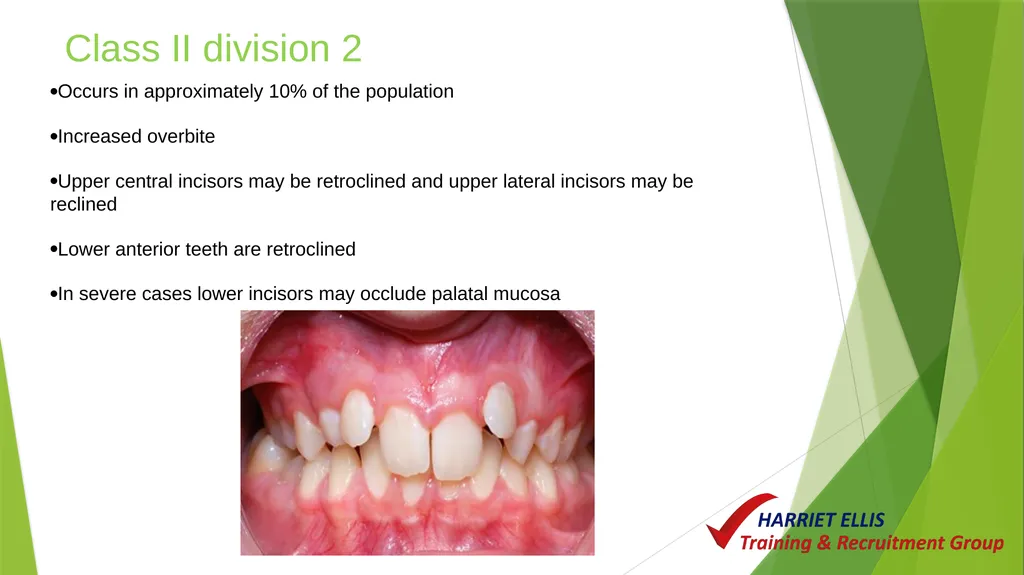
Class II division 2 Occurs in approximately 10% of the population
Increased overbite
Upper central incisors may be retroclined and upper lateral incisors may be reclined
Lower anterior teeth are retroclined
In severe cases lower incisors may occlude palatal mucosa<br>
11
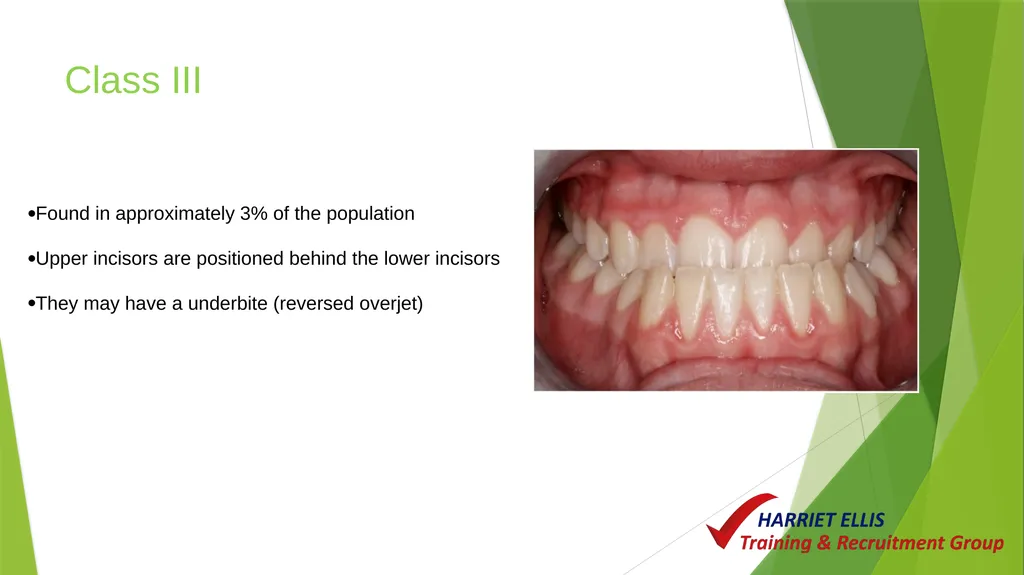
Class III Found in approximately 3% of the population
Upper incisors are positioned behind the lower incisors
They may have a underbite (reversed overjet)<br>
12
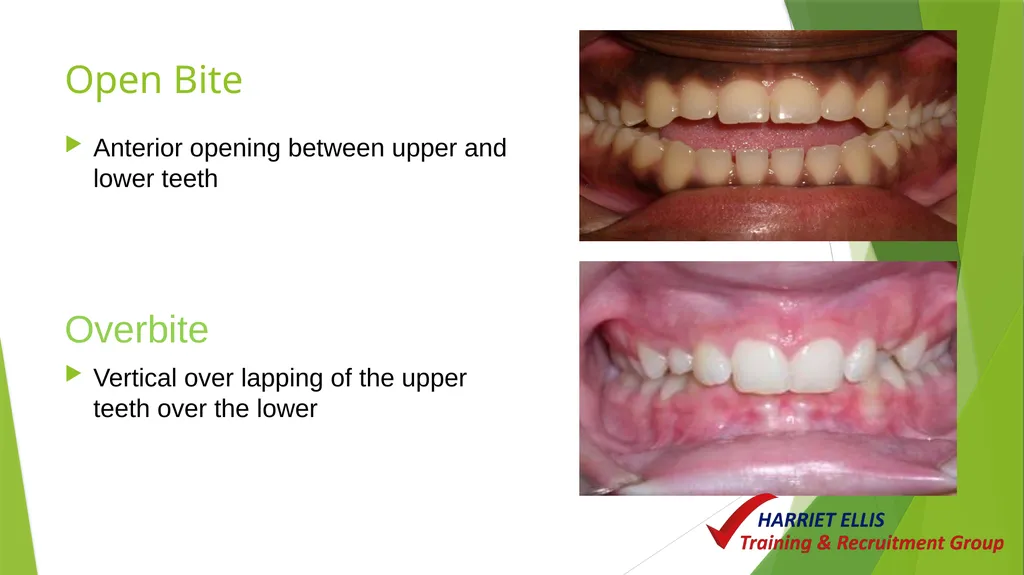
Open Bite Anterior opening between upper and lower teeth
Overbite
Vertical over lapping of the upper teeth over the lower<br>
13
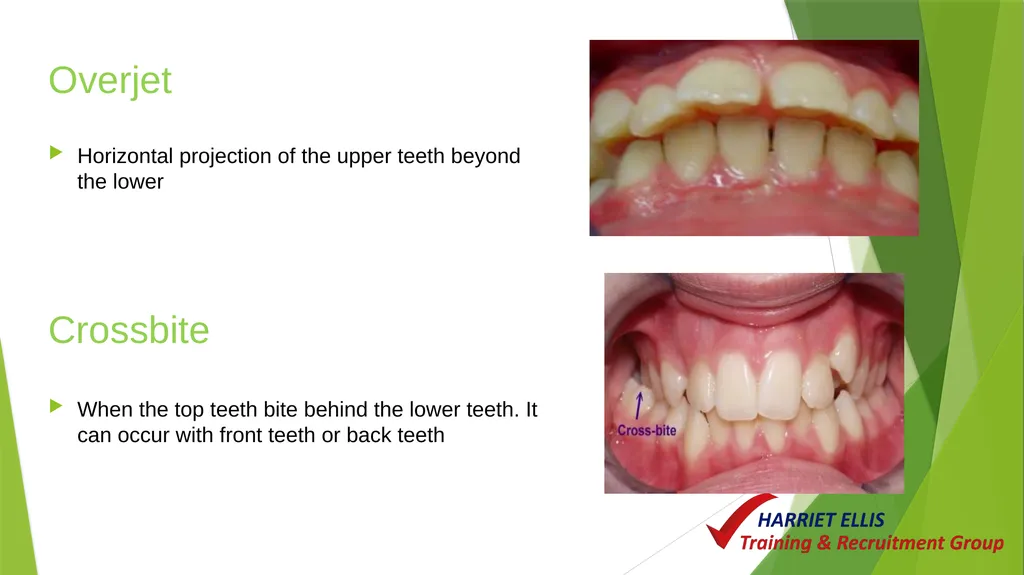
Overjet Horizontal projection of the upper teeth beyond the lower
Crossbite
When the top teeth bite behind the lower teeth. It can occur with front teeth or back teeth<br>
14
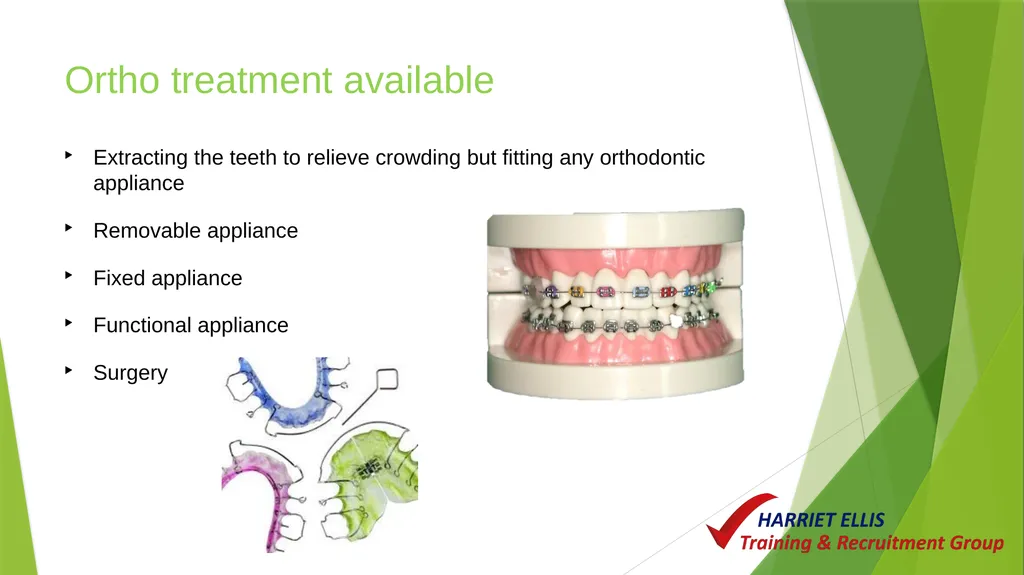
Ortho treatment available Extracting the teeth to relieve crowding but fitting any orthodontic appliance
Removable appliance
Fixed appliance
Functional appliance
Surgery<br>
15
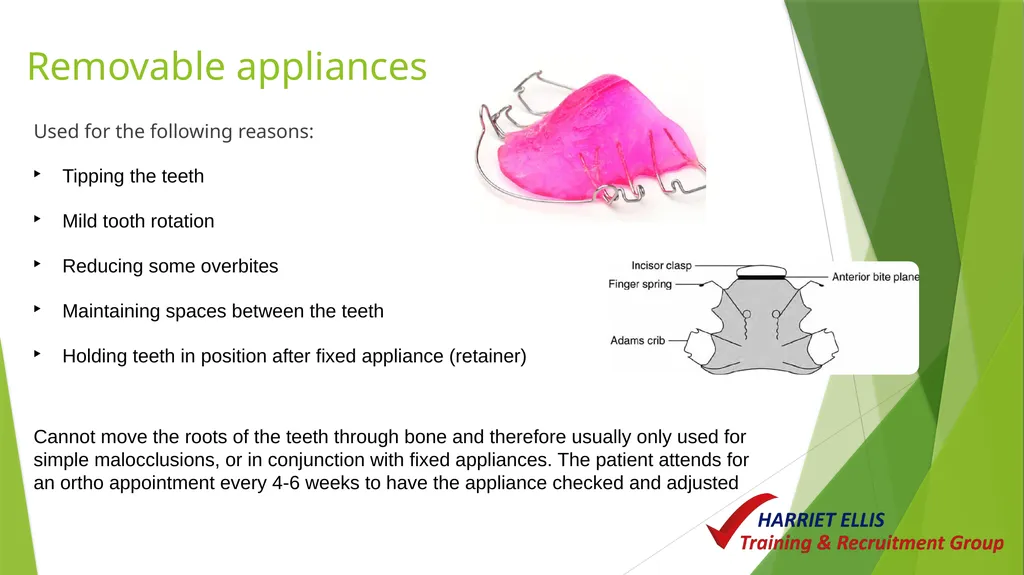
Removable appliances Used for the following reasons:
Tipping the teeth
Mild tooth rotation
Reducing some overbites
Maintaining spaces between the teeth
Holding teeth in position after fixed appliance (retainer)
Cannot move the roots of the teeth through bone and therefore usually only used for simple malocclusions, or in conjunction with fixed appliances. The patient attends for an ortho appointment every 4-6 weeks to have the appliance checked and adjusted<br>
16
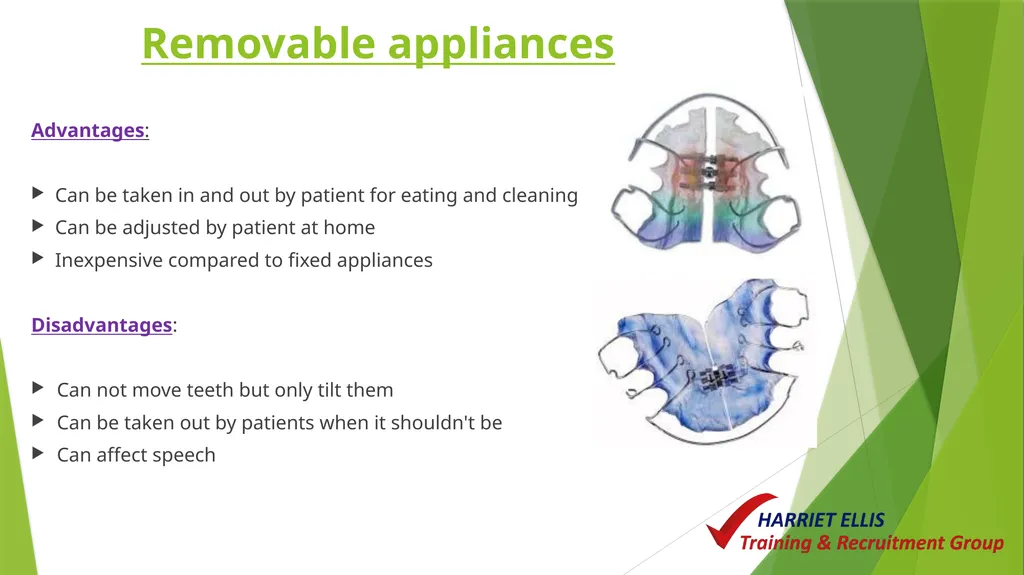
Removable appliances Advantages:
Can be taken in and out by patient for eating and cleaning
Can be adjusted by patient at home
Inexpensive compared to fixed appliances
Disadvantages:
Can not move teeth but only tilt them
Can be taken out by patients when it shouldn't be
Can affect speech<br>
17
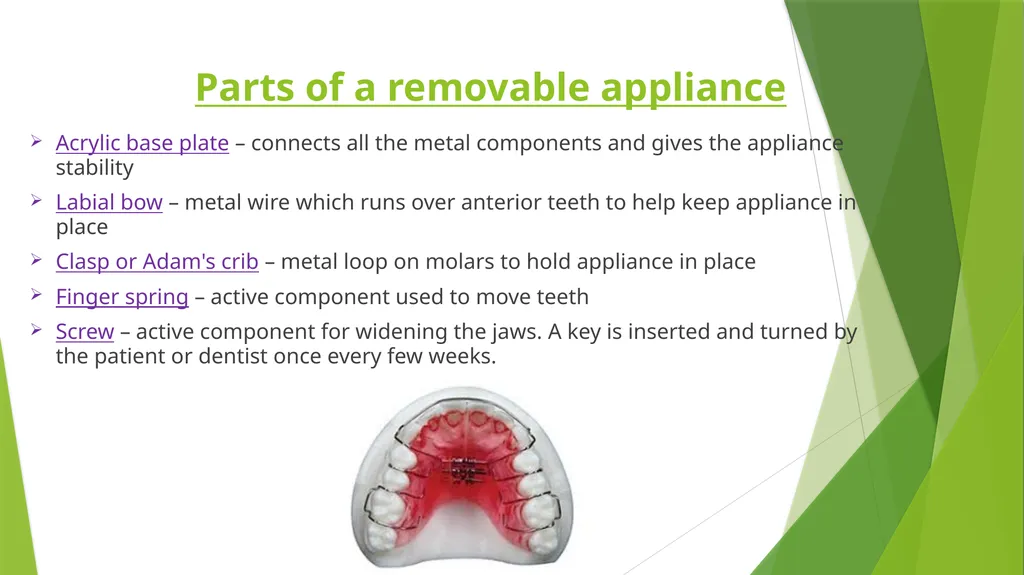
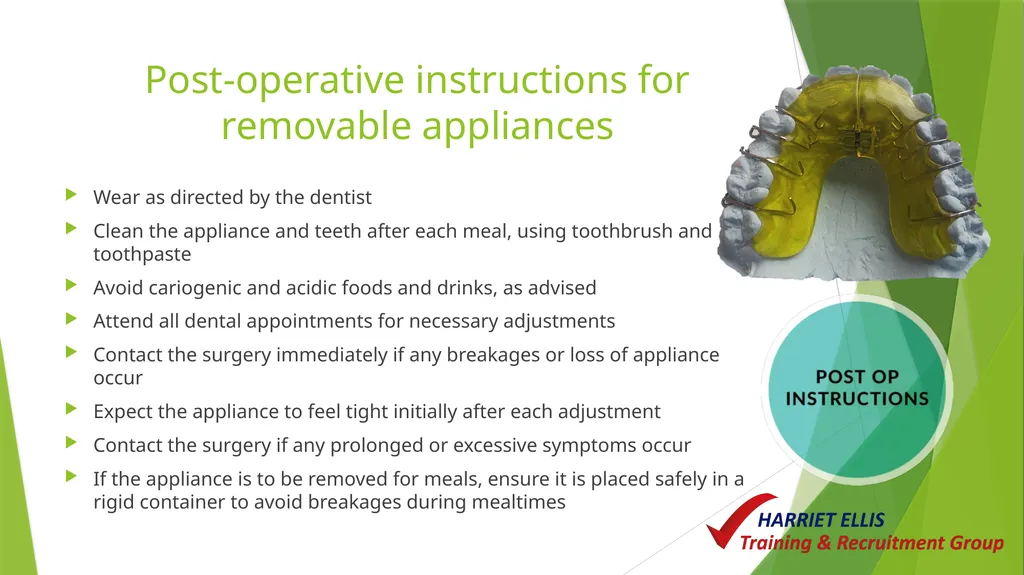
Parts of a removable appliance Acrylic base plate – connects all the metal components and gives the appliance stability
Labial bow – metal wire which runs over anterior teeth to help keep appliance in place
Clasp or Adam's crib – metal loop on molars to hold appliance in place
Finger spring – active component used to move teeth
Screw – active component for widening the jaws. A key is inserted and turned by the patient or dentist once every few weeks.<br>
18
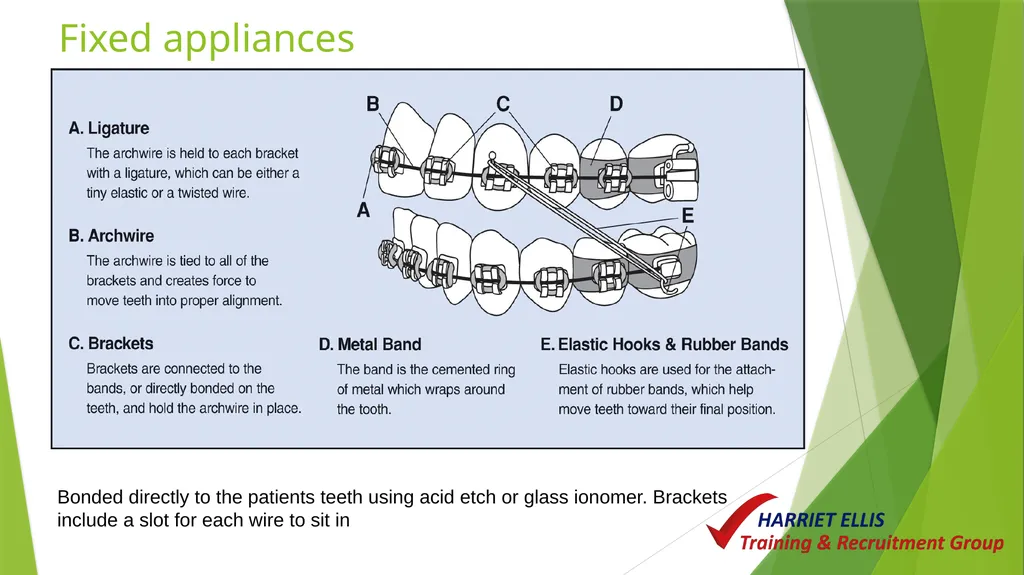
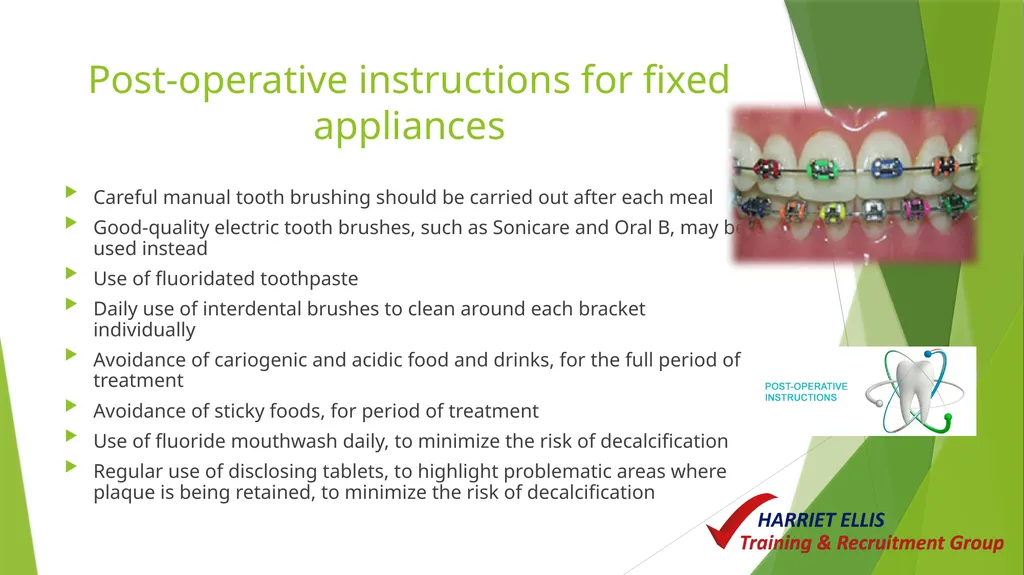
Fixed appliances Bonded directly to the patients teeth using acid etch or glass ionomer. Brackets include a slot for each wire to sit in<br>
19
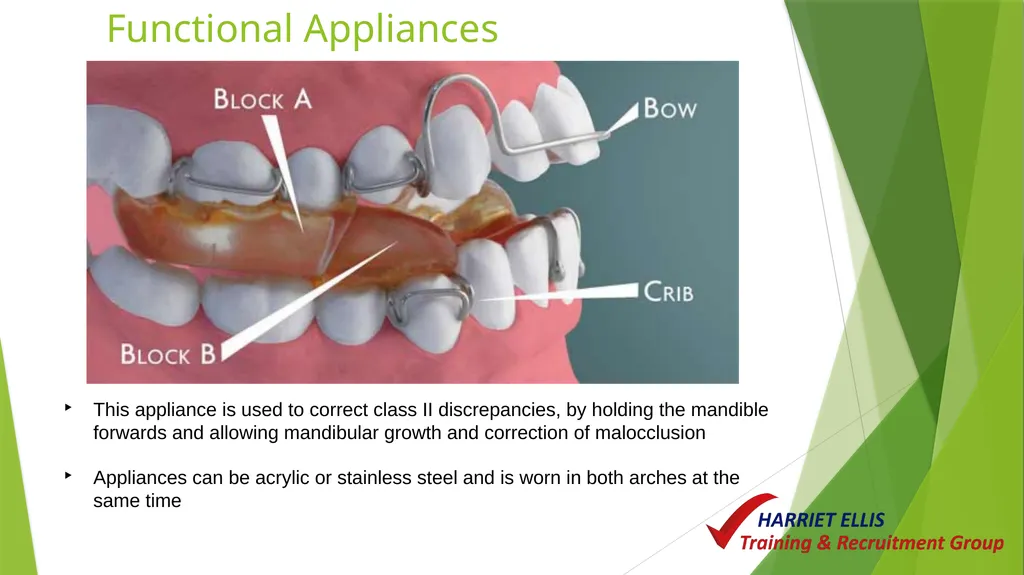
Functional Appliances This appliance is used to correct class II discrepancies, by holding the mandible forwards and allowing mandibular growth and correction of malocclusion
Appliances can be acrylic or stainless steel and is worn in both arches at the same time<br>
20
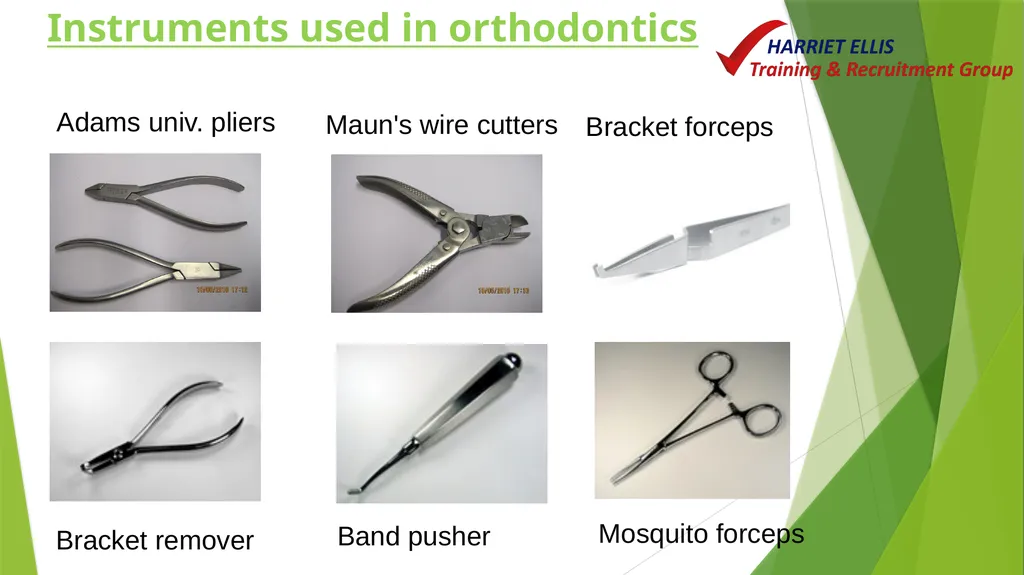
Instruments used in orthodontics Bracket forceps Bracket remover Band pusher Mosquito forceps Adams univ. pliers Maun's wire cutters<br>
21
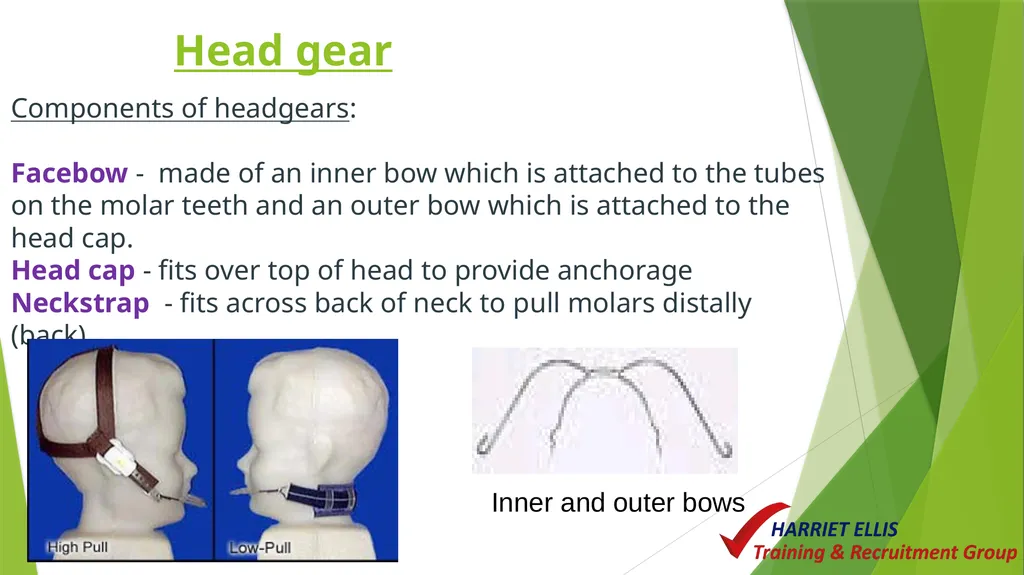
Head gear Components of headgears:
Facebow - made of an inner bow which is attached to the tubes on the molar teeth and an outer bow which is attached to the head cap.
Head cap - fits over top of head to provide anchorage
Neckstrap - fits across back of neck to pull molars distally (back) Inner and outer bows<br>
22
Dental Nurse’s Role during Treatment 1.Prepare patient records.
2.Help with taking and developing of X-rays
3.Mix alginate for study model impressions
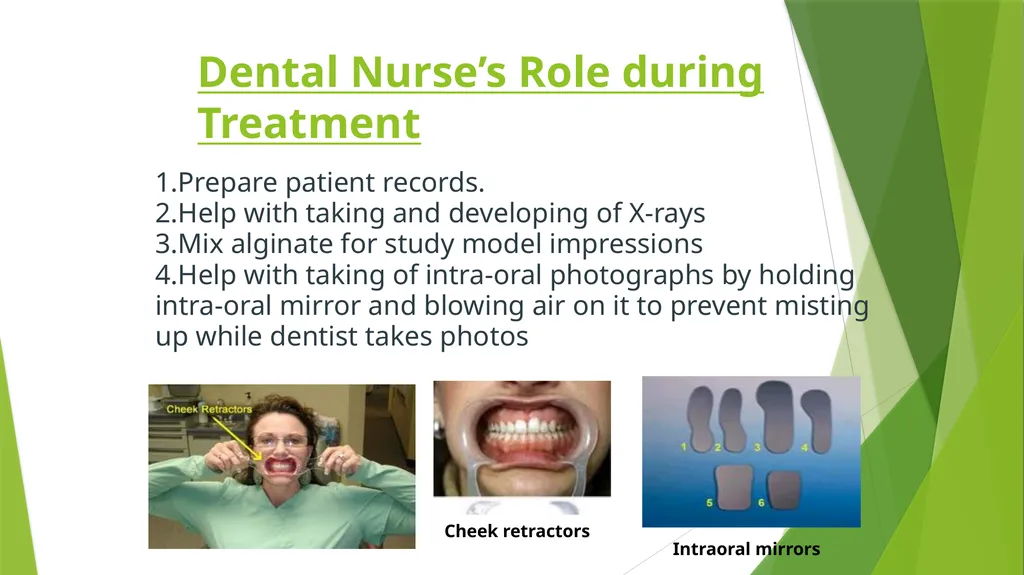
4.Help with taking of intra-oral photographs by holding intra-oral mirror and blowing air on it to prevent misting up while dentist takes photos Cheek retractors Intraoral mirrors<br>
23
Post-operative instructions for fixed appliances Careful manual tooth brushing should be carried out after each meal
Good-quality electric tooth brushes, such as Sonicare and Oral B, may be used instead
Use of fluoridated toothpaste
Daily use of interdental brushes to clean around each bracket individually
Avoidance of cariogenic and acidic food and drinks, for the full period of treatment
Avoidance of sticky foods, for period of treatment
Use of fluoride mouthwash daily, to minimize the risk of decalcification
Regular use of disclosing tablets, to highlight problematic areas where plaque is being retained, to minimize the risk of decalcification<br>
24
Post-operative instructions for removable appliances Wear as directed by the dentist
Clean the appliance and teeth after each meal, using toothbrush and toothpaste
Avoid cariogenic and acidic foods and drinks, as advised
Attend all dental appointments for necessary adjustments
Contact the surgery immediately if any breakages or loss of appliance occur
Expect the appliance to feel tight initially after each adjustment
Contact the surgery if any prolonged or excessive symptoms occur
If the appliance is to be removed for meals, ensure it is placed safely in a rigid container to avoid breakages during mealtimes<br>