
Overview of U.S. Export Compliance Josef Mejido
DP
Published · 29 slides · 0 views

1 / 1
Description
Overview of U.S. Export Compliance Josef Mejido University of Rochester Export Control Officer November 26, 2024 CLASP Big picture export compliance matters to reach out to me about Involvement with a party in an OFAC comprehensively
Related Topics
Share
Embed code
Download this presentation From Below
"Overview of U.S. Export Compliance Josef Mejido" is the property of its rightful owner. Permission is granted to download and print the materials on this website for personal, non-commercial use only, and to display it on your personal computer provided you do not modify the materials and that you retain all copyright notices contained in the materials. By downloading content from our website, you accept the terms of this agreement.
Presentation Transcript
01
Overview of U.S. Export Compliance Josef Mejido
University of Rochester
Export Control Officer November 26, 2024
CLASP<br>
02
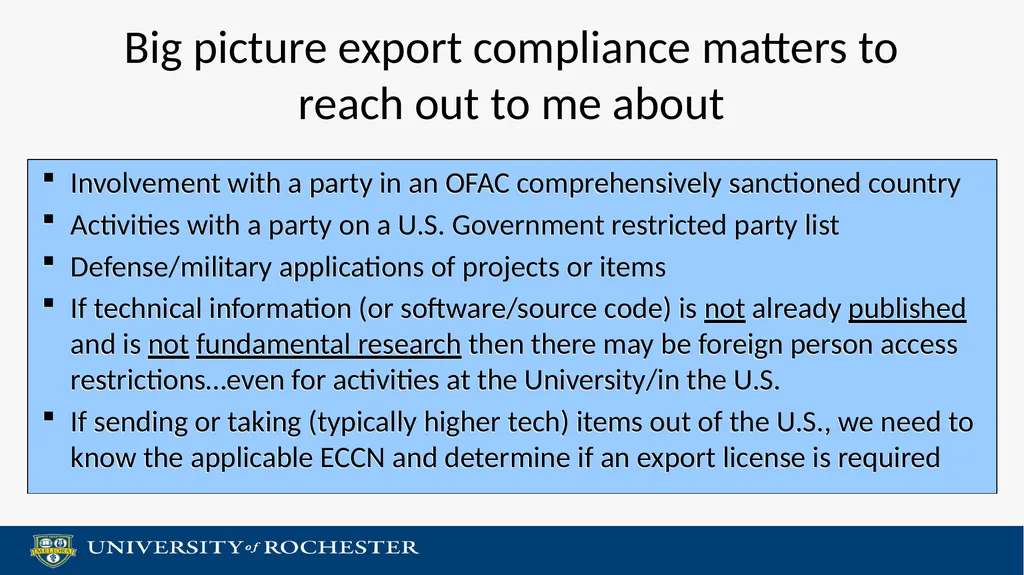
Big picture export compliance matters to reach out to me about Involvement with a party in an OFAC comprehensively sanctioned country
Activities with a party on a U.S. Government restricted party list
Defense/military applications of projects or items
If technical information (or software/source code) is not already published and is not fundamental research then there may be foreign person access restrictions…even for activities at the University/in the U.S.
If sending or taking (typically higher tech) items out of the U.S., we need to know the applicable ECCN and determine if an export license is required<br>
03
U.S. export control laws are primarily based on U.S. national security and foreign policy<br>
04
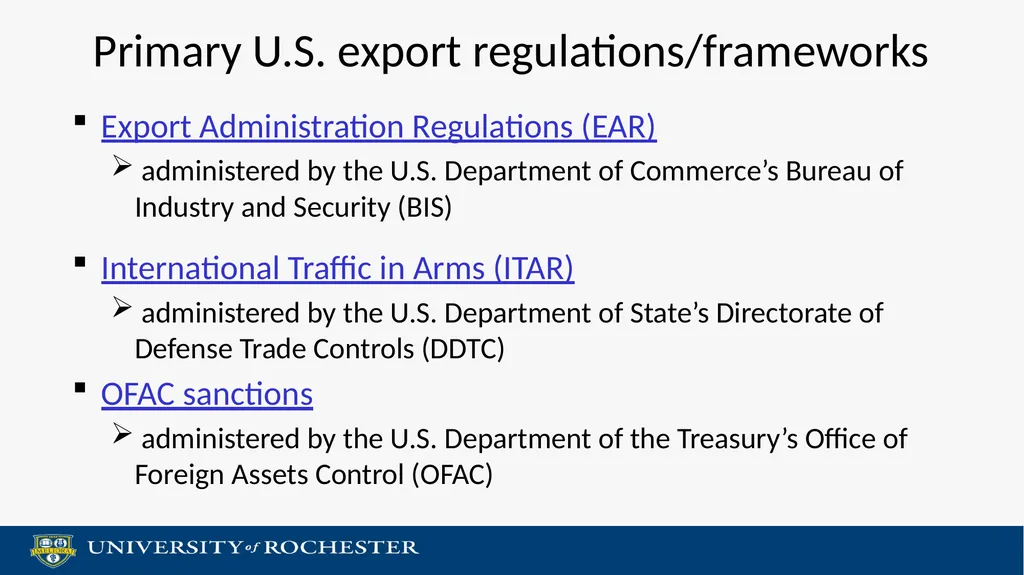
Primary U.S. export regulations/frameworks Export Administration Regulations (EAR)
administered by the U.S. Department of Commerce’s Bureau of Industry and Security (BIS)
International Traffic in Arms (ITAR)
administered by the U.S. Department of State’s Directorate of Defense Trade Controls (DDTC)
OFAC sanctions
administered by the U.S. Department of the Treasury’s Office of Foreign Assets Control (OFAC)<br>
05
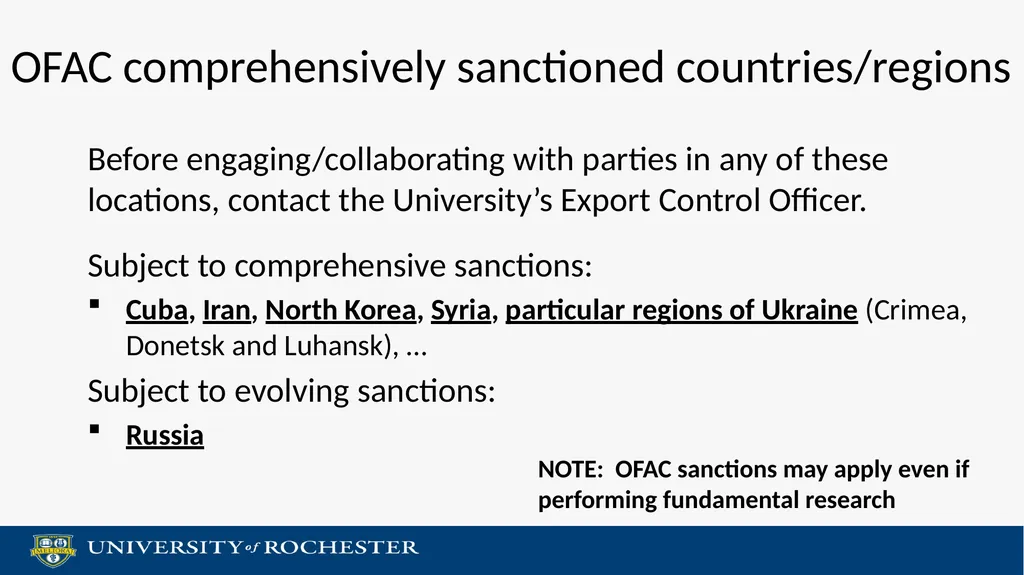
OFAC comprehensively sanctioned countries/regions Before engaging/collaborating with parties in any of these locations, contact the University’s Export Control Officer.
Subject to comprehensive sanctions:
Cuba, Iran, North Korea, Syria, particular regions of Ukraine (Crimea, Donetsk and Luhansk), …
Subject to evolving sanctions:
Russia NOTE: OFAC sanctions may apply even if performing fundamental research<br>
06
Restricted Party Screening Before engaging/collaborating with foreign parties, ensure that such parties are not subject to certain U.S. restrictions related to export compliance or research security
Requests to perform restricted party screening can be sent to the University’s Export Control Officer NOTE: some foreign universities appear on U.S. Government restricted party lists<br>
07
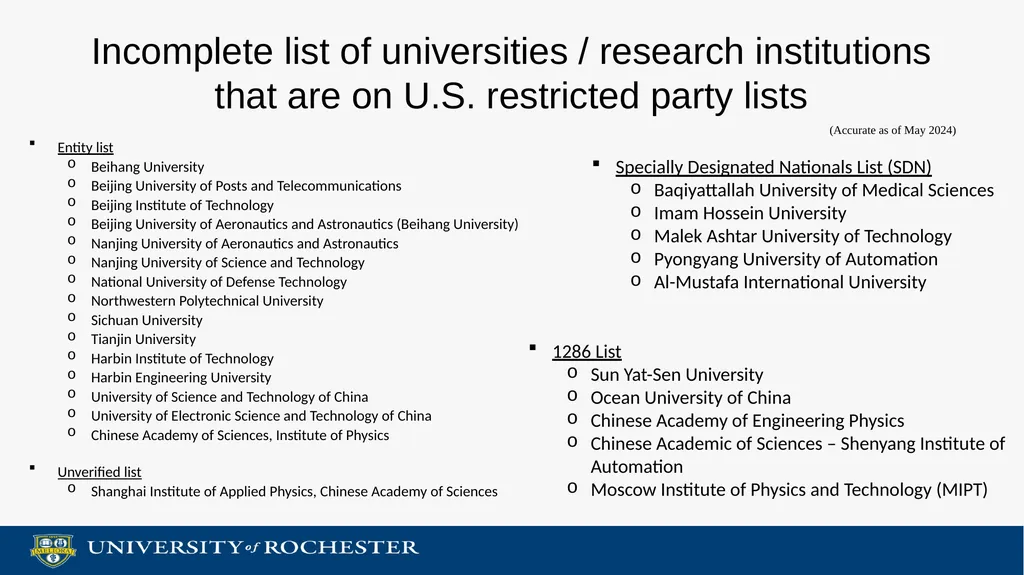
Incomplete list of universities / research institutions that are on U.S. restricted party lists Entity list
Beihang University
Beijing University of Posts and Telecommunications
Beijing Institute of Technology
Beijing University of Aeronautics and Astronautics (Beihang University)
Nanjing University of Aeronautics and Astronautics
Nanjing University of Science and Technology
National University of Defense Technology
Northwestern Polytechnical University
Sichuan University
Tianjin University
Harbin Institute of Technology
Harbin Engineering University
University of Science and Technology of China
University of Electronic Science and Technology of China
Chinese Academy of Sciences, Institute of Physics
Unverified list
Shanghai Institute of Applied Physics, Chinese Academy of Sciences Specially Designated Nationals List (SDN)
Baqiyattallah University of Medical Sciences
Imam Hossein University
Malek Ashtar University of Technology
Pyongyang University of Automation
Al-Mustafa International University (Accurate as of May 2024) 1286 List
Sun Yat-Sen University
Ocean University of China
Chinese Academy of Engineering Physics
Chinese Academic of Sciences – Shenyang Institute of Automation
Moscow Institute of Physics and Technology (MIPT)<br>
08
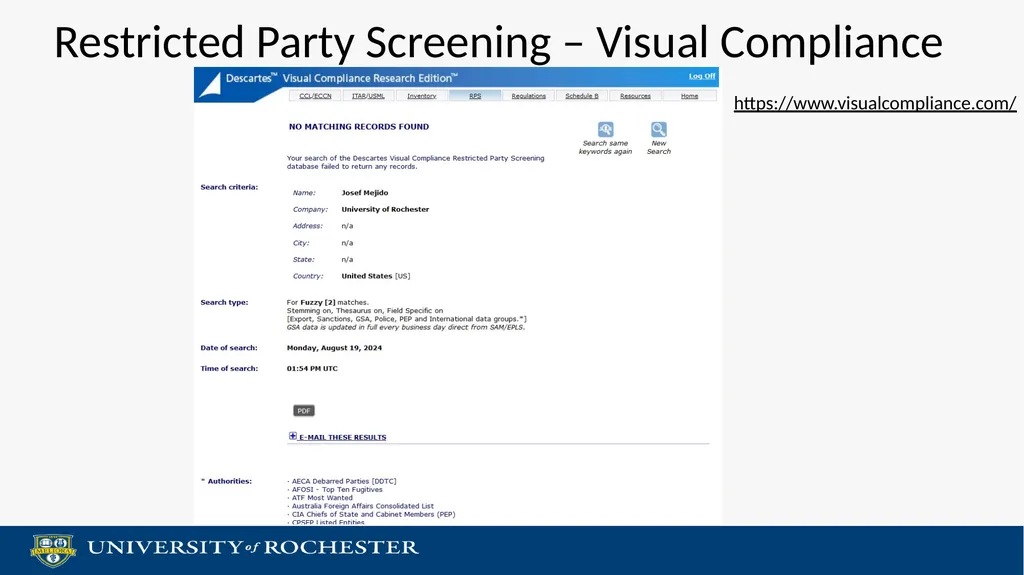
Restricted Party Screening – Visual Compliance https://www.visualcompliance.com/<br>
09
Military end-uses / end-users Contact the University’s Export Control Officer prior to:
engaging with any foreign military;
engaging with any foreign party that performs military/defense work;
Starting projects that have known military/defense applications<br>
10
International Traffic in Arms Regulations (ITAR) The ITAR controls defense articles and defense services
items controlled under the ITAR appear on the U.S. Munition List (USML)
https://www.ecfr.gov/current/title-22/chapter-I/subchapter-M/part-121
Immediately contact Josef Mejido, the University’s Export Control Officer and Chris Deeney, the University’s ITAR Empowered Official and Director at the Laboratory for Laser Energetics if there is any chance that the University may engage in any activity involving the ITAR.
ITAR controlled items and activities are very high risk. See also: Deemed Export Risks – Guidance for the University of Rochester Community<br>
11
“Export” Generally speaking, there are two different types of exports:
(1) An actual shipment or transmission out of the United States, including the sending or taking of an item out of the United States, in any manner;
(2) Releasing or otherwise transferring “technology” or source code (but not object code) to a foreign person in the United States (a “deemed export”);<br>
12
“foreign person” Anyone who is not a:
U.S. citizen
U.S. permanent resident/green card holder
U.S. asylee or refugee<br>
13
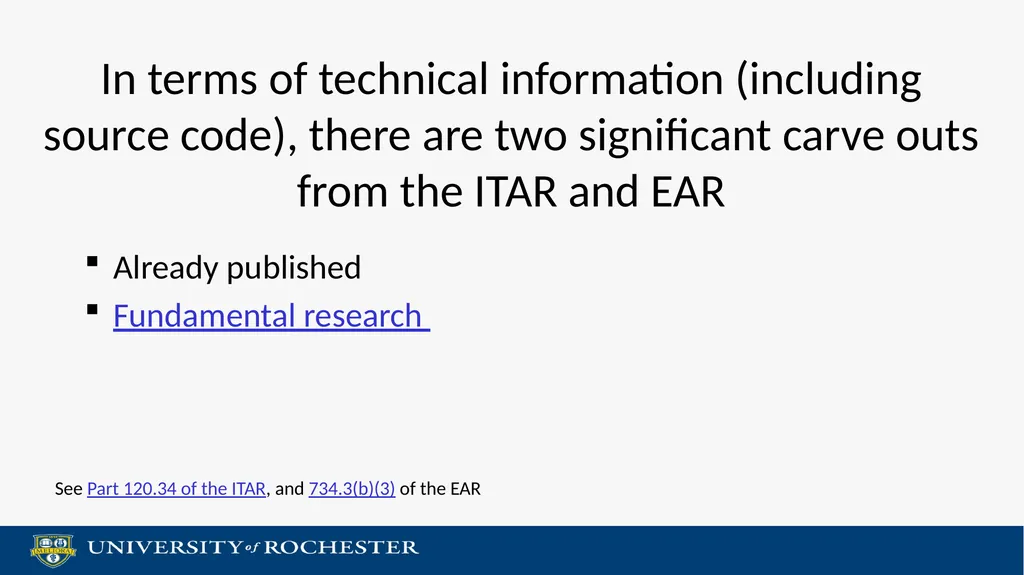
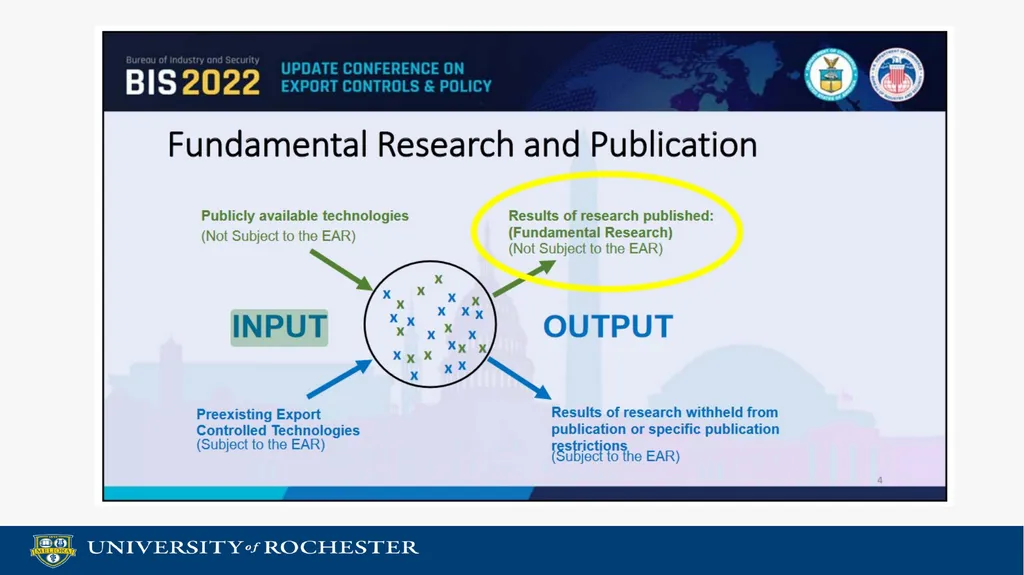
In terms of technical information (including source code), there are two significant carve outs from the ITAR and EAR Already published
Fundamental research See Part 120.34 of the ITAR, and 734.3(b)(3) of the EAR<br>
14
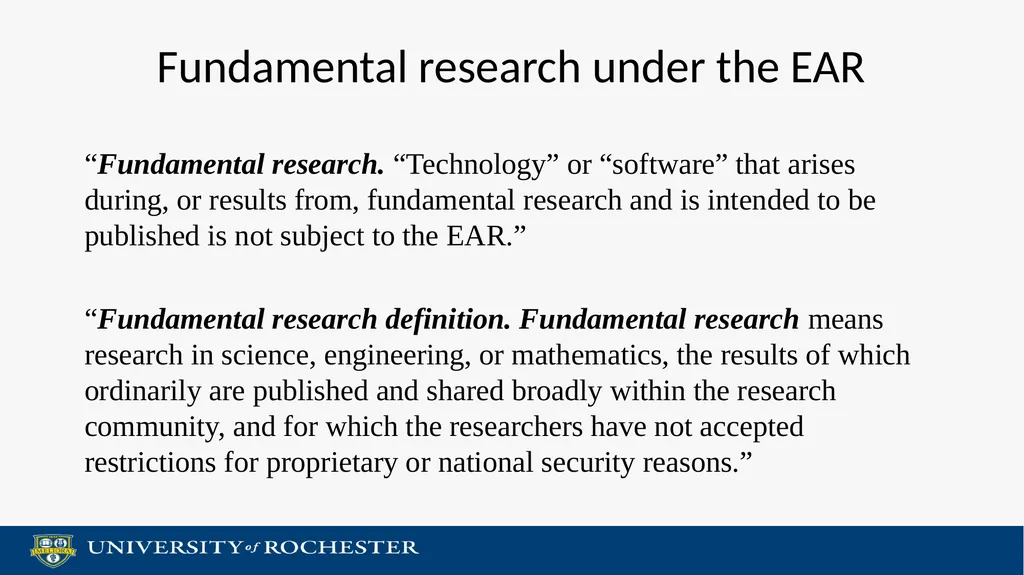
Fundamental research under the EAR “Fundamental research. “Technology” or “software” that arises during, or results from, fundamental research and is intended to be published is not subject to the EAR.”
“Fundamental research definition. Fundamental research means research in science, engineering, or mathematics, the results of which ordinarily are published and shared broadly within the research community, and for which the researchers have not accepted restrictions for proprietary or national security reasons.”<br>
15
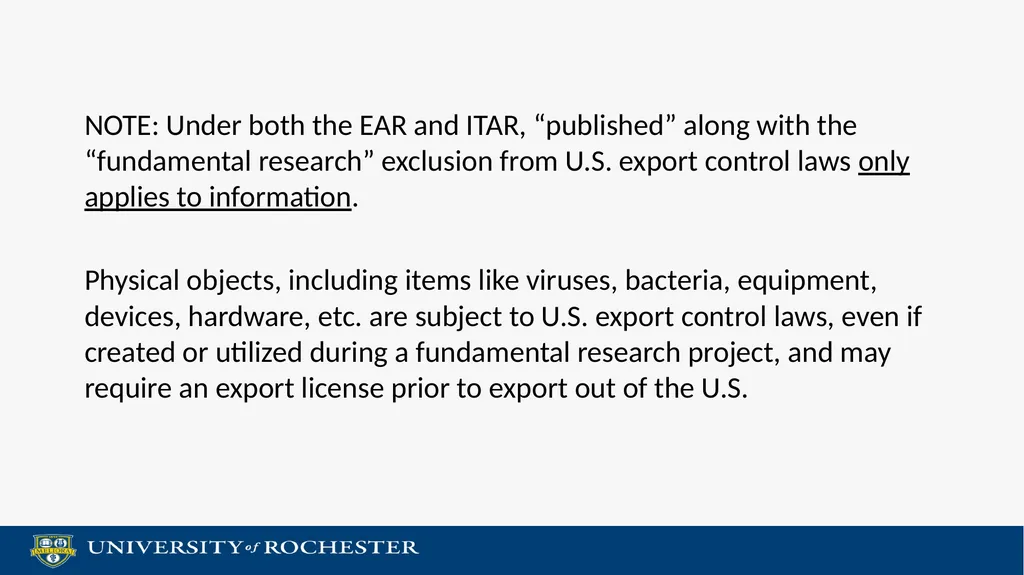
NOTE: Under both the EAR and ITAR, “published” along with the “fundamental research” exclusion from U.S. export control laws only applies to information.
Physical objects, including items like viruses, bacteria, equipment, devices, hardware, etc. are subject to U.S. export control laws, even if created or utilized during a fundamental research project, and may require an export license prior to export out of the U.S.<br>
16
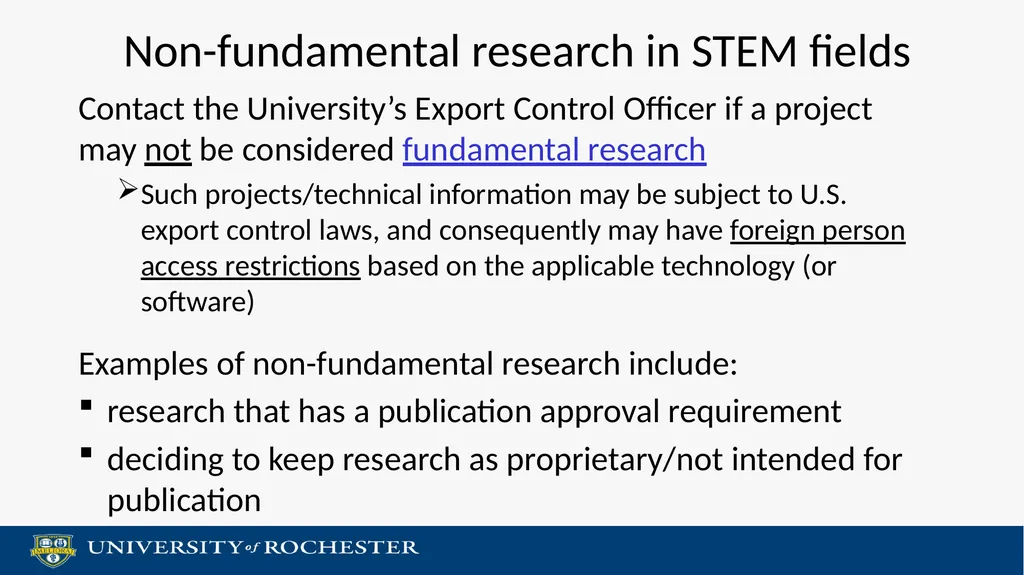
Non-fundamental research in STEM fields Contact the University’s Export Control Officer if a project may not be considered fundamental research
Such projects/technical information may be subject to U.S. export control laws, and consequently may have foreign person access restrictions based on the applicable technology (or software)
Examples of non-fundamental research include:
research that has a publication approval requirement
deciding to keep research as proprietary/not intended for publication<br>
17
Receiving confidential
technical information and/or source code
(even if done in the context of fundamental research Incoming technical information and/or source code to the University may have foreign person access restrictions based on U.S. export control laws
Examples include, receiving technical information or source code that is NOT:
already published; or
the result of fundamental research The University’s Export Control Officer can help make export compliance determinations on these types of potentially controlled inputs coming into the University<br>
18
Technology Control Plans (TCPs) Recommended by both BIS and DDTC for organizations that have export controlled technology and foreign persons.
A TCP outlines procedures for safeguarding such export controlled technical information, and typically includes the following elements:
Management commitment
Personnel screening procedures
Physical security plan
IT security plan
Training and awareness<br>
19
Physical exports Sending, taking, or transmitting an item out of the U.S. may require an export license prior to export.
U.S. export license requirements depend on the item being exported, the destination country, the end user/use, along with the applicable set of U.S. export regulations (e.g. EAR or ITAR)
Please consult with the University’s Export Control Officer prior to exporting items<br>
20
Exports Determine if the item is controlled under the ITAR
If not subject to the ITAR, then determine the applicable Export Control Classification Number (ECCN)
If a U.S. company manufactured/sold the item, then typically our first step is to ask the company for the applicable ECCN<br>
21
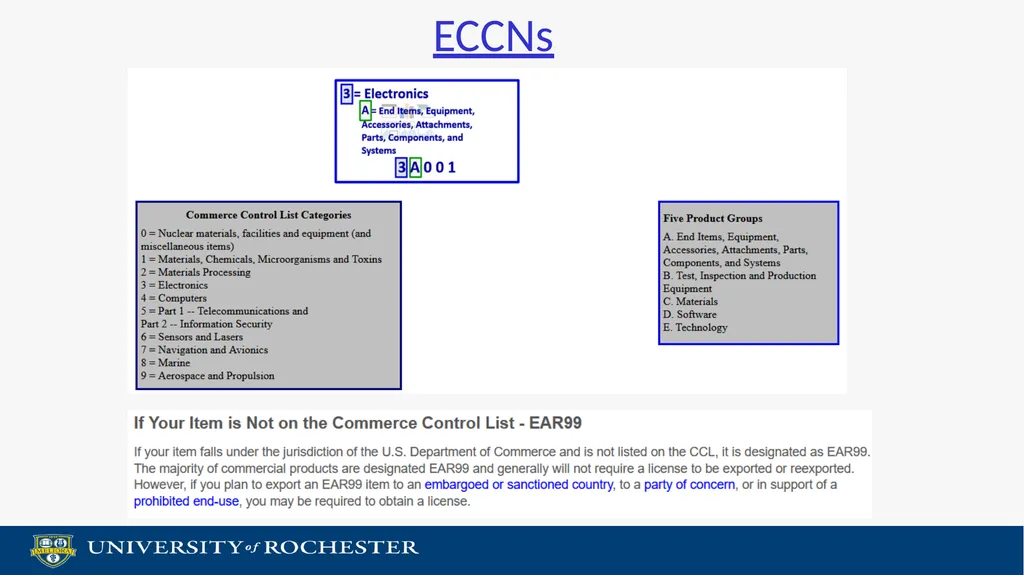
ECCNs<br>
22
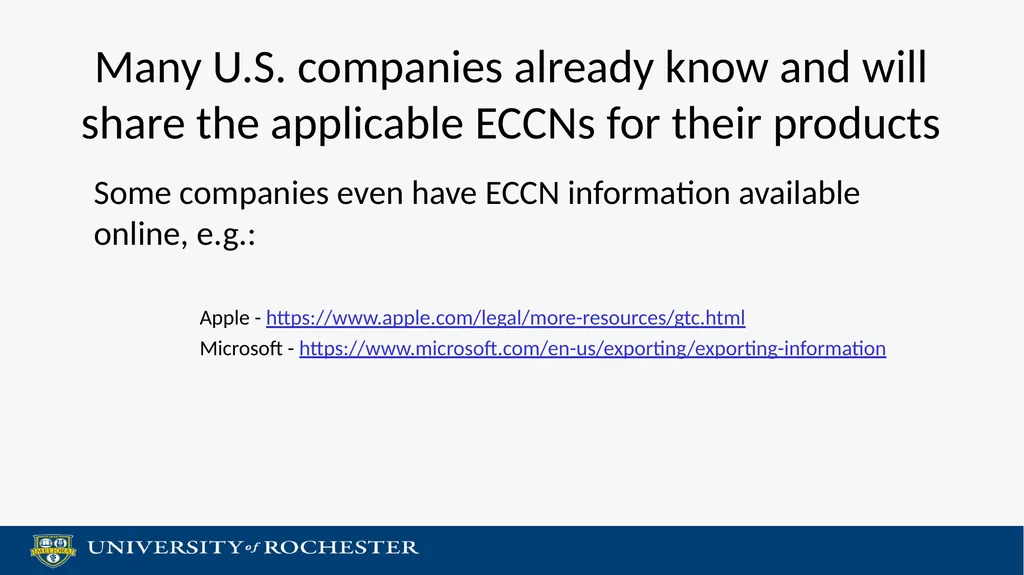
Many U.S. companies already know and will share the applicable ECCNs for their products Some companies even have ECCN information available online, e.g.:
Apple - https://www.apple.com/legal/more-resources/gtc.html
Microsoft - https://www.microsoft.com/en-us/exporting/exporting-information<br>
23
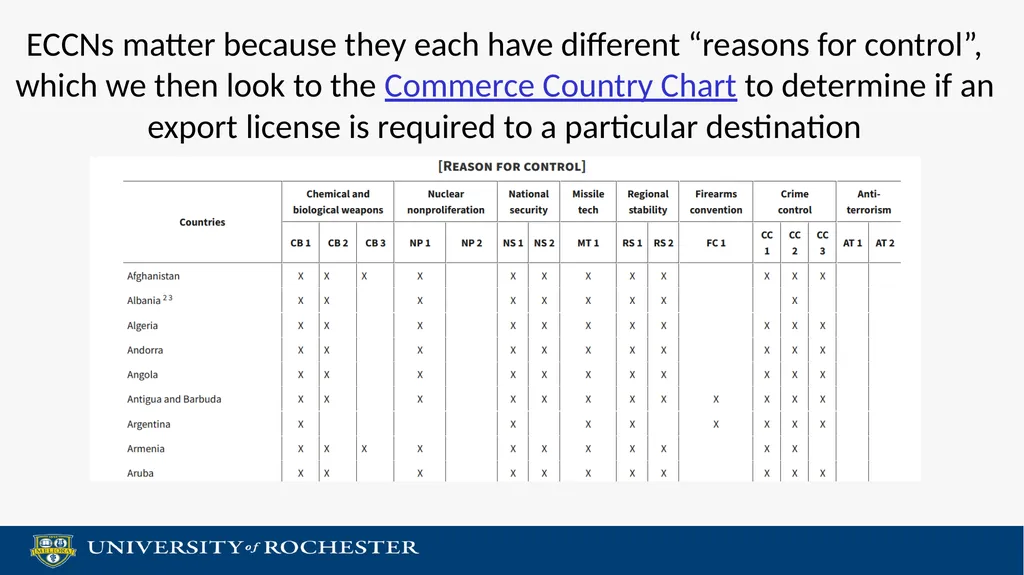
ECCNs matter because they each have different “reasons for control”, which we then look to the Commerce Country Chart to determine if an export license is required to a particular destination<br>
24
International Visitors International visitors to the University can be an export compliance risk.
For example, visitors may themselves be or are associated with a restricted party, may be a citizen of a comprehensively sanctioned country, or may be engaging in research activity that is subject to export control laws.
Please follow the established visitor processes outlined on the University’s U.S. Export Compliance and Research Security page when hosting international visitors<br>
25
Foreign Travel Foreign travel is an export control risk because it may involve:
sending or taking items that have export restrictions,
engaging with restricted parties,
engaging in activities with end-use or end-user restrictions under U.S. export control laws, or
OFAC sanctioned countries or regions.
The University’s Export Control Officer can help determine potential export compliance risks associated with travel to/involving certain destinations and parties. Faculty are strongly encouraged to register travel (individually or completed by department) in the University’s travel registry system.<br>
26
Other U.S. export regulations to consider Nuclear Regulatory Commission (NRC) – “Part 110”
Department of Energy (DOE) – “Part 810”<br>
27
Summary of key points to consider Involvement with an OFAC comprehensively sanctioned country
Will the University be engaging with a restricted party
Defense/military applications, and items/activities subject to the ITAR
If technical information (or software/source code) are not already published or fundamental research, then there may be deemed export risks for activities even done solely in the U.S. at the University
If sending or taking items out of the U.S., determine the applicable ECCN and assess if an export license is required<br>
28
For more detailed University export compliance information, please review:
https://www.rochester.edu/university-research/compliance/research-security/us-export-compliance/
http://www.rochester.edu/orpa/compliance/#export Josef Mejido, M.S., J.D.
Export Control Officer
University of Rochester
josef.mejido@rochester.edu or export@rochester.edu Also, please reach out to me with any export compliance questions<br>