
Paul Coulter www.livingleadership.org How to Help
BR
Published · 52 slides · 0 views

1 / 1











Description
Paul Coulter www.livingleadership.org How to Help People in Need www.livingleadership.orgelf-pastoral-care Paul Coulter www.livingleadership.org Pastoral Care Foundations 1. The Urgent Need for Pastoral Care Is pastoral care important in
Related Topics
Share
Embed code
Download this presentation From Below
"Paul Coulter www.livingleadership.org How to Help" is the property of its rightful owner. Permission is granted to download and print the materials on this website for personal, non-commercial use only, and to display it on your personal computer provided you do not modify the materials and that you retain all copyright notices contained in the materials. By downloading content from our website, you accept the terms of this agreement.
Presentation Transcript
01
Paul Coulter www.livingleadership.org How to Help People in Need<br>
02
www.livingleadership.org/elf-pastoral-care<br>
03
Paul Coulter www.livingleadership.org Pastoral Care Foundations
1. The Urgent Need for Pastoral Care<br>
1. The Urgent Need for Pastoral Care<br>
04
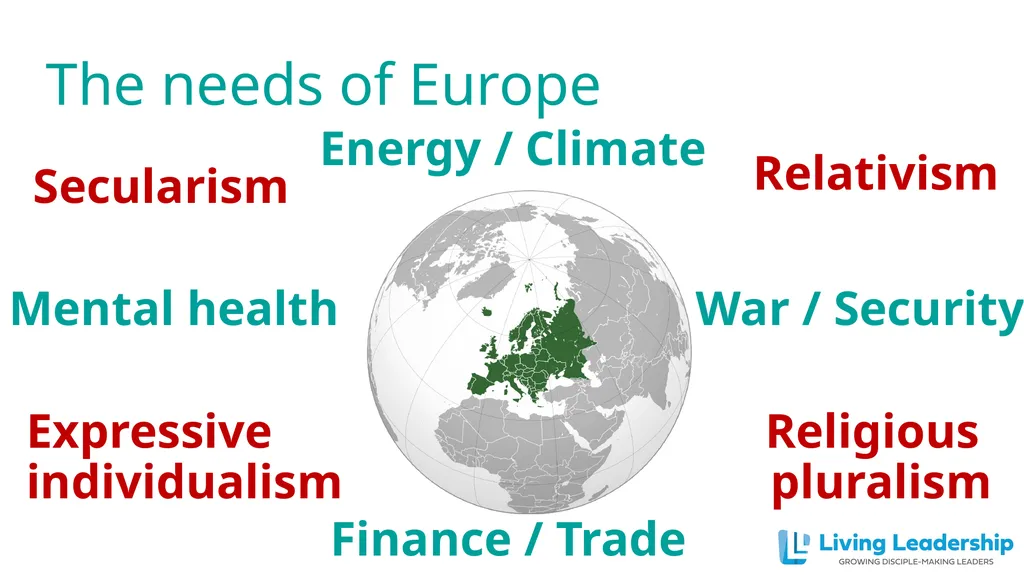
Is pastoral care important in the modern mission field of Europe?<br>
05
The needs of Europe Secularism Religious
pluralism Expressive
individualism Relativism Energy / Climate Mental health War / Security Finance / Trade<br>
pluralism Expressive
individualism Relativism Energy / Climate Mental health War / Security Finance / Trade<br>
06
Care Pastoral What is ?<br>
07
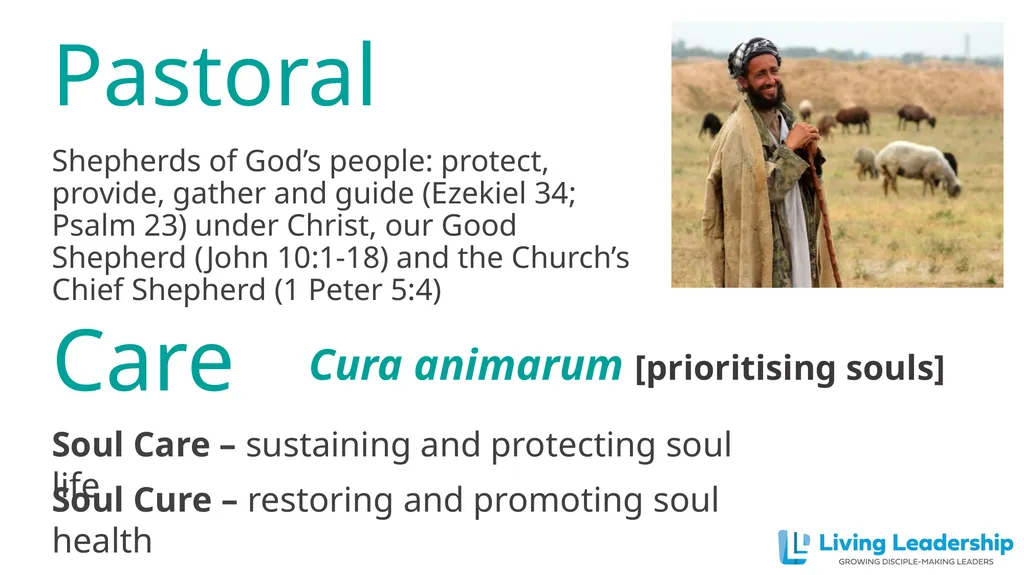
Care Shepherds of God’s people: protect, provide, gather and guide (Ezekiel 34; Psalm 23) under Christ, our Good Shepherd (John 10:1-18) and the Church’s Chief Shepherd (1 Peter 5:4) Cura animarum [prioritising souls] Pastoral Soul Care – sustaining and protecting soul life Soul Cure – restoring and promoting soul health<br>
08
Gospel-shaped people
responding to gospel-shaped needs
with gospel-shaped help
Disciple-making in specific needs
The gospel defines needs, health and help Gospel-shaped pastoral care?<br>
responding to gospel-shaped needs
with gospel-shaped help
Disciple-making in specific needs
The gospel defines needs, health and help Gospel-shaped pastoral care?<br>
09
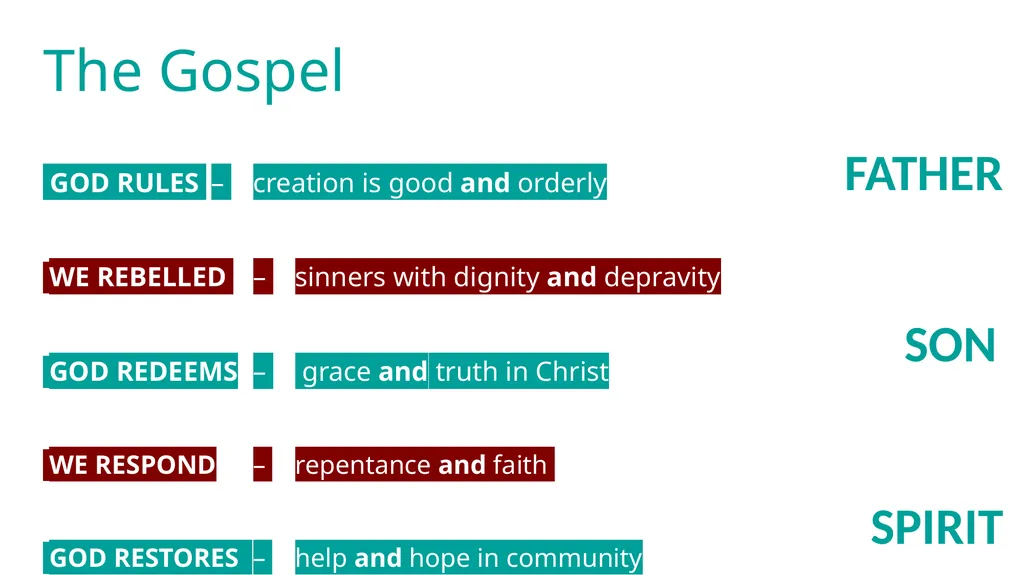
The Gospel GOD RULES – creation is good and orderly
WE REBELLED – sinners with dignity and depravity
GOD REDEEMS – grace and truth in Christ
WE RESPOND – repentance and faith
GOD RESTORES – help and hope in community FATHER SON SPIRIT<br>
WE REBELLED – sinners with dignity and depravity
GOD REDEEMS – grace and truth in Christ
WE RESPOND – repentance and faith
GOD RESTORES – help and hope in community FATHER SON SPIRIT<br>
10
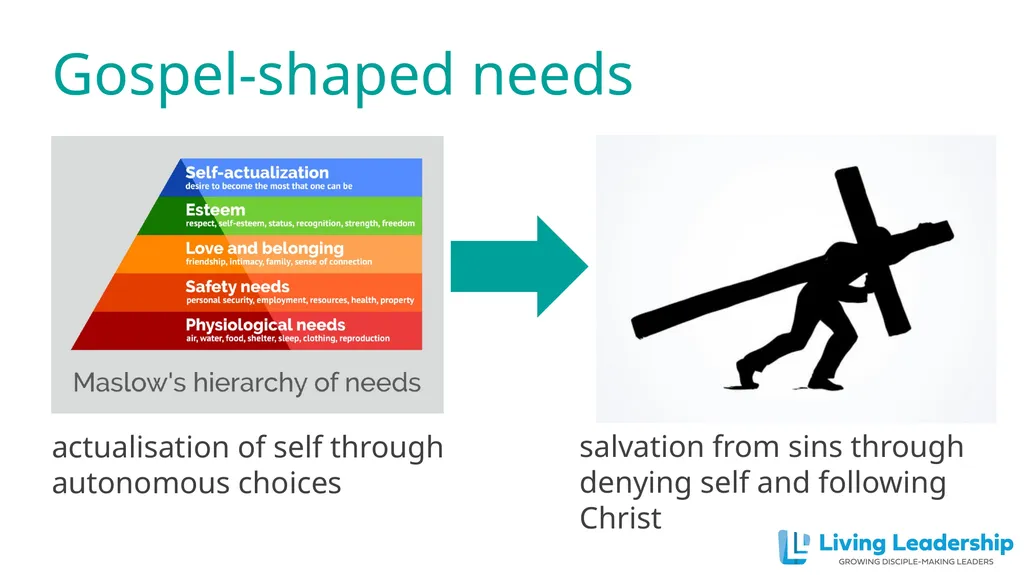
Gospel-shaped needs actualisation of self through autonomous choices salvation from sins through
denying self and following Christ<br>
denying self and following Christ<br>
11
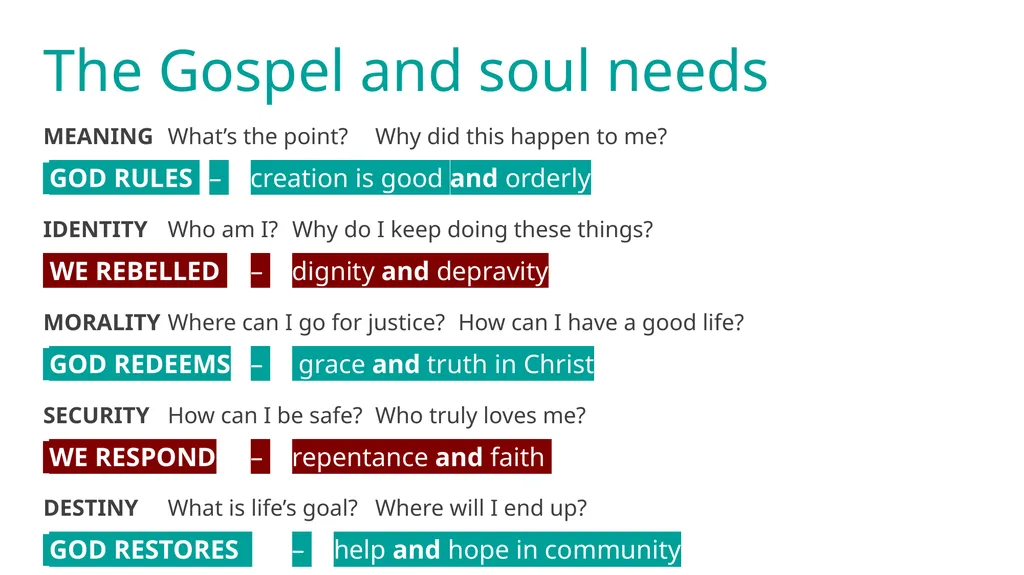
The Gospel and soul needs MEANING What’s the point? Why did this happen to me?
GOD RULES – creation is good and orderly
IDENTITY Who am I? Why do I keep doing these things?
WE REBELLED – dignity and depravity
MORALITY Where can I go for justice? How can I have a good life?
GOD REDEEMS – grace and truth in Christ
SECURITY How can I be safe? Who truly loves me?
WE RESPOND – repentance and faith
DESTINY What is life’s goal? Where will I end up?
GOD RESTORES – help and hope in community<br>
12
Gospel-shaped health (now & future) Organ systems in harmony as God designed and bodies offered to God Thoughts and emotions aligned with truth so we think and feel with Christ Honouring and loving, submitting and leading under Christ in love for good<br>
13
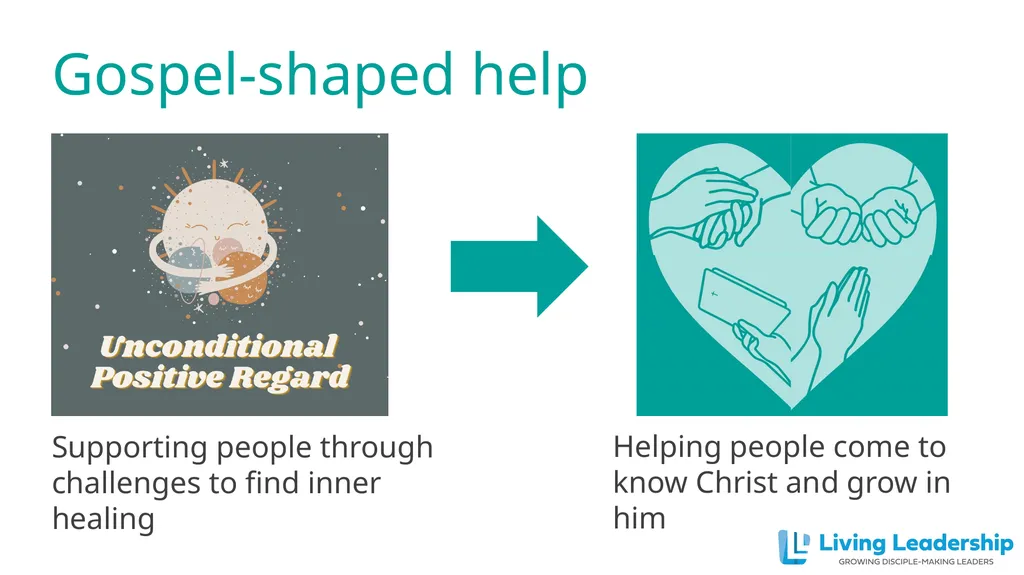
Gospel-shaped help Supporting people through challenges to find inner healing Helping people come to know Christ and grow in him<br>
14
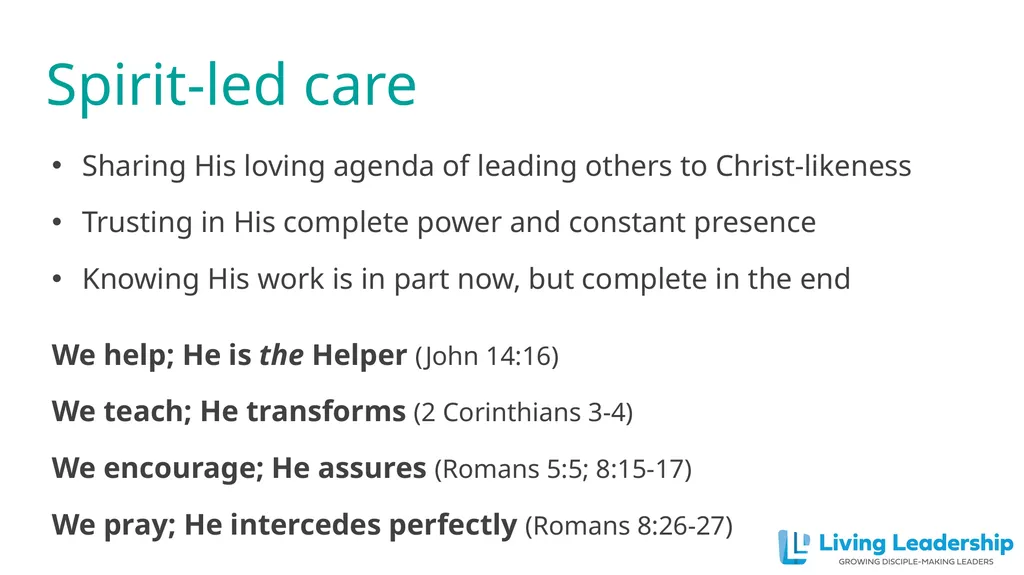
Spirit-led care Sharing His loving agenda of leading others to Christ-likeness
Trusting in His complete power and constant presence
Knowing His work is in part now, but complete in the end
We help; He is the Helper (John 14:16)
We teach; He transforms (2 Corinthians 3-4)
We encourage; He assures (Romans 5:5; 8:15-17)
We pray; He intercedes perfectly (Romans 8:26-27)<br>
Trusting in His complete power and constant presence
Knowing His work is in part now, but complete in the end
We help; He is the Helper (John 14:16)
We teach; He transforms (2 Corinthians 3-4)
We encourage; He assures (Romans 5:5; 8:15-17)
We pray; He intercedes perfectly (Romans 8:26-27)<br>
15
Paul Coulter www.livingleadership.org Pastoral Care Foundations
2. Gospel-Shaped Help<br>
2. Gospel-Shaped Help<br>
16
Gospel-shaped help<br>
17
Speaking to God on behalf of people Intercession Instruction Speaking to people on behalf of God Presence Provision Representing God to people SOUL CARE SOUL CURE<br>
18
Presence “a physical sign of the gracious presence of the triune God”
Dietrich Bonhoeffer (1954) Life Together, trans. by John W. Doberstein. San Francisco: HarperOne. p.20
Intentional – unhurried, undistracted, unshockable
Integral – body, words, emotions, silences, self-aware
Interactive – questions, feedback, summarising
Interpretive – discerningly identifying soul needs
Appropriate touch?<br>
19
Provision “it is part of the discipline of humility that we must not spare our hand where it can perform a service”
Dietrich Bonhoeffer (1954) Life Together, trans. by John W. Doberstein. San Francisco: HarperOne. p.99
Modelled by Christ, practised in Acts, commanded in epistles (e.g., 1 John 3 v17)
Integral mission of deeds and words
Roles of Church / State / Charities?
How long and what form?<br>
Dietrich Bonhoeffer (1954) Life Together, trans. by John W. Doberstein. San Francisco: HarperOne. p.99
Modelled by Christ, practised in Acts, commanded in epistles (e.g., 1 John 3 v17)
Integral mission of deeds and words
Roles of Church / State / Charities?
How long and what form?<br>
20
Intercession “spiritual love will speak to Christ about a brother more than to a brother about Christ”
Dietrich Bonhoeffer (1954) Life Together, trans. by John W. Doberstein. San Francisco: HarperOne. p.36
“Our Father” – joining Son & Spirit in God’s will
Specific petitions; Scriptural priorities
Changing us and involving us in God’s work
Bridging from listening to instruction<br>
Dietrich Bonhoeffer (1954) Life Together, trans. by John W. Doberstein. San Francisco: HarperOne. p.36
“Our Father” – joining Son & Spirit in God’s will
Specific petitions; Scriptural priorities
Changing us and involving us in God’s work
Bridging from listening to instruction<br>
21
Instruction “It is unchristian consciously to deprive another of the one decisive service we can render him”
Dietrich Bonhoeffer (1954) Life Together, trans. by John W. Doberstein. San Francisco: HarperOne. p.105
Reshaping stories around Christ
Exposing sin and encouraging faith(fulness)
God’s word versus our wisdom
Respecting conscience – not imposting<br>
Dietrich Bonhoeffer (1954) Life Together, trans. by John W. Doberstein. San Francisco: HarperOne. p.105
Reshaping stories around Christ
Exposing sin and encouraging faith(fulness)
God’s word versus our wisdom
Respecting conscience – not imposting<br>
22
The challenge of instruction Instruction is challenging :
Cultural – individual autonomy, self-actualisation, the ‘right’ not to be offended
Confidence – will I get it wrong or mishandle Scripture, and do I have the right?
Cost – will the relationship be lost and will it cause more harm than good?
Instruction is vital :
“Nothing can be more cruel than the tenderness that consigns another to his sin. Nothing can be more compassionate than the severe rebuke that calls a brother back from the path of sin.” Dietrich Bonhoeffer (1954) Life Together.
For even if I made you grieve with my letter, I do not regret it […]. For godly grief produces a repentance that leads to salvation without regret, whereas worldly grief produces death. 2 Corinthians 7:8-10<br>
23
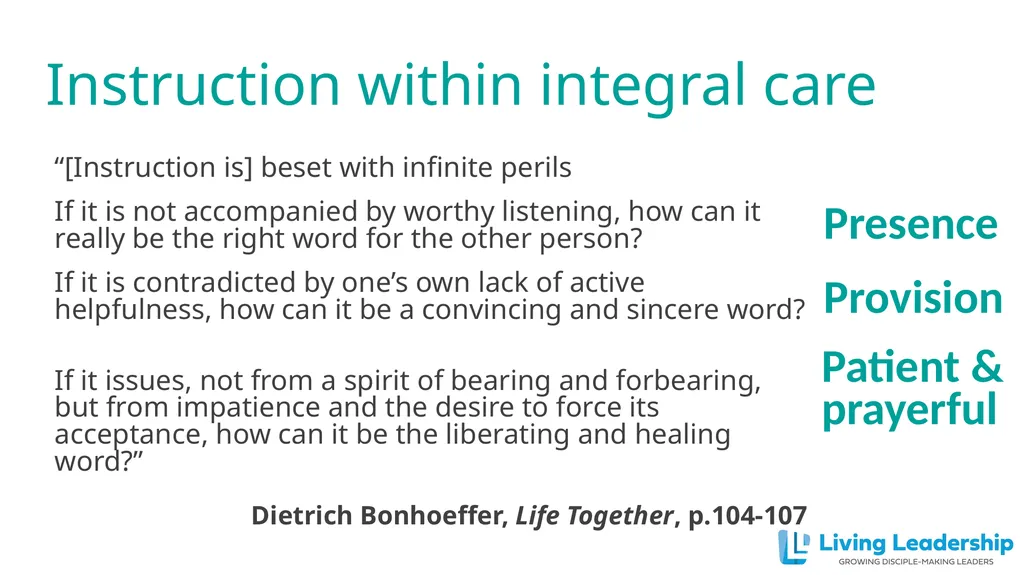
Instruction within integral care “[Instruction is] beset with infinite perils
If it is not accompanied by worthy listening, how can it really be the right word for the other person?
If it is contradicted by one’s own lack of active helpfulness, how can it be a convincing and sincere word?
If it issues, not from a spirit of bearing and forbearing, but from impatience and the desire to force its acceptance, how can it be the liberating and healing word?”
Dietrich Bonhoeffer, Life Together, p.104-107 Presence Provision Patient &
prayerful<br>
24
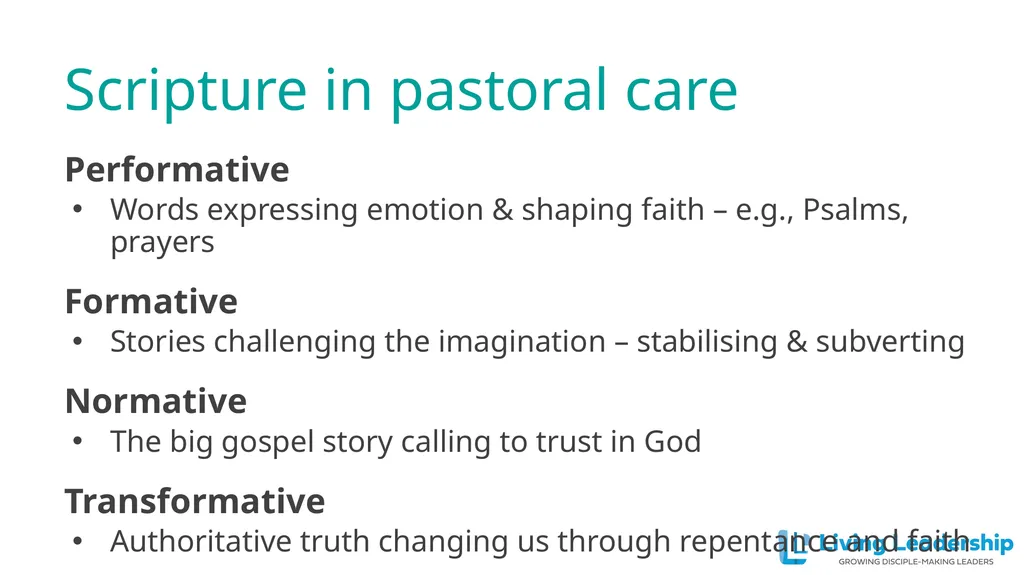
Scripture in pastoral care Performative
Words expressing emotion & shaping faith – e.g., Psalms, prayers
Formative
Stories challenging the imagination – stabilising & subverting
Normative
The big gospel story calling to trust in God
Transformative
Authoritative truth changing us through repentance and faith<br>
Words expressing emotion & shaping faith – e.g., Psalms, prayers
Formative
Stories challenging the imagination – stabilising & subverting
Normative
The big gospel story calling to trust in God
Transformative
Authoritative truth changing us through repentance and faith<br>
25
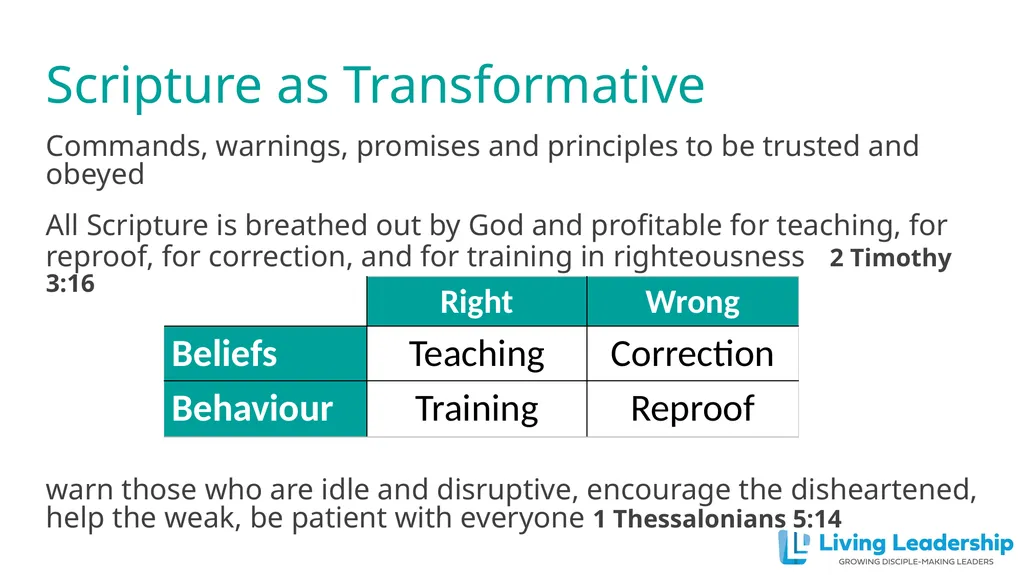
Scripture as Transformative Commands, warnings, promises and principles to be trusted and obeyed
All Scripture is breathed out by God and profitable for teaching, for reproof, for correction, and for training in righteousness 2 Timothy 3:16
warn those who are idle and disruptive, encourage the disheartened, help the weak, be patient with everyone 1 Thessalonians 5:14<br>
All Scripture is breathed out by God and profitable for teaching, for reproof, for correction, and for training in righteousness 2 Timothy 3:16
warn those who are idle and disruptive, encourage the disheartened, help the weak, be patient with everyone 1 Thessalonians 5:14<br>
26
Paul Coulter www.livingleadership.org Pastoral Care Foundations
3. Gospel-Shaped People<br>
3. Gospel-Shaped People<br>
27
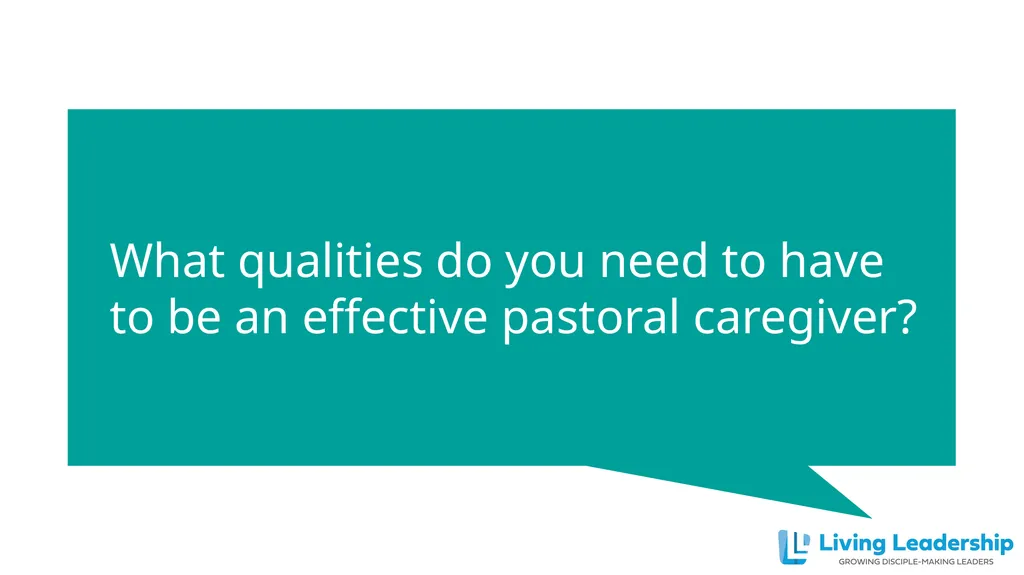
What qualities do you need to have to be an effective pastoral caregiver?<br>
28
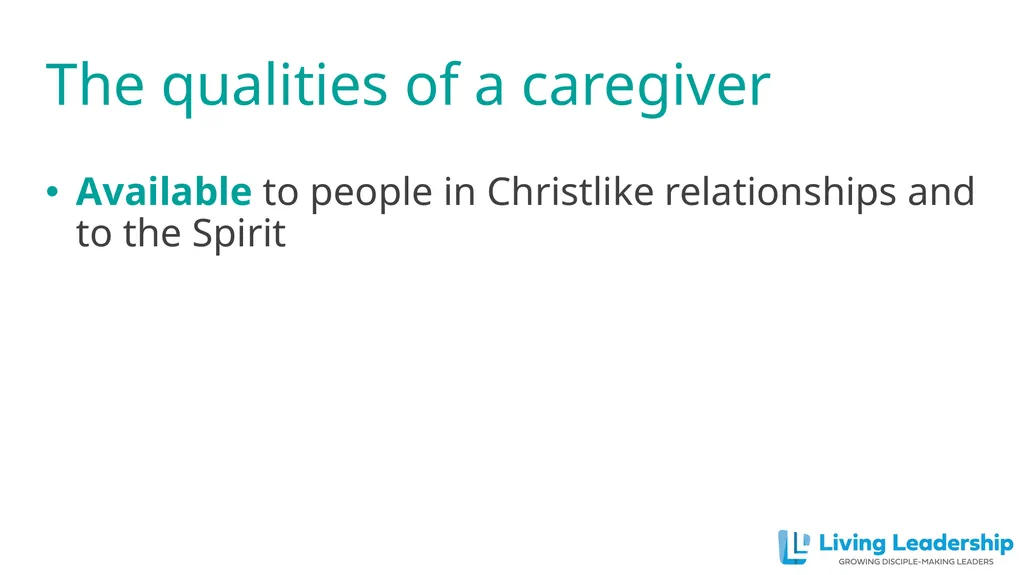
The qualities of a caregiver Available to people in Christlike relationships and to the Spirit<br>
29
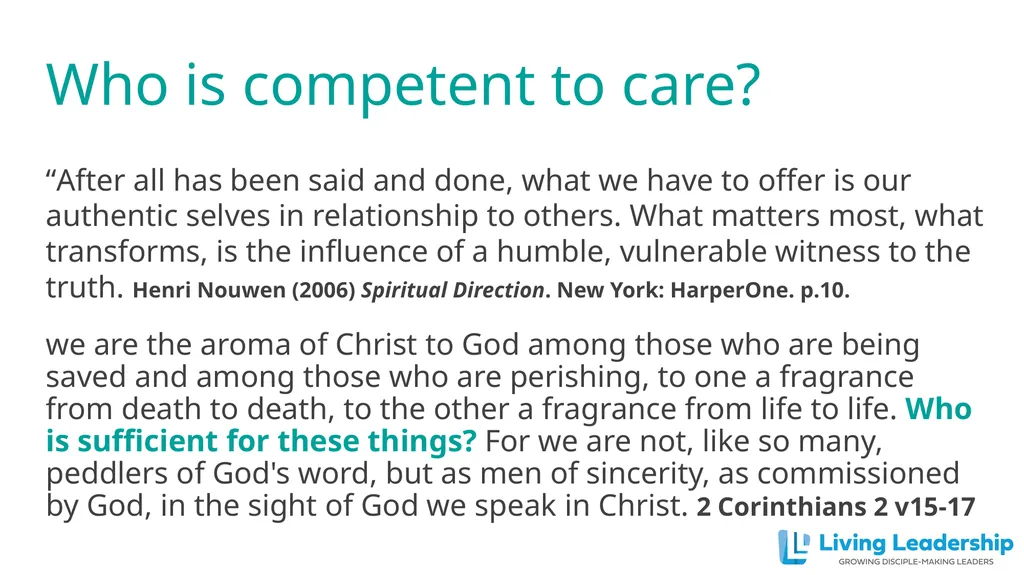
Who is competent to care? “After all has been said and done, what we have to offer is our authentic selves in relationship to others. What matters most, what transforms, is the influence of a humble, vulnerable witness to the truth. Henri Nouwen (2006) Spiritual Direction. New York: HarperOne. p.10.
we are the aroma of Christ to God among those who are being saved and among those who are perishing, to one a fragrance from death to death, to the other a fragrance from life to life. Who is sufficient for these things? For we are not, like so many, peddlers of God's word, but as men of sincerity, as commissioned by God, in the sight of God we speak in Christ. 2 Corinthians 2 v15-17<br>
we are the aroma of Christ to God among those who are being saved and among those who are perishing, to one a fragrance from death to death, to the other a fragrance from life to life. Who is sufficient for these things? For we are not, like so many, peddlers of God's word, but as men of sincerity, as commissioned by God, in the sight of God we speak in Christ. 2 Corinthians 2 v15-17<br>
30
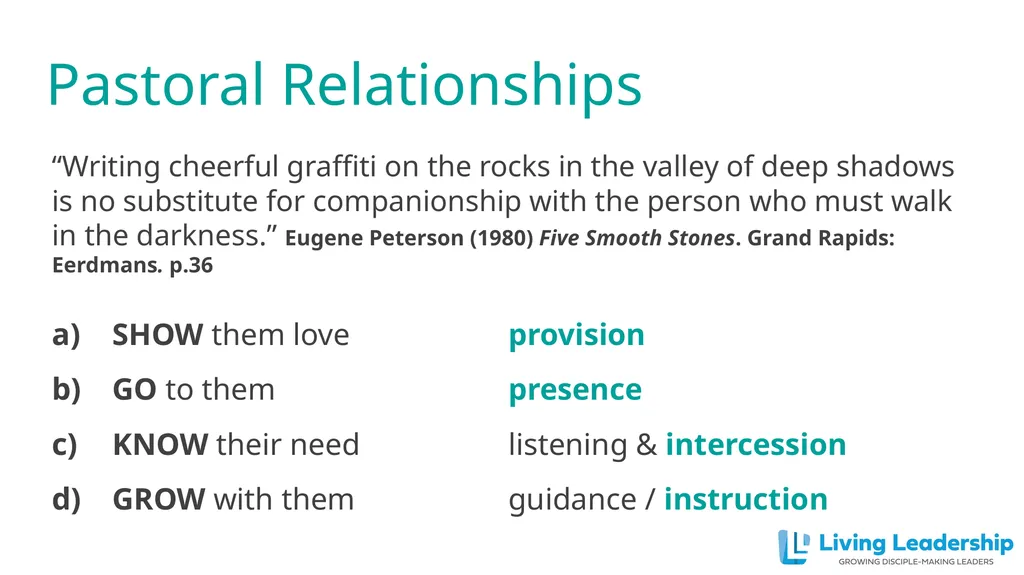
Pastoral Relationships “Writing cheerful graffiti on the rocks in the valley of deep shadows is no substitute for companionship with the person who must walk in the darkness.” Eugene Peterson (1980) Five Smooth Stones. Grand Rapids: Eerdmans. p.36
SHOW them love provision
GO to them presence
KNOW their need listening & intercession
GROW with them guidance / instruction<br>
SHOW them love provision
GO to them presence
KNOW their need listening & intercession
GROW with them guidance / instruction<br>
31
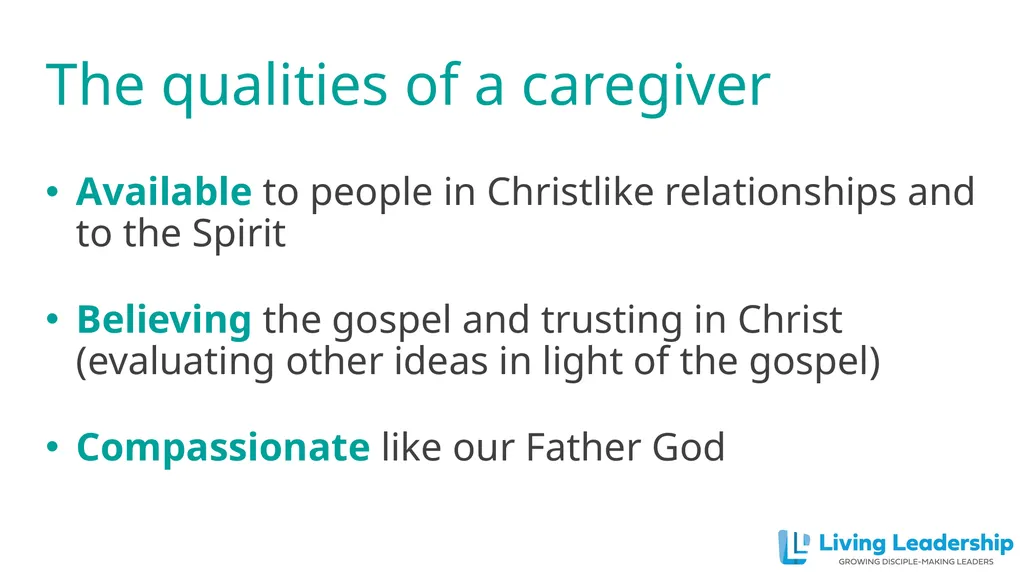
The qualities of a caregiver Available to people in Christlike relationships and to the Spirit
Believing the gospel and trusting in Christ (evaluating other ideas in light of the gospel)
Compassionate like our Father God<br>
Believing the gospel and trusting in Christ (evaluating other ideas in light of the gospel)
Compassionate like our Father God<br>
32
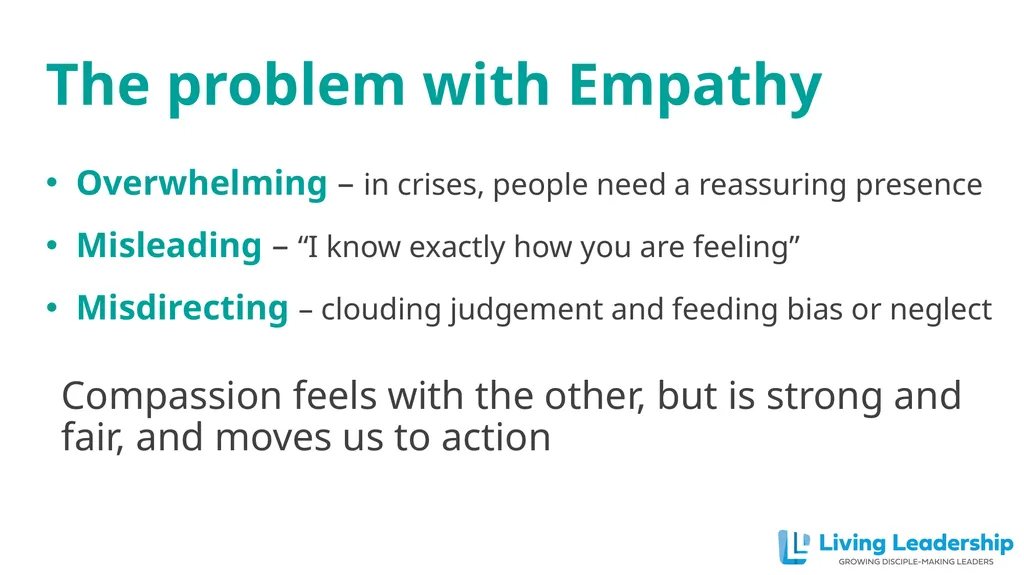
The problem with Empathy Overwhelming – in crises, people need a reassuring presence
Misleading – “I know exactly how you are feeling”
Misdirecting – clouding judgement and feeding bias or neglect
Compassion feels with the other, but is strong and fair, and moves us to action<br>
Misleading – “I know exactly how you are feeling”
Misdirecting – clouding judgement and feeding bias or neglect
Compassion feels with the other, but is strong and fair, and moves us to action<br>
33
Paul Coulter www.livingleadership.org Pastoral Care Foundations
4. Creating Caring Communities<br>
4. Creating Caring Communities<br>
34
How can you make sure everyone is well cared for in your church?<br>
35
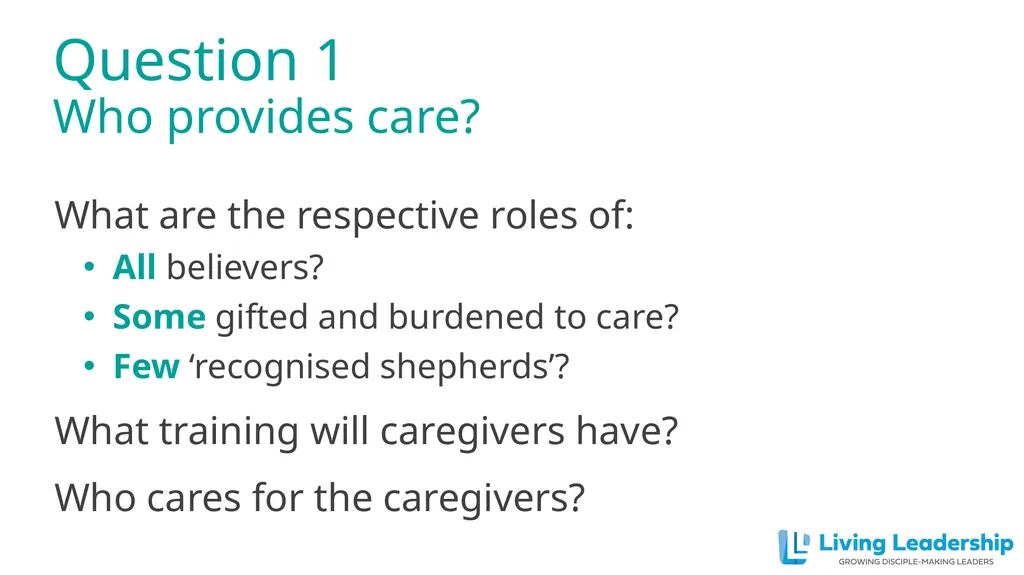
Question 1
Who provides care? What are the respective roles of:
All believers?
Some gifted and burdened to care?
Few ‘recognised shepherds’?
What training will caregivers have?
Who cares for the caregivers?<br>
All believers?
Some gifted and burdened to care?
Few ‘recognised shepherds’?
What training will caregivers have?
Who cares for the caregivers?<br>
36
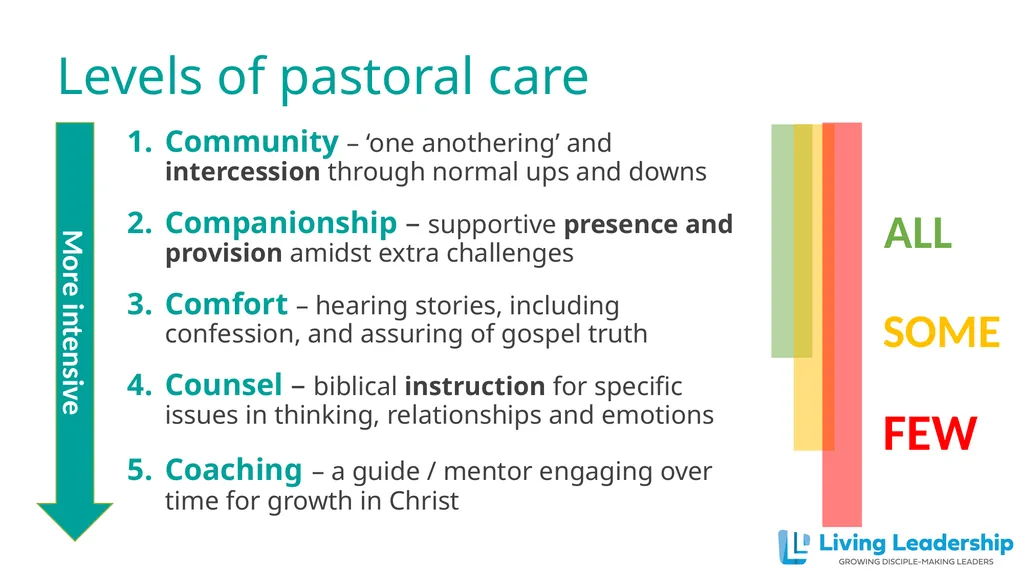
Levels of pastoral care Community – ‘one anothering’ and intercession through normal ups and downs
Companionship – supportive presence and provision amidst extra challenges
Comfort – hearing stories, including confession, and assuring of gospel truth
Counsel – biblical instruction for specific issues in thinking, relationships and emotions
Coaching – a guide / mentor engaging over time for growth in Christ More intensive ALL SOME FEW<br>
37
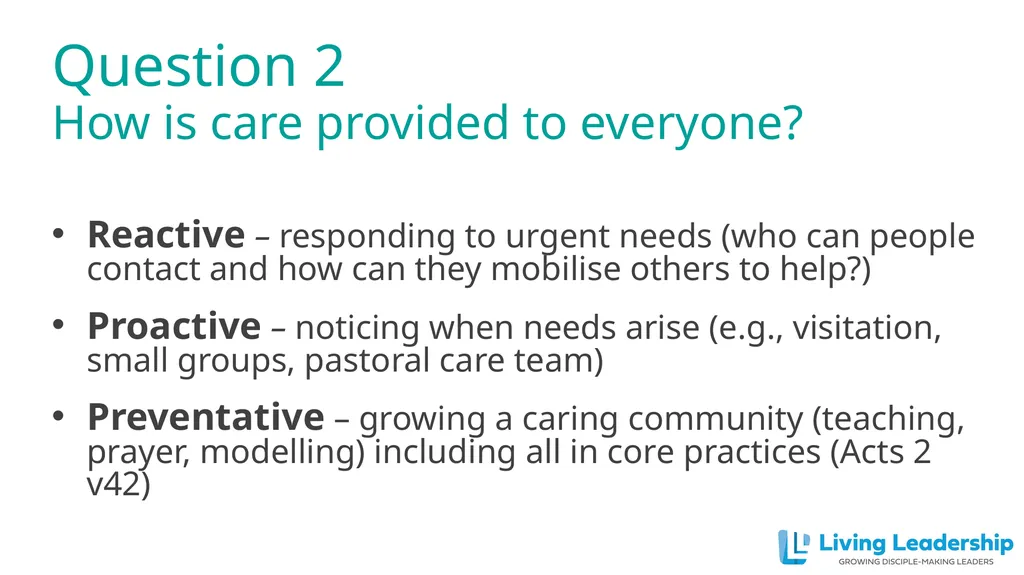
Question 2
How is care provided to everyone? Reactive – responding to urgent needs (who can people contact and how can they mobilise others to help?)
Proactive – noticing when needs arise (e.g., visitation, small groups, pastoral care team)
Preventative – growing a caring community (teaching, prayer, modelling) including all in core practices (Acts 2 v42)<br>
Proactive – noticing when needs arise (e.g., visitation, small groups, pastoral care team)
Preventative – growing a caring community (teaching, prayer, modelling) including all in core practices (Acts 2 v42)<br>
38
Church: a community of … Love – intimacy and vulnerability, secure in God’s love
Faith – trusting acceptance of mutual contributions
“It is not the experience of Christian brotherhood, but solid and certain faith in brotherhood that holds us together. […] We are bound together by faith, not by experience.” Dietrich Bonhoeffer (1954) Life Together. San Francisco: HarperOne. p.39.
Hope – patient endurance through weakness and disappointment
“a healing community not because wounds are cured and pains are alleviated, but because wounds and pains become openings or occasions for a new vision. […] sharing weakness becomes a reminder to one and all of the coming strength.” Henri Nouwen (1994) The Wounded Healer. London: DLT. P.94.<br>
39
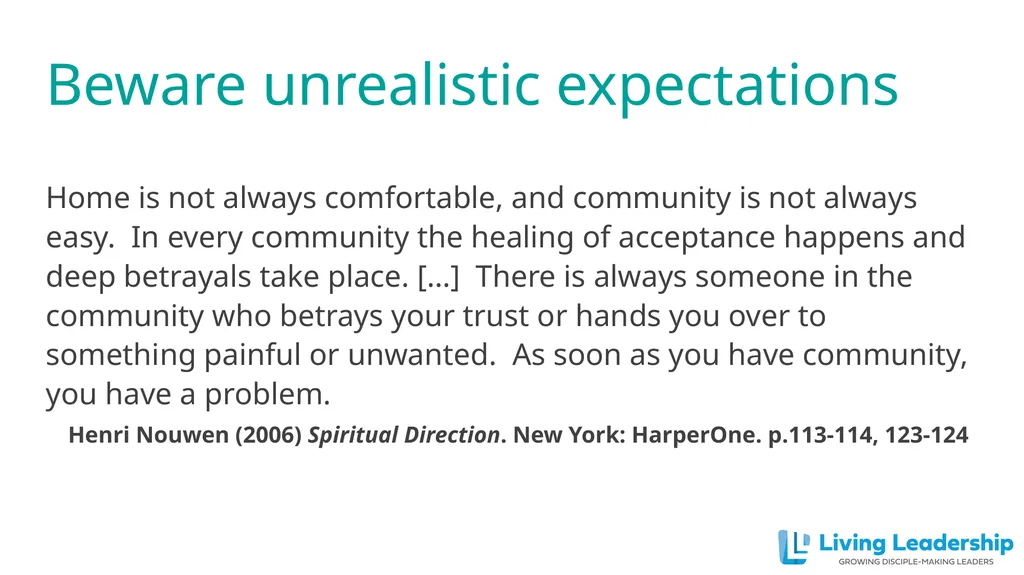
Beware unrealistic expectations Home is not always comfortable, and community is not always easy. In every community the healing of acceptance happens and deep betrayals take place. […] There is always someone in the community who betrays your trust or hands you over to something painful or unwanted. As soon as you have community, you have a problem.
Henri Nouwen (2006) Spiritual Direction. New York: HarperOne. p.113-114, 123-124<br>
Henri Nouwen (2006) Spiritual Direction. New York: HarperOne. p.113-114, 123-124<br>
40
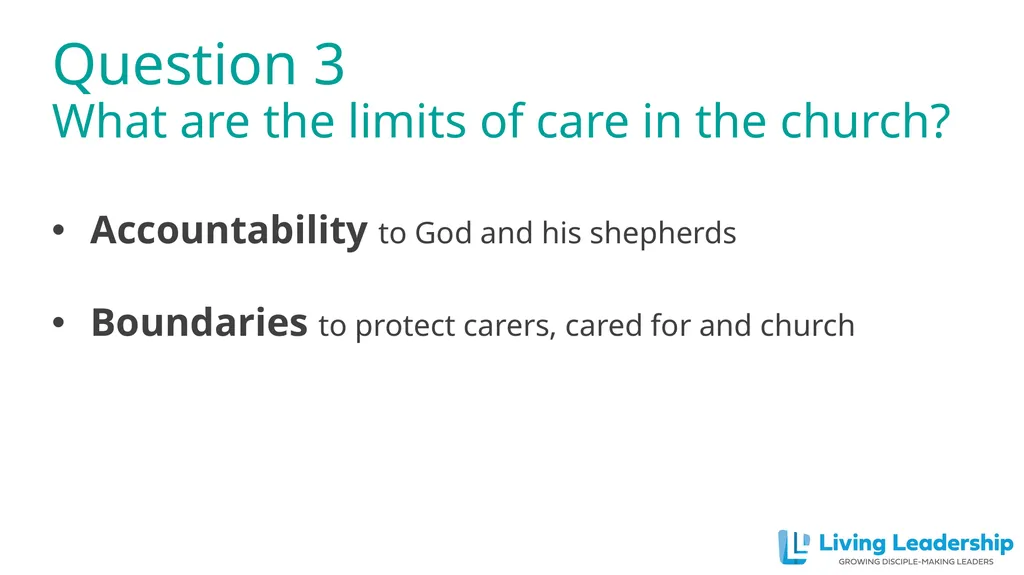
Question 3
What are the limits of care in the church? Accountability to God and his shepherds
Boundaries to protect carers, cared for and church<br>
Boundaries to protect carers, cared for and church<br>
41
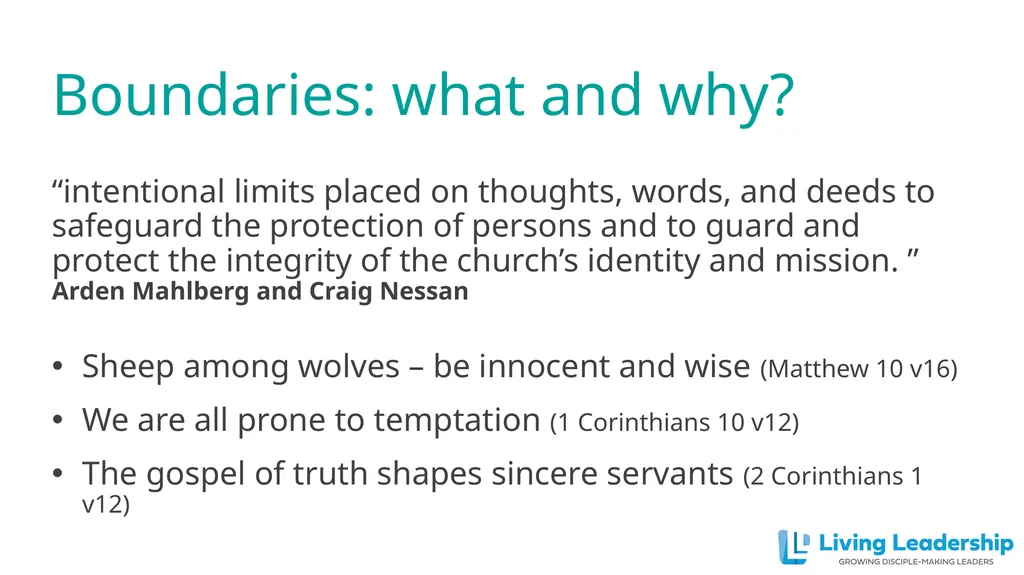
Boundaries: what and why? “intentional limits placed on thoughts, words, and deeds to safeguard the protection of persons and to guard and protect the integrity of the church’s identity and mission. ” Arden Mahlberg and Craig Nessan
Sheep among wolves – be innocent and wise (Matthew 10 v16)
We are all prone to temptation (1 Corinthians 10 v12)
The gospel of truth shapes sincere servants (2 Corinthians 1 v12)<br>
Sheep among wolves – be innocent and wise (Matthew 10 v16)
We are all prone to temptation (1 Corinthians 10 v12)
The gospel of truth shapes sincere servants (2 Corinthians 1 v12)<br>
42
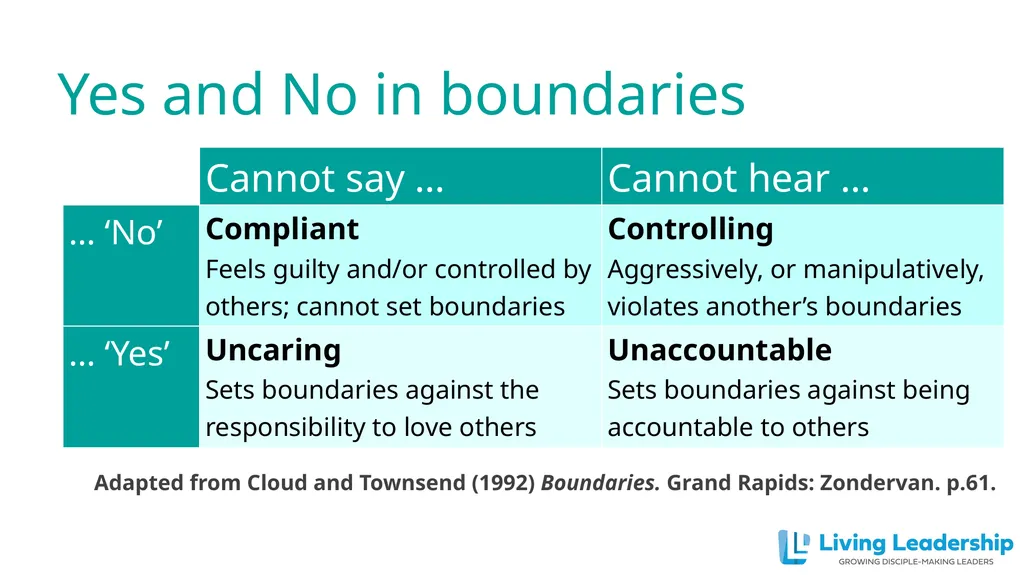
Yes and No in boundaries Adapted from Cloud and Townsend (1992) Boundaries. Grand Rapids: Zondervan. p.61.<br>
43
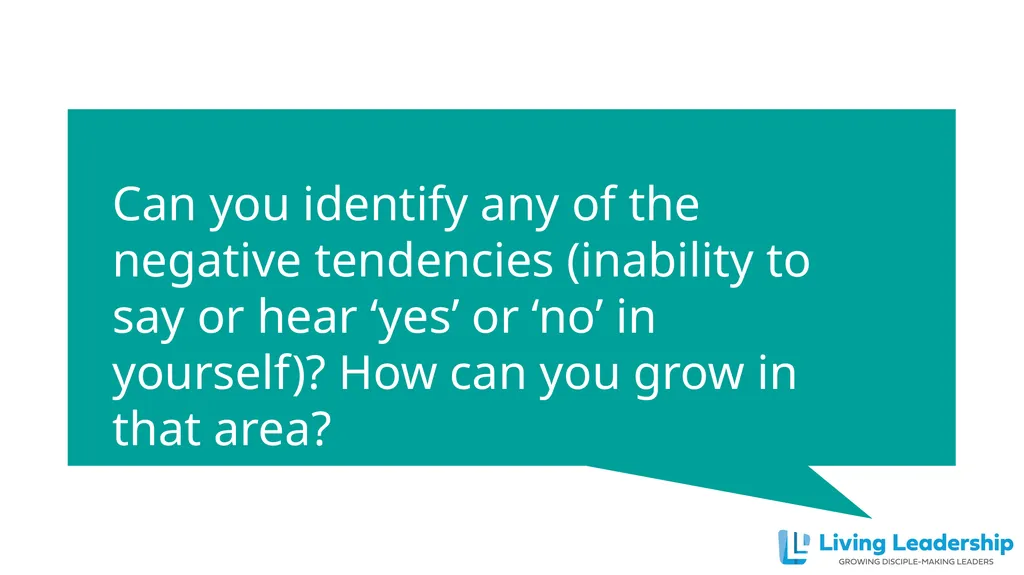
Can you identify any of the negative tendencies (inability to say or hear ‘yes’ or ‘no’ in yourself)? How can you grow in that area?<br>
44
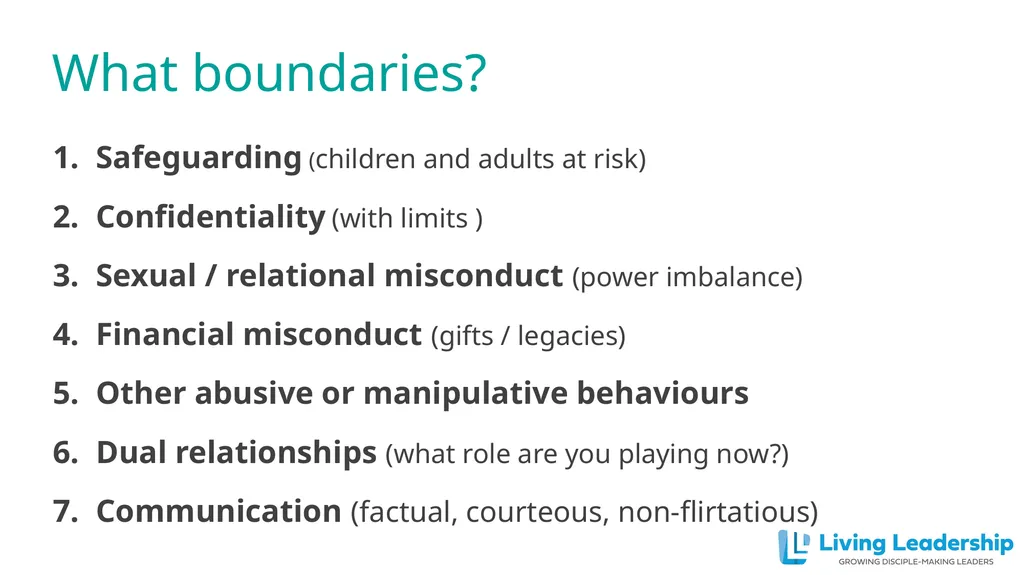
What boundaries? Safeguarding (children and adults at risk)
Confidentiality (with limits )
Sexual / relational misconduct (power imbalance)
Financial misconduct (gifts / legacies)
Other abusive or manipulative behaviours
Dual relationships (what role are you playing now?)
Communication (factual, courteous, non-flirtatious)<br>
Confidentiality (with limits )
Sexual / relational misconduct (power imbalance)
Financial misconduct (gifts / legacies)
Other abusive or manipulative behaviours
Dual relationships (what role are you playing now?)
Communication (factual, courteous, non-flirtatious)<br>
45
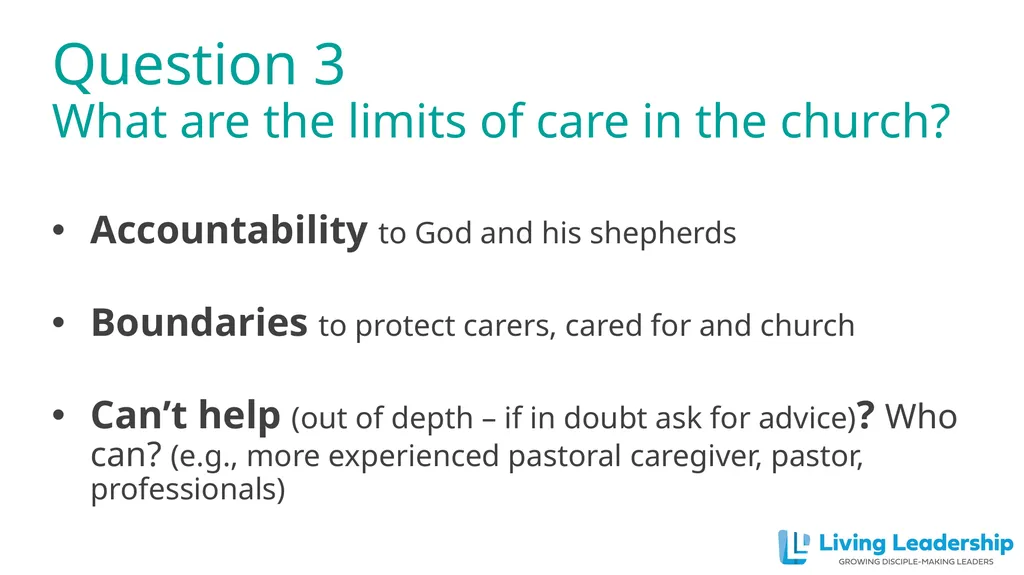
Question 3
What are the limits of care in the church? Accountability to God and his shepherds
Boundaries to protect carers, cared for and church
Can’t help (out of depth – if in doubt ask for advice)? Who can? (e.g., more experienced pastoral caregiver, pastor, professionals)<br>
Boundaries to protect carers, cared for and church
Can’t help (out of depth – if in doubt ask for advice)? Who can? (e.g., more experienced pastoral caregiver, pastor, professionals)<br>
46
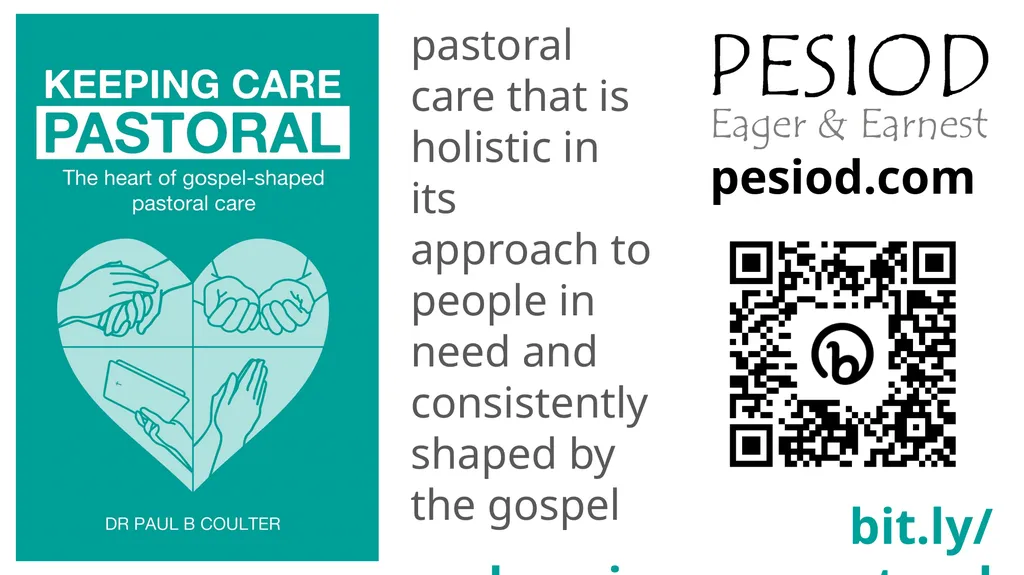
bit.ly/keepingcarepastoral pastoral care that is holistic in its approach to people in need and consistently shaped by the gospel pesiod.com<br>