
PGR Induction Beat Kümin Director of PG Research
CM
Published · 20 slides · 0 views

1 / 1



Description
PGR Induction Beat Kümin Director of PG Research Welcome to Historys PGR Community ! Introducing Key contacts HISTORY PGR TEAM Kay Jones PGR Co-Ordinator, FAB 3rd Floor Office, Tel: 50495, PGHistoryOfficewarwick.ac.uk Beat Kümin,
Related Topics
Share
Embed code
Download this presentation From Below
"PGR Induction Beat Kümin Director of PG Research" is the property of its rightful owner. Permission is granted to download and print the materials on this website for personal, non-commercial use only, and to display it on your personal computer provided you do not modify the materials and that you retain all copyright notices contained in the materials. By downloading content from our website, you accept the terms of this agreement.
Presentation Transcript
01
PGR Induction Beat Kümin
Director of PG Research<br>
Director of PG Research<br>
02
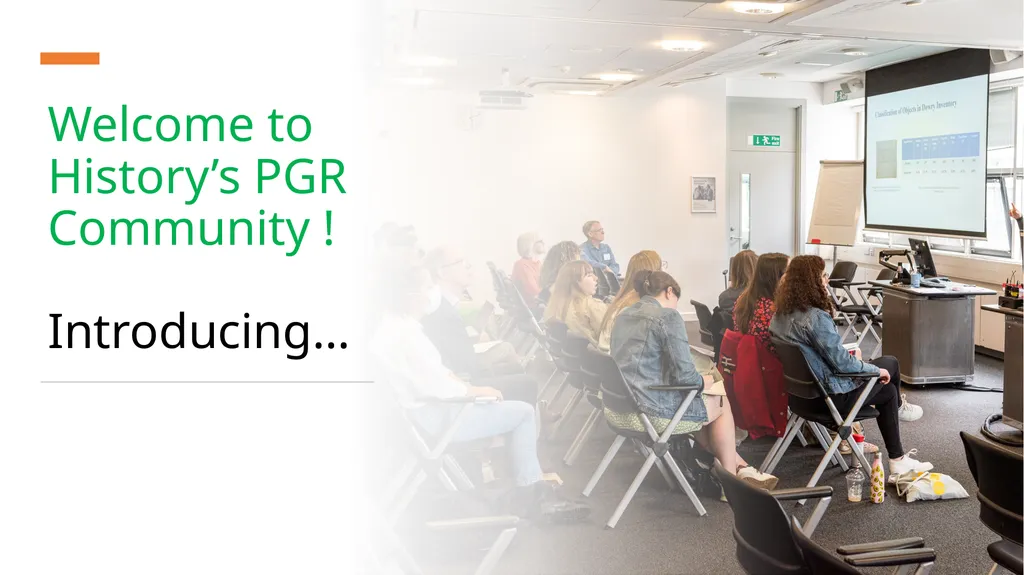
Welcome to
History’s PGR
Community !
Introducing…<br>
03
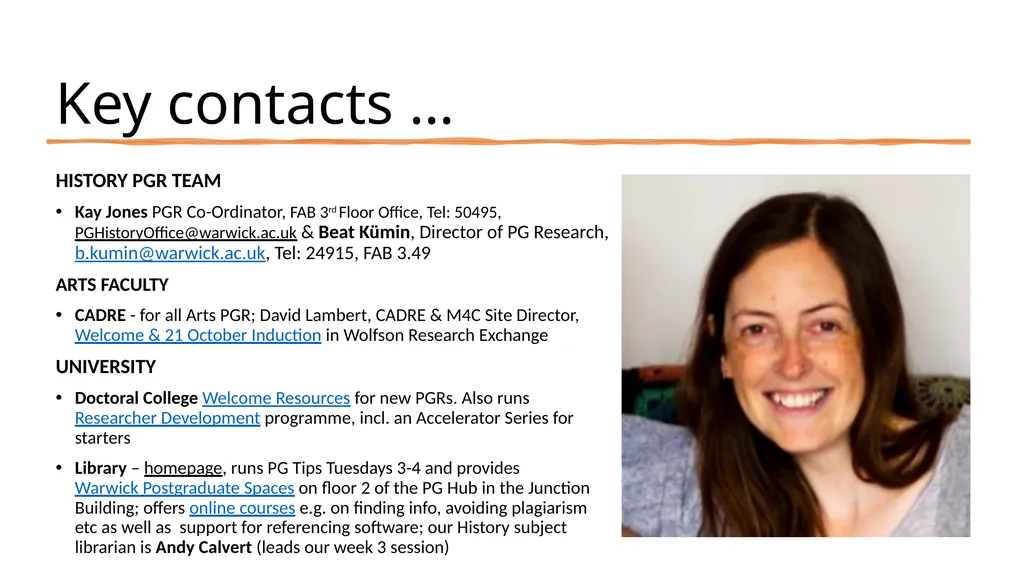
Key contacts … HISTORY PGR TEAM
Kay Jones PGR Co-Ordinator, FAB 3rd Floor Office, Tel: 50495, PGHistoryOffice@warwick.ac.uk & Beat Kümin, Director of PG Research, b.kumin@warwick.ac.uk, Tel: 24915, FAB 3.49
ARTS FACULTY
CADRE - for all Arts PGR; David Lambert, CADRE & M4C Site Director, Welcome & 21 October Induction in Wolfson Research Exchange
UNIVERSITY
Doctoral College Welcome Resources for new PGRs. Also runs Researcher Development programme, incl. an Accelerator Series for starters
Library – homepage, runs PG Tips Tuesdays 3-4 and provides Warwick Postgraduate Spaces on floor 2 of the PG Hub in the Junction Building; offers online courses e.g. on finding info, avoiding plagiarism etc as well as support for referencing software; our History subject librarian is Andy Calvert (leads our week 3 session)<br>
04
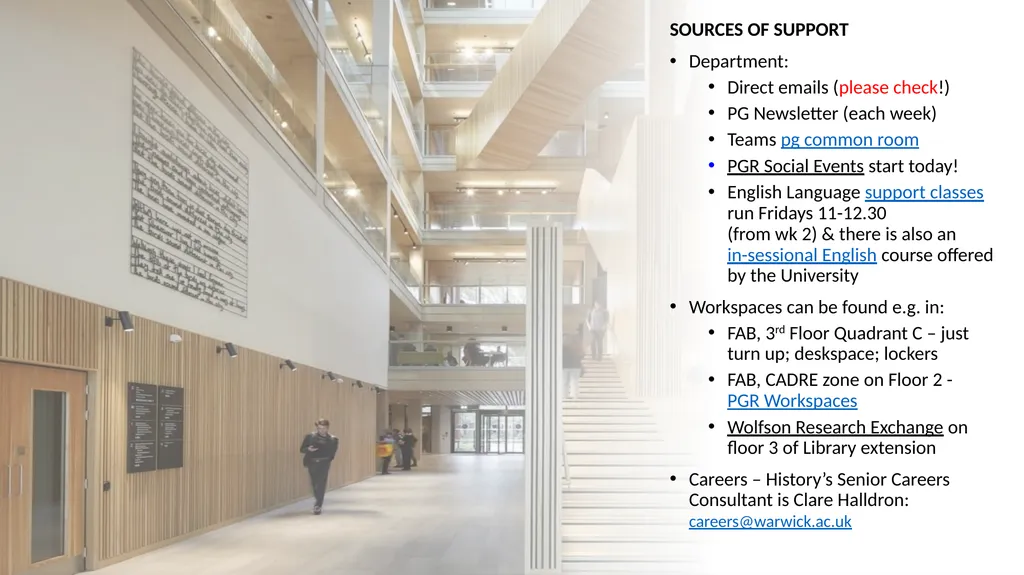
SOURCES OF SUPPORT
Department:
Direct emails (please check!)
PG Newsletter (each week)
Teams pg common room
PGR Social Events start today!
English Language support classes run Fridays 11-12.30 (from wk 2) & there is also an in-sessional English course offered by the University
Workspaces can be found e.g. in:
FAB, 3rd Floor Quadrant C – just turn up; deskspace; lockers
FAB, CADRE zone on Floor 2 - PGR Workspaces
Wolfson Research Exchange on floor 3 of Library extension
Careers – History’s Senior Careers Consultant is Clare Halldron: careers@warwick.ac.uk<br>
05
Fundamentals Warwick Core Values
Include commitments to equality, diversity, excellence in all areas of research and learning, an ambitious and entrepreneurial attitude, an openness to rational enquiry with intellectual integrity, and accessibility to students from all backgrounds at all stages of their learning. Ours is a highly cosmopolitan and diverse community in which different cultural frameworks and perspectives foster the generation of ideas.
As part of that community, we expect you to treat your peers and colleagues with respect; engage with ideas, disagree courteously
Harassment or abuse can be brought to attention of Report + Support (anonymously or with details)<br>
06
Our
Research
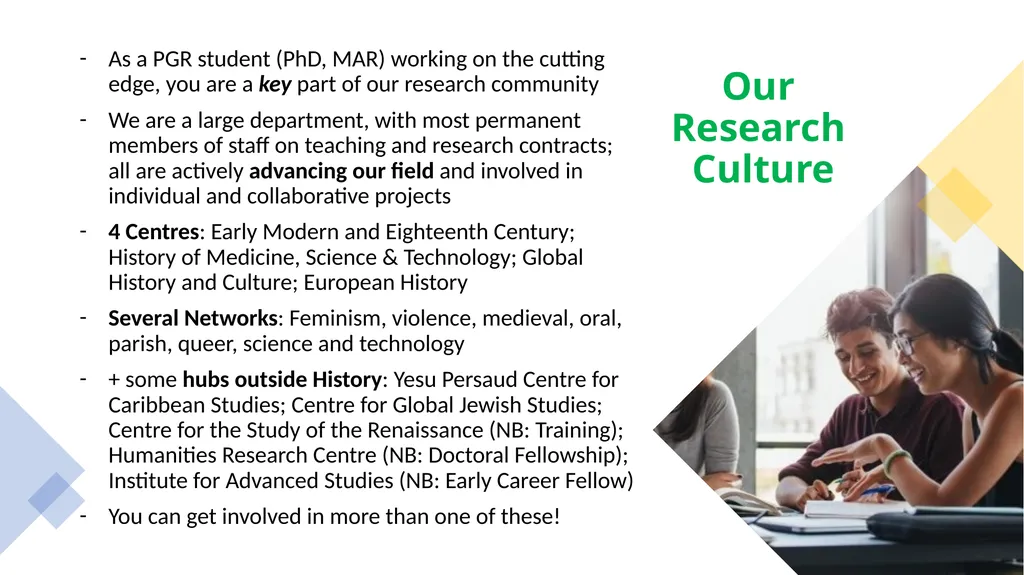
Culture As a PGR student (PhD, MAR) working on the cutting edge, you are a key part of our research community
We are a large department, with most permanent members of staff on teaching and research contracts; all are actively advancing our field and involved in individual and collaborative projects
4 Centres: Early Modern and Eighteenth Century; History of Medicine, Science & Technology; Global History and Culture; European History
Several Networks: Feminism, violence, medieval, oral, parish, queer, science and technology
+ some hubs outside History: Yesu Persaud Centre for Caribbean Studies; Centre for Global Jewish Studies; Centre for the Study of the Renaissance (NB: Training); Humanities Research Centre (NB: Doctoral Fellowship); Institute for Advanced Studies (NB: Early Career Fellow)
You can get involved in more than one of these!<br>
07
We want you to attend research seminars and workshops! In-person/online/hybrid, especially:
Our ‘Work in Progress’: meeting weekly on Mondays 5-6.30 (in-person 13/10 in FAB5.01, otherwise hybrid, followed by social), co-convened by Anna, Evie, Joseph – expected!
The dept’s flagship History Seminars: Weds 1-3 (from 22 Oct in PS 1.28 / hybrid) – expected!
You can suggest activities & contribute too!
Some of our Research Centres run collective blogs – contact the Centre directors
The Department has a social media presence – contact Claire Woodrow Claire.Woodrow@warwick.ac.uk
There are public engagement opportunities here & elsewhere – NB the week 7 GRF on this!<br>
08
The PGR Handbook
https://warwick.ac.uk/fac/arts/history/students/pgr/ Has lots of information about
The History department
Course regulations (PhD, MAR)
Progression and examination
Personal development
Funding and Travel (full information;
Overseas Travel Declaration Form- Kay)
University support
Welfare and wellbeing
Student Voice – PGR Reps (thanks to Anna & David) & SIDCOM volunteer?<br>
The History department
Course regulations (PhD, MAR)
Progression and examination
Personal development
Funding and Travel (full information;
Overseas Travel Declaration Form- Kay)
University support
Welfare and wellbeing
Student Voice – PGR Reps (thanks to Anna & David) & SIDCOM volunteer?<br>
09
Roles - YOU develop your research project with independent initiative as well as guidance from supervisors and other advisors
Be proactive about planning ahead, obtaining secondary materials, contacting libraries/archives, consider ethics etc
Take the initiative to ask for meetings with supervisors and to tell them about skills training you need (we expect 2 development events / activities each year, e.g. via SkillsForge)
Write frequently and submit drafts on time (not the day before a supervision) – a key tool to develop as a scholar
Please read the relevant handbook section – sets out expectations of meetings – and engage with Doctoral College (University level) / CADRE (Faculty level Centre for Arts Doctoral Research Excellence) / other training programmes<br>
10
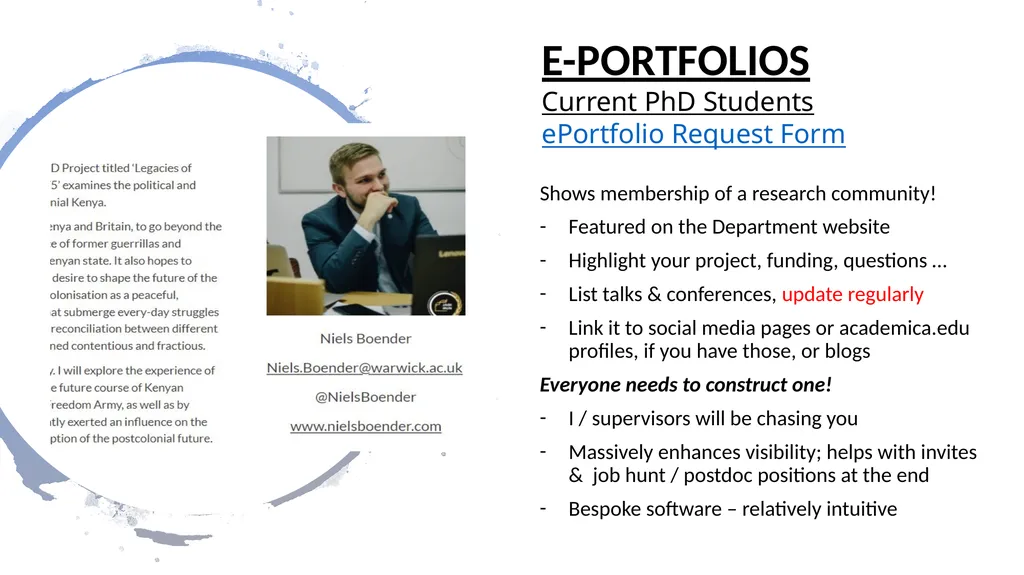
E-PORTFOLIOS
Current PhD Students
ePortfolio Request Form Shows membership of a research community!
Featured on the Department website
Highlight your project, funding, questions …
List talks & conferences, update regularly
Link it to social media pages or academica.edu profiles, if you have those, or blogs
Everyone needs to construct one!
I / supervisors will be chasing you
Massively enhances visibility; helps with invites & job hunt / postdoc positions at the end
Bespoke software – relatively intuitive<br>
11
Teaching Opportunities Graduate Teaching Assistant [GTA] positions are normally open to you to do, after your first year - important to consider if you are thinking about a career in academia.
PGRs can teach up to max.2 seminars a week
There is a module run by the Learning Development Centre – ‘Prepare to Teach’ - it is compulsory for anyone wanting to teach and it will run in term 2 of year 1.
Teaching is run by the History Office – so any queries / expressions of interest to CLAUDIA GRAY. We can’t guarantee recruitment but try to accommodate requests.<br>
12
‘give guidance about the nature of research and the standard expected, about the planning of the research programme, about historiography / sources and the use of requisite techniques (including instruction where necessary) aware of all relevant developments within the subject’
read material you write and give constructive feedback
maintain regular contact
discuss training requirements
ensure you are on track to complete within registration period
are accessible by arrangement
assist with development of transferable skills (e.g. conferences)
advise on ethical issues
Two supervisors is now the norm, but no ‘right’ way of running the team and:
Key that arrangements work for all involved ! Roles - SUPERVISORS<br>
13
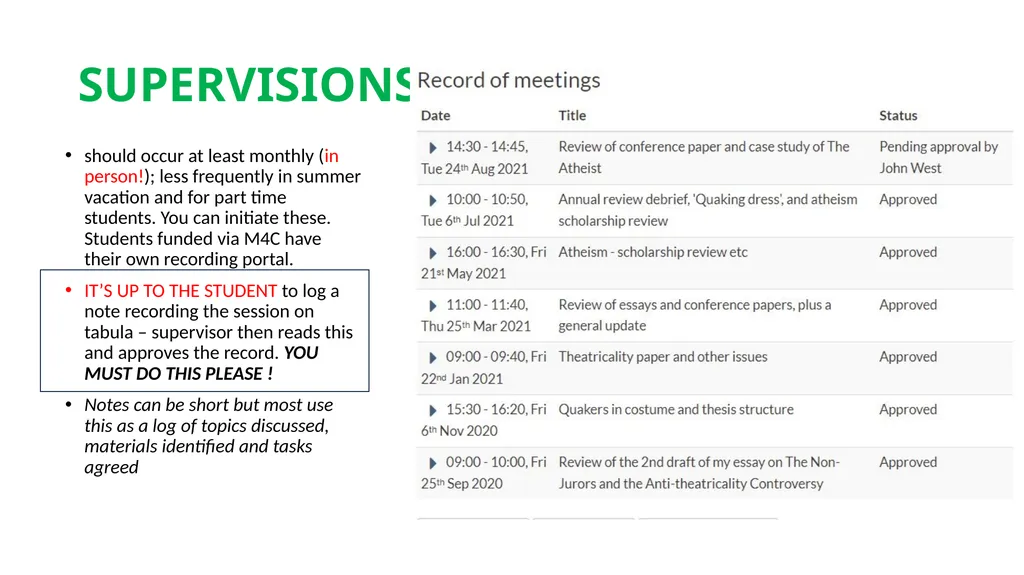
SUPERVISIONS should occur at least monthly (in person!); less frequently in summer vacation and for part time students. You can initiate these. Students funded via M4C have their own recording portal.
IT’S UP TO THE STUDENT to log a note recording the session on tabula – supervisor then reads this and approves the record. YOU MUST DO THIS PLEASE !
Notes can be short but most use this as a log of topics discussed, materials identified and tasks agreed<br>
IT’S UP TO THE STUDENT to log a note recording the session on tabula – supervisor then reads this and approves the record. YOU MUST DO THIS PLEASE !
Notes can be short but most use this as a log of topics discussed, materials identified and tasks agreed<br>
14
Roles – Director of PG Research Running the Graduate Research Forum (GRF) for ALL (new) PGR – Thursdays 5-6.30 pm in FAB2.43
Week 2 Project Design, The Upgrade and Ethics
Week 3. Navigating the Library
Week 4. Working in Archives (NB: extended time) – a workshop on research / dissemination (3.30 pm), followed by a visit to Warwick’s Modern Records Centre (their holdings and engaging with selected records)
Week 5 Internationalization - with Penny Roberts & Beat & you on French / Germanic / other cultures
Week 6 ---------- Reading Week - No GRF session
Week 7 Public Engagement - a session led by Angela McShane (formerly of V&A and Wellcome Trust), Tom Simpson (History’s Impact Director) and Angus Crawford (Year 3 Collaborative Doctoral Award holder)
Week 8 Digital Humanities - with Rob O’Toole (who runs the Faculty’s DH programme).
Week 9 Research Journeys: with Katayoun Shafiee
Week 10 Postdoctoral Projects and Applications - a joint session with existing postdocs, facilitated by Penny Roberts, History’s Director of Research I am your personal tutor 😊 – for questions on departmental level, matters that you would prefer
not to discuss with your supervisors or just anything you would like to raise with me.
My office hours are Mondays 12-13 and Thursdays 15-16 (FAB 3.49 in PG cluster C)
I’d like to see you individually at some point in the Autumn Term, so do book a time & drop by<br>
15
PGR Director Roles Oversee the PGR community’s progress
Troubleshoot where necessary
Liaise with your reps
Run an annual review process (usually in May) – but timing different for M4C funded students
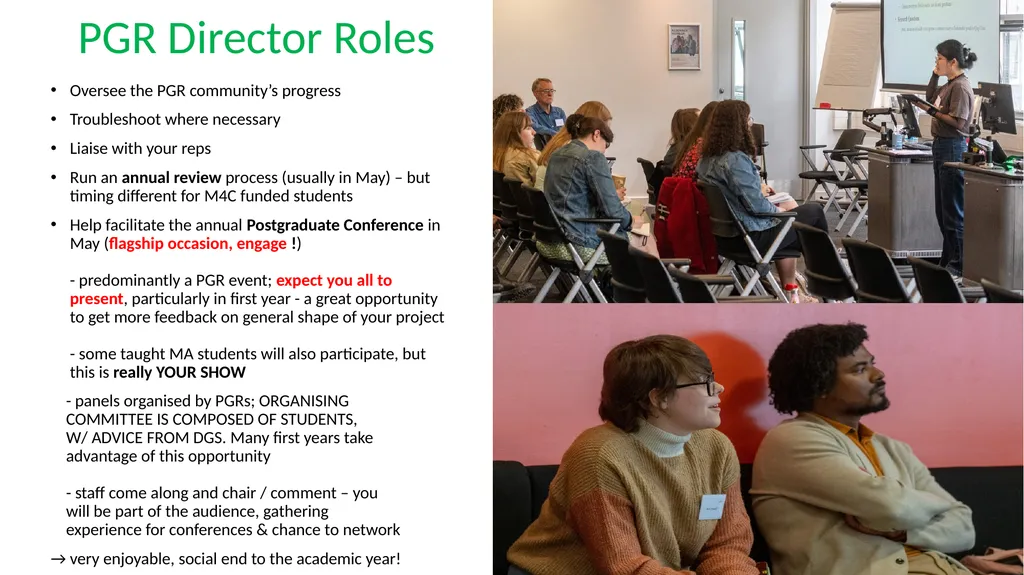
Help facilitate the annual Postgraduate Conference in May (flagship occasion, engage !) - predominantly a PGR event; expect you all to present, particularly in first year - a great opportunity to get more feedback on general shape of your project - some taught MA students will also participate, but this is really YOUR SHOW
- panels organised by PGRs; ORGANISING COMMITTEE IS COMPOSED OF STUDENTS, W/ ADVICE FROM DGS. Many first years take advantage of this opportunity - staff come along and chair / comment – you will be part of the audience, gathering experience for conferences & chance to network
→ very enjoyable, social end to the academic year!<br>
16
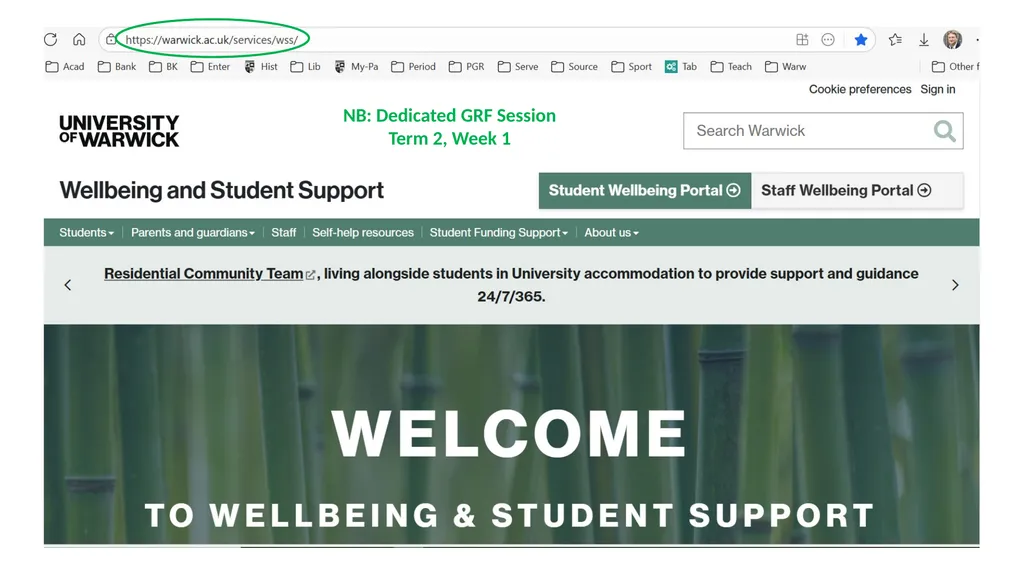
NB: Dedicated GRF Session
Term 2, Week 1<br>
Term 2, Week 1<br>
17
If you need a break or change ….
Temporary Withdrawal
[TWD]
You must discuss this with your supervisor(s) first. It is an online application process involving the Doctoral College, but be aware of implications:
If you’re on an award, funding may stop
Might lose contact w/ supervisor until you re-register
Visa implications for overseas students
So if you’re thinking about it you must weigh up the pros & cons – also talk to me or Kay, as I have to approve your request.
Similarly for changing between Full-Time and Part-Time modes – how that change happens also depends on how you are funded, so talk to us at earliest opportunity.<br>
18
Money
Matters Different sponsors have different arrangements
many of you are on FUNDED PhDs - these have expense and travel and research allowances built into them, and you should apply for those [NB PLAN AHEAD, with Kay]
Departmental support: I administer a personal research grant for every self-funding student in History – about £350 per student (PT pro rata) per year to support your research activities. Complete an online form which also runs past Kay. Rolling deadline.
This needs to be precise amounts and receipts – get you in the practice of being a history researcher, where this occupies much of your time (please note this – missing data means delays or even no reimbursement !)
OTHER PLACES offering funding
Humanities Research Centre / Institute of Advanced Study
Royal Historical Society (small grants); Economic History Society<br>
19
Some Homework for next time -
Research Integrity Training ! Research integrity covers a range of areas - from adhering to policies, standards and protocols, through good research practice (e.g. during field work or interviews), to reporting research findings clearly and transparently. A good place to start is Warwick’s bespoke 20 mins tutorial Introduction to Research Ethics on Moodle.
In order to support the community’s understanding of the principles and practices that protect research integrity, the University has approved a dedicated policy and mandated the completion of specialized training for all staff and students pursuing research: please note that all PGR have to complete the full course of 8 core Research Integrity training modules. Provided by a company called Epigeum, it focuses on areas such as conflict of interest, safety and health, animal research, and intellectual property. PGR working with human participants additionally need to complete the respective supplementary module.
Once you have completed this course, discuss with your supervisors whether your own project raises related issues and requires formal ethical approval (rather than just review at the upgrade). If so, you will have to apply to a university committee called HSSREC. This takes time & it is highly recommended to clarify this early on in your research.<br>
20
ANY QUESTIONS ? ! TIME FOR A DRINK !<br>