
Pig Behavior Handling Fitness of Pig ! Section
GB
Published · 53 slides · 0 views

1 / 1

Description
Pig Behavior Handling Fitness of Pig ! Section Title Key Topic Do this And this And this Important Tips and Suggestions Dont do this Or this Or this Important Warnings and Cautions 1. Pig Behavior 1. Pig Behavior Section Objectives Apply
Related Topics
Share
Embed code
Download this presentation From Below
"Pig Behavior Handling Fitness of Pig ! Section" is the property of its rightful owner. Permission is granted to download and print the materials on this website for personal, non-commercial use only, and to display it on your personal computer provided you do not modify the materials and that you retain all copyright notices contained in the materials. By downloading content from our website, you accept the terms of this agreement.
Presentation Transcript
01
Pig Behavior
Handling
Fitness of Pig<br>
02
! Section Title Key Topic<br>
03
Do this
And this
And this Important Tips and Suggestions<br>
And this
And this Important Tips and Suggestions<br>
04
Don’t do this
Or this
Or this Important Warnings and Cautions<br>
Or this
Or this Important Warnings and Cautions<br>
05
1. Pig Behavior<br>
06
1. Pig Behavior Section Objectives
Apply basic animal handling concepts, including animal behavior, the flight zone, and point of balance.
Recognize the importance of the animal handler's appropriate behavior as it relates to animal behavior.<br>
Apply basic animal handling concepts, including animal behavior, the flight zone, and point of balance.
Recognize the importance of the animal handler's appropriate behavior as it relates to animal behavior.<br>
07
Basic Pig Behavior Instinctive behavior is influenced by
Age
Gender
Health status
Environment
Prior experiences
Understanding basic pig behavior can help
Make animal handling easier
Reduce stress
Reduce safety risks to the handler
Reduce losses - skin injuries, bruises, fatigue, death 1. Pig Behavior Basic Pig Behavior<br>
Age
Gender
Health status
Environment
Prior experiences
Understanding basic pig behavior can help
Make animal handling easier
Reduce stress
Reduce safety risks to the handler
Reduce losses - skin injuries, bruises, fatigue, death 1. Pig Behavior Basic Pig Behavior<br>
08
Individual Pig Perception and Response Three basic characteristics to consider:
Flight Zone
Point of Balance
Senses – sight, hearing and smell 1. Pig Behavior Basic Pig Behavior<br>
Flight Zone
Point of Balance
Senses – sight, hearing and smell 1. Pig Behavior Basic Pig Behavior<br>
09
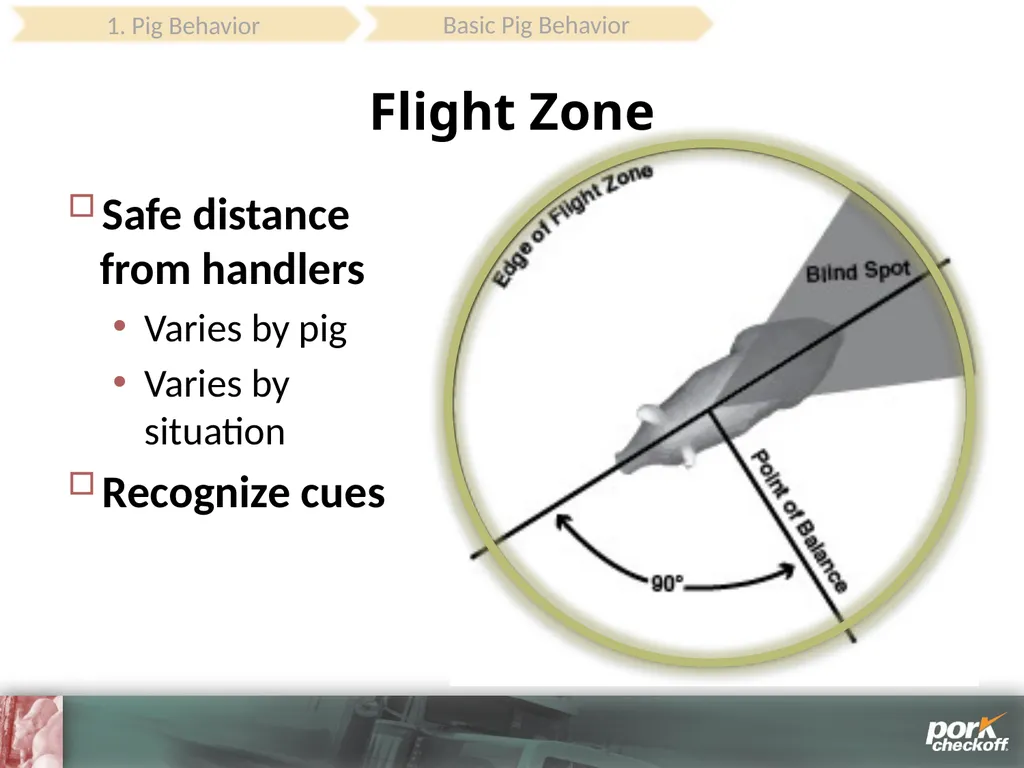
Flight Zone Safe distance from handlers
Varies by pig
Varies by situation
Recognize cues 1. Pig Behavior Basic Pig Behavior<br>
Varies by pig
Varies by situation
Recognize cues 1. Pig Behavior Basic Pig Behavior<br>
10
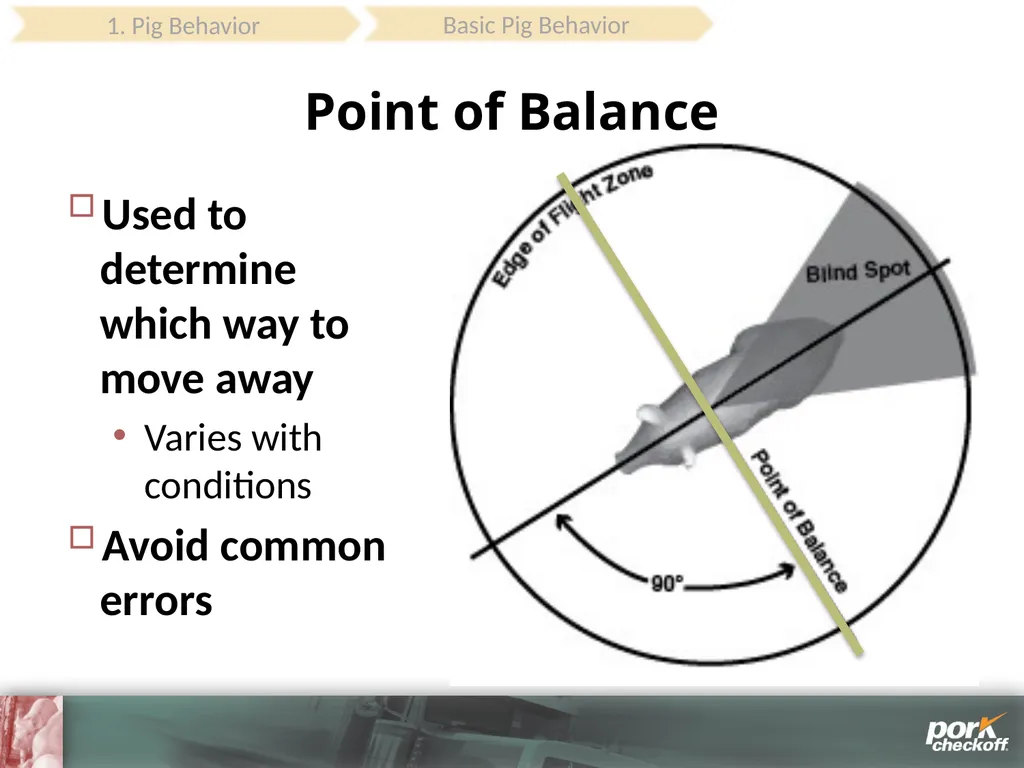
Point of Balance Used to determine which way to move away
Varies with conditions
Avoid common errors 1. Pig Behavior Basic Pig Behavior<br>
Varies with conditions
Avoid common errors 1. Pig Behavior Basic Pig Behavior<br>
11
Senses of Hearing, Smell & Sight Relies on hearing and smell to situate itself, while sight is a complement
Varies with conditions
Blind spot 1. Pig Behavior Basic Pig Behavior<br>
Varies with conditions
Blind spot 1. Pig Behavior Basic Pig Behavior<br>
12
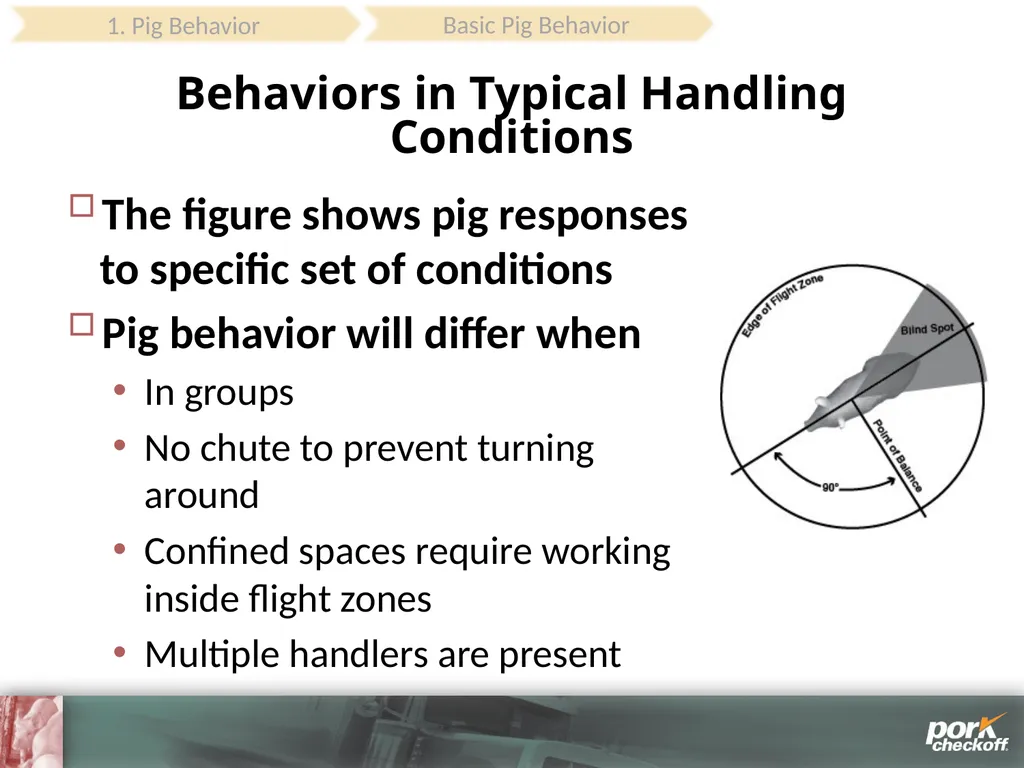
Behaviors in Typical Handling Conditions The figure shows pig responses to specific set of conditions
Pig behavior will differ when
In groups
No chute to prevent turning around
Confined spaces require working inside flight zones
Multiple handlers are present 1. Pig Behavior Basic Pig Behavior<br>
Pig behavior will differ when
In groups
No chute to prevent turning around
Confined spaces require working inside flight zones
Multiple handlers are present 1. Pig Behavior Basic Pig Behavior<br>
13
Changing Conditions Changes Pig Behaviors Can’t rely on flight zones and point of balance alone
Need to understand how behavior is influenced by
Herd behavior
The presence of additional people
Handlers’ use of pig handling tools
Environmental influences 1. Pig Behavior Basic Pig Behavior<br>
Need to understand how behavior is influenced by
Herd behavior
The presence of additional people
Handlers’ use of pig handling tools
Environmental influences 1. Pig Behavior Basic Pig Behavior<br>
14
The Importance of Pig Body Language Pigs tell us what they are paying attention to with their body language
Handlers should pay attention to
Where pigs are looking
How pigs are bending or twisting their bodies
How pigs have their heads or ears turned or cocked
Whether pigs are listening intently 1. Pig Behavior Pig Body Language<br>
Handlers should pay attention to
Where pigs are looking
How pigs are bending or twisting their bodies
How pigs have their heads or ears turned or cocked
Whether pigs are listening intently 1. Pig Behavior Pig Body Language<br>
15
Releasing Pressure Important to monitor body language and adjust the level of pressure you are applying
Ways to release pressure:
Pause and let pigs move away
Step back and refrain from making physical contact with them
Soften our body language to reduce both our threat and the distance pigs require
Let pigs circle past us: our strongest pressure is in the direction we are facing
Discontinue making noise
Look away from them
Reduce group size 1. Pig Behavior Pig Body Language<br>
16
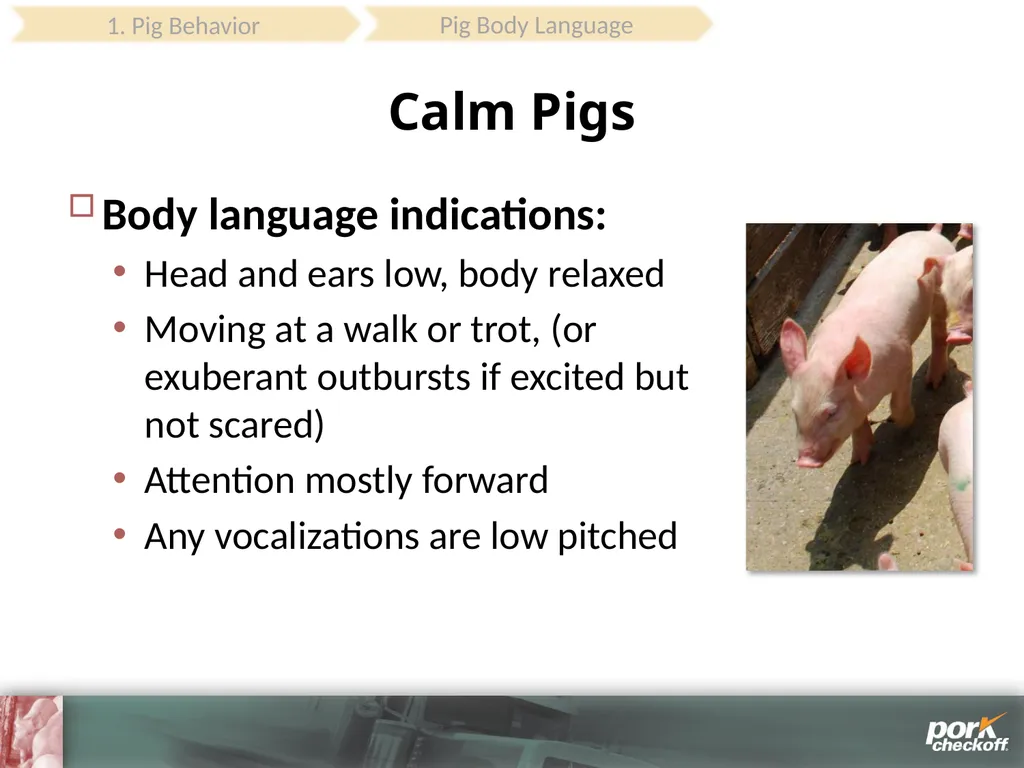
Calm Pigs Body language indications:
Head and ears low, body relaxed
Moving at a walk or trot, (or exuberant outbursts if excited but not scared)
Attention mostly forward
Any vocalizations are low pitched 1. Pig Behavior Pig Body Language<br>
Head and ears low, body relaxed
Moving at a walk or trot, (or exuberant outbursts if excited but not scared)
Attention mostly forward
Any vocalizations are low pitched 1. Pig Behavior Pig Body Language<br>
17
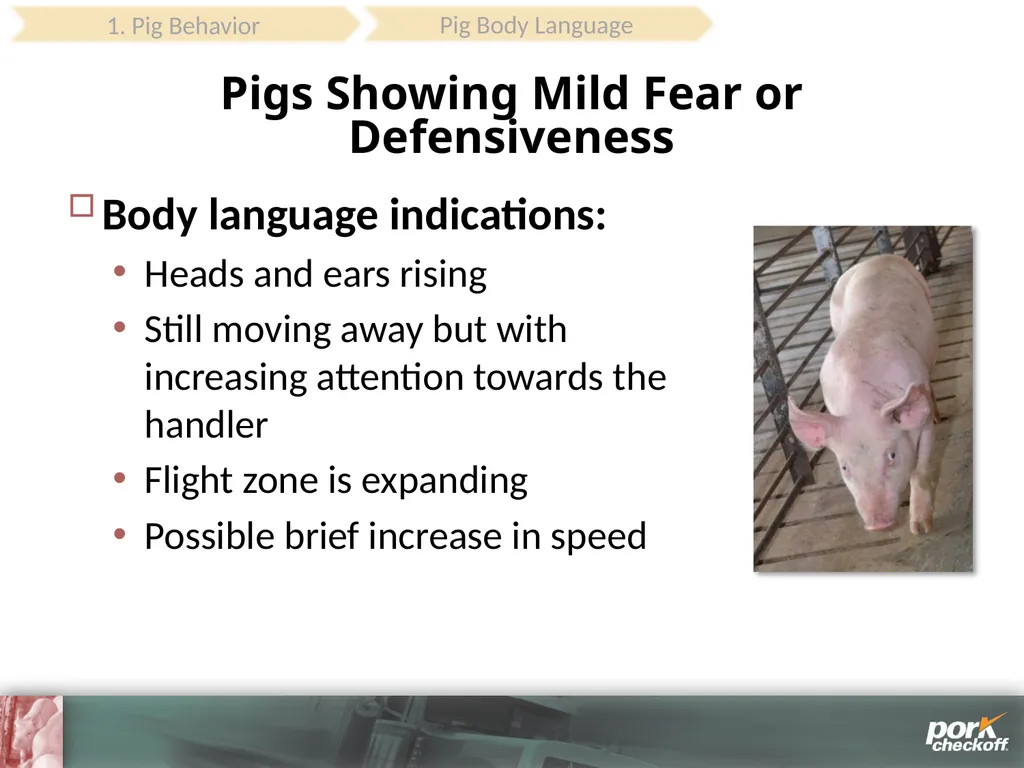
Pigs Showing Mild Fear or Defensiveness Body language indications:
Heads and ears rising
Still moving away but with increasing attention towards the handler
Flight zone is expanding
Possible brief increase in speed 1. Pig Behavior Pig Body Language<br>
Heads and ears rising
Still moving away but with increasing attention towards the handler
Flight zone is expanding
Possible brief increase in speed 1. Pig Behavior Pig Body Language<br>
18
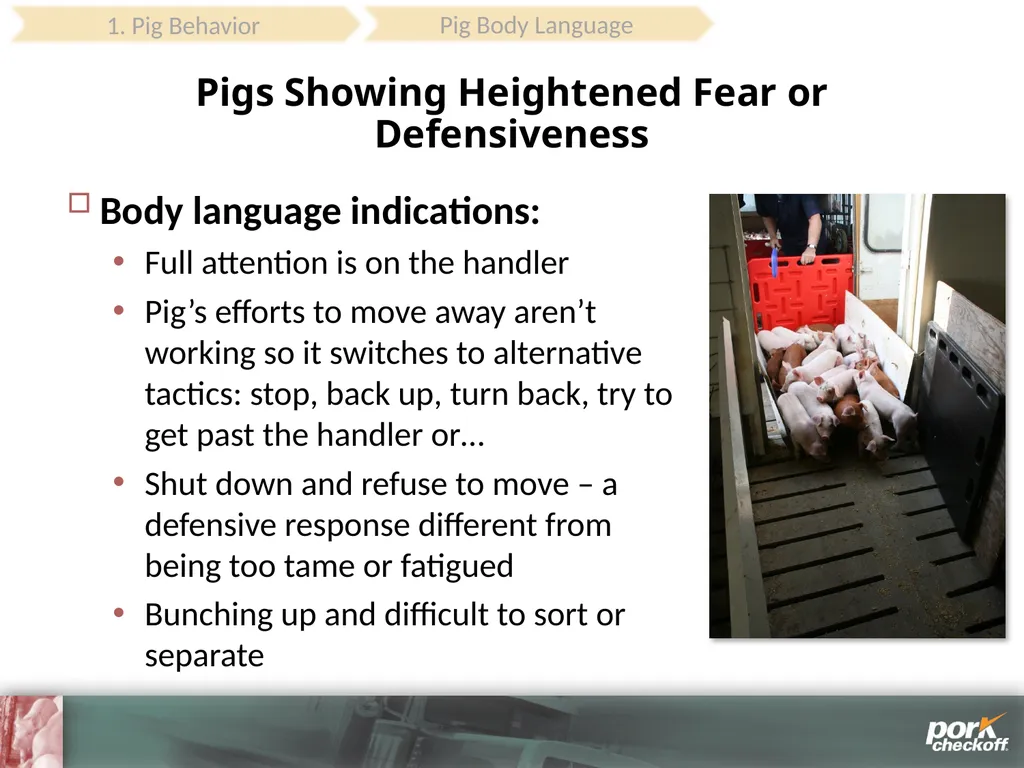
Pigs Showing Heightened Fear or Defensiveness Body language indications:
Full attention is on the handler
Pig’s efforts to move away aren’t working so it switches to alternative tactics: stop, back up, turn back, try to get past the handler or…
Shut down and refuse to move – a defensive response different from being too tame or fatigued
Bunching up and difficult to sort or separate 1. Pig Behavior Pig Body Language<br>
19
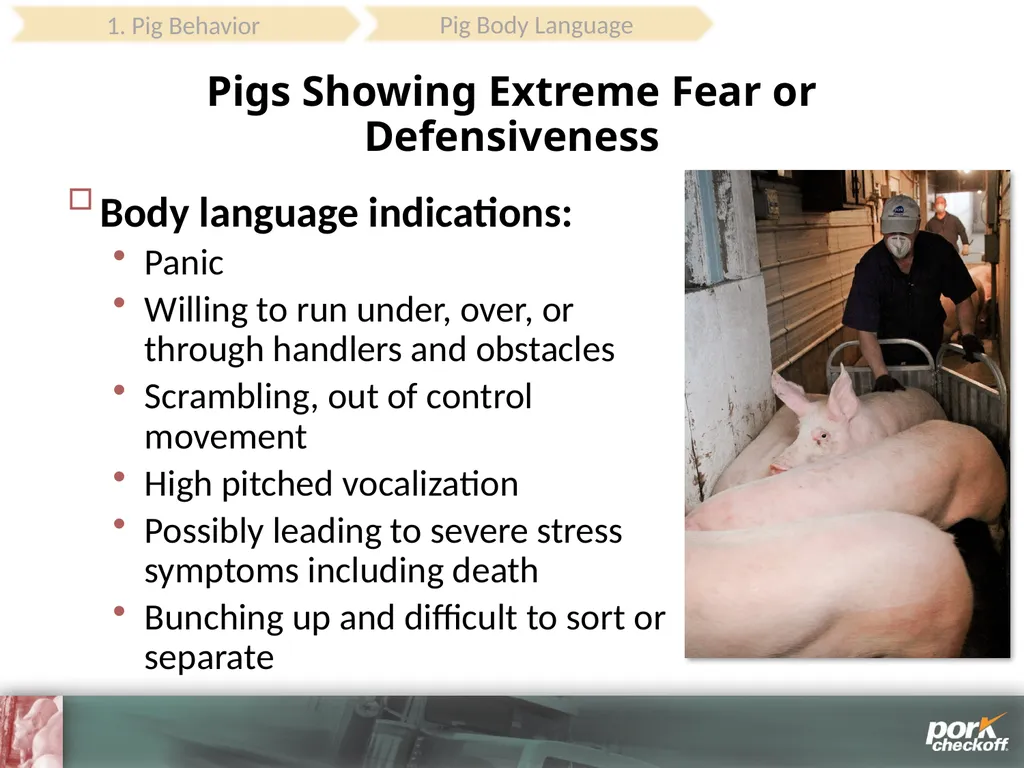
Pigs Showing Extreme Fear or Defensiveness Body language indications:
Panic
Willing to run under, over, or through handlers and obstacles
Scrambling, out of control movement
High pitched vocalization
Possibly leading to severe stress symptoms including death
Bunching up and difficult to sort or separate 1. Pig Behavior Pig Body Language<br>
Panic
Willing to run under, over, or through handlers and obstacles
Scrambling, out of control movement
High pitched vocalization
Possibly leading to severe stress symptoms including death
Bunching up and difficult to sort or separate 1. Pig Behavior Pig Body Language<br>
20
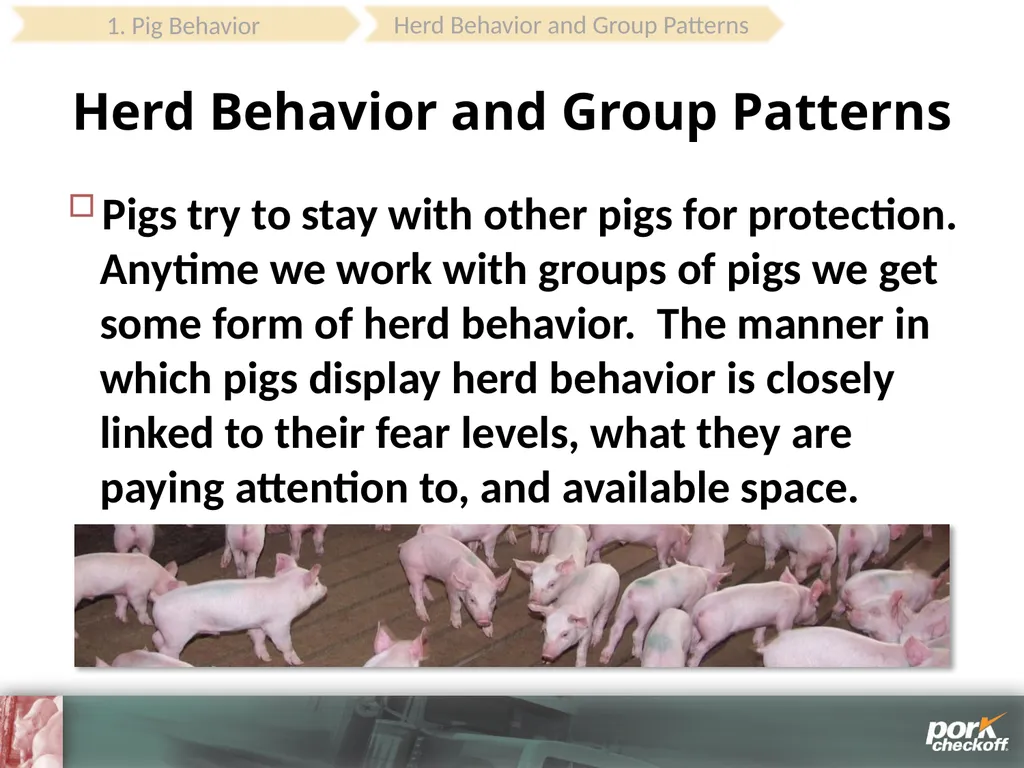
Herd Behavior and Group Patterns Pigs try to stay with other pigs for protection. Anytime we work with groups of pigs we get some form of herd behavior. The manner in which pigs display herd behavior is closely linked to their fear levels, what they are paying attention to, and available space. 1. Pig Behavior Herd Behavior and Group Patterns<br>
21
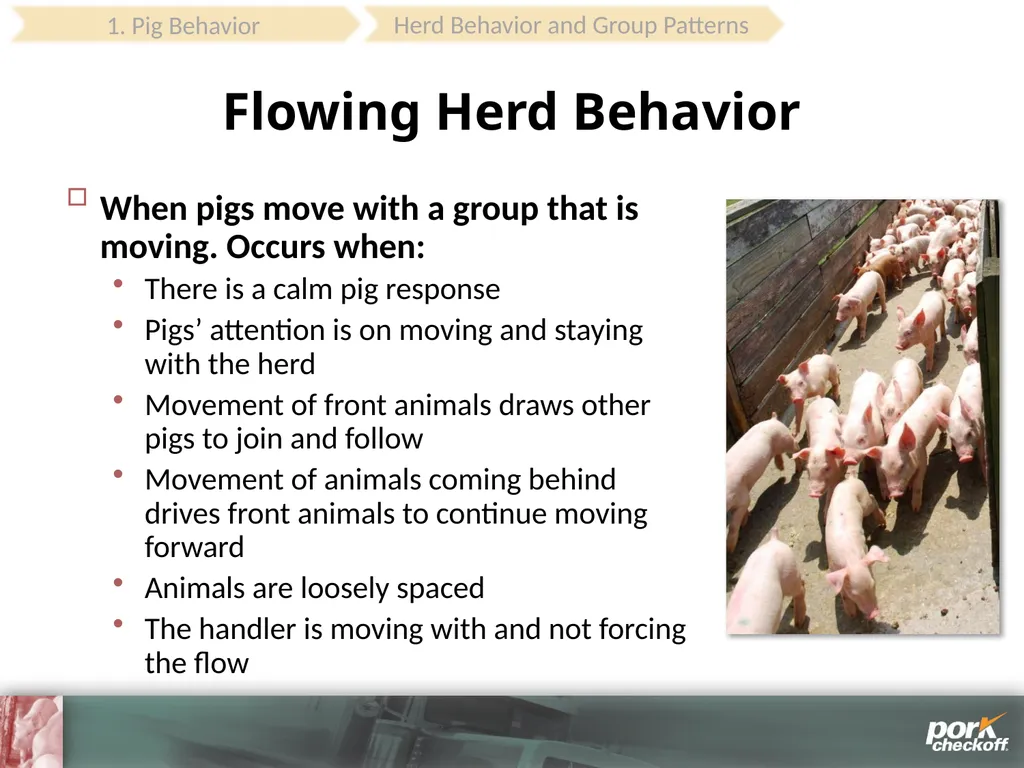
Flowing Herd Behavior When pigs move with a group that is moving. Occurs when:
There is a calm pig response
Pigs’ attention is on moving and staying with the herd
Movement of front animals draws other pigs to join and follow
Movement of animals coming behind drives front animals to continue moving forward
Animals are loosely spaced
The handler is moving with and not forcing the flow 1. Pig Behavior Herd Behavior and Group Patterns<br>
22
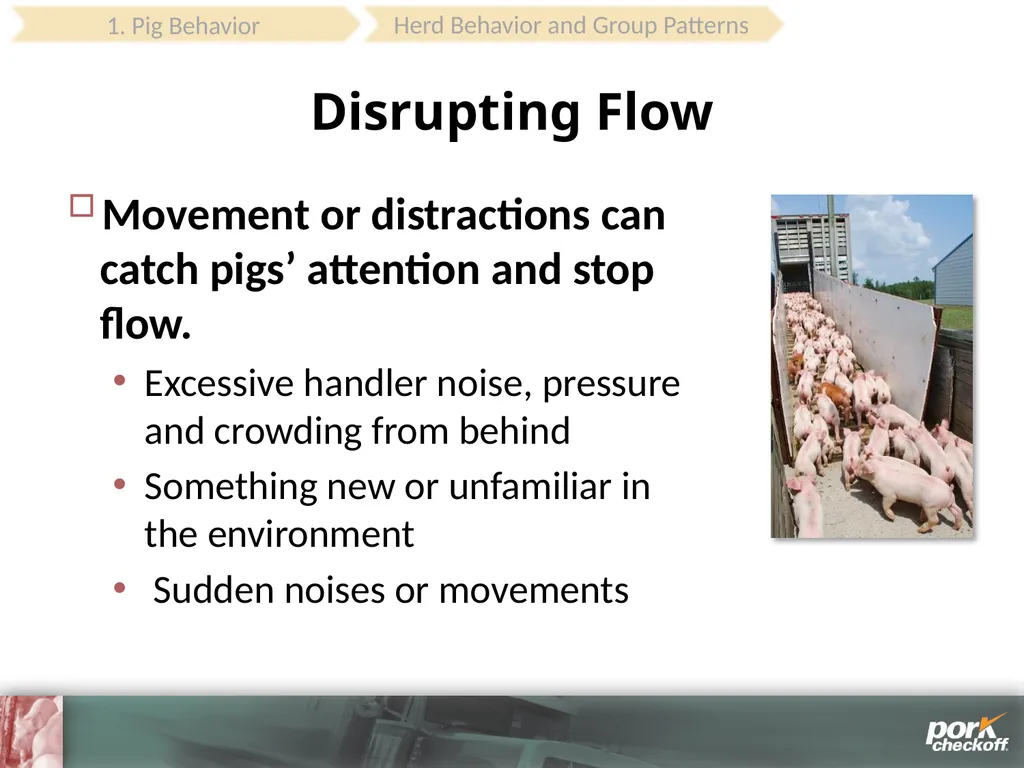
Disrupting Flow Movement or distractions can catch pigs’ attention and stop flow.
Excessive handler noise, pressure and crowding from behind
Something new or unfamiliar in the environment
Sudden noises or movements 1. Pig Behavior Herd Behavior and Group Patterns<br>
Excessive handler noise, pressure and crowding from behind
Something new or unfamiliar in the environment
Sudden noises or movements 1. Pig Behavior Herd Behavior and Group Patterns<br>
23
Flow and the Number of Handlers Pigs try to keep track of all people
Only one person should be pressuring pigs at any time or you risk disrupting flow
Drawing attention and stopping pigs that have already gone past
Blocking pigs that are approaching so they stop moving or stop driving the front pigs forward
More forceful handling from an annoyed loader and that in turn leading to more problems and longer load time
The fewer people present, the simpler it is for pigs to keep moving and the easier it is for handlers 1. Pig Behavior Herd Behavior and Group Patterns<br>
24
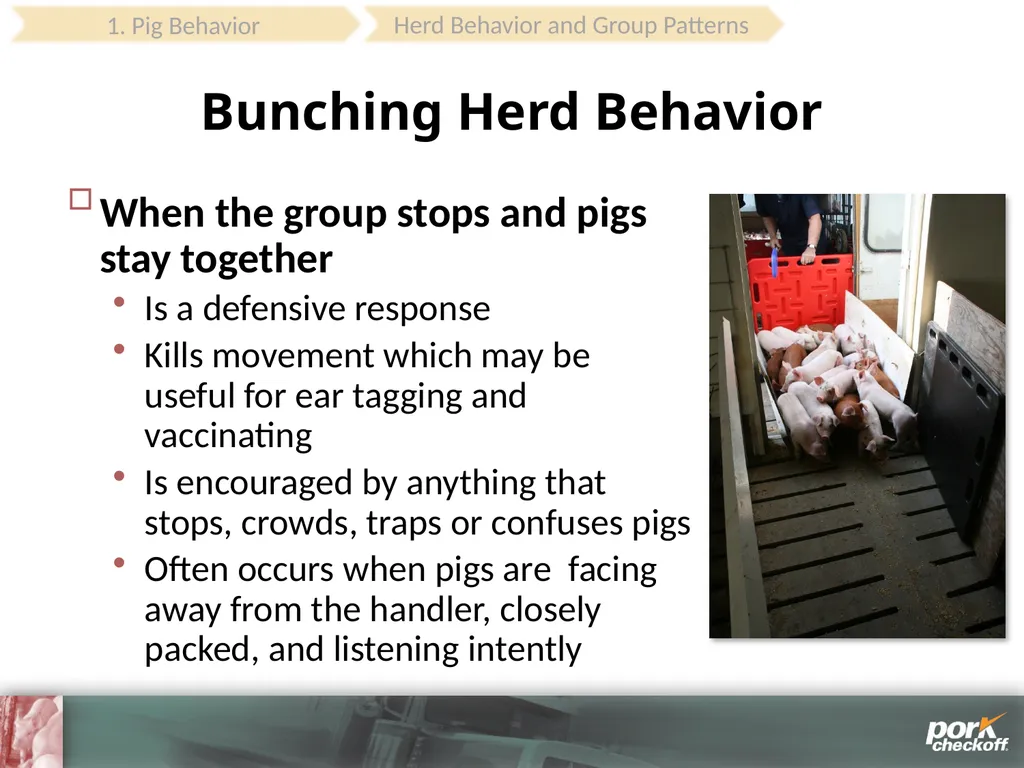
Bunching Herd Behavior When the group stops and pigs stay together
Is a defensive response
Kills movement which may be useful for ear tagging and vaccinating
Is encouraged by anything that stops, crowds, traps or confuses pigs
Often occurs when pigs are facing away from the handler, closely packed, and listening intently 1. Pig Behavior Herd Behavior and Group Patterns<br>
25
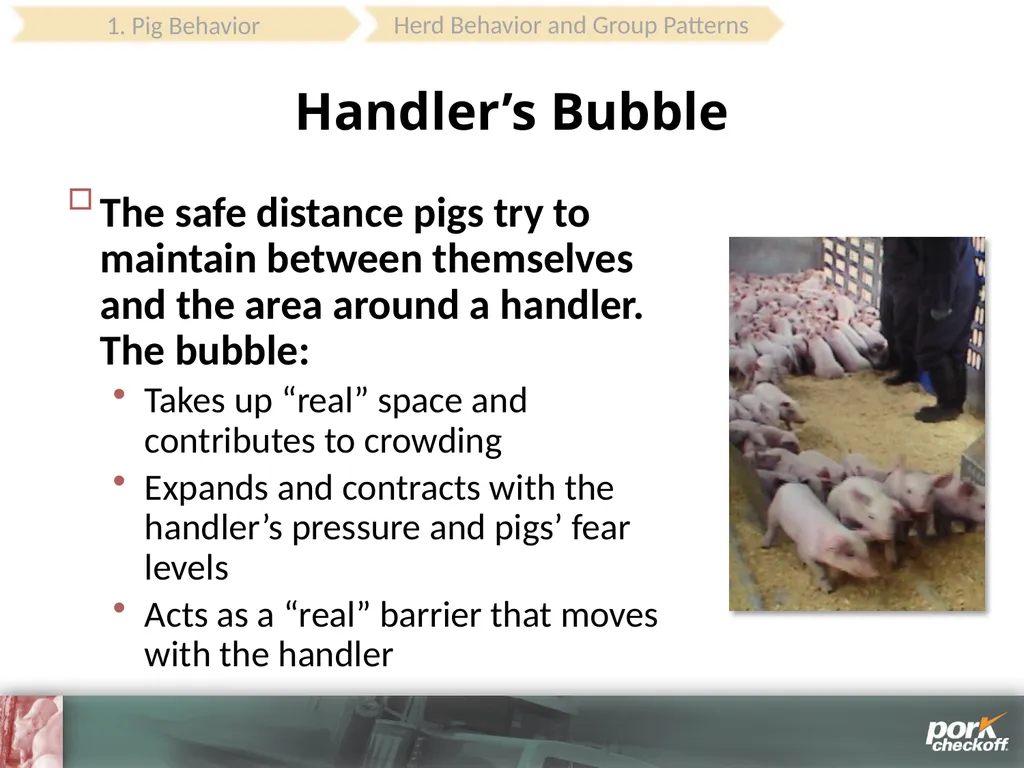
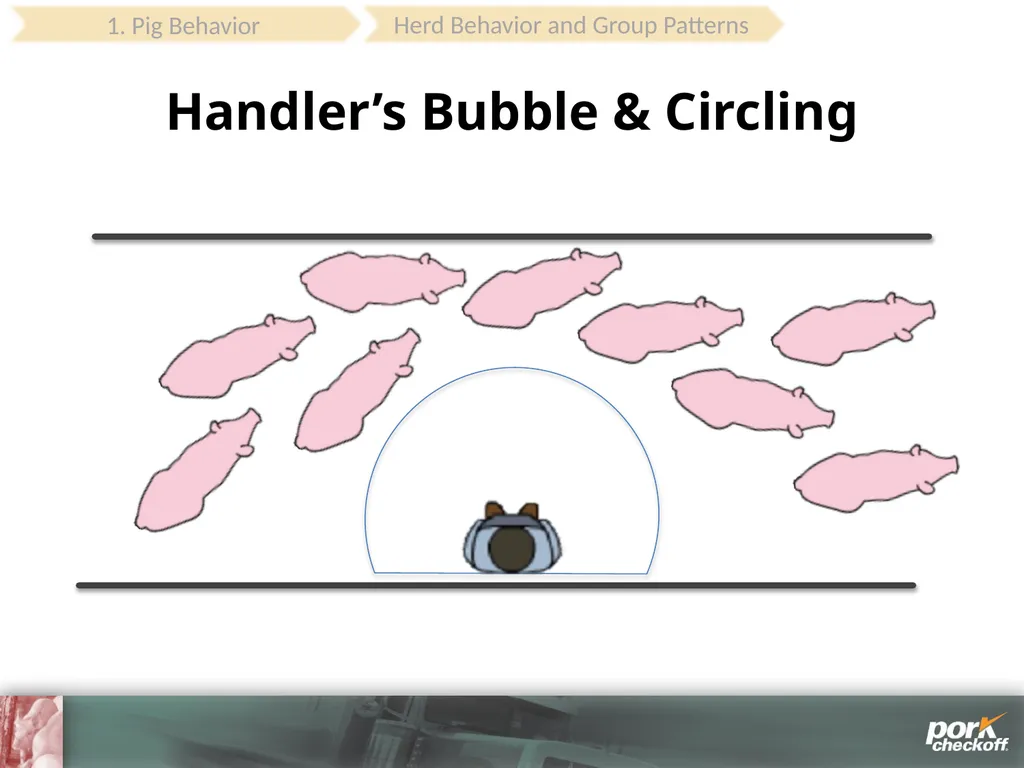
Handler’s Bubble The safe distance pigs try to maintain between themselves and the area around a handler. The bubble:
Takes up “real” space and contributes to crowding
Expands and contracts with the handler’s pressure and pigs’ fear levels
Acts as a “real” barrier that moves with the handler 1. Pig Behavior Herd Behavior and Group Patterns<br>
Takes up “real” space and contributes to crowding
Expands and contracts with the handler’s pressure and pigs’ fear levels
Acts as a “real” barrier that moves with the handler 1. Pig Behavior Herd Behavior and Group Patterns<br>
26
Handler’s Bubble & Circling 1. Pig Behavior Herd Behavior and Group Patterns<br>
27
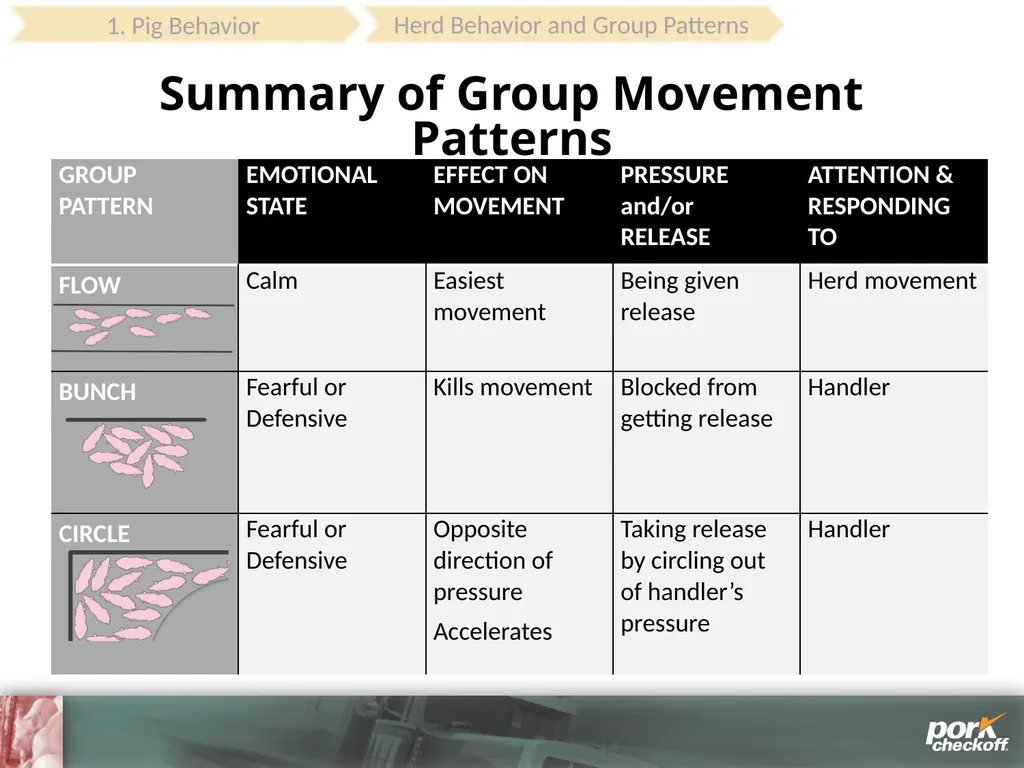
Summary of Group Movement Patterns 1. Pig Behavior Herd Behavior and Group Patterns<br>
28
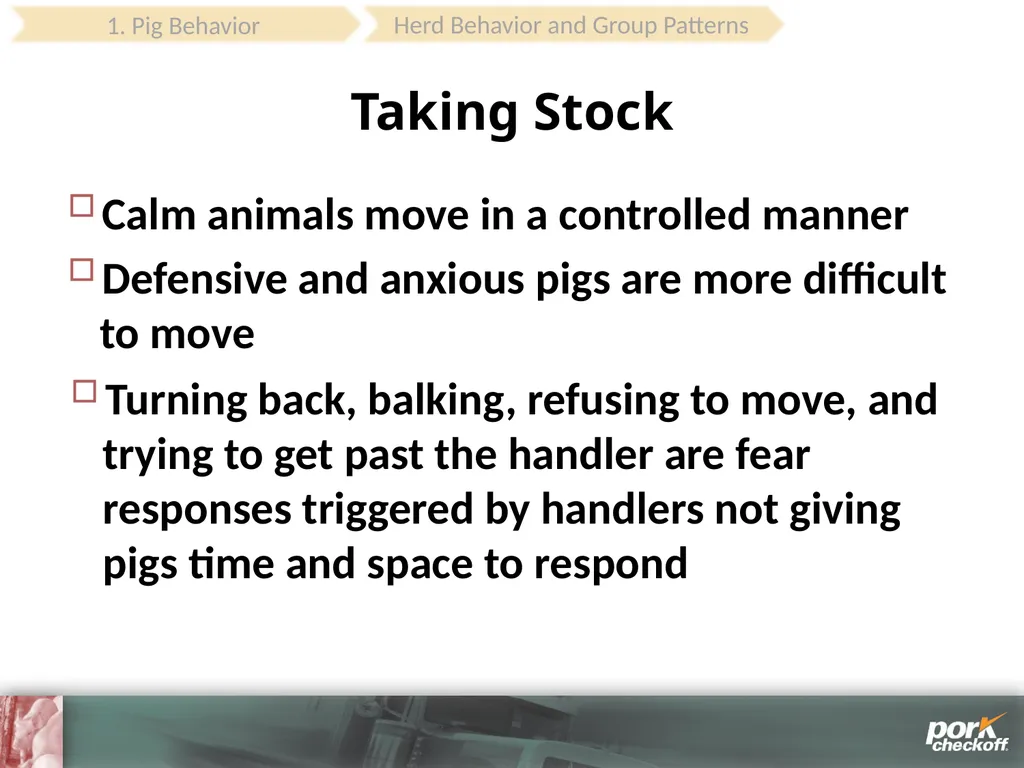
Taking Stock Calm animals move in a controlled manner
Defensive and anxious pigs are more difficult to move 1. Pig Behavior Herd Behavior and Group Patterns Turning back, balking, refusing to move, and trying to get past the handler are fear responses triggered by handlers not giving pigs time and space to respond<br>
Defensive and anxious pigs are more difficult to move 1. Pig Behavior Herd Behavior and Group Patterns Turning back, balking, refusing to move, and trying to get past the handler are fear responses triggered by handlers not giving pigs time and space to respond<br>
29
2. Handling<br>
30
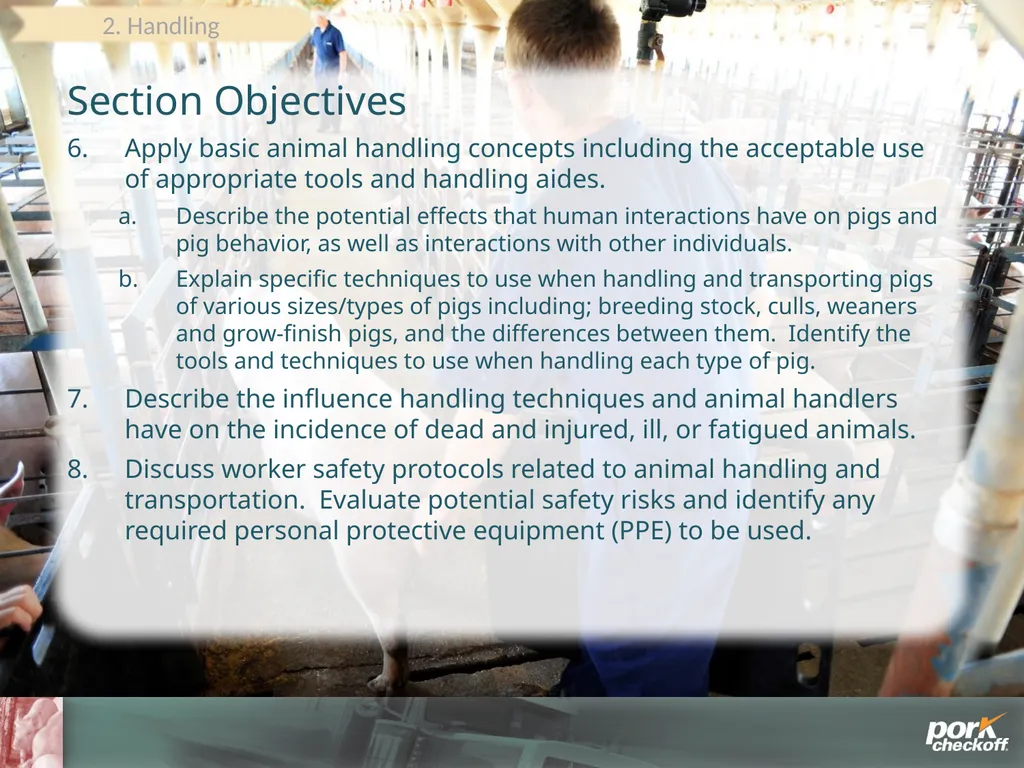
2. Handling Section Objectives
Apply basic animal handling concepts including the acceptable use of appropriate tools and handling aides.
Describe the potential effects that human interactions have on pigs and pig behavior, as well as interactions with other individuals.
Explain specific techniques to use when handling and transporting pigs of various sizes/types of pigs including; breeding stock, culls, weaners and grow-finish pigs, and the differences between them. Identify the tools and techniques to use when handling each type of pig.
Describe the influence handling techniques and animal handlers have on the incidence of dead and injured, ill, or fatigued animals.
Discuss worker safety protocols related to animal handling and transportation. Evaluate potential safety risks and identify any required personal protective equipment (PPE) to be used.<br>
31
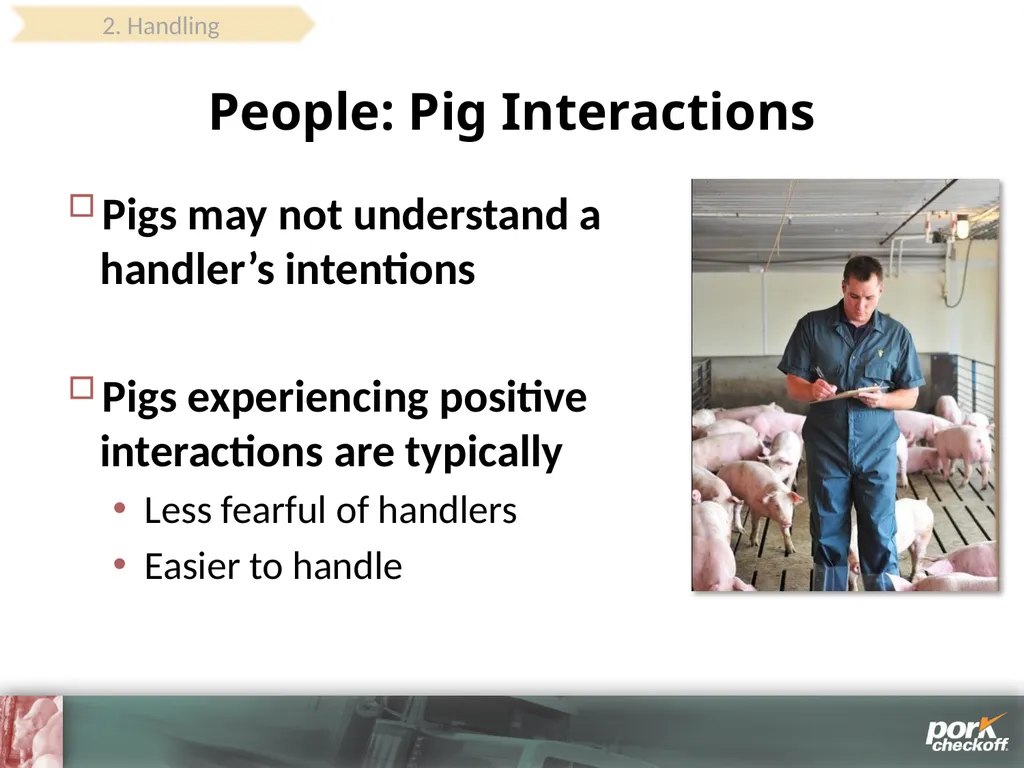
People: Pig Interactions Pigs may not understand a handler’s intentions
Pigs experiencing positive interactions are typically
Less fearful of handlers
Easier to handle 2. Handling<br>
Pigs experiencing positive interactions are typically
Less fearful of handlers
Easier to handle 2. Handling<br>
32
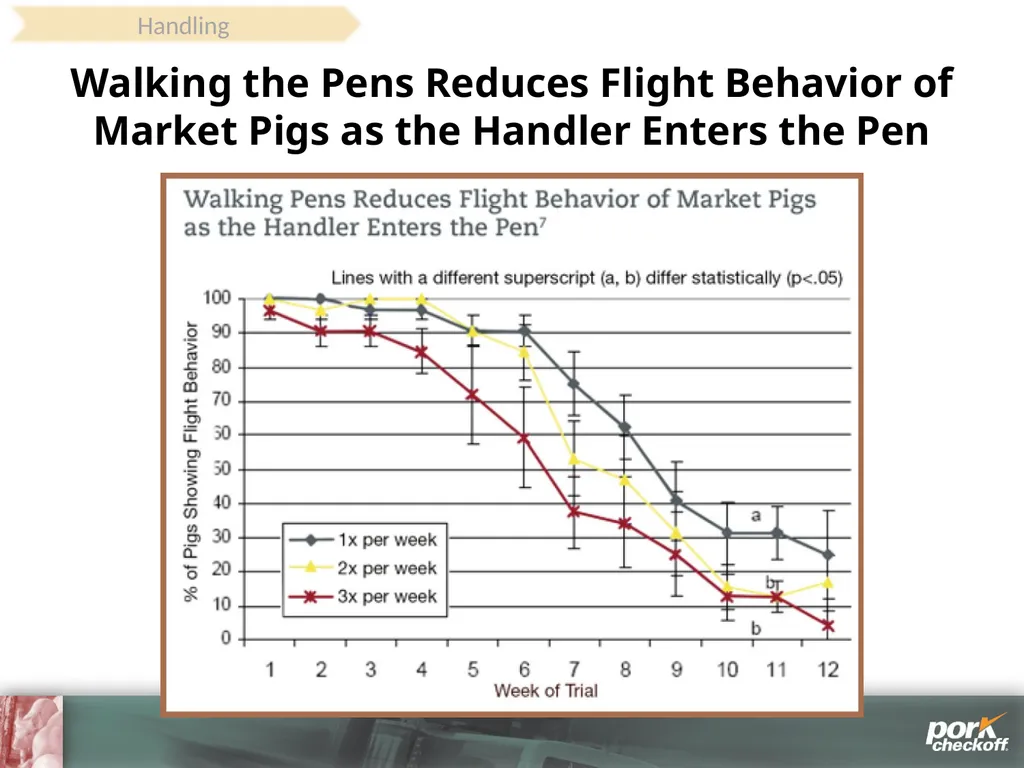
Walking the Pens Reduces Flight Behavior of Market Pigs as the Handler Enters the Pen Handling<br>
33
Proper Handling Move pigs at their normal walking pace
Avoid aggressive handling:
Overuse, or improper use, of electric prods
Loud noises and yelling
Moving pigs too fast
Moving too many pigs per group
Overcrowding pigs in chutes, ramps and alleyways
Rough physical contact
Willful acts of abuse are unacceptable
Requirements differ for certain sizes and types of pigs Handling<br>
34
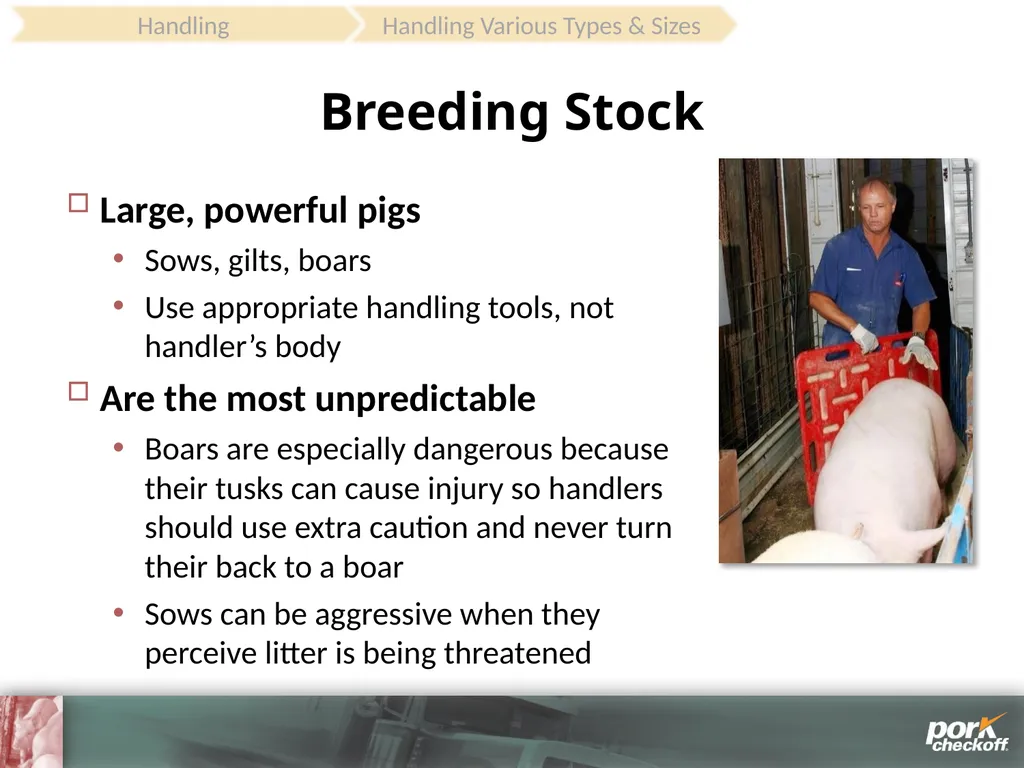
Breeding Stock Large, powerful pigs
Sows, gilts, boars
Use appropriate handling tools, not handler’s body
Are the most unpredictable
Boars are especially dangerous because their tusks can cause injury so handlers should use extra caution and never turn their back to a boar
Sows can be aggressive when they perceive litter is being threatened Handling Handling Various Types & Sizes<br>
35
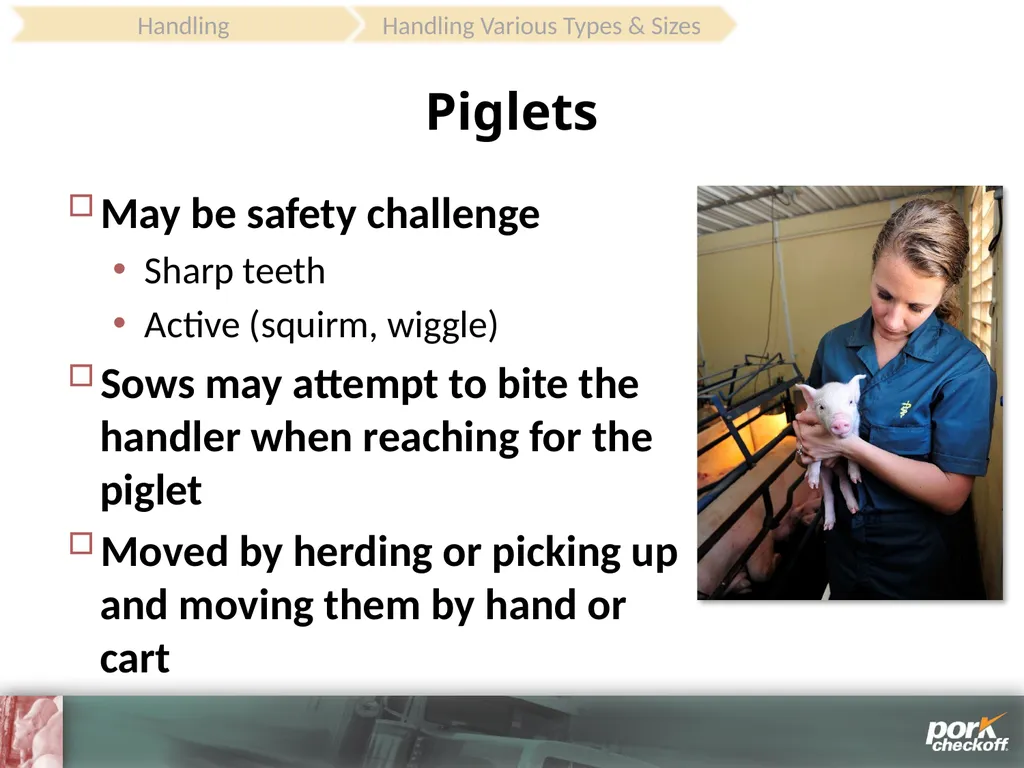
Piglets May be safety challenge
Sharp teeth
Active (squirm, wiggle)
Sows may attempt to bite the handler when reaching for the piglet
Moved by herding or picking up and moving them by hand or cart Handling Handling Various Types & Sizes<br>
Sharp teeth
Active (squirm, wiggle)
Sows may attempt to bite the handler when reaching for the piglet
Moved by herding or picking up and moving them by hand or cart Handling Handling Various Types & Sizes<br>
36
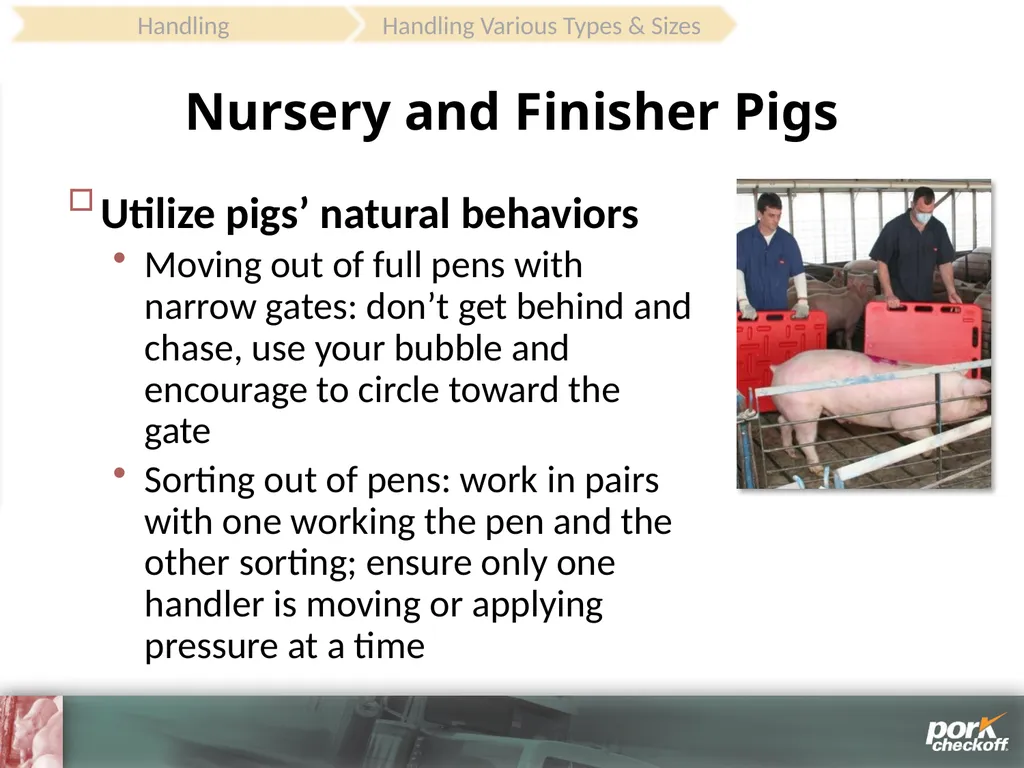
Nursery and Finisher Pigs Utilize pigs’ natural behaviors
Moving out of full pens with narrow gates: don’t get behind and chase, use your bubble and encourage to circle toward the gate
Sorting out of pens: work in pairs with one working the pen and the other sorting; ensure only one handler is moving or applying pressure at a time Handling Handling Various Types & Sizes<br>
37
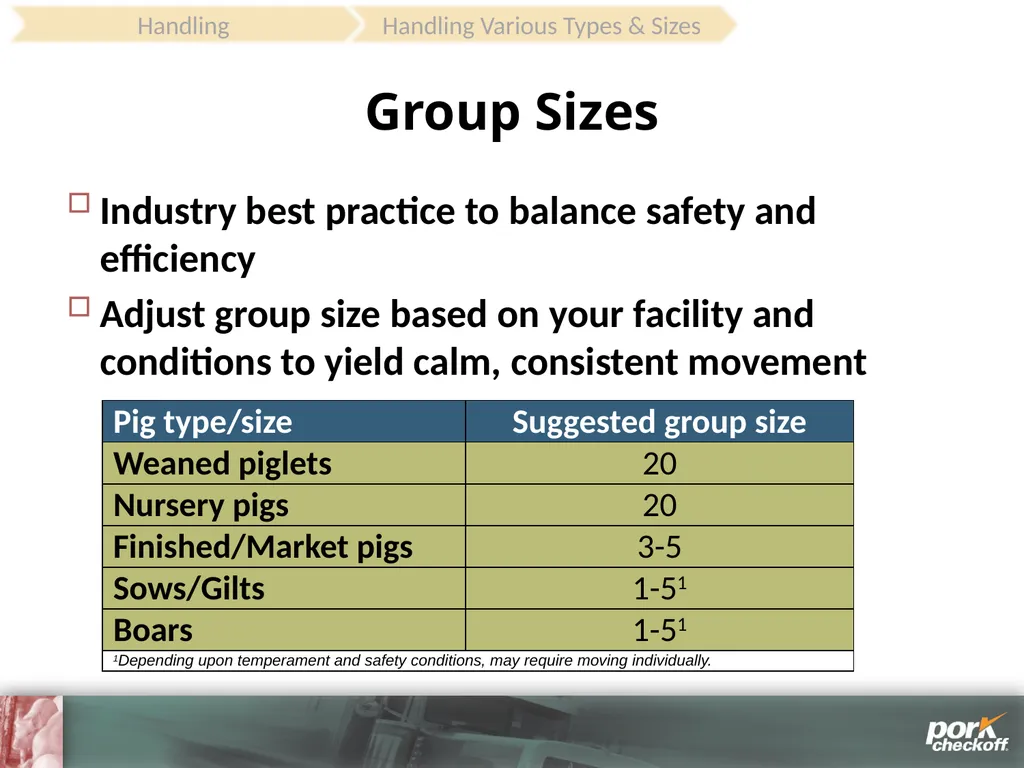
Group Sizes Industry best practice to balance safety and efficiency
Adjust group size based on your facility and conditions to yield calm, consistent movement Handling Handling Various Types & Sizes<br>
Adjust group size based on your facility and conditions to yield calm, consistent movement Handling Handling Various Types & Sizes<br>
38
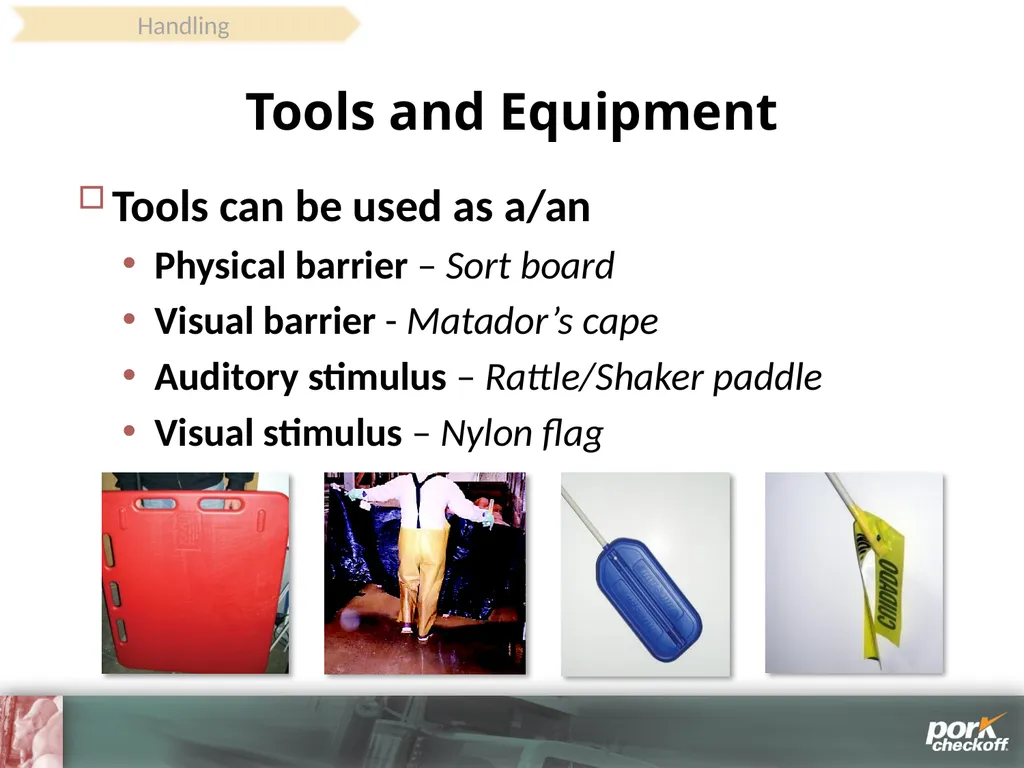
Tools and Equipment Tools can be used as a/an
Physical barrier – Sort board
Visual barrier - Matador’s cape
Auditory stimulus – Rattle/Shaker paddle
Visual stimulus – Nylon flag Handling<br>
Physical barrier – Sort board
Visual barrier - Matador’s cape
Auditory stimulus – Rattle/Shaker paddle
Visual stimulus – Nylon flag Handling<br>
39
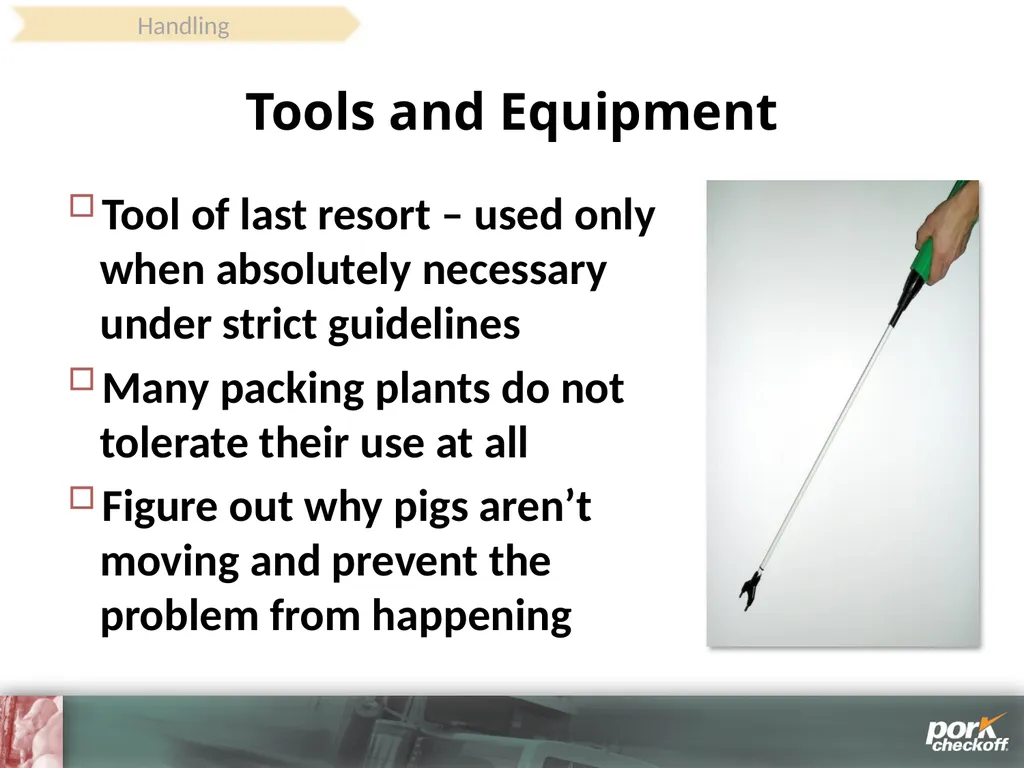
Tools and Equipment Tool of last resort – used only when absolutely necessary under strict guidelines
Many packing plants do not tolerate their use at all
Figure out why pigs aren’t moving and prevent the problem from happening Handling<br>
Many packing plants do not tolerate their use at all
Figure out why pigs aren’t moving and prevent the problem from happening Handling<br>
40
SAFE ANIMAL HANDLING PRACTICES Human injuries happen more often when people are handling animals than during any other activity performed in pork production;
Common injuries:
Contact injuries, slipping and falling, head cuts, or bumps and bruises when on the trailer
Remain aware of the environment to avoid injury to self Handling<br>
Common injuries:
Contact injuries, slipping and falling, head cuts, or bumps and bruises when on the trailer
Remain aware of the environment to avoid injury to self Handling<br>
41
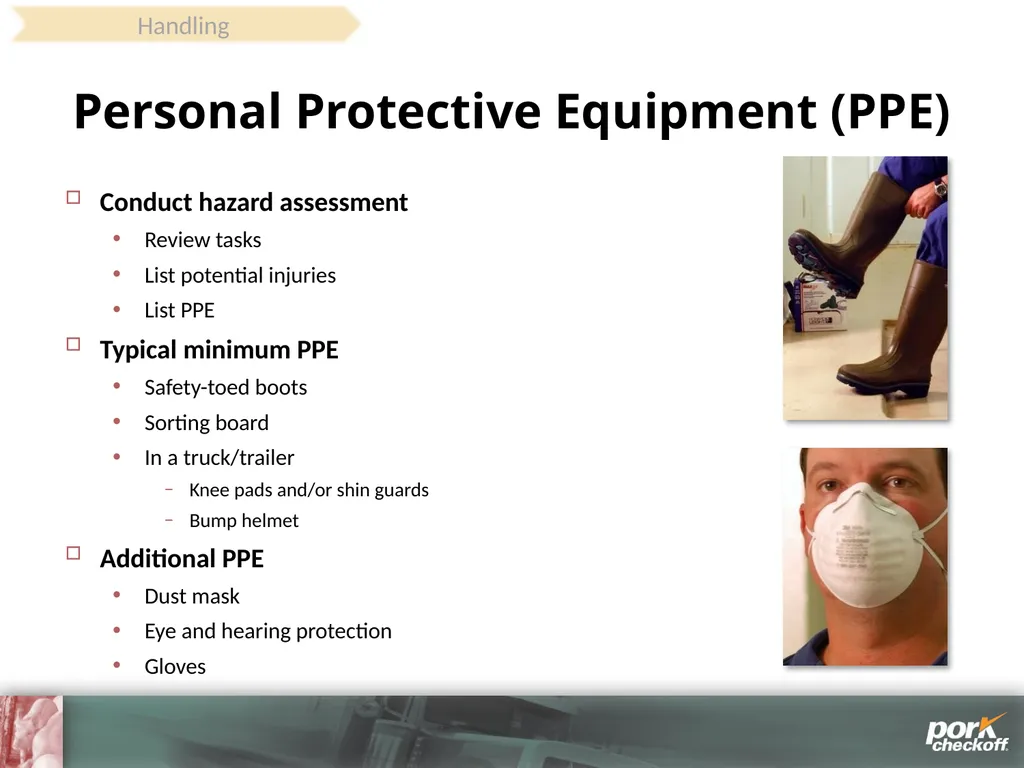
Personal Protective Equipment (PPE) Conduct hazard assessment
Review tasks
List potential injuries
List PPE
Typical minimum PPE
Safety-toed boots
Sorting board
In a truck/trailer
Knee pads and/or shin guards
Bump helmet
Additional PPE
Dust mask
Eye and hearing protection
Gloves Handling<br>
Review tasks
List potential injuries
List PPE
Typical minimum PPE
Safety-toed boots
Sorting board
In a truck/trailer
Knee pads and/or shin guards
Bump helmet
Additional PPE
Dust mask
Eye and hearing protection
Gloves Handling<br>
42
Summary How you choose to communicate with the pigs you move effects their behavior and meat quality:
Walk pens on a daily basis
When moving pigs, act calmly and avoid sudden movement, loud noises, and other actions that may frighten or excite pigs
Move pigs at their normal walking pace
As handlers:
Understand basic handling protocols for certain sizes and types of pigs
Move the correct group size for the type of pigs being handled
Understand handling equipment and when to use these tools so they are effective
Minimize or eliminate electric prod use when loading pigs
Understand personal protective equipment for loading, transport and unloading Handling<br>
43
5. Fitness of the Pig<br>
44
5. Fitness of Pig Section Objectives
Evaluate the fitness of a pig and its readiness for transportation in each phase of production.
Identify which animals are, and which are not, appropriate to transport and why.
Describe how to resolve potential conflicts regarding fitness of the pig during the loading/unloading process.
Compare the roles and relationships of proper animal handling, weight and phenotype.<br>
45
Fitness of the Pig It is the position of the National Pork Board that any pig unable to walk, is ill or significantly injured, should not be transported to market channels.
Where likelihood of recovery is low, even with treatment, pig should be humanely euthanized
Any pig that becomes fatigued should be moved to a resting area in an appropriate manner
A fatigued pig is defined as having temporarily lost the ability to walk but has a reasonable expectation to recover full locomotion with rest
Resting area helps enable recovery by minimizing competition for feed and water and provides the opportunity for monitoring 5. Fitness of Pig<br>
46
Fitness of the Pig Evaluate pigs before loading
Examples of pigs unfit for transport
Sick, injured, weak, disabled, or fatigued
Unable to stand unaided and bear weight on each leg
Blind in both eyes
Cannot be moved without causing them additional suffering
Body condition would result in poor welfare because of the expected climatic conditions
Newborn with an unhealed navel
Pregnant animals which would be in the final 10% of their gestational period at the planned time of unloading unless special conditions provided
Females traveling without young which have given birth within the previous 48 hours 5. Fitness of Pig<br>
47
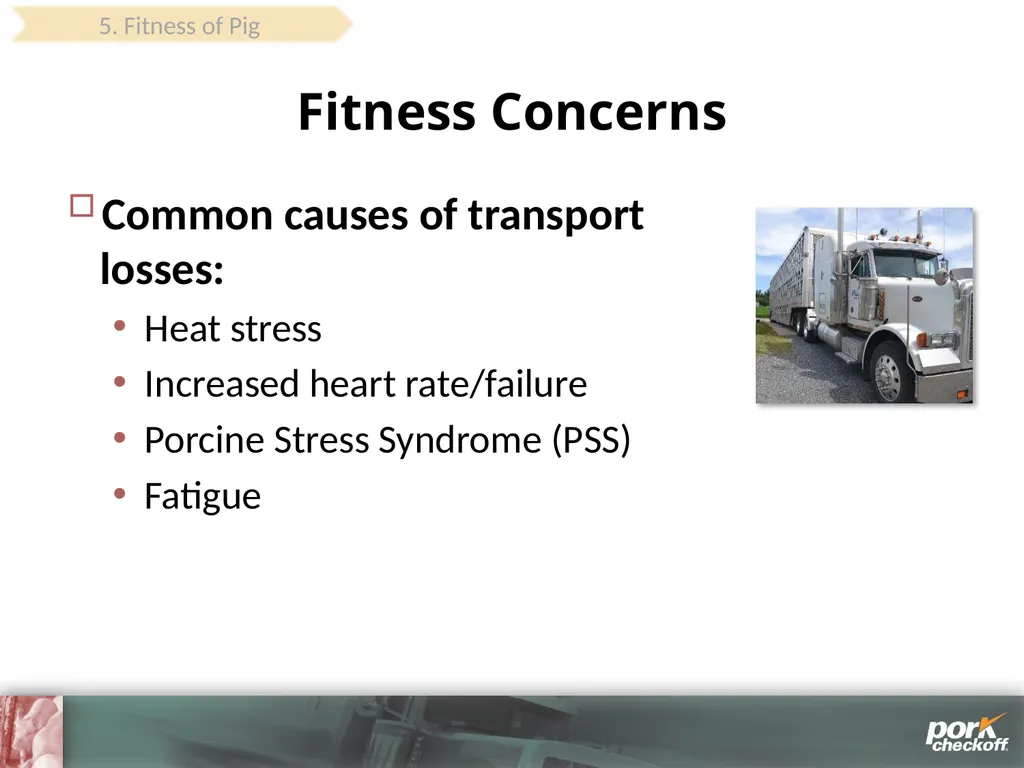
Fitness Concerns Common causes of transport losses:
Heat stress
Increased heart rate/failure
Porcine Stress Syndrome (PSS)
Fatigue 5. Fitness of Pig<br>
Heat stress
Increased heart rate/failure
Porcine Stress Syndrome (PSS)
Fatigue 5. Fitness of Pig<br>
48
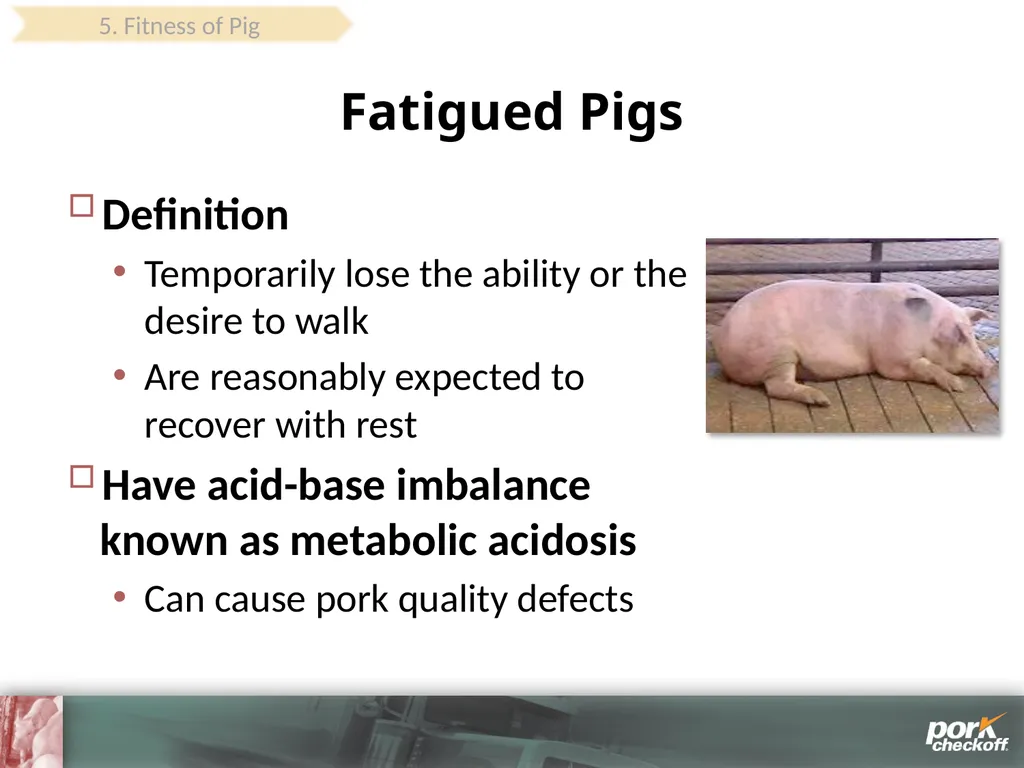
Fatigued Pigs Definition
Temporarily lose the ability or the desire to walk
Are reasonably expected to recover with rest
Have acid-base imbalance known as metabolic acidosis
Can cause pork quality defects 5. Fitness of Pig<br>
Temporarily lose the ability or the desire to walk
Are reasonably expected to recover with rest
Have acid-base imbalance known as metabolic acidosis
Can cause pork quality defects 5. Fitness of Pig<br>
49
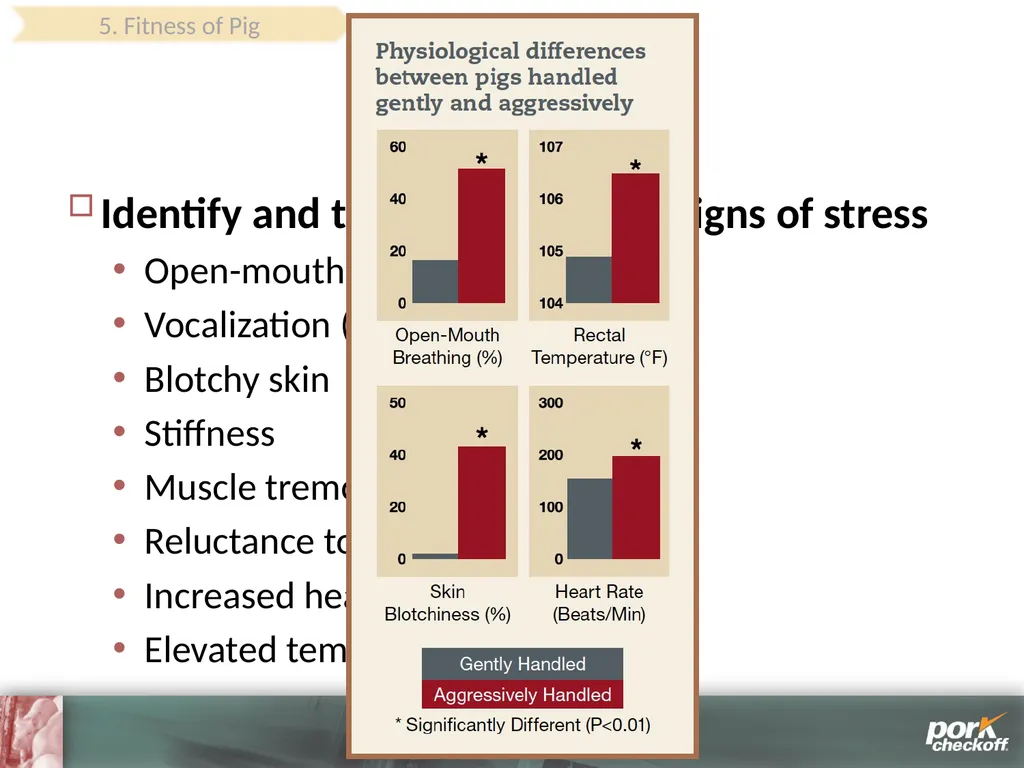
Stress Signs Identify and treat pigs showing signs of stress
Open-mouth breathing (panting)
Vocalization (squealing)
Blotchy skin
Stiffness
Muscle tremors
Reluctance to move
Increased heart rate
Elevated temperature 5. Fitness of Pig<br>
Open-mouth breathing (panting)
Vocalization (squealing)
Blotchy skin
Stiffness
Muscle tremors
Reluctance to move
Increased heart rate
Elevated temperature 5. Fitness of Pig<br>
50
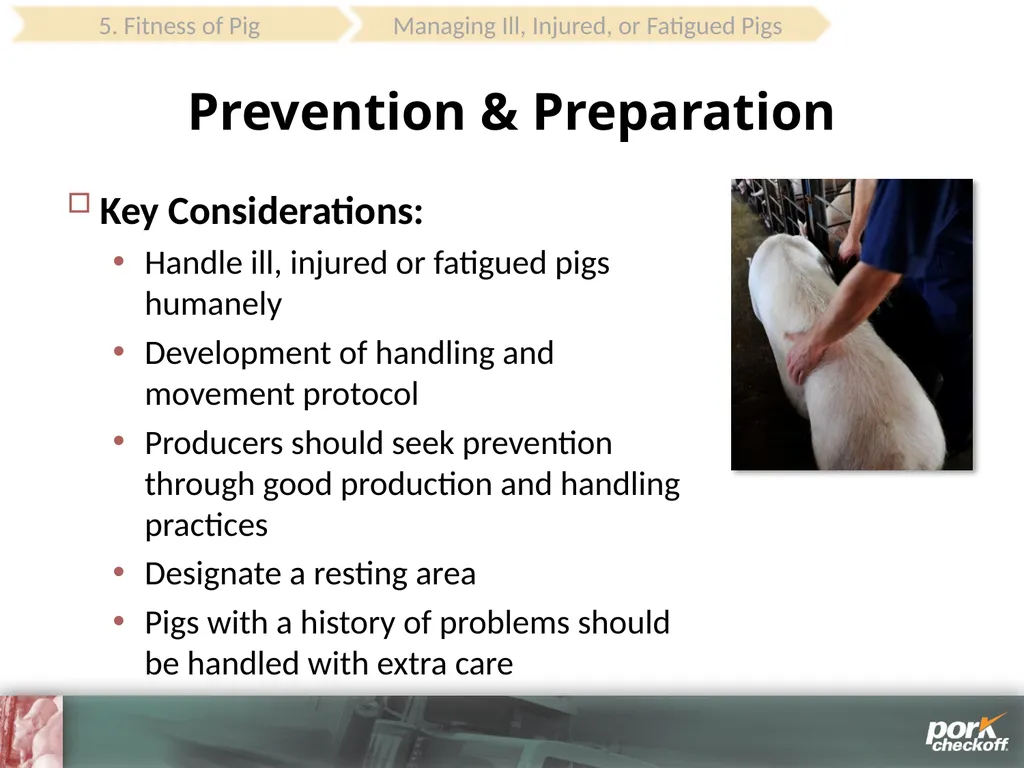
Prevention & Preparation Key Considerations:
Handle ill, injured or fatigued pigs humanely
Development of handling and movement protocol
Producers should seek prevention through good production and handling practices
Designate a resting area
Pigs with a history of problems should be handled with extra care 5. Fitness of Pig Managing Ill, Injured, or Fatigued Pigs<br>
51
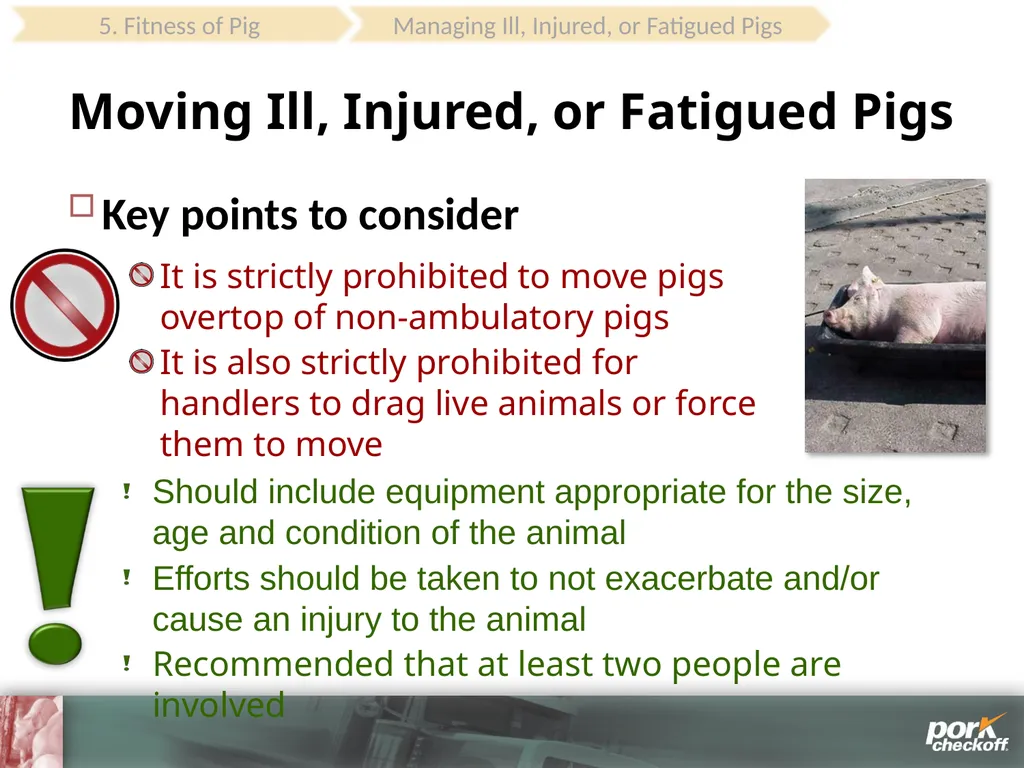
Moving Ill, Injured, or Fatigued Pigs Key points to consider 5. Fitness of Pig Managing Ill, Injured, or Fatigued Pigs<br>
52
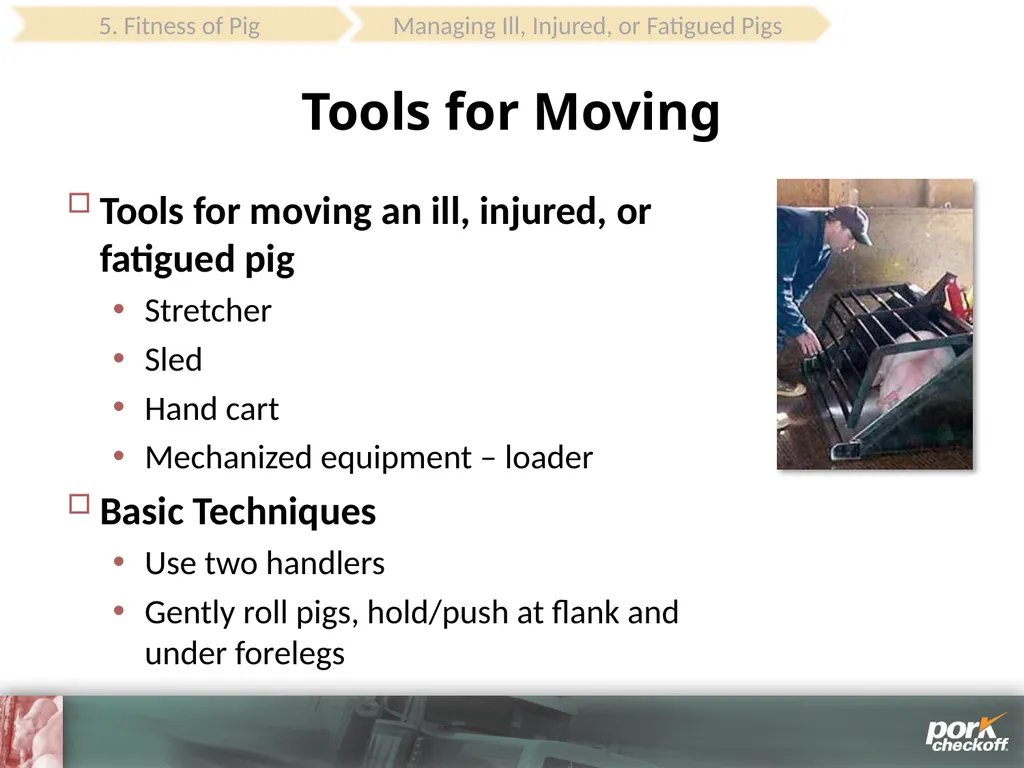
Tools for Moving Tools for moving an ill, injured, or fatigued pig
Stretcher
Sled
Hand cart
Mechanized equipment – loader
Basic Techniques
Use two handlers
Gently roll pigs, hold/push at flank and under forelegs 5. Fitness of Pig Managing Ill, Injured, or Fatigued Pigs<br>
Stretcher
Sled
Hand cart
Mechanized equipment – loader
Basic Techniques
Use two handlers
Gently roll pigs, hold/push at flank and under forelegs 5. Fitness of Pig Managing Ill, Injured, or Fatigued Pigs<br>
53
Summary Evaluate for fitness prior to transport
There are three primary issues that can lead to increased transport losses:
Fatigue,
Heat Stress
Porcine Stress Syndrome (PSS)
Animals that become ill or injured or fatigued during transport should always be handled humanely with the appropriate tools 5. Fitness of Pig<br>
There are three primary issues that can lead to increased transport losses:
Fatigue,
Heat Stress
Porcine Stress Syndrome (PSS)
Animals that become ill or injured or fatigued during transport should always be handled humanely with the appropriate tools 5. Fitness of Pig<br>