
PORTFOLIO COMMITTEE ON PLANNING, MONITORING &
KB
Published · 25 slides · 0 views

1 / 1


Description
PORTFOLIO COMMITTEE ON PLANNING, MONITORING EVALUATION The Medium-Term Development Plan 2024-2029 19 March 2025 1 Introduction 1 2 3 Introduction and Background Transitioning to the 7th Administration Methodology and Approach to the MTDP
Related Topics
Share
Embed code
Download this presentation From Below
"PORTFOLIO COMMITTEE ON PLANNING, MONITORING &" is the property of its rightful owner. Permission is granted to download and print the materials on this website for personal, non-commercial use only, and to display it on your personal computer provided you do not modify the materials and that you retain all copyright notices contained in the materials. By downloading content from our website, you accept the terms of this agreement.
Presentation Transcript
01
PORTFOLIO COMMITTEE ON PLANNING, MONITORING & EVALUATION The Medium-Term Development Plan 2024-2029
19 March 2025 1<br>
19 March 2025 1<br>
02
Introduction 1
2
3 Introduction and Background
Transitioning to the 7th Administration
Methodology and Approach to the MTDP 2024-2029
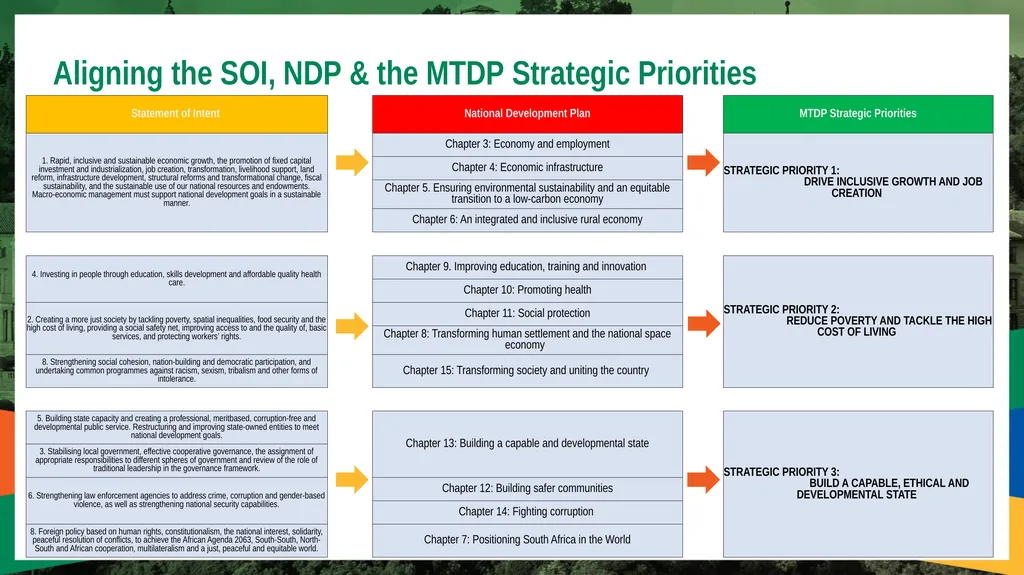
a) SoI, NDP and MTDP alignment
b) Scenarios
c) Approach to Priorities
d) Strategic Priorities and Interventions
Implementation, Monitoring and Evaluation
Annexure A: Acronyms/Abbreviations 2<br>
03
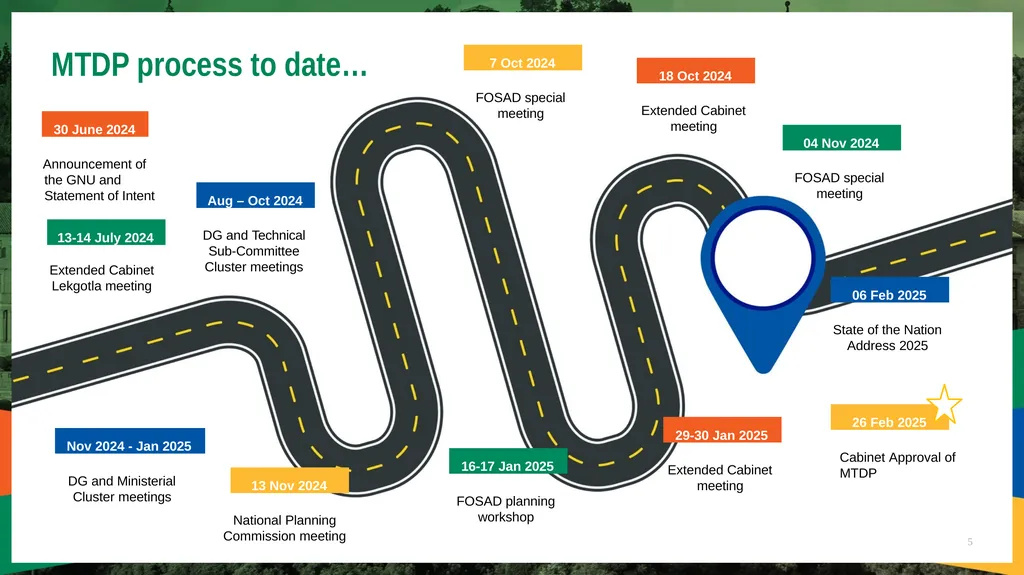
Introduction and background The outcome of the general elections on 29 May 2024 saw the formation of the Government of National Unity (GNU).
A Statement of Intent (Sol) binds the GNU and lays the foundational principles and minimum programme of priorities.
Cabinet Lekgotla on 13 - 14 July 2024 agreed on a minimum Programme of Priorities and approved that this be translated into the draft MTDP 2024-2029 as a more detailed plan.
It also serves as a framework that supports the goals of the National Development Plan (NDP): Vision 2030.
The medium-term planning process for the development of the MTDP thus far has included:
- A review of the approach and methodology, moving from the Medium Term Strategic Framework (MTSF) 2019-2024 to the MTDP 2024-2029;
- An analysis of the development context, drawing from evaluative reviews such as the DPME 30-Year Review, NDP 10-Year Review, and the Indlulamithi Scenarios 2035, amongst others; and
- Feedback was received from the Government Clusters, FOSAD, Cabinet Makgotla, MTDP Steering Committee, Reference Group, sector workshops, National Planning Commission, and national and provincial strategic planning sessions, amongst multiple other sources.
The MTDP 2024-2029 was adopted by the Extended Cabinet Lekgotla on the 30 January 2025 and officially approved by Cabinet on the 26 February 2025. 3<br>
04
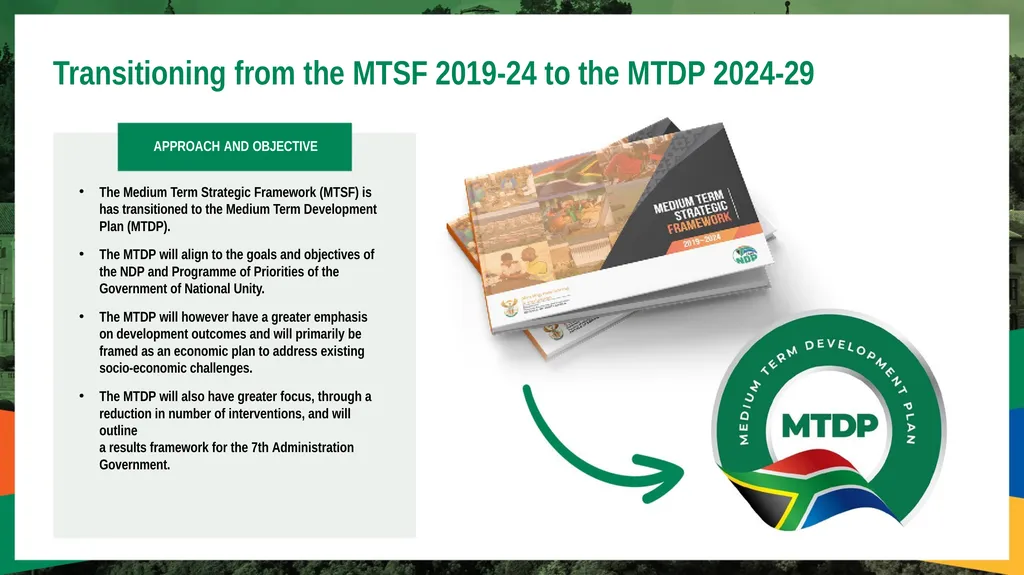
Transitioning from the MTSF 2019-24 to the MTDP 2024-29 The Medium Term Strategic Framework (MTSF) is has transitioned to the Medium Term Development Plan (MTDP).
The MTDP will align to the goals and objectives of the NDP and Programme of Priorities of the Government of National Unity.
The MTDP will however have a greater emphasis on development outcomes and will primarily be framed as an economic plan to address existing socio-economic challenges.
The MTDP will also have greater focus, through a reduction in number of interventions, and will outline a results framework for the 7th Administration Government. APPROACH AND OBJECTIVE 4<br>
05
MTDP process to date… Announcement of the GNU and Statement of Intent Extended Cabinet Lekgotla meeting FOSAD planning workshop DG and Technical Sub-Committee Cluster meetings DG and Ministerial Cluster meetings FOSAD special meeting National Planning Commission meeting Extended Cabinet meeting Extended Cabinet meeting State of the Nation Address 2025 Cabinet Approval of MTDP FOSAD special meeting 30 June 2024 13-14 July 2024 16-17 Jan 2025 Aug – Oct 2024 Nov 2024 - Jan 2025 7 Oct 2024 13 Nov 2024 18 Oct 2024 29-30 Jan 2025 06 Feb 2025 26 Feb 2025 04 Nov 2024 5<br>
06
Aligning the SOI, NDP & the MTDP Strategic Priorities 6<br>
07
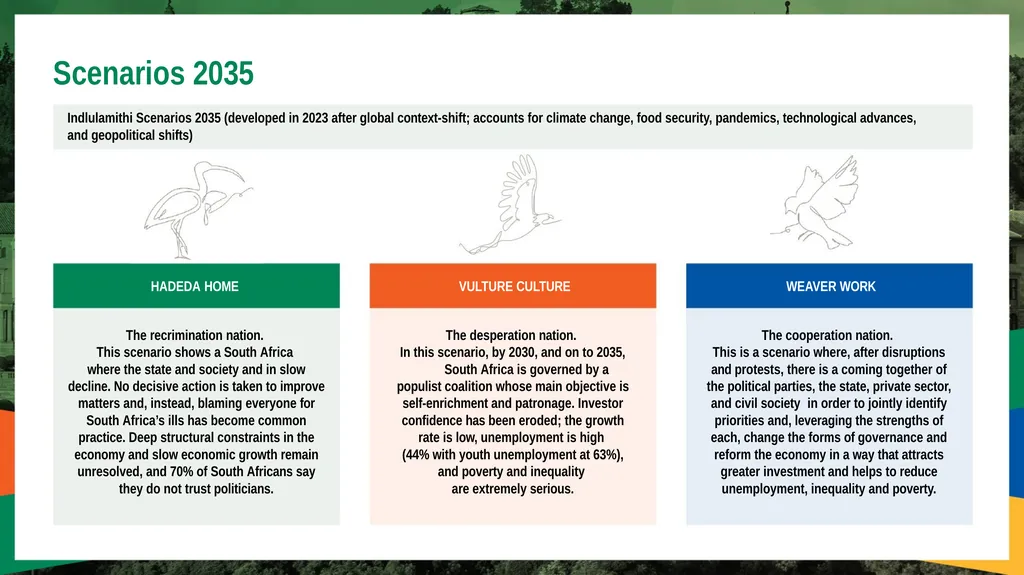
Scenarios 2035 Indlulamithi Scenarios 2035 (developed in 2023 after global context-shift; accounts for climate change, food security, pandemics, technological advances, and geopolitical shifts) The recrimination nation.
This scenario shows a South Africa
where the state and society and in slow decline. No decisive action is taken to improve matters and, instead, blaming everyone for South Africa’s ills has become common practice. Deep structural constraints in the economy and slow economic growth remain unresolved, and 70% of South Africans say they do not trust politicians. The desperation nation.
In this scenario, by 2030, and on to 2035,
South Africa is governed by a populist coalition whose main objective is self-enrichment and patronage. Investor confidence has been eroded; the growth rate is low, unemployment is high (44% with youth unemployment at 63%), and poverty and inequality are extremely serious. The cooperation nation. This is a scenario where, after disruptions and protests, there is a coming together of the political parties, the state, private sector, and civil society in order to jointly identify priorities and, leveraging the strengths of each, change the forms of governance and reform the economy in a way that attracts greater investment and helps to reduce unemployment, inequality and poverty. HADEDA HOME VULTURE CULTURE WEAVER WORK 7<br>
South Africa is governed by a populist coalition whose main objective is self-enrichment and patronage. Investor confidence has been eroded; the growth rate is low, unemployment is high (44% with youth unemployment at 63%), and poverty and inequality are extremely serious. The cooperation nation. This is a scenario where, after disruptions and protests, there is a coming together of the political parties, the state, private sector, and civil society in order to jointly identify priorities and, leveraging the strengths of each, change the forms of governance and reform the economy in a way that attracts greater investment and helps to reduce unemployment, inequality and poverty. HADEDA HOME VULTURE CULTURE WEAVER WORK 7<br>
08
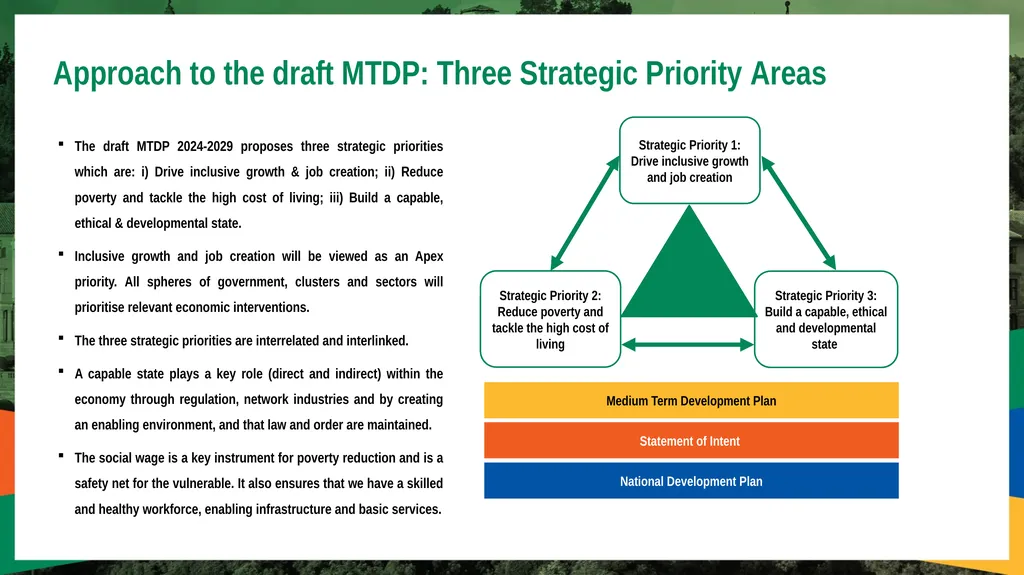
Approach to the draft MTDP: Three Strategic Priority Areas The draft MTDP 2024-2029 proposes three strategic priorities which are: i) Drive inclusive growth & job creation; ii) Reduce poverty and tackle the high cost of living; iii) Build a capable, ethical & developmental state.
Inclusive growth and job creation will be viewed as an Apex priority. All spheres of government, clusters and sectors will prioritise relevant economic interventions.
The three strategic priorities are interrelated and interlinked.
A capable state plays a key role (direct and indirect) within the economy through regulation, network industries and by creating an enabling environment, and that law and order are maintained.
The social wage is a key instrument for poverty reduction and is a safety net for the vulnerable. It also ensures that we have a skilled and healthy workforce, enabling infrastructure and basic services. Strategic Priority 1: Drive inclusive growth and job creation Strategic Priority 2: Reduce poverty and tackle the high cost of living Strategic Priority 3: Build a capable, ethical and developmental state National Development Plan Statement of Intent Medium Term Development Plan 8<br>
09
MTDP STRATEGIC PRIORITY 1:
DRIVE INCLUSIVE GROWTH AND JOB CREATION<br>
DRIVE INCLUSIVE GROWTH AND JOB CREATION<br>
10
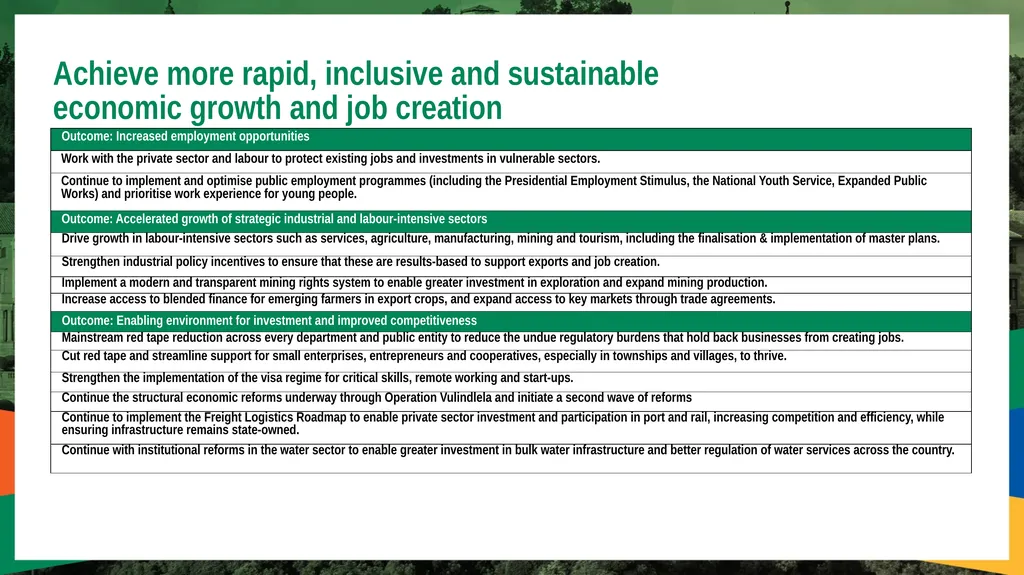
Achieve more rapid, inclusive and sustainable economic growth and job creation 10<br>
11
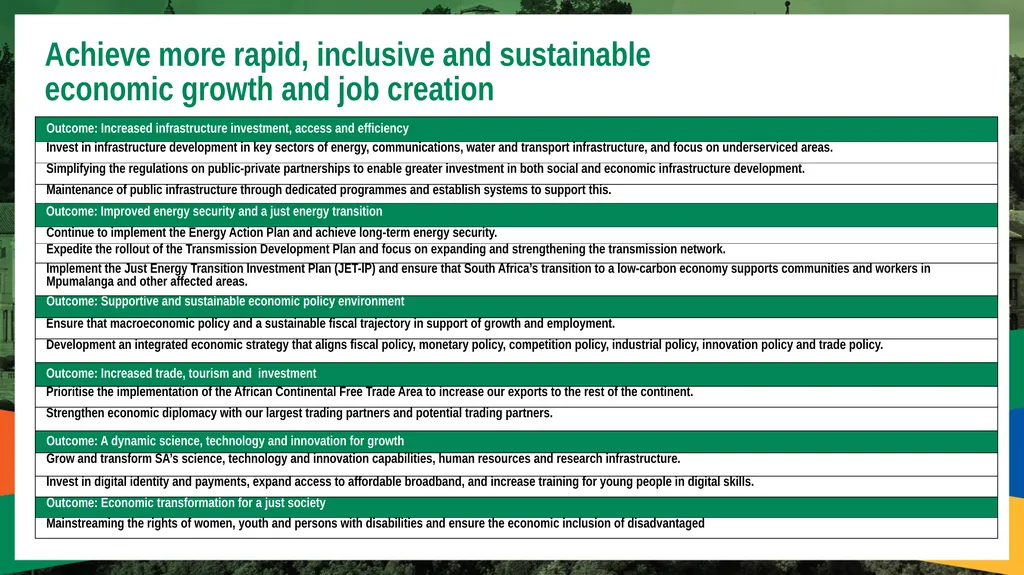
Achieve more rapid, inclusive and sustainable economic growth and job creation 11<br>
12
MTDP STRATEGIC PRIORITY 2:
REDUCE POVERTY AND TACKLE
THE HIGH COST OF LIVING<br>
13
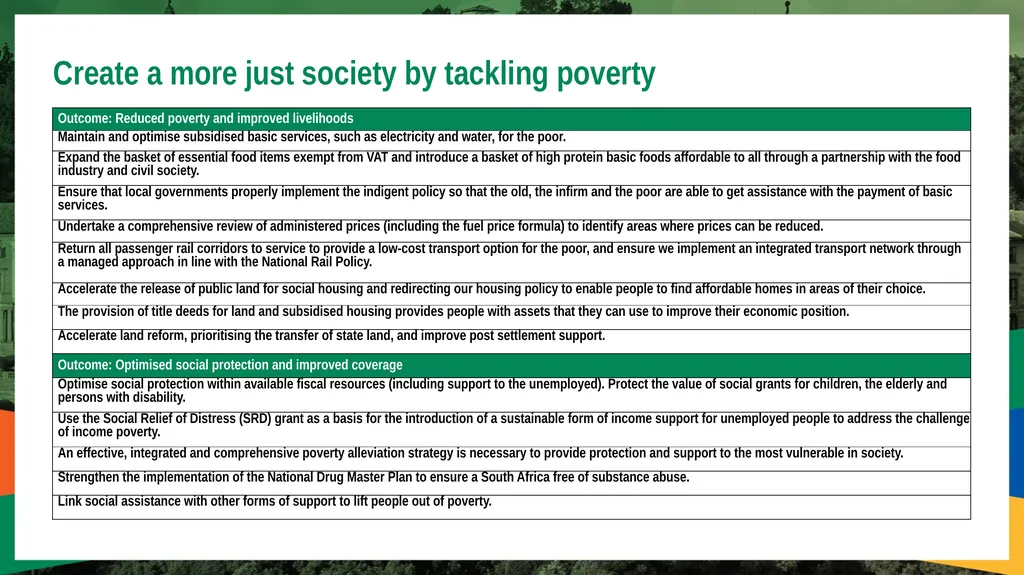
Create a more just society by tackling poverty 13<br>
14
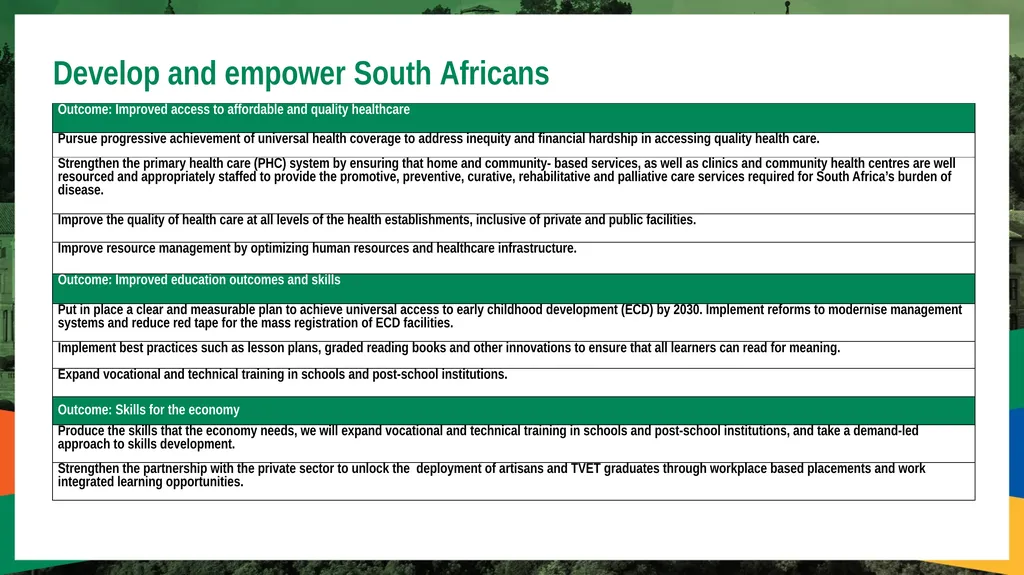
Develop and empower South Africans 14<br>
15
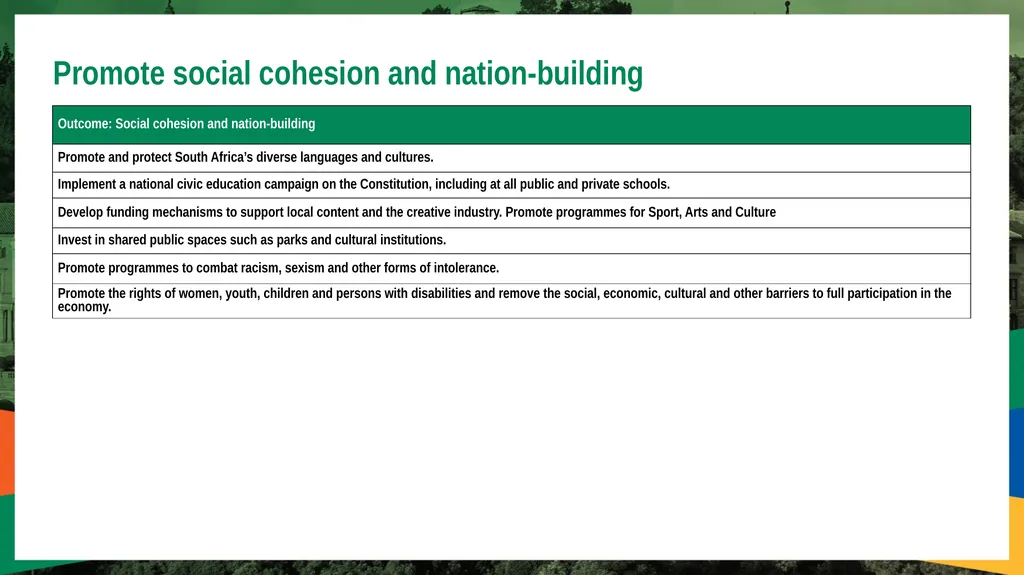
Promote social cohesion and nation-building 15<br>
16
MTDP STRATEGIC PRIORITY 3:
BUILD A CAPABLE, ETHICAL
AND DEVELOPMENTAL STATE<br>
AND DEVELOPMENTAL STATE<br>
17
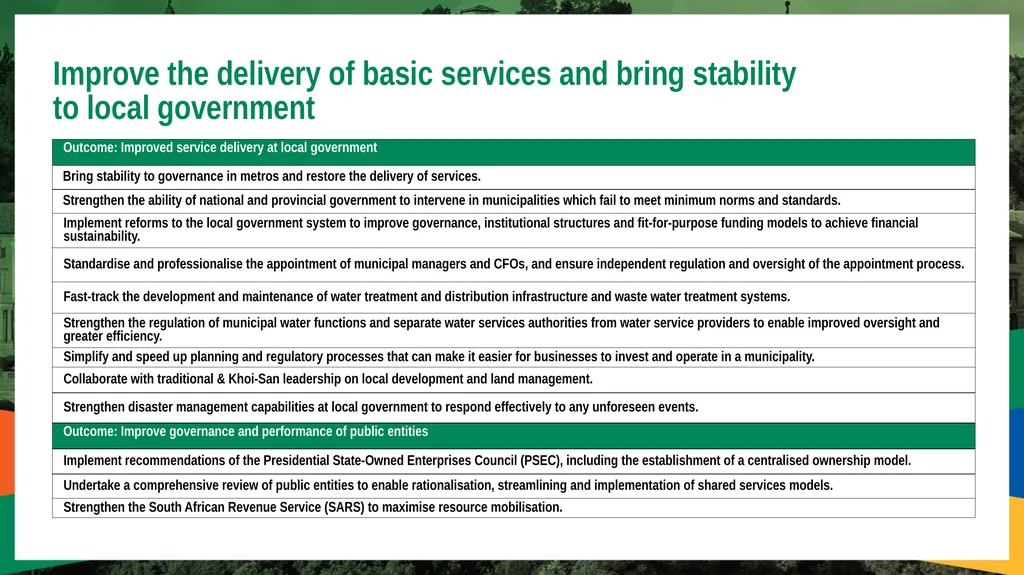
Improve the delivery of basic services and bring stability
to local government 17<br>
18
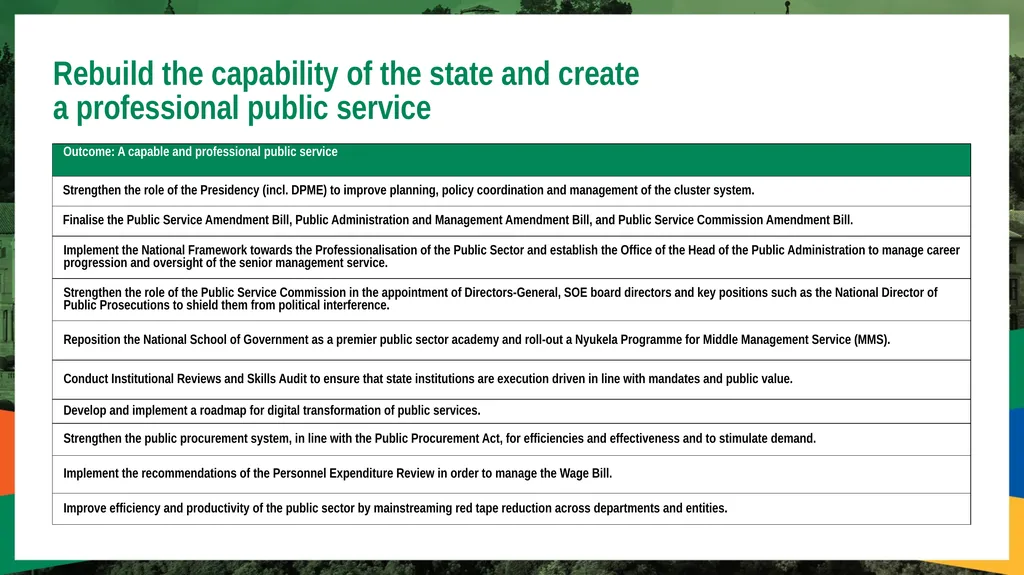
Rebuild the capability of the state and create
a professional public service 18<br>
19
Strengthen law enforcement agencies to address crime
and corruption 19<br>
20
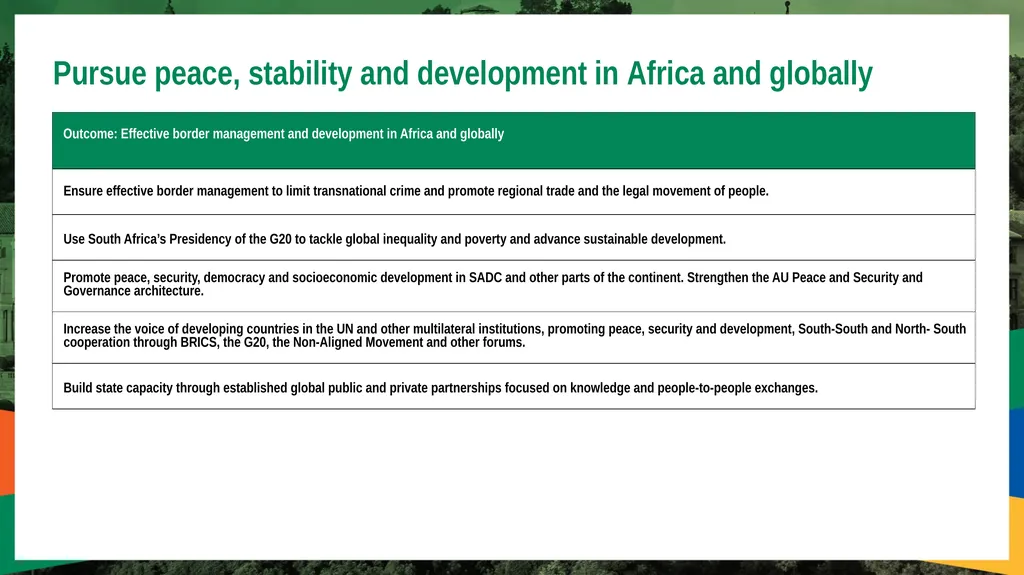
Pursue peace, stability and development in Africa and globally 20<br>
21
Implementation, monitoring and evaluation 21<br>
22
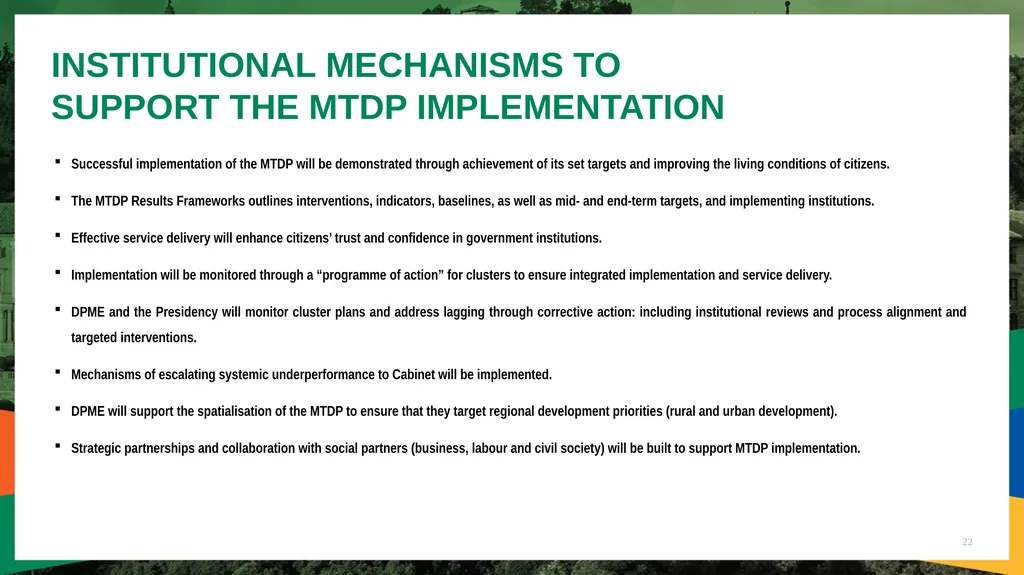
Institutional mechanisms to support THE MTDP implementation Successful implementation of the MTDP will be demonstrated through achievement of its set targets and improving the living conditions of citizens.
The MTDP Results Frameworks outlines interventions, indicators, baselines, as well as mid- and end-term targets, and implementing institutions.
Effective service delivery will enhance citizens’ trust and confidence in government institutions.
Implementation will be monitored through a “programme of action” for clusters to ensure integrated implementation and service delivery.
DPME and the Presidency will monitor cluster plans and address lagging through corrective action: including institutional reviews and process alignment and targeted interventions.
Mechanisms of escalating systemic underperformance to Cabinet will be implemented.
DPME will support the spatialisation of the MTDP to ensure that they target regional development priorities (rural and urban development).
Strategic partnerships and collaboration with social partners (business, labour and civil society) will be built to support MTDP implementation. 22<br>
23
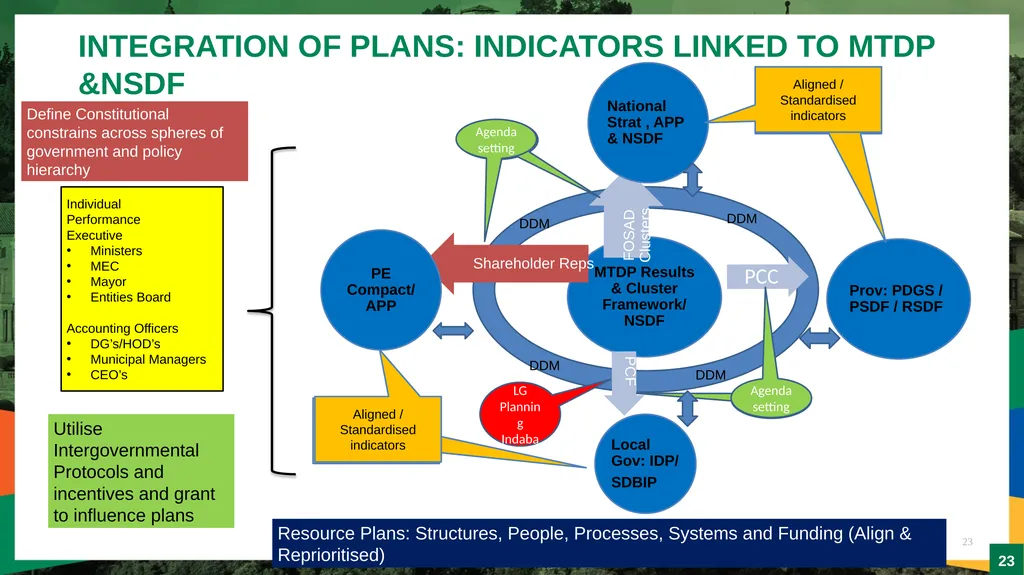
Integration of Plans: Indicators linked to MTDP &NSDF 23 Individual
Performance
Executive
Ministers
MEC
Mayor
Entities Board
Accounting Officers
DG’s/HOD’s
Municipal Managers
CEO’s Aligned / Standardised indicators Aligned / Standardised indicators Aligned / Standardised indicators Aligned / Standardised indicators 23 Define Constitutional constrains across spheres of government and policy hierarchy Resource Plans: Structures, People, Processes, Systems and Funding (Align & Reprioritised) DDM DDM DDM DDM LG Planning Indaba Agenda setting Agenda setting Agenda setting Agenda setting Utilise Intergovernmental Protocols and incentives and grant to influence plans<br>
24
THANK YOU 24<br>
25
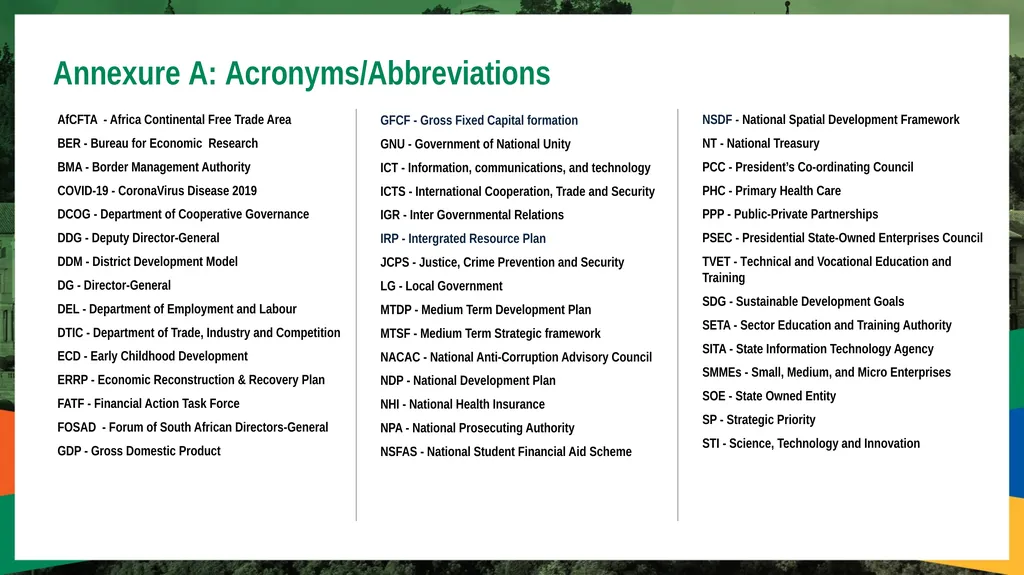
Annexure A: Acronyms/Abbreviations AfCFTA - Africa Continental Free Trade Area
BER - Bureau for Economic Research
BMA - Border Management Authority
COVID-19 - CoronaVirus Disease 2019
DCOG - Department of Cooperative Governance
DDG - Deputy Director-General
DDM - District Development Model
DG - Director-General
DEL - Department of Employment and Labour
DTIC - Department of Trade, Industry and Competition
ECD - Early Childhood Development
ERRP - Economic Reconstruction & Recovery Plan
FATF - Financial Action Task Force
FOSAD - Forum of South African Directors-General
GDP - Gross Domestic Product NSDF - National Spatial Development Framework
NT - National Treasury
PCC - President’s Co-ordinating Council
PHC - Primary Health Care
PPP - Public-Private Partnerships
PSEC - Presidential State-Owned Enterprises Council
TVET - Technical and Vocational Education and Training
SDG - Sustainable Development Goals
SETA - Sector Education and Training Authority
SITA - State Information Technology Agency
SMMEs - Small, Medium, and Micro Enterprises
SOE - State Owned Entity
SP - Strategic Priority
STI - Science, Technology and Innovation GFCF - Gross Fixed Capital formation
GNU - Government of National Unity
ICT - Information, communications, and technology
ICTS - International Cooperation, Trade and Security
IGR - Inter Governmental Relations
IRP - Intergrated Resource Plan
JCPS - Justice, Crime Prevention and Security
LG - Local Government
MTDP - Medium Term Development Plan
MTSF - Medium Term Strategic framework
NACAC - National Anti-Corruption Advisory Council
NDP - National Development Plan
NHI - National Health Insurance
NPA - National Prosecuting Authority
NSFAS - National Student Financial Aid Scheme 25<br>