Prasanta Choudhury Sources Of food 5 Topic : The food habits of Animals Teaching Points: (a) Meaning of Food habits (b) Reason of the food habits (c) Types of food habits (d) Importance of food habits Specific Aim : To know the Meaning food
"Prasanta Choudhury Sources Of food 5 Topic : The" is the property of its rightful owner. Permission is granted to
download and print the materials on this website for personal, non-commercial use only, and to display it
on your personal computer provided you do not modify the materials and that you retain all copyright
notices contained in the materials. By downloading content from our website, you accept the terms of this
agreement.
Presentation Transcript
01
Prasanta Choudhury Sources Of food 5<br>
02
Topic : The food habits of Animals Teaching Points:
(a) Meaning of Food habits
(b) Reason of the food habits
(c) Types of food habits
(d) Importance of food habits
Specific Aim : To know the Meaning food habit, Reason the food habit, Types of food habits and Importance of food habits, to Develop the co-relation, Understanding and Application<br>
03
Some Questions & Answers Question:
Name some animals which feed on grass.
Answer:
Goat, Sheep, Cow, Buffalo etc.
Question:
Name some animals which eat flesh.
Answer:
Lion, Tiger, Leopard etc.
Question:
Name some animals which eat both plants and flesh.
Answer:
Human being, Cat, Dog etc.<br>
04
Introduction You know cadets;
Animals have different food habits. Food habits of animals depend upon the availability of foods around him. Food habits of animals also tend to change with time and food availability. We categorize animals depending upon their food habits
Today, we shall discuss about the food habit of animals.<br>
05
Important Points Herbivores:
The animals which eat both the plant and plant products are known as herbivorous animals.
e.g. Cow, Buffalo, Goat, Sheep etc.
Carnivores:
The animals and birds those eat meat are known as Carnivores
e.g. Tiger, Lion, Leopard, etc.
Omnivores:
The animals and birds that eat both plants and flesh are known as Omnivores
e.g. Bear Monkey, Crow, Humans etc.
Scavengers:
The animals and plants that eat the dead animals and plants are termed as Scavengers.
e.g. Vulture, Jackal, Hyena, Crow etc.
Parasites:
The animals that feed on other animals are known as Parasites.
e.g. Bedbug, Leech, Mosquito etc.<br>
06
Some Questions & Answers Question:
What types of teeth do the Herbivores have?
Answer:
The Herbivores have (i) strong and sharp Incisors to cut food (ii) flat molars for chewing their food.
Question:
What types of teeth do the Carnivores have?
Answer:
The Carnivores have long, sharp and pointed Canines for tearing the flesh.
Question:
What types of teeth do the Omnivores have?
Answer:
Omnivores have different types of teeth designed to ea both Plants and animals.
Question:
Name the food habits of Tapeworm and Roundworm
Answer:
Both Tapeworm and Roundworm are Parasites living inside our body.<br>
07
Important Points Herbivores:
The animals which eat both the plant and plant products are known as herbivorous animals.
e.g. Cow, Buffalo, Goat, Sheep etc.
Carnivores:
The animals and birds those eat meat are known as Carnivores
e.g. Tiger, Lion, Leopard, etc.
Omnivores:
The animals and birds that eat flesh are known as Omnivores
e.g. Bear Monkey, Crow, Humans etc.
Scavengers:
The animals and plants that eat the dead animals and plants are termed as Scavengers.
e.g. Vulture, Jackal, Hyena, Crow etc.
Parasites:
The animals that feed on other animals are known as Parasites.
e.g. Bedbug, Leech, Mosquito etc.<br>
08
Question? Question: Name different types of teeth we have?
Answer: We have four types of teeth viz. Incisors, Canines, Pre-Molars and Molars.
Question? How many teeth does a Matured human have? Name the total number of teeth of each type.
Answer: A matured human has 32 (Thirty Two) teeth. Incisors = 08, Canines = 04, Pre-Molars = 08 and Molars = 12<br>
09
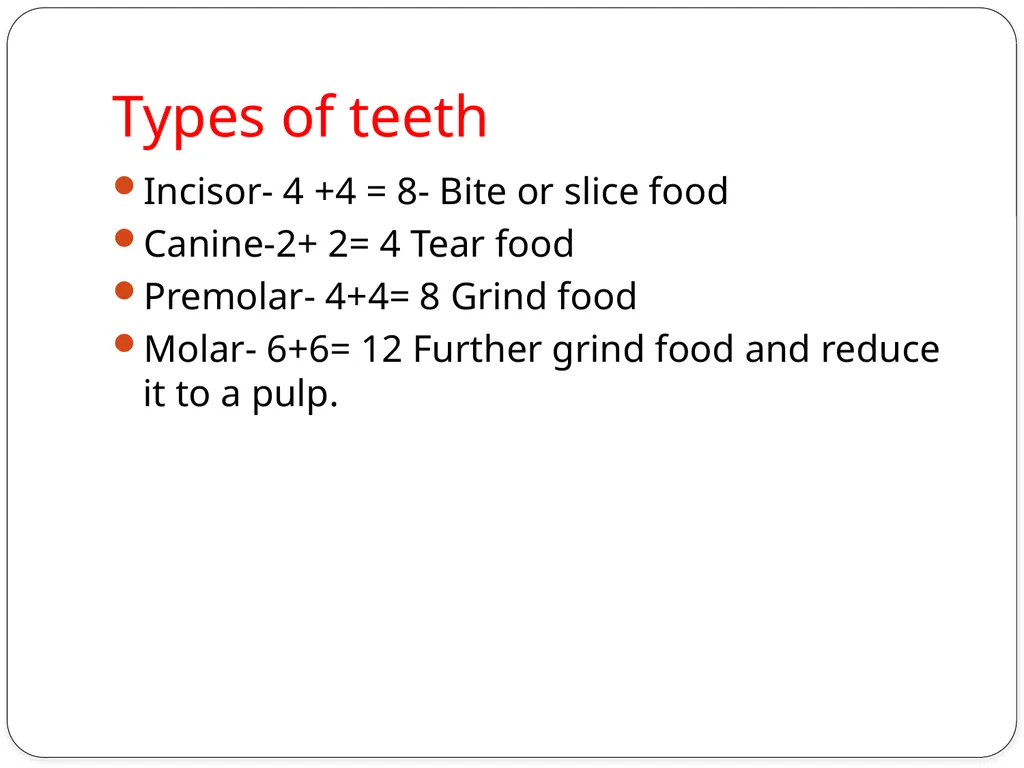
Types of teeth Incisor- 4 +4 = 8- Bite or slice food
Canine-2+ 2= 4 Tear food
Premolar- 4+4= 8 Grind food
Molar- 6+6= 12 Further grind food and reduce it to a pulp.<br>