
Prepare for discharge All mothers are supported to
MS
Published · 38 slides · 0 views

1 / 1






Description
Prepare for discharge All mothers are supported to give safe, responsive and nurturing care at home. Apply discharge criteria to decide if a newborn is ready to go home. Counsel caregivers on how to care for the baby at home (including
Related Topics
Share
Embed code
Download this presentation From Below
"Prepare for discharge All mothers are supported to" is the property of its rightful owner. Permission is granted to download and print the materials on this website for personal, non-commercial use only, and to display it on your personal computer provided you do not modify the materials and that you retain all copyright notices contained in the materials. By downloading content from our website, you accept the terms of this agreement.
Presentation Transcript
01
Prepare for discharge<br>
02
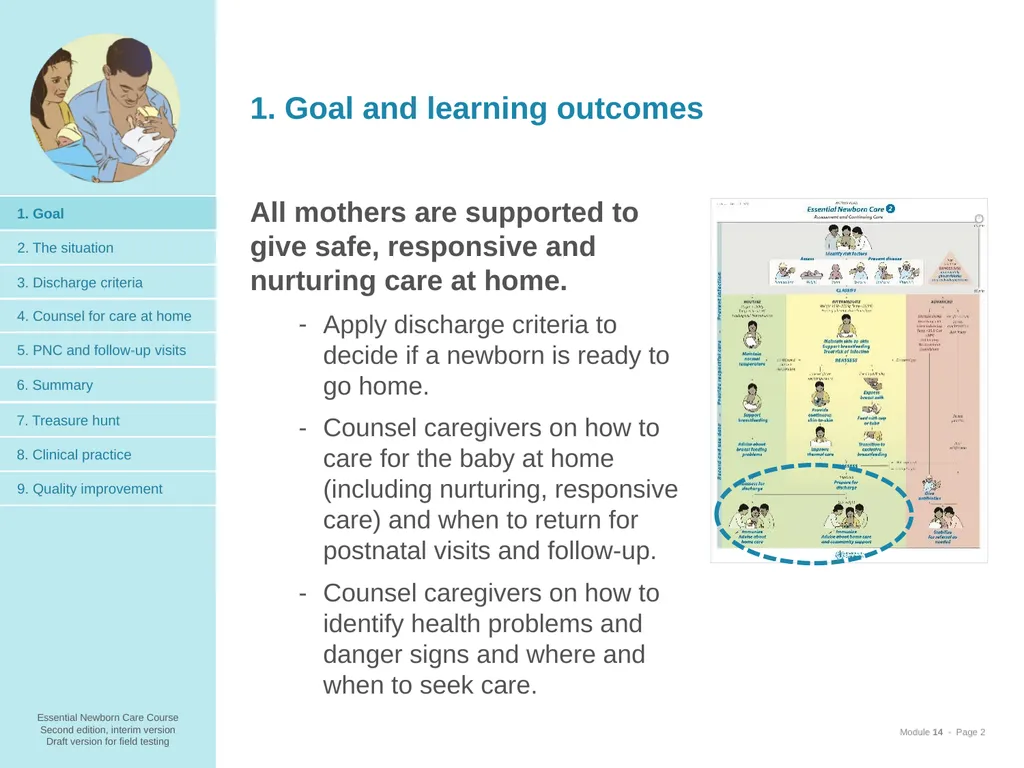
All mothers are supported to give safe, responsive and nurturing care at home.
Apply discharge criteria to decide if a newborn is ready to go home.
Counsel caregivers on how to care for the baby at home (including nurturing, responsive care) and when to return for postnatal visits and follow-up.
Counsel caregivers on how to identify health problems and danger signs and where and when to seek care. 1. Goal and learning outcomes<br>
03
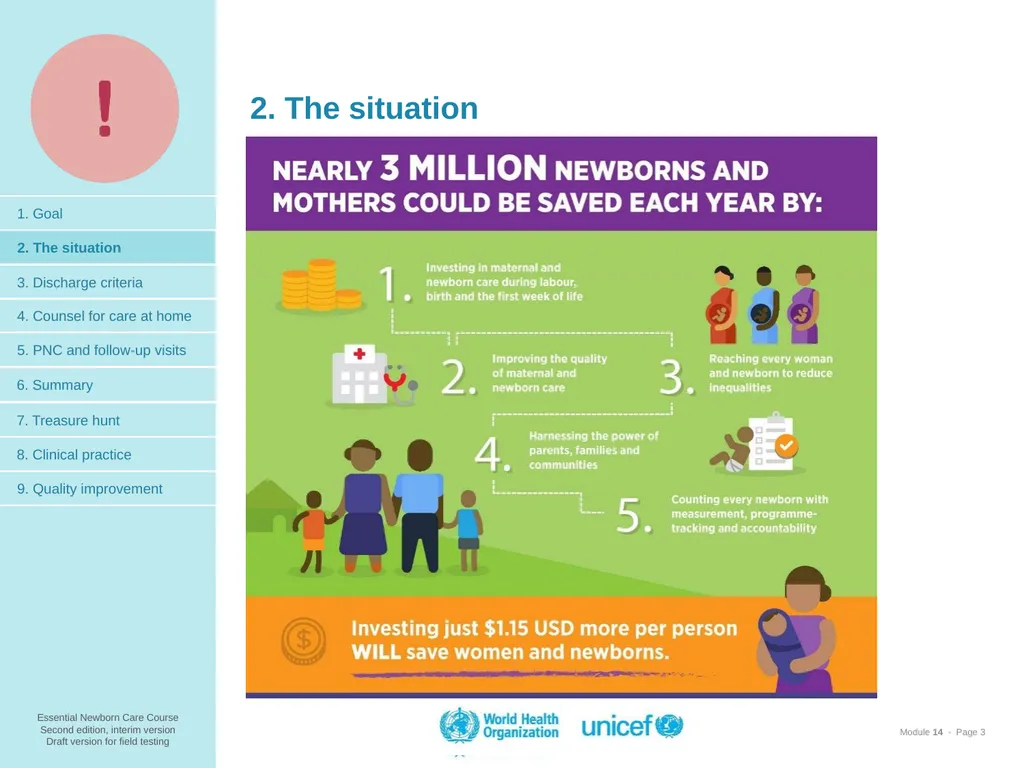
7000 newborns die every day.
Few women and newborns stay in the facility for the recommended 24 hours after birth, which is the most critical time for complications.
The first 3 days after birth account for about 30% of under-five child deaths.
About 62% of the total neonatal deaths occurred during the first 3 days of life.
Barriers to access and delays in seeking postnatal and emergency care contribute to deaths and disabilities. 2. The situation<br>
04
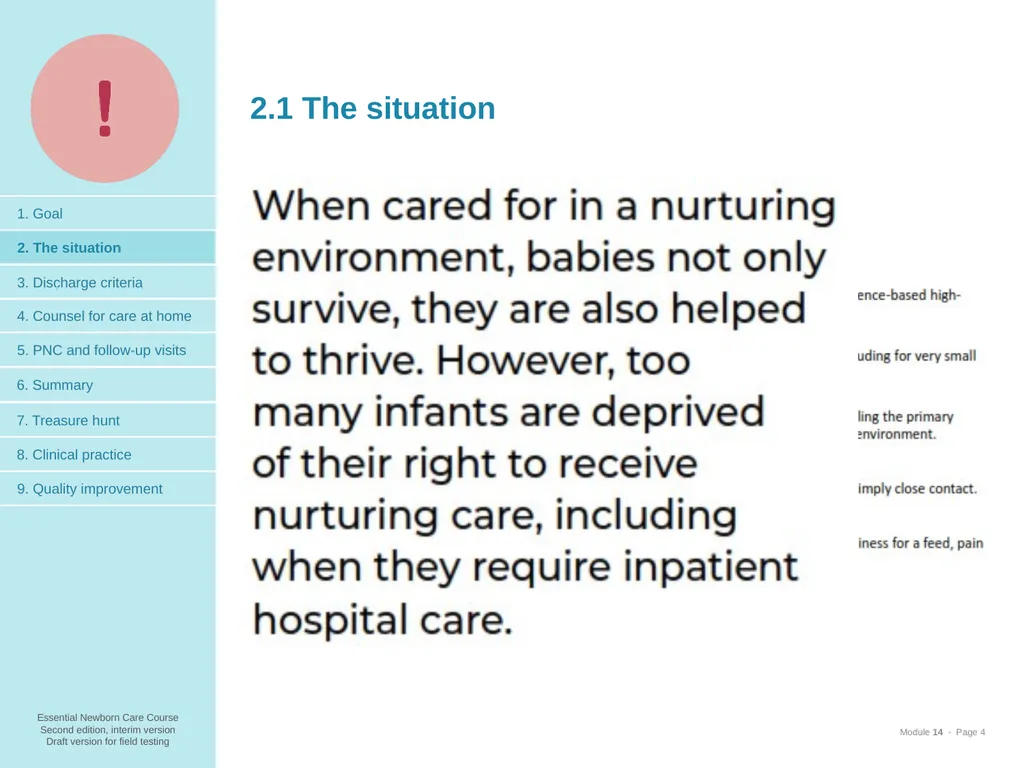
2.1 The situation<br>
05
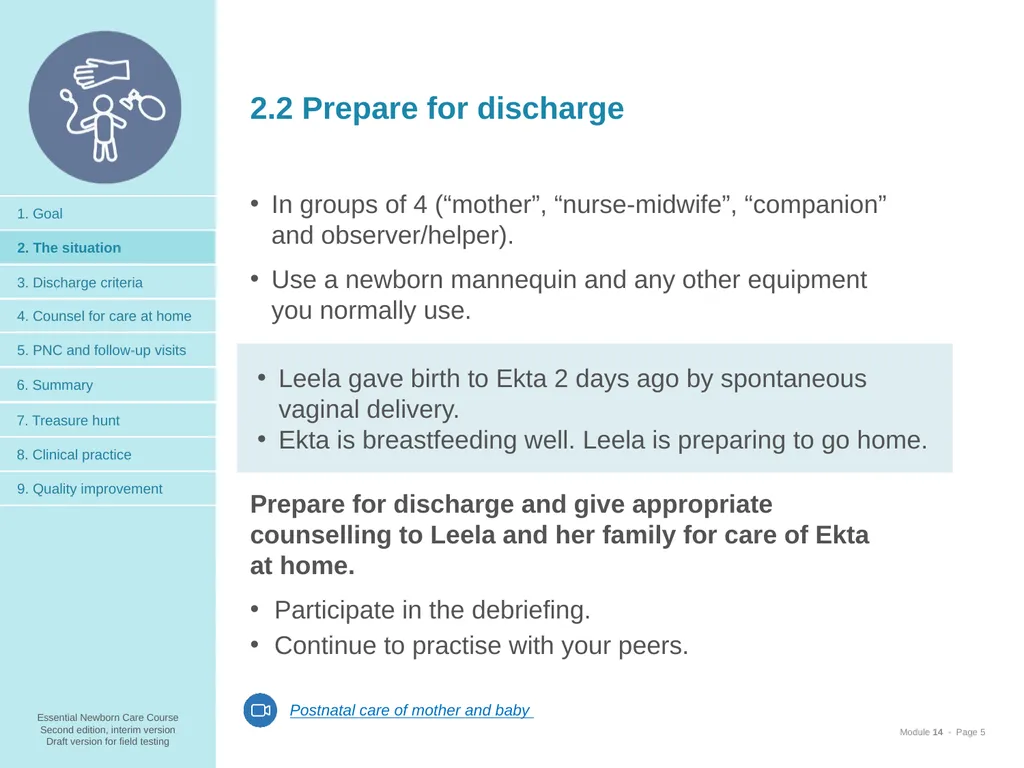
In groups of 4 (“mother”, “nurse-midwife”, “companion” and observer/helper).
Use a newborn mannequin and any other equipment you normally use.
Prepare for discharge and give appropriate counselling to Leela and her family for care of Ekta at home.
Participate in the debriefing.
Continue to practise with your peers. 2.2 Prepare for discharge Leela gave birth to Ekta 2 days ago by spontaneous vaginal delivery.
Ekta is breastfeeding well. Leela is preparing to go home.<br>
06
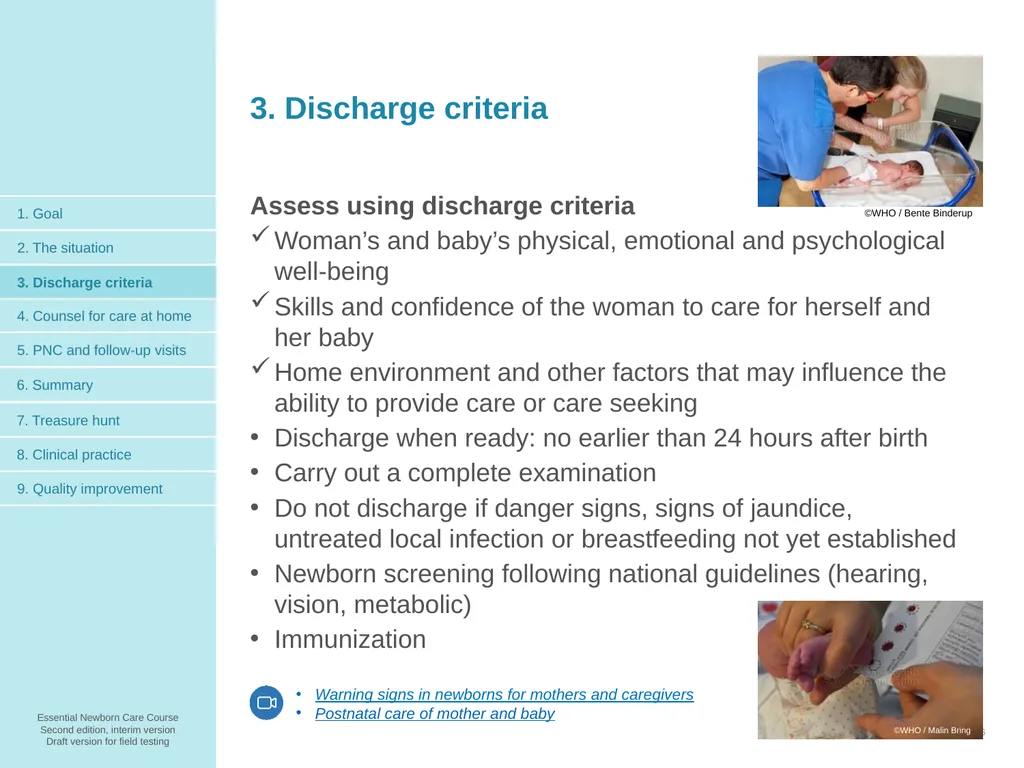
Assess using discharge criteria
Woman’s and baby’s physical, emotional and psychological well-being
Skills and confidence of the woman to care for herself and her baby
Home environment and other factors that may influence the ability to provide care or care seeking
Discharge when ready: no earlier than 24 hours after birth
Carry out a complete examination
Do not discharge if danger signs, signs of jaundice, untreated local infection or breastfeeding not yet established
Newborn screening following national guidelines (hearing, vision, metabolic)
Immunization 3. Discharge criteria<br>
07
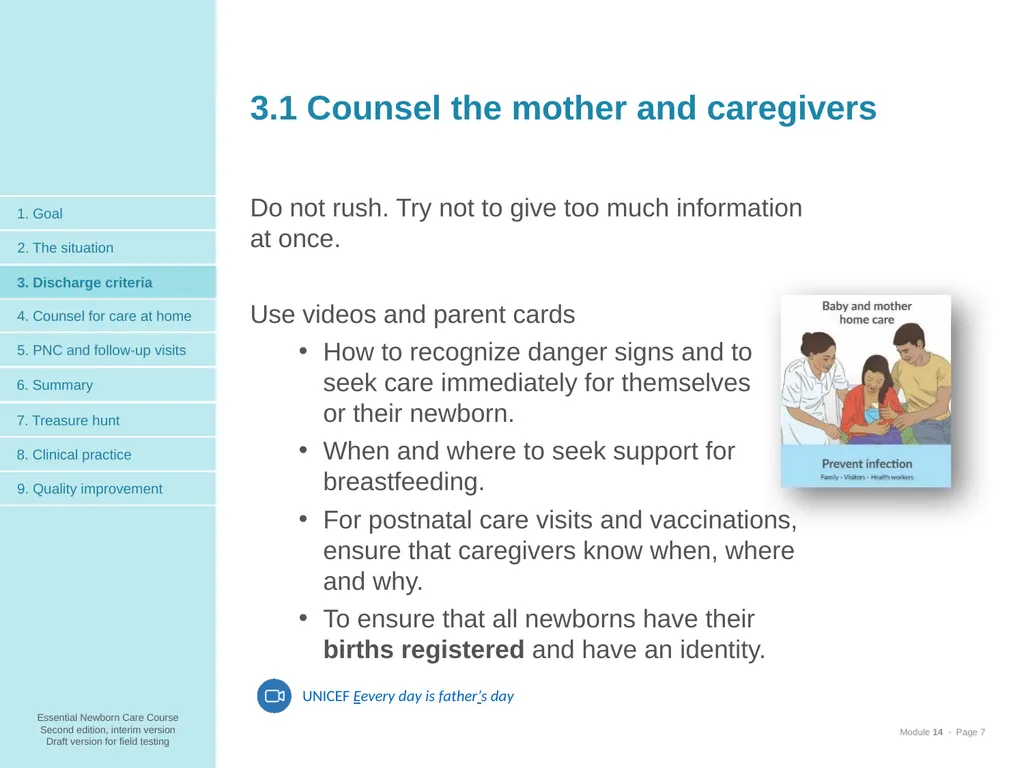
Do not rush. Try not to give too much information at once.
Use videos and parent cards
How to recognize danger signs and to seek care immediately for themselves or their newborn.
When and where to seek support for breastfeeding.
For postnatal care visits and vaccinations, ensure that caregivers know when, where and why.
To ensure that all newborns have their births registered and have an identity. 3.1 Counsel the mother and caregivers<br>
08
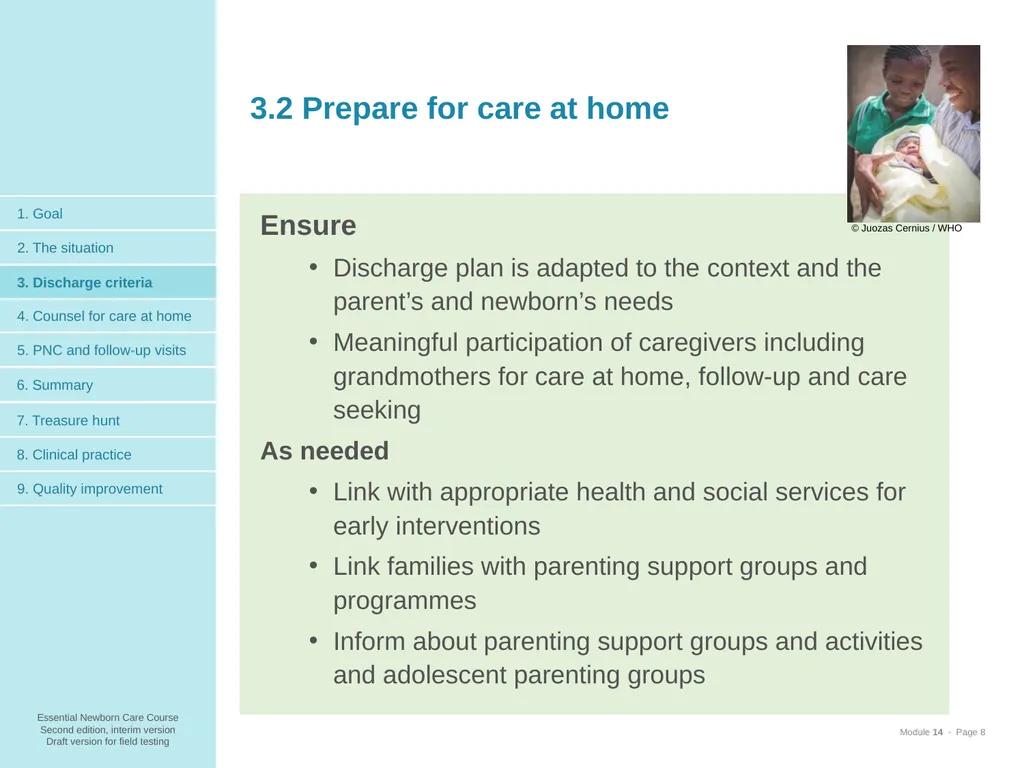
Build confidence, support caregiving at home and improved home environment.
Ensure additional support if:
Newborn was small or premature
First-time parents
Newborn or mother has a health condition or disability 3.2 Prepare for care at home Maternal health, well-being and her mental health will influence the nurturing care she can give her newborn. Ensure
Discharge plan is adapted to the context and the parent’s and newborn’s needs
Meaningful participation of caregivers including grandmothers for care at home, follow-up and care seeking
As needed
Link with appropriate health and social services for early interventions
Link families with parenting support groups and programmes
Inform about parenting support groups and activities and adolescent parenting groups<br>
09
Ensure that the baby is feeding,
sleeping well, warm, clean and nurtured.
Feed
Be responsive to the newborn’s behaviours and cues.
Support exclusive breastfeeding on demand, day and night.
Counsel the mother to seek help if there is a breastfeeding difficulty. 4. Care at home Sources: Engle PL et al. Lancet. 2011;378(9799):1339–53.
Aboud FE, Yousafzai AK. Reproductive, Maternal, Newborn, and Child Health. 2016:241. Caring for your baby at night for health professionals. UNICEF.
Caring for your baby at night. A guide for parents. UNICEF. Sleep
Place the baby to sleep on his/her back to prevent sudden infant death syndrome.
Keep the baby away from smoke and from people smoking.
In malaria settings, ensure that the mother and baby are sleeping under an impregnated bed net. Nurturing care
Stimulate brain development by encouraging newborns to explore the environment using sight, touch, sound and smell, and interacting with mother and family.<br>
10
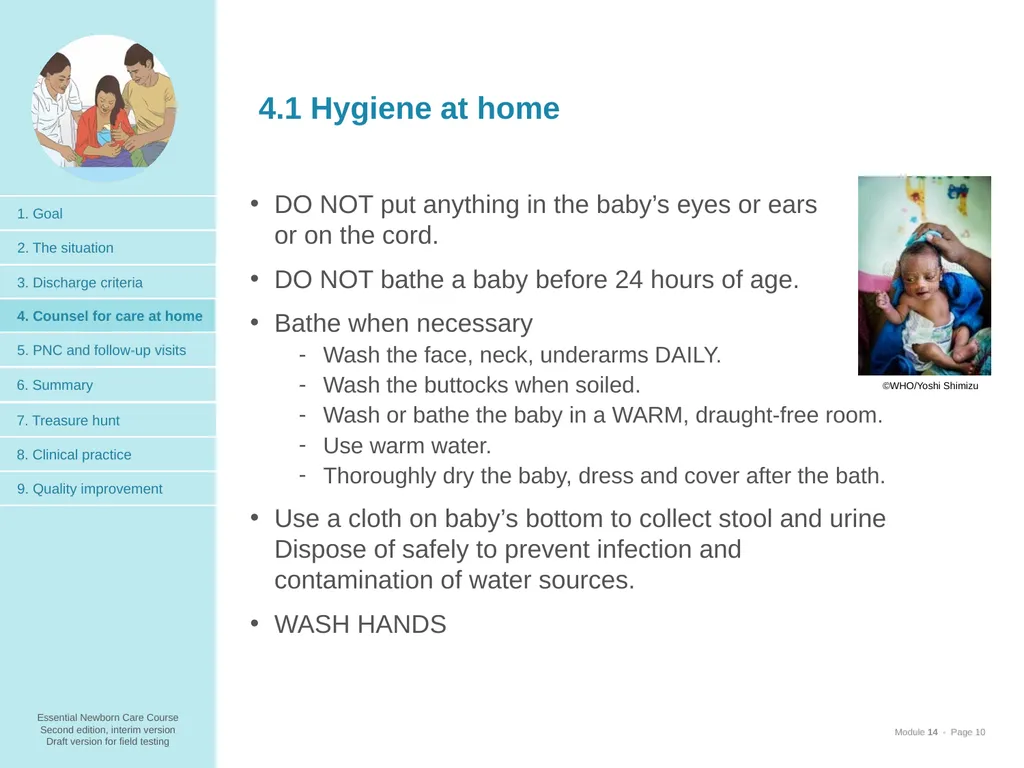
DO NOT put anything in the baby’s eyes or ears
or on the cord.
DO NOT bathe a baby before 24 hours of age.
Bathe when necessary
Wash the face, neck, underarms DAILY.
Wash the buttocks when soiled.
Wash or bathe the baby in a WARM, draught-free room.
Use warm water.
Thoroughly dry the baby, dress and cover after the bath.
Use a cloth on baby’s bottom to collect stool and urine Dispose of safely to prevent infection and contamination of water sources.
WASH HANDS 4.1 Hygiene at home<br>
11
In a cold climate, keep one room or part of one room warm, but not smoky (if there is an open fire).
Use one more layer of clothes on baby than on children or adults.
Do not leave the newborn in wet diapers.
During the day, dress or wrap the baby according to the climate.
If the temperature varies during the day, counsel caregivers accordingly.
At night let the newborn sleep with the mother or within easy reach for breastfeeding.
Ensure continuous skin-to-skin care if giving kangaroo mother care at home. 4.2 Thermal care at home<br>
12
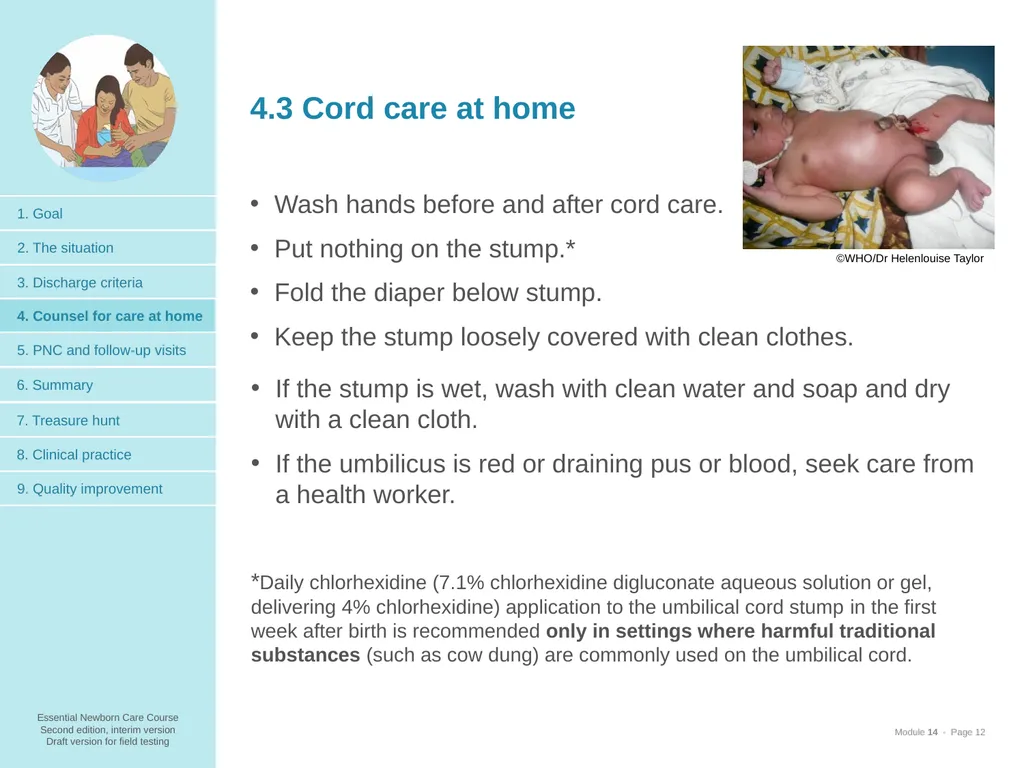
Wash hands before and after cord care.
Put nothing on the stump.*
Fold the diaper below stump.
Keep the stump loosely covered with clean clothes. 4.3 Cord care at home If the stump is wet, wash with clean water and soap and dry with a clean cloth.
If the umbilicus is red or draining pus or blood, seek care from a health worker.
*Daily chlorhexidine (7.1% chlorhexidine digluconate aqueous solution or gel, delivering 4% chlorhexidine) application to the umbilical cord stump in the first week after birth is recommended only in settings where harmful traditional substances (such as cow dung) are commonly used on the umbilical cord.<br>
13
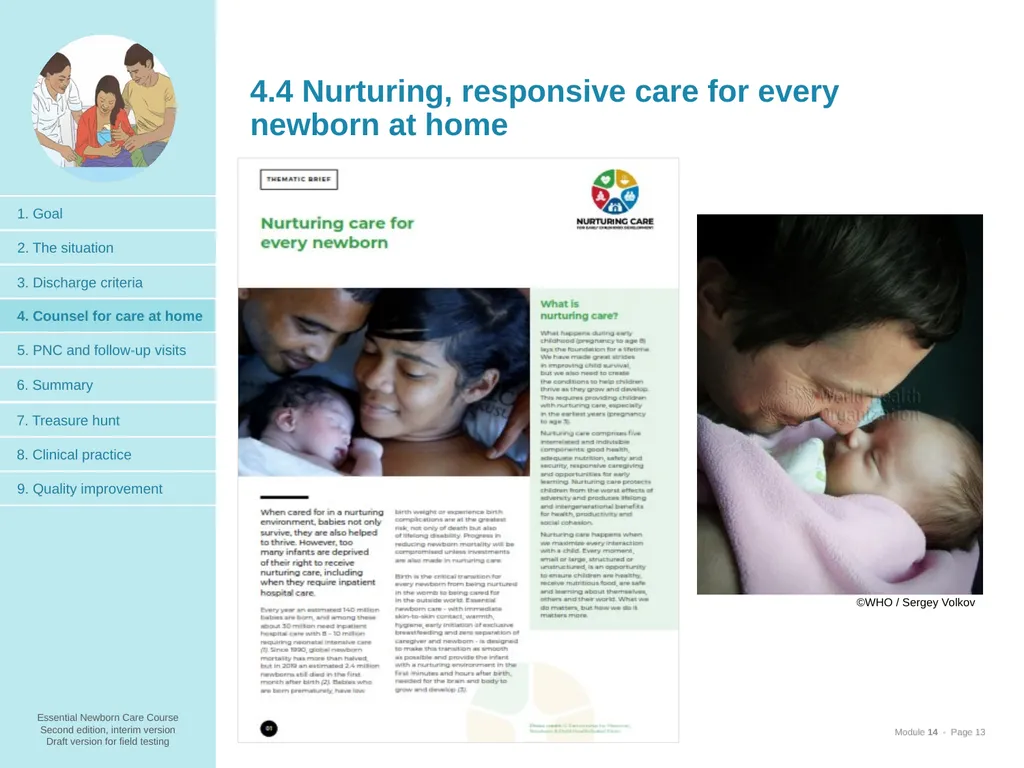
4.4 Nurturing, responsive care for every newborn at home<br>
14
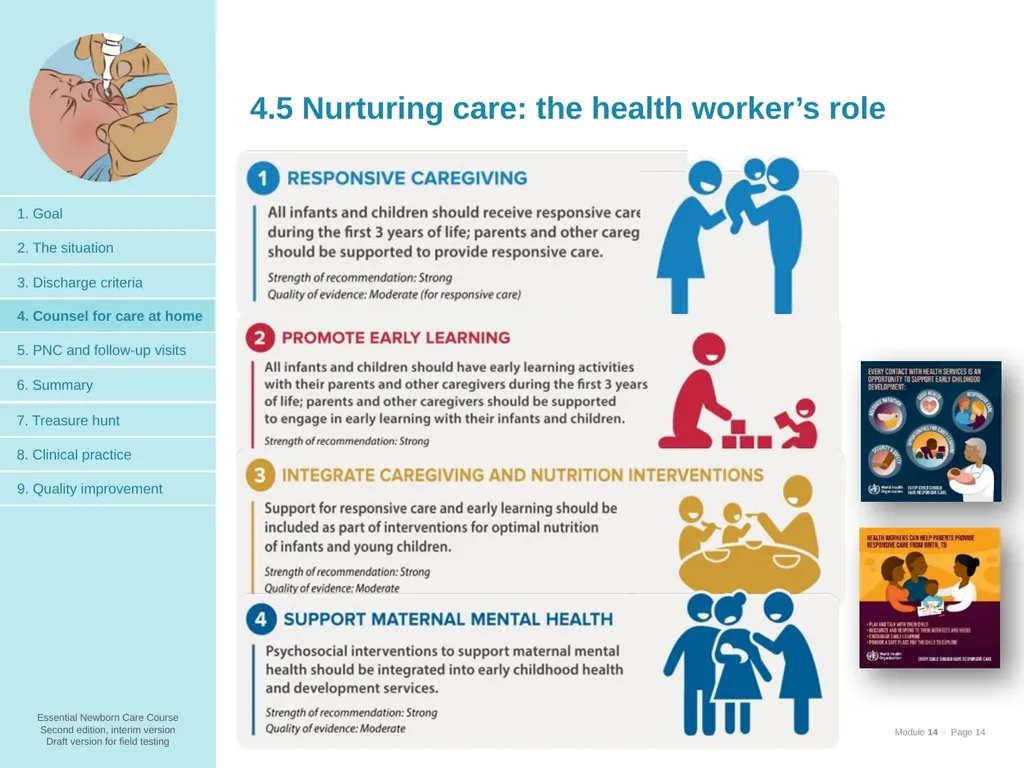
Ensure routine follow-up, support the newborn
and family by early detection of disability or developmental delay and link to services.
Prioritize developmentally supportive care to improve outcomes for all newborns: foster a family-centred, nurturing, supportive environment.
Link families with early childhood development programmes with interventions during the first 1000 days.
Support coping, parenting and early stimulation. Encourage male involvement.
Refer mothers with anxiety or depression to appropriate services. 4.5 Nurturing care: the health worker’s role Improving early childhood development: Who guideline. WHO, 2020.<br>
15
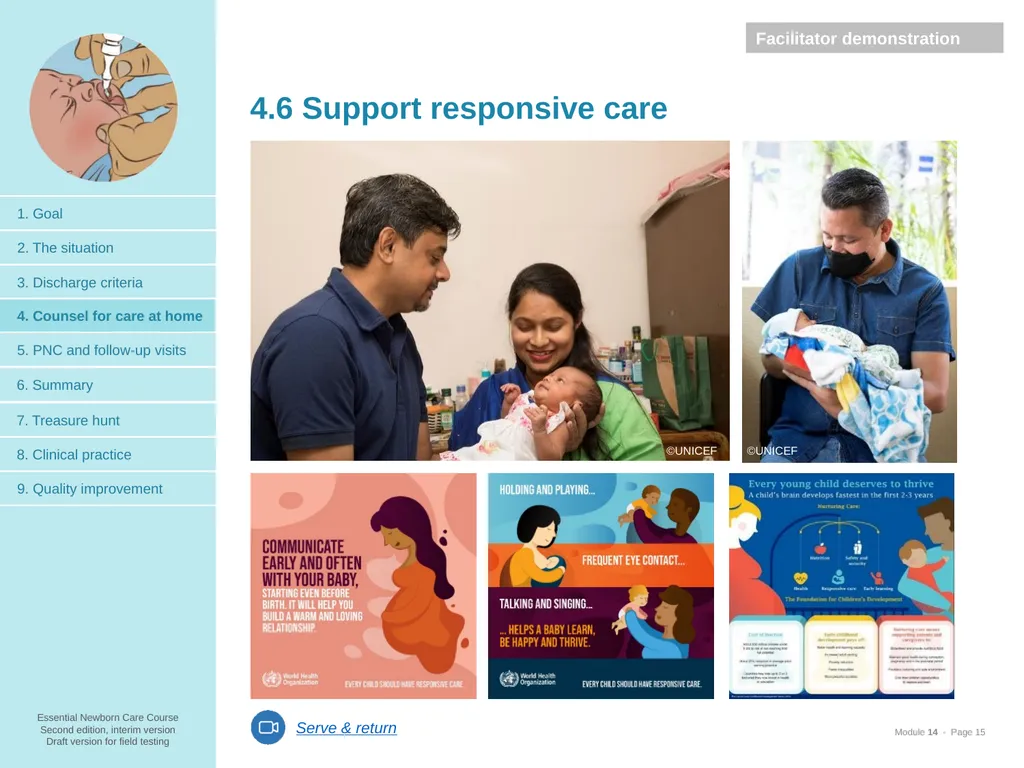
4.6 Support responsive care Facilitator demonstration ©UNICEF ©UNICEF<br>
16
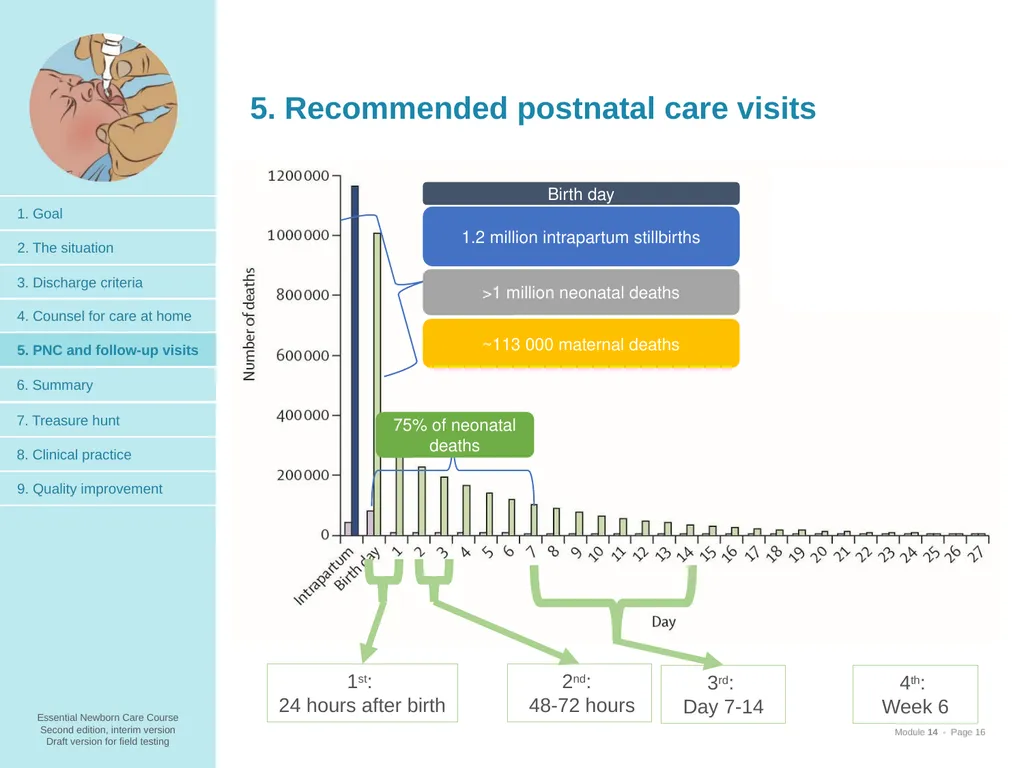
WHO recommends all newborns have 4 PNC visits :
Day 1 , Day 3, Day 7-14 , and at 6 weeks
Small newborns need additional follow-up visits .
All mothers and newborns should have post natal visits
Newborns born at home should have the first PNC visit as soon as possible after birth
First PNC within 24 hours of delivery is not the same as the standard examination after delivery
Some newborns have NO postnatal visits
Effective Coverage of PNC visits is often much lower for newborns thantheir mothers .
Country profiles Countdown 2030. 5. Recommended postnatal care visits 1st:
24 hours after birth 2nd:
48-72 hours 3rd:
Day 7-14 4th:
Week 6<br>
17
All mothers and newborns should have postnatal care visits.
WHO recommends all newborns have 4 PNC visits :
Within 24 hours, at 48–72 hours, between days 7–14 and at 6 weeks.
Small newborns need additional postnatal visits.
Newborns born at home should have the first PNC visit as soon as possible after birth.
Home visits during the first week after birth by a skilled health personnel or a trained community health worker are recommended for postnatal care of healthy women and newborns.
Where home visits are not feasible or not preferred, outpatient postnatal care contacts are recommended. 5.1 Recommended postnatal care visits<br>
18
Tailor the number, timing and content to each woman’s and newborn’s health outcomes and needs, guided by the newborn’s physical well-being and the woman’s emotional well-being:
the skills and confidence of the women to care for herself and the skills and confidence of parents/carers/family to care for the newborn
the home environment and other factors that may influence the ability to provide care in the home and care seeking
the place of birth and the time of discharge from the health facility for a facility-based birth.
Country profiles Countdown 2030.
Some newborns have NO postnatal visits.
Coverage maybe lower for newborns than their mothers.
Content and quality of postnatal care visits may also vary. 5.2 Tailor postnatal visits to needs<br>
19
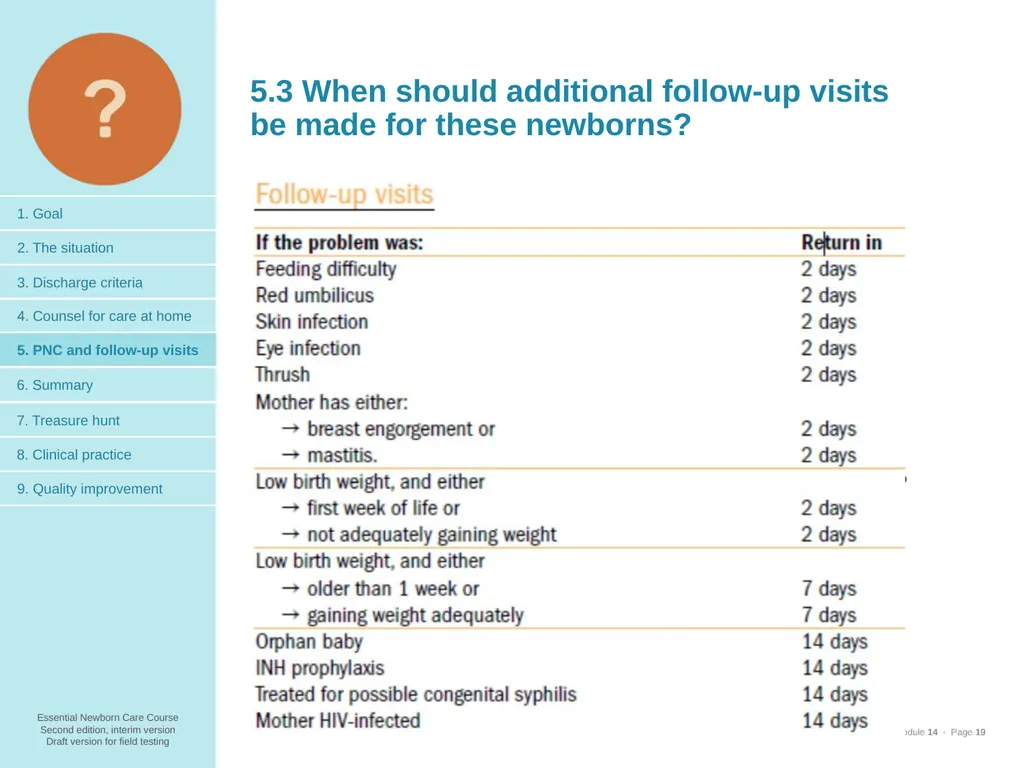
5.3 When should additional follow-up visits be made for these newborns? 19 Newborn has feeding difficulty?
Newborn has red umbilicus?
Newborn has skin infection?
Newborn has eye infection?
Newborn has thrush/ candidiasis?
Low birthweight newborn in the first week of life?
Whose mother has breast engorgement or mastitis?
Low birthweight newborn who gains weight adequately?
Newborn with possible syphilis?
Mother HIV-positive and none of above?<br>
20
Refer if any of the following signs are present:
Stopped feeding well
History of convulsions
Fast breathing (breathing rate >60 per minute)
Severe chest in-drawing
No spontaneous movement
Fever (temperature >37.5 °C)
Low body temperature (temperature <35.5 °C)
Any jaundice in first 24 hours after birth or yellow palms and soles at any age.
Parents and family should be encouraged to seek health care early if they identify any of the above at any time. 5.4 Always assess for danger signs<br>
21
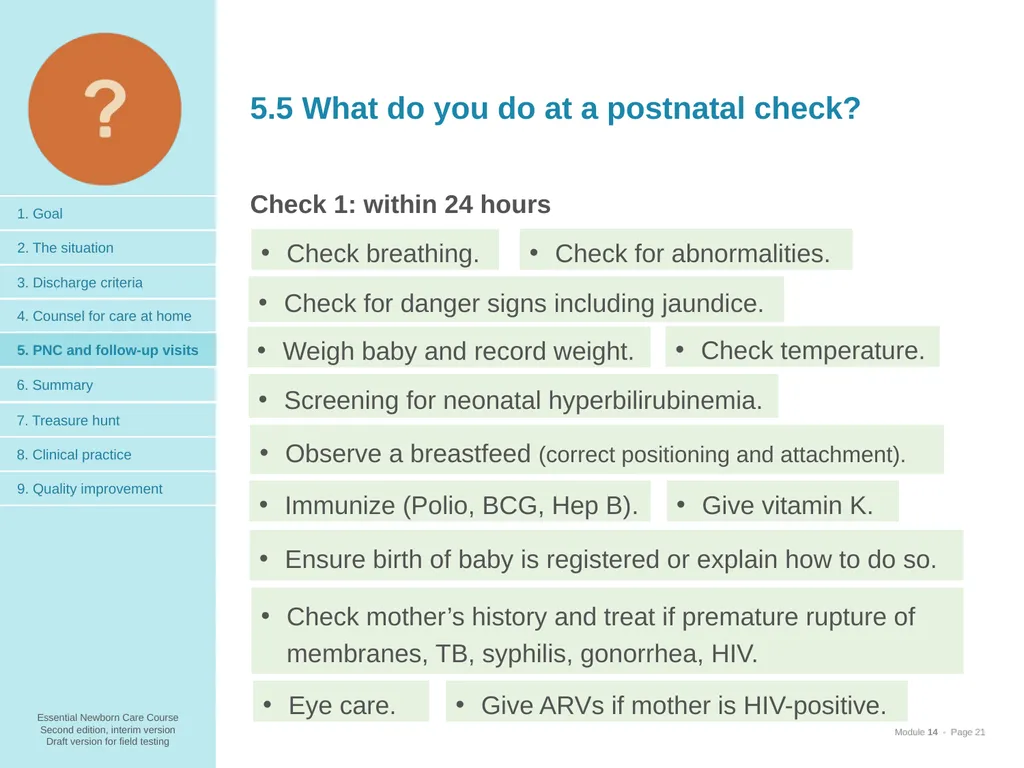
Check 1: within 24 hours 5.5 What do you do at a postnatal check? Check for danger signs including jaundice. Check for abnormalities. Weigh baby and record weight. Immunize (Polio, BCG, Hep B). Give ARVs if mother is HIV-positive. Check breathing. Check mother’s history and treat if premature rupture of membranes, TB, syphilis, gonorrhea, HIV. Eye care. Observe a breastfeed (correct positioning and attachment). Give vitamin K. Ensure birth of baby is registered or explain how to do so. Screening for neonatal hyperbilirubinemia. Check temperature.<br>
22
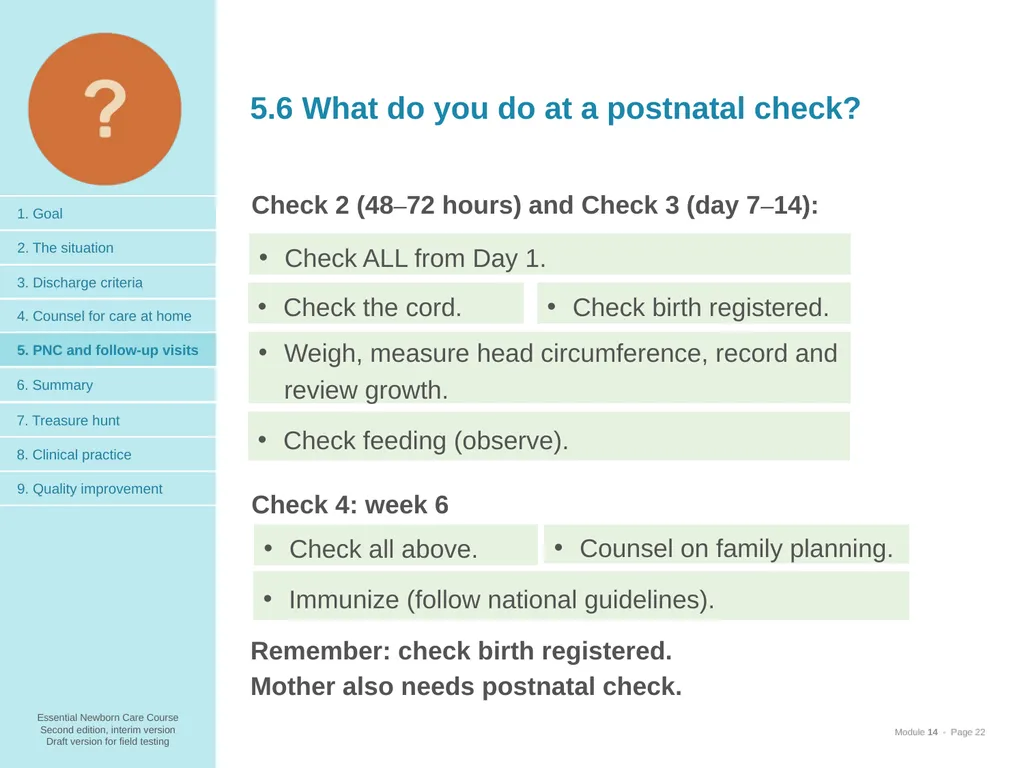
Check 2 (48–72 hours) and Check 3 (day 7–14):
Check 4: week 6 5.6 What do you do at a postnatal check? Check the cord. Weigh, measure head circumference, record and review growth. Check feeding (observe). Check birth registered. Check ALL from Day 1. Check all above. Immunize (follow national guidelines). Remember: check birth registered.
Mother also needs postnatal check. Counsel on family planning.<br>
23
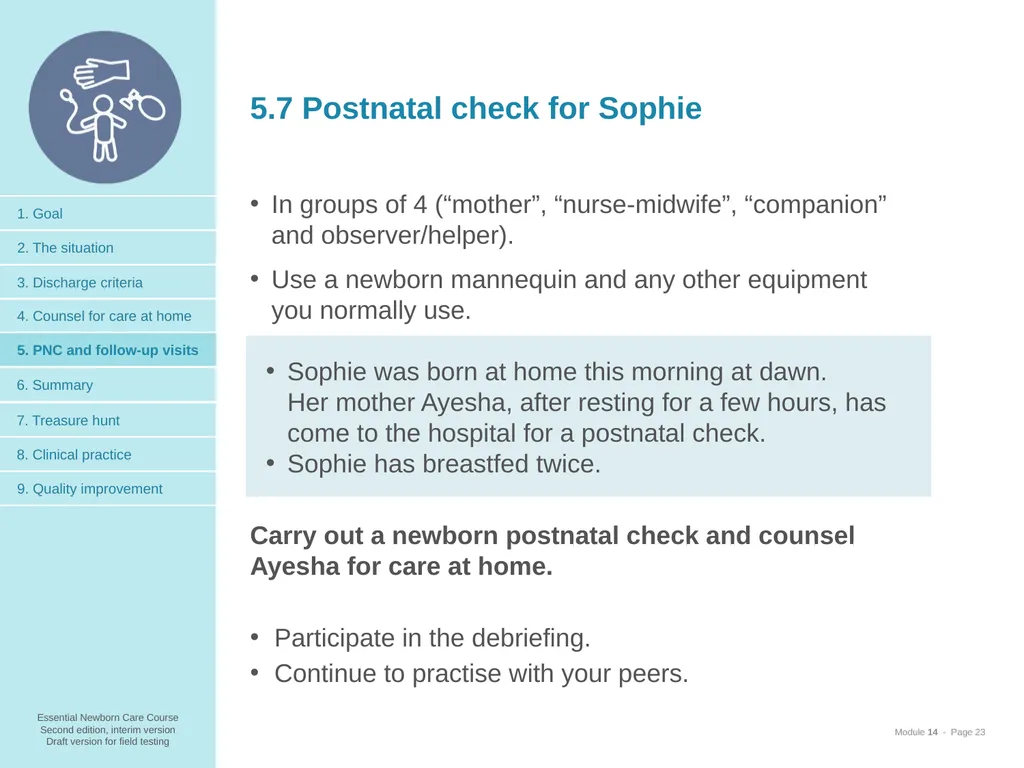
In groups of 4 (“mother”, “nurse-midwife”, “companion” and observer/helper).
Use a newborn mannequin and any other equipment you normally use.
Carry out a newborn postnatal check and counsel Ayesha for care at home.
Participate in the debriefing.
Continue to practise with your peers. 5.7 Postnatal check for Sophie Sophie was born at home this morning at dawn. Her mother Ayesha, after resting for a few hours, has come to the hospital for a postnatal check.
Sophie has breastfed twice.<br>
24
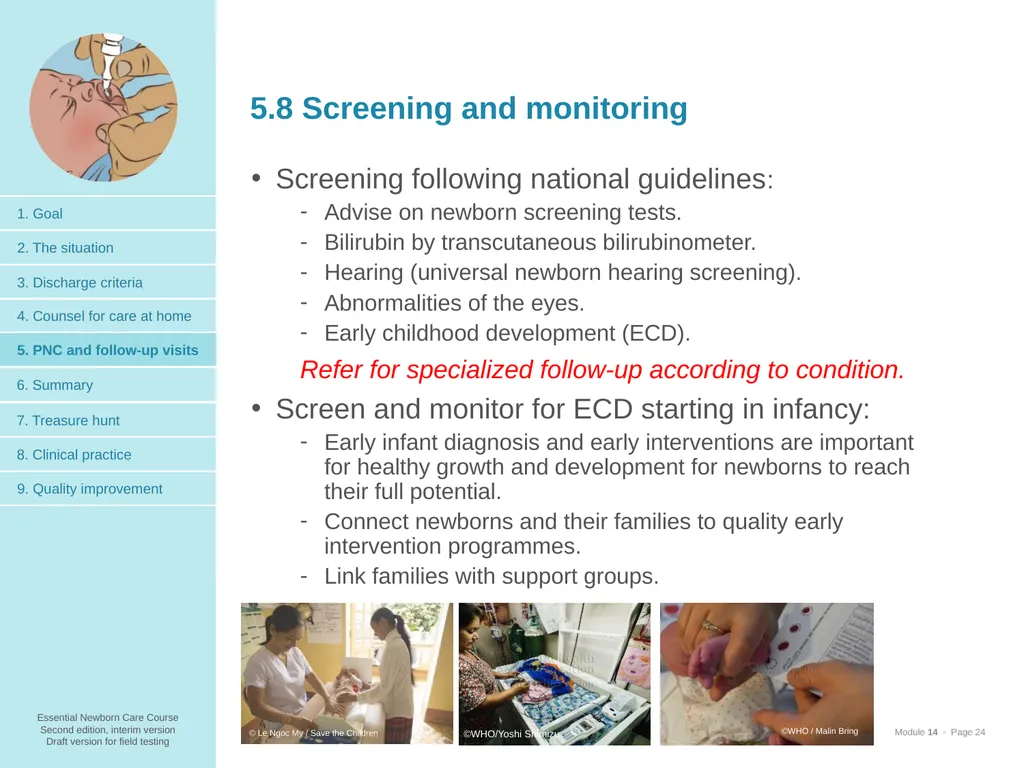
Screening following national guidelines:
Advise on newborn screening tests.
Bilirubin by transcutaneous bilirubinometer.
Hearing (universal newborn hearing screening).
Abnormalities of the eyes.
Early childhood development (ECD).
Refer for specialized follow-up according to condition.
Screen and monitor for ECD starting in infancy:
Early infant diagnosis and early interventions are important for healthy growth and development for newborns to reach their full potential.
Connect newborns and their families to quality early intervention programmes.
Link families with support groups. 5.8 Screening and monitoring ©WHO / Malin Bring ©WHO/Yoshi Shimizu © Le Ngoc My / Save the Children<br>
25
Baby Jojo and his mother, Anna, are now in the postnatal area. Jojo has had his first examination, and has been classified as a “well baby”.
Jojo is being breastfed. During the first newborn examination Anna said she was not sure if Jojo was attached correctly at his first feed. She was lying down to feed.
How will you support Anna in breastfeeding Jojo? 5.9 Jojo and Anna<br>
Jojo is being breastfed. During the first newborn examination Anna said she was not sure if Jojo was attached correctly at his first feed. She was lying down to feed.
How will you support Anna in breastfeeding Jojo? 5.9 Jojo and Anna<br>
26
Olivia is HIV-positive.
She gave birth to Sam 3 days ago.
Sam weighs 3500 g.
Now they are preparing for discharge.
How did you manage Sam at birth?
What treatment did you give him?
How did you counsel Olivia on day 1?
How did you counsel Olivia on day 3?
What are your criteria for discharging for Sam?
What is the follow-up plan? 5.10 Olivia and Sam<br>
How did you manage Sam at birth?
What treatment did you give him?
How did you counsel Olivia on day 1?
How did you counsel Olivia on day 3?
What are your criteria for discharging for Sam?
What is the follow-up plan? 5.10 Olivia and Sam<br>
27
Michael born 2 days ago. He weighs 3400 g and is breastfeeding well now, after some support with positioning and attachment. Maya wants to go home. On examination Michael’s umbilicus is red. The redness extends less than 1 cm beyond the umbilicus.
How do you manage a red umbilicus?
What do you do before Maya and Michael go home?
When will Michael be ready for discharge?
What is the follow-up plan? 5.11 Maya and Michael<br>
How do you manage a red umbilicus?
What do you do before Maya and Michael go home?
When will Michael be ready for discharge?
What is the follow-up plan? 5.11 Maya and Michael<br>
28
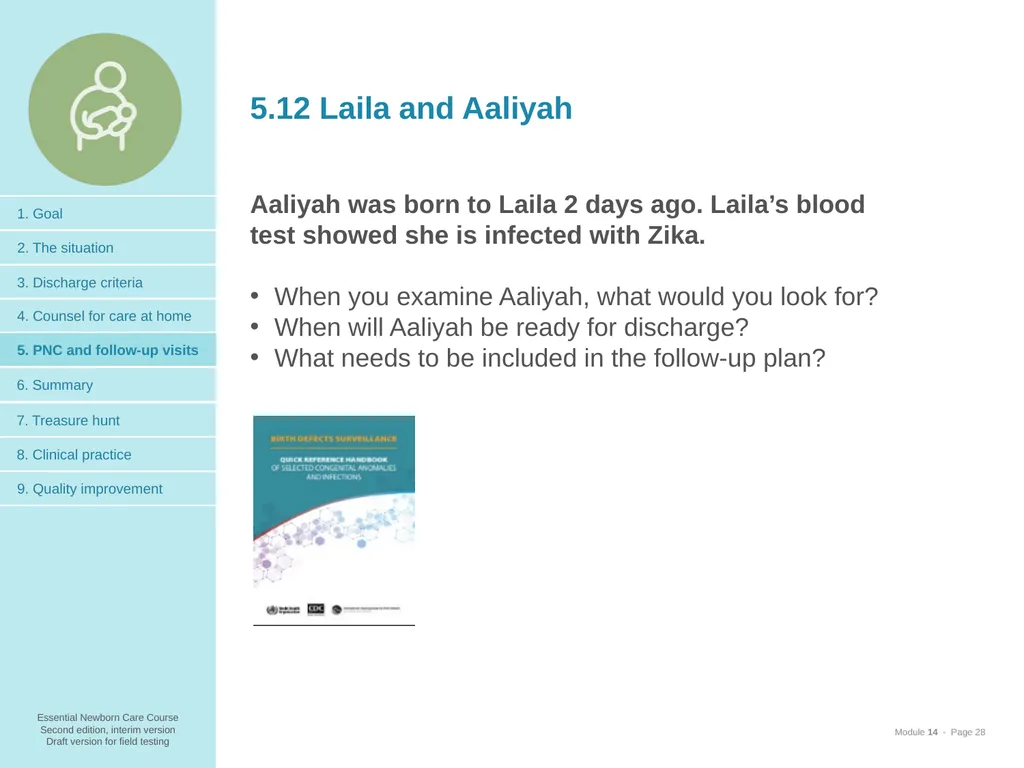
Aaliyah was born to Laila 2 days ago. Laila’s blood test showed she is infected with Zika.
When you examine Aaliyah, what would you look for?
When will Aaliyah be ready for discharge?
What needs to be included in the follow-up plan? 5.12 Laila and Aaliyah<br>
When you examine Aaliyah, what would you look for?
When will Aaliyah be ready for discharge?
What needs to be included in the follow-up plan? 5.12 Laila and Aaliyah<br>
29
Form groups of 4 (“mother”, “neonatal nurse”, “grandmother” and observer).
Use a small baby mannequin and any other equipment you normally use.
Prepare for the discharge and give appropriate counselling to Amy for care of Samuel at home and for follow-up visits required. Complete relevant records and forms.
Participate in the debriefing.
Continue to practise with your peers. 5.13 Prepare for discharge: Samuel Amy, 15 years of age, gave birth to Samuel at 34 weeks. He weighed 1975 g at birth.
Samuel is 2000 g and ready for discharge from the hospital on day 11.
He is breastfeeding well and gaining approximately 16 g/day for the last 4 days. His examination is normal.<br>
30
In groups of 4 (“mother”, “doctor”, “father” and observer).
Use a baby mannequin and any other equipment you normally use.
Prepare for discharge and give appropriate counselling to Ida and her family for care of Harry at home, including for referral and follow-up visits required. Complete relevant records and forms.
Participate in the debriefing.
Continue to practise with your peers. 5.14 Prepare for discharge: Harry Harry was born 5 days ago. He has trisomy 21 (Downs Syndrome).
At first he was slow to feed and sleepy. His mother Ida has had support to breastfeed him using the dancer hold.
He is now taking all feeds by breast and has been gaining adequate weight for the past 3 days.<br>
31
In groups of 4 (“mother”, “midwife”, “mother-in-law” and observer).
Use a baby mannequin and any other equipment you normally use.
Prepare for discharge and give appropriate counselling to Francoise and her family for care of Marie-Christine at home, and for postnatal contacts. Complete relevant records and forms.
Participate in the debriefing.
Continue to practise with your peers. 5.15 Marie-Christine Marie-Christine was born by spontaneous vaginal delivery to Francoise in a temporary hospital structure supported by Mariam, who is a midwife.
She is breastfeeding well and her examination is normal. She weighs 3.2 kgs.
Francoise and her baby will be discharged to a tent where she is housed with her extended family.<br>
32
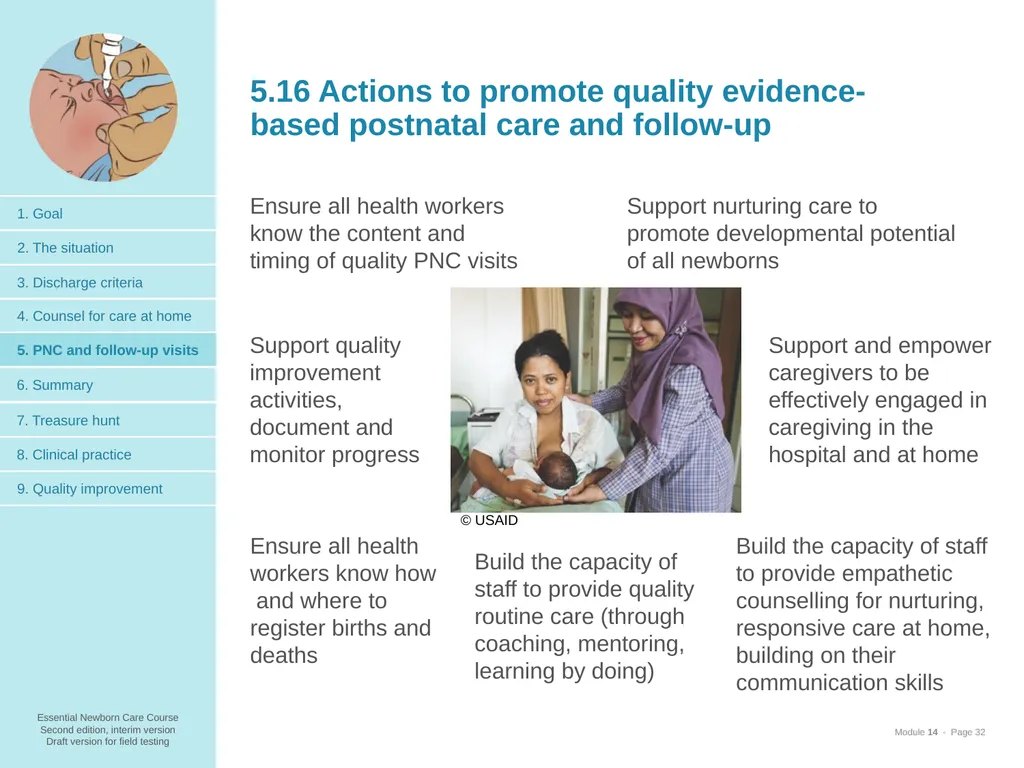
5.16 Actions to promote quality evidence- based postnatal care and follow-up Support nurturing care to promote developmental potential of all newborns Support and empower caregivers to be effectively engaged in caregiving in the hospital and at home Build the capacity of staff to provide quality routine care (through coaching, mentoring, learning by doing) Support quality improvement activities, document and monitor progress Ensure all health workers know how and where to register births and deaths Ensure all health workers know the content and timing of quality PNC visits Build the capacity of staff to provide empathetic counselling for nurturing, responsive care at home, building on their communication skills<br>
33
In this module, you have learned to:
Apply discharge criteria to decide if a newborn is ready to go home.
Counsel caregivers
how to care for the baby at home (including nurturing, responsive care) and when to return for postnatal visits and follow-up
how to identify health problems and danger signs and where and when to seek care.
Demonstrate counselling for nurturing care at home, building the mother’s confidence and capabilities.
Apply new knowledge and skills when discharging a newborn. 6. Summary<br>
34
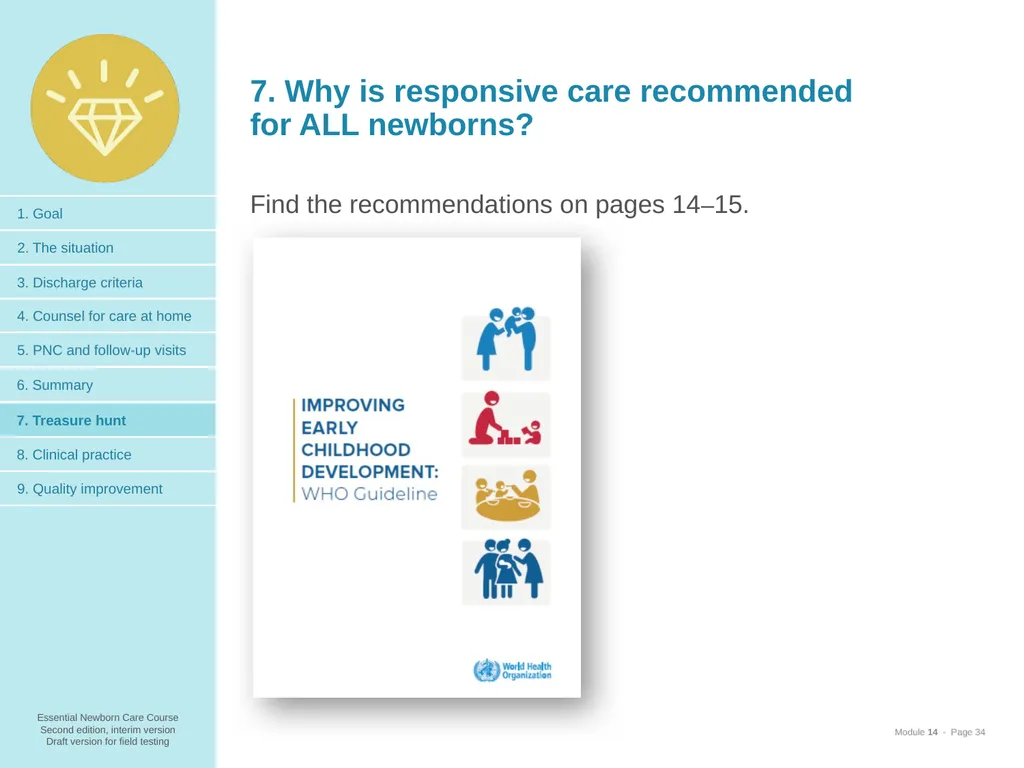
Find the recommendations on pages 14–15. 7. Why is responsive care recommended for ALL newborns?<br>
35
All infants and children should receive responsive care during the first 3 years of life.
Parents and other caregivers should be supported to provide responsive care.
Benefits of responsive care
Improves newborn’s/infant’s/children’s motor development.
Improves newborn’s/infant’s/children’s height-for-age.
Significantly improves caregiver–child interactions.
Reduces caregiver’s depressive symptoms.
Review evidence
Improving early childhood development: WHO guideline. WHO, 2020. 7.1 Recommendations and reasons<br>
36
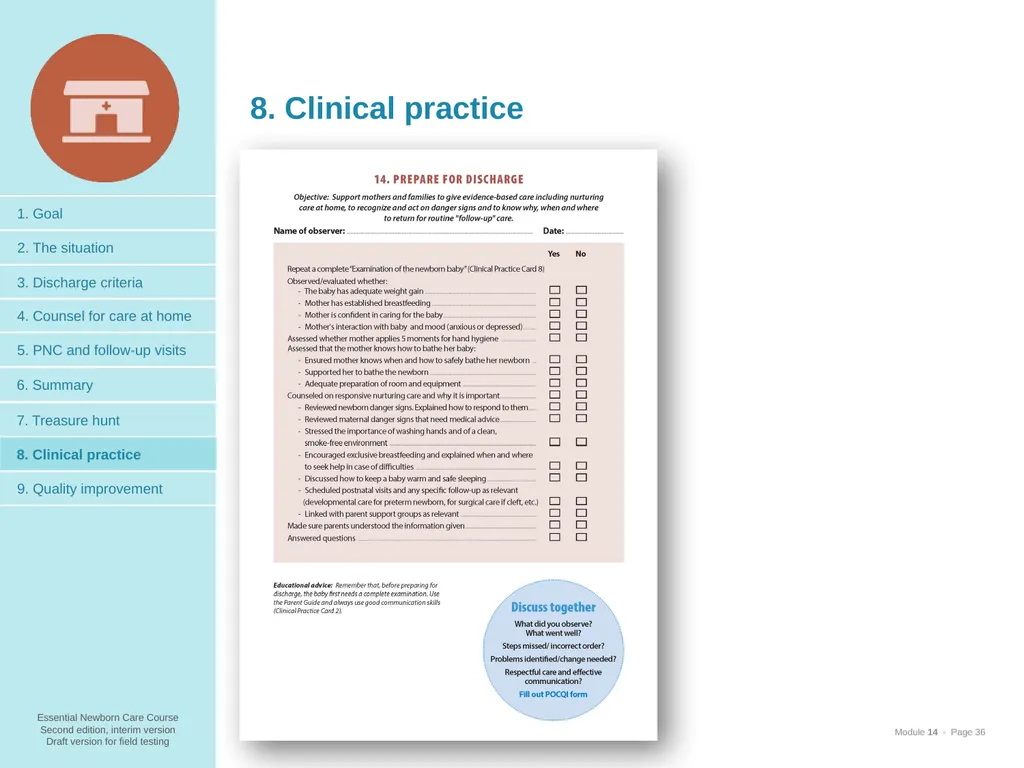
8. Clinical practice<br>
37
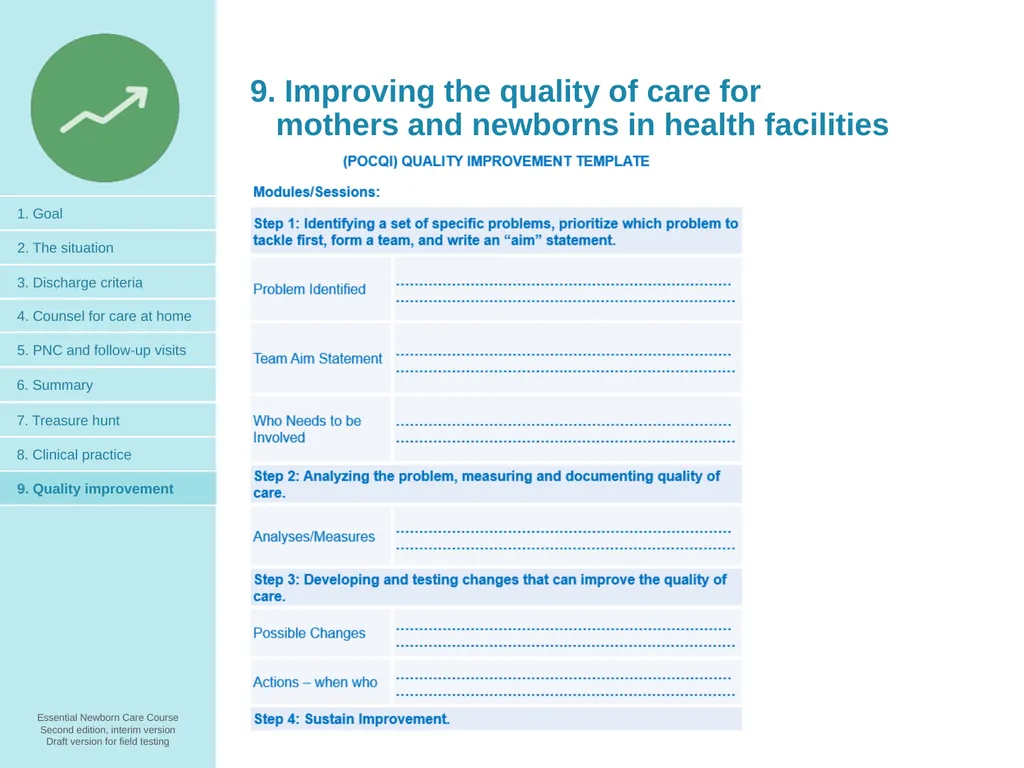
9. Improving the quality of care for
mothers and newborns in health facilities Identify a problem
Analyze the problem
Develop and test changes
4. Sustain improvement 4 simple steps:<br>
Analyze the problem
Develop and test changes
4. Sustain improvement 4 simple steps:<br>
38
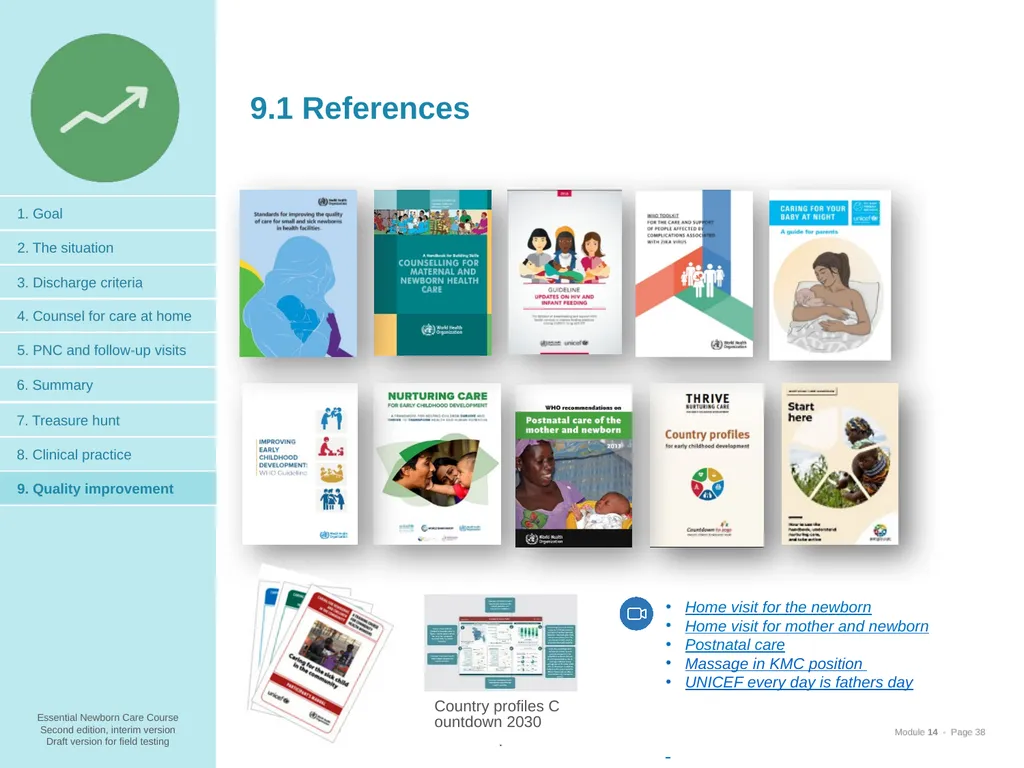
9.1 References<br>