
"Putting Women First" Ethical and Safety
GB
Published · 29 slides · 0 views

1 / 1




Description
Putting Women First Ethical and Safety recommendations for Researching Violence against Women Claudia García-Moreno, WHO Background Inquiries into incidents of violence against women (VAW) are very sensitive. Collecting and sharing
Related Topics
Share
Embed code
Download this presentation From Below
""Putting Women First" Ethical and Safety" is the property of its rightful owner. Permission is granted to download and print the materials on this website for personal, non-commercial use only, and to display it on your personal computer provided you do not modify the materials and that you retain all copyright notices contained in the materials. By downloading content from our website, you accept the terms of this agreement.
Presentation Transcript
01
"Putting Women First"
Ethical and Safety recommendations for Researching Violence against Women Claudia García-Moreno, WHO<br>
02
Background Inquiries into incidents of violence against women (VAW) are very sensitive.
Collecting and sharing information on VAW can be dangerous, even life threatening to survivors, communities, and those involved in collecting the information.
There are many ethical and safety issues that must be considered and planned for in advance.<br>
Collecting and sharing information on VAW can be dangerous, even life threatening to survivors, communities, and those involved in collecting the information.
There are many ethical and safety issues that must be considered and planned for in advance.<br>
03
Rigorous Protocols Research involving human subjects requires justification
Clear research questions
Clear justification
Benefits outweigh risks
Background and literature review to assess and build off prior research
Protocols
Clear and concise science
Theory
Methodology
Analysis plans
Consent procedures that take into account the study population and the sensitive subject matter
Build upon current research to minimize under-reporting
Plans for adverse events<br>
04
There is the danger that a well-intentioned but poorly conceptualized or implemented study may result in a serious under-reporting of violence. This raises both ethical and practical concerns.
Ethically, it is unacceptable to conduct a poorly designed study that cannot hope to address its primary study aims.
Putting Women First<br>
05
To whom do women talk about physical partner violence? Very few women have talked with "formal services" – implications for value of these services as source of data
Many women never talked about it before – implications for the interviewers<br>
Many women never talked about it before – implications for the interviewers<br>
06
Ethical and safety recommendations The benefits to respondents or communities of documenting VAW must be greater than the risks to respondents and communities.
Information gathering and documentation must be done in a manner that presents the least risk to respondents, is methodologically sound, and builds on current experience and good practice.
The study design must include actions aimed at reducing any possible distress caused to the participants by the research.<br>
07
Ethical and safety recommendations (cont) 4. Basic care and support for survivors must be available locally before commencing any activity that may involve individuals disclosing information about their experiences of violence. Fieldworkers should be trained to refer women to services.
5. The safety and security of all those involved in information gathering about violence is of paramount concern should be continuously monitored.
6. The confidentiality of individuals who provide information about violence must be protected at all times to ensure both women’s safety and data quality.<br>
08
Ethical and safety recommendations (cont) 7. Anyone providing information about violence must give informed consent before participating in the data gathering activity.
8. All members of the data collection team must be carefully selected and receive relevant and sufficient specialized training and support.
9. Researchers and donors have an ethical obligation to help ensure that their findings are properly interpreted and used to advance policy and intervention development
10. Additional safeguards must be put into place if children (i.e. those under 18 years) are to be the subject of information gathering.<br>
09
Putting women’s safety first in violence research 1. Safety of respondents and research team
2. Studies need to be methodologically sound
3. Confidentiality for safety and data quality
4. Selection and training of team members
5. Actions to reducing distress to respondents
6. Possibilities of referral, support mechanisms
7. Proper interpretation and use of study results
8. Violence questions in other surveys<br>
10
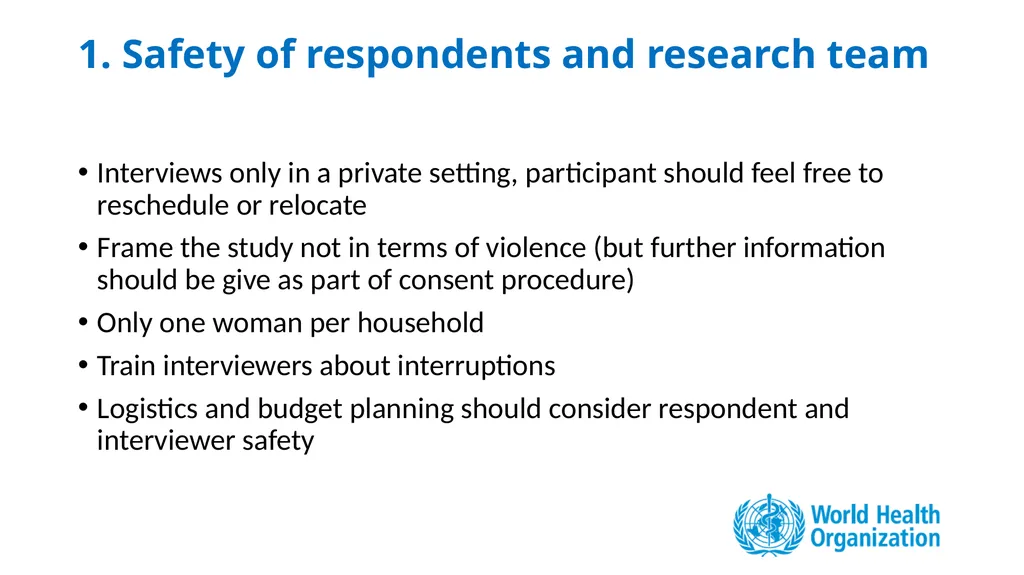
1. Safety of respondents and research team Interviews only in a private setting, participant should feel free to reschedule or relocate
Frame the study not in terms of violence (but further information should be give as part of consent procedure)
Only one woman per household
Train interviewers about interruptions
Logistics and budget planning should consider respondent and interviewer safety<br>
Frame the study not in terms of violence (but further information should be give as part of consent procedure)
Only one woman per household
Train interviewers about interruptions
Logistics and budget planning should consider respondent and interviewer safety<br>
11
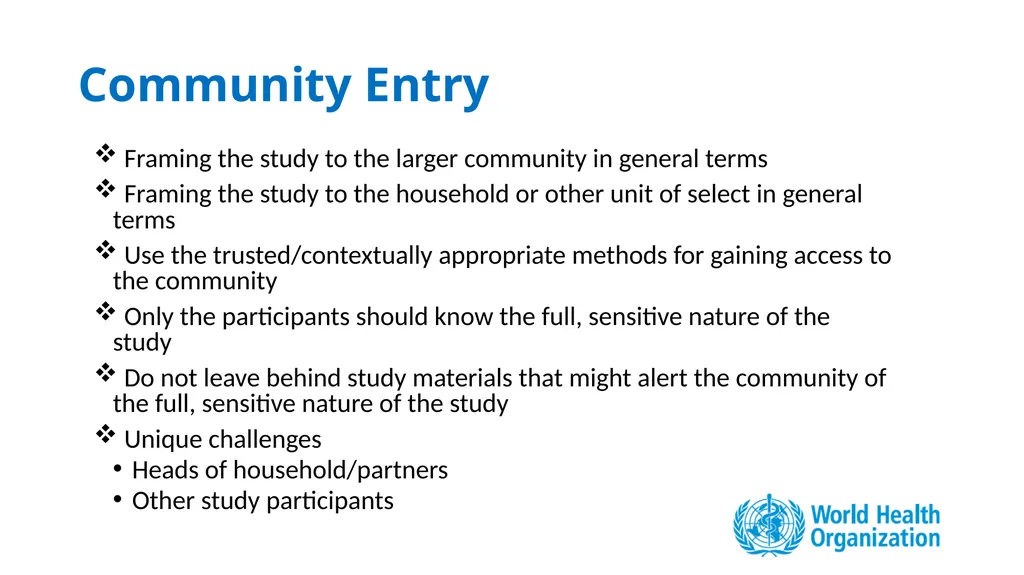
Community Entry Framing the study to the larger community in general terms
Framing the study to the household or other unit of select in general terms
Use the trusted/contextually appropriate methods for gaining access to the community
Only the participants should know the full, sensitive nature of the study
Do not leave behind study materials that might alert the community of the full, sensitive nature of the study
Unique challenges
Heads of household/partners
Other study participants<br>
12
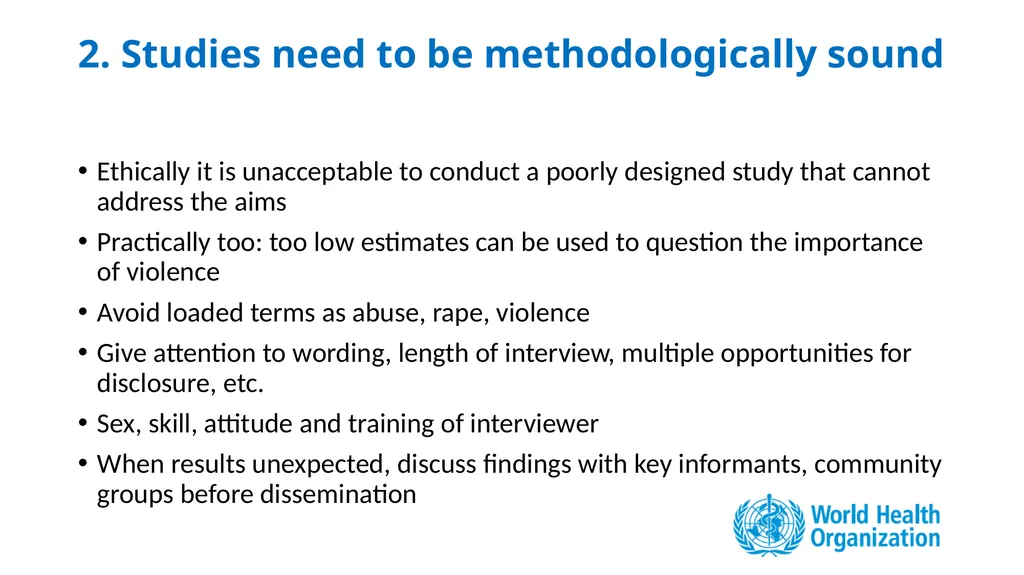
2. Studies need to be methodologically sound Ethically it is unacceptable to conduct a poorly designed study that cannot address the aims
Practically too: too low estimates can be used to question the importance of violence
Avoid loaded terms as abuse, rape, violence
Give attention to wording, length of interview, multiple opportunities for disclosure, etc.
Sex, skill, attitude and training of interviewer
When results unexpected, discuss findings with key informants, community groups before dissemination<br>
13
3. Confidentiality for safety and data quality Address this in training of interviewers; no interviewers working in their own community
Confidentiality procedures, consent process
Handling of names
Presentation of findings: no one community or individual can be identified
Handling of photographs<br>
Confidentiality procedures, consent process
Handling of names
Presentation of findings: no one community or individual can be identified
Handling of photographs<br>
14
Fieldwork
Brazil<br>
15
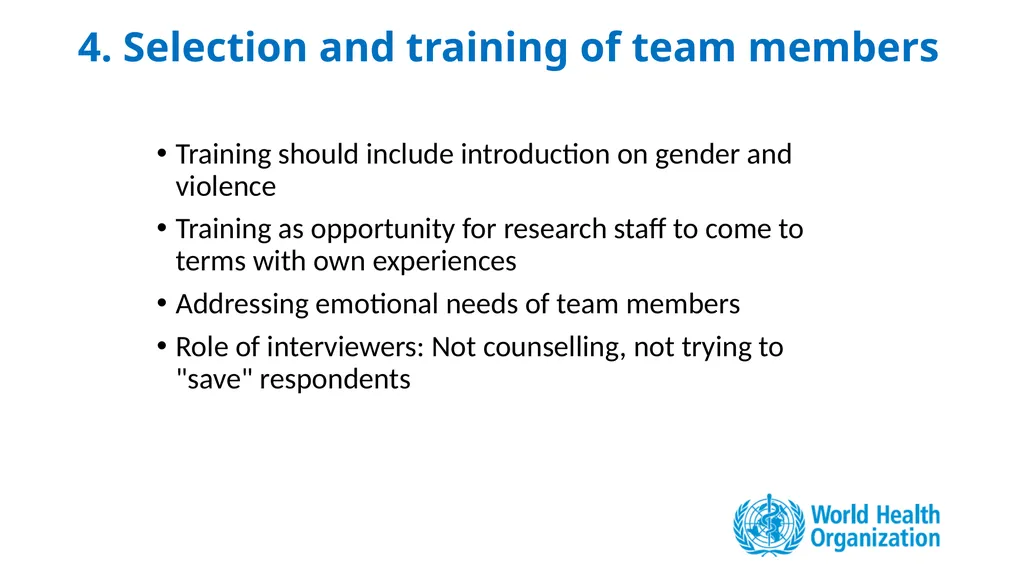
4. Selection and training of team members Training should include introduction on gender and violence
Training as opportunity for research staff to come to terms with own experiences
Addressing emotional needs of team members
Role of interviewers: Not counselling, not trying to "save" respondents<br>
Training as opportunity for research staff to come to terms with own experiences
Addressing emotional needs of team members
Role of interviewers: Not counselling, not trying to "save" respondents<br>
16
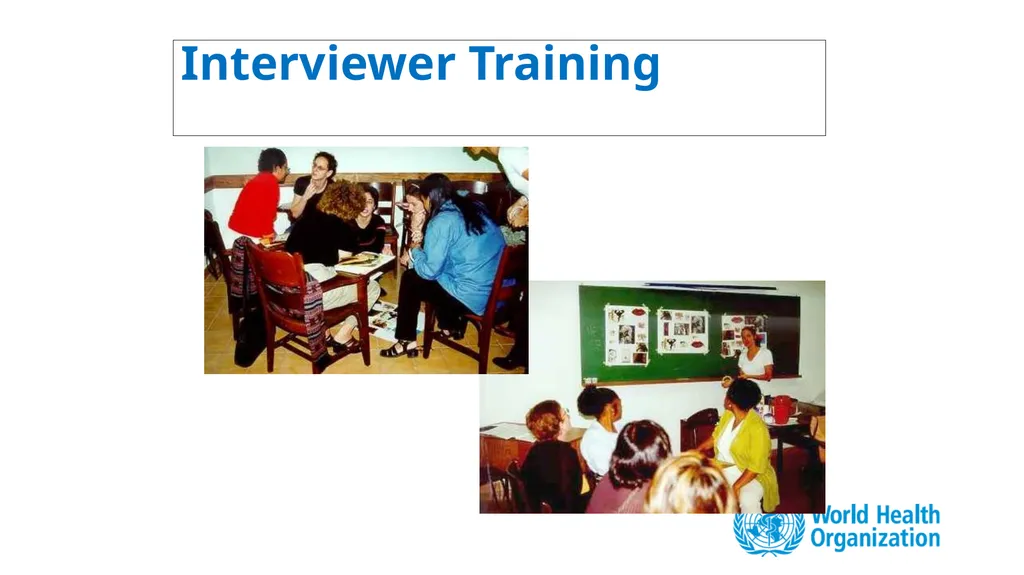
Interviewer Training<br>
17
Goals of interviewer training To increase sensitivity of participants to gender issues at a personal as well as a community level;
To develop a basic understanding of gender-based violence, its characteristics, causes and impact on the health of women and children;
To understand the goals of the Multi-Country Study on Women’s Health and Domestic Violence;
To learn skills for interviewing, taking into account safety and ethical guidelines;
To become familiar with the questionnaire and protocol of the Violence against Women Study.<br>
18
Special training vs professional interviewers<br>
19
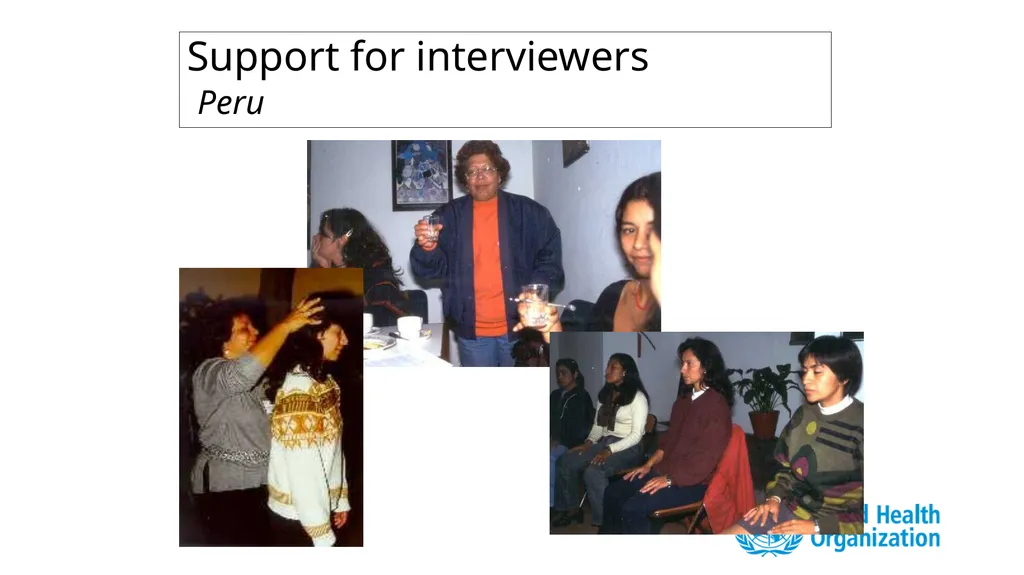
Support for interviewers
Peru<br>
20
5. Actions to reducing distress to respondents Ask all questions in supportive and non-judgemental manner (language of questions)
Train interviewers to deal with distress
Train when and how to terminate interview
All interviews should end in a positive manner<br>
Train interviewers to deal with distress
Train when and how to terminate interview
All interviews should end in a positive manner<br>
21
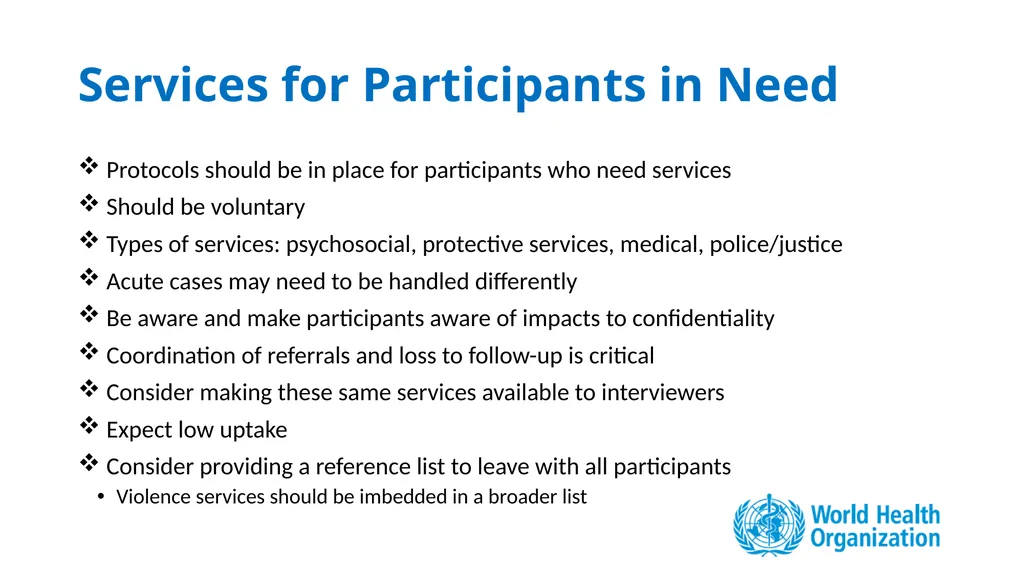
Services for Participants in Need Protocols should be in place for participants who need services
Should be voluntary
Types of services: psychosocial, protective services, medical, police/justice
Acute cases may need to be handled differently
Be aware and make participants aware of impacts to confidentiality
Coordination of referrals and loss to follow-up is critical
Consider making these same services available to interviewers
Expect low uptake
Consider providing a reference list to leave with all participants
Violence services should be imbedded in a broader list<br>
22
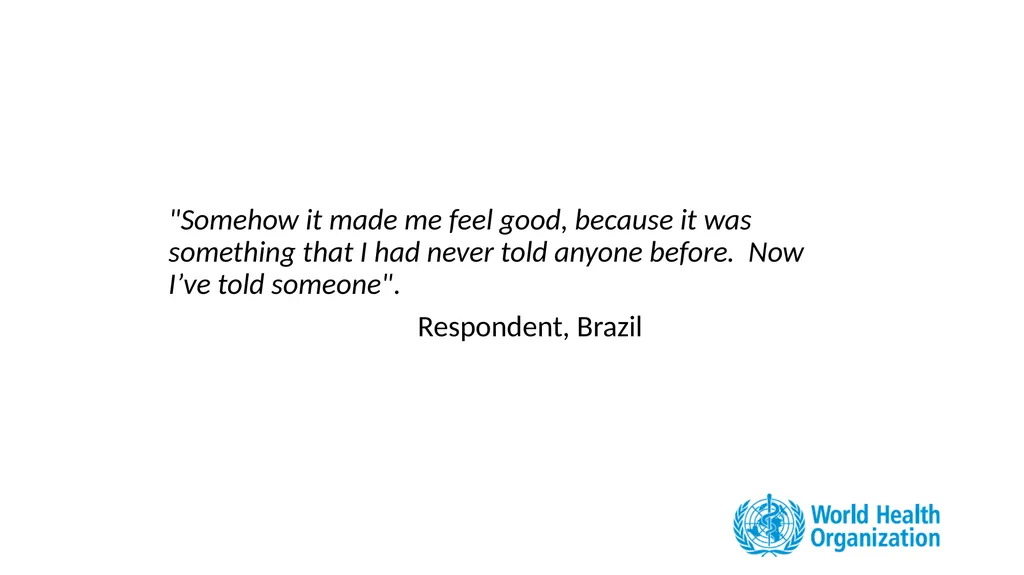
"Somehow it made me feel good, because it was something that I had never told anyone before. Now I’ve told someone".
Respondent, Brazil<br>
Respondent, Brazil<br>
23
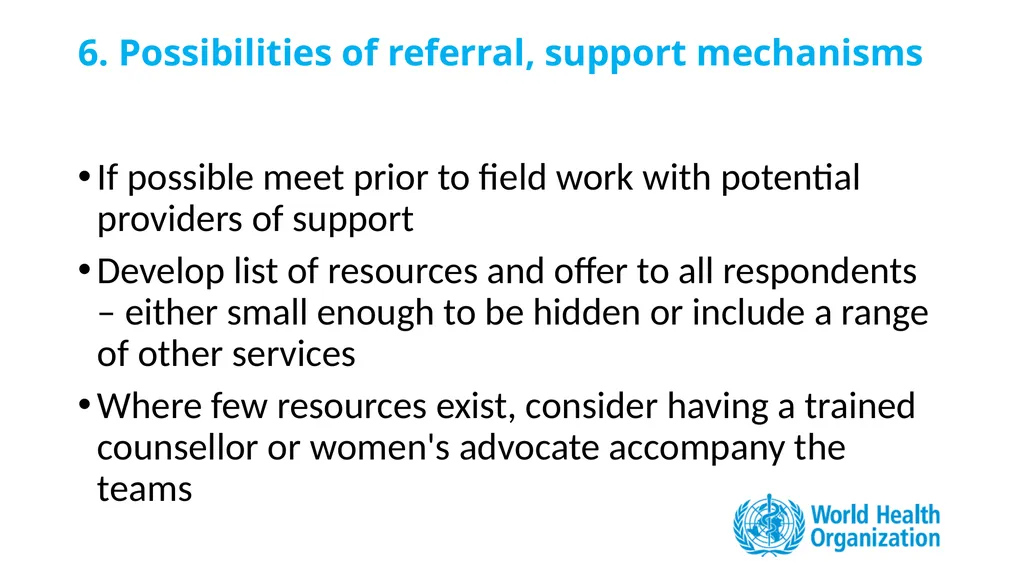
6. Possibilities of referral, support mechanisms If possible meet prior to field work with potential providers of support
Develop list of resources and offer to all respondents – either small enough to be hidden or include a range of other services
Where few resources exist, consider having a trained counsellor or women's advocate accompany the teams<br>
Develop list of resources and offer to all respondents – either small enough to be hidden or include a range of other services
Where few resources exist, consider having a trained counsellor or women's advocate accompany the teams<br>
24
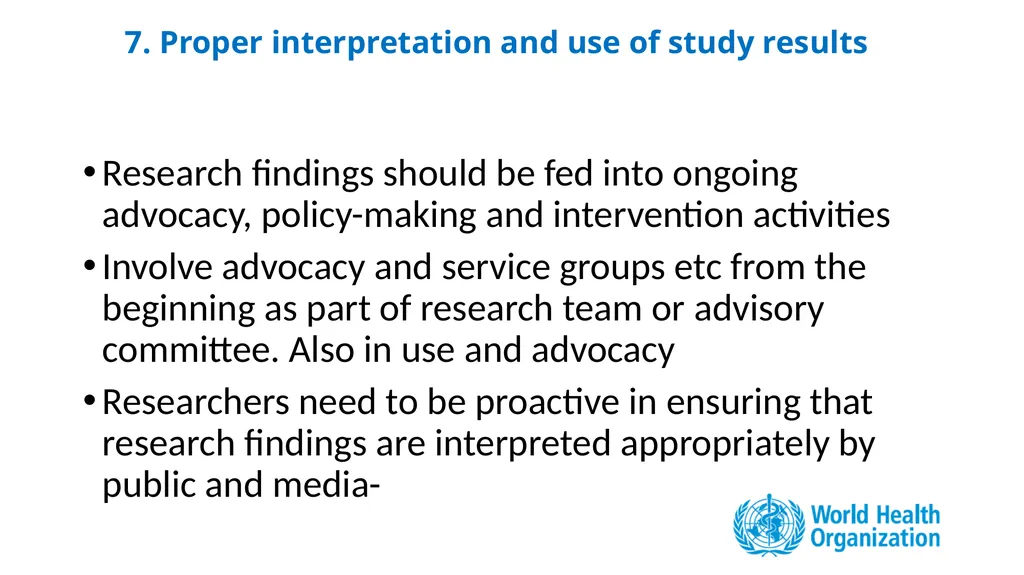
7. Proper interpretation and use of study results Research findings should be fed into ongoing advocacy, policy-making and intervention activities
Involve advocacy and service groups etc from the beginning as part of research team or advisory committee. Also in use and advocacy
Researchers need to be proactive in ensuring that research findings are interpreted appropriately by public and media-<br>
Involve advocacy and service groups etc from the beginning as part of research team or advisory committee. Also in use and advocacy
Researchers need to be proactive in ensuring that research findings are interpreted appropriately by public and media-<br>
25
8. Violence questions in other surveys Considered a second option to a specialized survey due to length and methodological constraints
Be aware of the challenges of ensuring data quality and ensuring respondent safety
It makes sense only of research team is willing and able to address basic ethical and methodological guidelines.<br>
Be aware of the challenges of ensuring data quality and ensuring respondent safety
It makes sense only of research team is willing and able to address basic ethical and methodological guidelines.<br>
26
…”We were so naïve. When we first added questions on violence into our survey on contraceptive use we did nothing special…it never occurred to us that we would have problems. Later we found out that three women had been severely beaten for participating in our survey. We felt awful and realized then that we were in over our heads..
(Researcher from Mexico)<br>
(Researcher from Mexico)<br>
27
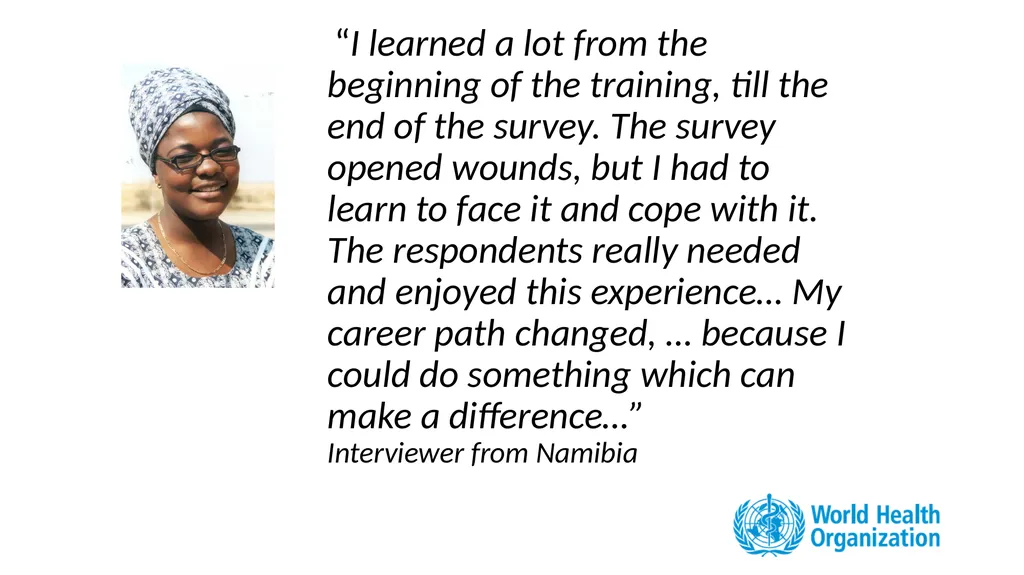
“I learned a lot from the beginning of the training, till the end of the survey. The survey opened wounds, but I had to learn to face it and cope with it. The respondents really needed and enjoyed this experience… My career path changed, … because I could do something which can make a difference…” Interviewer from Namibia<br>
28
Take home messages A population based survey on violence against women should be and can be done ethically and safely
It must be undertaken carefully
Methodologically rigorous
safety of participants paramount
Important for researchers to understand and apply recommendations from prior research and to be creative and thoughtful about new directions
Important to disseminate results, best practices and lessons learned
Women are willing to share experiences with trained and empathetic interviewers<br>
29
For more information:
garciamorenoc@who.int
http://www.who.int/reproductivehealth/publications/violence/en<br>
garciamorenoc@who.int
http://www.who.int/reproductivehealth/publications/violence/en<br>
30
INDIVIDUAL CONSENT FORM<br>
31
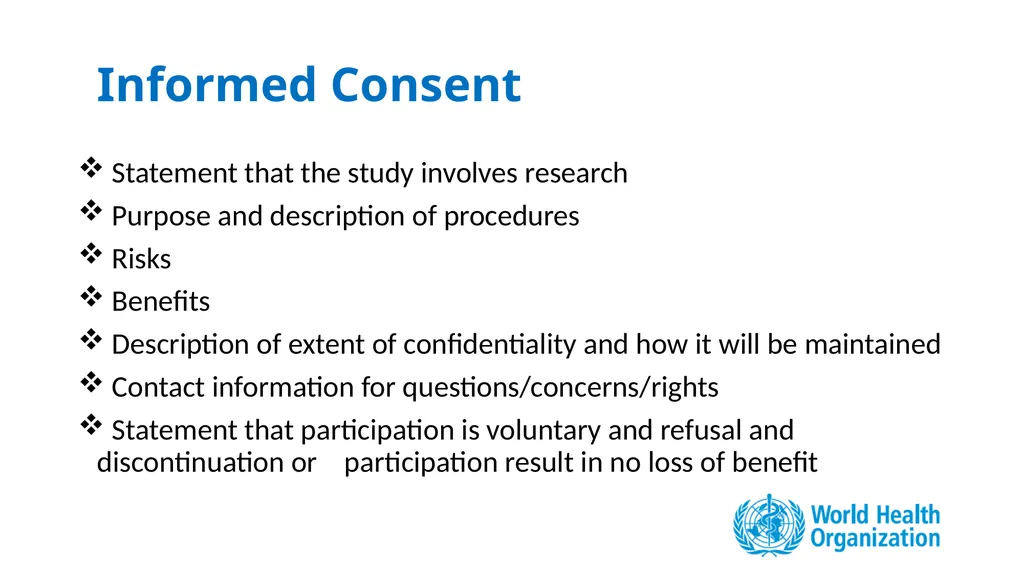
Informed Consent Statement that the study involves research
Purpose and description of procedures
Risks
Benefits
Description of extent of confidentiality and how it will be maintained
Contact information for questions/concerns/rights
Statement that participation is voluntary and refusal and discontinuation or participation result in no loss of benefit<br>
Purpose and description of procedures
Risks
Benefits
Description of extent of confidentiality and how it will be maintained
Contact information for questions/concerns/rights
Statement that participation is voluntary and refusal and discontinuation or participation result in no loss of benefit<br>
32
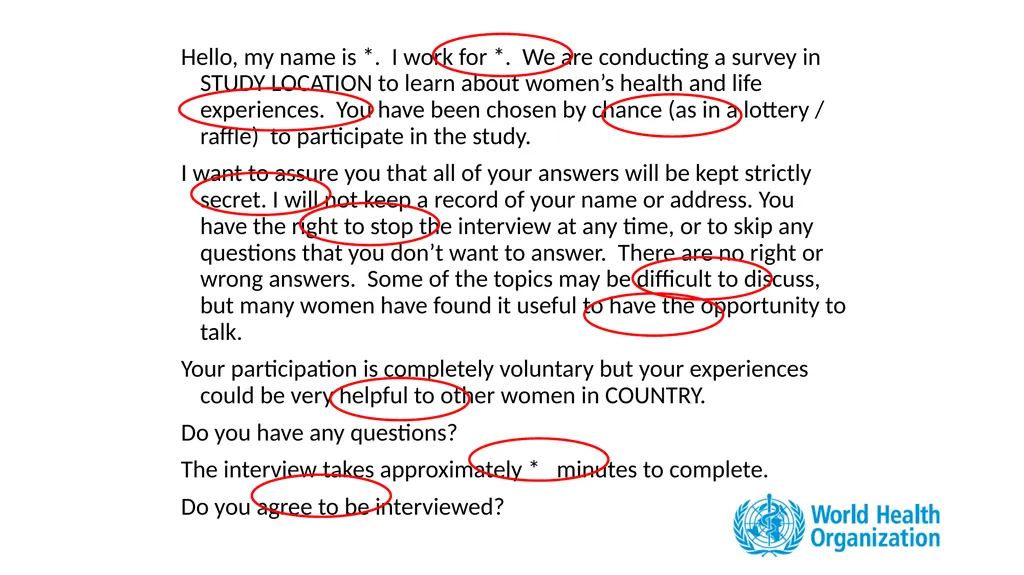
Hello, my name is *. I work for *. We are conducting a survey in STUDY LOCATION to learn about women’s health and life experiences. You have been chosen by chance (as in a lottery / raffle) to participate in the study.
I want to assure you that all of your answers will be kept strictly secret. I will not keep a record of your name or address. You have the right to stop the interview at any time, or to skip any questions that you don’t want to answer. There are no right or wrong answers. Some of the topics may be difficult to discuss, but many women have found it useful to have the opportunity to talk.
Your participation is completely voluntary but your experiences could be very helpful to other women in COUNTRY.
Do you have any questions?
The interview takes approximately * minutes to complete.
Do you agree to be interviewed?<br>
33
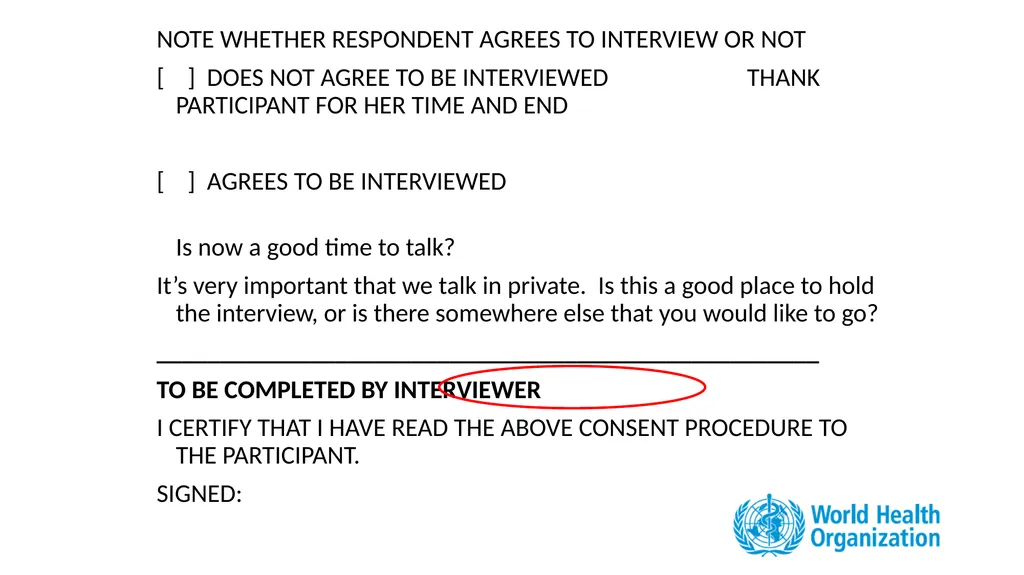
NOTE WHETHER RESPONDENT AGREES TO INTERVIEW OR NOT
[ ] DOES NOT AGREE TO BE INTERVIEWED THANK PARTICIPANT FOR HER TIME AND END
[ ] AGREES TO BE INTERVIEWED
Is now a good time to talk?
It’s very important that we talk in private. Is this a good place to hold the interview, or is there somewhere else that you would like to go?
____________________________________________________
TO BE COMPLETED BY INTERVIEWER
I CERTIFY THAT I HAVE READ THE ABOVE CONSENT PROCEDURE TO THE PARTICIPANT.
SIGNED:<br>
34
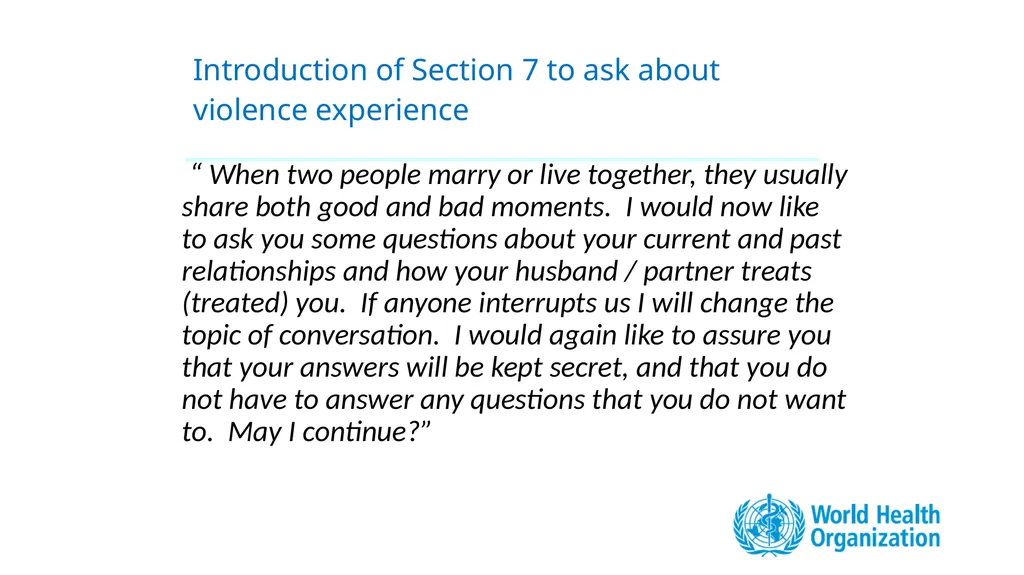
Introduction of Section 7 to ask about violence experience “ When two people marry or live together, they usually share both good and bad moments. I would now like to ask you some questions about your current and past relationships and how your husband / partner treats (treated) you. If anyone interrupts us I will change the topic of conversation. I would again like to assure you that your answers will be kept secret, and that you do not have to answer any questions that you do not want to. May I continue?”<br>