
Quality Circle Forum Of India Hyderabad Chapter
SB
Published · 48 slides · 0 views

1 / 1


Description
Quality Circle Forum Of India Hyderabad Chapter Welcome You All To One Day Program (WEBINAR) (21082020) On Implementation In Educational Institutes QCs in Education Introduction Implementation -Methodology Experiences with QCs in
Related Topics
Share
Embed code
Download this presentation From Below
"Quality Circle Forum Of India Hyderabad Chapter" is the property of its rightful owner. Permission is granted to download and print the materials on this website for personal, non-commercial use only, and to display it on your personal computer provided you do not modify the materials and that you retain all copyright notices contained in the materials. By downloading content from our website, you accept the terms of this agreement.
Presentation Transcript
01
Quality Circle Forum Of India
Hyderabad Chapter
Welcome You All
To
One Day Program (WEBINAR)
(21/08/2020)
On
Implementation In Educational Institutes<br>
Hyderabad Chapter
Welcome You All
To
One Day Program (WEBINAR)
(21/08/2020)
On
Implementation In Educational Institutes<br>
02
QCs in Education Introduction
Implementation -Methodology
Experiences with QCs in education
Case study presentation
Open forum for discussions<br>
Implementation -Methodology
Experiences with QCs in education
Case study presentation
Open forum for discussions<br>
03
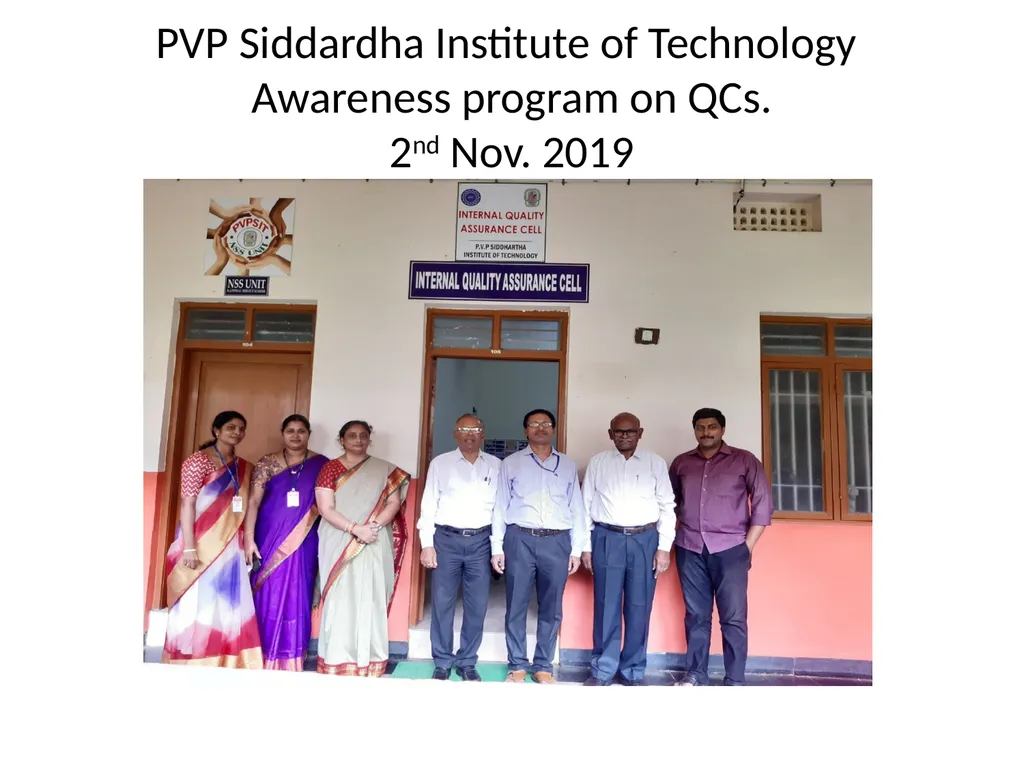
PVP Siddardha Institute of Technology
Awareness program on QCs.
2nd Nov. 2019<br>
04
Dr Jagdish Gandhi
Founder-Manager, CMS, Lucknow, India<br>
Founder-Manager, CMS, Lucknow, India<br>
05
‘Catch Them Young’. Dr. Gandhi thought of using Kaizen philosophy of continuous improvement and QCs’ in schools to inculcate quality awareness at a tender age in children, when minds are impressionable and the attitudes can be built. The basic aim was to ‘Catch Them Young’.
He collected literature on Quality Circles and on his return to India, he introduced the idea at the CMS Principal’s meeting. Taking inspiration from Mr. Gandhi, Dr. (Mrs) Vineeta Kamran, Principal, City Montessori School, Kanpur Road, Lucknow sought the help of Mr. P.C.Bihari and Mr. Saomi Das, the QC experts from Indian Railways to start QCs’ in her school.<br>
He collected literature on Quality Circles and on his return to India, he introduced the idea at the CMS Principal’s meeting. Taking inspiration from Mr. Gandhi, Dr. (Mrs) Vineeta Kamran, Principal, City Montessori School, Kanpur Road, Lucknow sought the help of Mr. P.C.Bihari and Mr. Saomi Das, the QC experts from Indian Railways to start QCs’ in her school.<br>
06
Applying Japanese Management Techniques to
American Higher Education Japanese organizations traditionally treat all employees
with respect and dignity. In American business and industry
and in our colleges and universities, we lack this tradition.
How can colleges and universities adapt the Japanese
concept of looking to the future?
What works well in one culture is not necessarily
transferable to another. But to study the Japanese success is to
suggest that its postulates can be reshaped to meet our needs.<br>
07
Pennsylvania State University Can quality circles be adapted to our colleges and universities?
Kogut (1984) says yes. He reports that such circles have already been successfully introduced at The Pennsylvania State University. "
At Penn State, the professor serves as facilitator.
Kogut found that his students offered valuable suggestions which helped him to fine-tune his instruction. 1.Depositing a copy of his lecture notes in the library to ways to make more effective use of the blackboard. Another was inducing enough students to volunteer for the circle.<br>
08
NAAC What is higher in higher education?
Higher education imparts in-depth knowledge and understanding so as to advance the students to new frontiers of knowledge in different walks of life (subject domains).
It is about knowing more and more about less and less.
It develops the student’s ability to question and seek truth and makes him/her competent to critique on contemporary issues. It broadens the intellectual powers of the individual within a narrow specialization, but also gives him/her a wider perspective of the world around.<br>
09
KEY ISSUES a) Teaching & Learning in small groups
b) Infrastructure maintenance and its optimum use
c) Use of ICT
d) Faculty development
e) Course Curricula review<br>
b) Infrastructure maintenance and its optimum use
c) Use of ICT
d) Faculty development
e) Course Curricula review<br>
10
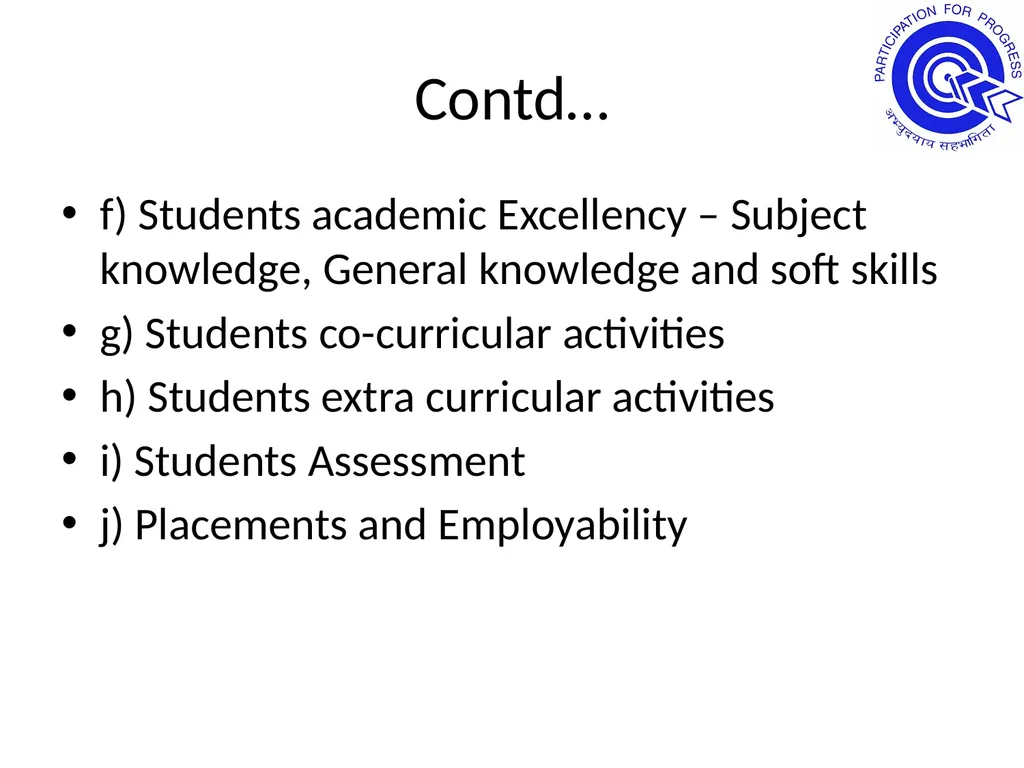
Contd… f) Students academic Excellency – Subject knowledge, General knowledge and soft skills
g) Students co-curricular activities
h) Students extra curricular activities
i) Students Assessment
j) Placements and Employability<br>
g) Students co-curricular activities
h) Students extra curricular activities
i) Students Assessment
j) Placements and Employability<br>
11
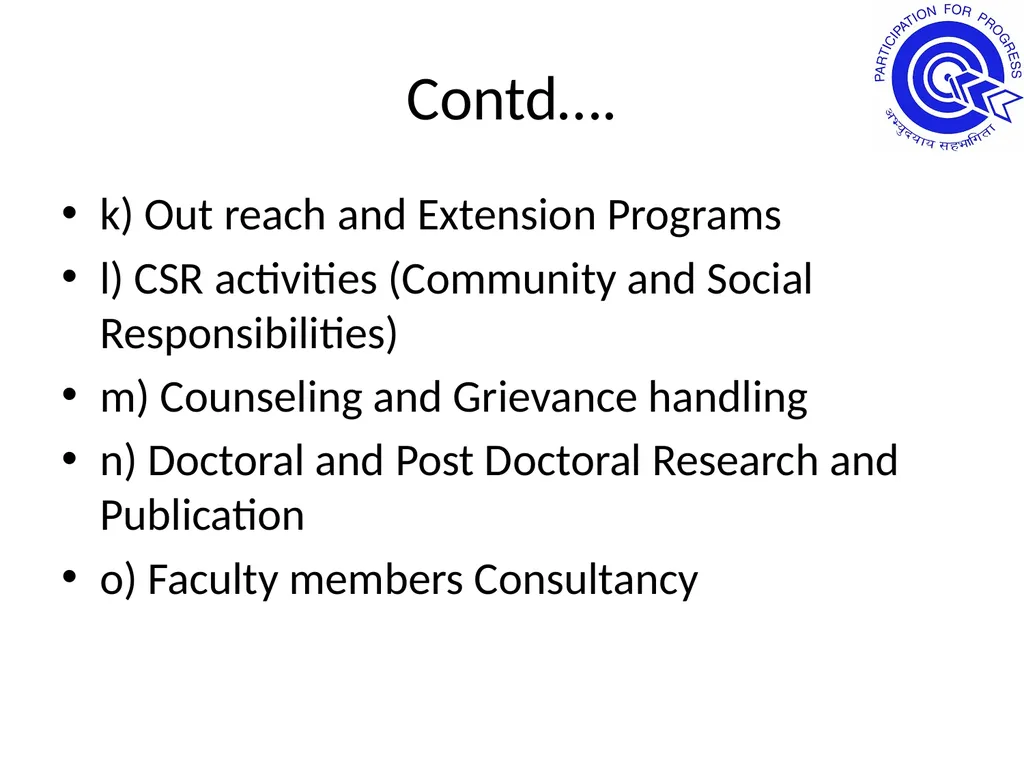
Contd…. k) Out reach and Extension Programs
l) CSR activities (Community and Social Responsibilities)
m) Counseling and Grievance handling
n) Doctoral and Post Doctoral Research and Publication
o) Faculty members Consultancy<br>
l) CSR activities (Community and Social Responsibilities)
m) Counseling and Grievance handling
n) Doctoral and Post Doctoral Research and Publication
o) Faculty members Consultancy<br>
12
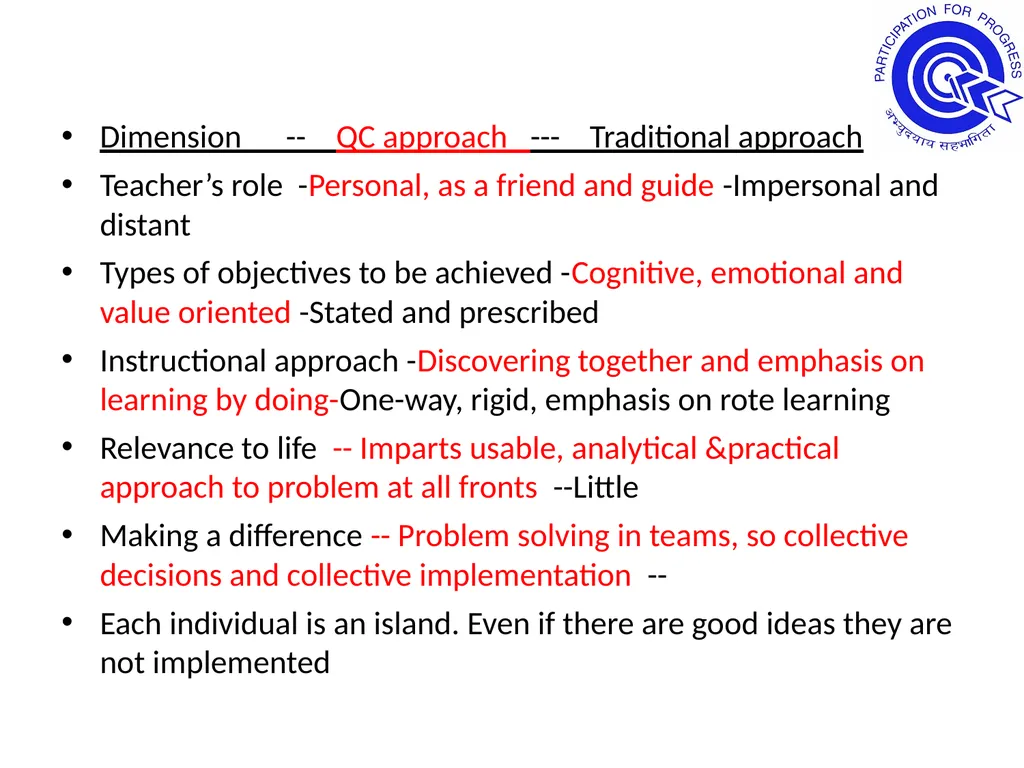
Dimension -- QC approach --- Traditional approach
Teacher’s role -Personal, as a friend and guide -Impersonal and distant
Types of objectives to be achieved -Cognitive, emotional and value oriented -Stated and prescribed
Instructional approach -Discovering together and emphasis on learning by doing-One-way, rigid, emphasis on rote learning
Relevance to life -- Imparts usable, analytical &practical approach to problem at all fronts --Little
Making a difference -- Problem solving in teams, so collective decisions and collective implementation --
Each individual is an island. Even if there are good ideas they are not implemented<br>
13
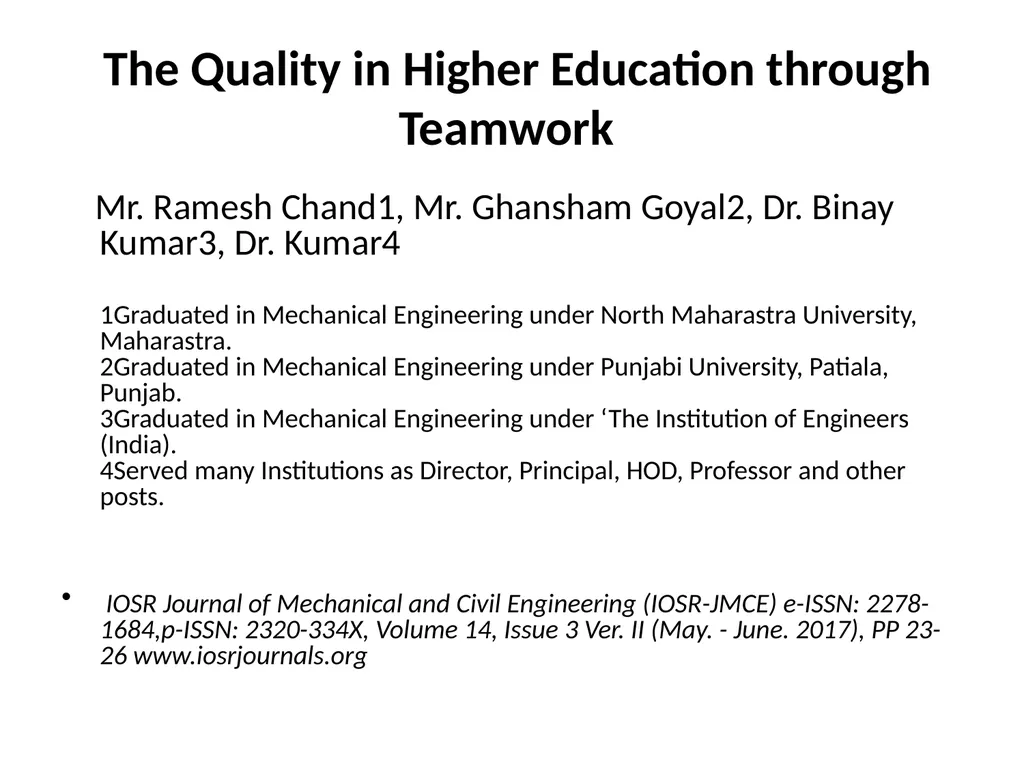
The Quality in Higher Education through Teamwork Mr. Ramesh Chand1, Mr. Ghansham Goyal2, Dr. Binay Kumar3, Dr. Kumar4
1Graduated in Mechanical Engineering under North Maharastra University, Maharastra. 2Graduated in Mechanical Engineering under Punjabi University, Patiala, Punjab. 3Graduated in Mechanical Engineering under ‘The Institution of Engineers (India). 4Served many Institutions as Director, Principal, HOD, Professor and other posts.
IOSR Journal of Mechanical and Civil Engineering (IOSR-JMCE) e-ISSN: 2278-1684,p-ISSN: 2320-334X, Volume 14, Issue 3 Ver. II (May. - June. 2017), PP 23-26 www.iosrjournals.org<br>
14
QC approach The quality education has become watchword and indeed the corner stone for any higher technical educational system. The authors have in mind the quality circles or teamwork approaches can have for maintaining and improving the quality in higher technical education as per available resources to raise the institute at the competitive highest level to solve unemployment.
The concept assumes that people closest to the problem understand better than who maintain the system from outsides. It hopes that a group of individuals working together will come up with better solution than one individual working alone. Quality circles approaches are a specifically structured form and mode of for betterment of management system.<br>
The concept assumes that people closest to the problem understand better than who maintain the system from outsides. It hopes that a group of individuals working together will come up with better solution than one individual working alone. Quality circles approaches are a specifically structured form and mode of for betterment of management system.<br>
15
Total Quality Improvement Through Quality Circles
In Technician Education Institutions Of India 1RAMESH B. SHIVAGUNDE, 2C. S. RAJESHWARI, 3ANJALI POTNIS
1 Professor of Management
2 Professor of Electrical & Electronics Engineering
3 Assistant Professor of Electrical & Electronics Engineering
National Institute of Technical Teachers Training and Research, Bhopal
E-mail: 1rbshivagunde@gmail.com, 2csrajeshwari@gmail.com, 3apotnis@gmail.com
“Study on Implementation of QCs in polytechnics.”<br>
16
Participation Areas of QC - There were nine areas in which 34 QCs were functioning.
The three most crucial areas appeared to be classroom instruction, laboratory instruction and Student Amenities.
Participation - In the all the 13 polytechnics,
183 faculty members, 68 Technical support staff members, 14 ministerial staff members and 74 students participated in QC operation.<br>
The three most crucial areas appeared to be classroom instruction, laboratory instruction and Student Amenities.
Participation - In the all the 13 polytechnics,
183 faculty members, 68 Technical support staff members, 14 ministerial staff members and 74 students participated in QC operation.<br>
17
OUTCOMES Most of the polytechnics reported that QC brought
considerable changes in Polytechnics it also provided
opportunity for involvement of different stakeholders of Polytechnic to solve work related problems and for
improving quality in different areas.
The significant outcomes were:
innovations in instructional processes
started many student-centred activities in the
institution
improvement in the attendance in laboratory work<br>
18
reduction in absenteeism of students in classrooms
more participation and involvement in laboratory work
improved relationship with industry
increased usage of resources
overall improvement in cleanliness of the campus
improvement in sensitivity towards environment
involvement of students in work-related problem solving
positive attitudinal changes occurred in supporting staff
effective interaction for strengthening relationship
with stakeholder groups
sense of belongingness and owning the polytechnic and its resources
More awareness and consciousness for quality of individuals life of student and employees<br>
19
Quality Circle: An Approach to Solve Institutional Problems: A Case Study
Mohan P. Khond ,Mechanical Engineering Department ,
College of Engineering Pune ,India, 411005
Swapnil C. Devatwal and Hanumant J. Gorade ,College of Engineering Pune ,Maharashtra, India, 411005
This paper is to focus on the effective implementation of the Quality Circle (QC) in educational institutes. (ppt enclosed)
Proceedings of the 2012 International Conference on Industrial Engineering and Operations Management
Istanbul, Turkey, July 3 – 6, 2012<br>
20
The American Society for Quality’s Education Division Publishes the online, double-blind, peer-reviewed journal
“Quality Approaches in Education.”
Encourage evidence-based analysis using quality approach-driven improvement of education.<br>
“Quality Approaches in Education.”
Encourage evidence-based analysis using quality approach-driven improvement of education.<br>
21
The following types of articles fit the purview of
Quality Approaches in Education: • Case studies on how to improve quality in a college, using evidence-based analysis, continuous improvement approaches, especially related to improving student retention and degree completion.
• Research articles reporting on survey findings such as a national survey on students’ attitudes toward confidence, success, social networking, student engagement, access and affordability, etc.
• Case studies or research articles addressing issues such as the role of faculty, administrators, and trainers in quality systems.<br>
22
Contd.. • Case studies or research studies focusing on the role of quality in accreditation.
• Case studies or research studies on scholarship of teaching and approaches to improve teaching, enhancing and supporting student learning, learning outcomes assessment best practices, and best practices for using technology in the classroom.<br>
• Case studies or research studies on scholarship of teaching and approaches to improve teaching, enhancing and supporting student learning, learning outcomes assessment best practices, and best practices for using technology in the classroom.<br>
23
Quality Circles for Teaching Key elements are to watch each other work, measure everything we can to find informative excursions, and talk about what we see.
HOW DOES A QCT WORK?
QCT will comprise three to four faculty, and ideally represent multiple disciplines.
Each QCT will identify a focus of choice that may include active learning, syllabus design, assignment design, application of course concepts, teaching large lecture courses, and integration of technology, to name only a few.<br>
24
Meetings QCT meetings can take a variety of forms to stimulate conversation and help faculty investigate teaching/ learning issues and opportunities:
Guided Discussion: Members come prepared to discuss an item (article, chapter, videotape) or issue selected by the group.
Round-robins: Members share personal experience and knowledge on a topic of interest to the group.
Ask the expert: An “expert” (or expert panel) is invited to share insights on a topic.
contd..<br>
25
“Progress” reports: Members report on experiments they have conducted with new teaching practices.
Peer Tutoring: Members of the group take responsibility for learning different aspects of the topic being explored by the group. At each session, one or two members report back on the material they have researched.
General discussion: Meetings can be occasions for informal conversations about teaching and learning. There is no set agenda. Participants bring in issues, questions, topics that are of interest to them.<br>
26
Quality Circle: A perspective from Engineering Education M. Easwaramoorthi, M.K.Murthi, B.Velliyangiri, M.Sengottaiyan
Department of Mechanical Engineering, Nandha Engineering College, Erode, Tamilnadu, India-638052.
eswaramoorthi65@gmail.com
South Asian Journal of Engineering and Technology Vol.2, No.23 (2016) 106 – 109<br>
Department of Mechanical Engineering, Nandha Engineering College, Erode, Tamilnadu, India-638052.
eswaramoorthi65@gmail.com
South Asian Journal of Engineering and Technology Vol.2, No.23 (2016) 106 – 109<br>
27
Problem QC implementation in education sector was started in India by 1993 named as Student Quality Circle (SQC) and soon it gained currency across the globe .Nahai et al. (2012) says SQCs have been very effective tools in bridging three important parameters: ―Quality improvement, Student engagement and the Student learning experience.
In this research, an objective was set to investigate the performance of slow learners in a class by implementing SQC concepts.<br>
In this research, an objective was set to investigate the performance of slow learners in a class by implementing SQC concepts.<br>
28
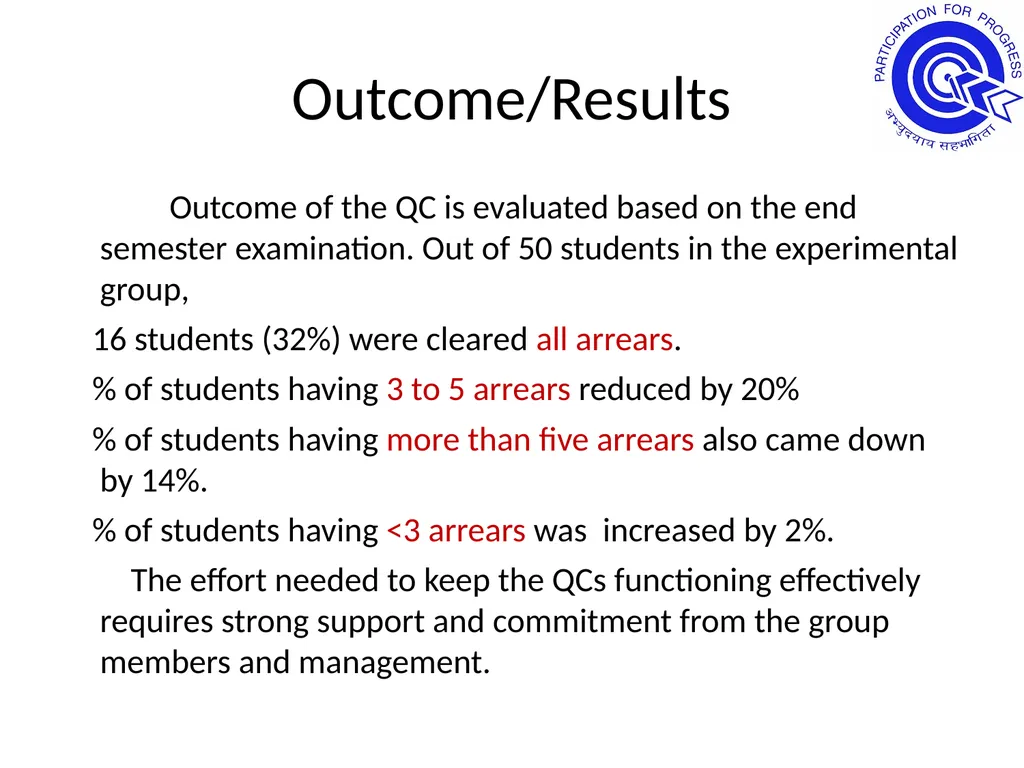
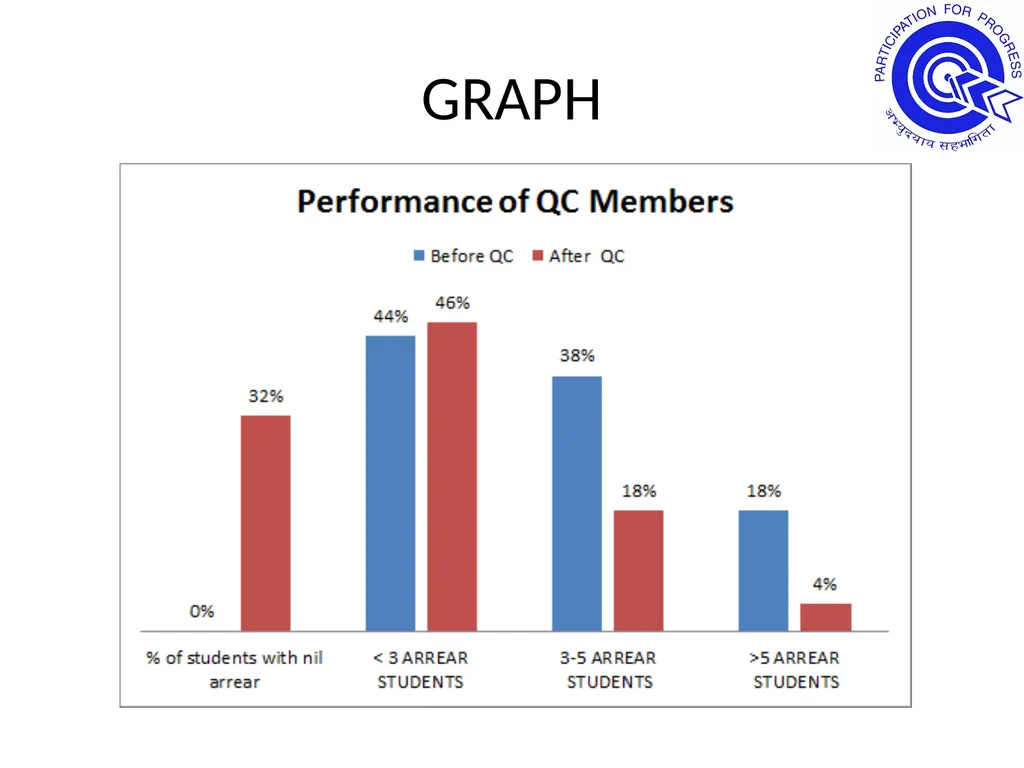
Outcome/Results Outcome of the QC is evaluated based on the end semester examination. Out of 50 students in the experimental group,
16 students (32%) were cleared all arrears.
% of students having 3 to 5 arrears reduced by 20%
% of students having more than five arrears also came down by 14%.
% of students having <3 arrears was increased by 2%.
The effort needed to keep the QCs functioning effectively requires strong support and commitment from the group members and management.<br>
29
GRAPH<br>
30
Students’ Quality Circles for Personality Development An Approach to Prepare Total Quality People
Prof. Dinesh P. Chapagain
President, Network for Quality, Productivity and
Competitiveness – Nepal
Former Dean, School of Engineering,
Kathmandu University, Nepal
<dinesh.chapagain@yahoo.com>
*3rd ANQ Congress, Singapore, 2006<br>
Prof. Dinesh P. Chapagain
President, Network for Quality, Productivity and
Competitiveness – Nepal
Former Dean, School of Engineering,
Kathmandu University, Nepal
<dinesh.chapagain@yahoo.com>
*3rd ANQ Congress, Singapore, 2006<br>
31
BENEFITS Practicing SQC activities in educational institutes creates the environment needed to
deliver various benefits in the personality development of students.
Self confidence, Self-discipline, Interpersonal and public relations, Empathy, Social responsibility, Time management skills, Scientific and analytical skills, Communication skills, Creativity and lateral thinking habits, Working habits in a team, Broader vision more than bookish knowledge.<br>
32
Using Quality Circles to Master the Classroom Dr. Useem I have instituted quality circles in all of my courses except doctoral seminars. The courses have included a College introductory course with 110 students, an upper-division undergraduate class with 40, a first-year MBA course with 65, and an executive MBA class with 95.
I announce the student volunteers to the entire class at our next meeting, suggesting that complaints can be
safely channeled through them. QC members often take the initiative to sound out their class-mates before and after class. Several have even e-mailed all of their fellow students just before a QC meeting to take complete stock<br>
33
Dr. Useem Among the answers I have received:
failure to call on students in the corners of the classroom, the occasional mistake of repeating myself, insufficient clarity on the main points of a topic presented, and failure to summarize the day's key lessons.
Dr. Useem is Professor of Management in the Wharton School and Professor of Sociology in the School of Arts and Sciences.<br>
34
Student Quality Circle: Skilful Learning Environment K Nagraj Dharwadkar1, Gautami Shingan2
Computer Science and Engineering Department, Rajarambapu Institute of Technology, Islampur.
1nagaraj.dharwadkar@ritindia.edu, 2gautami.shingan@ritindia.edu
Applied various learning activities of standard in the form of quality Circle adapted in department of Computer Science and Engineering for year 2015-16. These activities are designed and
implemented to improve the attainment of Programme Outcomes (POs) alongwith placement of department. Results are analysed to demonstrate that the adapted methods improved the learning capabilities of students.
Journal of Engineering Education Transformations , Volume 31 , No. 2, October 2017, ISSN 2349-2473, eISSN 2394-1707<br>
35
Objective The objective of this paper is:
1) To develop working knowledge and technical skills of the students
2) Enhance Problem solving abi li ty and
Communication skill within students.
3) Build a Project management skill and team work strategy in students<br>
1) To develop working knowledge and technical skills of the students
2) Enhance Problem solving abi li ty and
Communication skill within students.
3) Build a Project management skill and team work strategy in students<br>
36
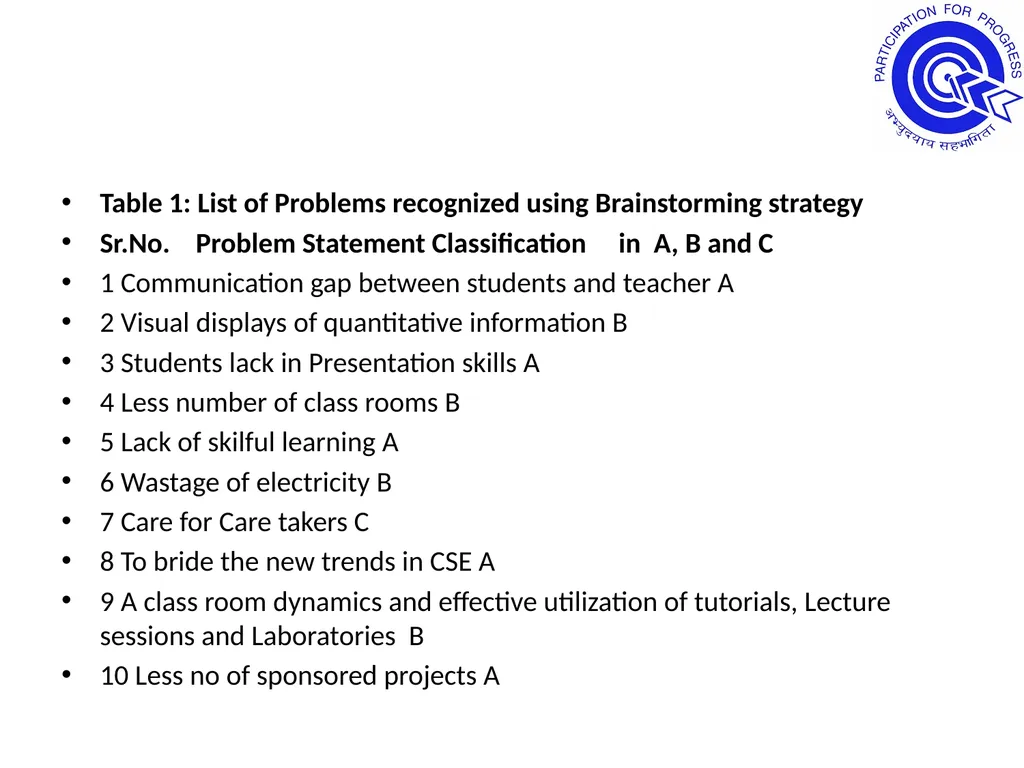
Table 1: List of Problems recognized using Brainstorming strategy
Sr.No. Problem Statement Classification in A, B and C
1 Communication gap between students and teacher A
2 Visual displays of quantitative information B
3 Students lack in Presentation skills A
4 Less number of class rooms B
5 Lack of skilful learning A
6 Wastage of electricity B
7 Care for Care takers C
8 To bride the new trends in CSE A
9 A class room dynamics and effective utilization of tutorials, Lecture sessions and Laboratories B
10 Less no of sponsored projects A<br>
37
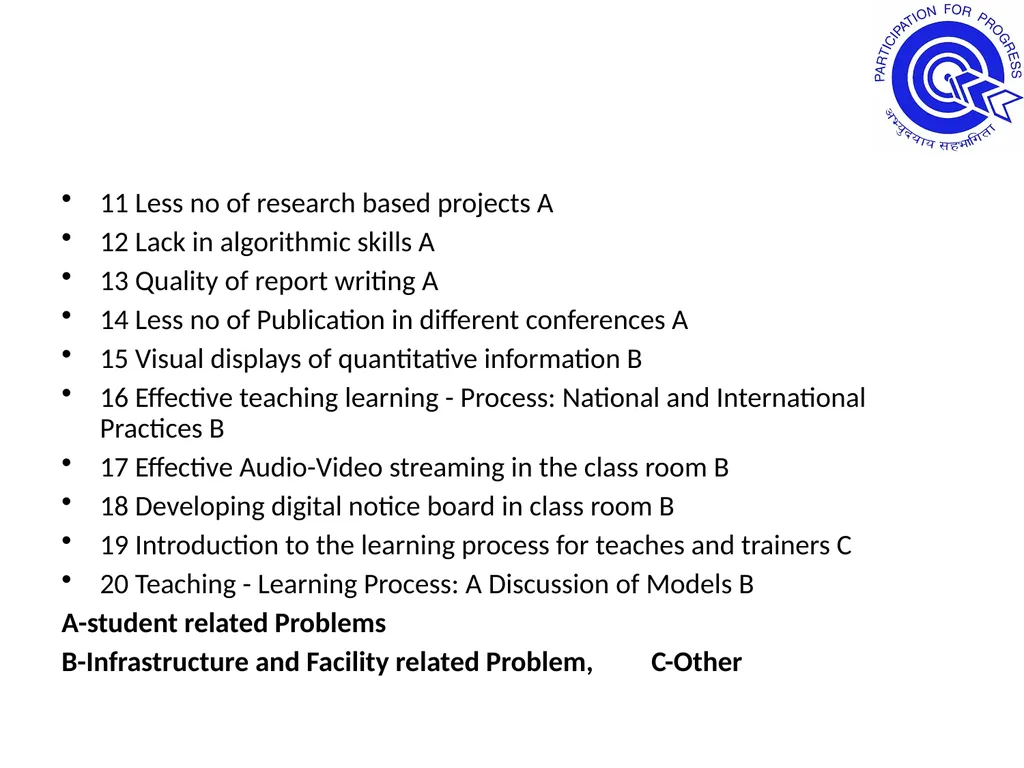
11 Less no of research based projects A
12 Lack in algorithmic skills A
13 Quality of report writing A
14 Less no of Publication in different conferences A
15 Visual displays of quantitative information B
16 Effective teaching learning - Process: National and International Practices B
17 Effective Audio-Video streaming in the class room B
18 Developing digital notice board in class room B
19 Introduction to the learning process for teaches and trainers C
20 Teaching - Learning Process: A Discussion of Models B
A-student related Problems
B-Infrastructure and Facility related Problem, C-Other<br>
38
Project forum Outcomes of this activity are:
CO1. Ability towork in team
CO2. Skills to negotiate and resolve conflicts
CO3. Ability to have leadership skills
CO4. Work in time constraints and with
responsibility
CO5. Ability to Share the knowledge<br>
CO1. Ability towork in team
CO2. Skills to negotiate and resolve conflicts
CO3. Ability to have leadership skills
CO4. Work in time constraints and with
responsibility
CO5. Ability to Share the knowledge<br>
39
RESULT In acadamic year 2015-16 placement and Programme Outcomes has enhanced up to 5% and 14% respectively. With the adopted innovative techniques, the attitude of the students towards overall learning, specifically basic knowledge, addition to this technical and soft skills and thinking ability has been considerably improved.<br>
40
Thiagaraja college of Engineering
Madhurai. QCs implementation in teaching learning process.
Training to 35 + 32 teaching faculty
Presented case studies at CCQC ,Chennai chapter and got awards.
More faculty joined in QC activities after this.
Ref: https://www.tce.edu/content/quality_circle<br>
Training to 35 + 32 teaching faculty
Presented case studies at CCQC ,Chennai chapter and got awards.
More faculty joined in QC activities after this.
Ref: https://www.tce.edu/content/quality_circle<br>
41
Quality Circles and Academic Libraries P.V. Konnur
University Librarian
Bangalore University, Bangalore, India
konnur@bub.ernet.in
A.N. Joshi
Assistant Librarian
Prof. S.S. Basavanal Library
Karnatak University, Dharwad, India
an.joshi@yahoo.co.in<br>
University Librarian
Bangalore University, Bangalore, India
konnur@bub.ernet.in
A.N. Joshi
Assistant Librarian
Prof. S.S. Basavanal Library
Karnatak University, Dharwad, India
an.joshi@yahoo.co.in<br>
42
Why QC QC gives an opportunity to each member of the library to voice his/her opinion as a result of which rapport building is extensively undertaken and acceptance of others views is built up.
Adoption of QC may be very helpful in libraries attached to medical colleges, engineering colleges and universities as the users are very specific about their information needs and also very techno-savvy.<br>
Adoption of QC may be very helpful in libraries attached to medical colleges, engineering colleges and universities as the users are very specific about their information needs and also very techno-savvy.<br>
43
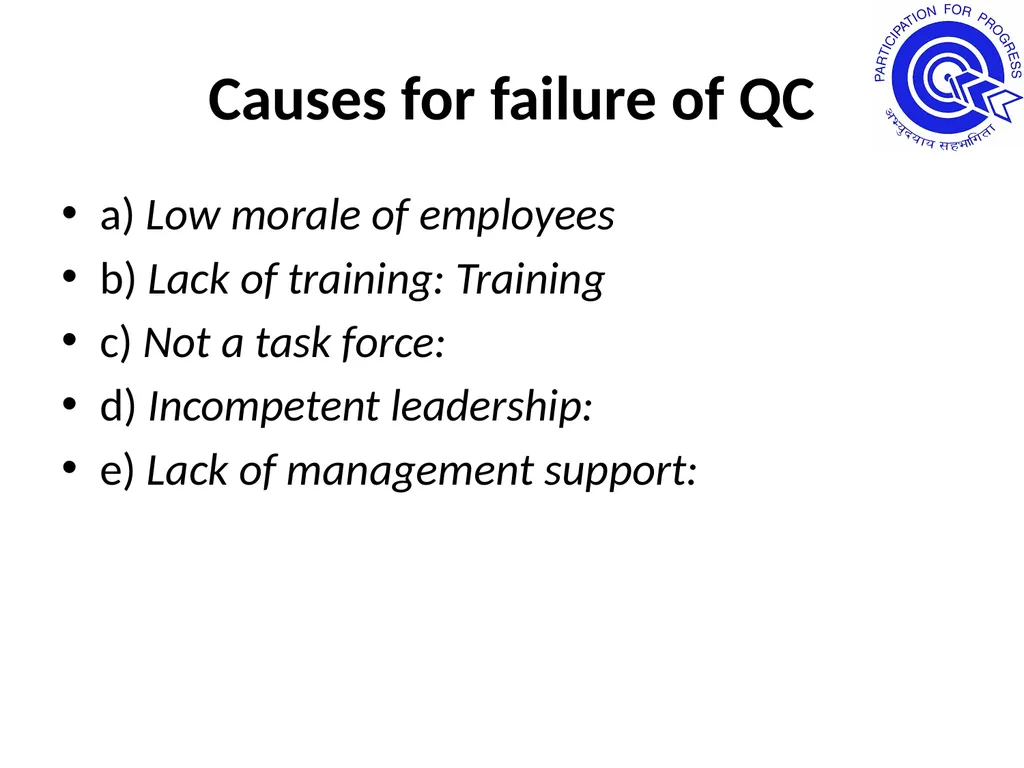
Causes for failure of QC a) Low morale of employees
b) Lack of training: Training
c) Not a task force:
d) Incompetent leadership:
e) Lack of management support:<br>
b) Lack of training: Training
c) Not a task force:
d) Incompetent leadership:
e) Lack of management support:<br>
44
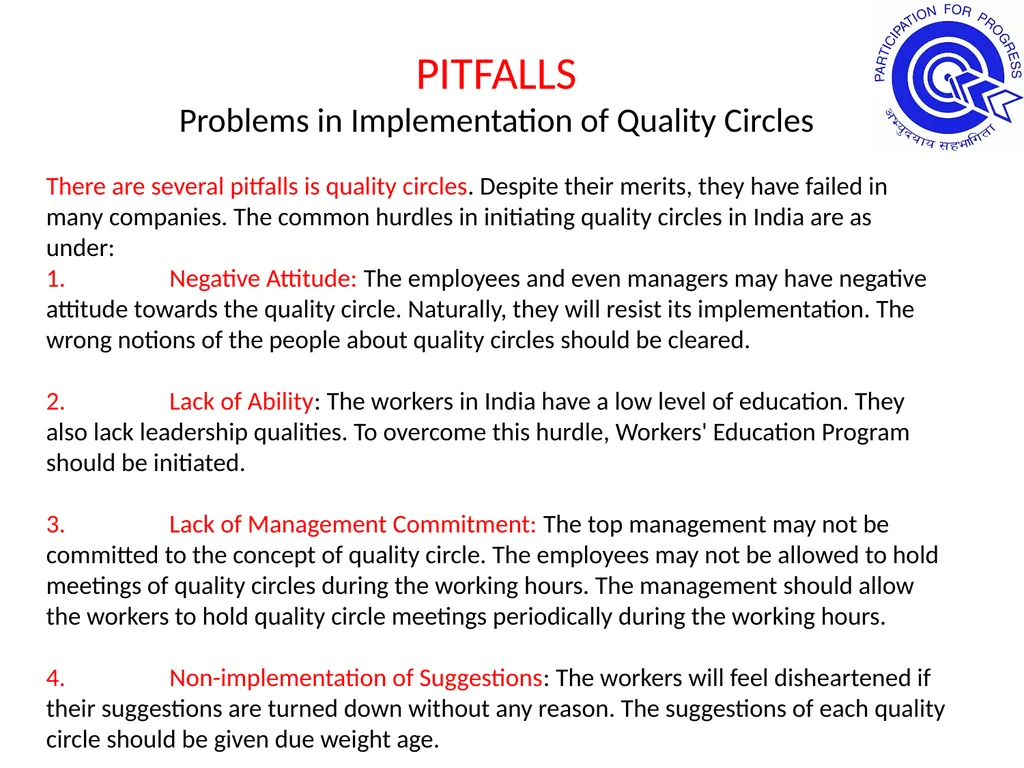
PITFALLS
Problems in Implementation of Quality Circles
There are several pitfalls is quality circles. Despite their merits, they have failed in many companies. The common hurdles in initiating quality circles in India are as under:
1. Negative Attitude: The employees and even managers may have negative attitude towards the quality circle. Naturally, they will resist its implementation. The wrong notions of the people about quality circles should be cleared.
2. Lack of Ability: The workers in India have a low level of education. They also lack leadership qualities. To overcome this hurdle, Workers' Education Program should be initiated.
3. Lack of Management Commitment: The top management may not be committed to the concept of quality circle. The employees may not be allowed to hold meetings of quality circles during the working hours. The management should allow the workers to hold quality circle meetings periodically during the working hours.
4. Non-implementation of Suggestions: The workers will feel disheartened if their suggestions are turned down without any reason. The suggestions of each quality circle should be given due weight age.<br>
45
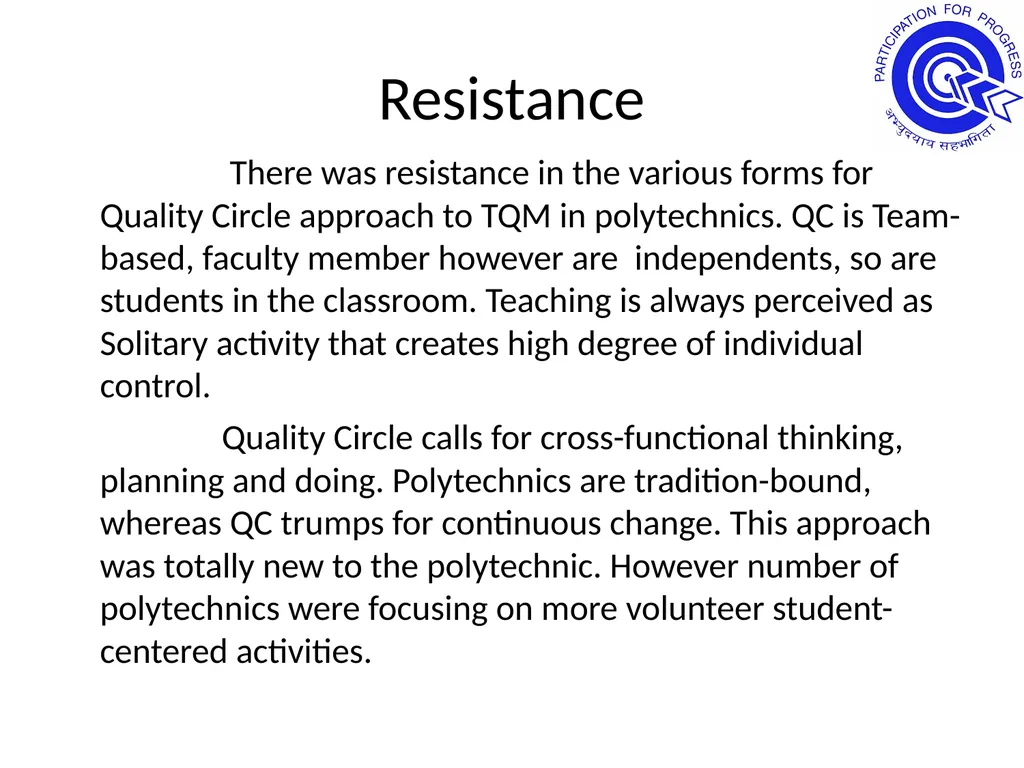
Resistance There was resistance in the various forms for Quality Circle approach to TQM in polytechnics. QC is Team-based, faculty member however are independents, so are students in the classroom. Teaching is always perceived as Solitary activity that creates high degree of individual control.
Quality Circle calls for cross-functional thinking, planning and doing. Polytechnics are tradition-bound, whereas QC trumps for continuous change. This approach was totally new to the polytechnic. However number of polytechnics were focusing on more volunteer student-centered activities.<br>
Quality Circle calls for cross-functional thinking, planning and doing. Polytechnics are tradition-bound, whereas QC trumps for continuous change. This approach was totally new to the polytechnic. However number of polytechnics were focusing on more volunteer student-centered activities.<br>
46
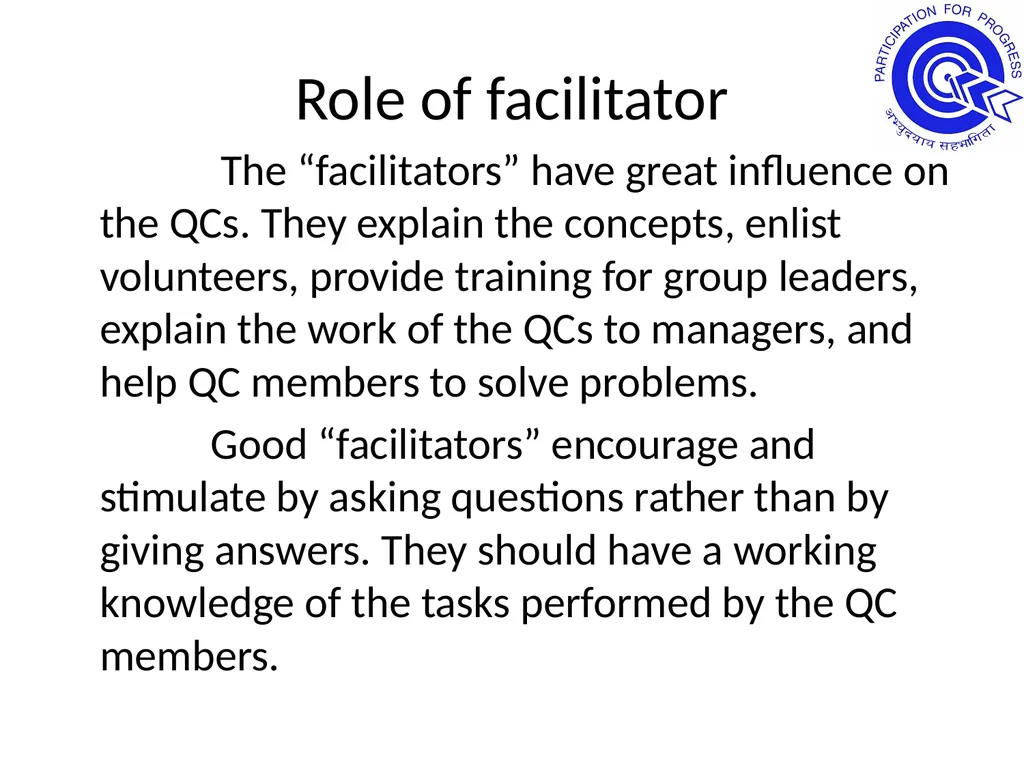
Role of facilitator The “facilitators” have great influence on the QCs. They explain the concepts, enlist volunteers, provide training for group leaders, explain the work of the QCs to managers, and help QC members to solve problems.
Good “facilitators” encourage and stimulate by asking questions rather than by giving answers. They should have a working knowledge of the tasks performed by the QC members.<br>
Good “facilitators” encourage and stimulate by asking questions rather than by giving answers. They should have a working knowledge of the tasks performed by the QC members.<br>
47
Participation
(online) Chapter Convention of Quality Circles
QCFI ,Hyderabad Chapter
In
October 2020
---<br>
QCFI ,Hyderabad Chapter
In
October 2020
---<br>
48
THANK YOU
Presentation
By
AV Seshagiri rao
Sr Faculty,QCFI
Hyderabad Chapter.
21/08/2020<br>
Presentation
By
AV Seshagiri rao
Sr Faculty,QCFI
Hyderabad Chapter.
21/08/2020<br>