
Raising the age of Delinquency – Impact,
A
Published · 34 slides · 0 views

1 / 1

Description
Raising the age of Delinquency Impact, Considerations and Planning Lori Whittier, Principal Assistant county attorney, child protection division, hcao Sarah Winge, Assistant Aitkin County Attorney Jennifer Christensen, Juvenile Division
Related Topics
Share
Embed code
Download this presentation From Below
"Raising the age of Delinquency – Impact," is the property of its rightful owner. Permission is granted to download and print the materials on this website for personal, non-commercial use only, and to display it on your personal computer provided you do not modify the materials and that you retain all copyright notices contained in the materials. By downloading content from our website, you accept the terms of this agreement.
Presentation Transcript
01
Raising the age of Delinquency –
Impact, Considerations and Planning Lori Whittier, Principal Assistant county attorney, child protection division, hcao
Sarah Winge, Assistant Aitkin County Attorney
Jennifer Christensen, Juvenile Division Manager, Carver County attorney’s office<br>
Sarah Winge, Assistant Aitkin County Attorney
Jennifer Christensen, Juvenile Division Manager, Carver County attorney’s office<br>
02
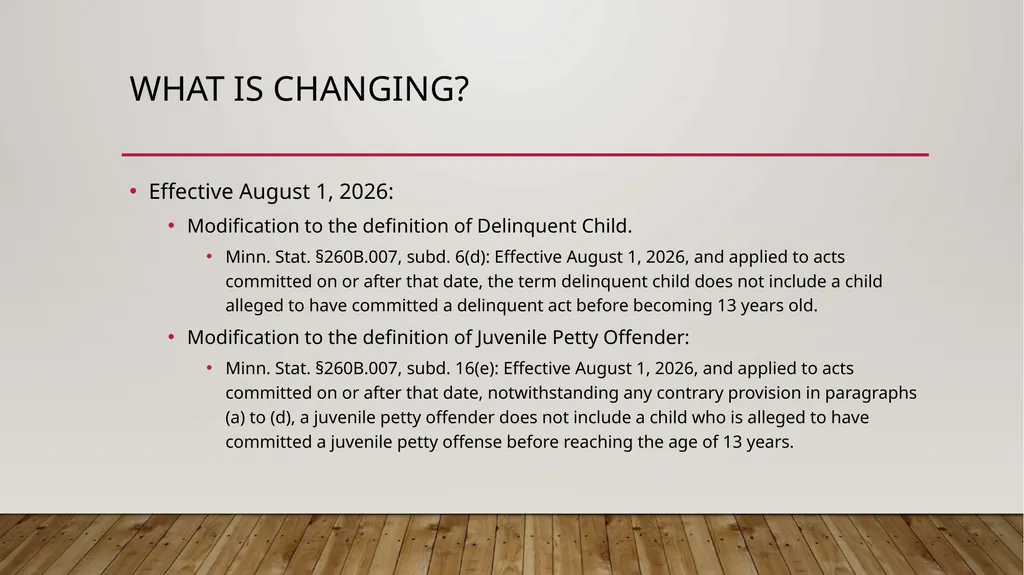
What is changing? Effective August 1, 2026:
Modification to the definition of Delinquent Child.
Minn. Stat. §260B.007, subd. 6(d): Effective August 1, 2026, and applied to acts committed on or after that date, the term delinquent child does not include a child alleged to have committed a delinquent act before becoming 13 years old.
Modification to the definition of Juvenile Petty Offender:
Minn. Stat. §260B.007, subd. 16(e): Effective August 1, 2026, and applied to acts committed on or after that date, notwithstanding any contrary provision in paragraphs (a) to (d), a juvenile petty offender does not include a child who is alleged to have committed a juvenile petty offense before reaching the age of 13 years.<br>
03
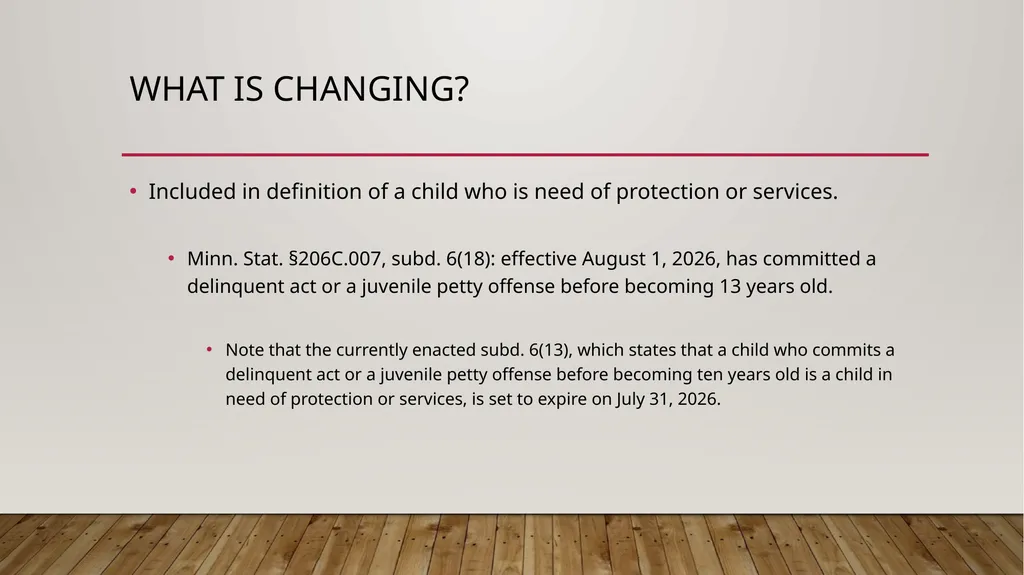
What is Changing? Included in definition of a child who is need of protection or services.
Minn. Stat. §206C.007, subd. 6(18): effective August 1, 2026, has committed a delinquent act or a juvenile petty offense before becoming 13 years old.
Note that the currently enacted subd. 6(13), which states that a child who commits a delinquent act or a juvenile petty offense before becoming ten years old is a child in need of protection or services, is set to expire on July 31, 2026.<br>
04
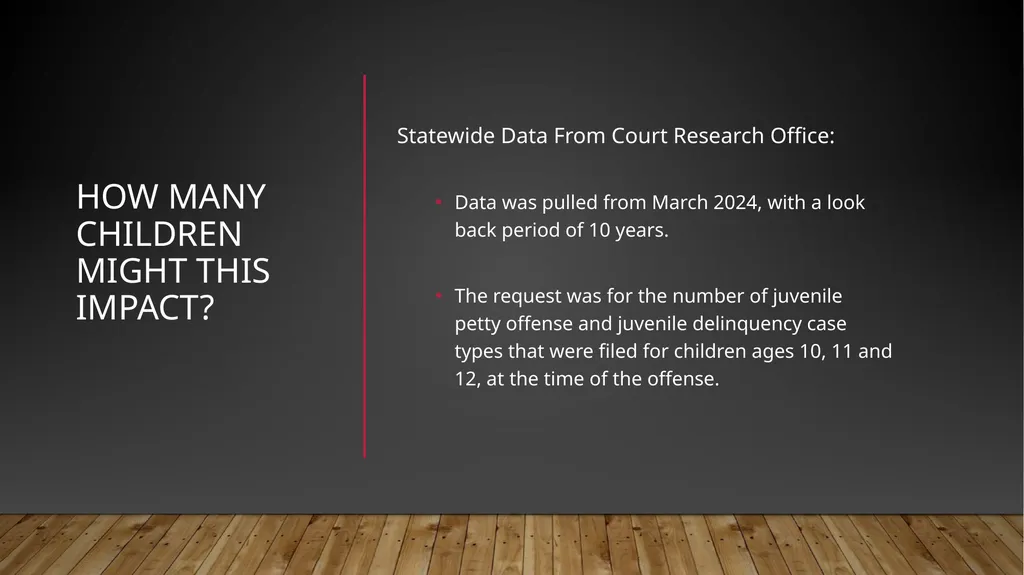
How many children Might this impact? Statewide Data From Court Research Office:
Data was pulled from March 2024, with a look back period of 10 years.
The request was for the number of juvenile petty offense and juvenile delinquency case types that were filed for children ages 10, 11 and 12, at the time of the offense.<br>
Data was pulled from March 2024, with a look back period of 10 years.
The request was for the number of juvenile petty offense and juvenile delinquency case types that were filed for children ages 10, 11 and 12, at the time of the offense.<br>
05
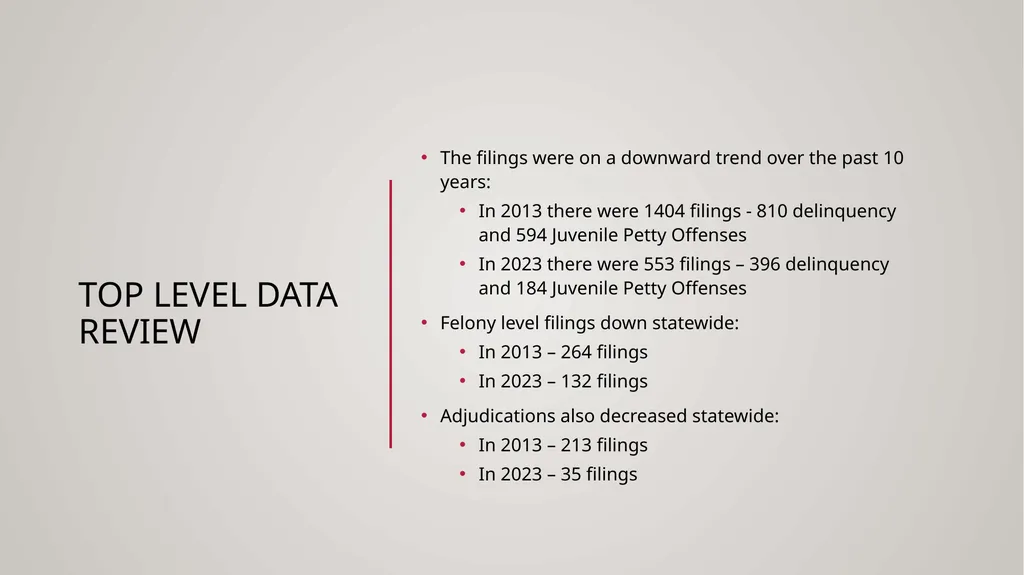
Top level data review The filings were on a downward trend over the past 10 years:
In 2013 there were 1404 filings - 810 delinquency and 594 Juvenile Petty Offenses
In 2023 there were 553 filings – 396 delinquency and 184 Juvenile Petty Offenses
Felony level filings down statewide:
In 2013 – 264 filings
In 2023 – 132 filings
Adjudications also decreased statewide:
In 2013 – 213 filings
In 2023 – 35 filings<br>
06
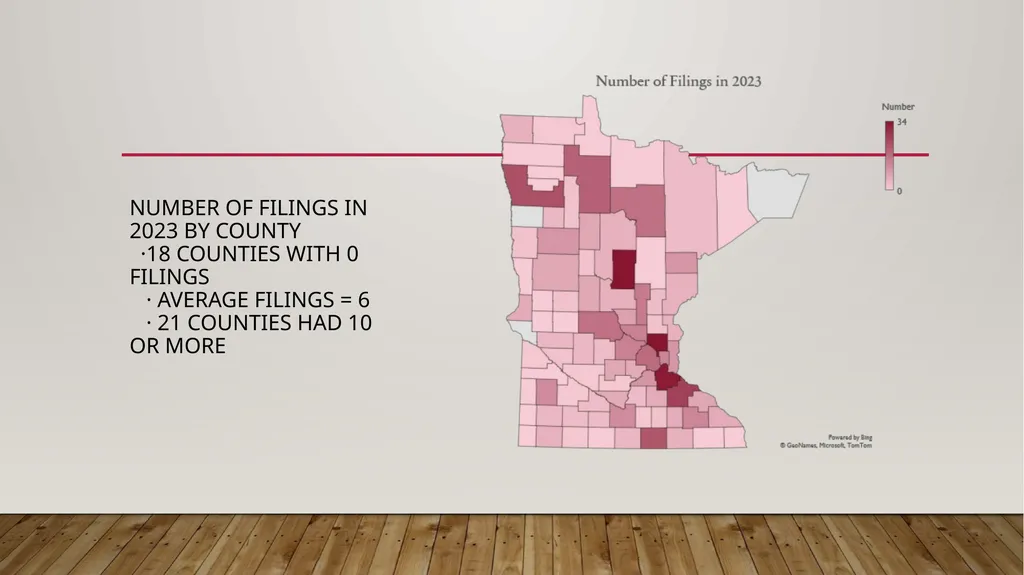
Number of Filings in 2023 by County
·18 Counties with 0 filings
· average filings = 6
· 21 Counties had 10 or more<br>
07
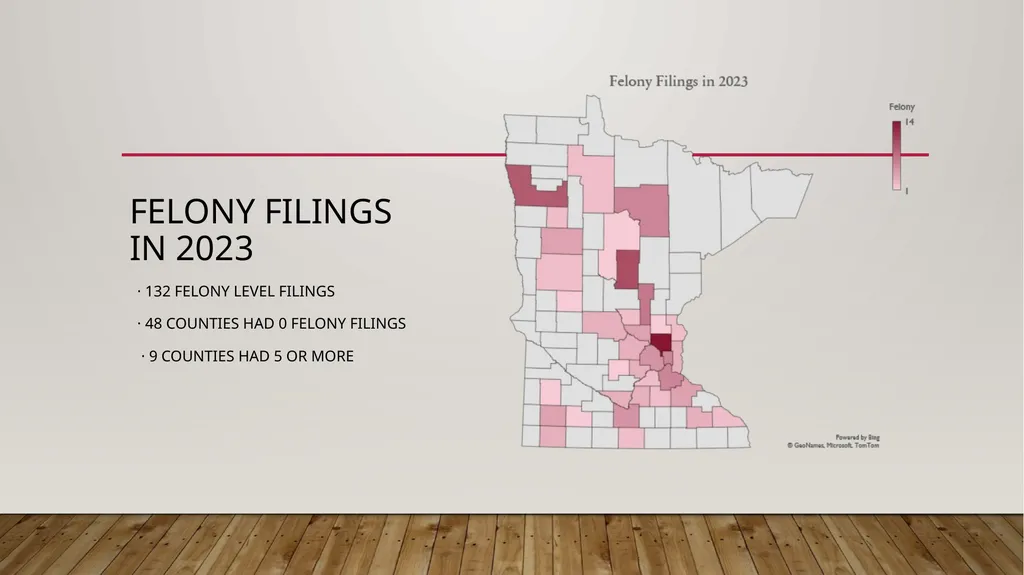
Felony filings in 2023
· 132 felony level filings
· 48 counties had 0 felony filings
· 9 Counties had 5 or more<br>
08
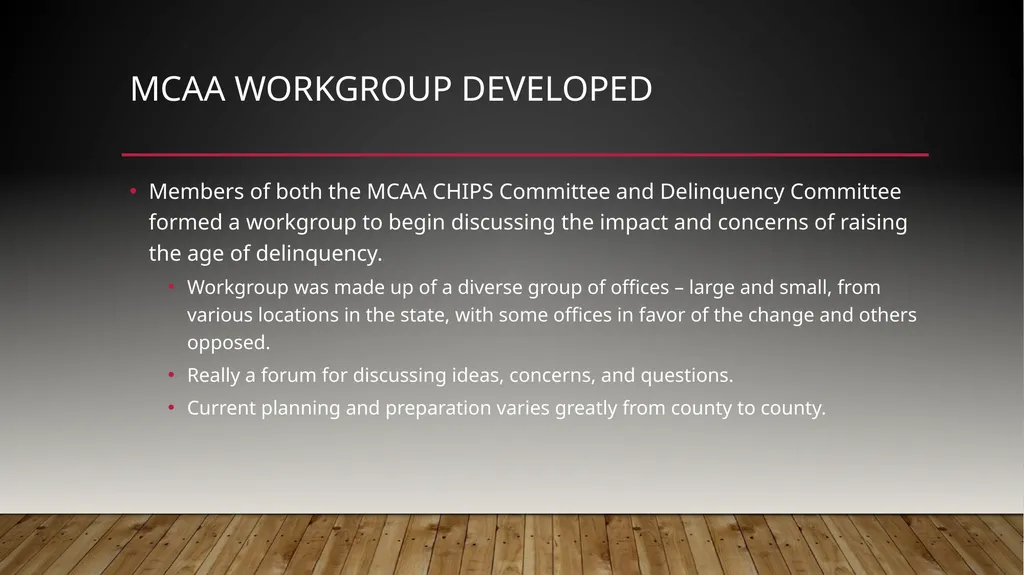
MCAA WorkGroup developed Members of both the MCAA CHIPS Committee and Delinquency Committee formed a workgroup to begin discussing the impact and concerns of raising the age of delinquency.
Workgroup was made up of a diverse group of offices – large and small, from various locations in the state, with some offices in favor of the change and others opposed.
Really a forum for discussing ideas, concerns, and questions.
Current planning and preparation varies greatly from county to county.<br>
09
Impact considerations Information Sharing
Need for additional legislative changes and/or changes to screening guidelines
Coordination
Funding
Pending Cases<br>
Need for additional legislative changes and/or changes to screening guidelines
Coordination
Funding
Pending Cases<br>
10
Information sharing For an intervention to be successful, several agencies must be able to share information with one another, operating as a Multidisciplinary Team (MDT). How can this be accomplished? Is a legislative change necessary to ensure this can occur?<br>
11
MDT See Minn. Stat. §260E.02. Duties of team.
A multidisciplinary child protection team may provide public and professional education, develop resources for prevention, intervention, and treatment, and provide case consultation to the local welfare agency or other interested community-based agencies. The community-based agencies may request case consultation from the multidisciplinary child protection team regarding a child or family for whom the community-based agency is providing services. As used in this section, "case consultation" means a case review process in which recommendations are made concerning services to be provided to the identified children and family. Case consultation may be performed by a committee or subcommittee of members representing human services or children’s services, including mental health and substance use disorder providers; law enforcement, including probation and parole; the county attorney; a children's advocacy center; health care; education; community-based agencies and other necessary agencies; and persons directly involved in an individual case as designated by other members performing case consultation.<br>
A multidisciplinary child protection team may provide public and professional education, develop resources for prevention, intervention, and treatment, and provide case consultation to the local welfare agency or other interested community-based agencies. The community-based agencies may request case consultation from the multidisciplinary child protection team regarding a child or family for whom the community-based agency is providing services. As used in this section, "case consultation" means a case review process in which recommendations are made concerning services to be provided to the identified children and family. Case consultation may be performed by a committee or subcommittee of members representing human services or children’s services, including mental health and substance use disorder providers; law enforcement, including probation and parole; the county attorney; a children's advocacy center; health care; education; community-based agencies and other necessary agencies; and persons directly involved in an individual case as designated by other members performing case consultation.<br>
12
MDT continued… Who is on the team? Currently, pursuant to Minn. Stat. §260E.02, subd. 1, a child protection MDT may include, but is not limited to:
Local welfare agency director or designees
County attorney or designees
County sheriff or designees
Representatives of health and education
Representatives of mental health
Representatives of agencies providing specialized services or responding to youth who experience or are at risk of experiencing sex or labor trafficking or sexual exploitation
Community base services or other children’s services
Children’s advocacy centers<br>
13
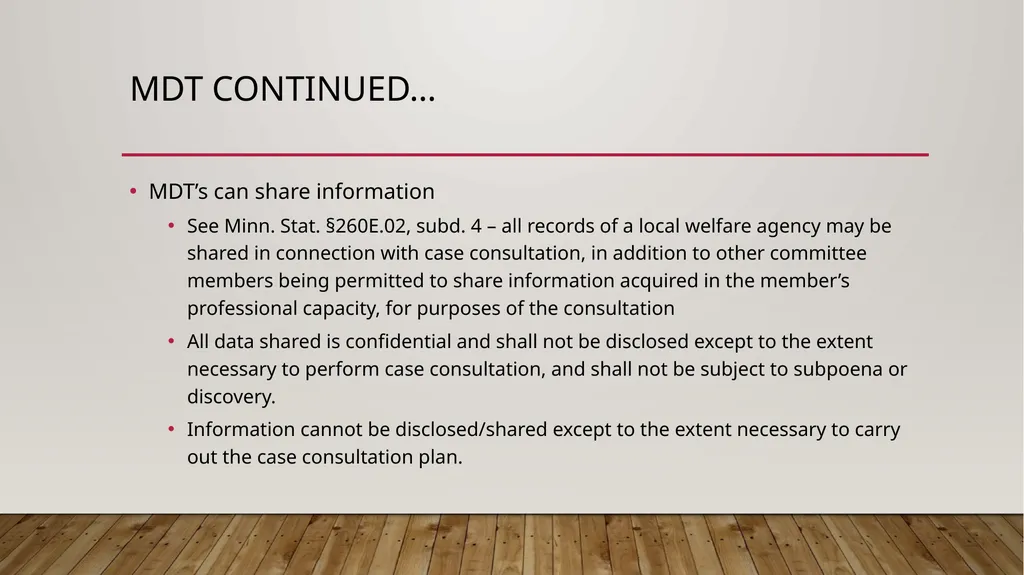
MDT Continued… MDT’s can share information
See Minn. Stat. §260E.02, subd. 4 – all records of a local welfare agency may be shared in connection with case consultation, in addition to other committee members being permitted to share information acquired in the member’s professional capacity, for purposes of the consultation
All data shared is confidential and shall not be disclosed except to the extent necessary to perform case consultation, and shall not be subject to subpoena or discovery.
Information cannot be disclosed/shared except to the extent necessary to carry out the case consultation plan.<br>
14
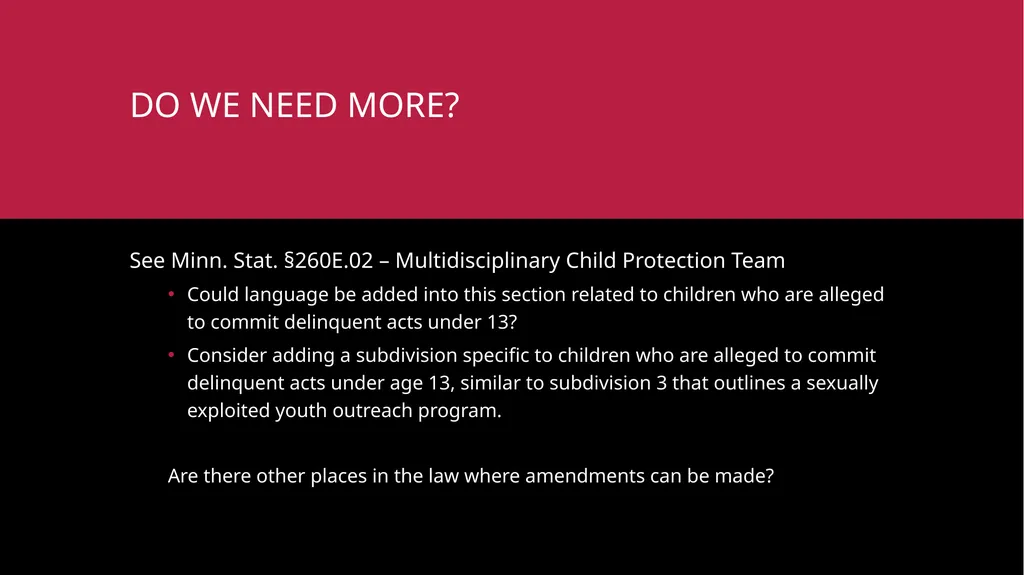
Do we need more? See Minn. Stat. §260E.02 – Multidisciplinary Child Protection Team
Could language be added into this section related to children who are alleged to commit delinquent acts under 13?
Consider adding a subdivision specific to children who are alleged to commit delinquent acts under age 13, similar to subdivision 3 that outlines a sexually exploited youth outreach program.
Are there other places in the law where amendments can be made?<br>
15
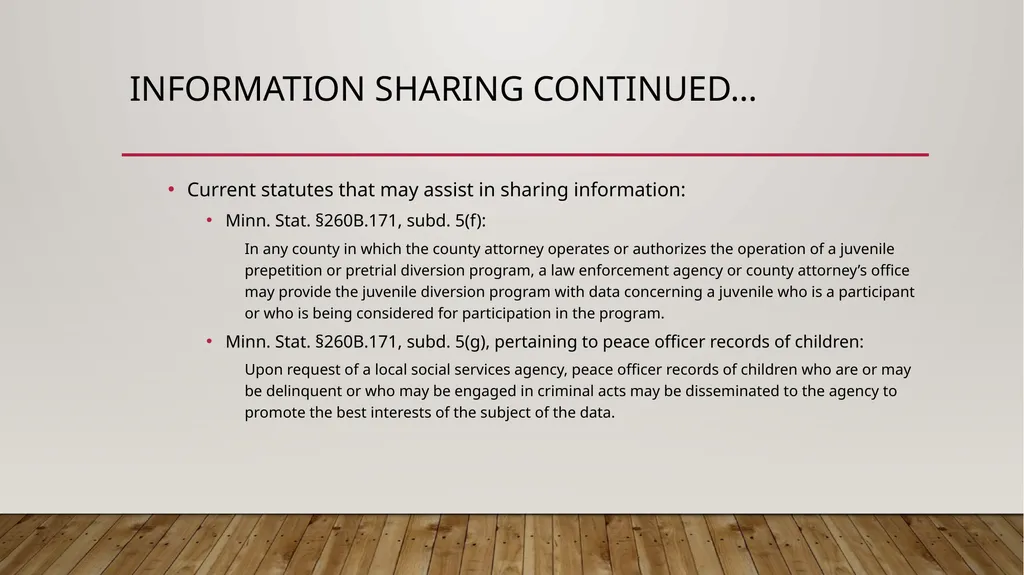
Information sharing continued… Current statutes that may assist in sharing information:
Minn. Stat. §260B.171, subd. 5(f):
In any county in which the county attorney operates or authorizes the operation of a juvenile prepetition or pretrial diversion program, a law enforcement agency or county attorney’s office may provide the juvenile diversion program with data concerning a juvenile who is a participant or who is being considered for participation in the program.
Minn. Stat. §260B.171, subd. 5(g), pertaining to peace officer records of children:
Upon request of a local social services agency, peace officer records of children who are or may be delinquent or who may be engaged in criminal acts may be disseminated to the agency to promote the best interests of the subject of the data.<br>
16
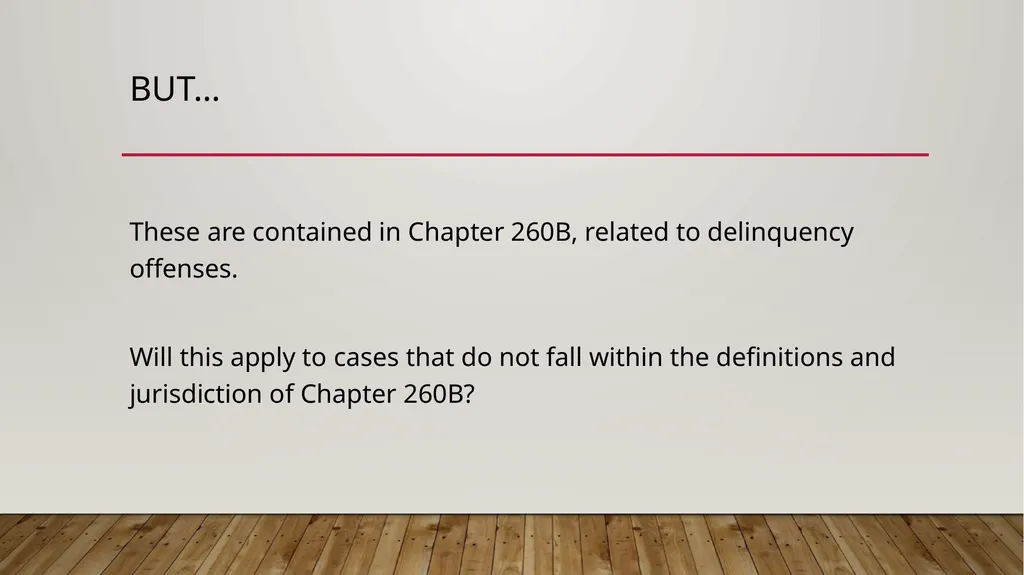
But… These are contained in Chapter 260B, related to delinquency offenses.
Will this apply to cases that do not fall within the definitions and jurisdiction of Chapter 260B?<br>
Will this apply to cases that do not fall within the definitions and jurisdiction of Chapter 260B?<br>
17
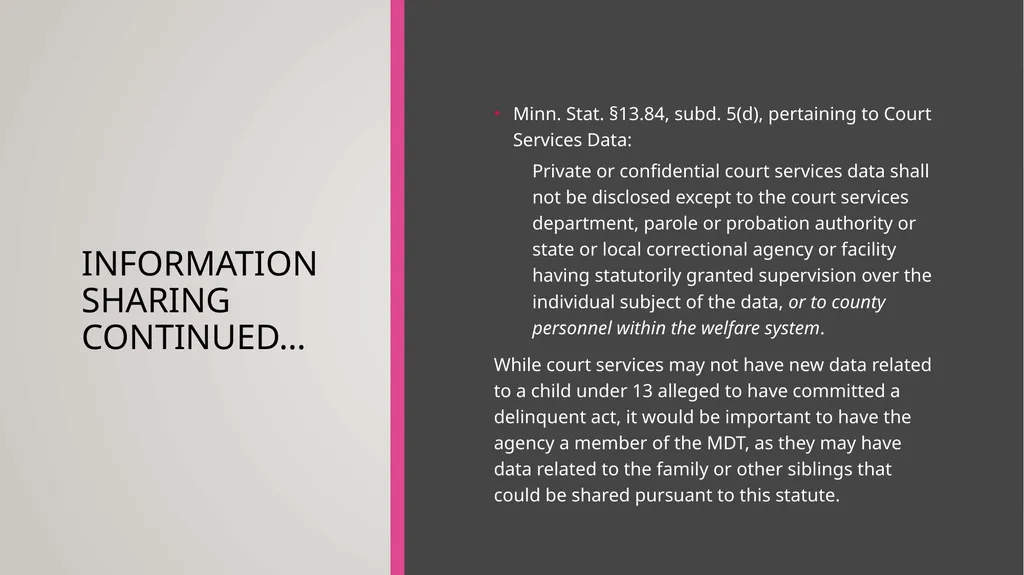
Information sharing continued… Minn. Stat. §13.84, subd. 5(d), pertaining to Court Services Data:
Private or confidential court services data shall not be disclosed except to the court services department, parole or probation authority or state or local correctional agency or facility having statutorily granted supervision over the individual subject of the data, or to county personnel within the welfare system.
While court services may not have new data related to a child under 13 alleged to have committed a delinquent act, it would be important to have the agency a member of the MDT, as they may have data related to the family or other siblings that could be shared pursuant to this statute.<br>
18
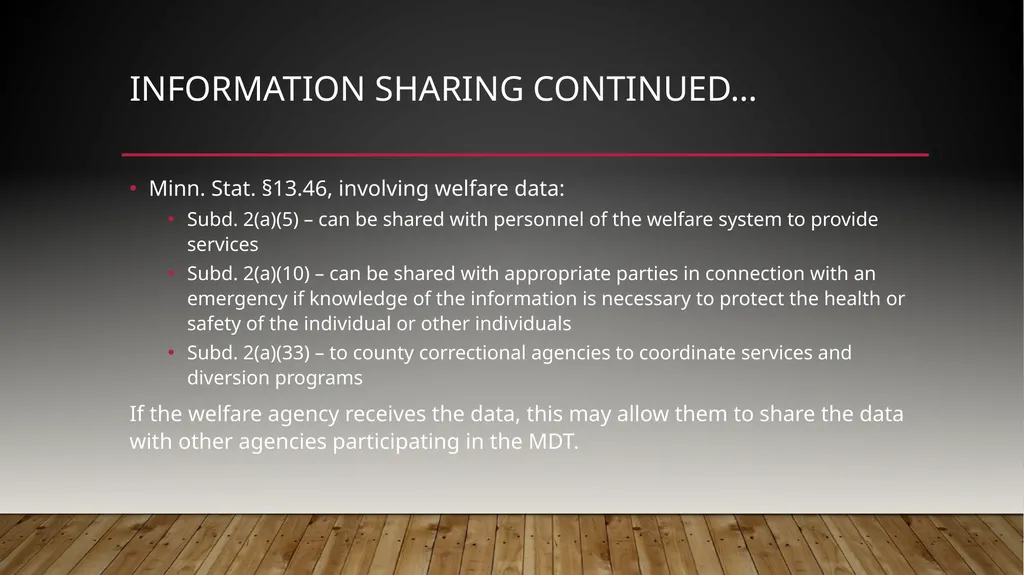
Information sharing continued… Minn. Stat. §13.46, involving welfare data:
Subd. 2(a)(5) – can be shared with personnel of the welfare system to provide services
Subd. 2(a)(10) – can be shared with appropriate parties in connection with an emergency if knowledge of the information is necessary to protect the health or safety of the individual or other individuals
Subd. 2(a)(33) – to county correctional agencies to coordinate services and diversion programs
If the welfare agency receives the data, this may allow them to share the data with other agencies participating in the MDT.<br>
19
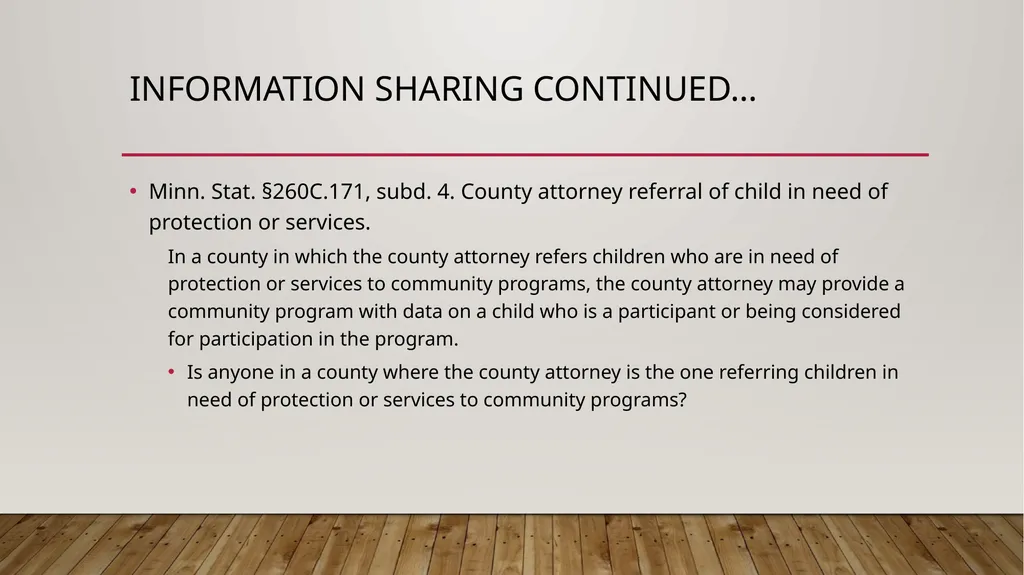
Information sharing continued… Minn. Stat. §260C.171, subd. 4. County attorney referral of child in need of protection or services.
In a county in which the county attorney refers children who are in need of protection or services to community programs, the county attorney may provide a community program with data on a child who is a participant or being considered for participation in the program.
Is anyone in a county where the county attorney is the one referring children in need of protection or services to community programs?<br>
20
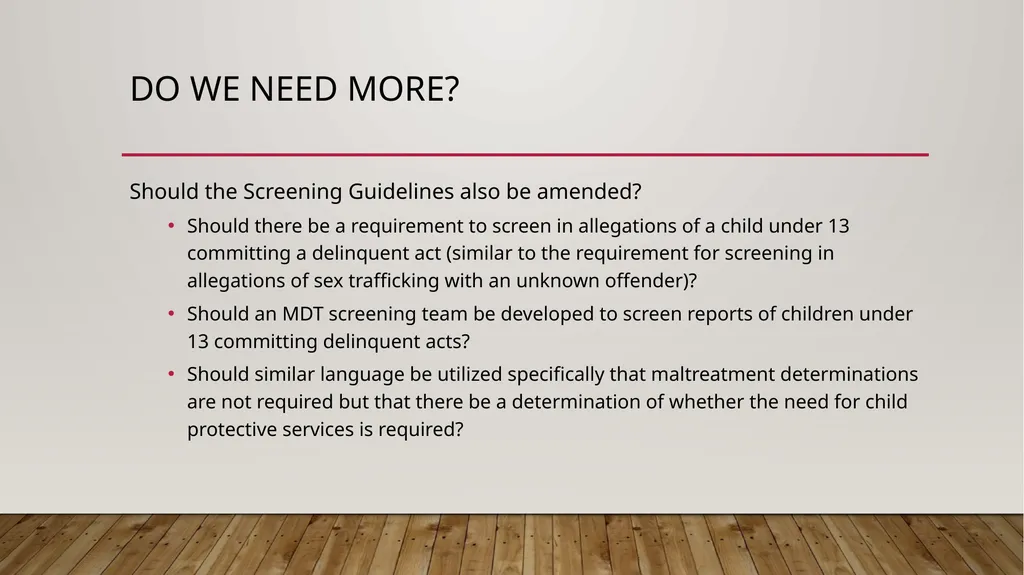
Do we need more? Should the Screening Guidelines also be amended?
Should there be a requirement to screen in allegations of a child under 13 committing a delinquent act (similar to the requirement for screening in allegations of sex trafficking with an unknown offender)?
Should an MDT screening team be developed to screen reports of children under 13 committing delinquent acts?
Should similar language be utilized specifically that maltreatment determinations are not required but that there be a determination of whether the need for child protective services is required?<br>
21
Possible legislative changes Unless an allegation includes a current allegation of maltreatment or meets child protection criteria, cases involving children under the age of 10 alleged to have committed a delinquent act are currently being screened out.
Presumably, this will be true for children under the age of 13, when the new law takes effect.
Is there a need for a change to Minnesota Statutes §260E that would result in these reports being screened in? Is this necessary to ensure there is no gap in services for these children?
These children could be referred for Children’s Mental Health or Child Welfare Services.
What if a family is unwilling to engage?
What if the parent wants services but the child is unwilling to engage?<br>
22
Possible Legislative Changes continued… Some counties are discussing the establishment of a formal diversion program for youth under 13 alleged to have committed delinquent acts. But…
What if the child/family does not want to participate? What is the incentive or leverage if court is not an option?
Will HHS Agencies considering filing a CHIPS Petition if the family is not cooperating?
What funding source is available?<br>
What if the child/family does not want to participate? What is the incentive or leverage if court is not an option?
Will HHS Agencies considering filing a CHIPS Petition if the family is not cooperating?
What funding source is available?<br>
23
Possible legislative changes continued… How do we address the issue of public safety for a child alleged to have committed a violent or dangerous act when they cannot be arrested or held at a secure juvenile detention center?
See Minn. Stat. §260C.181, subd. 1 – prohibiting placement in a secure setting beyond 24 hours
See also In re the Welfare of the Child of K.O. and D.W., 4 N.W.3d 359 (Minn. Ct. App. 2024).
Do we need legislation that would make exceptions to this statute under certain circumstances?<br>
See Minn. Stat. §260C.181, subd. 1 – prohibiting placement in a secure setting beyond 24 hours
See also In re the Welfare of the Child of K.O. and D.W., 4 N.W.3d 359 (Minn. Ct. App. 2024).
Do we need legislation that would make exceptions to this statute under certain circumstances?<br>
24
Notice to appear –
Minn. Stat. §260C.143, subd. 1 When a peace officer, or attendance officer in the case of a habitual truant, has probable cause to believe that a child is in need of protection or services under section 260C.007, subdivision 6, clause (13) or (14), the officer may issue a notice to the child to appear in juvenile court in the county in which the child is found or in the county of the child's residence. If there is a school attendance review board or county attorney mediation program operating in the child's school district, a notice to appear in juvenile court for a habitual truant may not be issued until the applicable procedures under section 260A.06 or 260A.07 have been followed. The officer shall file a copy of the notice to appear with the juvenile court of the appropriate county. If a child fails to appear in response to the notice, the court may issue a summons notifying the child of the nature of the offense alleged and the time and place set for the hearing. If the peace officer finds it necessary to take the child into custody, sections 260C.175 and 260C.176 shall apply.<br>
25
Effect of notice, subd. 2 Filing with the court a notice to appear containing the name and address of the child, specifying the offense alleged and the time and place it was committed, has the effect of a petition giving the juvenile court jurisdiction. In the case of running away, the place where the offense was committed may be stated in the notice as either the child's custodial parent's or guardian's residence or lawful placement or where the child was found by the officer. In the case of truancy, the place where the offense was committed may be stated as the school or the place where the child was found by the officer.<br>
26
Minn. Stat. §260C.143 Is anyone already using this?
Does this make law enforcement the Petitioner?
What does the Notice look like?
If HHS is a participant pursuant to Minn. R. Juv. Prot. P. 33.01(c), will they provide services? Case management?
What if the child’s county of residence and the county the child committed the alleged delinquent act are not the same?<br>
27
coordination The MCAA Workgroup identified the issue of coordination as something that will require counties to make an action plan:
Law Enforcement – will they still do reports of children under the age of 13 who are alleged to have committed a delinquent act? Where will those be sent?
Human Services Agencies – will cases get screened in or screened out? Will child welfare services be offered? Will agencies have access to services and treatment for children who have been alleged to have committed a delinquent act?
Court Services/Probation Agencies – will they contribute and offer services?
County Attorneys Office – will reports go through the county attorney’s office for screening?
Other service providers
Tribes – How might ICWA apply?<br>
28
coordination How will reports be received?
Who will screen the reports to determine intervention or services?
Who will make referrals to services or assessments?
Begin discussing this within your counties now to develop an implementation plan.<br>
Who will screen the reports to determine intervention or services?
Who will make referrals to services or assessments?
Begin discussing this within your counties now to develop an implementation plan.<br>
29
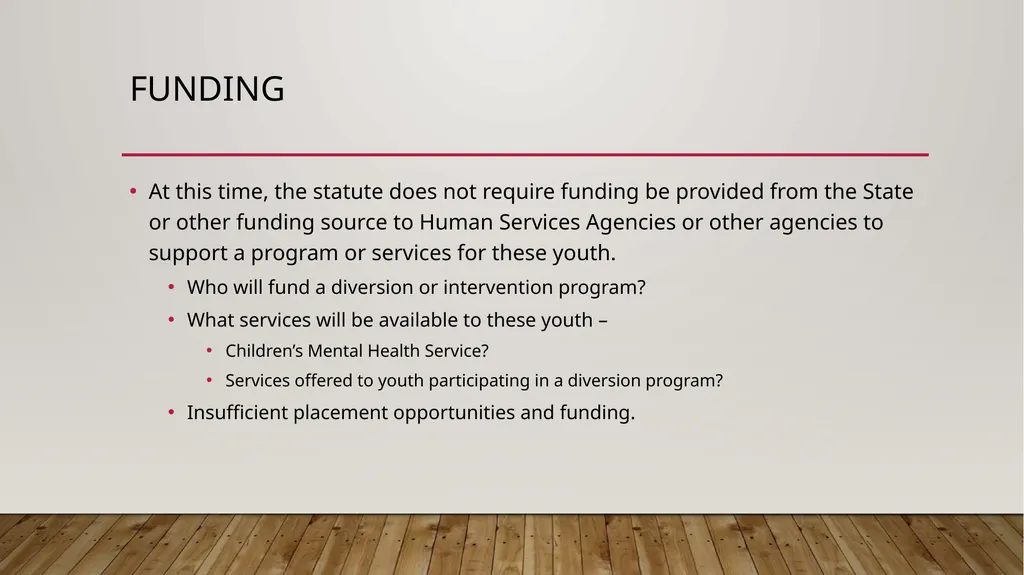
funding At this time, the statute does not require funding be provided from the State or other funding source to Human Services Agencies or other agencies to support a program or services for these youth.
Who will fund a diversion or intervention program?
What services will be available to these youth –
Children’s Mental Health Service?
Services offered to youth participating in a diversion program?
Insufficient placement opportunities and funding.<br>
Who will fund a diversion or intervention program?
What services will be available to these youth –
Children’s Mental Health Service?
Services offered to youth participating in a diversion program?
Insufficient placement opportunities and funding.<br>
30
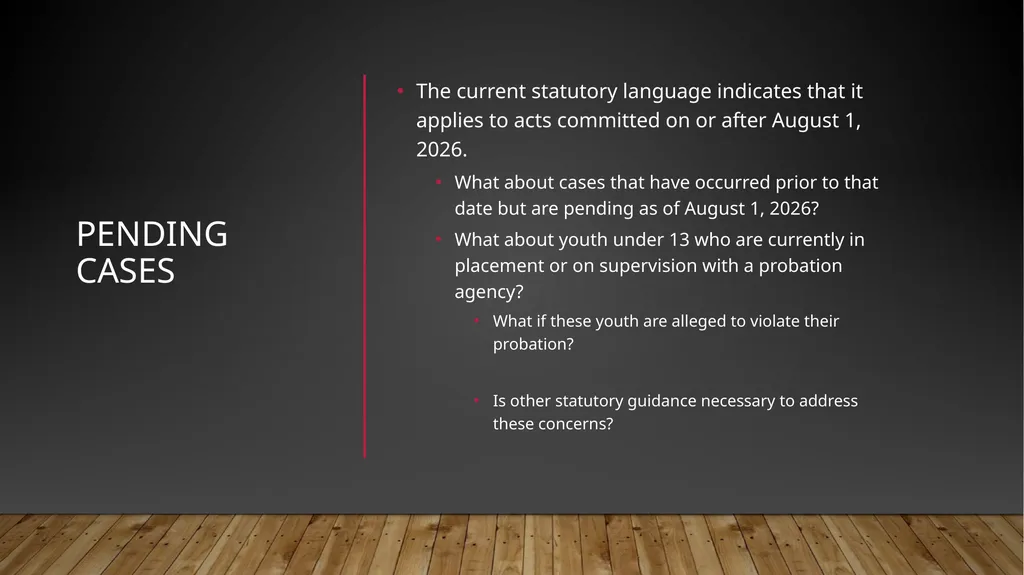
Pending cases The current statutory language indicates that it applies to acts committed on or after August 1, 2026.
What about cases that have occurred prior to that date but are pending as of August 1, 2026?
What about youth under 13 who are currently in placement or on supervision with a probation agency?
What if these youth are alleged to violate their probation?
Is other statutory guidance necessary to address these concerns?<br>
31
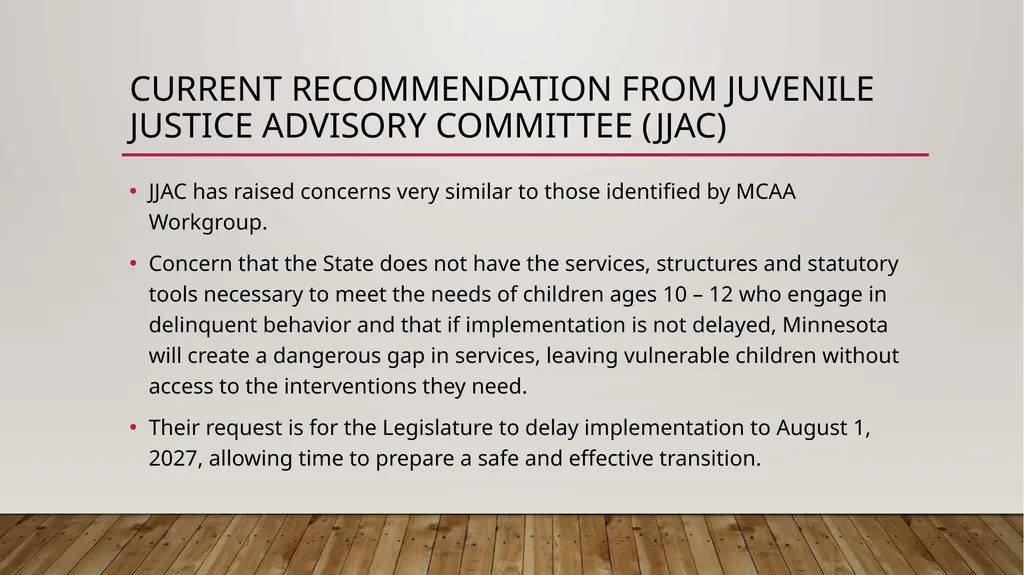
Current recommendation from Juvenile justice advisory committee (jJAC) JJAC has raised concerns very similar to those identified by MCAA Workgroup.
Concern that the State does not have the services, structures and statutory tools necessary to meet the needs of children ages 10 – 12 who engage in delinquent behavior and that if implementation is not delayed, Minnesota will create a dangerous gap in services, leaving vulnerable children without access to the interventions they need.
Their request is for the Legislature to delay implementation to August 1, 2027, allowing time to prepare a safe and effective transition.<br>
32
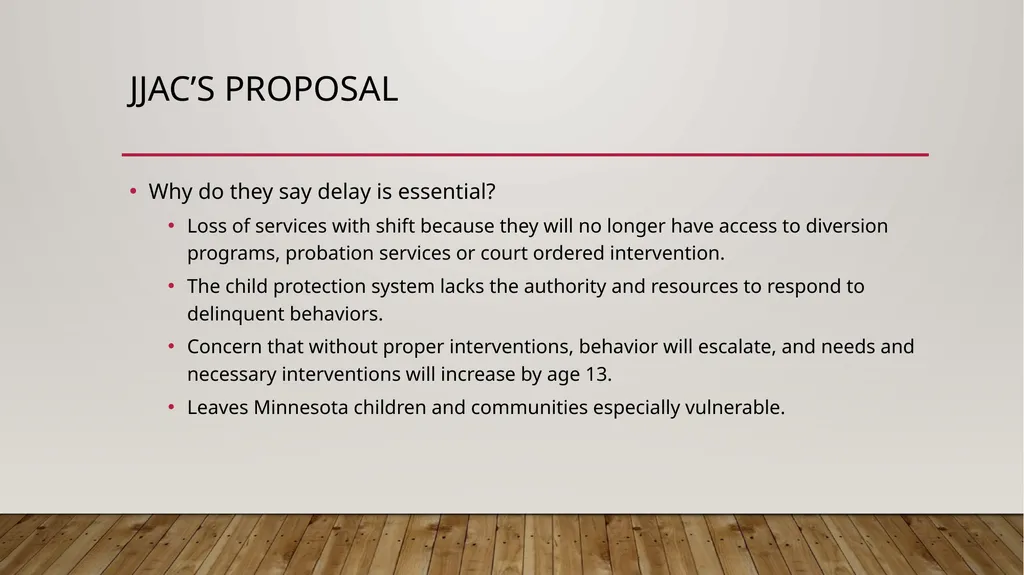
JJAC’s proposal Why do they say delay is essential?
Loss of services with shift because they will no longer have access to diversion programs, probation services or court ordered intervention.
The child protection system lacks the authority and resources to respond to delinquent behaviors.
Concern that without proper interventions, behavior will escalate, and needs and necessary interventions will increase by age 13.
Leaves Minnesota children and communities especially vulnerable.<br>
33
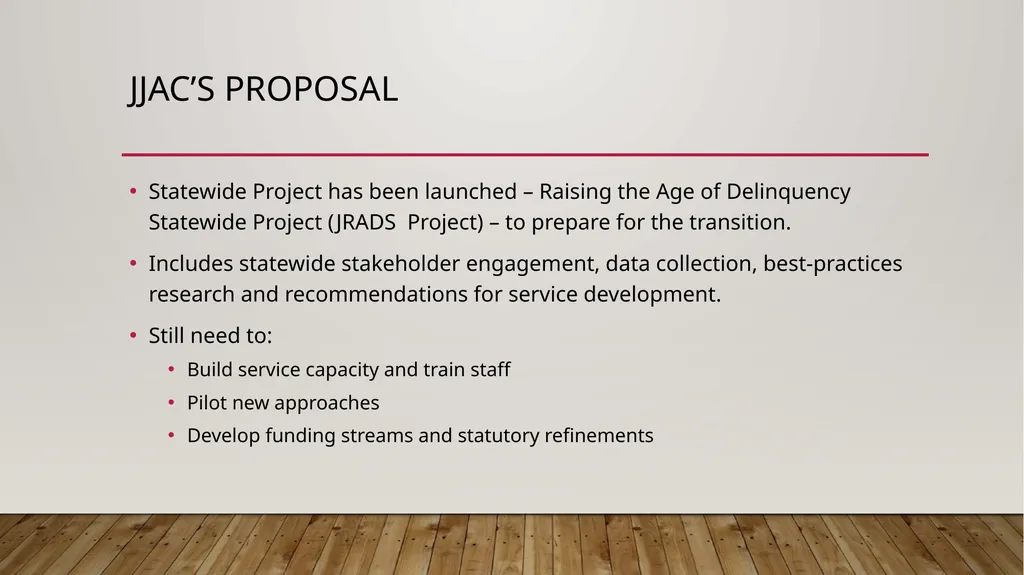
Jjac’s proposal Statewide Project has been launched – Raising the Age of Delinquency Statewide Project (JRADS Project) – to prepare for the transition.
Includes statewide stakeholder engagement, data collection, best-practices research and recommendations for service development.
Still need to:
Build service capacity and train staff
Pilot new approaches
Develop funding streams and statutory refinements<br>
Includes statewide stakeholder engagement, data collection, best-practices research and recommendations for service development.
Still need to:
Build service capacity and train staff
Pilot new approaches
Develop funding streams and statutory refinements<br>
34
thank you!
Lori Whittier, Principal Assistant county attorney, child protection division, hcao
lori.whittier@hennepin.us
Sarah Winge, Assistant Aitkin County Attorney
sarah.winge@aitkincountymn.gov
Jennifer Christensen, Juvenile Division Manager, Carver County attorney’s office
jchristensen@carvercountymn.gov<br>