
Referral Coordination Initiative (RCI) February
PT
Published · 14 slides · 0 views

1 / 1
Description
Referral Coordination Initiative (RCI) February 25, 2021 VETERANS HEALTH ADMINISTRATION Referral Coordination Initiative About RCI RCI Goals Referral Coordination Teams Referral Coordination Ideal State RCI Data Tools Additional RCI
Related Topics
Share
Embed code
Download this presentation From Below
"Referral Coordination Initiative (RCI) February" is the property of its rightful owner. Permission is granted to download and print the materials on this website for personal, non-commercial use only, and to display it on your personal computer provided you do not modify the materials and that you retain all copyright notices contained in the materials. By downloading content from our website, you accept the terms of this agreement.
Presentation Transcript
01
Referral Coordination Initiative (RCI) February 25, 2021 VETERANS HEALTH ADMINISTRATION<br>
02
Referral Coordination Initiative About RCI
RCI Goals
Referral Coordination Teams
Referral Coordination – Ideal State
RCI Data Tools
Additional RCI Resources 2 Understanding the Referral Coordination Initiative (RCI)<br>
RCI Goals
Referral Coordination Teams
Referral Coordination – Ideal State
RCI Data Tools
Additional RCI Resources 2 Understanding the Referral Coordination Initiative (RCI)<br>
03
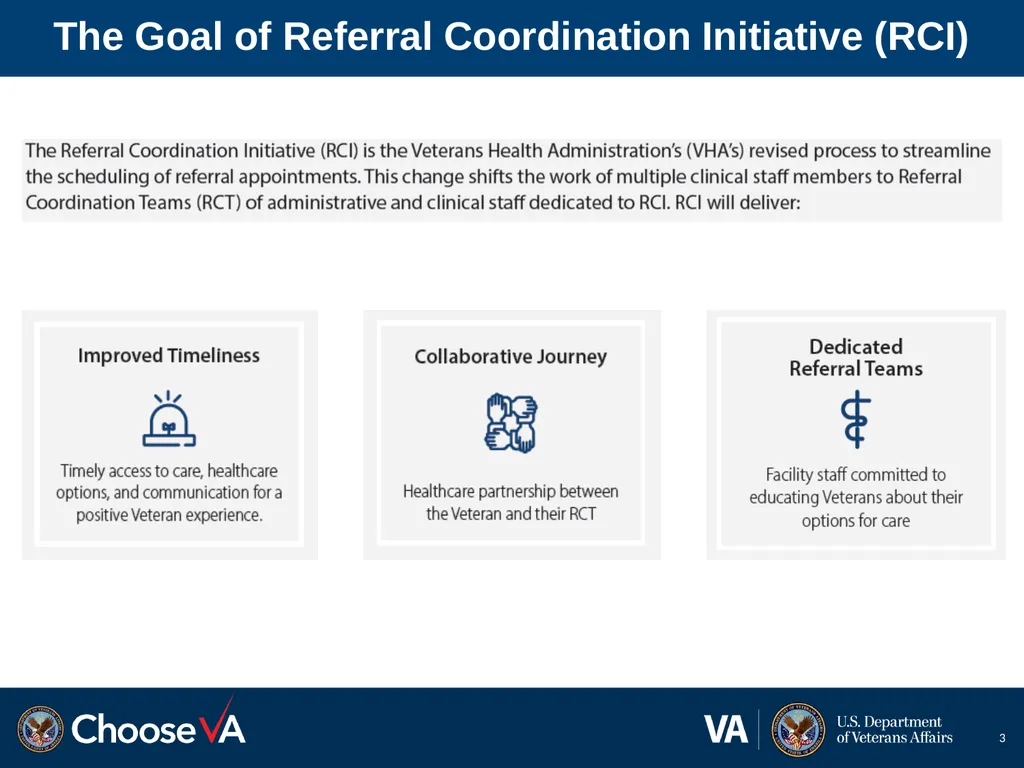
The Goal of Referral Coordination Initiative (RCI) 3<br>
04
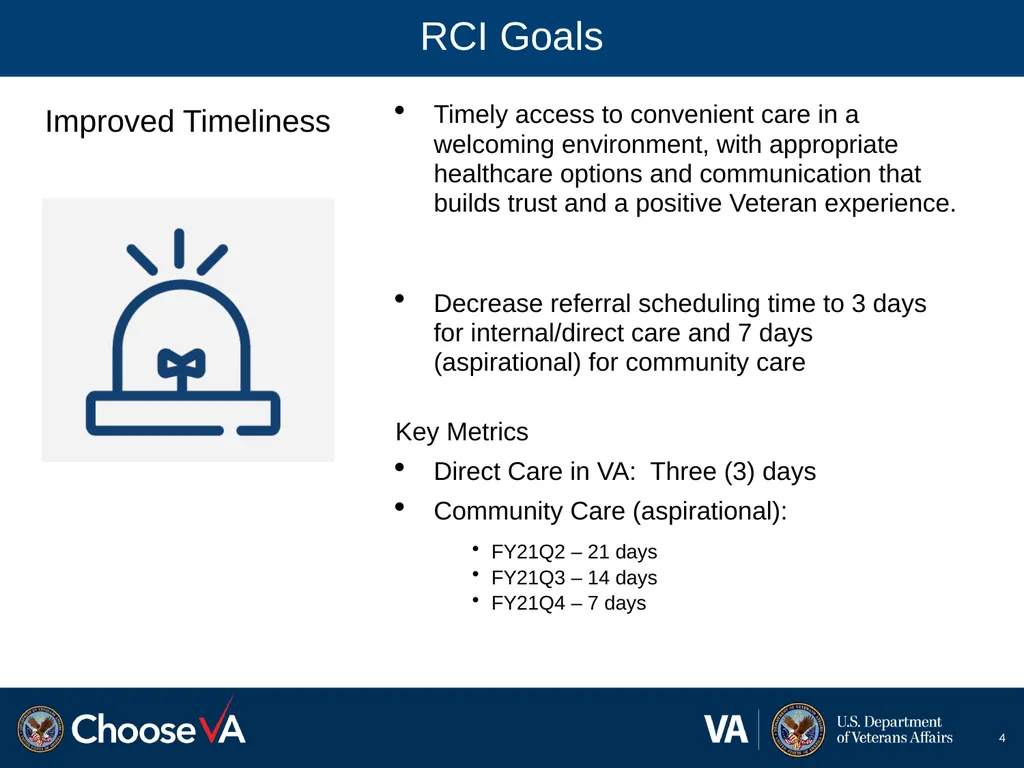
RCI Goals Timely access to convenient care in a welcoming environment, with appropriate healthcare options and communication that builds trust and a positive Veteran experience.
Decrease referral scheduling time to 3 days for internal/direct care and 7 days (aspirational) for community care
Key Metrics
Direct Care in VA: Three (3) days
Community Care (aspirational):
FY21Q2 – 21 days
FY21Q3 – 14 days
FY21Q4 – 7 days 4 Improved Timeliness<br>
Decrease referral scheduling time to 3 days for internal/direct care and 7 days (aspirational) for community care
Key Metrics
Direct Care in VA: Three (3) days
Community Care (aspirational):
FY21Q2 – 21 days
FY21Q3 – 14 days
FY21Q4 – 7 days 4 Improved Timeliness<br>
05
RCI Goals A collaborative health care journey between the Veteran and his or her care team to achieve desired health outcomes.
Improve Veteran satisfaction by ensuring Veterans understand their full range of care options for internal/direct and community care and are able to make an informed decision about where, when, and how they would like to receive their care
Key Metrics
Improve Veteran satisfaction
Increase agreement scores in V-Signal Surveys related to RCI 5 Collaborative Journey<br>
06
RCI Goals Administrative and clinical staff who will be better positioned to listen and act on Veteran preferences.
Utilize internal/direct specialty care services and maximize value-added community care options by ensuring staff only refers Veterans into the community who are both eligible for community care and actively choose to receive care by community providers
Key Metrics
Timeliness to schedule Veteran appointments (internal and CC)
Percent of Veterans engaging with RCT
Referral patterns for internal/direct vs community care
VSignals data to monitor Veteran satisfaction 6 Dedicated Referral Teams<br>
07
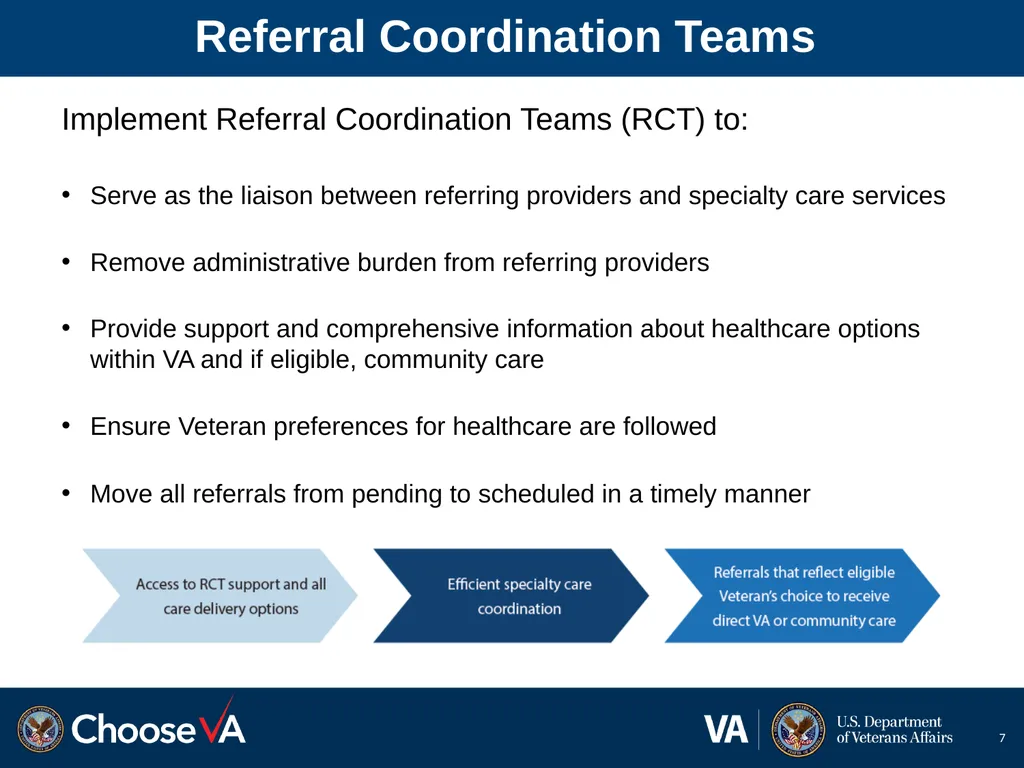
Referral Coordination Teams Implement Referral Coordination Teams (RCT) to:
Serve as the liaison between referring providers and specialty care services
Remove administrative burden from referring providers
Provide support and comprehensive information about healthcare options within VA and if eligible, community care
Ensure Veteran preferences for healthcare are followed
Move all referrals from pending to scheduled in a timely manner 7<br>
08
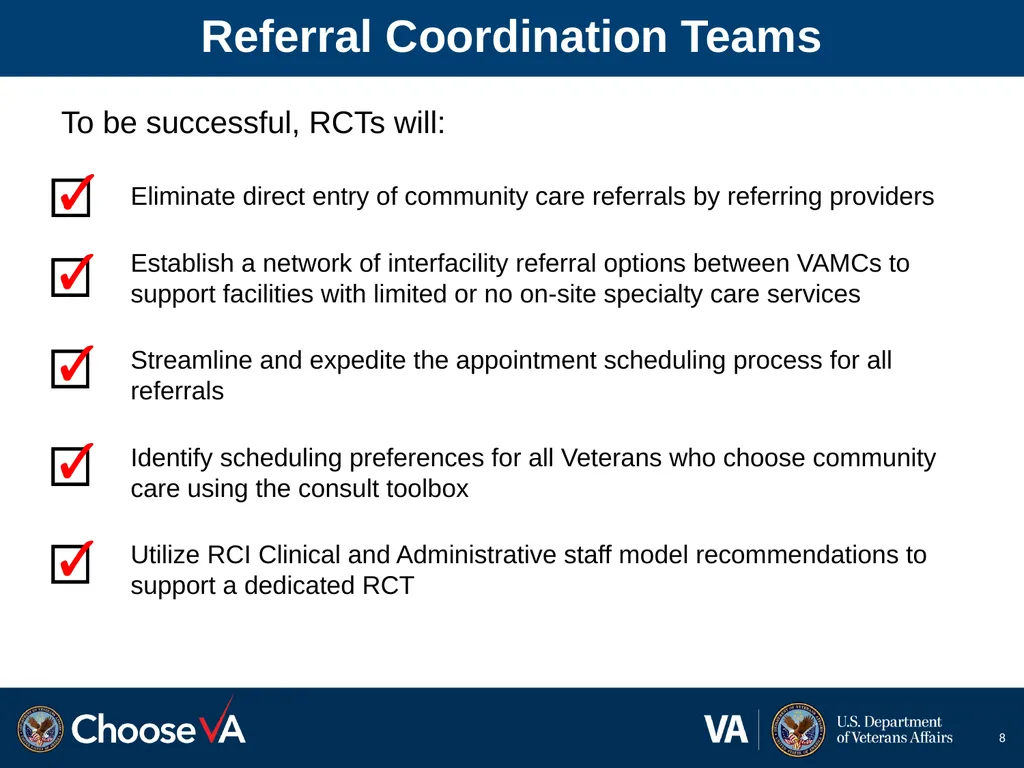
Referral Coordination Teams Eliminate direct entry of community care referrals by referring providers
Establish a network of interfacility referral options between VAMCs to support facilities with limited or no on-site specialty care services
Streamline and expedite the appointment scheduling process for all referrals
Identify scheduling preferences for all Veterans who choose community care using the consult toolbox
Utilize RCI Clinical and Administrative staff model recommendations to support a dedicated RCT 8 To be successful, RCTs will:<br>
09
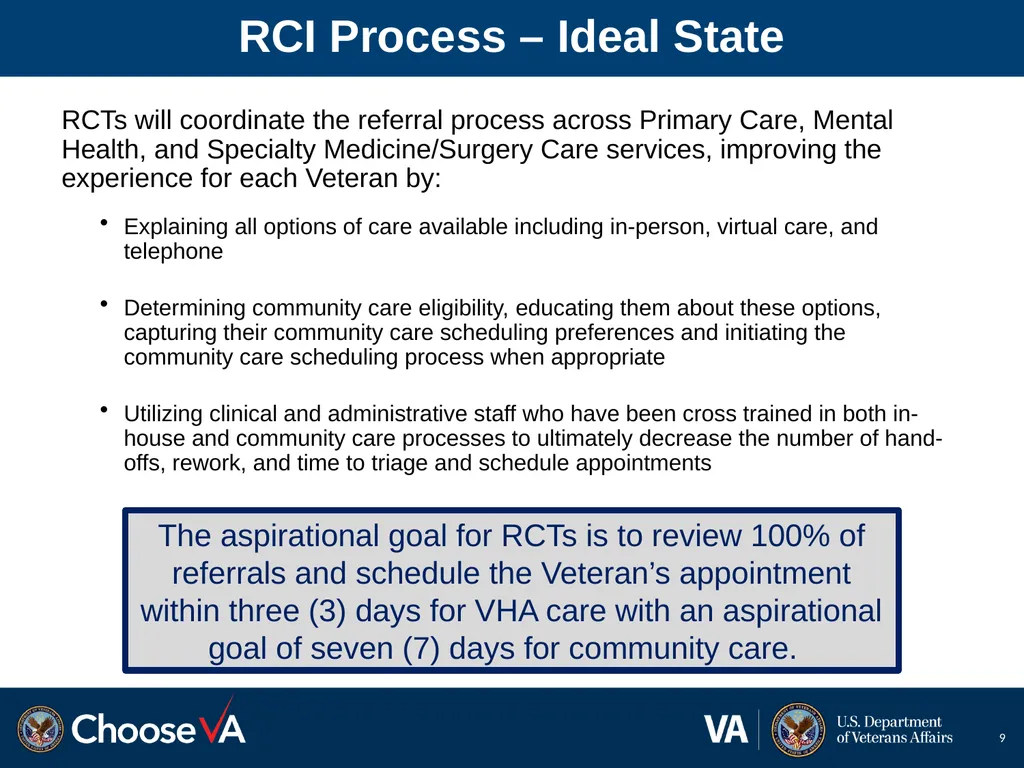
RCI Process – Ideal State RCTs will coordinate the referral process across Primary Care, Mental Health, and Specialty Medicine/Surgery Care services, improving the experience for each Veteran by:
Explaining all options of care available including in-person, virtual care, and telephone
Determining community care eligibility, educating them about these options, capturing their community care scheduling preferences and initiating the community care scheduling process when appropriate
Utilizing clinical and administrative staff who have been cross trained in both in-house and community care processes to ultimately decrease the number of hand-offs, rework, and time to triage and schedule appointments 9 The aspirational goal for RCTs is to review 100% of referrals and schedule the Veteran’s appointment within three (3) days for VHA care with an aspirational goal of seven (7) days for community care.<br>
10
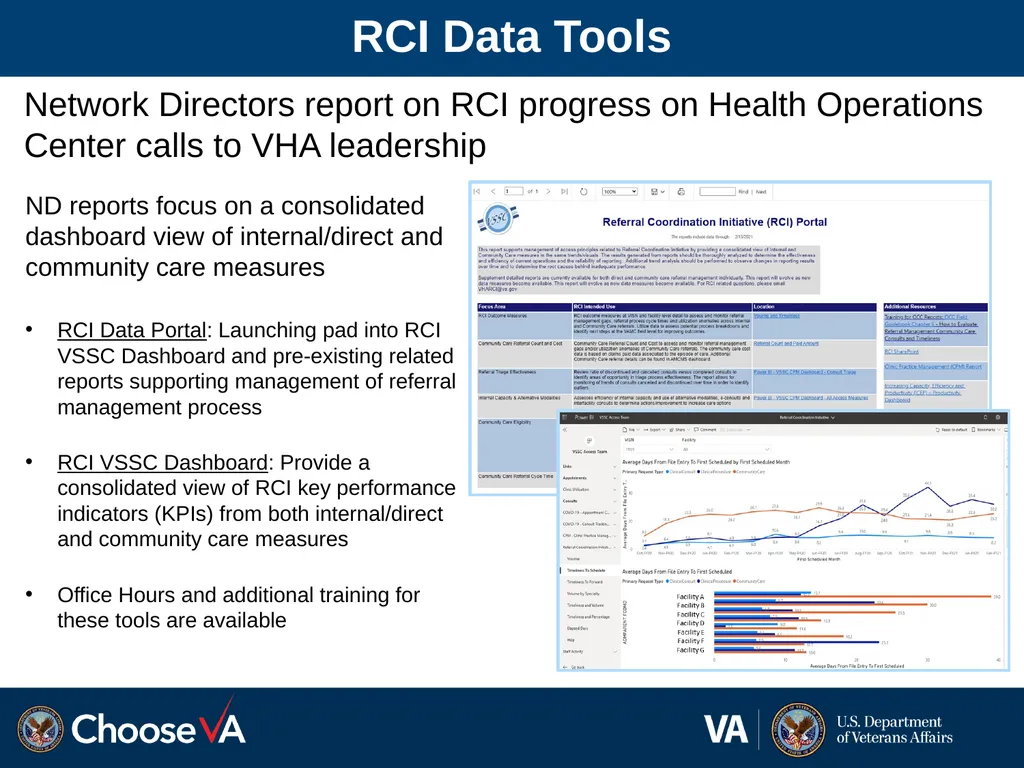
Network Directors report on RCI progress on Health Operations Center calls to VHA leadership RCI Data Tools ND reports focus on a consolidated dashboard view of internal/direct and community care measures
RCI Data Portal: Launching pad into RCI VSSC Dashboard and pre-existing related reports supporting management of referral management process
RCI VSSC Dashboard: Provide a consolidated view of RCI key performance indicators (KPIs) from both internal/direct and community care measures
Office Hours and additional training for these tools are available<br>
11
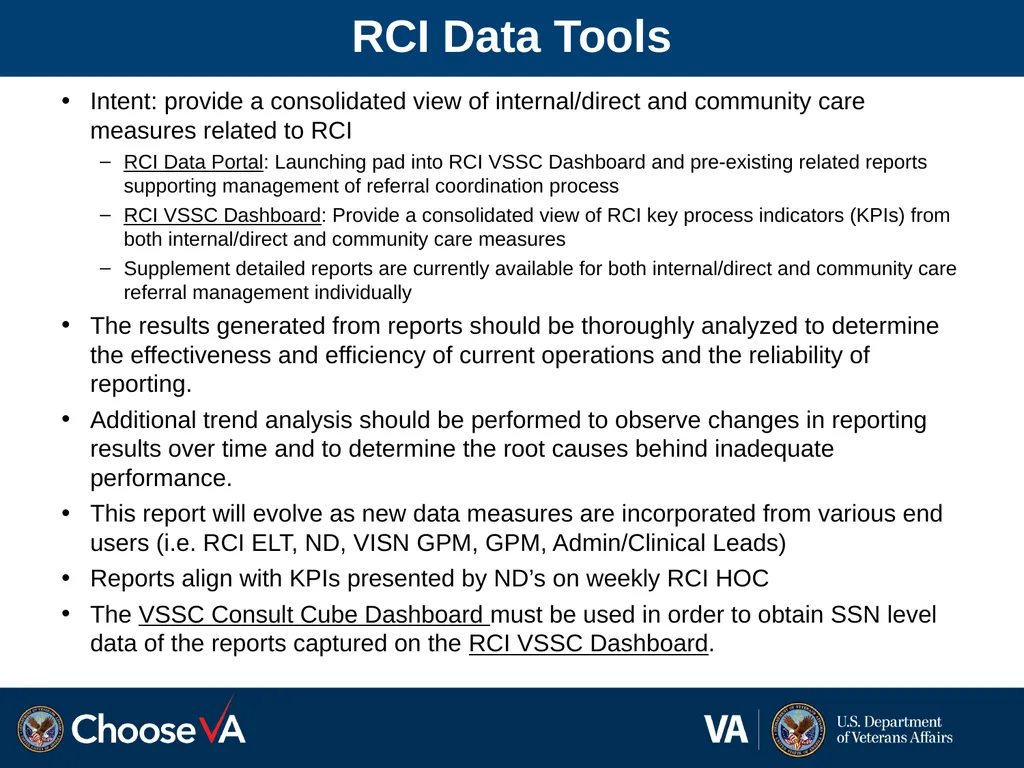
Intent: provide a consolidated view of internal/direct and community care measures related to RCI
RCI Data Portal: Launching pad into RCI VSSC Dashboard and pre-existing related reports supporting management of referral coordination process
RCI VSSC Dashboard: Provide a consolidated view of RCI key process indicators (KPIs) from both internal/direct and community care measures
Supplement detailed reports are currently available for both internal/direct and community care referral management individually
The results generated from reports should be thoroughly analyzed to determine the effectiveness and efficiency of current operations and the reliability of reporting.
Additional trend analysis should be performed to observe changes in reporting results over time and to determine the root causes behind inadequate performance.
This report will evolve as new data measures are incorporated from various end users (i.e. RCI ELT, ND, VISN GPM, GPM, Admin/Clinical Leads)
Reports align with KPIs presented by ND’s on weekly RCI HOC
The VSSC Consult Cube Dashboard must be used in order to obtain SSN level data of the reports captured on the RCI VSSC Dashboard. RCI Data Tools<br>
12
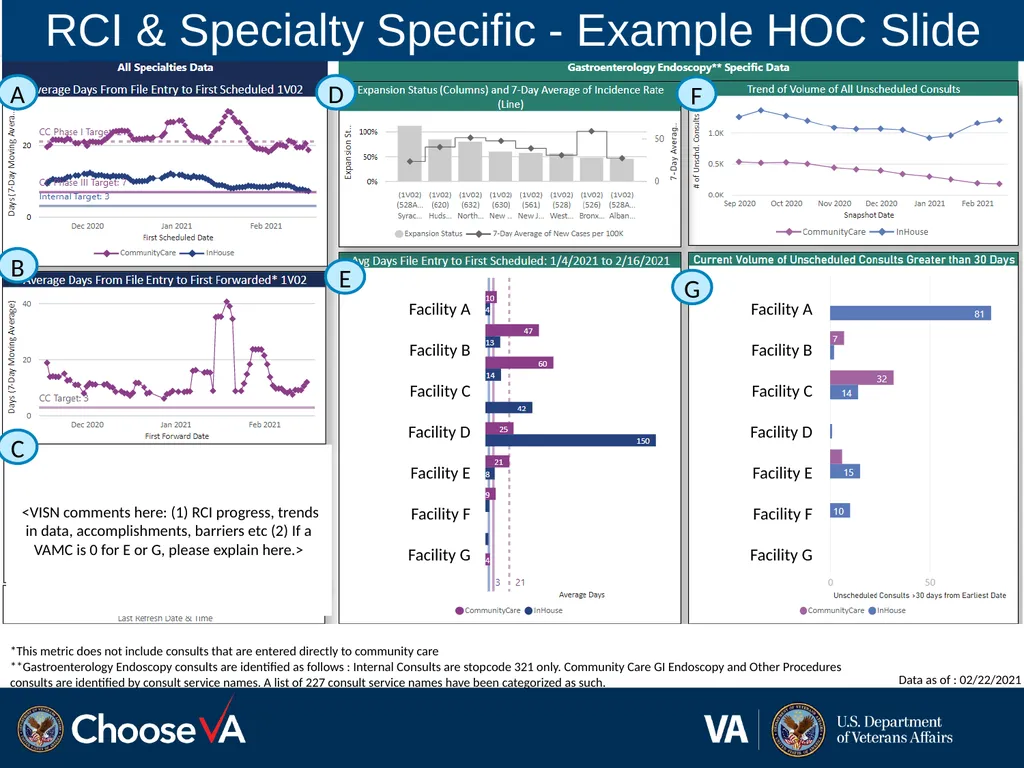
RCI & Specialty Specific - Example HOC Slide A B D F Data as of : 02/22/2021 *This metric does not include consults that are entered directly to community care
**Gastroenterology Endoscopy consults are identified as follows : Internal Consults are stopcode 321 only. Community Care GI Endoscopy and Other Procedures consults are identified by consult service names. A list of 227 consult service names have been categorized as such. <VISN comments here: (1) RCI progress, trends in data, accomplishments, barriers etc (2) If a VAMC is 0 for E or G, please explain here.> C Facility A
Facility B
Facility C
Facility D
Facility E
Facility F
Facility G E Facility A
Facility B
Facility C
Facility D
Facility E
Facility F
Facility G G<br>
13
Additional RCI Resources RCI SharePoint page: VHA Referral Coordination Initiative
RCI Project team provides feedback to NDs on local RCI implementation progress and outcomes during weekly Health Operations Center call
RCI memo includes additional guidance and expectations (Coming Soon)
Updated RCI Guidebook (Coming Soon)
Internal/Staff and External/Veteran Communication Materials
RCI Implementation Checklist (Coming Soon)
RCI Weekly Meeting – Wed. 12 p.m. ET.
Contact the RCI Project Team at VHARCI@va.gov for additional support as needed 13<br>
14
Questions 14 Pre-Decisional
Internal VA Use Only<br>
Internal VA Use Only<br>
15
RCT Process Maps 15 VETERAN EXPERIENCE RCT PROCESS MAP Pre-Decisional
Internal VA Use Only<br>
Internal VA Use Only<br>
16
FY21 RCI Milestones 16 January February April June OCC RCI FY21 Glidepath for Scheduling Pre-Decisional
Internal VA Use Only<br>
Internal VA Use Only<br>
17
Referral Coordination Team (RCT) - Composition MOVE TO NOTES SECTION
The Referral Coordination Team (RCT) is comprised of clinical and administrative staff. The RCT serves as the care coordinators for both internal/direct and community care needs.
Clinical RCT. Clinical RCTs should be a nurse. Sites may use MD/DO/NP/PA during the transition to RNs. They should be cross trained to triage both internal/direct and community care referrals.
perform initial triage on all consults
run the DST or determine community care eligibility through alternative means
call every Veteran to review possible community care eligibilities and internal/direct care modality options
document the conversation with the Veteran using the RCI Consult Toolbox (CTB) tab [in production]/
Capture #RCT# comment on consult after clinical review
complete a warm hand-off to the Administrative RCT to schedule the appointment
Capture the Veterans community care scheduling preferences and forward the consult to community care using the Consult Toolbox, when applicable
Administrative RCT. Administrative RCTs should be a Medical Support Assistant (MSA) scheduler or equivalent. They should be cross trained to schedule both internal/direct and community care appointments.
accept the warm hand-off from the Clinical RCT if appliable or call every Veteran to schedule both internal/direct or community care appointments per VHA scheduling directives
Capture #RCT# comment on consult after clinical review (if clinical member on the team did not capture, but clinical review was completed)
Capture the Veterans community care scheduling preferences and forward the consult to community care using the Consult Toolbox, when applicable 17 Make this visual<br>
18
VAMCs with Limited or No On-Site Specialty Care All VAMCs are required to implement RCI and put RCT in place.
VAMCs with limited or no on-site specialty care services should work with VISN and VAMC leadership to develop a VISN-level inventory and appropriate service level agreements between VAMCs that are able to provide e-consult reviews and/or in-person or virtual care appointments for Veterans as an alternative care option.
VAMCs are also encouraged to offer the Veteran an appointment with the Clinical Resource Hub (CRH) within their VISN as an alternative care option to community care when care is unable to be delivered via service level agreement. 18<br>
19
Ideal RCI process for limited or no-on-site specialty care During the Veteran’s initial visit, the referring providers will inform the Veteran that the RCT will contact them within 3 days to review all potential eligibilities and care options for their referral(s) and coordinate appropriate internal/direct or community care appointments.
VAMCs must decide if they will utilize an on-site RCT at the referral originating facility or a partnering RCT located remotely or at another VAMC
If the RCT reviewing the consult is located at the originating VAMC:
The referring provider enters an e-consult or internal/direct consult.
If the RCT reviewing the consult is located remotely or at another VAMC:
The referring provider will enter an e-consult or interfacility consult
The Veteran will have the option to schedule an RCT appointment prior to leaving the referring provider’s office.
The RCT located at the originating facility or the partnering facility will follow the same process outline for the RCT. 19<br>