
Refuting the Rabbis Jews for Judaism vs. Jews for
MT
Published · 28 slides · 0 views

1 / 1


Description
Refuting the Rabbis Jews for Judaism vs. Jews for Jesus on Daniel 9 Intro The other day a fellow brother in Christ, named Patrick, from Brazil reached out to me and asked for help. He said; Brother, could you help me? a Jewish article
Related Topics
Share
Embed code
Download this presentation From Below
"Refuting the Rabbis Jews for Judaism vs. Jews for" is the property of its rightful owner. Permission is granted to download and print the materials on this website for personal, non-commercial use only, and to display it on your personal computer provided you do not modify the materials and that you retain all copyright notices contained in the materials. By downloading content from our website, you accept the terms of this agreement.
Presentation Transcript
01
Refuting the Rabbis Jews for Judaism vs. Jews for Jesus on Daniel 9<br>
02
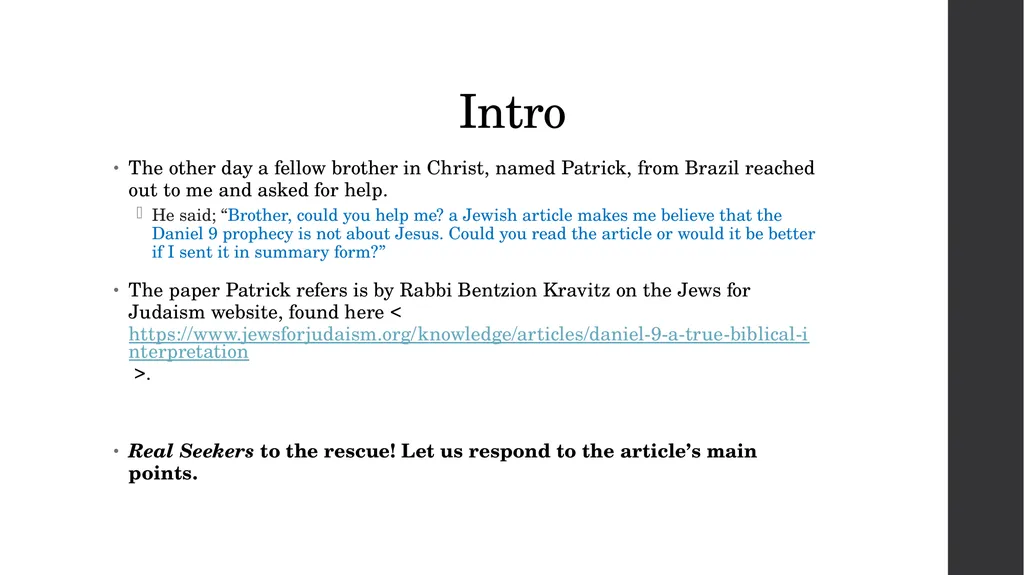
Intro The other day a fellow brother in Christ, named Patrick, from Brazil reached out to me and asked for help.
He said; “Brother, could you help me? a Jewish article makes me believe that the Daniel 9 prophecy is not about Jesus. Could you read the article or would it be better if I sent it in summary form?”
The paper Patrick refers is by Rabbi Bentzion Kravitz on the Jews for Judaism website, found here < https://www.jewsforjudaism.org/knowledge/articles/daniel-9-a-true-biblical-interpretation >.
Real Seekers to the rescue! Let us respond to the article’s main points.<br>
03
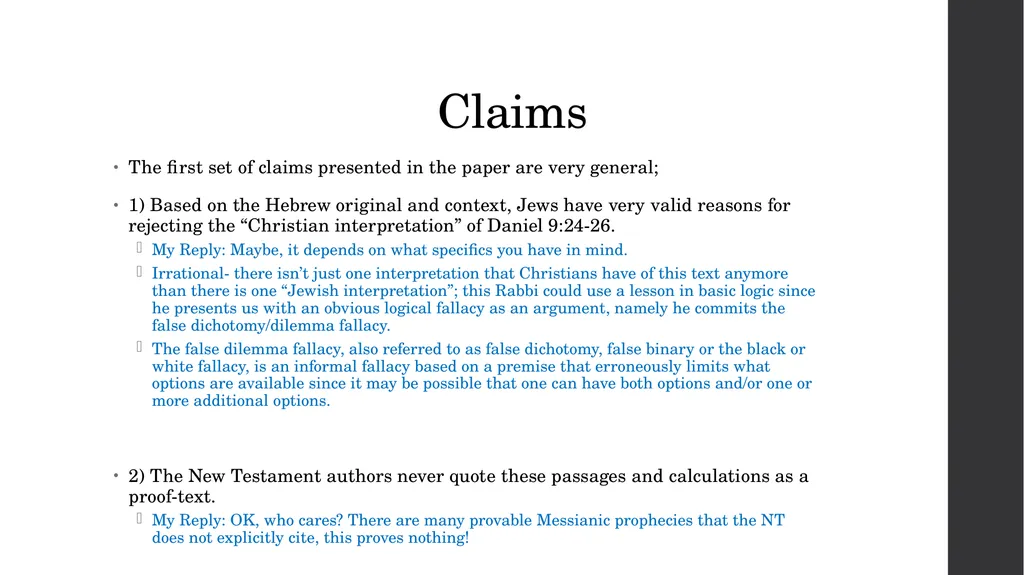
Claims The first set of claims presented in the paper are very general;
1) Based on the Hebrew original and context, Jews have very valid reasons for rejecting the “Christian interpretation” of Daniel 9:24-26.
My Reply: Maybe, it depends on what specifics you have in mind.
Irrational- there isn’t just one interpretation that Christians have of this text anymore than there is one “Jewish interpretation”; this Rabbi could use a lesson in basic logic since he presents us with an obvious logical fallacy as an argument, namely he commits the false dichotomy/dilemma fallacy.
The false dilemma fallacy, also referred to as false dichotomy, false binary or the black or white fallacy, is an informal fallacy based on a premise that erroneously limits what options are available since it may be possible that one can have both options and/or one or more additional options.
2) The New Testament authors never quote these passages and calculations as a proof-text.
My Reply: OK, who cares? There are many provable Messianic prophecies that the NT does not explicitly cite, this proves nothing!<br>
04
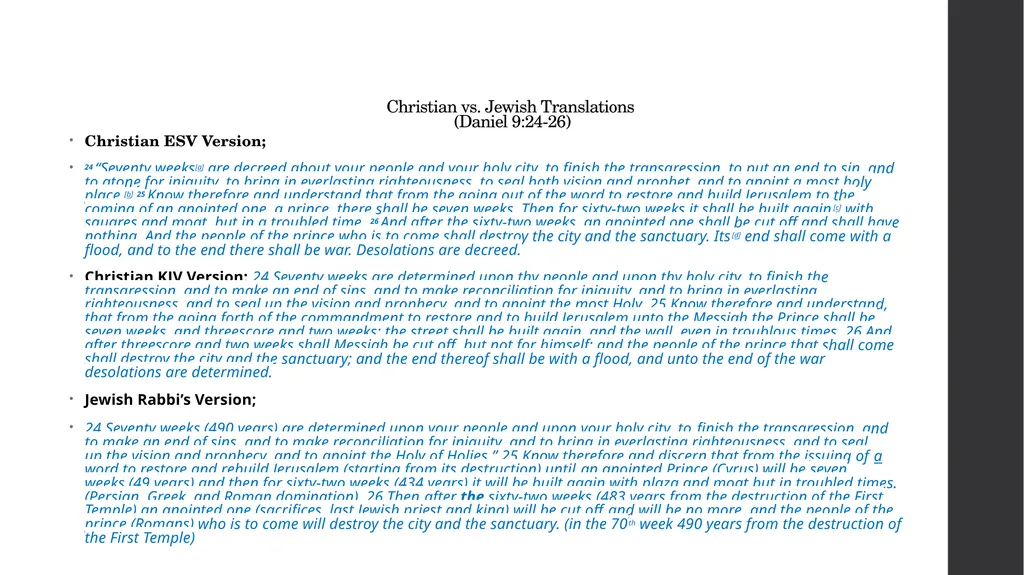
Christian vs. Jewish Translations
(Daniel 9:24-26) Christian ESV Version;
24 “Seventy weeks[a] are decreed about your people and your holy city, to finish the transgression, to put an end to sin, and to atone for iniquity, to bring in everlasting righteousness, to seal both vision and prophet, and to anoint a most holy place.[b] 25 Know therefore and understand that from the going out of the word to restore and build Jerusalem to the coming of an anointed one, a prince, there shall be seven weeks. Then for sixty-two weeks it shall be built again[c] with squares and moat, but in a troubled time. 26 And after the sixty-two weeks, an anointed one shall be cut off and shall have nothing. And the people of the prince who is to come shall destroy the city and the sanctuary. Its[d] end shall come with a flood, and to the end there shall be war. Desolations are decreed.
Christian KJV Version: 24 Seventy weeks are determined upon thy people and upon thy holy city, to finish the transgression, and to make an end of sins, and to make reconciliation for iniquity, and to bring in everlasting righteousness, and to seal up the vision and prophecy, and to anoint the most Holy. 25 Know therefore and understand, that from the going forth of the commandment to restore and to build Jerusalem unto the Messiah the Prince shall be seven weeks, and threescore and two weeks: the street shall be built again, and the wall, even in troublous times. 26 And after threescore and two weeks shall Messiah be cut off, but not for himself: and the people of the prince that shall come shall destroy the city and the sanctuary; and the end thereof shall be with a flood, and unto the end of the war desolations are determined.
Jewish Rabbi’s Version;
24 Seventy weeks (490 years) are determined upon your people and upon your holy city, to finish the transgression, and to make an end of sins, and to make reconciliation for iniquity, and to bring in everlasting righteousness, and to seal up the vision and prophecy, and to anoint the Holy of Holies.” 25 Know therefore and discern that from the issuing of a word to restore and rebuild Jerusalem (starting from its destruction) until an anointed Prince (Cyrus) will be seven weeks (49 years) and then for sixty-two weeks (434 years) it will be built again with plaza and moat but in troubled times. (Persian, Greek, and Roman domination). 26 Then after the sixty-two weeks (483 years from the destruction of the First Temple) an anointed one (sacrifices, last Jewish priest and king) will be cut off and will be no more, and the people of the prince (Romans) who is to come will destroy the city and the sanctuary. (in the 70th week 490 years from the destruction of the First Temple)<br>
05
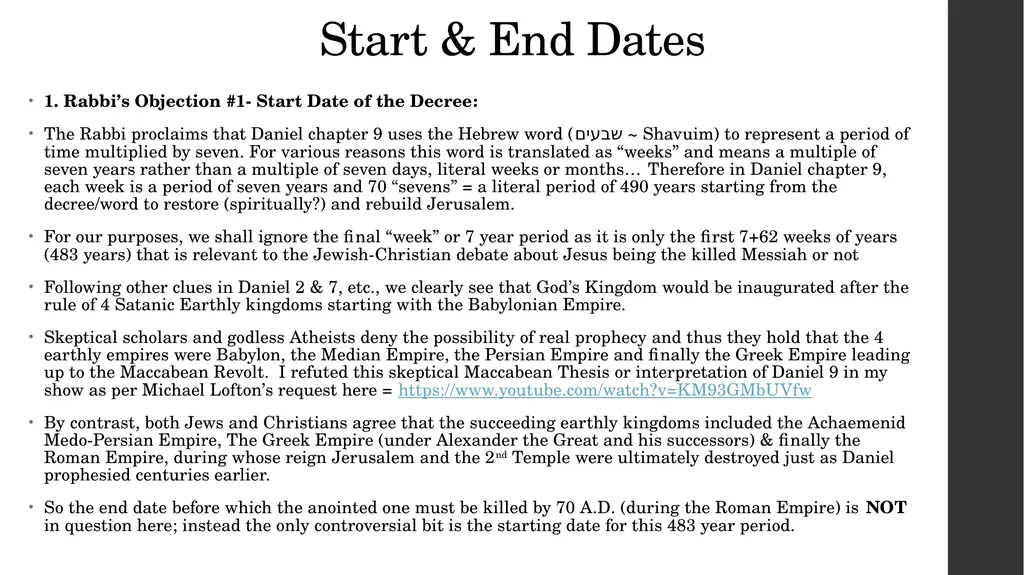
Start & End Dates 1. Rabbi’s Objection #1- Start Date of the Decree:
The Rabbi proclaims that Daniel chapter 9 uses the Hebrew word (שבעים ~ Shavuim) to represent a period of time multiplied by seven. For various reasons this word is translated as “weeks” and means a multiple of seven years rather than a multiple of seven days, literal weeks or months… Therefore in Daniel chapter 9, each week is a period of seven years and 70 “sevens” = a literal period of 490 years starting from the decree/word to restore (spiritually?) and rebuild Jerusalem.
For our purposes, we shall ignore the final “week” or 7 year period as it is only the first 7+62 weeks of years (483 years) that is relevant to the Jewish-Christian debate about Jesus being the killed Messiah or not
Following other clues in Daniel 2 & 7, etc., we clearly see that God’s Kingdom would be inaugurated after the rule of 4 Satanic Earthly kingdoms starting with the Babylonian Empire.
Skeptical scholars and godless Atheists deny the possibility of real prophecy and thus they hold that the 4 earthly empires were Babylon, the Median Empire, the Persian Empire and finally the Greek Empire leading up to the Maccabean Revolt. I refuted this skeptical Maccabean Thesis or interpretation of Daniel 9 in my show as per Michael Lofton’s request here = https://www.youtube.com/watch?v=KM93GMbUVfw
By contrast, both Jews and Christians agree that the succeeding earthly kingdoms included the Achaemenid Medo-Persian Empire, The Greek Empire (under Alexander the Great and his successors) & finally the Roman Empire, during whose reign Jerusalem and the 2nd Temple were ultimately destroyed just as Daniel prophesied centuries earlier.
So the end date before which the anointed one must be killed by 70 A.D. (during the Roman Empire) is NOT in question here; instead the only controversial bit is the starting date for this 483 year period.<br>
06
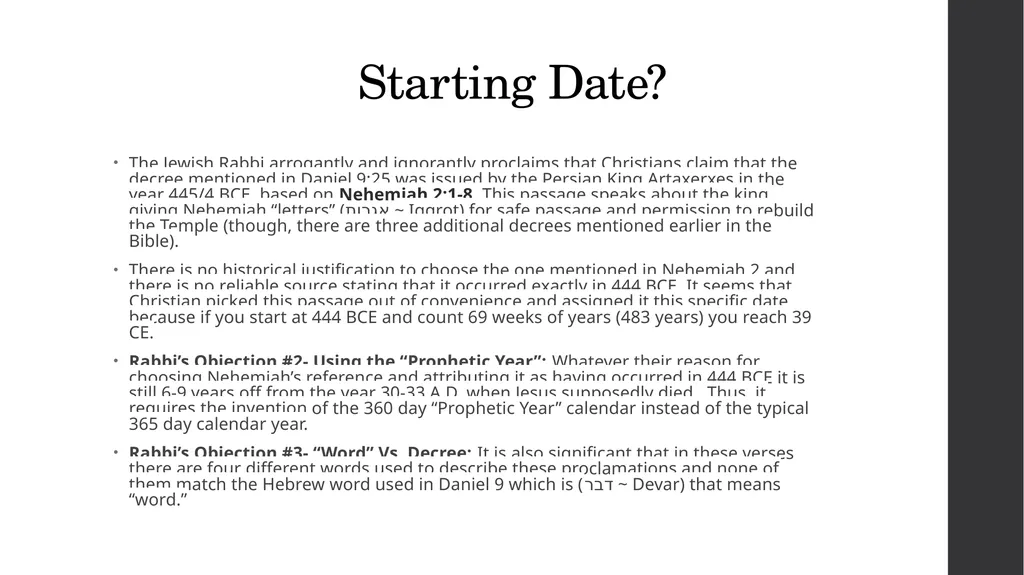
Starting Date? The Jewish Rabbi arrogantly and ignorantly proclaims that Christians claim that the decree mentioned in Daniel 9:25 was issued by the Persian King Artaxerxes in the year 445/4 BCE, based on Nehemiah 2:1-8. This passage speaks about the king giving Nehemiah “letters” (אגרות ~ Iggrot) for safe passage and permission to rebuild the Temple (though, there are three additional decrees mentioned earlier in the Bible).
There is no historical justification to choose the one mentioned in Nehemiah 2 and there is no reliable source stating that it occurred exactly in 444 BCE. It seems that Christian picked this passage out of convenience and assigned it this specific date, because if you start at 444 BCE and count 69 weeks of years (483 years) you reach 39 CE.
Rabbi’s Objection #2- Using the “Prophetic Year”: Whatever their reason for choosing Nehemiah’s reference and attributing it as having occurred in 444 BCE it is still 6-9 years off from the year 30-33 A.D. when Jesus supposedly died. Thus, it requires the invention of the 360 day “Prophetic Year” calendar instead of the typical 365 day calendar year.
Rabbi’s Objection #3- “Word” Vs. Decree: It is also significant that in these verses there are four different words used to describe these proclamations and none of them match the Hebrew word used in Daniel 9 which is (דבר ~ Devar) that means “word.”<br>
07
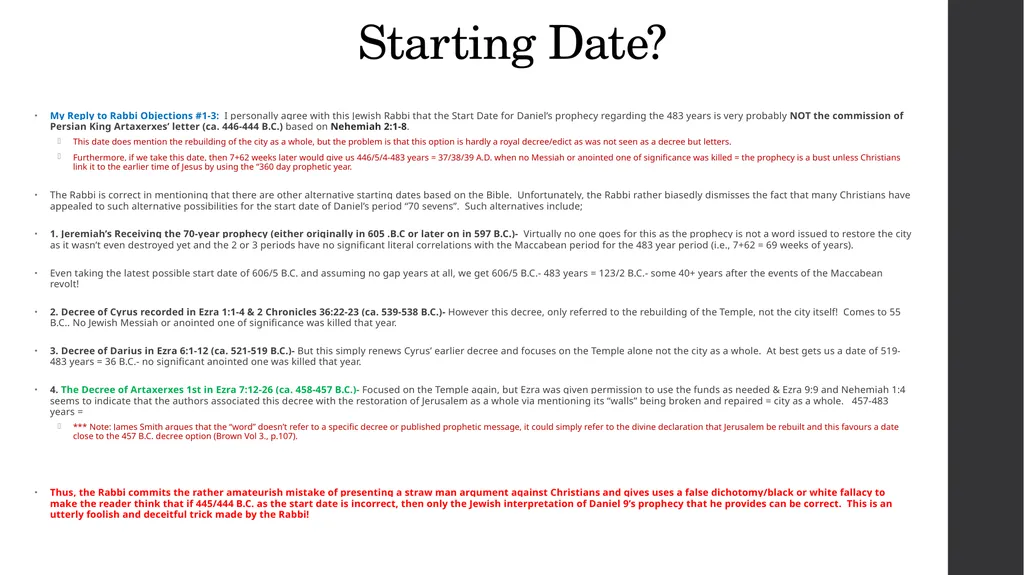
Starting Date? My Reply to Rabbi Objections #1-3: I personally agree with this Jewish Rabbi that the Start Date for Daniel’s prophecy regarding the 483 years is very probably NOT the commission of Persian King Artaxerxes’ letter (ca. 446-444 B.C.) based on Nehemiah 2:1-8.
This date does mention the rebuilding of the city as a whole, but the problem is that this option is hardly a royal decree/edict as was not seen as a decree but letters.
Furthermore, if we take this date, then 7+62 weeks later would give us 446/5/4-483 years = 37/38/39 A.D. when no Messiah or anointed one of significance was killed = the prophecy is a bust unless Christians link it to the earlier time of Jesus by using the “360 day prophetic year.
The Rabbi is correct in mentioning that there are other alternative starting dates based on the Bible. Unfortunately, the Rabbi rather biasedly dismisses the fact that many Christians have appealed to such alternative possibilities for the start date of Daniel’s period “70 sevens”. Such alternatives include;
1. Jeremiah’s Receiving the 70-year prophecy (either originally in 605 .B.C or later on in 597 B.C.)- Virtually no one goes for this as the prophecy is not a word issued to restore the city as it wasn’t even destroyed yet and the 2 or 3 periods have no significant literal correlations with the Maccabean period for the 483 year period (i.e., 7+62 = 69 weeks of years).
Even taking the latest possible start date of 606/5 B.C. and assuming no gap years at all, we get 606/5 B.C.- 483 years = 123/2 B.C.- some 40+ years after the events of the Maccabean revolt!
2. Decree of Cyrus recorded in Ezra 1:1-4 & 2 Chronicles 36:22-23 (ca. 539-538 B.C.)- However this decree, only referred to the rebuilding of the Temple, not the city itself! Comes to 55 B.C.. No Jewish Messiah or anointed one of significance was killed that year.
3. Decree of Darius in Ezra 6:1-12 (ca. 521-519 B.C.)- But this simply renews Cyrus’ earlier decree and focuses on the Temple alone not the city as a whole. At best gets us a date of 519-483 years = 36 B.C.- no significant anointed one was killed that year.
4. The Decree of Artaxerxes 1st in Ezra 7:12-26 (ca. 458-457 B.C.)- Focused on the Temple again, but Ezra was given permission to use the funds as needed & Ezra 9:9 and Nehemiah 1:4 seems to indicate that the authors associated this decree with the restoration of Jerusalem as a whole via mentioning its “walls” being broken and repaired = city as a whole. 457-483 years =
*** Note: James Smith argues that the “word” doesn’t refer to a specific decree or published prophetic message, it could simply refer to the divine declaration that Jerusalem be rebuilt and this favours a date close to the 457 B.C. decree option (Brown Vol 3., p.107).
Thus, the Rabbi commits the rather amateurish mistake of presenting a straw man argument against Christians and gives uses a false dichotomy/black or white fallacy to make the reader think that if 445/444 B.C. as the start date is incorrect, then only the Jewish interpretation of Daniel 9’s prophecy that he provides can be correct. This is an utterly foolish and deceitful trick made by the Rabbi!<br>
08
Decree of Artaxerxes
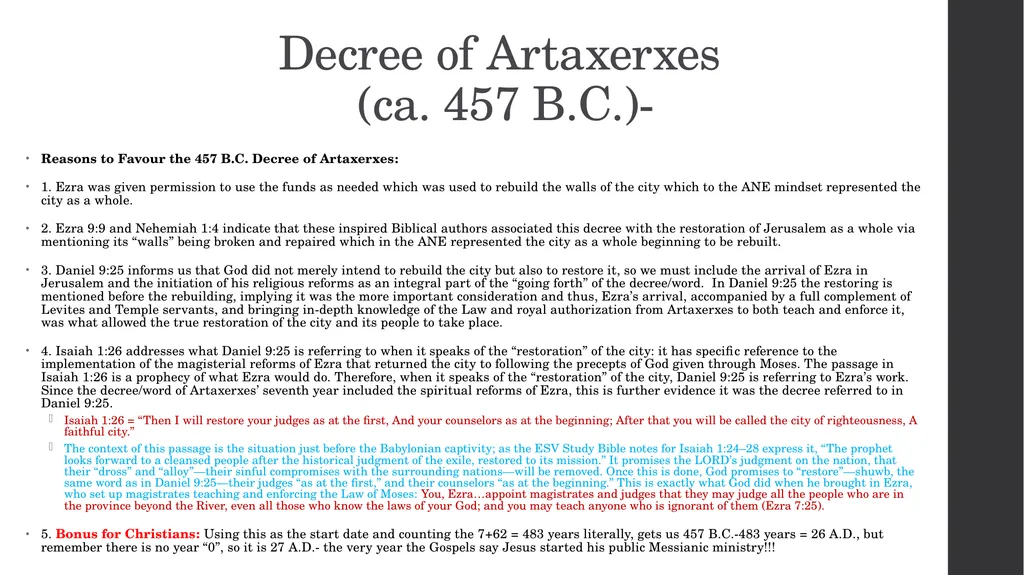
(ca. 457 B.C.)- Reasons to Favour the 457 B.C. Decree of Artaxerxes:
1. Ezra was given permission to use the funds as needed which was used to rebuild the walls of the city which to the ANE mindset represented the city as a whole.
2. Ezra 9:9 and Nehemiah 1:4 indicate that these inspired Biblical authors associated this decree with the restoration of Jerusalem as a whole via mentioning its “walls” being broken and repaired which in the ANE represented the city as a whole beginning to be rebuilt.
3. Daniel 9:25 informs us that God did not merely intend to rebuild the city but also to restore it, so we must include the arrival of Ezra in Jerusalem and the initiation of his religious reforms as an integral part of the “going forth” of the decree/word. In Daniel 9:25 the restoring is mentioned before the rebuilding, implying it was the more important consideration and thus, Ezra’s arrival, accompanied by a full complement of Levites and Temple servants, and bringing in-depth knowledge of the Law and royal authorization from Artaxerxes to both teach and enforce it, was what allowed the true restoration of the city and its people to take place.
4. Isaiah 1:26 addresses what Daniel 9:25 is referring to when it speaks of the “restoration” of the city: it has specific reference to the implementation of the magisterial reforms of Ezra that returned the city to following the precepts of God given through Moses. The passage in Isaiah 1:26 is a prophecy of what Ezra would do. Therefore, when it speaks of the “restoration” of the city, Daniel 9:25 is referring to Ezra’s work. Since the decree/word of Artaxerxes’ seventh year included the spiritual reforms of Ezra, this is further evidence it was the decree referred to in Daniel 9:25.
Isaiah 1:26 = “Then I will restore your judges as at the first, And your counselors as at the beginning; After that you will be called the city of righteousness, A faithful city.”
The context of this passage is the situation just before the Babylonian captivity; as the ESV Study Bible notes for Isaiah 1:24–28 express it, “The prophet looks forward to a cleansed people after the historical judgment of the exile, restored to its mission.” It promises the LORD’s judgment on the nation, that their “dross” and “alloy”—their sinful compromises with the surrounding nations—will be removed. Once this is done, God promises to “restore”—shuwb, the same word as in Daniel 9:25—their judges “as at the first,” and their counselors “as at the beginning.” This is exactly what God did when he brought in Ezra, who set up magistrates teaching and enforcing the Law of Moses: You, Ezra…appoint magistrates and judges that they may judge all the people who are in the province beyond the River, even all those who know the laws of your God; and you may teach anyone who is ignorant of them (Ezra 7:25).
5. Bonus for Christians: Using this as the start date and counting the 7+62 = 483 years literally, gets us 457 B.C.-483 years = 26 A.D., but remember there is no year “0”, so it is 27 A.D.- the very year the Gospels say Jesus started his public Messianic ministry!!!<br>
09
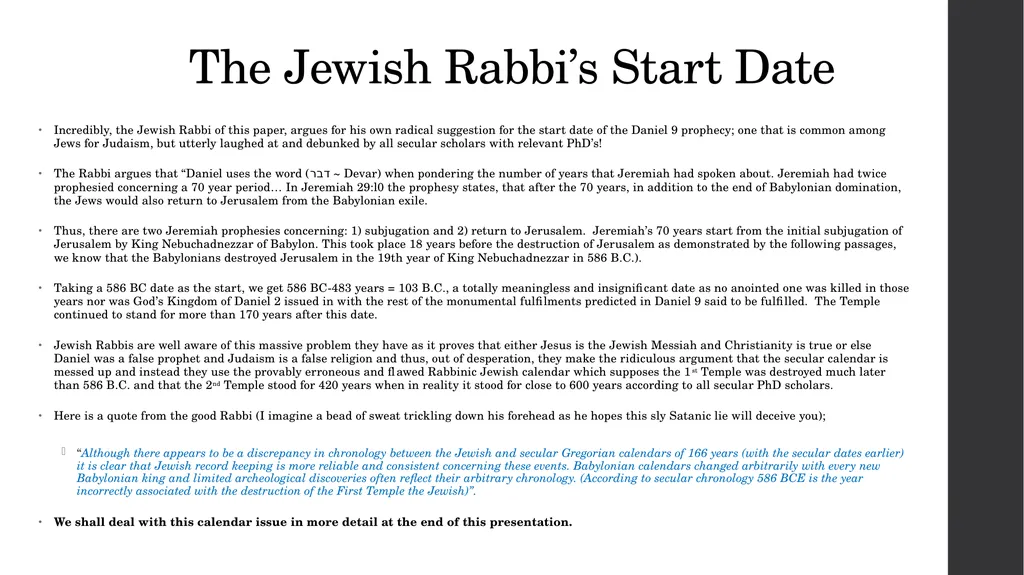
The Jewish Rabbi’s Start Date Incredibly, the Jewish Rabbi of this paper, argues for his own radical suggestion for the start date of the Daniel 9 prophecy; one that is common among Jews for Judaism, but utterly laughed at and debunked by all secular scholars with relevant PhD’s!
The Rabbi argues that “Daniel uses the word (דבר ~ Devar) when pondering the number of years that Jeremiah had spoken about. Jeremiah had twice prophesied concerning a 70 year period… In Jeremiah 29:l0 the prophesy states, that after the 70 years, in addition to the end of Babylonian domination, the Jews would also return to Jerusalem from the Babylonian exile.
Thus, there are two Jeremiah prophesies concerning: 1) subjugation and 2) return to Jerusalem. Jeremiah’s 70 years start from the initial subjugation of Jerusalem by King Nebuchadnezzar of Babylon. This took place 18 years before the destruction of Jerusalem as demonstrated by the following passages, we know that the Babylonians destroyed Jerusalem in the 19th year of King Nebuchadnezzar in 586 B.C.).
Taking a 586 BC date as the start, we get 586 BC-483 years = 103 B.C., a totally meaningless and insignificant date as no anointed one was killed in those years nor was God’s Kingdom of Daniel 2 issued in with the rest of the monumental fulfilments predicted in Daniel 9 said to be fulfilled. The Temple continued to stand for more than 170 years after this date.
Jewish Rabbis are well aware of this massive problem they have as it proves that either Jesus is the Jewish Messiah and Christianity is true or else Daniel was a false prophet and Judaism is a false religion and thus, out of desperation, they make the ridiculous argument that the secular calendar is messed up and instead they use the provably erroneous and flawed Rabbinic Jewish calendar which supposes the 1st Temple was destroyed much later than 586 B.C. and that the 2nd Temple stood for 420 years when in reality it stood for close to 600 years according to all secular PhD scholars.
Here is a quote from the good Rabbi (I imagine a bead of sweat trickling down his forehead as he hopes this sly Satanic lie will deceive you);
“Although there appears to be a discrepancy in chronology between the Jewish and secular Gregorian calendars of 166 years (with the secular dates earlier) it is clear that Jewish record keeping is more reliable and consistent concerning these events. Babylonian calendars changed arbitrarily with every new Babylonian king and limited archeological discoveries often reflect their arbitrary chronology. (According to secular chronology 586 BCE is the year incorrectly associated with the destruction of the First Temple the Jewish)”.
We shall deal with this calendar issue in more detail at the end of this presentation.<br>
10
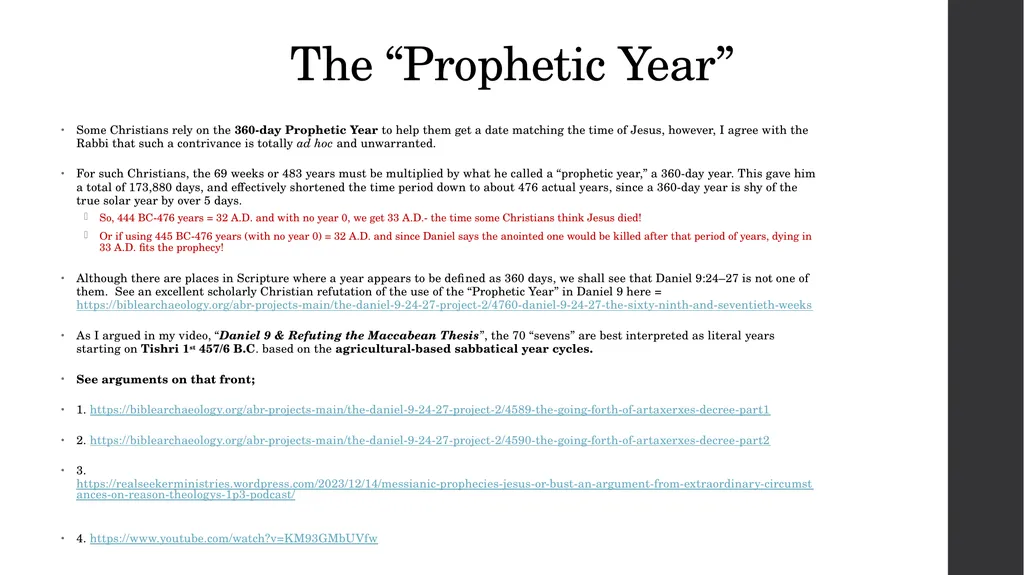
The “Prophetic Year” Some Christians rely on the 360-day Prophetic Year to help them get a date matching the time of Jesus, however, I agree with the Rabbi that such a contrivance is totally ad hoc and unwarranted.
For such Christians, the 69 weeks or 483 years must be multiplied by what he called a “prophetic year,” a 360-day year. This gave him a total of 173,880 days, and effectively shortened the time period down to about 476 actual years, since a 360-day year is shy of the true solar year by over 5 days.
So, 444 BC-476 years = 32 A.D. and with no year 0, we get 33 A.D.- the time some Christians think Jesus died!
Or if using 445 BC-476 years (with no year 0) = 32 A.D. and since Daniel says the anointed one would be killed after that period of years, dying in 33 A.D. fits the prophecy!
Although there are places in Scripture where a year appears to be defined as 360 days, we shall see that Daniel 9:24–27 is not one of them. See an excellent scholarly Christian refutation of the use of the “Prophetic Year” in Daniel 9 here = https://biblearchaeology.org/abr-projects-main/the-daniel-9-24-27-project-2/4760-daniel-9-24-27-the-sixty-ninth-and-seventieth-weeks
As I argued in my video, “Daniel 9 & Refuting the Maccabean Thesis”, the 70 “sevens” are best interpreted as literal years starting on Tishri 1st 457/6 B.C. based on the agricultural-based sabbatical year cycles.
See arguments on that front;
1. https://biblearchaeology.org/abr-projects-main/the-daniel-9-24-27-project-2/4589-the-going-forth-of-artaxerxes-decree-part1
2. https://biblearchaeology.org/abr-projects-main/the-daniel-9-24-27-project-2/4590-the-going-forth-of-artaxerxes-decree-part2
3. https://realseekerministries.wordpress.com/2023/12/14/messianic-prophecies-jesus-or-bust-an-argument-from-extraordinary-circumstances-on-reason-theologys-1p3-podcast/
4. https://www.youtube.com/watch?v=KM93GMbUVfw<br>
11
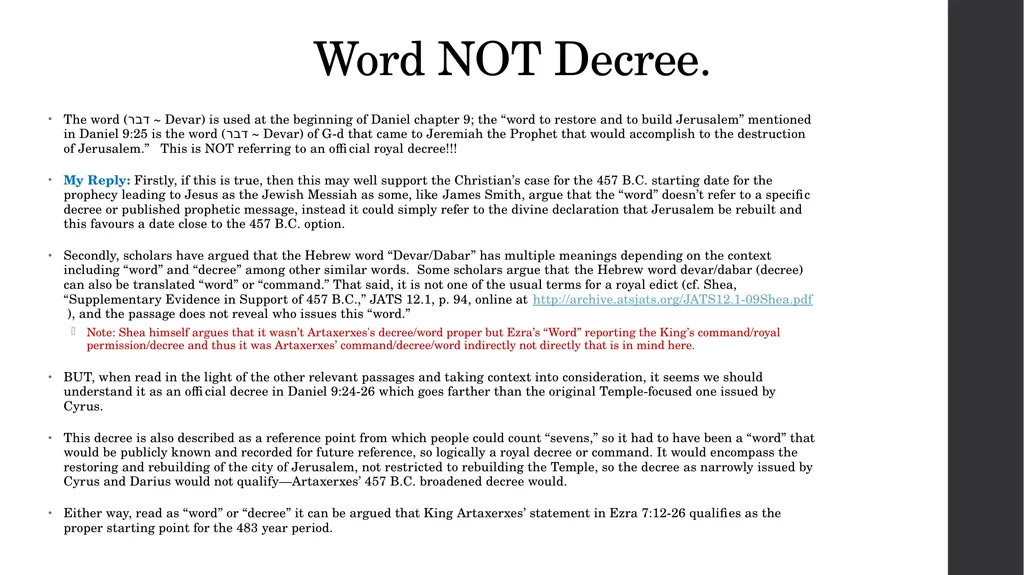
Word NOT Decree. The word (דבר ~ Devar) is used at the beginning of Daniel chapter 9; the “word to restore and to build Jerusalem” mentioned in Daniel 9:25 is the word (דבר ~ Devar) of G-d that came to Jeremiah the Prophet that would accomplish to the destruction of Jerusalem.” This is NOT referring to an official royal decree!!!
My Reply: Firstly, if this is true, then this may well support the Christian’s case for the 457 B.C. starting date for the prophecy leading to Jesus as the Jewish Messiah as some, like James Smith, argue that the “word” doesn’t refer to a specific decree or published prophetic message, instead it could simply refer to the divine declaration that Jerusalem be rebuilt and this favours a date close to the 457 B.C. option.
Secondly, scholars have argued that the Hebrew word “Devar/Dabar” has multiple meanings depending on the context including “word” and “decree” among other similar words. Some scholars argue that the Hebrew word devar/dabar (decree) can also be translated “word” or “command.” That said, it is not one of the usual terms for a royal edict (cf. Shea, “Supplementary Evidence in Support of 457 B.C.,” JATS 12.1, p. 94, online at http://archive.atsjats.org/JATS12.1-09Shea.pdf ), and the passage does not reveal who issues this “word.”
Note: Shea himself argues that it wasn’t Artaxerxes's decree/word proper but Ezra’s “Word” reporting the King’s command/royal permission/decree and thus it was Artaxerxes’ command/decree/word indirectly not directly that is in mind here.
BUT, when read in the light of the other relevant passages and taking context into consideration, it seems we should understand it as an official decree in Daniel 9:24-26 which goes farther than the original Temple-focused one issued by Cyrus.
This decree is also described as a reference point from which people could count “sevens,” so it had to have been a “word” that would be publicly known and recorded for future reference, so logically a royal decree or command. It would encompass the restoring and rebuilding of the city of Jerusalem, not restricted to rebuilding the Temple, so the decree as narrowly issued by Cyrus and Darius would not qualify—Artaxerxes’ 457 B.C. broadened decree would.
Either way, read as “word” or “decree” it can be argued that King Artaxerxes’ statement in Ezra 7:12-26 qualifies as the proper starting point for the 483 year period.<br>
12
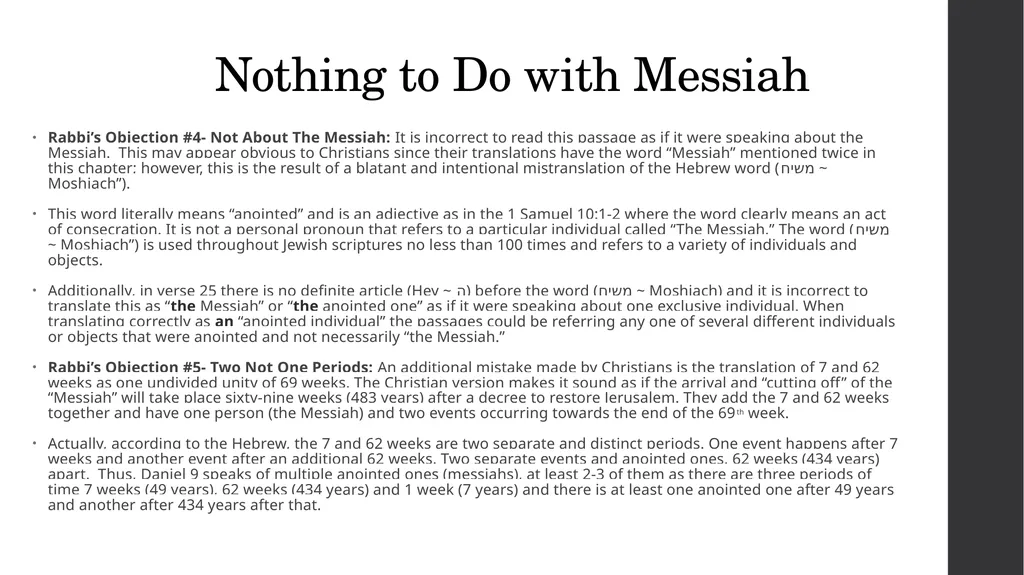
Nothing to Do with Messiah Rabbi’s Objection #4- Not About The Messiah: It is incorrect to read this passage as if it were speaking about the Messiah. This may appear obvious to Christians since their translations have the word “Messiah” mentioned twice in this chapter; however, this is the result of a blatant and intentional mistranslation of the Hebrew word (משיח ~ Moshiach”).
This word literally means “anointed” and is an adjective as in the 1 Samuel 10:1-2 where the word clearly means an act of consecration. It is not a personal pronoun that refers to a particular individual called “The Messiah.” The word (משיח ~ Moshiach”) is used throughout Jewish scriptures no less than 100 times and refers to a variety of individuals and objects.
Additionally, in verse 25 there is no definite article (Hey ~ ה) before the word (משיח ~ Moshiach) and it is incorrect to translate this as “the Messiah” or “the anointed one” as if it were speaking about one exclusive individual. When translating correctly as an “anointed individual” the passages could be referring any one of several different individuals or objects that were anointed and not necessarily “the Messiah.”
Rabbi’s Objection #5- Two Not One Periods: An additional mistake made by Christians is the translation of 7 and 62 weeks as one undivided unity of 69 weeks. The Christian version makes it sound as if the arrival and “cutting off” of the “Messiah” will take place sixty-nine weeks (483 years) after a decree to restore Jerusalem. They add the 7 and 62 weeks together and have one person (the Messiah) and two events occurring towards the end of the 69th week.
Actually, according to the Hebrew, the 7 and 62 weeks are two separate and distinct periods. One event happens after 7 weeks and another event after an additional 62 weeks. Two separate events and anointed ones, 62 weeks (434 years) apart. Thus, Daniel 9 speaks of multiple anointed ones (messiahs), at least 2-3 of them as there are three periods of time 7 weeks (49 years), 62 weeks (434 years) and 1 week (7 years) and there is at least one anointed one after 49 years and another after 434 years after that.<br>
13
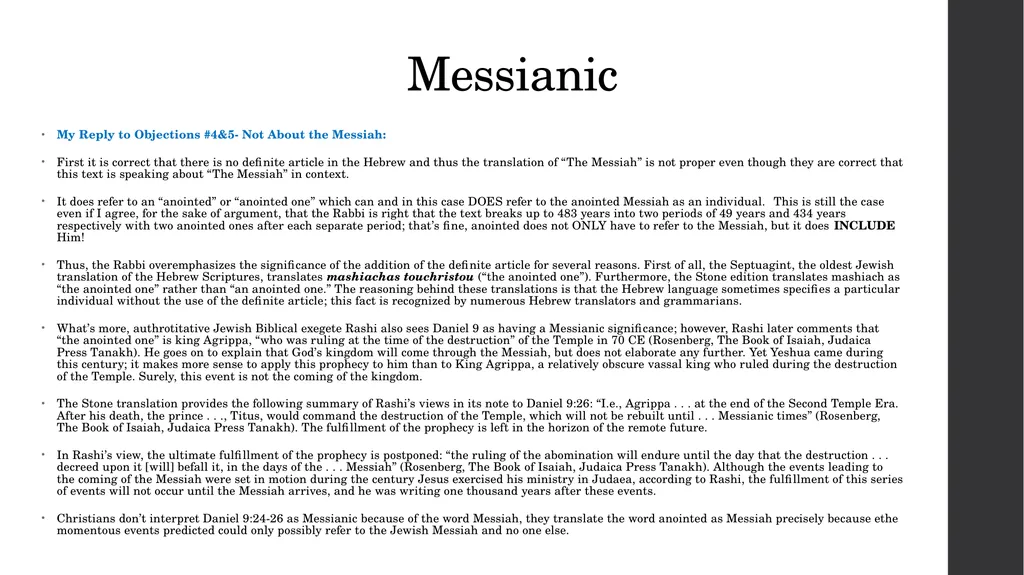
Messianic My Reply to Objections #4&5- Not About the Messiah:
First it is correct that there is no definite article in the Hebrew and thus the translation of “The Messiah” is not proper even though they are correct that this text is speaking about “The Messiah” in context.
It does refer to an “anointed” or “anointed one” which can and in this case DOES refer to the anointed Messiah as an individual. This is still the case even if I agree, for the sake of argument, that the Rabbi is right that the text breaks up to 483 years into two periods of 49 years and 434 years respectively with two anointed ones after each separate period; that’s fine, anointed does not ONLY have to refer to the Messiah, but it does INCLUDE Him!
Thus, the Rabbi overemphasizes the significance of the addition of the definite article for several reasons. First of all, the Septuagint, the oldest Jewish translation of the Hebrew Scriptures, translates mashiachas touchristou (“the anointed one”). Furthermore, the Stone edition translates mashiach as “the anointed one” rather than “an anointed one.” The reasoning behind these translations is that the Hebrew language sometimes specifies a particular individual without the use of the definite article; this fact is recognized by numerous Hebrew translators and grammarians.
What’s more, authrotitative Jewish Biblical exegete Rashi also sees Daniel 9 as having a Messianic significance; however, Rashi later comments that “the anointed one” is king Agrippa, “who was ruling at the time of the destruction” of the Temple in 70 CE (Rosenberg, The Book of Isaiah, Judaica Press Tanakh). He goes on to explain that God’s kingdom will come through the Messiah, but does not elaborate any further. Yet Yeshua came during this century; it makes more sense to apply this prophecy to him than to King Agrippa, a relatively obscure vassal king who ruled during the destruction of the Temple. Surely, this event is not the coming of the kingdom.
The Stone translation provides the following summary of Rashi’s views in its note to Daniel 9:26: “I.e., Agrippa . . . at the end of the Second Temple Era. After his death, the prince . . ., Titus, would command the destruction of the Temple, which will not be rebuilt until . . . Messianic times” (Rosenberg, The Book of Isaiah, Judaica Press Tanakh). The fulfillment of the prophecy is left in the horizon of the remote future.
In Rashi’s view, the ultimate fulfillment of the prophecy is postponed: “the ruling of the abomination will endure until the day that the destruction . . . decreed upon it [will] befall it, in the days of the . . . Messiah” (Rosenberg, The Book of Isaiah, Judaica Press Tanakh). Although the events leading to the coming of the Messiah were set in motion during the century Jesus exercised his ministry in Judaea, according to Rashi, the fulfillment of this series of events will not occur until the Messiah arrives, and he was writing one thousand years after these events.
Christians don’t interpret Daniel 9:24-26 as Messianic because of the word Messiah, they translate the word anointed as Messiah precisely because ethe momentous events predicted could only possibly refer to the Jewish Messiah and no one else.<br>
14
Even if Messiah, Not Jesus! Rabbi’s Objection #6- No Atoning Death: Christians incorrectly translate the Hebrew (v'ayn Lo ~ לו ואין), at the end of Daniel 9:26 to say that the Messiah will be cut off “but not for himself,” as if it refers to someone being cut off not for himself but cut off for us and indicating a form of vicarious atonement.
However, nowhere in the Jewish bible are these words translated as “not for himself.” The Hebrew means “and he will be no more” literally “and no more of him” and simply indicates the finality of his demise.
Interestingly the Hebrew word (kares ~ כרת) translated as “cut off” biblically refers to someone who has sinned so grievously that they are put to death by heavenly decree as a divine punishment for their own transgressions. Thus, this is probably speaking of the King of Babylon being cut off as the anointed one.
Also, in this instance, it is referring to anointing the innermost chamber of the Holy Temple, known as the “Holy of Holies,” (קדשים קדש ~ Kodesh Kedoshim). It is incorrect to translate this, as some Christian missionaries do, to mean the “most holy one” in an attempt to have this refer to the Messiah rather than a place.
My Reply: Well, if not Jesus, then Judaism is false since no Messiah was killed before the destruction of Jerusalem and the 2nd Temple in 70 A.D. So if not Jesus and the Messiah or anointed one is yet to come in the future, then Judaism is false. BUT, the Rabbi who wrote this paper does NOT take a Messianic interpretation as he points to Herod Agrippa as the anointed who was killed before 70 A.D.<br>
15
Christian Response: Jesus or BUST! Let’s Use the Jewish Rabbi’s Translation Version;
24 Seventy weeks (490 years) are determined upon your people and upon your holy city, to finish the transgression, and to make an end of sins, and to make reconciliation for iniquity, and to bring in everlasting righteousness, and to seal up the vision and prophecy, and to anoint the Holy of Holies.” 25 Know therefore and discern that from the issuing of a word to restore and rebuild Jerusalem (starting from its destruction) until an anointed Prince (Cyrus) will be seven weeks (49 years) and then for sixty-two weeks (434 years) it will be built again with plaza and moat but in troubled times. (Persian, Greek, and Roman domination). 26 Then after the sixty-two weeks (483 years from the destruction of the First Temple) an anointed one (sacrifices, last Jewish priest and king) will be cut off and will be no more, and the people of the prince (Romans) who is to come will destroy the city and the sanctuary.
1. For the people and Jerusalem to “finish the transgression”. Interesting Jesus says that they were about to fill up their transgression by rejecting and killing Him.
2. To Make an End to Sins: Could be saying the same as above or Jesus was putting an end to the reign of sin and dealing decisively with it via His atoning sacrifice for our sins.
3. To make atonement for iniquity- again his once for all sacrifice is able to make perfect those who are redeemed by it- no more need for sacrifices.
4. To bring in everlasting righteousness- the perpetuity of the righteousness necessarily entails that this is Messianic in nature as only the Messiah ushers in God’s Kingdom of everlasting righteousness once and for all and that is what Jesus inaugurated with His 1st Coming.
5. To seal up the vision and prophecy- Jesus as Messiah fulfilled all the Law and the Prophets.
6. To anoint the Most Holy- Several ways Jesus fulfilled this, if referring to anointing the Messiah, then it means that Jesus was anointed as the “most holy one” or He anointed a holy nation/Israel (spiritual), or perhaps He was anointed as the new High Priest who makes atonement for our sins. 1 Chronicles 23:13 may entail a person being consecrated or anointed not just the Holy of Holies in the Temple (“Aaron set aside to sanctify “him”- a person, not “it”). Finally Gleason Archer argues this is not anointing of Jesus Himself, so perhaps as Haggai 2:7 says God will fill the 2nd Temple with His Holy Presence and Glory- well Jesus did that as God in the flesh when entered the Temple.<br>
16
Jewish Interpretation 1. For the people and Jerusalem to “finish the transgression”.
2. To Make an End to Sins
3. To make atonement for iniquity
The Rabbi claims these all just refer to the same thing, being redeemed or atoning for their past sins which lead to the Babylonian Exile.
4. To bring in everlasting righteousness- The Rabbi says this refers to the ongoing Temple service that brings righteousness- total nonsense and is just wrong + it is a failed prophecy since the Temple sacrifices were stopped in 70 A.D. or in 30 A.D. since God gave the scarlet cloth showing the Yom Kippur sacrifice was NOT accepted for 40 years before the destruction of the 2nd Temple (same year Jesus Christ was killed- interesting!).
5. To seal up the vision and prophecy- to fulfill the promises of the prophets and end the prophetic era. This makes no sense since the time of the prophets had long since past for centuries already- what Jewish prophets existed up to 70 A.D.
6. To anoint the Most Holy- the Temple was anointed or consecrated perhaps during the Maccabean Revolt era?
Also, these are the 70 years for the first exile (52 years until Cyrus and 18 additional years to dedicate the second Temple) and 420 years of the second temple. If Cyrus is the anointed mentioned for 49 years, then why is it 52 years not 49- false prophecy by the Jews???<br>
17
The Atonement: “Killed, But Not for Himself” Rabbi’s Objection #7- Stepping back in time and looking ahead from Daniel’s perspective in verse 26, we see first that “the Messiah shall be cut off and shall have nothing.”
The Hebrew word “kare” translated “cut off” is the common word used in the Mosaic Law and simply means “to be killed.” The implication of the term is that the Messiah would not only be killed, but he would die a penal death by execution.
My Reply:
The Hebrew expression translated “and shall have nothing” has two meanings. It may mean “nothingness,” emphasizing Messiah’s state at death. It can also be translated “but not for himself,” and the meaning would then be that he died for others rather than for himself, a substitutionary death.
The latter meaning would be much more consistent with what the Prophets had to say about the reason for Messiah’s death (e.g. Isaiah 53:1-12). The first three purposes of the 70 sevens—to finish transgression, to make an end of sins, to make reconciliation for iniquity—have to be accomplished by an atonement. The Law of Moses decreed that atonement is made by blood (Leviticus 17:11).
It appears that Messiah’s death “not for himself” but for others would be the means by which Israel’s transgression, sins and iniquity would be atoned for. The point of this phrase is that between the end of the second subdivision (the 69th seven) and before the start of the 70th seven, Messiah would be killed and would die a penal, substitutionary death.
Secondly, during this interim period it would also happen that “the people of the prince that shall come shall destroy the city and the sanctuary; and the end thereof shall be with a flood.…” The city and the temple that were to be rebuilt because of the decree by which the 70 sevens began would now be judged and destroyed- for what? Under the Rabbi’s interpretation there is no explanation but the Christians can explain this desolation and judgement from God, the Jews killed the Messiah Jesus and so God judged them by destroying the Temple and city that He spiritually and physically restored and rebuilt after the Babylonian Exile.
So sometime after the Messiah was cut off, Jerusalem and the temple suffered another destruction as Judgement from God. Our knowledge of history during this period is extremely clear: the people responsible for this deed were the Romans, and Jerusalem and the temple were destroyed in year 70 C. E. Based upon this verse, it is also clear that the Messiah should have both come and died prior to the year 70 C.E..<br>
18
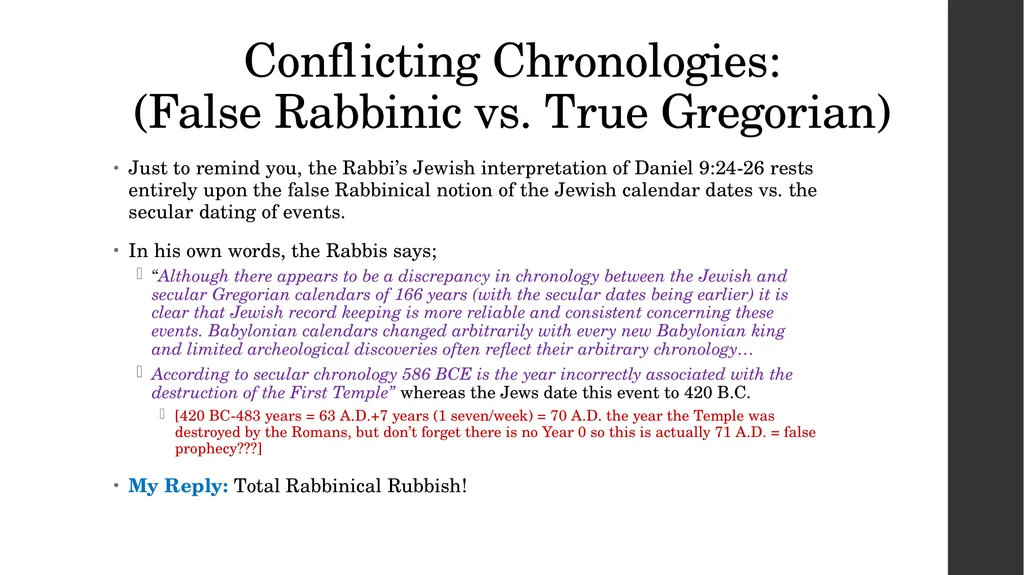
Conflicting Chronologies:
(False Rabbinic vs. True Gregorian) Just to remind you, the Rabbi’s Jewish interpretation of Daniel 9:24-26 rests entirely upon the false Rabbinical notion of the Jewish calendar dates vs. the secular dating of events.
In his own words, the Rabbis says;
“Although there appears to be a discrepancy in chronology between the Jewish and secular Gregorian calendars of 166 years (with the secular dates being earlier) it is clear that Jewish record keeping is more reliable and consistent concerning these events. Babylonian calendars changed arbitrarily with every new Babylonian king and limited archeological discoveries often reflect their arbitrary chronology…
According to secular chronology 586 BCE is the year incorrectly associated with the destruction of the First Temple” whereas the Jews date this event to 420 B.C.
[420 BC-483 years = 63 A.D.+7 years (1 seven/week) = 70 A.D. the year the Temple was destroyed by the Romans, but don’t forget there is no Year 0 so this is actually 71 A.D. = false prophecy???]
My Reply: Total Rabbinical Rubbish!<br>
19
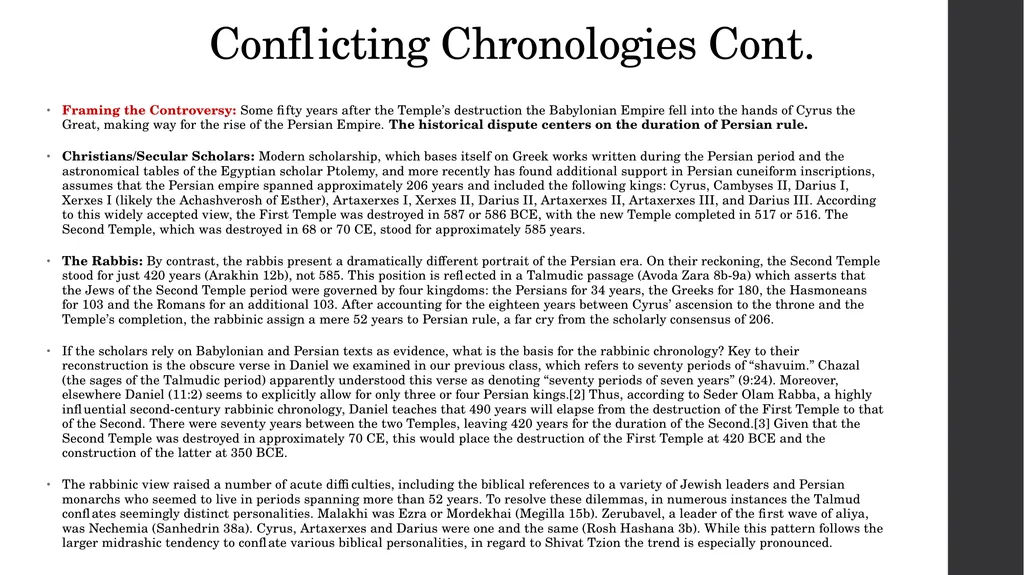
Conflicting Chronologies Cont. Framing the Controversy: Some fifty years after the Temple’s destruction the Babylonian Empire fell into the hands of Cyrus the Great, making way for the rise of the Persian Empire. The historical dispute centers on the duration of Persian rule.
Christians/Secular Scholars: Modern scholarship, which bases itself on Greek works written during the Persian period and the astronomical tables of the Egyptian scholar Ptolemy, and more recently has found additional support in Persian cuneiform inscriptions, assumes that the Persian empire spanned approximately 206 years and included the following kings: Cyrus, Cambyses II, Darius I, Xerxes I (likely the Achashverosh of Esther), Artaxerxes I, Xerxes II, Darius II, Artaxerxes II, Artaxerxes III, and Darius III. According to this widely accepted view, the First Temple was destroyed in 587 or 586 BCE, with the new Temple completed in 517 or 516. The Second Temple, which was destroyed in 68 or 70 CE, stood for approximately 585 years.
The Rabbis: By contrast, the rabbis present a dramatically different portrait of the Persian era. On their reckoning, the Second Temple stood for just 420 years (Arakhin 12b), not 585. This position is reflected in a Talmudic passage (Avoda Zara 8b-9a) which asserts that the Jews of the Second Temple period were governed by four kingdoms: the Persians for 34 years, the Greeks for 180, the Hasmoneans for 103 and the Romans for an additional 103. After accounting for the eighteen years between Cyrus’ ascension to the throne and the Temple’s completion, the rabbinic assign a mere 52 years to Persian rule, a far cry from the scholarly consensus of 206.
If the scholars rely on Babylonian and Persian texts as evidence, what is the basis for the rabbinic chronology? Key to their reconstruction is the obscure verse in Daniel we examined in our previous class, which refers to seventy periods of “shavuim.” Chazal (the sages of the Talmudic period) apparently understood this verse as denoting “seventy periods of seven years” (9:24). Moreover, elsewhere Daniel (11:2) seems to explicitly allow for only three or four Persian kings.[2] Thus, according to Seder Olam Rabba, a highly influential second-century rabbinic chronology, Daniel teaches that 490 years will elapse from the destruction of the First Temple to that of the Second. There were seventy years between the two Temples, leaving 420 years for the duration of the Second.[3] Given that the Second Temple was destroyed in approximately 70 CE, this would place the destruction of the First Temple at 420 BCE and the construction of the latter at 350 BCE.
The rabbinic view raised a number of acute difficulties, including the biblical references to a variety of Jewish leaders and Persian monarchs who seemed to live in periods spanning more than 52 years. To resolve these dilemmas, in numerous instances the Talmud conflates seemingly distinct personalities. Malakhi was Ezra or Mordekhai (Megilla 15b). Zerubavel, a leader of the first wave of aliya, was Nechemia (Sanhedrin 38a). Cyrus, Artaxerxes and Darius were one and the same (Rosh Hashana 3b). While this pattern follows the larger midrashic tendency to conflate various biblical personalities, in regard to Shivat Tzion the trend is especially pronounced.<br>
20
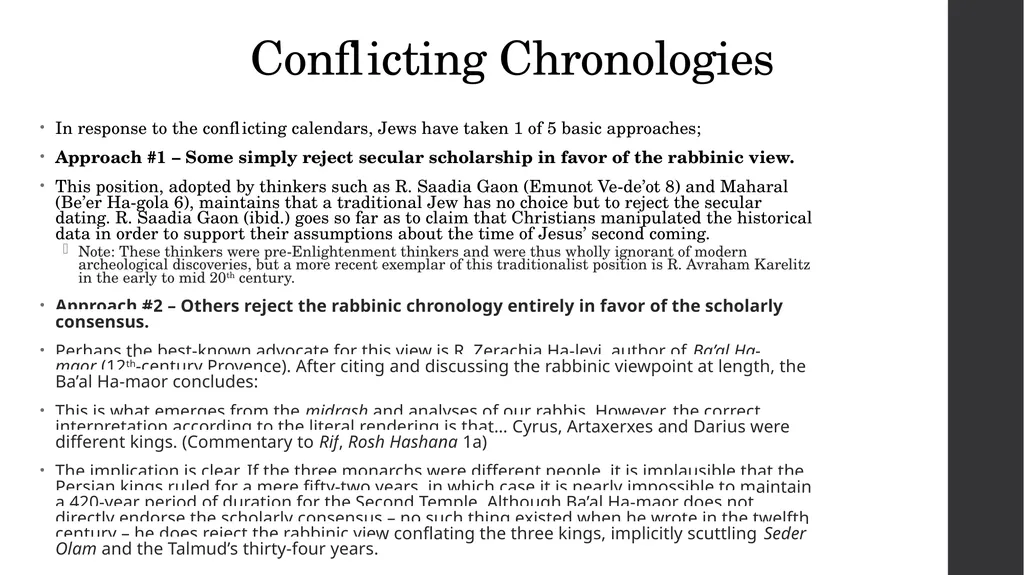
Conflicting Chronologies In response to the conflicting calendars, Jews have taken 1 of 5 basic approaches;
Approach #1 – Some simply reject secular scholarship in favor of the rabbinic view.
This position, adopted by thinkers such as R. Saadia Gaon (Emunot Ve-de’ot 8) and Maharal (Be’er Ha-gola 6), maintains that a traditional Jew has no choice but to reject the secular dating. R. Saadia Gaon (ibid.) goes so far as to claim that Christians manipulated the historical data in order to support their assumptions about the time of Jesus’ second coming.
Note: These thinkers were pre-Enlightenment thinkers and were thus wholly ignorant of modern archeological discoveries, but a more recent exemplar of this traditionalist position is R. Avraham Karelitz in the early to mid 20th century.
Approach #2 – Others reject the rabbinic chronology entirely in favor of the scholarly consensus.
Perhaps the best-known advocate for this view is R. Zerachia Ha-levi, author of Ba’al Ha-maor (12th-century Provence). After citing and discussing the rabbinic viewpoint at length, the Ba’al Ha-maor concludes:
This is what emerges from the midrash and analyses of our rabbis. However, the correct interpretation according to the literal rendering is that… Cyrus, Artaxerxes and Darius were different kings. (Commentary to Rif, Rosh Hashana 1a)
The implication is clear. If the three monarchs were different people, it is implausible that the Persian kings ruled for a mere fifty-two years, in which case it is nearly impossible to maintain a 420-year period of duration for the Second Temple. Although Ba’al Ha-maor does not directly endorse the scholarly consensus – no such thing existed when he wrote in the twelfth century – he does reject the rabbinic view conflating the three kings, implicitly scuttling Seder Olam and the Talmud’s thirty-four years.<br>
21
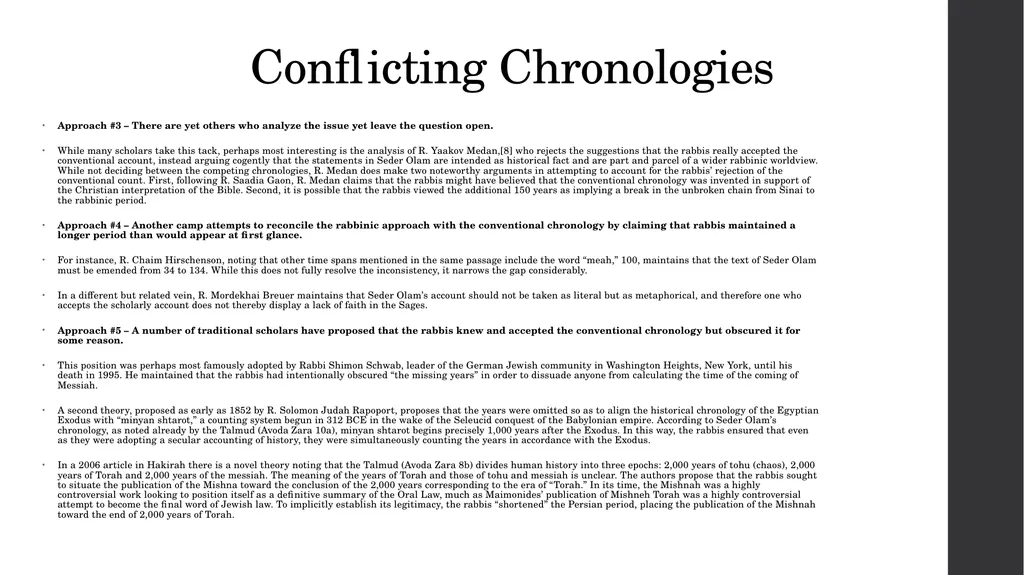
Conflicting Chronologies Approach #3 – There are yet others who analyze the issue yet leave the question open.
While many scholars take this tack, perhaps most interesting is the analysis of R. Yaakov Medan,[8] who rejects the suggestions that the rabbis really accepted the conventional account, instead arguing cogently that the statements in Seder Olam are intended as historical fact and are part and parcel of a wider rabbinic worldview. While not deciding between the competing chronologies, R. Medan does make two noteworthy arguments in attempting to account for the rabbis’ rejection of the conventional count. First, following R. Saadia Gaon, R. Medan claims that the rabbis might have believed that the conventional chronology was invented in support of the Christian interpretation of the Bible. Second, it is possible that the rabbis viewed the additional 150 years as implying a break in the unbroken chain from Sinai to the rabbinic period.
Approach #4 – Another camp attempts to reconcile the rabbinic approach with the conventional chronology by claiming that rabbis maintained a longer period than would appear at first glance.
For instance, R. Chaim Hirschenson, noting that other time spans mentioned in the same passage include the word “meah,” 100, maintains that the text of Seder Olam must be emended from 34 to 134. While this does not fully resolve the inconsistency, it narrows the gap considerably.
In a different but related vein, R. Mordekhai Breuer maintains that Seder Olam’s account should not be taken as literal but as metaphorical, and therefore one who accepts the scholarly account does not thereby display a lack of faith in the Sages.
Approach #5 – A number of traditional scholars have proposed that the rabbis knew and accepted the conventional chronology but obscured it for some reason.
This position was perhaps most famously adopted by Rabbi Shimon Schwab, leader of the German Jewish community in Washington Heights, New York, until his death in 1995. He maintained that the rabbis had intentionally obscured “the missing years” in order to dissuade anyone from calculating the time of the coming of Messiah.
A second theory, proposed as early as 1852 by R. Solomon Judah Rapoport, proposes that the years were omitted so as to align the historical chronology of the Egyptian Exodus with “minyan shtarot,” a counting system begun in 312 BCE in the wake of the Seleucid conquest of the Babylonian empire. According to Seder Olam’s chronology, as noted already by the Talmud (Avoda Zara 10a), minyan shtarot begins precisely 1,000 years after the Exodus. In this way, the rabbis ensured that even as they were adopting a secular accounting of history, they were simultaneously counting the years in accordance with the Exodus.
In a 2006 article in Hakirah there is a novel theory noting that the Talmud (Avoda Zara 8b) divides human history into three epochs: 2,000 years of tohu (chaos), 2,000 years of Torah and 2,000 years of the messiah. The meaning of the years of Torah and those of tohu and messiah is unclear. The authors propose that the rabbis sought to situate the publication of the Mishna toward the conclusion of the 2,000 years corresponding to the era of “Torah.” In its time, the Mishnah was a highly controversial work looking to position itself as a definitive summary of the Oral Law, much as Maimonides’ publication of Mishneh Torah was a highly controversial attempt to become the final word of Jewish law. To implicitly establish its legitimacy, the rabbis “shortened” the Persian period, placing the publication of the Mishnah toward the end of 2,000 years of Torah.<br>
22
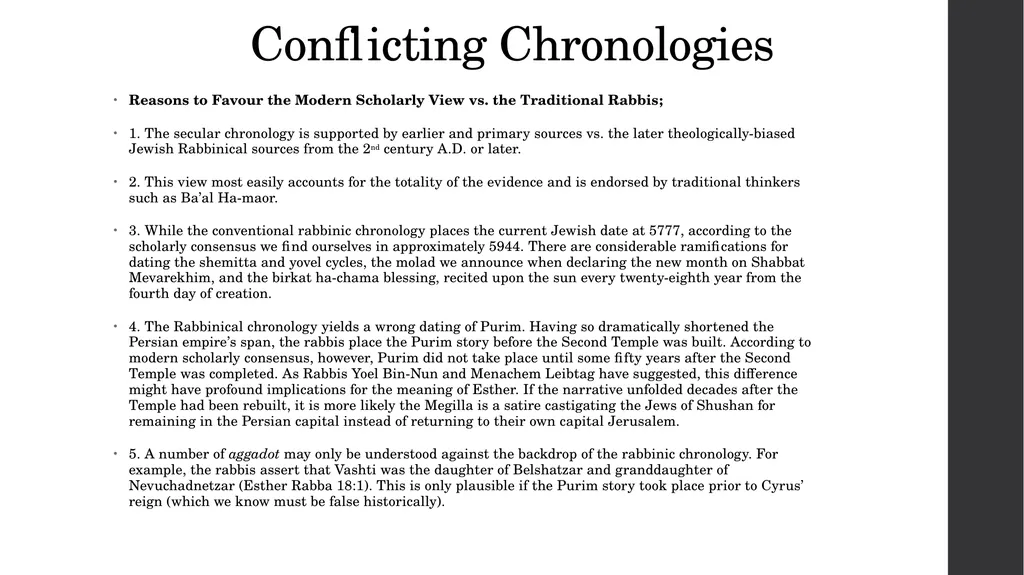
Conflicting Chronologies Reasons to Favour the Modern Scholarly View vs. the Traditional Rabbis;
1. The secular chronology is supported by earlier and primary sources vs. the later theologically-biased Jewish Rabbinical sources from the 2nd century A.D. or later.
2. This view most easily accounts for the totality of the evidence and is endorsed by traditional thinkers such as Ba’al Ha-maor.
3. While the conventional rabbinic chronology places the current Jewish date at 5777, according to the scholarly consensus we find ourselves in approximately 5944. There are considerable ramifications for dating the shemitta and yovel cycles, the molad we announce when declaring the new month on Shabbat Mevarekhim, and the birkat ha-chama blessing, recited upon the sun every twenty-eighth year from the fourth day of creation.
4. The Rabbinical chronology yields a wrong dating of Purim. Having so dramatically shortened the Persian empire’s span, the rabbis place the Purim story before the Second Temple was built. According to modern scholarly consensus, however, Purim did not take place until some fifty years after the Second Temple was completed. As Rabbis Yoel Bin-Nun and Menachem Leibtag have suggested, this difference might have profound implications for the meaning of Esther. If the narrative unfolded decades after the Temple had been rebuilt, it is more likely the Megilla is a satire castigating the Jews of Shushan for remaining in the Persian capital instead of returning to their own capital Jerusalem.
5. A number of aggadot may only be understood against the backdrop of the rabbinic chronology. For example, the rabbis assert that Vashti was the daughter of Belshatzar and granddaughter of Nevuchadnetzar (Esther Rabba 18:1). This is only plausible if the Purim story took place prior to Cyrus’ reign (which we know must be false historically).<br>
23
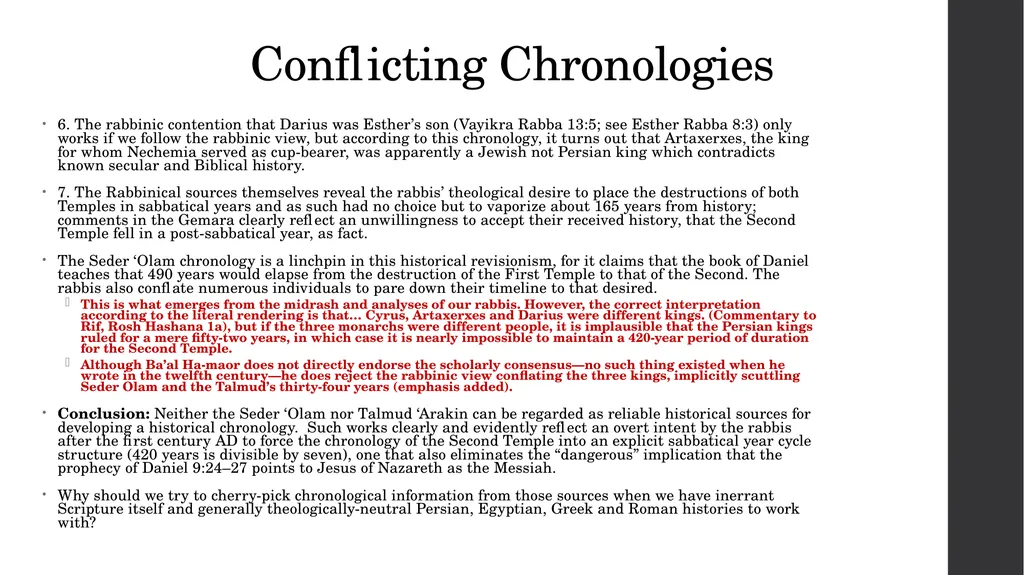
Conflicting Chronologies 6. The rabbinic contention that Darius was Esther’s son (Vayikra Rabba 13:5; see Esther Rabba 8:3) only works if we follow the rabbinic view, but according to this chronology, it turns out that Artaxerxes, the king for whom Nechemia served as cup-bearer, was apparently a Jewish not Persian king which contradicts known secular and Biblical history.
7. The Rabbinical sources themselves reveal the rabbis’ theological desire to place the destructions of both Temples in sabbatical years and as such had no choice but to vaporize about 165 years from history; comments in the Gemara clearly reflect an unwillingness to accept their received history, that the Second Temple fell in a post-sabbatical year, as fact.
The Seder ‘Olam chronology is a linchpin in this historical revisionism, for it claims that the book of Daniel teaches that 490 years would elapse from the destruction of the First Temple to that of the Second. The rabbis also conflate numerous individuals to pare down their timeline to that desired.
This is what emerges from the midrash and analyses of our rabbis. However, the correct interpretation according to the literal rendering is that… Cyrus, Artaxerxes and Darius were different kings. (Commentary to Rif, Rosh Hashana 1a), but if the three monarchs were different people, it is implausible that the Persian kings ruled for a mere fifty-two years, in which case it is nearly impossible to maintain a 420-year period of duration for the Second Temple.
Although Ba’al Ha-maor does not directly endorse the scholarly consensus—no such thing existed when he wrote in the twelfth century—he does reject the rabbinic view conflating the three kings, implicitly scuttling Seder Olam and the Talmud’s thirty-four years (emphasis added).
Conclusion: Neither the Seder ‘Olam nor Talmud ‘Arakin can be regarded as reliable historical sources for developing a historical chronology. Such works clearly and evidently reflect an overt intent by the rabbis after the first century AD to force the chronology of the Second Temple into an explicit sabbatical year cycle structure (420 years is divisible by seven), one that also eliminates the “dangerous” implication that the prophecy of Daniel 9:24–27 points to Jesus of Nazareth as the Messiah.
Why should we try to cherry-pick chronological information from those sources when we have inerrant Scripture itself and generally theologically-neutral Persian, Egyptian, Greek and Roman histories to work with?<br>
24
Jesus or BUST?
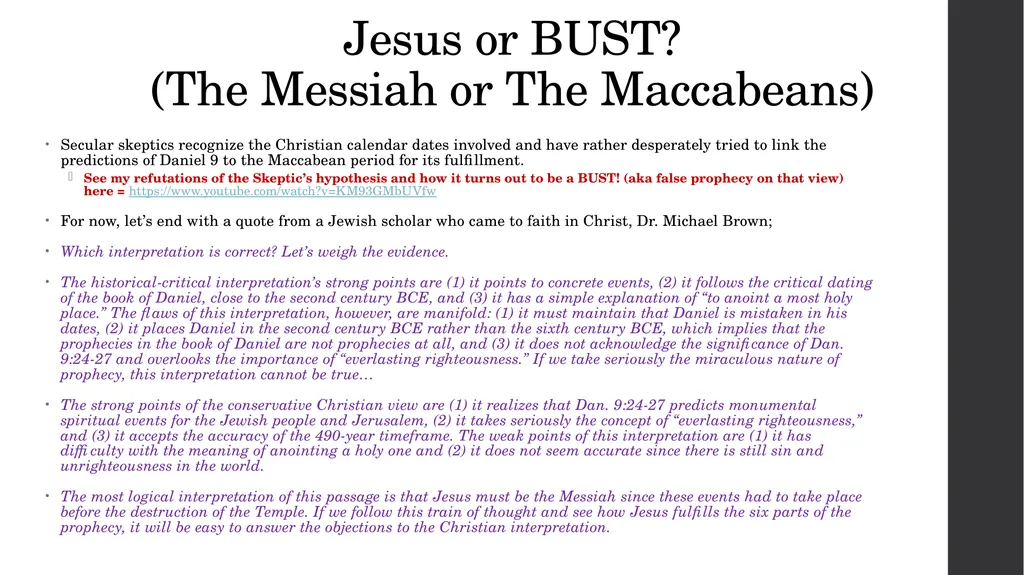
(The Messiah or The Maccabeans) Secular skeptics recognize the Christian calendar dates involved and have rather desperately tried to link the predictions of Daniel 9 to the Maccabean period for its fulfillment.
See my refutations of the Skeptic’s hypothesis and how it turns out to be a BUST! (aka false prophecy on that view) here = https://www.youtube.com/watch?v=KM93GMbUVfw
For now, let’s end with a quote from a Jewish scholar who came to faith in Christ, Dr. Michael Brown;
Which interpretation is correct? Let’s weigh the evidence.
The historical-critical interpretation’s strong points are (1) it points to concrete events, (2) it follows the critical dating of the book of Daniel, close to the second century BCE, and (3) it has a simple explanation of “to anoint a most holy place.” The flaws of this interpretation, however, are manifold: (1) it must maintain that Daniel is mistaken in his dates, (2) it places Daniel in the second century BCE rather than the sixth century BCE, which implies that the prophecies in the book of Daniel are not prophecies at all, and (3) it does not acknowledge the significance of Dan. 9:24-27 and overlooks the importance of “everlasting righteousness.” If we take seriously the miraculous nature of prophecy, this interpretation cannot be true…
The strong points of the conservative Christian view are (1) it realizes that Dan. 9:24-27 predicts monumental spiritual events for the Jewish people and Jerusalem, (2) it takes seriously the concept of “everlasting righteousness,” and (3) it accepts the accuracy of the 490-year timeframe. The weak points of this interpretation are (1) it has difficulty with the meaning of anointing a holy one and (2) it does not seem accurate since there is still sin and unrighteousness in the world.
The most logical interpretation of this passage is that Jesus must be the Messiah since these events had to take place before the destruction of the Temple. If we follow this train of thought and see how Jesus fulfills the six parts of the prophecy, it will be easy to answer the objections to the Christian interpretation.<br>
25
END OF PRESENTATION!<br>
26
Rough Notes /Slides
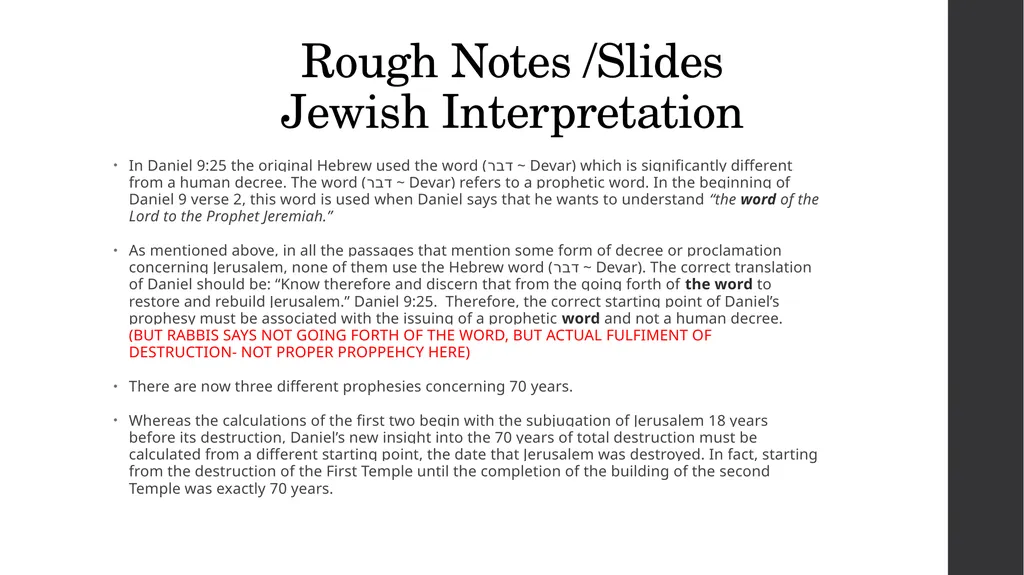
Jewish Interpretation In Daniel 9:25 the original Hebrew used the word (דבר ~ Devar) which is significantly different from a human decree. The word (דבר ~ Devar) refers to a prophetic word. In the beginning of Daniel 9 verse 2, this word is used when Daniel says that he wants to understand “the word of the Lord to the Prophet Jeremiah.”
As mentioned above, in all the passages that mention some form of decree or proclamation concerning Jerusalem, none of them use the Hebrew word (דבר ~ Devar). The correct translation of Daniel should be: “Know therefore and discern that from the going forth of the word to restore and rebuild Jerusalem.” Daniel 9:25. Therefore, the correct starting point of Daniel’s prophesy must be associated with the issuing of a prophetic word and not a human decree. (BUT RABBIS SAYS NOT GOING FORTH OF THE WORD, BUT ACTUAL FULFIMENT OF DESTRUCTION- NOT PROPER PROPPEHCY HERE)
There are now three different prophesies concerning 70 years.
Whereas the calculations of the first two begin with the subjugation of Jerusalem 18 years before its destruction, Daniel’s new insight into the 70 years of total destruction must be calculated from a different starting point, the date that Jerusalem was destroyed. In fact, starting from the destruction of the First Temple until the completion of the building of the second Temple was exactly 70 years.<br>
27
Jewish Interpretation Remember there are two anointed subjects, one after 7 weeks and another after an additional 62 weeks.
The first “anointed” individual identified as a prince/leader in Daniel 9:25 is King Cyrus, who came 7 weeks of years after the destruction of Jerusalem. Then from Cyrus' Decree to rebuild Jerusalem, “it will be built again” for an additional 62 weeks (434 years). But “in troubled times,” Daniel 9:25, meaning under the foreign domination of the subsequent Persian, Greek and Roman rule. The Greek is mentioned in Daniel 11:2 and Roman alluded to in Daniel 1:30 where the word (כתים ~ Kittim) refers to the Roman capital of Constantinople)
Then in the 69th week (483 years) after the destruction of the First Temple and 1 week (7 years) before the destruction of the second Temple, an anointed one is cut off. The fact that there is no definite article indicates that this can refer to several different anointed subjects. King Agrippa the last King of Israel (Kings are considered anointed as it says in 1 Chronicles 11:3) who was killed during this time. It also refers to the last High priest (priests are anointed as seen in Leviticus 4) and the sacrifices (indicated in Leviticus 8:10-11). All three subjects were considered anointed and were cut off during the final week before the destruction of the second Temple.
“The people of the prince will come and destroy the city and the Sanctuary.” Daniel 9:26, refers to the Roman legions of Vespasian and Titus who destroyed Jerusalem.
Additionally, the sacrificial system (that was anointed) ceased during this last week before the completion of the total 70 weeks of 490 years, as it says, “during half of a week he will abolish sacrifice and meal-offerings” Daniel 9:27 Historically during the years before the destruction of the second Temple, the Romans set up idolatry in the Temple fulfilling the final verse in Daniel 9 that says; “upon wings of abomination shall come one who makes desolate until the decreed destruction is poured out desolator.” Daniel 9:27
The Romans, who are often symbolized by the Eagle Wings resting on their standards, would desecrate the Temple with idolatry; destroy the Temple that would remain desolate until the Roman exile is finished with the advent of the true Messianic age of complete peace, tranquility, and knowledge of God. Today’s exile is considered an extension of the Roman exile that has lasted more than 2,000 years.<br>
28
Jewish Interpretation In Daniel 9 the original 70 years are from the destruction of the First Temple until the building of the second. If they had returned whole-heartedly there would have been no need for the Second Temple to be destroyed and the events listed in verse 24 would have been fulfilled.
“Seventy weeks (490 years) are determined upon your people and upon your holy city, to finish the transgression and to make an end of sins and to make reconciliation for iniquity(atone for there past transgressions), and to bring in everlasting righteousness (Temple service that brings righteousness), and to seal up the vision and prophecy (fulfill the promises of the prophets and end the prophetic era) and, and to anoint the Holy of Holies (the Temple)” Daniel 9:24
The angel Gabriel reveals to Daniel this additional understanding of the 70 years extending them from 70 years to 70 weeks of years stretching the time span to 490 years that span from the destruction of the First Temple to the Destruction of the second Temple. This prophecy also included a description of events that would unfold if the Jewish people did not repent properly.
These are the 70 years for the first exile (52 years until Cyrus and 18 additional years to dedicate the second Temple) and 420 years of the second temple.
Although there appears to be a discrepancy in chronology between the Jewish and secular Gregorian calendars of 166 years (with the secular dates earlier) it is clear that Jewish record keeping is more reliable and consistent concerning these events. Babylonian calendars changed arbitrarily with every new Babylonian king and limited archeological discoveries often reflect their arbitrary chronology. (According to secular chronology 586 BCE is the year incorrectly associated with the destruction of the First Temple the Jewish)<br>