Relative Pronouns and Relative Clauses LO: To identify and use relative pronouns When is it a pronoun and when is it a determiner? Discuss with your partner What is the difference between a possessive pronoun and a possessive determiner?
"Relative Pronouns and Relative Clauses LO: To" is the property of its rightful owner. Permission is granted to
download and print the materials on this website for personal, non-commercial use only, and to display it
on your personal computer provided you do not modify the materials and that you retain all copyright
notices contained in the materials. By downloading content from our website, you accept the terms of this
agreement.
Presentation Transcript
01
Relative Pronouns and Relative Clauses LO: To identify and use relative pronouns<br>
02
When is it a pronoun and when is it a determiner? Discuss with your partner…
What is the difference between a possessive pronoun and a possessive determiner?
Write an explanation on your white board.
For example:
‘His’ and ‘her’ are possessive determiners. Why?
But ‘his’ can also be a possessive pronoun. When?<br>
03
The answer… If it looks like a ‘pronoun’ (takes the place of a noun) but is before a noun, then it is a determiner.
E.g.
The boy asked his father for a pay rise – he felt that the promotion to ‘Chief Executive Dishwasher’ was his.
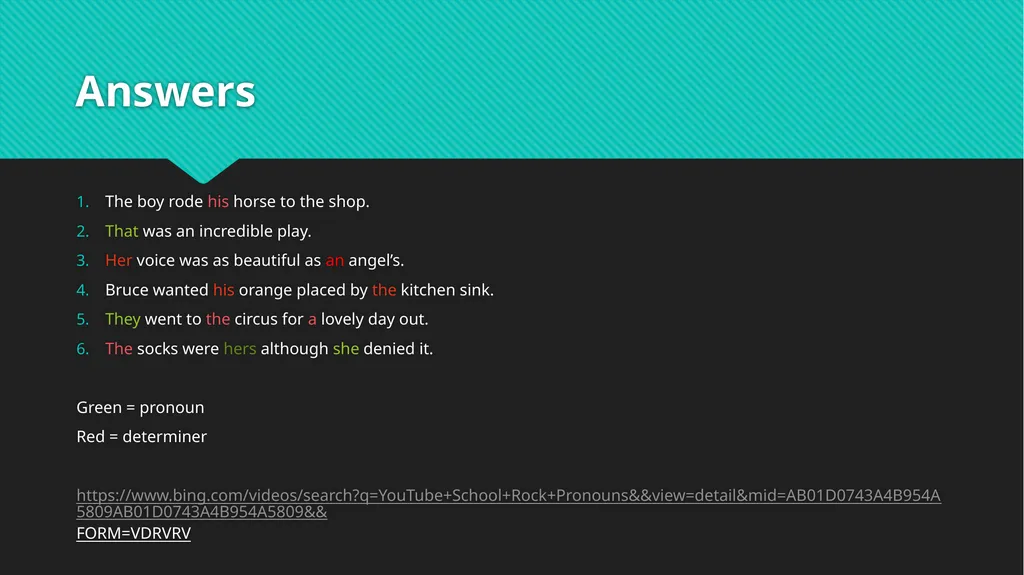
Red = determiner
Green = pronoun<br>
04
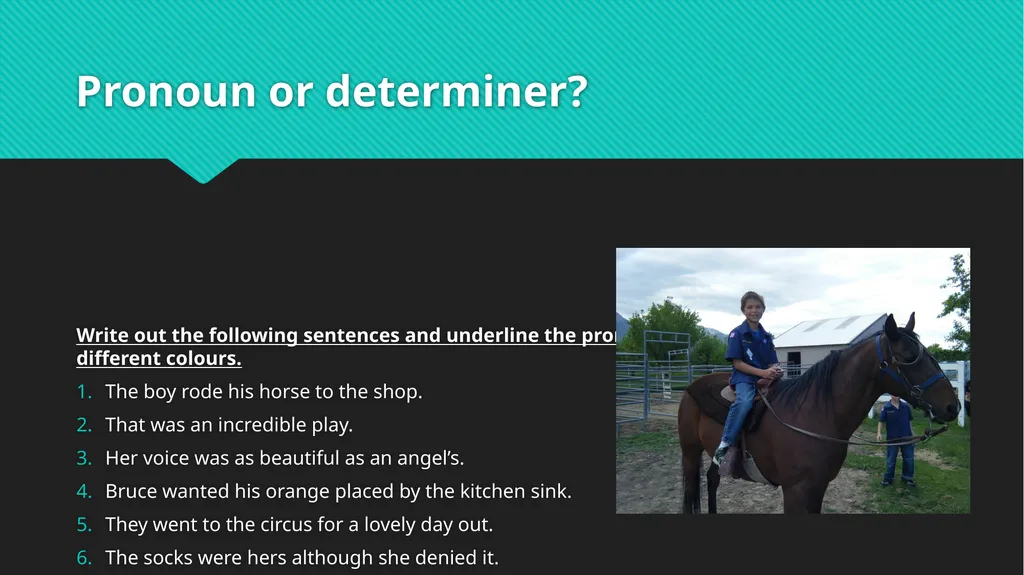
Pronoun or determiner? Write out the following sentences and underline the pronouns and determiners in different colours.
The boy rode his horse to the shop.
That was an incredible play.
Her voice was as beautiful as an angel’s.
Bruce wanted his orange placed by the kitchen sink.
They went to the circus for a lovely day out.
The socks were hers although she denied it.<br>
05
Answers The boy rode his horse to the shop.
That was an incredible play.
Her voice was as beautiful as an angel’s.
Bruce wanted his orange placed by the kitchen sink.
They went to the circus for a lovely day out.
The socks were hers although she denied it.
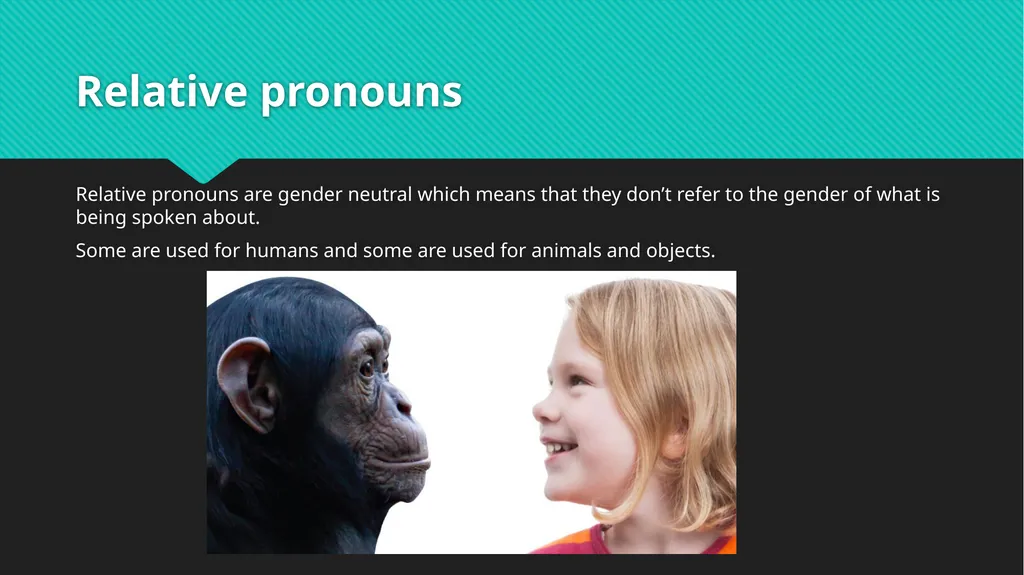
Relative pronouns Relative pronouns are gender neutral which means that they don’t refer to the gender of what is being spoken about.
Some are used for humans and some are used for animals and objects.<br>
08
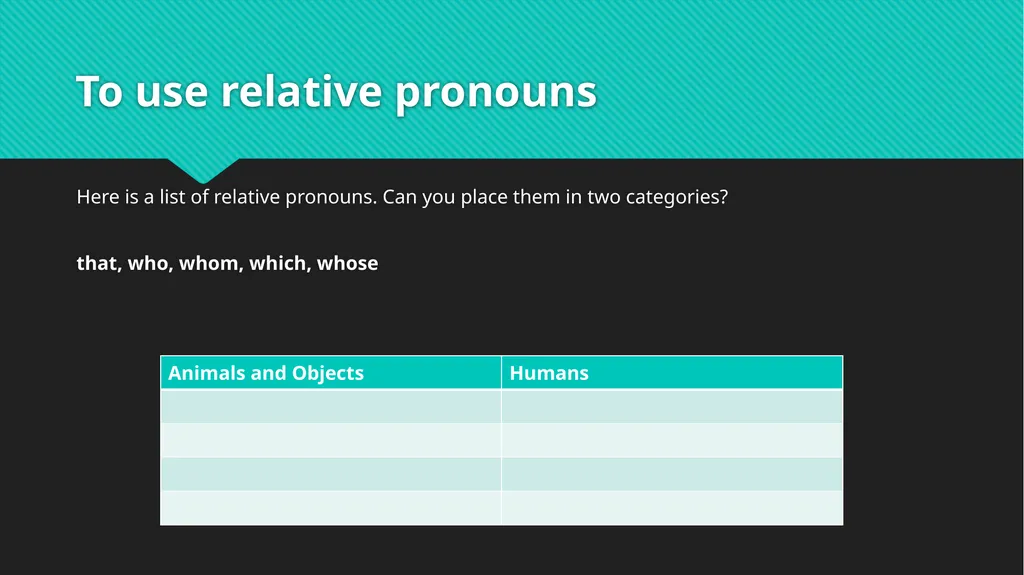
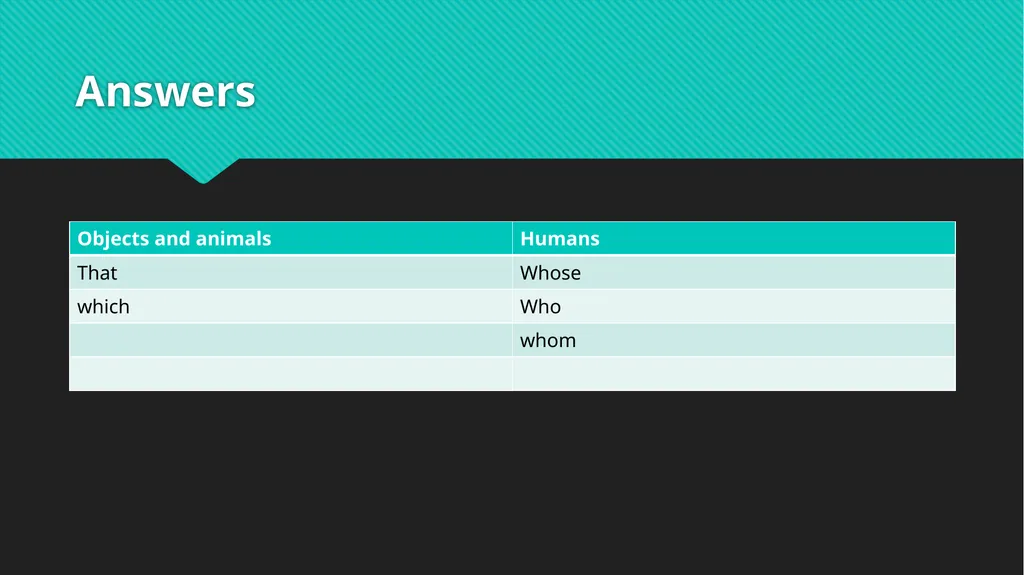
To use relative pronouns Here is a list of relative pronouns. Can you place them in two categories?
that, who, whom, which, whose<br>
09
Answers<br>
10
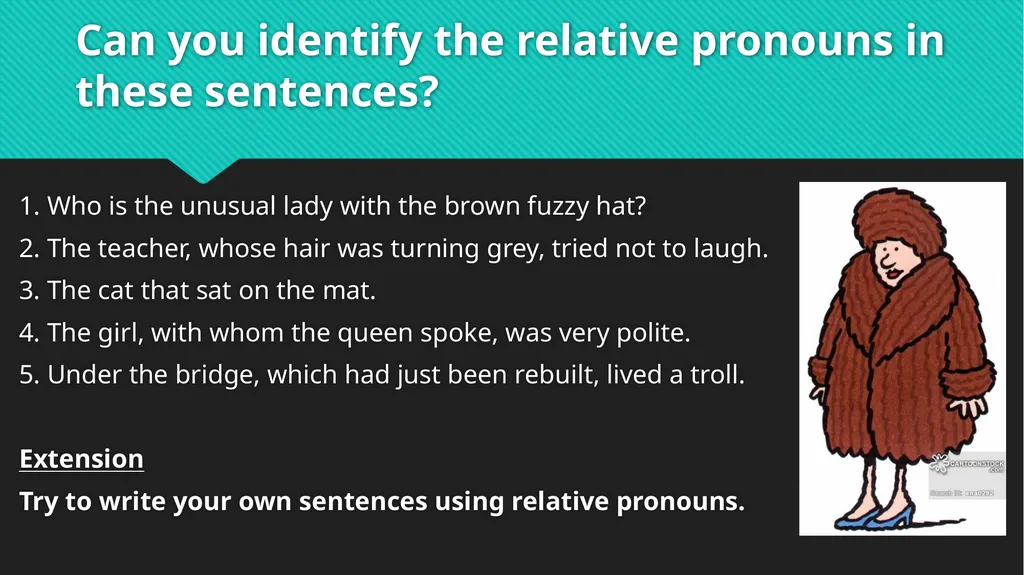
Can you identify the relative pronouns in these sentences? 1. Who is the unusual lady with the brown fuzzy hat?
2. The teacher, whose hair was turning grey, tried not to laugh.
3. The cat that sat on the mat.
4. The girl, with whom the queen spoke, was very polite.
5. Under the bridge, which had just been rebuilt, lived a troll.
Extension
Try to write your own sentences using relative pronouns.<br>
11
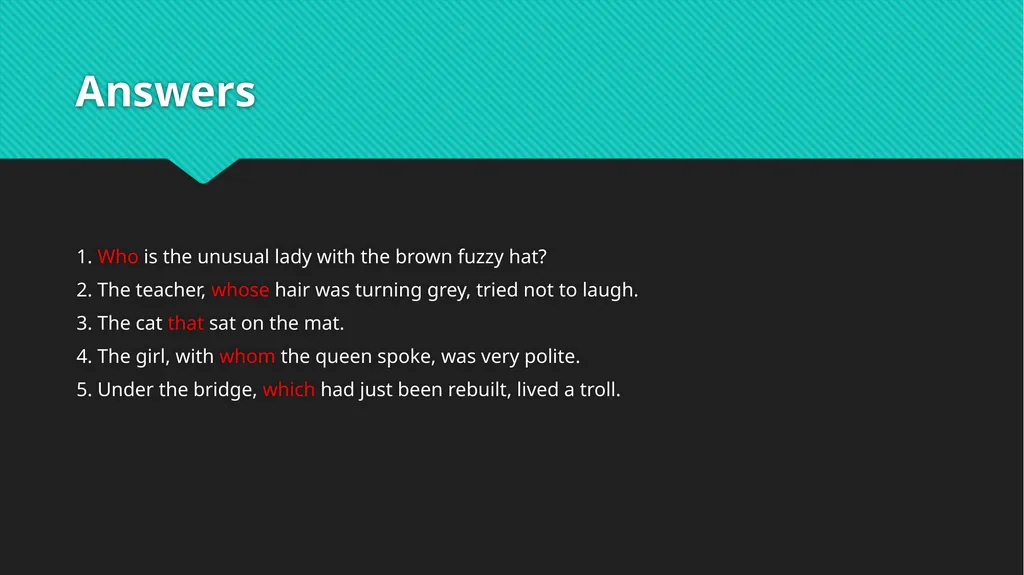
Answers 1. Who is the unusual lady with the brown fuzzy hat?
2. The teacher, whose hair was turning grey, tried not to laugh.
3. The cat that sat on the mat.
4. The girl, with whom the queen spoke, was very polite.
5. Under the bridge, which had just been rebuilt, lived a troll.<br>
12
LO: To use relative pronouns to produce relative clauses<br>
13
Clauses Recap Talk to your partner. You have learnt about two different types of clauses. What are they?<br>
14
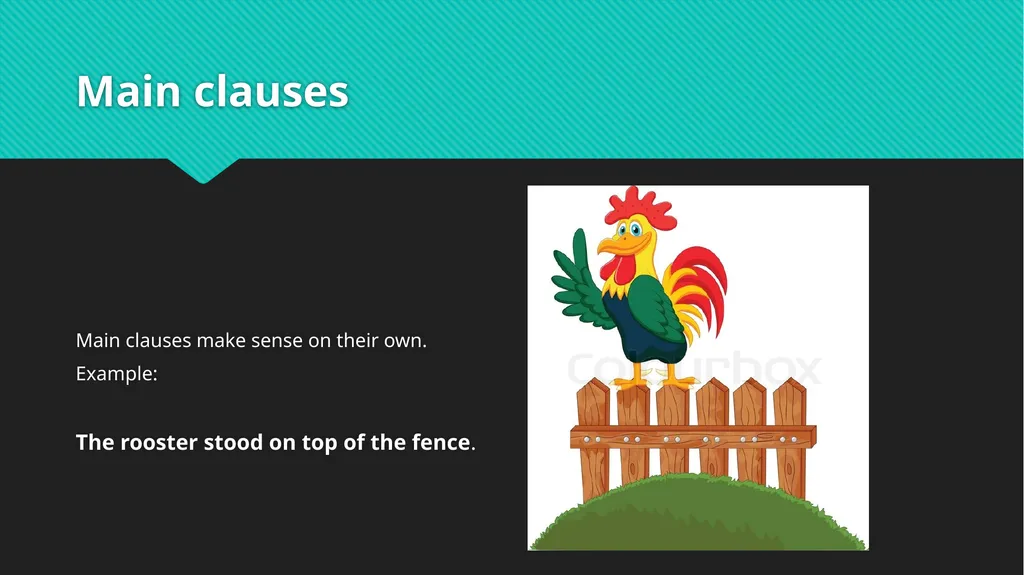
Main clauses Main clauses make sense on their own.
Example:
The rooster stood on top of the fence.<br>
15
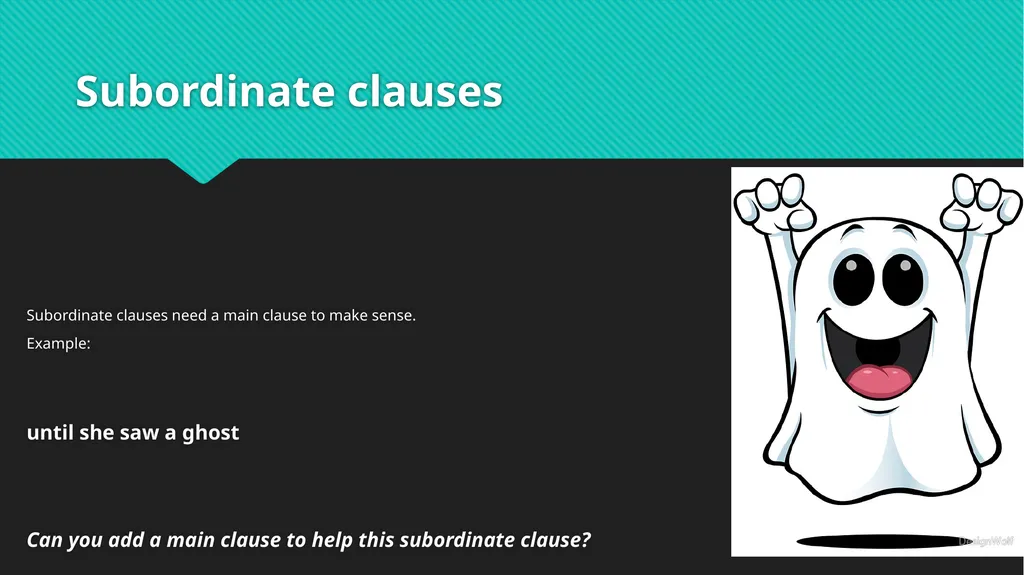
Subordinate clauses Subordinate clauses need a main clause to make sense.
Example:
until she saw a ghost
Can you add a main clause to help this subordinate clause?<br>
16
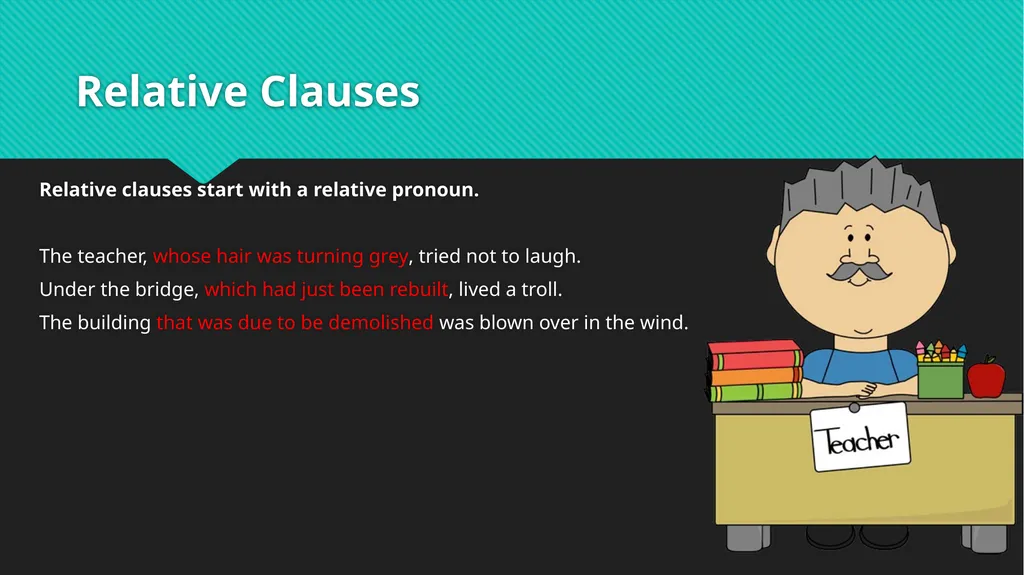
Relative Clauses Relative clauses start with a relative pronoun.
The teacher, whose hair was turning grey, tried not to laugh.
Under the bridge, which had just been rebuilt, lived a troll.
The building that was due to be demolished was blown over in the wind.<br>
17
Let’s identify some relative clauses Tarzan, who fell into a frying pan, now has a tan.
Jane, whose aeroplane crashed into traffic lane, got hurt.
The cheetah, that danced on a pizza, got grease on his feet.
What do you notice about these clauses? What do they have in common?
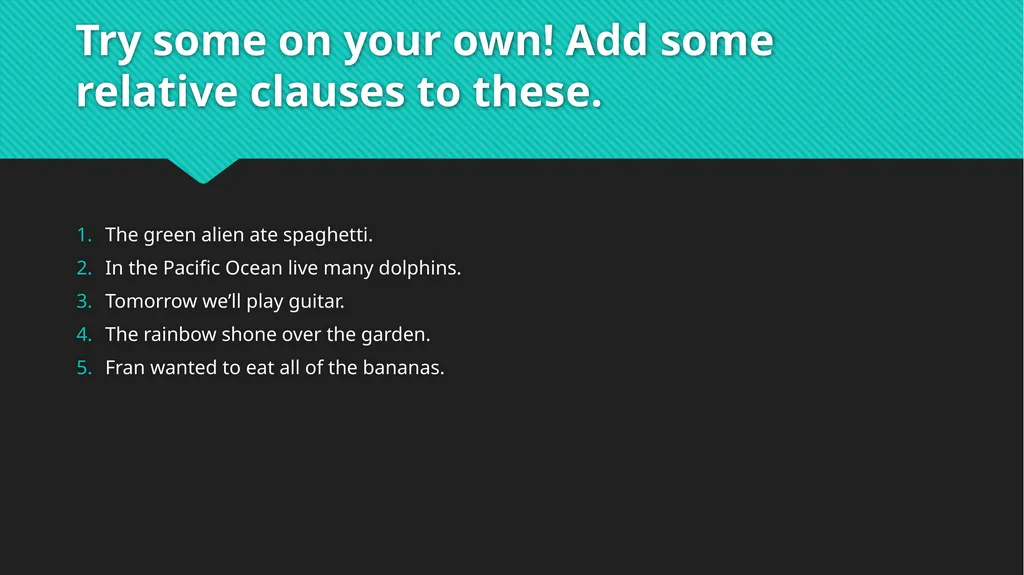
Try some on your own! Add some relative clauses to these. The green alien ate spaghetti.
In the Pacific Ocean live many dolphins.
Tomorrow we’ll play guitar.
The rainbow shone over the garden.
Fran wanted to eat all of the bananas.<br>