
Reproductive organs of cattle Paper 1: Question 4
LD
Published · 65 slides · 0 views

1 / 1
Description
Reproductive organs of cattle Paper 1: Question 4 : 35 marks Reproductive Organs in the Male Crura (pl) Retractor Penis Muscle Cowpers Gland Caput Epididymis Cauda Epididymis Testis Scrotum Glans Penis Retractor Penis Muscle Sigmoid Flexure
Related Topics
Share
Embed code
Download this presentation From Below
"Reproductive organs of cattle Paper 1: Question 4" is the property of its rightful owner. Permission is granted to download and print the materials on this website for personal, non-commercial use only, and to display it on your personal computer provided you do not modify the materials and that you retain all copyright notices contained in the materials. By downloading content from our website, you accept the terms of this agreement.
Presentation Transcript
01
Reproductive organs of cattle Paper 1: Question 4 : 35 marks<br>
02
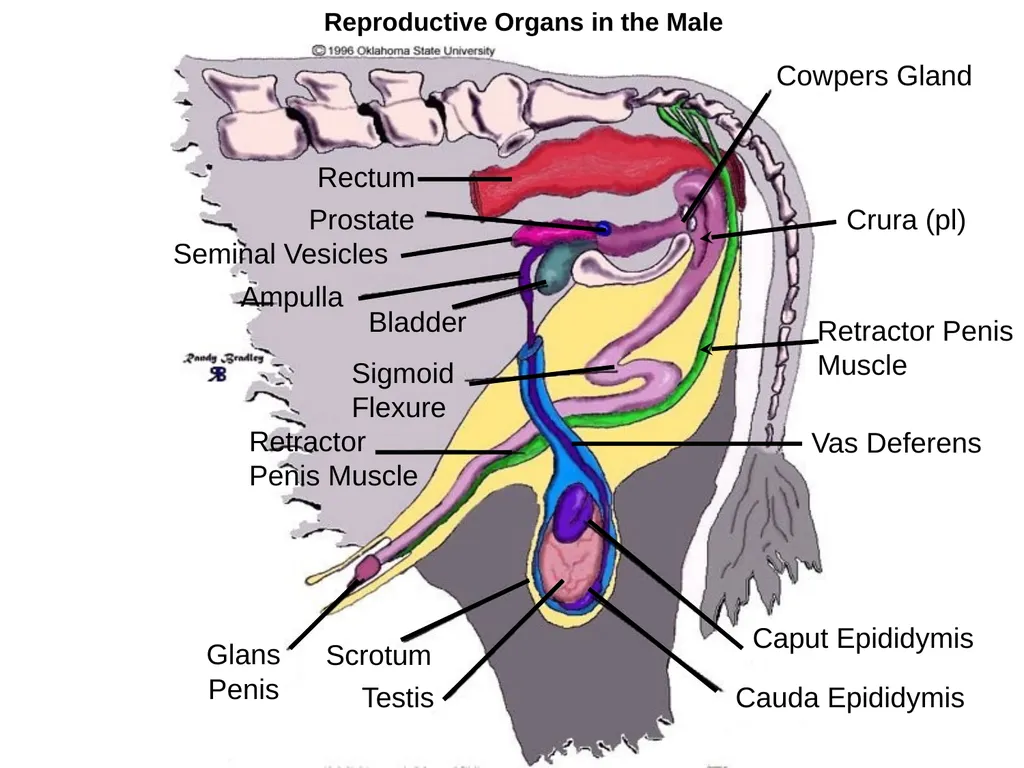
Reproductive Organs in the Male Crura (pl) Retractor Penis
Muscle Cowpers Gland Caput Epididymis Cauda Epididymis Testis Scrotum Glans
Penis Retractor
Penis Muscle Sigmoid
Flexure Bladder Ampulla Seminal Vesicles Prostate Rectum Vas Deferens<br>
Muscle Cowpers Gland Caput Epididymis Cauda Epididymis Testis Scrotum Glans
Penis Retractor
Penis Muscle Sigmoid
Flexure Bladder Ampulla Seminal Vesicles Prostate Rectum Vas Deferens<br>
03
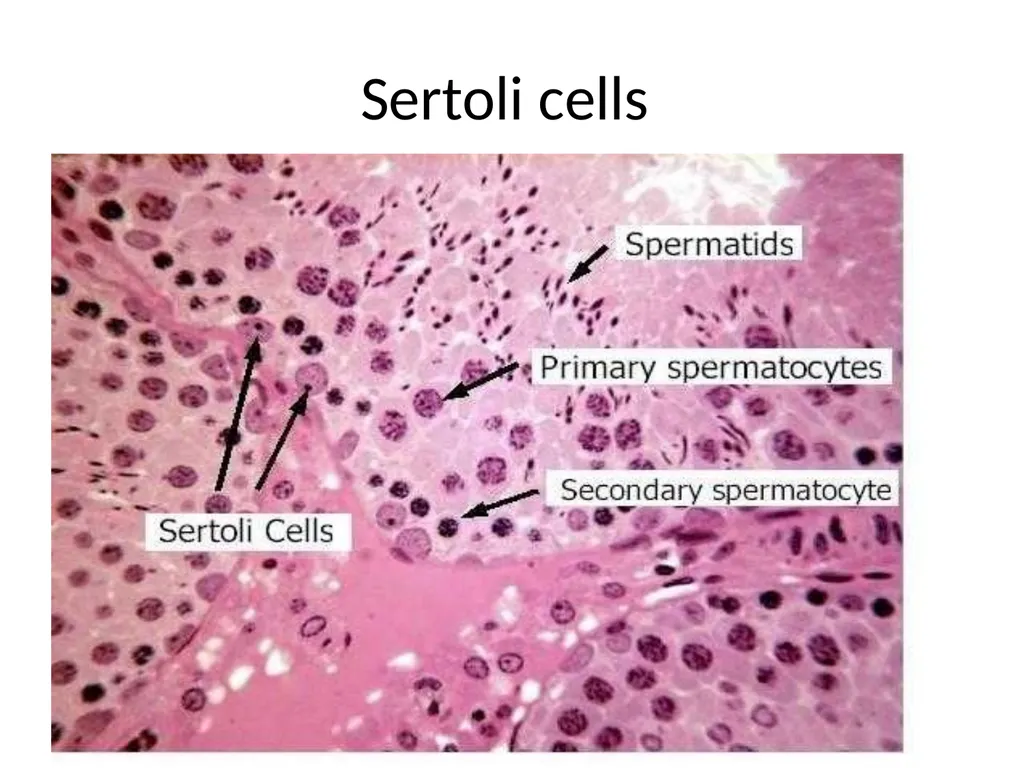
Sertoli cells<br>
04
Functions of the testes The testes are exocrine organs producing the male gametes (spermatozoa).
The testes are also endocrine organs secreting the male sex hormone testosterone.
Semen is stored in the testes.<br>
The testes are also endocrine organs secreting the male sex hormone testosterone.
Semen is stored in the testes.<br>
05
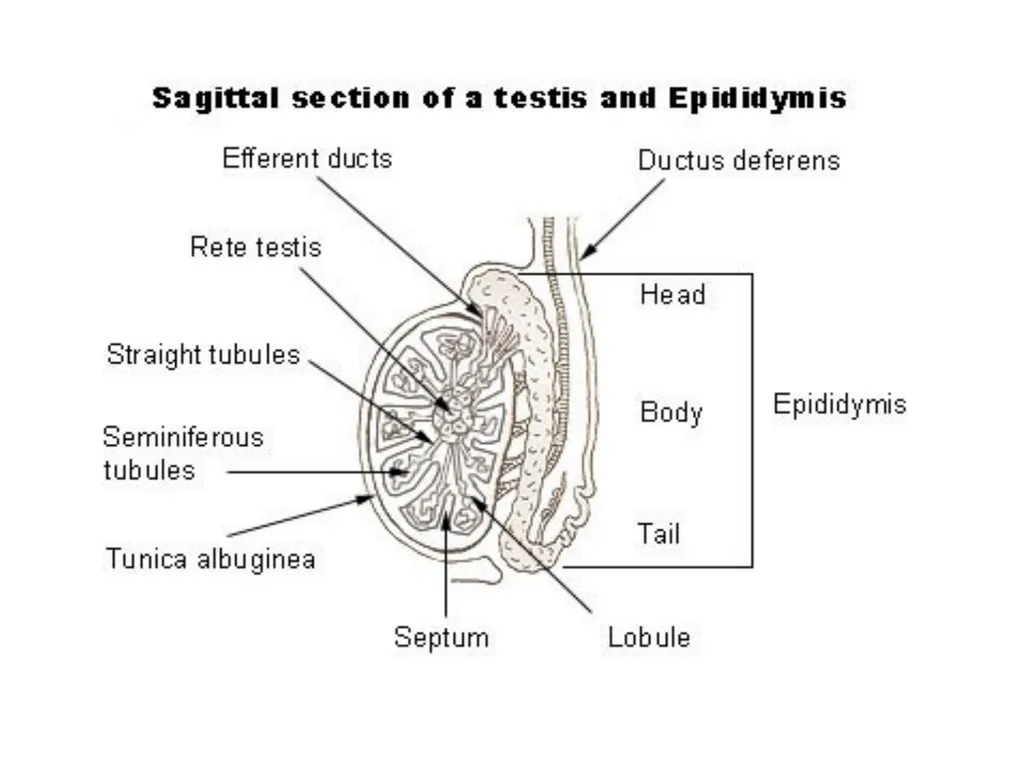
Epididymis Consists of three parts:
Head (caput epididymis), which is connected to the vasa efferentia
Body ( corpus epididymis)
Tail (cauda epididymis), which goes over into the vas defe1ens.<br>
Head (caput epididymis), which is connected to the vasa efferentia
Body ( corpus epididymis)
Tail (cauda epididymis), which goes over into the vas defe1ens.<br>
06
Functions of the epididymis It acts as a transport organ for the developing sperms to the vas deferens
It is a storage organ for sperm
The sperm matures and becomes fully mobile in the epididymis
The epididymis secretes a buffer that protects the sperm from the acid secretions of the female sex organs.<br>
It is a storage organ for sperm
The sperm matures and becomes fully mobile in the epididymis
The epididymis secretes a buffer that protects the sperm from the acid secretions of the female sex organs.<br>
07
Scrotum “The scrotum is a two-lobed sac (layer of skin) that encloses the testes. The scrotum wall consists of three layers:
The outer skin layer
The smooth central
The inner layer
Functions of the scrotum
The scrotum regulates the temperature for spermatogenesis.
The scrotum and spermatic cord hold and support the testes.<br>
The outer skin layer
The smooth central
The inner layer
Functions of the scrotum
The scrotum regulates the temperature for spermatogenesis.
The scrotum and spermatic cord hold and support the testes.<br>
08
Accessory sex glands Vesicular glands (seminal vesicles)
Prostate
Bulbo-urethral glands (Cowper’s glands)
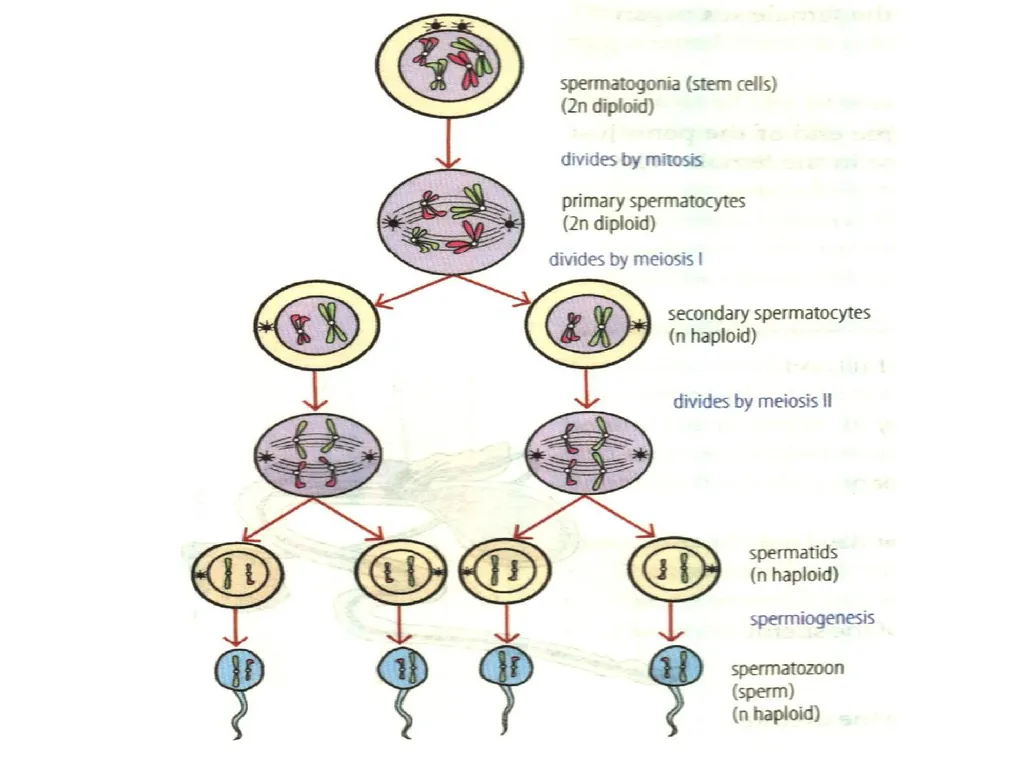
SPERMATOGENESIS PROCESSES:
The spermatogonium divides through mitosis to form two primary spermatocytes. This process takes about 15 days.<br>
Prostate
Bulbo-urethral glands (Cowper’s glands)
SPERMATOGENESIS PROCESSES:
The spermatogonium divides through mitosis to form two primary spermatocytes. This process takes about 15 days.<br>
09
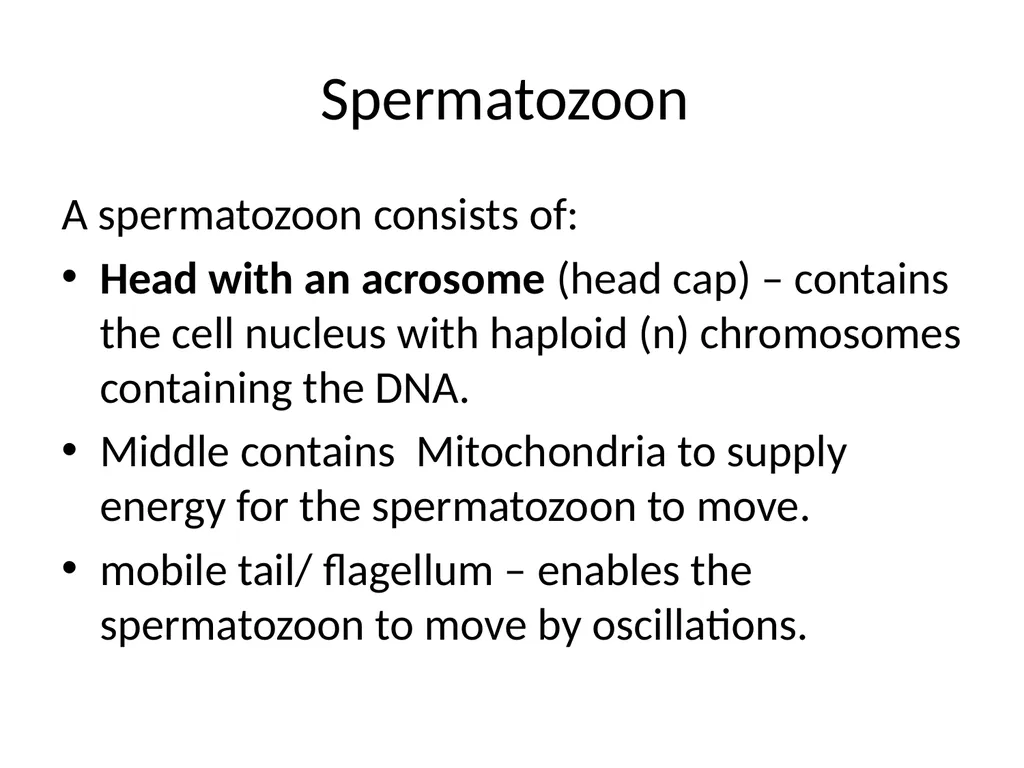
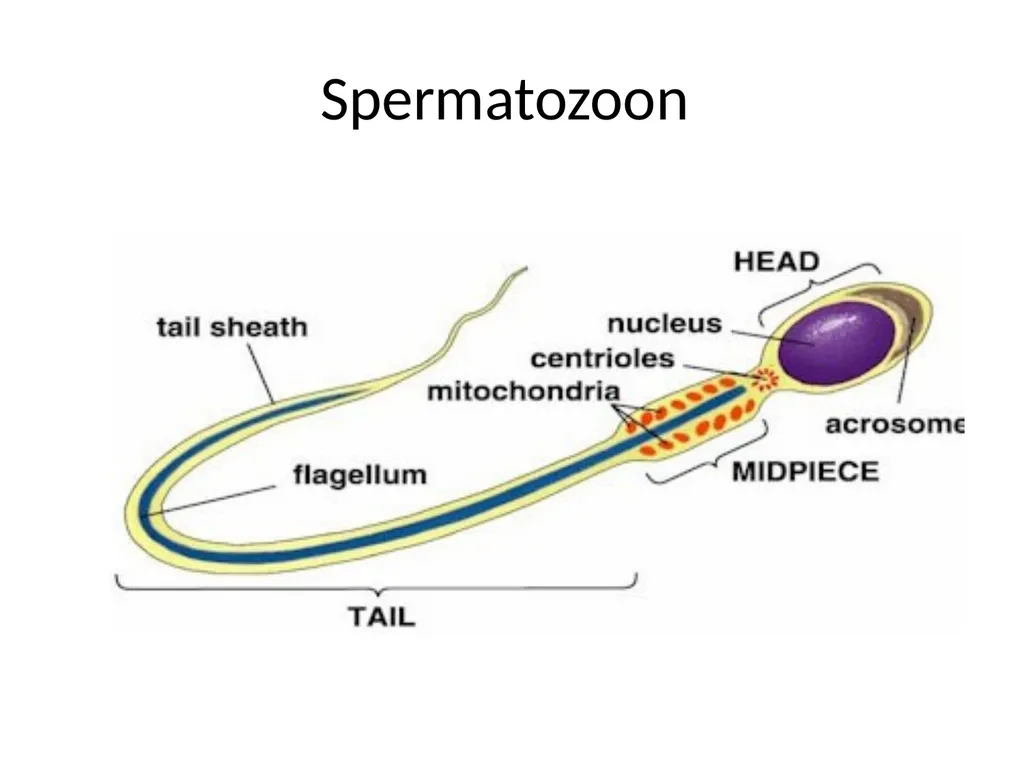
Spermatozoon A spermatozoon consists of:
Head with an acrosome (head cap) – contains the cell nucleus with haploid (n) chromosomes containing the DNA.
Middle contains Mitochondria to supply energy for the spermatozoon to move.
mobile tail/ flagellum – enables the spermatozoon to move by oscillations.<br>
Head with an acrosome (head cap) – contains the cell nucleus with haploid (n) chromosomes containing the DNA.
Middle contains Mitochondria to supply energy for the spermatozoon to move.
mobile tail/ flagellum – enables the spermatozoon to move by oscillations.<br>
10
Spermatozoon<br>
11
Congenital defects Hypoplasia is the condition when the testes are underdeveloped.
Hermaphroditism animal has both male and female reproductive organs.
Cryptorchidism one or both testes do not descend from the abdominal cavity into the scrotum.<br>
Hermaphroditism animal has both male and female reproductive organs.
Cryptorchidism one or both testes do not descend from the abdominal cavity into the scrotum.<br>
12
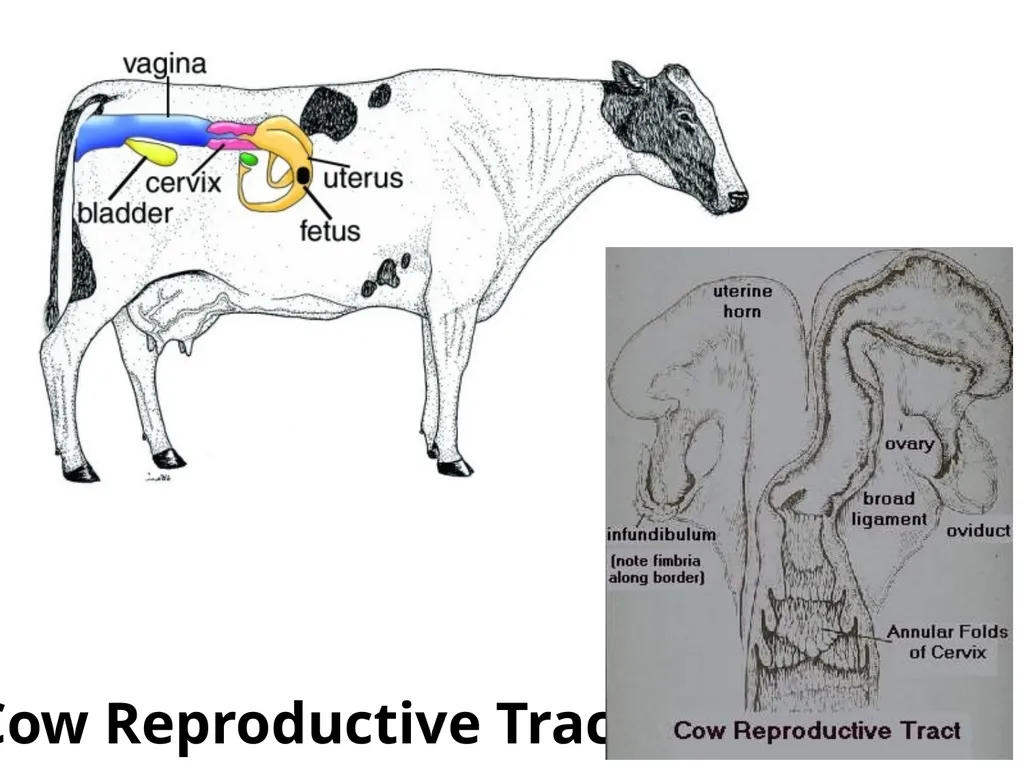
Cow Reproductive Tract<br>
13
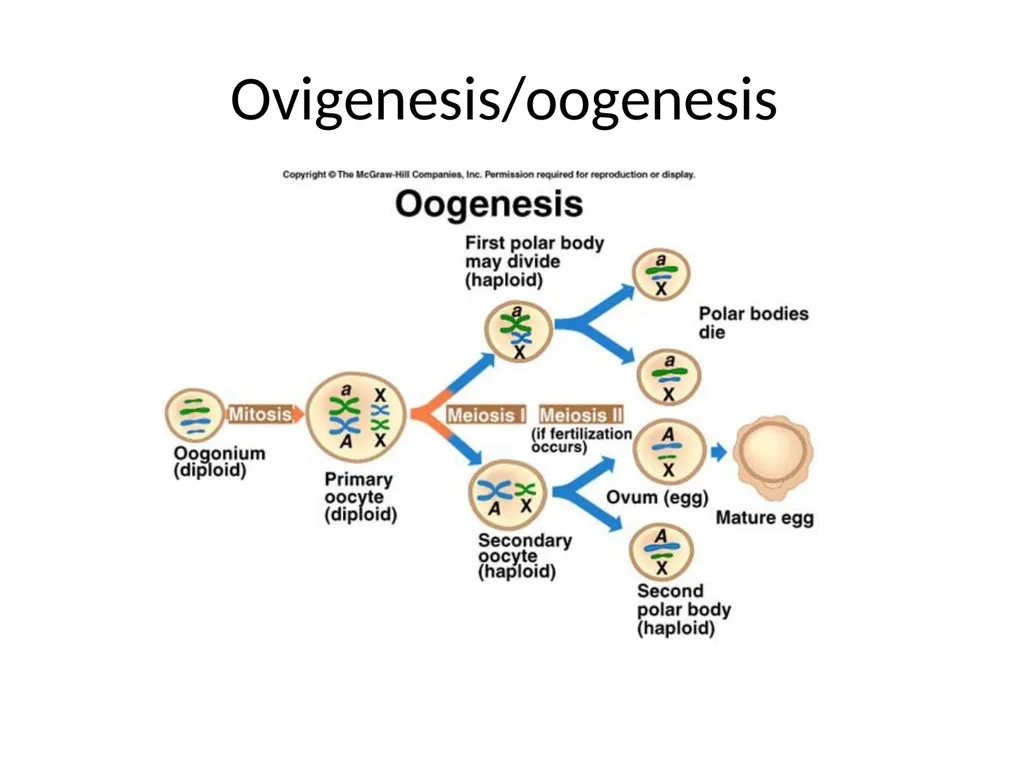
Ovigenesis/oogenesis<br>
14
Phases of oestrus in cows Oestrus cycle is divided into four stages.
Pro-oestrus (2-3 days)
Oestrus (in heat) (16-18 hours)
Meta-oestrus (post-oestrus) (3 days)
Di-oestrus (final phase) (15 days)
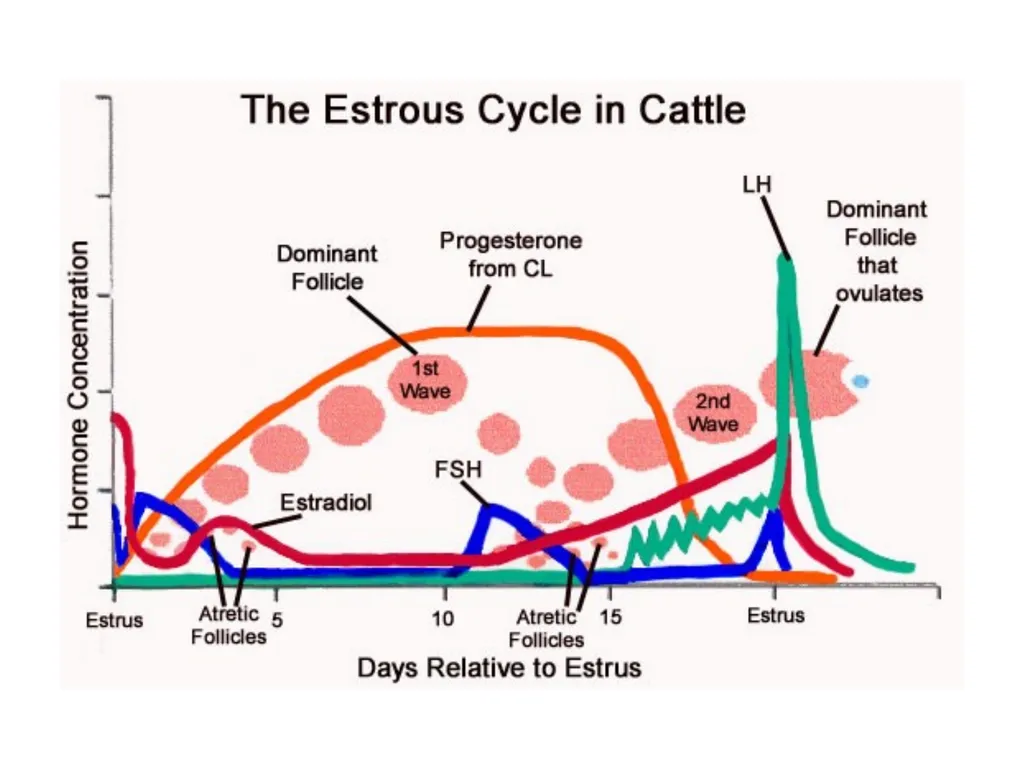
This cycle averages 21 days in the cow; the range is 17 to 24 days. Oestrous cycles start at puberty, are mostly controlled by female hormones, and can only be disturbed or interrupted by pregnancy, disease and extreme climatic conditions.<br>
15
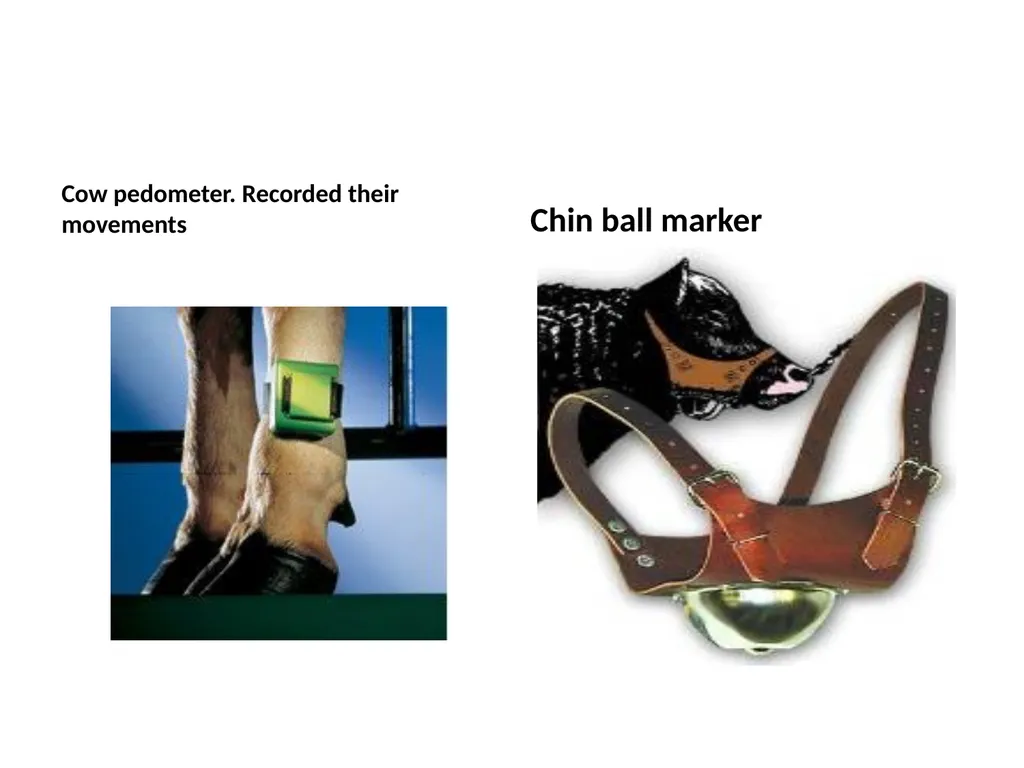
Cow pedometer. Recorded their movements Chin ball marker<br>
16
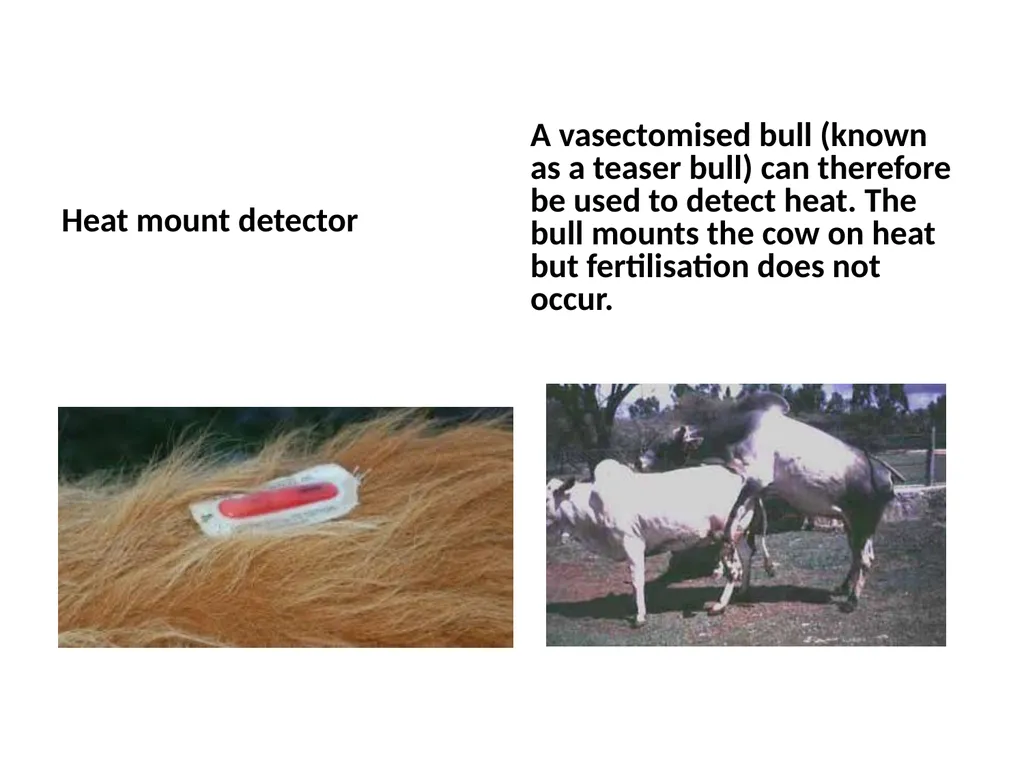
Heat mount detector A vasectomised bull (known as a teaser bull) can therefore be used to detect heat. The bull mounts the cow on heat but fertilisation does not occur.<br>
17
Mating: Natural mating Mating terminology
Copulation: insertion of a male’s penis into a female’s vagina for the purposes of reproduction
Ejaculation: the ejection of semen from the male’s penis
Pheromones: chemical substances produced and released by an animal that affects the behaviour or physiology of others of the same species.<br>
Copulation: insertion of a male’s penis into a female’s vagina for the purposes of reproduction
Ejaculation: the ejection of semen from the male’s penis
Pheromones: chemical substances produced and released by an animal that affects the behaviour or physiology of others of the same species.<br>
18
The five main stages of mating Courtship:
Mounting:
Intromission /Copulation:
Ejaculation:
Dismounting:<br>
Mounting:
Intromission /Copulation:
Ejaculation:
Dismounting:<br>
19
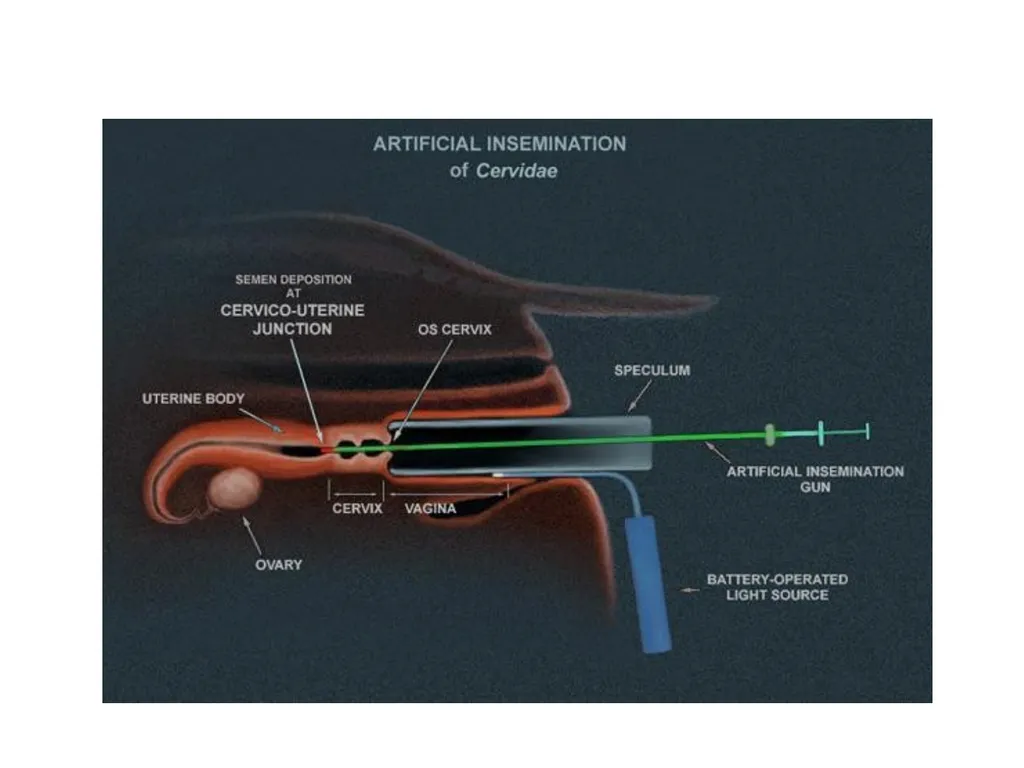
Artificial mating: Artificial insemination (AI) Artificial insemination (AI) is the process whereby sperm is placed into a female’s uterus or cervix by artificial means rather than through natural mating.<br>
20
The main requirements of successfull AI Use healthy, uninfected and viable semen
Use the correct techniques
Inseminate at the correct time during the oestrus cycle
The equipment needed for AI should all be kept in hygienic conditions.
The cow to be inseminated must be calm and standing still.
Insemination should be done only with sexually mature heifers.
The inseminator should touch the sex organs with the hand to stimulate peristaltic movements<br>
21
Advantages of artificial insemination Efective way of preventing the transfer of diseases
Economical breeding method
The semen of the best available bulls can be used
Thousand cows per year from one bull
AI results in rapid genetic improvement of the herd.
Semen from exceptional overseas bulls can be used<br>
Economical breeding method
The semen of the best available bulls can be used
Thousand cows per year from one bull
AI results in rapid genetic improvement of the herd.
Semen from exceptional overseas bulls can be used<br>
22
Disadvantages Mating diseases can spread rapidly if infected semen is used.
Careless handling of semen or insemination done by an inexperienced person will lead to unsatisfactory results and a waste of money.
There is often a limited number of bulls available for AI.
Optimal management is required
Undesirable genetic characteristics can be spread.
Certain heifers are difficult to inseminate successfully.
Inexperienced or careless inseminator - injuries
Proper record keeping of the breeding program is essential
AI is labour intensive
Al is more time-consuming
It is not always successful and then a bull or bulls will beneeded
The genetic variability in a herd will decrease if the number of offspring produced by one bull increases.<br>
23
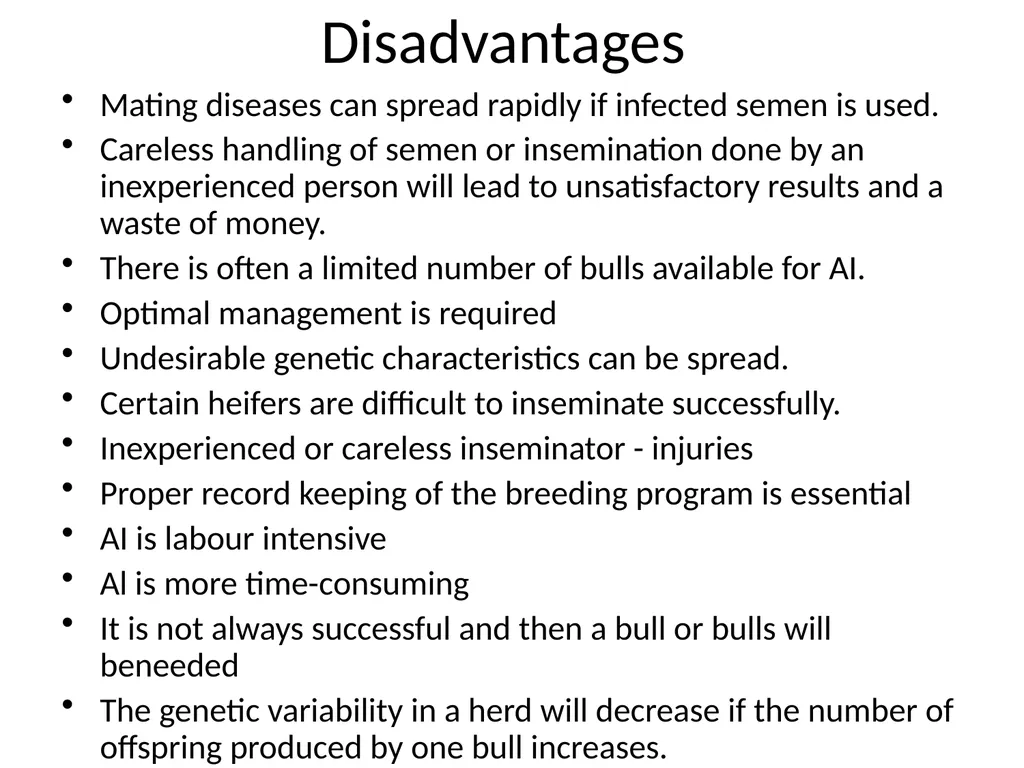
Necessary Equipment for AI (con’t.) Pistolette en sheaths<br>
24
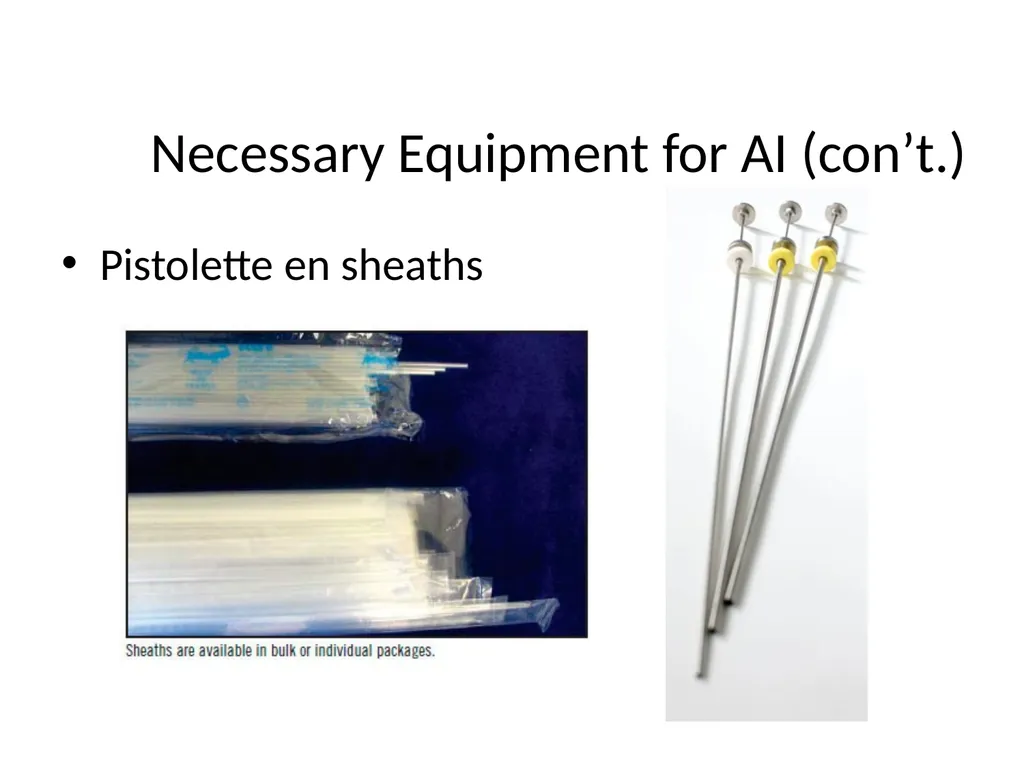
Cutter Cloves<br>
25
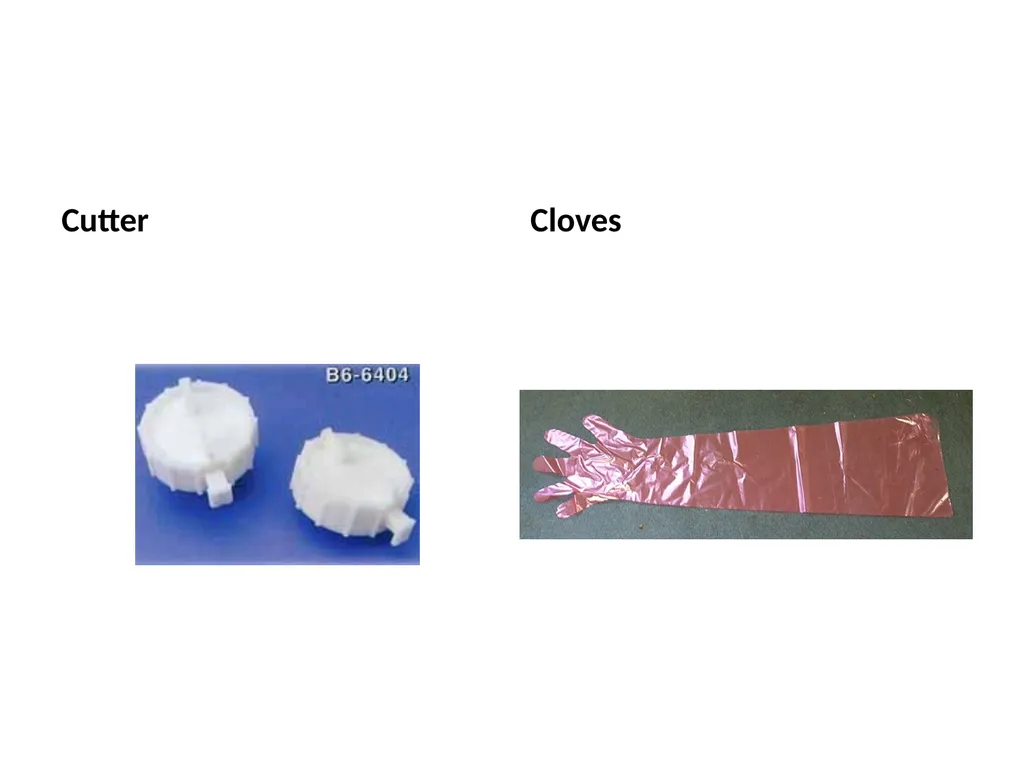
Thanwning flask AI Flask<br>
26
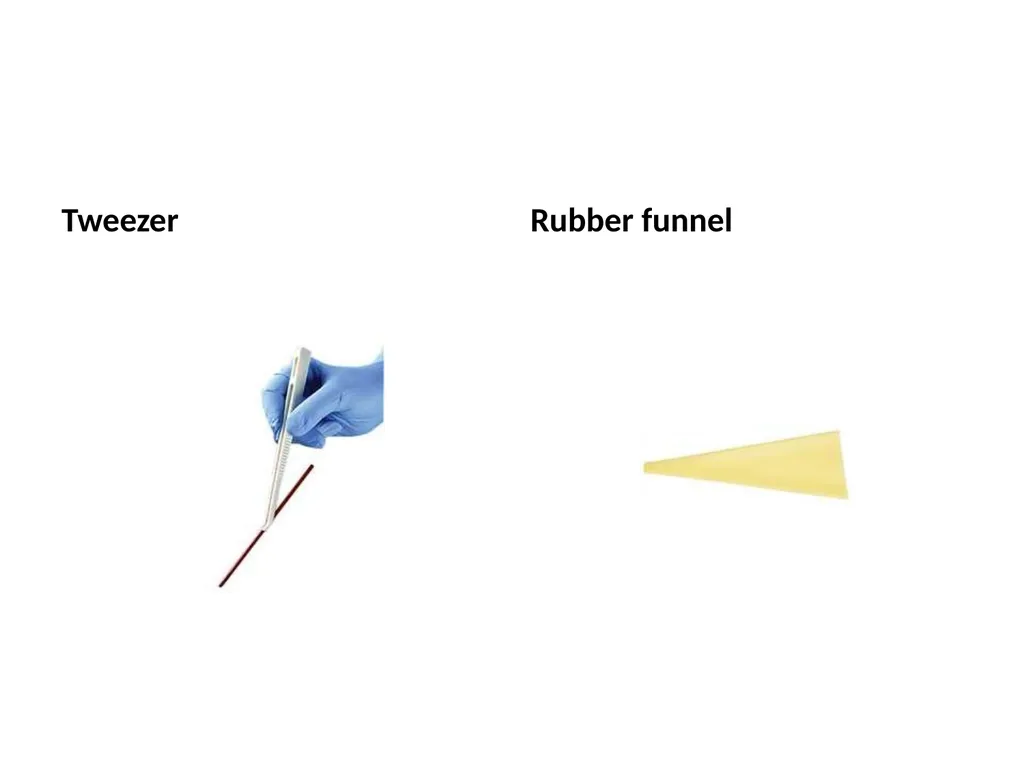
Tweezer Rubber funnel<br>
27
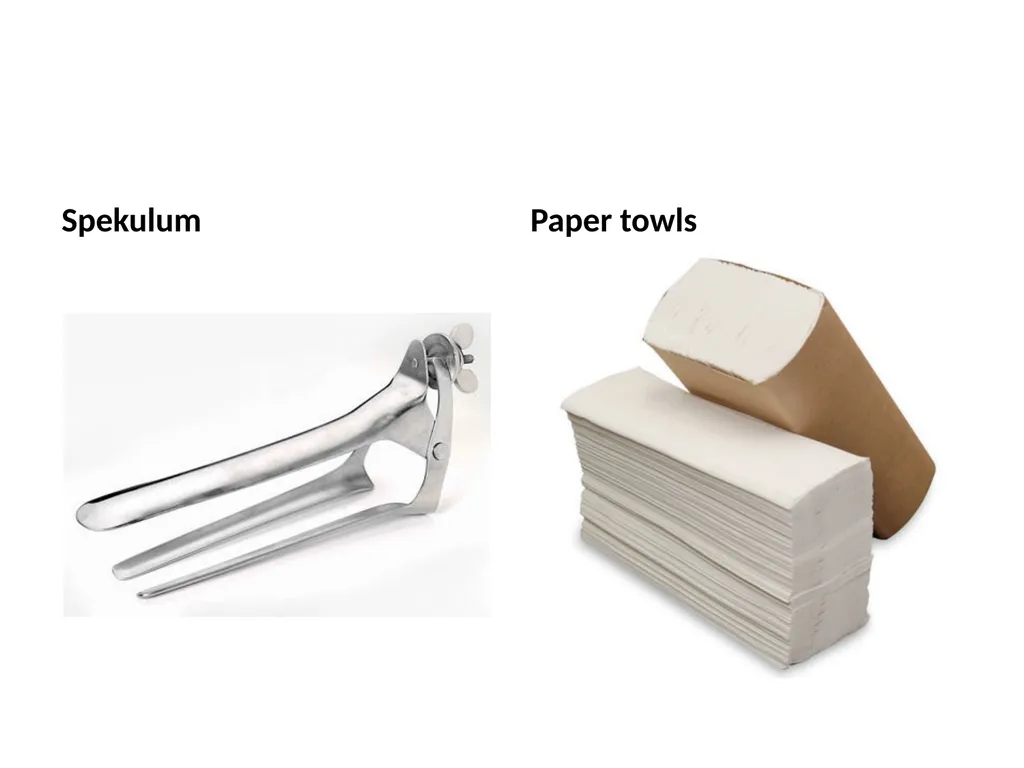
Spekulum Paper towls<br>
28
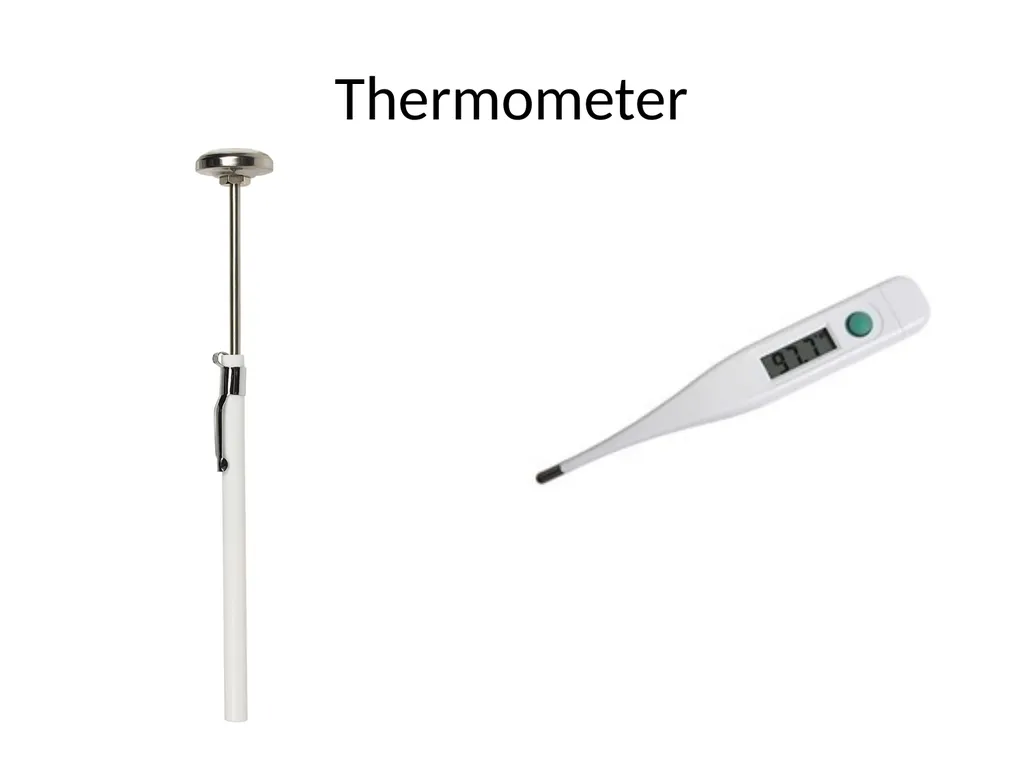
Thermometer<br>
29
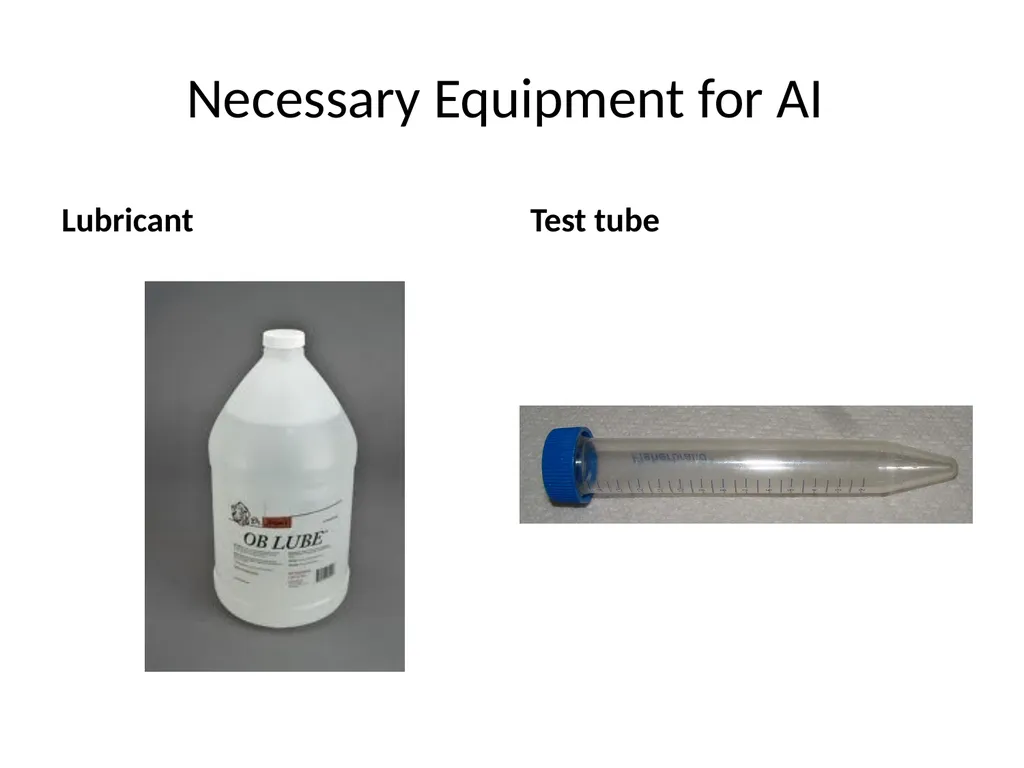
Necessary Equipment for AI Lubricant Test tube<br>
30
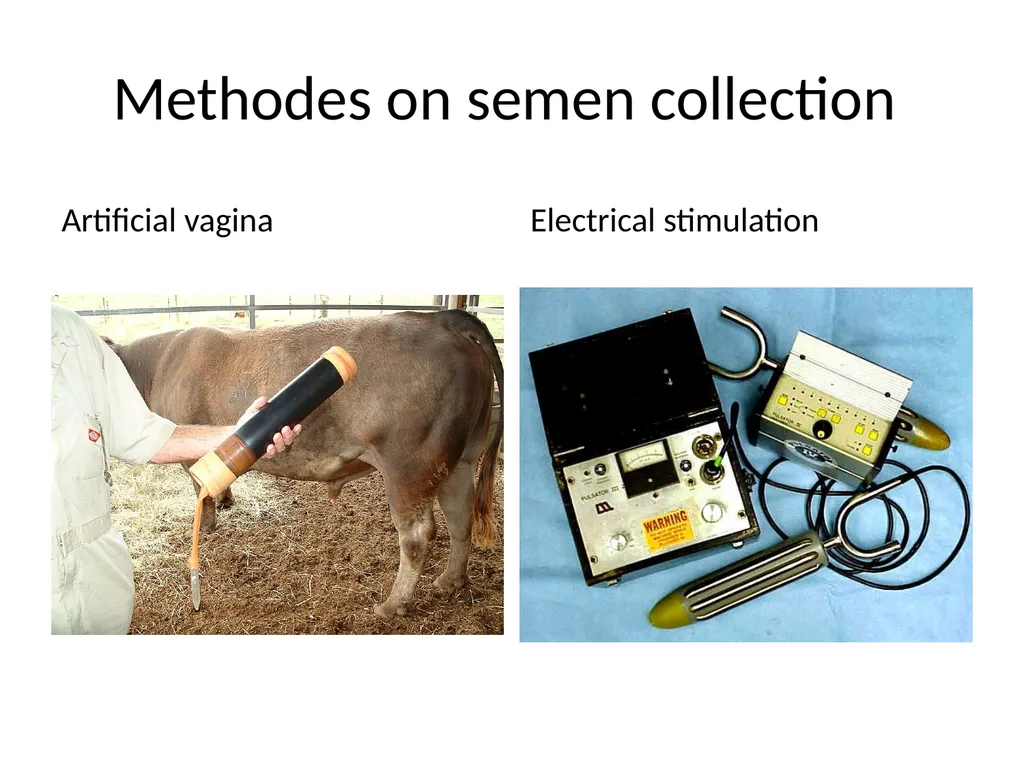
Methodes on semen collection Artificial vagina Electrical stimulation<br>
31
Legal requirements for semen collection Semen collection is normally done at specialised AI centres by specialised people, although some breeders collect semen from their own animals. The collection of semen is regulated by the Livestock Improvement Act No. 2S of 1977. Semen is only allowed to be collected for the following reasons:
From licensed bulls for AI purposes
For testing and examination purposes
To use in the herd of the owner for AI
For use in animals of not more than five co-owners or succeeding owners<br>
From licensed bulls for AI purposes
For testing and examination purposes
To use in the herd of the owner for AI
For use in animals of not more than five co-owners or succeeding owners<br>
32
Semen evaluation An investigation with the naked eye should check for colour, density and volume of the semen:
Greyish semen has an infection
Reddish semen indicates the presence of fresh blood, indicating a possible infection or injury
A dark brown colour indicates the presence of old blood
Good quality semen is opaque, milky and sticky
Volume of semen may vary between 1-15 ml, but an average of 4,5 ml is acceptable.<br>
33
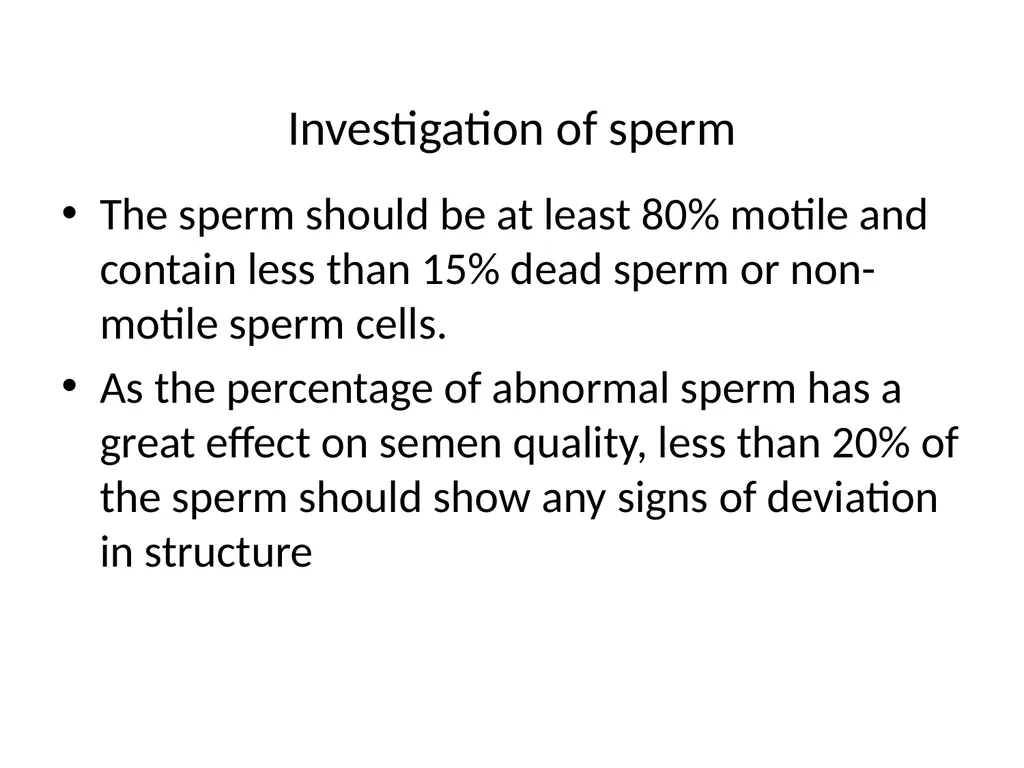
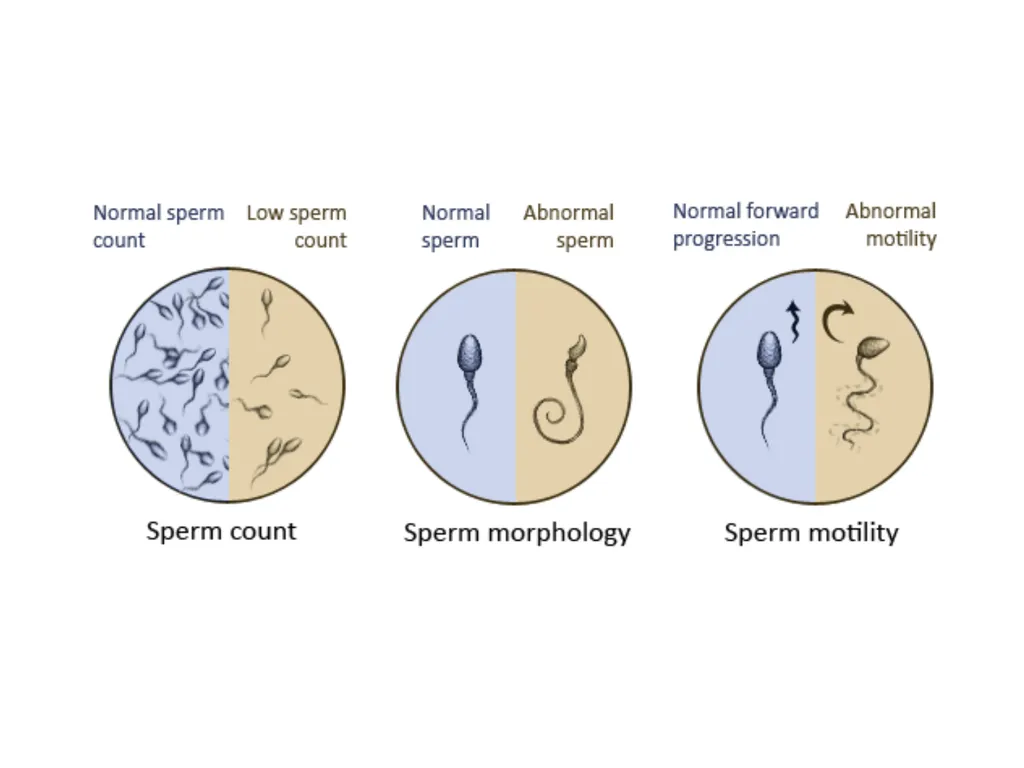
Investigation of sperm The sperm should be at least 80% motile and contain less than 15% dead sperm or non-motile sperm cells.
As the percentage of abnormal sperm has a great effect on semen quality, less than 20% of the sperm should show any signs of deviation in structure<br>
As the percentage of abnormal sperm has a great effect on semen quality, less than 20% of the sperm should show any signs of deviation in structure<br>
34
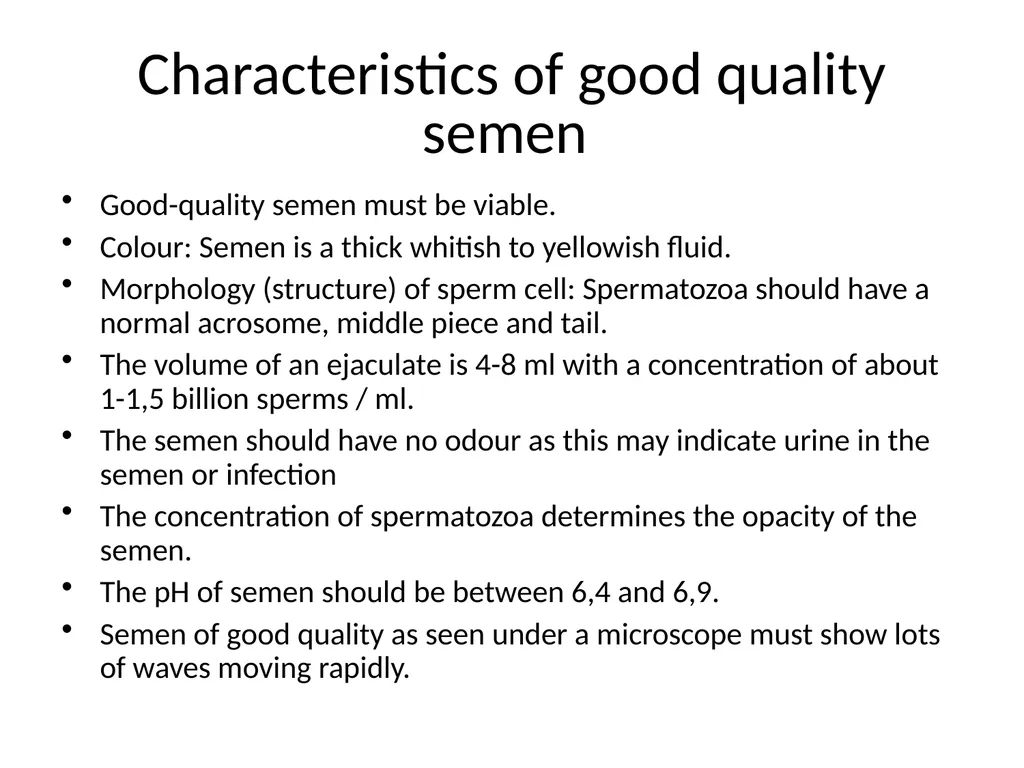
Characteristics of good quality semen Good-quality semen must be viable.
Colour: Semen is a thick whitish to yellowish fluid.
Morphology (structure) of sperm cell: Spermatozoa should have a normal acrosome, middle piece and tail.
The volume of an ejaculate is 4-8 ml with a concentration of about 1-1,5 billion sperms / ml.
The semen should have no odour as this may indicate urine in the semen or infection
The concentration of spermatozoa determines the opacity of the semen.
The pH of semen should be between 6,4 and 6,9.
Semen of good quality as seen under a microscope must show lots of waves moving rapidly.<br>
35
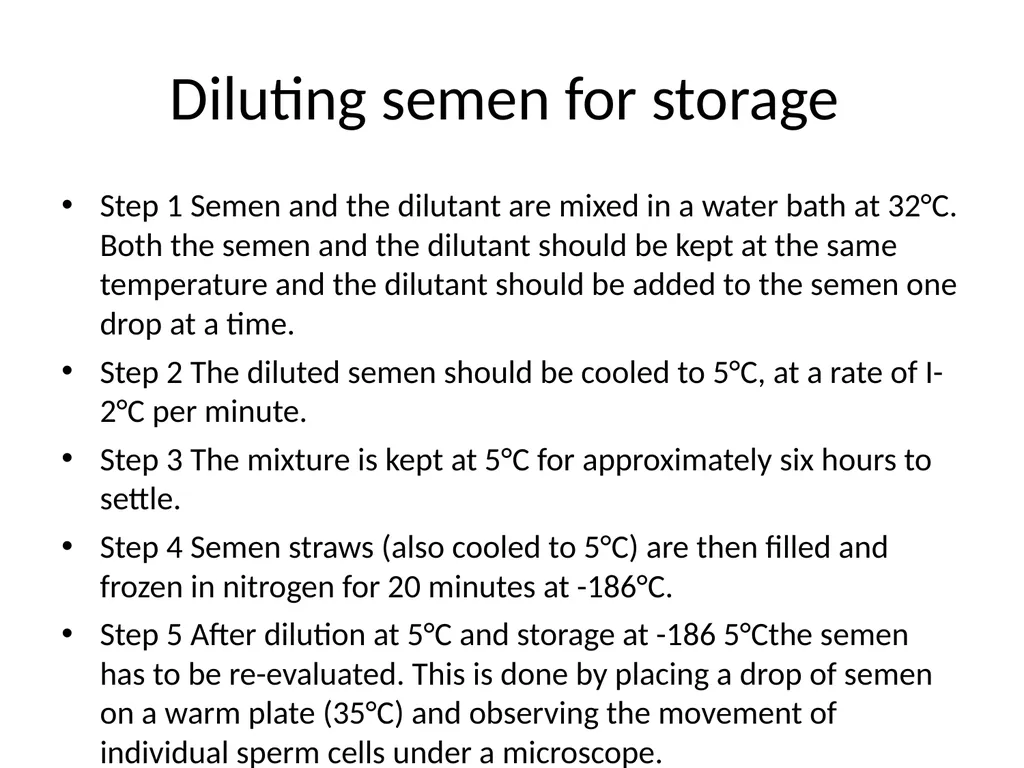
Diluting semen for storage Step 1 Semen and the dilutant are mixed in a water bath at 32°C. Both the semen and the dilutant should be kept at the same temperature and the dilutant should be added to the semen one drop at a time.
Step 2 The diluted semen should be cooled to 5°C, at a rate of I-2°C per minute.
Step 3 The mixture is kept at 5°C for approximately six hours to settle.
Step 4 Semen straws (also cooled to 5°C) are then filled and frozen in nitrogen for 20 minutes at -186°C.
Step 5 After dilution at 5°C and storage at -186 5°Cthe semen has to be re-evaluated. This is done by placing a drop of semen on a warm plate (35°C) and observing the movement of individual sperm cells under a microscope.<br>
36
Functions of dilutants Buffers such as sodium titrate and egg yolk control the pH of diluted semen at between 6,7 and 7,0.
Lipids such as skim milk and egg yolk protect the sperm membranes from changes in the temperature such as cold shock.
Nutrients such as fructose and glucose provide energy for the sperm.
Antibiotics such as penicillin and streptomycin protect the sperm from bacterial growth.
Glycerol is used as a protective agent that protects the sperm from the lethal effects of freezing and prevents crystallisation of Water within the sperm cells.
Dilutants increase the volume
Dilutants provide an isotonic environment.
Dilutants maintain proper osmotic and electrolyte pressure.<br>
37
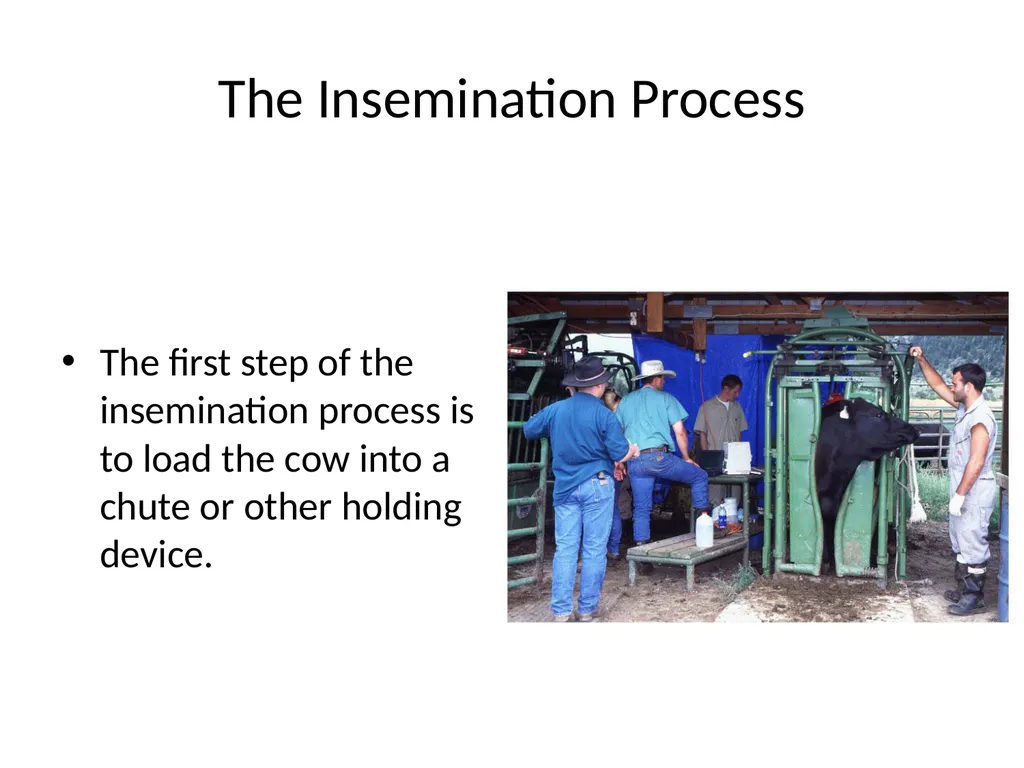
The Insemination Process The first step of the insemination process is to load the cow into a chute or other holding device.<br>
38
Thawing the Semen Once the cow is in the chute, the technician should thaw the straw of semen.
Thawing must be done carefully to avoid damage to the sperm.
Thawing semen too fast or too slow will harm the sperm.
The straw must be carefully removed from the liquid nitrogen tank to avoid burn injuries from the liquid nitrogen.<br>
Thawing must be done carefully to avoid damage to the sperm.
Thawing semen too fast or too slow will harm the sperm.
The straw must be carefully removed from the liquid nitrogen tank to avoid burn injuries from the liquid nitrogen.<br>
39
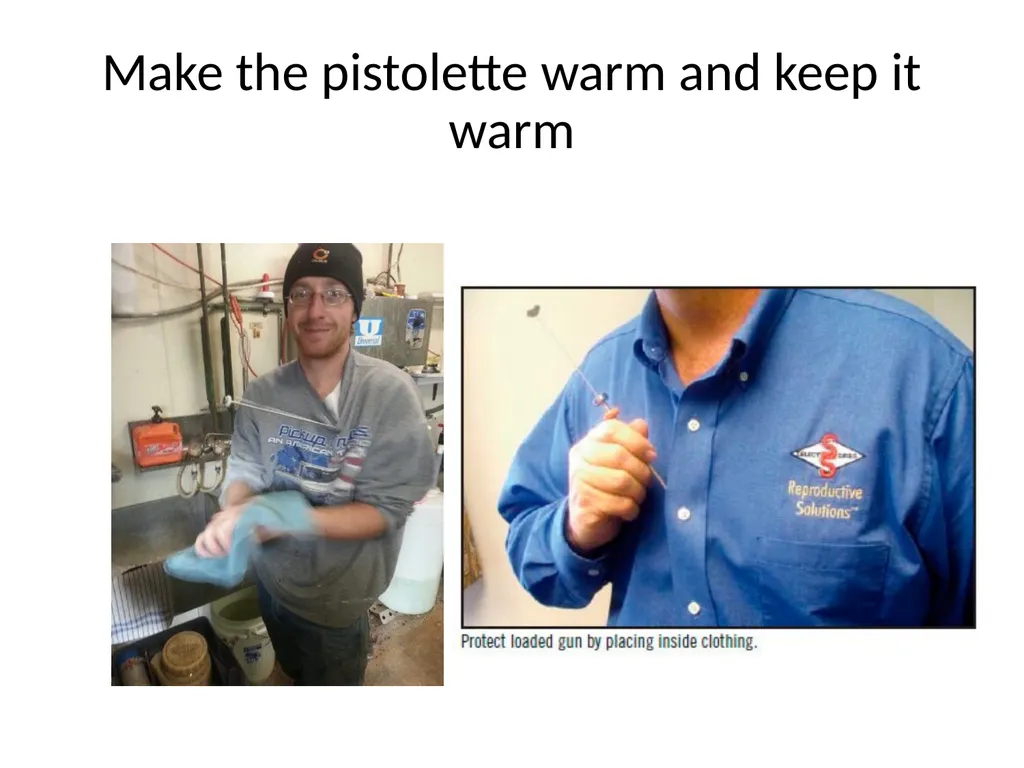
Make the pistolette warm and keep it warm<br>
40
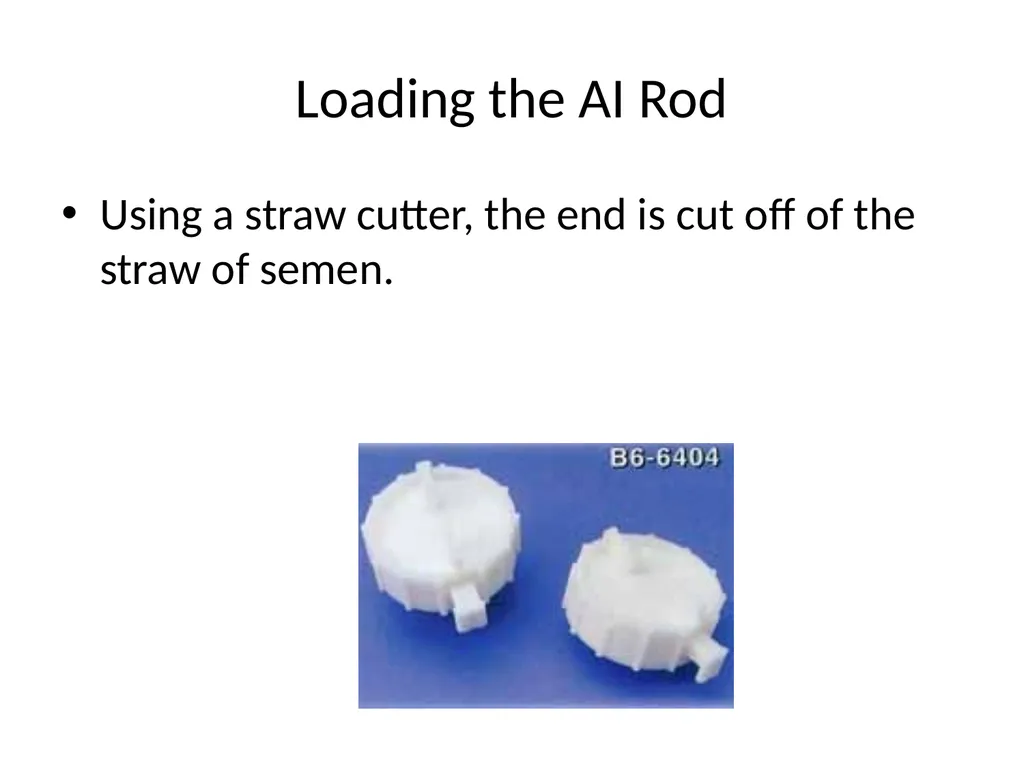
Loading the AI Rod Using a straw cutter, the end is cut off of the straw of semen.<br>
41
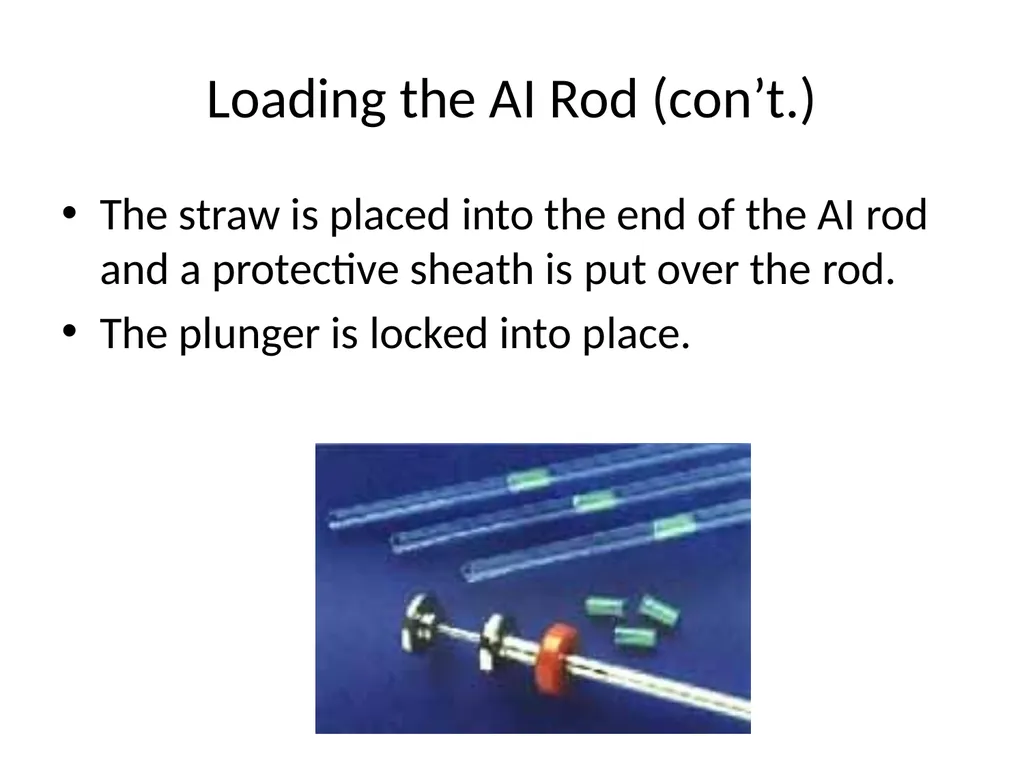
Loading the AI Rod (con’t.) The straw is placed into the end of the AI rod and a protective sheath is put over the rod.
The plunger is locked into place.<br>
The plunger is locked into place.<br>
42
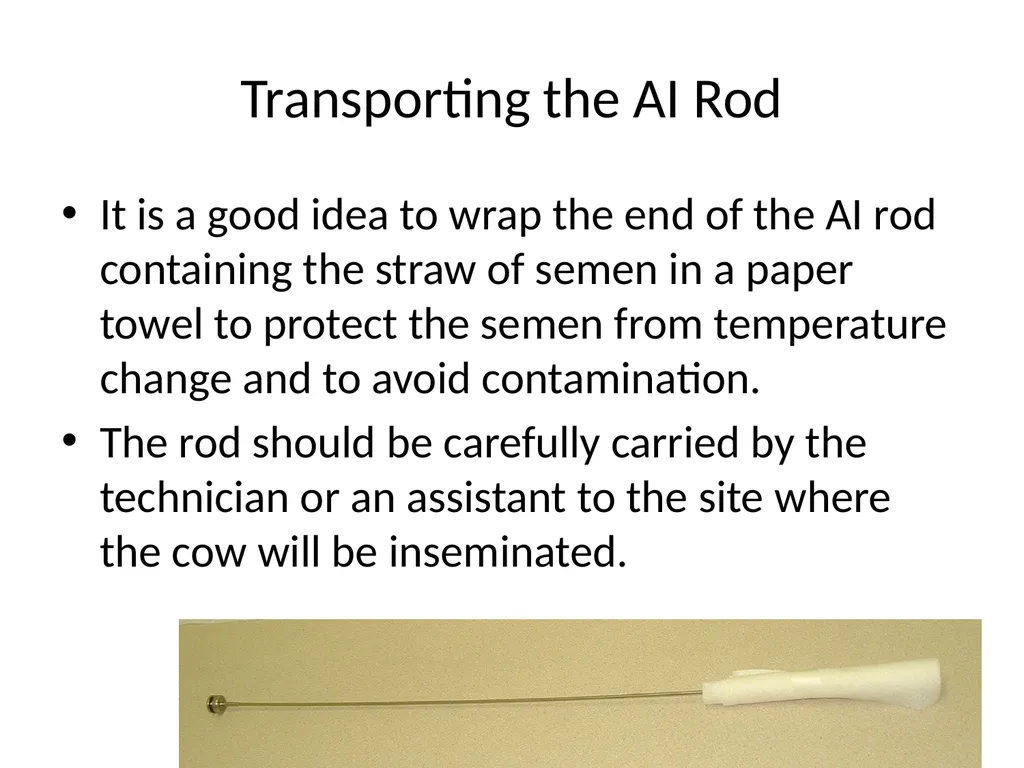
Transporting the AI Rod It is a good idea to wrap the end of the AI rod containing the straw of semen in a paper towel to protect the semen from temperature change and to avoid contamination.
The rod should be carefully carried by the technician or an assistant to the site where the cow will be inseminated.<br>
The rod should be carefully carried by the technician or an assistant to the site where the cow will be inseminated.<br>
43
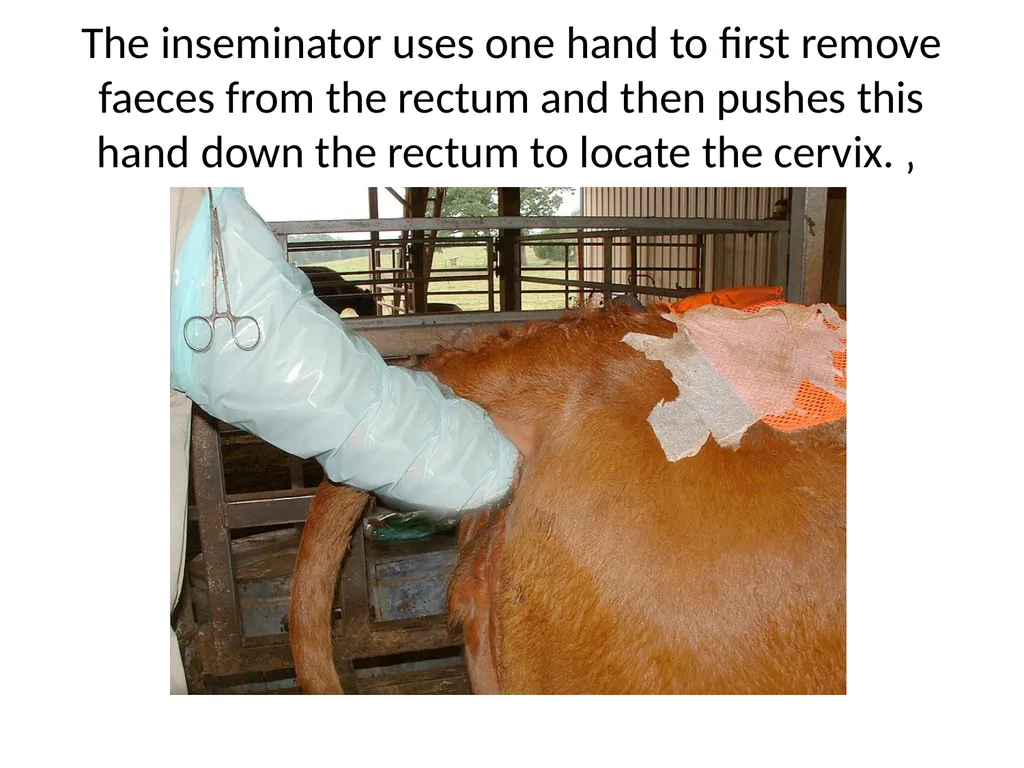
The inseminator uses one hand to first remove faeces from the rectum and then pushes this hand down the rectum to locate the cervix. ‚<br>
44
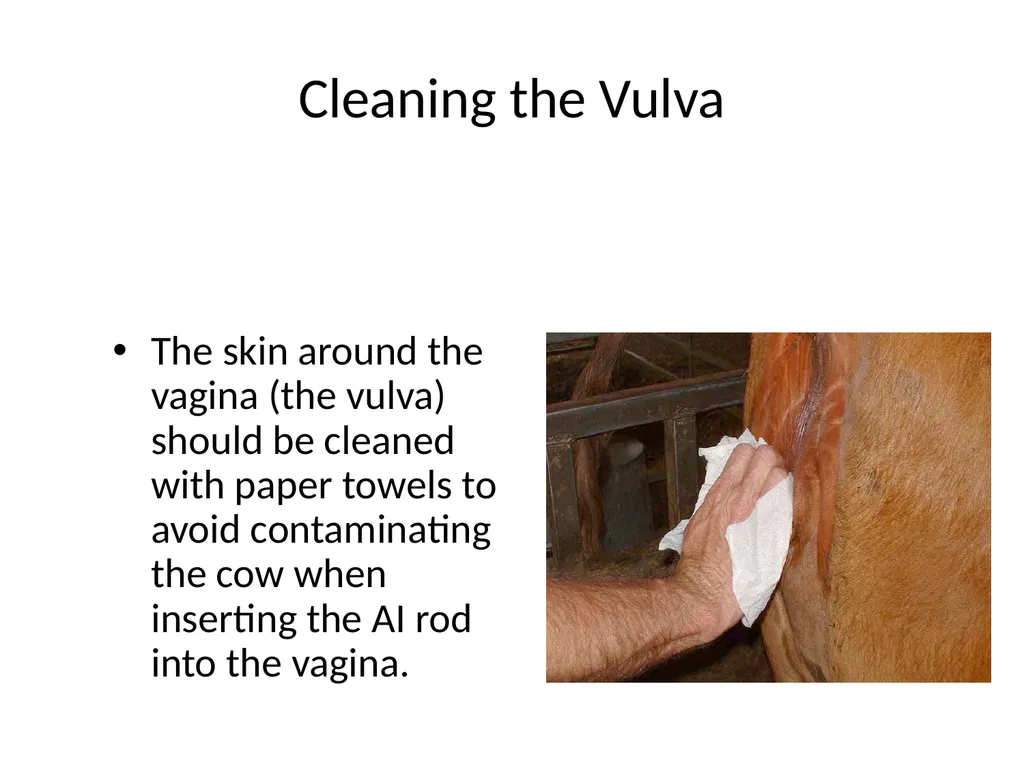
Cleaning the Vulva The skin around the vagina (the vulva) should be cleaned with paper towels to avoid contaminating the cow when inserting the AI rod into the vagina.<br>
45
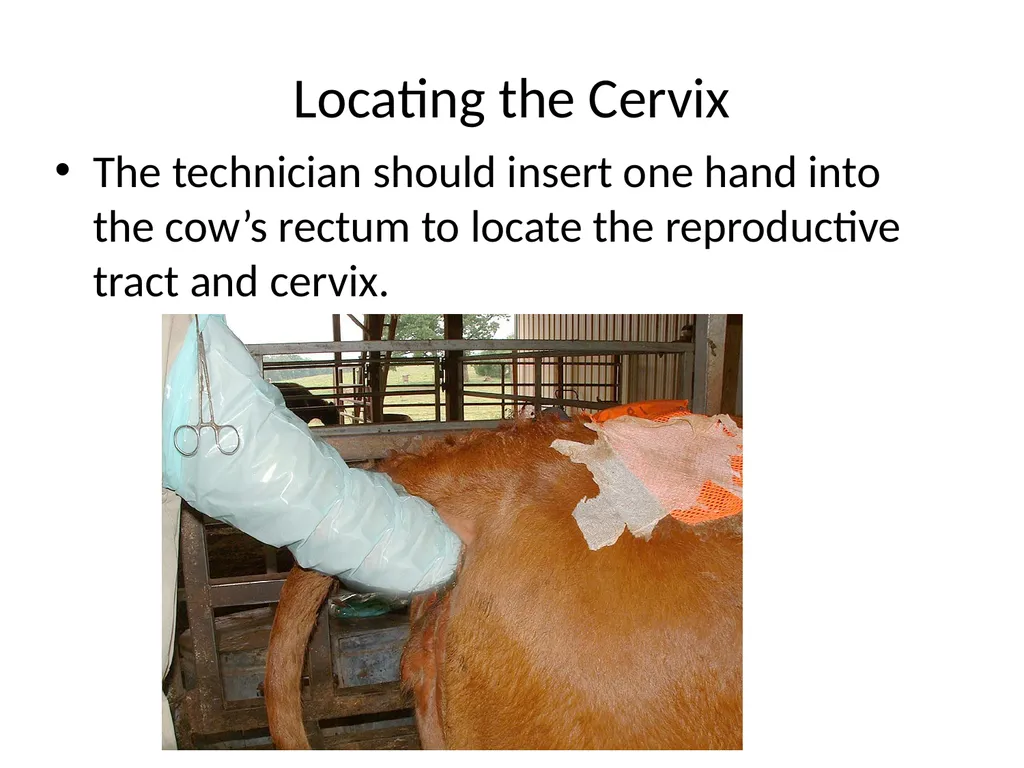
Locating the Cervix The technician should insert one hand into the cow’s rectum to locate the reproductive tract and cervix.<br>
46
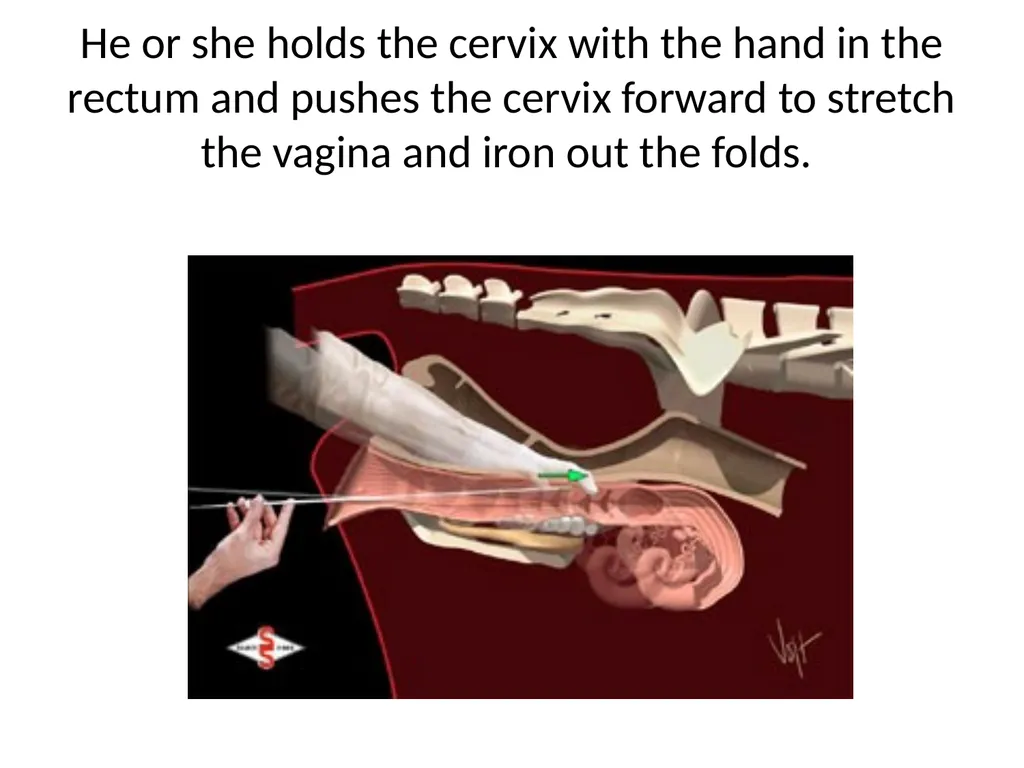
He or she holds the cervix with the hand in the rectum and pushes the cervix forward to stretch the vagina and iron out the folds.<br>
47
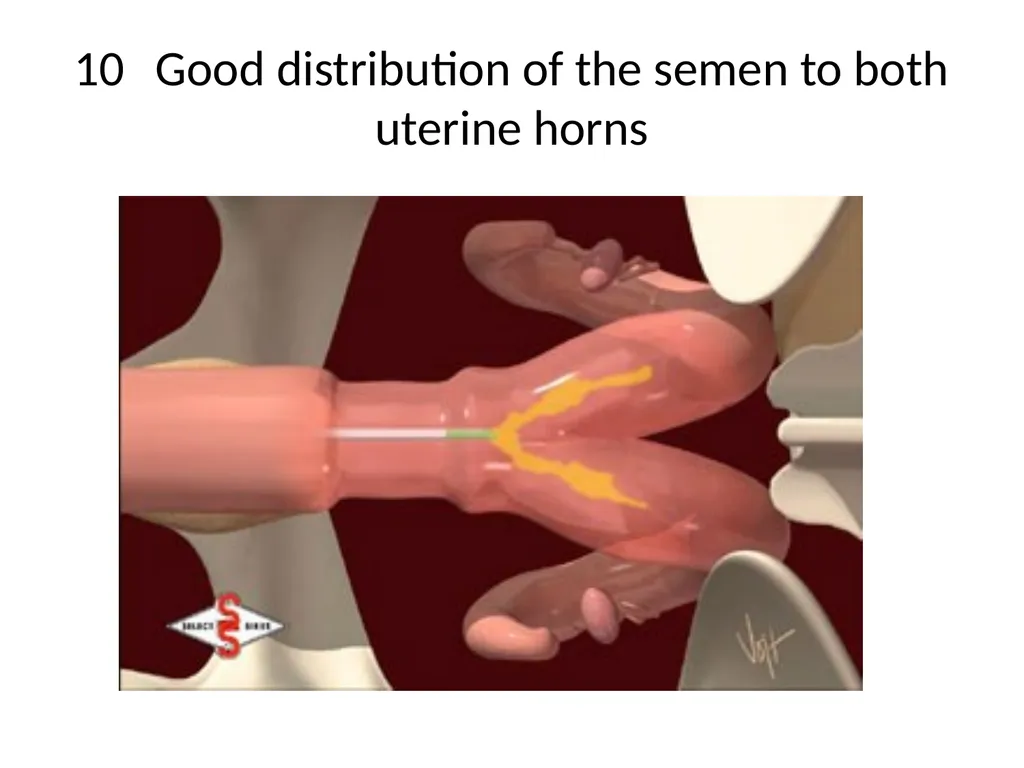
10 Good distribution of the semen to both uterine horns<br>
48
What is embryonic transfer (ET)? Embryonic transfer involves removing the fertilised ovum from the uterus of a genetically superior cow during an early stage of ovum development and transferring it to the uterus of a genetically inferior cow where the calf then develops until partuition (birth).<br>
49
Some key terms Superovulation: more than one ovum being released at a singular ovulation
Embryo flushing/harvesting: fertilised ovum, or embryo, is removed from the donor animal
Donor: animal from which the ovum or embryo is harvested
Recipient: animal that receives harvested ovum or embryo<br>
Embryo flushing/harvesting: fertilised ovum, or embryo, is removed from the donor animal
Donor: animal from which the ovum or embryo is harvested
Recipient: animal that receives harvested ovum or embryo<br>
50
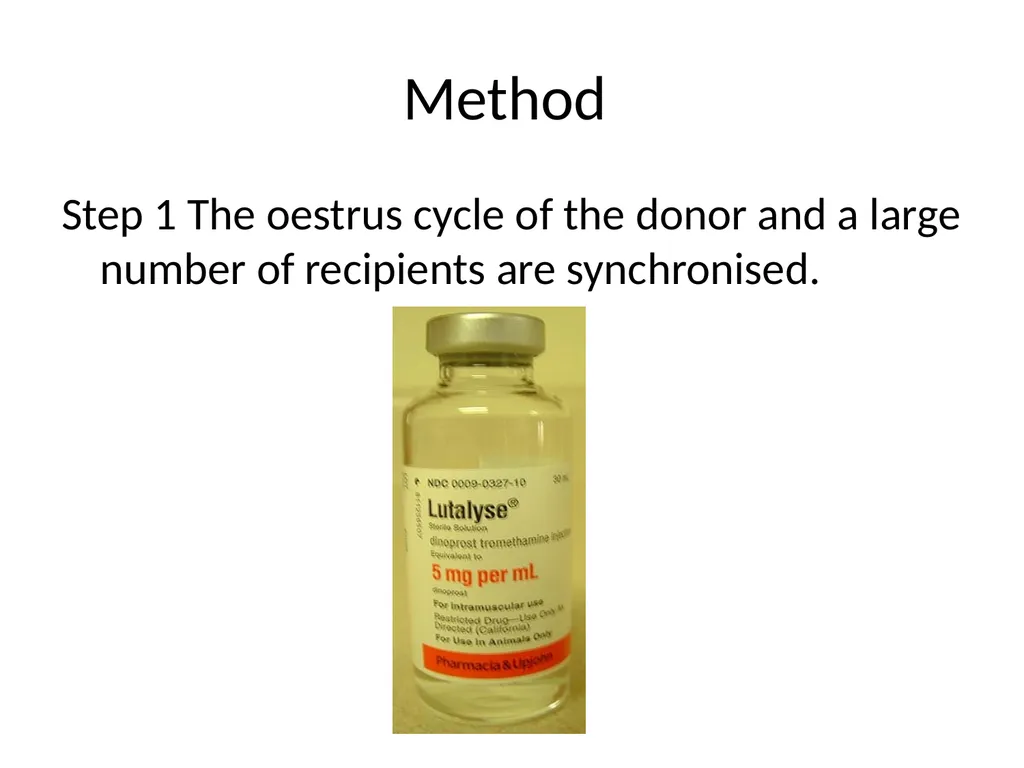
Method Step 1 The oestrus cycle of the donor and a large number of recipients are synchronised.<br>
51
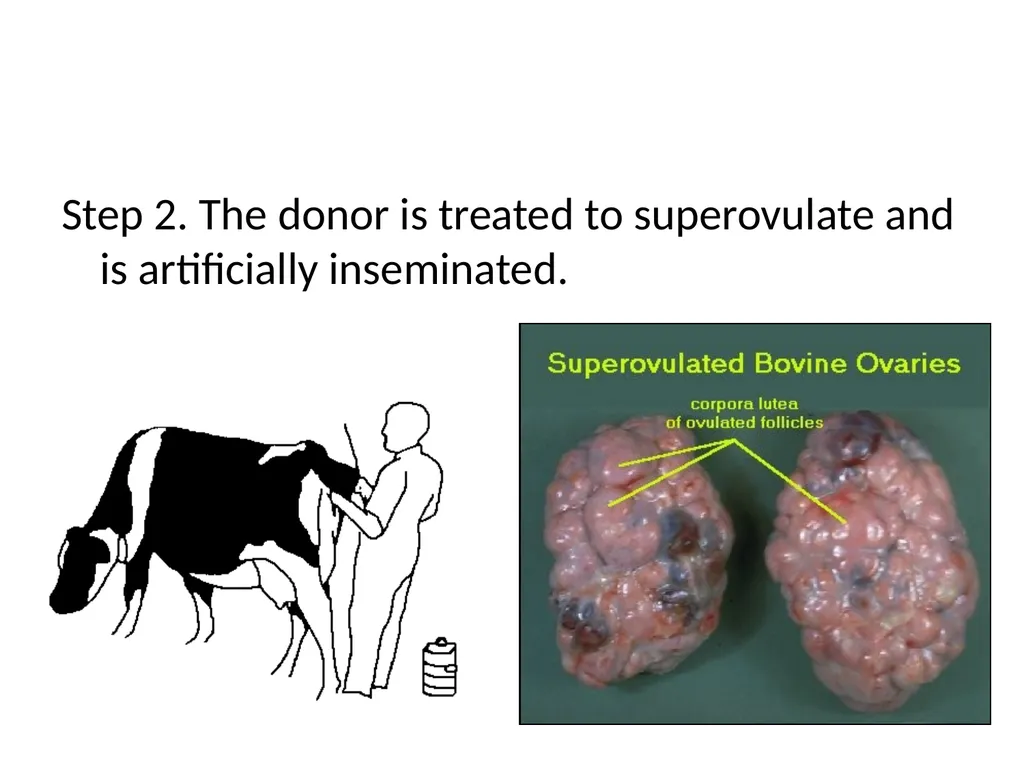
Step 2. The donor is treated to superovulate and is artificially inseminated.<br>
52
Step 3. Prostaglandin (PGT) is administered on the third to fourth day after FSH treatment. Oestrus should be noticed 36 to 48 hours later.
Step 4. Chemical treatment is given to the recipient cows (in mid-oestrus) the evening before the donor cow is treated with PGF hormone.<br>
Step 4. Chemical treatment is given to the recipient cows (in mid-oestrus) the evening before the donor cow is treated with PGF hormone.<br>
53
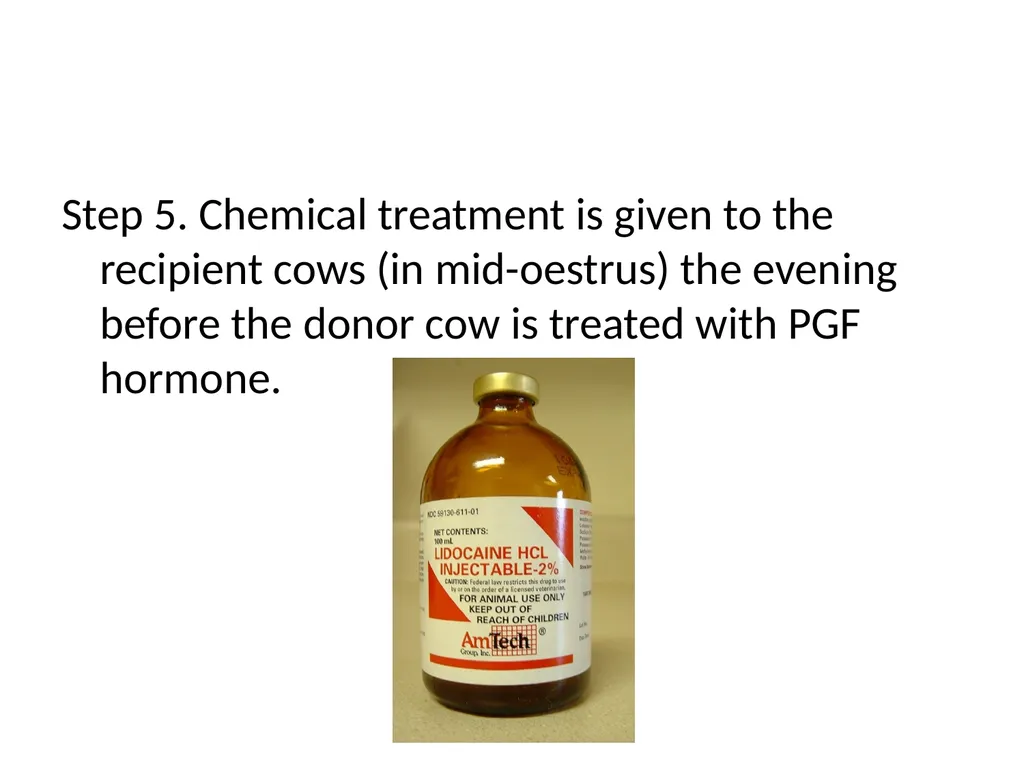
Step 5. Chemical treatment is given to the recipient cows (in mid-oestrus) the evening before the donor cow is treated with PGF hormone.<br>
54
Step 6. Chemical treatment is given to the recipient cows (in mid-oestrus) the evening before the donor cow is treated with PGF hormone.
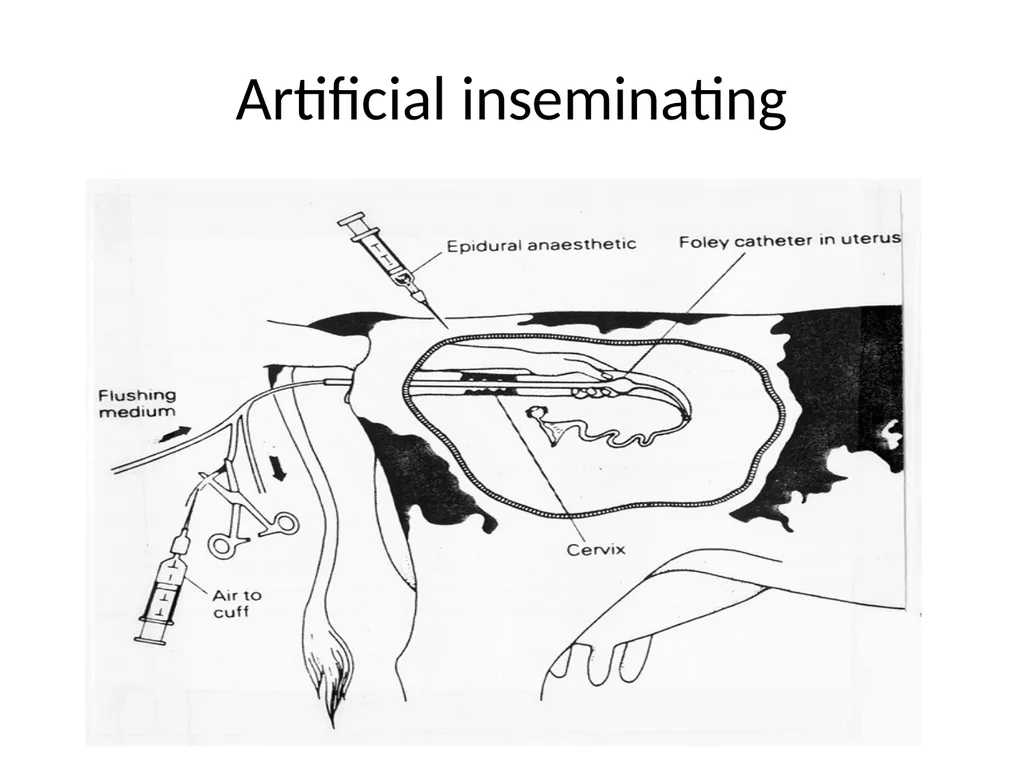
Step 7. One week after insemination the fertilized ova are washed from the donor’s uterus using a special salt solution. This process is called recovery of the embryo.<br>
Step 7. One week after insemination the fertilized ova are washed from the donor’s uterus using a special salt solution. This process is called recovery of the embryo.<br>
55
Artificial inseminating<br>
56
Embryo splitting Embryo splitting is a method that is used to increase the number of offspring obtained in the process.
In the early embryonic stage the embryo consists of a number of identical cells before they become specialised to form different tissues and organs.
The cells of the developing embryo are split apart. Each cell develops into a new embryo, and each new embryo is then transplanted into a different recipient cow.
These cows will give birth to identical offspring with the desirable characteristics.<br>
57
Donor cows Be genetically superior
Respond well to superovulation
Be of a suitable age to produce large numbers of usable embryos
Be healthy cycling cows with high fertility
Have no previous calving problems
Produce offspring that inherit the desirable traits
Be in good physical condition
Not have any abnormalities of the reproductive tract
Not have conformational or detectable genetic defects.<br>
58
Recipient cows Recipient cows are not genetically related to the offspring
The recipient cow should be a bit larger than the donor cow so that she does not experience calving difficulties.
She should not have abnormalities such as a twisted cervix
Should not have experienced calving problems before.
The recipient cows must be cycling and must be in the correct stage of the oestrus cycle
Recipient cows must not be exposed to bulls before the embryo is transplanted
Cows must be kept close to the treatment areas for synchonisation treatment, oestrus detection and embryo transfer.<br>
59
What is nuclear transfer (NT)? Nucleur transfer (NT), also called cloning, is when the nucleus of a somatic cell is transferred to unfertilised egg that has its nucleus removed. The egg cell then divides to form an embryo. The resultant embryo is then placed inside a surrogate mother where it develops.<br>
60
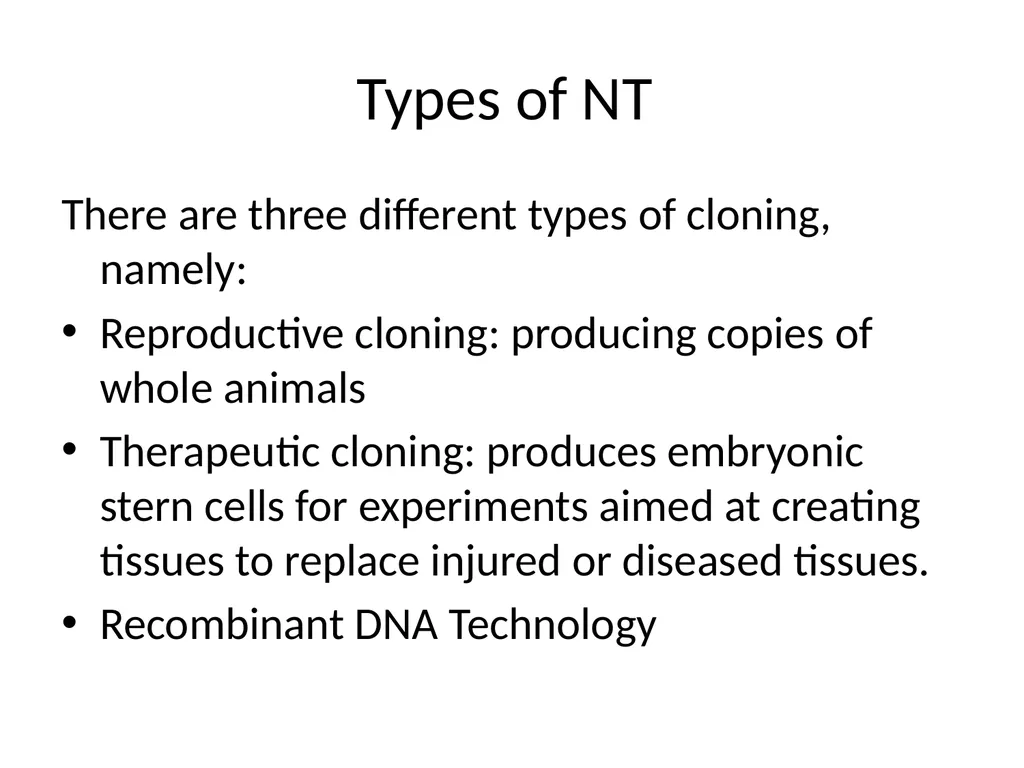
Types of NT There are three different types of cloning, namely:
Reproductive cloning: producing copies of whole animals
Therapeutic cloning: produces embryonic stern cells for experiments aimed at creating tissues to replace injured or diseased tissues.
Recombinant DNA Technology<br>
Reproductive cloning: producing copies of whole animals
Therapeutic cloning: produces embryonic stern cells for experiments aimed at creating tissues to replace injured or diseased tissues.
Recombinant DNA Technology<br>