Rise of Macedonia Philip II became King of Macedonia in 359 BCE Determined to do 3 things: ) Create a strong army used Greek-style phalanxes 2) Unify the Greeks under Macedonian rule 3) Destroy the Persian Empire Greek city-states
"Rise of Macedonia Philip II became King of" is the property of its rightful owner. Permission is granted to
download and print the materials on this website for personal, non-commercial use only, and to display it
on your personal computer provided you do not modify the materials and that you retain all copyright
notices contained in the materials. By downloading content from our website, you accept the terms of this
agreement.
Presentation Transcript
01
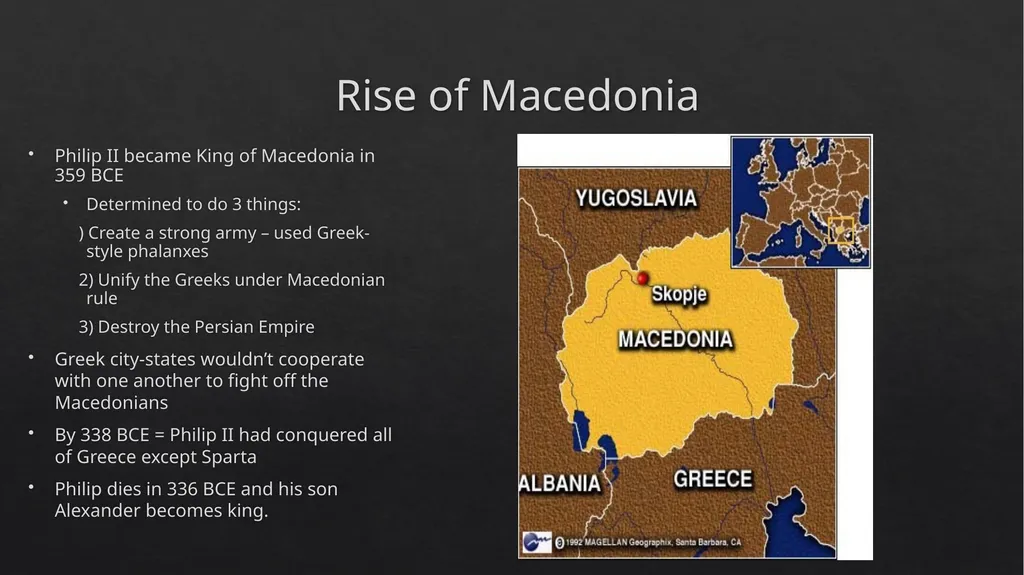
Rise of Macedonia Philip II became King of Macedonia in 359 BCE
Determined to do 3 things:
) Create a strong army – used Greek-style phalanxes
2) Unify the Greeks under Macedonian rule
3) Destroy the Persian Empire
Greek city-states wouldn’t cooperate with one another to fight off the Macedonians
By 338 BCE = Philip II had conquered all of Greece except Sparta
Philip dies in 336 BCE and his son Alexander becomes king.<br>
02
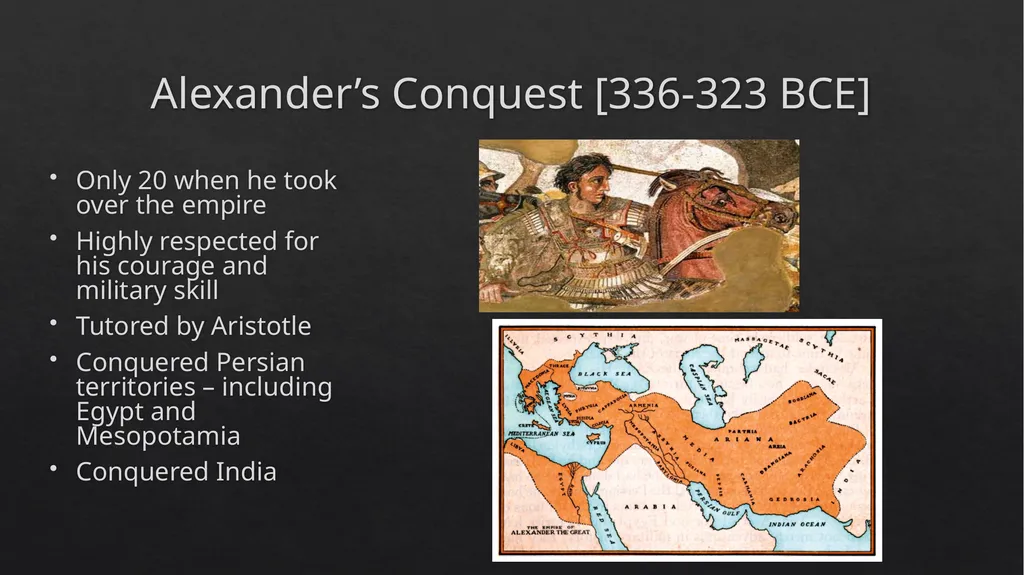
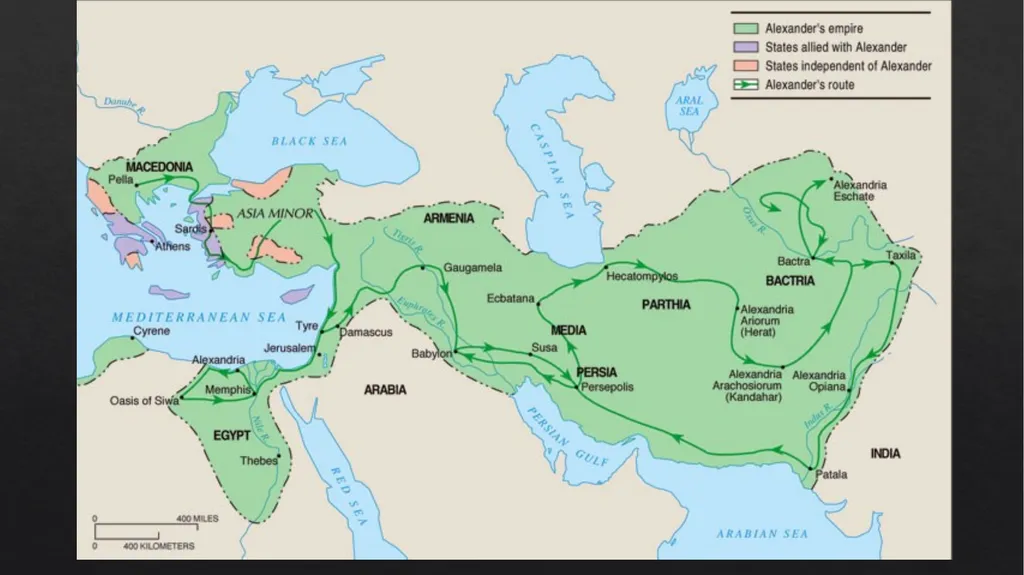
Alexander’s Conquest [336-323 BCE] Only 20 when he took over the empire
Highly respected for his courage and military skill
Tutored by Aristotle
Conquered Persian territories – including Egypt and Mesopotamia
Conquered India<br>
03
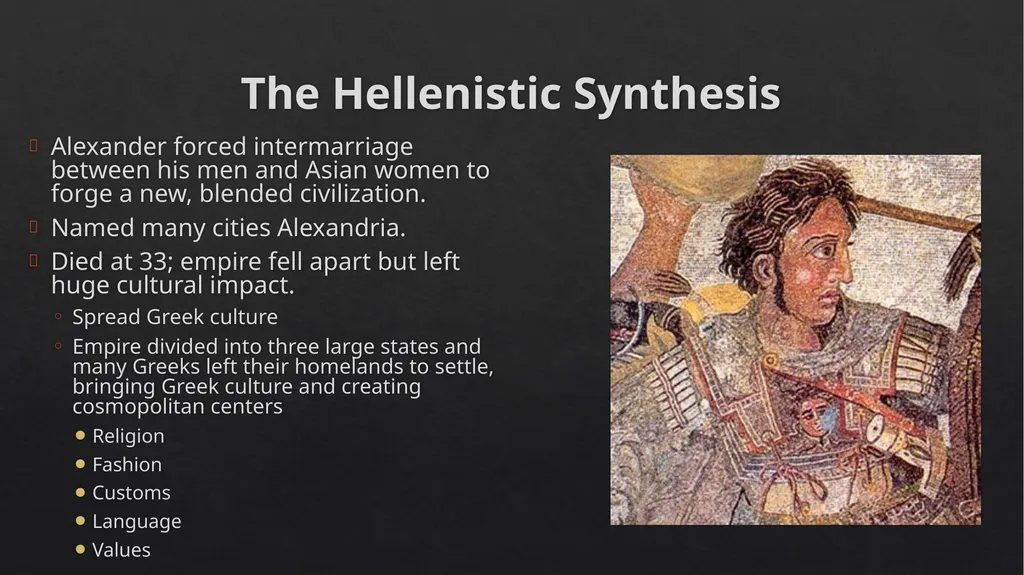
The Hellenistic Synthesis Alexander forced intermarriage between his men and Asian women to forge a new, blended civilization.
Named many cities Alexandria.
Died at 33; empire fell apart but left huge cultural impact.
Spread Greek culture
Empire divided into three large states and many Greeks left their homelands to settle, bringing Greek culture and creating cosmopolitan centers
Religion
Fashion
Customs
Language
Values<br>
04
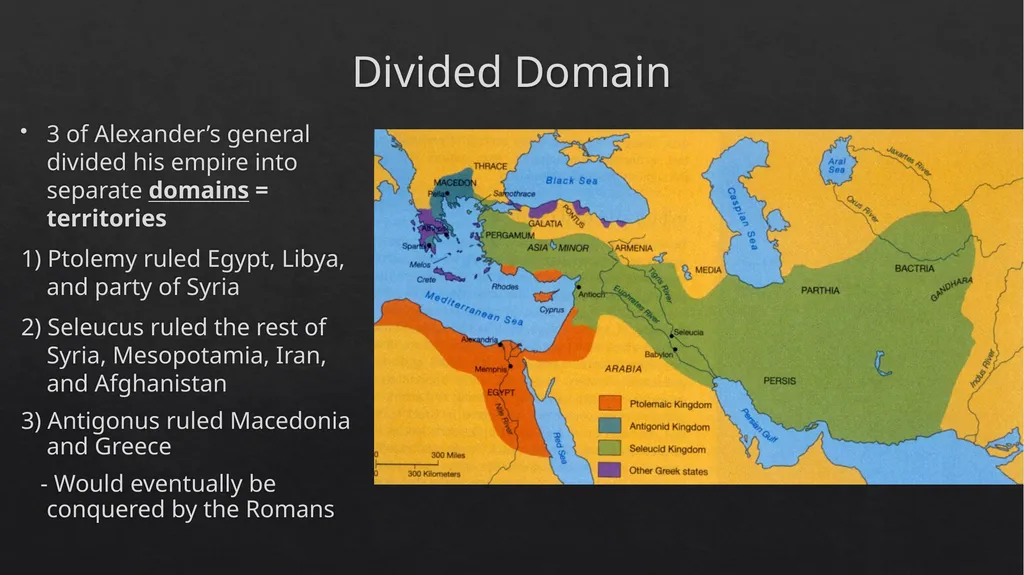
Divided Domain 3 of Alexander’s general divided his empire into separate domains = territories
1) Ptolemy ruled Egypt, Libya, and party of Syria
2) Seleucus ruled the rest of Syria, Mesopotamia, Iran, and Afghanistan
3) Antigonus ruled Macedonia and Greece
- Would eventually be conquered by the Romans<br>
05
Hellenistic Culture Greek language and culture spread in the lands Alexander had conquered
Greek (Hellenic) ways of life mixed with Persian culture of Middle East to form a new culture = Hellenistic
Hellenistic culture was concentrated in cities
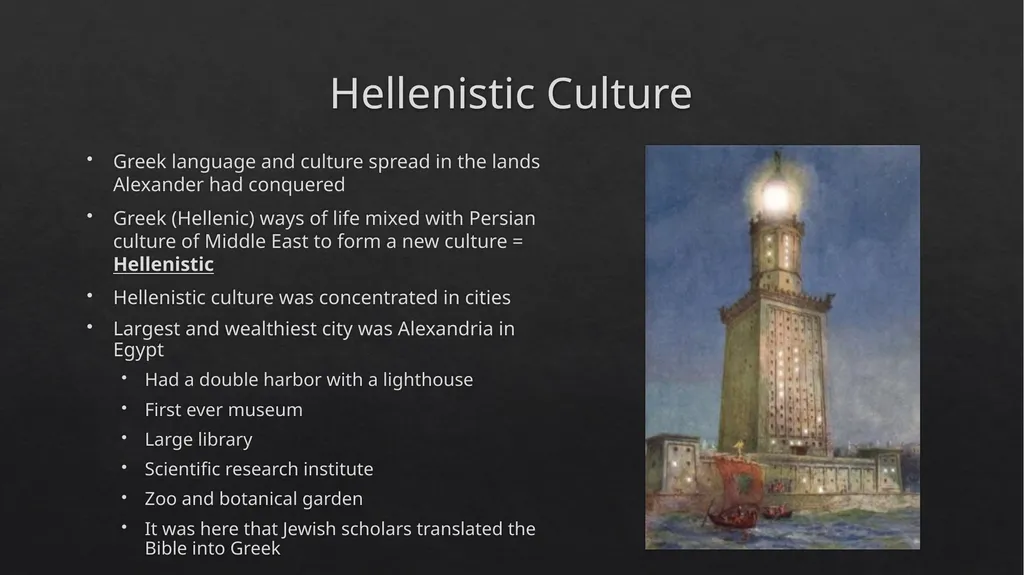
Largest and wealthiest city was Alexandria in Egypt
Had a double harbor with a lighthouse
First ever museum
Large library
Scientific research institute
Zoo and botanical garden
It was here that Jewish scholars translated the Bible into Greek<br>
06
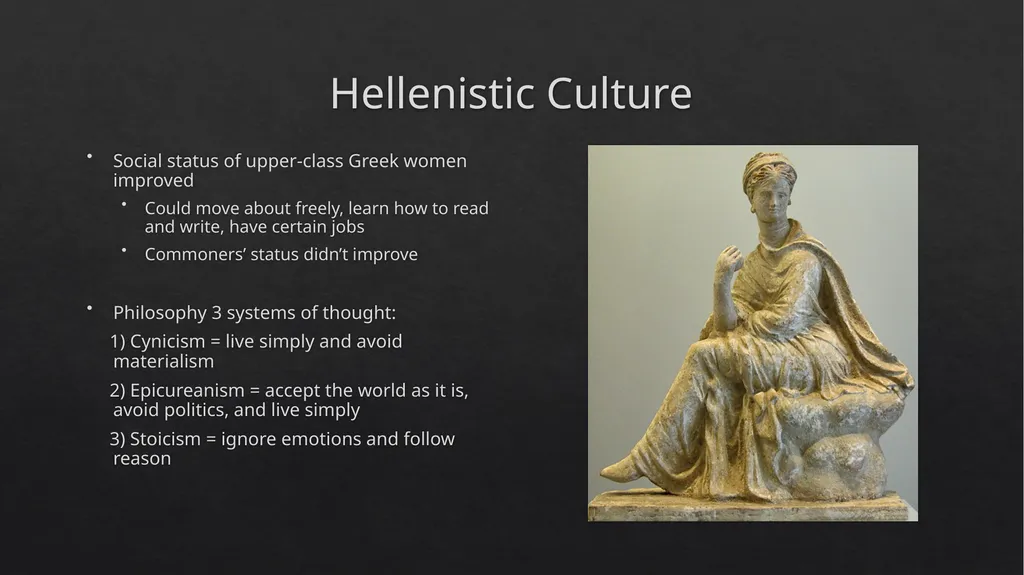
Hellenistic Culture Social status of upper-class Greek women improved
Could move about freely, learn how to read and write, have certain jobs
Commoners’ status didn’t improve
Philosophy 3 systems of thought:
1) Cynicism = live simply and avoid materialism
2) Epicureanism = accept the world as it is, avoid politics, and live simply
3) Stoicism = ignore emotions and follow reason<br>
07
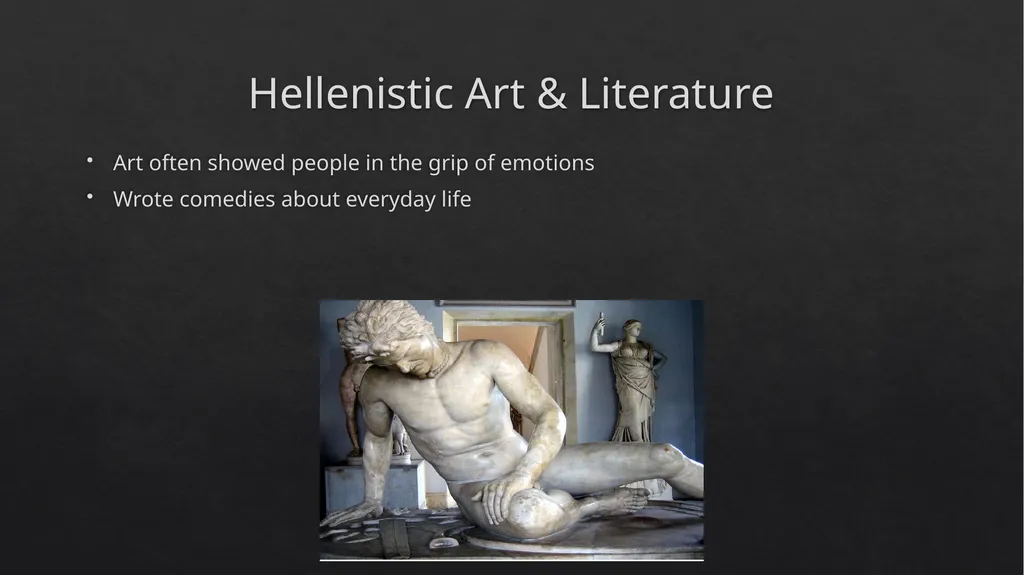
Hellenistic Art & Literature Art often showed people in the grip of emotions
Wrote comedies about everyday life<br>
08
Science, Medicine, and Math Performed experiments and developed new theories
Eratosthenes estimated the circumference of the Earth within 1%
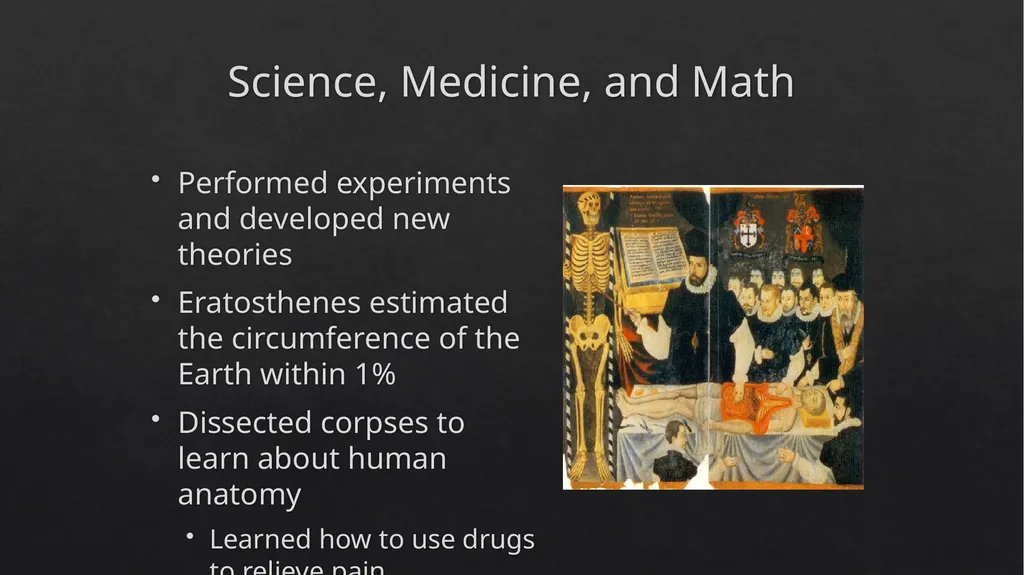
Dissected corpses to learn about human anatomy
Learned how to use drugs to relieve pain<br>
09
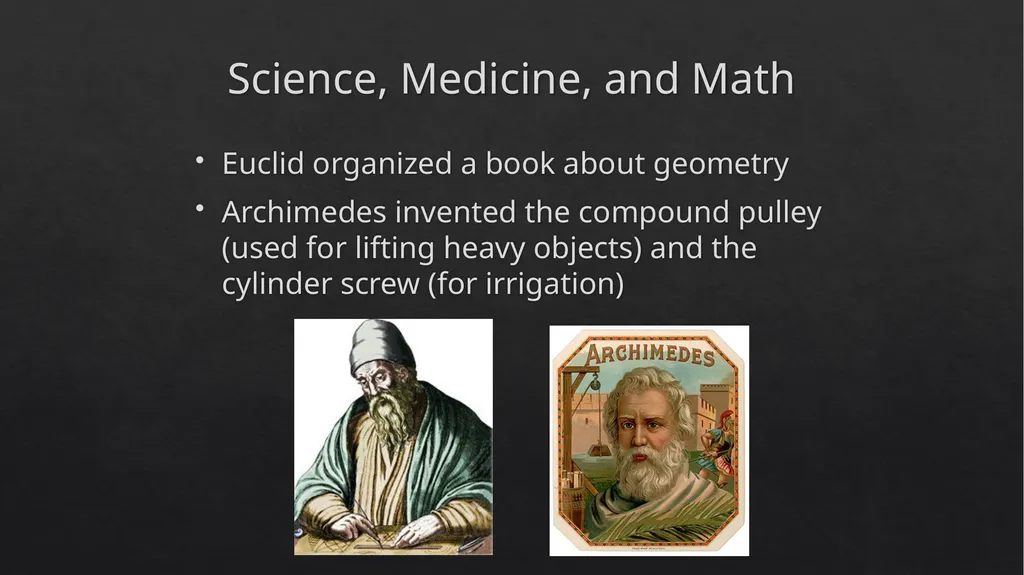
Science, Medicine, and Math Euclid organized a book about geometry
Archimedes invented the compound pulley (used for lifting heavy objects) and the cylinder screw (for irrigation)<br>