
Role of WMO Regional Office for Africa in support
KB
Published · 18 slides · 0 views

1 / 1
Description
Role of WMO Regional Office for Africa in support of Regional Training Centres (RTCs) in RA I (Africa) Ernest A. Afiesimama Regional Office for Africa World Meteorological Organization (WMO) Addis Ababa, Ethiopia Introduction Regional
Related Topics
Share
Embed code
Download this presentation From Below
"Role of WMO Regional Office for Africa in support" is the property of its rightful owner. Permission is granted to download and print the materials on this website for personal, non-commercial use only, and to display it on your personal computer provided you do not modify the materials and that you retain all copyright notices contained in the materials. By downloading content from our website, you accept the terms of this agreement.
Presentation Transcript
01
Role of WMO Regional Office for Africa in support of Regional Training Centres (RTCs)
in RA I (Africa) Ernest A. Afiesimama
Regional Office for Africa
World Meteorological Organization (WMO)
Addis Ababa, Ethiopia<br>
in RA I (Africa) Ernest A. Afiesimama
Regional Office for Africa
World Meteorological Organization (WMO)
Addis Ababa, Ethiopia<br>
02
Introduction
Regional Office for Africa:
WMO Regional Office for Africa (ROA) is part of the Member Services and Development (MSD). It is currently located in Addis Ababa, Ethiopia. The activities for the Least Developed Countries (LDCs) and AMCOMET Secretariat are co-located with ROA.
Sub-offices:
WMO Office for North, Central and West Africa in Abuja, Nigeria
WMO Office for Eastern and Southern Africa in Nairobi, Kenya<br>
03
LDCs
The Least Developed Countries (LDCs) are a group of countries that have been classified by the UN as “least developed” in terms of their low gross national income (GNI), their weak human assets and their high degree of economic vulnerability.
There are thirty four (34) LDCs in Africa, eight (8) in Asia, five (5) in the Pacific and one (1) in the Caribbean, making a total of 48 LDCs. Furthermore, there are nine Small Island Developing States (SIDS) and 16 Landlocked Developing Countries (LLDCs), which are also LDCs.
The governing bodies of UN system and other multilateral organizations are invited to contribute to the implementation of Istanbul Programme of Action for LDCs (IPoA: 2011-2020)
WMO Programme of LDCs is developed as WMO contribution to the IPoA to enable NMHSs in the countries to enhance both human and institutional capacities to eradicate poverty, achieve internationally agreed development goals and enable graduation from LDC category like Capo Verde, Botswana, Maldives, Samoa.<br>
04
The Office for the LDC Programme is located in Regional Office for Africa and is responsible for ensuring:
Development and effective implementation of the WMO Programme for the LDCs, through harmonization and coherence in the implementation of the Regional Programmes, including support to common regional issues;
Coordination of the development and implementation of the WMO Country Profile Database;
Coordination of the development and implementation of the WMO strategy for the SIDS; and
Promotion of WMO and NMHSs contribution towards achieving the internationally agreed development, goals and initiatives, including the Sustainable Development Goals (SDGs).<br>
05
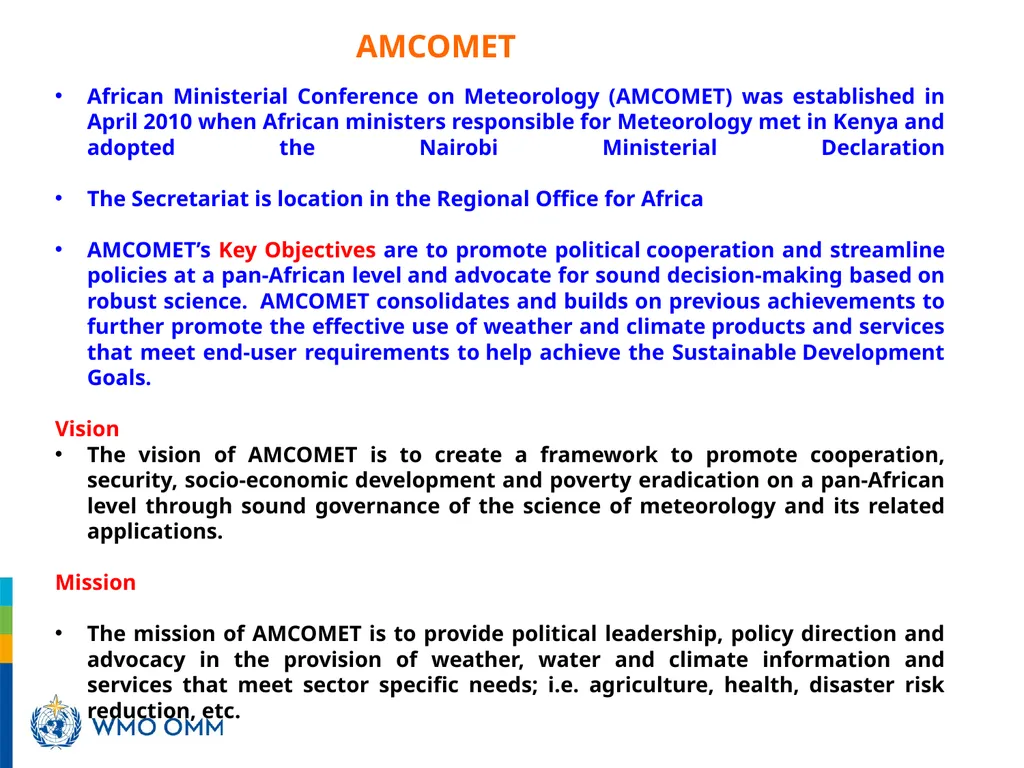
AMCOMET 5 African Ministerial Conference on Meteorology (AMCOMET) was established in April 2010 when African ministers responsible for Meteorology met in Kenya and adopted the Nairobi Ministerial Declaration
The Secretariat is location in the Regional Office for Africa
AMCOMET’s Key Objectives are to promote political cooperation and streamline policies at a pan-African level and advocate for sound decision-making based on robust science. AMCOMET consolidates and builds on previous achievements to further promote the effective use of weather and climate products and services that meet end-user requirements to help achieve the Sustainable Development Goals.
Vision
The vision of AMCOMET is to create a framework to promote cooperation, security, socio-economic development and poverty eradication on a pan-African level through sound governance of the science of meteorology and its related applications.
Mission
The mission of AMCOMET is to provide political leadership, policy direction and advocacy in the provision of weather, water and climate information and services that meet sector specific needs; i.e. agriculture, health, disaster risk reduction, etc.<br>
06
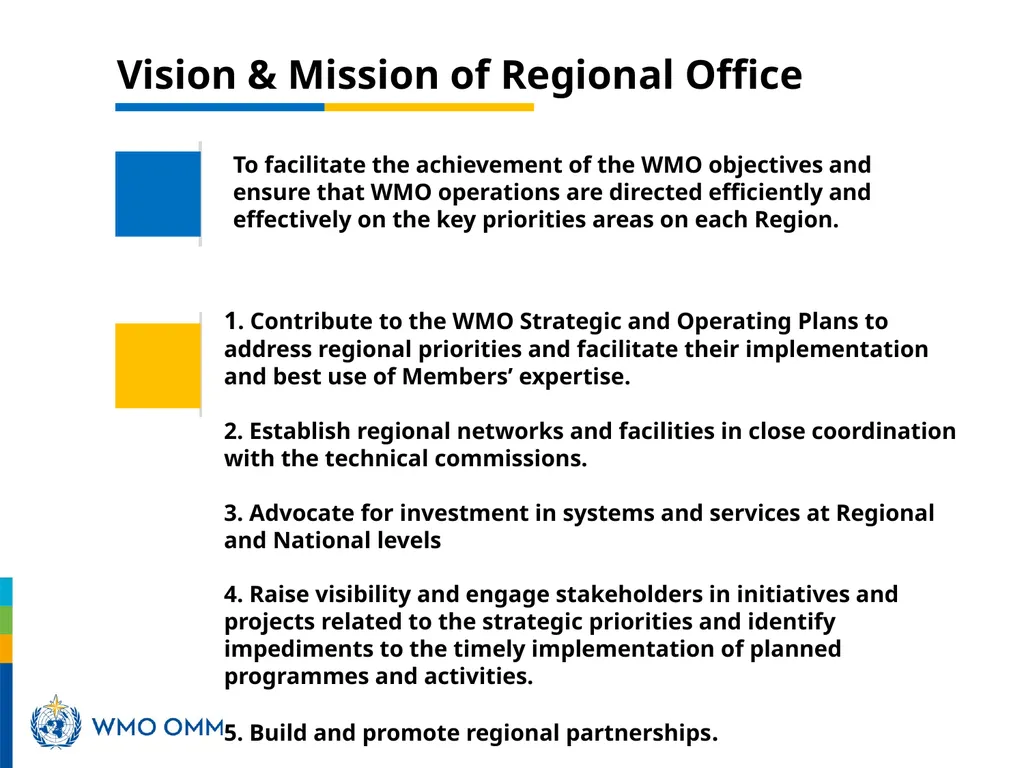
To facilitate the achievement of the WMO objectives and ensure that WMO operations are directed efficiently and effectively on the key priorities areas on each Region. 1. Contribute to the WMO Strategic and Operating Plans to address regional priorities and facilitate their implementation and best use of Members’ expertise.
2. Establish regional networks and facilities in close coordination with the technical commissions.
3. Advocate for investment in systems and services at Regional and National levels
4. Raise visibility and engage stakeholders in initiatives and projects related to the strategic priorities and identify impediments to the timely implementation of planned programmes and activities.
5. Build and promote regional partnerships. Vision & Mission of Regional Office<br>
07
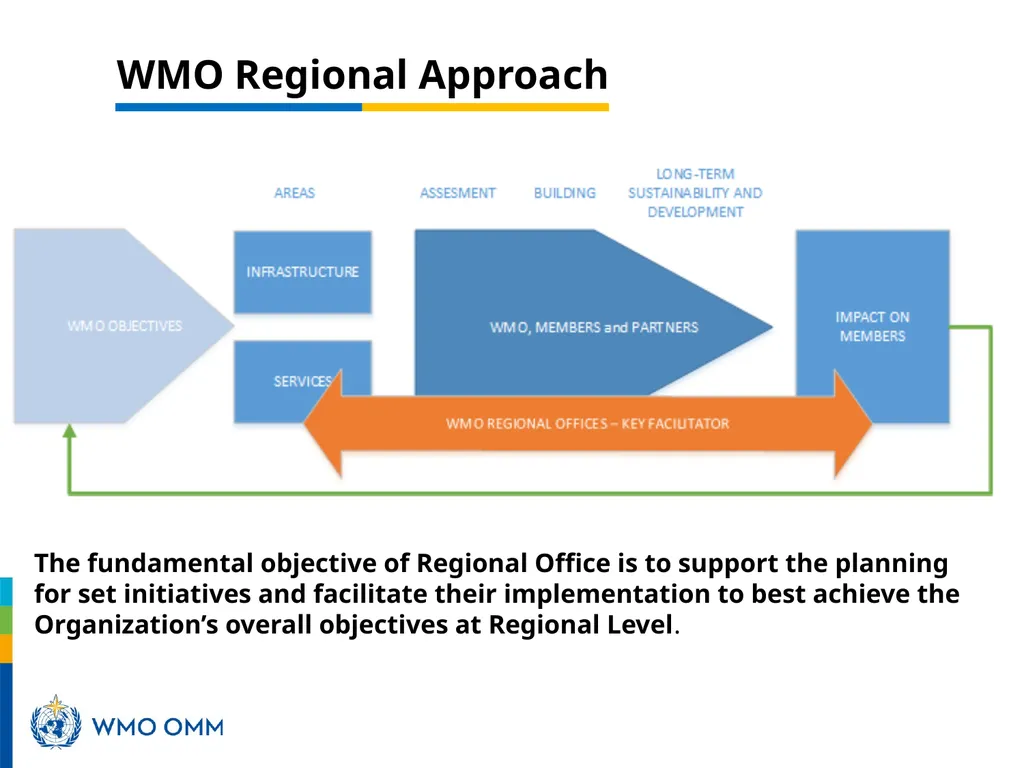
WMO Regional Approach The fundamental objective of Regional Office is to support the planning for set initiatives and facilitate their implementation to best achieve the Organization’s overall objectives at Regional Level.<br>
08
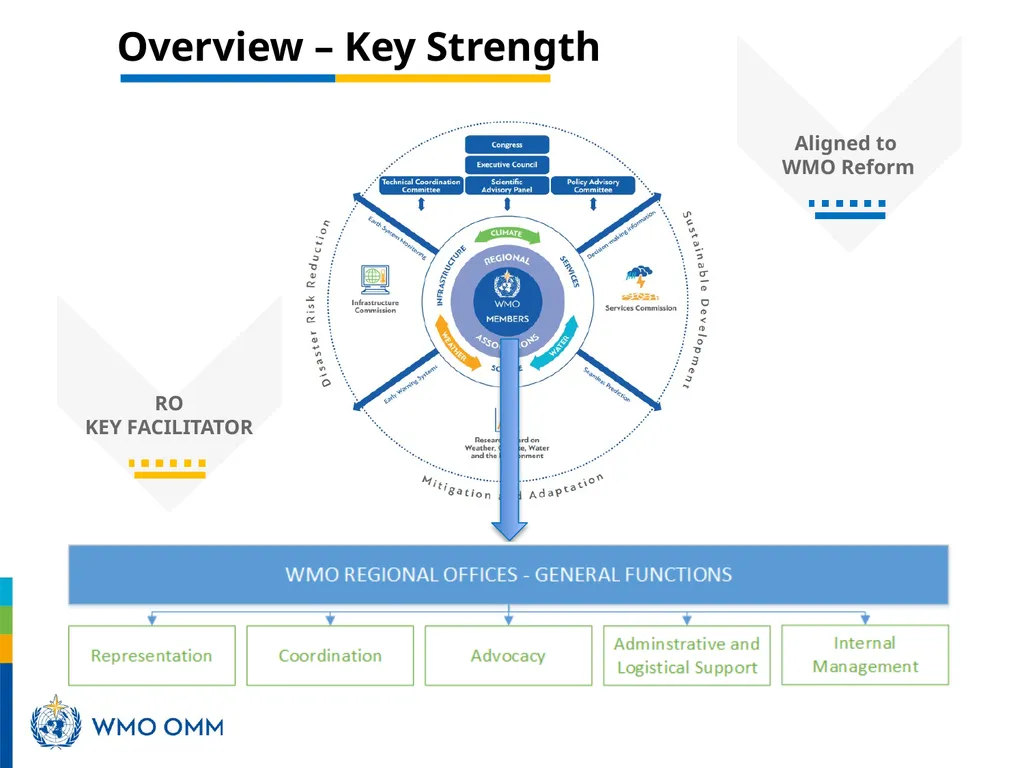
Overview – Key Strength<br>
09
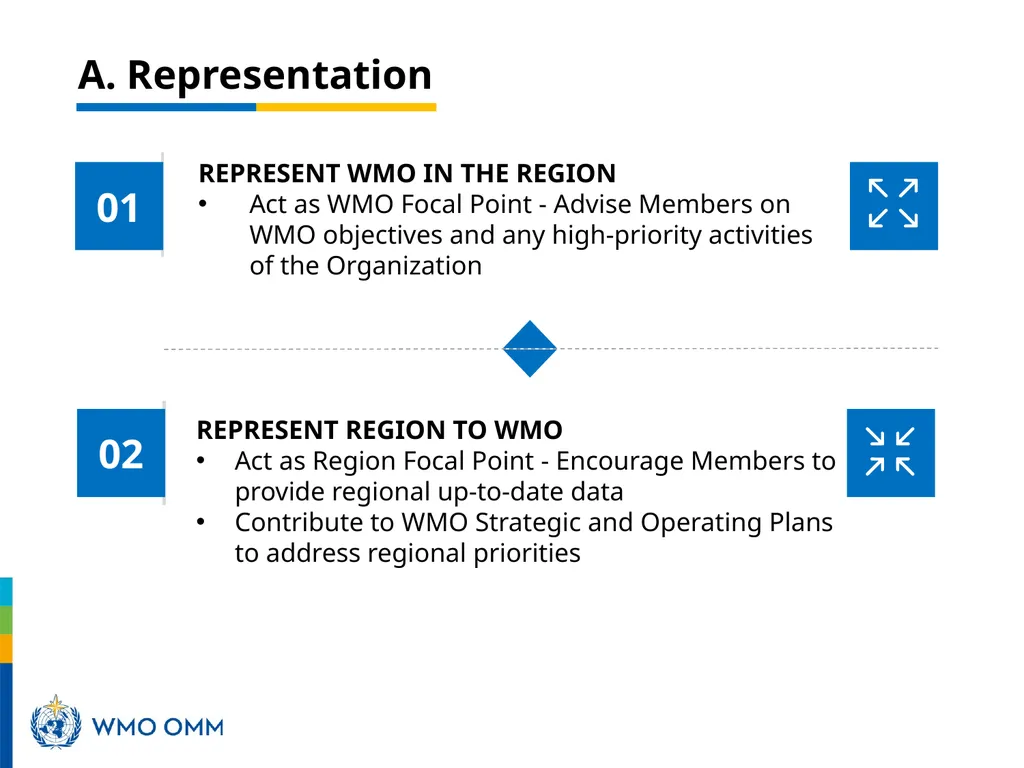
A. Representation REPRESENT WMO IN THE REGION
Act as WMO Focal Point - Advise Members on WMO objectives and any high-priority activities of the Organization REPRESENT REGION TO WMO
Act as Region Focal Point - Encourage Members to provide regional up-to-date data
Contribute to WMO Strategic and Operating Plans to address regional priorities 01 02<br>
10
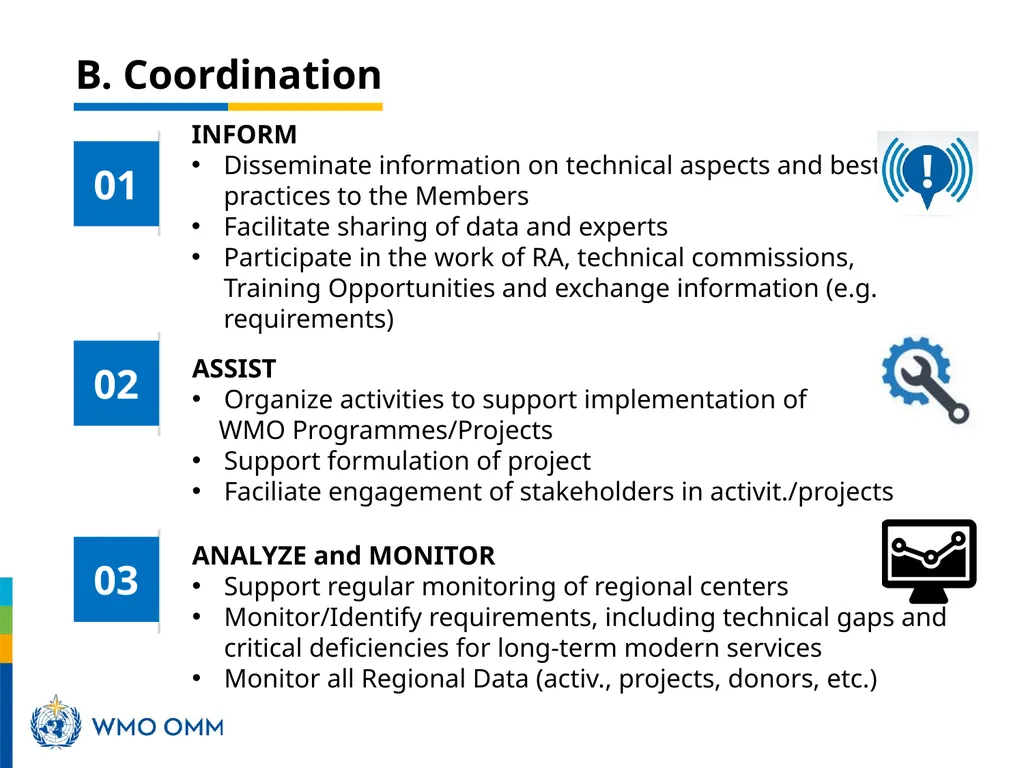
B. Coordination INFORM
Disseminate information on technical aspects and best practices to the Members
Facilitate sharing of data and experts
Participate in the work of RA, technical commissions, Training Opportunities and exchange information (e.g. requirements) ANALYZE and MONITOR
Support regular monitoring of regional centers
Monitor/Identify requirements, including technical gaps and critical deficiencies for long-term modern services
Monitor all Regional Data (activ., projects, donors, etc.) 01 03 ASSIST
Organize activities to support implementation of
WMO Programmes/Projects
Support formulation of project
Faciliate engagement of stakeholders in activit./projects 02<br>
11
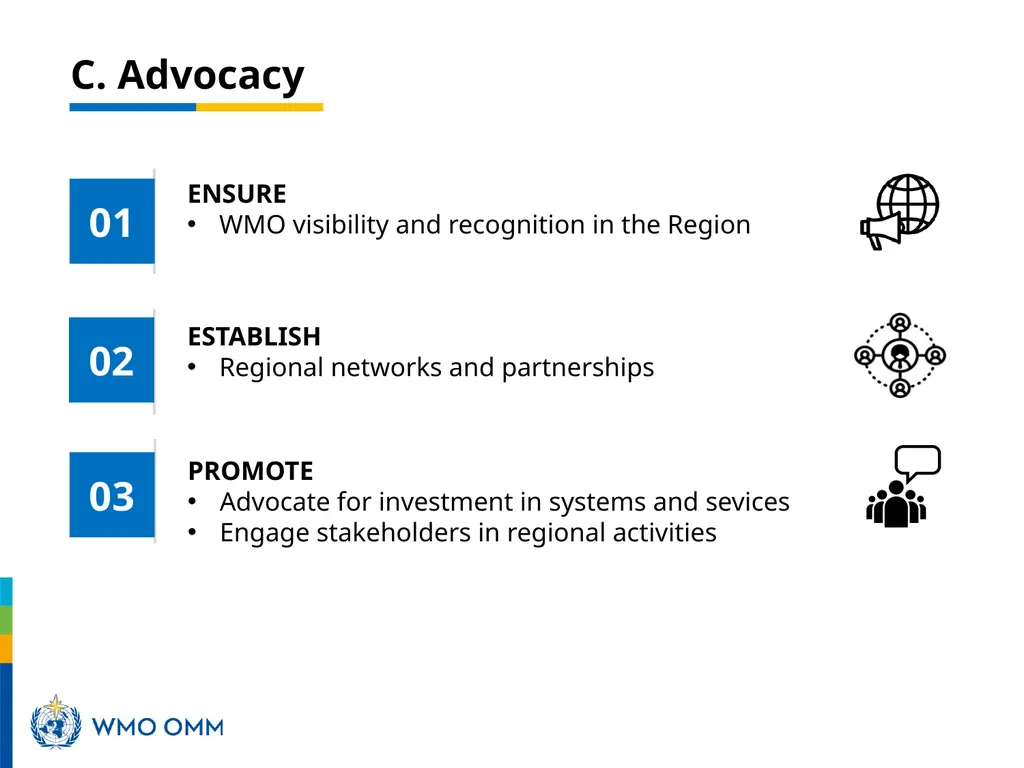
C. Advocacy ENSURE
WMO visibility and recognition in the Region ESTABLISH
Regional networks and partnerships 01 02 PROMOTE
Advocate for investment in systems and sevices
Engage stakeholders in regional activities 03<br>
WMO visibility and recognition in the Region ESTABLISH
Regional networks and partnerships 01 02 PROMOTE
Advocate for investment in systems and sevices
Engage stakeholders in regional activities 03<br>
12
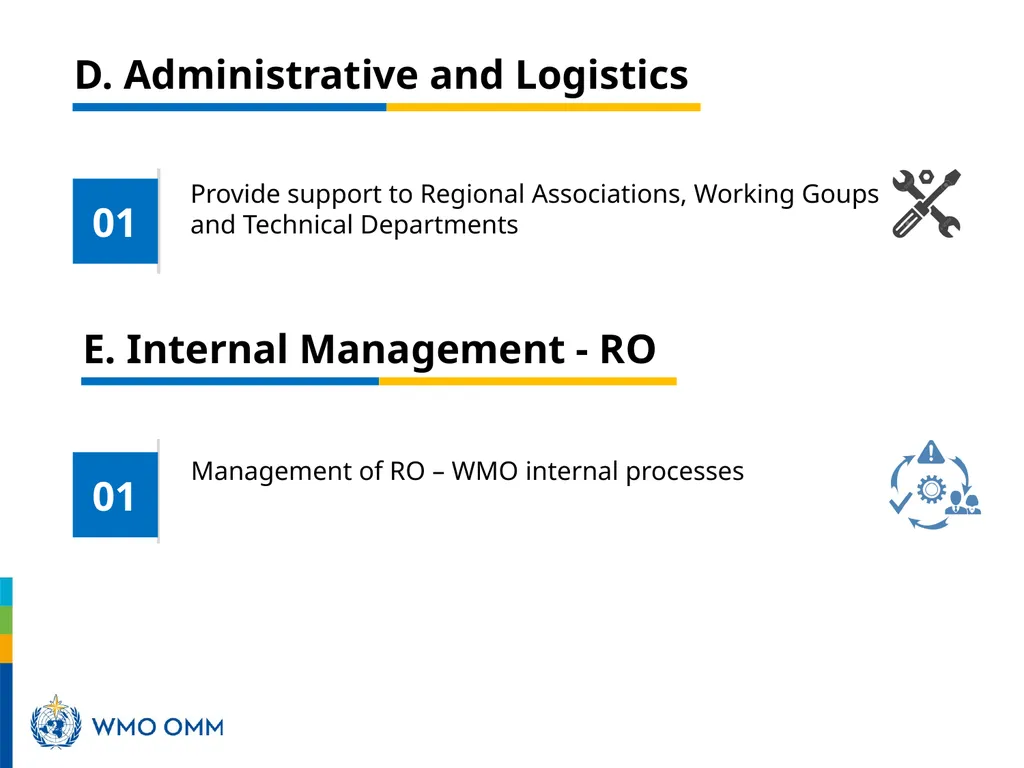
D. Administrative and Logistics Provide support to Regional Associations, Working Goups and Technical Departments Management of RO – WMO internal processes 01 E. Internal Management - RO 01<br>
13
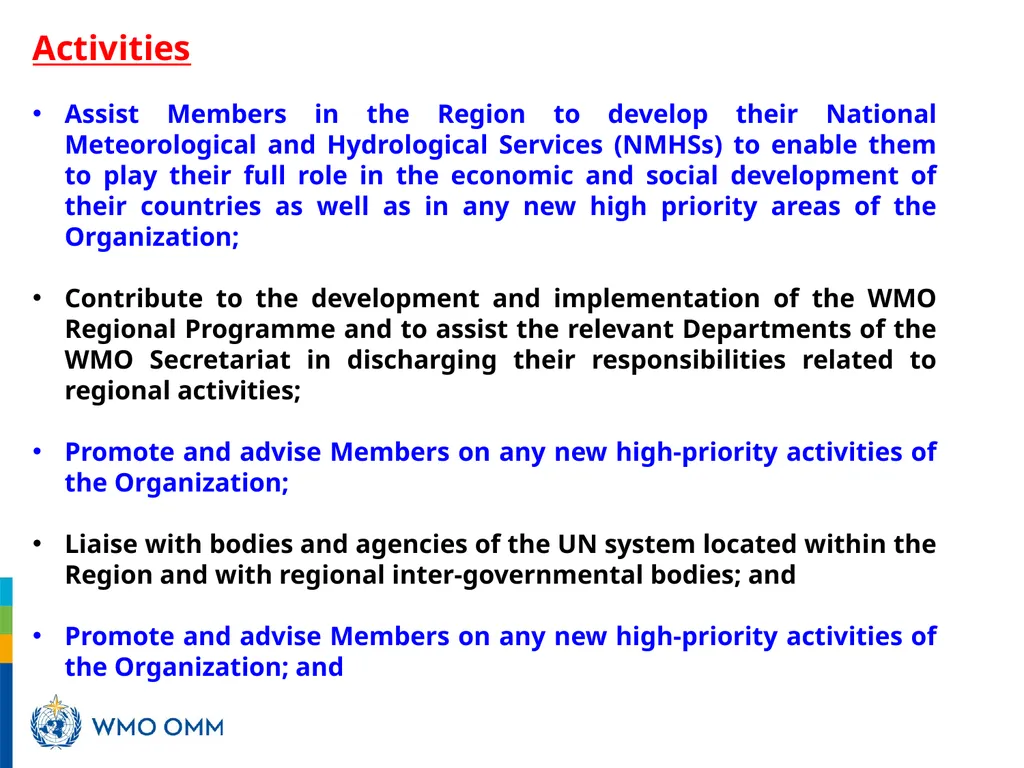
Activities
Assist Members in the Region to develop their National Meteorological and Hydrological Services (NMHSs) to enable them to play their full role in the economic and social development of their countries as well as in any new high priority areas of the Organization;
Contribute to the development and implementation of the WMO Regional Programme and to assist the relevant Departments of the WMO Secretariat in discharging their responsibilities related to regional activities;
Promote and advise Members on any new high-priority activities of the Organization;
Liaise with bodies and agencies of the UN system located within the Region and with regional inter-governmental bodies; and
Promote and advise Members on any new high-priority activities of the Organization; and<br>
14
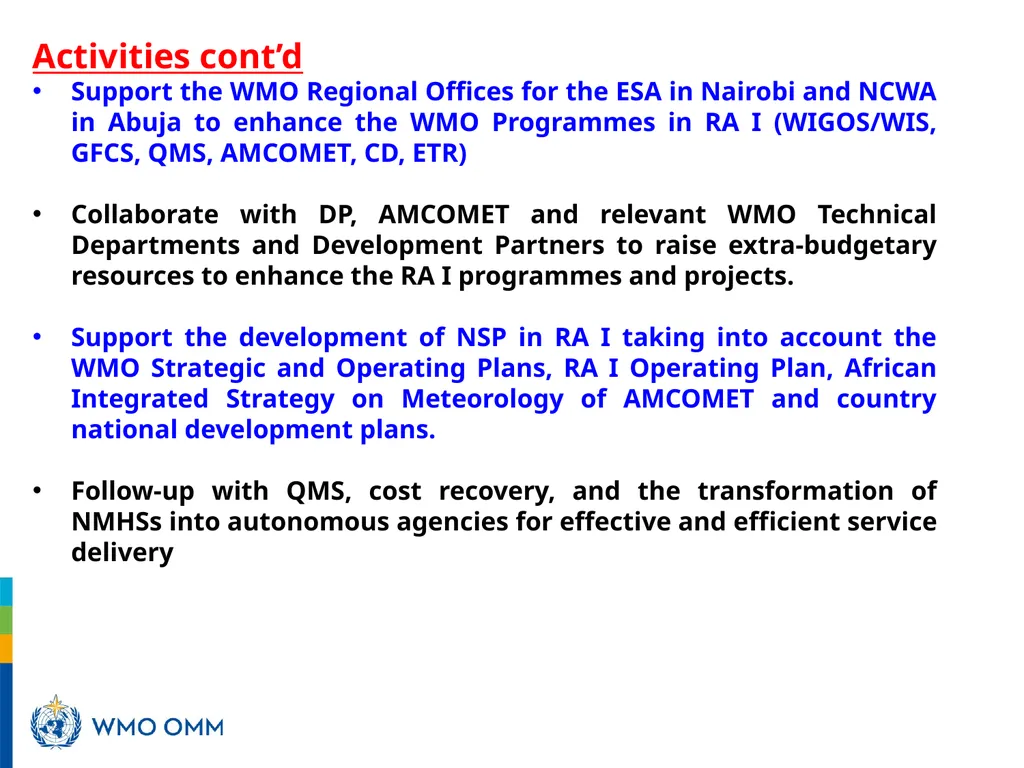
Activities cont’d
Support the WMO Regional Offices for the ESA in Nairobi and NCWA in Abuja to enhance the WMO Programmes in RA I (WIGOS/WIS, GFCS, QMS, AMCOMET, CD, ETR)
Collaborate with DP, AMCOMET and relevant WMO Technical Departments and Development Partners to raise extra-budgetary resources to enhance the RA I programmes and projects.
Support the development of NSP in RA I taking into account the WMO Strategic and Operating Plans, RA I Operating Plan, African Integrated Strategy on Meteorology of AMCOMET and country national development plans.
Follow-up with QMS, cost recovery, and the transformation of NMHSs into autonomous agencies for effective and efficient service delivery<br>
15
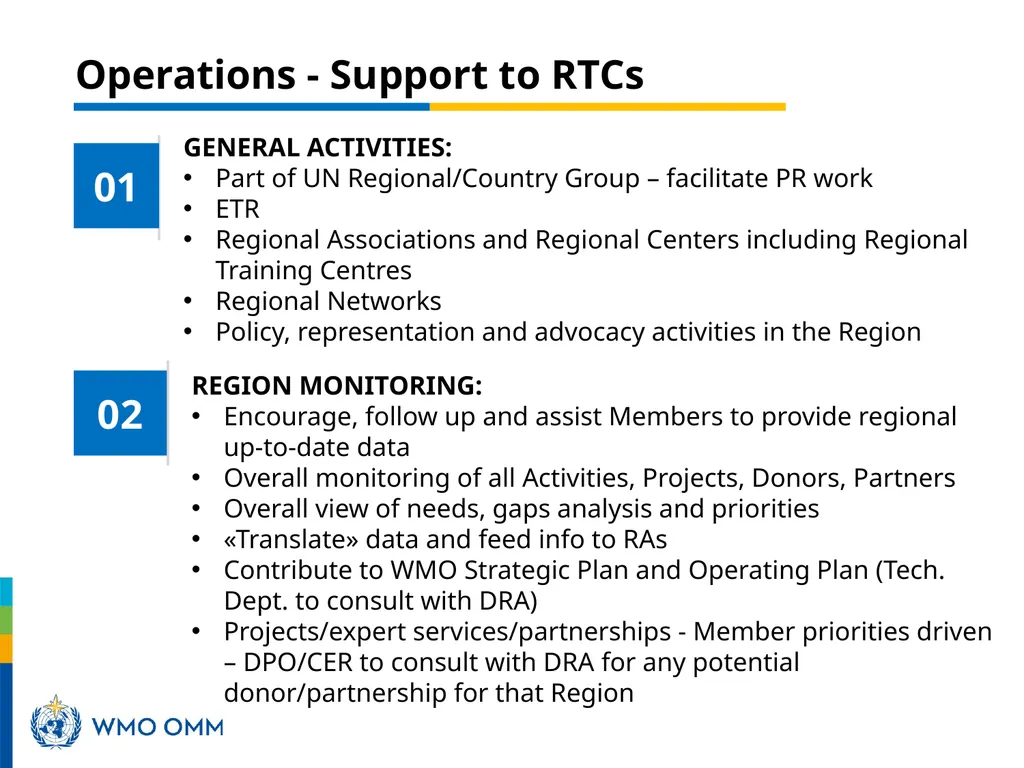
Operations - Support to RTCs 01 GENERAL ACTIVITIES:
Part of UN Regional/Country Group – facilitate PR work
ETR
Regional Associations and Regional Centers including Regional Training Centres
Regional Networks
Policy, representation and advocacy activities in the Region REGION MONITORING:
Encourage, follow up and assist Members to provide regional up-to-date data
Overall monitoring of all Activities, Projects, Donors, Partners
Overall view of needs, gaps analysis and priorities
«Translate» data and feed info to RAs
Contribute to WMO Strategic Plan and Operating Plan (Tech. Dept. to consult with DRA)
Projects/expert services/partnerships - Member priorities driven – DPO/CER to consult with DRA for any potential donor/partnership for that Region 02<br>
16
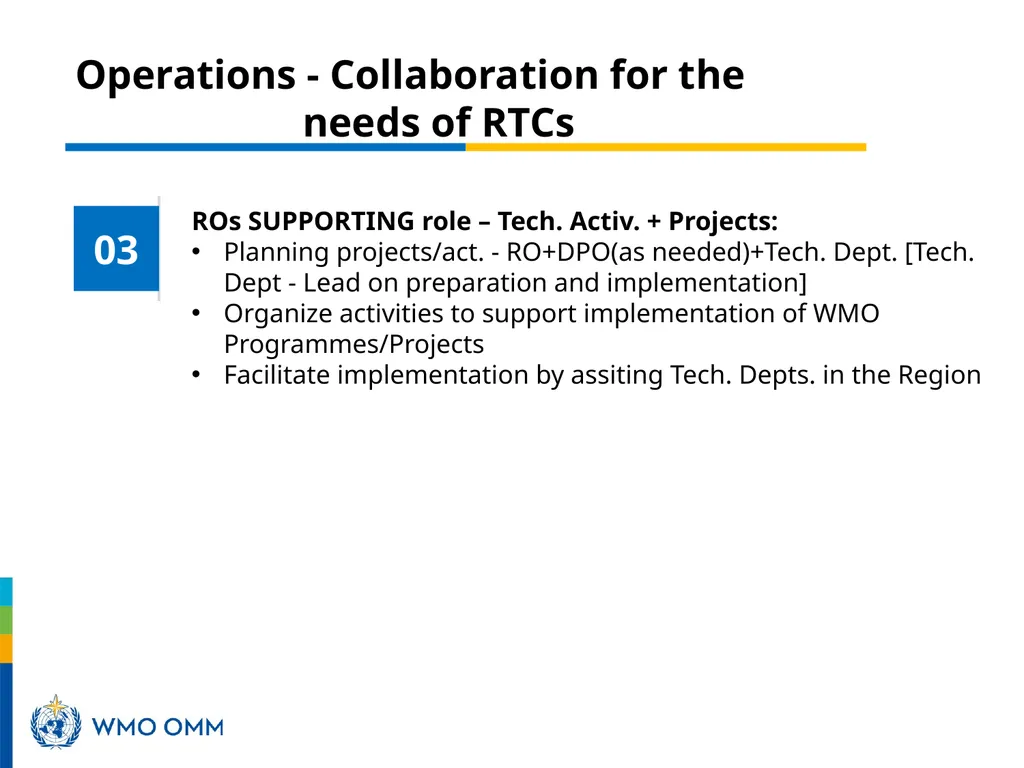
Operations - Collaboration for the
needs of RTCs ROs SUPPORTING role – Tech. Activ. + Projects:
Planning projects/act. - RO+DPO(as needed)+Tech. Dept. [Tech. Dept - Lead on preparation and implementation]
Organize activities to support implementation of WMO Programmes/Projects
Facilitate implementation by assiting Tech. Depts. in the Region 03<br>
17
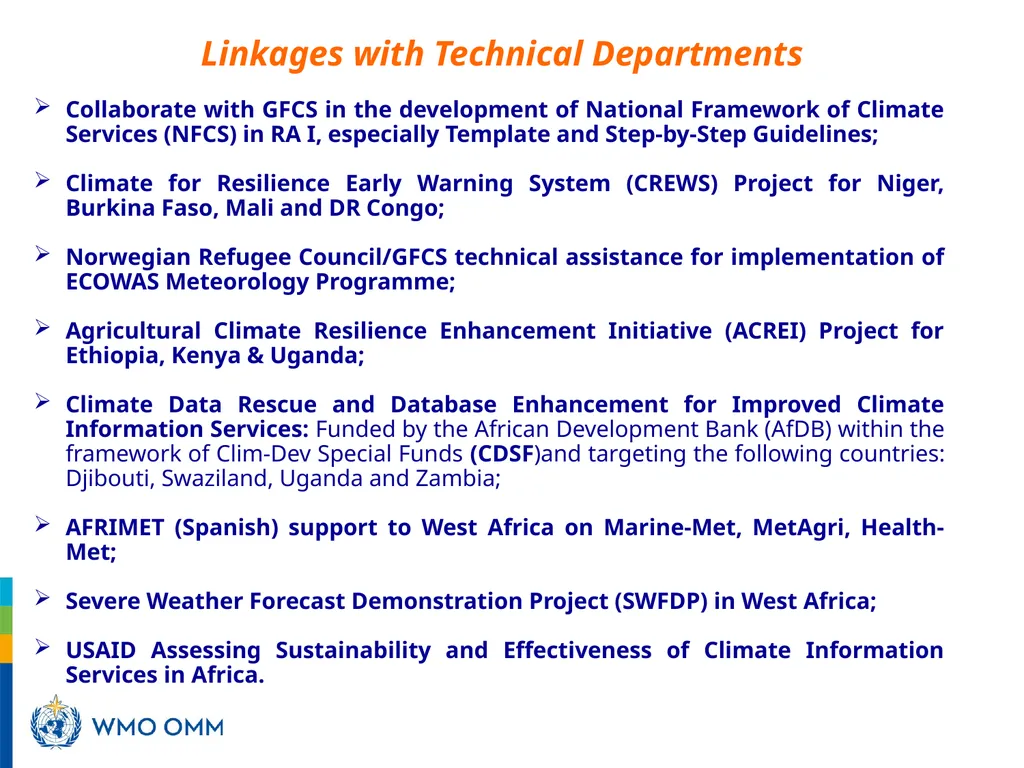
Linkages with Technical Departments 17 Collaborate with GFCS in the development of National Framework of Climate Services (NFCS) in RA I, especially Template and Step-by-Step Guidelines;
Climate for Resilience Early Warning System (CREWS) Project for Niger, Burkina Faso, Mali and DR Congo;
Norwegian Refugee Council/GFCS technical assistance for implementation of ECOWAS Meteorology Programme;
Agricultural Climate Resilience Enhancement Initiative (ACREI) Project for Ethiopia, Kenya & Uganda;
Climate Data Rescue and Database Enhancement for Improved Climate Information Services: Funded by the African Development Bank (AfDB) within the framework of Clim-Dev Special Funds (CDSF)and targeting the following countries: Djibouti, Swaziland, Uganda and Zambia;
AFRIMET (Spanish) support to West Africa on Marine-Met, MetAgri, Health-Met;
Severe Weather Forecast Demonstration Project (SWFDP) in West Africa;
USAID Assessing Sustainability and Effectiveness of Climate Information Services in Africa.<br>
18
Thank you
Merci<br>
Merci<br>