
Rosie’s story: What happens if families change?
LS
Published · 24 slides · 0 views

1 / 1




Description
Rosies story: What happens if families change? Lesson 2 TEACHER SLIDE PREPARING TO TEACH Preparing to teach and using these slides: The slides headed teacher slides assist the teacher in setting up and running the lesson Slide 8
Related Topics
Share
Embed code
Download this presentation From Below
"Rosie’s story: What happens if families change?" is the property of its rightful owner. Permission is granted to download and print the materials on this website for personal, non-commercial use only, and to display it on your personal computer provided you do not modify the materials and that you retain all copyright notices contained in the materials. By downloading content from our website, you accept the terms of this agreement.
Presentation Transcript
01
Rosie’s story: What happens if families change?
Lesson 2<br>
Lesson 2<br>
02
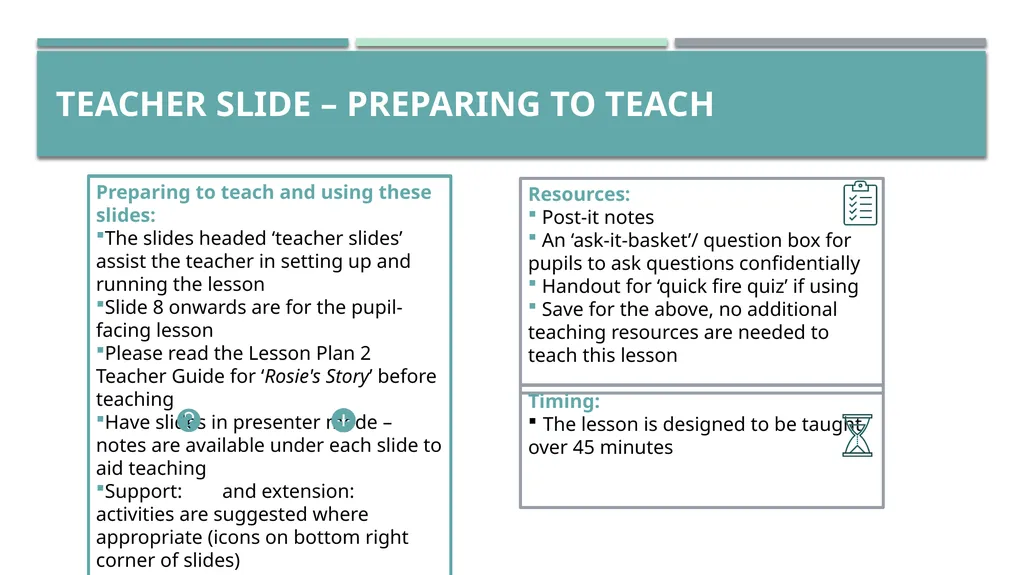
TEACHER SLIDE – PREPARING TO TEACH Preparing to teach and using these slides:
The slides headed ‘teacher slides’ assist the teacher in setting up and running the lesson
Slide 8 onwards are for the pupil-facing lesson
Please read the Lesson Plan 2 Teacher Guide for ‘Rosie's Story’ before teaching
Have slides in presenter mode – notes are available under each slide to aid teaching
Support: and extension:
activities are suggested where appropriate (icons on bottom right corner of slides) Resources:
Post-it notes
An ‘ask-it-basket’/ question box for pupils to ask questions confidentially
Handout for ‘quick fire quiz’ if using
Save for the above, no additional teaching resources are needed to teach this lesson Timing:
The lesson is designed to be taught
over 45 minutes<br>
03
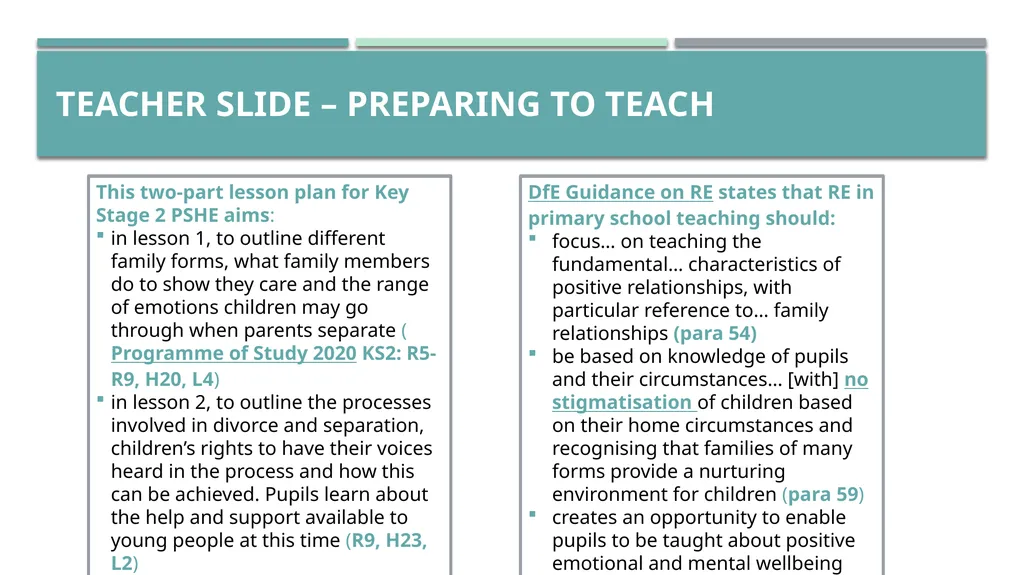
TEACHER SLIDE – PREPARING TO TEACH This two-part lesson plan for Key Stage 2 PSHE aims:
in lesson 1, to outline different family forms, what family members do to show they care and the range of emotions children may go through when parents separate (Programme of Study 2020 KS2: R5-R9, H20, L4)
in lesson 2, to outline the processes involved in divorce and separation, children’s rights to have their voices heard in the process and how this can be achieved. Pupils learn about the help and support available to young people at this time (R9, H23, L2) DfE Guidance on RE states that RE in primary school teaching should:
focus… on teaching the fundamental… characteristics of positive relationships, with particular reference to… family relationships (para 54)
be based on knowledge of pupils and their circumstances… [with] no stigmatisation of children based on their home circumstances and recognising that families of many forms provide a nurturing environment for children (para 59)
creates an opportunity to enable pupils to be taught about positive emotional and mental wellbeing (para 61)<br>
04
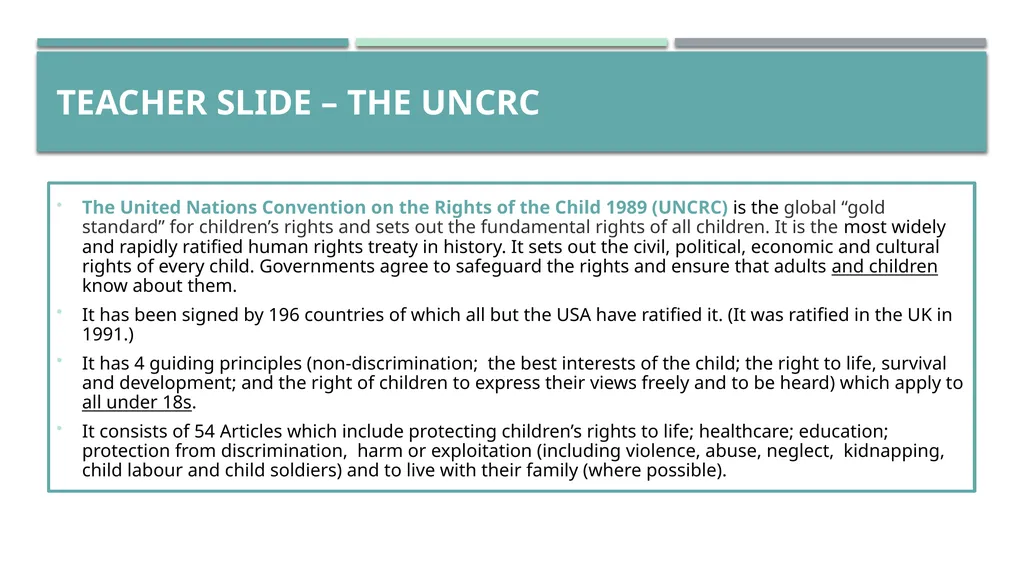
TEACHER SLIDE – the uncrc The United Nations Convention on the Rights of the Child 1989 (UNCRC) is the global “gold standard” for children’s rights and sets out the fundamental rights of all children. It is the most widely and rapidly ratified human rights treaty in history. It sets out the civil, political, economic and cultural rights of every child. Governments agree to safeguard the rights and ensure that adults and children know about them.
It has been signed by 196 countries of which all but the USA have ratified it. (It was ratified in the UK in 1991.)
It has 4 guiding principles (non-discrimination; the best interests of the child; the right to life, survival and development; and the right of children to express their views freely and to be heard) which apply to all under 18s.
It consists of 54 Articles which include protecting children’s rights to life; healthcare; education; protection from discrimination, harm or exploitation (including violence, abuse, neglect, kidnapping, child labour and child soldiers) and to live with their family (where possible).<br>
05
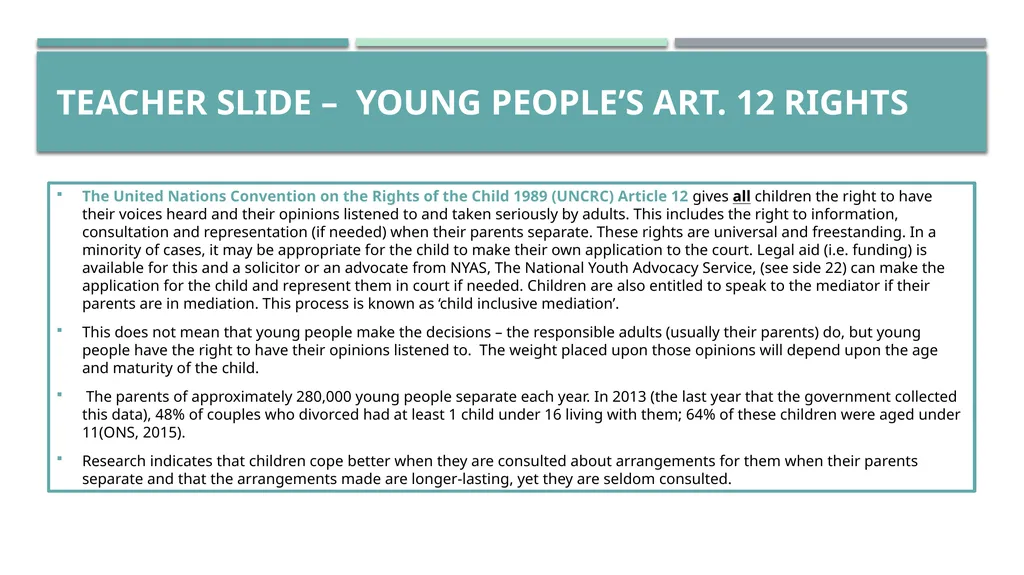
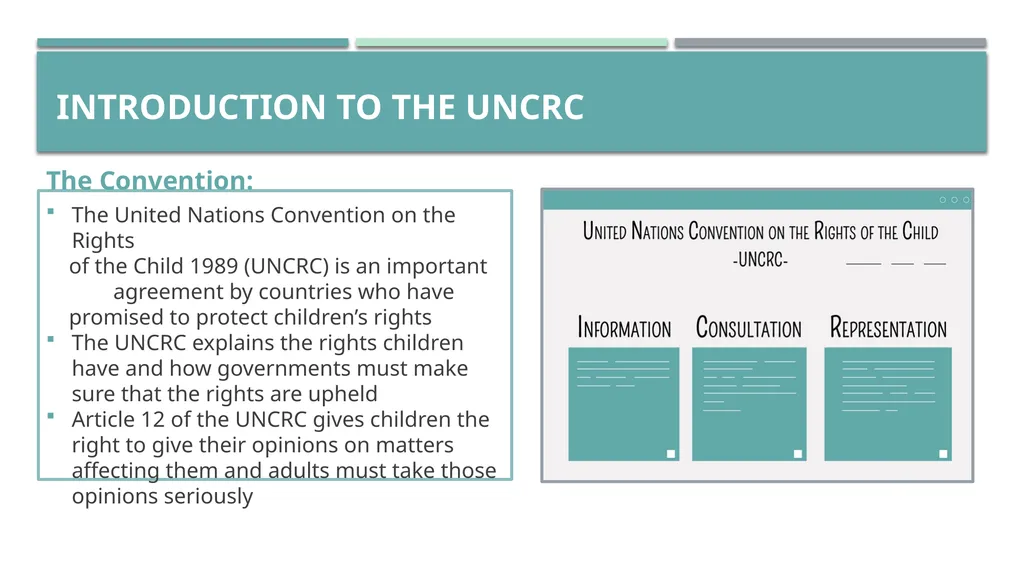
TEACHER SLIDE – YOUNG PEOPLE’S ART. 12 RIGHTS The United Nations Convention on the Rights of the Child 1989 (UNCRC) Article 12 gives all children the right to have their voices heard and their opinions listened to and taken seriously by adults. This includes the right to information, consultation and representation (if needed) when their parents separate. These rights are universal and freestanding. In a minority of cases, it may be appropriate for the child to make their own application to the court. Legal aid (i.e. funding) is available for this and a solicitor or an advocate from NYAS, The National Youth Advocacy Service, (see side 22) can make the application for the child and represent them in court if needed. Children are also entitled to speak to the mediator if their parents are in mediation. This process is known as ‘child inclusive mediation’.
This does not mean that young people make the decisions – the responsible adults (usually their parents) do, but young people have the right to have their opinions listened to. The weight placed upon those opinions will depend upon the age and maturity of the child.
The parents of approximately 280,000 young people separate each year. In 2013 (the last year that the government collected this data), 48% of couples who divorced had at least 1 child under 16 living with them; 64% of these children were aged under 11(ONS, 2015).
Research indicates that children cope better when they are consulted about arrangements for them when their parents separate and that the arrangements made are longer-lasting, yet they are seldom consulted.<br>
06
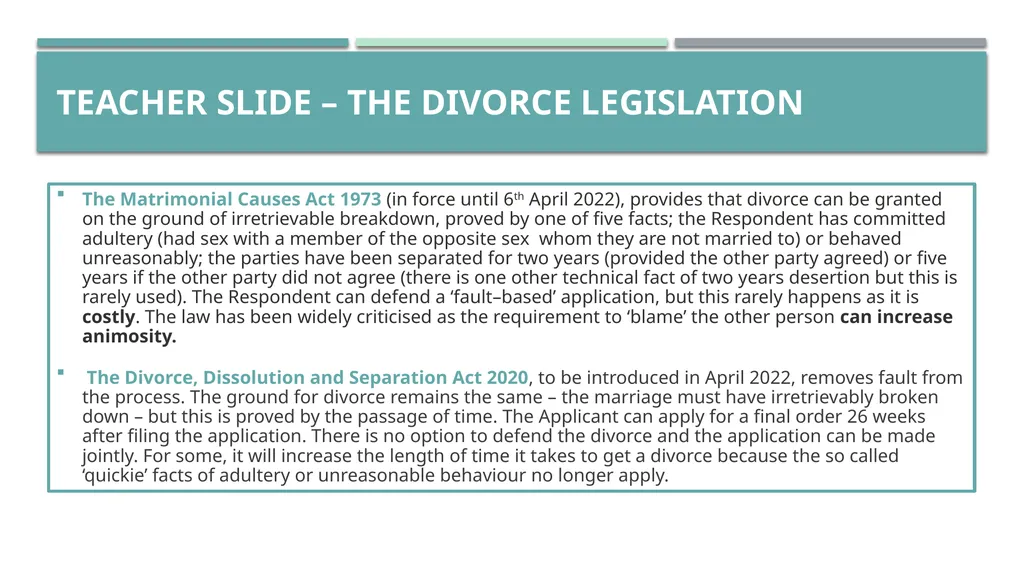
TEACHER SLIDE – the divorce LEGISLATION The Matrimonial Causes Act 1973 (in force until 6th April 2022), provides that divorce can be granted on the ground of irretrievable breakdown, proved by one of five facts; the Respondent has committed adultery (had sex with a member of the opposite sex whom they are not married to) or behaved unreasonably; the parties have been separated for two years (provided the other party agreed) or five years if the other party did not agree (there is one other technical fact of two years desertion but this is rarely used). The Respondent can defend a ‘fault–based’ application, but this rarely happens as it is costly. The law has been widely criticised as the requirement to ‘blame’ the other person can increase animosity.
The Divorce, Dissolution and Separation Act 2020, to be introduced in April 2022, removes fault from the process. The ground for divorce remains the same – the marriage must have irretrievably broken down – but this is proved by the passage of time. The Applicant can apply for a final order 26 weeks after filing the application. There is no option to defend the divorce and the application can be made jointly. For some, it will increase the length of time it takes to get a divorce because the so called ‘quickie’ facts of adultery or unreasonable behaviour no longer apply.<br>
The Divorce, Dissolution and Separation Act 2020, to be introduced in April 2022, removes fault from the process. The ground for divorce remains the same – the marriage must have irretrievably broken down – but this is proved by the passage of time. The Applicant can apply for a final order 26 weeks after filing the application. There is no option to defend the divorce and the application can be made jointly. For some, it will increase the length of time it takes to get a divorce because the so called ‘quickie’ facts of adultery or unreasonable behaviour no longer apply.<br>
07
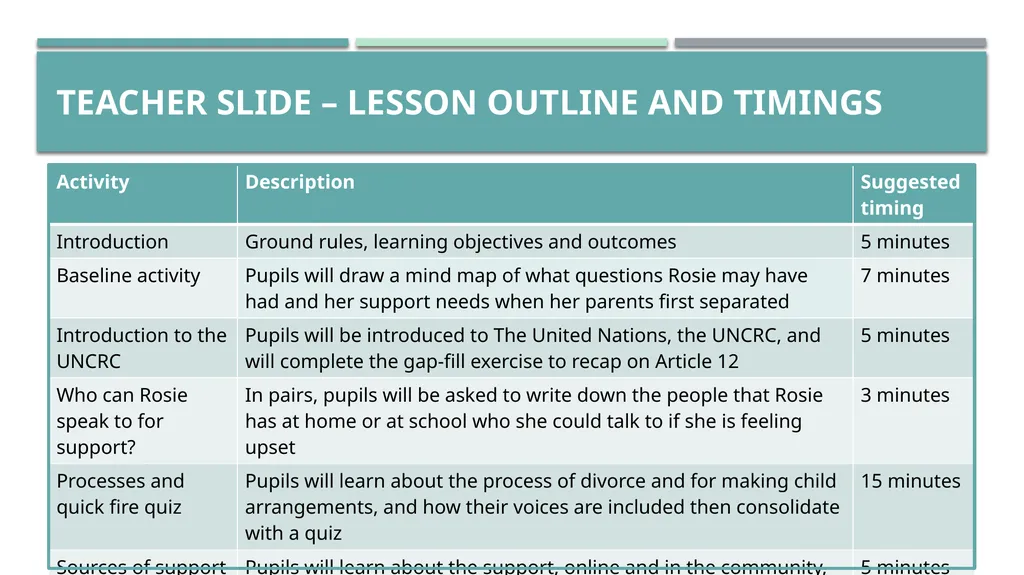
TEACHER SLIDE – LESSON OUTLINE AND TIMINGS<br>
08
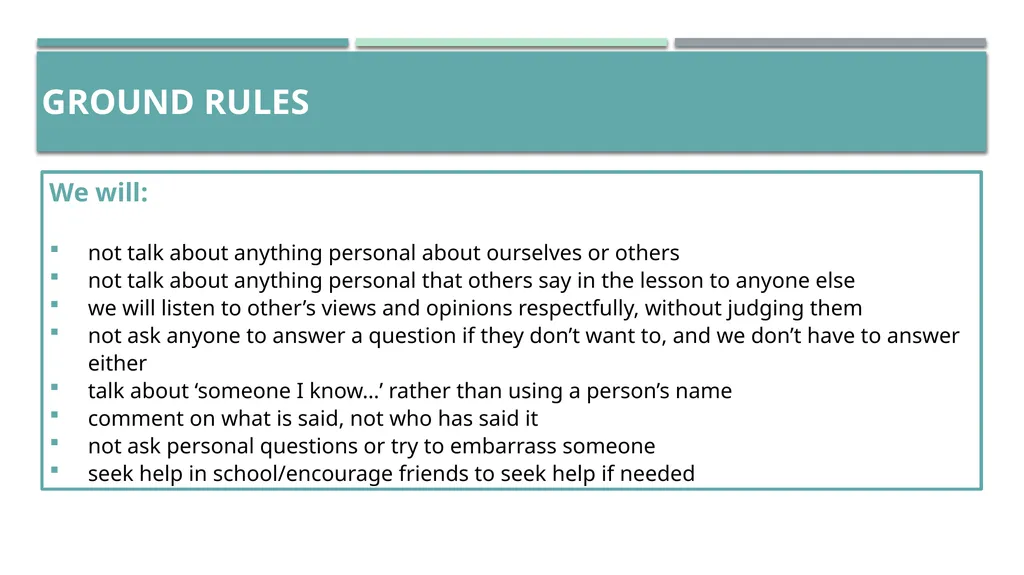
GROUND RULES We will:
not talk about anything personal about ourselves or others
not talk about anything personal that others say in the lesson to anyone else
we will listen to other’s views and opinions respectfully, without judging them
not ask anyone to answer a question if they don’t want to, and we don’t have to answer either
talk about ‘someone I know…’ rather than using a person’s name
comment on what is said, not who has said it
not ask personal questions or try to embarrass someone
seek help in school/encourage friends to seek help if needed<br>
09
Rosie’s story: What happens if families change? LESSON 2 Learning Objectives - Pupils will learn:
about rights children have if parents separate and the type of support they might need<br>
about rights children have if parents separate and the type of support they might need<br>
10
Rosie’s story: What happens if families change? LESSON 2 Learning Outcomes - Pupils will be able to:
explain young people’s rights under Article 12, UNCRC when
parents separate
identify the different ways arrangements for children can be made and how young people can be consulted if parents separate
identify sources of support for these young people and explain how to access them<br>
explain young people’s rights under Article 12, UNCRC when
parents separate
identify the different ways arrangements for children can be made and how young people can be consulted if parents separate
identify sources of support for these young people and explain how to access them<br>
11
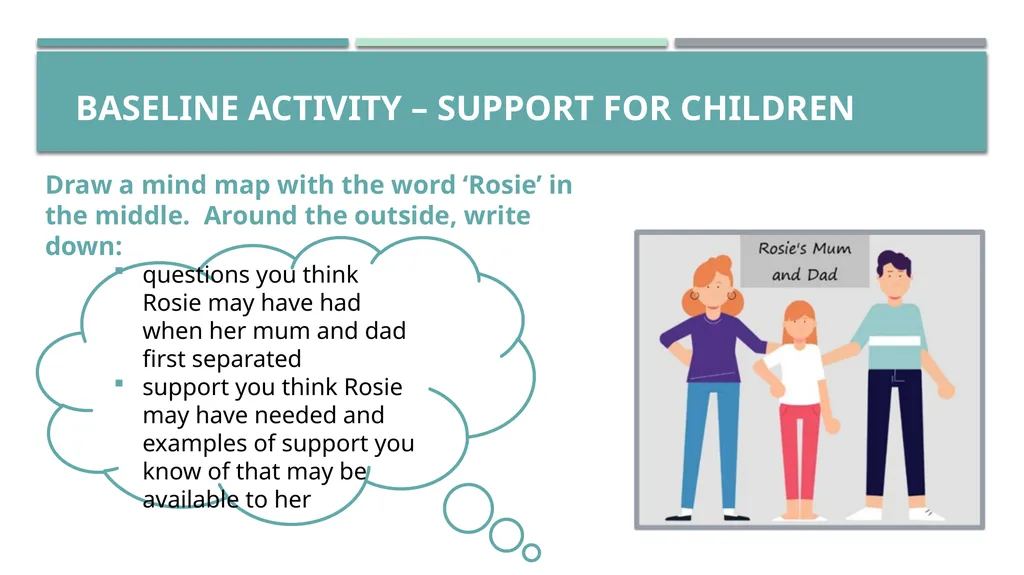
BASELINE ACTIVITY – support for children questions you think Rosie may have had when her mum and dad first separated
support you think Rosie may have needed and examples of support you know of that may be available to her Draw a mind map with the word ‘Rosie’ in the middle. Around the outside, write down:<br>
support you think Rosie may have needed and examples of support you know of that may be available to her Draw a mind map with the word ‘Rosie’ in the middle. Around the outside, write down:<br>
12
INTRODUCTION TO THE UNCRC The Convention:
The United Nations Convention on the Rights
of the Child 1989 (UNCRC) is an important agreement by countries who have promised to protect children’s rights
The UNCRC explains the rights children have and how governments must make sure that the rights are upheld
Article 12 of the UNCRC gives children the right to give their opinions on matters affecting them and adults must take those opinions seriously<br>
13
ARTICLE 12: UNCRC ARTICLE 12
You have the _________ to give your ___________ and for __________ to _________, and take it __________.
adults, opinion, seriously, right, listen<br>
You have the _________ to give your ___________ and for __________ to _________, and take it __________.
adults, opinion, seriously, right, listen<br>
14
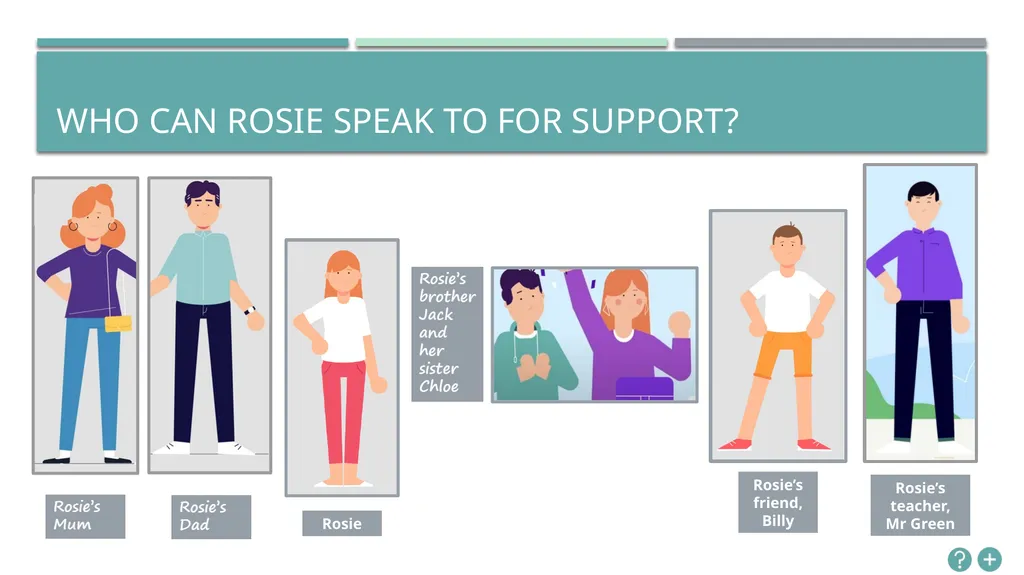
Who can ROSIE SPEAK TO FOR support?<br>
15
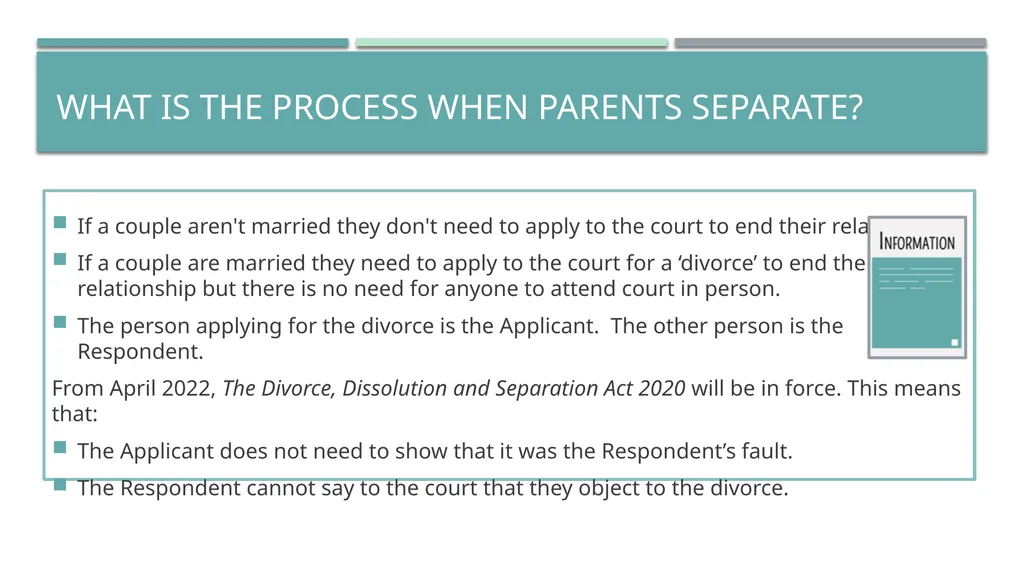
What is the process when parents separate? If a couple aren't married they don't need to apply to the court to end their relationship.
If a couple are married they need to apply to the court for a ‘divorce’ to end their relationship but there is no need for anyone to attend court in person.
The person applying for the divorce is the Applicant. The other person is the Respondent.
From April 2022, The Divorce, Dissolution and Separation Act 2020 will be in force. This means that:
The Applicant does not need to show that it was the Respondent’s fault.
The Respondent cannot say to the court that they object to the divorce.<br>
16
How are child arrangements agreed? Making child arrangements
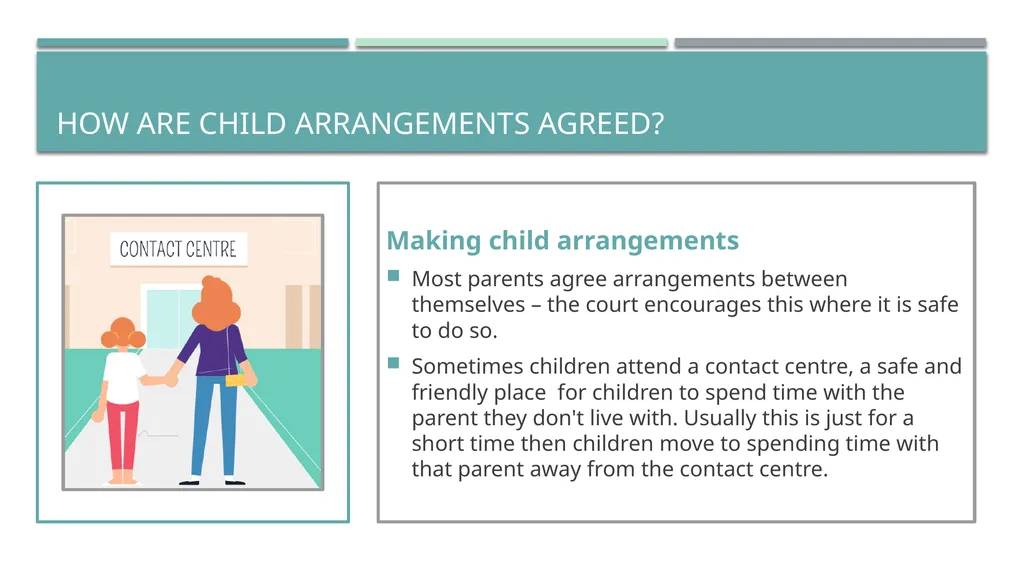
Most parents agree arrangements between themselves – the court encourages this where it is safe to do so.
Sometimes children attend a contact centre, a safe and friendly place for children to spend time with the parent they don't live with. Usually this is just for a short time then children move to spending time with that parent away from the contact centre.<br>
17
mediation Mediation
If parents can't agree between themselves, they can choose to meet with a ‘mediator’ to help them to reach agreement instead of going to court.
A mediator is someone who helps parents who have separated to agree the things that need to be sorted out.
The mediator doesn't take sides.<br>
If parents can't agree between themselves, they can choose to meet with a ‘mediator’ to help them to reach agreement instead of going to court.
A mediator is someone who helps parents who have separated to agree the things that need to be sorted out.
The mediator doesn't take sides.<br>
18
Meeting the mediator Child inclusive mediation
If children meet the mediator this is known as ‘child inclusive mediation’.
Mediators meet with children who are around 9 or older.
Child inclusive mediation gives young people the opportunity to meet and talk (alone or with their brothers and sisters) with the mediator who is helping their parents to sort things out.
The mediator then tells the parents what the young person wants the mediator to say to help the parents make decisions.<br>
19
Meeting the family court advisor The Family Court Advisor (FCA)
Sometimes the family court may ask an FCA to meet with a child or young person to talk about their wishes and feelings and to make sure the family court hears what they have to say.
The FCA will also usually meet the parents and will then gives their view to the court about what is best for the child.
FCAs do not need to meet all children and young people because sometimes families can agree themselves on what is best.<br>
20
Decisions made at court Decisions made at court
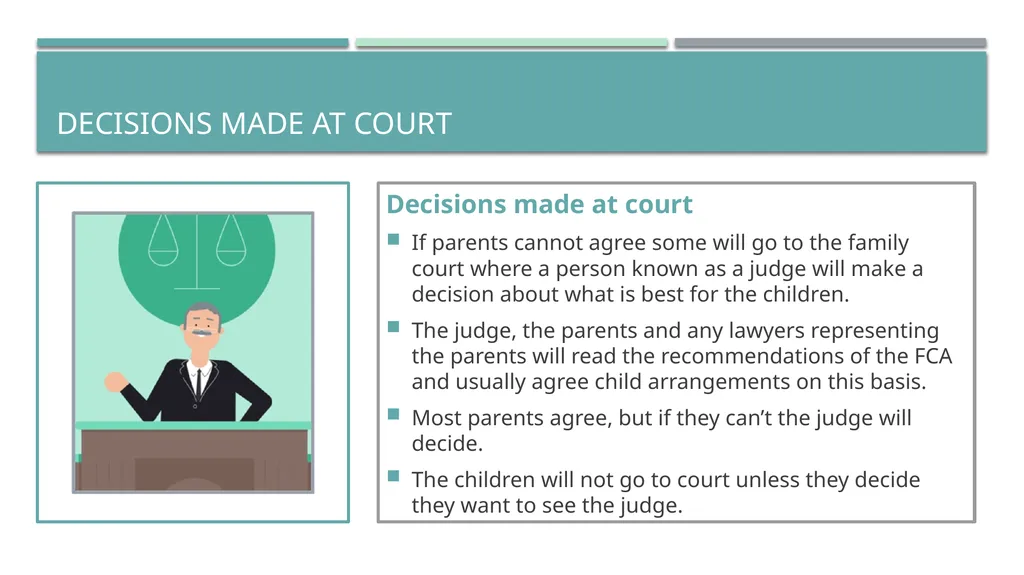
If parents cannot agree some will go to the family court where a person known as a judge will make a decision about what is best for the children.
The judge, the parents and any lawyers representing the parents will read the recommendations of the FCA and usually agree child arrangements on this basis.
Most parents agree, but if they can’t the judge will decide.
The children will not go to court unless they decide they want to see the judge.<br>
21
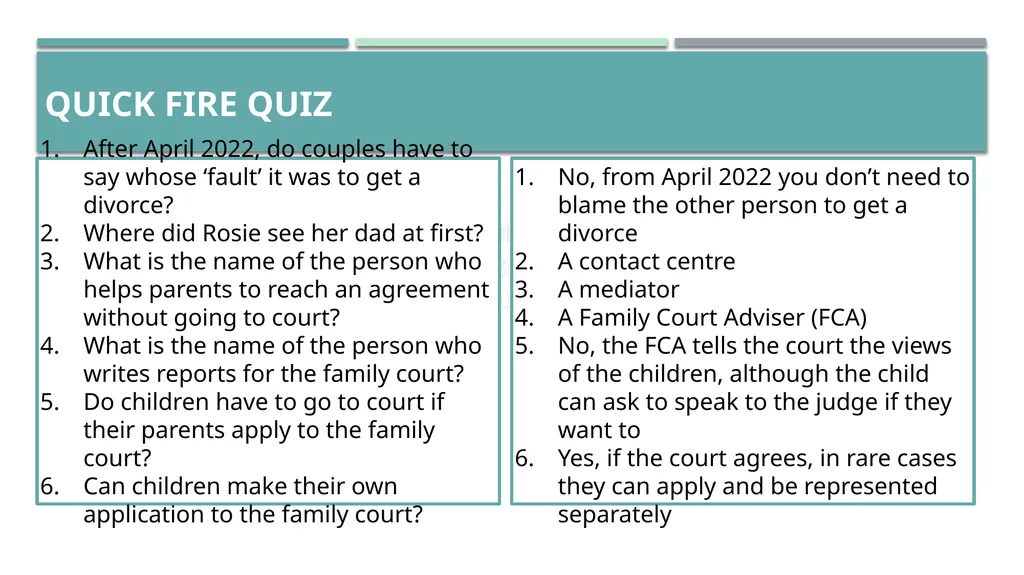
QUICK FIRE QUIZ 1. Relationship built mostly on FRIENDSHIP
2. BOTH PARTNERS SHOULD EXPECT IT TO BE PERFECT – IF IT’S NOT MOVE ON
3. CONFLICT DEALT WITH AT AN EARLY STAGE
4. 1. UNHEALTHY: Attraction is important but friendship is crucial
2. UNHEALTHY: All relationships go through ups and downs
3. HEALTHY: Respectfully dealing with issues as they arise keeps relationships on track No, from April 2022 you don’t need to blame the other person to get a divorce
A contact centre
A mediator
A Family Court Adviser (FCA)
No, the FCA tells the court the views of the children, although the child can ask to speak to the judge if they want to
Yes, if the court agrees, in rare cases they can apply and be represented separately After April 2022, do couples have to say whose ‘fault’ it was to get a divorce?
Where did Rosie see her dad at first?
What is the name of the person who helps parents to reach an agreement without going to court?
What is the name of the person who writes reports for the family court?
Do children have to go to court if their parents apply to the family court?
Can children make their own application to the family court?<br>
22
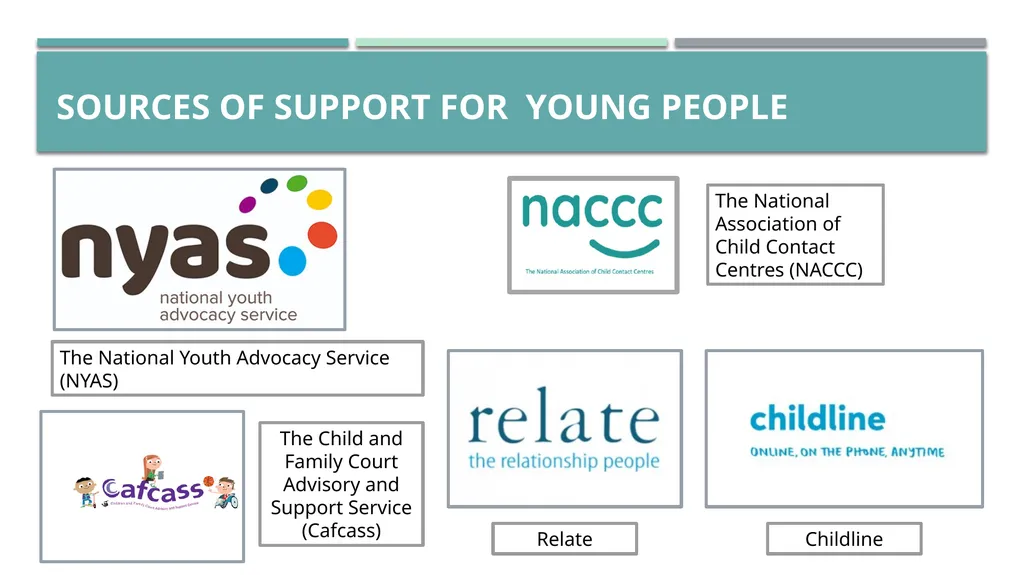
Sources of support for young people Childline<br>
23
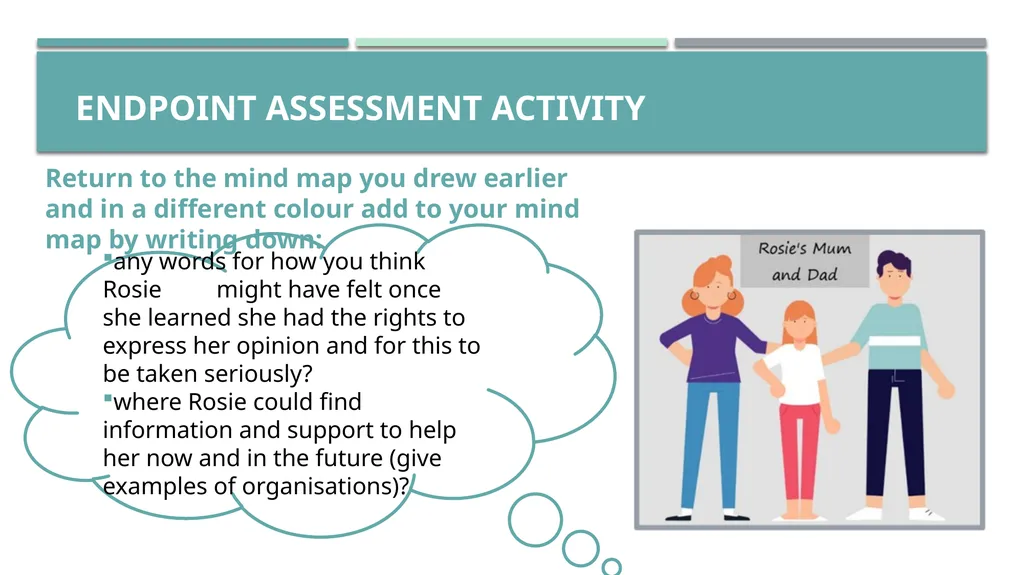
ENDPOINT ASSESSMENT ACTIVITY any words for how you think Rosie might have felt once she learned she had the rights to express her opinion and for this to be taken seriously?
where Rosie could find information and support to help her now and in the future (give examples of organisations)? Return to the mind map you drew earlier and in a different colour add to your mind map by writing down:<br>
where Rosie could find information and support to help her now and in the future (give examples of organisations)? Return to the mind map you drew earlier and in a different colour add to your mind map by writing down:<br>
24
Further help and support For further help and support in school contact:
your form teacher/ PSHE teacher
your Head of Year
the pastoral support team
For further help and support outside of school:
National Youth Advocacy Service: https://NYAS.net (tel: 0808 8081001)
National Association of Child Contact Centres: https://naccc.org.uk (tel: 01159 484557)
Cafcass: https://www.cafcass.gov.uk (tel: 0300 456 4000)
Relate: https://www.relate.org.uk
ChildLine: https://www.childline.org.uk tel: 0800 1111)<br>