
Seizures and Epilepsy Dr Khushboo Anjum Assistant
PC
Published · 31 slides · 0 views

1 / 1









Description
Seizures and Epilepsy Dr Khushboo Anjum Assistant professor (neurology) SCHOOL OF Health sciences, csjm university, kanpur Dr Khushboo Anjum, ASSISTANT PROFESSOR, SHS, CSJMU, KANPUR Dr Khushboo Anjum, ASSISTANT PROFESSOR, SHS, CSJMU, KANPUR
Related Topics
Share
Embed code
Download this presentation From Below
"Seizures and Epilepsy Dr Khushboo Anjum Assistant" is the property of its rightful owner. Permission is granted to download and print the materials on this website for personal, non-commercial use only, and to display it on your personal computer provided you do not modify the materials and that you retain all copyright notices contained in the materials. By downloading content from our website, you accept the terms of this agreement.
Presentation Transcript
01
Seizures and Epilepsy Dr Khushboo Anjum
Assistant professor (neurology)
SCHOOL OF Health sciences,
csjm university, kanpur Dr Khushboo Anjum, ASSISTANT PROFESSOR, SHS, CSJMU, KANPUR<br>
Assistant professor (neurology)
SCHOOL OF Health sciences,
csjm university, kanpur Dr Khushboo Anjum, ASSISTANT PROFESSOR, SHS, CSJMU, KANPUR<br>
02
Dr Khushboo Anjum, ASSISTANT PROFESSOR, SHS, CSJMU, KANPUR<br>
03
INTRODUCTION Epilepsy is one of the most common neurological conditions, affecting over 70 million people worldwide (1).
Its prevalence in high-income countries is estimated to be 6.4 cases per 1,000 persons, and the annual incidence is 67.8 cases per 100,000 person-years (2).
These numbers are almost quadrupled in low-income and middle-income countries (LMICs) Dr Khushboo Anjum, ASSISTANT PROFESSOR, SHS, CSJMU, KANPUR<br>
04
introduction Epilepsy is a chronic neurological disorder characterized by recurrent, unprovoked seizures caused by abnormal, excessive, and synchronous neuronal activity in the brain.
It affects approximately 1–2% of the global population. Dr Khushboo Anjum, ASSISTANT PROFESSOR, SHS, CSJMU, KANPUR<br>
It affects approximately 1–2% of the global population. Dr Khushboo Anjum, ASSISTANT PROFESSOR, SHS, CSJMU, KANPUR<br>
05
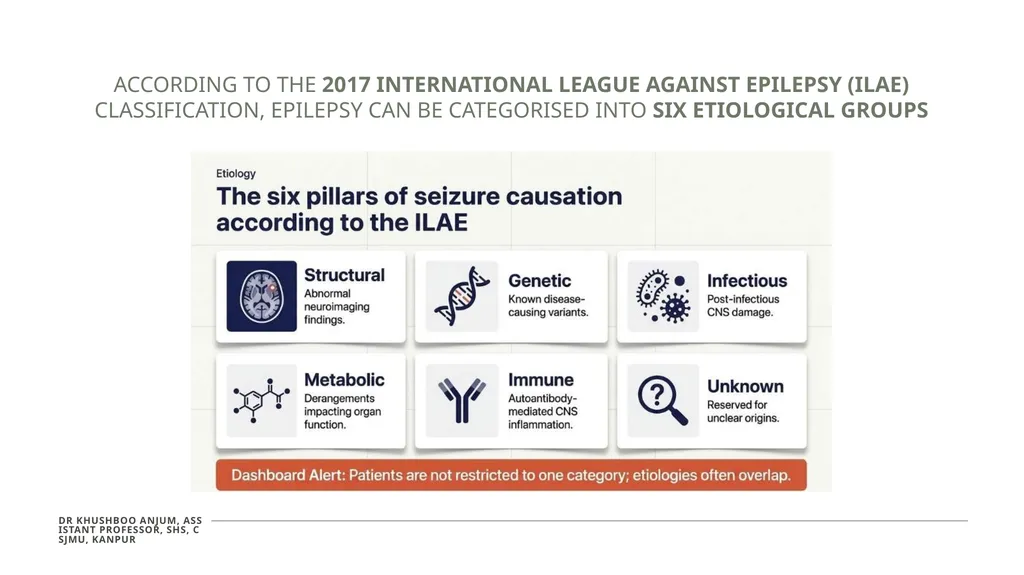
According to the 2017 International League Against Epilepsy (ILAE) classification, epilepsy can be categorised into six etiological groups Dr Khushboo Anjum, ASSISTANT PROFESSOR, SHS, CSJMU, KANPUR<br>
06
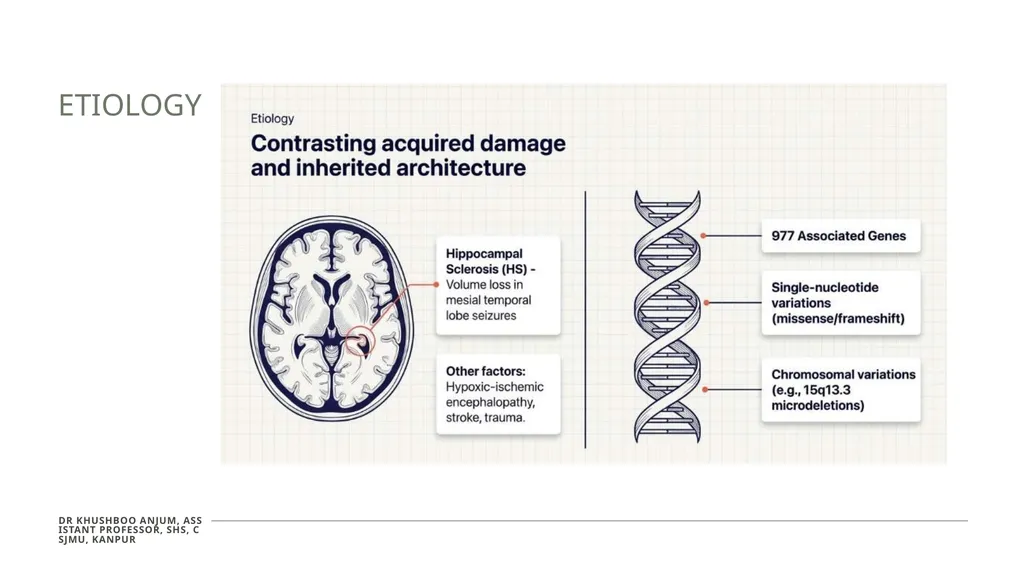
etiology Dr Khushboo Anjum, ASSISTANT PROFESSOR, SHS, CSJMU, KANPUR<br>
07
Dr Khushboo Anjum, ASSISTANT PROFESSOR, SHS, CSJMU, KANPUR<br>
08
Dr Khushboo Anjum, ASSISTANT PROFESSOR, SHS, CSJMU, KANPUR<br>
09
Dr Khushboo Anjum, ASSISTANT PROFESSOR, SHS, CSJMU, KANPUR<br>
10
Dr Khushboo Anjum, ASSISTANT PROFESSOR, SHS, CSJMU, KANPUR<br>
11
Dr Khushboo Anjum, ASSISTANT PROFESSOR, SHS, CSJMU, KANPUR<br>
12
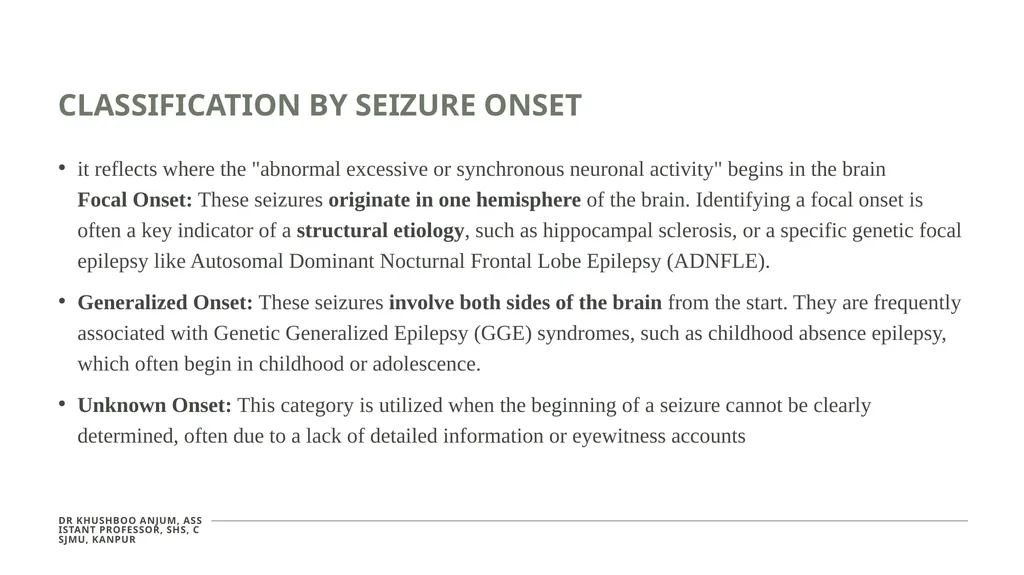
Classification by Seizure Onset it reflects where the "abnormal excessive or synchronous neuronal activity" begins in the brain
Focal Onset: These seizures originate in one hemisphere of the brain. Identifying a focal onset is often a key indicator of a structural etiology, such as hippocampal sclerosis, or a specific genetic focal epilepsy like Autosomal Dominant Nocturnal Frontal Lobe Epilepsy (ADNFLE).
Generalized Onset: These seizures involve both sides of the brain from the start. They are frequently associated with Genetic Generalized Epilepsy (GGE) syndromes, such as childhood absence epilepsy, which often begin in childhood or adolescence.
Unknown Onset: This category is utilized when the beginning of a seizure cannot be clearly determined, often due to a lack of detailed information or eyewitness accounts Dr Khushboo Anjum, ASSISTANT PROFESSOR, SHS, CSJMU, KANPUR<br>
13
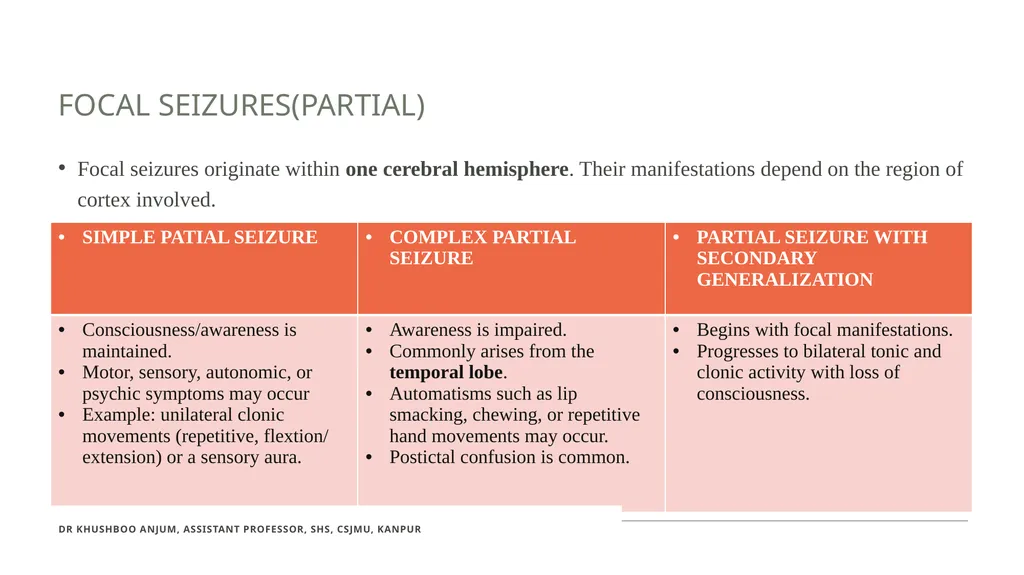
Focal Seizures(PARTIAL) Focal seizures originate within one cerebral hemisphere. Their manifestations depend on the region of cortex involved. Dr Khushboo Anjum, ASSISTANT PROFESSOR, SHS, CSJMU, KANPUR<br>
14
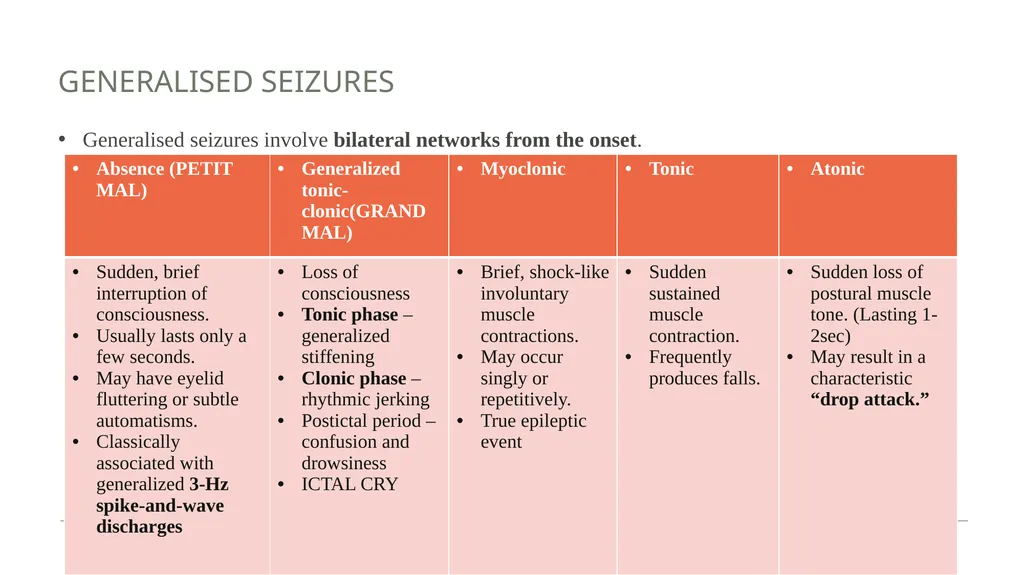
GeneraliSed Seizures Generalised seizures involve bilateral networks from the onset.<br>
15
Dr Khushboo Anjum, ASSISTANT PROFESSOR, SHS, CSJMU, KANPUR<br>
16
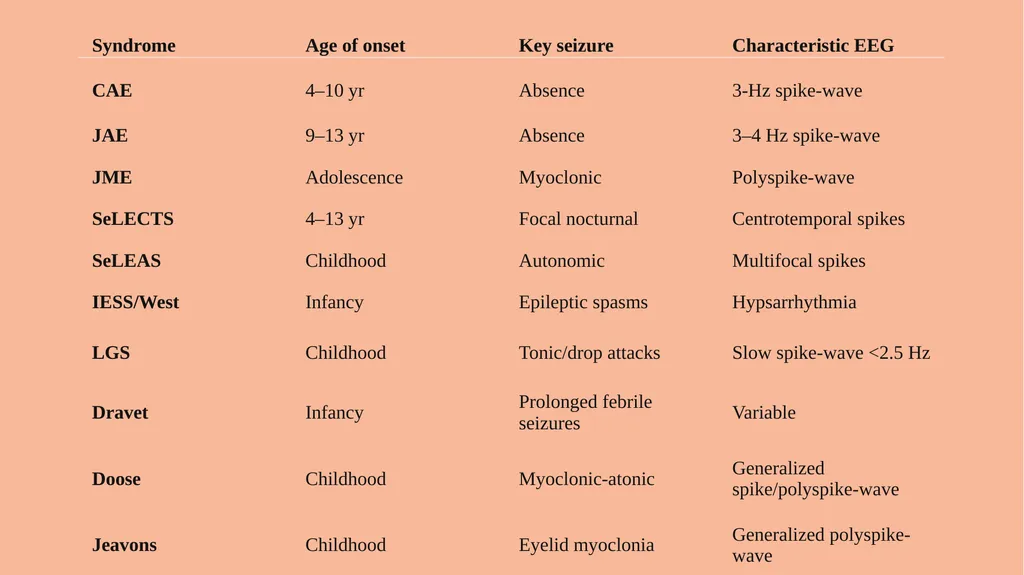
Epilepsy syndrome Dr Khushboo Anjum, ASSISTANT PROFESSOR, SHS, CSJMU, KANPUR<br>
17
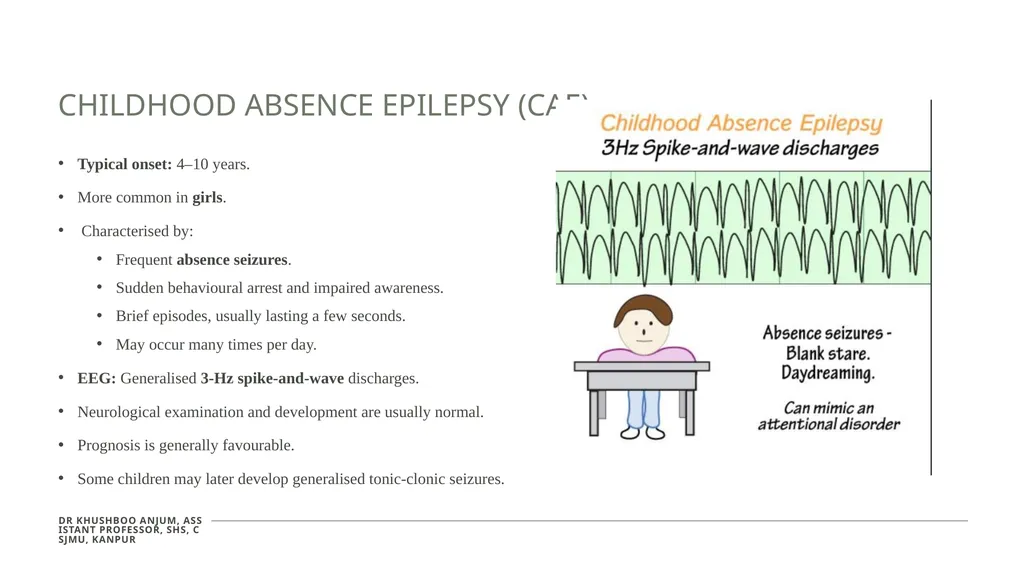
Childhood Absence Epilepsy (CAE) Typical onset: 4–10 years.
More common in girls.
Characterised by:
Frequent absence seizures.
Sudden behavioural arrest and impaired awareness.
Brief episodes, usually lasting a few seconds.
May occur many times per day.
EEG: Generalised 3-Hz spike-and-wave discharges.
Neurological examination and development are usually normal.
Prognosis is generally favourable.
Some children may later develop generalised tonic-clonic seizures. Dr Khushboo Anjum, ASSISTANT PROFESSOR, SHS, CSJMU, KANPUR<br>
18
Juvenile Absence Epilepsy (JAE) Typical onset: Adolescence, approximately 9–13 years.
Main seizure type:
Absence seizures.
Absences tend to be less frequent but longer than in CAE.
Generalised tonic-clonic seizures may occur.
EEG: Generalised 3–4 Hz spike-and-wave activity.
Seizures may be precipitated by sleep deprivation.
Long-term treatment is frequently required. Dr Khushboo Anjum, ASSISTANT PROFESSOR, SHS, CSJMU, KANPUR<br>
19
Juvenile Myoclonic Epilepsy (JME) Typical onset: Adolescence, commonly 12–18 years.
Characteristic myoclonic jerks, especially shortly after awakening.
Other seizure types:
Generalised tonic-clonic seizures.
Absence seizures in some patients.
Myoclonic jerks may cause dropping of objects.
Common precipitants:
Sleep deprivation
Alcohol
Stress
Fatigue
EEG: Generalised 4–6 Hz polyspike-and-wave discharges.
Usually has normal intelligence and neurological examination.
Often requires long-term antiseizure medication. Dr Khushboo Anjum, ASSISTANT PROFESSOR, SHS, CSJMU, KANPUR<br>
20
Infantile Epileptic Spasms Syndrome (IESS) Previously commonly referred to as West syndrome.
Usually begins during the first year of life.
Characteristic seizure:
Epileptic spasms.
Spasms may occur in clusters.
May occur particularly around awakening.
Important clinical features:
Flexor spasms.
Extensor spasms.
Mixed flexor-extensor spasms.
May be associated with developmental regression or developmental impairment.
Classical EEG finding:
Hypsarrhythmia.
Causes include:
Structural brain abnormalities.
Genetic disorders.
Metabolic disorders.
Perinatal brain injury.
Unknown causes Dr Khushboo Anjum, ASSISTANT PROFESSOR, SHS, CSJMU, KANPUR<br>
21
Dr Khushboo Anjum, ASSISTANT PROFESSOR, SHS, CSJMU, KANPUR<br>
22
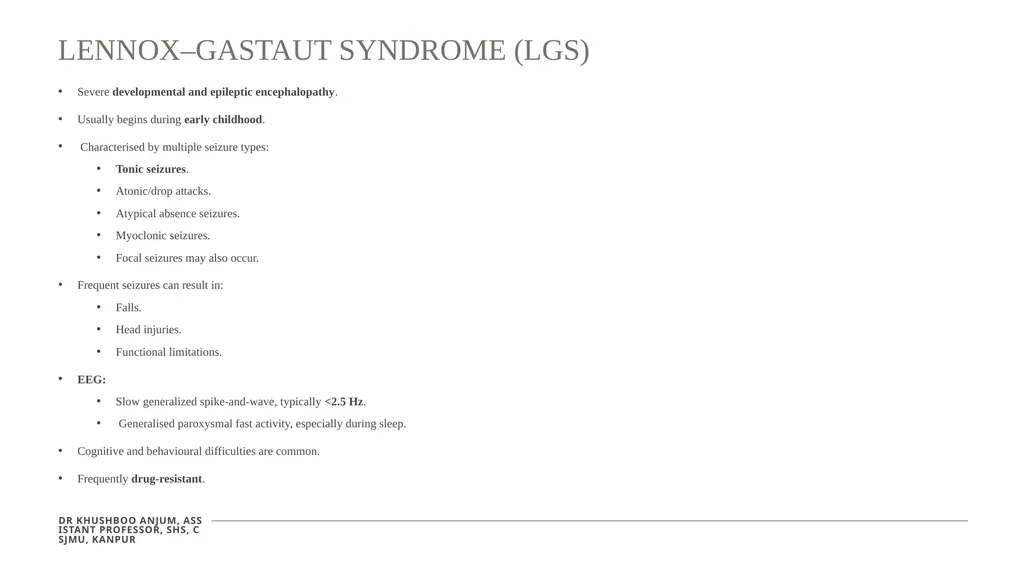
Lennox–Gastaut Syndrome (LGS) Severe developmental and epileptic encephalopathy.
Usually begins during early childhood.
Characterised by multiple seizure types:
Tonic seizures.
Atonic/drop attacks.
Atypical absence seizures.
Myoclonic seizures.
Focal seizures may also occur.
Frequent seizures can result in:
Falls.
Head injuries.
Functional limitations.
EEG:
Slow generalized spike-and-wave, typically <2.5 Hz.
Generalised paroxysmal fast activity, especially during sleep.
Cognitive and behavioural difficulties are common.
Frequently drug-resistant. Dr Khushboo Anjum, ASSISTANT PROFESSOR, SHS, CSJMU, KANPUR<br>
23
Dr Khushboo Anjum, ASSISTANT PROFESSOR, SHS, CSJMU, KANPUR<br>
24
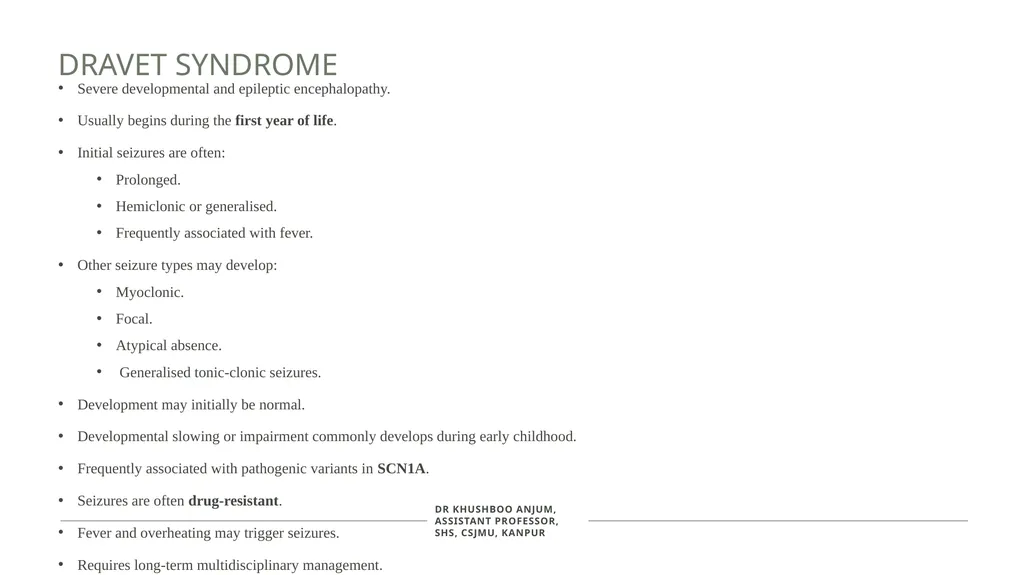
Dravet Syndrome Severe developmental and epileptic encephalopathy.
Usually begins during the first year of life.
Initial seizures are often:
Prolonged.
Hemiclonic or generalised.
Frequently associated with fever.
Other seizure types may develop:
Myoclonic.
Focal.
Atypical absence.
Generalised tonic-clonic seizures.
Development may initially be normal.
Developmental slowing or impairment commonly develops during early childhood.
Frequently associated with pathogenic variants in SCN1A.
Seizures are often drug-resistant.
Fever and overheating may trigger seizures.
Requires long-term multidisciplinary management. Dr Khushboo Anjum, ASSISTANT PROFESSOR, SHS, CSJMU, KANPUR<br>
25
Dr Khushboo Anjum, ASSISTANT PROFESSOR, SHS, CSJMU, KANPUR<br>
26
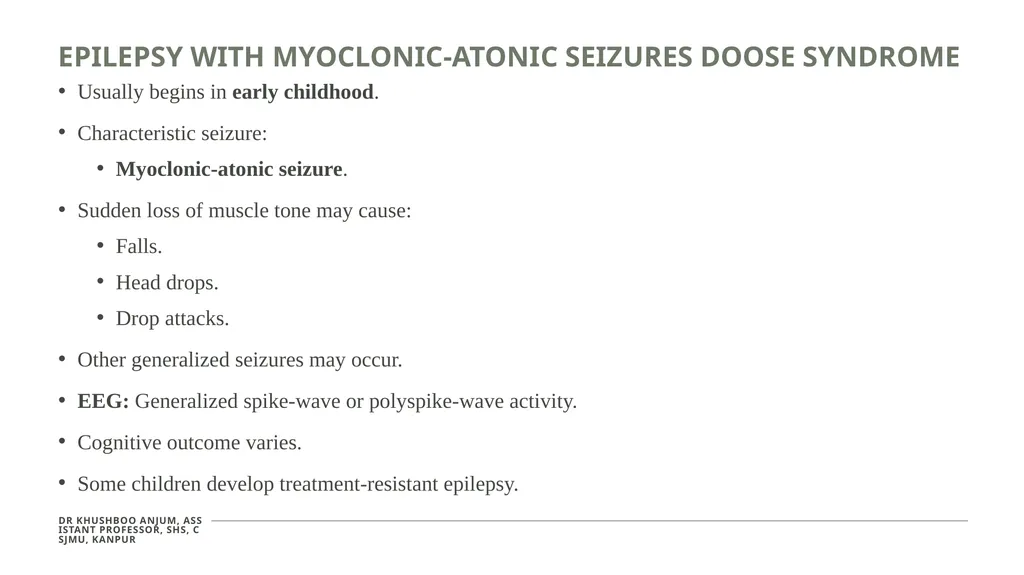
Epilepsy with Myoclonic-Atonic Seizures Doose Syndrome Usually begins in early childhood.
Characteristic seizure:
Myoclonic-atonic seizure.
Sudden loss of muscle tone may cause:
Falls.
Head drops.
Drop attacks.
Other generalized seizures may occur.
EEG: Generalized spike-wave or polyspike-wave activity.
Cognitive outcome varies.
Some children develop treatment-resistant epilepsy. Dr Khushboo Anjum, ASSISTANT PROFESSOR, SHS, CSJMU, KANPUR<br>
27
Epilepsy with Eyelid Myoclonia (Jeavons Syndrome) Epilepsy with Eyelid Myoclonia (Jeavons Syndrome)
Usually begins during childhood.
Characteristic:
Eyelid myoclonia.
Brief upward deviation of the eyes.
Often precipitated by:
Eye closure.
Bright or flickering light.
Absence seizures may occur.
Generalized tonic-clonic seizures may develop.
EEG: Generalised polyspike-wave activity, often enhanced by photic stimulation.
Frequently persists into adulthood Dr Khushboo Anjum, ASSISTANT PROFESSOR, SHS, CSJMU, KANPUR<br>
28
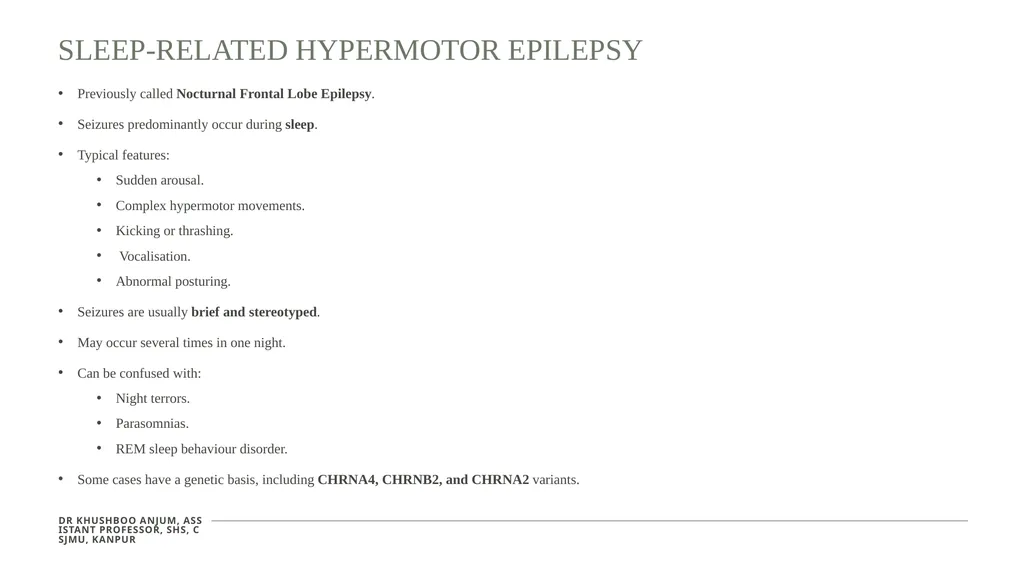
Sleep-Related Hypermotor Epilepsy Previously called Nocturnal Frontal Lobe Epilepsy.
Seizures predominantly occur during sleep.
Typical features:
Sudden arousal.
Complex hypermotor movements.
Kicking or thrashing.
Vocalisation.
Abnormal posturing.
Seizures are usually brief and stereotyped.
May occur several times in one night.
Can be confused with:
Night terrors.
Parasomnias.
REM sleep behaviour disorder.
Some cases have a genetic basis, including CHRNA4, CHRNB2, and CHRNA2 variants. Dr Khushboo Anjum, ASSISTANT PROFESSOR, SHS, CSJMU, KANPUR<br>
29
REFERENCES International League Against Epilepsy. ILAE classification and definitions of epilepsy syndromes. Epilepsia. 2022;63(6):1333-1370.
Scheffer IE, Berkovic S, Capovilla G, et al. ILAE classification of the epilepsies: Position paper of the ILAE Commission for Classification and Terminology. Epilepsia. 2017;58(4):512-521.
Genton P, Gelisse P, Thomas P, Bureau M. Juvenile myoclonic epilepsy today: current definitions and controversies. Epilepsy Behav. 2013;28 Suppl 1:S1-S7.
Fejerman N. Benign childhood epilepsy with centrotemporal spikes. Epileptic Disord. 2009;11(1):1-8.
Panayiotopoulos CP. Panayiotopoulos syndrome: a common childhood autonomic epilepsy. Epilepsia. 2002;43 Suppl 3:34-39.
Wirrell EC, Shellhaas RA, Joshi C, et al. Treatment of infantile spasms: report of the American Academy of Neurology and Child Neurology Society. Neurology. 2012;78(3):197-204.
Cross JH, Auvin S, Falip M, Striano P, Arzimanoglou A. Expert opinion on the management of Lennox-Gastaut syndrome: treatment algorithms and practical approaches. Epilepsia. 2017;58 Suppl 1:10-18.
Dravet C, Oguni H. Dravet syndrome (severe myoclonic epilepsy in infancy). Handb Clin Neurol. 2013;111:627-633. Dr Khushboo Anjum, ASSISTANT PROFESSOR, SHS, CSJMU, KANPUR<br>
30
Thank you…… Dr Khushboo Anjum, ASSISTANT PROFESSOR, SHS, CSJMU, KANPUR<br>