
SLOVENIAN IMMIGRATION TO THE MINNESOTA IRON RANGE
KL
Published · 50 slides · 0 views

1 / 1




Description
SLOVENIAN IMMIGRATION TO THE MINNESOTA IRON RANGE Dr. Matjaz Klemencic- University of Maribor ETHNIC SETTLEMENTS OF THE 1819TH CENTURY TO THE UNITED STATES FOLLOW SIMILAR PATTERNS. ETHNIC PARISHES CULTURAL CENTERS- NATIONAL HOMES MUTUAL
Related Topics
Share
Embed code
Download this presentation From Below
"SLOVENIAN IMMIGRATION TO THE MINNESOTA IRON RANGE" is the property of its rightful owner. Permission is granted to download and print the materials on this website for personal, non-commercial use only, and to display it on your personal computer provided you do not modify the materials and that you retain all copyright notices contained in the materials. By downloading content from our website, you accept the terms of this agreement.
Presentation Transcript
01
SLOVENIAN IMMIGRATION TO THE MINNESOTA IRON RANGE<br>
02
Dr. Matjaz Klemencic-
University of Maribor ETHNIC SETTLEMENTS OF THE 18/19TH CENTURY TO THE UNITED STATES FOLLOW SIMILAR PATTERNS.
ETHNIC PARISHES
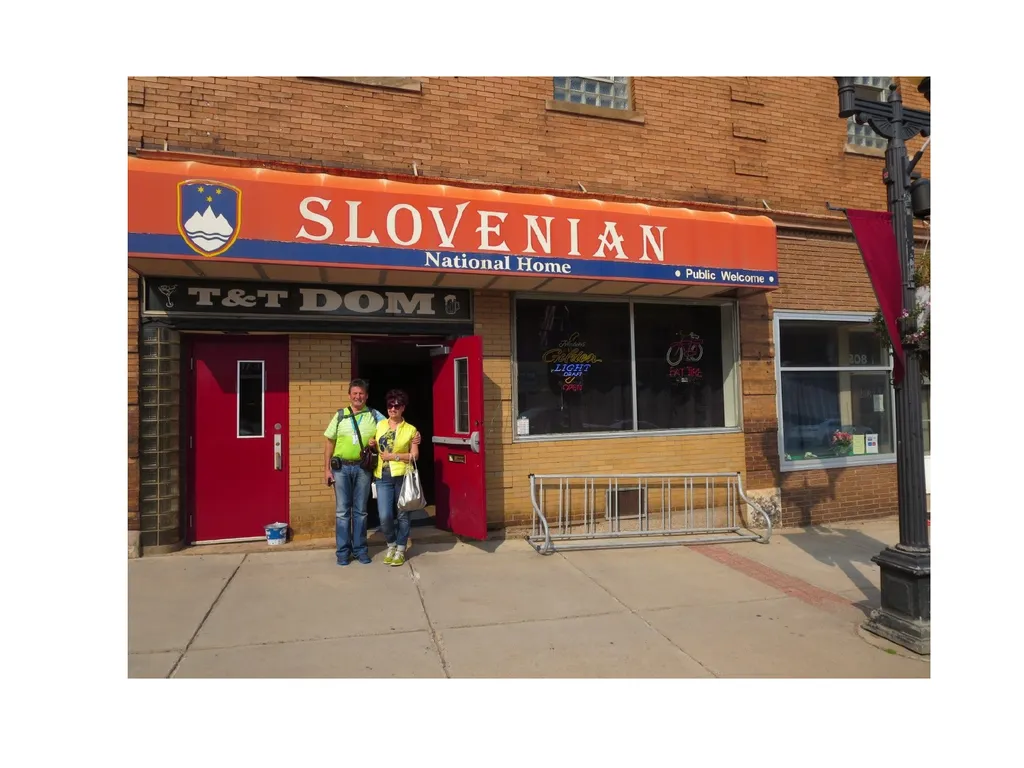
CULTURAL CENTERS- NATIONAL HOMES
MUTUAL AID SOCIETIES-KSKJ, SNPJ, ETC.<br>
ETHNIC PARISHES
CULTURAL CENTERS- NATIONAL HOMES
MUTUAL AID SOCIETIES-KSKJ, SNPJ, ETC.<br>
03
According to Dr. Klemencic there are 1.63 million Slovenians in the Republic of Slovenia.
APPROXIMATELY 180,000 SLOVENES LIVE IN THE UNITED STATES.<br>
APPROXIMATELY 180,000 SLOVENES LIVE IN THE UNITED STATES.<br>
04
Chronology of Slovene history 1945-1963- Slovenia is part of a non Soviet bloc communist country
1963-1990 –Slovenia is a a republic within Yugoslavia.
1980- Tito dies- Slovenia ruled by a central govt. – unrest in the republics
1991 – June 25, Slovenia becomes independent Republic .12/26/91 Constitution<br>
1963-1990 –Slovenia is a a republic within Yugoslavia.
1980- Tito dies- Slovenia ruled by a central govt. – unrest in the republics
1991 – June 25, Slovenia becomes independent Republic .12/26/91 Constitution<br>
05
SLOVENIAN EMIGRANTS 1870-1924 The majority of Slovenian emigrants in the U.S settled in Slovenian communities between 1870-1924
Before that immigrants were likely to be Slovene missionaries.
Slovenes were preceded into the new world by priests of their own nationality. This was characteristic of Slovenes coming into MN<br>
Before that immigrants were likely to be Slovene missionaries.
Slovenes were preceded into the new world by priests of their own nationality. This was characteristic of Slovenes coming into MN<br>
06
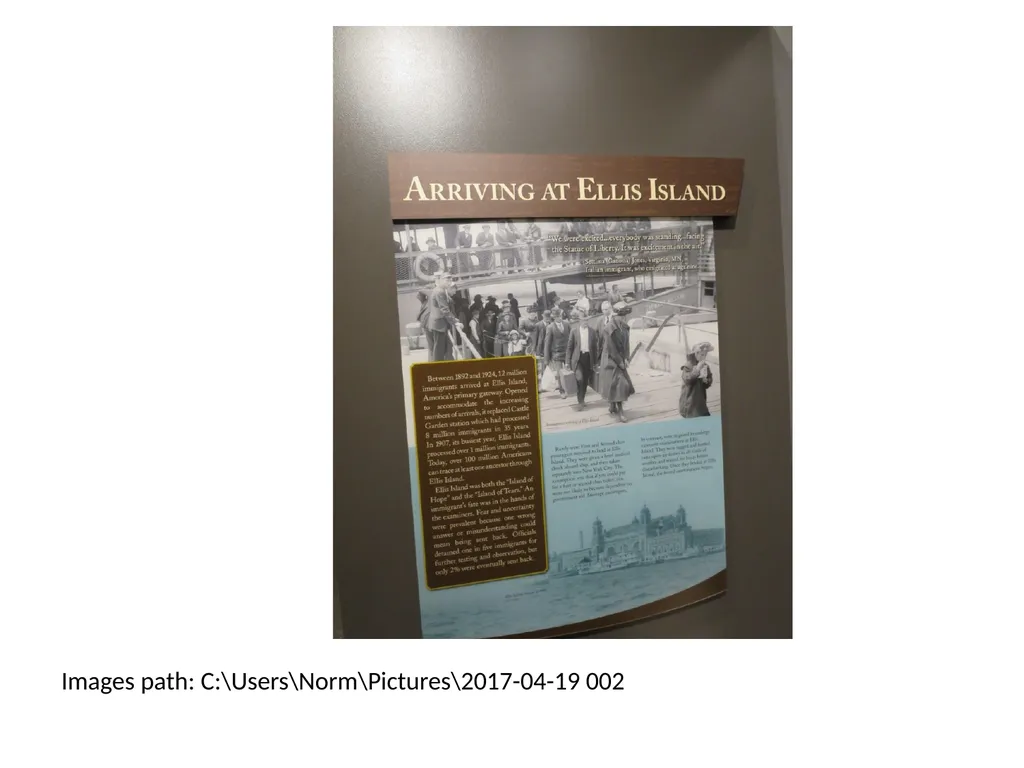
Images path: C:\Users\Norm\Pictures\2017-04-19 002<br>
07
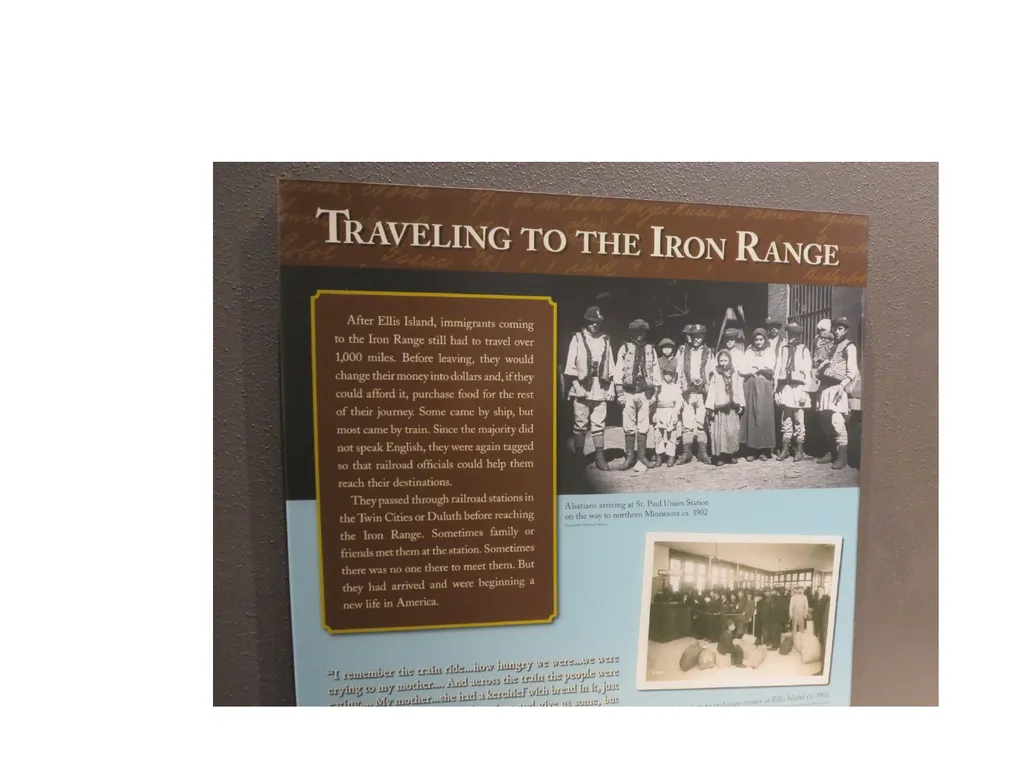
Geography of the Iron Range Prior to the 1890,the Range area consisted of virgin timber and swamps. But by 1910 the area consisted of 13 communities with 50,000 residents including 3600 Slovenes.<br>
08
Slovenian Migrations to MN First wave of Slovenian immigrants shortly after the Civil War ( 1867) to Central Minnesota. Key economic activity – Farming
Early 1900’s- northern Minnesota- Mining
Post WW II- northern Minnesota – Cold War era . Many were employed at the mines on the Mesabi Iron Range<br>
Early 1900’s- northern Minnesota- Mining
Post WW II- northern Minnesota – Cold War era . Many were employed at the mines on the Mesabi Iron Range<br>
09
Emigrants-Early 20th Century Composed of men who entered unskilled work force – 85% were Croats and Slovenes in both the Vermilion and Mesabi Ranges. By 1888 when Father Buh became the first resident priest in Tower; he estimated that ¼ of the 300 families were Slovenians. By 1909 Slovenians constituted 40% of Tower’s population of 2000.<br>
10
Ely mining operations Started with the opening of the underground Chandler Mine in 1888.
By 1885 at least 114 Slovenes, many moved from Tower were counted in Ely’s population of 2,260 and by 1909 they constituted 1/3-30% of its residents.<br>
By 1885 at least 114 Slovenes, many moved from Tower were counted in Ely’s population of 2,260 and by 1909 they constituted 1/3-30% of its residents.<br>
11
Slovenes on Mesabi Iron Range Mesabi Range located 70 miles NW of Duluth. The Merritt brothers unearthed iron ore close to the surface and began operations in the Mountain Iron area in 1890’s along with the mining of iron ore in Biwabik. The Biwabik Mine began shipping iron ore in 1893.<br>
12
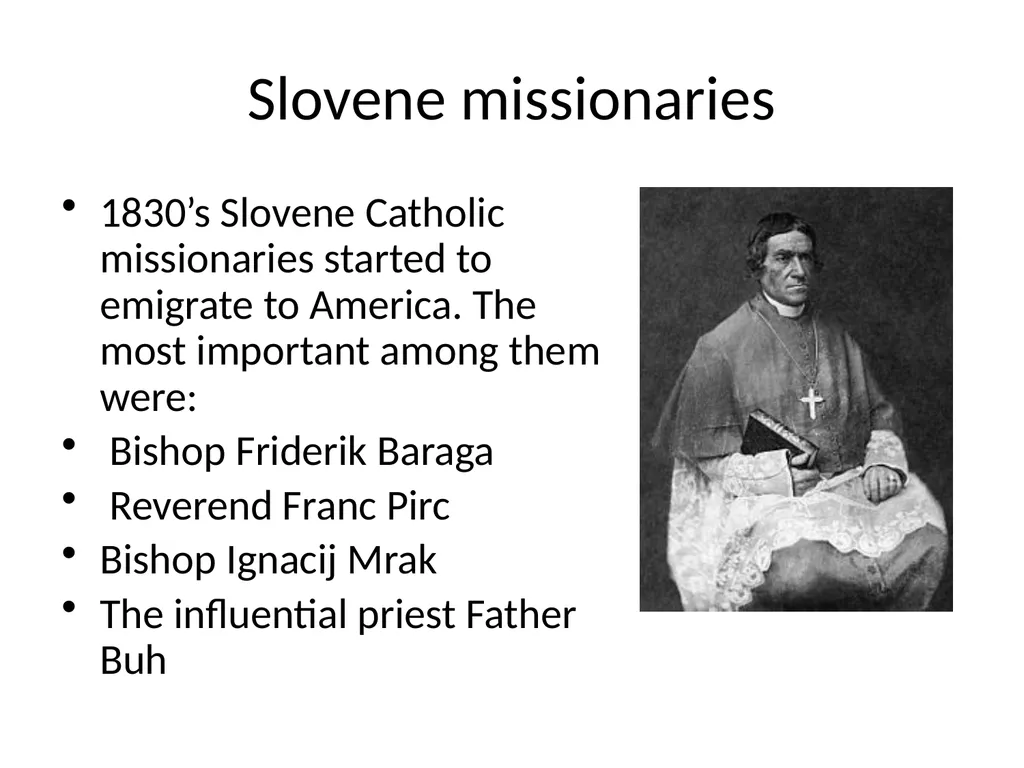
Slovene missionaries 1830’s Slovene Catholic missionaries started to emigrate to America. The most important among them were:
Bishop Friderik Baraga
Reverend Franc Pirc
Bishop Ignacij Mrak
The influential priest Father Buh<br>
Bishop Friderik Baraga
Reverend Franc Pirc
Bishop Ignacij Mrak
The influential priest Father Buh<br>
13
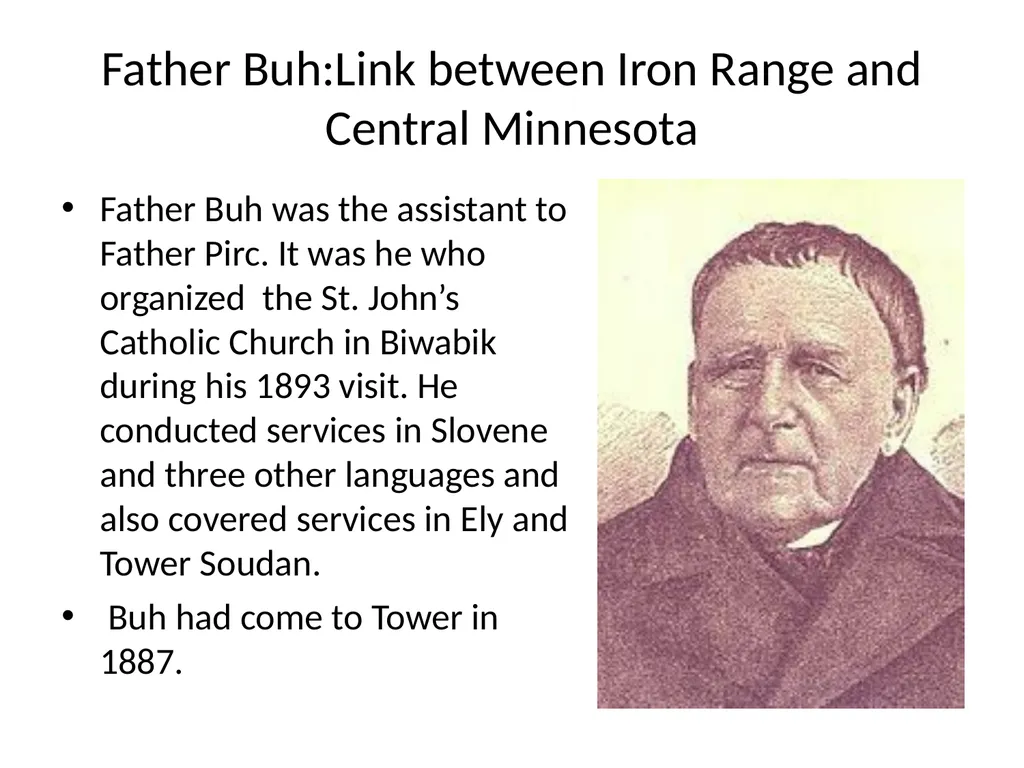
Father Buh:Link between Iron Range and Central Minnesota Father Buh was the assistant to Father Pirc. It was he who organized the St. John’s Catholic Church in Biwabik during his 1893 visit. He conducted services in Slovene and three other languages and also covered services in Ely and Tower Soudan.
Buh had come to Tower in 1887.<br>
Buh had come to Tower in 1887.<br>
14
Father Buh’s Accomplishments He spent 61 years as a missionary in MN, WI, Michigan and eastern Dakota;
He is given credit for starting the first “Amerikanski Slovene National newspaper in 1885.
He was one of the first Slovenian missionaries on the Iron Range responsible for recruiting Slovenian priests for Ely, Tower, Gilbert, Eveleth and Chisholm<br>
He is given credit for starting the first “Amerikanski Slovene National newspaper in 1885.
He was one of the first Slovenian missionaries on the Iron Range responsible for recruiting Slovenian priests for Ely, Tower, Gilbert, Eveleth and Chisholm<br>
15
The Oliver Iron Mining Company Was the largest firm on the Range, heavy demand for unskilled workers because of the stripping and open pit mining techniques were different than underground mining.
The Oliver Mining Co. was the largest firm on the Range and totaled 12,018 men. Nearly 85% were foreign born.
South Slavs made up over 30% of firm’s foreign born workers.<br>
The Oliver Mining Co. was the largest firm on the Range and totaled 12,018 men. Nearly 85% were foreign born.
South Slavs made up over 30% of firm’s foreign born workers.<br>
16
Slovene Labor Like the Slovenes before them and others arriving later from Southeast Europe, they had no previous experience in mining. One source estimated that nearly 80% were peasant farmers or farm laborers who worked low paying jobs such as dump men, tramers or track layers. Wages ranged in 1909 from $12.50- $15 a week. Open pit mining was seasonal- could not count on steady income.<br>
17
Labor unbalanced: Genders According to Immigration commission findings, the South Slav population was young and the sex ratio was unbalanced at first. 1885 the ratio in NE. Minnesota was 249.5 men to 100 women. In 1895, it was 233 to 100. It was common to find ratios of 25 men to 1 woman. In Kitzville, near Hibbing, reported 30 families- 500 single men.<br>
18
FORMING COMMUNITIES AND INSTITUTIONS For Minnesota, Slovenes emigrated from Carniola and Styria.
Increased mobility because of mines closing or better employment in neighboring villages and mines.
It seems like many south Slavs concentrated on the south side of Chisholm, Kitzville and Carson Lake near Hibbing; Spruce and Adams locations in Eveleth, Gilbert, Ely. These were the main South Slav areas.<br>
19
BOARDINGHOUSES, SALOONS, STORES On the Iron Range boardinghouses were prominent among Croats and Serbs. One study of 40 Minnesotan Croatian families in 1909 indicated that almost ¾ had borders, compared to 1/3 Slovenes.
For married couples who had boardinghouses it was a valuable source of income. In 1909, average Croat Boarding house yearly income as $ 1,370. Slovenes income was smaller $ 869<br>
For married couples who had boardinghouses it was a valuable source of income. In 1909, average Croat Boarding house yearly income as $ 1,370. Slovenes income was smaller $ 869<br>
20
SALOONS- A key social institution In 1909 the immigration commission counted 356 saloons in 15 towns on Mesabi and Vermilion ranges. Of these 91 were run by South Slavs (48 by Slovenes, 34 by Croats ,8 by Montenegrans and 1 by a Serb)
These drinking locations were convenient social clubs. For a newcomer the saloon was the best source of information-along with pool halls, card rooms, dance halls. There is still ethnic music in some of the towns such as Gilbert.<br>
These drinking locations were convenient social clubs. For a newcomer the saloon was the best source of information-along with pool halls, card rooms, dance halls. There is still ethnic music in some of the towns such as Gilbert.<br>
21
Homeownership Of 49 Croat families living in Minnesota Range towns- 47% owned their own homes. Of 28 Slovenes 71% owned their own homes.<br>
22
THE ETHNIC STORE The ethnic store whether it was an all purpose grocery store, meant market or specialty shop, served as another useful institution. Because of language difficulties or desire to eat similar items in their native homeland, stores offered credit on reasonable terms. As late as 1937 more than 30 grocery stores and meat markets were operated by south Slavs in 7 towns on the two ranges.<br>
23
FRATERNAL GROUPS
-Social Institutions In addition to ethnic bars, funeral homes, insurance agents there were a large number of fraternal groups such as:
KSKJ-”Kranjsko Slovenska Klotoliska Jednota offered insurance to Catholics that paid $800 upon death.
SNPJ – Slovenska Narodna Podporna Jednota:
‘it was very social minded’ . Members objected to insistence at mass and attendance to confession and gave equal benefits to women. It was the leading Slovenian group<br>
24
South Slav Colony of Duluth Started about 1893 because of the DMIR railroad and construction of shipping piers for the iron ore.
Duluth (west side) had the notoriety of having the second and last Slovene newspaper to be published in Minnesota: “Narodni Vestnik”
1910 the U.S. Steel Corp plant starts in Gary – west Duluth with mutual societies of KSKJ, SNPJ. Population around 3-5000 in the steel and cement works-South Slavs largest majority.<br>
25
WWI -1914 The outbreak of World War I and the quota laws of the 1920’s giving preferences to northern Europeans interrupted the family immigration chain. It was natural that many men sought to seek wives outside of their ethnicity.<br>
26
WW I and Americanization U.S. entry into the war 1n 1917 triggered massive assault on immigrant groups including Slovenes. There were attempts to Americanize the Slav population.
l. Churches offered English courses
2.1900’s local school systems offered adult classes
3. Political education increased along with efforts of nationalization of foreign born<br>
l. Churches offered English courses
2.1900’s local school systems offered adult classes
3. Political education increased along with efforts of nationalization of foreign born<br>
27
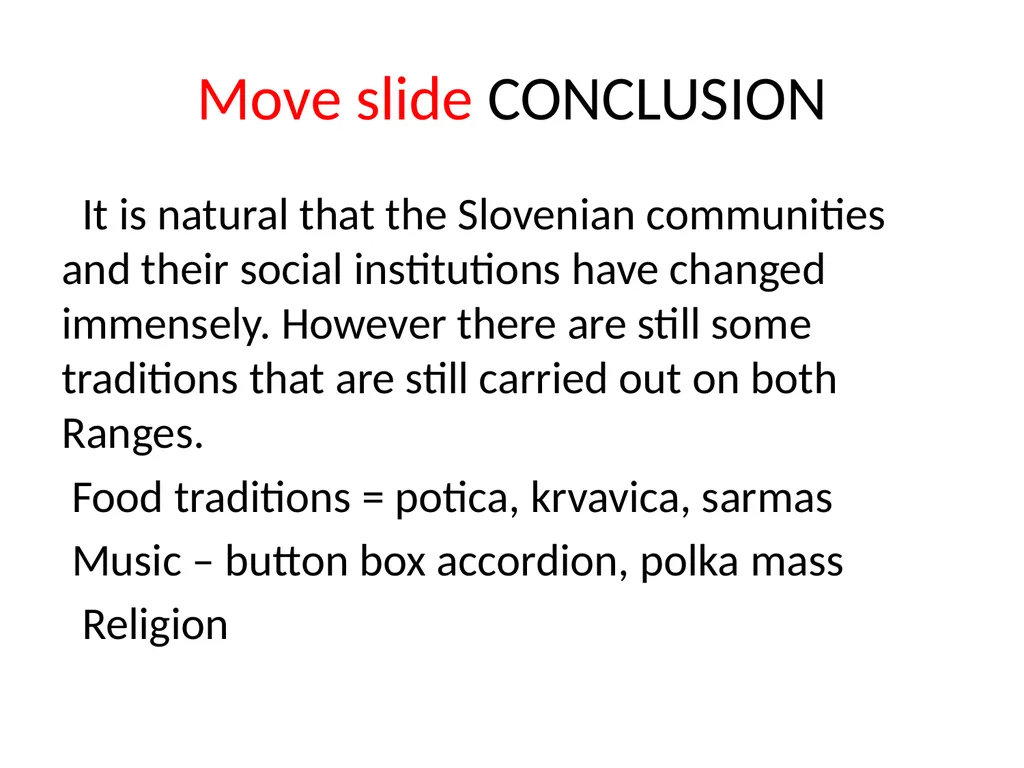
Move slide CONCLUSION It is natural that the Slovenian communities and their social institutions have changed immensely. However there are still some traditions that are still carried out on both Ranges.
Food traditions = potica, krvavica, sarmas
Music – button box accordion, polka mass
Religion<br>
Food traditions = potica, krvavica, sarmas
Music – button box accordion, polka mass
Religion<br>
28
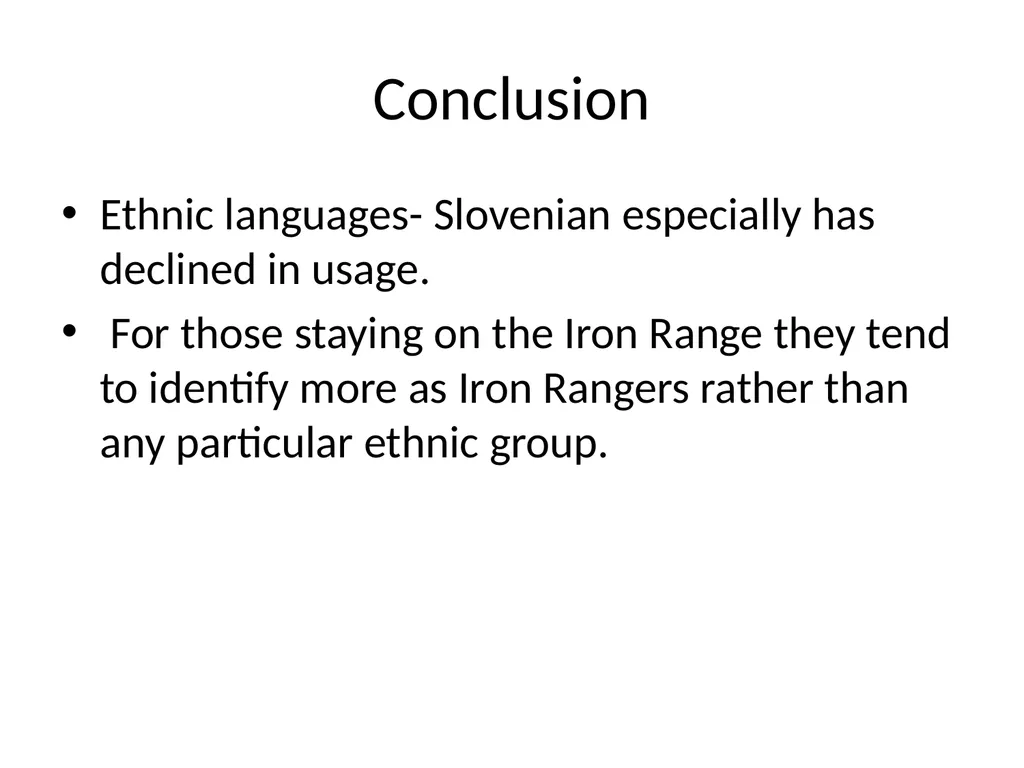
Conclusion Ethnic languages- Slovenian especially has declined in usage.
For those staying on the Iron Range they tend to identify more as Iron Rangers rather than any particular ethnic group.<br>
For those staying on the Iron Range they tend to identify more as Iron Rangers rather than any particular ethnic group.<br>
29
BIBLIOGRAPHY Holmquist, June, Editor. “They Chose Minnesota- A Survey of the States Ethnic Groups. Minnesota Historical Society Press, 1981.
Immigration Commission-”Immigrants in industries, July, 1907
U.S. Census 1910.
Marolt, Ed. Development of Labor Unionism<br>
Immigration Commission-”Immigrants in industries, July, 1907
U.S. Census 1910.
Marolt, Ed. Development of Labor Unionism<br>
30
Move slide -Bibliography Setnicker, Norm. Development of the Biwabik Mine, Masters Thesis, 1968.
Prisland, Marie –From Slovenia to America, 1968
Sister Mary Daniel O Neill, A Survey and interpretation of Slovenian Folk Culture in Minnesota Iron Range, Masters Thesis, 1952<br>
Prisland, Marie –From Slovenia to America, 1968
Sister Mary Daniel O Neill, A Survey and interpretation of Slovenian Folk Culture in Minnesota Iron Range, Masters Thesis, 1952<br>
31
Post Script: Art of Albin Zaverl Many of the old memories of Slovenian culture have been preserved in the paintings of Albin Zaverl. His old country memories includes a painting of the priest who married Zaverl’s parents- the Revered Father Buh, the priest that followed Father Pirc to Minnesota and Zaverl’s print of “Bled” was hung in the Slovenian Embassy in Washington, D.C. Albin was from Ely.<br>
32
Climb Every Mountain
Stories of Escape and Resettlement “Who are these kids? We had never seen them before. Mom and Dad never said a thing about them. In September 1951, the first day of school at Washington Elementary in Biwabik, they just….appeared. No fanfare. No prior notice. And..they didn’t speak any English! But they looked and dressed like us. We recognized first names: Kristine, Angela, Mary, Peter, John and Frank.<br>
33
Continued Stories of Escape and Resettlement Except for their language(Slovenian), they were us. Some of us recognized the language because we were also of Slovenian descent growing up with the language of our parents and grandparents. In my case, at age 5, I had already a working knowledge of unmentionable Slovenian words and phrases. Funny how these expressions seem to stick<br>
34
Displaced Persons- DP’s If Ms. Connors or Ms. Anderson, our kindergarten teachers, told us that our new classmates were DPs from Europe, it meant nothing to us. D and P were just letters in the alphabet that needed to be learned sooner or later. Europe was just a place to be found on the classroom globe.<br>
35
Continued: older siblings Older siblings of these Slovenian kids also appeared and were immediately placed in the appropriate grade. Unlike today, they were not afforded any special classes like ESL. Some teachers and residents truly empathized with their plight and they offered after school English language instruction.<br>
36
Migration was larger Over time we heard that the migration was much bigger than 5 of 6 Slovenian families that settled in Biwabik, Elcor, Belgrade and Pineville. Slovenian families appeared in Gilbert, Eveleth, Aurora and other cities on the Range. These families were part of the post WWII world wide migration. For us it was just about the Slovenians and a few Croatians…. But what did we know?<br>
37
Slovenian Families on the Range We children came to know these families but not much about them and their story. The family names, included Medved, Bajda, Ferkul Strupi, Krulc, Vidmar, Percic, Grebenc, Skrbec, Gruden and others. They became acquaintances, friends and classmates. Our parents and friends of Slovenian heritage were able to converse rather fluently and knew much more about their story.<br>
38
DP’s- Pejorative acronym Most of the time the refugees were simply referred to as DPs” This political acronym became somewhat pejorative and a very sensitive subject to many of the Slovenes who emigrated in the late 1940’s and early 1950’s.<br>
39
Sponsored Refugees The U.S. were taking only “sponsored” refugees from 1949 and only those victims of totalitarianism (Communism). This was the status of the Slovene families who would emigrate eventually to Minnesota’s Iron Range. Local sponsors would need to “vouch “ for them financially. Few Americans were likely to underwrite such a large financial risk.<br>
40
Slovenes of the First Migration Early 1900’s Opened their hearts and their wallets to sponsor freedom for their Slovene sisters and brothers. They along with the Catholic Church provided the strong ethnic and cultural bedrock for these newcomers of this final Slovenian resettlement. It was time to give back.<br>
41
Catholic Welfare Society This organization played an important role during the resettlement years in the camps and the transition from Europe to the United States. It clothed and fed the DP’s and gave each one $ 6 in cash and then it ALL ABOARD to the trains and their final destination..<br>
42
Memory of a 5 Year Old I remember my mom and dad, John and Margaret Setnicker, visiting the Ferkuls. While Dad conversed mostly with Cyril, John and Vinko over a few “pivos” and Slivovka about what it was like. Justine Ferkul babysat me until I fell asleep. I recall the same scenario at the Peter Strupi’s family who resided in the apartments above what is today The Pub. Dad was practically fluent in Slovenia and mom….<br>
43
And mom….not so much. Being Slovenian was important to the folks. It was time to give back for all that was given to them of the first migration, like my grandfather, Frank Setnikar, Sr.<br>