Sport and Society in Sparta Background In ancient Greece, the city-state of Sparta was situated in the southeast of the Peloponnese. By enslaving its neighboring region of Messenia, Sparta expanded to a size that rivaled that of the
"Sport and Society in Sparta Background In ancient" is the property of its rightful owner. Permission is granted to
download and print the materials on this website for personal, non-commercial use only, and to display it
on your personal computer provided you do not modify the materials and that you retain all copyright
notices contained in the materials. By downloading content from our website, you accept the terms of this
agreement.
Presentation Transcript
01
Sport and Society in Sparta<br>
02
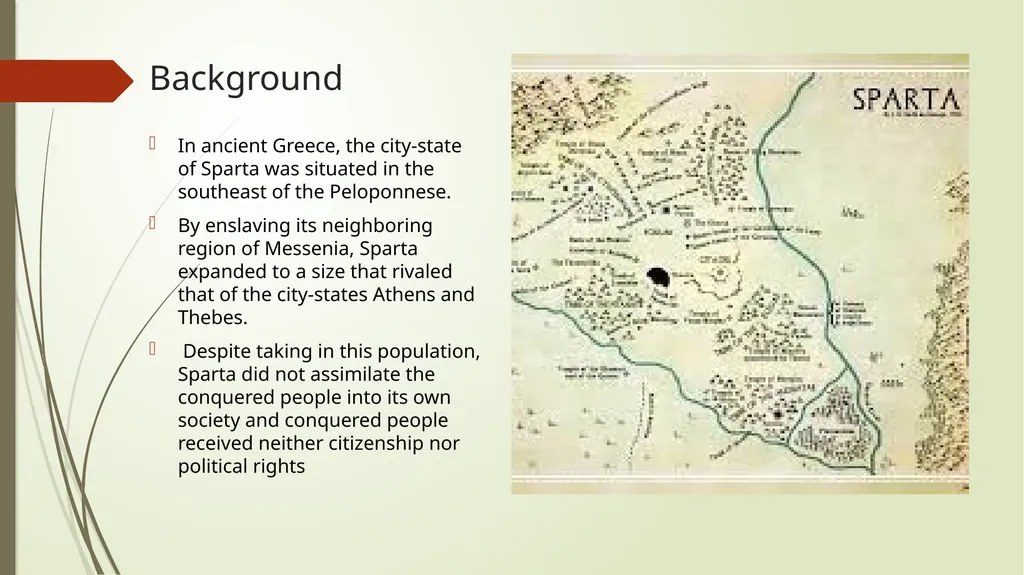
Background In ancient Greece, the city-state of Sparta was situated in the southeast of the Peloponnese.
By enslaving its neighboring region of Messenia, Sparta expanded to a size that rivaled that of the city-states Athens and Thebes.
Despite taking in this population, Sparta did not assimilate the conquered people into its own society and conquered people received neither citizenship nor political rights<br>
03
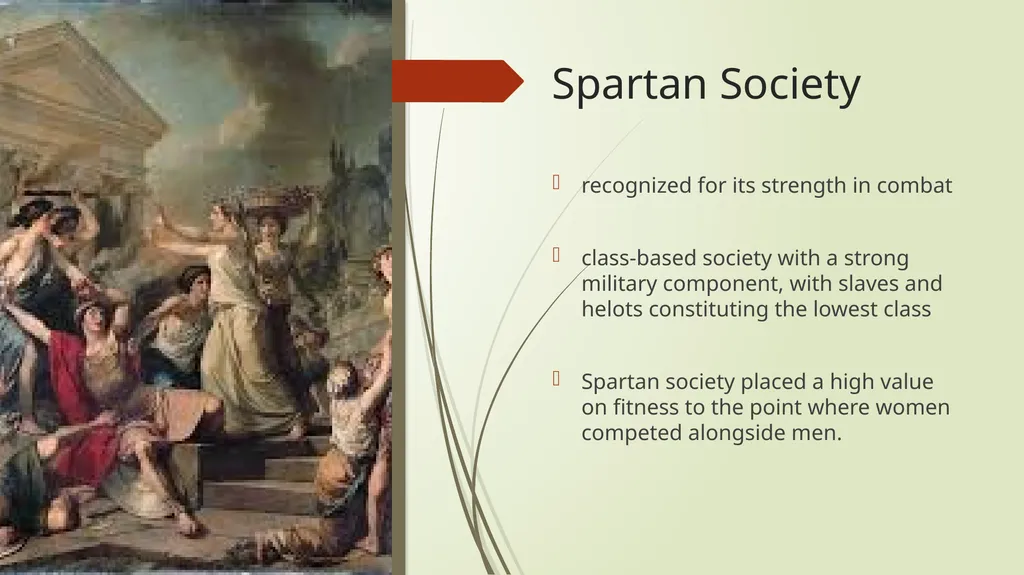
Spartan Society recognized for its strength in combat
class-based society with a strong military component, with slaves and helots constituting the lowest class
Spartan society placed a high value on fitness to the point where women competed alongside men.<br>
04
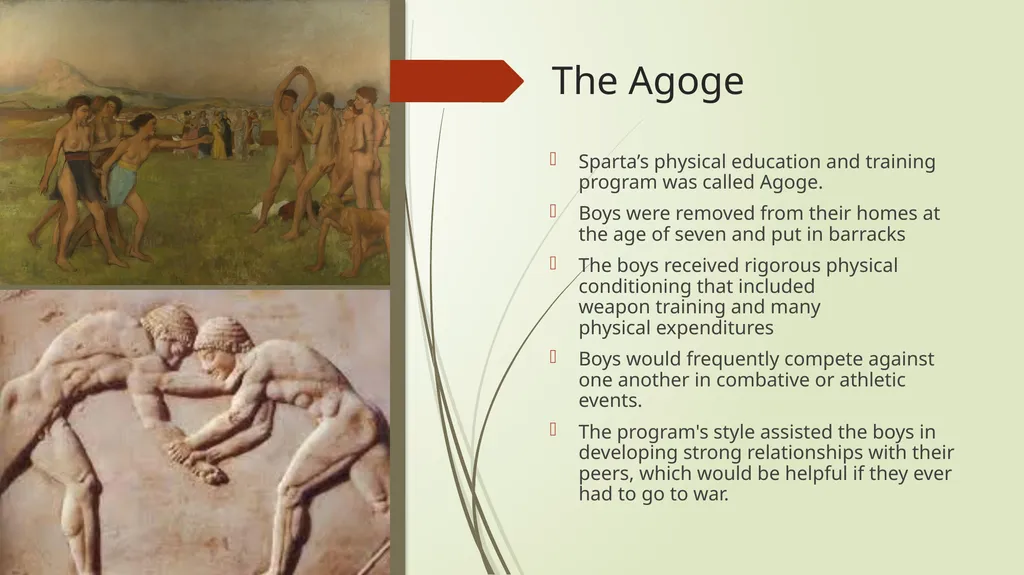
The Agoge Sparta’s physical education and training program was called Agoge.
Boys were removed from their homes at the age of seven and put in barracks
The boys received rigorous physical conditioning that included weapon training and many physical expenditures
Boys would frequently compete against one another in combative or athletic events.
The program's style assisted the boys in developing strong relationships with their peers, which would be helpful if they ever had to go to war.<br>
05
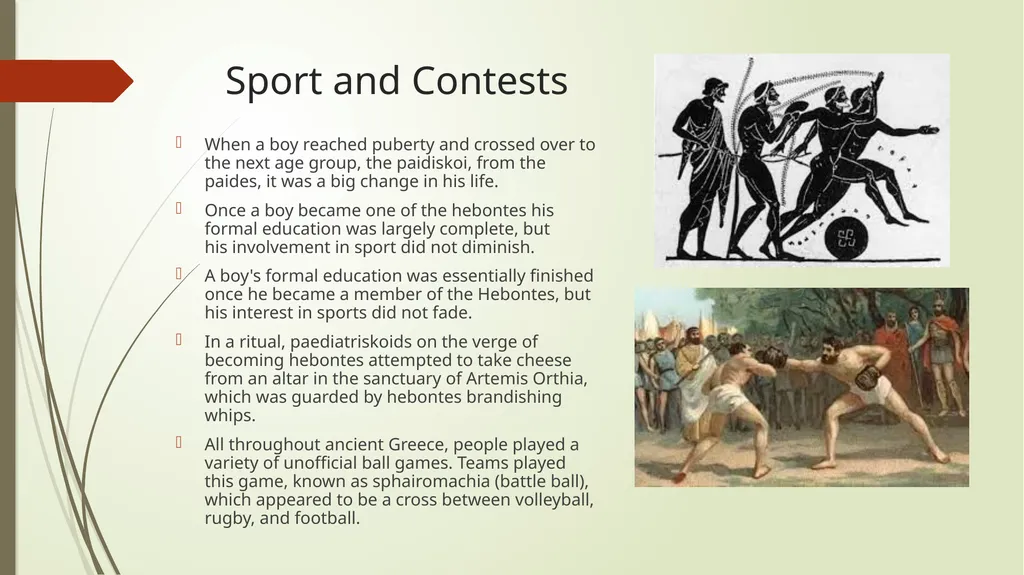
Sport and Contests When a boy reached puberty and crossed over to the next age group, the paidiskoi, from the paides, it was a big change in his life.
Once a boy became one of the hebontes his formal education was largely complete, but his involvement in sport did not diminish.
A boy's formal education was essentially finished once he became a member of the Hebontes, but his interest in sports did not fade.
In a ritual, paediatriskoids on the verge of becoming hebontes attempted to take cheese from an altar in the sanctuary of Artemis Orthia, which was guarded by hebontes brandishing whips.
All throughout ancient Greece, people played a variety of unofficial ball games. Teams played this game, known as sphairomachia (battle ball), which appeared to be a cross between volleyball, rugby, and football.<br>
06
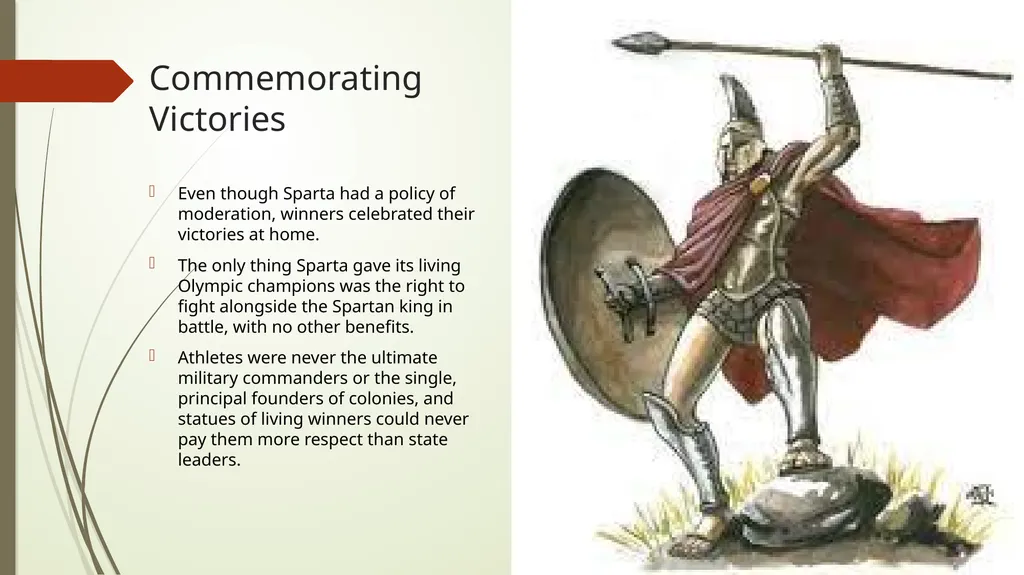
Commemorating Victories Even though Sparta had a policy of moderation, winners celebrated their victories at home.
The only thing Sparta gave its living Olympic champions was the right to fight alongside the Spartan king in battle, with no other benefits.
Athletes were never the ultimate military commanders or the single, principal founders of colonies, and statues of living winners could never pay them more respect than state leaders.<br>
07
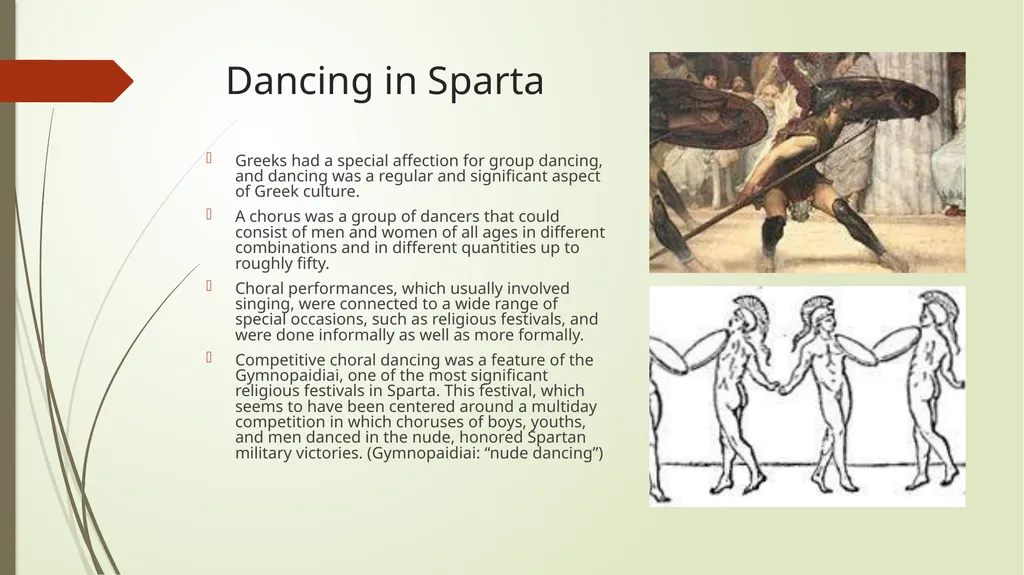
Dancing in Sparta Greeks had a special affection for group dancing, and dancing was a regular and significant aspect of Greek culture.
A chorus was a group of dancers that could consist of men and women of all ages in different combinations and in different quantities up to roughly fifty.
Choral performances, which usually involved singing, were connected to a wide range of special occasions, such as religious festivals, and were done informally as well as more formally.
Competitive choral dancing was a feature of the Gymnopaidiai, one of the most significant religious festivals in Sparta. This festival, which seems to have been centered around a multiday competition in which choruses of boys, youths, and men danced in the nude, honored Spartan military victories. (Gymnopaidiai: “nude dancing”)<br>
08
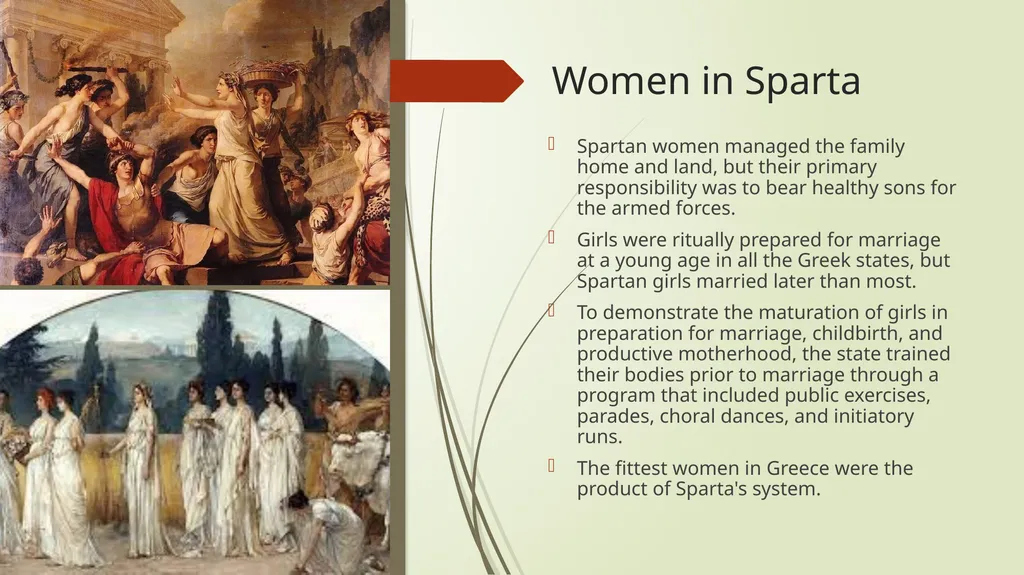
Women in Sparta Spartan women managed the family home and land, but their primary responsibility was to bear healthy sons for the armed forces.
Girls were ritually prepared for marriage at a young age in all the Greek states, but Spartan girls married later than most.
To demonstrate the maturation of girls in preparation for marriage, childbirth, and productive motherhood, the state trained their bodies prior to marriage through a program that included public exercises, parades, choral dances, and initiatory runs.
The fittest women in Greece were the product of Sparta's system.<br>
09
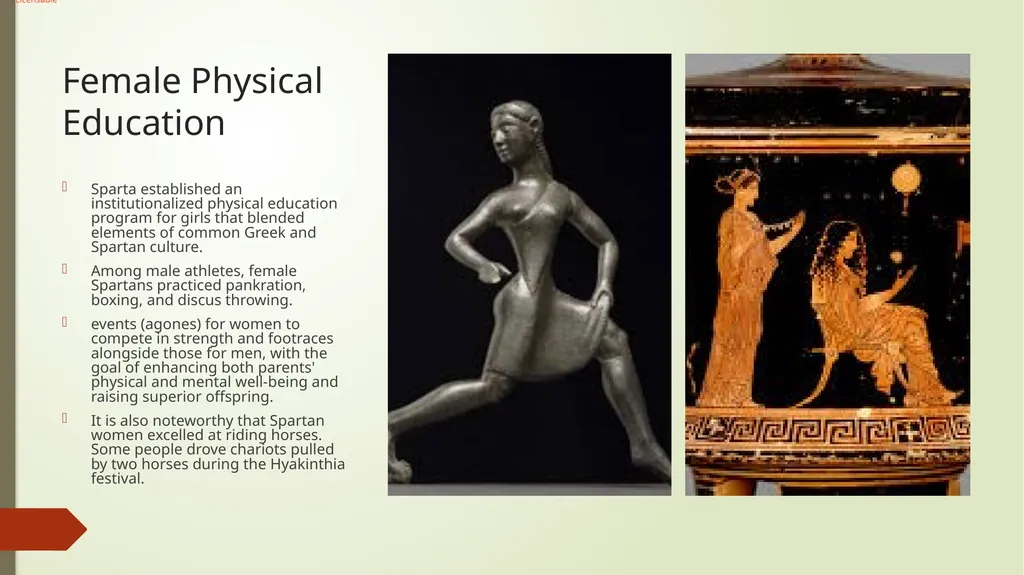
Female Physical Education Sparta established an institutionalized physical education program for girls that blended elements of common Greek and Spartan culture.
Among male athletes, female Spartans practiced pankration, boxing, and discus throwing.
events (agones) for women to compete in strength and footraces alongside those for men, with the goal of enhancing both parents' physical and mental well-being and raising superior offspring.
It is also noteworthy that Spartan women excelled at riding horses. Some people drove chariots pulled by two horses during the Hyakinthia festival. Licensable<br>
10
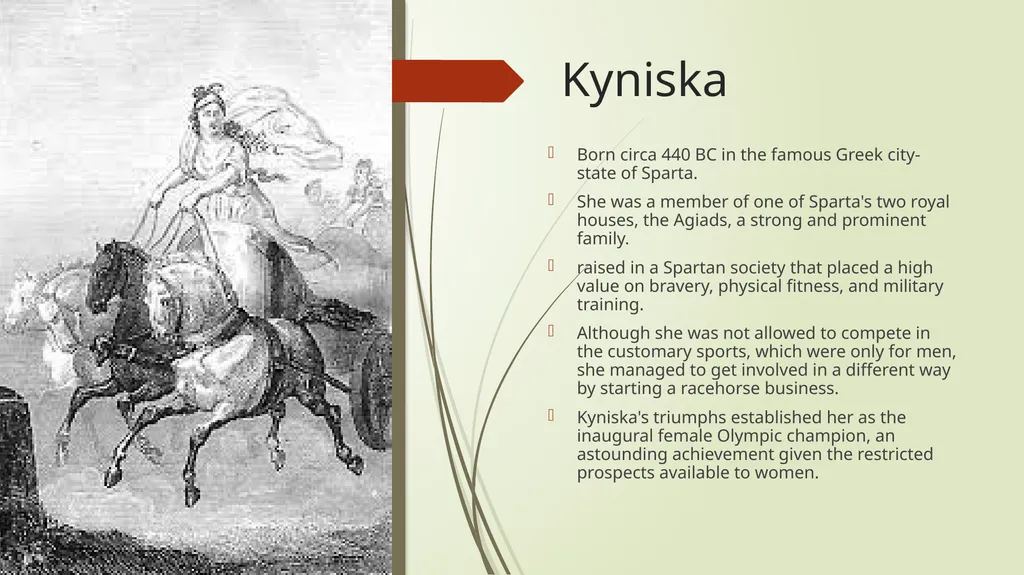
Kyniska Born circa 440 BC in the famous Greek city-state of Sparta.
She was a member of one of Sparta's two royal houses, the Agiads, a strong and prominent family.
raised in a Spartan society that placed a high value on bravery, physical fitness, and military training.
Although she was not allowed to compete in the customary sports, which were only for men, she managed to get involved in a different way by starting a racehorse business.
Kyniska's triumphs established her as the inaugural female Olympic champion, an astounding achievement given the restricted prospects available to women.<br>
11
Works Cited Kyle, Donald G. Sport and Spectacle In the Ancient World. 2nd ed., Wiley Blackwell. 2015
Christesen, Paul, and Donald G. Kyle. “Sport and Society in Sparta.” Essay. In A Companion to Sport and Spectacle in Greek and Roman Antiquity. Chichester, West Sussex, UK: Wiley-Blackwell, 2014.
“Sparta.” Education. Accessed October 13, 2023. https://education.nationalgeographic.org/resource/sparta/.
“Cynisca.” Wikipedia, September 27, 2023. https://en.wikipedia.org/wiki/Cynisca.
Laves, August. Xenophons Hellenica. Lyck, 1867.
“The Role of Spartan Women in Ancient Greece.” TheCollector, September 28, 2023. https://www.thecollector.com/role-spartan-women-ancient-greece/.<br>