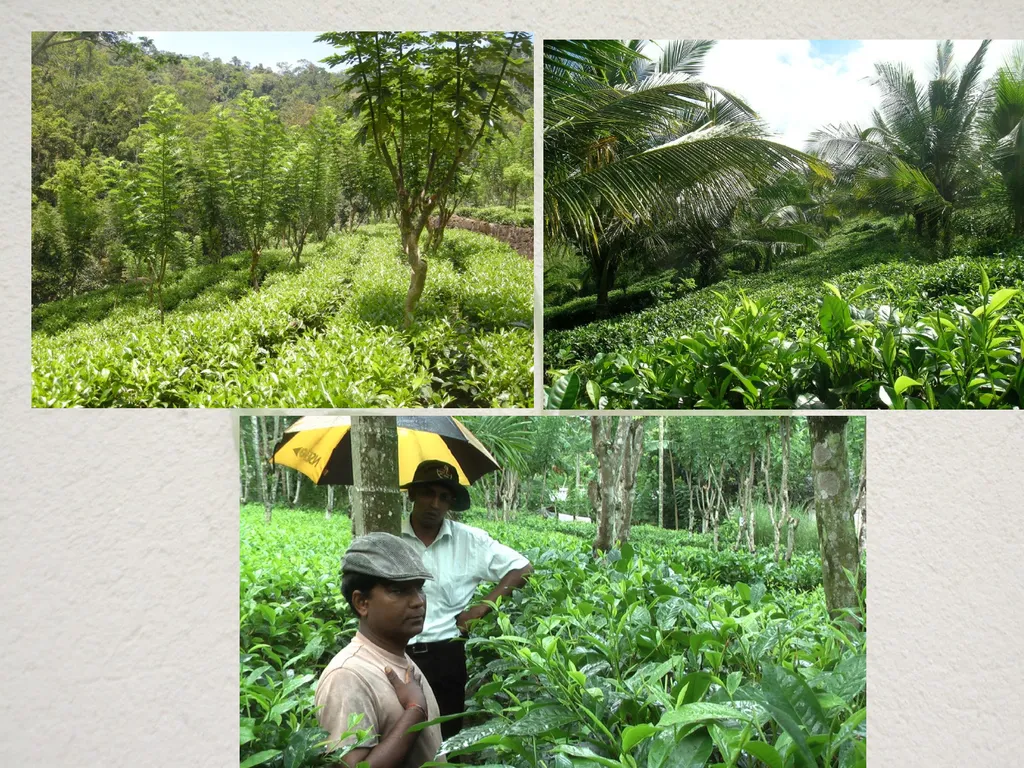
Tea Smallholdings Sector in Sri Lanka MB Cyril General Manager Tea Small holdings Development Authority Outline Current status of the sector Smallholder profile Community initiatives Issues Tea Smallholding Holding less than 10 Acres (4 Ha)
"Tea Smallholdings Sector in Sri Lanka MB Cyril" is the property of its rightful owner. Permission is granted to
download and print the materials on this website for personal, non-commercial use only, and to display it
on your personal computer provided you do not modify the materials and that you retain all copyright
notices contained in the materials. By downloading content from our website, you accept the terms of this
agreement.
Presentation Transcript
01
Tea Smallholdings Sector in Sri Lanka MB Cyril
General Manager
Tea Small holdings Development Authority<br>
02
Outline Current status of the sector
Smallholder profile
Community initiatives
Issues<br>
03
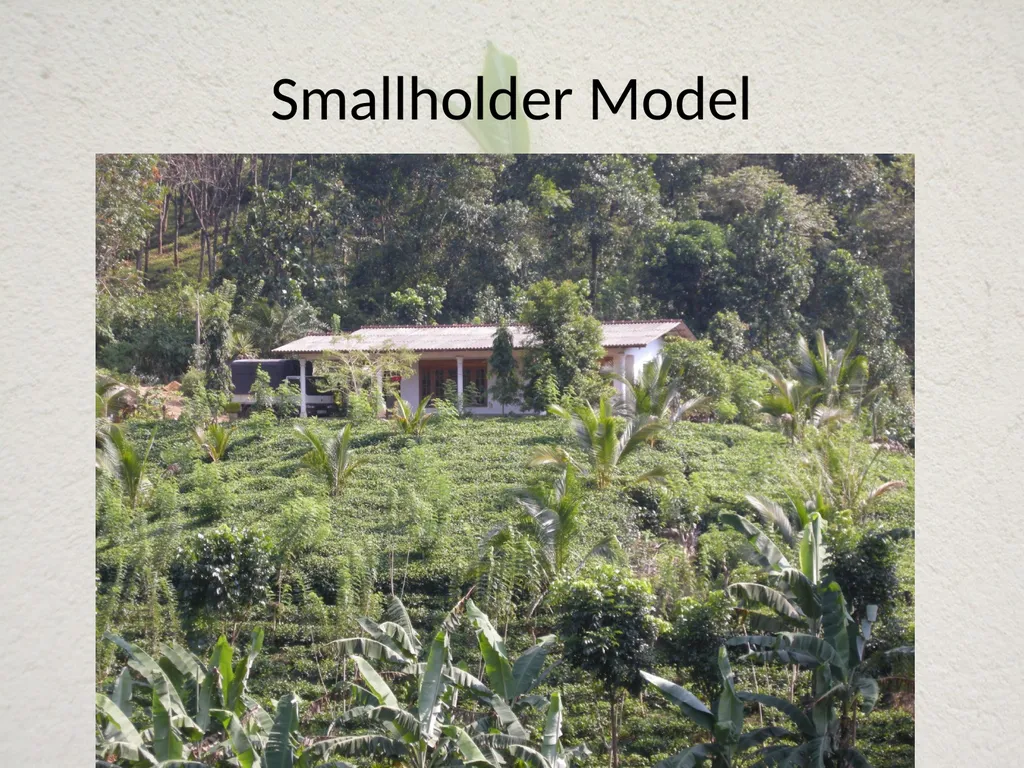
Tea Smallholding Holding less than 10 Acres (4 Ha) where tea is grown for the purpose of converting to made tea<br>
04
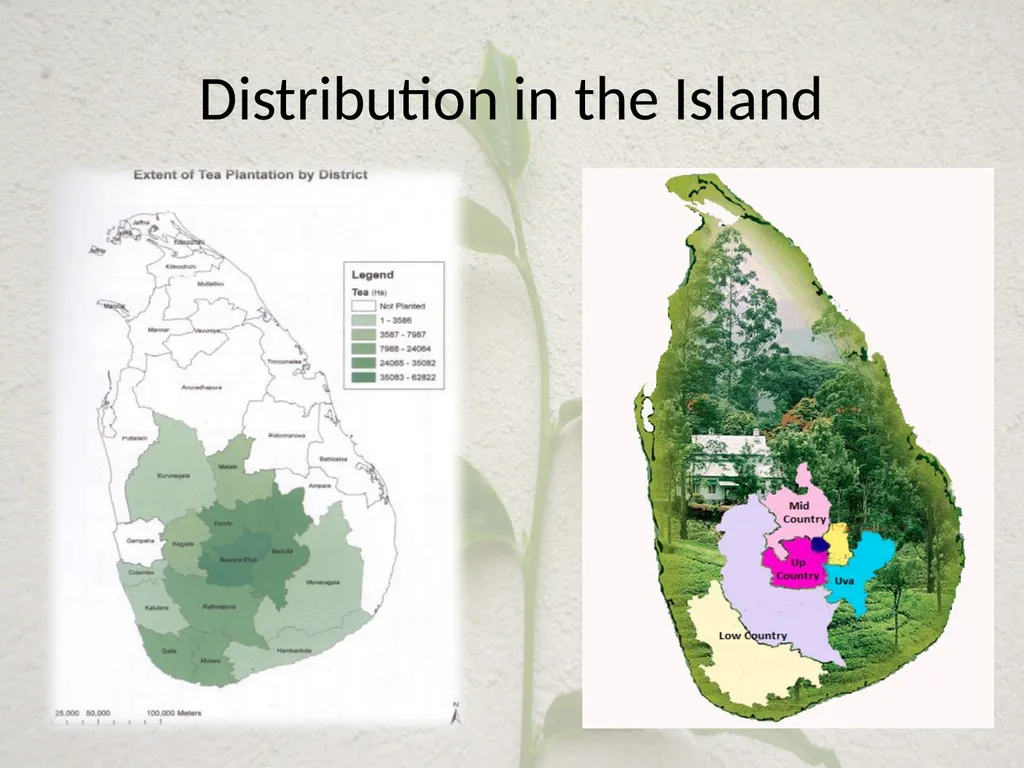
Distribution in the Island<br>
05
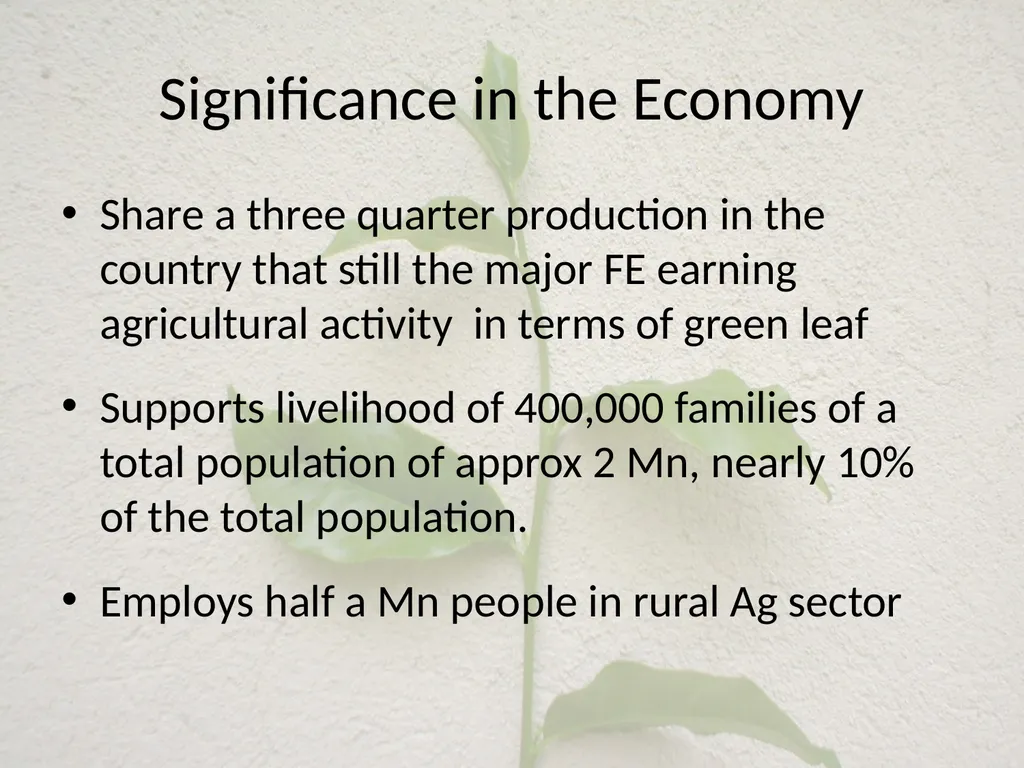
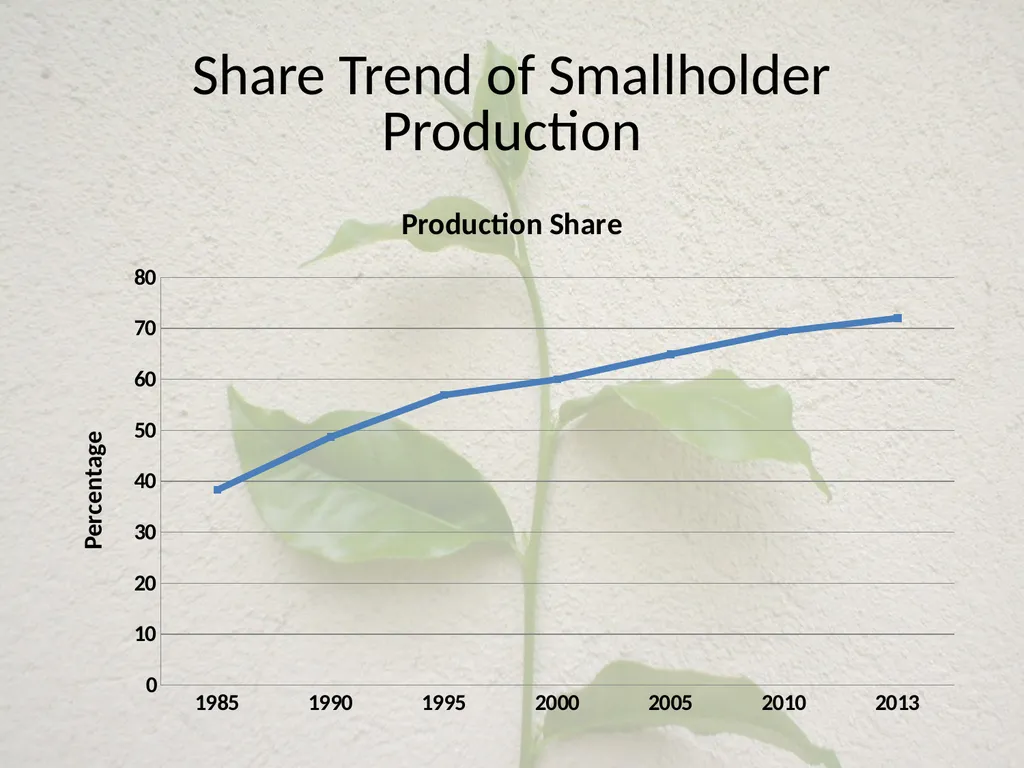
Significance in the Economy Share a three quarter production in the country that still the major FE earning agricultural activity in terms of green leaf
Supports livelihood of 400,000 families of a total population of approx 2 Mn, nearly 10% of the total population.
Employs half a Mn people in rural Ag sector<br>
06
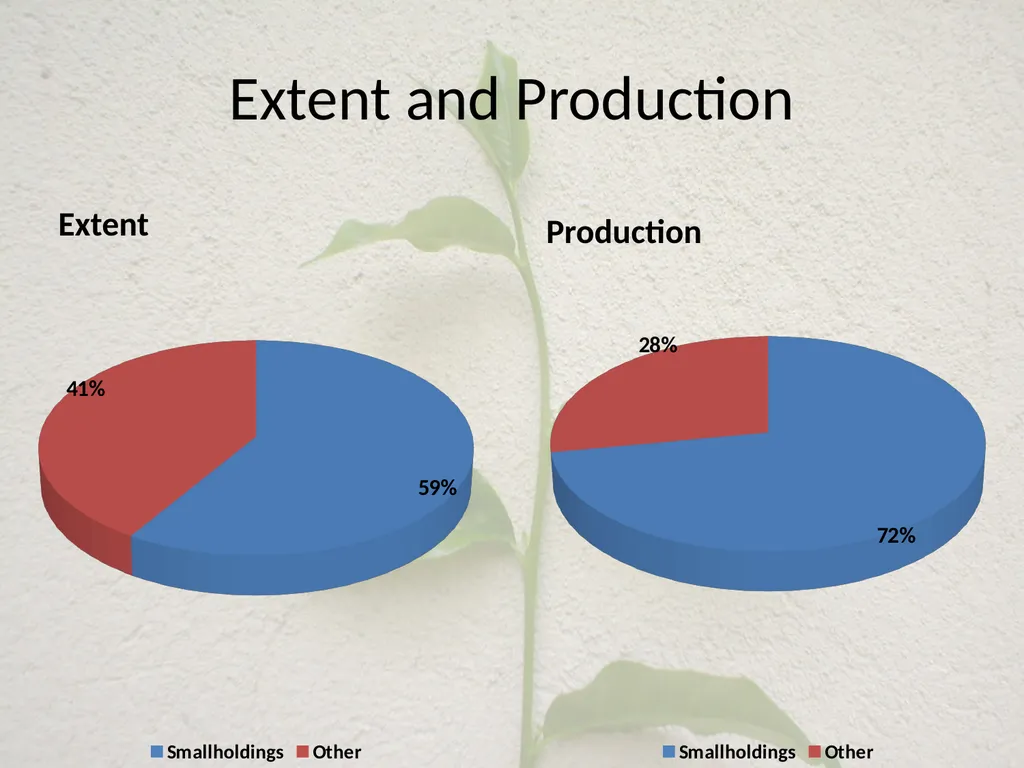
Extent and Production Extent Production<br>
07
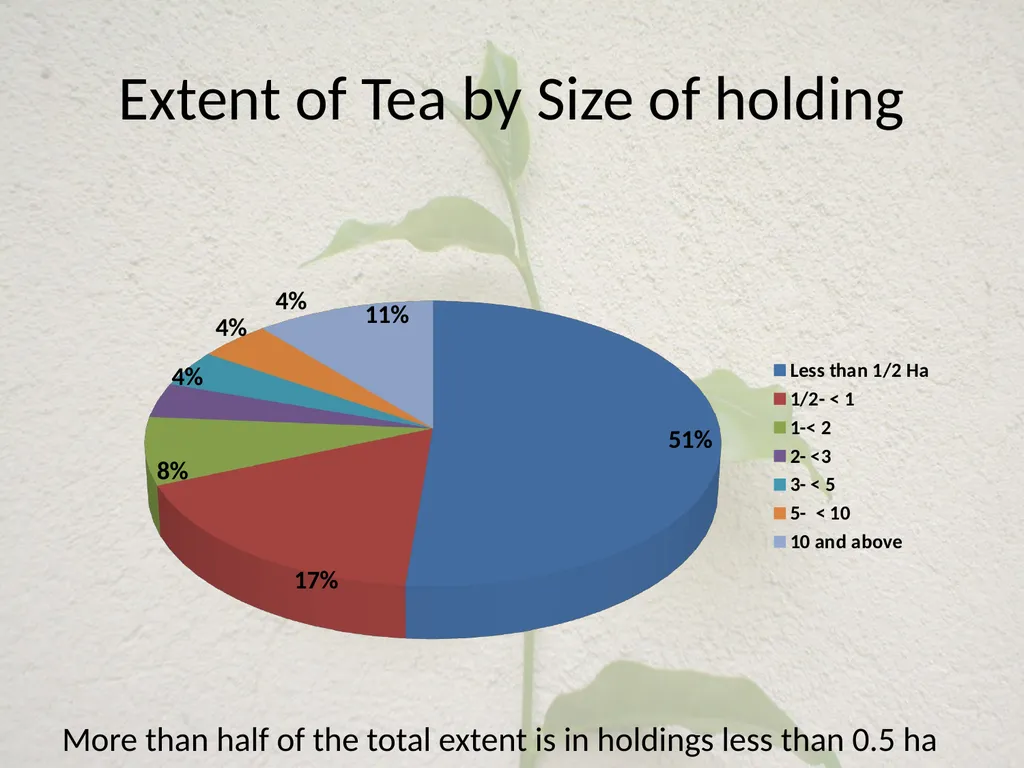
Extent of Tea by Size of holding More than half of the total extent is in holdings less than 0.5 ha<br>
08
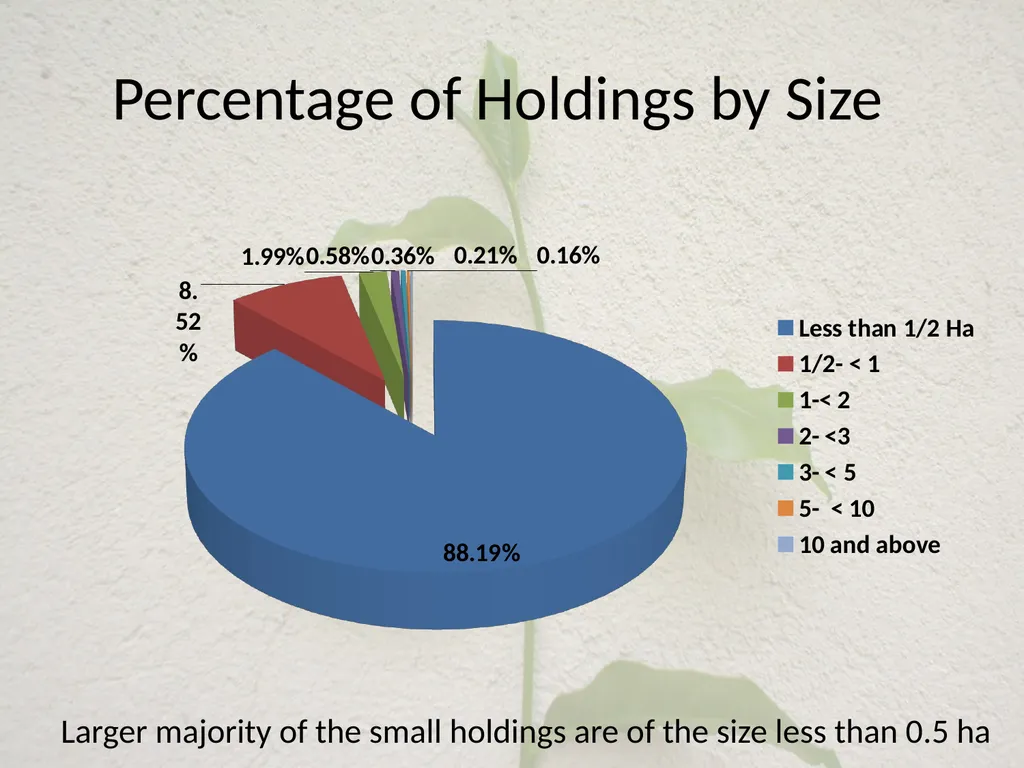
Percentage of Holdings by Size Larger majority of the small holdings are of the size less than 0.5 ha<br>
09
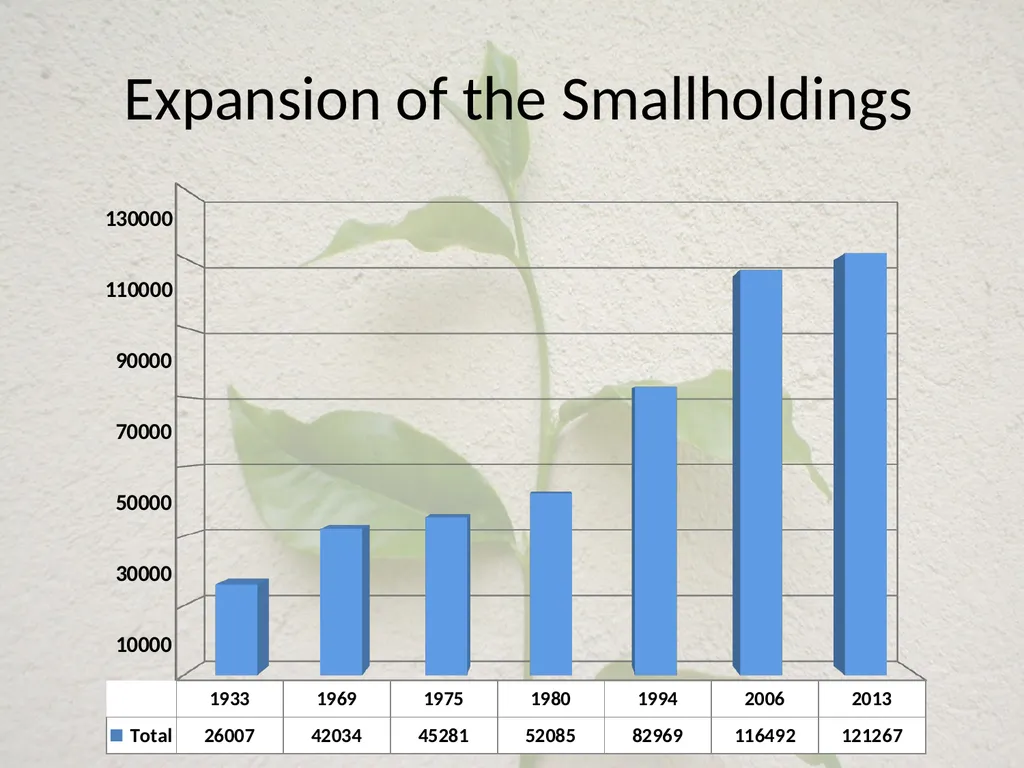
Expansion of the Smallholdings<br>
10
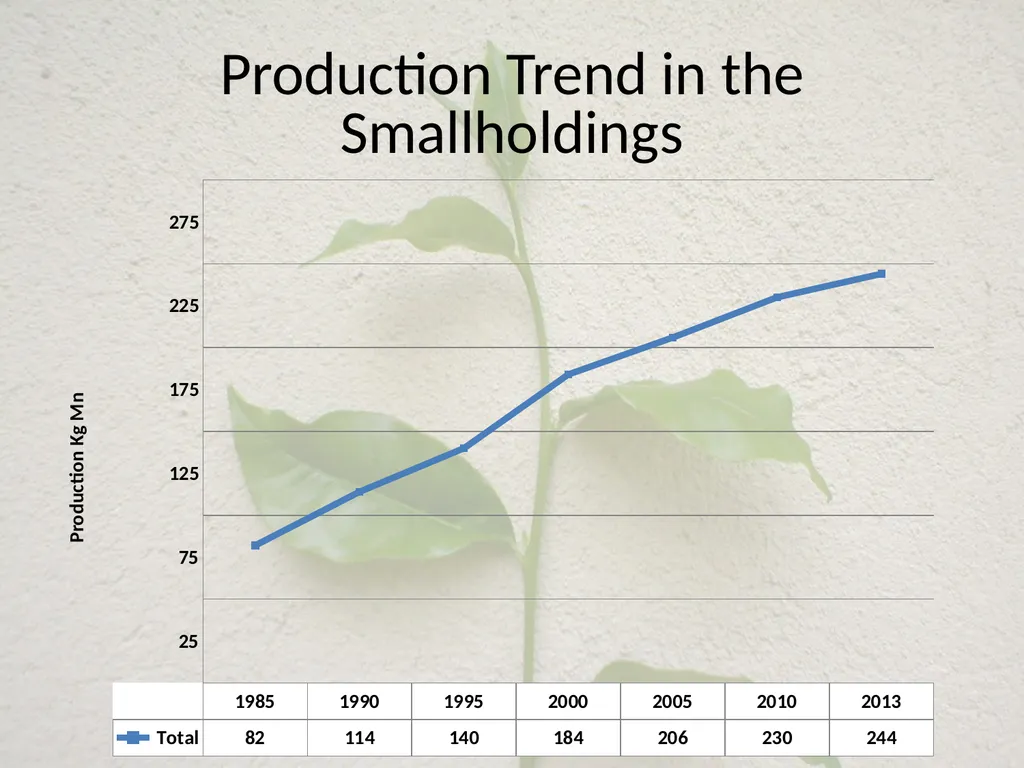
Production Trend in the Smallholdings<br>
11
Share Trend of Smallholder Production<br>
12
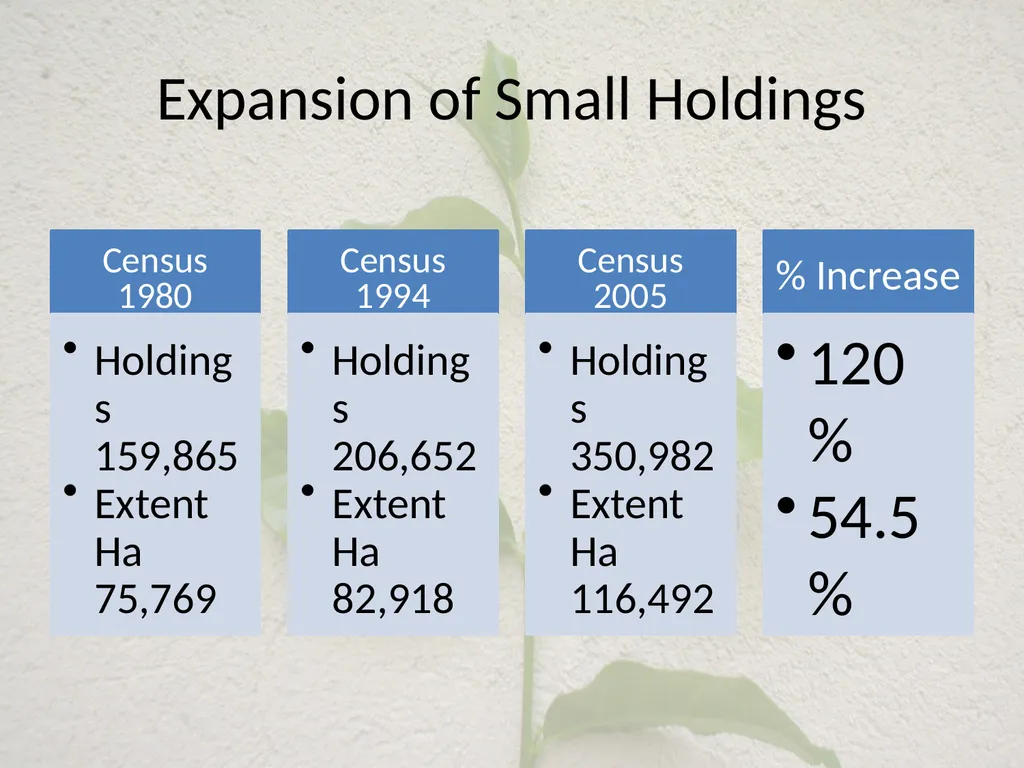
Expansion of Small Holdings<br>
13
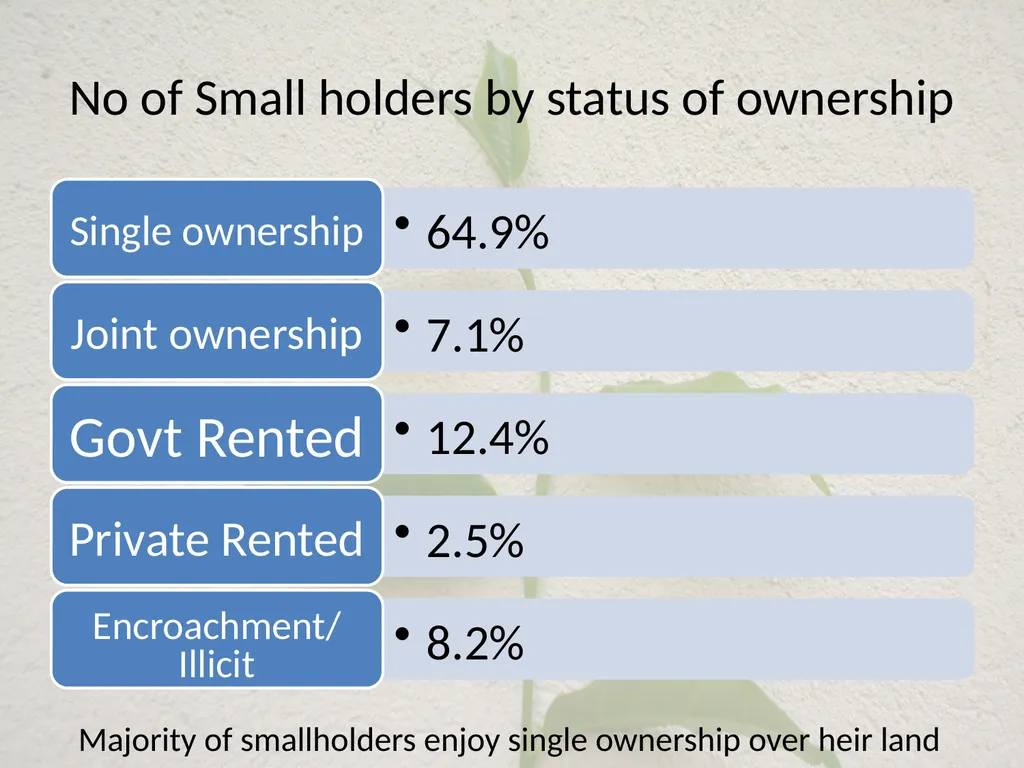
No of Small holders by status of ownership Majority of smallholders enjoy single ownership over heir land<br>
14
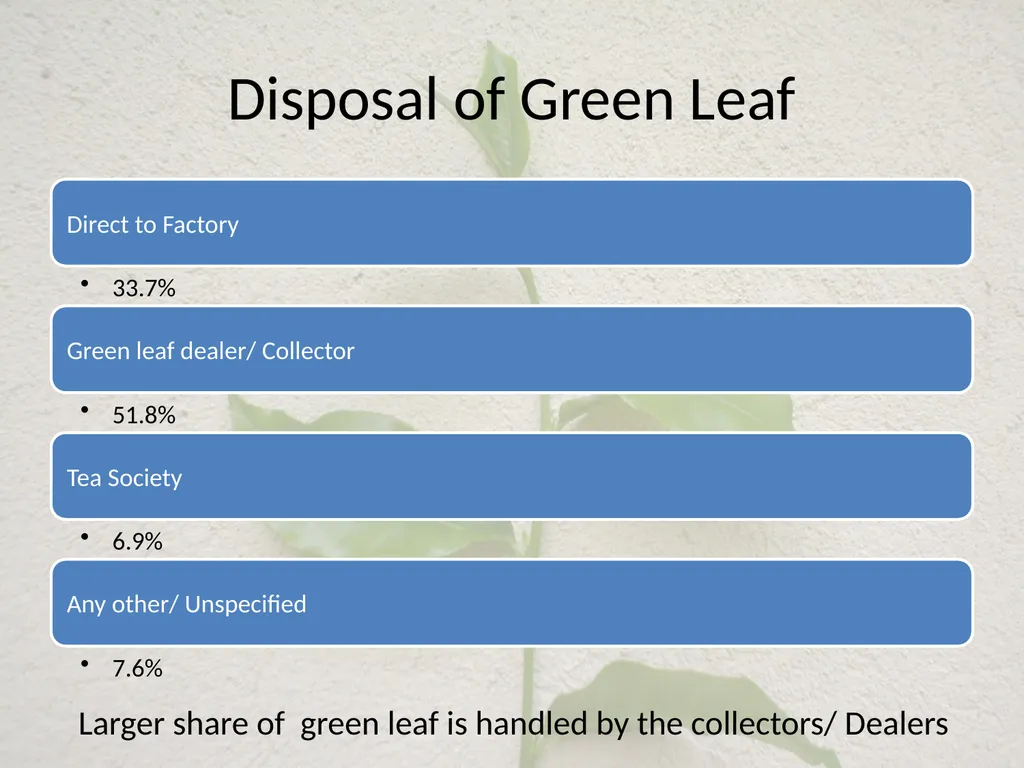
Disposal of Green Leaf Larger share of green leaf is handled by the collectors/ Dealers<br>
15
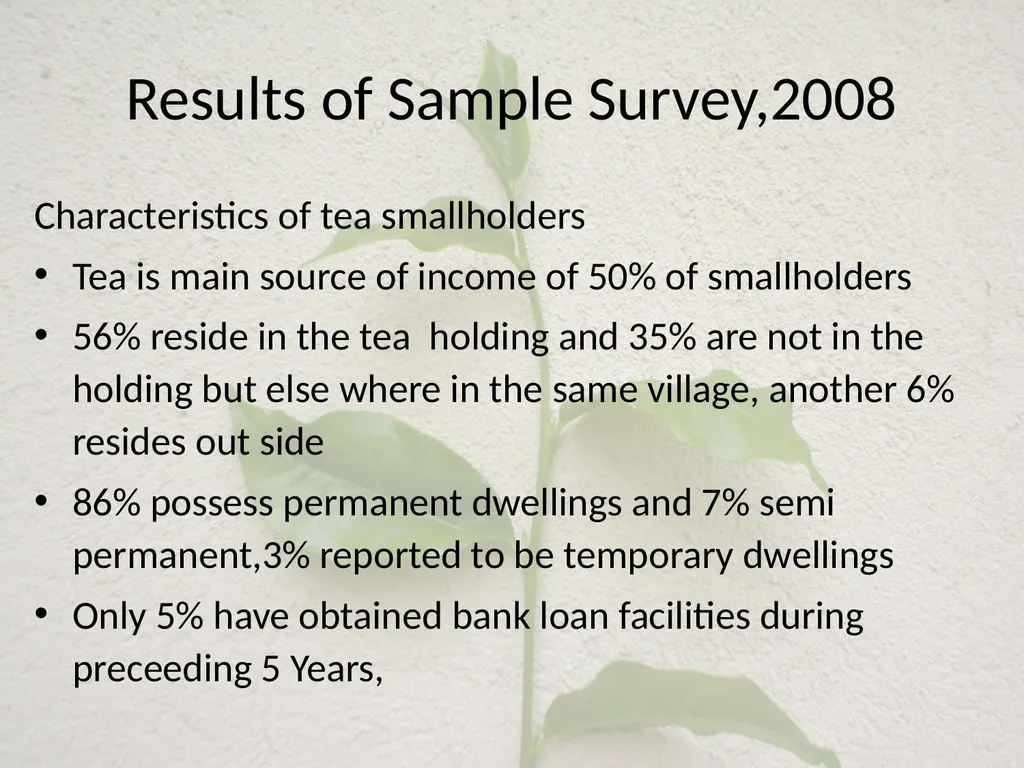
Results of Sample Survey,2008 Characteristics of tea smallholders
Tea is main source of income of 50% of smallholders
56% reside in the tea holding and 35% are not in the holding but else where in the same village, another 6% resides out side
86% possess permanent dwellings and 7% semi permanent,3% reported to be temporary dwellings
Only 5% have obtained bank loan facilities during preceeding 5 Years,<br>
16
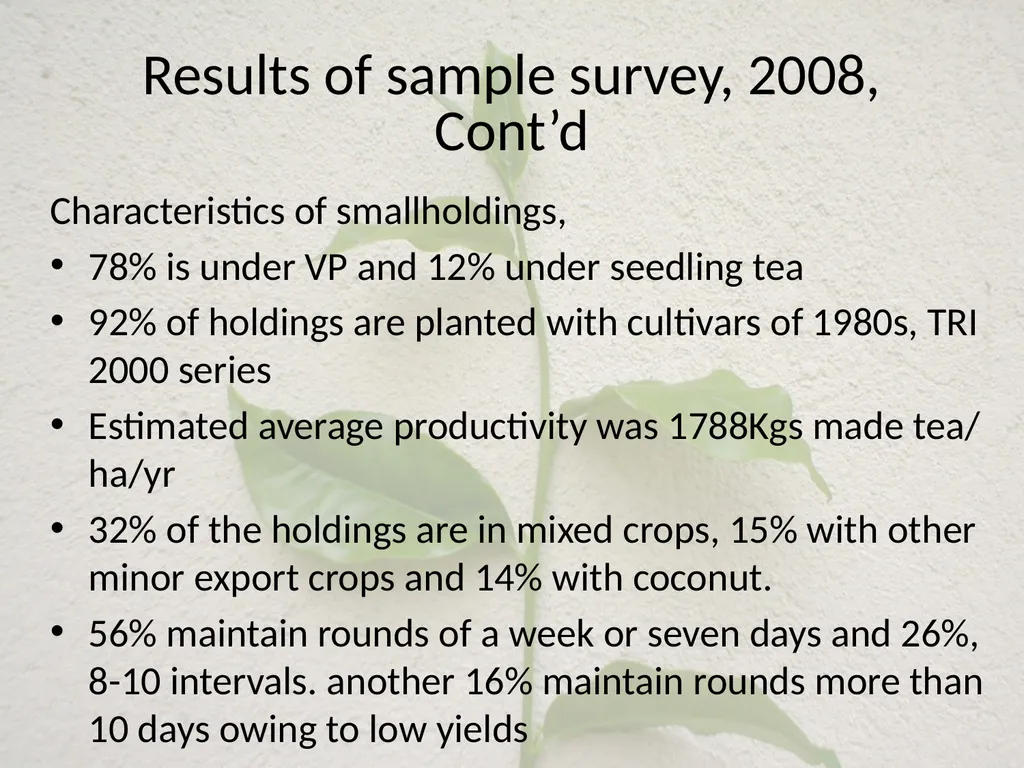
Results of sample survey, 2008, Cont’d Characteristics of smallholdings,
78% is under VP and 12% under seedling tea
92% of holdings are planted with cultivars of 1980s, TRI 2000 series
Estimated average productivity was 1788Kgs made tea/ ha/yr
32% of the holdings are in mixed crops, 15% with other minor export crops and 14% with coconut.
56% maintain rounds of a week or seven days and 26%, 8-10 intervals. another 16% maintain rounds more than 10 days owing to low yields<br>
17
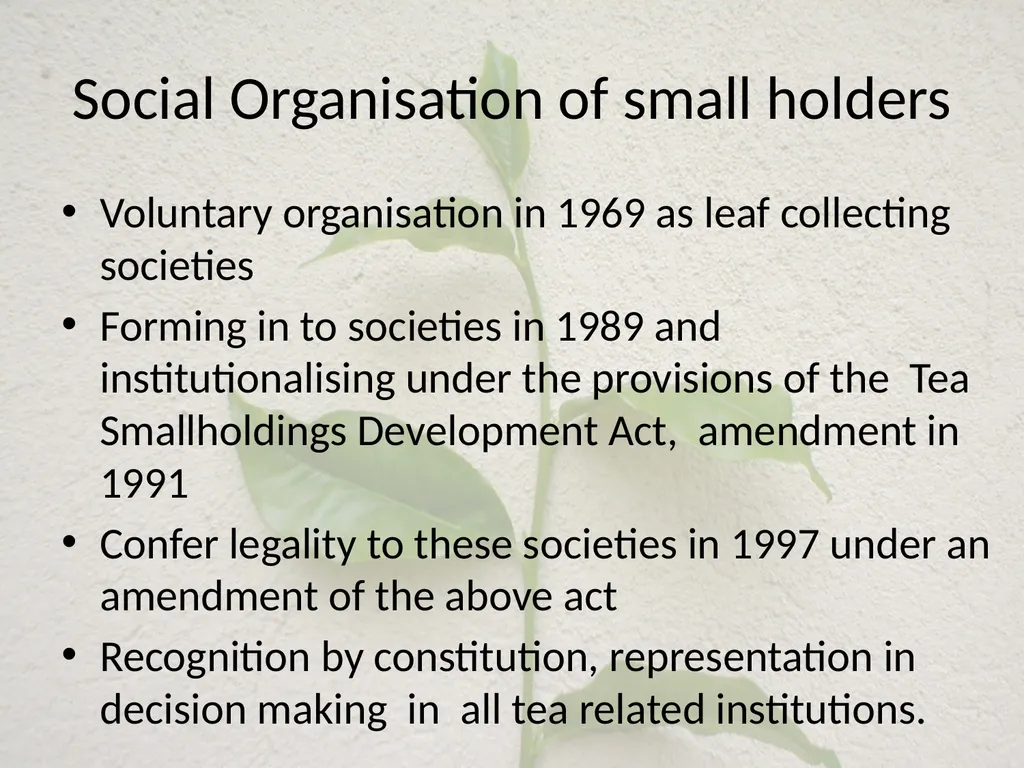
Social Organisation of small holders Voluntary organisation in 1969 as leaf collecting societies
Forming in to societies in 1989 and institutionalising under the provisions of the Tea Smallholdings Development Act, amendment in 1991
Confer legality to these societies in 1997 under an amendment of the above act
Recognition by constitution, representation in decision making in all tea related institutions.<br>
18
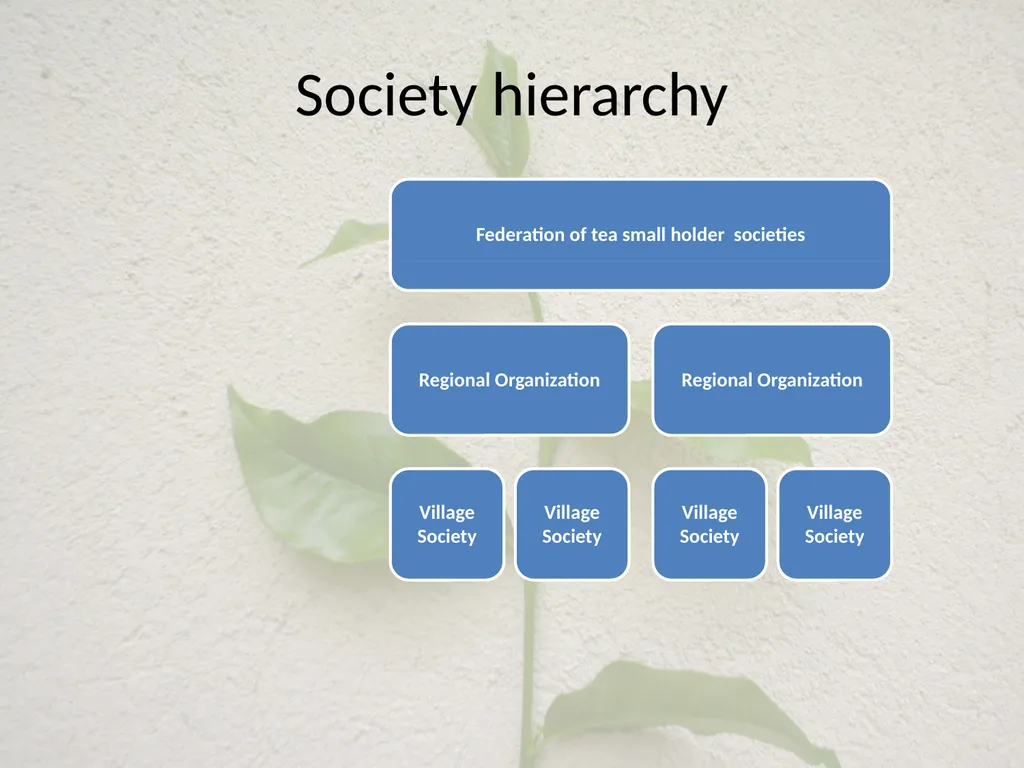
Society hierarchy<br>
19
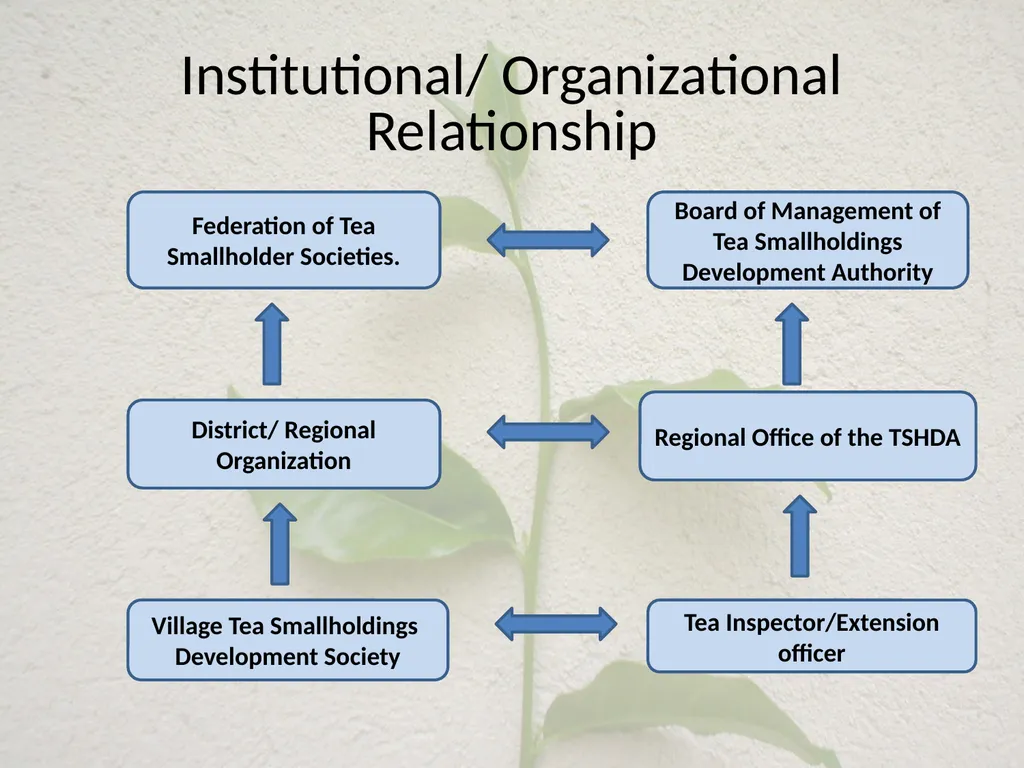
Institutional/ Organizational Relationship Federation of Tea Smallholder Societies. Board of Management of Tea Smallholdings Development Authority Regional Office of the TSHDA District/ Regional Organization Village Tea Smallholdings Development Society Tea Inspector/Extension officer<br>
20
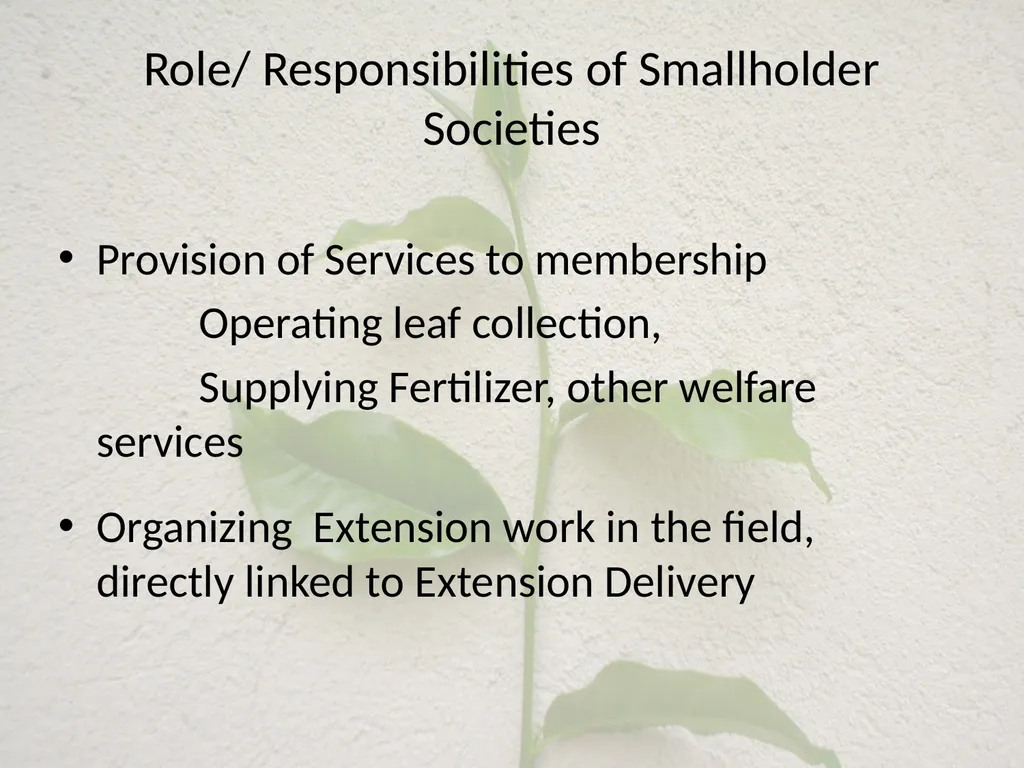
Role/ Responsibilities of Smallholder Societies Provision of Services to membership
Operating leaf collection,
Supplying Fertilizer, other welfare services
Organizing Extension work in the field, directly linked to Extension Delivery<br>
21
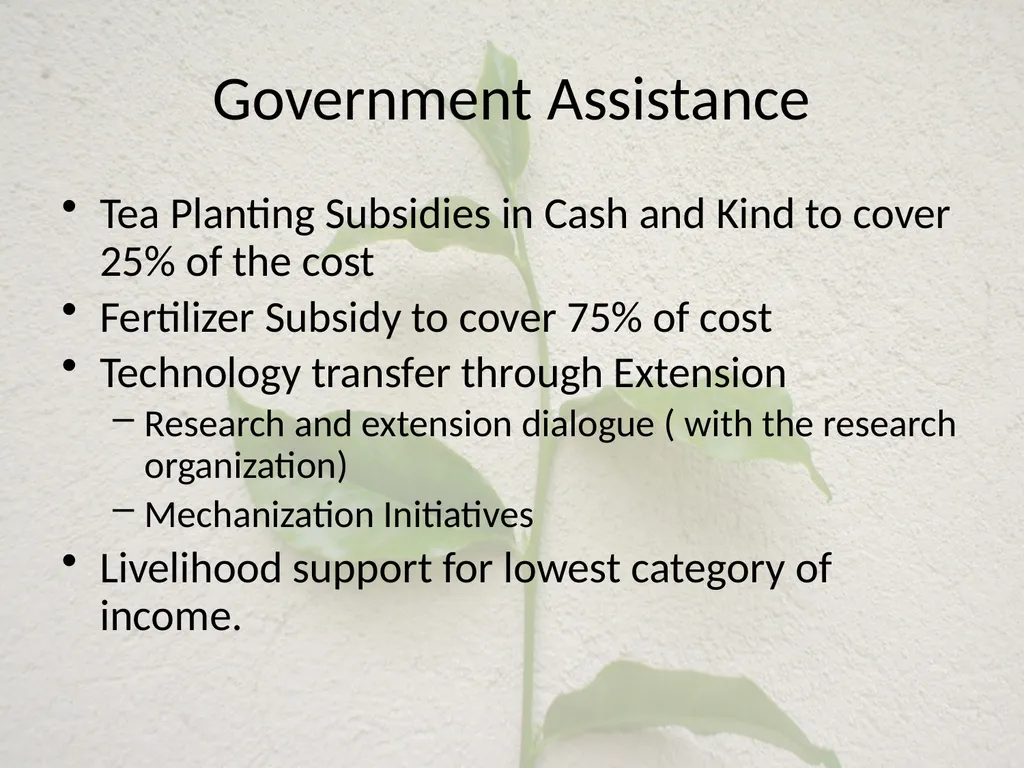
Government Assistance Tea Planting Subsidies in Cash and Kind to cover 25% of the cost
Fertilizer Subsidy to cover 75% of cost
Technology transfer through Extension
Research and extension dialogue ( with the research organization)
Mechanization Initiatives
Livelihood support for lowest category of income.<br>
22
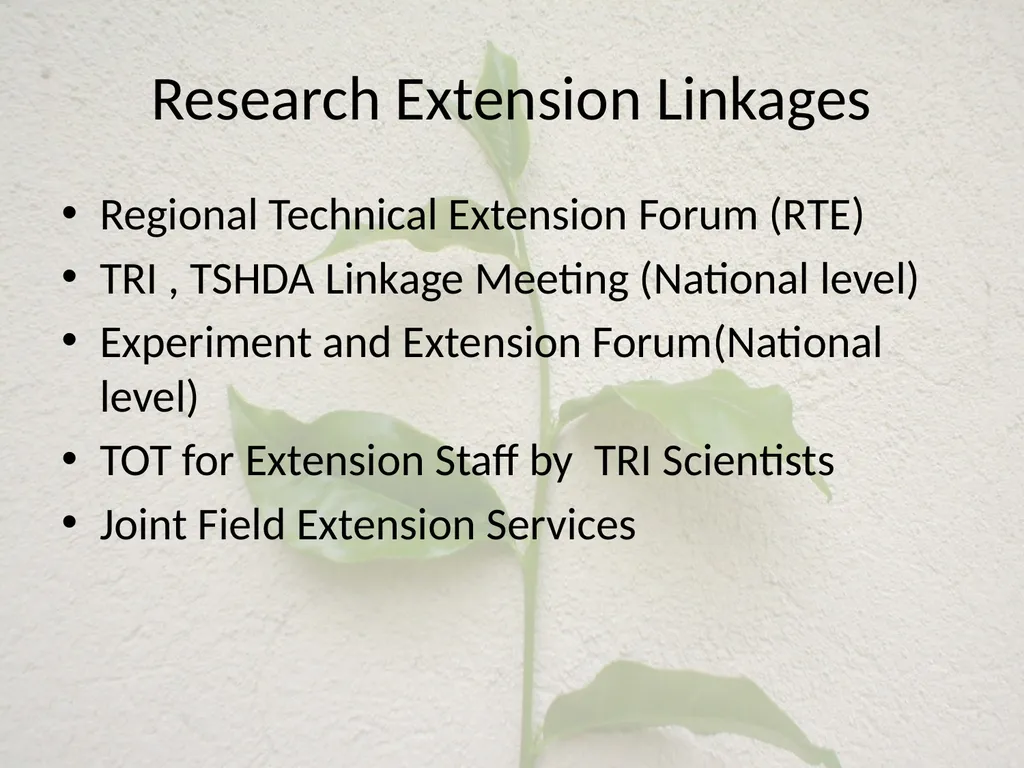
Research Extension Linkages Regional Technical Extension Forum (RTE)
TRI , TSHDA Linkage Meeting (National level)
Experiment and Extension Forum(National level)
TOT for Extension Staff by TRI Scientists
Joint Field Extension Services<br>
23
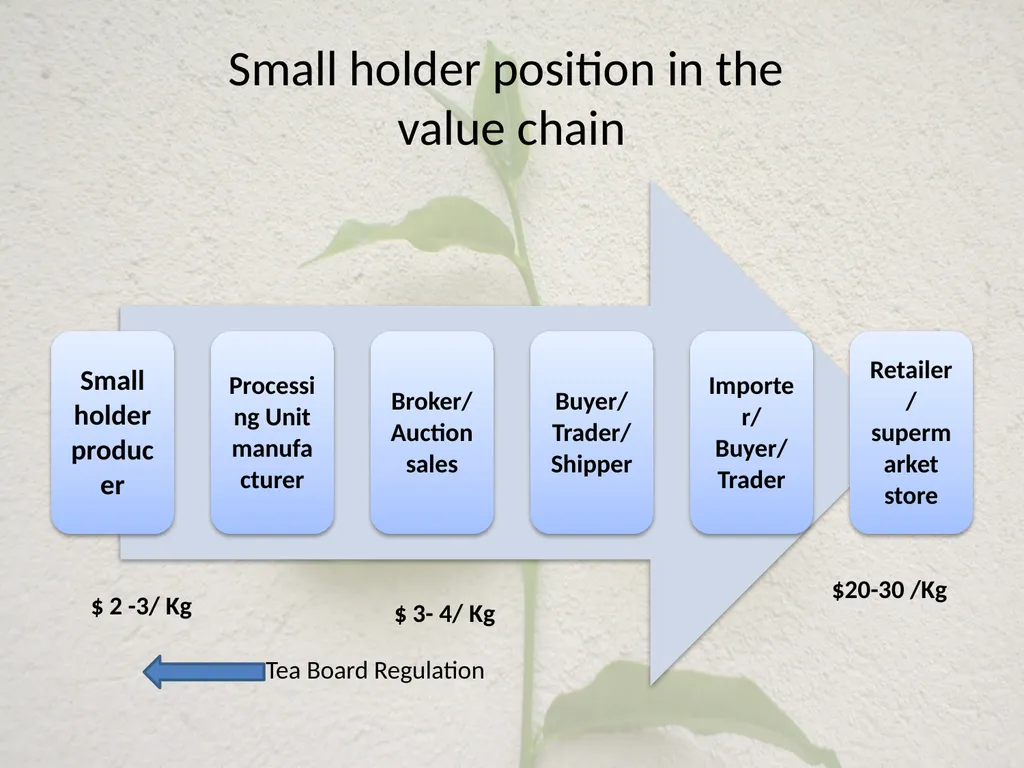
Small holder position in the value chain $20-30 /Kg $ 3- 4/ Kg $ 2 -3/ Kg Tea Board Regulation<br>
24
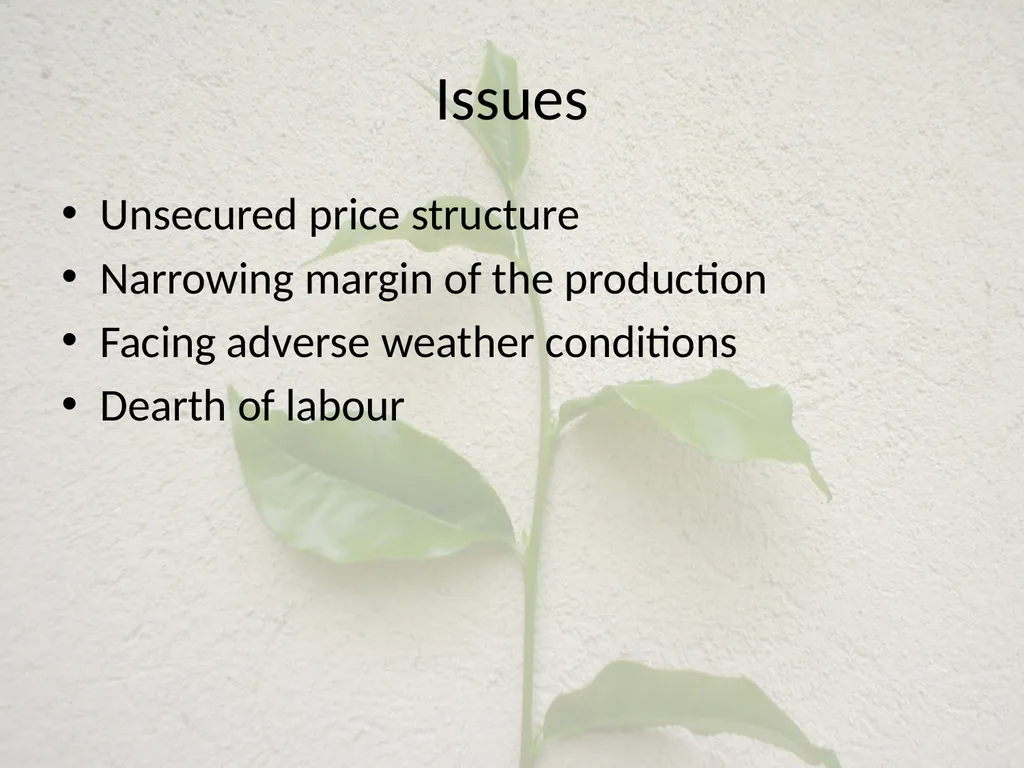
Issues Unsecured price structure
Narrowing margin of the production
Facing adverse weather conditions
Dearth of labour<br>