
Teaching Children Self-Regulation of Anger: A
KL
Published · 41 slides · 0 views

1 / 1

Description
Teaching Children Self-Regulation of Anger: A Neurodevelopmental Systems Approach CW Austin Learning Disabilities Conference March 29, 2025 Randall L. Lemoine, Ph.D. Psychologist in Private Practice 7913 Wrenwood Blvd. Suite A , BRLA 70809
Related Topics
Share
Embed code
Download this presentation From Below
"Teaching Children Self-Regulation of Anger: A" is the property of its rightful owner. Permission is granted to download and print the materials on this website for personal, non-commercial use only, and to display it on your personal computer provided you do not modify the materials and that you retain all copyright notices contained in the materials. By downloading content from our website, you accept the terms of this agreement.
Presentation Transcript
01
Teaching Children
Self-Regulation of Anger:
A Neurodevelopmental Systems Approach CW Austin Learning Disabilities Conference
March 29, 2025
Randall L. Lemoine, Ph.D.
Psychologist in Private Practice
7913 Wrenwood Blvd. Suite A , BRLA 70809
225-383-9808
www.RandallLemoinePhD.com
Rev. 03.21.25<br>
March 29, 2025
Randall L. Lemoine, Ph.D.
Psychologist in Private Practice
7913 Wrenwood Blvd. Suite A , BRLA 70809
225-383-9808
www.RandallLemoinePhD.com
Rev. 03.21.25<br>
02
Why Teach Self-Regulation of Anger?
All about Anger and its Expression
What is Self-Regulation of Anger (SR/A)?
A Neurodevelopmental-Systems Approach
SR/A Teaching Tools, Techniques & Tips
My Calming Procedure & Place; Roar Rating
5-Steps to Taming Temper During/After Episodes
Positive Communication & Conflict Resolution Our Agenda 2<br>
03
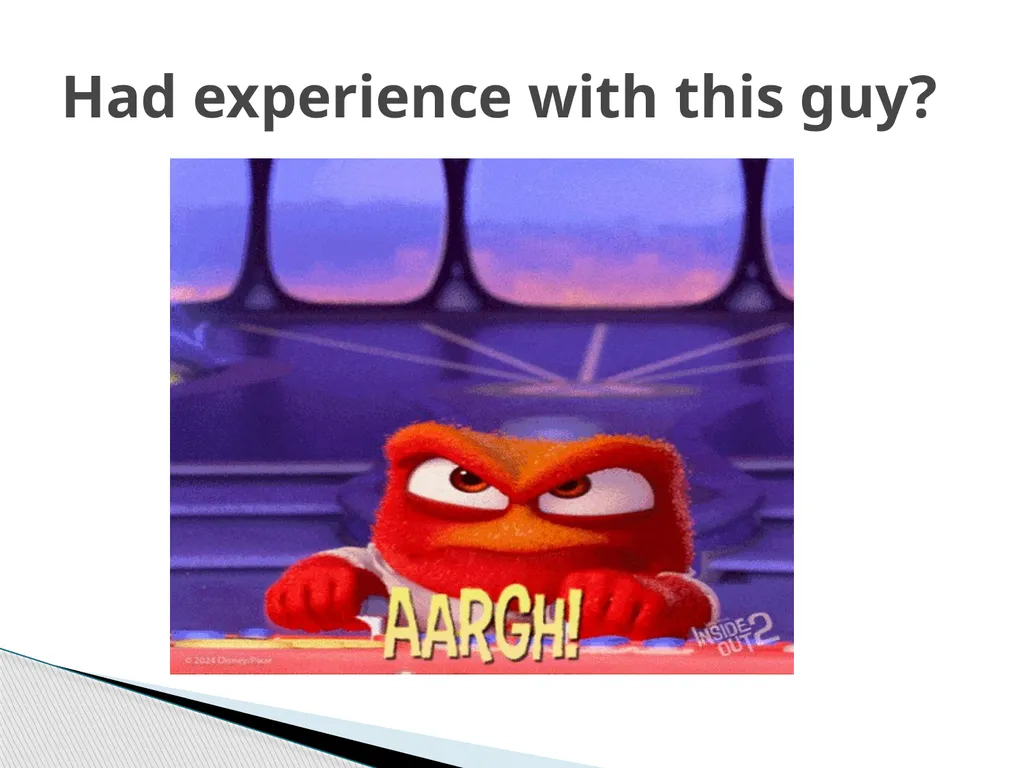
Had experience with this guy?<br>
04
SR/A is a critical & core life skill
Anger is a public epidemic & on is the rise
Anger is often a core feature of many neurodevelopmental disorders:
ASD; ADHD; ODD; IED; & DMDD
We know a lot about anger & self-regulation skills to teach it effectively! But often don’t. 4 Why Teach Children SR/A?<br>
Anger is a public epidemic & on is the rise
Anger is often a core feature of many neurodevelopmental disorders:
ASD; ADHD; ODD; IED; & DMDD
We know a lot about anger & self-regulation skills to teach it effectively! But often don’t. 4 Why Teach Children SR/A?<br>
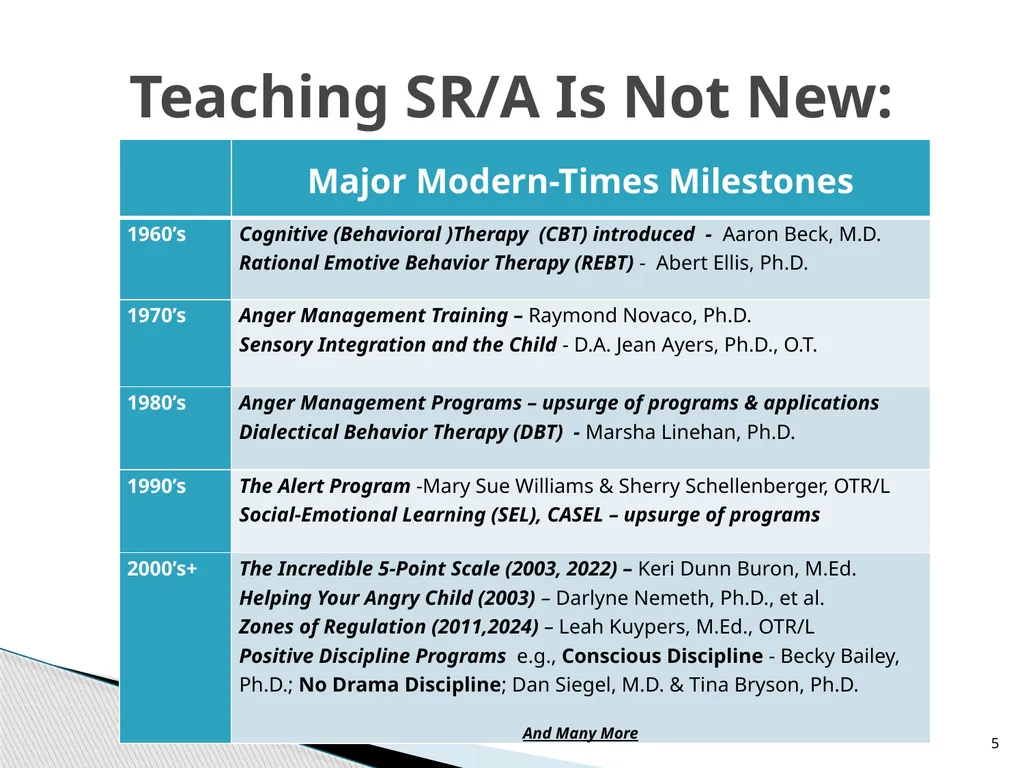
05
Teaching SR/A Is Not New: 5<br>
06
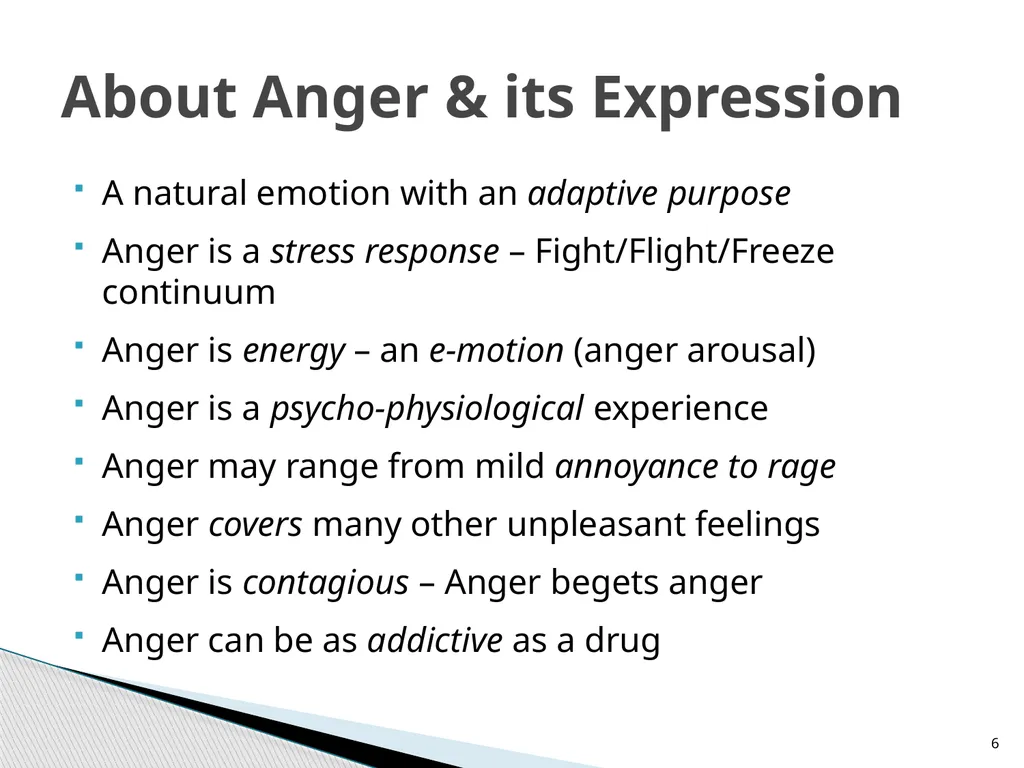
A natural emotion with an adaptive purpose
Anger is a stress response – Fight/Flight/Freeze continuum
Anger is energy – an e-motion (anger arousal)
Anger is a psycho-physiological experience
Anger may range from mild annoyance to rage
Anger covers many other unpleasant feelings
Anger is contagious – Anger begets anger
Anger can be as addictive as a drug 6 About Anger & its Expression<br>
07
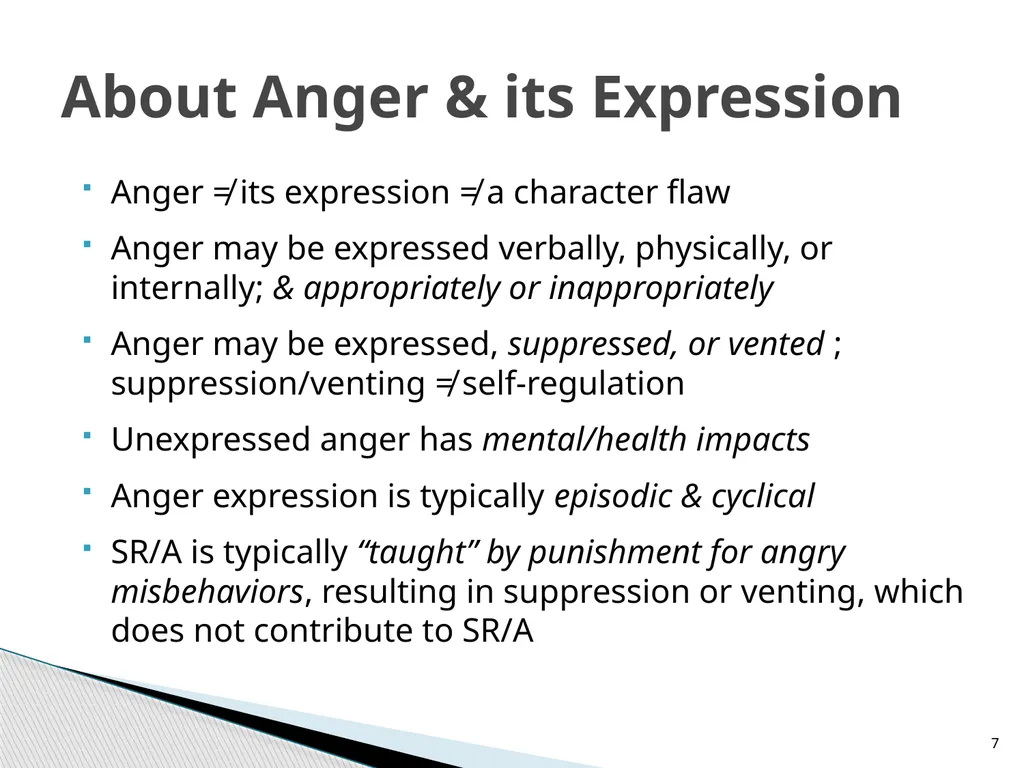
Anger ≠ its expression ≠ a character flaw
Anger may be expressed verbally, physically, or internally; & appropriately or inappropriately
Anger may be expressed, suppressed, or vented ; suppression/venting ≠ self-regulation
Unexpressed anger has mental/health impacts
Anger expression is typically episodic & cyclical
SR/A is typically “taught” by punishment for angry misbehaviors, resulting in suppression or venting, which does not contribute to SR/A 7 About Anger & its Expression<br>
08
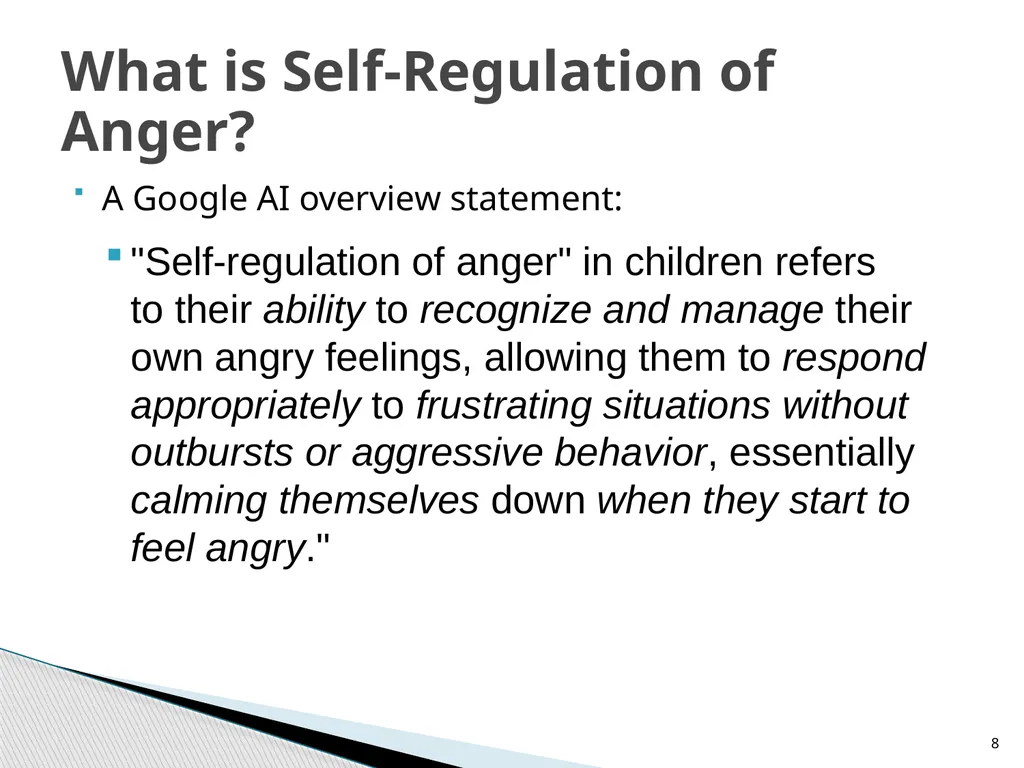
A Google AI overview statement:
"Self-regulation of anger" in children refers to their ability to recognize and manage their own angry feelings, allowing them to respond appropriately to frustrating situations without outbursts or aggressive behavior, essentially calming themselves down when they start to feel angry." 8 What is Self-Regulation of Anger?<br>
"Self-regulation of anger" in children refers to their ability to recognize and manage their own angry feelings, allowing them to respond appropriately to frustrating situations without outbursts or aggressive behavior, essentially calming themselves down when they start to feel angry." 8 What is Self-Regulation of Anger?<br>
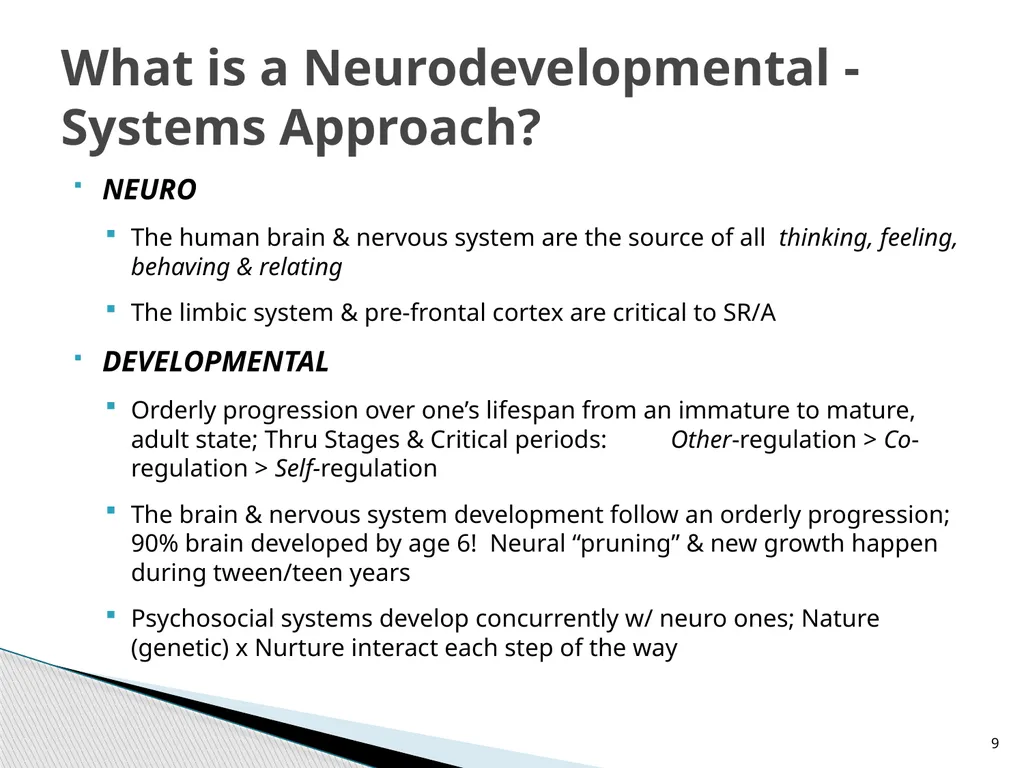
09
NEURO
The human brain & nervous system are the source of all thinking, feeling, behaving & relating
The limbic system & pre-frontal cortex are critical to SR/A
DEVELOPMENTAL
Orderly progression over one’s lifespan from an immature to mature, adult state; Thru Stages & Critical periods: Other-regulation > Co-regulation > Self-regulation
The brain & nervous system development follow an orderly progression; 90% brain developed by age 6! Neural “pruning” & new growth happen during tween/teen years
Psychosocial systems develop concurrently w/ neuro ones; Nature (genetic) x Nurture interact each step of the way 9 What is a Neurodevelopmental - Systems Approach?<br>
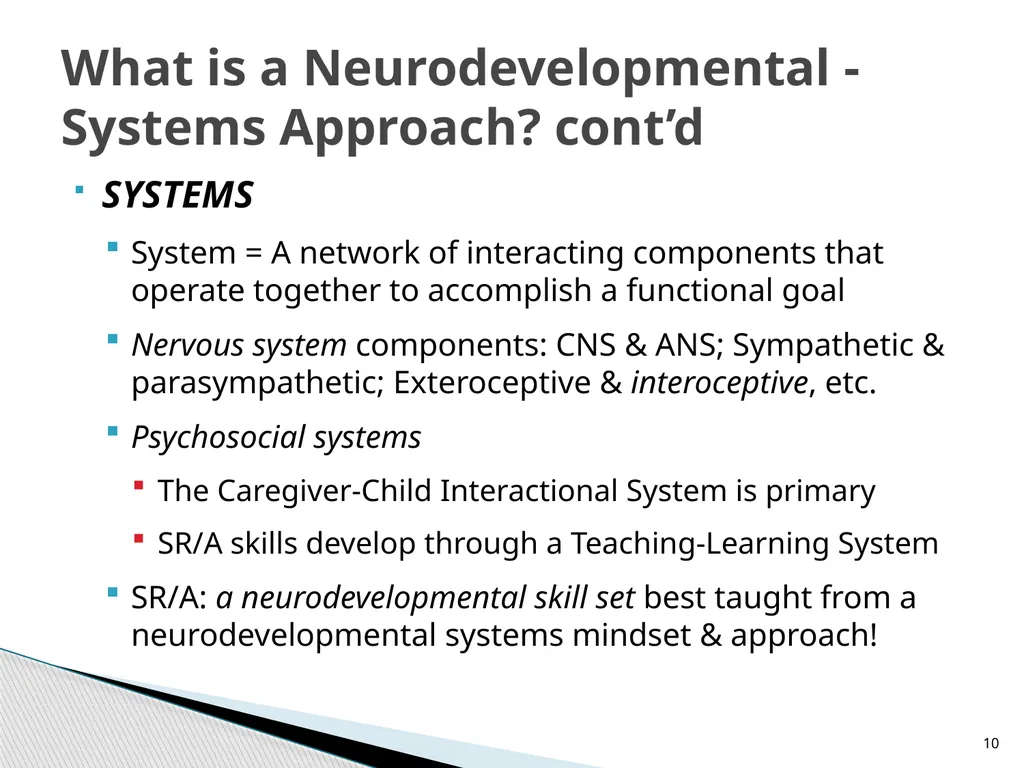
10
SYSTEMS
System = A network of interacting components that operate together to accomplish a functional goal
Nervous system components: CNS & ANS; Sympathetic & parasympathetic; Exteroceptive & interoceptive, etc.
Psychosocial systems
The Caregiver-Child Interactional System is primary
SR/A skills develop through a Teaching-Learning System
SR/A: a neurodevelopmental skill set best taught from a neurodevelopmental systems mindset & approach! 10 What is a Neurodevelopmental - Systems Approach? cont’d<br>
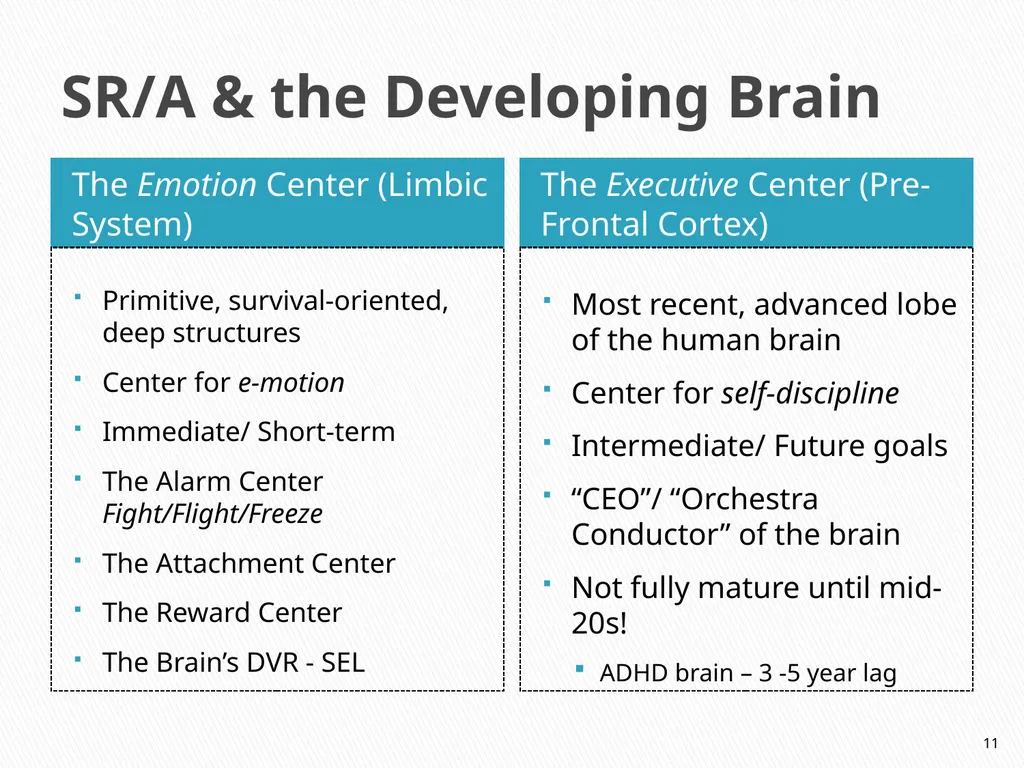
11
SR/A & the Developing Brain The Emotion Center (Limbic System) The Executive Center (Pre-Frontal Cortex) Primitive, survival-oriented, deep structures
Center for e-motion
Immediate/ Short-term
The Alarm Center Fight/Flight/Freeze
The Attachment Center
The Reward Center
The Brain’s DVR - SEL Most recent, advanced lobe of the human brain
Center for self-discipline
Intermediate/ Future goals
“CEO”/ “Orchestra Conductor” of the brain
Not fully mature until mid-20s!
ADHD brain – 3 -5 year lag 11<br>
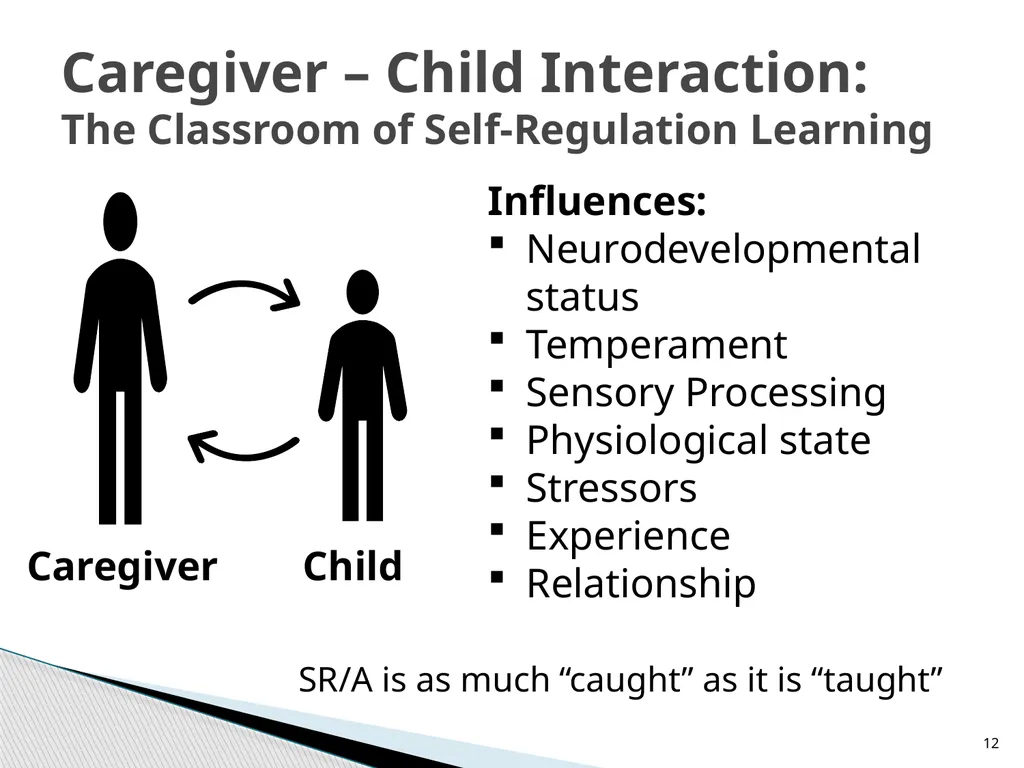
12
Caregiver – Child Interaction:
The Classroom of Self-Regulation Learning 12 Caregiver Child Influences:
Neurodevelopmental status
Temperament
Sensory Processing
Physiological state
Stressors
Experience
Relationship SR/A is as much “caught” as it is “taught”<br>
Neurodevelopmental status
Temperament
Sensory Processing
Physiological state
Stressors
Experience
Relationship SR/A is as much “caught” as it is “taught”<br>
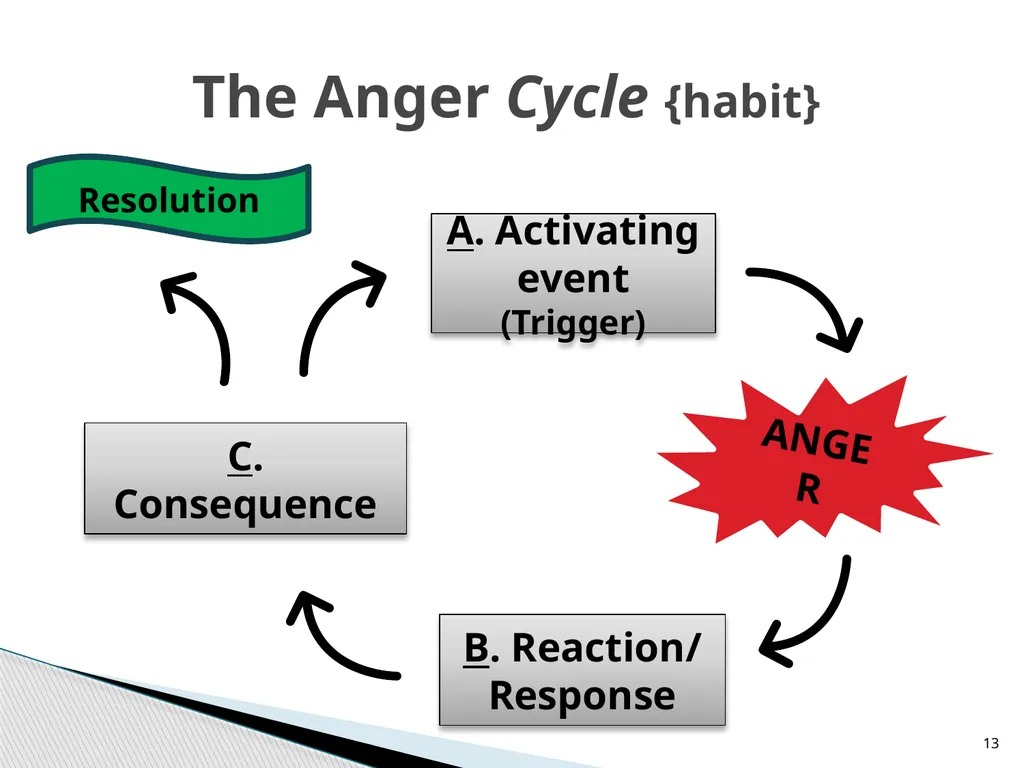
13
The Anger Cycle {habit} 13 A. Activating event (Trigger) ANGER B. Reaction/
Response C. Consequence Resolution<br>
Response C. Consequence Resolution<br>
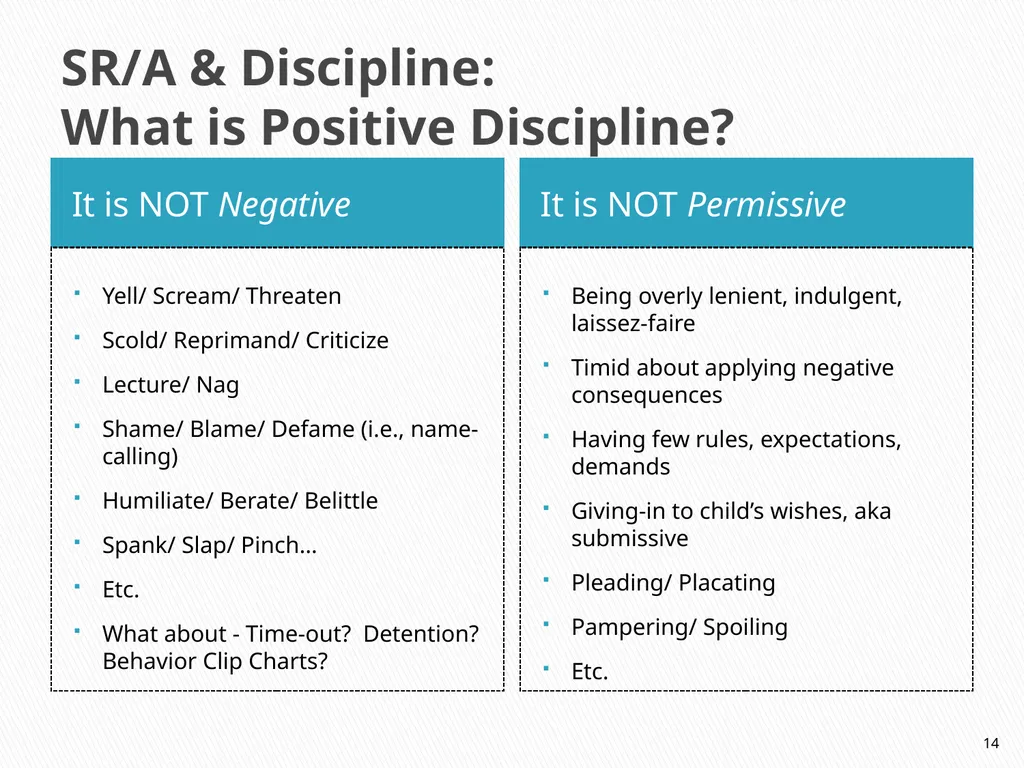
14
SR/A & Discipline:
What is Positive Discipline? It is NOT Negative It is NOT Permissive Yell/ Scream/ Threaten
Scold/ Reprimand/ Criticize
Lecture/ Nag
Shame/ Blame/ Defame (i.e., name-calling)
Humiliate/ Berate/ Belittle
Spank/ Slap/ Pinch…
Etc.
What about - Time-out? Detention? Behavior Clip Charts? Being overly lenient, indulgent, laissez-faire
Timid about applying negative consequences
Having few rules, expectations, demands
Giving-in to child’s wishes, aka submissive
Pleading/ Placating
Pampering/ Spoiling
Etc. 14<br>
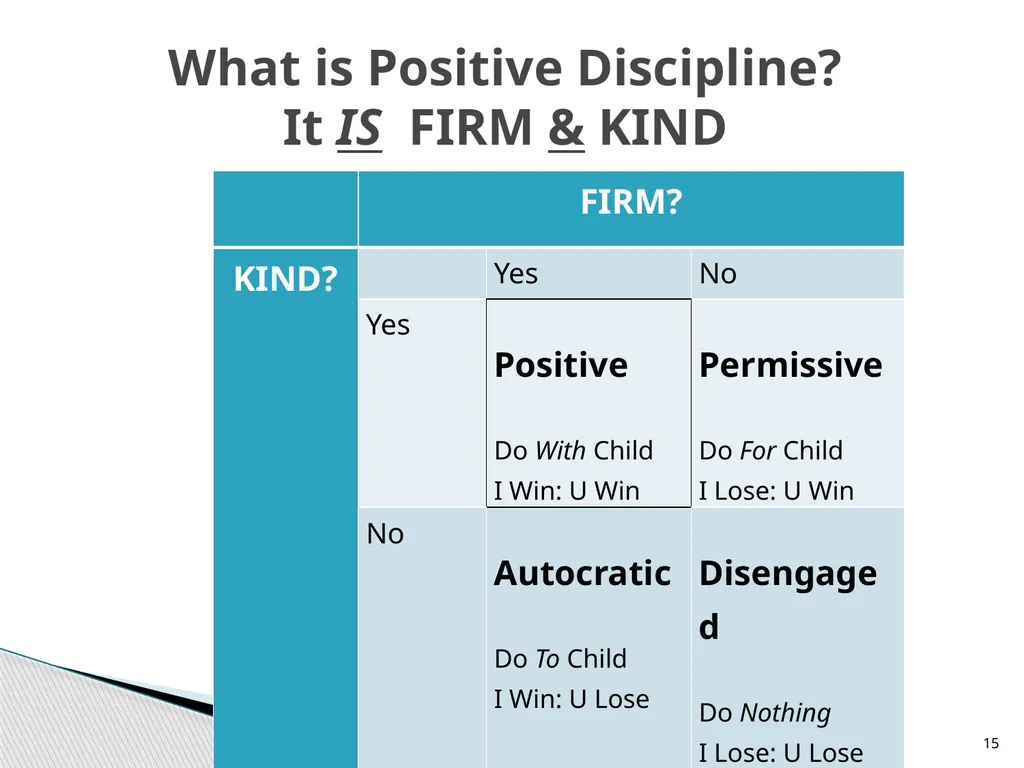
15
What is Positive Discipline?
It IS FIRM & KIND 15<br>
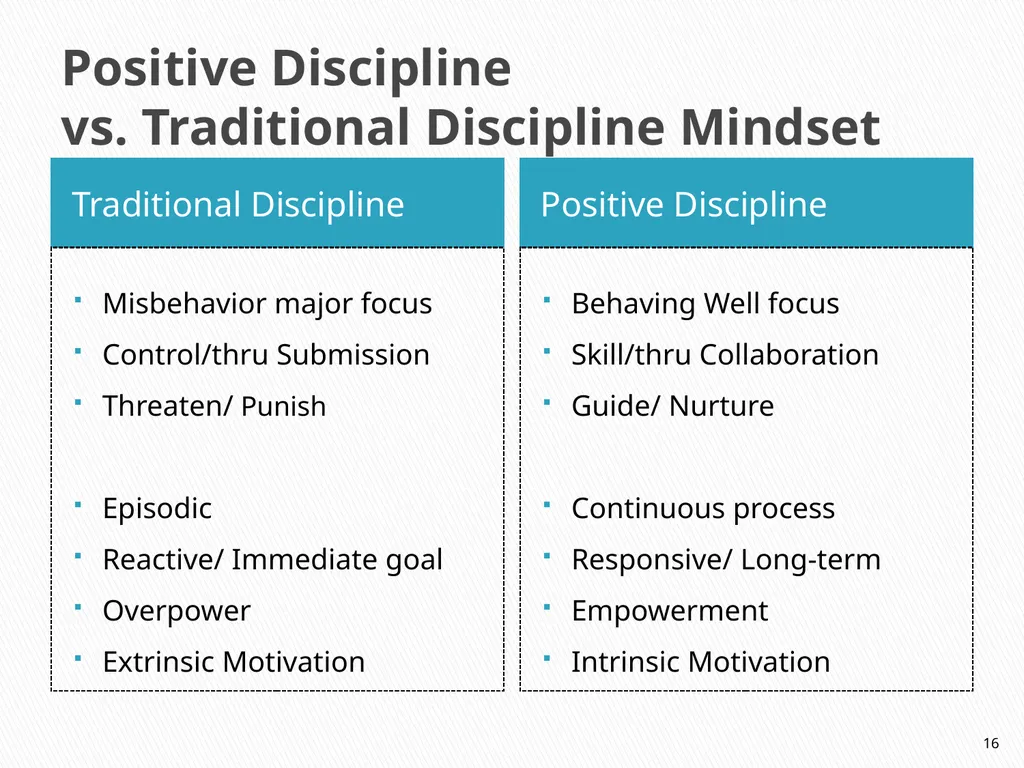
16
Positive Discipline
vs. Traditional Discipline Mindset Traditional Discipline Positive Discipline Misbehavior major focus
Control/thru Submission
Threaten/ Punish
Episodic
Reactive/ Immediate goal
Overpower
Extrinsic Motivation Behaving Well focus
Skill/thru Collaboration
Guide/ Nurture
Continuous process
Responsive/ Long-term
Empowerment
Intrinsic Motivation 16<br>
Control/thru Submission
Threaten/ Punish
Episodic
Reactive/ Immediate goal
Overpower
Extrinsic Motivation Behaving Well focus
Skill/thru Collaboration
Guide/ Nurture
Continuous process
Responsive/ Long-term
Empowerment
Intrinsic Motivation 16<br>
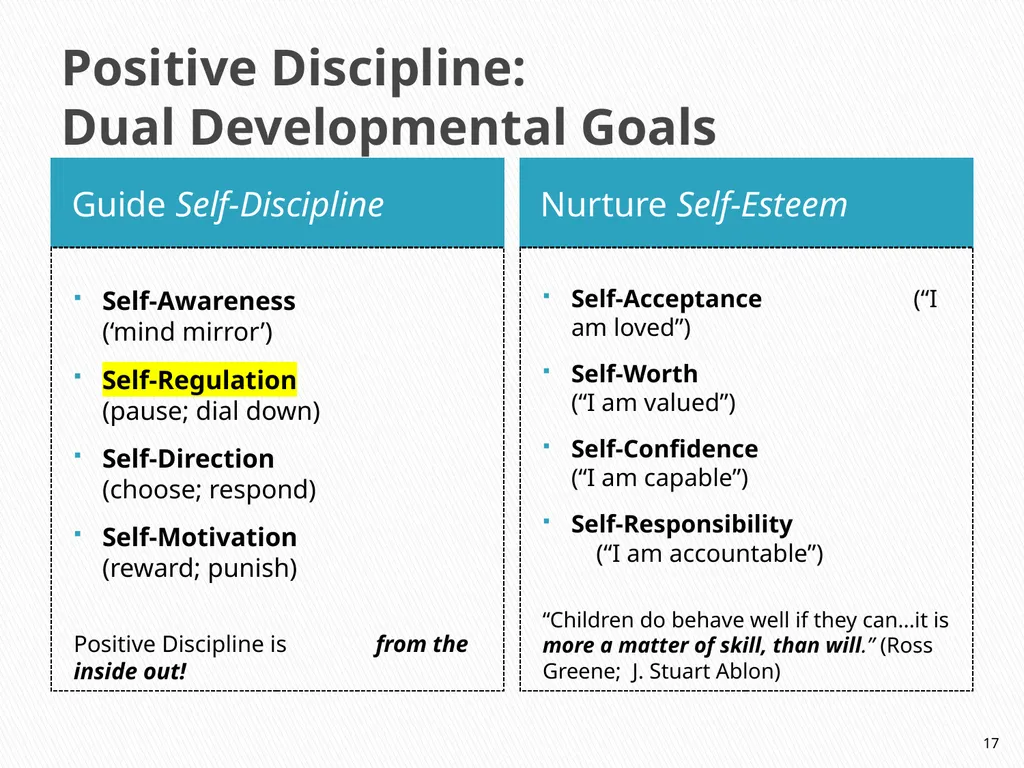
17
Positive Discipline:
Dual Developmental Goals Guide Self-Discipline Nurture Self-Esteem Self-Awareness (‘mind mirror’)
Self-Regulation (pause; dial down)
Self-Direction (choose; respond)
Self-Motivation (reward; punish)
Positive Discipline is from the inside out! Self-Acceptance (“I am loved”)
Self-Worth (“I am valued”)
Self-Confidence (“I am capable”)
Self-Responsibility (“I am accountable”)
“Children do behave well if they can…it is more a matter of skill, than will.” (Ross Greene; J. Stuart Ablon) 17<br>
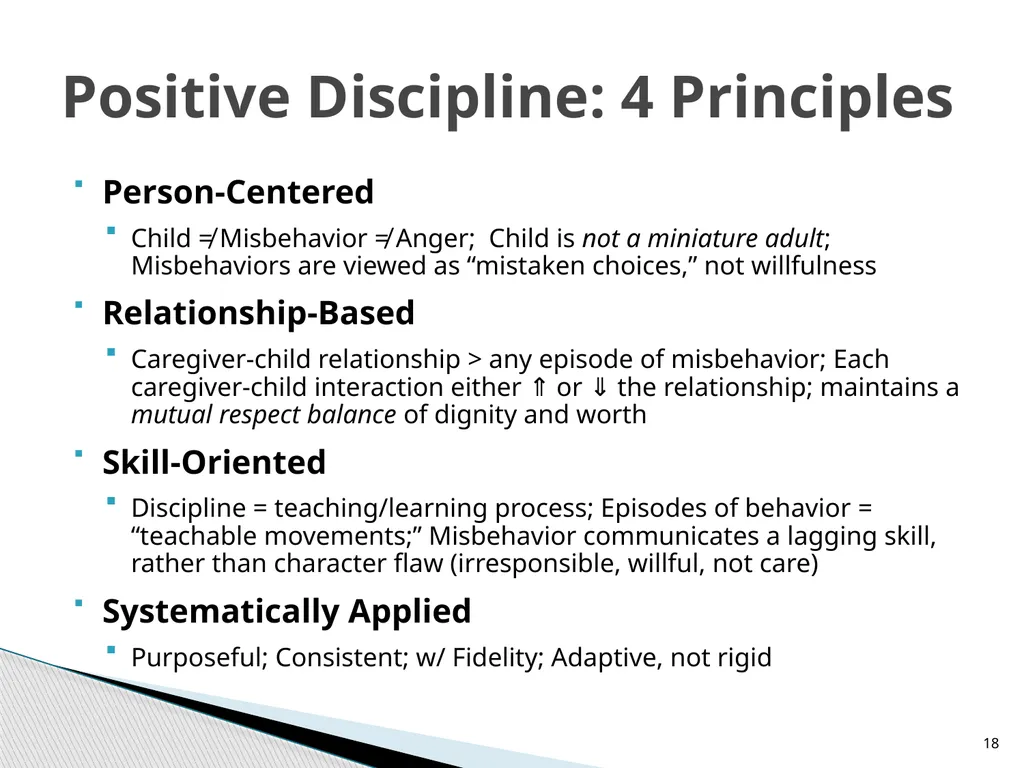
18
Person-Centered
Child ≠ Misbehavior ≠ Anger; Child is not a miniature adult; Misbehaviors are viewed as “mistaken choices,” not willfulness
Relationship-Based
Caregiver-child relationship > any episode of misbehavior; Each caregiver-child interaction either ⇑ or ⇓ the relationship; maintains a mutual respect balance of dignity and worth
Skill-Oriented
Discipline = teaching/learning process; Episodes of behavior = “teachable movements;” Misbehavior communicates a lagging skill, rather than character flaw (irresponsible, willful, not care)
Systematically Applied
Purposeful; Consistent; w/ Fidelity; Adaptive, not rigid Positive Discipline: 4 Principles 18<br>
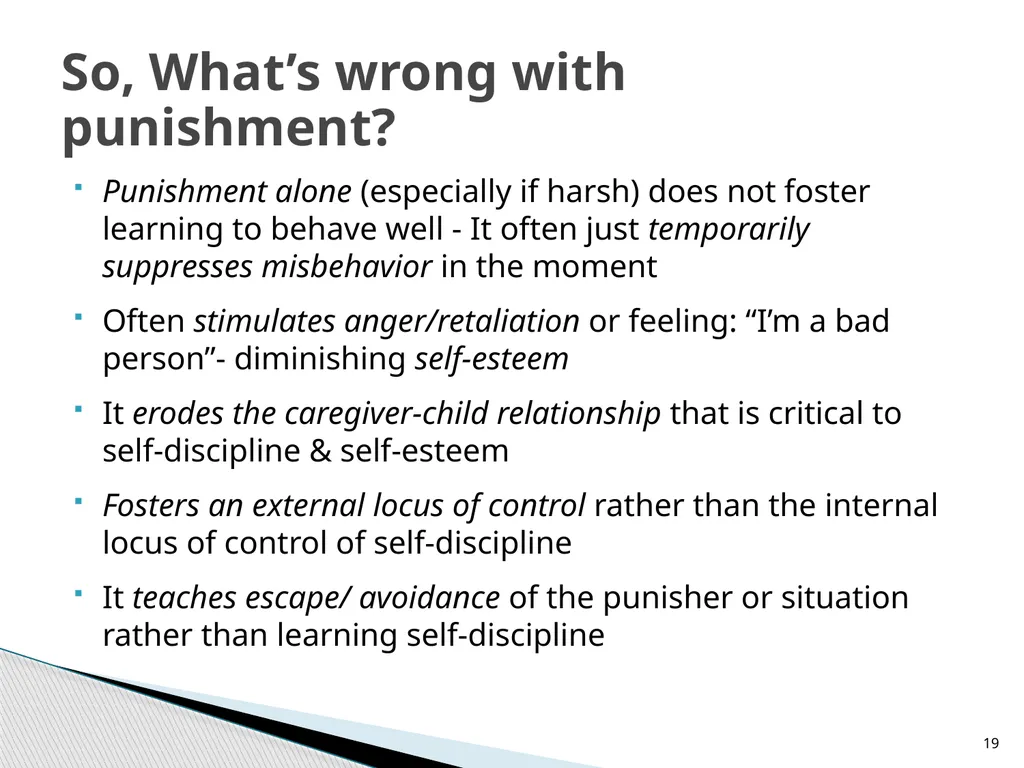
19
Punishment alone (especially if harsh) does not foster learning to behave well - It often just temporarily suppresses misbehavior in the moment
Often stimulates anger/retaliation or feeling: “I’m a bad person”- diminishing self-esteem
It erodes the caregiver-child relationship that is critical to self-discipline & self-esteem
Fosters an external locus of control rather than the internal locus of control of self-discipline
It teaches escape/ avoidance of the punisher or situation rather than learning self-discipline So, What’s wrong with punishment? 19<br>
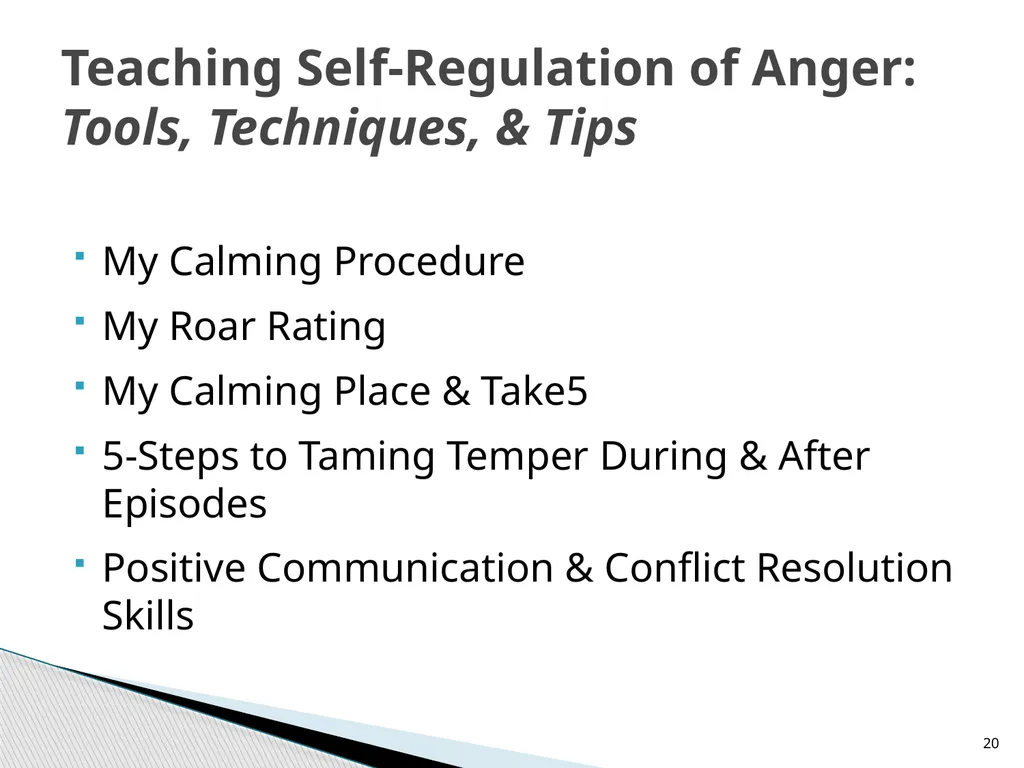
20
My Calming Procedure
My Roar Rating
My Calming Place & Take5
5-Steps to Taming Temper During & After Episodes
Positive Communication & Conflict Resolution Skills Teaching Self-Regulation of Anger: Tools, Techniques, & Tips 20<br>
My Roar Rating
My Calming Place & Take5
5-Steps to Taming Temper During & After Episodes
Positive Communication & Conflict Resolution Skills Teaching Self-Regulation of Anger: Tools, Techniques, & Tips 20<br>
21
Fools give full vent to their anger; but the wise bring calm in the end.
Proverbs 29: 11 21<br>
Proverbs 29: 11 21<br>
22
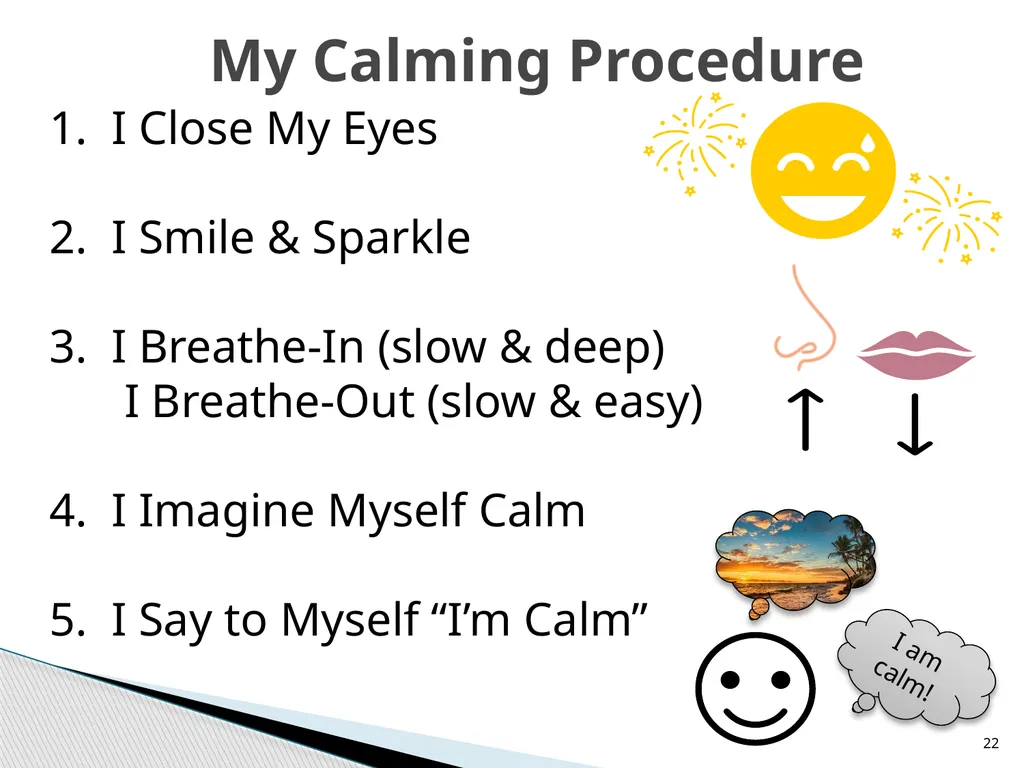
My Calming Procedure 22 I Close My Eyes
2. I Smile & Sparkle
3. I Breathe-In (slow & deep)
I Breathe-Out (slow & easy)
4. I Imagine Myself Calm
5. I Say to Myself “I’m Calm” I am calm!<br>
2. I Smile & Sparkle
3. I Breathe-In (slow & deep)
I Breathe-Out (slow & easy)
4. I Imagine Myself Calm
5. I Say to Myself “I’m Calm” I am calm!<br>
23
Calm Breathing (aka diaphragmic or belly breathing)
Inhale through the nose, exhale through the mouth, slowly, deeply, smoothly; w/relaxed shoulders & jaw
e.g., 4-square breathing; star breathing, etc.
Tense and Release
Progressively tense then relax body parts from head to toe (or visa versa) to “let it go” (Elsa got it right!)
Body Scan
Mentally scan & progressively relax body parts head to toe, similar to Tense & Release but only mentally My Calming Procedure: Calm Body Skills 23<br>
24
Positive Self-talk & Affirmations
Help child to be aware of their automatic negative self-talk that can often increase their anger (e.g., ..)
Coach child into using positive, calming self-talk affirmations that w/ practice decrease anger (e.g.,…)
Tranquil Imagery
Visualize a calm place & state of mind & body (e.g.,)
Coach child to use calm body skills and to engage their senses in the scene to experience “being there” My Calming Procedure: Calm Mind Skills 24<br>
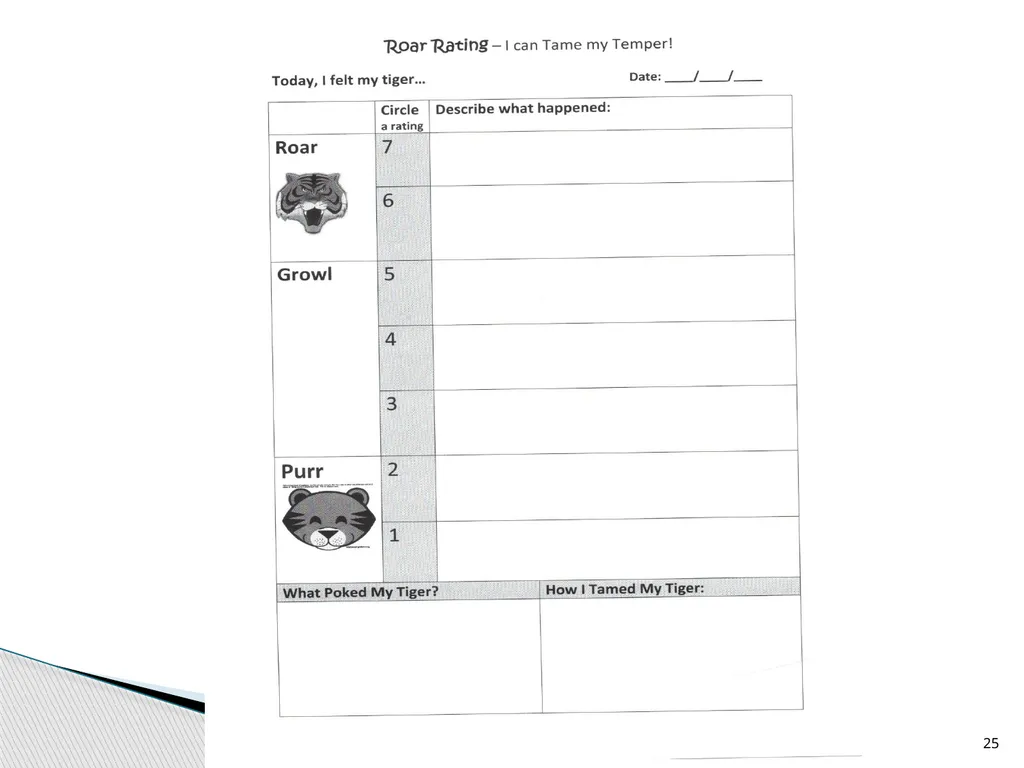
25
25<br>
26
A visual guide for a systematic caregiver-child learning dialogue for review of episodes of anger (“temper taming talks”)
Identifies underlying feelings (sensations) & thoughts that triggered (“poked”) anger
Identifies the self-calming skills child used & what may be tried next time to progressively improve SR/A skill
Must be “calibrated” first, anchoring to real-life prior episodes of “roars, growls, purrs” My Roar Rating – More than a scale 26<br>
27
A self-regulation of anger therapy program for young children who are challenged by anger & angry outbursts
Anger is metaphorically cast as Temper the Tiger’s roars/growls; Child as a Tiger Tamer
Roar rating is used as a teaching tool
Child is taught specific temper taming techniques to teach Temper to self calm: To growl, rather than roar; To purr more than growl; & celebrating success daily/weekly Temper the Tiger Tamer Training 27<br>
28
An inviting, comfortable place where the child can actively remove her/himself from the anger arousal scene & actively engage in self-calming practices
Pre-equipped with a soft cushion; a calming procedure graphic; books; stuffed animal (Temper the Tiger); sand timer; Personalized by the child; KISS -Not cluttered
This is not a Time Out: Invited use, not demanded use; Also, it’s not a “go to your room and cool down!”
Often used in conjunction w/ Take5: a mutually agreed upon 5-min “break” from the anger arousal moment & place, w/ the expectation of returning afterwards w/ a calmer mindset, to seek solutions together, & maybe even for apologies & forgiveness, etc. My Calming Place & Take5 28<br>
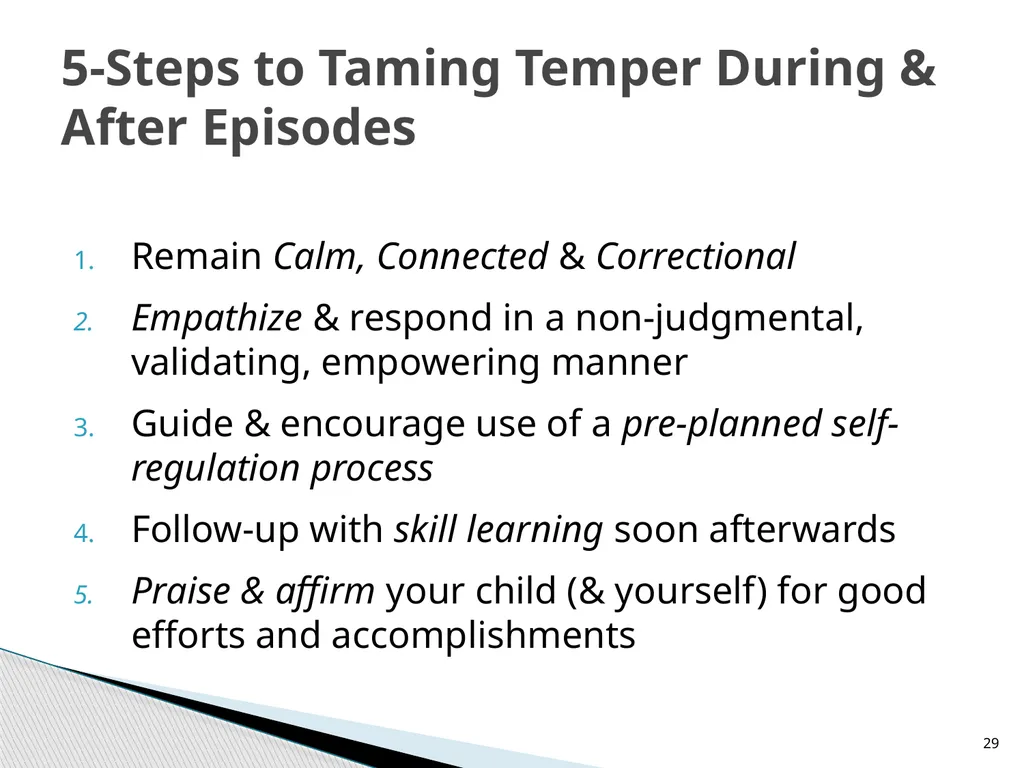
29
Remain Calm, Connected & Correctional
Empathize & respond in a non-judgmental, validating, empowering manner
Guide & encourage use of a pre-planned self-regulation process
Follow-up with skill learning soon afterwards
Praise & affirm your child (& yourself) for good efforts and accomplishments 5-Steps to Taming Temper During & After Episodes 29<br>
30
Caregiver’s self-regulation of own anger is Job#1. Model calm to teach calm. (co-regulation!)
Press “Pause for P.E.A.C.E;” then “slo-mo”
Use your own calm body & calm mind skills
Do a mutual Take5 if anger continues to rise
Keep a correctional mindset, not punitive one: Remember this is a “teachable moment!”
Praise & affirm your child (& yourself) for good efforts and accomplishments of this 1st step! 1. Remain Calm, Connected, & Correctional 30<br>
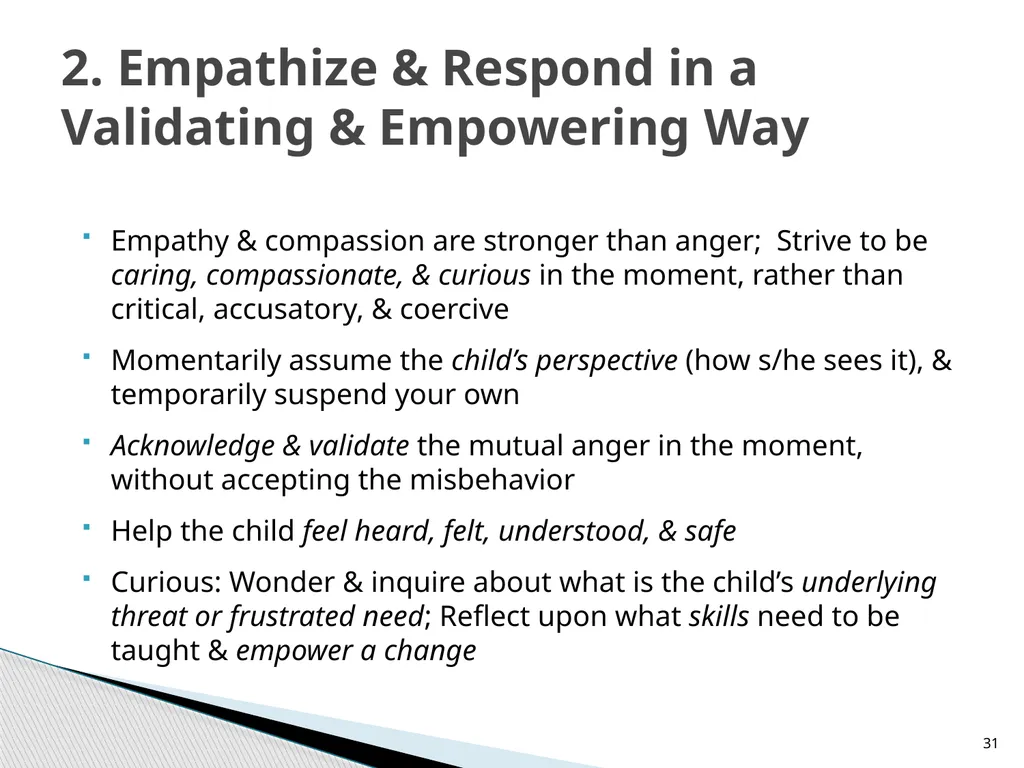
31
Empathy & compassion are stronger than anger; Strive to be caring, compassionate, & curious in the moment, rather than critical, accusatory, & coercive
Momentarily assume the child’s perspective (how s/he sees it), & temporarily suspend your own
Acknowledge & validate the mutual anger in the moment, without accepting the misbehavior
Help the child feel heard, felt, understood, & safe
Curious: Wonder & inquire about what is the child’s underlying threat or frustrated need; Reflect upon what skills need to be taught & empower a change 2. Empathize & Respond in a Validating & Empowering Way 31<br>
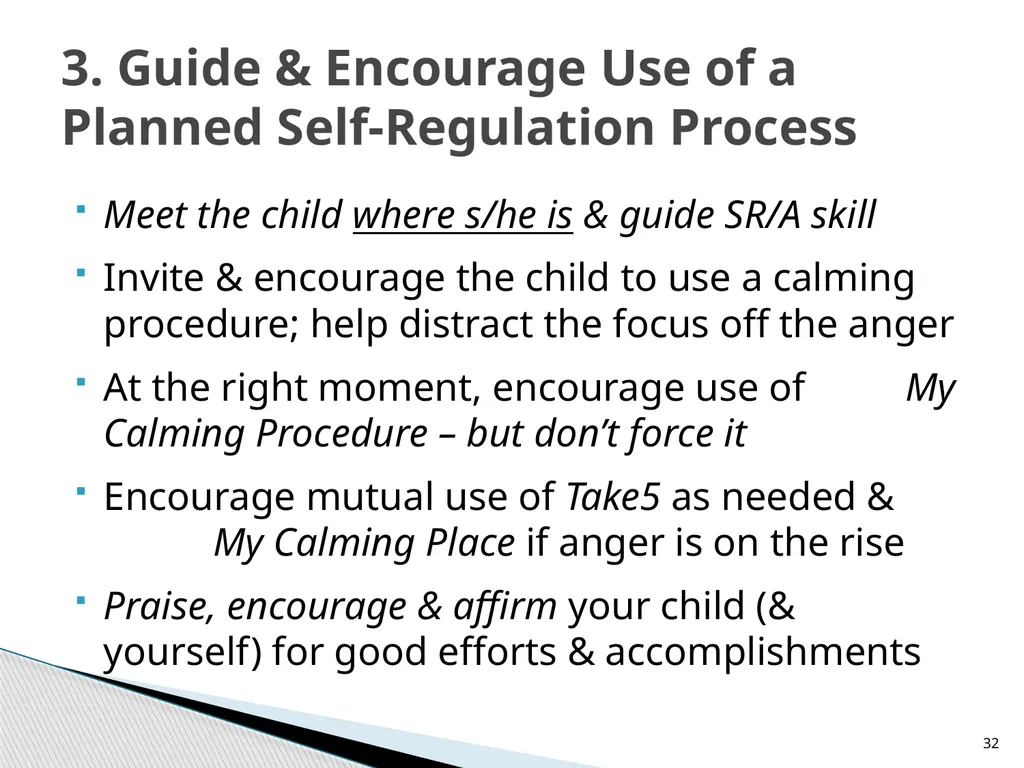
32
Meet the child where s/he is & guide SR/A skill
Invite & encourage the child to use a calming procedure; help distract the focus off the anger
At the right moment, encourage use of My Calming Procedure – but don’t force it
Encourage mutual use of Take5 as needed & My Calming Place if anger is on the rise
Praise, encourage & affirm your child (& yourself) for good efforts & accomplishments 3. Guide & Encourage Use of a Planned Self-Regulation Process 32<br>
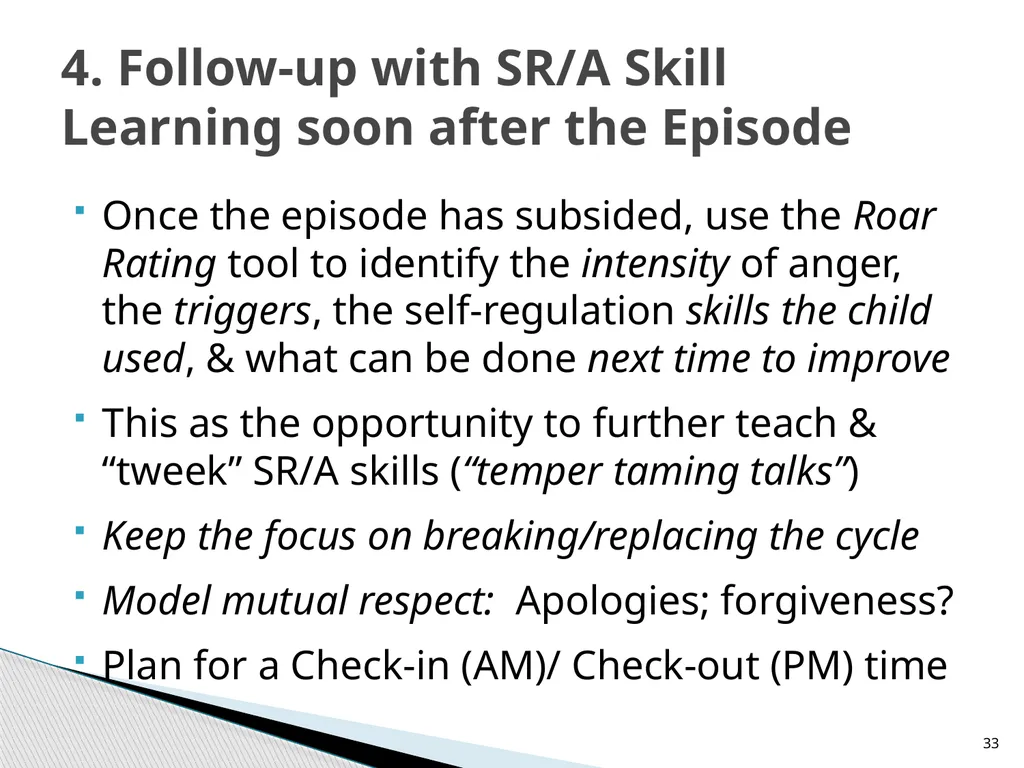
33
Once the episode has subsided, use the Roar Rating tool to identify the intensity of anger, the triggers, the self-regulation skills the child used, & what can be done next time to improve
This as the opportunity to further teach & “tweek” SR/A skills (“temper taming talks”)
Keep the focus on breaking/replacing the cycle
Model mutual respect: Apologies; forgiveness?
Plan for a Check-in (AM)/ Check-out (PM) time 4. Follow-up with SR/A Skill Learning soon after the Episode 33<br>
This as the opportunity to further teach & “tweek” SR/A skills (“temper taming talks”)
Keep the focus on breaking/replacing the cycle
Model mutual respect: Apologies; forgiveness?
Plan for a Check-in (AM)/ Check-out (PM) time 4. Follow-up with SR/A Skill Learning soon after the Episode 33<br>
34
Acknowledge that this is hard work and takes time, energy, patience, and dedication
Acknowledge the challenges as they arise as opportunities for learning and for creating more celebrations! (a growth mindset!) 5. Celebrate Good Efforts & Accomplishments Together! 34<br>
Acknowledge the challenges as they arise as opportunities for learning and for creating more celebrations! (a growth mindset!) 5. Celebrate Good Efforts & Accomplishments Together! 34<br>
35
Seek first to understand, then to be understood
Maintain a mutual respect balance, between caregiver and child
Attack the issue/conflict, not the person Positive Communication & Conflict Resolution Skills 35<br>
Maintain a mutual respect balance, between caregiver and child
Attack the issue/conflict, not the person Positive Communication & Conflict Resolution Skills 35<br>
36
Help the child feel heard by seeking first to understand their point of view
Set your own viewpoint aside for a while (“Please help me to understand what is frustrating you right now”)
Listen more than speak (God gave us 2 ears & 1 mouth for a reason!)
Wait patiently for the child to finish before speaking 1. Seek first to understand, then to be understood 36<br>
Set your own viewpoint aside for a while (“Please help me to understand what is frustrating you right now”)
Listen more than speak (God gave us 2 ears & 1 mouth for a reason!)
Wait patiently for the child to finish before speaking 1. Seek first to understand, then to be understood 36<br>
37
Use respectful language, tone, & posture – peaceful, caring vs. threatening, demanding
Use “I messages” & Avoid “U messages” (“I feel angry when you…because…please…”)
Keep the focus on finding a Win-Win solution rather than a Win-Lose solution
Invite mutual problem solving (“What do you think would help next time?”) 2. Maintain a mutual respect balance 37<br>
Use “I messages” & Avoid “U messages” (“I feel angry when you…because…please…”)
Keep the focus on finding a Win-Win solution rather than a Win-Lose solution
Invite mutual problem solving (“What do you think would help next time?”) 2. Maintain a mutual respect balance 37<br>
38
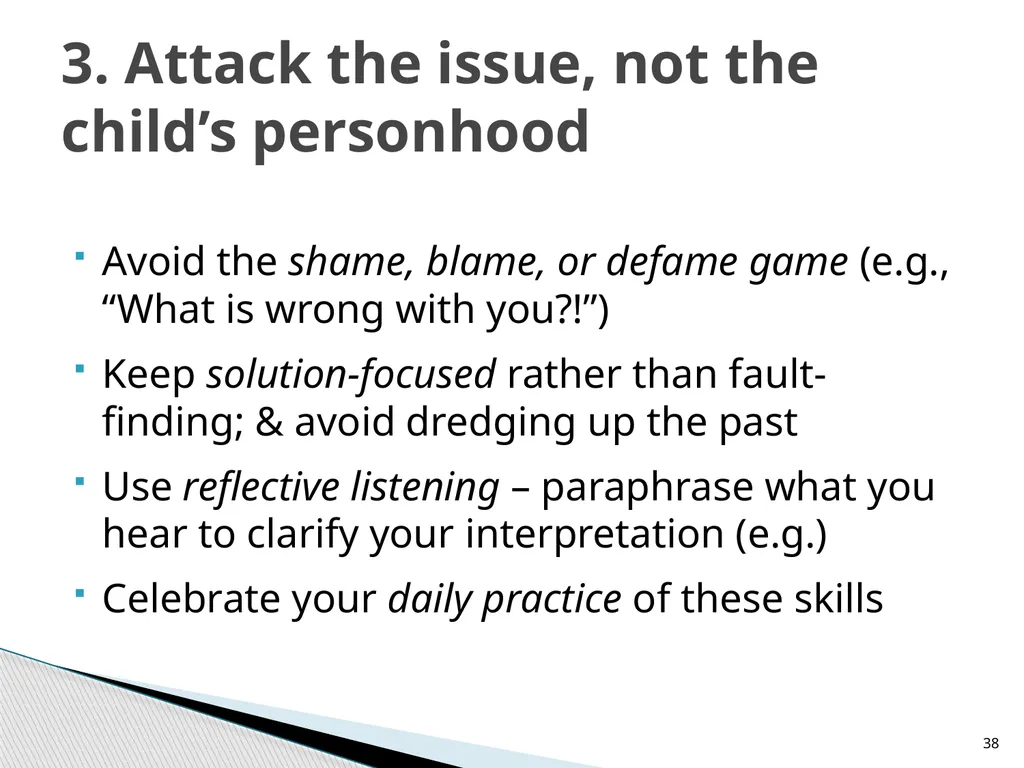
Avoid the shame, blame, or defame game (e.g., “What is wrong with you?!”)
Keep solution-focused rather than fault-finding; & avoid dredging up the past
Use reflective listening – paraphrase what you hear to clarify your interpretation (e.g.)
Celebrate your daily practice of these skills 3. Attack the issue, not the child’s personhood 38<br>
Keep solution-focused rather than fault-finding; & avoid dredging up the past
Use reflective listening – paraphrase what you hear to clarify your interpretation (e.g.)
Celebrate your daily practice of these skills 3. Attack the issue, not the child’s personhood 38<br>
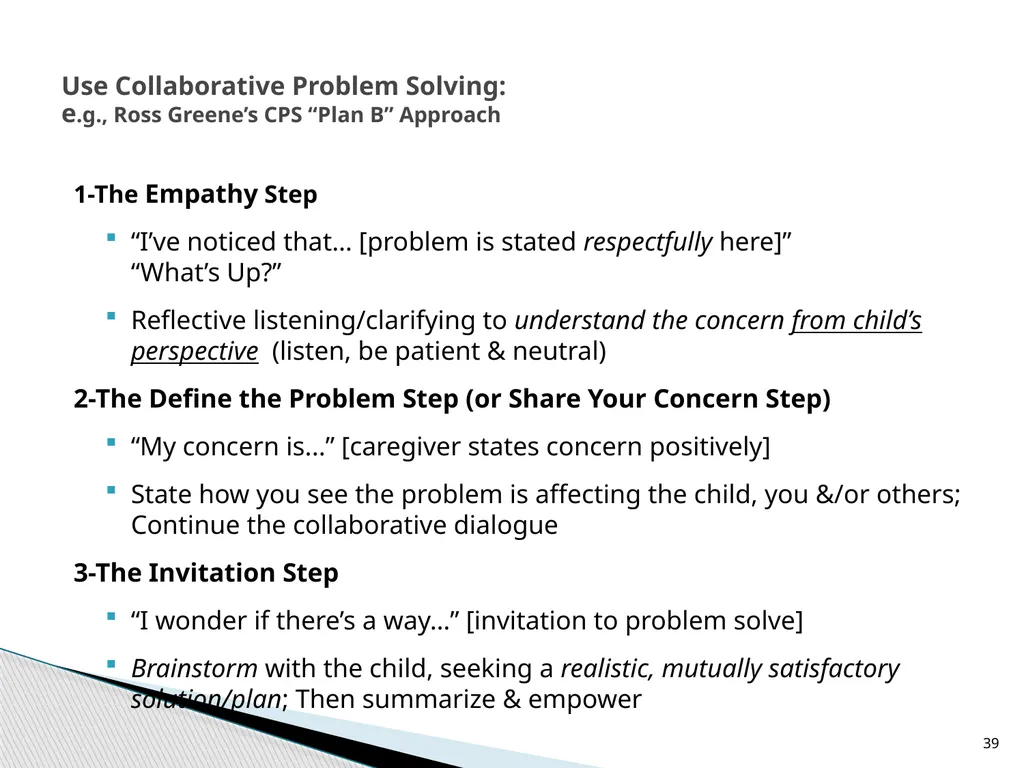
39
1-The Empathy Step
“I’ve noticed that… [problem is stated respectfully here]” “What’s Up?”
Reflective listening/clarifying to understand the concern from child’s perspective (listen, be patient & neutral)
2-The Define the Problem Step (or Share Your Concern Step)
“My concern is...” [caregiver states concern positively]
State how you see the problem is affecting the child, you &/or others; Continue the collaborative dialogue
3-The Invitation Step
“I wonder if there’s a way…” [invitation to problem solve]
Brainstorm with the child, seeking a realistic, mutually satisfactory solution/plan; Then summarize & empower Use Collaborative Problem Solving: e.g., Ross Greene’s CPS “Plan B” Approach 39<br>
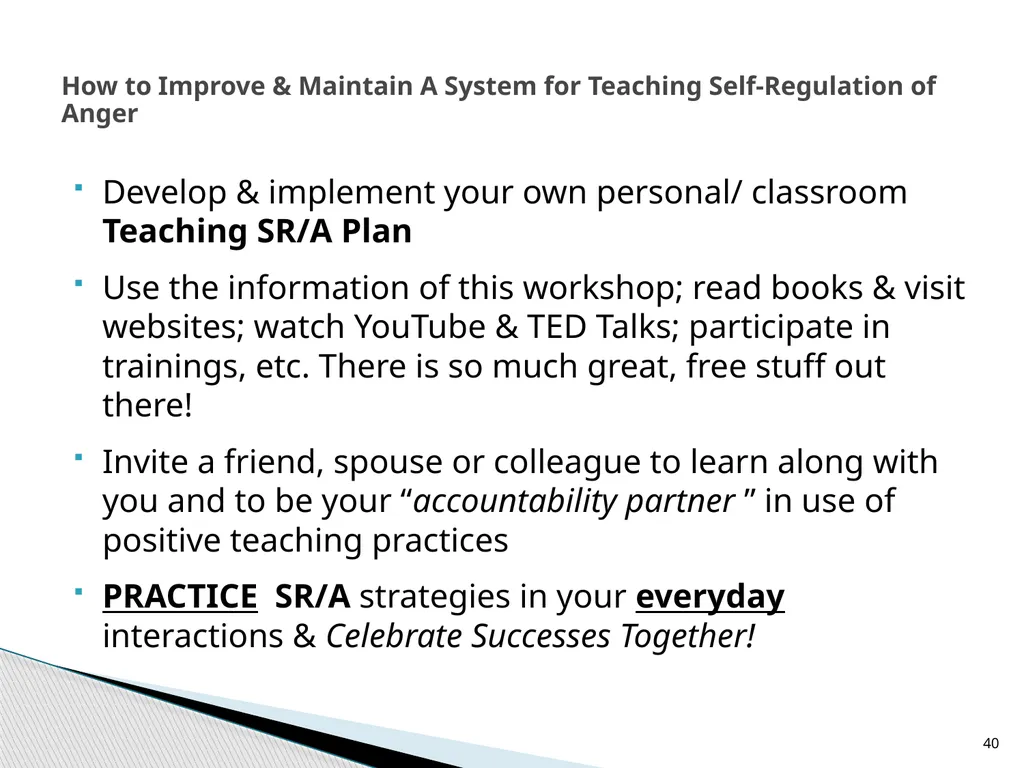
40
Develop & implement your own personal/ classroom Teaching SR/A Plan
Use the information of this workshop; read books & visit websites; watch YouTube & TED Talks; participate in trainings, etc. There is so much great, free stuff out there!
Invite a friend, spouse or colleague to learn along with you and to be your “accountability partner ” in use of positive teaching practices
PRACTICE SR/A strategies in your everyday interactions & Celebrate Successes Together! How to Improve & Maintain A System for Teaching Self-Regulation of Anger 40<br>
41
Thanks so much for your attention and interest throughout today’s presentation!
And best wishes to you on teaching your child, student, or client the critical life skills of self-regulation of anger!
Randall L. Lemoine, Ph.D.
7913 Wrenwood Blvd. Suite A , BRLA, 70808 - 225-383-9808
www.RandallLemoinePhD.com Thanks! Questions? 41<br>
And best wishes to you on teaching your child, student, or client the critical life skills of self-regulation of anger!
Randall L. Lemoine, Ph.D.
7913 Wrenwood Blvd. Suite A , BRLA, 70808 - 225-383-9808
www.RandallLemoinePhD.com Thanks! Questions? 41<br>