The Appeal of Religious Organisations: NRMs have experienced a growth in recent years (link to secularisation debate), particularly in the West. Attendance, on the whole has dropped within establishes churches but NRM membership has
"The Appeal of Religious Organisations: NRMs have" is the property of its rightful owner. Permission is granted to
download and print the materials on this website for personal, non-commercial use only, and to display it
on your personal computer provided you do not modify the materials and that you retain all copyright
notices contained in the materials. By downloading content from our website, you accept the terms of this
agreement.
Presentation Transcript
01
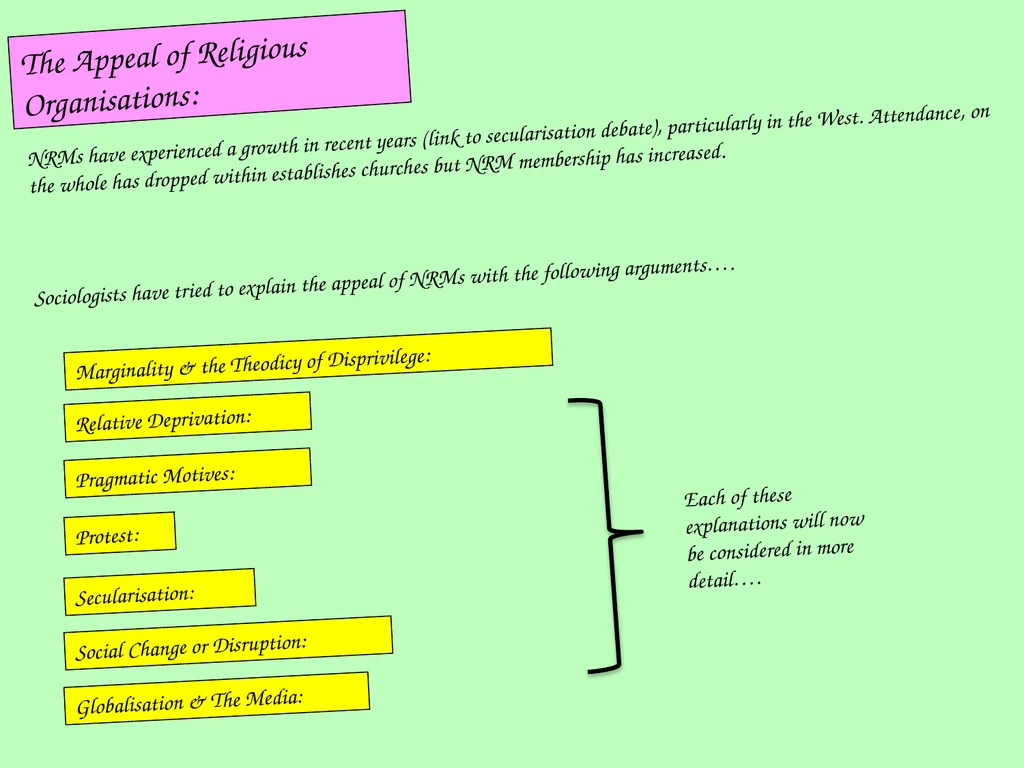
The Appeal of Religious Organisations: NRMs have experienced a growth in recent years (link to secularisation debate), particularly in the West. Attendance, on the whole has dropped within establishes churches but NRM membership has increased. Sociologists have tried to explain the appeal of NRMs with the following arguments….<br>
02
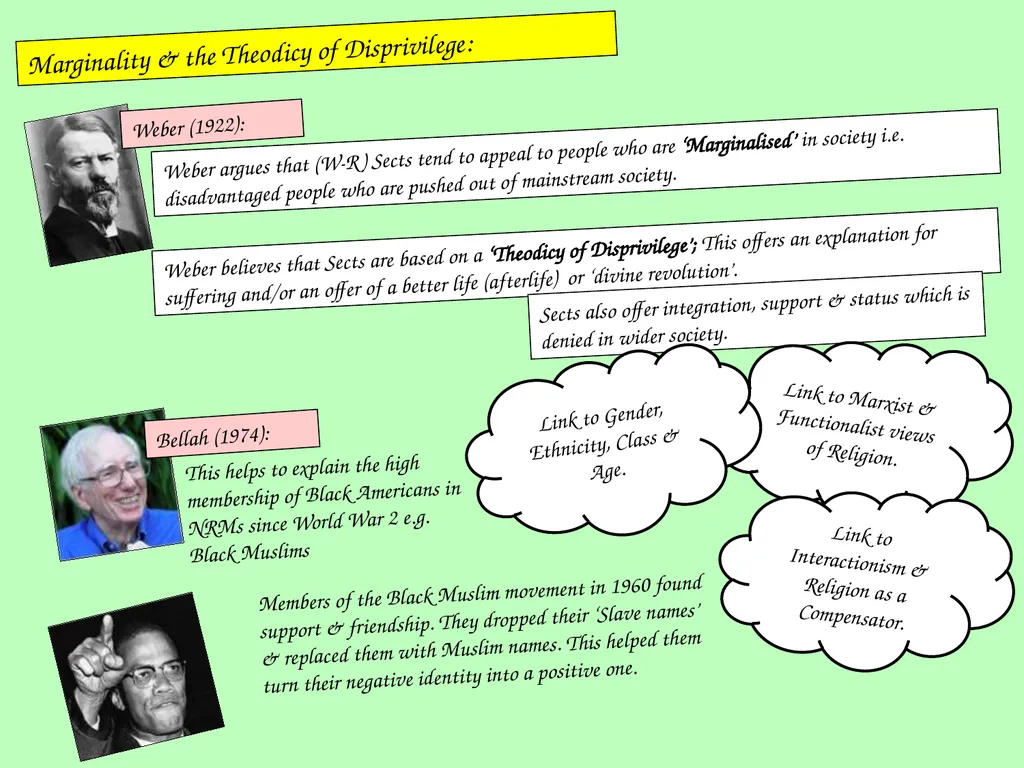
Marginality & the Theodicy of Disprivilege: Weber believes that Sects are based on a ‘Theodicy of Disprivilege’; This offers an explanation for suffering and/or an offer of a better life (afterlife) or ‘divine revolution’. Sects also offer integration, support & status which is denied in wider society. Link to Marxist & Functionalist views of Religion. Link to Gender, Ethnicity, Class & Age. Link to Interactionism & Religion as a Compensator.<br>
03
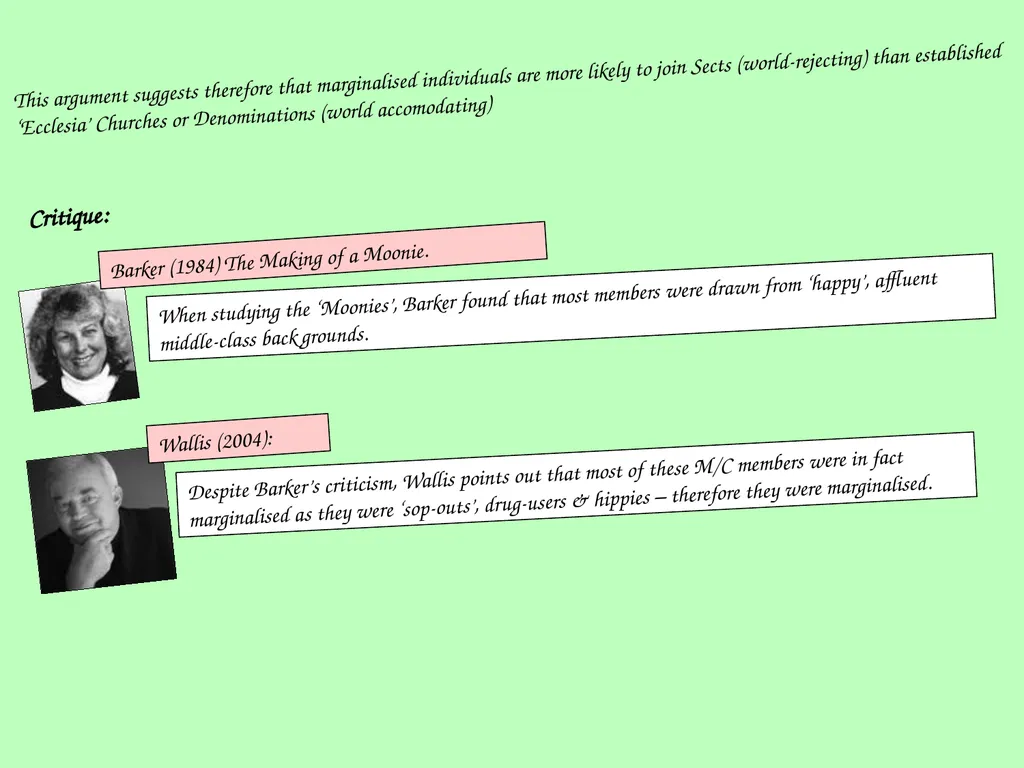
This argument suggests therefore that marginalised individuals are more likely to join Sects (world-rejecting) than established ‘Ecclesia’ Churches or Denominations (world accomodating)<br>
04
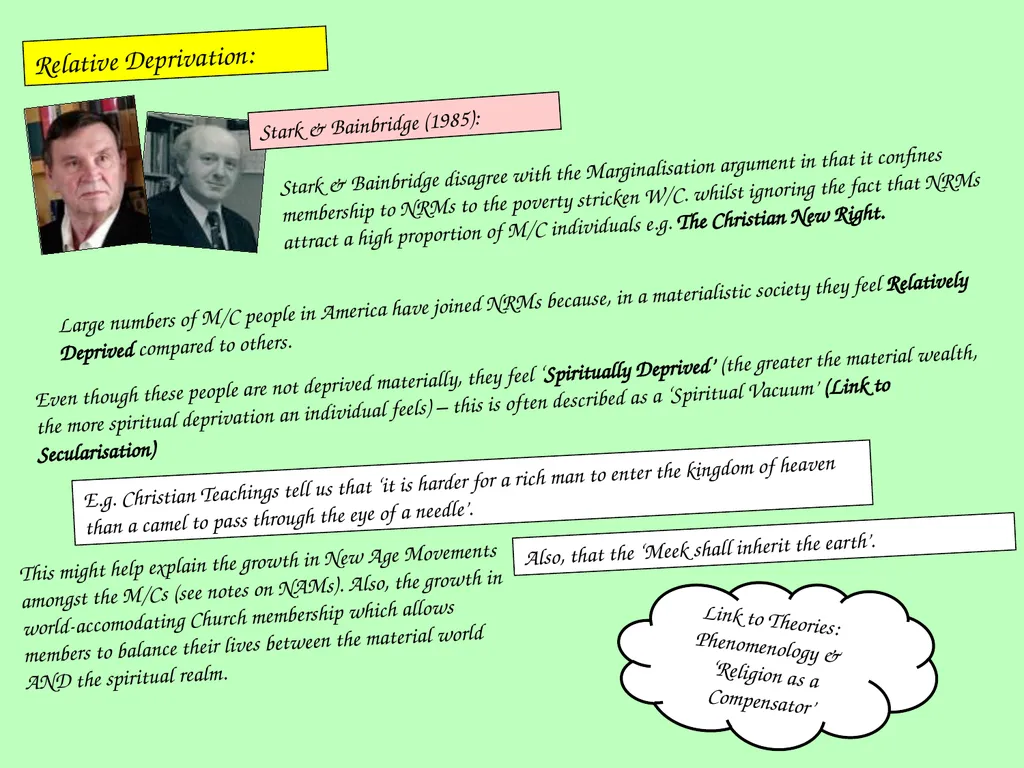
Relative Deprivation: Large numbers of M/C people in America have joined NRMs because, in a materialistic society they feel Relatively Deprived compared to others. Even though these people are not deprived materially, they feel ‘Spiritually Deprived’ (the greater the material wealth, the more spiritual deprivation an individual feels) – this is often described as a ‘Spiritual Vacuum’ (Link to Secularisation) This might help explain the growth in New Age Movements amongst the M/Cs (see notes on NAMs). Also, the growth in world-accomodating Church membership which allows members to balance their lives between the material world AND the spiritual realm. E.g. Christian Teachings tell us that ‘it is harder for a rich man to enter the kingdom of heaven than a camel to pass through the eye of a needle’. Also, that the ‘Meek shall inherit the earth’. Link to Theories: Phenomenology & ‘Religion as a Compensator’<br>
05
Pragmatic Motives: Furthermore, NRMs can teach techniques that inspire people to achieve emotionally & materially. This might help explain the growth of NRMs & NAMs within Post-Modern society – people may be disillusioned with the consumerist, materialist, liberal nature of the post-modern world. Link to Theories: Neo-Marxism.<br>
06
Social Change or Disruption:<br>
07
Remember, it is useful to remind yourselves of the individualistic, diverse & choice-ridden nature of the post-modern world. Secularisation: Also, because many traditional churches have watered down their beliefs in contemporary society, people may feel the need to reassert their beliefs through NRMs – this could explain the growth of Fundamentalist Movements. Another argument that is key here is that Post-Modernism assumes that traditional structures that define individual identity have broken down e.g. Class, Gender, Age & Ethnicity. As such people may turn to NRMs for a sense of identity.<br>
08
Remember – you will need to draw on these explanations when considering why particular social groups join particular types of religious organisations i.e. Gender, Ethnicity, Class & Age.<br>