
The Chemistry of Household Products household
TG
Published · 28 slides · 0 views

1 / 1

Description
The Chemistry of Household Products household products How do products like soap, shampoo, laundry detergent, and toilet bowl cleaner work? What kinds of compounds do they contain? Cleaning Clothes with Molecules Why simply use water can
Related Topics
Share
Embed code
Download this presentation From Below
"The Chemistry of Household Products household" is the property of its rightful owner. Permission is granted to download and print the materials on this website for personal, non-commercial use only, and to display it on your personal computer provided you do not modify the materials and that you retain all copyright notices contained in the materials. By downloading content from our website, you accept the terms of this agreement.
Presentation Transcript
01
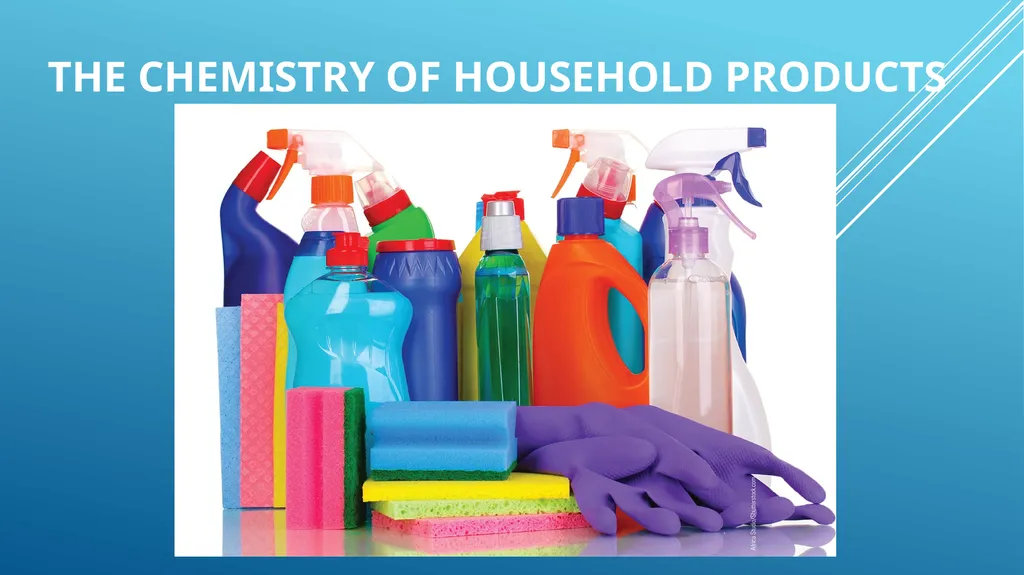
The Chemistry of Household Products<br>
02
household products How do products like soap, shampoo, laundry detergent, and toilet bowl cleaner work?
What kinds of compounds do they contain?<br>
What kinds of compounds do they contain?<br>
03
Cleaning Clothes with Molecules Why simply use water can clean spilled pancake syrup but not grease?
Because
The sugar molecules in pancake syrup are polar, and they mix well with polar water molecules. The water dissolves the sugar and removes it.
The molecules composing grease are nonpolar and do not mix with polar water; thus the greasy stain repels water
Soap or detergent is needed to remove grease stain
Why?<br>
04
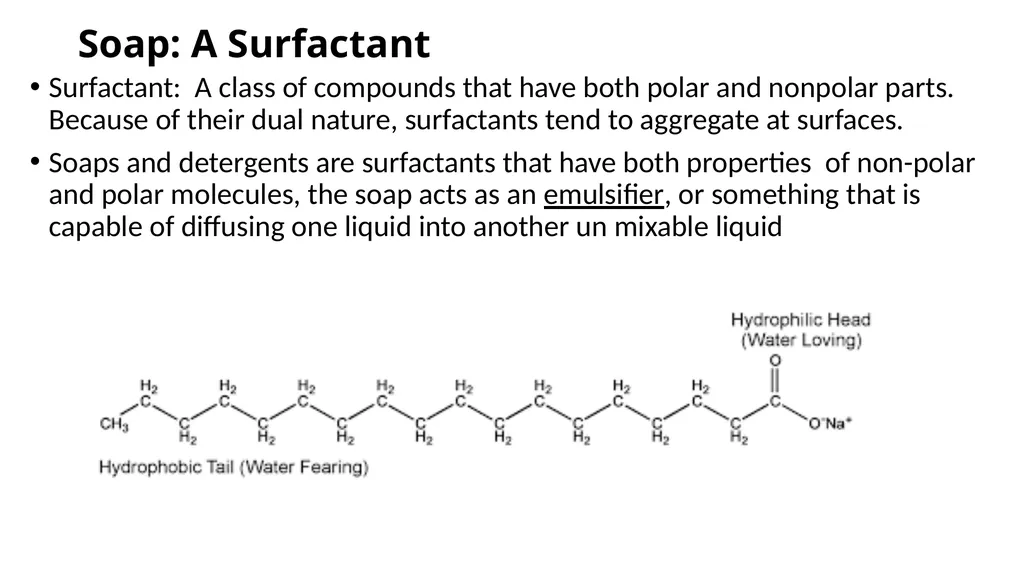
Soap: A Surfactant Surfactant: A class of compounds that have both polar and nonpolar parts. Because of their dual nature, surfactants tend to aggregate at surfaces.
Soaps and detergents are surfactants that have both properties of non-polar and polar molecules, the soap acts as an emulsifier, or something that is capable of diffusing one liquid into another un mixable liquid<br>
Soaps and detergents are surfactants that have both properties of non-polar and polar molecules, the soap acts as an emulsifier, or something that is capable of diffusing one liquid into another un mixable liquid<br>
05
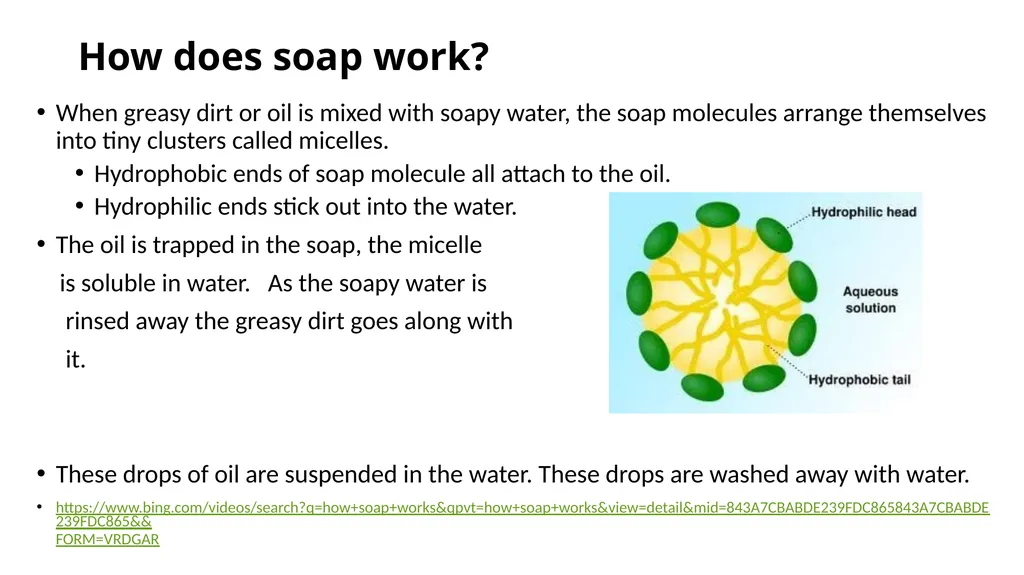
How does soap work? When greasy dirt or oil is mixed with soapy water, the soap molecules arrange themselves into tiny clusters called micelles.
Hydrophobic ends of soap molecule all attach to the oil.
Hydrophilic ends stick out into the water.
The oil is trapped in the soap, the micelle
is soluble in water. As the soapy water is
rinsed away the greasy dirt goes along with
it.
These drops of oil are suspended in the water. These drops are washed away with water.
https://www.bing.com/videos/search?q=how+soap+works&qpvt=how+soap+works&view=detail&mid=843A7CBABDE239FDC865843A7CBABDE239FDC865&&FORM=VRDGAR<br>
06
Detergents Soaps are typically made out of organic, naturally occurring compounds. By contrast, detergents are usually made out of synthetic, man-made materials.
Detergents are also usually made out of molecules with a more intense ionic charge, and some detergents can actually dissolve into substances other than water.
Synthetic detergents work better in hard water than soap does because they do not react with calcium and magnesium ions to form curd
the first successful synthetic detergents were the alkylbenzenesulfonate (ABS) detergents. The ABS detergents work well in hard water but do not biodegrade in the environment.
Chemists develop a new detergent with straight chain alkyl chain, more like soap. These linear alkylsulfonate (LAS) work well in hard water and also biodegrade in the environment.<br>
07
Laundry-Cleaning Formulations Laundry-cleaning formulations can have 40 or 50 different ingredients, all tailored to make clothes clean, bright, and sweet smelling.
The most important ingredients in laundry-cleaning formulations are the surfactants, which dissolve grease and oil, and the builder that softens hard water and improves detergent action.
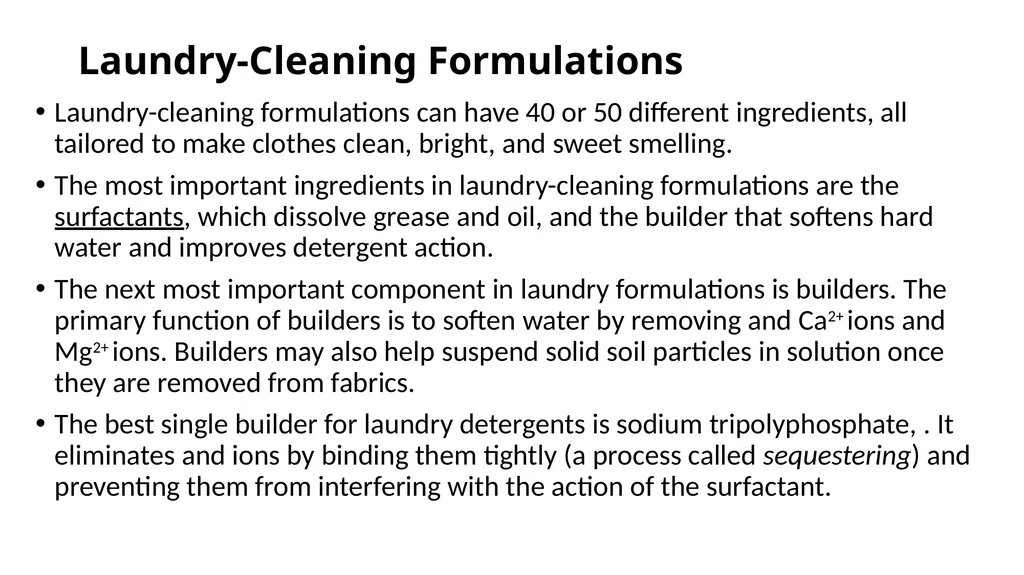
The next most important component in laundry formulations is builders. The primary function of builders is to soften water by removing and Ca2+ ions and Mg2+ ions. Builders may also help suspend solid soil particles in solution once they are removed from fabrics.
The best single builder for laundry detergents is sodium tripolyphosphate, . It eliminates and ions by binding them tightly (a process called sequestering) and preventing them from interfering with the action of the surfactant.<br>
08
The use of sodium tripolyphosphate and other phosphates in laundry formulations has been banned in many places because their presence in wastewater can—through a process called eutrophication—threaten marine life.
phosphates are also excellent fertilizers. When phosphates are disposed in natural waters, they fertilize algae, producing abnormally large algae blooms, which in turn consume large amounts of oxygen on their decomposition. The water becomes oxygen poor, threatening many types of marine life.
There is no single replacement for phosphates in laundry detergents. Modern North American detergents contain a combination of builders including sodium carbonate and zeolites.
Sodium carbonate softens water by forming solid precipitates with calcium and magnesium ions.
Zeolites are small porous particles containing sodium ions. When a zeolite is added to hard water, calcium ions diffuse into the zeolite and exchange places with sodium ions. The sodium ions work their way back into the water but do not impede detergent action.<br>
09
Other ingredients found in laundry-cleaning formulations include fillers, enzymes, brighteners, bleaching agents, and perfumes.
Enzymes are present to help degrade certain types of stains.
Brighteners Dye molecules that bind to clothes fibers and help make clothes appear “brighter than before.”<br>
Enzymes are present to help degrade certain types of stains.
Brighteners Dye molecules that bind to clothes fibers and help make clothes appear “brighter than before.”<br>
10
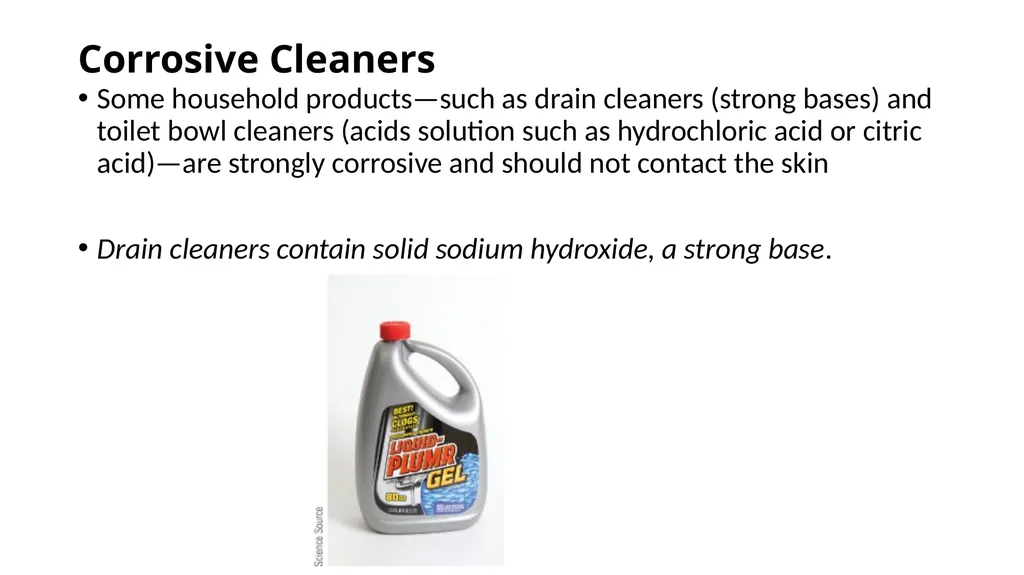
Corrosive Cleaners Some household products—such as drain cleaners (strong bases) and toilet bowl cleaners (acids solution such as hydrochloric acid or citric acid)—are strongly corrosive and should not contact the skin
Drain cleaners contain solid sodium hydroxide, a strong base.<br>
Drain cleaners contain solid sodium hydroxide, a strong base.<br>
11
Household products, whose functions depend on chemistry and chemical knowledge, impact the way we live. Our lives would be different without soaps and detergents. Sometimes, in the development of chemical technologies, products that help improve our lives can have negative effects on the environment.
The first synthetic detergents, called ABS detergents, are a good example of this kind of problem. ABS detergents did not break down in the environment and consequently turned some natural waters sudsy. In this case, the problem was solved with a change in the detergent’s structure. Today’s detergents biodegrade into environmentally benign products.<br>
The first synthetic detergents, called ABS detergents, are a good example of this kind of problem. ABS detergents did not break down in the environment and consequently turned some natural waters sudsy. In this case, the problem was solved with a change in the detergent’s structure. Today’s detergents biodegrade into environmentally benign products.<br>
12
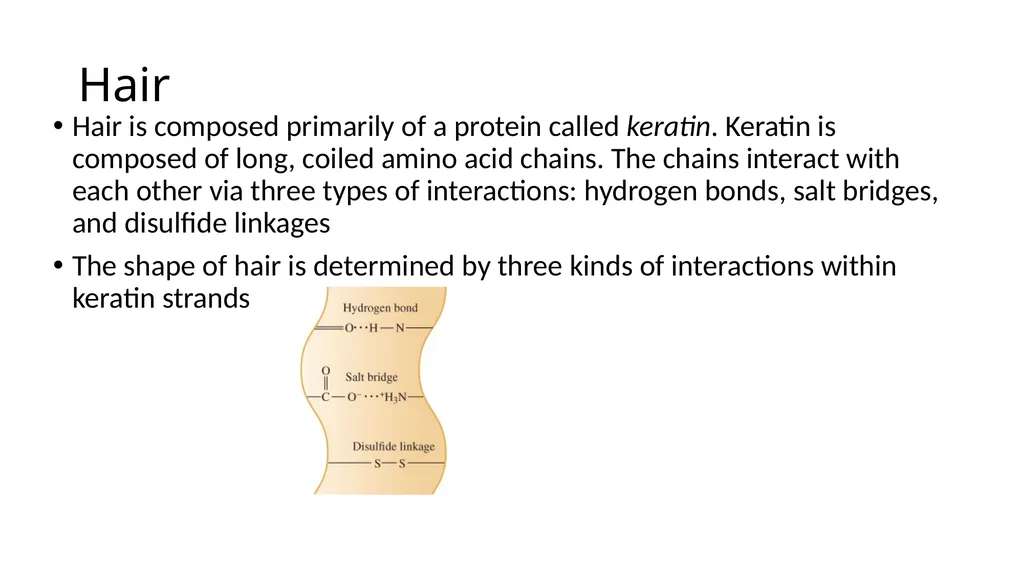
Hair Hair is composed primarily of a protein called keratin. Keratin is composed of long, coiled amino acid chains. The chains interact with each other via three types of interactions: hydrogen bonds, salt bridges, and disulfide linkages
The shape of hair is determined by three kinds of interactions within keratin strands<br>
The shape of hair is determined by three kinds of interactions within keratin strands<br>
13
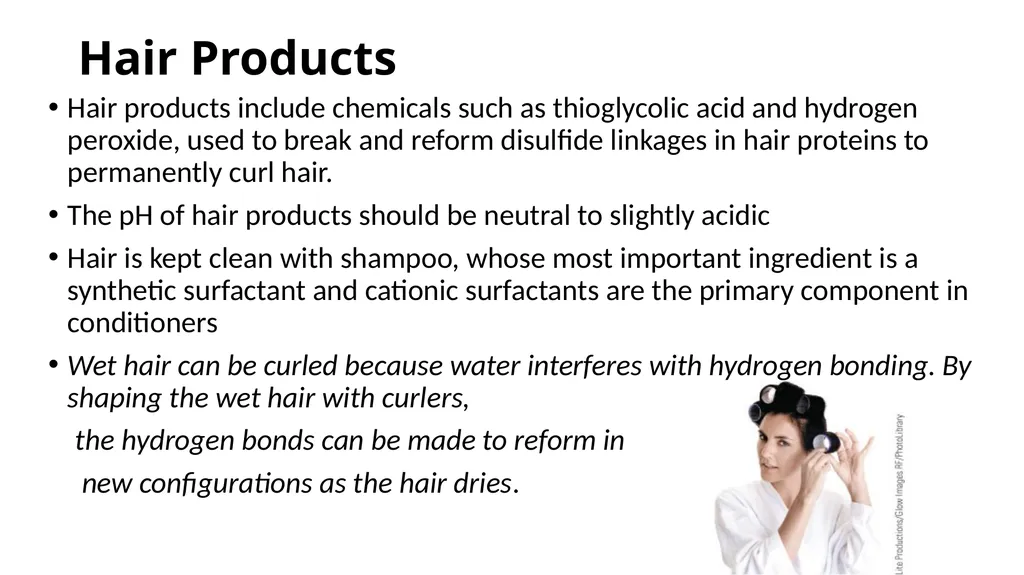
Hair Products Hair products include chemicals such as thioglycolic acid and hydrogen peroxide, used to break and reform disulfide linkages in hair proteins to permanently curl hair.
The pH of hair products should be neutral to slightly acidic
Hair is kept clean with shampoo, whose most important ingredient is a synthetic surfactant and cationic surfactants are the primary component in conditioners
Wet hair can be curled because water interferes with hydrogen bonding. By shaping the wet hair with curlers,
the hydrogen bonds can be made to reform in
new configurations as the hair dries.<br>
14
Coloring Hair The natural color of hair depends primarily on two pigments: melanin, a dark pigment, and phaeomelanin, a red-orange pigment.
The hair color depends on the amount of these two pigments.
The lightening of hair—whether it is red, brown, black, or blonde—requires the removal of these pigments, usually accomplished with bleaches, such as hydrogen peroxide
Darkening or adding color to hair can be accomplished by several different treatments. The simplest process involves applying a dye of the desired color to the hair.
However, because dye molecules are fairly large, they only coat the surface of hair strands; the hair color is only temporary and will wash out after several shampoos<br>
15
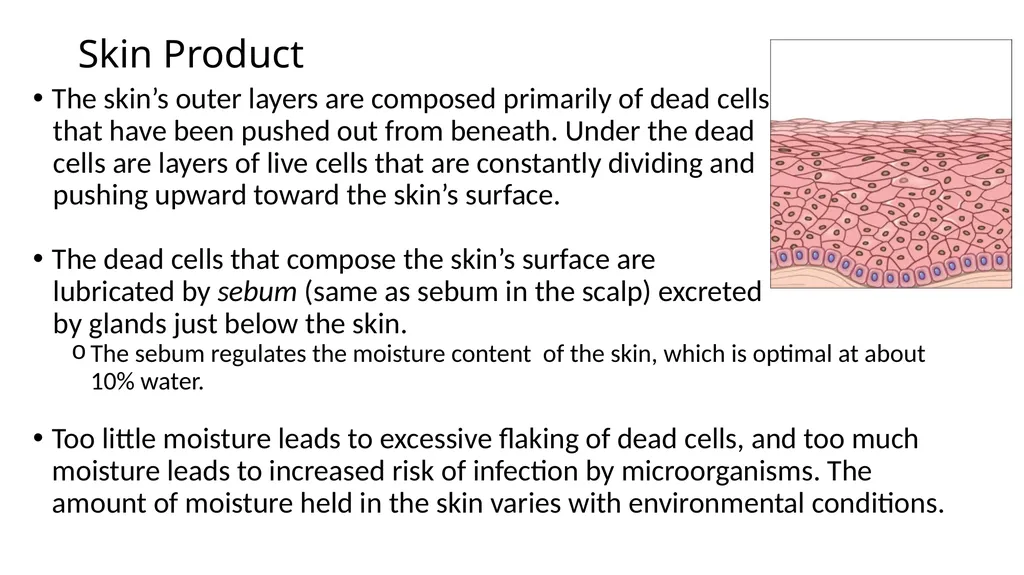
Skin Product The skin’s outer layers are composed primarily of dead cells
that have been pushed out from beneath. Under the dead
cells are layers of live cells that are constantly dividing and
pushing upward toward the skin’s surface.
The dead cells that compose the skin’s surface are
lubricated by sebum (same as sebum in the scalp) excreted
by glands just below the skin.
The sebum regulates the moisture content of the skin, which is optimal at about 10% water.
Too little moisture leads to excessive flaking of dead cells, and too much moisture leads to increased risk of infection by microorganisms. The amount of moisture held in the skin varies with environmental conditions.<br>
16
Creams and Lotions Dry or windy weather dries the skin, whereas wet or humid weather moistens it.
Skin products such as lotions and creams are designed to keep skin moist and consist of water and oil or wax along with emulsifiers to keep the two mixed. Sunscreens have similar compositions with an added ingredient to absorb UV-B light
Creams and lotions are emulsions of water and oil designed to help the skin maintain enough moisture. The water adds moisture to the skin, and the oil holds the moisture in the skin. Lotions tend to contain more water than oil, and the oils tend to be liquids at room temperature. Creams tend to contain more oil than water, and the oils tend to be solids at room temperature.
Both creams and lotions also contain emulsifying agents, soap like substances (as defined earlier) that keep the normally immiscible oil and water together in an emulsion.
Oils used in creams and lotions include olive oil, mineral oil, almond oil, and lanolin (oil from sheep’s wool).
Creams often include waxes, such as beeswax or carnauba. In addition, most creams and lotions contain perfumes to add pleasant fragrances. Both creams and lotions can help skin retain its ideal moisture content of about 10%.<br>
17
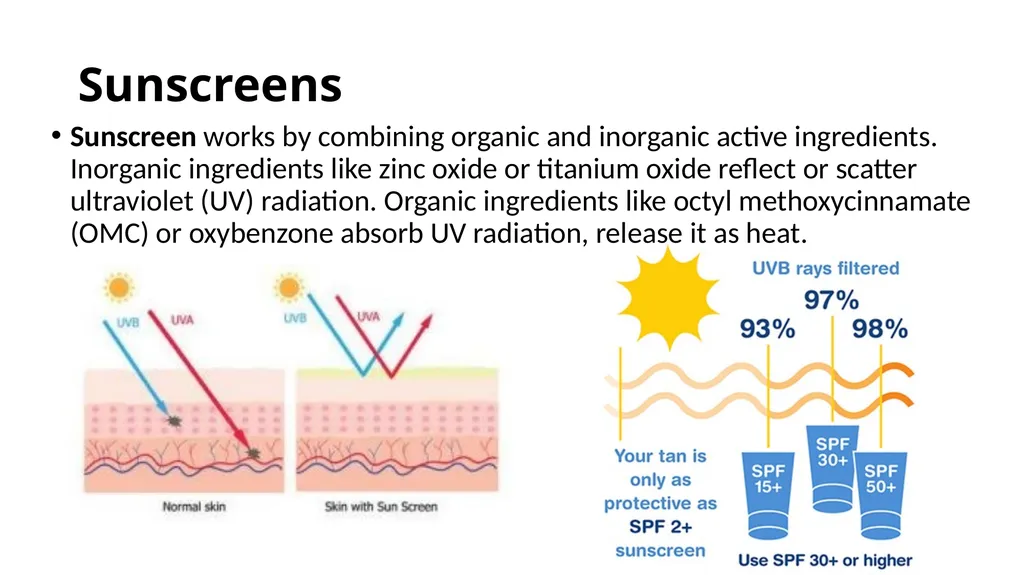
Sunscreens Sunscreen works by combining organic and inorganic active ingredients. Inorganic ingredients like zinc oxide or titanium oxide reflect or scatter ultraviolet (UV) radiation. Organic ingredients like octyl methoxycinnamate (OMC) or oxybenzone absorb UV radiation, release it as heat.<br>
18
Facial Cosmetics Most facial cosmetics are mixtures of waxes, oils, pigments, dyes, and perfumes.
Lipstick, for example, is composed of pigments and dyes suspended in a mixture of waxes and oils.
Foundations, in similarity to creams and lotions, are oil and water emulsions with a soaplike emulsifying agent. When put on the face, they provide cover and form the base for face powders.
Face powders also contain talc, a mineral that helps absorbs water and oil from the skin’s surface
Mascara, used to darken and thicken the eyelashes, is composed of soap, oils, waxes, and pigments.<br>
19
Perfumes Our sense of smell is particularly sensitive. We smell a flower on a spring day because some of the molecules from the flower diffuse into the air, and we inhale them through the nose.
In the nose lie about million chemical receptors. The molecules from the flower precisely fit into some of these receptors, triggering a signal to the brain that we interpret as a sweet smell. Other molecules, such as those from rotting fish, for instance, fit receptors that trigger a signal that we interpret as unpleasant. Still other molecules, like water, do not fit any receptor at all and therefore have no odor. The brain’s processing centers for smell are linked to its processing centers for emotion
Perfumes are composed of several volatile substances with pleasant odors. Usually, the volatility of the ingredients varies so the smells are experienced in three different phases or notes.<br>
20
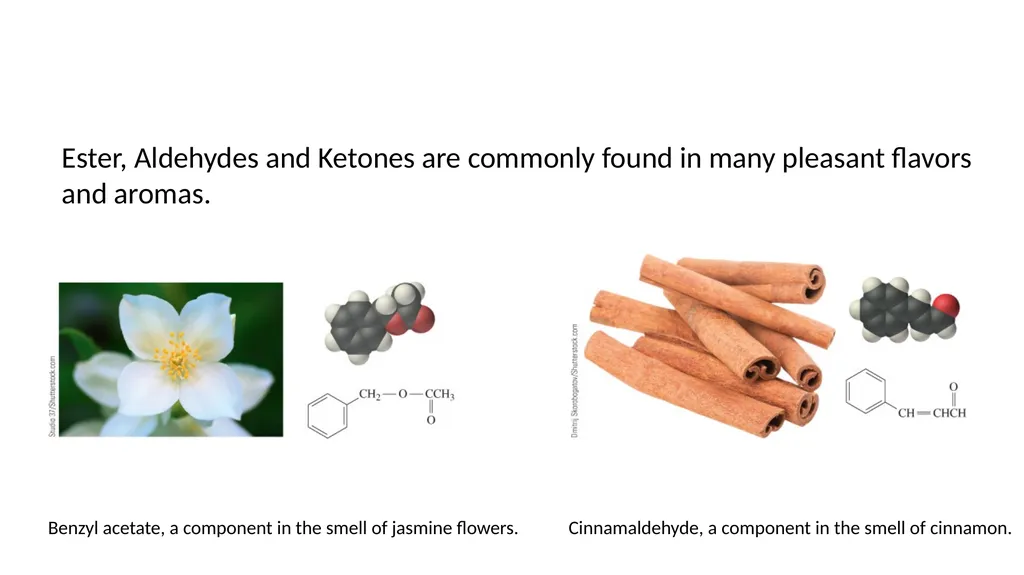
Ester, Aldehydes and Ketones are commonly found in many pleasant flavors
and aromas. Benzyl acetate, a component in the smell of jasmine flowers. Cinnamaldehyde, a component in the smell of cinnamon.<br>
and aromas. Benzyl acetate, a component in the smell of jasmine flowers. Cinnamaldehyde, a component in the smell of cinnamon.<br>
21
Deodorants and Antiperspirants Deodorants contain antibacterial agents that kill odor-causing bacteria that live in the armpits.
Anti-perspirants contain aluminum chlorohydrates, Al2(OH)4Cl2, that actually reduce sweating by constricting sweat glands.
Both deodorants and antiperspirants also contain fragrances, soap, and glycol Triclosan, an antibacterial agent found in deodorants.<br>
Anti-perspirants contain aluminum chlorohydrates, Al2(OH)4Cl2, that actually reduce sweating by constricting sweat glands.
Both deodorants and antiperspirants also contain fragrances, soap, and glycol Triclosan, an antibacterial agent found in deodorants.<br>
22
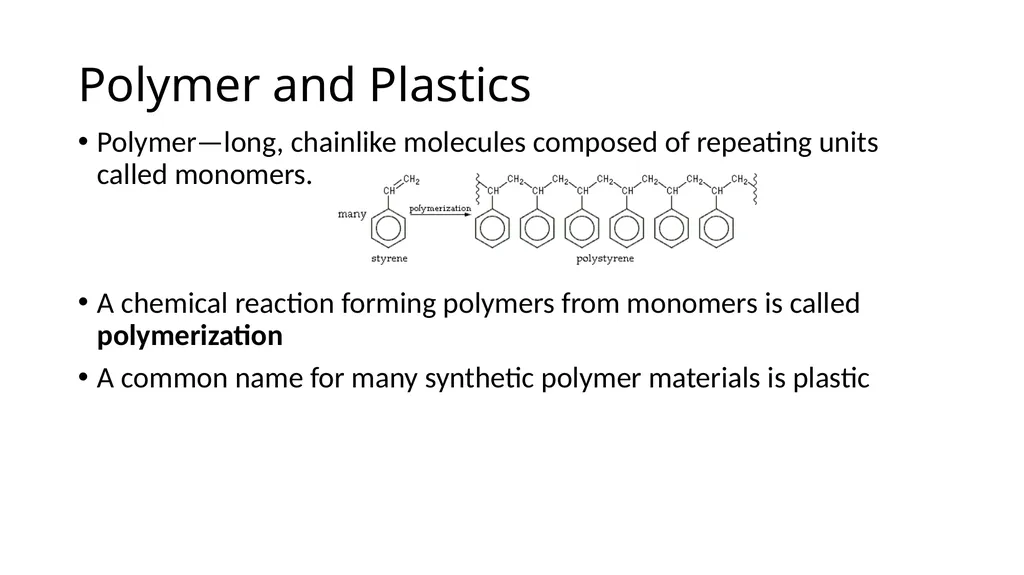
Polymer and Plastics Polymer—long, chainlike molecules composed of repeating units called monomers.
A chemical reaction forming polymers from monomers is called polymerization
A common name for many synthetic polymer materials is plastic<br>
A chemical reaction forming polymers from monomers is called polymerization
A common name for many synthetic polymer materials is plastic<br>
23
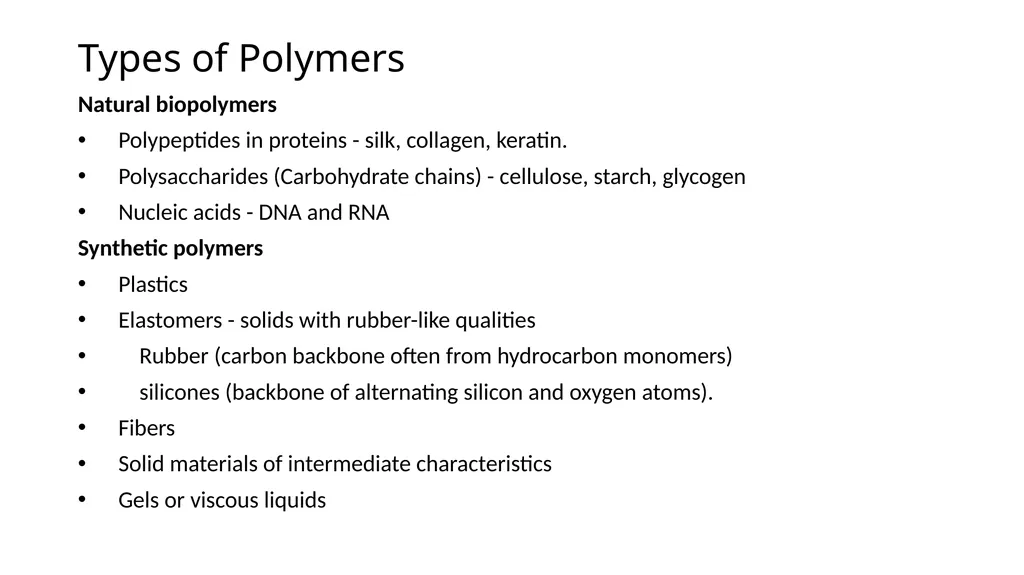
Types of Polymers Natural biopolymers
Polypeptides in proteins - silk, collagen, keratin.
Polysaccharides (Carbohydrate chains) - cellulose, starch, glycogen
Nucleic acids - DNA and RNA
Synthetic polymers
Plastics
Elastomers - solids with rubber-like qualities
Rubber (carbon backbone often from hydrocarbon monomers)
silicones (backbone of alternating silicon and oxygen atoms).
Fibers
Solid materials of intermediate characteristics
Gels or viscous liquids<br>
24
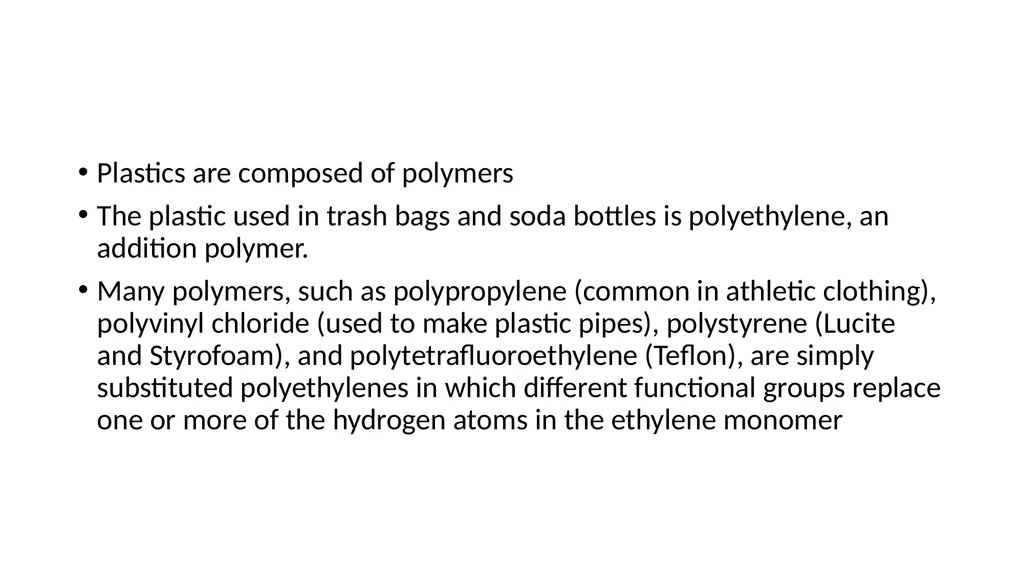
Plastics are composed of polymers
The plastic used in trash bags and soda bottles is polyethylene, an addition polymer.
Many polymers, such as polypropylene (common in athletic clothing), polyvinyl chloride (used to make plastic pipes), polystyrene (Lucite and Styrofoam), and polytetrafluoroethylene (Teflon), are simply substituted polyethylenes in which different functional groups replace one or more of the hydrogen atoms in the ethylene monomer<br>
25
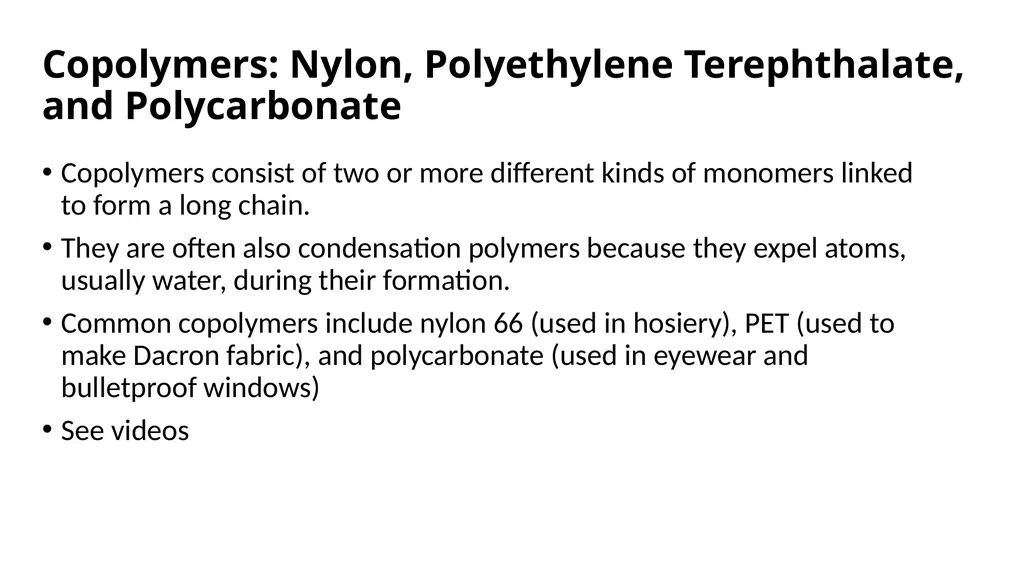
Copolymers: Nylon, Polyethylene Terephthalate, and Polycarbonate Copolymers consist of two or more different kinds of monomers linked to form a long chain.
They are often also condensation polymers because they expel atoms, usually water, during their formation.
Common copolymers include nylon 66 (used in hosiery), PET (used to make Dacron fabric), and polycarbonate (used in eyewear and bulletproof windows)
See videos<br>
They are often also condensation polymers because they expel atoms, usually water, during their formation.
Common copolymers include nylon 66 (used in hosiery), PET (used to make Dacron fabric), and polycarbonate (used in eyewear and bulletproof windows)
See videos<br>
26
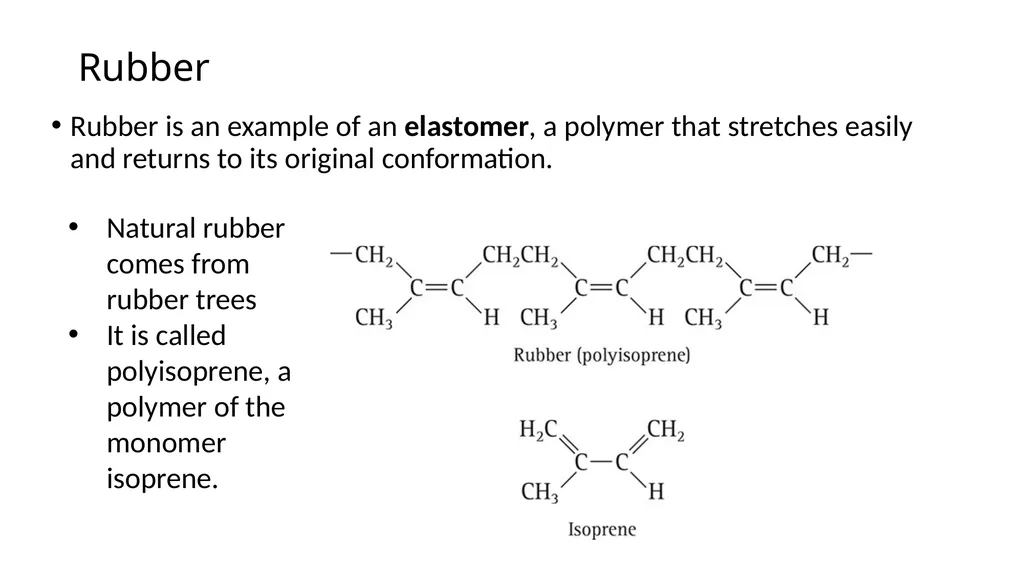
Rubber Rubber is an example of an elastomer, a polymer that stretches easily and returns to its original conformation. Natural rubber comes from rubber trees
It is called polyisoprene, a polymer of the monomer isoprene.<br>
It is called polyisoprene, a polymer of the monomer isoprene.<br>
27
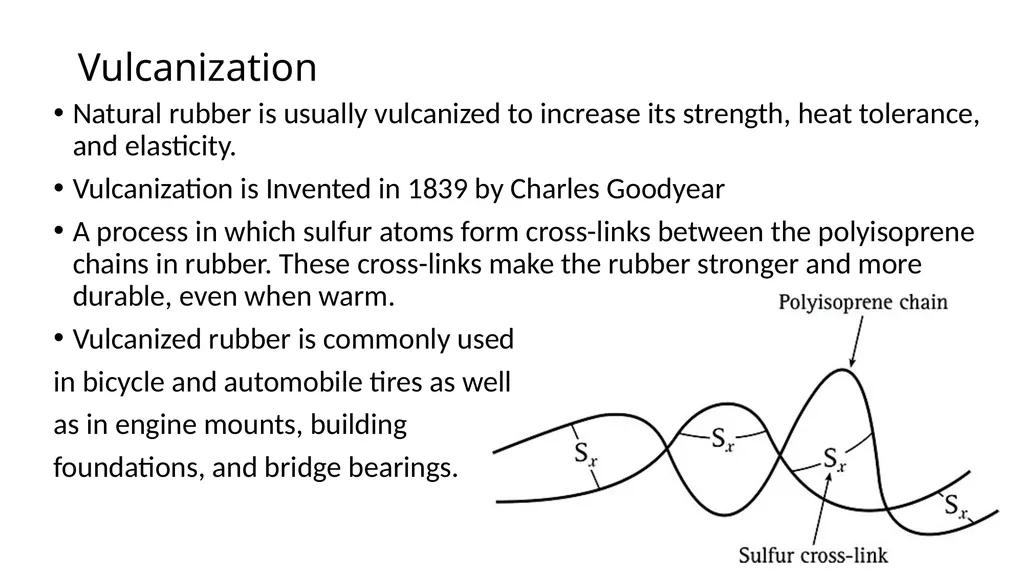
Vulcanization Natural rubber is usually vulcanized to increase its strength, heat tolerance, and elasticity.
Vulcanization is Invented in 1839 by Charles Goodyear
A process in which sulfur atoms form cross-links between the polyisoprene chains in rubber. These cross-links make the rubber stronger and more durable, even when warm.
Vulcanized rubber is commonly used
in bicycle and automobile tires as well
as in engine mounts, building
foundations, and bridge bearings.<br>
28
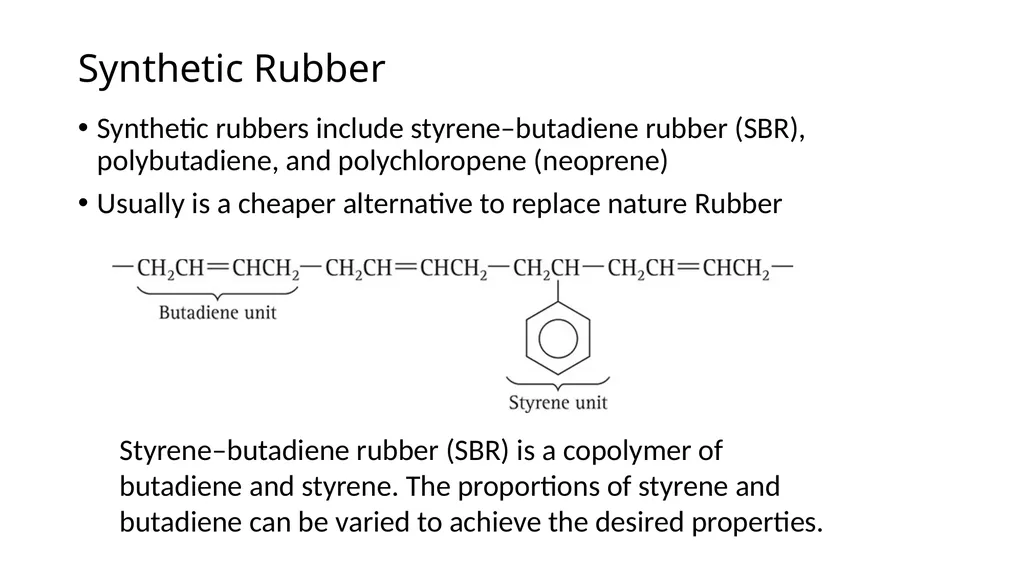
Synthetic Rubber Synthetic rubbers include styrene–butadiene rubber (SBR), polybutadiene, and polychloropene (neoprene)
Usually is a cheaper alternative to replace nature Rubber Styrene–butadiene rubber (SBR) is a copolymer of butadiene and styrene. The proportions of styrene and butadiene can be varied to achieve the desired properties.<br>
Usually is a cheaper alternative to replace nature Rubber Styrene–butadiene rubber (SBR) is a copolymer of butadiene and styrene. The proportions of styrene and butadiene can be varied to achieve the desired properties.<br>