The Course of Fundamentals of Thermodynamics MUSTANSIRIYAH UNIVERSITY COLLEGE OF SCIENCES DEPARTMENT OF ATMOSPHERIC SCIENCES 2021-2022 Dr. Sama Khalid Mohammed SECOND STAGE Lecture 8 Welcome Students In The New Course And In The Eighth
"The Course of Fundamentals of Thermodynamics" is the property of its rightful owner. Permission is granted to
download and print the materials on this website for personal, non-commercial use only, and to display it
on your personal computer provided you do not modify the materials and that you retain all copyright
notices contained in the materials. By downloading content from our website, you accept the terms of this
agreement.
Presentation Transcript
01
The Course of Fundamentals of Thermodynamics MUSTANSIRIYAH UNIVERSITY
COLLEGE OF SCIENCES
DEPARTMENT OF ATMOSPHERIC SCIENCES
2021-2022
Dr. Sama Khalid Mohammed
SECOND STAGE
Lecture 8<br>
02
Welcome Students In The New Course
And In The Eighth Lecture <br>
03
Processes
Isolated Processes
Cyclic Processes
Isothermal Processes
Isochoric Processes
Isobaric Processes
Adiabatic Processes
Adiabatic Free Expansion
Exercises This lecture including the following items<br>
04
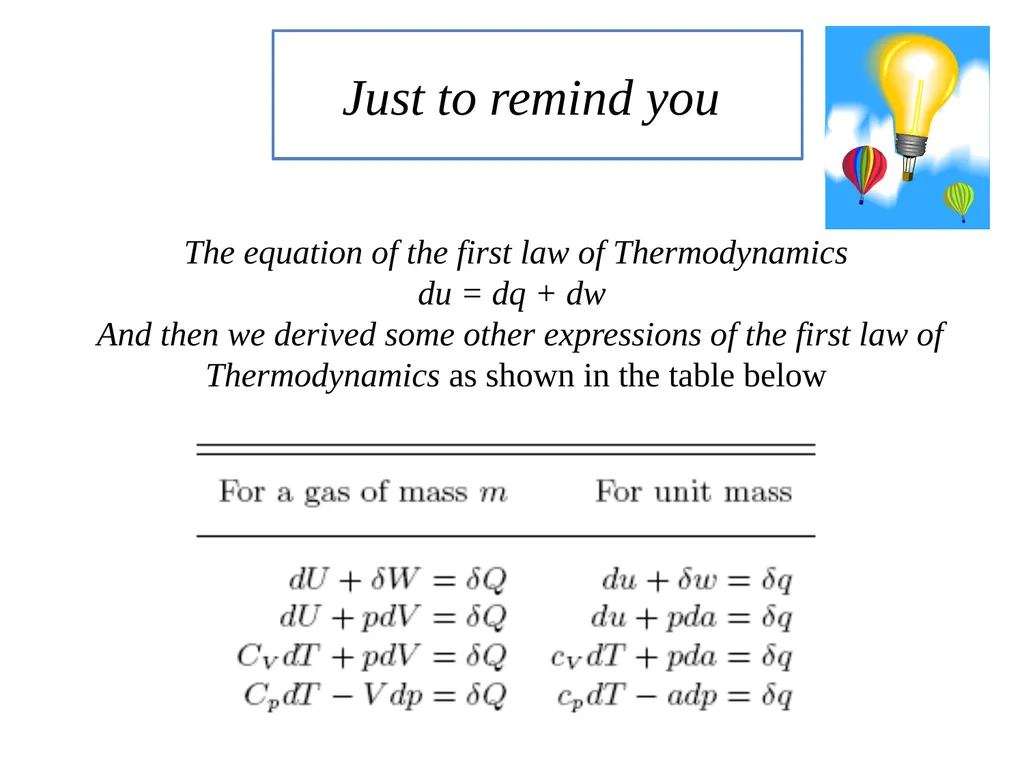
Just to remind you The equation of the first law of Thermodynamics
du = dq + dw
And then we derived some other expressions of the first law of Thermodynamics as shown in the table below<br>
05
Often systems undergo a Change of State (transformation), which means one or more properties of the system has changed.
Process: is a succession of changes of state.
We assume our processes are all sufficiently slow such that each stage of the process is near equilibrium.
Certain common processes are given special names, based on the Greek “isos” , meaning “equal” Processes<br>
06
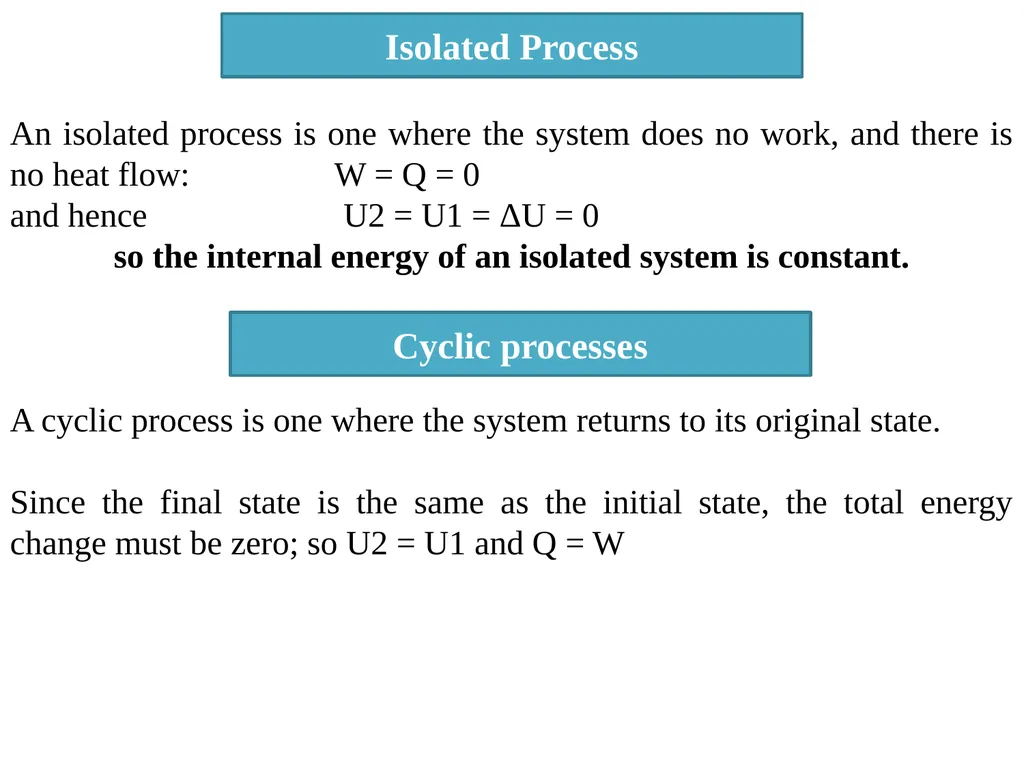
An isolated process is one where the system does no work, and there is no heat flow: W = Q = 0
and hence U2 = U1 = ΔU = 0
so the internal energy of an isolated system is constant.
A cyclic process is one where the system returns to its original state.
Since the final state is the same as the initial state, the total energy change must be zero; so U2 = U1 and Q = W Isolated Process Cyclic processes<br>
07
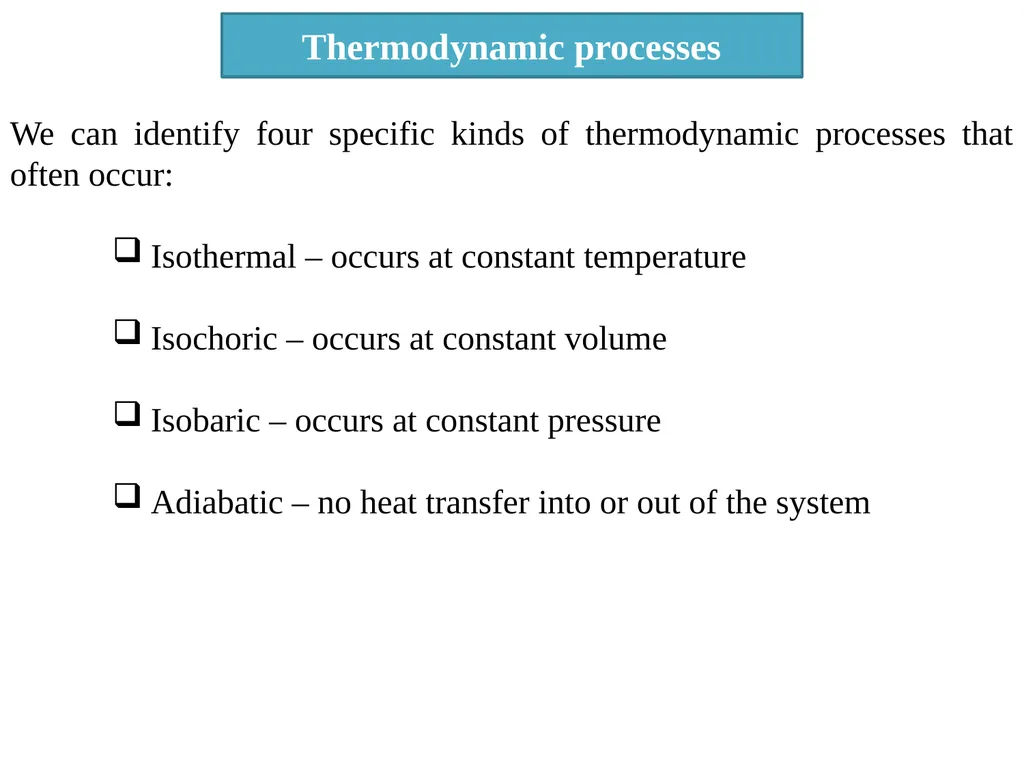
We can identify four specific kinds of thermodynamic processes that often occur:
Isothermal – occurs at constant temperature
Isochoric – occurs at constant volume
Isobaric – occurs at constant pressure
Adiabatic – no heat transfer into or out of the system Thermodynamic processes<br>
08
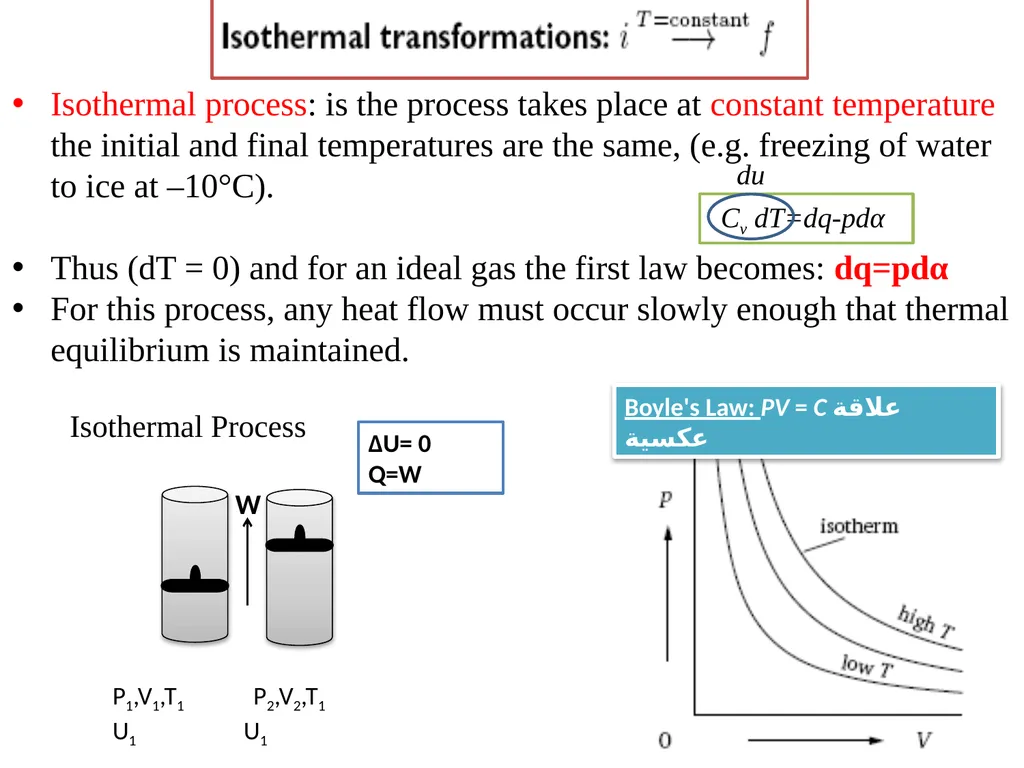
Isothermal process: is the process takes place at constant temperature the initial and final temperatures are the same, (e.g. freezing of water to ice at –10°C).
Thus (dT = 0) and for an ideal gas the first law becomes: dq=pdα
For this process, any heat flow must occur slowly enough that thermal equilibrium is maintained.<br>
09
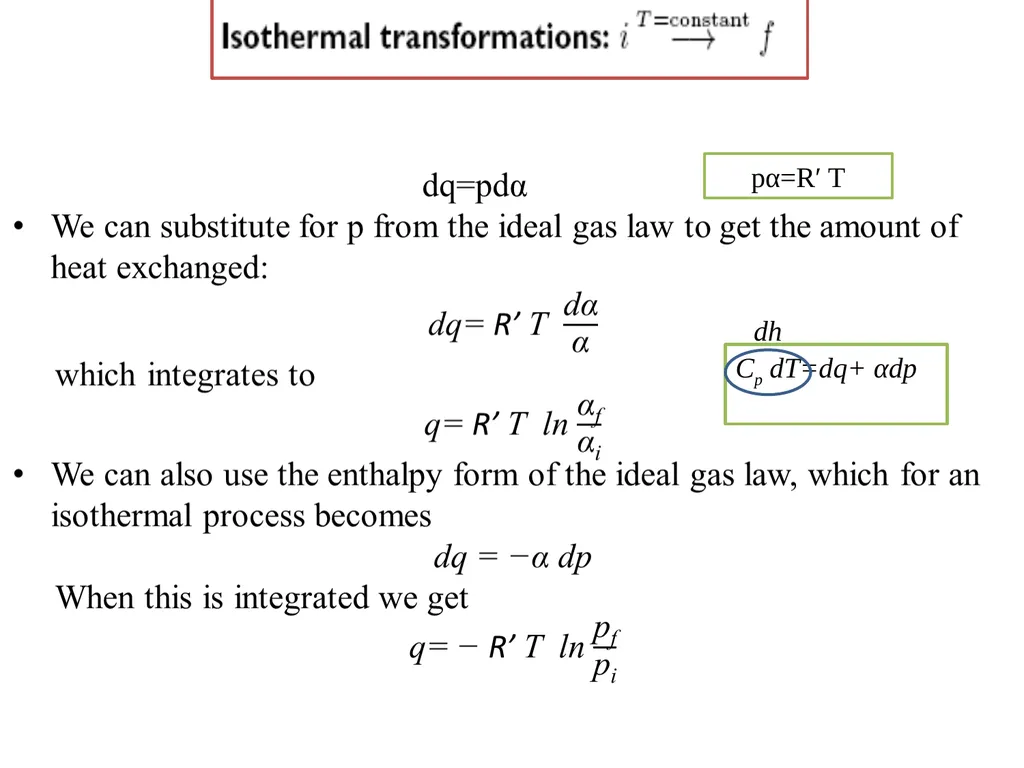
pα=Rʹ T<br>
10
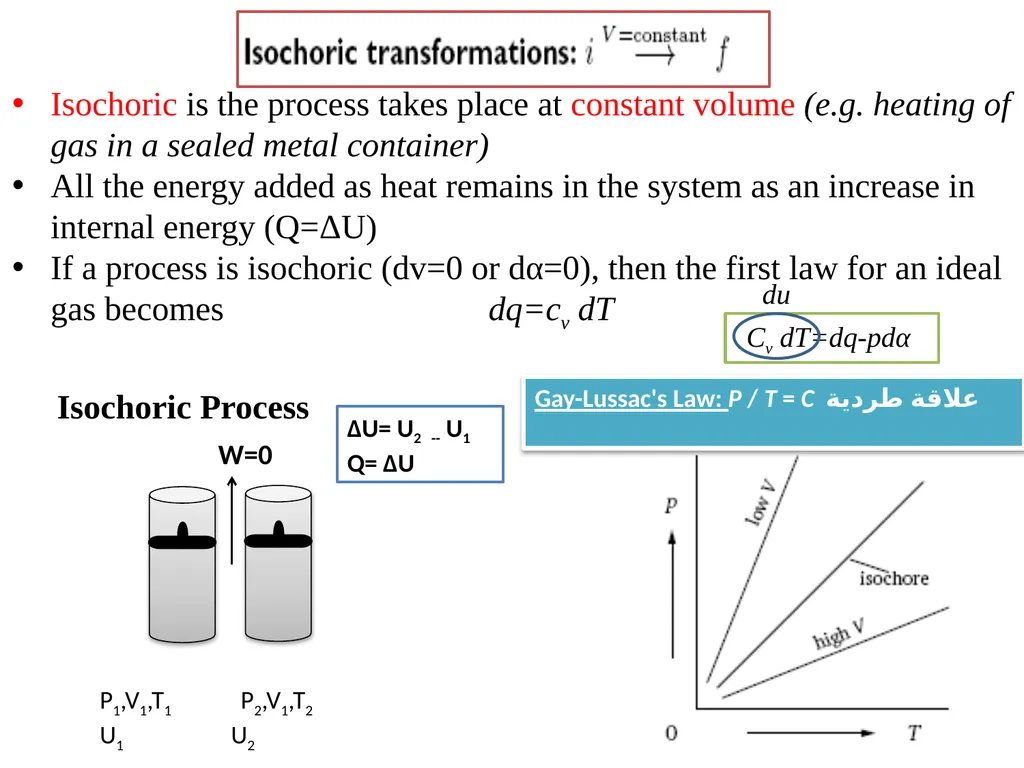
Isochoric is the process takes place at constant volume (e.g. heating of gas in a sealed metal container)
All the energy added as heat remains in the system as an increase in internal energy (Q=ΔU)
If a process is isochoric (dv=0 or dα=0), then the first law for an ideal gas becomes dq=cv dT<br>
11
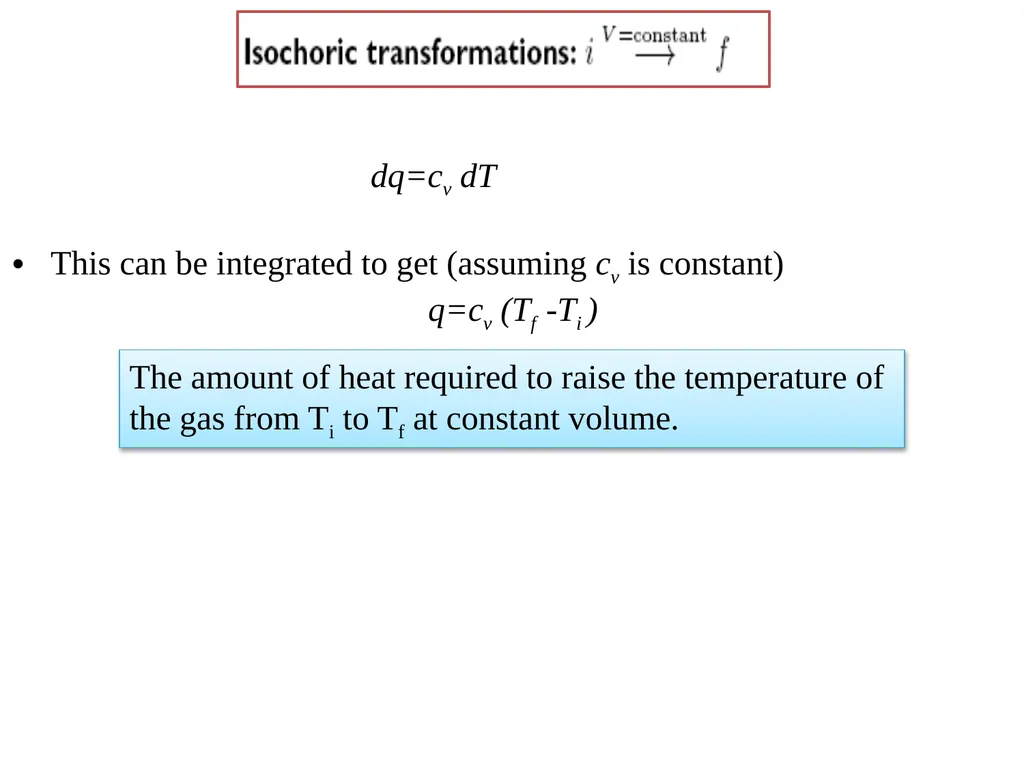
dq=cv dT
This can be integrated to get (assuming cv is constant)
q=cv (Tf -Ti ) The amount of heat required to raise the temperature of the gas from Ti to Tf at constant volume.<br>
12
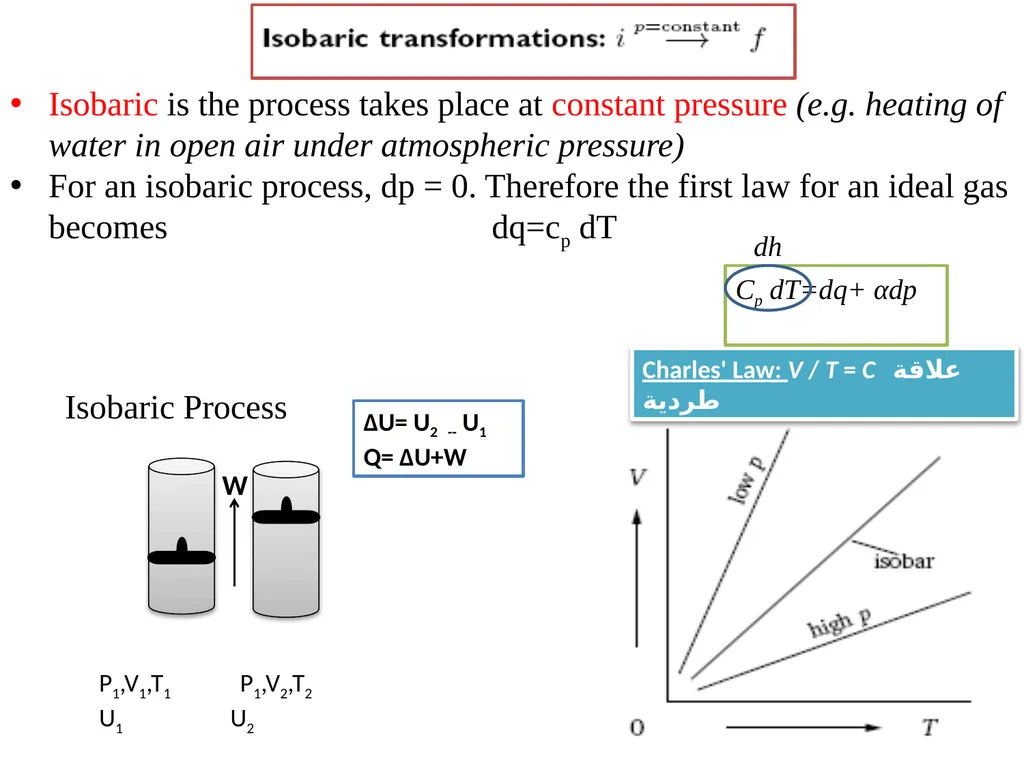
Isobaric is the process takes place at constant pressure (e.g. heating of water in open air under atmospheric pressure)
For an isobaric process, dp = 0. Therefore the first law for an ideal gas becomes dq=cp dT<br>
13
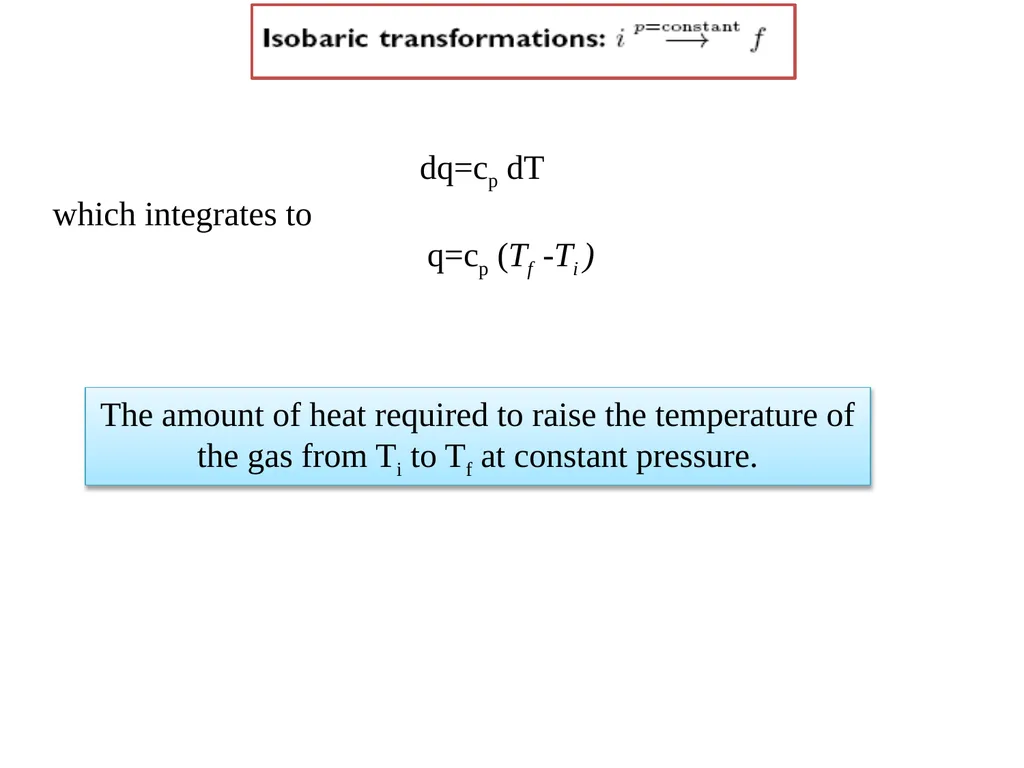
dq=cp dT
which integrates to
q=cp (Tf -Ti ) The amount of heat required to raise the temperature of the gas from Ti to Tf at constant pressure.<br>
14
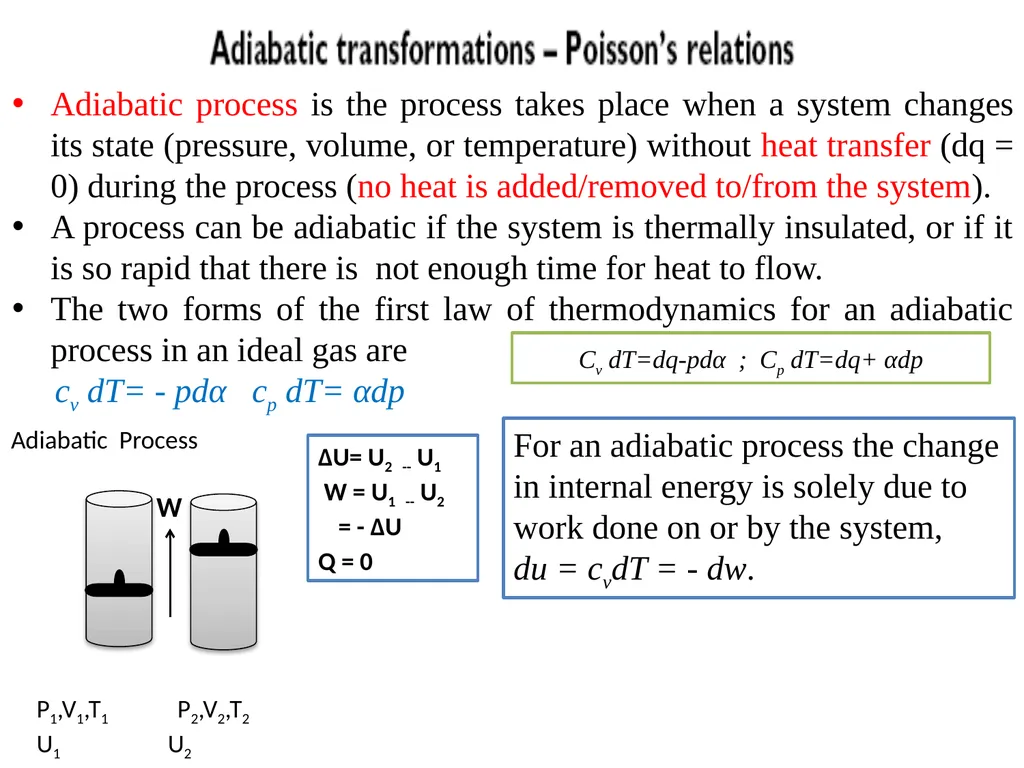
Adiabatic process is the process takes place when a system changes its state (pressure, volume, or temperature) without heat transfer (dq = 0) during the process (no heat is added/removed to/from the system).
A process can be adiabatic if the system is thermally insulated, or if it is so rapid that there is not enough time for heat to flow.
The two forms of the first law of thermodynamics for an adiabatic process in an ideal gas are
cv dT= - pdα cp dT= αdp Cv dT=dq-pdα ; Cp dT=dq+ αdp For an adiabatic process the change in internal energy is solely due to work done on or by the system,
du = cvdT = - dw.<br>
15
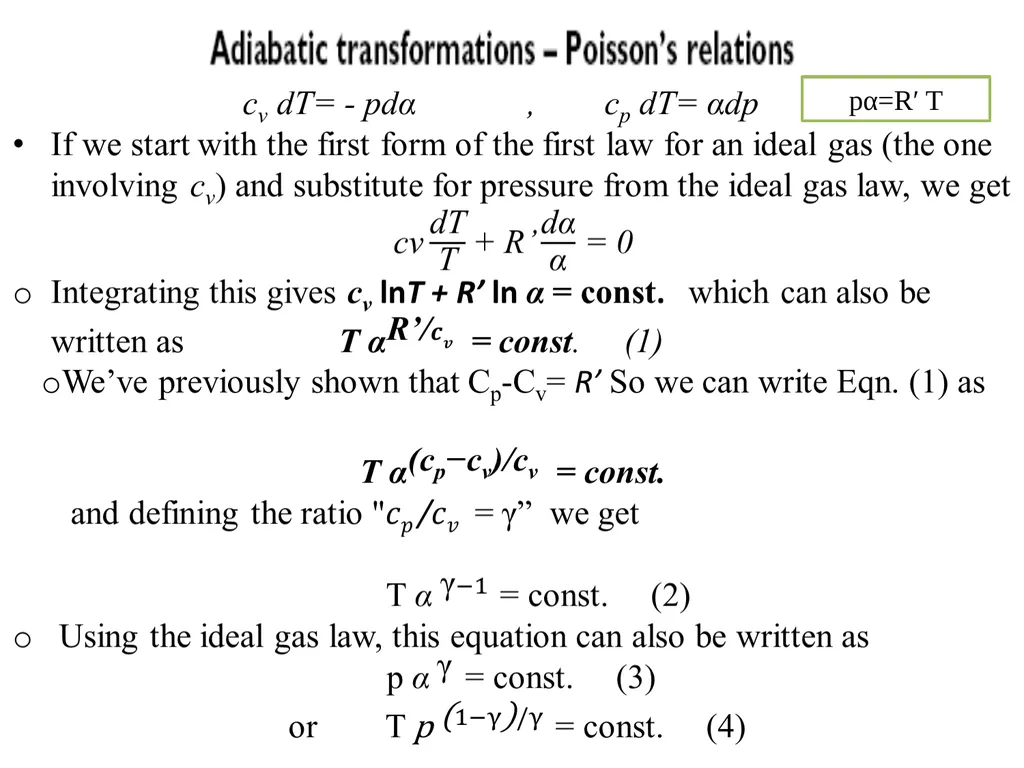
pα=Rʹ T<br>
16
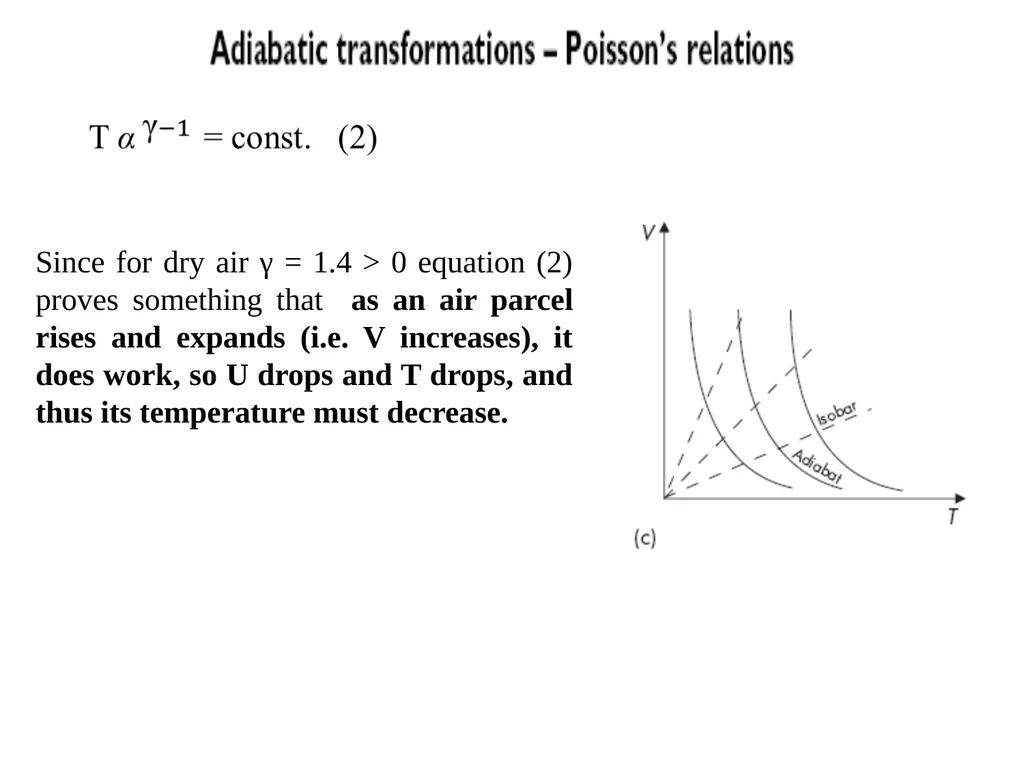
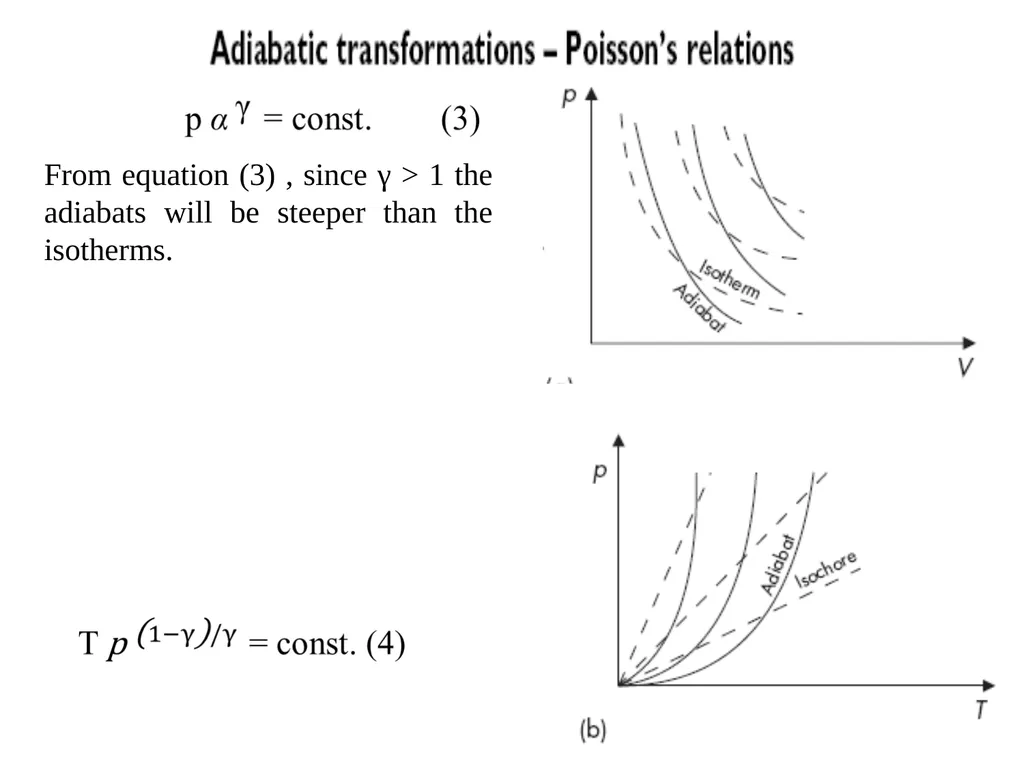
Since for dry air γ = 1.4 > 0 equation (2) proves something that as an air parcel rises and expands (i.e. V increases), it does work, so U drops and T drops, and thus its temperature must decrease.<br>
17
From equation (3) , since γ > 1 the adiabats will be steeper than the isotherms.<br>
18
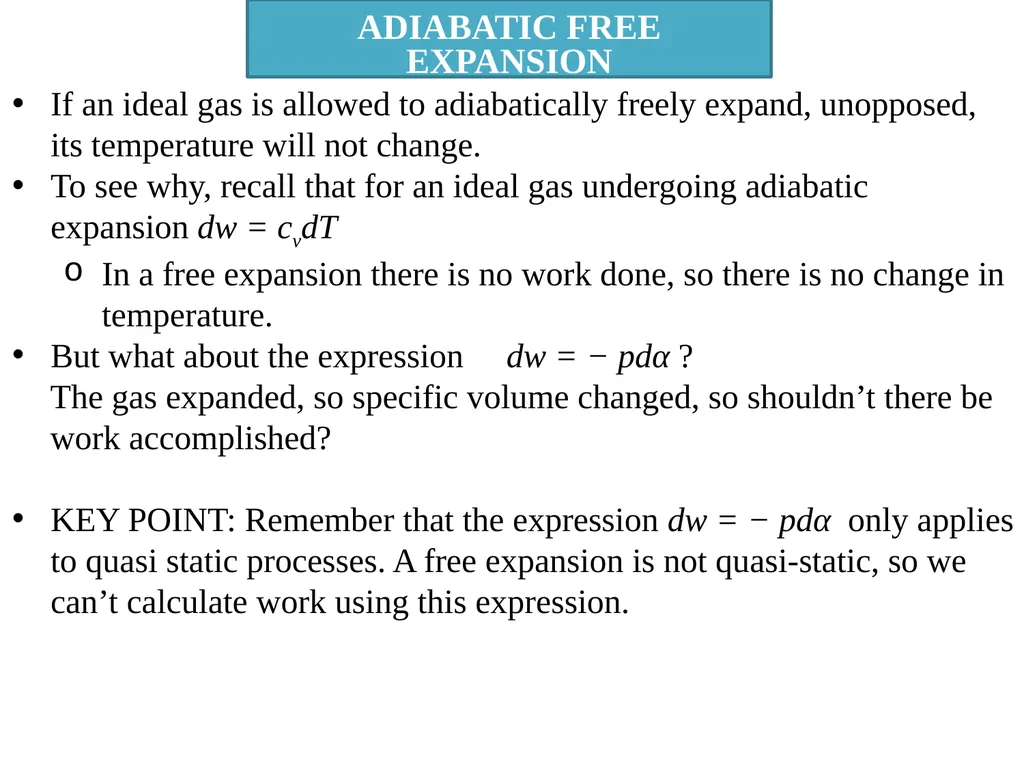
ADIABATIC FREE EXPANSION If an ideal gas is allowed to adiabatically freely expand, unopposed, its temperature will not change.
To see why, recall that for an ideal gas undergoing adiabatic expansion dw = cvdT
In a free expansion there is no work done, so there is no change in temperature.
But what about the expression dw = − pdα ?
The gas expanded, so specific volume changed, so shouldn’t there be work accomplished?
KEY POINT: Remember that the expression dw = − pdα only applies to quasi static processes. A free expansion is not quasi-static, so we can’t calculate work using this expression.<br>
19
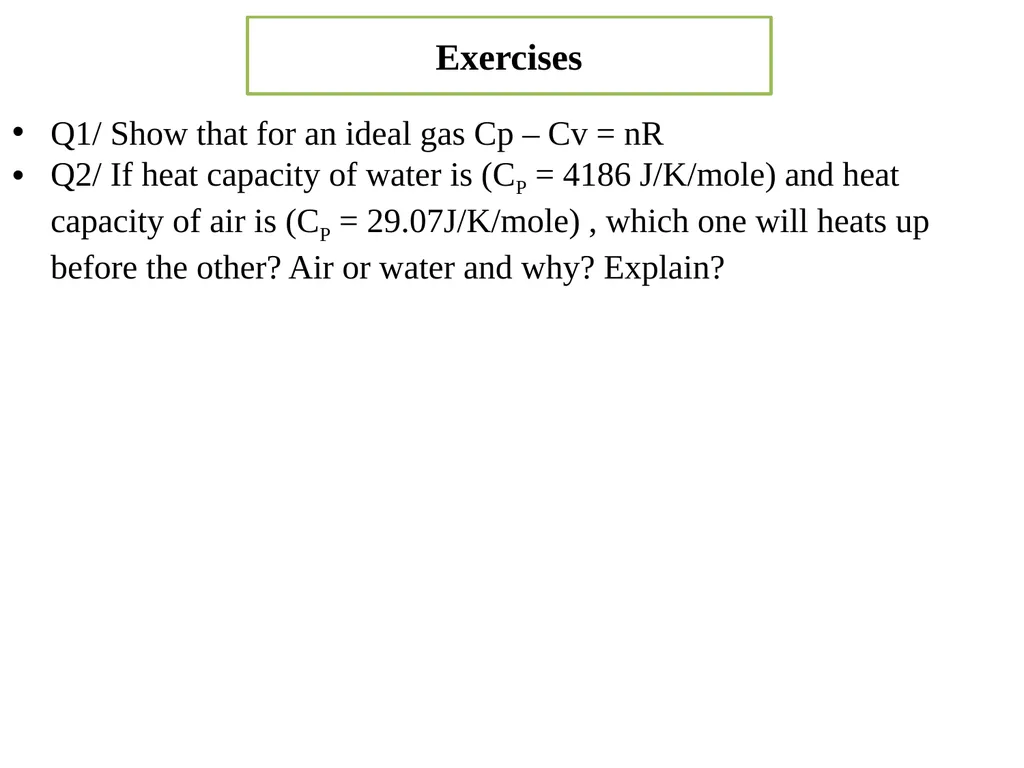
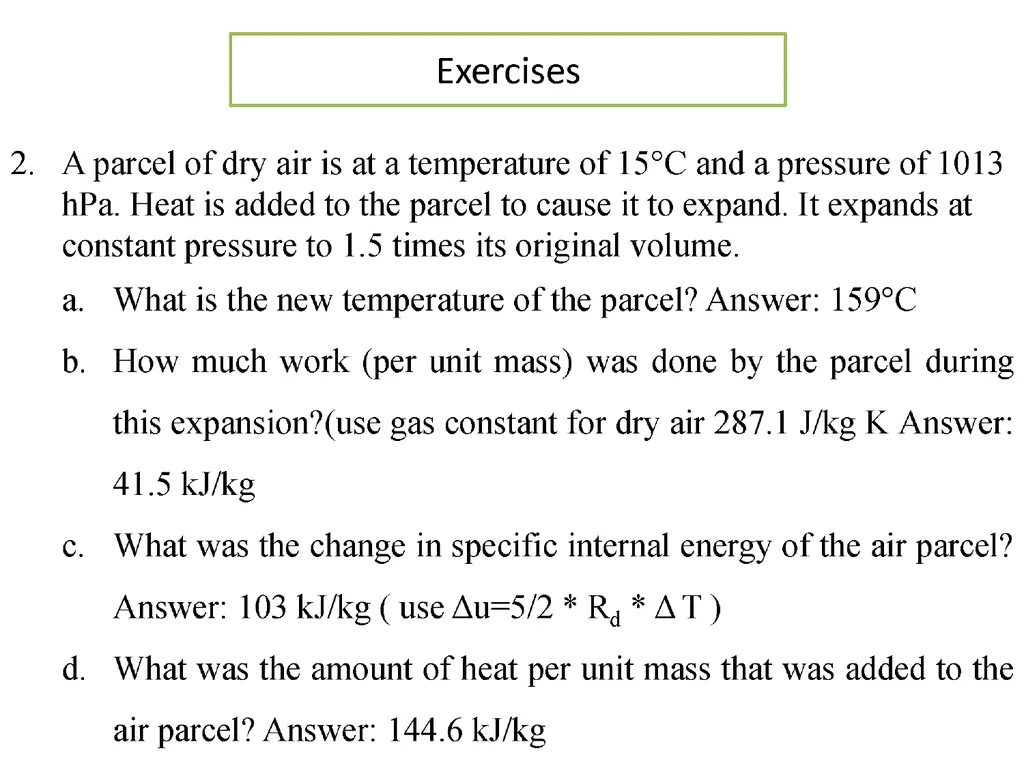
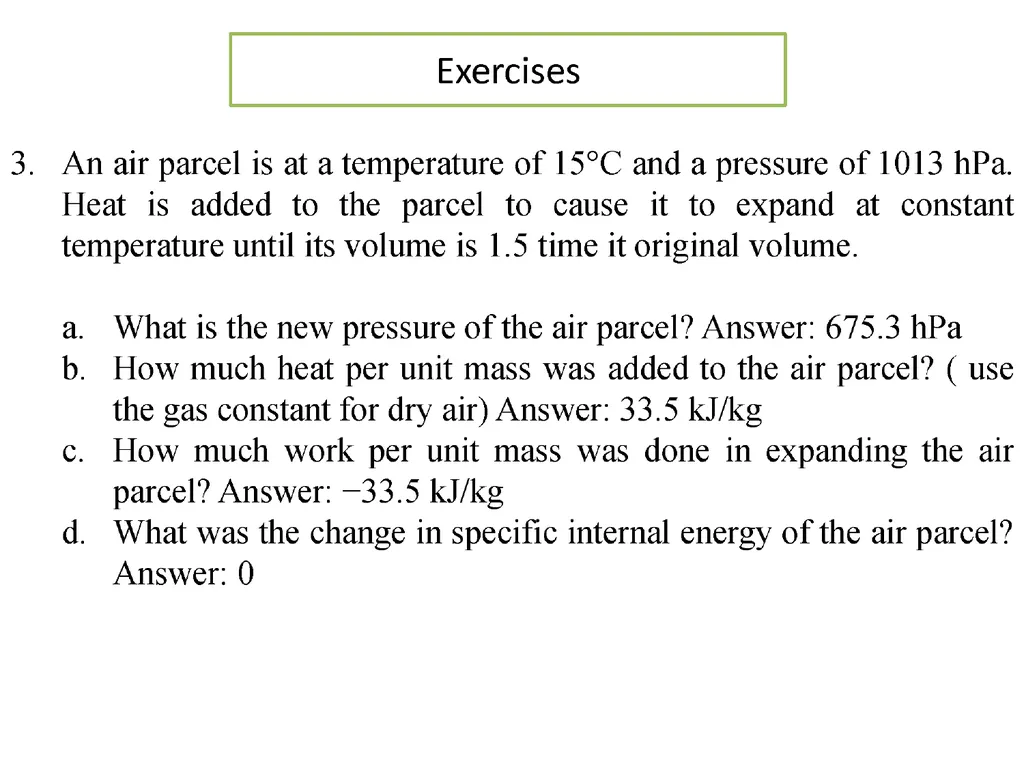
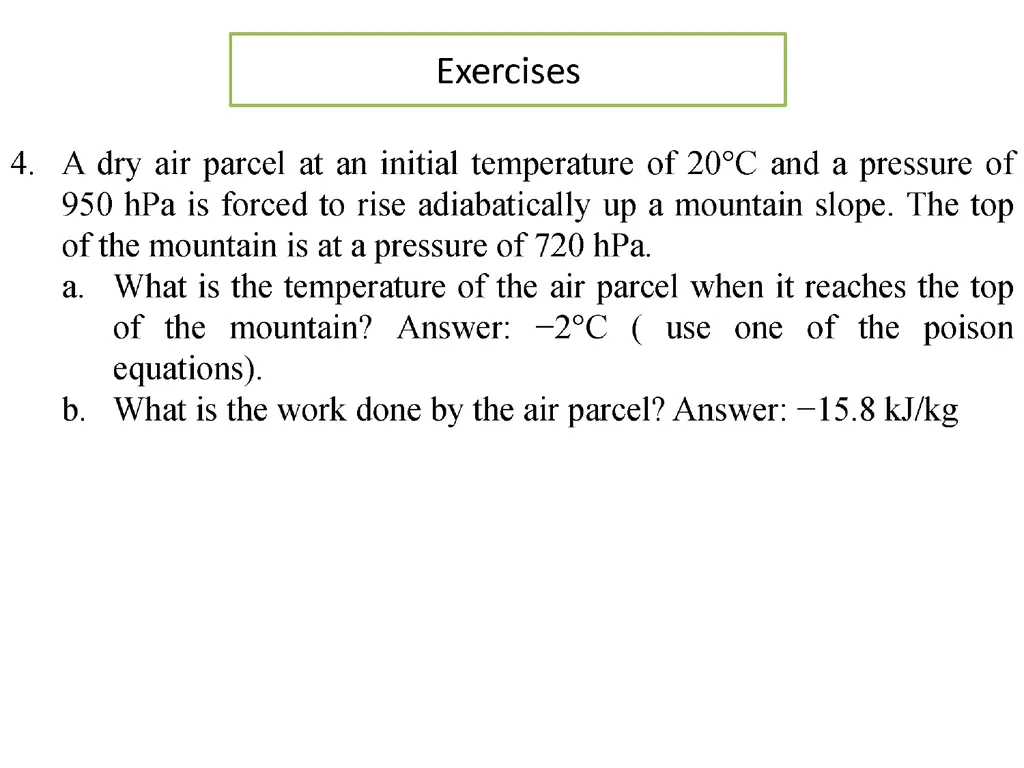
Exercises Q1/ Show that for an ideal gas Cp – Cv = nR
Q2/ If heat capacity of water is (CP = 4186 J/K/mole) and heat capacity of air is (CP = 29.07J/K/mole) , which one will heats up before the other? Air or water and why? Explain?<br>