
The Fire Eaters WALT: understand how to read and
MT
Published · 56 slides · 0 views

1 / 1


Description
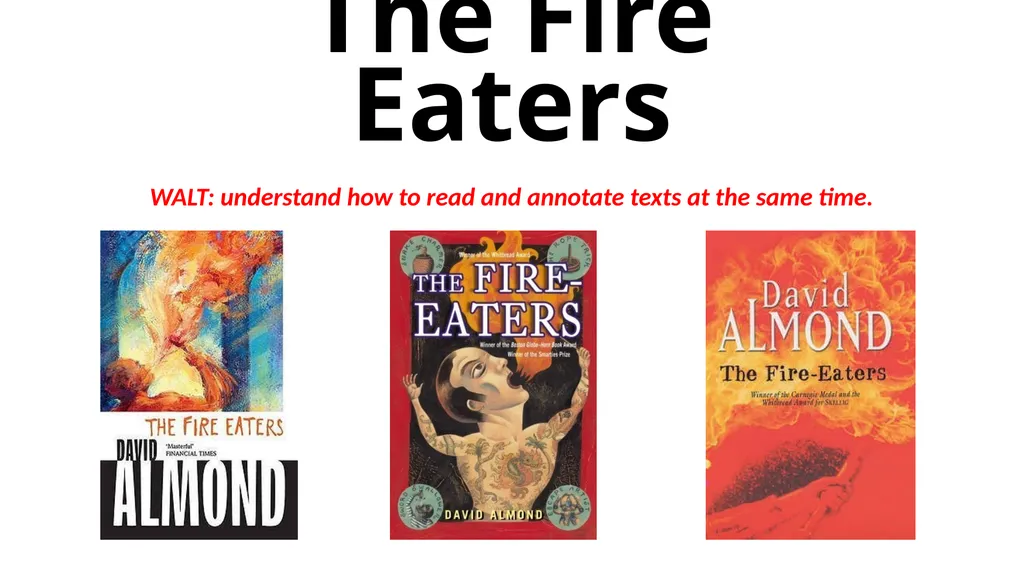
The Fire Eaters WALT: understand how to read and annotate texts at the same time. Section A: Reading 1 hour 21st Century prose-fiction It is an extract from the novel The Fire Eaters by David Almond published in 2003. It tells the story of
Related Topics
Share
Embed code
Download this presentation From Below
"The Fire Eaters WALT: understand how to read and" is the property of its rightful owner. Permission is granted to download and print the materials on this website for personal, non-commercial use only, and to display it on your personal computer provided you do not modify the materials and that you retain all copyright notices contained in the materials. By downloading content from our website, you accept the terms of this agreement.
Presentation Transcript
01
The Fire Eaters WALT: understand how to read and annotate texts at the same time.<br>
02
Section A: Reading
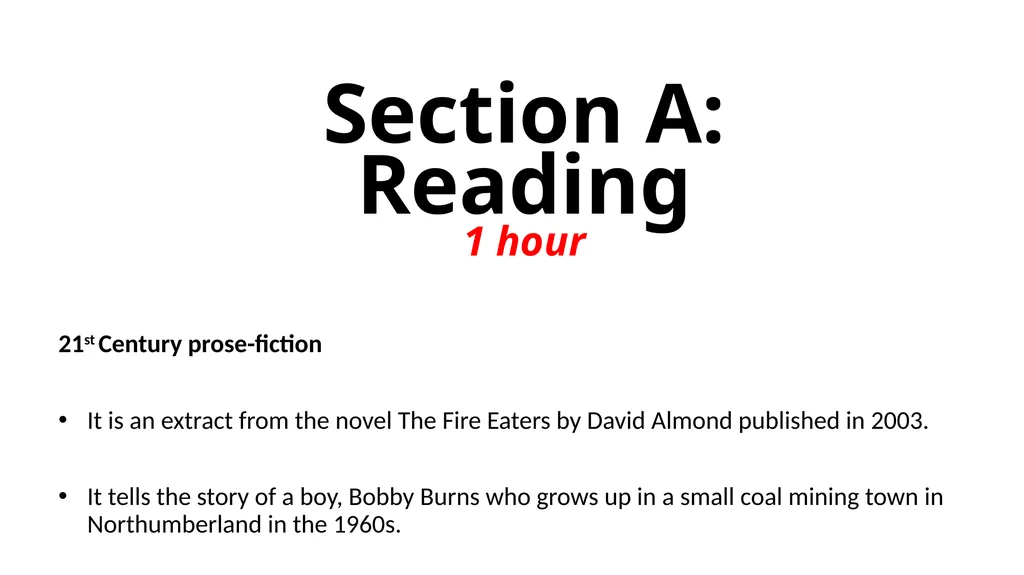
1 hour 21st Century prose-fiction
It is an extract from the novel The Fire Eaters by David Almond published in 2003.
It tells the story of a boy, Bobby Burns who grows up in a small coal mining town in Northumberland in the 1960s.<br>
It is an extract from the novel The Fire Eaters by David Almond published in 2003.
It tells the story of a boy, Bobby Burns who grows up in a small coal mining town in Northumberland in the 1960s.<br>
03
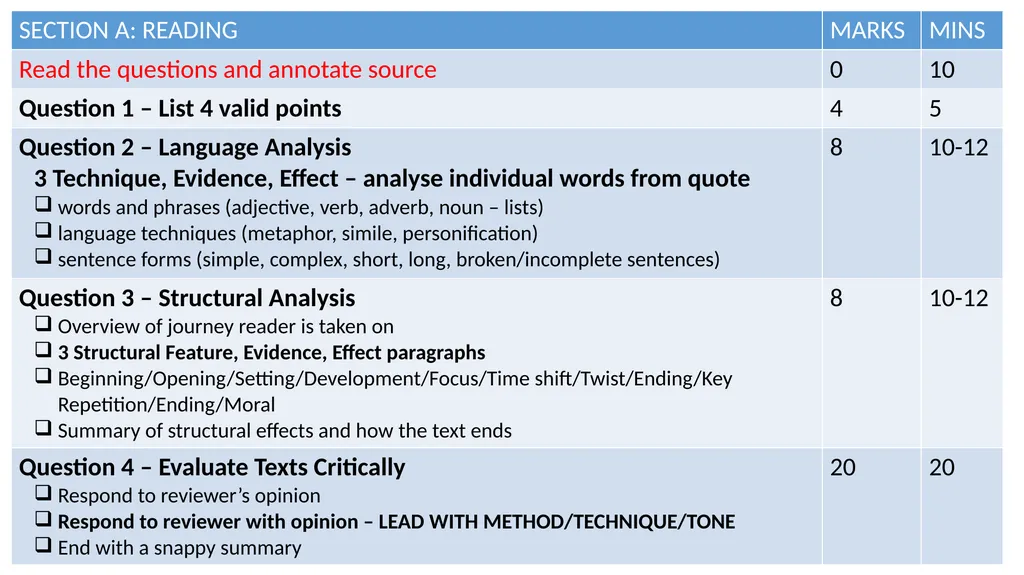
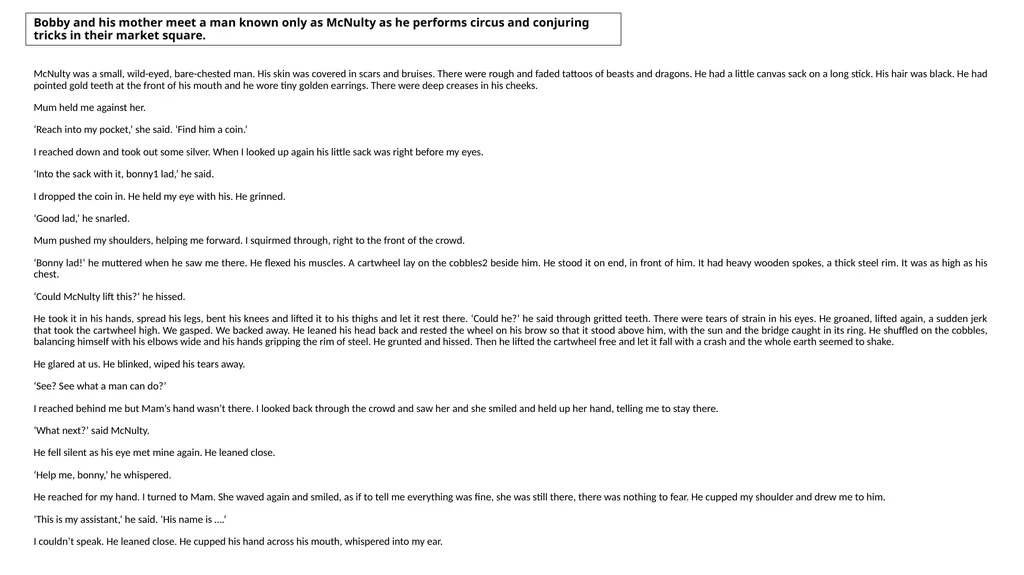
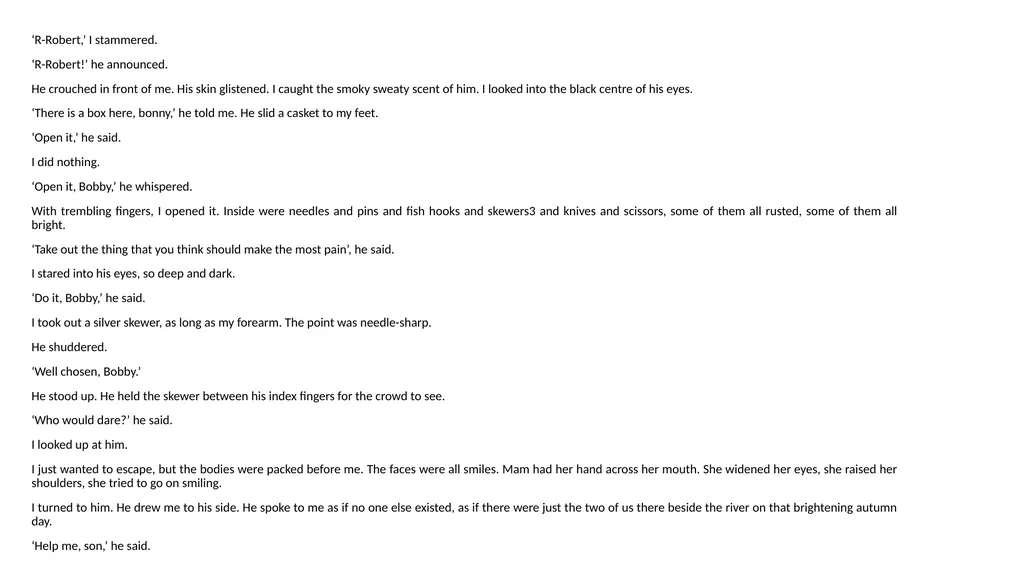
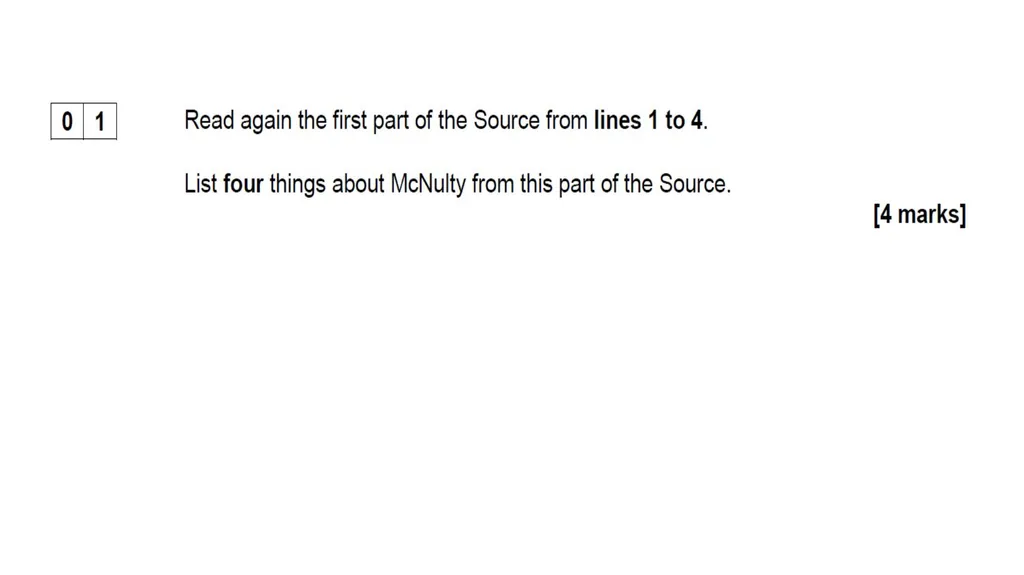
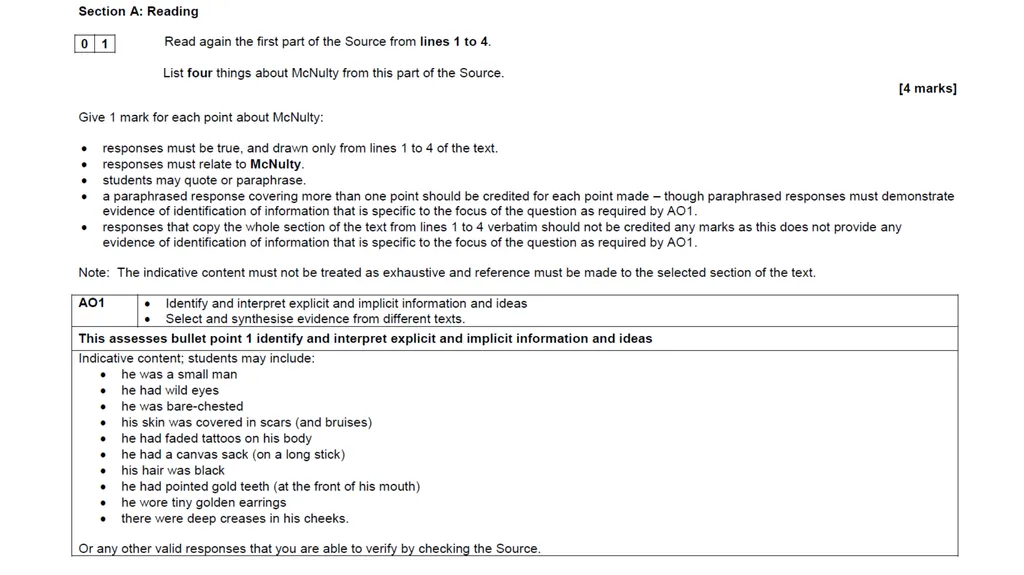
McNulty was a small, wild-eyed, bare-chested man. His skin was covered in scars and bruises. There were rough and faded tattoos of beasts and dragons. He had a little canvas sack on a long stick. His hair was black. He had pointed gold teeth at the front of his mouth and he wore tiny golden earrings. There were deep creases in his cheeks.
Mum held me against her.
‘Reach into my pocket,’ she said. ‘Find him a coin.’
I reached down and took out some silver. When I looked up again his little sack was right before my eyes.
‘Into the sack with it, bonny1 lad,’ he said.
I dropped the coin in. He held my eye with his. He grinned.
‘Good lad,’ he snarled.
Mum pushed my shoulders, helping me forward. I squirmed through, right to the front of the crowd.
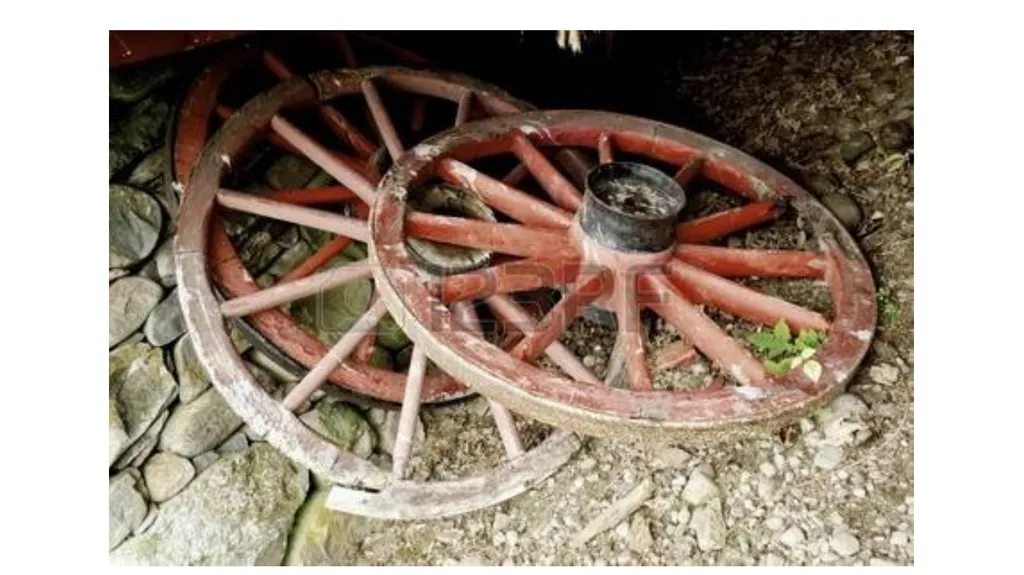
‘Bonny lad!’ he muttered when he saw me there. He flexed his muscles. A cartwheel lay on the cobbles2 beside him. He stood it on end, in front of him. It had heavy wooden spokes, a thick steel rim. It was as high as his chest.
‘Could McNulty lift this?’ he hissed.
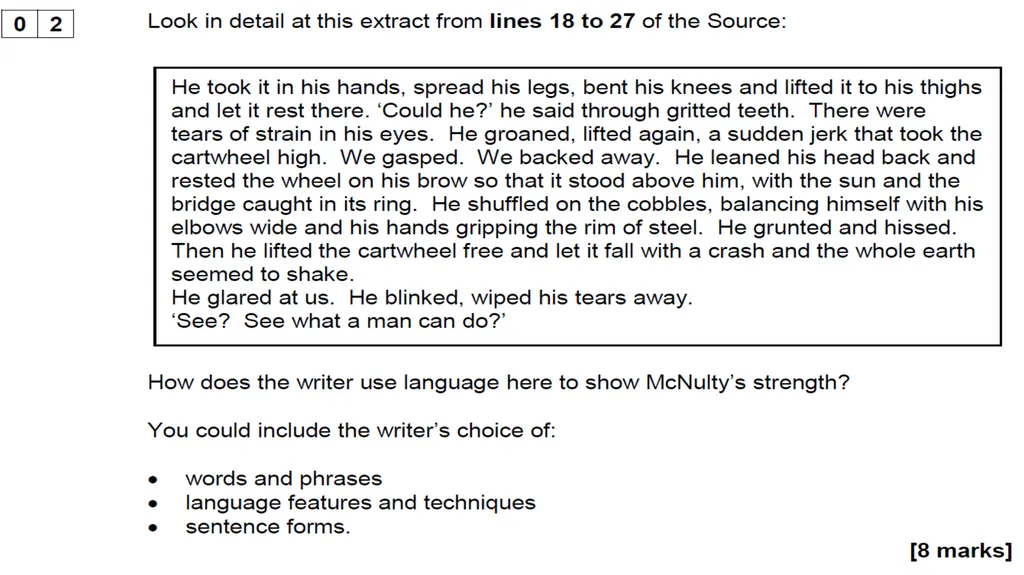
He took it in his hands, spread his legs, bent his knees and lifted it to his thighs and let it rest there. ‘Could he?’ he said through gritted teeth. There were tears of strain in his eyes. He groaned, lifted again, a sudden jerk that took the cartwheel high. We gasped. We backed away. He leaned his head back and rested the wheel on his brow so that it stood above him, with the sun and the bridge caught in its ring. He shuffled on the cobbles, balancing himself with his elbows wide and his hands gripping the rim of steel. He grunted and hissed. Then he lifted the cartwheel free and let it fall with a crash and the whole earth seemed to shake.
He glared at us. He blinked, wiped his tears away.
‘See? See what a man can do?’
I reached behind me but Mam’s hand wasn’t there. I looked back through the crowd and saw her and she smiled and held up her hand, telling me to stay there.
‘What next?’ said McNulty.
He fell silent as his eye met mine again. He leaned close.
‘Help me, bonny,’ he whispered.
He reached for my hand. I turned to Mam. She waved again and smiled, as if to tell me everything was fine, she was still there, there was nothing to fear. He cupped my shoulder and drew me to him.
‘This is my assistant,’ he said. ‘His name is ….’
I couldn’t speak. He leaned close. He cupped his hand across his mouth, whispered into my ear. Bobby and his mother meet a man known only as McNulty as he performs circus and conjuring tricks in their market square.<br>
04
‘R-Robert,’ I stammered.
‘R-Robert!’ he announced.
He crouched in front of me. His skin glistened. I caught the smoky sweaty scent of him. I looked into the black centre of his eyes.
‘There is a box here, bonny,’ he told me. He slid a casket to my feet.
‘Open it,’ he said.
I did nothing.
‘Open it, Bobby,’ he whispered.
With trembling fingers, I opened it. Inside were needles and pins and fish hooks and skewers3 and knives and scissors, some of them all rusted, some of them all bright.
‘Take out the thing that you think should make the most pain’, he said.
I stared into his eyes, so deep and dark.
‘Do it, Bobby,’ he said.
I took out a silver skewer, as long as my forearm. The point was needle-sharp.
He shuddered.
‘Well chosen, Bobby.’
He stood up. He held the skewer between his index fingers for the crowd to see.
‘Who would dare?’ he said.
I looked up at him.
I just wanted to escape, but the bodies were packed before me. The faces were all smiles. Mam had her hand across her mouth. She widened her eyes, she raised her shoulders, she tried to go on smiling.
I turned to him. He drew me to his side. He spoke to me as if no one else existed, as if there were just the two of us there beside the river on that brightening autumn day.
‘Help me, son,’ he said.<br>
05
Question 2 Language Analysis<br>
06
Our approach is similar for Paper 2, Question 3 Page 19<br>
07
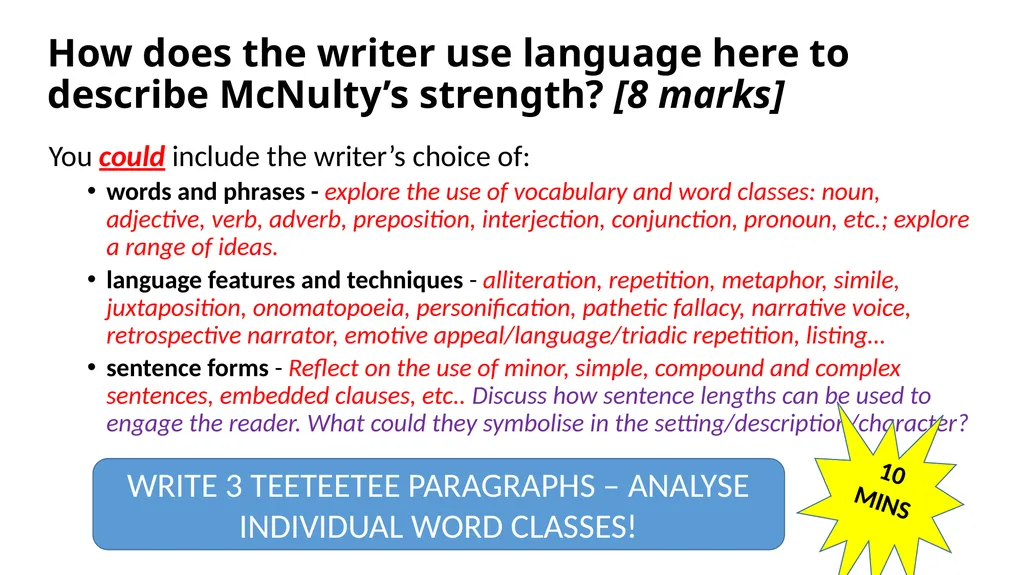
How does the writer use language here to describe McNulty’s strength? [8 marks] You could include the writer’s choice of:
words and phrases - explore the use of vocabulary and word classes: noun, adjective, verb, adverb, preposition, interjection, conjunction, pronoun, etc.; explore a range of ideas.
language features and techniques - alliteration, repetition, metaphor, simile, juxtaposition, onomatopoeia, personification, pathetic fallacy, narrative voice, retrospective narrator, emotive appeal/language/triadic repetition, listing…
sentence forms - Reflect on the use of minor, simple, compound and complex sentences, embedded clauses, etc.. Discuss how sentence lengths can be used to engage the reader. What could they symbolise in the setting/description/character? 10 MINS WRITE 3 TEETEETEE PARAGRAPHS – ANALYSE INDIVIDUAL WORD CLASSES!<br>
08
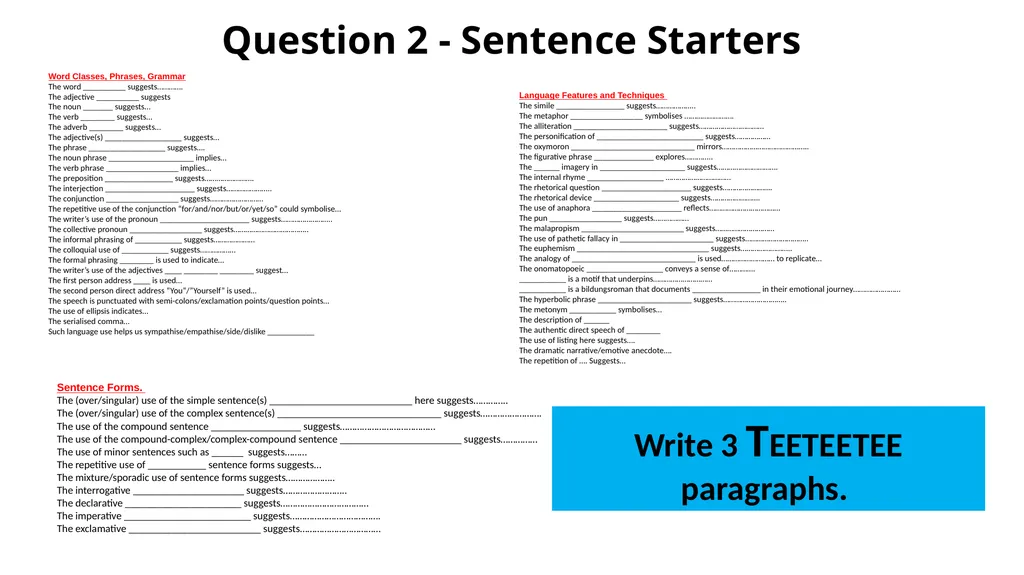
Question 2 - Sentence Starters Sentence Forms.
The (over/singular) use of the simple sentence(s) ___________________________ here suggests…………..
The (over/singular) use of the complex sentence(s) _______________________________ suggests…………………….
The use of the compound sentence _________________ suggests…………………………………
The use of the compound-complex/complex-compound sentence _______________________ suggests……………
The use of minor sentences such as ______ suggests………
The repetitive use of ___________ sentence forms suggests…
The mixture/sporadic use of sentence forms suggests………………..
The interrogative _____________________ suggests……………………..
The declarative ______________________ suggests………………………………
The imperative ________________________ suggests……………………………….
The exclamative _________________________ suggests…………………………… Language Features and Techniques
The simile ________________ suggests………………..
The metaphor _________________ symbolises …………………….
The alliteration ______________________ suggests……………………………
The personification of _________________________ suggests………………
The oxymoron _____________________________ mirrors……………………………………..
The figurative phrase ______________ explores…………..
The ______ imagery in ____________________ suggests………………………….
The internal rhyme __________________ ……………………………
The rhetorical question _____________________ suggests…………………….
The rhetorical device ____________________ suggests…………………….
The use of anaphora _____________________ reflects………………………………
The pun _________________ suggests………………
The malapropism ________________________ suggests…………………………
The use of pathetic fallacy in ______________________ suggests…………………………..
The euphemism _______________________________ suggests……………………..
The analogy of _____________________________ is used……………………… to replicate…
The onomatopoeic __________________ conveys a sense of………….
___________ is a motif that underpins…………………………
___________ is a bildungsroman that documents ________________ in their emotional journey……………………
The hyperbolic phrase ______________________ suggests…………………………..
The metonym ___________ symbolises…
The description of ______
The authentic direct speech of ________
The use of listing here suggests….
The dramatic narrative/emotive anecdote….
The repetition of …. Suggests… Word Classes, Phrases, Grammar
The word __________ suggests………….
The adjective __________ suggests
The noun _______ suggests…
The verb ________ suggests…
The adverb ________ suggests…
The adjective(s) __________________ suggests…
The phrase __________________ suggests….
The noun phrase ____________________ implies…
The verb phrase _________________ implies…
The preposition ________________ suggests…………………….
The interjection _____________________ suggests…………………..
The conjunction _________________ suggests………………………
The repetitive use of the conjunction “for/and/nor/but/or/yet/so” could symbolise…
The writer’s use of the pronoun _____________________ suggests……………………..
The collective pronoun _________________ suggests………………………………..
The informal phrasing of ___________ suggests…………………
The colloquial use of ___________ suggests………………
The formal phrasing ________ is used to indicate…
The writer’s use of the adjectives ____ ________ ________ suggest…
The first person address ____ is used…
The second person direct address “You”/”Yourself” is used…
The speech is punctuated with semi-colons/exclamation points/question points…
The use of ellipsis indicates…
The serialised comma…
Such language use helps us sympathise/empathise/side/dislike ___________ Write 3 TEETEETEE paragraphs.<br>
09
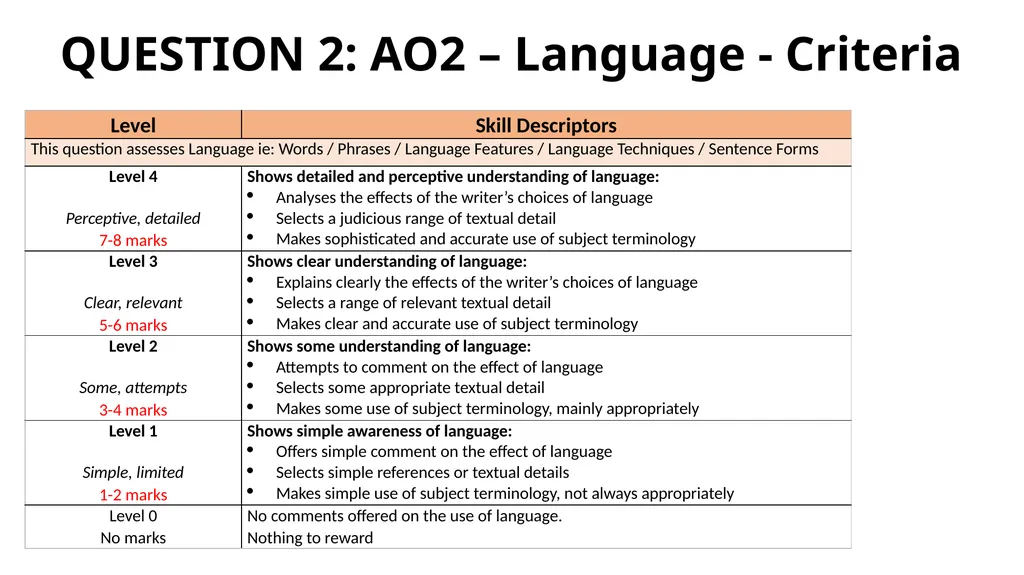
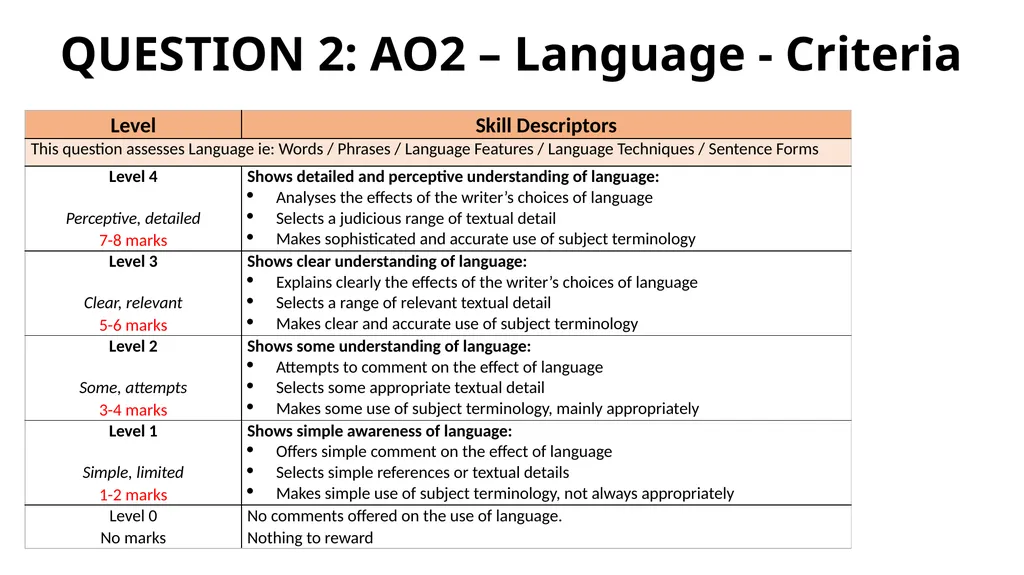
QUESTION 2: AO2 – Language - Criteria<br>
10
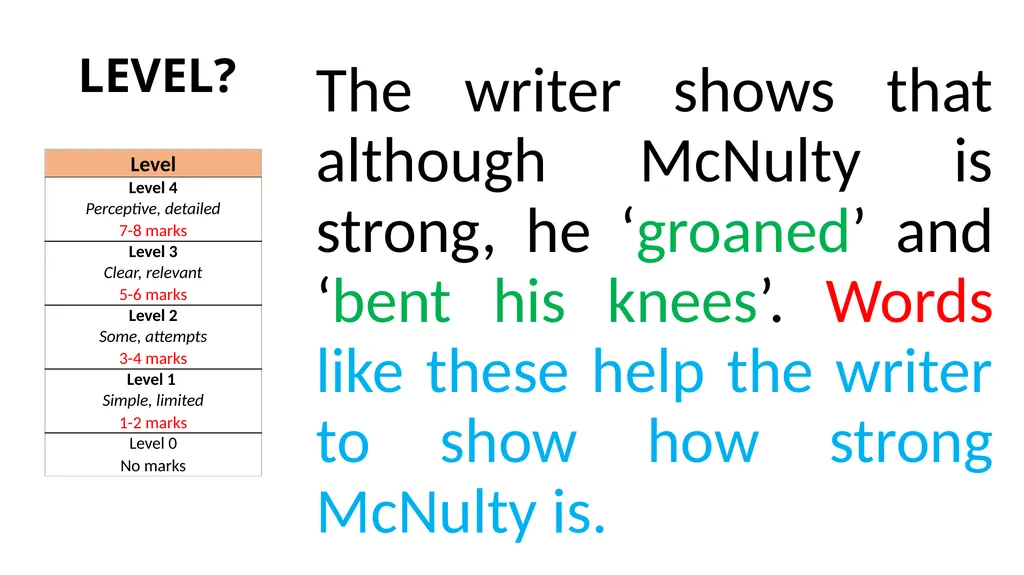
LEVEL? The writer shows that although McNulty is strong, he ‘groaned’ and ‘bent his knees’. Words like these help the writer to show how strong McNulty is.<br>
11
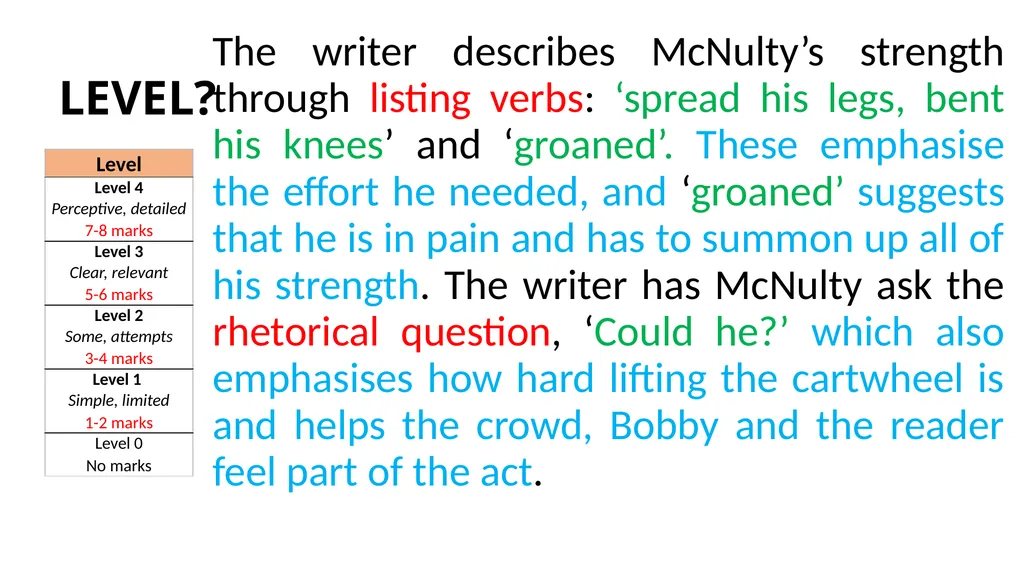
LEVEL? The writer describes McNulty’s strength through listing verbs: ‘spread his legs, bent his knees’ and ‘groaned’. These emphasise the effort he needed, and ‘groaned’ suggests that he is in pain and has to summon up all of his strength. The writer has McNulty ask the rhetorical question, ‘Could he?’ which also emphasises how hard lifting the cartwheel is and helps the crowd, Bobby and the reader feel part of the act.<br>
12
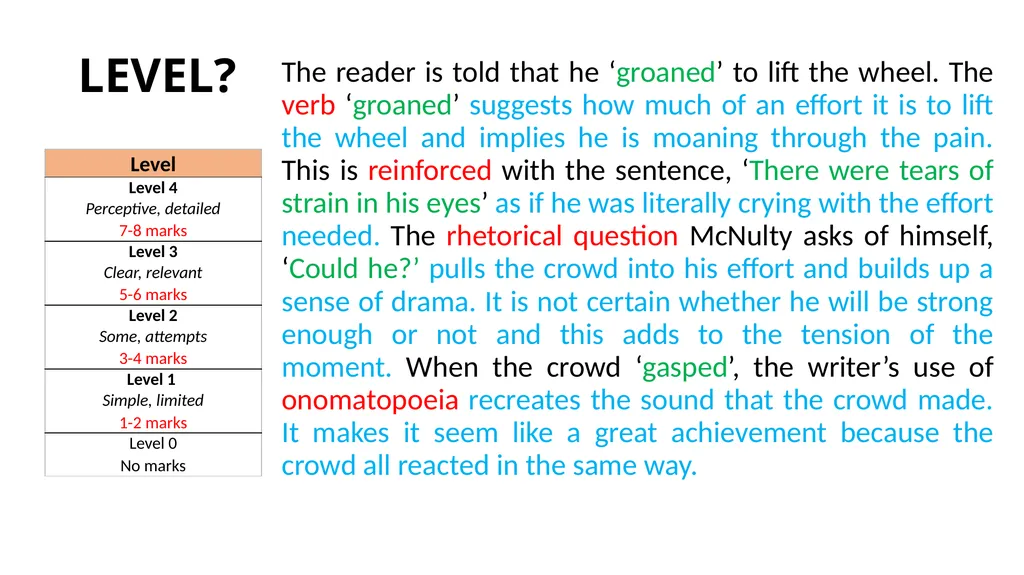
LEVEL? The reader is told that he ‘groaned’ to lift the wheel. The verb ‘groaned’ suggests how much of an effort it is to lift the wheel and implies he is moaning through the pain. This is reinforced with the sentence, ‘There were tears of strain in his eyes’ as if he was literally crying with the effort needed. The rhetorical question McNulty asks of himself, ‘Could he?’ pulls the crowd into his effort and builds up a sense of drama. It is not certain whether he will be strong enough or not and this adds to the tension of the moment. When the crowd ‘gasped’, the writer’s use of onomatopoeia recreates the sound that the crowd made. It makes it seem like a great achievement because the crowd all reacted in the same way.<br>
13
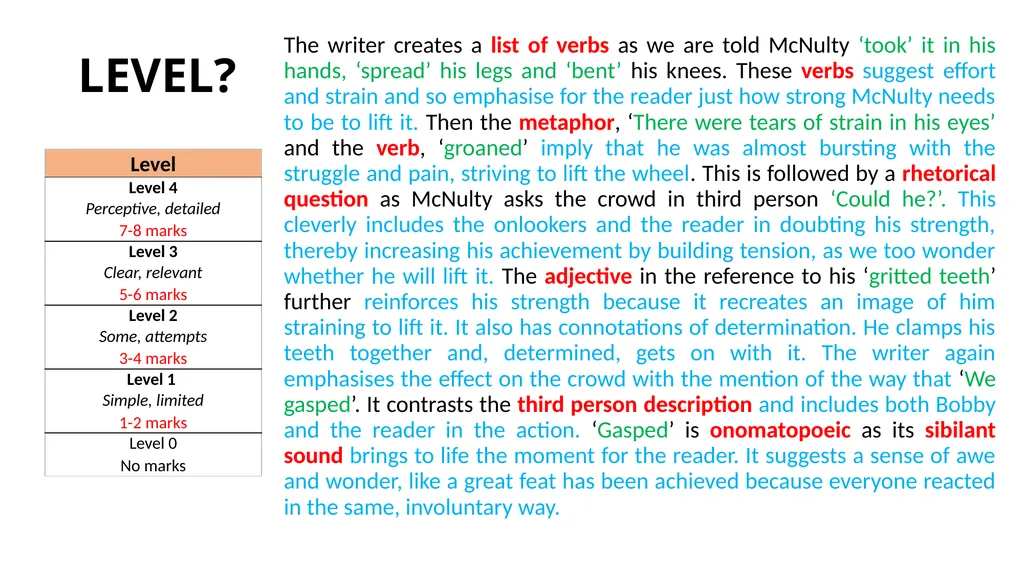
LEVEL? The writer creates a list of verbs as we are told McNulty ‘took’ it in his hands, ‘spread’ his legs and ‘bent’ his knees. These verbs suggest effort and strain and so emphasise for the reader just how strong McNulty needs to be to lift it. Then the metaphor, ‘There were tears of strain in his eyes’ and the verb, ‘groaned’ imply that he was almost bursting with the struggle and pain, striving to lift the wheel. This is followed by a rhetorical question as McNulty asks the crowd in third person ‘Could he?’. This cleverly includes the onlookers and the reader in doubting his strength, thereby increasing his achievement by building tension, as we too wonder whether he will lift it. The adjective in the reference to his ‘gritted teeth’ further reinforces his strength because it recreates an image of him straining to lift it. It also has connotations of determination. He clamps his teeth together and, determined, gets on with it. The writer again emphasises the effect on the crowd with the mention of the way that ‘We gasped’. It contrasts the third person description and includes both Bobby and the reader in the action. ‘Gasped’ is onomatopoeic as its sibilant sound brings to life the moment for the reader. It suggests a sense of awe and wonder, like a great feat has been achieved because everyone reacted in the same, involuntary way.<br>
14
Our approach is similar for Paper 2, Question 3 Page 19<br>
15
QUESTION 2: AO2 – Language - Criteria<br>
16
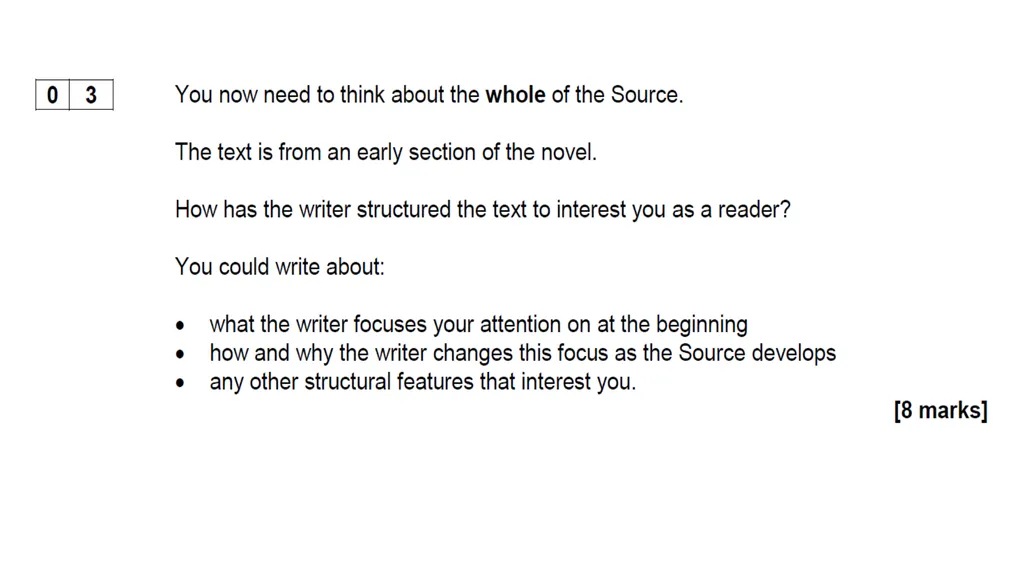
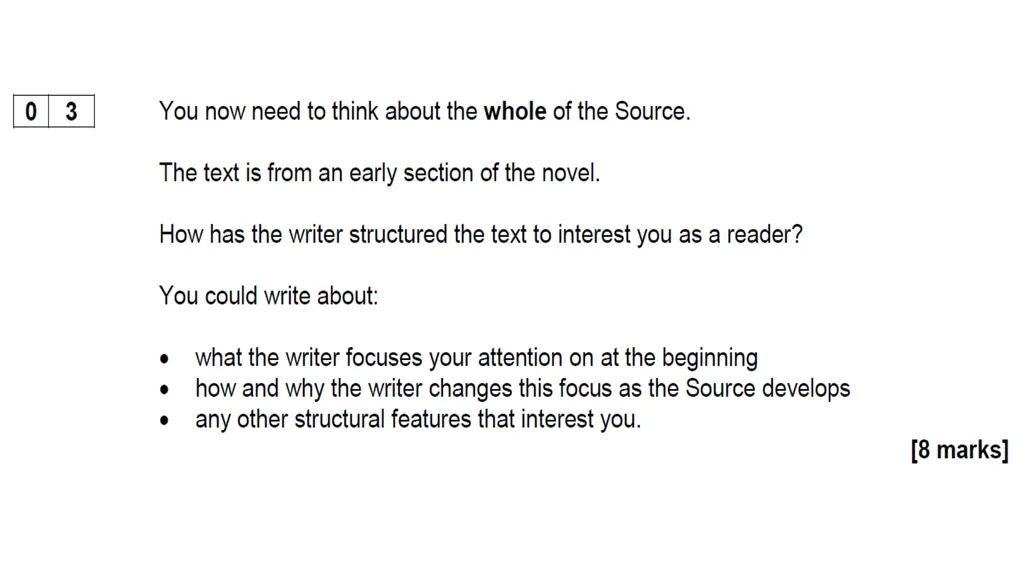
Question 3 Structure Analysis WALT: identify and explain the effect of writer’s structure using structural terminology.<br>
17
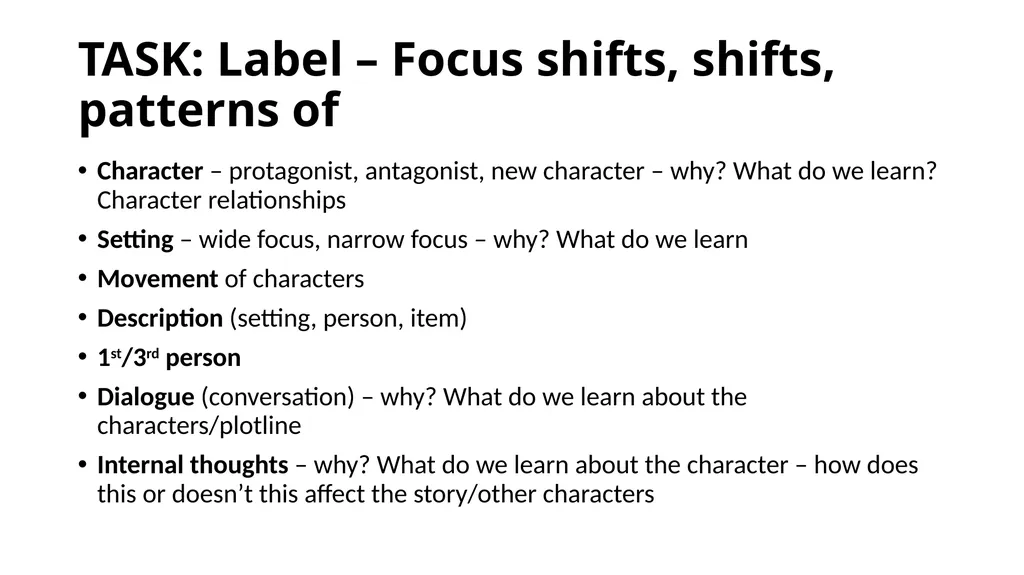
TASK: Label – Focus shifts, shifts, patterns of Character – protagonist, antagonist, new character – why? What do we learn? Character relationships
Setting – wide focus, narrow focus – why? What do we learn
Movement of characters
Description (setting, person, item)
1st/3rd person
Dialogue (conversation) – why? What do we learn about the characters/plotline
Internal thoughts – why? What do we learn about the character – how does this or doesn’t this affect the story/other characters<br>
18
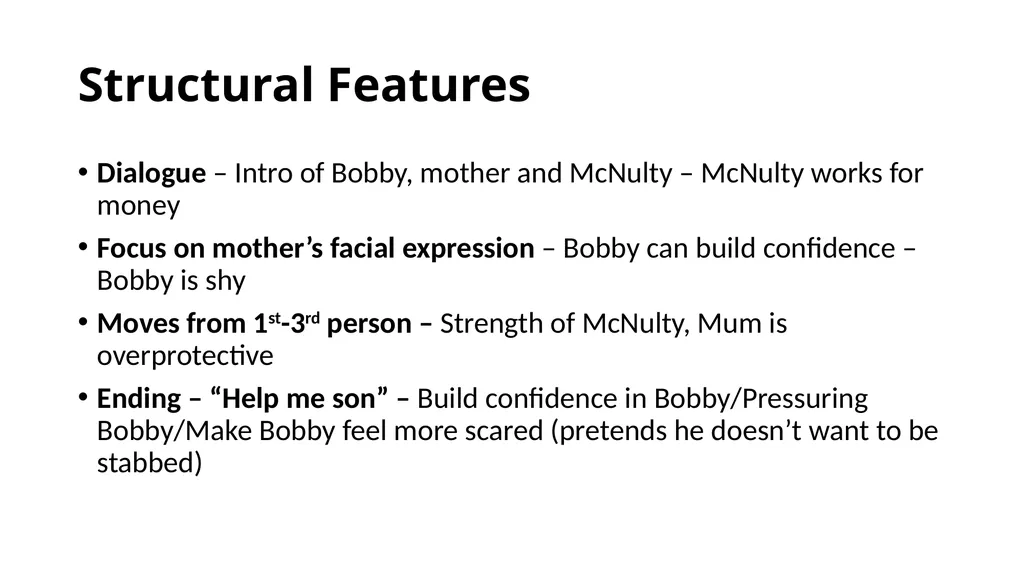
Structural Features Dialogue – Intro of Bobby, mother and McNulty – McNulty works for money
Focus on mother’s facial expression – Bobby can build confidence – Bobby is shy
Moves from 1st-3rd person – Strength of McNulty, Mum is overprotective
Ending – “Help me son” – Build confidence in Bobby/Pressuring Bobby/Make Bobby feel more scared (pretends he doesn’t want to be stabbed)<br>
Focus on mother’s facial expression – Bobby can build confidence – Bobby is shy
Moves from 1st-3rd person – Strength of McNulty, Mum is overprotective
Ending – “Help me son” – Build confidence in Bobby/Pressuring Bobby/Make Bobby feel more scared (pretends he doesn’t want to be stabbed)<br>
19
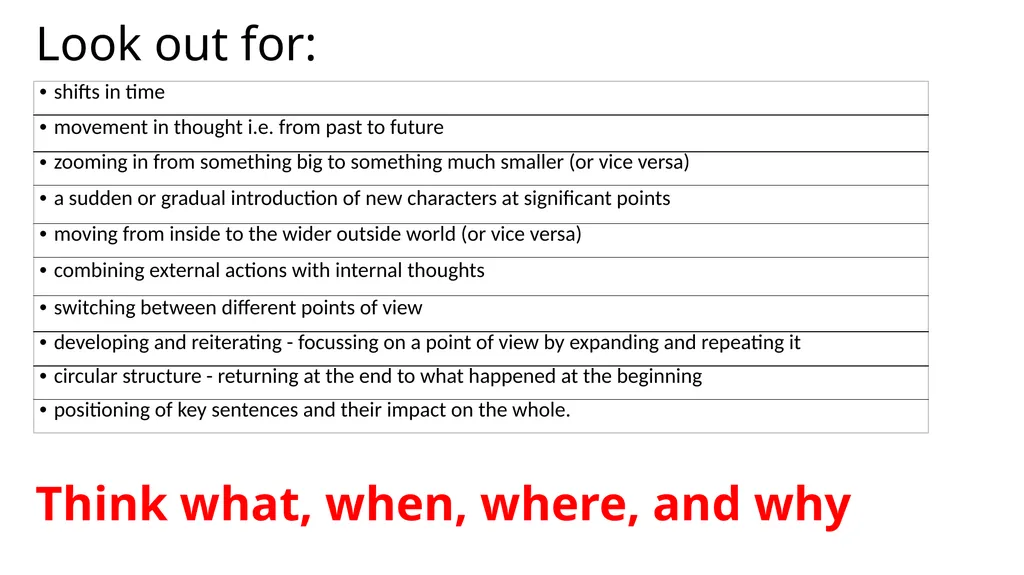
Look out for: Think what, when, where, and why<br>
20
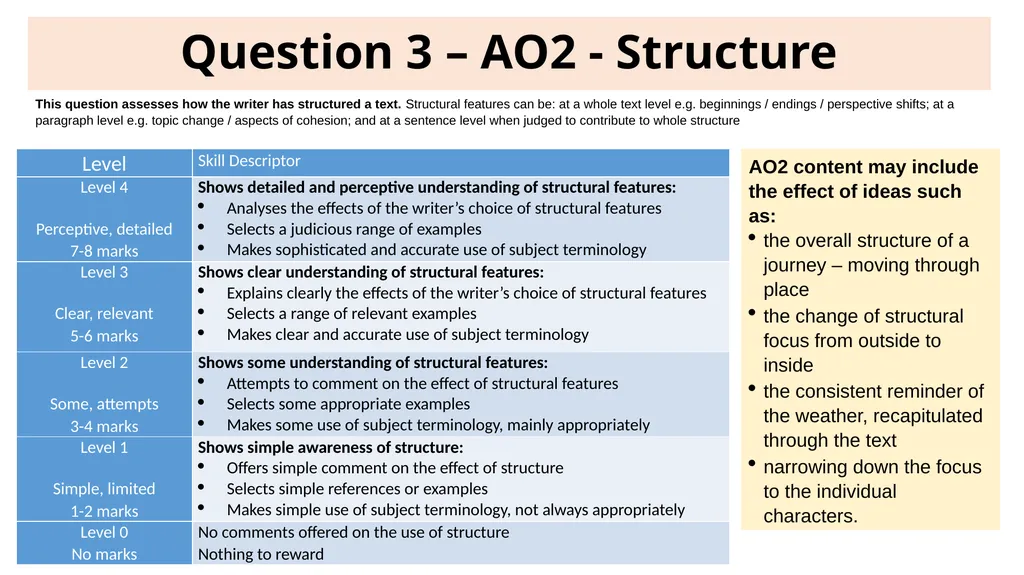
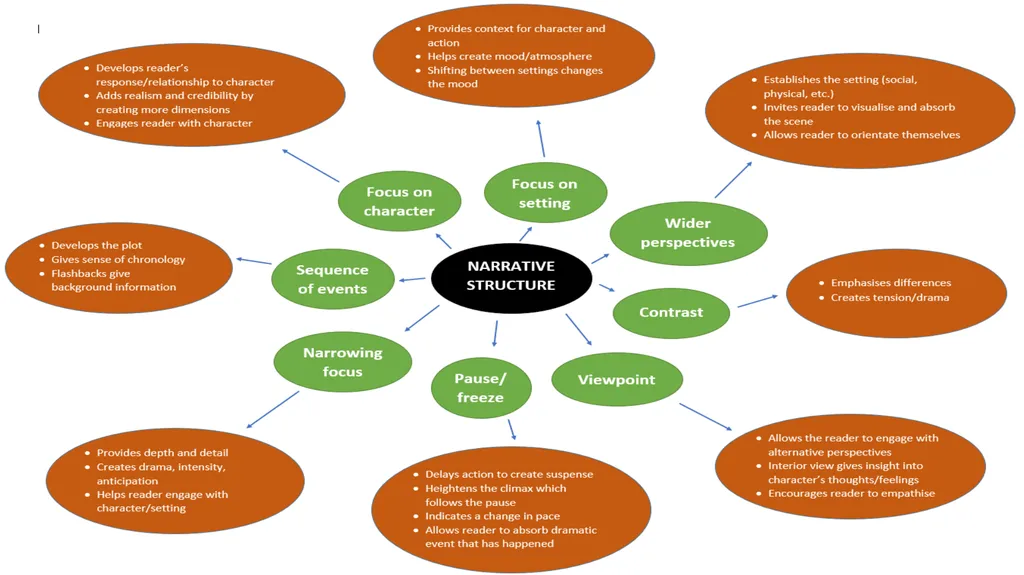
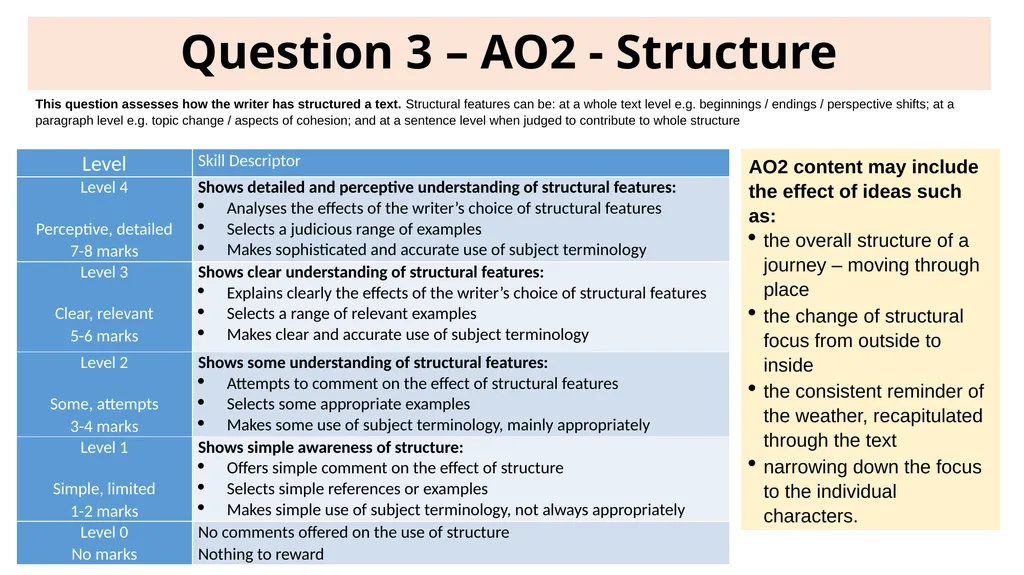
Question 3 – AO2 - Structure AO2 content may include the effect of ideas such as:
the overall structure of a journey – moving through place
the change of structural focus from outside to inside
the consistent reminder of the weather, recapitulated through the text
narrowing down the focus to the individual characters. This question assesses how the writer has structured a text. Structural features can be: at a whole text level e.g. beginnings / endings / perspective shifts; at a paragraph level e.g. topic change / aspects of cohesion; and at a sentence level when judged to contribute to whole structure<br>
21
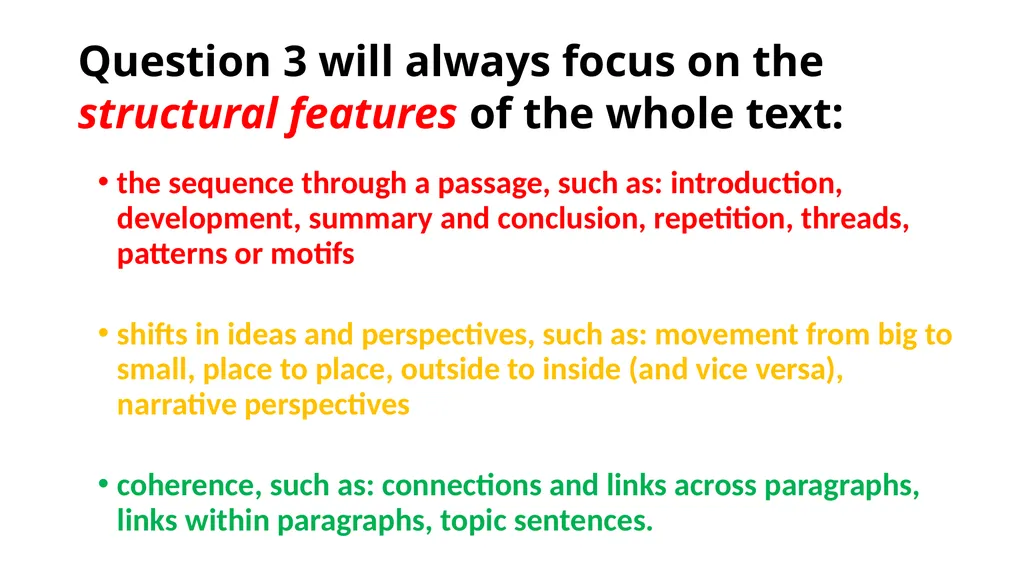
Question 3 will always focus on the structural features of the whole text: the sequence through a passage, such as: introduction, development, summary and conclusion, repetition, threads, patterns or motifs
shifts in ideas and perspectives, such as: movement from big to small, place to place, outside to inside (and vice versa), narrative perspectives
coherence, such as: connections and links across paragraphs, links within paragraphs, topic sentences.<br>
shifts in ideas and perspectives, such as: movement from big to small, place to place, outside to inside (and vice versa), narrative perspectives
coherence, such as: connections and links across paragraphs, links within paragraphs, topic sentences.<br>
22
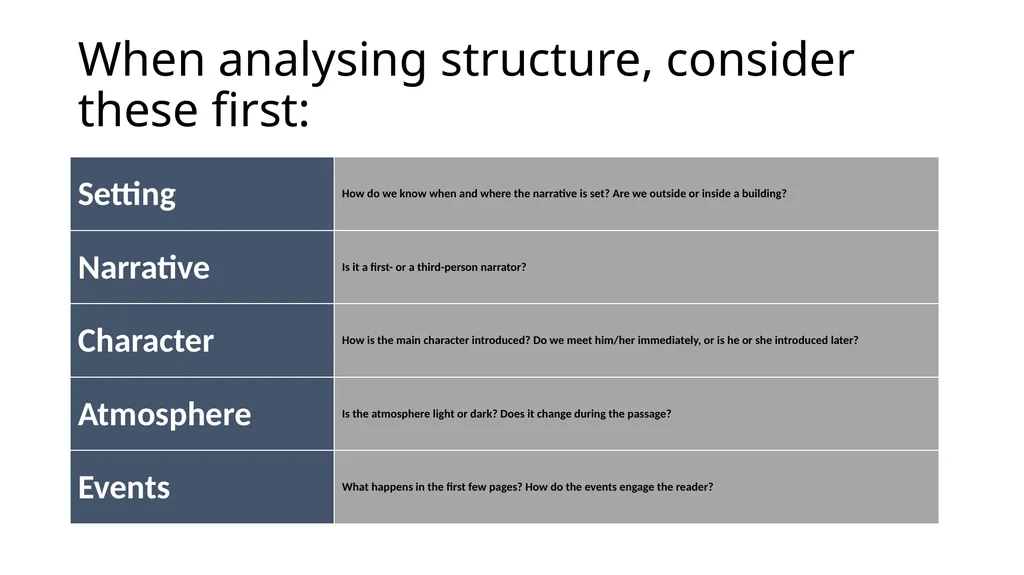
When analysing structure, consider these first:<br>
23
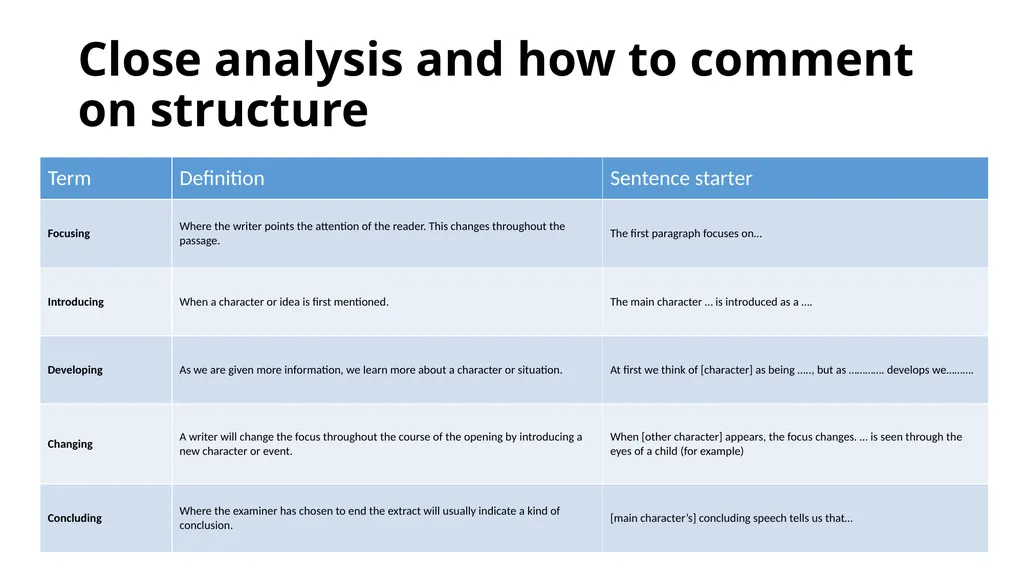
Close analysis and how to comment on structure<br>
24
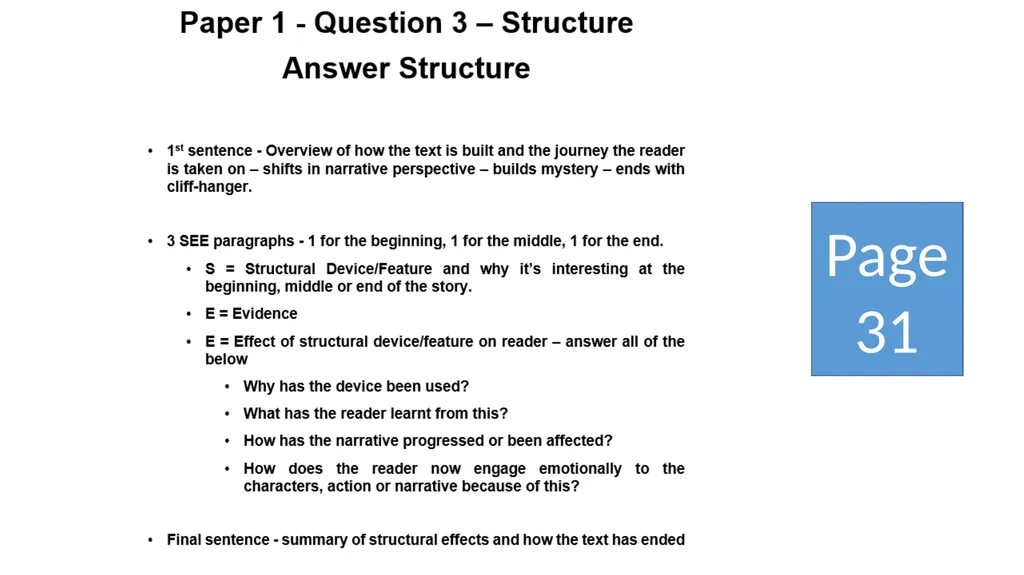
Page 31<br>
25
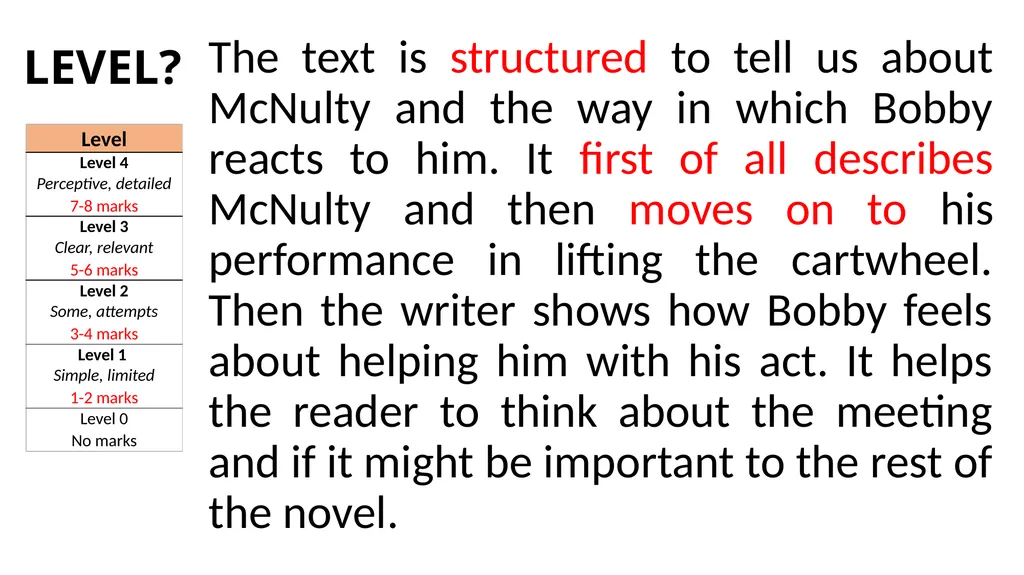
LEVEL? The text is structured to tell us about McNulty and the way in which Bobby reacts to him. It first of all describes McNulty and then moves on to his performance in lifting the cartwheel. Then the writer shows how Bobby feels about helping him with his act. It helps the reader to think about the meeting and if it might be important to the rest of the novel.<br>
26
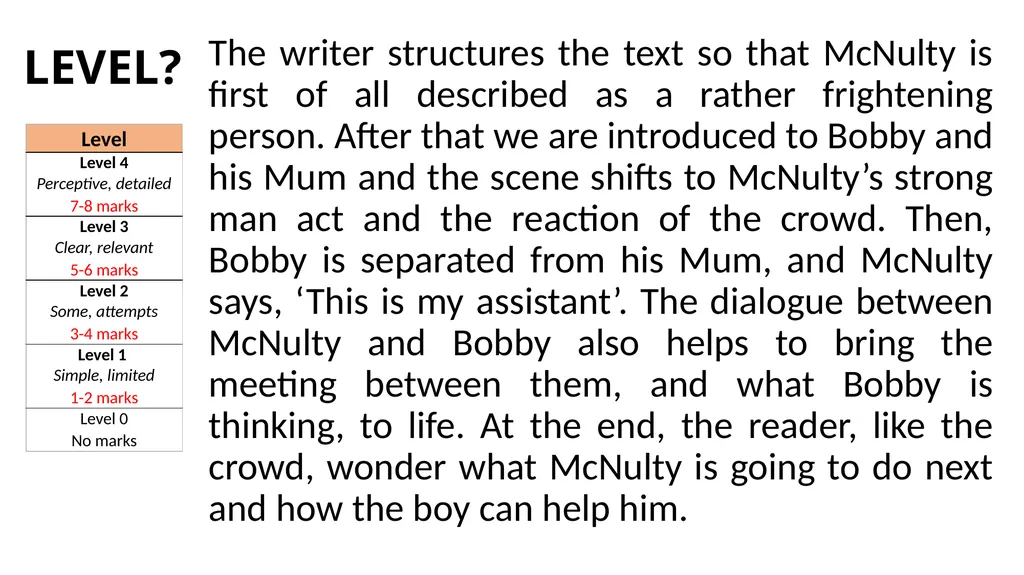
LEVEL? The writer structures the text so that McNulty is first of all described as a rather frightening person. After that we are introduced to Bobby and his Mum and the scene shifts to McNulty’s strong man act and the reaction of the crowd. Then, Bobby is separated from his Mum, and McNulty says, ‘This is my assistant’. The dialogue between McNulty and Bobby also helps to bring the meeting between them, and what Bobby is thinking, to life. At the end, the reader, like the crowd, wonder what McNulty is going to do next and how the boy can help him.<br>
27
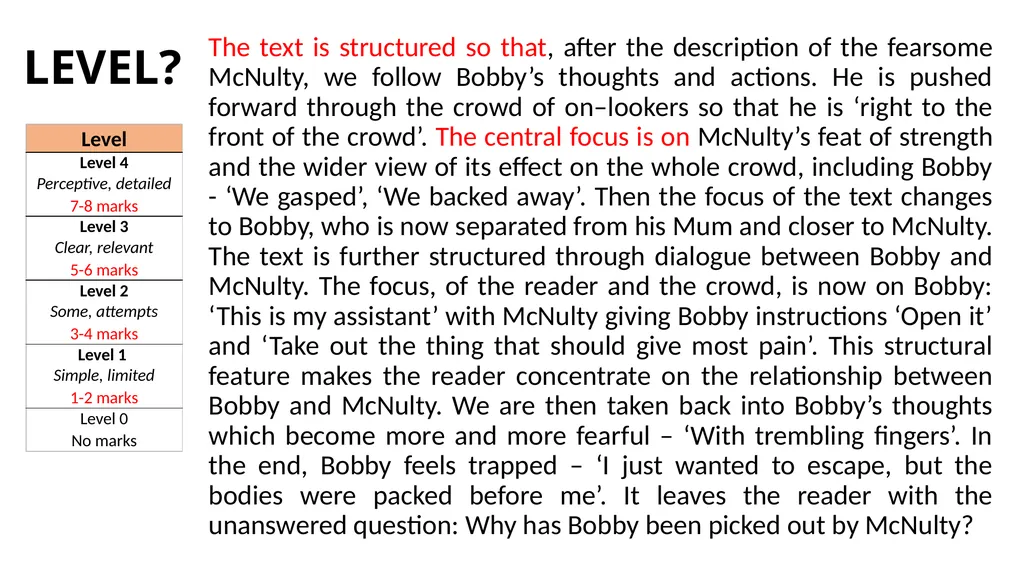
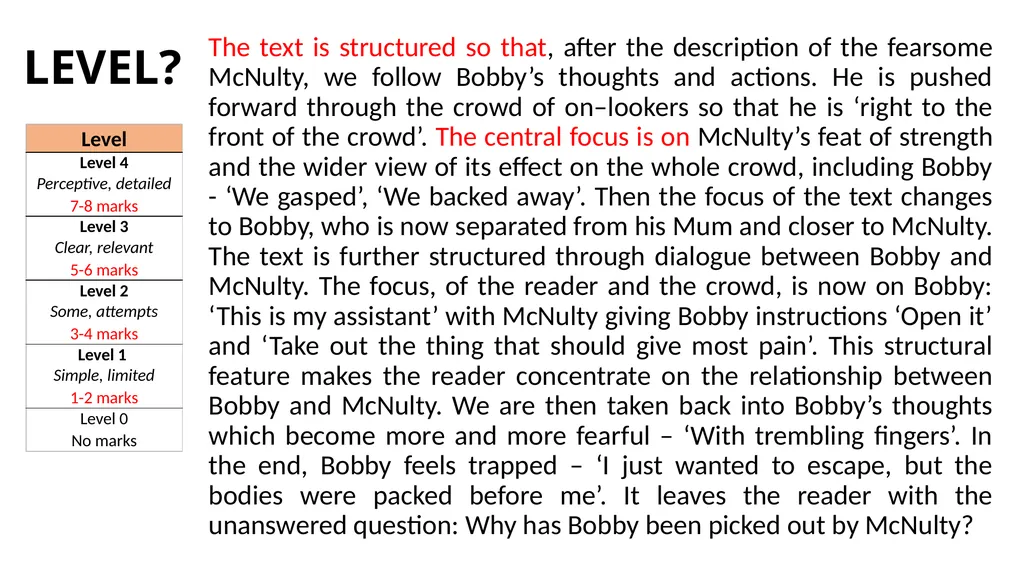
LEVEL? The text is structured so that, after the description of the fearsome McNulty, we follow Bobby’s thoughts and actions. He is pushed forward through the crowd of on–lookers so that he is ‘right to the front of the crowd’. The central focus is on McNulty’s feat of strength and the wider view of its effect on the whole crowd, including Bobby - ‘We gasped’, ‘We backed away’. Then the focus of the text changes to Bobby, who is now separated from his Mum and closer to McNulty. The text is further structured through dialogue between Bobby and McNulty. The focus, of the reader and the crowd, is now on Bobby: ‘This is my assistant’ with McNulty giving Bobby instructions ‘Open it’ and ‘Take out the thing that should give most pain’. This structural feature makes the reader concentrate on the relationship between Bobby and McNulty. We are then taken back into Bobby’s thoughts which become more and more fearful – ‘With trembling fingers’. In the end, Bobby feels trapped – ‘I just wanted to escape, but the bodies were packed before me’. It leaves the reader with the unanswered question: Why has Bobby been picked out by McNulty?<br>
28
Explaining Story Structure WALT: use structural terminology in explaining story structure. STARTER:
IN PAIRS, COME UP WITH AS MANY STRUCTURAL TERMS AS POSSIBLE.<br>
IN PAIRS, COME UP WITH AS MANY STRUCTURAL TERMS AS POSSIBLE.<br>
29
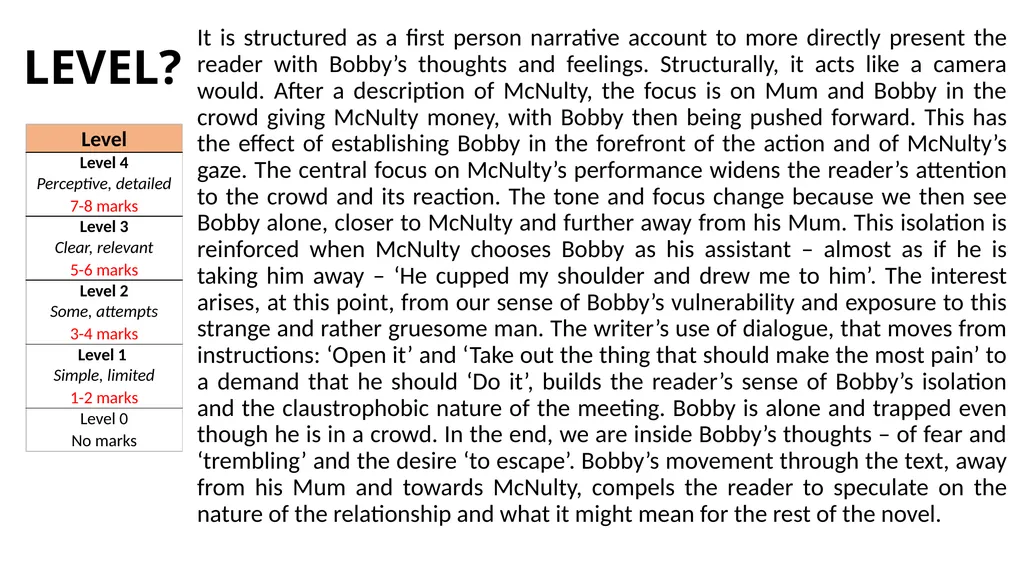
LEVEL? It is structured as a first person narrative account to more directly present the reader with Bobby’s thoughts and feelings. Structurally, it acts like a camera would. After a description of McNulty, the focus is on Mum and Bobby in the crowd giving McNulty money, with Bobby then being pushed forward. This has the effect of establishing Bobby in the forefront of the action and of McNulty’s gaze. The central focus on McNulty’s performance widens the reader’s attention to the crowd and its reaction. The tone and focus change because we then see Bobby alone, closer to McNulty and further away from his Mum. This isolation is reinforced when McNulty chooses Bobby as his assistant – almost as if he is taking him away – ‘He cupped my shoulder and drew me to him’. The interest arises, at this point, from our sense of Bobby’s vulnerability and exposure to this strange and rather gruesome man. The writer’s use of dialogue, that moves from instructions: ‘Open it’ and ‘Take out the thing that should make the most pain’ to a demand that he should ‘Do it’, builds the reader’s sense of Bobby’s isolation and the claustrophobic nature of the meeting. Bobby is alone and trapped even though he is in a crowd. In the end, we are inside Bobby’s thoughts – of fear and ‘trembling’ and the desire ‘to escape’. Bobby’s movement through the text, away from his Mum and towards McNulty, compels the reader to speculate on the nature of the relationship and what it might mean for the rest of the novel.<br>
30
Annotate: structural terminology
evidence
explanations<br>
evidence
explanations<br>
31
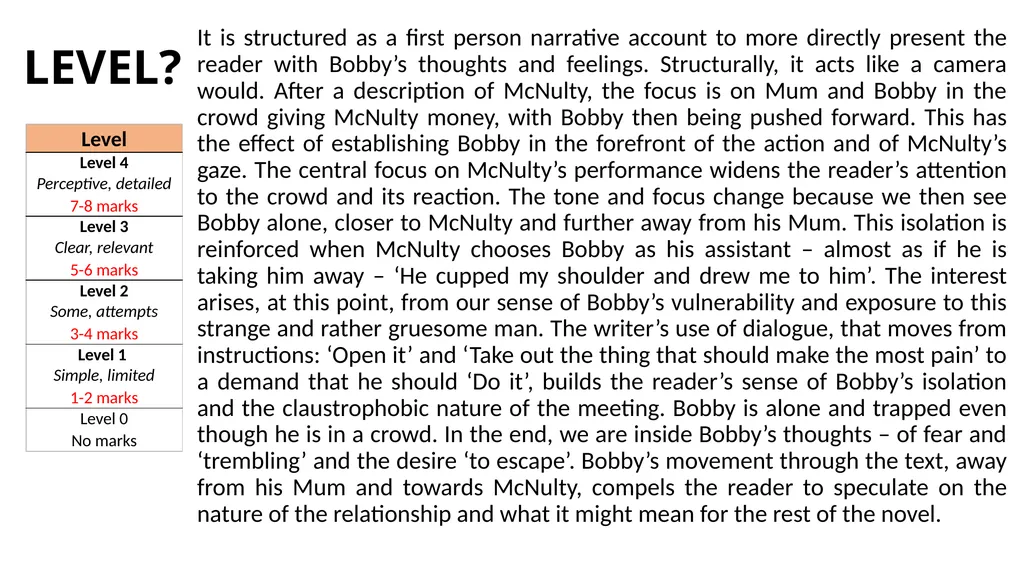
LEVEL? It is structured as a first person narrative account to more directly present the reader with Bobby’s thoughts and feelings. Structurally, it acts like a camera would. After a description of McNulty, the focus is on Mum and Bobby in the crowd giving McNulty money, with Bobby then being pushed forward. This has the effect of establishing Bobby in the forefront of the action and of McNulty’s gaze. The central focus on McNulty’s performance widens the reader’s attention to the crowd and its reaction. The tone and focus change because we then see Bobby alone, closer to McNulty and further away from his Mum. This isolation is reinforced when McNulty chooses Bobby as his assistant – almost as if he is taking him away – ‘He cupped my shoulder and drew me to him’. The interest arises, at this point, from our sense of Bobby’s vulnerability and exposure to this strange and rather gruesome man. The writer’s use of dialogue, that moves from instructions: ‘Open it’ and ‘Take out the thing that should make the most pain’ to a demand that he should ‘Do it’, builds the reader’s sense of Bobby’s isolation and the claustrophobic nature of the meeting. Bobby is alone and trapped even though he is in a crowd. In the end, we are inside Bobby’s thoughts – of fear and ‘trembling’ and the desire ‘to escape’. Bobby’s movement through the text, away from his Mum and towards McNulty, compels the reader to speculate on the nature of the relationship and what it might mean for the rest of the novel.<br>
32
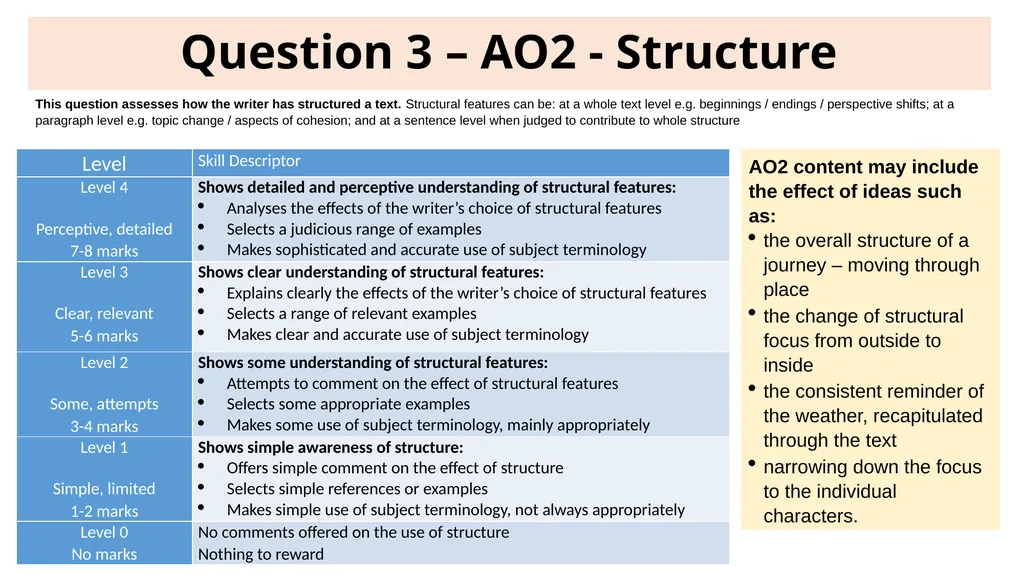
Question 3 – AO2 - Structure AO2 content may include the effect of ideas such as:
the overall structure of a journey – moving through place
the change of structural focus from outside to inside
the consistent reminder of the weather, recapitulated through the text
narrowing down the focus to the individual characters. This question assesses how the writer has structured a text. Structural features can be: at a whole text level e.g. beginnings / endings / perspective shifts; at a paragraph level e.g. topic change / aspects of cohesion; and at a sentence level when judged to contribute to whole structure<br>
the overall structure of a journey – moving through place
the change of structural focus from outside to inside
the consistent reminder of the weather, recapitulated through the text
narrowing down the focus to the individual characters. This question assesses how the writer has structured a text. Structural features can be: at a whole text level e.g. beginnings / endings / perspective shifts; at a paragraph level e.g. topic change / aspects of cohesion; and at a sentence level when judged to contribute to whole structure<br>
33
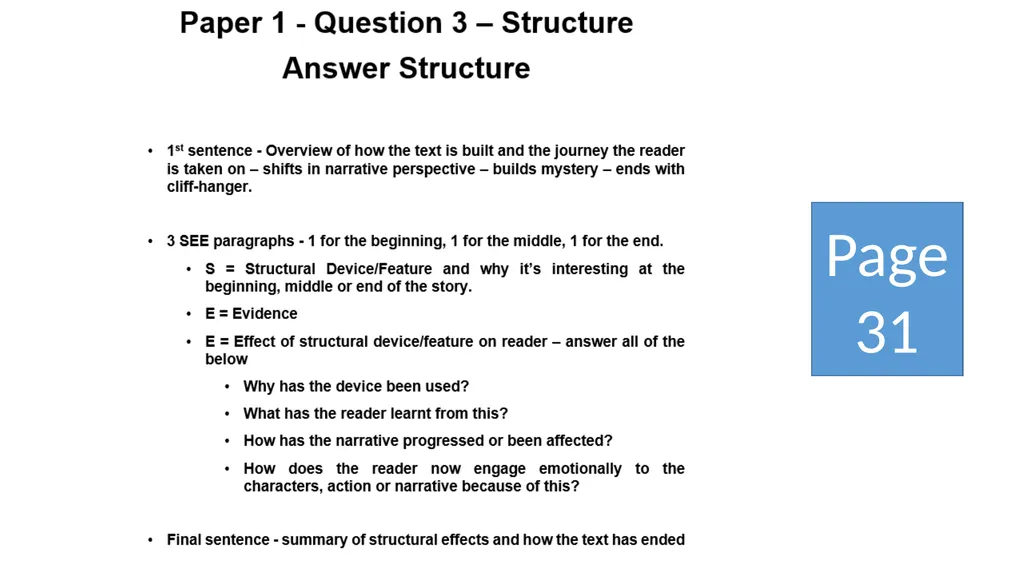
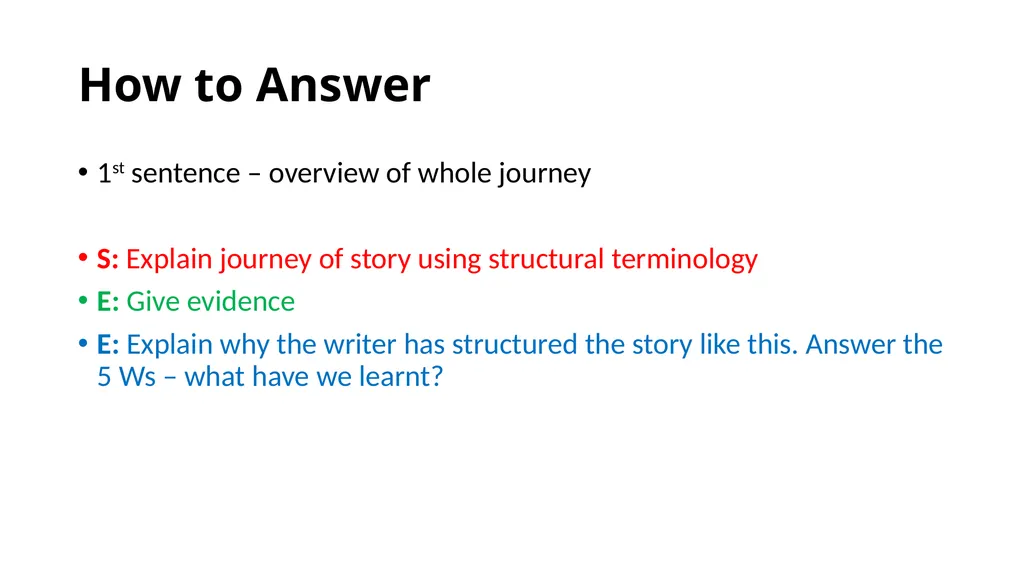
How to Answer 1st sentence – overview of whole journey
S: Explain journey of story using structural terminology
E: Give evidence
E: Explain why the writer has structured the story like this. Answer the 5 Ws – what have we learnt?<br>
S: Explain journey of story using structural terminology
E: Give evidence
E: Explain why the writer has structured the story like this. Answer the 5 Ws – what have we learnt?<br>
34
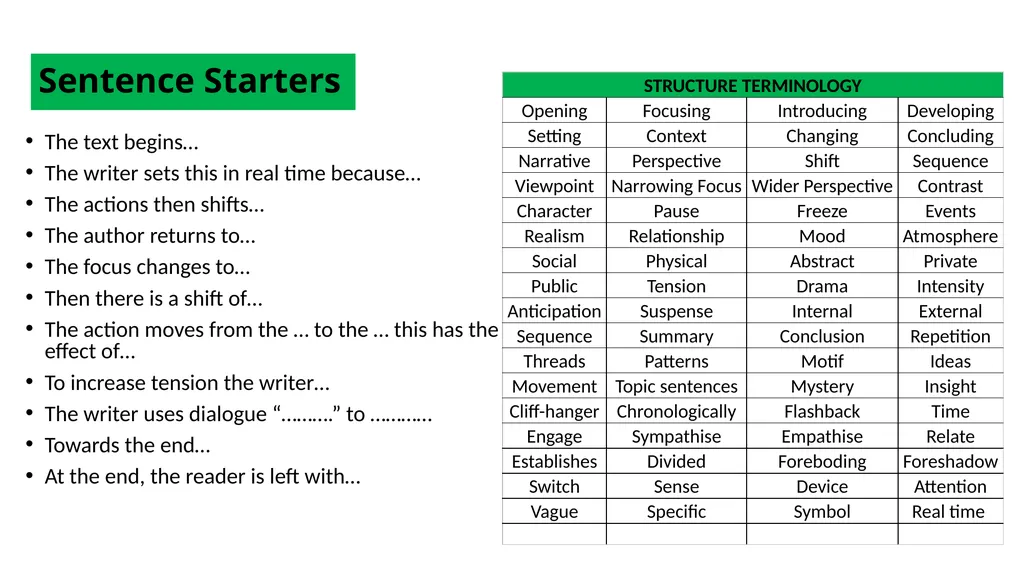
Sentence Starters The text begins…
The writer sets this in real time because…
The actions then shifts…
The author returns to…
The focus changes to…
Then there is a shift of…
The action moves from the … to the … this has the effect of…
To increase tension the writer…
The writer uses dialogue “……….” to …………
Towards the end…
At the end, the reader is left with…<br>
35
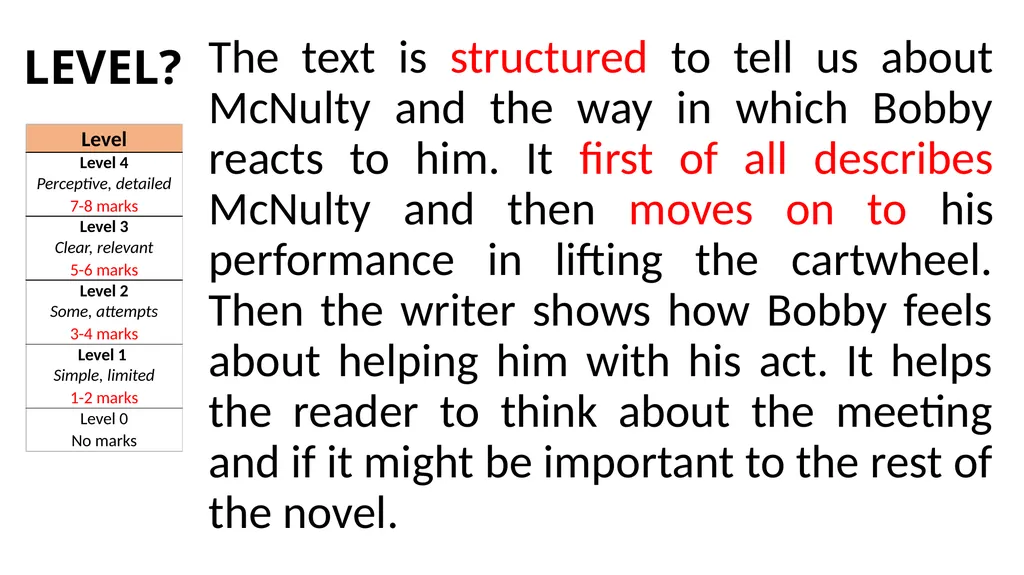
LEVEL? The text is structured to tell us about McNulty and the way in which Bobby reacts to him. It first of all describes McNulty and then moves on to his performance in lifting the cartwheel. Then the writer shows how Bobby feels about helping him with his act. It helps the reader to think about the meeting and if it might be important to the rest of the novel.<br>
36
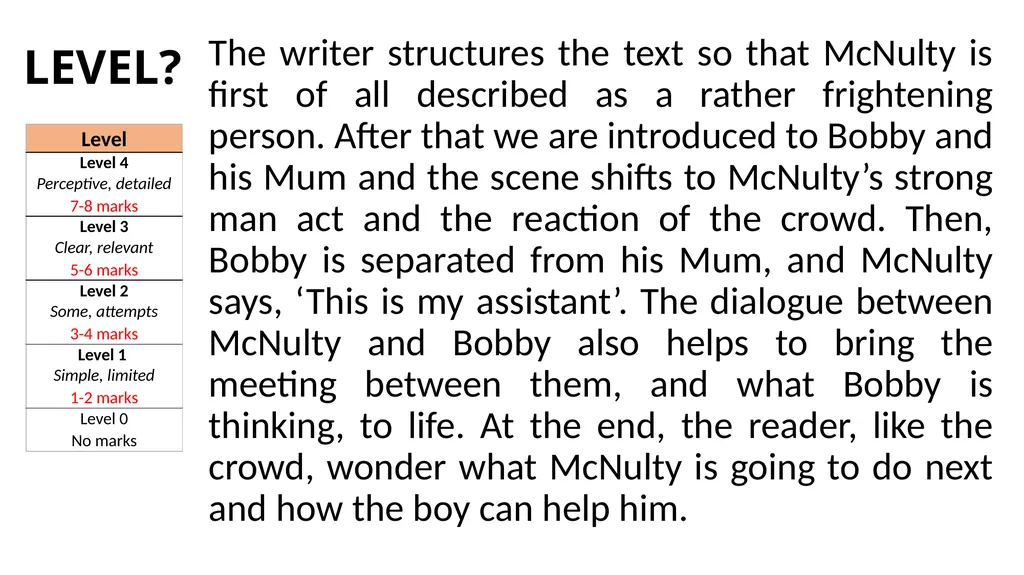
LEVEL? The writer structures the text so that McNulty is first of all described as a rather frightening person. After that we are introduced to Bobby and his Mum and the scene shifts to McNulty’s strong man act and the reaction of the crowd. Then, Bobby is separated from his Mum, and McNulty says, ‘This is my assistant’. The dialogue between McNulty and Bobby also helps to bring the meeting between them, and what Bobby is thinking, to life. At the end, the reader, like the crowd, wonder what McNulty is going to do next and how the boy can help him.<br>
37
LEVEL? The text is structured so that, after the description of the fearsome McNulty, we follow Bobby’s thoughts and actions. He is pushed forward through the crowd of on–lookers so that he is ‘right to the front of the crowd’. The central focus is on McNulty’s feat of strength and the wider view of its effect on the whole crowd, including Bobby - ‘We gasped’, ‘We backed away’. Then the focus of the text changes to Bobby, who is now separated from his Mum and closer to McNulty. The text is further structured through dialogue between Bobby and McNulty. The focus, of the reader and the crowd, is now on Bobby: ‘This is my assistant’ with McNulty giving Bobby instructions ‘Open it’ and ‘Take out the thing that should give most pain’. This structural feature makes the reader concentrate on the relationship between Bobby and McNulty. We are then taken back into Bobby’s thoughts which become more and more fearful – ‘With trembling fingers’. In the end, Bobby feels trapped – ‘I just wanted to escape, but the bodies were packed before me’. It leaves the reader with the unanswered question: Why has Bobby been picked out by McNulty?<br>
38
Question 3 – AO2 - Structure AO2 content may include the effect of ideas such as:
the overall structure of a journey – moving through place
the change of structural focus from outside to inside
the consistent reminder of the weather, recapitulated through the text
narrowing down the focus to the individual characters. This question assesses how the writer has structured a text. Structural features can be: at a whole text level e.g. beginnings / endings / perspective shifts; at a paragraph level e.g. topic change / aspects of cohesion; and at a sentence level when judged to contribute to whole structure<br>
the overall structure of a journey – moving through place
the change of structural focus from outside to inside
the consistent reminder of the weather, recapitulated through the text
narrowing down the focus to the individual characters. This question assesses how the writer has structured a text. Structural features can be: at a whole text level e.g. beginnings / endings / perspective shifts; at a paragraph level e.g. topic change / aspects of cohesion; and at a sentence level when judged to contribute to whole structure<br>
39
Page 31<br>
40
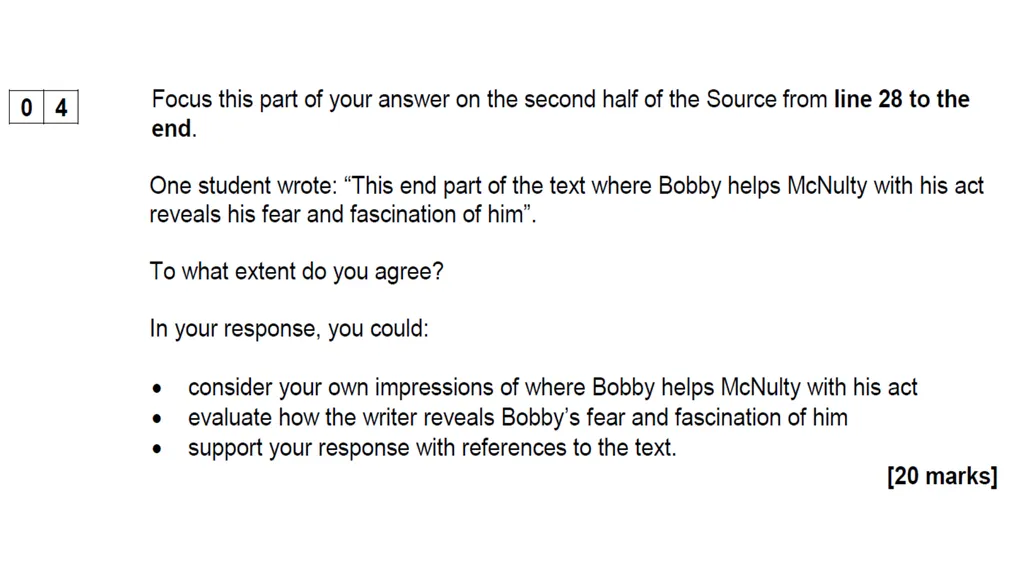
Question 4 Evaluate Texts Critically<br>
41
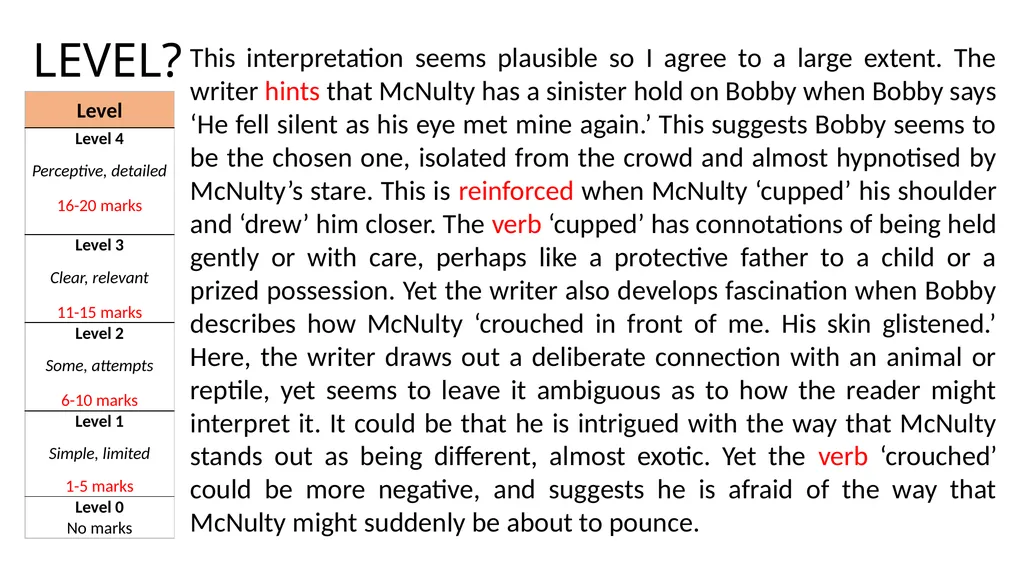
LEVEL? This interpretation seems plausible so I agree to a large extent. The writer hints that McNulty has a sinister hold on Bobby when Bobby says ‘He fell silent as his eye met mine again.’ This suggests Bobby seems to be the chosen one, isolated from the crowd and almost hypnotised by McNulty’s stare. This is reinforced when McNulty ‘cupped’ his shoulder and ‘drew’ him closer. The verb ‘cupped’ has connotations of being held gently or with care, perhaps like a protective father to a child or a prized possession. Yet the writer also develops fascination when Bobby describes how McNulty ‘crouched in front of me. His skin glistened.’ Here, the writer draws out a deliberate connection with an animal or reptile, yet seems to leave it ambiguous as to how the reader might interpret it. It could be that he is intrigued with the way that McNulty stands out as being different, almost exotic. Yet the verb ‘crouched’ could be more negative, and suggests he is afraid of the way that McNulty might suddenly be about to pounce.<br>
42
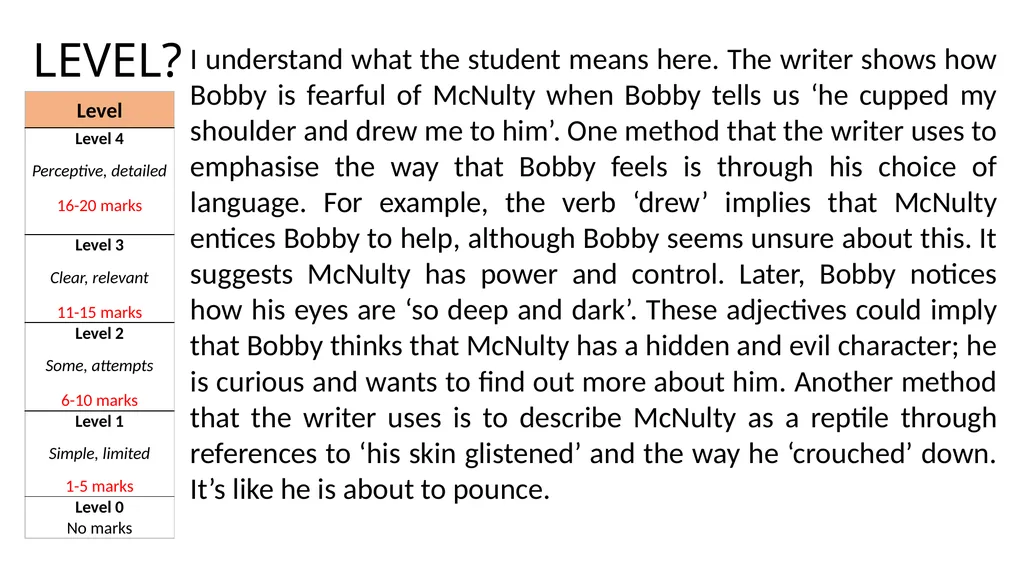
LEVEL? I understand what the student means here. The writer shows how Bobby is fearful of McNulty when Bobby tells us ‘he cupped my shoulder and drew me to him’. One method that the writer uses to emphasise the way that Bobby feels is through his choice of language. For example, the verb ‘drew’ implies that McNulty entices Bobby to help, although Bobby seems unsure about this. It suggests McNulty has power and control. Later, Bobby notices how his eyes are ‘so deep and dark’. These adjectives could imply that Bobby thinks that McNulty has a hidden and evil character; he is curious and wants to find out more about him. Another method that the writer uses is to describe McNulty as a reptile through references to ‘his skin glistened’ and the way he ‘crouched’ down. It’s like he is about to pounce.<br>
43
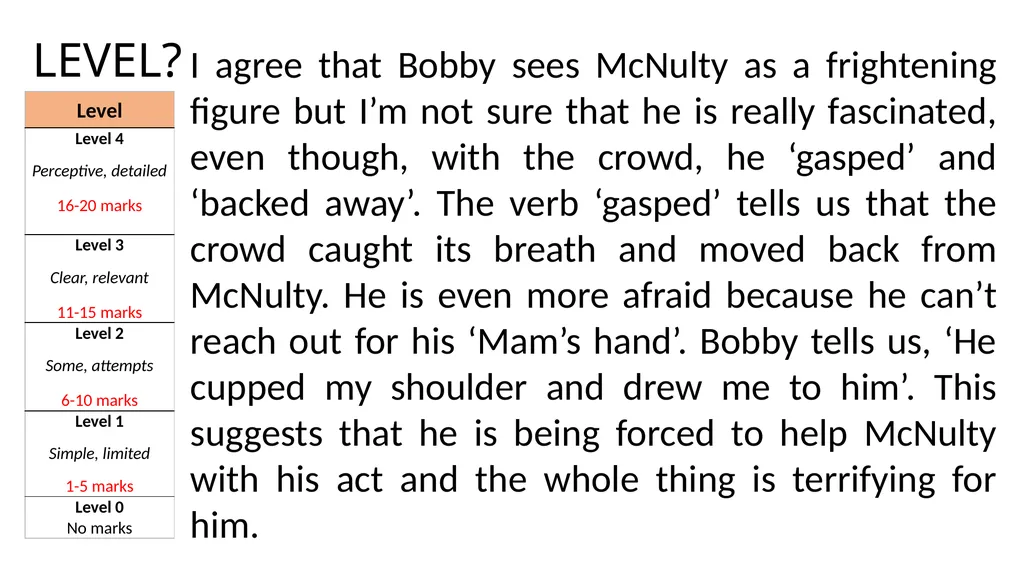
LEVEL? I agree that Bobby sees McNulty as a frightening figure but I’m not sure that he is really fascinated, even though, with the crowd, he ‘gasped’ and ‘backed away’. The verb ‘gasped’ tells us that the crowd caught its breath and moved back from McNulty. He is even more afraid because he can’t reach out for his ‘Mam’s hand’. Bobby tells us, ‘He cupped my shoulder and drew me to him’. This suggests that he is being forced to help McNulty with his act and the whole thing is terrifying for him.<br>
44
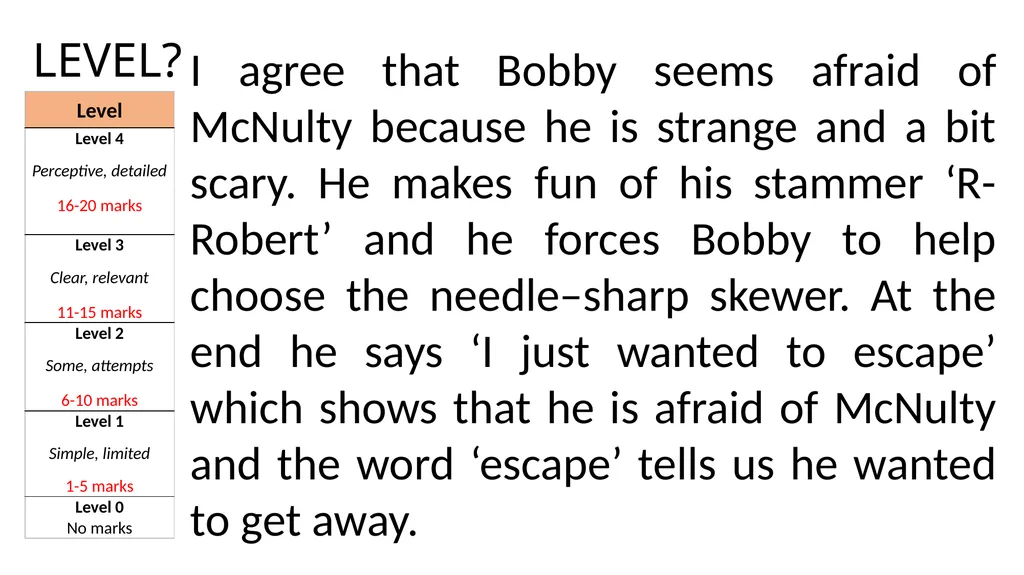
LEVEL? I agree that Bobby seems afraid of McNulty because he is strange and a bit scary. He makes fun of his stammer ‘R-Robert’ and he forces Bobby to help choose the needle–sharp skewer. At the end he says ‘I just wanted to escape’ which shows that he is afraid of McNulty and the word ‘escape’ tells us he wanted to get away.<br>
45
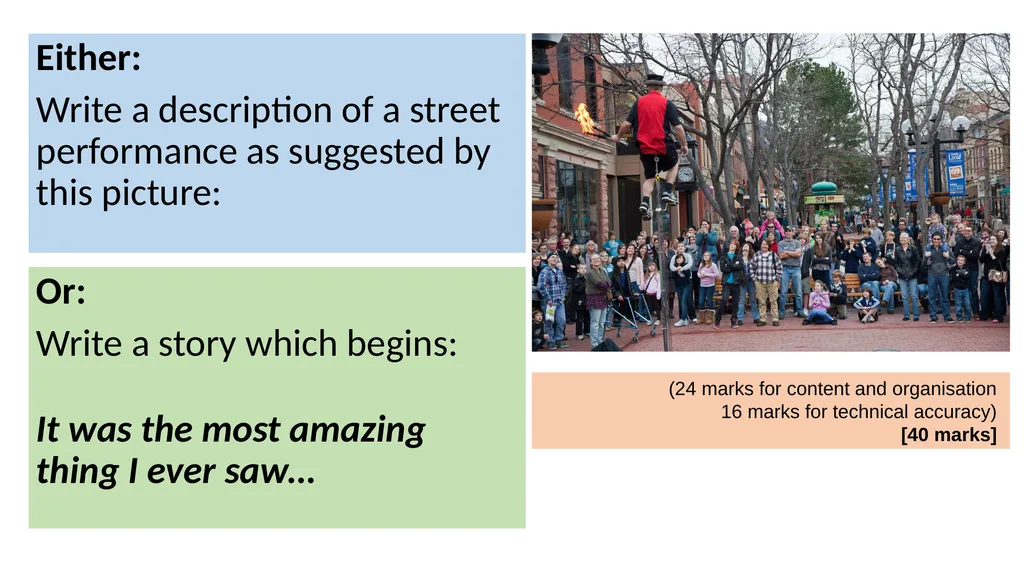
Either:
Write a description of a street performance as suggested by this picture: Or:
Write a story which begins:
It was the most amazing thing I ever saw… (24 marks for content and organisation
16 marks for technical accuracy)
[40 marks]<br>
Write a description of a street performance as suggested by this picture: Or:
Write a story which begins:
It was the most amazing thing I ever saw… (24 marks for content and organisation
16 marks for technical accuracy)
[40 marks]<br>