The Future of Financial Markets on the Cloud Deep Hedging and Heat Rate Options Mark Higgins, Co-Founder CAO Overview: Better Hedging Through Deep Learning Introduction to deep hedging Gas-fired power plant optimization Heat rate options
"The Future of Financial Markets on the Cloud Deep" is the property of its rightful owner. Permission is granted to
download and print the materials on this website for personal, non-commercial use only, and to display it
on your personal computer provided you do not modify the materials and that you retain all copyright
notices contained in the materials. By downloading content from our website, you accept the terms of this
agreement.
Presentation Transcript
01
The Future of Financial Markets on the Cloud Deep Hedging and Heat Rate Options
Mark Higgins, Co-Founder & CAO<br>
02
Overview: Better Hedging Through Deep Learning Introduction to deep hedging
Gas-fired power plant optimization
Heat rate options
Comparison of deep hedging to risk neutral hedging<br>
03
Introduction to Deep Hedging Paper by JPMorgan and academic partners in Feb 2018
https://arxiv.org/abs/1802.03042
Rethinks the core engine behind how to hedge a portfolio that generalizes beyond the assumptions behind traditional risk neutral pricing
They focused on hedging vanilla options under a Heston stochastic volatility world
In production at JPMorgan<br>
04
Risk Neutral Pricing and Post-Hedges PNL Distribution Risk neutral pricing is the traditional approach to derivatives pricing and risk management but makes three important assumptions:
No transaction costs when hedging
Hedges are dynamically rebalanced continuously
There are no unhedgeable risks
If those assumptions are valid, PNL distribution over life of a deal is a delta function
If they are violated, PNL distribution has some width
If that happens, what are hedging objectives?
Risk neutral processes: when simulating market prices for the purpose of derivative pricing, need to use a modified process so that expected value of a price in the future matches its market forward price<br>
05
Deep Hedging to Go Beyond Risk Neutral First, decide what you want to optimize
Convex risk measure of the post-hedges lifetime PNL distribution
eg expected shortfall
Assume that there’s a nonlinear function which, given the market conditions and portfolio, tells you the new hedge trades to do
In risk neutral pricing, that comes the sensitivity of the risk neutral price to market inputs
In deep hedging, it’s a neural network trained to minimize your convex risk measure<br>
06
Benefits of Deep Hedging over Risk Neutral Pricing No need for risk neutral processes - all real world measure
Reproduces standard risk neutral results in the limit of continuous hedging, no transaction costs, and no unhedgeable risks
Can use any realistic market model you want that violates those risk neutral assumptions
Transaction costs, infrequent hedging, unhedgeable risks
Lots of real world applications, eg
Life insurers issuing variable annuities
Commodity traders managing physical assets<br>
07
Example: Risk Neutral Limit Start with a simple case where we know the answer: delta hedging a short European call option with an underlying asset that follows geometric Brownian motion
All risks are hedgeable, no transaction costs, frequent hedging
Note that the asset process is the real world process, not risk neutral
Example: 20% volatility, initial spot = 1, zero rates, zero drift, 3m to expiration, strike = 1
Should agree with Black-Scholes delta in this limit as all risk neutral assumptions hold<br>
08
Example: Risk Neutral Limit Neural network structure:
Neural network, two hidden layers, 50 nodes each
Three inputs: current asset spot, current time, and current hedge notional
One output: incremental notional of delta to trade on new hedge
Training:
Generate a subset of Monte Carlo paths (100 paths); each path has 20 time steps (so not exactly continuous rebalancing)
At each time step on each path, ask the neural network for incremental hedge notional and add it to the portfolio
Calculate the 70%-ile expected shortfall from the resulting PNL distribution
Bump weights to minimize that expected shortfall
Repeat 10k times until results are converged
New set of 100 paths each time, so 1M paths overall<br>
09
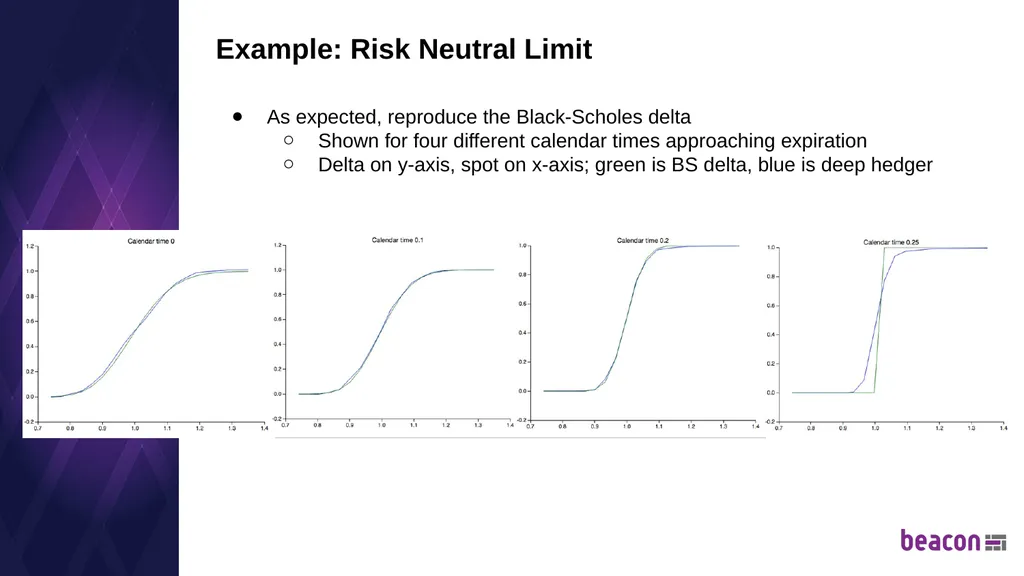
Example: Risk Neutral Limit As expected, reproduce the Black-Scholes delta
Shown for four different calendar times approaching expiration
Delta on y-axis, spot on x-axis; green is BS delta, blue is deep hedger<br>
10
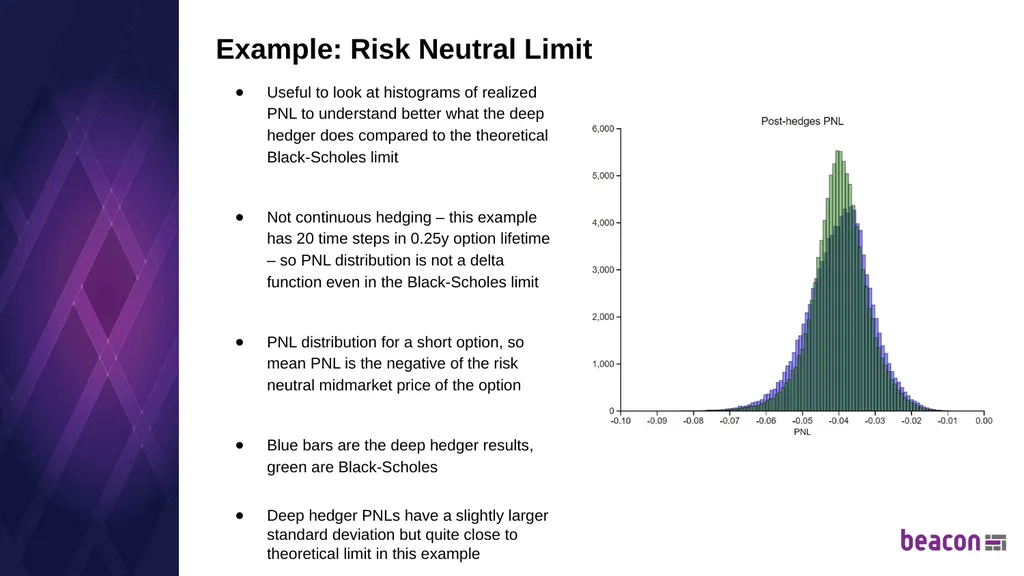
Example: Risk Neutral Limit Useful to look at histograms of realized PNL to understand better what the deep hedger does compared to the theoretical Black-Scholes limit
Not continuous hedging – this example has 20 time steps in 0.25y option lifetime – so PNL distribution is not a delta function even in the Black-Scholes limit
PNL distribution for a short option, so mean PNL is the negative of the risk neutral midmarket price of the option
Blue bars are the deep hedger results, green are Black-Scholes
Deep hedger PNLs have a slightly larger standard deviation but quite close to theoretical limit in this example<br>
11
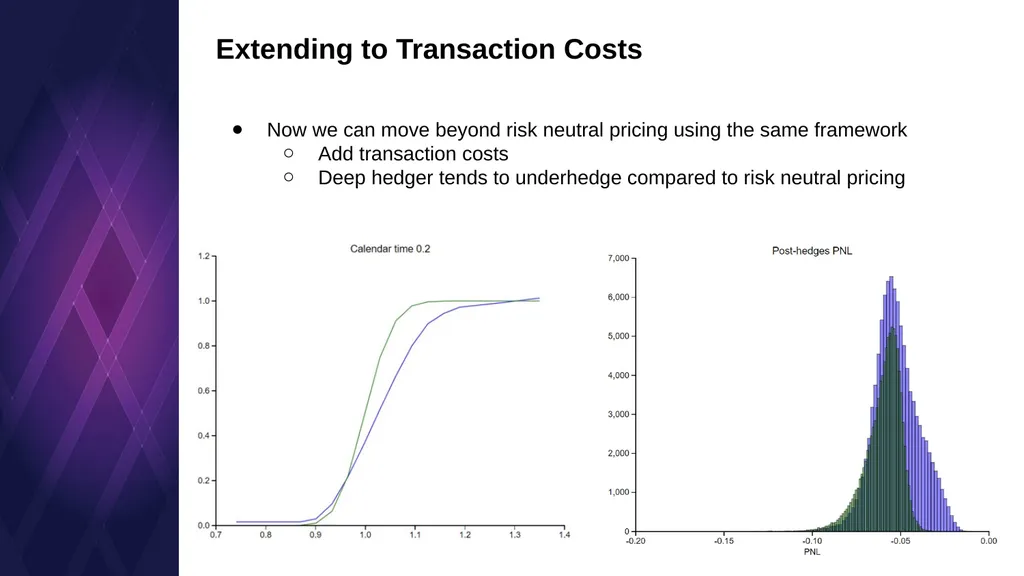
Extending to Transaction Costs Now we can move beyond risk neutral pricing using the same framework
Add transaction costs
Deep hedger tends to underhedge compared to risk neutral pricing<br>
12
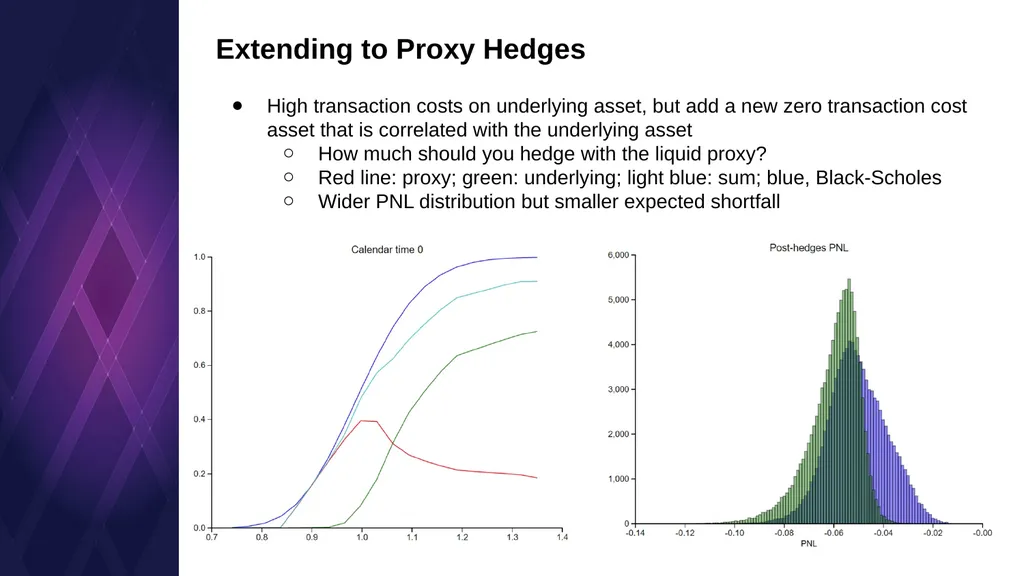
Extending to Proxy Hedges High transaction costs on underlying asset, but add a new zero transaction cost asset that is correlated with the underlying asset
How much should you hedge with the liquid proxy?
Red line: proxy; green: underlying; light blue: sum; blue, Black-Scholes
Wider PNL distribution but smaller expected shortfall<br>
13
Gas-Fired Power Plant Optimization Gas-fired power plant: buy and burn gas to generate and sell electricity
Run it when power-gas spread is high, don’t run it when it’s not
Acts like an option on the spread between power and gas prices
If unhedged, revenue from the plant is volatile
Volatile earnings are bad for company valuation
Hedging gas and power price risks smooths out revenue profile
In risk neutral limit, it makes revenue certain
Good for company valuation
Good example of a problem where risk neutral assumptions are violated
Power and gas markets for delivery at the power plant are often illiquid and have high transaction costs
Unhedgeable risks due to unexpected plant outages<br>
14
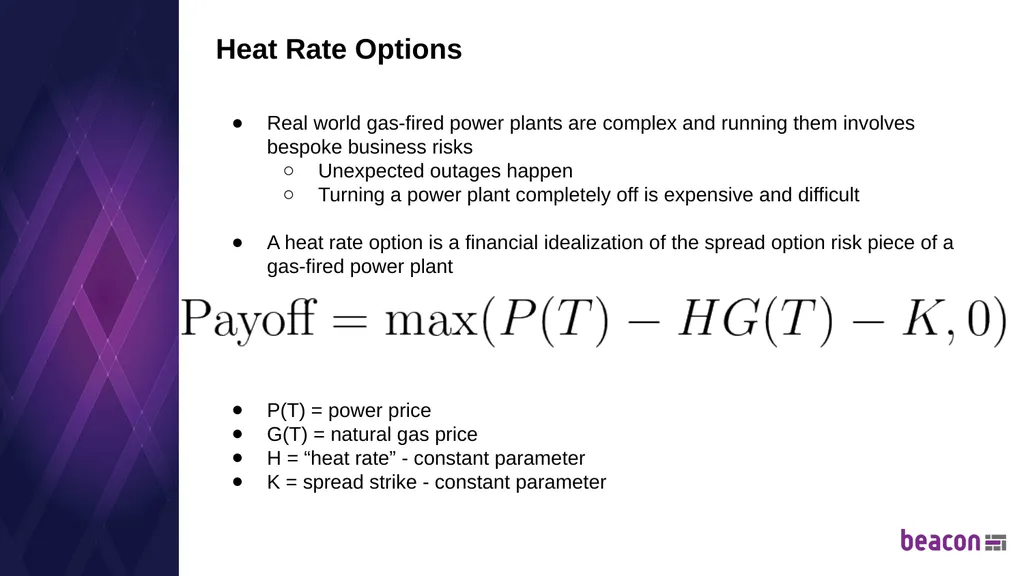
Heat Rate Options Real world gas-fired power plants are complex and running them involves bespoke business risks
Unexpected outages happen
Turning a power plant completely off is expensive and difficult
A heat rate option is a financial idealization of the spread option risk piece of a gas-fired power plant
P(T) = power price
G(T) = natural gas price
H = “heat rate” - constant parameter
K = spread strike - constant parameter<br>
15
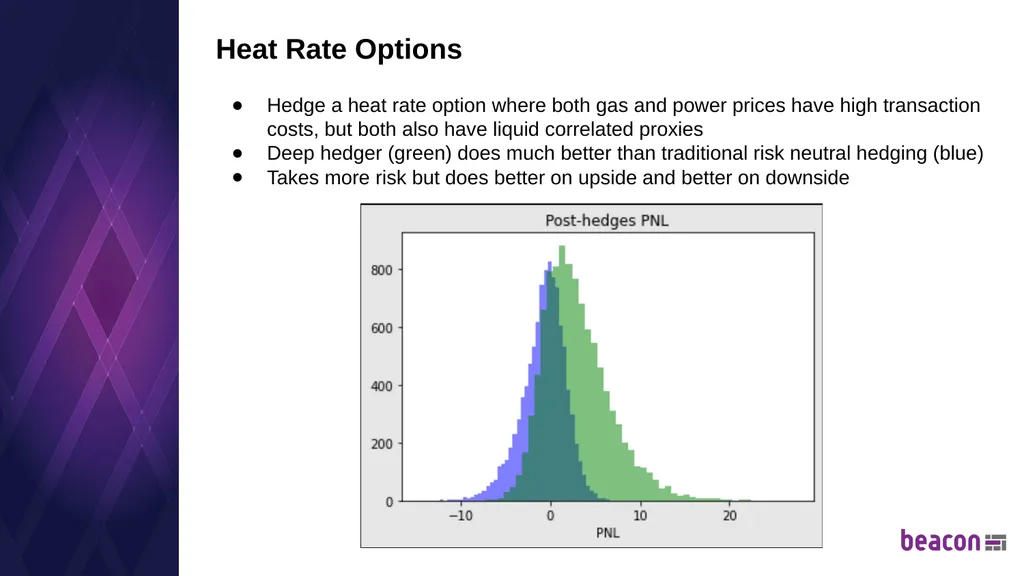
Heat Rate Options Hedge a heat rate option where both gas and power prices have high transaction costs, but both also have liquid correlated proxies
Deep hedger (green) does much better than traditional risk neutral hedging (blue)
Takes more risk but does better on upside and better on downside<br>
16
Conclusions Deep hedging is a powerful new machine learning technique in derivatives pricing and risk management
Deep hedging reproduces the results of risk neutral pricing when those assumptions are satisfied
It that lets us extend quantitative hedging methods beyond the constraints of risk neutral pricing
There are many problems of real option optimization in commodity markets where these techniques can perform better than previous state of the art<br>