
The Hidden Power Of Hypnosis in Couples Therapy
JO
Published · 27 slides · 0 views

1 / 1

Description
The Hidden Power Of Hypnosis in Couples Therapy Lilian Borges, LPC Arizona, USA Lilian Borges The Milton H. Erickson Foundation Faculty for the Hypnosis Intensive Trainings for more than 23 years Teaching Hypnosis for more than 33 years
Related Topics
Share
Embed code
Download this presentation From Below
"The Hidden Power Of Hypnosis in Couples Therapy" is the property of its rightful owner. Permission is granted to download and print the materials on this website for personal, non-commercial use only, and to display it on your personal computer provided you do not modify the materials and that you retain all copyright notices contained in the materials. By downloading content from our website, you accept the terms of this agreement.
Presentation Transcript
01
The Hidden Power Of Hypnosis in Couples Therapy Lilian Borges, LPC
Arizona, USA<br>
Arizona, USA<br>
02
Lilian Borges The Milton H. Erickson Foundation Faculty for the Hypnosis Intensive Trainings for more than 23 years
Teaching Hypnosis for more than 33 years
PACT Certified Therapist
PACT Teacher in Training
Expert in Hypnosis and Couples therapy
Integration of cultures, languages, approaches is my life’s work<br>
Teaching Hypnosis for more than 33 years
PACT Certified Therapist
PACT Teacher in Training
Expert in Hypnosis and Couples therapy
Integration of cultures, languages, approaches is my life’s work<br>
03
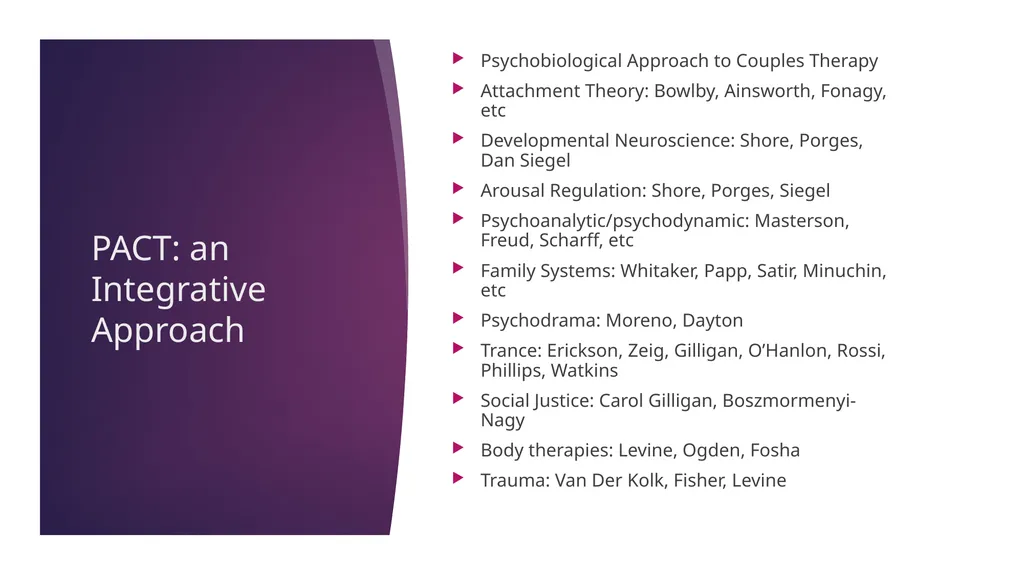
PACT: an Integrative Approach Psychobiological Approach to Couples Therapy
Attachment Theory: Bowlby, Ainsworth, Fonagy, etc
Developmental Neuroscience: Shore, Porges, Dan Siegel
Arousal Regulation: Shore, Porges, Siegel
Psychoanalytic/psychodynamic: Masterson, Freud, Scharff, etc
Family Systems: Whitaker, Papp, Satir, Minuchin, etc
Psychodrama: Moreno, Dayton
Trance: Erickson, Zeig, Gilligan, O’Hanlon, Rossi, Phillips, Watkins
Social Justice: Carol Gilligan, Boszmormenyi-Nagy
Body therapies: Levine, Ogden, Fosha
Trauma: Van Der Kolk, Fisher, Levine<br>
04
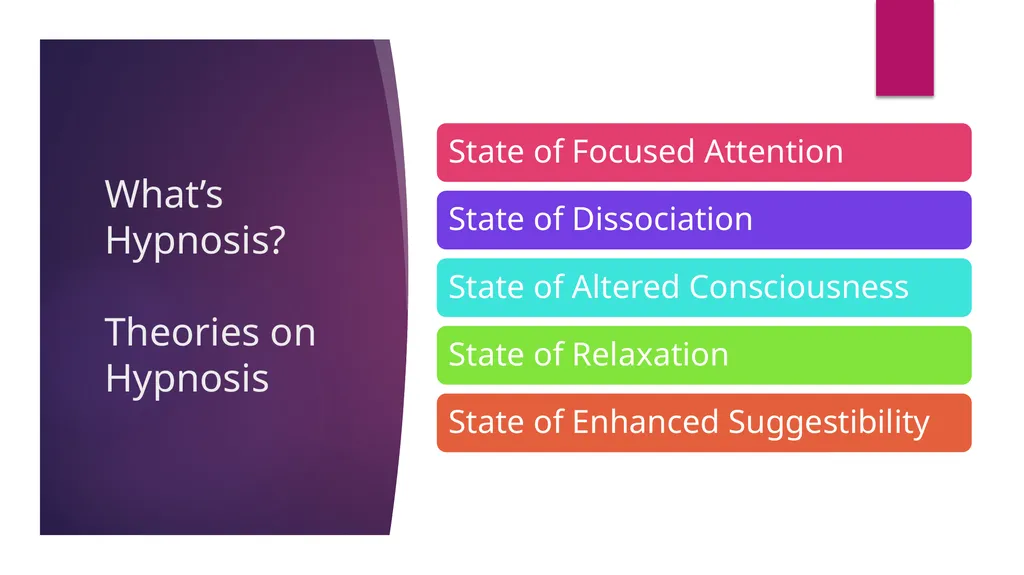
What’s Hypnosis?
Theories on Hypnosis<br>
05
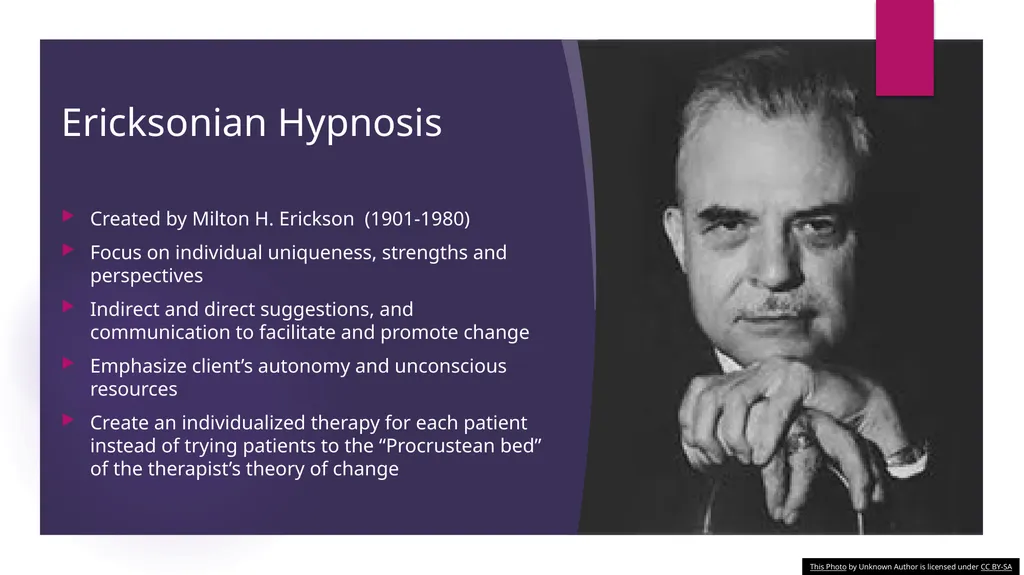
Ericksonian Hypnosis Created by Milton H. Erickson (1901-1980)
Focus on individual uniqueness, strengths and perspectives
Indirect and direct suggestions, and communication to facilitate and promote change
Emphasize client’s autonomy and unconscious resources
Create an individualized therapy for each patient instead of trying patients to the “Procrustean bed” of the therapist’s theory of change This Photo by Unknown Author is licensed under CC BY-SA<br>
06
Ericksonian Hypnosis: Utilization Ericksonian therapists place a primary emphasis on the relational aspects of attunement, and utilization in treatment (Erickson, 1959, 1982; Gilligan, 1987; Zeig, 2014; Borges, 2021)
Utilization is an Ericksonian concept that is a central strategy for working hypnotically with people. Using the patient’s values, language, body language, even the symptom we attune to the patient’s world like a parent would do with their child.
Using hypnotic suggestions according to the utilization approach, the therapist demonstrate the characteristics of a sensitive, responsive caregiver, which may facilitate the development of a secure relationship with the client
Inducing a trance in a different language<br>
07
Ericksonian Hypnosis: Utilization “Utilization is the readiness of the therapist to respond strategically to any and all aspects of the patient or the environment” (Zeig)
Therapist is always observing how the patient responded after each suggestion. Is it a ”yes” response or a “no” response. We are observing facial micro-expressions, breathing, relaxation, deepening in the trance state, etc.
Hypnosis can increase the sense of contingency
“…contigency refers to a relational experience in which you feel understood by another person. You have a felt sense that this person is attuned to you… You feel they “get” you” (Heller, 2016)
Attunement is essential in co-regulation<br>
08
Myths of Hypnosis Hypnosis is mind control
Hypnosis is a sleep state
Hypnosis is dangerous or harmful
Hypnosis can cure all problems
Hypnosis is for entertainment
Hypnotist has special powers
Hypnosis can make you reveal secrets, act like a fool or do something against your will
You can get stuck in hypnosis
Only certain people can be hypnotized
People have no memory of what happens in trance, etc<br>
09
Myth of hypnosis: Control<br>
10
Every hypnosis is self hypnosis<br>
11
DEMO
Non hypnotic imaginative suggestion exercise<br>
12
What hypnosis is: Hypnosis relies on the human ability to respond to one another
Hypnosis use aspects of human communication that we aren’t usually aware: tone, rhythm, volume, gestures, facial expressions, etc
7/38/55 rule: Mehrabian, UCLA Prof. research on body language: 7% words, 38% body language, 55% voice (93% of communication is non verbal! )
Hypnosis increases suggestibility. Responsiveness can increase with Skills Training: Carleton Skills Training Program (CSTP)
Hypnosis uses direct and indirect communication for attunement, emotional impact, promote change, etc.<br>
13
Integrative Definition of Hypnosis “We define hypnosis as a “situation” in which imaginative suggestions for changes in thoughts, feelings and actions are provided to a person in a context defined as “hypnosis” with the expectation that the participant will respond to them in a compelling manner consistent with his or her beliefs about hypnosis, often derived from the broader sociocultural context”. (Lynn et. al. 2015)
Imaginative suggestions can be given with or without the induction of hypnosis
Suggesting that things are ”just happening” contributes to the sense of being in trance, or the involuntariness that’s one of the main characteristics of hypnosis<br>
Imaginative suggestions can be given with or without the induction of hypnosis
Suggesting that things are ”just happening” contributes to the sense of being in trance, or the involuntariness that’s one of the main characteristics of hypnosis<br>
14
Integrative Definition of Hypnosis Individuals respond differently to hypnosis and suggestions
Suggestions are experienced as involuntary when they contain imagery, and would be expected to involuntary response, like the helium balloon as part of hand levitation
Altered state is not necessary to explain the hypnotic responses
People respond better when they see hypnosis as a collaboration and they are not as responsive when they describe it as a trance
(Lynn et. al. 2015)<br>
15
Hypnosis and Suggestibility How to explain phenomena like hallucination on command, amnesia for events or hypnotic anesthesia?
Someone is hypnotized when responds to imaginative suggestions that are presented following a hypnotic induction ritual.
Hypnotizability and Suggestibility describe two different concepts.
“Non-hypnotic and hypnotic suggestibility correlates strongly. Hypnotic suggestibility has proven to be a stable trait over time” (Lynn et. al. 2015)
“Words change physiology” (Bloom, 2004)
Apparent shifts in consciousness can be explained by operations of day-to-day consciousness and automatic behaviors like driving, or writing<br>
16
Hypnosis is NOT An extraordinary state induced by a powerful hypnotist on a passive and hypnotizable subject, who is debil, and has no control of their own experience and no recollection of what happens during the sleep-like state called trance!!!!<br>
17
Relational Aspects of Hypnosis In hypnosis, the relationship itself is key. It’s not just about talking or thinking, but also about the way the person feels—both mentally and physically.
Hypnosis creates the experience of joining the other in their phenomenological world. It is not only verbal, or emotional empathy
Using hypnotic suggestions according to the utilization approach, the therapist demonstrate the characteristics of a sensitive, responsive caregiver, which may facilitate the development of a secure relationship with the client<br>
18
Hypnosis and Attachment Styles …”attachment factors (anxiety and avoidance) were not associated with the level of hypnotizability. Whereas is was associated with variations of consciousness during hypnosis, mainly internal dialogue, absorption, and negative emotions. Overall, the insecure attachment styles yielded increased mind wandering and restlessness during hypnosis when compared to the secure style. The reason probably lies in the feeling of anxiety or danger of the insecurely attached individuals when involved in intimate or confidential relationships.”
(Di Fillippo & Perri, 2024)<br>
(Di Fillippo & Perri, 2024)<br>
19
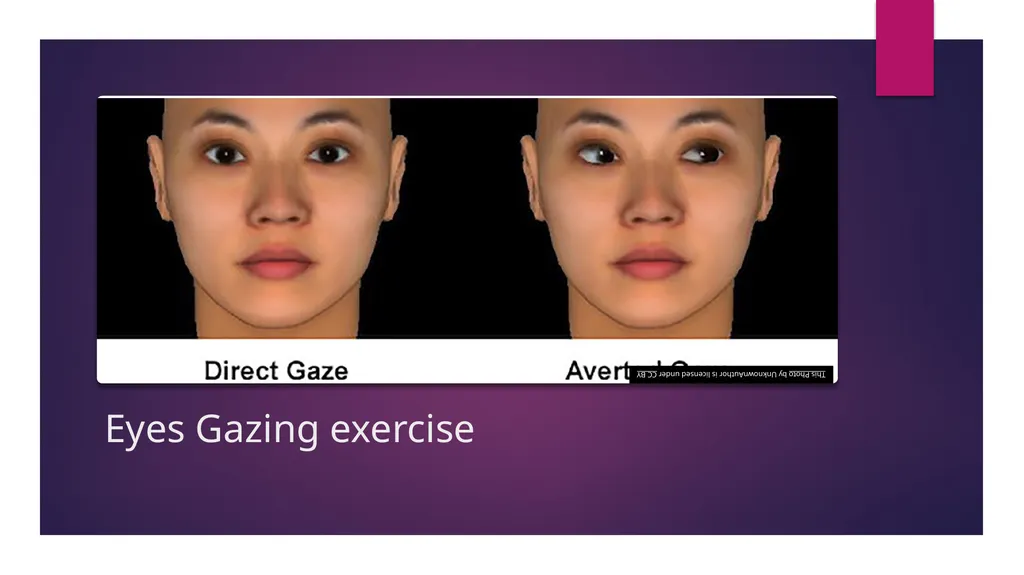
Eyes Gazing exercise This Photo by UnknownAuthor is licensed under CC BY<br>
20
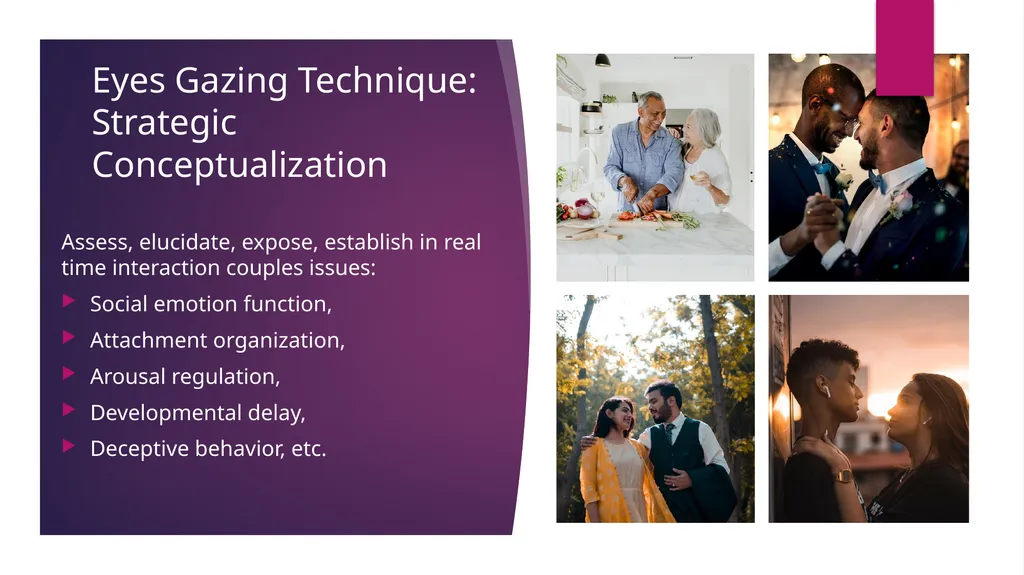
Eyes Gazing Technique: Strategic Conceptualization Assess, elucidate, expose, establish in real time interaction couples issues:
Social emotion function,
Attachment organization,
Arousal regulation,
Developmental delay,
Deceptive behavior, etc.<br>
Social emotion function,
Attachment organization,
Arousal regulation,
Developmental delay,
Deceptive behavior, etc.<br>
21
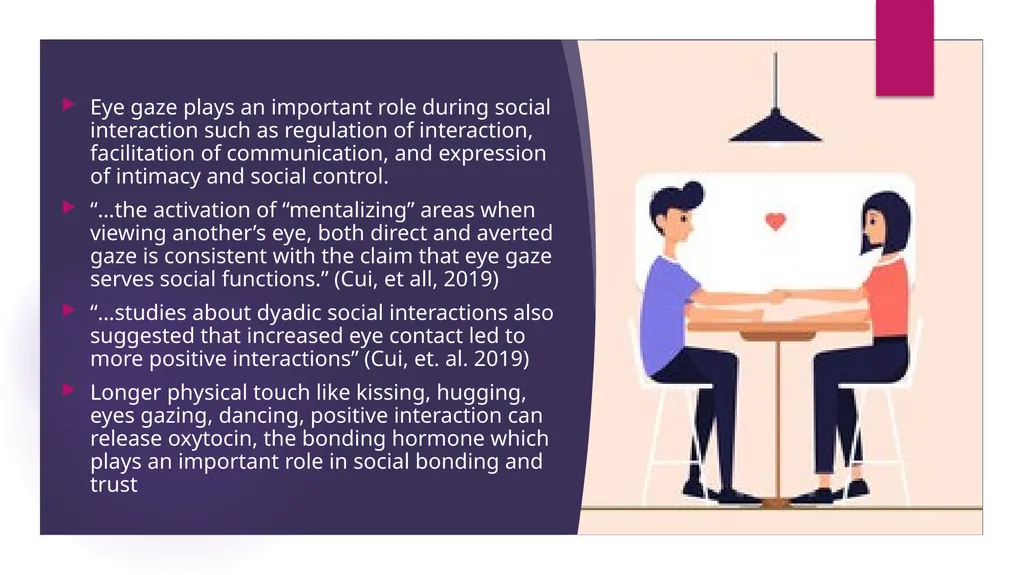
Eye gaze plays an important role during social interaction such as regulation of interaction, facilitation of communication, and expression of intimacy and social control.
“…the activation of “mentalizing” areas when viewing another’s eye, both direct and averted gaze is consistent with the claim that eye gaze serves social functions.” (Cui, et all, 2019)
“…studies about dyadic social interactions also suggested that increased eye contact led to more positive interactions” (Cui, et. al. 2019)
Longer physical touch like kissing, hugging, eyes gazing, dancing, positive interaction can release oxytocin, the bonding hormone which plays an important role in social bonding and trust<br>
22
Eyes Gazing- DEMO What is the attachment style of each one? Why?
How comfortable/uncomfortable they are in sustaining the direct gaze?
What do they do to manage the stress of the exercise?
How do they communicate non-verbally?
Observe the signs of light trance being developed:
Eye fixation, immobility, less prone to talk<br>
How comfortable/uncomfortable they are in sustaining the direct gaze?
What do they do to manage the stress of the exercise?
How do they communicate non-verbally?
Observe the signs of light trance being developed:
Eye fixation, immobility, less prone to talk<br>
23
Eyes Gazing- DEMO This exercise puts pressure on the couple’s attachment system. How do they respond under pressure?
Are they going to use defenses or not? If so which ones?
How these defenses show in their verbal and non-verbal communication?
Does the couple help each other during stress or they stress each other?
Do they use mostly self-regulation, co-regulation, auto-regulation or external regulation?<br>
Are they going to use defenses or not? If so which ones?
How these defenses show in their verbal and non-verbal communication?
Does the couple help each other during stress or they stress each other?
Do they use mostly self-regulation, co-regulation, auto-regulation or external regulation?<br>
24
Video: Eyes Gazing technique<br>
25
“…in hypnosis the relationship is both the container and the conduit of those processes that promote change” Spiegel, et al. (2019)<br>
26
Eyes Gazing technique Teach couples about each other: anxious or insecure people tend to avoid eye contact;
Teach couple about repairation or communication in conflict;
State change: oxytocin release for trust and emotional connection;
Naturalistic trance state<br>
Teach couple about repairation or communication in conflict;
State change: oxytocin release for trust and emotional connection;
Naturalistic trance state<br>
27
Secure Functioning, Strategic Thinking and Hypnosis We use Eyes gazing technique to strategically assess the couple’s regulatory mechanisms, attachment style, how they function as a dyad.
We used the Eyes Gazing technique as a container to assess, and teach the couple about Secure Functioning, Attachment styles, etc
Eyes gazing can be used to change states; suggestions in a light trance can facilitate the process, i.e.: “you can observe how your body relaxes as you breathe deeply, and deeply”
Suggestions are used in a multilevel communication to facilitate change.
Suggestions are given so the couple can experience Secure Functioning in real time<br>