The Hmong and the Secret War in Laos HMONG HISTORY AND CULTURAL STUDIES MODEL CURRICULUM 2024 Marlette, D. (1972). --And, of course, if Cambodia fell, then Laos would fall, and if Laos fell .... Marlette.Photograph. Retrieved from the
"The Hmong and the Secret War in Laos HMONG HISTORY" is the property of its rightful owner. Permission is granted to
download and print the materials on this website for personal, non-commercial use only, and to display it
on your personal computer provided you do not modify the materials and that you retain all copyright
notices contained in the materials. By downloading content from our website, you accept the terms of this
agreement.
Presentation Transcript
01
The Hmong and the Secret War in Laos HMONG HISTORY AND CULTURAL STUDIES MODEL CURRICULUM 2024<br>
02
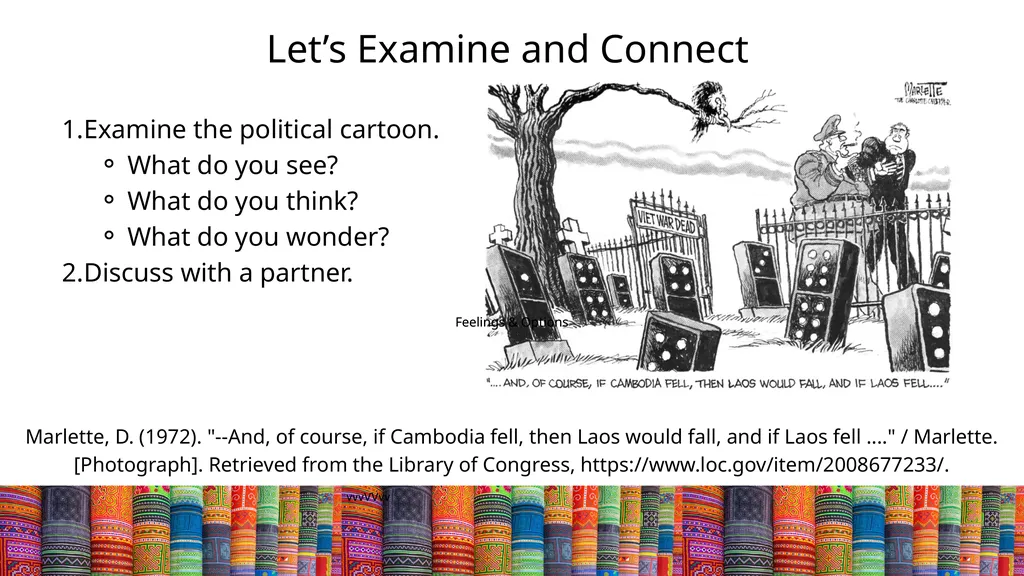
Marlette, D. (1972). "--And, of course, if Cambodia fell, then Laos would fall, and if Laos fell ...." / Marlette.[Photograph]. Retrieved from the Library of Congress, https://www.loc.gov/item/2008677233/. Examine the political cartoon.
What do you see?
What do you think?
What do you wonder?
Discuss with a partner. Let’s Examine and Connect Feelings & Options Feelings & Options<br>
03
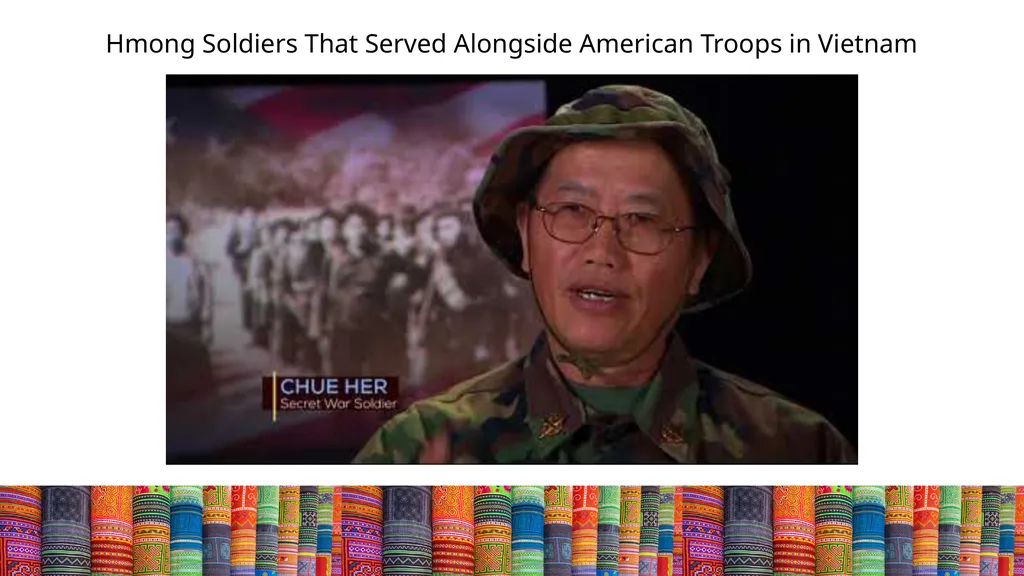
Hmong Soldiers That Served Alongside American Troops in Vietnam<br>
04
Notes
Thoughts
Question
Epiphany Take video notes below. Then complete a TQE (Thought, Question, Epiphany) Hmong Soldiers That Served Alongside American Troops in Vietnam<br>
05
Click on the newspaper image and read the article. Discuss with a partner/table group:
How does activity in Laos connect to the domino theory?
What was guaranteed to Laos in the Geneva Accords?
What decision did President Kennedy make in 1961?
Why do you think the president ordered the CIA to go in and recruit Hmong to fight the communist in Laos? Geneva and US Actions<br>
06
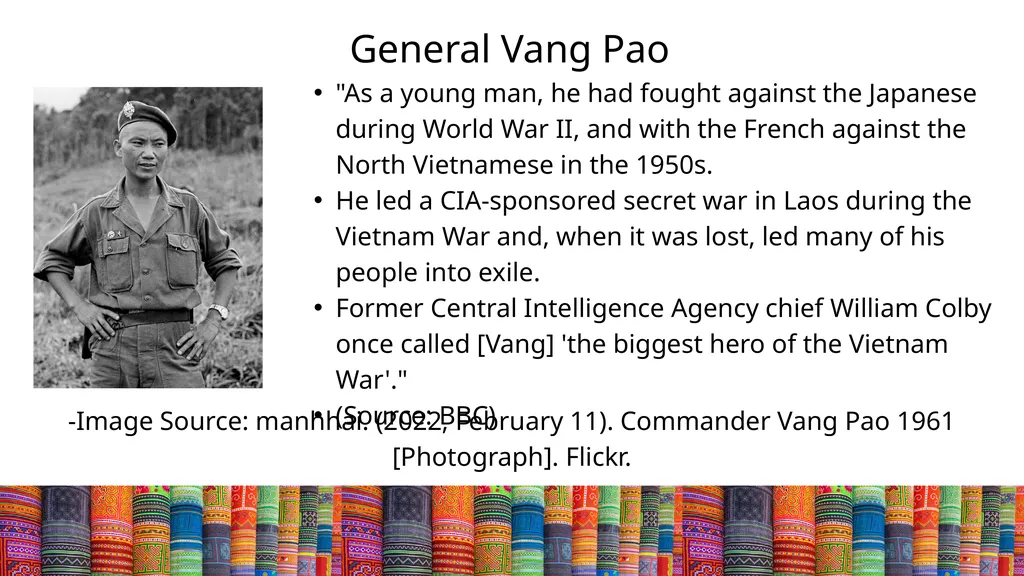
-Image Source: manhhai. (2022, February 11). Commander Vang Pao 1961 [Photograph]. Flickr. "As a young man, he had fought against the Japanese during World War II, and with the French against the North Vietnamese in the 1950s.
He led a CIA-sponsored secret war in Laos during the Vietnam War and, when it was lost, led many of his people into exile.
Former Central Intelligence Agency chief William Colby once called [Vang] 'the biggest hero of the Vietnam War'."
(Source: BBC) General Vang Pao<br>
07
When asked how the Americans contacted him, Vang Pao describes…
They never came to make this agreement or that agreement. They just came looking around, They saw the Hmong were very poor in many ways- no salt to eat… no clothes to wear, so when Americans came, they said, “Do you want salt for the Hmong?” So Americans dropped salt everywhere for the Hmong. And when the winter came and it was very cold, the Americans asked, “Do you need clothes for the Hmong?” The Hmong are very poor, so they dropped clothes from the sky for the Hmong… Then one day they brought carbines… And then they brought in… communication radios and gave one to each Hmong chief. At that time we already had communication everywhere. So slowly, slowly, that’s how we did it… All they did was say, “Do you need this? Do you need that?” Yes, we needed this, we needed that, we were very poor… So when the war came, they asked for our help, and we helped… [T]he king also gave his consent. So that’s why I helped the Americans.
-Source: Hillmer, P. (2015). A people's history of the Hmong. Minnesota Historical Society. Geneva and US Actions<br>
08
Hmong Child Soldiers in the Secret War<br>
09
Notes
Thoughts
Question
Epiphany Take video notes below. Then complete a TQE (Thought, Question, Epiphany) Hmong Child Soldiers in the Secret War<br>
10
Questions
Why did the US recruit the Hmong people to fight in the Secret War in Laos?
How did the Secret War take place? Directions
Read the article.
Answer the two questions that follow. CIA Air Operations in Laos, 1955-1974<br>
11
Over 270 million cluster bombs were dropped on Laos during the Vietnam War (210 million more bombs than were dropped on Iraq in 1991, 1998 and 2006 combined); up to 80 million did not detonate.
Nearly 40 years on, less than 1% of these munitions have been destroyed. More than half of all confirmed cluster munitions casualties in the world have occurred in Laos.
Each year there are now just under 50 new casualties in Laos, down from 310 in 2008. Close to 60% of the accidents result in death, and 40% of the victims are children.
Between 1993 and 2016, the U.S. contributed on average $4.9M per year for UXO clearance in Laos; the U.S. spent $13.3M per day (in 2013 dollars) for nine years bombing Laos.
In just ten days of bombing Laos, the U.S. spent $130M (in 2013 dollars), or more than it has spent in clean up over the past 24 years ($118M). US Bombing in Laos Facts<br>
12
Image: Map showing US Bombing in Laos Questions
What do you notice about where the US dropped bombs in Laos?
How do you think the bombing impacted the Hmong population in Laos? US Bombing in Laos Facts<br>
13
Go to the north (agree) or south (disagree) of the classroom depending upon your position on the following statements. Discuss with the other students and be prepared to explain your position to the other side.
The US actions during the 1960s fell in line with the Geneva Accords.
(The US actions = launching a secret war in Laos in which the US CIA fed, supplied the Hmong to fight the communist. In other words, the Hmong did the fighting for the US on the ground level in Laos. This was kept a secret from the US Congress and American people.) Take a Stand<br>
14
Select one of the following options to demonstrate your understanding of the Secret War:
By the numbers (soldiers, bombs, years, etc.)
Infographic events
News report (radio or tv) recorded on Flipgrid with storyboard submission
News investigative reporter exposes the Secret War in 1973
Interview someone from the Hmong community or watch or listen to a Hmong oral history interview - write a poem reflecting their experience.
Collage of photos of the Secret War and important facts coming out about the Secret War in Laos.
Letter to a Hmong veteran apologizing to them for suffering and then lack of recognition for their sacrifice Assessment Option: Menu Board<br>
15
Across The Mountains. (2023, January 12). The child soldiers of Vang Pao’s Army [Video]. YouTube. https://www.youtube.com/watch?v=HBeQzheWskY
Central Intelligence Agency (CIA). (2008, June 27). CIA air operations in Laos, 1955-1974: Supporting the "Secret War.” https://web.archive.org/web/20201116105808/https://www.cia.gov/library/center-for-the-study-of-intelligence/csi-publications/csi-studies/studies/winter99-00/art7.htmlEvening Star. (1963, April 20). Chronicling America: Historic American newspapers. Library of Congress, Washington D.C.
Hillmer, P. (2015). A people's history of the Hmong. Minnesota Historical Society.
Legacies of War. (n.d.). Legacies library: Resources on the American Secret War in Laos. https://legaciesofwar.org/about-laos/secret-war-laos/
manhhai. (2022, February 11). Commander Vang Pao 1961 [Photograph]. Flickr. flickr.com/photos/13476480@N07/51875071173
Marlette, D. (1972). "--And, of course, if Cambodia fell, then Laos would fall, and if Laos fell ...." / Marlette. [Photograph]. Retrieved from the Library of Congress, https://www.loc.gov/item/2008677233/
Milwaukee PBS. (2017, September 25). 10thirtysix | Exclusive | The Secret War: Hmong Soldiers who served alongside Americans in Vietnam [Video]. YouTube. https://youtu.be/1_0WbPq2lhs References<br>