The Keynesian Critique of the Classical System Adam smith, credited by many as the founder of classical economics believed the government should intervene in economic affairs as little as possible John Maynard Keynes asked, If supply
"The Keynesian Critique of the Classical System" is the property of its rightful owner. Permission is granted to
download and print the materials on this website for personal, non-commercial use only, and to display it
on your personal computer provided you do not modify the materials and that you retain all copyright
notices contained in the materials. By downloading content from our website, you accept the terms of this
agreement.
Presentation Transcript
01
The Keynesian Critique of the Classical System Adam smith, credited by many as the founder of classical economics believed the government should intervene in economic affairs as little as possible
John Maynard Keynes asked, “If supply creates its own demand, why are we having a worldwide depression?”
John Maynard Keynes advocated massive government intervention to bring an end to the Great Depression 11-30 Copyright 2002 by The McGraw-Hill Companies, Inc. All rights reserved.<br>
02
Keynesian Economics The Great Depression of the 1930s
Keynes and Keynesian Economics
Keynes (1936), General Theory of Employment, Interest and Money
the capitalist economy is inherently unstable and likely to achieve equilibrium with considerable unemployment or severe inflation, and the possibility of persistent unemployment Copyright 2004 McGraw-Hill Australia Pty Ltd PPTs t/a Macroeconomics 7/e by Jackson and McIver
Slides prepared by Muni Perumal, University of Canberra, Australia<br>
03
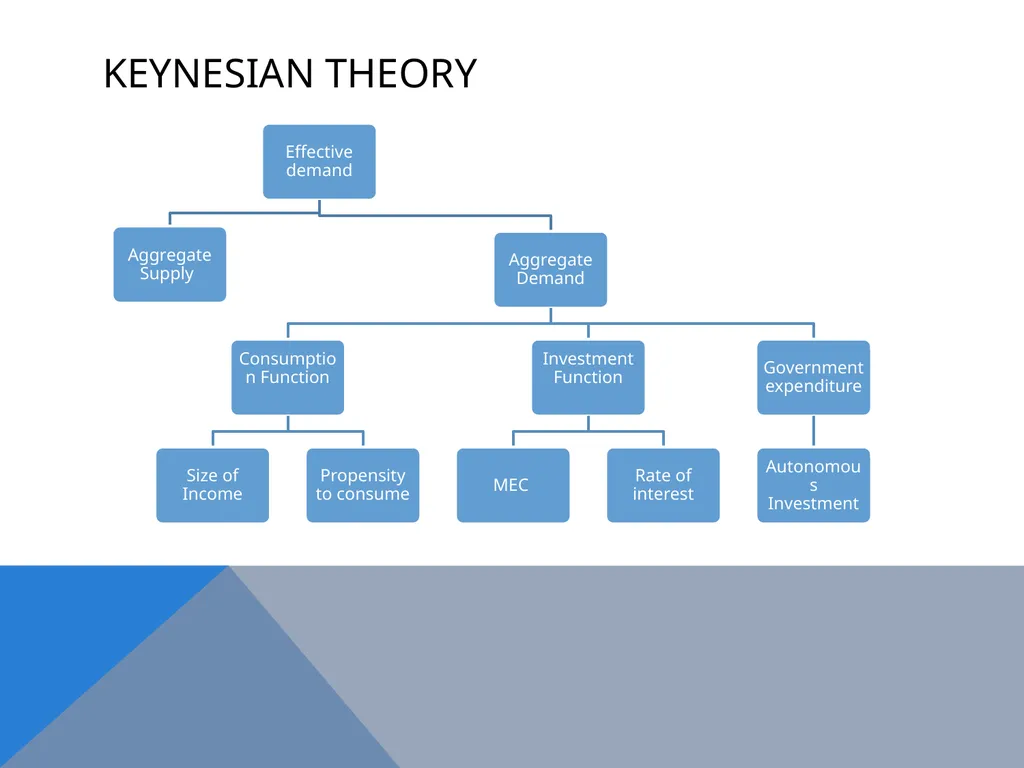
Effective Demand PRINCIPLE OF EFFECTIVE DEMAND is the pillar of keynesian theory of employment
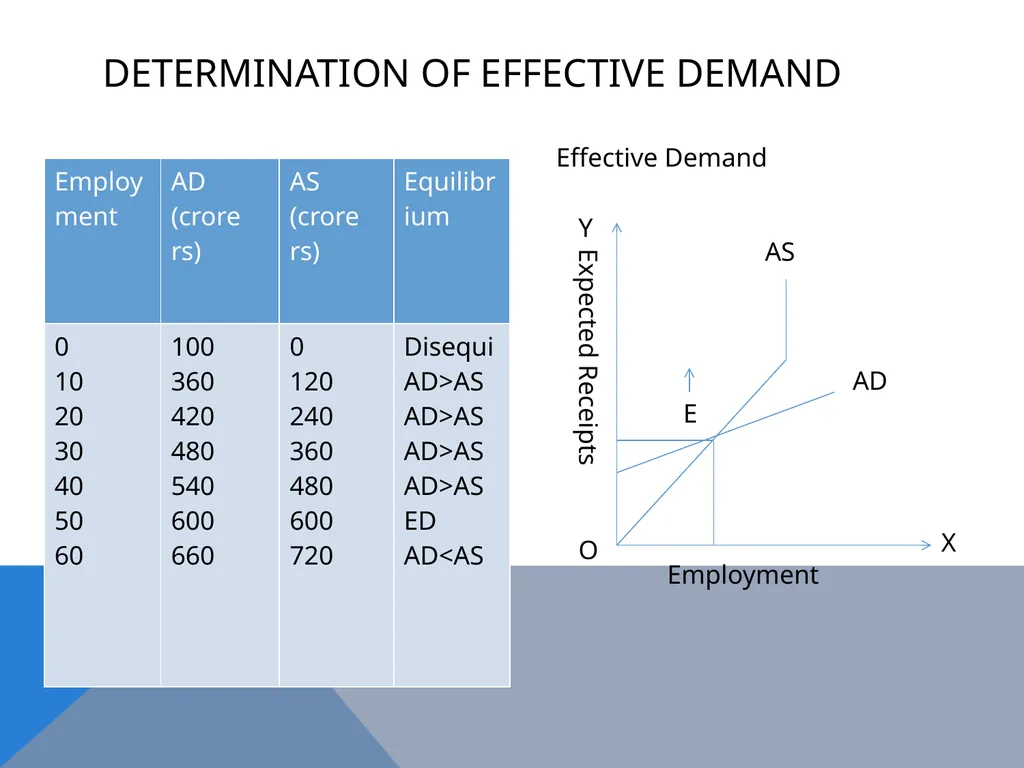
effective demand is that level of aggregate demand at which it is equal to aggregate supply.
effective demand is expressed by aggregate expenditure of an economy
ad refers to aggregate demand expenditure in an economy.
it refers to the amount that all the people of an economy may spend on buying goods produced at a given level of employment.<br>
04
What is Effective Demand? In other words, effective demand is the signification of the equilibrium between aggregate demand (C+I) and aggregate supply (C+S).
This equilibrium position (effective demand) indicates that the entrepreneurs neither have a tendency to increase production nor a tendency to decrease production.
It implies that the national income and employment which correspond to the effective demand are equilibrium levels of national income and employment.
Unlike classical theory of income and employment, Keynesian theory of income and employment emphasizes that the equilibrium level of employment would not necessarily be full employment. It can be below or above the level of fullemployment.<br>
05
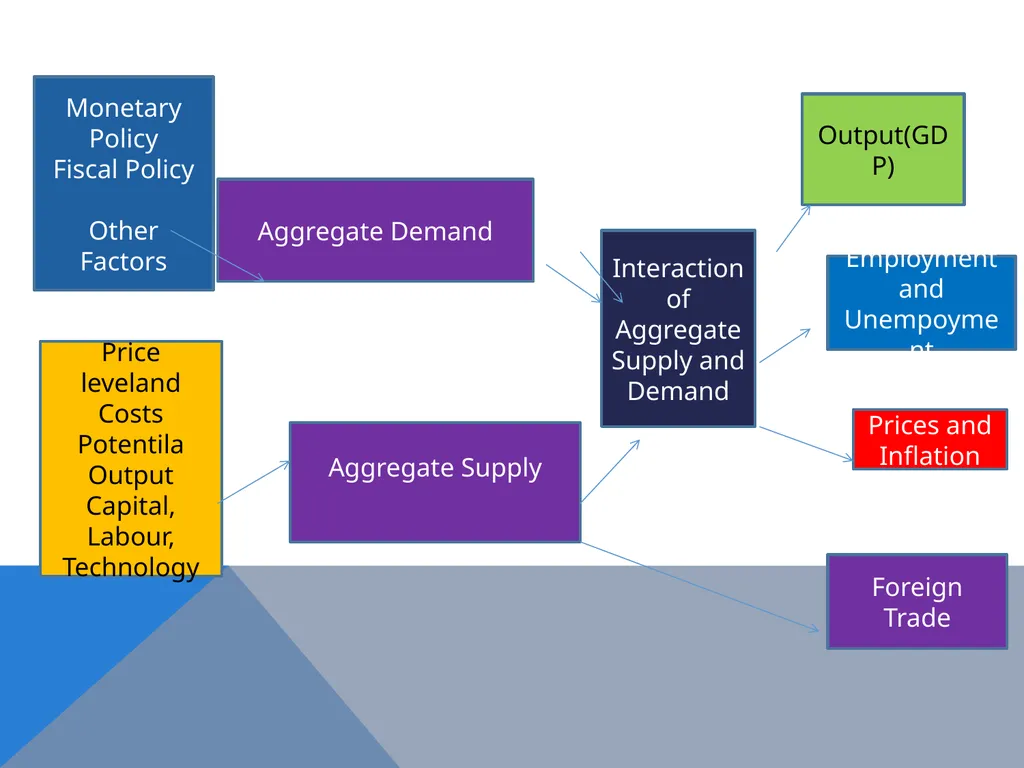
Aggregate Demand Aggregate Supply Interaction of Aggregate Supply and Demand Output(GDP) Employment and Unempoyment Prices and Inflation Foreign Trade Monetary Policy
Fiscal Policy
Other Factors Price leveland Costs
Potentila Output
Capital, Labour,
Technology<br>
06
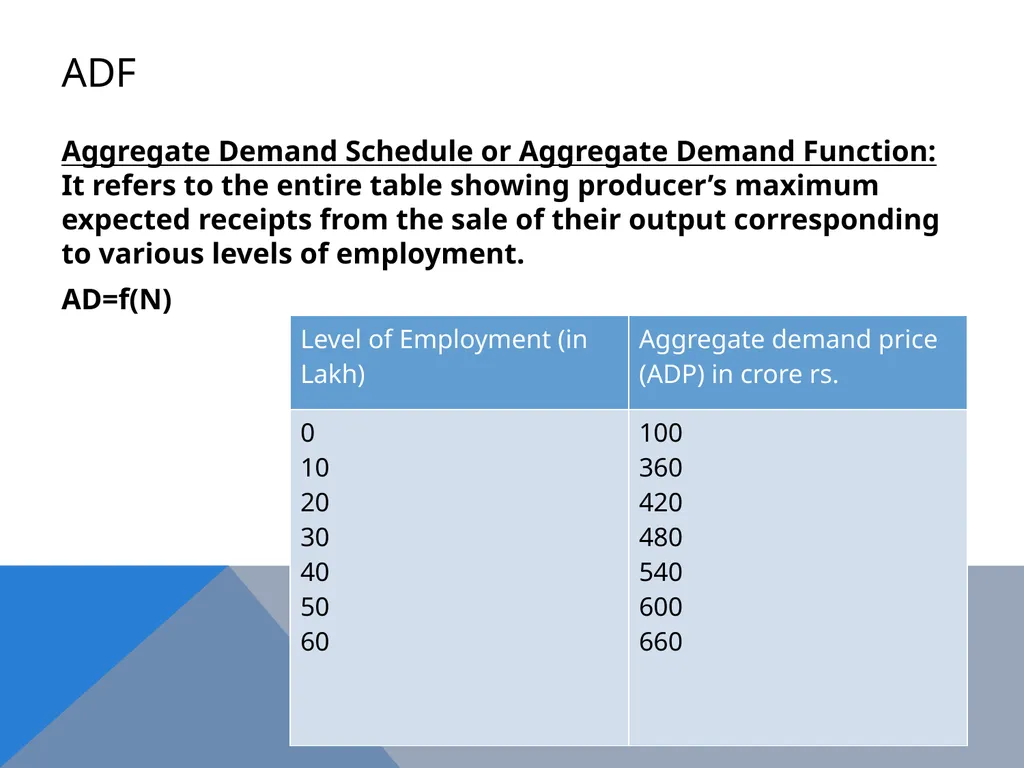
ADF Aggregate Demand Schedule or Aggregate Demand Function: It refers to the entire table showing producer’s maximum expected receipts from the sale of their output corresponding to various levels of employment.
AD=f(N)<br>
07
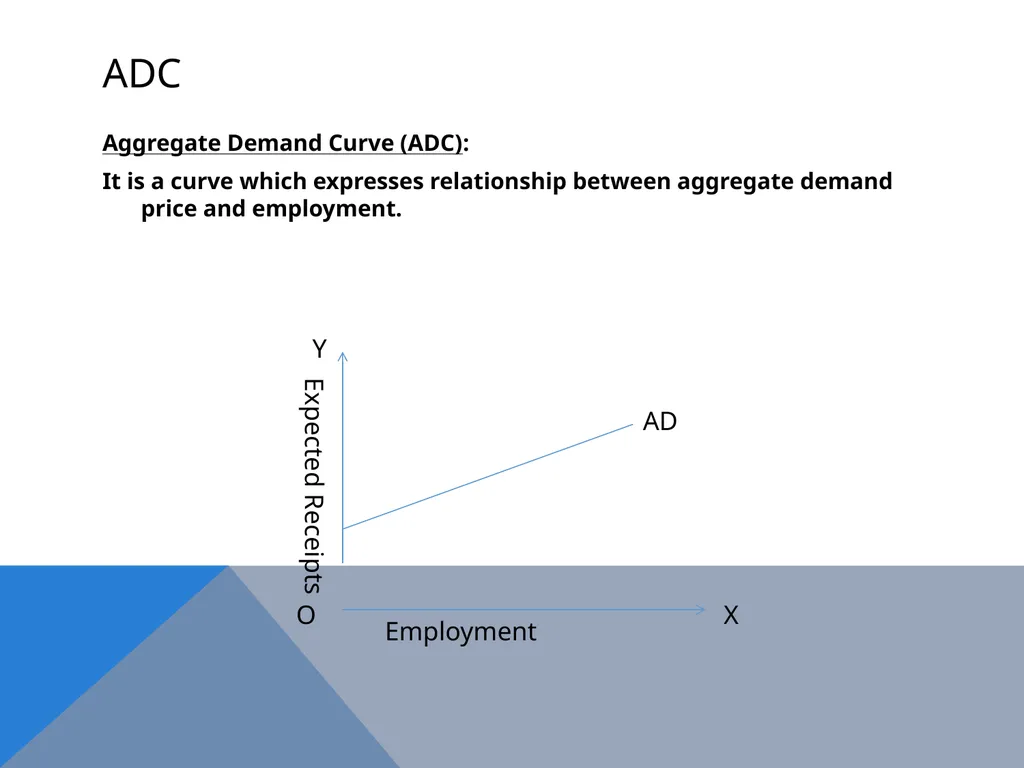
ADC Aggregate Demand Curve (ADC):
It is a curve which expresses relationship between aggregate demand price and employment. AD Expected Receipts Employment O X Y<br>
08
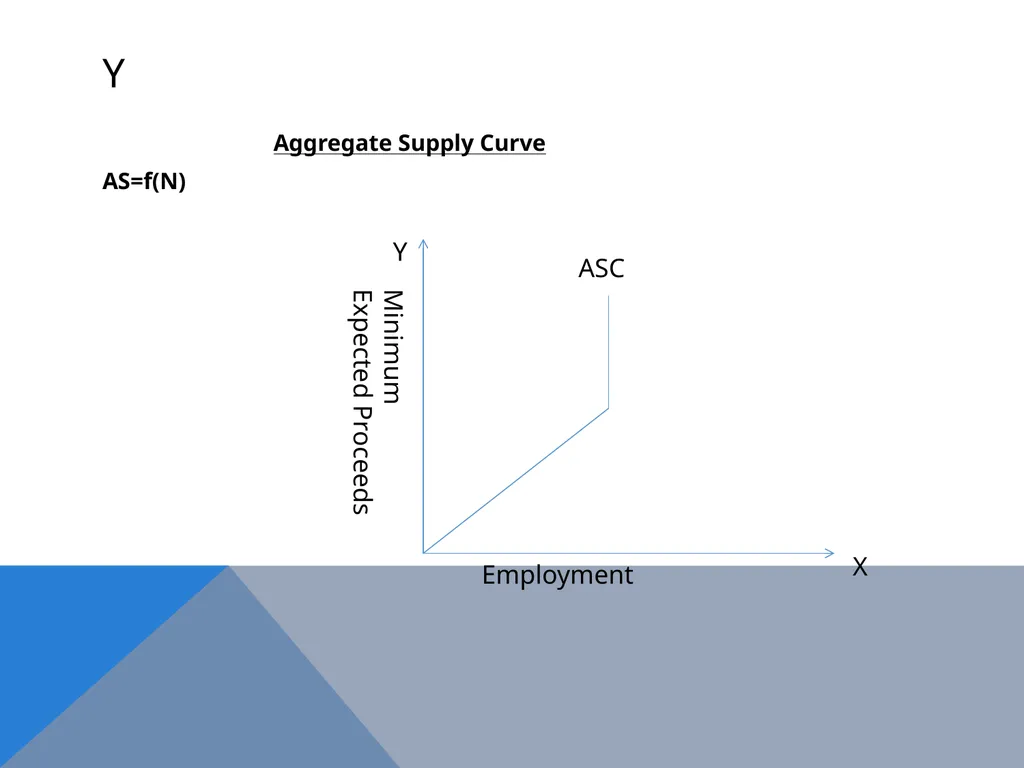
Aggregate Supply (C+S): In other words, the aggregate supply is the value of final output valued at factor cost.
The aggregate supply price is the minimum amount of money which the entrepreneurs must receive to cover the costs of output produced by the employment of certain number of workers.
The aggregate supply curve, (C+S) is positively sloped indicating that as the level of employment increases, the level of output also increases, thereby, increasing the aggregate, supply. Thus, the aggregate supply (C+S) depends upon the level of employment through the economy's aggregate production function.<br>
09
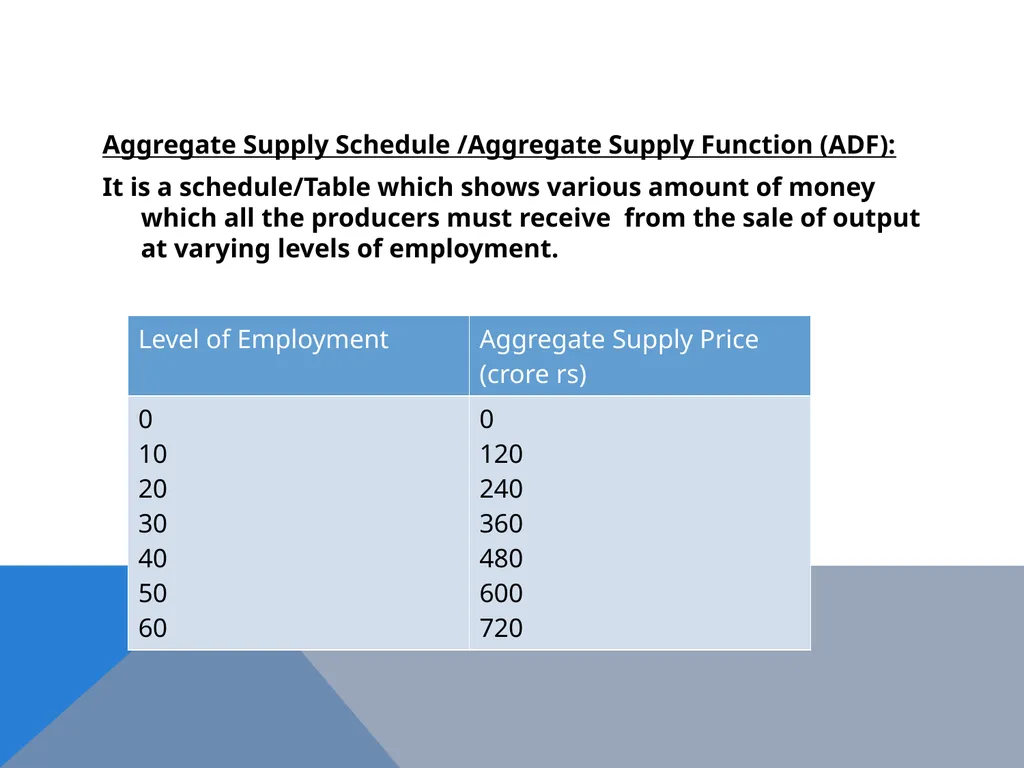
Aggregate Supply Schedule /Aggregate Supply Function (ADF):
It is a schedule/Table which shows various amount of money which all the producers must receive from the sale of output at varying levels of employment.<br>
10
Y Aggregate Supply Curve
AS=f(N) Minimum Expected Proceeds Employment ASC X Y<br>
11
Determination of Effective Demand Expected Receipts Employment X Y E Effective Demand AD AS O<br>
12
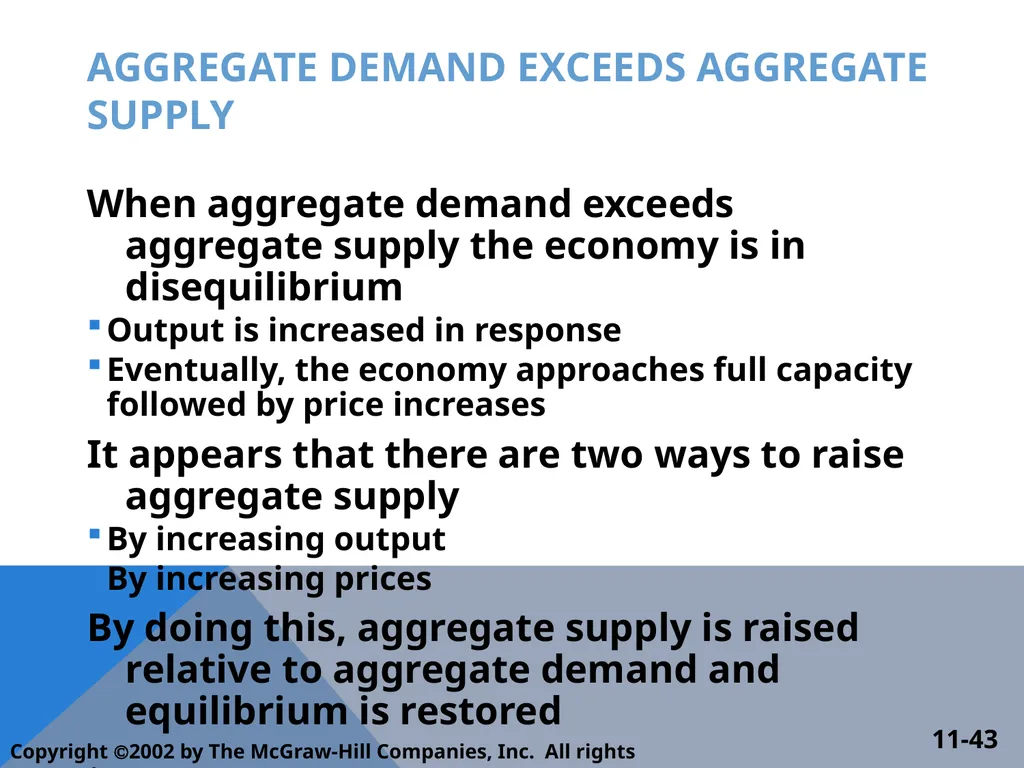
Aggregate Demand Exceeds Aggregate Supply When aggregate demand exceeds aggregate supply the economy is in disequilibrium
Output is increased in response
Eventually, the economy approaches full capacity followed by price increases
It appears that there are two ways to raise aggregate supply
By increasing output
By increasing prices
By doing this, aggregate supply is raised relative to aggregate demand and equilibrium is restored 11-43 Copyright 2002 by The McGraw-Hill Companies, Inc. All rights reserved.<br>
13
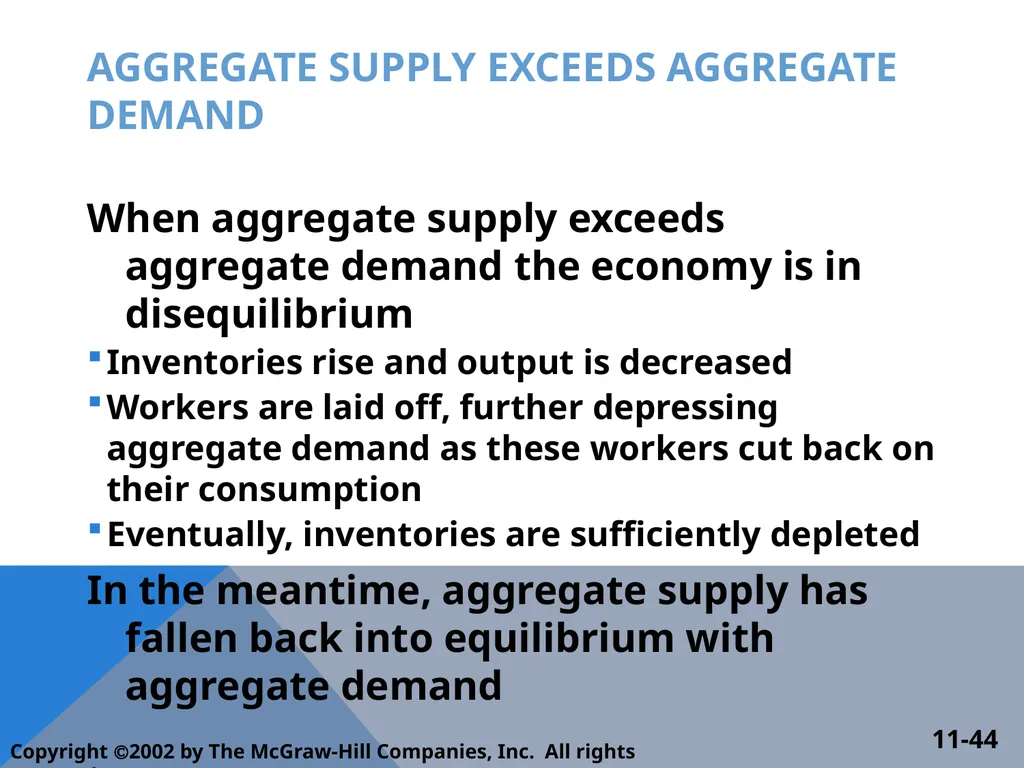
Aggregate Supply Exceeds Aggregate Demand When aggregate supply exceeds aggregate demand the economy is in disequilibrium
Inventories rise and output is decreased
Workers are laid off, further depressing aggregate demand as these workers cut back on their consumption
Eventually, inventories are sufficiently depleted
In the meantime, aggregate supply has fallen back into equilibrium with aggregate demand 11-44 Copyright 2002 by The McGraw-Hill Companies, Inc. All rights reserved.<br>
14
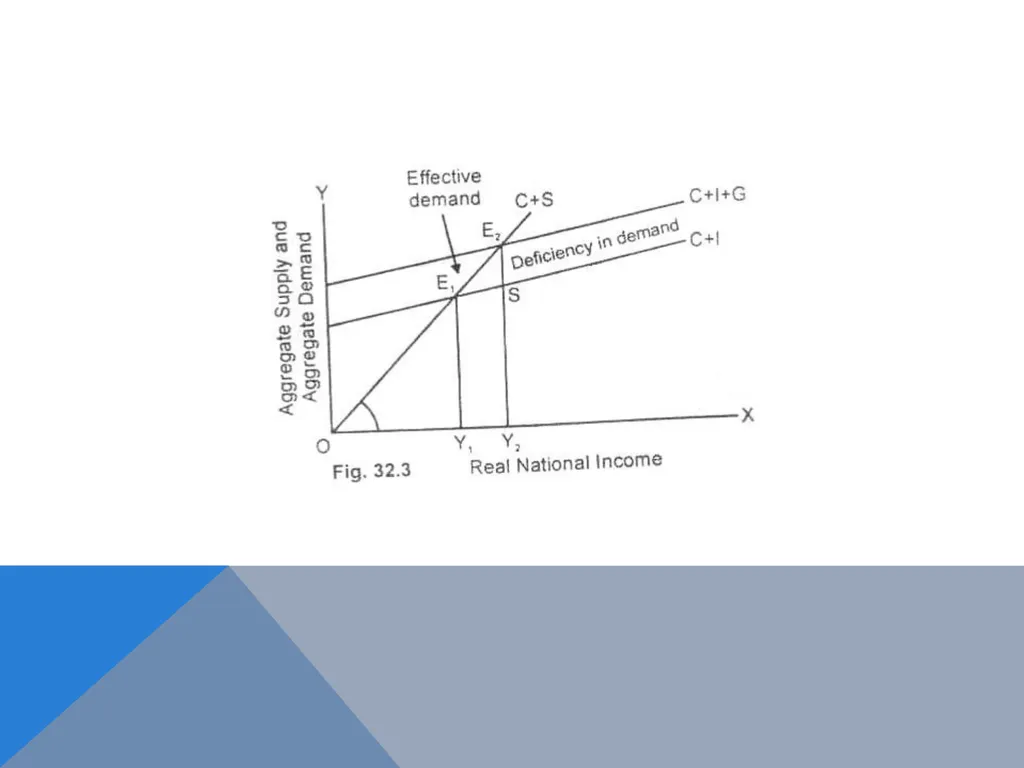
Determination of Level of Employment and Income:
According to Keynes, the equilibrium levels of national income and employment are determined by the interaction of aggregate demand curve (AD) and aggregate supply curve (AS). The equilibrium level of income determined by the equality of AD and AS does not necessarily indicate the full employment level. The equilibrium position between aggregate demand and aggregate supply can be below or above the level of full employment as is shown in the curve below.
Diagram/Figure:<br>