
The Notebook to reflect on the Meaning of Life
T
Published · 20 slides · 0 views

1 / 1
Description
The Notebook to reflect on the Meaning of Life Concetta La Rocca, Massimo Margottini Roma Tre University Italy concetta.laroccauniroma3.it; massimo.margottiniuniroma3.it Innovations in Learning and Technology for the Workplace and Higher
Related Topics
Share
Embed code
Download this presentation From Below
"The Notebook to reflect on the Meaning of Life" is the property of its rightful owner. Permission is granted to download and print the materials on this website for personal, non-commercial use only, and to display it on your personal computer provided you do not modify the materials and that you retain all copyright notices contained in the materials. By downloading content from our website, you accept the terms of this agreement.
Presentation Transcript
01
The Notebook to reflect on the Meaning of Life Concetta La Rocca, Massimo Margottini
Roma Tre University
Italy
concetta.larocca@uniroma3.it; massimo.margottini@uniroma3.it
Innovations in Learning and Technology for the Workplace and Higher Education.
The Learning Ideas Conference 2022
June 15-17, 2022, in New York and online<br>
Roma Tre University
Italy
concetta.larocca@uniroma3.it; massimo.margottini@uniroma3.it
Innovations in Learning and Technology for the Workplace and Higher Education.
The Learning Ideas Conference 2022
June 15-17, 2022, in New York and online<br>
02
The F.A.R.O. PROJECT
In Italian FARO means slighthouse The F.A.R.O. Project (acronym: FAre Reti e Orientare - Make networks and Guidance) was co-financed by the EU and the Italian Ministry of the Interior (Ministry of Domestic Affairs).
The FARO project (08/07/2019 - 31/03/2022) was coordinated by Massimo Margottini (Department of Education at Roma Tre University, Italy) and follows the path traced by the previous CREI Project (CREI: CreareREti per gli Immigrati - Creating Networks for Immigrants) (10/01/2017 - 31.03.2018)<br>
The FARO project (08/07/2019 - 31/03/2022) was coordinated by Massimo Margottini (Department of Education at Roma Tre University, Italy) and follows the path traced by the previous CREI Project (CREI: CreareREti per gli Immigrati - Creating Networks for Immigrants) (10/01/2017 - 31.03.2018)<br>
03
F.A.R.O. Project Plan (synthetic) Aim
The Project, which ended on 31/03/2022, had the objective of experimenting the construction of an integrated network aimed at responding to the training and work needs of citizens of Third Countries in some Italian territories.
Methodology
The project involved the use of multiple methodologies and tools, developed by Roma Tre research group, and submitted in training modules to the operators of local agencies for the instruction and training of young migrants. There were seven modules, all characterized by two closely related aspects: a theoretical section for study and reflection, and a laboratory section, for the practical use of methodologies and tools and also for reflection
In each module participants are asked to use a personal computer to fill in the provided tools.<br>
04
Module 2 - Personal history: narration about oneself, personal experience, and migratory project The Notebook to Reflect on the Meaning of Life is the tool presented in Module 2
Notebook theoretical framework : the measures to guide young immigrants cannot be reduced to the exclusive goal of identifying their professional skills to facilitate integration into the labor market; rather, they should aim to bring out desires and projects, expectations, and interests.<br>
Notebook theoretical framework : the measures to guide young immigrants cannot be reduced to the exclusive goal of identifying their professional skills to facilitate integration into the labor market; rather, they should aim to bring out desires and projects, expectations, and interests.<br>
05
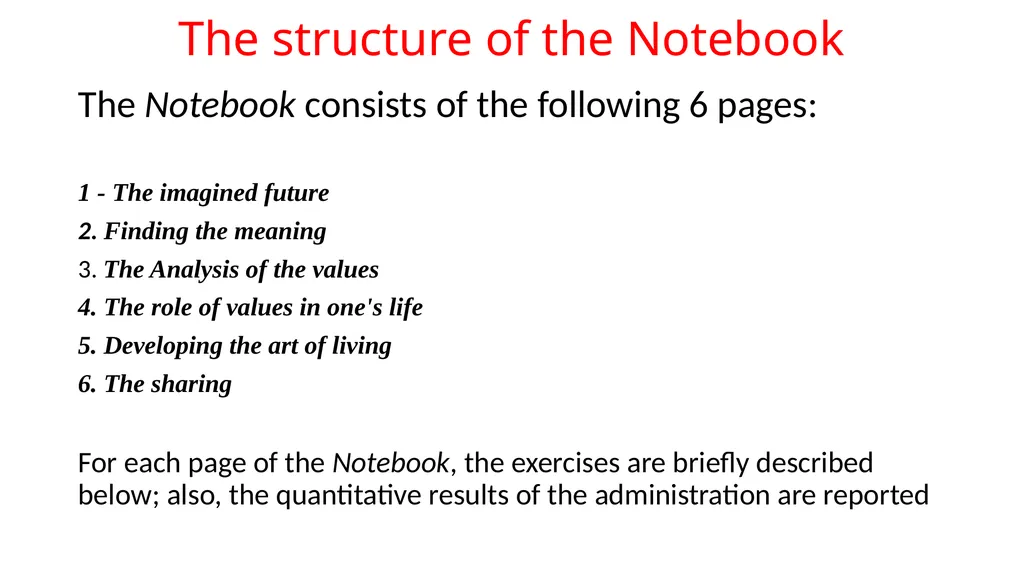
The structure of the Notebook The Notebook consists of the following 6 pages:
1 - The imagined future
2. Finding the meaning
3. The Analysis of the values
4. The role of values in one's life
5. Developing the art of living
6. The sharing
For each page of the Notebook, the exercises are briefly described below; also, the quantitative results of the administration are reported<br>
06
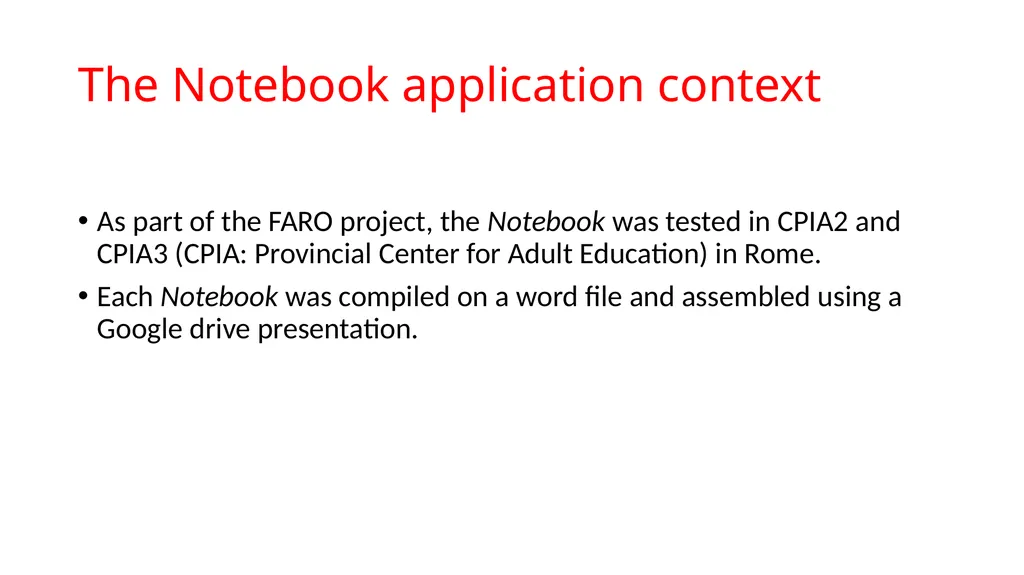
The Notebook application context As part of the FARO project, the Notebook was tested in CPIA2 and CPIA3 (CPIA: Provincial Center for Adult Education) in Rome.
Each Notebook was compiled on a word file and assembled using a Google drive presentation.<br>
Each Notebook was compiled on a word file and assembled using a Google drive presentation.<br>
07
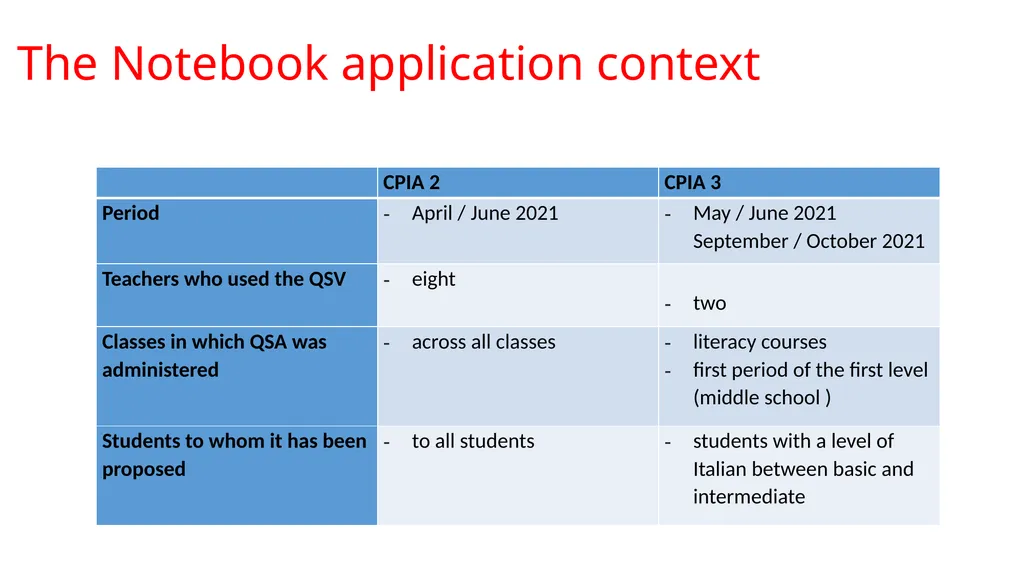
The Notebook application context<br>
08
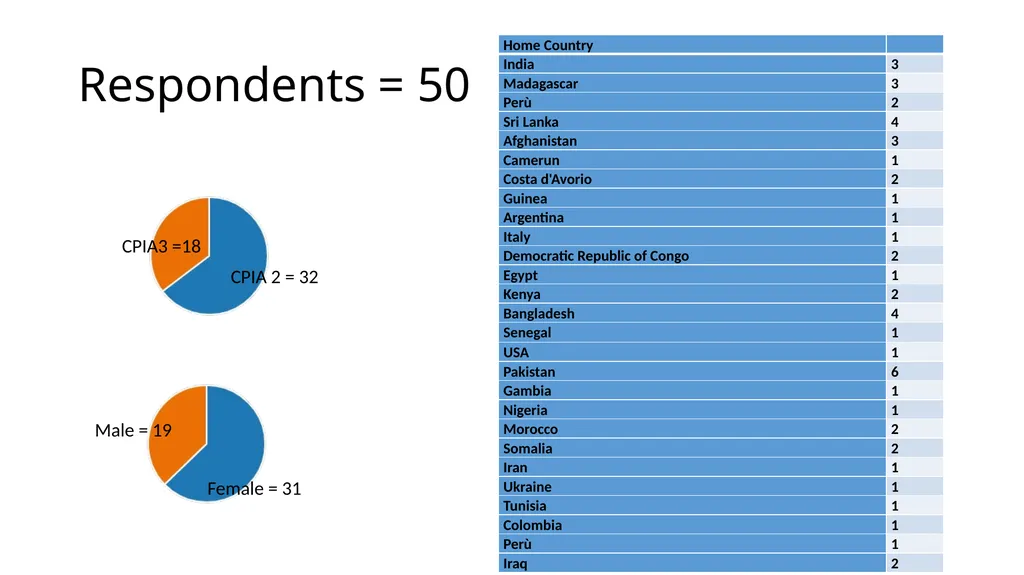
Respondents = 50 CPIA3 =18 CPIA 2 = 32 Male = 19 Female = 31<br>
09
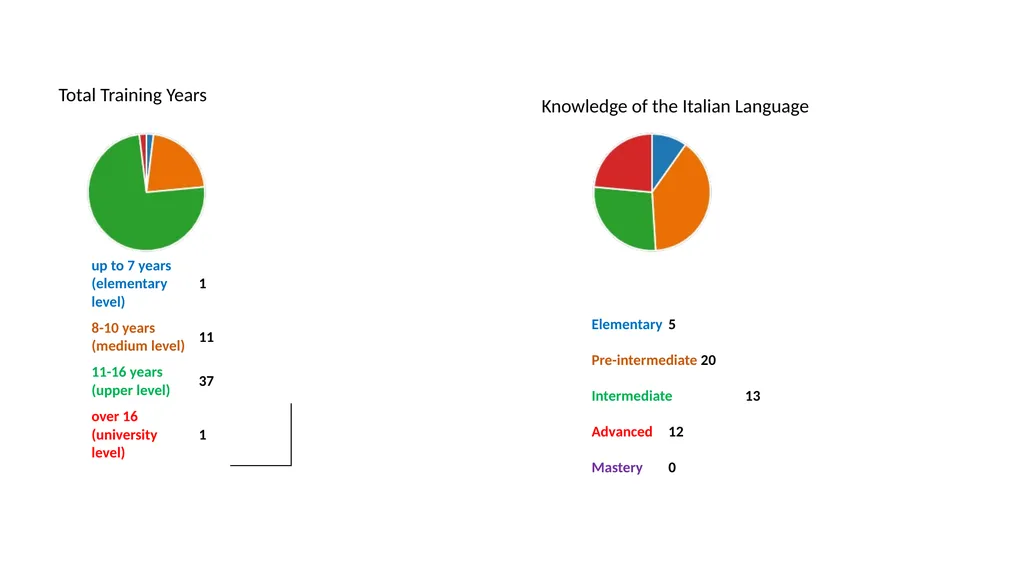
Total Training Years Elementary 5
Pre-intermediate 20
Intermediate 13
Advanced 12
Mastery 0 Knowledge of the Italian Language<br>
Pre-intermediate 20
Intermediate 13
Advanced 12
Mastery 0 Knowledge of the Italian Language<br>
10
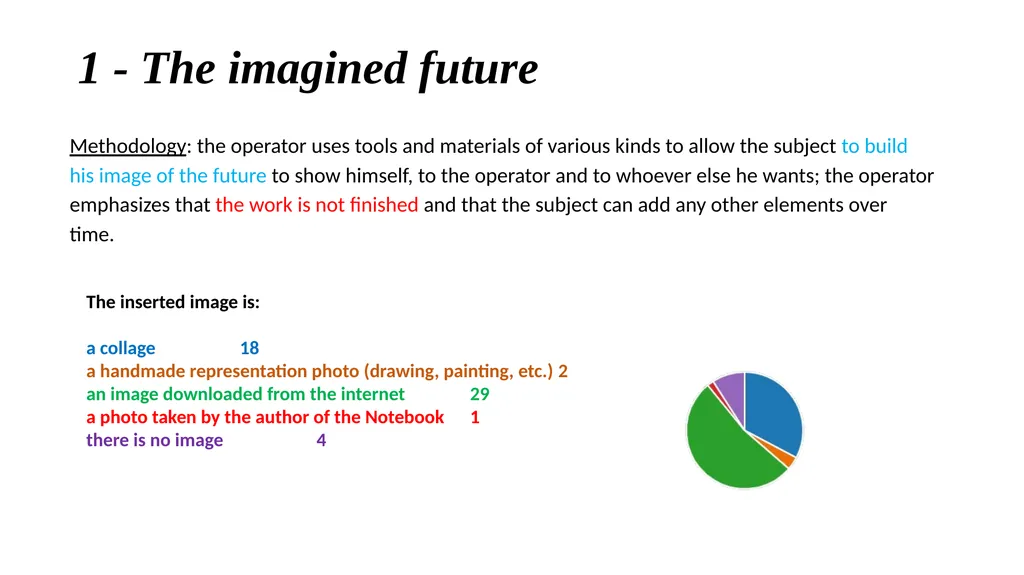
1 - The imagined future Methodology: the operator uses tools and materials of various kinds to allow the subject to build his image of the future to show himself, to the operator and to whoever else he wants; the operator emphasizes that the work is not finished and that the subject can add any other elements over time. The inserted image is:
a collage 18
a handmade representation photo (drawing, painting, etc.) 2
an image downloaded from the internet 29
a photo taken by the author of the Notebook 1
there is no image 4<br>
a collage 18
a handmade representation photo (drawing, painting, etc.) 2
an image downloaded from the internet 29
a photo taken by the author of the Notebook 1
there is no image 4<br>
11
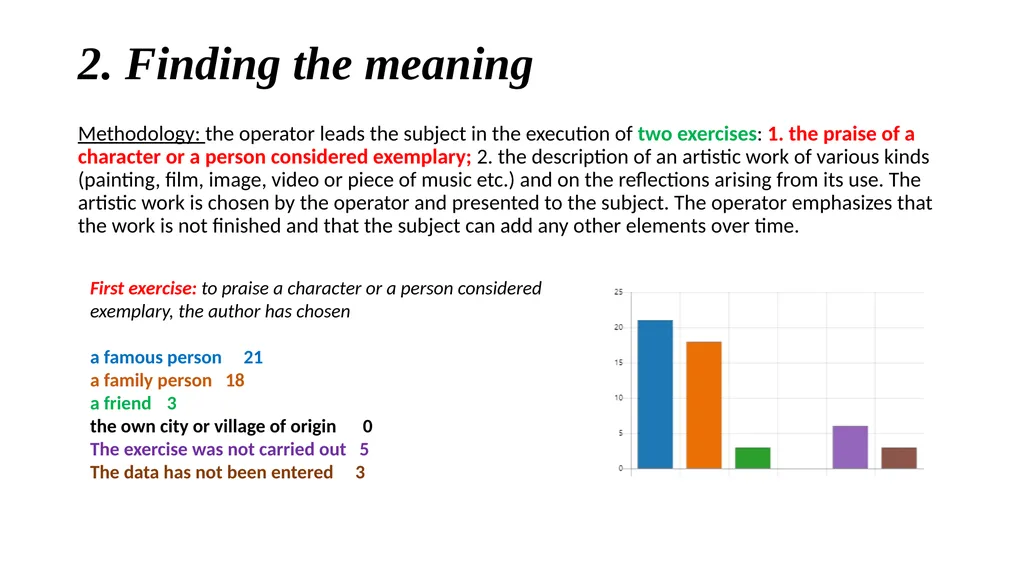
2. Finding the meaning Methodology: the operator leads the subject in the execution of two exercises: 1. the praise of a character or a person considered exemplary; 2. the description of an artistic work of various kinds (painting, film, image, video or piece of music etc.) and on the reflections arising from its use. The artistic work is chosen by the operator and presented to the subject. The operator emphasizes that the work is not finished and that the subject can add any other elements over time. First exercise: to praise a character or a person considered exemplary, the author has chosen
a famous person 21
a family person 18
a friend 3
the own city or village of origin 0
The exercise was not carried out 5
The data has not been entered 3<br>
a famous person 21
a family person 18
a friend 3
the own city or village of origin 0
The exercise was not carried out 5
The data has not been entered 3<br>
12
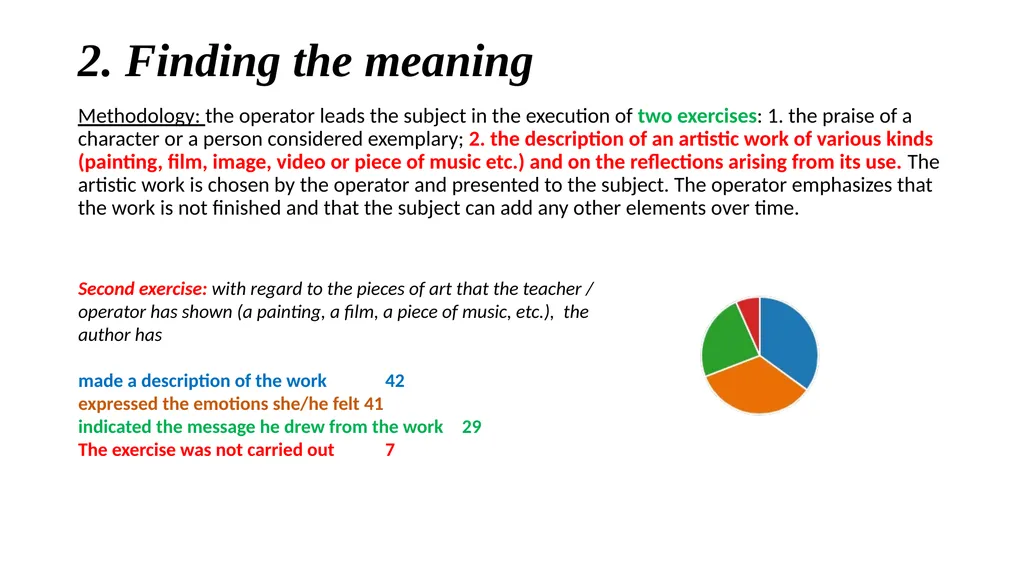
2. Finding the meaning Methodology: the operator leads the subject in the execution of two exercises: 1. the praise of a character or a person considered exemplary; 2. the description of an artistic work of various kinds (painting, film, image, video or piece of music etc.) and on the reflections arising from its use. The artistic work is chosen by the operator and presented to the subject. The operator emphasizes that the work is not finished and that the subject can add any other elements over time. Second exercise: with regard to the pieces of art that the teacher / operator has shown (a painting, a film, a piece of music, etc.), the author has
made a description of the work 42
expressed the emotions she/he felt 41
indicated the message he drew from the work 29
The exercise was not carried out 7<br>
made a description of the work 42
expressed the emotions she/he felt 41
indicated the message he drew from the work 29
The exercise was not carried out 7<br>
13
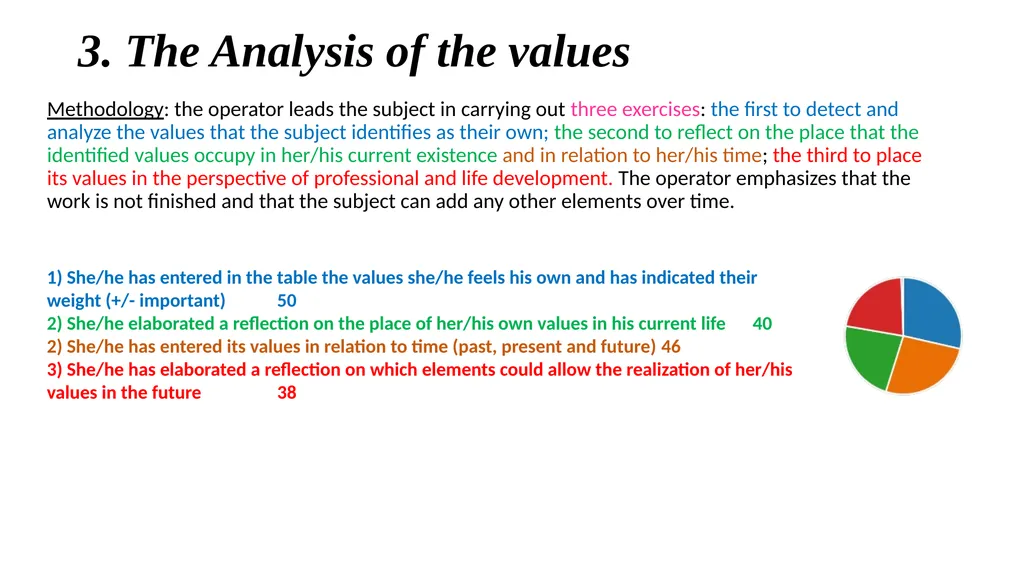
3. The Analysis of the values Methodology: the operator leads the subject in carrying out three exercises: the first to detect and analyze the values that the subject identifies as their own; the second to reflect on the place that the identified values occupy in her/his current existence and in relation to her/his time; the third to place its values in the perspective of professional and life development. The operator emphasizes that the work is not finished and that the subject can add any other elements over time. 1) She/he has entered in the table the values she/he feels his own and has indicated their weight (+/- important) 50
2) She/he elaborated a reflection on the place of her/his own values in his current life 40
2) She/he has entered its values in relation to time (past, present and future) 46
3) She/he has elaborated a reflection on which elements could allow the realization of her/his values in the future 38<br>
2) She/he elaborated a reflection on the place of her/his own values in his current life 40
2) She/he has entered its values in relation to time (past, present and future) 46
3) She/he has elaborated a reflection on which elements could allow the realization of her/his values in the future 38<br>
14
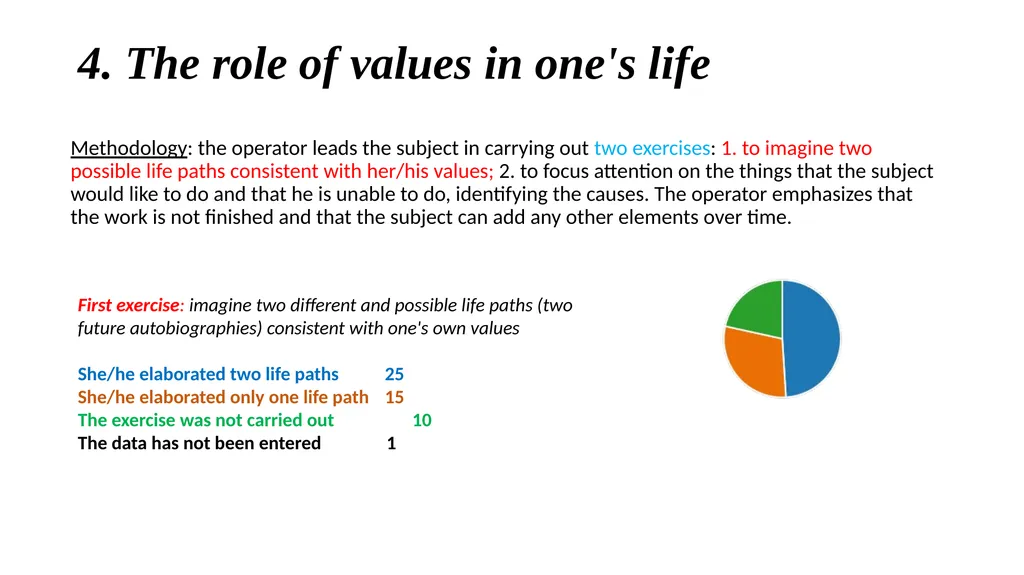
4. The role of values in one's life Methodology: the operator leads the subject in carrying out two exercises: 1. to imagine two possible life paths consistent with her/his values; 2. to focus attention on the things that the subject would like to do and that he is unable to do, identifying the causes. The operator emphasizes that the work is not finished and that the subject can add any other elements over time. First exercise: imagine two different and possible life paths (two future autobiographies) consistent with one's own values
She/he elaborated two life paths 25
She/he elaborated only one life path 15
The exercise was not carried out 10
The data has not been entered 1<br>
She/he elaborated two life paths 25
She/he elaborated only one life path 15
The exercise was not carried out 10
The data has not been entered 1<br>
15
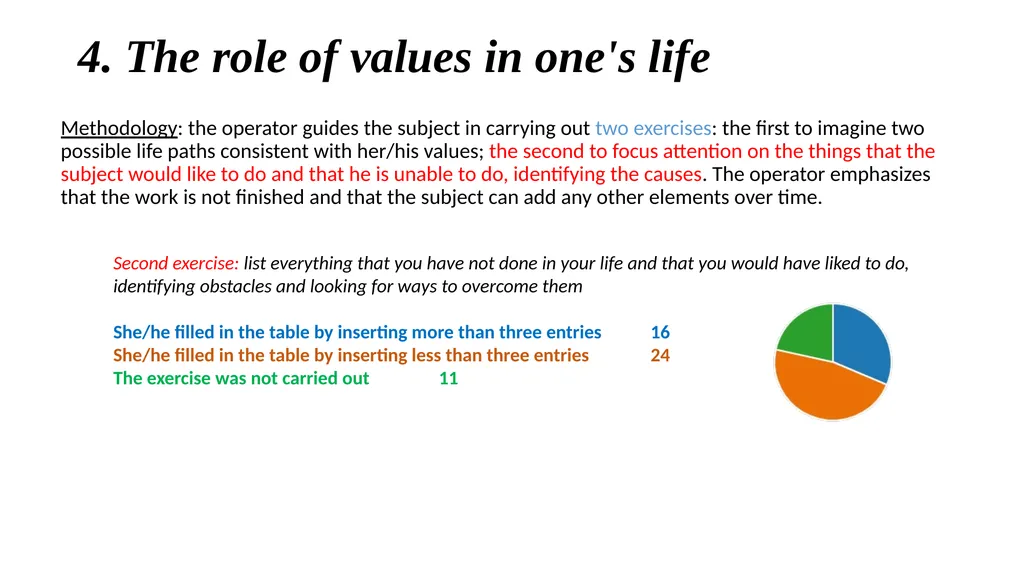
4. The role of values in one's life Methodology: the operator guides the subject in carrying out two exercises: the first to imagine two possible life paths consistent with her/his values; the second to focus attention on the things that the subject would like to do and that he is unable to do, identifying the causes. The operator emphasizes that the work is not finished and that the subject can add any other elements over time. Second exercise: list everything that you have not done in your life and that you would have liked to do,
identifying obstacles and looking for ways to overcome them
She/he filled in the table by inserting more than three entries 16
She/he filled in the table by inserting less than three entries 24
The exercise was not carried out 11<br>
identifying obstacles and looking for ways to overcome them
She/he filled in the table by inserting more than three entries 16
She/he filled in the table by inserting less than three entries 24
The exercise was not carried out 11<br>
16
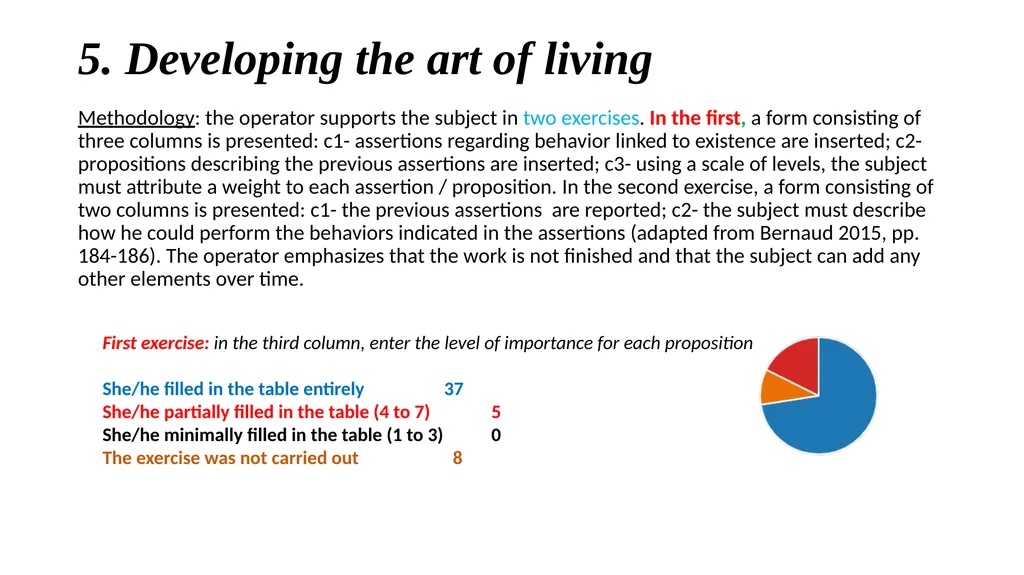
5. Developing the art of living Methodology: the operator supports the subject in two exercises. In the first, a form consisting of three columns is presented: c1- assertions regarding behavior linked to existence are inserted; c2- propositions describing the previous assertions are inserted; c3- using a scale of levels, the subject must attribute a weight to each assertion / proposition. In the second exercise, a form consisting of two columns is presented: c1- the previous assertions are reported; c2- the subject must describe how he could perform the behaviors indicated in the assertions (adapted from Bernaud 2015, pp. 184-186). The operator emphasizes that the work is not finished and that the subject can add any other elements over time. First exercise: in the third column, enter the level of importance for each proposition
She/he filled in the table entirely 37
She/he partially filled in the table (4 to 7) 5
She/he minimally filled in the table (1 to 3) 0
The exercise was not carried out 8<br>
She/he filled in the table entirely 37
She/he partially filled in the table (4 to 7) 5
She/he minimally filled in the table (1 to 3) 0
The exercise was not carried out 8<br>
17
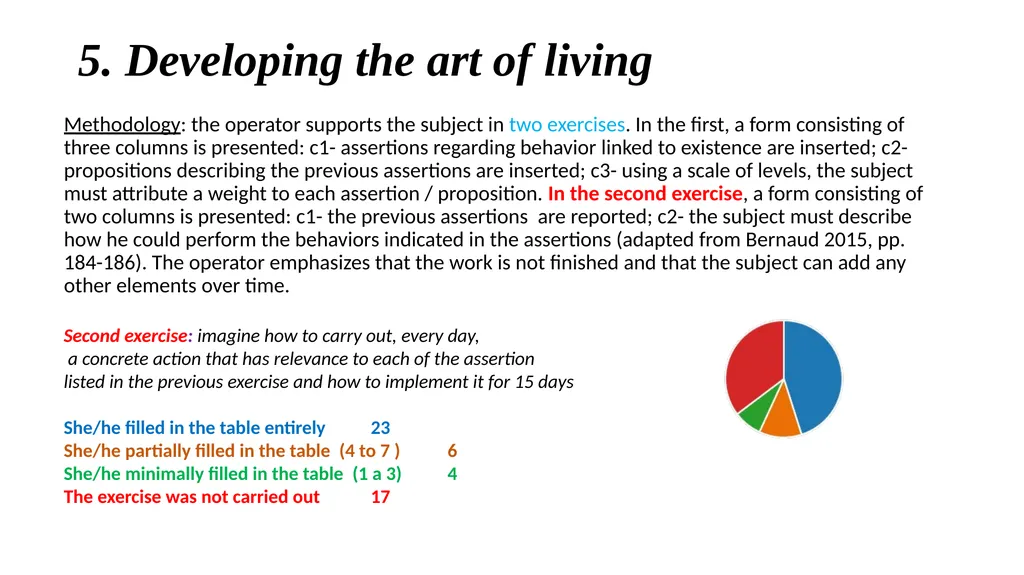
5. Developing the art of living Methodology: the operator supports the subject in two exercises. In the first, a form consisting of three columns is presented: c1- assertions regarding behavior linked to existence are inserted; c2- propositions describing the previous assertions are inserted; c3- using a scale of levels, the subject must attribute a weight to each assertion / proposition. In the second exercise, a form consisting of two columns is presented: c1- the previous assertions are reported; c2- the subject must describe how he could perform the behaviors indicated in the assertions (adapted from Bernaud 2015, pp. 184-186). The operator emphasizes that the work is not finished and that the subject can add any other elements over time. Second exercise: imagine how to carry out, every day,
a concrete action that has relevance to each of the assertion
listed in the previous exercise and how to implement it for 15 days
She/he filled in the table entirely 23
She/he partially filled in the table (4 to 7 ) 6
She/he minimally filled in the table (1 a 3) 4
The exercise was not carried out 17<br>
18
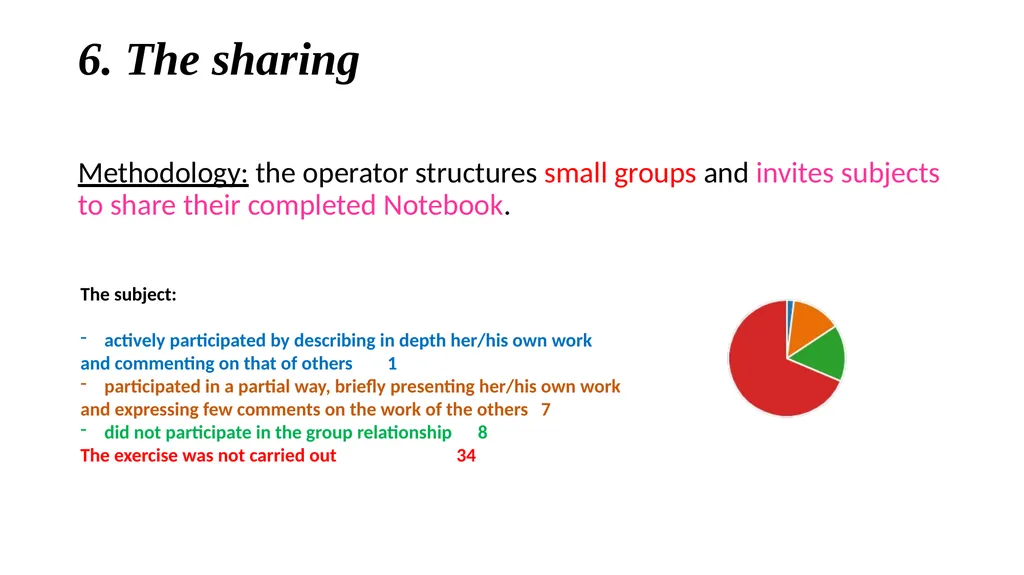
6. The sharing Methodology: the operator structures small groups and invites subjects to share their completed Notebook. The subject:
actively participated by describing in depth her/his own work
and commenting on that of others 1
participated in a partial way, briefly presenting her/his own work
and expressing few comments on the work of the others 7
did not participate in the group relationship 8
The exercise was not carried out 34<br>
19
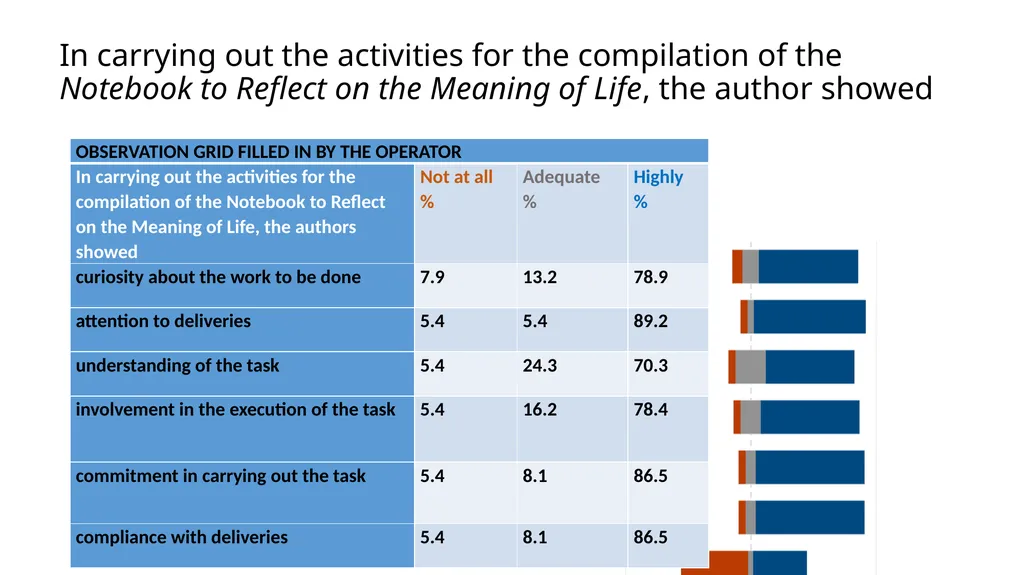
In carrying out the activities for the compilation of the Notebook to Reflect on the Meaning of Life, the author showed<br>
20
Case study CPIA 3 The teachers Antonella Bracalenti, Paola Russo and Pamela Di Lodovico present the case study
The student Bah from Guinea speaks
https://express.adobe.com/page/10r73yENfRHP0/
Bah's Notebook is written in Italian<br>
The student Bah from Guinea speaks
https://express.adobe.com/page/10r73yENfRHP0/
Bah's Notebook is written in Italian<br>