
The Practice and Legal Implications of Withdrawing
MS
Published · 31 slides · 0 views

1 / 1

Description
The Practice and Legal Implications of Withdrawing from an Engagement W. Dane Floyd, Aldridge Borden Company Gary R. Shendell, Shendell Pollock, P.L. Eris Bryan Paul, Huie, Fernambucq Stewart, LLP Why this topic? Important to
Related Topics
Share
Embed code
Download this presentation From Below
"The Practice and Legal Implications of Withdrawing" is the property of its rightful owner. Permission is granted to download and print the materials on this website for personal, non-commercial use only, and to display it on your personal computer provided you do not modify the materials and that you retain all copyright notices contained in the materials. By downloading content from our website, you accept the terms of this agreement.
Presentation Transcript
01
The Practice and Legal Implications of Withdrawing from an Engagement W. Dane Floyd, Aldridge Borden & Company
Gary R. Shendell, Shendell & Pollock, P.L.
Eris Bryan Paul, Huie, Fernambucq & Stewart, LLP<br>
Gary R. Shendell, Shendell & Pollock, P.L.
Eris Bryan Paul, Huie, Fernambucq & Stewart, LLP<br>
02
Why this topic? Important to understand when you need to withdraw from an engagement.
Important to understand how you should withdraw from an engagement.
Important to understand the risk associated with a withdraw from an engagement so that you can mitigate the risk of potential liability.<br>
Important to understand how you should withdraw from an engagement.
Important to understand the risk associated with a withdraw from an engagement so that you can mitigate the risk of potential liability.<br>
03
Focus of today’s presentation Learn practical steps that should be taken by an accountant to withdraw from an engagement under the standards.
Understand the legal and practical implications of withdrawing from an engagement, including the means to minimize potential exposure to liability claims.
Providing an understanding regarding the potential liability associated with an improper withdrawal.<br>
Understand the legal and practical implications of withdrawing from an engagement, including the means to minimize potential exposure to liability claims.
Providing an understanding regarding the potential liability associated with an improper withdrawal.<br>
04
Reasons to disengage Potential and actual conflicts of interest
Nonpayment or late payment of fees
Frequent price or service complaints
Disagreements or disputes between the CPA and the client over fees, aggressive tax positions, or accounting treatments
Disputes among the client’s partners or shareholders
Difficulty in obtaining, or consistent delays in receiving, requested information or documents
Consistent negative reactions to points of improvement raised by the CPA
Lack of management integrity
Lack on internal controls
High accounting or management turnover
Poor treatment of CPA firm staff
Poor treatment of client’s own accounting staff<br>
05
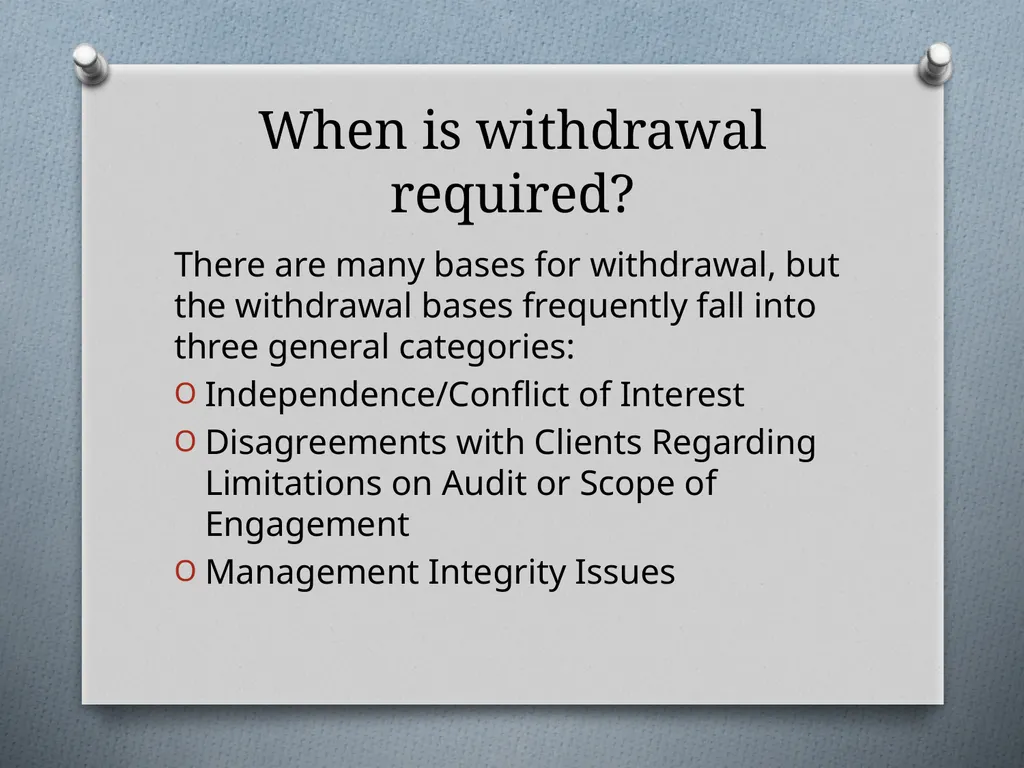
When is withdrawal required? There are many bases for withdrawal, but the withdrawal bases frequently fall into three general categories:
Independence/Conflict of Interest
Disagreements with Clients Regarding Limitations on Audit or Scope of Engagement
Management Integrity Issues<br>
Independence/Conflict of Interest
Disagreements with Clients Regarding Limitations on Audit or Scope of Engagement
Management Integrity Issues<br>
06
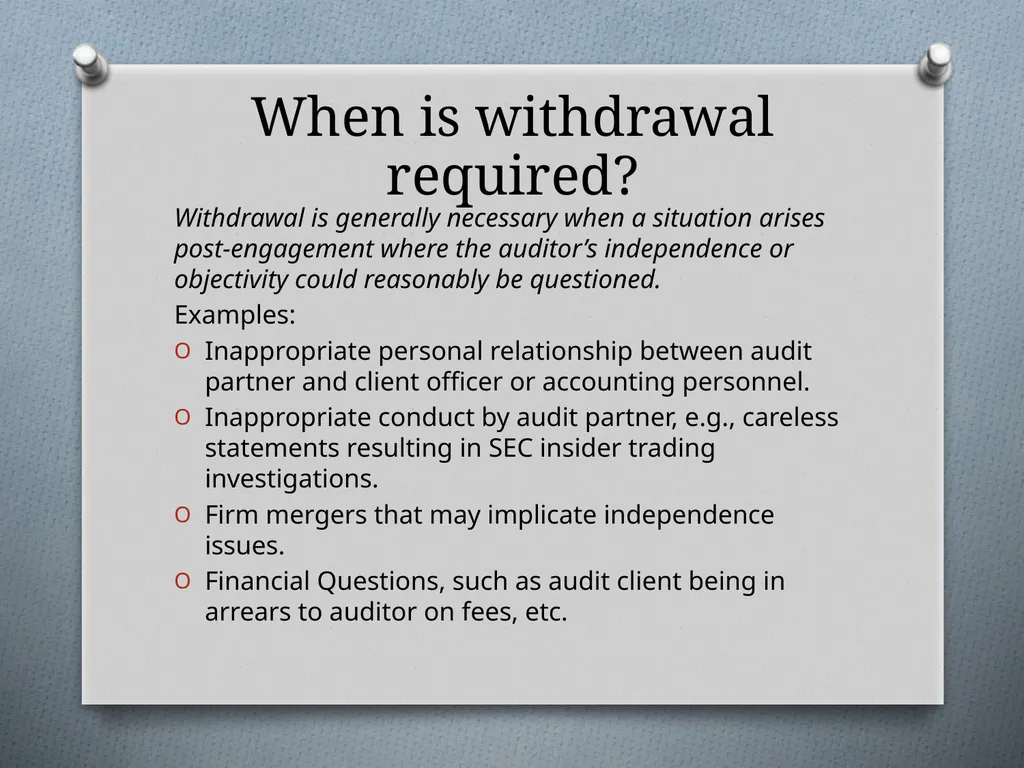
When is withdrawal required? Withdrawal is generally necessary when a situation arises post-engagement where the auditor’s independence or objectivity could reasonably be questioned.
Examples:
Inappropriate personal relationship between audit partner and client officer or accounting personnel.
Inappropriate conduct by audit partner, e.g., careless statements resulting in SEC insider trading investigations.
Firm mergers that may implicate independence issues.
Financial Questions, such as audit client being in arrears to auditor on fees, etc.<br>
07
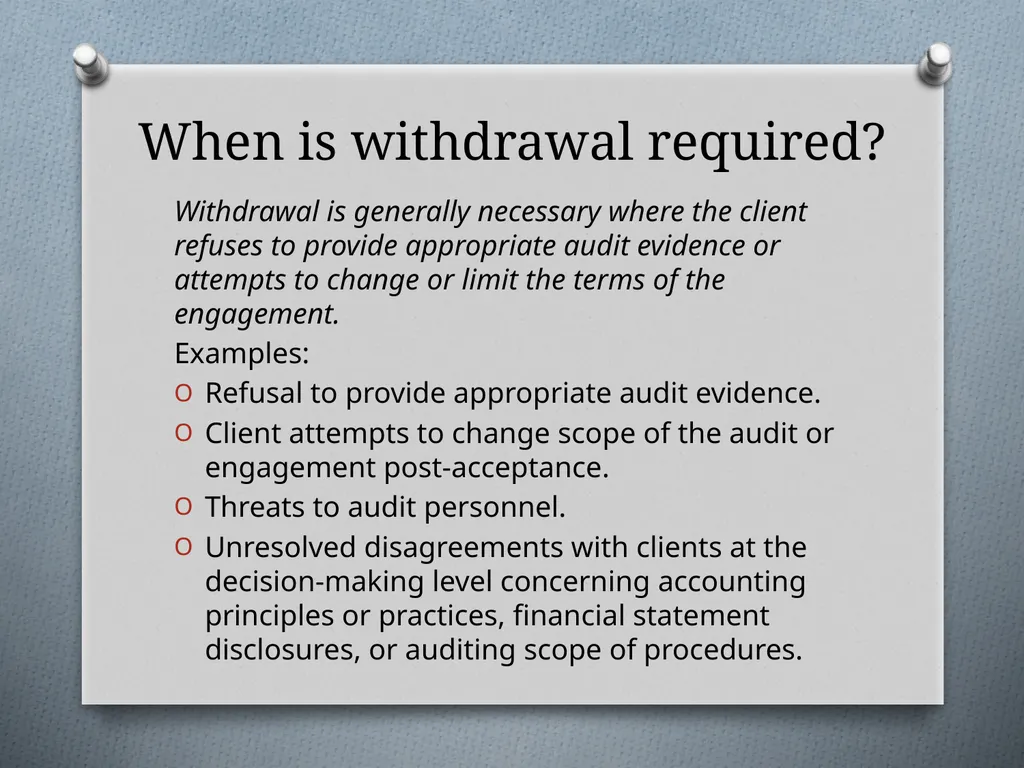
When is withdrawal required? Withdrawal is generally necessary where the client refuses to provide appropriate audit evidence or attempts to change or limit the terms of the engagement.
Examples:
Refusal to provide appropriate audit evidence.
Client attempts to change scope of the audit or engagement post-acceptance.
Threats to audit personnel.
Unresolved disagreements with clients at the decision-making level concerning accounting principles or practices, financial statement disclosures, or auditing scope of procedures.<br>
08
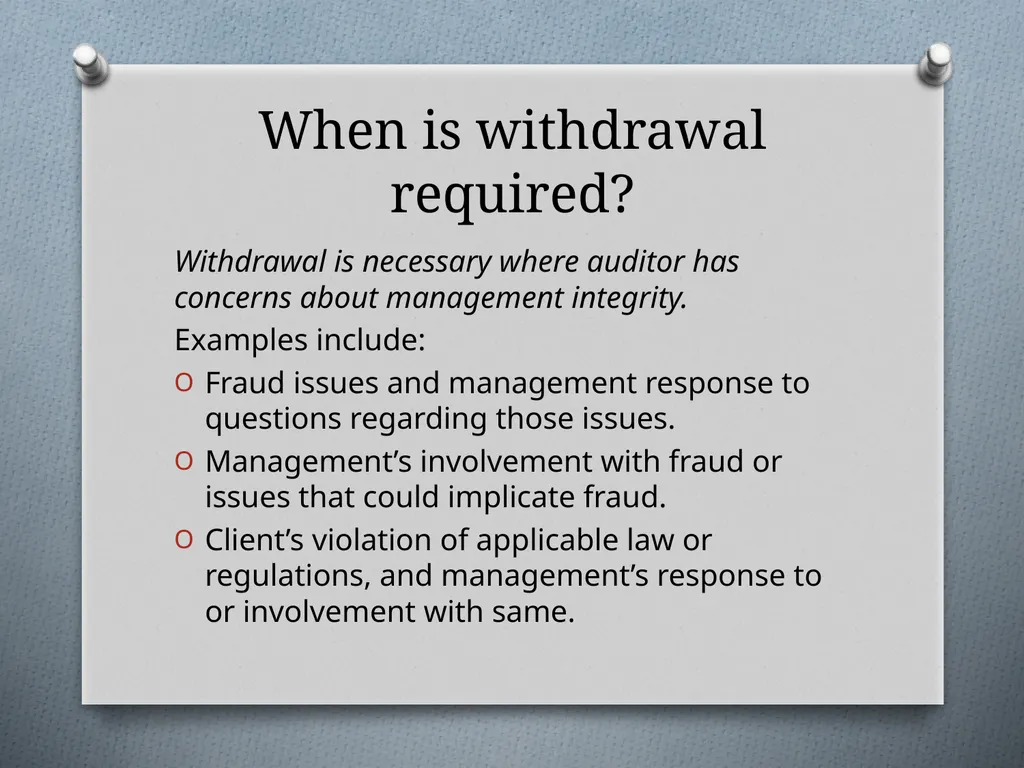
When is withdrawal required? Withdrawal is necessary where auditor has concerns about management integrity.
Examples include:
Fraud issues and management response to questions regarding those issues.
Management’s involvement with fraud or issues that could implicate fraud.
Client’s violation of applicable law or regulations, and management’s response to or involvement with same.<br>
Examples include:
Fraud issues and management response to questions regarding those issues.
Management’s involvement with fraud or issues that could implicate fraud.
Client’s violation of applicable law or regulations, and management’s response to or involvement with same.<br>
09
Standards related to withdrawal AU-C § 240
Consideration of Fraud in Financial Statement Audit
AU-C § 250
Consideration of Laws and Regulations in Audit of Financial Statements<br>
Consideration of Fraud in Financial Statement Audit
AU-C § 250
Consideration of Laws and Regulations in Audit of Financial Statements<br>
10
Practical questions regarding a decision to withdraw What ethical considerations need to be made regarding an accountant’s withdrawal under the standards?
What insurance considerations need to be made regarding an accountant’s decision to withdraw?
What legal considerations need to be made regarding an accountant’s decision to withdraw?<br>
What insurance considerations need to be made regarding an accountant’s decision to withdraw?
What legal considerations need to be made regarding an accountant’s decision to withdraw?<br>
11
Adverse effect of resignation or withdrawal Aside from costs to the client inherent in a change of auditors, studies have shown that in the years following auditor resignation, audit clients are more likely to:
Be involved in shareholder litigation/class action lawsuits;
Report weakness in controls over financial reporting;
Be delisted from a national stock exchange due to bankruptcy or failure to meet stock exchange listing requirements.
Even with respect to non-public companies, withdrawal in the midst of the engagement can result in adverse consequences, such as failure to meet loan covenants or otherwise lose financing.<br>
12
National Medical v. Deloitte National Medical Transportation Network v. Deloitte & Touche, 62 Cal. App. 4th 412, 72 Cal. Rptr. 2nd 720 (1998):
Audit client sued auditor based upon auditor withdrawal prior to completion of audit.
CFO resigned during audit and refused to sign management representation letter, specifically raising questions with Deloitte partner about CEO’s integrity.
CEO threatened auditor with lawsuit in the event audit was not completed.
Deloitte resigned. After going through two more auditors, audit client ultimately made adjustments recommended by Deloitte.
Audit client sued Deloitte for professional negligence, breach of contract, and negligent interference with prospective economic advantage and obtained a jury verdict in its favor!<br>
13
National Medical v. Deloitte The Appellate Court came to the rescue, however, and reversed, holding that the professional standards set forth by the AICPA permitted Deloitte to resign.
Specifically, the court held that the plaintiff’s theory of the case conflicted with the defendant auditors’ obligation to maintain their independence, and that their public responsibilities as auditors (as reflected in the AICPA professional standards) transcended any duties they owed to that particular client.<br>
Specifically, the court held that the plaintiff’s theory of the case conflicted with the defendant auditors’ obligation to maintain their independence, and that their public responsibilities as auditors (as reflected in the AICPA professional standards) transcended any duties they owed to that particular client.<br>
14
Wiz Tech v. Coopers Wiz Technology Inc. v. Coopers & Lybrand, 106 Cal. App. 4th 1, 130 Cal. Rptrt. 2d 263 (2003) :
Audit client sued auditor based upon auditor resignation prior to completion of audit.
Coopers performed 1995 audit for client. As part of engagement negotiations for 1996, Coopers partner conditioned engagement upon several conditions, including client’s retention of competent securities’ counsel.
During audit, Coopers discovered that previous counsel continued to perform securities work for client, notwithstanding earlier representation by client.<br>
15
Wiz Tech v. Coopers Coopers resigned in August 1996, and the client ultimately hired Grant Thornton. Grant Thornton resigned in December 1996.
The client ultimately filed for bankruptcy in January 1998, and filed suit against Coopers six months later.
Unlike the trial court’s National Medical Transport case, Coopers obtained summary judgment in its favor.
Court found that “it is reasonable and permissible for an auditor to resign for good cause,” citing National Medical Transport. Because the client breached a condition of the contract, Coopers decision to resign was supported by good cause and not actionable.<br>
16
You should address the possibility of withdrawal at the outset of the engagement. Your engagement letter should detail the specific circumstances when a withdrawal is appropriate.
Your engagement letter should address the method by which you can withdraw.
Your engagement letter should set forth what occurs when you withdraw.<br>
Your engagement letter should address the method by which you can withdraw.
Your engagement letter should set forth what occurs when you withdraw.<br>
17
Engagement letters NEED to be in writing! Have a written agreement setting forth the ground rules of the business relationship with the client.
Use an engagement letter and avoid oral agreements, which may be reinterpreted by an attorney or a judge many years later.
Use that engagement letter to establish that the parties bargained for an arm’s-length, business transaction.
Include provisions that may afford defenses in the event that litigation arises in the future.<br>
18
Engagement letters should detail the rights and responsibilities of the parties when a withdrawal happens. Provides you with the right to withdrawal for any reason or no reason at all.
Sets forth the notice requirements for withdrawal.
Sets forth your responsibilities to the client upon withdrawal.
Sets forth your client’s responsibilities to you upon withdrawal.<br>
Sets forth the notice requirements for withdrawal.
Sets forth your responsibilities to the client upon withdrawal.
Sets forth your client’s responsibilities to you upon withdrawal.<br>
19
Engagement letter should set the procedure for withdrawal. The engagement letter should outline the conditions that might lead to your withdrawal, any compensation that may be due and the procedures the CPA will follow in case of withdrawal.<br>
20
Engagement letter should set the procedure for withdrawal The engagement letter should also discuss policies and procedures related to the termination of the engagement including return of client files; preparation of the final bill; work-paper retention; and date of termination of services.
If you should decided to withdraw, you should send a disengagement letter confirming your decision.<br>
If you should decided to withdraw, you should send a disengagement letter confirming your decision.<br>
21
Other considerations for engagement letters. Include disclaimer language that rejects any sort of damages related to a withdrawal.
Limitation of liability language (liquidated damages, disclaimer for consequential damages, attorneys fees, or punitive damages).
Forum selection clause.
Arbitration provision.<br>
Limitation of liability language (liquidated damages, disclaimer for consequential damages, attorneys fees, or punitive damages).
Forum selection clause.
Arbitration provision.<br>
22
Are there ethical considerations affecting engagement terms? What are the ethical considerations that a CPA needs to take into account when including protective language in her engagement letter?
Are there certain ethical limitations regarding protective language a CPA can include in her engagement letter?<br>
Are there certain ethical limitations regarding protective language a CPA can include in her engagement letter?<br>
23
Ethical considerations regarding limitations in engagement letters. Attest engagements subject to SEC, FFIEC, or insurance commission requirements generally cannot have limitation-of-liability clauses.
SEC holds that these breach independence requirement.
FFIEC holds that these constitute “unsafe and unsound” practices by regulated banks and thrifts.
Model rule by NAIC says indemnity agreement prevents auditors’ assertion of independence.<br>
SEC holds that these breach independence requirement.
FFIEC holds that these constitute “unsafe and unsound” practices by regulated banks and thrifts.
Model rule by NAIC says indemnity agreement prevents auditors’ assertion of independence.<br>
24
Ethical considerations regarding limitations in engagement letters. For other audit situations, contractual limitations on auditors’ liability may be possible.
Indemnification of auditors for knowing misrepresentations by management appears acceptable, if controversial (opposed by NASBA, disputed by many courts).
Trends for other professions suggests limitation of liability clauses are increasingly acceptable.
Limitations on damages are much more likely to be upheld than indemnification clauses.<br>
25
Non-engagement letters When CPAs have had issue discussions with prospective clients, and the CPA has not been formally engaged, the CPA should consider sending a non-engagement letter to notify the prospect that no engagement has been entered into and that the client should not rely on any discussions that preliminary and tentative, at best.
Use certified mail for delivery<br>
Use certified mail for delivery<br>
26
Complying with the standards regarding withdrawal What do the standards require regarding withdrawals?
What steps should you take when considering withdrawal?
How do you protect yourself after you have made the decision to withdraw?
Should you have to do anything regarding your insurance if you withdraw?
Under what circumstances should you consult with counsel regarding a withdrawal?<br>
What steps should you take when considering withdrawal?
How do you protect yourself after you have made the decision to withdraw?
Should you have to do anything regarding your insurance if you withdraw?
Under what circumstances should you consult with counsel regarding a withdrawal?<br>
27
Proper documentation regarding withdrawal What documentation do the standards require?
When should that documentation be generated?
Who should be creating that documentation?
What should that documentation look like?
How much of that documentation should I share with the client?<br>
When should that documentation be generated?
Who should be creating that documentation?
What should that documentation look like?
How much of that documentation should I share with the client?<br>
28
Disengagement letters Introductory paragraph – clearly indicate that the client relationship is being terminated, the timing of same, and the status of services previously agreed in issued engagement letters
Work-in-process – address the work product, if any, that the firm will deliver to the client. If there is no work-in-process state that fact. Avoid providing partially completed work product to clients or successor CPA firms.
Outstanding fees – briefly state the amount of outstanding fees due, even if collection is unlikely
Items for client follow-up – address outstanding accounting and tax matters that require follow-up or completion by the client or successor CPA firm. Clearly identify deadline-sensitive items.
Client records and records retention – clearly indicate the status of any client records supplied to you and also note your firm’s record retention policy. CPAs must return original client records.
Use certified mail for delivery<br>
29
Post-withdrawal communications How should I handle client requests following a withdrawal?
How should I handle a subsequent auditor’s request following a withdrawal?
How should I handle request from a third party lender regarding my withdrawal?
How should I handle a call from an attorney regarding my withdrawal?
How should I handle a call from my client regarding my withdrawal?<br>
How should I handle a subsequent auditor’s request following a withdrawal?
How should I handle request from a third party lender regarding my withdrawal?
How should I handle a call from an attorney regarding my withdrawal?
How should I handle a call from my client regarding my withdrawal?<br>
30
Privilege issues following withdrawal Privilege can vary depending on what jurisdiction you are practicing in.
Privilege can vary depending on what type of client you are working with.
Privilege can vary depending on what type of services you provide.
Illinois Supreme Court:
In Re October 1985 Grand Jury, 124 Ill.2d 446 (1988)
Brunton v. Kruger, 2015 IL 117663<br>
Privilege can vary depending on what type of client you are working with.
Privilege can vary depending on what type of services you provide.
Illinois Supreme Court:
In Re October 1985 Grand Jury, 124 Ill.2d 446 (1988)
Brunton v. Kruger, 2015 IL 117663<br>
31
Questions W. Dane Floyd, Aldridge Borden & Company
Gary R. Shendell, Shendell & Pollock, P.L.
Eris Bryan Paul, Huie, Fernambucq & Stewart, LLP<br>
Gary R. Shendell, Shendell & Pollock, P.L.
Eris Bryan Paul, Huie, Fernambucq & Stewart, LLP<br>