
The Role of Plant Biology in Agribusiness. Level 2
LD
Published · 83 slides · 0 views

1 / 1



Description
The Role of Plant Biology in Agribusiness. Level 2 Agribusiness. The BIG picture? Why are plants important to the primary industry? How does understanding their structure, form and function improve primary production, meet producer and
Related Topics
Share
Embed code
Download this presentation From Below
"The Role of Plant Biology in Agribusiness. Level 2" is the property of its rightful owner. Permission is granted to download and print the materials on this website for personal, non-commercial use only, and to display it on your personal computer provided you do not modify the materials and that you retain all copyright notices contained in the materials. By downloading content from our website, you accept the terms of this agreement.
Presentation Transcript
01
The Role of Plant Biology in Agribusiness. Level 2 Agribusiness.<br>
02
The BIG picture? Why are plants important to the primary industry?
How does understanding their structure, form and function improve primary production, meet producer and customer needs?
What is the role of plant biology in agribusiness?<br>
How does understanding their structure, form and function improve primary production, meet producer and customer needs?
What is the role of plant biology in agribusiness?<br>
03
Plant Taxonomy and Classification. This is the science of the classification of living things.
Carl Linnaeus (Swedish 1707 – 1778) introduced the binomial system for naming organisms. This helped humans to organise their knowledge into groups.
First part of the name is the genus name. Always starts with a capital and is underlined or in italics.
Second part of the name is the species name. It always starts with a small letter and is underlined or in italics.
E.g. Homo sapiens - humans
Linnaeus considered a species to be fixed / unchanged thing and a genus was a group of species having certain characteristics in common. He introduced other higher categories which we still use today.<br>
04
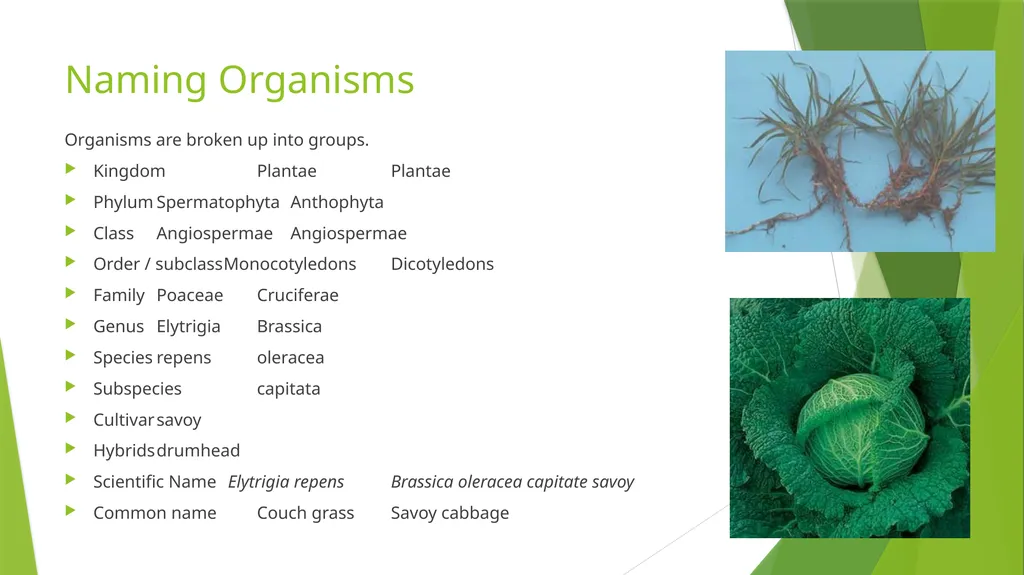
Naming Organisms Organisms are broken up into groups.
Kingdom Plantae Plantae
Phylum Spermatophyta Anthophyta
Class Angiospermae Angiospermae
Order / subclass Monocotyledons Dicotyledons
Family Poaceae Cruciferae
Genus Elytrigia Brassica
Species repens oleracea
Subspecies capitata
Cultivar savoy
Hybrids drumhead
Scientific Name Elytrigia repens Brassica oleracea capitate savoy
Common name Couch grass Savoy cabbage<br>
05
Species. Species are referred to internationally by their binomial names – genus and species.
Shows how species are closely related.
Species is a population of similar individuals, alike in their structure and function, which can only breed with each other and have a common ancestry.
Species name may have been chosen because of it
The biologist discovering / bred it.
A use of the organism
Its colour, size, place of origin etc.<br>
06
Kingdom Plantae (plants) Multicellular organisms that carry out photosynthesis and have cellulose walls.
All except for a few parasitic forms are autotrophic and use photosynthesis as a source of carbon
Most live on land
350,000 species identified including mosses, ferns, conifers, flowering plants.<br>
All except for a few parasitic forms are autotrophic and use photosynthesis as a source of carbon
Most live on land
350,000 species identified including mosses, ferns, conifers, flowering plants.<br>
07
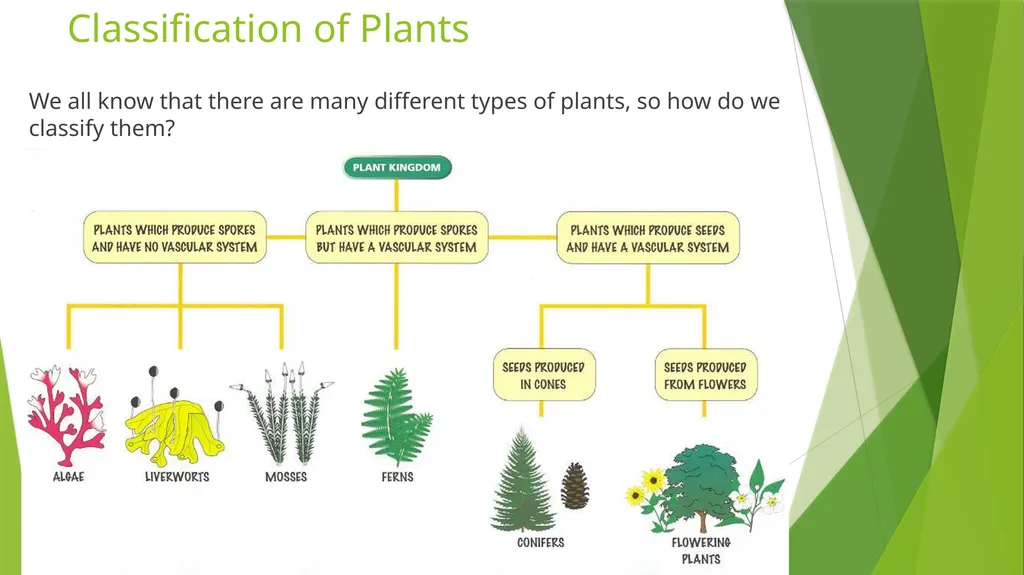
15/02/2016 Classification of Plants We all know that there are many different types of plants, so how do we classify them?<br>
08
Bryophytes – non vascular plants e.g. mosses and liverworts.
Traecheophyta – vascular plants
3 groups
1. Filicopsida – ferns and horse tails. E.g. tree fern, kidney fern.
2. Gymnosperms – cone bearing plants. E.g. kauri, matai, rimu.
3. Angiosperms – flowering plants.
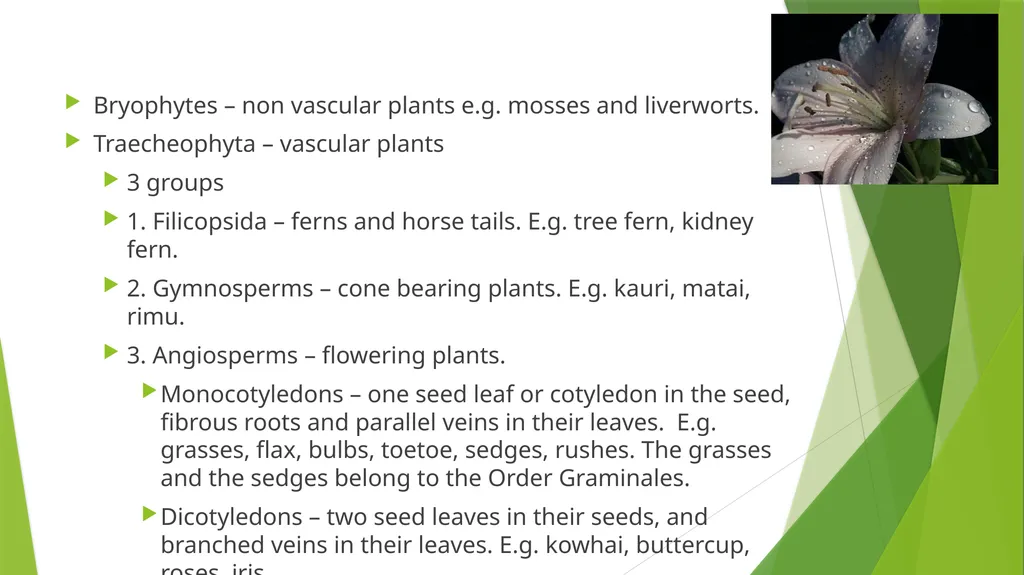
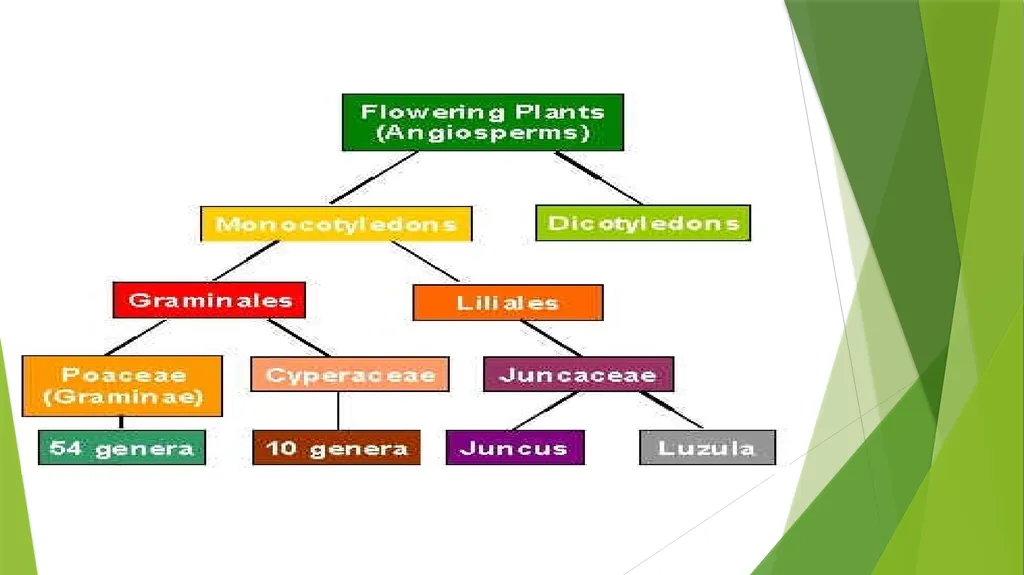
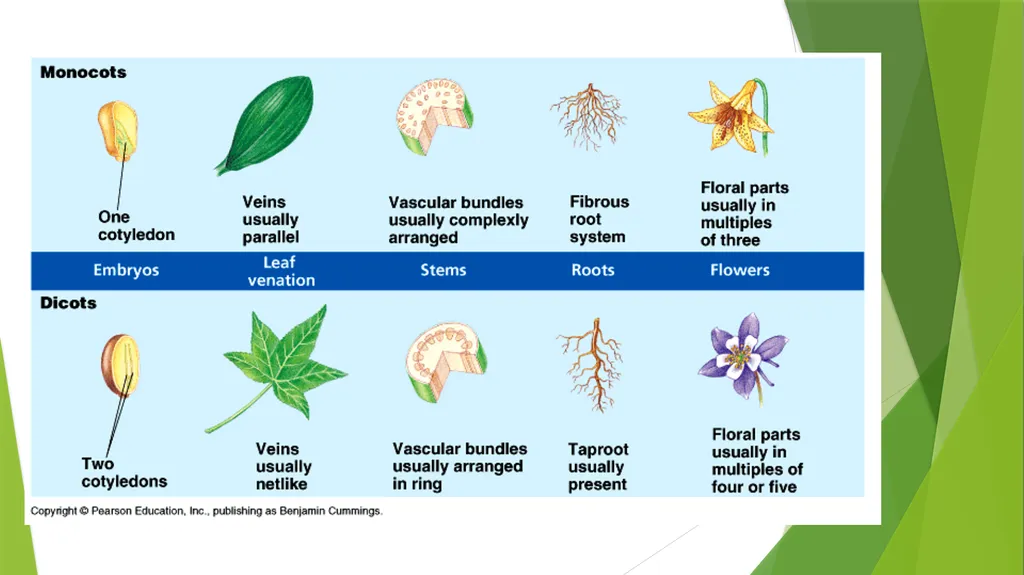
Monocotyledons – one seed leaf or cotyledon in the seed, fibrous roots and parallel veins in their leaves. E.g. grasses, flax, bulbs, toetoe, sedges, rushes. The grasses and the sedges belong to the Order Graminales.
Dicotyledons – two seed leaves in their seeds, and branched veins in their leaves. E.g. kowhai, buttercup, roses, iris<br>
09
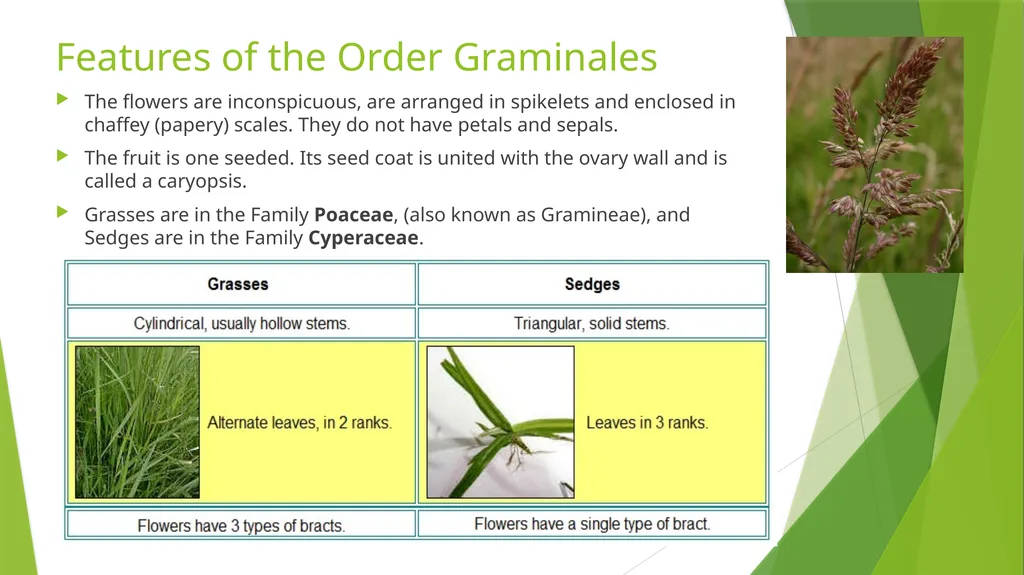
Features of the Order Graminales
The flowers are inconspicuous, are arranged in spikelets and enclosed in chaffey (papery) scales. They do not have petals and sepals.
The fruit is one seeded. Its seed coat is united with the ovary wall and is called a caryopsis.
Grasses are in the Family Poaceae, (also known as Gramineae), and Sedges are in the Family Cyperaceae.<br>
10
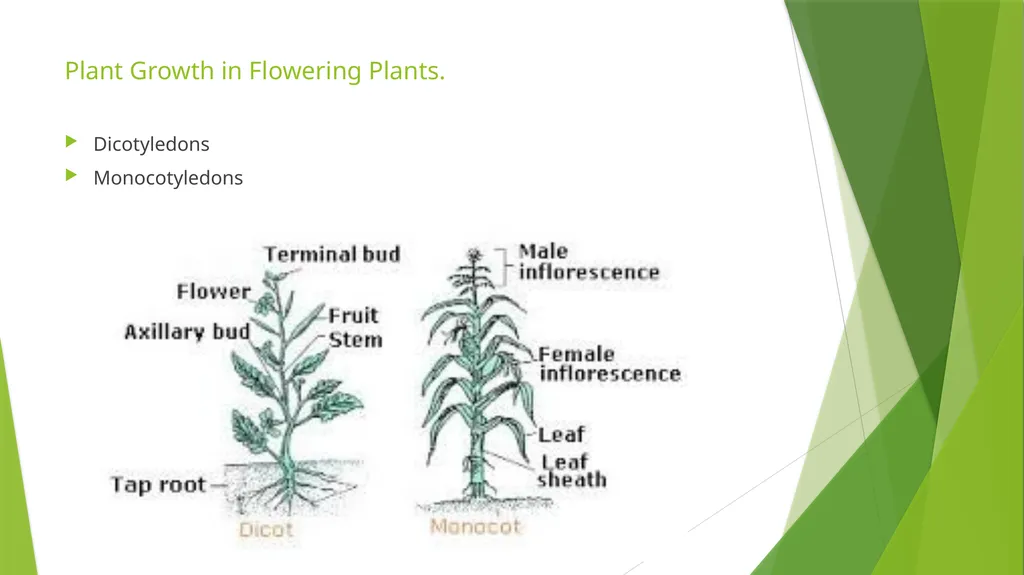
Plant Growth in Flowering Plants. Dicotyledons
Monocotyledons<br>
Monocotyledons<br>
11
Activity On the lawn outside, find a thin leafed plant with parallel veins and a broad leafed plant with net venation.
Compare the strength needed to pull out the broad leaf and the narrow leaf plants.
Compare the soil residue around the root systems.
Identify which is a monocotyledon and the dicotyledon.<br>
Compare the strength needed to pull out the broad leaf and the narrow leaf plants.
Compare the soil residue around the root systems.
Identify which is a monocotyledon and the dicotyledon.<br>
12
Questions. Write a mnemonic to remember the binominal system.
Angiosperms are the _______________ plants. They can be divided into two main groups: the _____________ that have parallel veins in their leaves, and the ____________ that have branched veins in their leaves.
Daffodils, grasses and corn are examples of the __________, and oak trees, pansies and poppies are examples of the ________.
Name the three incorrect things about the writing of this scientific name: podocarp Totara.
Using just the letters, place these classification groups in order from the biggest to the smallest: G – Genus, K – Kingdom, C – Class, S – Species, P – Phylum, O – Order, F – Family.
Who developed the idea of the bionomical system of nomenclature?
All organisms have a common name as well as a scientific name; e.g. flax Phormium tenax purpureum. What are the reasons for using scientific names rather than just common names?<br>
13
In which of the following pairs would the two plants have the most characteristics in common?
Epacris longiflora and Erica longiflora.
Epacris lanuginose and Erica lusitanica
Ehrharta longiflora and Epacris longiflora
Ehrharta distichophylla and Ehrharta longiflora.
Which of the following pairs of plants are most closely related?
Pittosporum crassifolium variegata and Pittosporum tenuifolium variegata
Pittosporum tenuifolium garnetti and Pittosporum tenuifolium variegata
Diosma ericoides and Hebe diosmaefolia
Phormium tenax purpureum and Pittosporum tenuifolium purpureum.
Make a list of scientific names for the following pasture plants: ryegrass, fescue, cocksfoot, timothy, white clover, lucerne, lotus, kale, Chou Moellier, rape, turnips, swedes, chicory, and plantain.<br>
14
Important Plants for New Zealand? Brainstorm
What are agricultural or horticultural plants?
What is the difference between the agricultural or horticultural species?
What are these plants used for?
Explain the differences between the different agricultural species.
Why are these plants important to New Zealand primary industries?<br>
What are agricultural or horticultural plants?
What is the difference between the agricultural or horticultural species?
What are these plants used for?
Explain the differences between the different agricultural species.
Why are these plants important to New Zealand primary industries?<br>
15
Economic outlook for 2016. Despite some challenging conditions over the last year, the horticulture (5%) and arable (2%) sectors have grown strongly, partially offsetting larger decreases in forestry (10%).
High volumes of wine and kiwifruit were sold.
$8797 million in export revenue for 2015.
Positive medium term prospects for log and timber exports to China; potential for growth in the United States of America as the housing market continues to recover from post global financial crisis (GFC) lows.
Strong kiwifruit recovery from the Psa disease; positive signals for price gains and expansion of markets for wine, apples and pears.
Arable export revenue is down from a record high in 2014 but increasing global demand and New Zealand’s reputation for high quality seed will underpin growth till 2019.<br>
16
Important Plants for New Zealand. Pasture plants (see later)
Forestry Crops.
Pinus radiata, Douglas fir, eucalypt, blackwood.
Grain and seed plants
Cereal species e.g. oats, barley, wheat, maize; Brassica species e.g. oil seed rape; Pulse species e.g. peas, beans, and linseed; Herbage, forage and vegetable crops e.g. white clover, ryegrass, maize which are grown as annuals to harvest the seed; Energy species e.g. maize for ethanol.
Fruit plants
Temperate e.g. grapes, stonefruit, pipfruit, berryfruit, persimmons, walnuts; Sub temperate e.g. kiwifruit, feijoas, passionfruit, tamarillos, macadamias, citrus.
Vegetable plants
Squash, potatoes, onions, greens (lettuce, cauliflower, broccoli), asparagus, carrots, process vegetables (peas, beans, potatoes), covered crops (capsicums, tomatoes).
Flower - bulbs, tubers, corms, seeds
Orchids, lilium, sandersonia, tulips, seeds.<br>
17
Pasture Plants
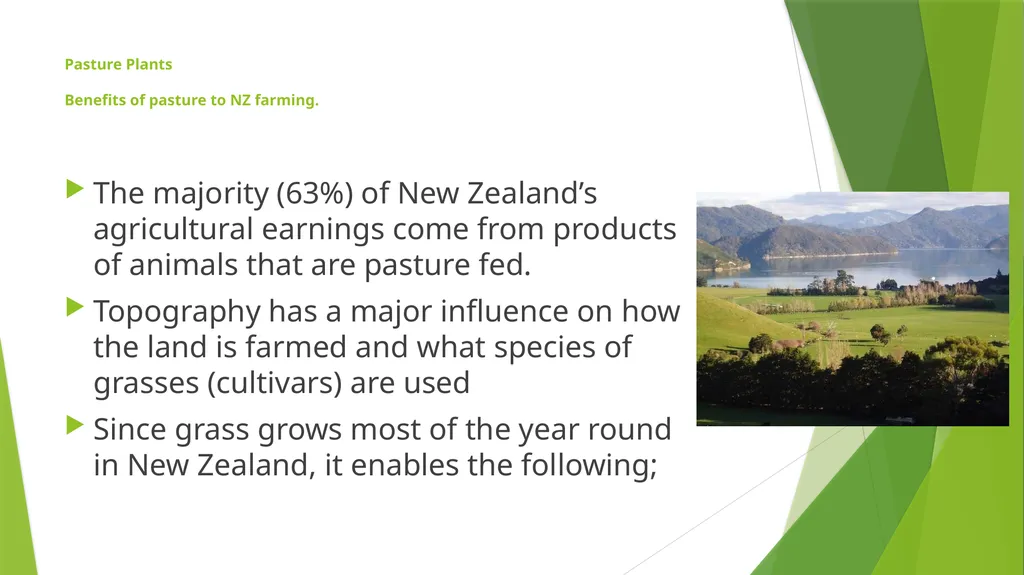
Benefits of pasture to NZ farming. The majority (63%) of New Zealand’s agricultural earnings come from products of animals that are pasture fed.
Topography has a major influence on how the land is farmed and what species of grasses (cultivars) are used
Since grass grows most of the year round in New Zealand, it enables the following;<br>
Topography has a major influence on how the land is farmed and what species of grasses (cultivars) are used
Since grass grows most of the year round in New Zealand, it enables the following;<br>
18
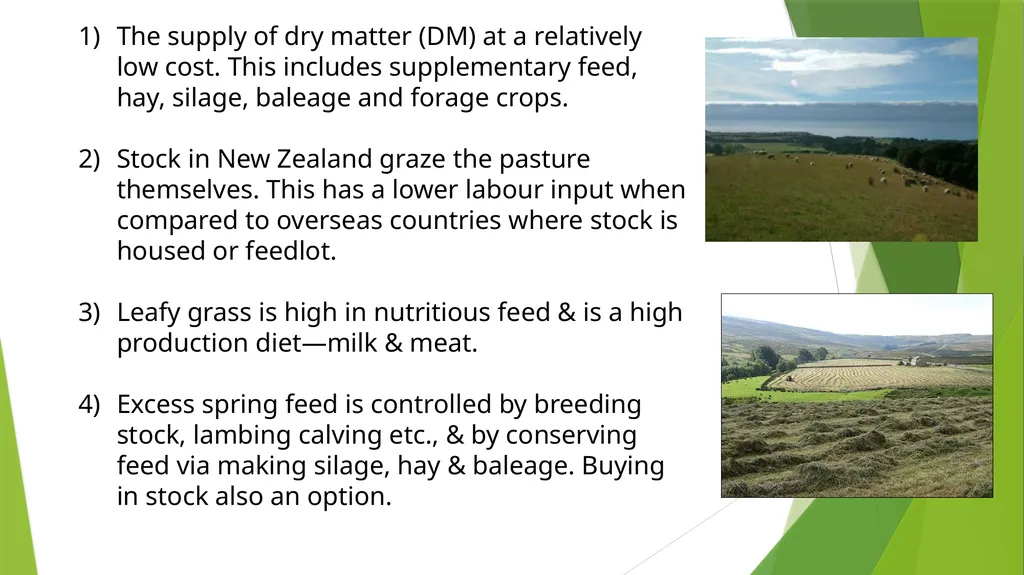
The supply of dry matter (DM) at a relatively low cost. This includes supplementary feed, hay, silage, baleage and forage crops.
Stock in New Zealand graze the pasture themselves. This has a lower labour input when compared to overseas countries where stock is housed or feedlot.
Leafy grass is high in nutritious feed & is a high production diet—milk & meat.
Excess spring feed is controlled by breeding stock, lambing calving etc., & by conserving feed via making silage, hay & baleage. Buying in stock also an option.<br>
19
Stock return nutrients to the soil via urine & dung.
Urine returns Potassium & Nitrogen to the soil.
Faeces returns Phosphate, Calcium & Magnesium to the soil.
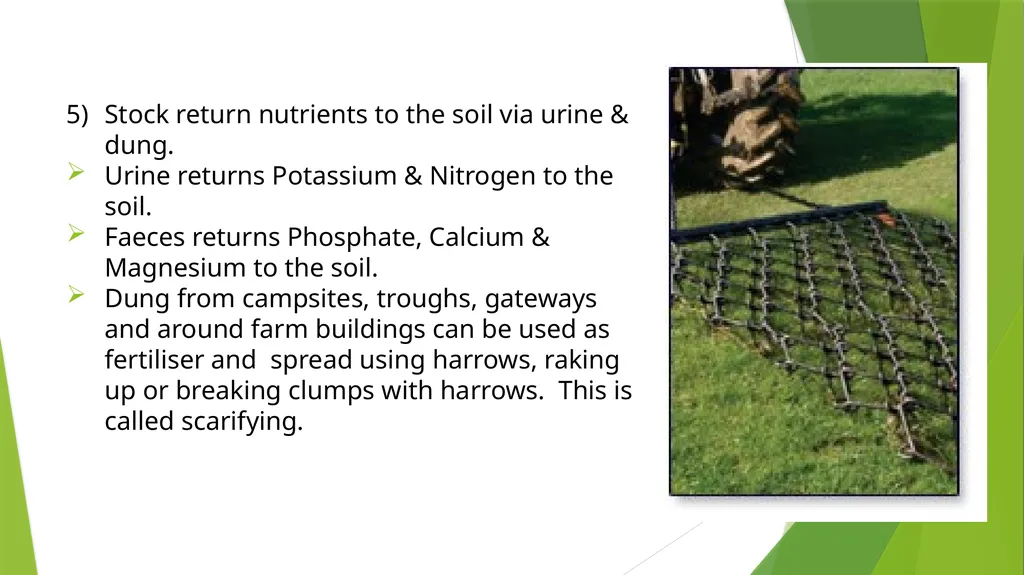
Dung from campsites, troughs, gateways and around farm buildings can be used as fertiliser and spread using harrows, raking up or breaking clumps with harrows. This is called scarifying.<br>
Urine returns Potassium & Nitrogen to the soil.
Faeces returns Phosphate, Calcium & Magnesium to the soil.
Dung from campsites, troughs, gateways and around farm buildings can be used as fertiliser and spread using harrows, raking up or breaking clumps with harrows. This is called scarifying.<br>
20
Importance of Pasture to the New Zealand Economy What are 3 aspects that make New Zealand unique in the world for pasture production?
What are 3 advantages of feeding pasture to livestock compared to stored grains or supplements?
How do European and American farmers feed their stock in winter?<br>
What are 3 advantages of feeding pasture to livestock compared to stored grains or supplements?
How do European and American farmers feed their stock in winter?<br>
21
Pasture plants Grasses - Gramineae family e.g. ryegrasses, fescue, cocksfoot, timothy.
Herbage, forage and legumes such as white clover, lucerne, lotus.
Brassica species e.g. kale, Chou Moellier, rape, turnips, swedes.
Pasture herbs e.g. chicory, plantain.<br>
Herbage, forage and legumes such as white clover, lucerne, lotus.
Brassica species e.g. kale, Chou Moellier, rape, turnips, swedes.
Pasture herbs e.g. chicory, plantain.<br>
22
Poaceae 4th largest family – 620 genera, 10,000 species
Most important family (ethno botanically).
All the important grain crops are all grasses.
Grasses are thought to have originated in South America, but have spread across the world.
First diversified about 70 mya in late Cretaceous in the understories of tropical forests.<br>
Most important family (ethno botanically).
All the important grain crops are all grasses.
Grasses are thought to have originated in South America, but have spread across the world.
First diversified about 70 mya in late Cretaceous in the understories of tropical forests.<br>
23
Grasses The grass family is the most abundant plant group in grazing pastures.
Besides providing grazing animals with feed, which enables the production of meat, fibre, milk and hides, this family includes plants that yield cereal grains for human consumption and numerous other plants that are important for people.
Grasses that are of considerable value for;
Hay and silage production
Protecting soil from erosion
Planting lawns and playing fields
Sugar production
Binding coastal sand dunes
Paper making
Thatching and weavng
Reclaiming saline areas.
Plants in the grass family vary considerable, from small annuals to plants of great size like giant bamboo.<br>
24
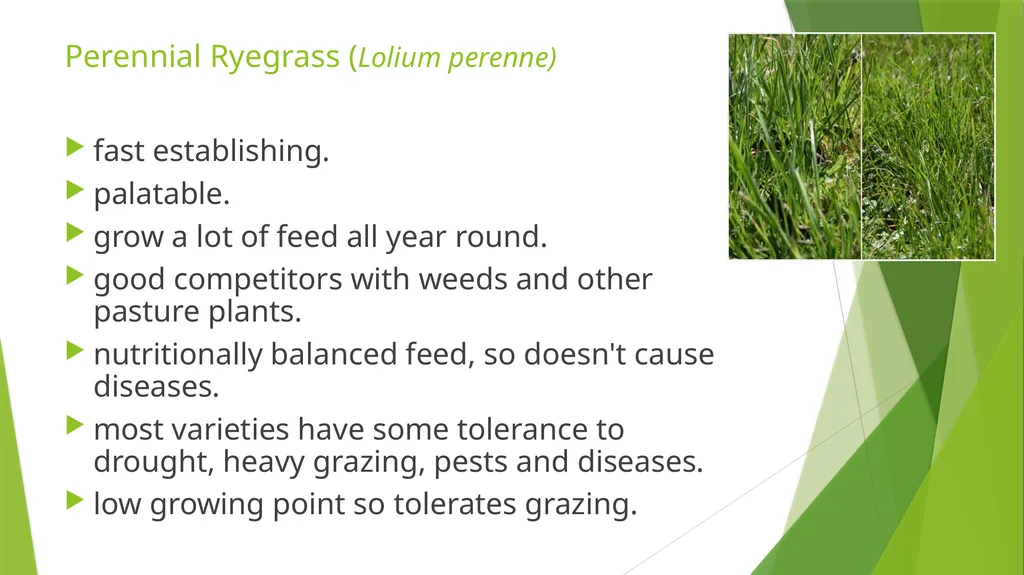
Perennial Ryegrass (Lolium perenne) fast establishing.
palatable.
grow a lot of feed all year round.
good competitors with weeds and other pasture plants.
nutritionally balanced feed, so doesn't cause diseases.
most varieties have some tolerance to drought, heavy grazing, pests and diseases.
low growing point so tolerates grazing.<br>
palatable.
grow a lot of feed all year round.
good competitors with weeds and other pasture plants.
nutritionally balanced feed, so doesn't cause diseases.
most varieties have some tolerance to drought, heavy grazing, pests and diseases.
low growing point so tolerates grazing.<br>
25
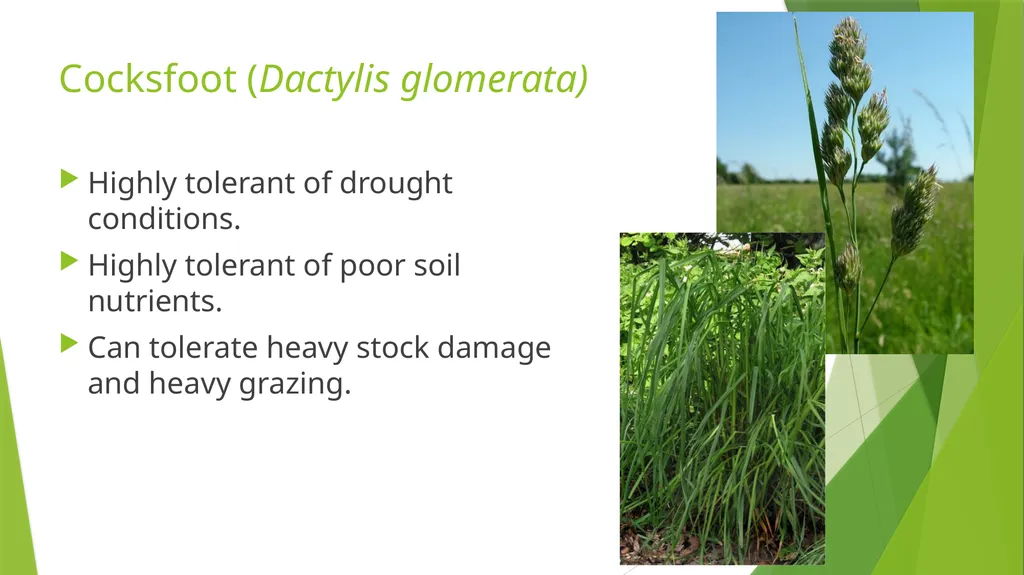
Cocksfoot (Dactylis glomerata) Highly tolerant of drought conditions.
Highly tolerant of poor soil nutrients.
Can tolerate heavy stock damage and heavy grazing.<br>
Highly tolerant of poor soil nutrients.
Can tolerate heavy stock damage and heavy grazing.<br>
26
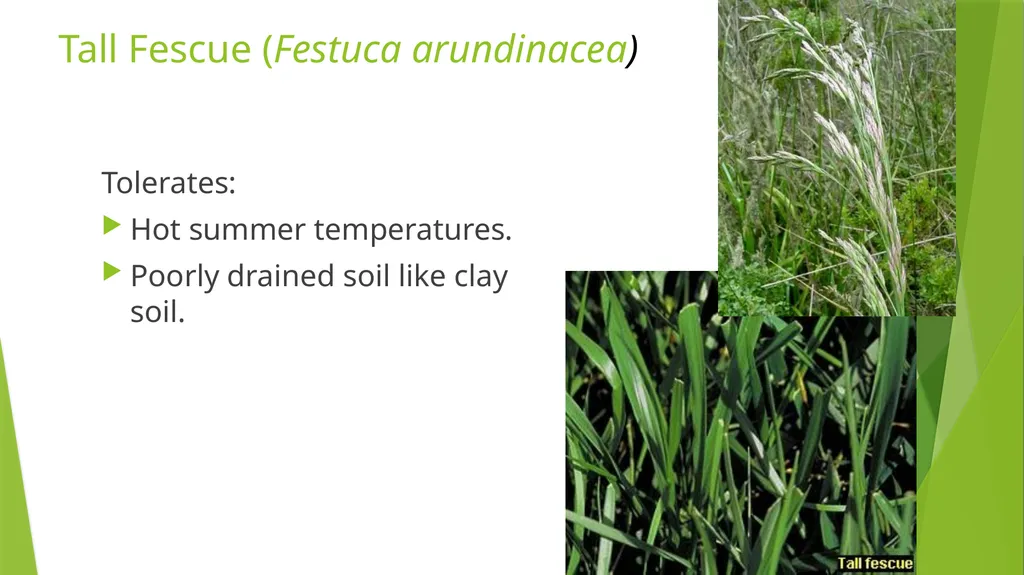
Tall Fescue (Festuca arundinacea) Tolerates:
Hot summer temperatures.
Poorly drained soil like clay soil.<br>
Hot summer temperatures.
Poorly drained soil like clay soil.<br>
27
Herbage, forage and legumes
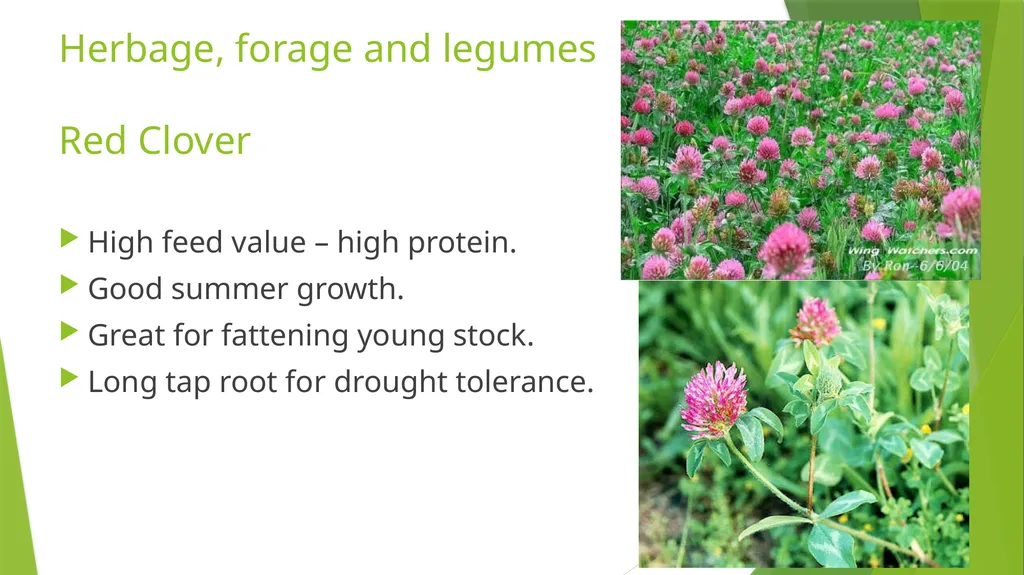
Red Clover High feed value – high protein.
Good summer growth.
Great for fattening young stock.
Long tap root for drought tolerance.<br>
Good summer growth.
Great for fattening young stock.
Long tap root for drought tolerance.<br>
28
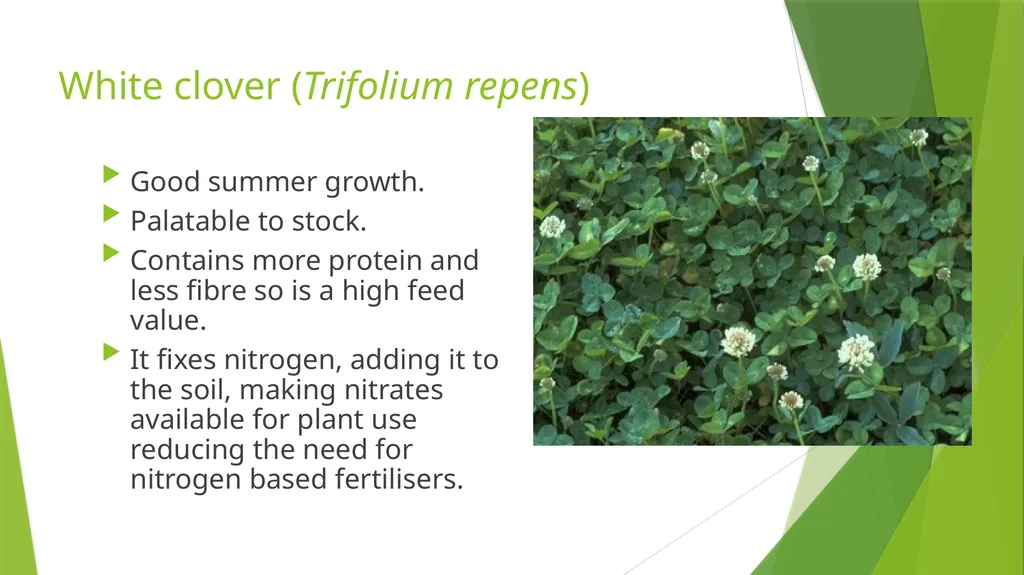
White clover (Trifolium repens) Good summer growth.
Palatable to stock.
Contains more protein and less fibre so is a high feed value.
It fixes nitrogen, adding it to the soil, making nitrates available for plant use reducing the need for nitrogen based fertilisers.<br>
Palatable to stock.
Contains more protein and less fibre so is a high feed value.
It fixes nitrogen, adding it to the soil, making nitrates available for plant use reducing the need for nitrogen based fertilisers.<br>
29
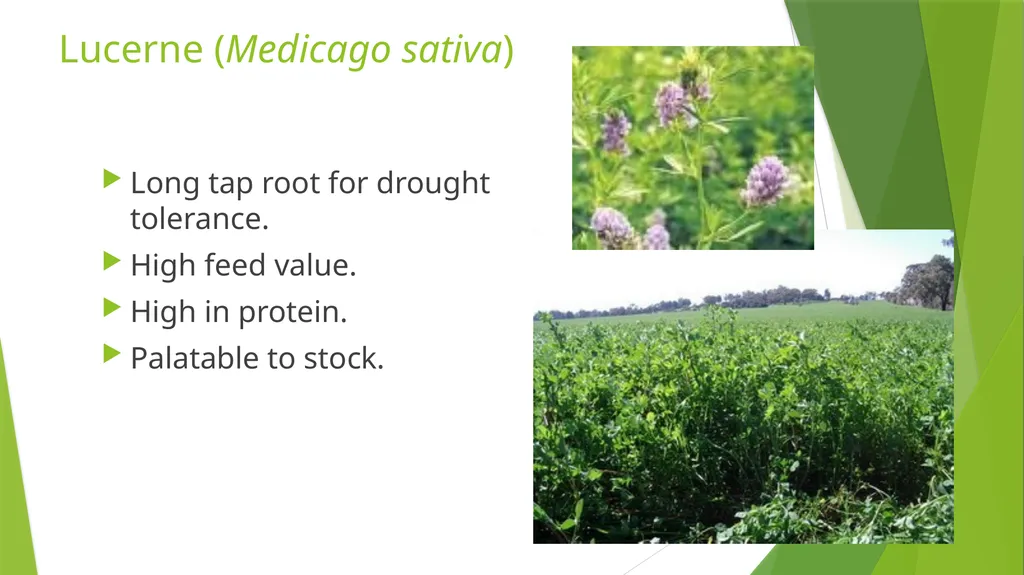
Lucerne (Medicago sativa) Long tap root for drought tolerance.
High feed value.
High in protein.
Palatable to stock.<br>
High feed value.
High in protein.
Palatable to stock.<br>
30
Brassica species
Kale (Brassica oleracea var. sabellica) Deep root system.
Good drought tolerance.
Good tolerance to most insect pests.
Good tolerance to club root and dry rot.
Produces large amounts of high quality feed.<br>
Good drought tolerance.
Good tolerance to most insect pests.
Good tolerance to club root and dry rot.
Produces large amounts of high quality feed.<br>
31
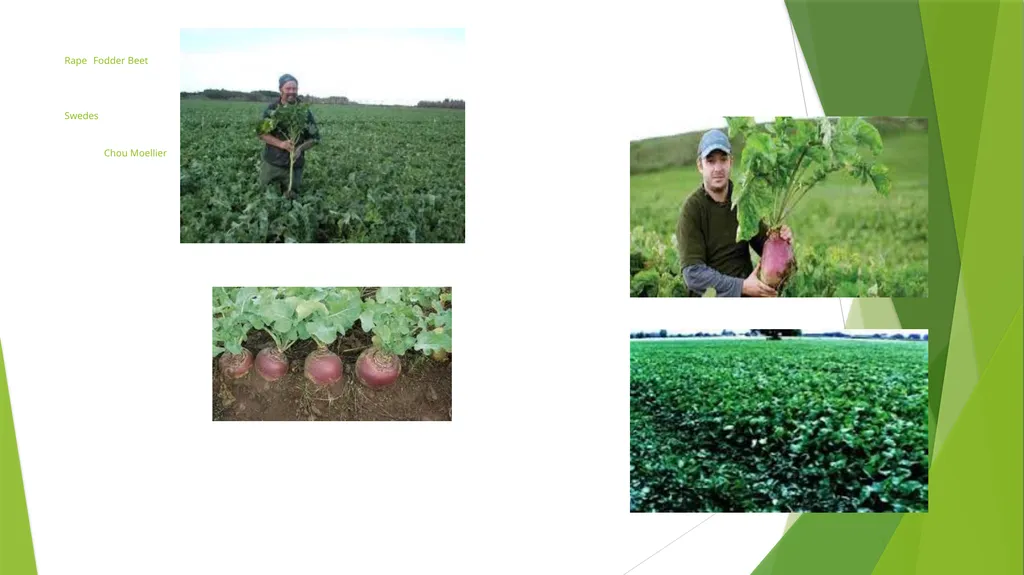
Rape Fodder Beet
Swedes
Chou Moellier<br>
32
Pasture herbs
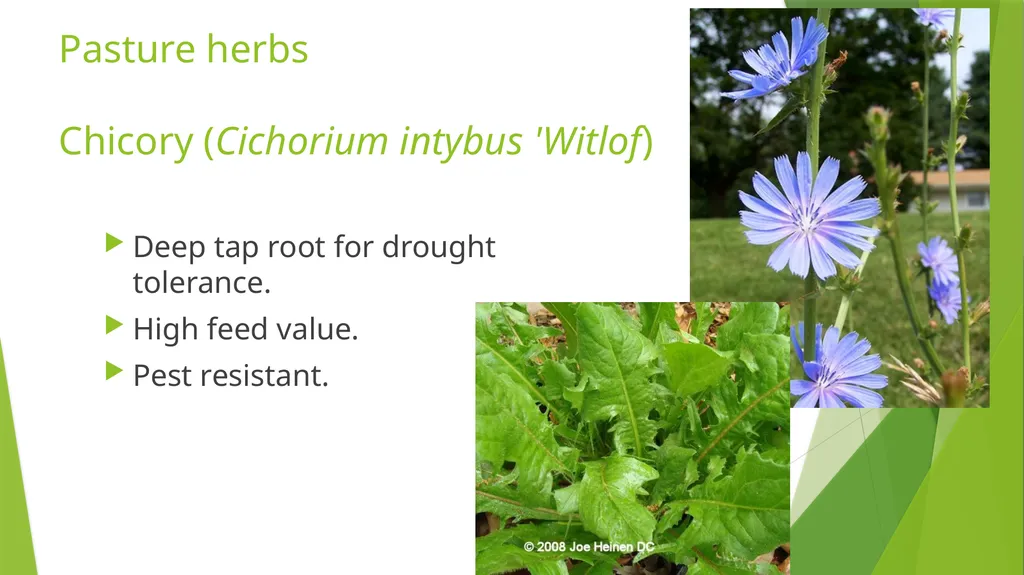
Chicory (Cichorium intybus 'Witlof) Deep tap root for drought tolerance.
High feed value.
Pest resistant.<br>
High feed value.
Pest resistant.<br>
33
Pasture use in New Zealand
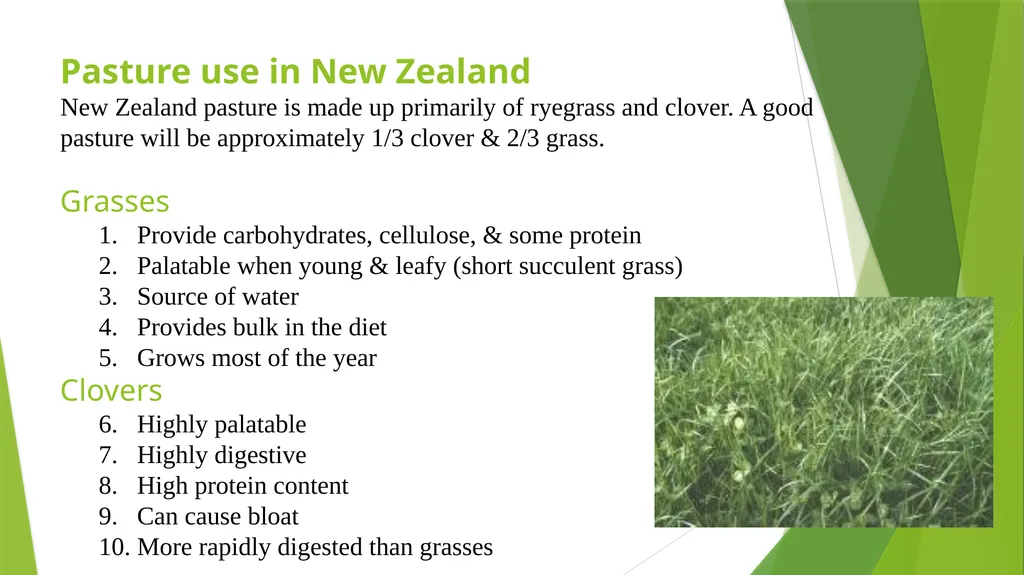
New Zealand pasture is made up primarily of ryegrass and clover. A good pasture will be approximately 1/3 clover & 2/3 grass.
Grasses
Provide carbohydrates, cellulose, & some protein
Palatable when young & leafy (short succulent grass)
Source of water
Provides bulk in the diet
Grows most of the year
Clovers
Highly palatable
Highly digestive
High protein content
Can cause bloat
More rapidly digested than grasses<br>
34
Questions Write a definition of pasture.
What are the two main pasture species grown on New Zealand farms?
Give 2 reasons why these species are grown.
Which species is the most important and why?
What is important about providing protein from pasture species?<br>
What are the two main pasture species grown on New Zealand farms?
Give 2 reasons why these species are grown.
Which species is the most important and why?
What is important about providing protein from pasture species?<br>
35
Life cycle strategies
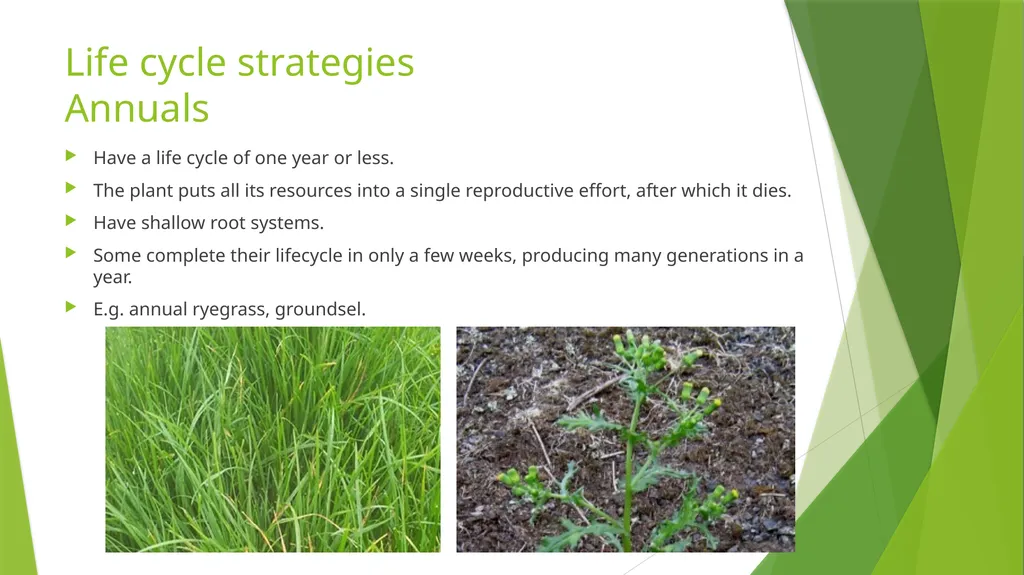
Annuals Have a life cycle of one year or less.
The plant puts all its resources into a single reproductive effort, after which it dies.
Have shallow root systems.
Some complete their lifecycle in only a few weeks, producing many generations in a year.
E.g. annual ryegrass, groundsel.<br>
The plant puts all its resources into a single reproductive effort, after which it dies.
Have shallow root systems.
Some complete their lifecycle in only a few weeks, producing many generations in a year.
E.g. annual ryegrass, groundsel.<br>
36
Biennials Have a life cycle that spans two seasons.
In the first year, the plant does not flower, concentrating on building up energy reserves.
The following year the plant uses all its energy reserves for flower and seed production after which it dies.
Have larger root systems that annuals.
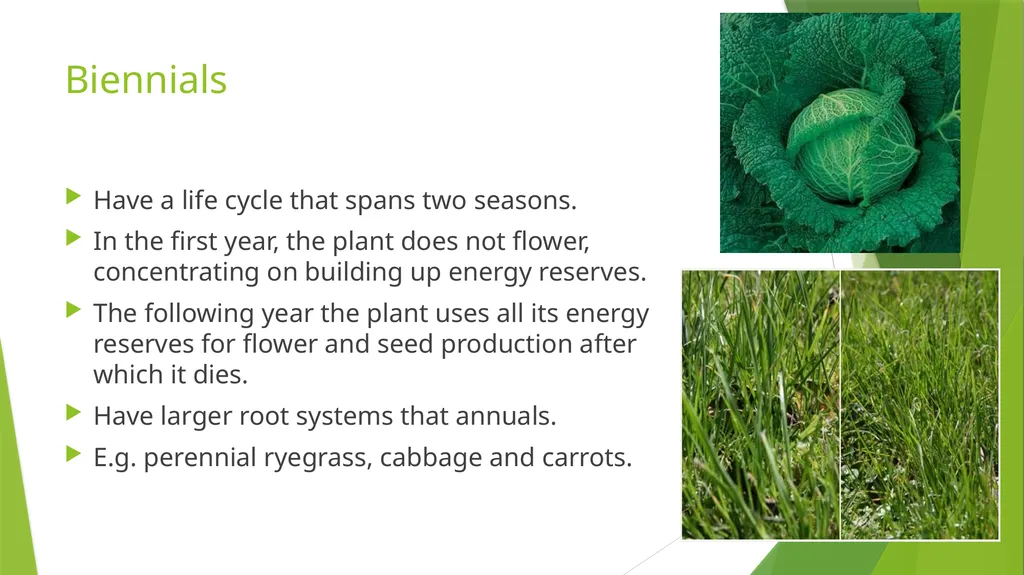
E.g. perennial ryegrass, cabbage and carrots.<br>
In the first year, the plant does not flower, concentrating on building up energy reserves.
The following year the plant uses all its energy reserves for flower and seed production after which it dies.
Have larger root systems that annuals.
E.g. perennial ryegrass, cabbage and carrots.<br>
37
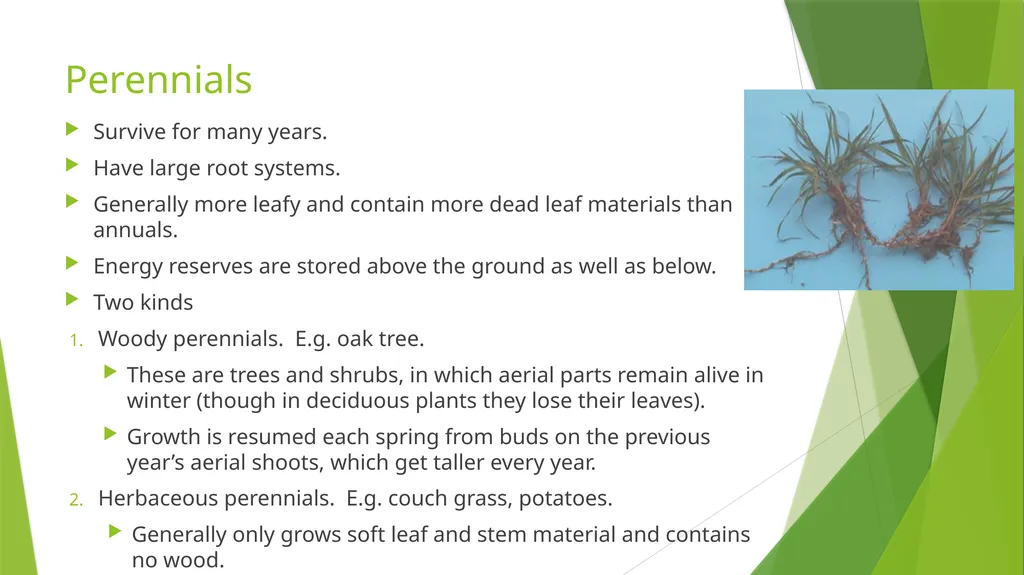
Perennials Survive for many years.
Have large root systems.
Generally more leafy and contain more dead leaf materials than annuals.
Energy reserves are stored above the ground as well as below.
Two kinds
Woody perennials. E.g. oak tree.
These are trees and shrubs, in which aerial parts remain alive in winter (though in deciduous plants they lose their leaves).
Growth is resumed each spring from buds on the previous year’s aerial shoots, which get taller every year.
Herbaceous perennials. E.g. couch grass, potatoes.
Generally only grows soft leaf and stem material and contains no wood.<br>
38
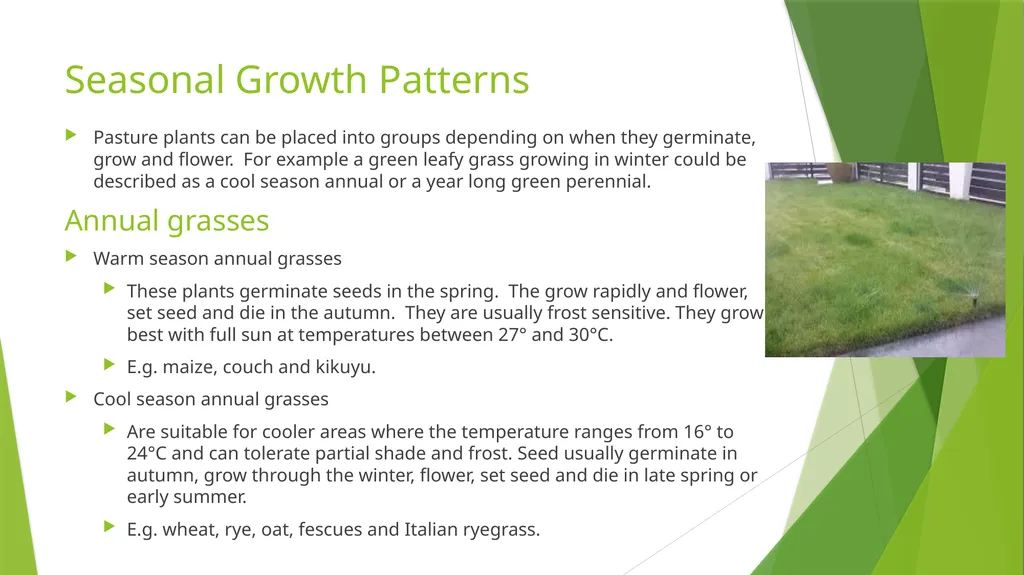
Seasonal Growth Patterns Pasture plants can be placed into groups depending on when they germinate, grow and flower. For example a green leafy grass growing in winter could be described as a cool season annual or a year long green perennial.
Annual grasses
Warm season annual grasses
These plants germinate seeds in the spring. The grow rapidly and flower, set seed and die in the autumn. They are usually frost sensitive. They grow best with full sun at temperatures between 27° and 30°C.
E.g. maize, couch and kikuyu.
Cool season annual grasses
Are suitable for cooler areas where the temperature ranges from 16° to 24°C and can tolerate partial shade and frost. Seed usually germinate in autumn, grow through the winter, flower, set seed and die in late spring or early summer.
E.g. wheat, rye, oat, fescues and Italian ryegrass.<br>
39
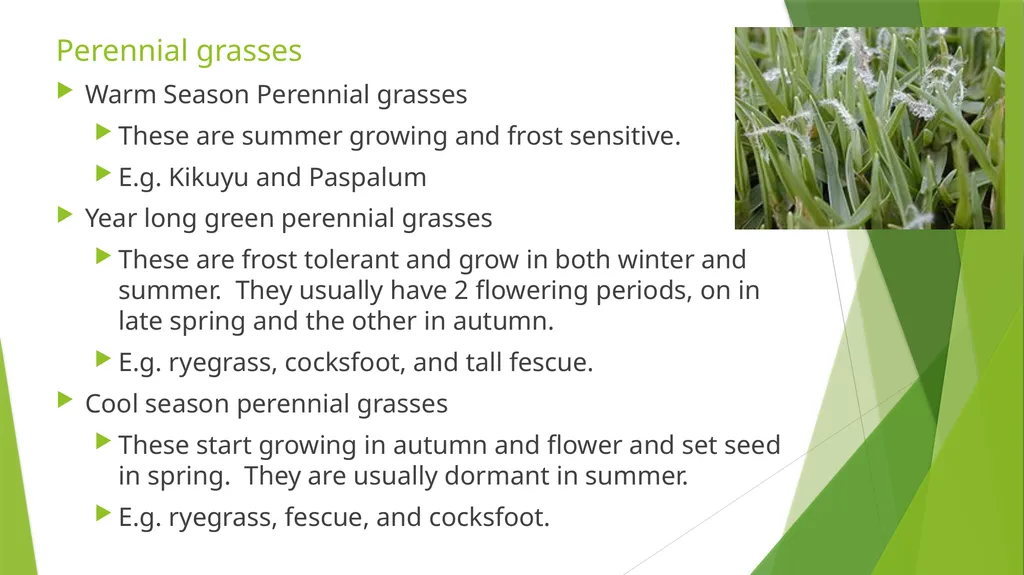
Perennial grasses
Warm Season Perennial grasses
These are summer growing and frost sensitive.
E.g. Kikuyu and Paspalum
Year long green perennial grasses
These are frost tolerant and grow in both winter and summer. They usually have 2 flowering periods, on in late spring and the other in autumn.
E.g. ryegrass, cocksfoot, and tall fescue.
Cool season perennial grasses
These start growing in autumn and flower and set seed in spring. They are usually dormant in summer.
E.g. ryegrass, fescue, and cocksfoot.<br>
40
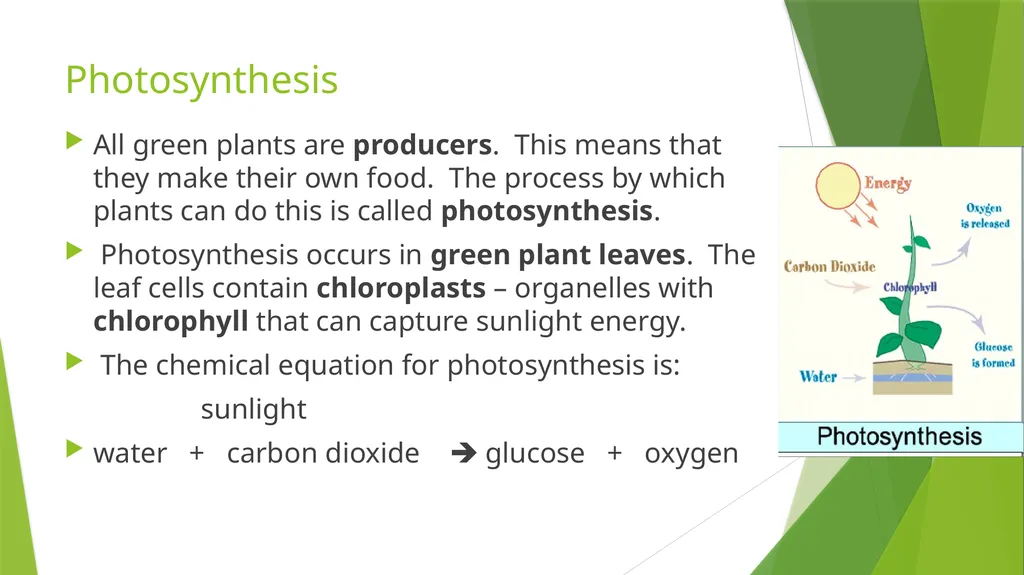
Photosynthesis All green plants are producers. This means that they make their own food. The process by which plants can do this is called photosynthesis.
Photosynthesis occurs in green plant leaves. The leaf cells contain chloroplasts – organelles with chlorophyll that can capture sunlight energy.
The chemical equation for photosynthesis is:
sunlight
water + carbon dioxide glucose + oxygen<br>
Photosynthesis occurs in green plant leaves. The leaf cells contain chloroplasts – organelles with chlorophyll that can capture sunlight energy.
The chemical equation for photosynthesis is:
sunlight
water + carbon dioxide glucose + oxygen<br>
41
Photosynthetic pathway. Plants fall in to groups, depending on their photosynthetic pathway.
Pasture plants usually fall into C3 or C4 groups.
The photosynthetic pathway that a plant uses will determine the conditions under which it will grow.
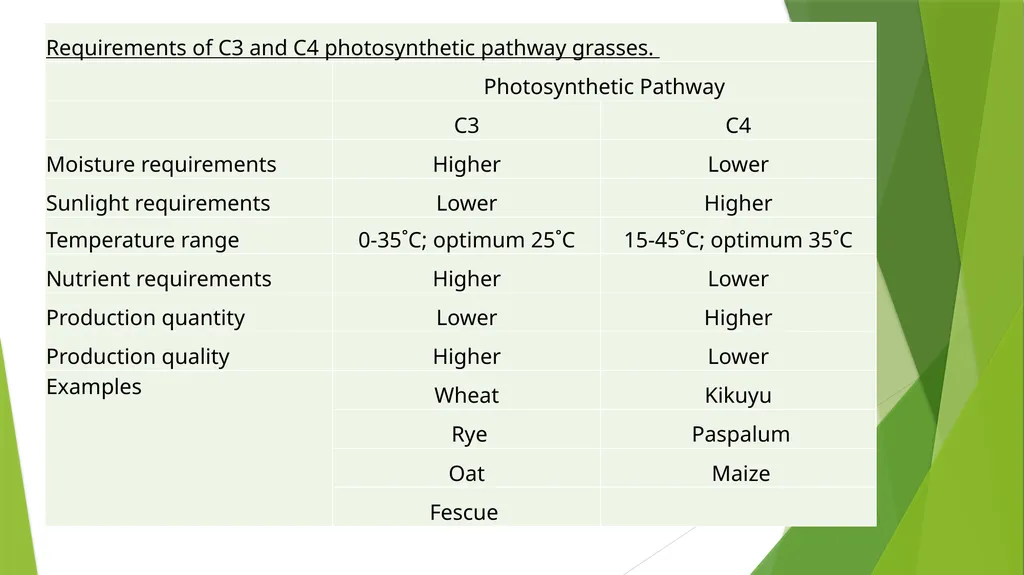
The C3 grasses are referred to as "cool-season" grasses, they may be either annual or perennial. Generally they are winter growing species.
The C4 grasses have a photosynthetic pathway, linked to specialized leaf anatomy, which allows for increased water use efficiency, rendering them better adapted to hot, arid environments and those lacking in carbon dioxide. These are considered "warm-season" grasses and are summer growing; they may be either annual or perennial.<br>
42
Questions Name 3 grasses best suited to high rainfall in the winter.
Name 3 grasses best suited to summer growing conditions.
Assume an autumn season is mild, with an average temperature of 20˚C and good rainfall. List 6 grasses that you would expect to grow.
An ideal pasture mix will contain both C3 and C4 grasses. Why?
Discuss why a farmer based in Northland, with poor quality soils, would expect to find C4 grasses dominating pastures?<br>
43
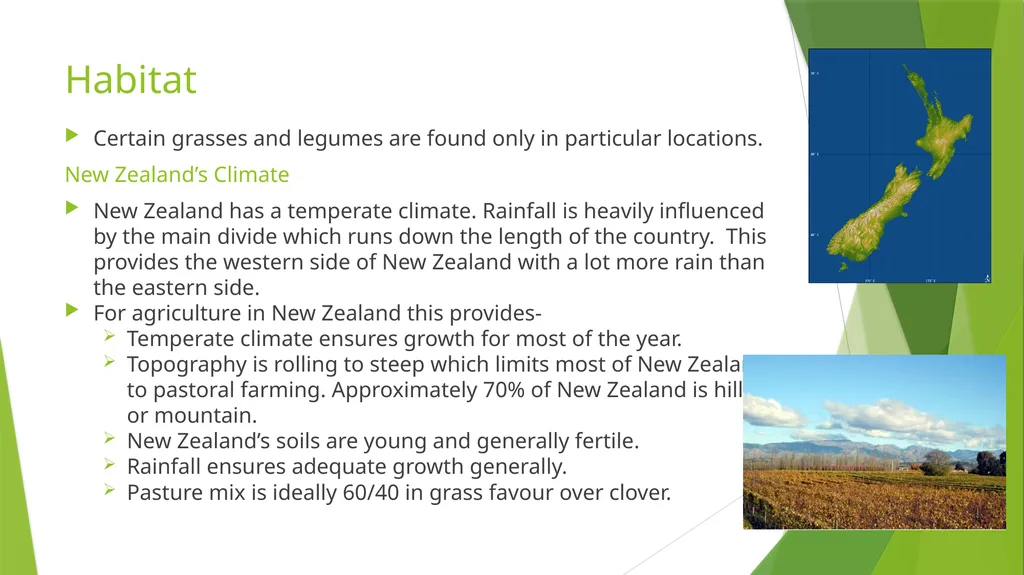
Habitat Certain grasses and legumes are found only in particular locations.
New Zealand’s Climate
New Zealand has a temperate climate. Rainfall is heavily influenced by the main divide which runs down the length of the country. This provides the western side of New Zealand with a lot more rain than the eastern side.
For agriculture in New Zealand this provides-
Temperate climate ensures growth for most of the year.
Topography is rolling to steep which limits most of New Zealand to pastoral farming. Approximately 70% of New Zealand is hill or mountain.
New Zealand’s soils are young and generally fertile.
Rainfall ensures adequate growth generally.
Pasture mix is ideally 60/40 in grass favour over clover.<br>
44
Other plant growth characteristics Type of seed head.
Plants may be grouped according to the way their seeds are arranged.
E.g. panicle, raceme, spike, digitate, and spatheate.
Growth Habit.
Pasture plants may be upright (erect) or form a mat (prostrate).<br>
Plants may be grouped according to the way their seeds are arranged.
E.g. panicle, raceme, spike, digitate, and spatheate.
Growth Habit.
Pasture plants may be upright (erect) or form a mat (prostrate).<br>
45
Species Selection Factors in selection;
Compatibility.
Suits local climate.
Provides feed all year round.
Provides nutrition.
Palatable and digestible.
Be persistent.<br>
Compatibility.
Suits local climate.
Provides feed all year round.
Provides nutrition.
Palatable and digestible.
Be persistent.<br>
46
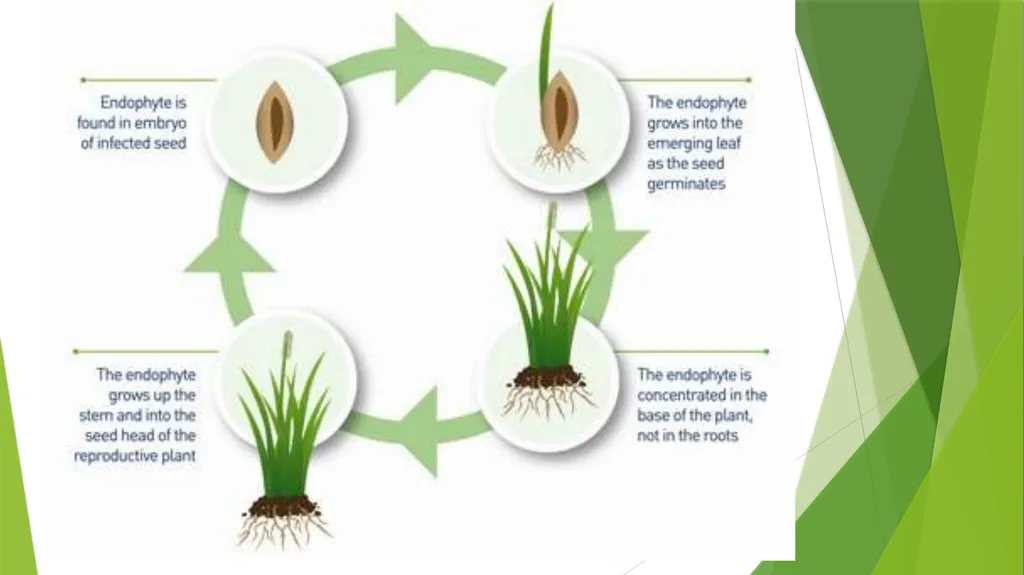
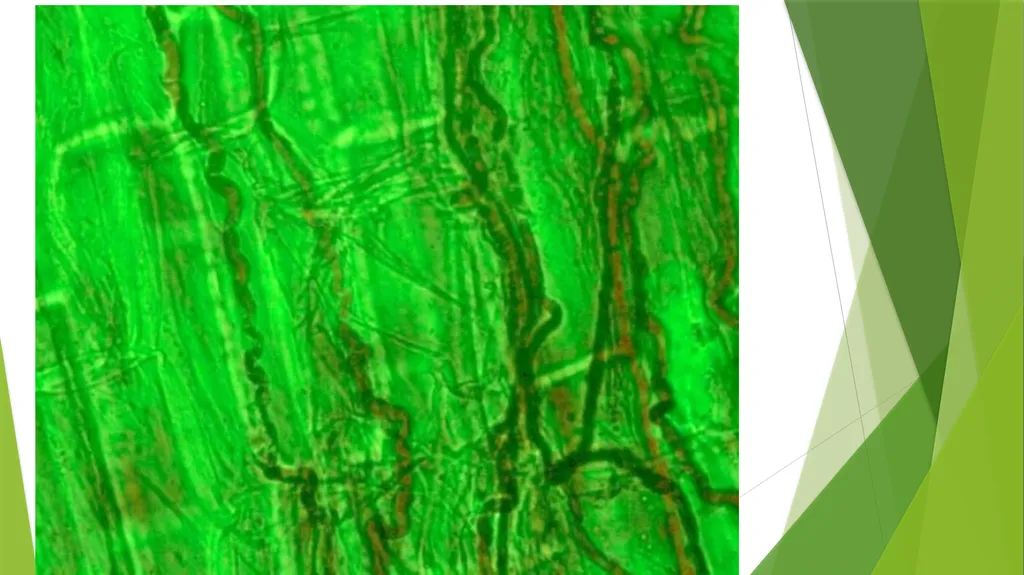
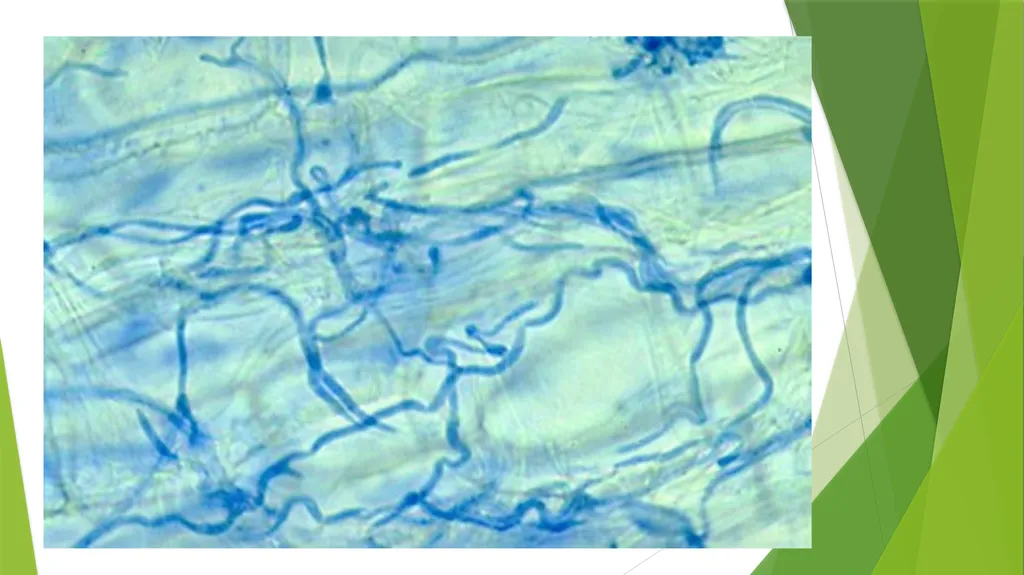
Endophyte The endophyte is a fungus that lives inside the grass plant.
Grass and endophyte have a symbiotic relationship.
Endophyte increases grass growth and resistance to some insects such as Argentine stem weevil.
There are no visible signs that a plants has endophyte.
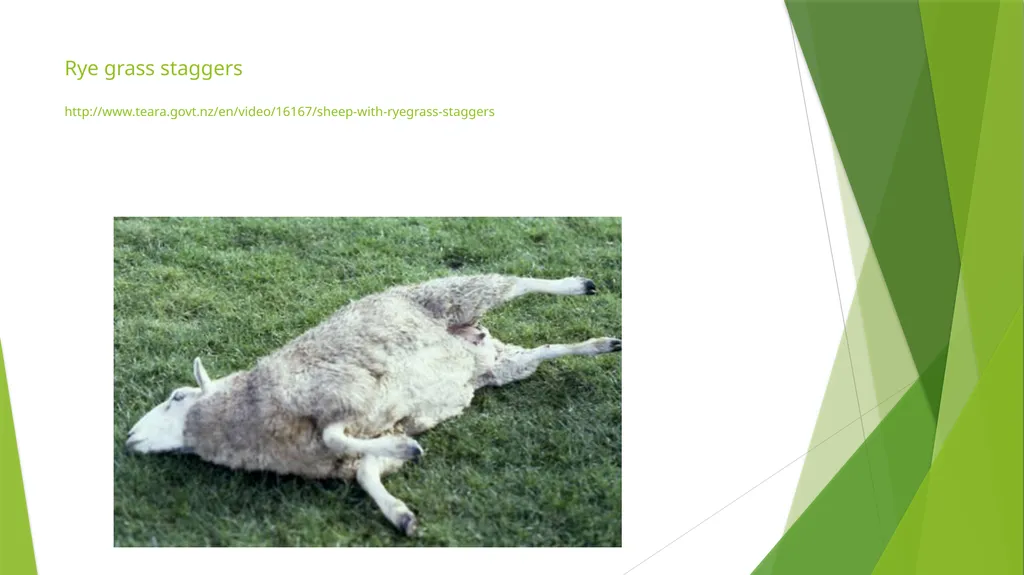
The endophyte produces toxins (or poisons) which can harm the livestock at various times of the year if large amounts are ingested.
The toxins are often seen affecting livestock with staggers in the autumn period.<br>
47
Rye grass staggers
http://www.teara.govt.nz/en/video/16167/sheep-with-ryegrass-staggers<br>
48
High endophyte ryegrass The endophyte fungus provides resistance to various insect pests, particularly Argentine stem weevil.
Is tolerant of drought conditions.
Highly nutritious to animals.
Disadvantage: sheep can get rye grass staggers.<br>
Is tolerant of drought conditions.
Highly nutritious to animals.
Disadvantage: sheep can get rye grass staggers.<br>
49
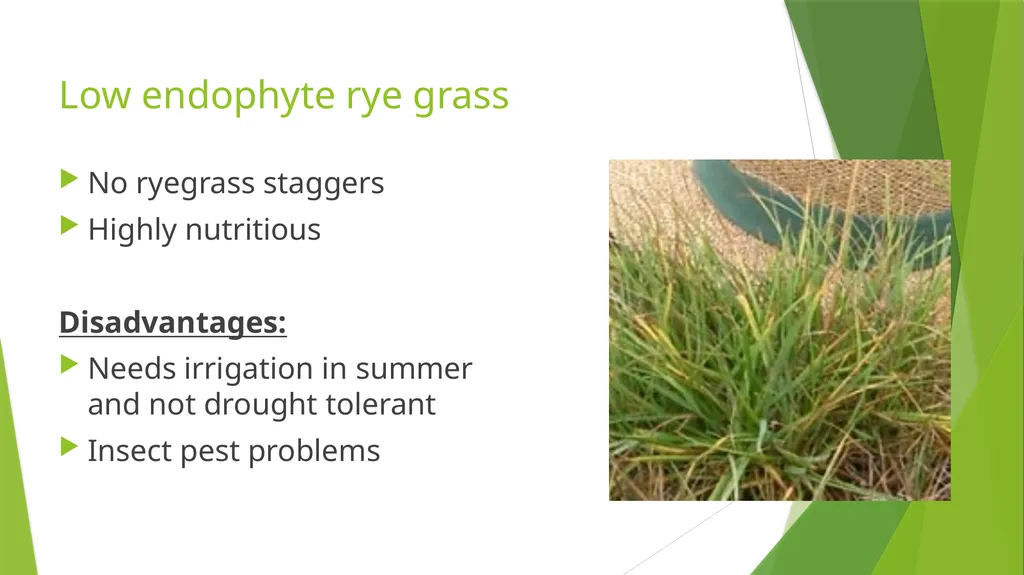
Low endophyte rye grass No ryegrass staggers
Highly nutritious
Disadvantages:
Needs irrigation in summer and not drought tolerant
Insect pest problems<br>
Highly nutritious
Disadvantages:
Needs irrigation in summer and not drought tolerant
Insect pest problems<br>
50
Questions List 5 factors a farmer needs to consider in selecting a pasture species.
What is an endophyte?
What are the symptoms of an animal with endophyte poisoning?
What are two ways to reduce endophyte poisoning in your stock?
What is the difference between low and high endophyte grasses?<br>
What is an endophyte?
What are the symptoms of an animal with endophyte poisoning?
What are two ways to reduce endophyte poisoning in your stock?
What is the difference between low and high endophyte grasses?<br>
51
Plant Morphology The principal parts of most pasture plants are the roots, stems, leaves and flowers.
All of these parts have special functions.
Roots anchor the plants in the ground and act as collectors of moisture and mineral salts.
Stems are the main supporting bodies of the plants and carry the leaves, flowers and seeds.
Leaves are the main organs for the manufacture of foods needed by the plant.
Flowers have the special function of reproduction, the seeds forming after the flowers have been fertilised.<br>
52
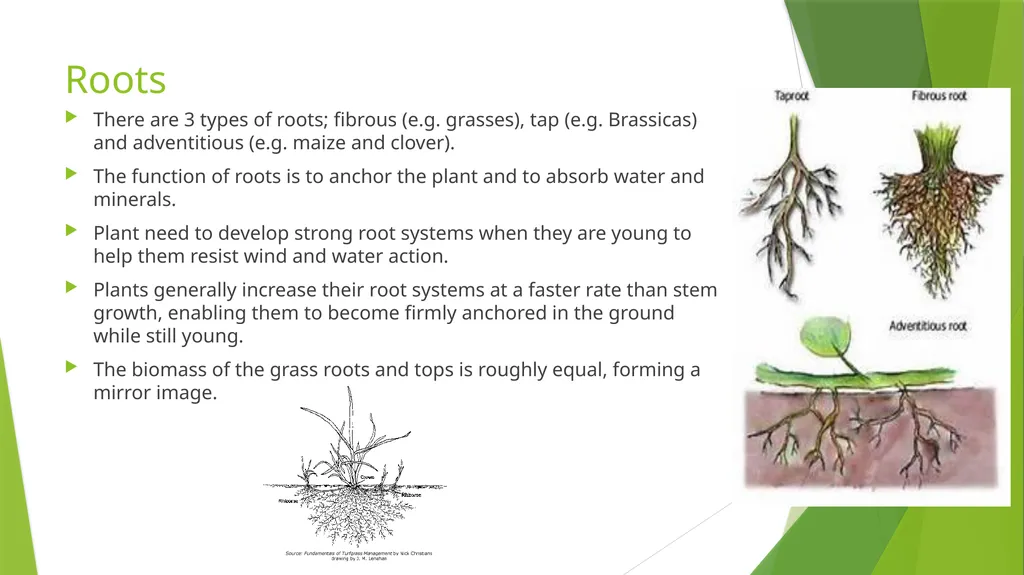
Roots There are 3 types of roots; fibrous (e.g. grasses), tap (e.g. Brassicas) and adventitious (e.g. maize and clover).
The function of roots is to anchor the plant and to absorb water and minerals.
Plant need to develop strong root systems when they are young to help them resist wind and water action.
Plants generally increase their root systems at a faster rate than stem growth, enabling them to become firmly anchored in the ground while still young.
The biomass of the grass roots and tops is roughly equal, forming a mirror image.<br>
53
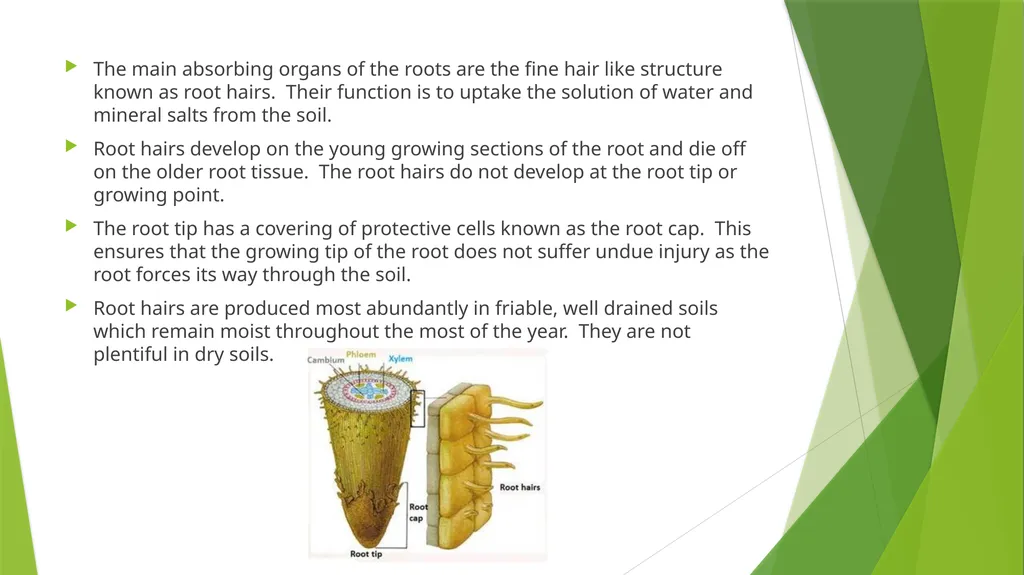
The main absorbing organs of the roots are the fine hair like structure known as root hairs. Their function is to uptake the solution of water and mineral salts from the soil.
Root hairs develop on the young growing sections of the root and die off on the older root tissue. The root hairs do not develop at the root tip or growing point.
The root tip has a covering of protective cells known as the root cap. This ensures that the growing tip of the root does not suffer undue injury as the root forces its way through the soil.
Root hairs are produced most abundantly in friable, well drained soils which remain moist throughout the most of the year. They are not plentiful in dry soils.<br>
54
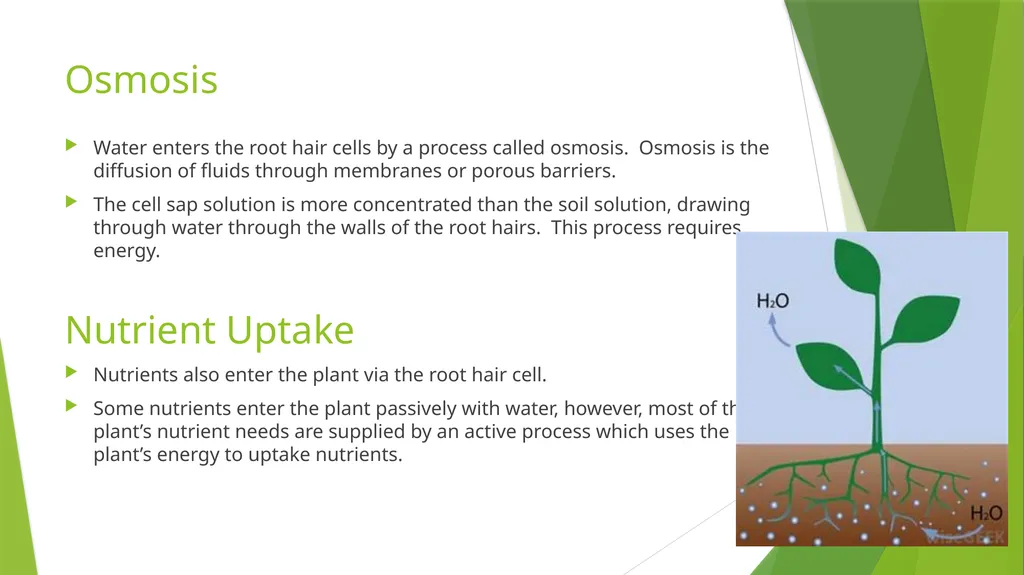
Osmosis Water enters the root hair cells by a process called osmosis. Osmosis is the diffusion of fluids through membranes or porous barriers.
The cell sap solution is more concentrated than the soil solution, drawing through water through the walls of the root hairs. This process requires energy.
Nutrient Uptake
Nutrients also enter the plant via the root hair cell.
Some nutrients enter the plant passively with water, however, most of the plant’s nutrient needs are supplied by an active process which uses the plant’s energy to uptake nutrients.<br>
55
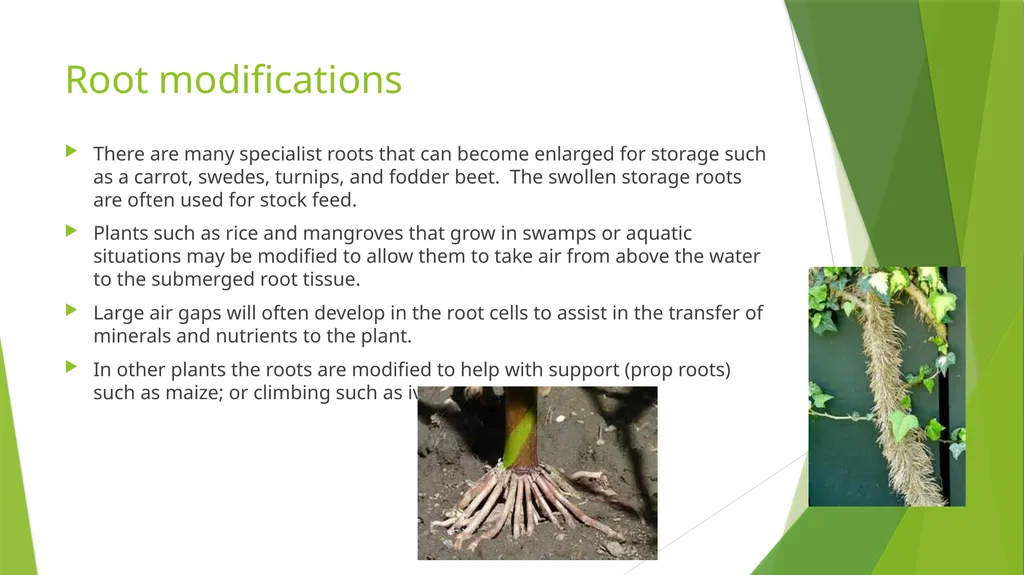
Root modifications There are many specialist roots that can become enlarged for storage such as a carrot, swedes, turnips, and fodder beet. The swollen storage roots are often used for stock feed.
Plants such as rice and mangroves that grow in swamps or aquatic situations may be modified to allow them to take air from above the water to the submerged root tissue.
Large air gaps will often develop in the root cells to assist in the transfer of minerals and nutrients to the plant.
In other plants the roots are modified to help with support (prop roots) such as maize; or climbing such as ivy.<br>
56
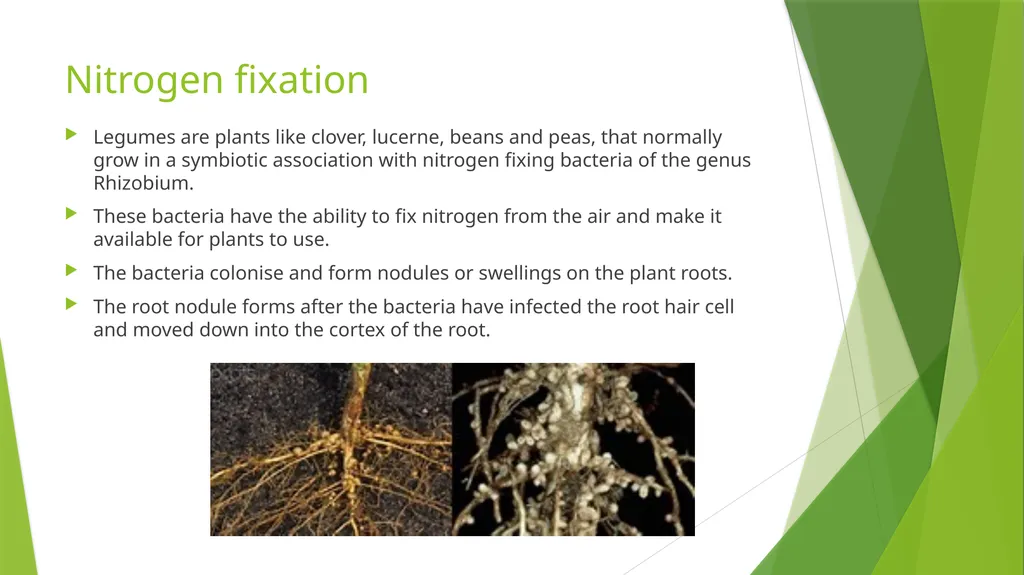
Nitrogen fixation Legumes are plants like clover, lucerne, beans and peas, that normally grow in a symbiotic association with nitrogen fixing bacteria of the genus Rhizobium.
These bacteria have the ability to fix nitrogen from the air and make it available for plants to use.
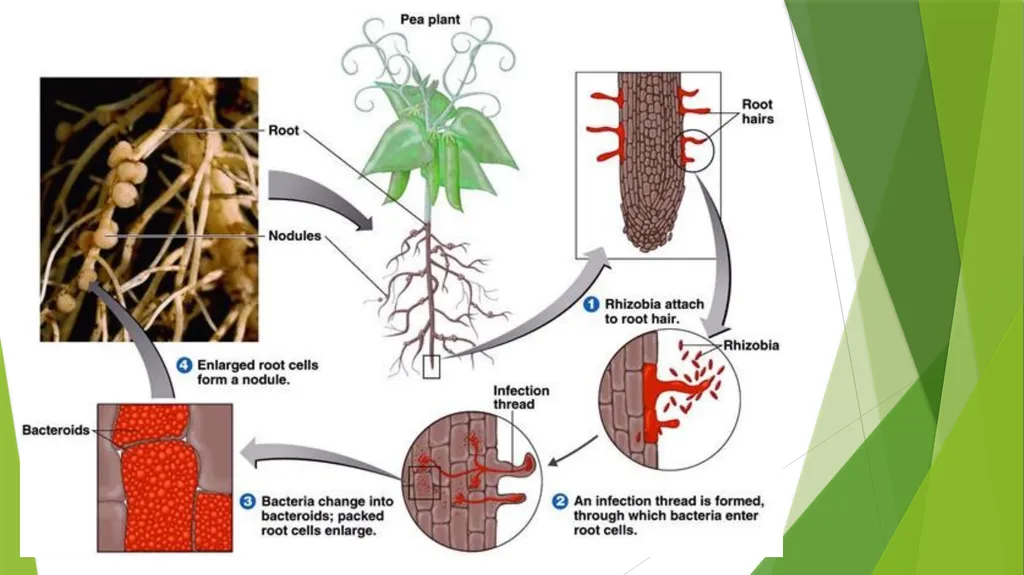
The bacteria colonise and form nodules or swellings on the plant roots.
The root nodule forms after the bacteria have infected the root hair cell and moved down into the cortex of the root.<br>
These bacteria have the ability to fix nitrogen from the air and make it available for plants to use.
The bacteria colonise and form nodules or swellings on the plant roots.
The root nodule forms after the bacteria have infected the root hair cell and moved down into the cortex of the root.<br>
57
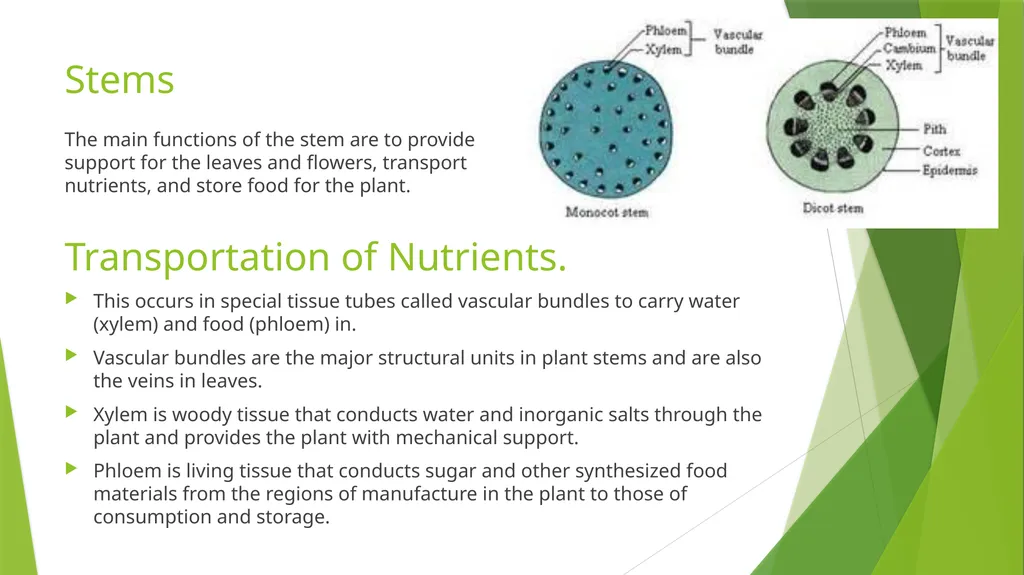
Stems Transportation of Nutrients.
This occurs in special tissue tubes called vascular bundles to carry water (xylem) and food (phloem) in.
Vascular bundles are the major structural units in plant stems and are also the veins in leaves.
Xylem is woody tissue that conducts water and inorganic salts through the plant and provides the plant with mechanical support.
Phloem is living tissue that conducts sugar and other synthesized food materials from the regions of manufacture in the plant to those of consumption and storage. The main functions of the stem are to provide support for the leaves and flowers, transport nutrients, and store food for the plant.<br>
58
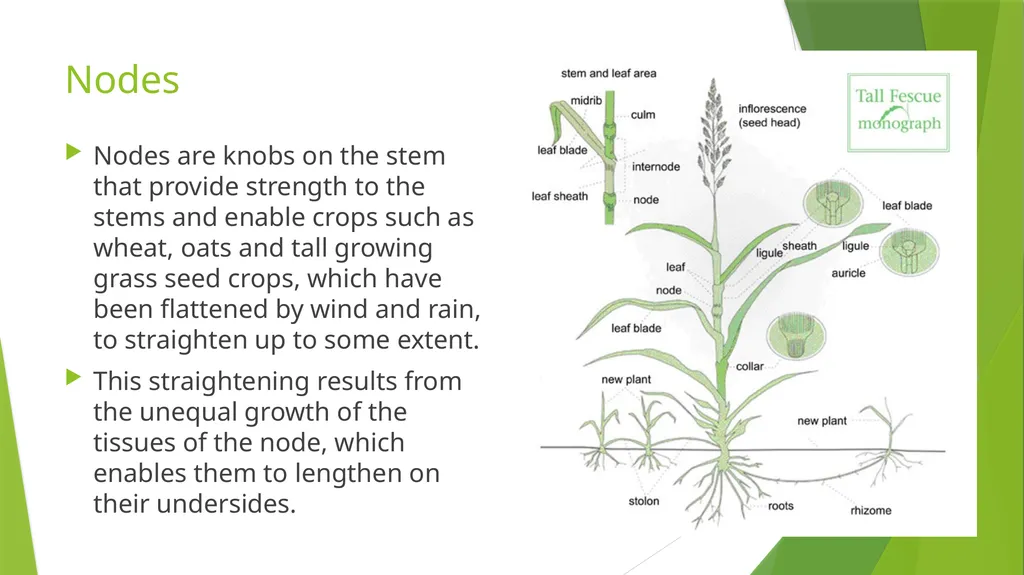
Nodes Nodes are knobs on the stem that provide strength to the stems and enable crops such as wheat, oats and tall growing grass seed crops, which have been flattened by wind and rain, to straighten up to some extent.
This straightening results from the unequal growth of the tissues of the node, which enables them to lengthen on their undersides.<br>
This straightening results from the unequal growth of the tissues of the node, which enables them to lengthen on their undersides.<br>
59
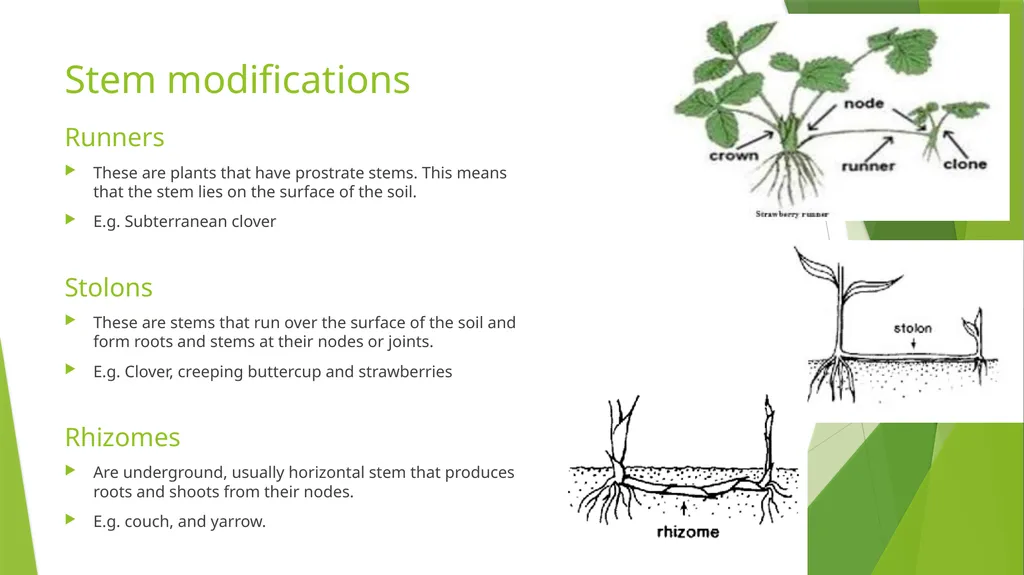
Stem modifications Runners
These are plants that have prostrate stems. This means that the stem lies on the surface of the soil.
E.g. Subterranean clover
Stolons
These are stems that run over the surface of the soil and form roots and stems at their nodes or joints.
E.g. Clover, creeping buttercup and strawberries
Rhizomes
Are underground, usually horizontal stem that produces roots and shoots from their nodes.
E.g. couch, and yarrow.<br>
60
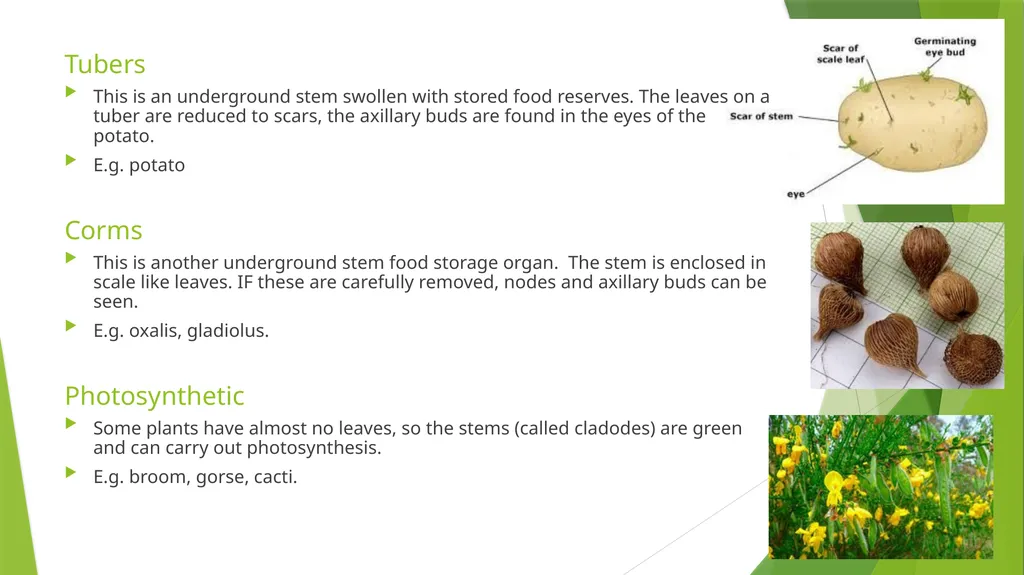
Tubers
This is an underground stem swollen with stored food reserves. The leaves on a tuber are reduced to scars, the axillary buds are found in the eyes of the potato.
E.g. potato
Corms
This is another underground stem food storage organ. The stem is enclosed in scale like leaves. IF these are carefully removed, nodes and axillary buds can be seen.
E.g. oxalis, gladiolus.
Photosynthetic
Some plants have almost no leaves, so the stems (called cladodes) are green and can carry out photosynthesis.
E.g. broom, gorse, cacti.<br>
61
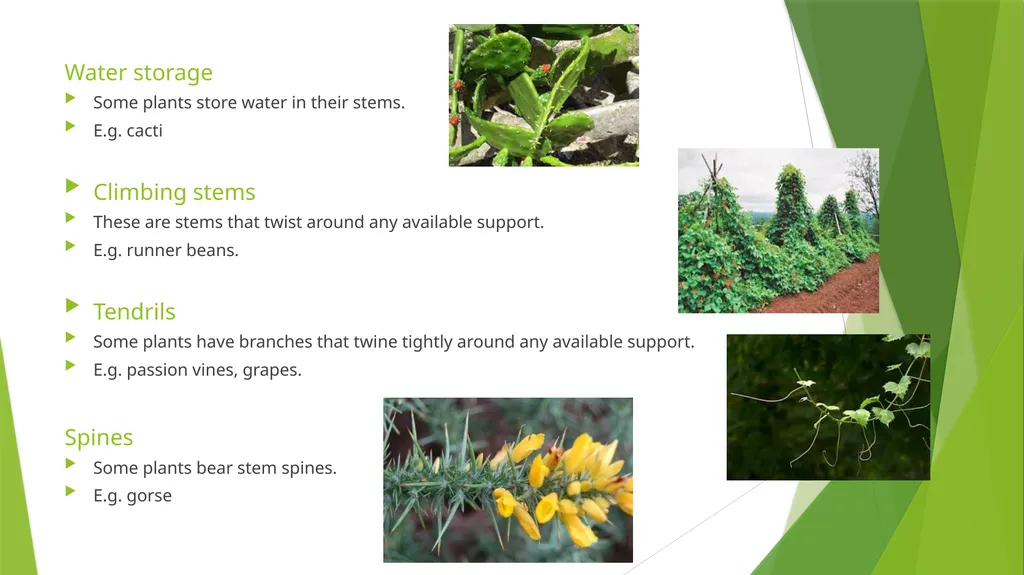
Water storage
Some plants store water in their stems.
E.g. cacti
Climbing stems
These are stems that twist around any available support.
E.g. runner beans.
Tendrils
Some plants have branches that twine tightly around any available support.
E.g. passion vines, grapes.
Spines
Some plants bear stem spines.
E.g. gorse<br>
62
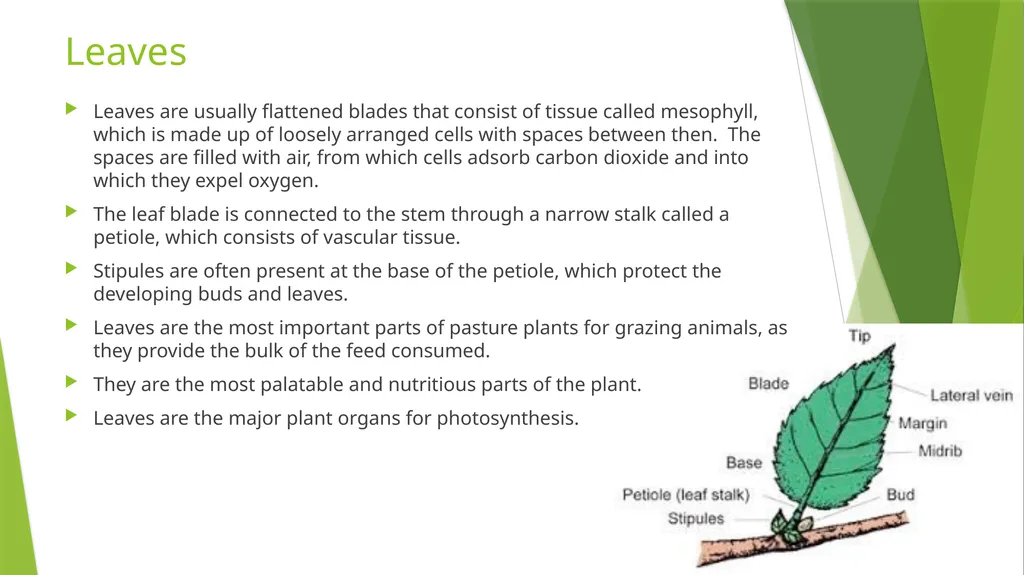
Leaves Leaves are usually flattened blades that consist of tissue called mesophyll, which is made up of loosely arranged cells with spaces between then. The spaces are filled with air, from which cells adsorb carbon dioxide and into which they expel oxygen.
The leaf blade is connected to the stem through a narrow stalk called a petiole, which consists of vascular tissue.
Stipules are often present at the base of the petiole, which protect the developing buds and leaves.
Leaves are the most important parts of pasture plants for grazing animals, as they provide the bulk of the feed consumed.
They are the most palatable and nutritious parts of the plant.
Leaves are the major plant organs for photosynthesis.<br>
63
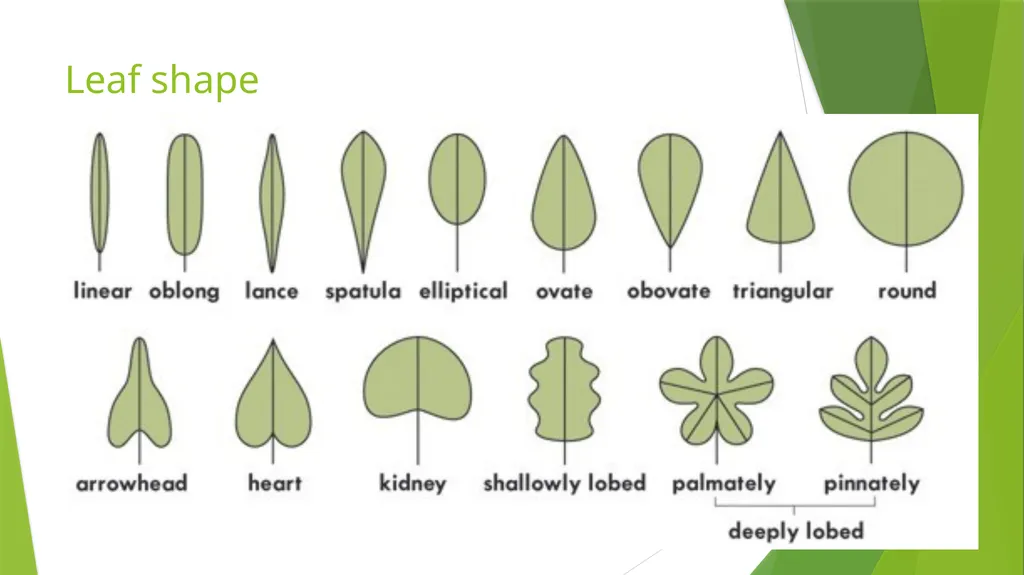
Leaf shape<br>
64
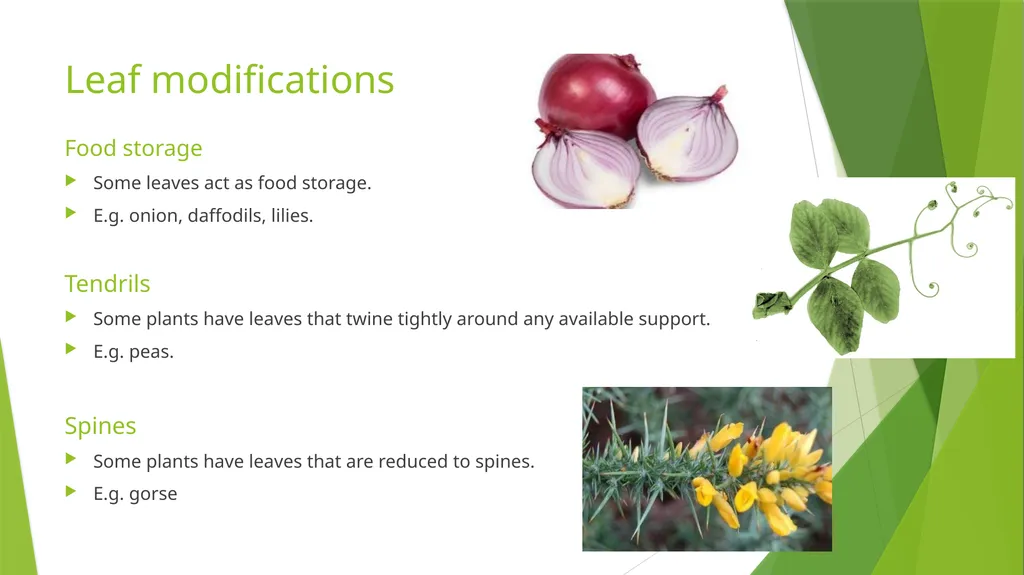
Leaf modifications Food storage
Some leaves act as food storage.
E.g. onion, daffodils, lilies.
Tendrils
Some plants have leaves that twine tightly around any available support.
E.g. peas.
Spines
Some plants have leaves that are reduced to spines.
E.g. gorse<br>
Some leaves act as food storage.
E.g. onion, daffodils, lilies.
Tendrils
Some plants have leaves that twine tightly around any available support.
E.g. peas.
Spines
Some plants have leaves that are reduced to spines.
E.g. gorse<br>
65
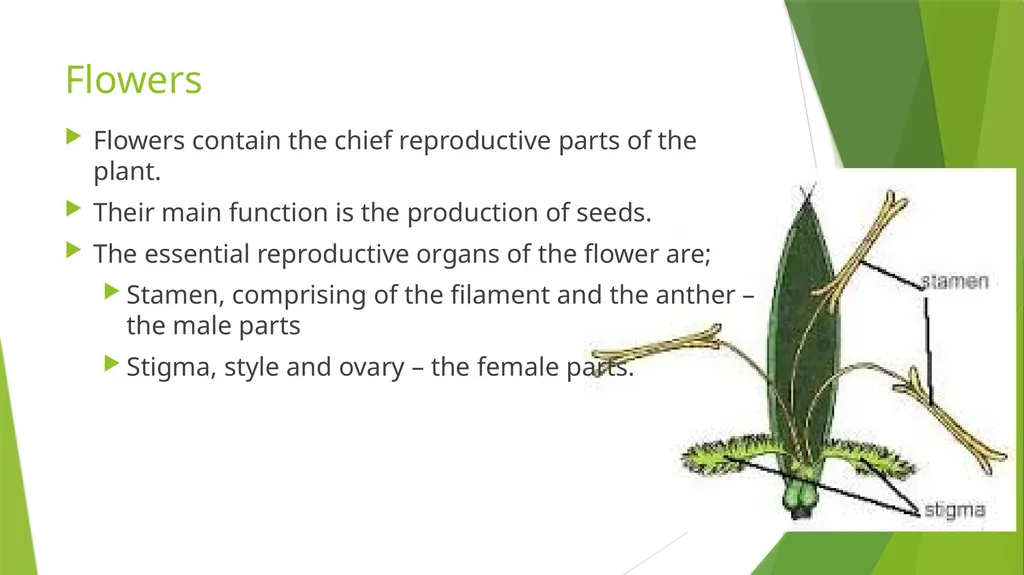
Flowers Flowers contain the chief reproductive parts of the plant.
Their main function is the production of seeds.
The essential reproductive organs of the flower are;
Stamen, comprising of the filament and the anther – the male parts
Stigma, style and ovary – the female parts.<br>
Their main function is the production of seeds.
The essential reproductive organs of the flower are;
Stamen, comprising of the filament and the anther – the male parts
Stigma, style and ovary – the female parts.<br>
66
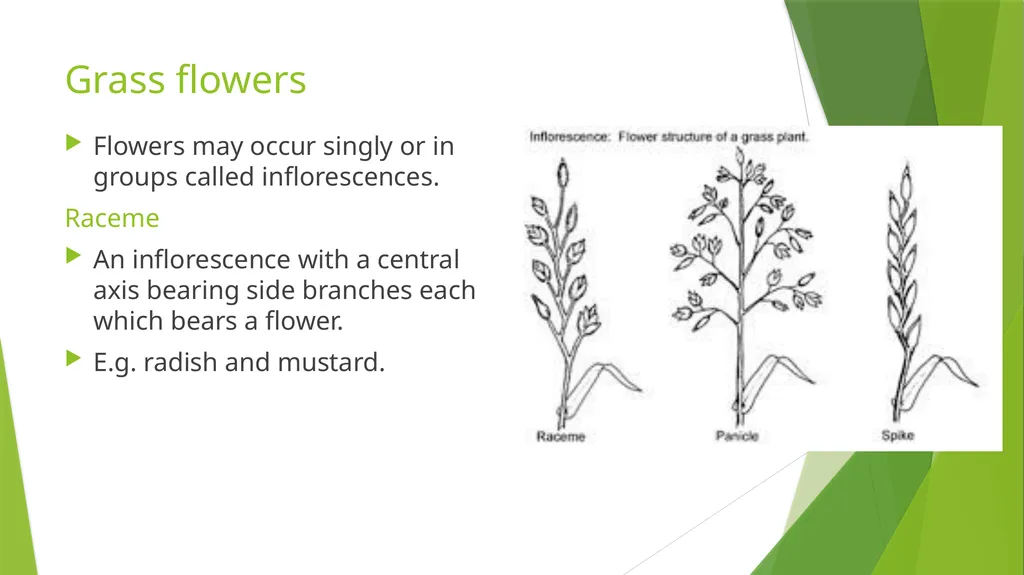
Grass flowers Flowers may occur singly or in groups called inflorescences.
Raceme
An inflorescence with a central axis bearing side branches each which bears a flower.
E.g. radish and mustard.<br>
Raceme
An inflorescence with a central axis bearing side branches each which bears a flower.
E.g. radish and mustard.<br>
67
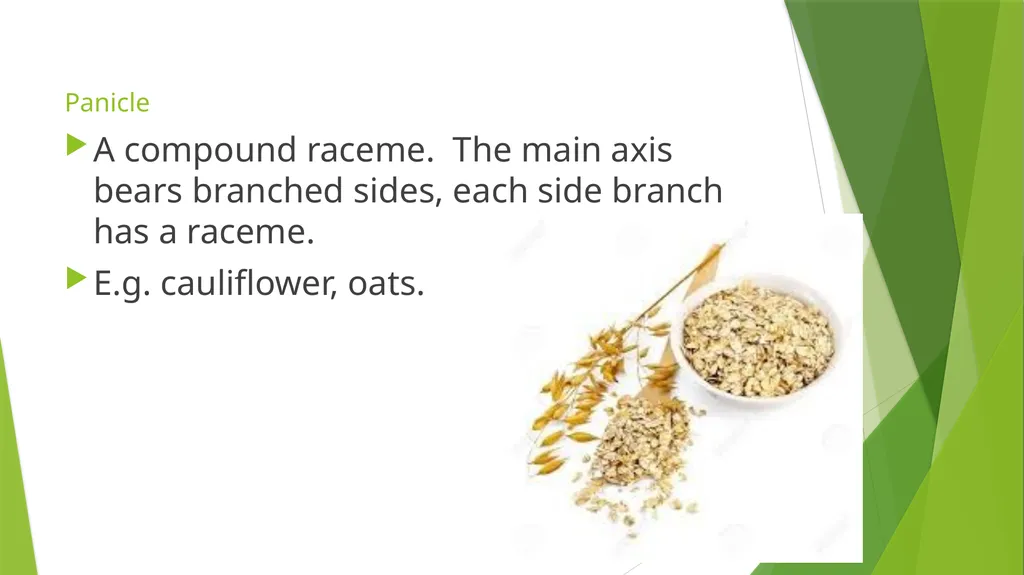
Panicle
A compound raceme. The main axis bears branched sides, each side branch has a raceme.
E.g. cauliflower, oats.<br>
A compound raceme. The main axis bears branched sides, each side branch has a raceme.
E.g. cauliflower, oats.<br>
68
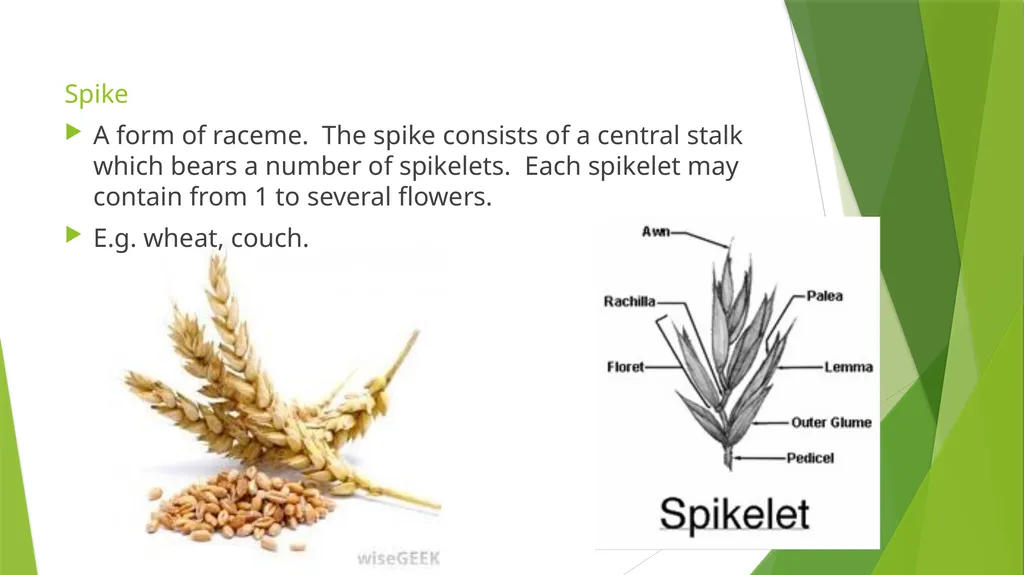
Spike
A form of raceme. The spike consists of a central stalk which bears a number of spikelets. Each spikelet may contain from 1 to several flowers.
E.g. wheat, couch.<br>
A form of raceme. The spike consists of a central stalk which bears a number of spikelets. Each spikelet may contain from 1 to several flowers.
E.g. wheat, couch.<br>
69
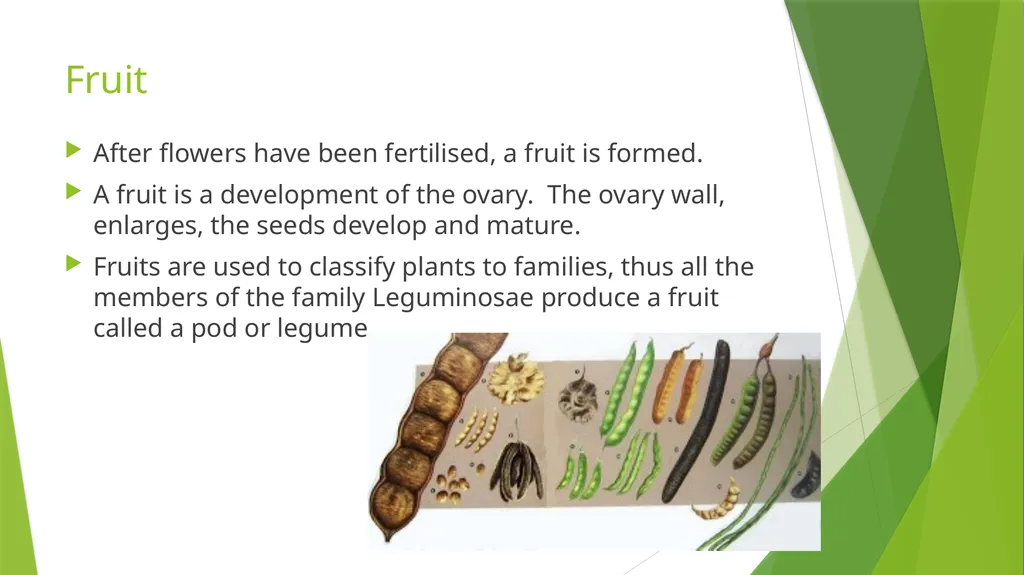
Fruit After flowers have been fertilised, a fruit is formed.
A fruit is a development of the ovary. The ovary wall, enlarges, the seeds develop and mature.
Fruits are used to classify plants to families, thus all the members of the family Leguminosae produce a fruit called a pod or legume.<br>
A fruit is a development of the ovary. The ovary wall, enlarges, the seeds develop and mature.
Fruits are used to classify plants to families, thus all the members of the family Leguminosae produce a fruit called a pod or legume.<br>
70
Plant structure adaptions in grasses. Grasses have narrow leaves to reduce water loss.
Grasses grow from their base rather than their top so that grazing does not permanently damage them.
Grasses are wind pollinated taking advantage of the windy and exposed conditions that they live in.
Grasses have soft flexible stems that are able to bend in the wind, reducing damage.
They generally grow close to the ground and together in clumps to increase warmth.
Root system is dense to overcome drought.
Generally are perennials.
Have underground runners to allow the plant to spread out.
Extensive root systems prevent grazing animals from pulling the plant out of the ground.<br>
71
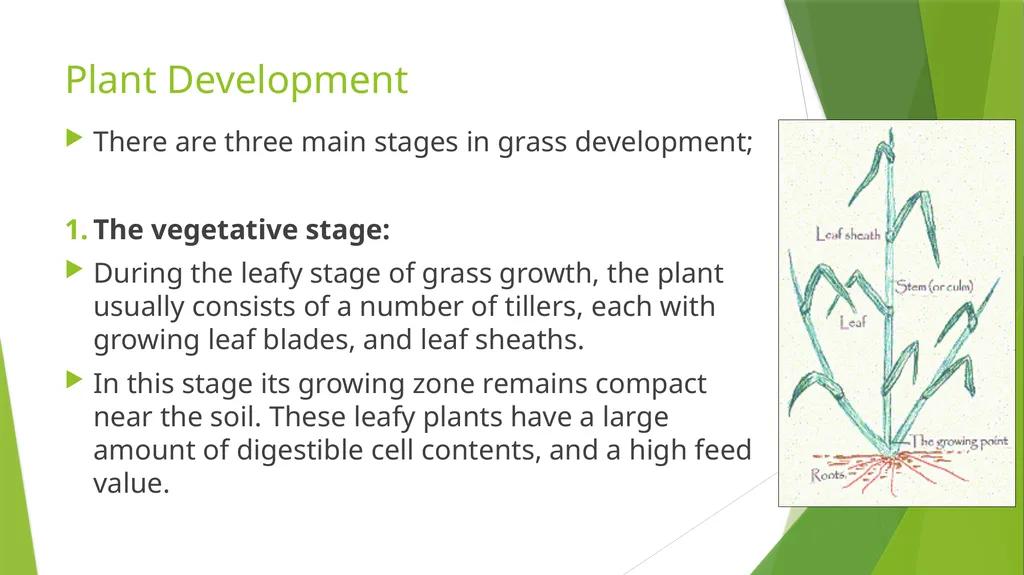
Plant Development There are three main stages in grass development;
The vegetative stage:
During the leafy stage of grass growth, the plant usually consists of a number of tillers, each with growing leaf blades, and leaf sheaths.
In this stage its growing zone remains compact near the soil. These leafy plants have a large amount of digestible cell contents, and a high feed value.<br>
72
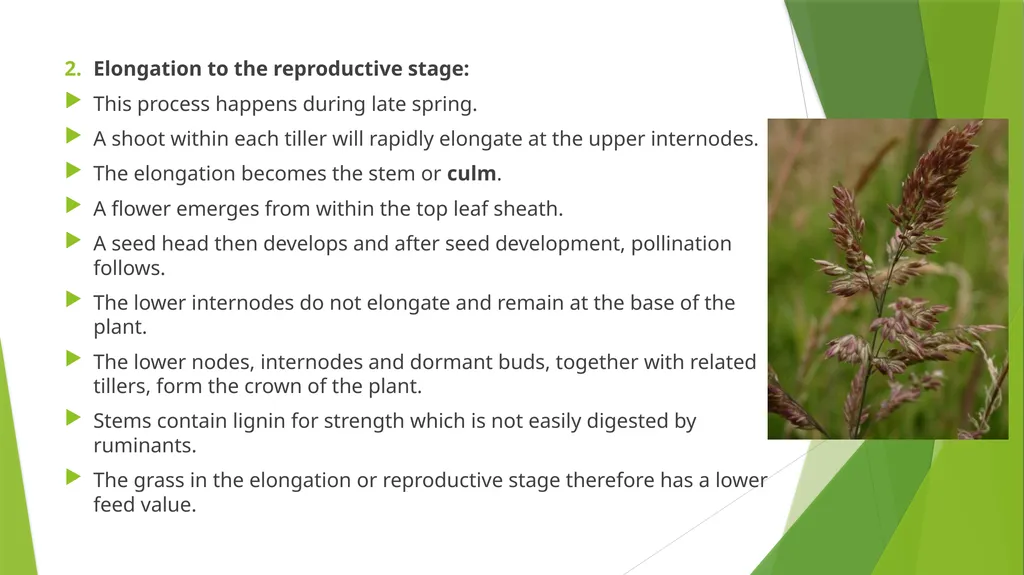
Elongation to the reproductive stage:
This process happens during late spring.
A shoot within each tiller will rapidly elongate at the upper internodes.
The elongation becomes the stem or culm.
A flower emerges from within the top leaf sheath.
A seed head then develops and after seed development, pollination follows.
The lower internodes do not elongate and remain at the base of the plant.
The lower nodes, internodes and dormant buds, together with related tillers, form the crown of the plant.
Stems contain lignin for strength which is not easily digested by ruminants.
The grass in the elongation or reproductive stage therefore has a lower feed value.<br>
73
Leaves, regrowth, and nutrition:
The amount of regrowth requires moisture and sunlight but it is related to the amount of leaf area remaining after eating, topping, or mowing.
The amount of leaf remaining determines the amount of photosynthesis that then follows.
The plant replenishes the carbohydrates stores in the leaf, and root growth continues.
If grasses can be maintained in a leafy state, their palatability (flavour and taste), and nutritive value is higher than grass in its reproductive or stalky flowering state.<br>
74
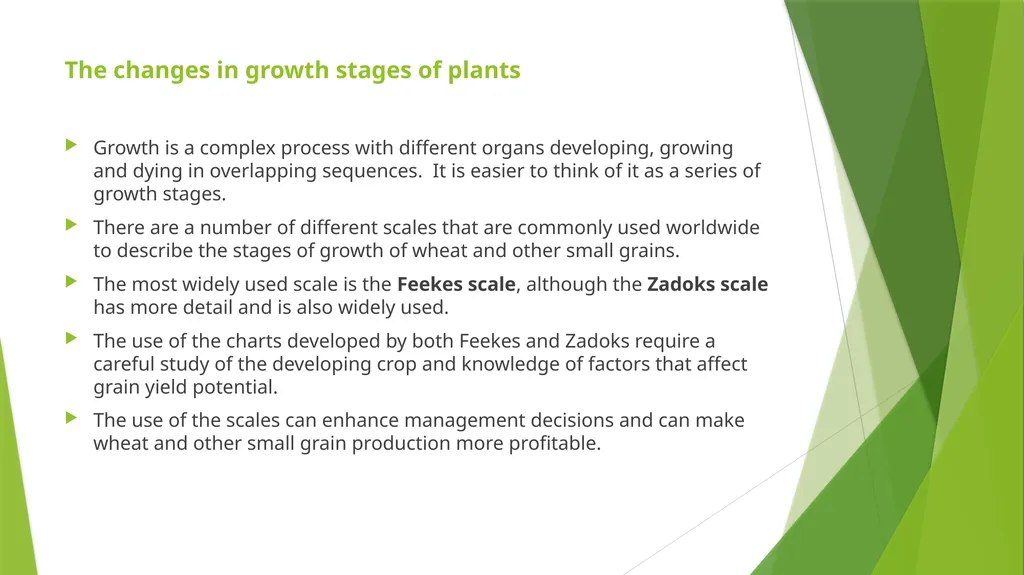
The changes in growth stages of plants Growth is a complex process with different organs developing, growing and dying in overlapping sequences. It is easier to think of it as a series of growth stages.
There are a number of different scales that are commonly used worldwide to describe the stages of growth of wheat and other small grains.
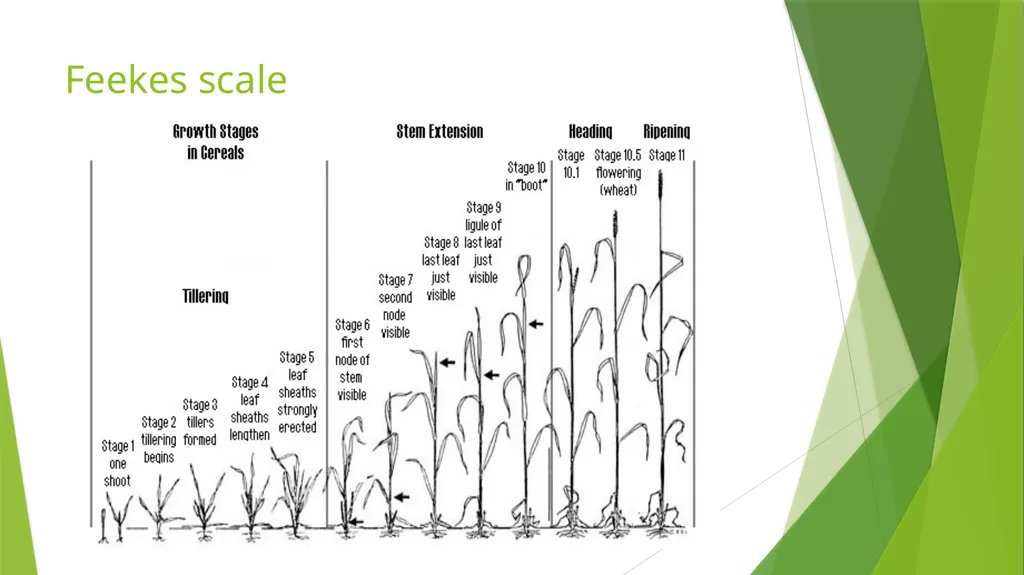
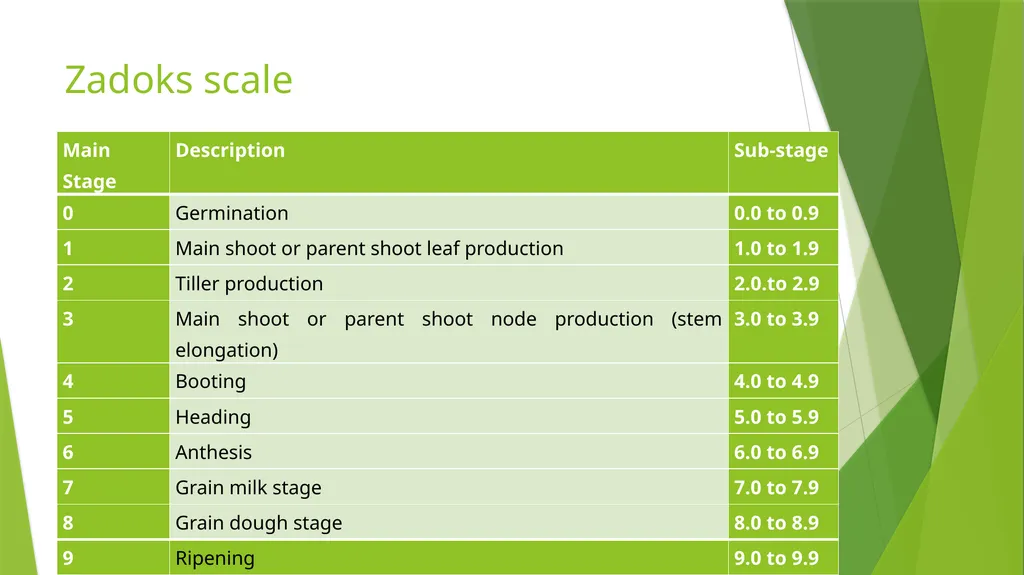
The most widely used scale is the Feekes scale, although the Zadoks scale has more detail and is also widely used.
The use of the charts developed by both Feekes and Zadoks require a careful study of the developing crop and knowledge of factors that affect grain yield potential.
The use of the scales can enhance management decisions and can make wheat and other small grain production more profitable.<br>
75
Feekes scale<br>
76
Zadoks scale<br>