
The Study of James - Practical Christianity Lake
MJ
Published · 35 slides · 0 views

1 / 1






Description
The Study of James - Practical Christianity Lake Houston Church of Christ - Spring 2020 Week 1 Class Introduction - Resources Study Guide for the class Used as an outline, but not followed rigorously Prepared by Paul Cantrell Gospel
Related Topics
Share
Embed code
Download this presentation From Below
"The Study of James - Practical Christianity Lake" is the property of its rightful owner. Permission is granted to download and print the materials on this website for personal, non-commercial use only, and to display it on your personal computer provided you do not modify the materials and that you retain all copyright notices contained in the materials. By downloading content from our website, you accept the terms of this agreement.
Presentation Transcript
01
The Study of James -
Practical Christianity Lake Houston Church of Christ - Spring 2020
Week 1<br>
Week 1<br>
02
Class Introduction - Resources Study Guide for the class
Used as an outline, but not followed rigorously
Prepared by Paul Cantrell
Gospel minister for churches of Christ for over 60 years
Served mainly in the Northeast in New Jersey and Pennsylvania
The Study of James - Practical Christianity
http://camphillchurch.org/study_books/JAMES.%20the%20Study%20of.pdf<br>
03
Class Introduction – Resources - Background of the Epistle of James The Bible Project
Video introduction to the Book of James
https://thebibleproject.com/
https://www.youtube.com/watch?v=qn-hLHWwRYY&feature=share<br>
Video introduction to the Book of James
https://thebibleproject.com/
https://www.youtube.com/watch?v=qn-hLHWwRYY&feature=share<br>
04
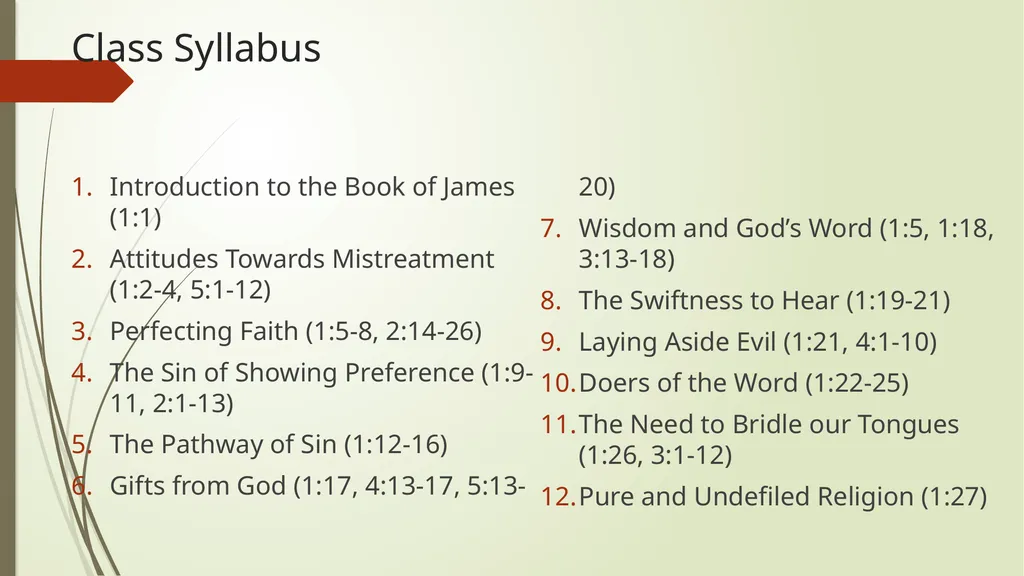
Class Syllabus Introduction to the Book of James (1:1)
Attitudes Towards Mistreatment (1:2-4, 5:1-12)
Perfecting Faith (1:5-8, 2:14-26)
The Sin of Showing Preference (1:9-11, 2:1-13)
The Pathway of Sin (1:12-16)
Gifts from God (1:17, 4:13-17, 5:13-20)
Wisdom and God’s Word (1:5, 1:18, 3:13-18)
The Swiftness to Hear (1:19-21)
Laying Aside Evil (1:21, 4:1-10)
Doers of the Word (1:22-25)
The Need to Bridle our Tongues (1:26, 3:1-12)
Pure and Undefiled Religion (1:27)<br>
05
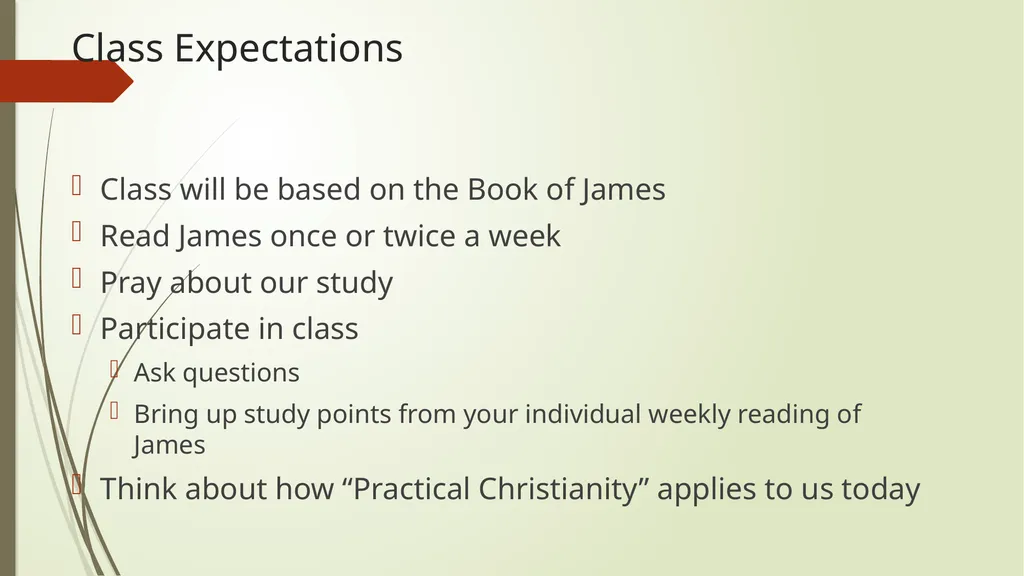
Class Expectations Class will be based on the Book of James
Read James once or twice a week
Pray about our study
Participate in class
Ask questions
Bring up study points from your individual weekly reading of James
Think about how “Practical Christianity” applies to us today<br>
Read James once or twice a week
Pray about our study
Participate in class
Ask questions
Bring up study points from your individual weekly reading of James
Think about how “Practical Christianity” applies to us today<br>
06
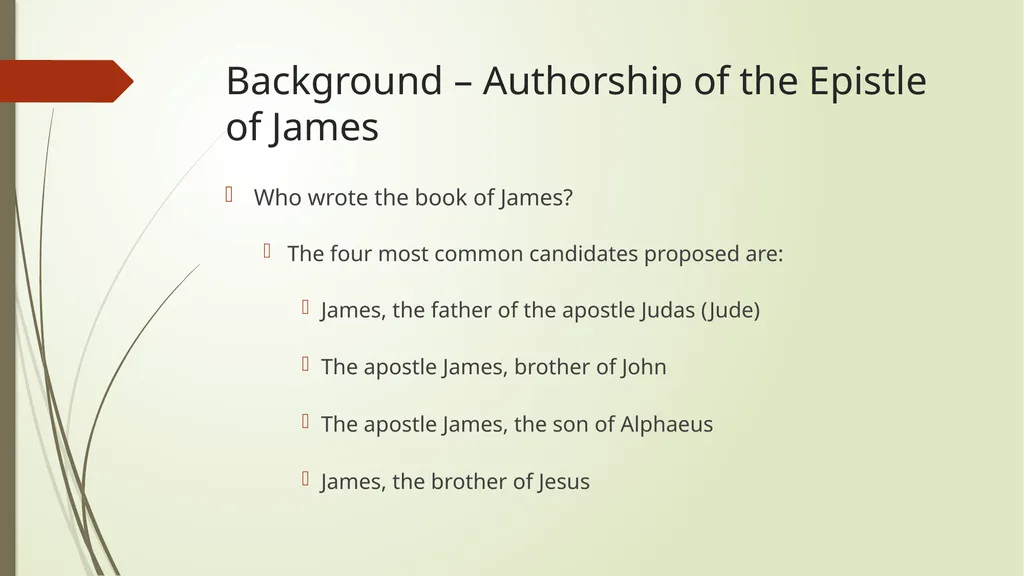
Background – Authorship of the Epistle of James Who wrote the book of James?
The four most common candidates proposed are:
James, the father of the apostle Judas (Jude)
The apostle James, brother of John
The apostle James, the son of Alphaeus
James, the brother of Jesus<br>
The four most common candidates proposed are:
James, the father of the apostle Judas (Jude)
The apostle James, brother of John
The apostle James, the son of Alphaeus
James, the brother of Jesus<br>
07
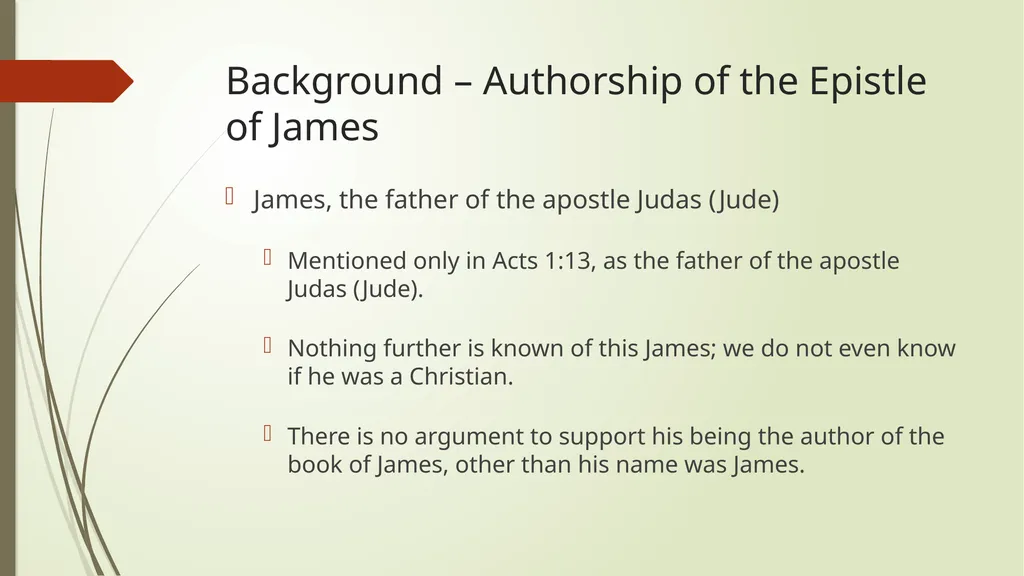
Background – Authorship of the Epistle of James James, the father of the apostle Judas (Jude)
Mentioned only in Acts 1:13, as the father of the apostle Judas (Jude).
Nothing further is known of this James; we do not even know if he was a Christian.
There is no argument to support his being the author of the book of James, other than his name was James.<br>
Mentioned only in Acts 1:13, as the father of the apostle Judas (Jude).
Nothing further is known of this James; we do not even know if he was a Christian.
There is no argument to support his being the author of the book of James, other than his name was James.<br>
08
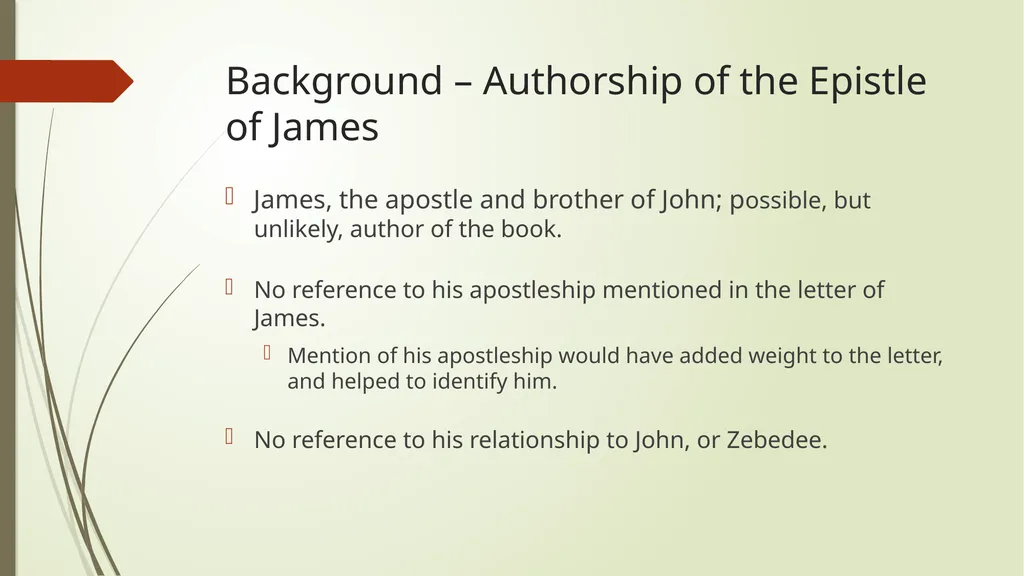
Background – Authorship of the Epistle of James James, the apostle and brother of John; possible, but unlikely, author of the book.
No reference to his apostleship mentioned in the letter of James.
Mention of his apostleship would have added weight to the letter, and helped to identify him.
No reference to his relationship to John, or Zebedee.<br>
No reference to his apostleship mentioned in the letter of James.
Mention of his apostleship would have added weight to the letter, and helped to identify him.
No reference to his relationship to John, or Zebedee.<br>
09
Background – Authorship of the Epistle of James James, the apostle and brother of John (Continued)
His martyrdom (by King Herod – Acts 12:1-2) is estimated to have occurred in A.D. 43-44, shortly after the persecution of Stephen, and the dispersion of the church from Jerusalem (Acts 7:54-8:1), which occurred around A.D. 36-37.<br>
His martyrdom (by King Herod – Acts 12:1-2) is estimated to have occurred in A.D. 43-44, shortly after the persecution of Stephen, and the dispersion of the church from Jerusalem (Acts 7:54-8:1), which occurred around A.D. 36-37.<br>
10
Background – Authorship of the Epistle of James James, the apostle and brother of John (Continued)
The short duration between the time of James martyrdom and the dispersion of the church makes it unlikely that James wrote the letter.
The churches to whom he wrote would have needed some time to develop, and for James to become aware of them and their needs.<br>
The short duration between the time of James martyrdom and the dispersion of the church makes it unlikely that James wrote the letter.
The churches to whom he wrote would have needed some time to develop, and for James to become aware of them and their needs.<br>
11
Background – Authorship of the Epistle of James James, the apostle and brother of John (Continued)
The date of the letter can not be established definitively, but it is generally considered to be late 40’s or early 50’s A.D.
If accurate, this date would be after James Martyrdom, prohibiting him from being its author.<br>
The date of the letter can not be established definitively, but it is generally considered to be late 40’s or early 50’s A.D.
If accurate, this date would be after James Martyrdom, prohibiting him from being its author.<br>
12
Background – Authorship of the Epistle of James The apostle James, the son of Alphaeus; unlikely author of the letter of James.
No reference to his apostleship mentioned in the letter of James.
Mention of his apostleship would have added weight to the letter, and helped to identify him.<br>
No reference to his apostleship mentioned in the letter of James.
Mention of his apostleship would have added weight to the letter, and helped to identify him.<br>
13
Background – Authorship of the Epistle of James The apostle James, the son of Alphaeus (Continued)
No distinct reference to this apostle outside the gospels.
Nothing is known of his activity; only the name “James” suggests him as a possible author.
Not likely that he would be identified simply as “James”.<br>
No distinct reference to this apostle outside the gospels.
Nothing is known of his activity; only the name “James” suggests him as a possible author.
Not likely that he would be identified simply as “James”.<br>
14
Background – Authorship of the Epistle of James James, the brother of Jesus, is the most likely author of the letter of James.
Noted by Paul as one of the pillars of the church in Jerusalem, along with Peter and John. – Gal 2:9
Active in the council held in Jerusalem to discuss the conversion of Gentiles and their need to be circumcised and keep the law of Moses. –Acts 15:12-21<br>
Noted by Paul as one of the pillars of the church in Jerusalem, along with Peter and John. – Gal 2:9
Active in the council held in Jerusalem to discuss the conversion of Gentiles and their need to be circumcised and keep the law of Moses. –Acts 15:12-21<br>
15
Background – Authorship of the Epistle of James James, the brother of Jesus (Continued)
James is mentioned as the one to whom Paul went to present the monetary offering of the Gentiles to the church to Jerusalem. – Acts 21:17-18
This suggests that James was the dominant leader of the church at Jerusalem during the time Paul visited (57 A. D.).<br>
James is mentioned as the one to whom Paul went to present the monetary offering of the Gentiles to the church to Jerusalem. – Acts 21:17-18
This suggests that James was the dominant leader of the church at Jerusalem during the time Paul visited (57 A. D.).<br>
16
Background – Authorship of the Epistle of James James, the brother of Jesus (Continued)
James is also discussed in the writings of Eusebius (fourth century Christian historian), who references Hegesippus, a second century writer.
James is regarded as a leader of the Judaic community, and as being constantly in prayer for the people, earning him the title of “James the Just”.<br>
James is also discussed in the writings of Eusebius (fourth century Christian historian), who references Hegesippus, a second century writer.
James is regarded as a leader of the Judaic community, and as being constantly in prayer for the people, earning him the title of “James the Just”.<br>
17
Background – Authorship of the Epistle of James - Conclusion Given the references to Jesus’ brother, James, found both in the New Testament and early church history, it is reasonable to conclude that he is the “James” who could be identified simply as James, and be recognized.
Furthermore, the writer of the letter of James speaks with authority, and in character with the information that we have in Acts regarding James role in the church.<br>
Furthermore, the writer of the letter of James speaks with authority, and in character with the information that we have in Acts regarding James role in the church.<br>
18
James - Early relationship to Jesus James was one of four brothers of Jesus (Matthew 13:55, Mark 6:3).
Also the brother of Jude, who later wrote the book of Jude
άδελφός (brother), not άνεψιός (cousin); Col 4:10
James did not believe in Jesus prior to Jesus’ crucifixion (John 7: 3-5)<br>
Also the brother of Jude, who later wrote the book of Jude
άδελφός (brother), not άνεψιός (cousin); Col 4:10
James did not believe in Jesus prior to Jesus’ crucifixion (John 7: 3-5)<br>
19
James – A believer in Jesus After His crucifixion, Jesus appeared to James (1 Cor. 15:7), and this is considered to be what lead to James’ conversion.
He came to be numbered with the believers (Acts 1:14)<br>
He came to be numbered with the believers (Acts 1:14)<br>
20
James - In the Jerusalem church James was later recognized as a leader of the church in Jerusalem by Paul, who referred to James as one of the pillars of the church in Jerusalem (Gal. 2:9)<br>
21
James, in the Jerusalem church – Book of Acts Peter sent James news of his release from prison (Acts 12:17).
James was active at the council in Jerusalem to resolve the question of Gentile circumcision, and the subsequent letter to the church in Antioch (Acts 15:13-30).
Received Paul’s 3rd missionary report, and gift from the Gentiles (Acts 21:18-25)<br>
James was active at the council in Jerusalem to resolve the question of Gentile circumcision, and the subsequent letter to the church in Antioch (Acts 15:13-30).
Received Paul’s 3rd missionary report, and gift from the Gentiles (Acts 21:18-25)<br>
22
James, in the Jerusalem church – External Sources Regarded as James the Just by Eusebius, and Josephus
Knees were like that of a camel, worn and hard, per Eusebius (4th century historian)
Killed by the Jews in AD 62, according to Josephus - Jewish Antiquities, (xx.9)<br>
Knees were like that of a camel, worn and hard, per Eusebius (4th century historian)
Killed by the Jews in AD 62, according to Josephus - Jewish Antiquities, (xx.9)<br>
23
Background of the Epistle of James – Written to Whom? To Whom was the epistle of James written?
That the letter is written to Jewish Christians is evident from several references:
To the twelve tribes (1:1)
To Jesus Christ (1:1, 2:1)
To father Abraham (2:21)
To the law (2:8-10)
To a synagogue as a place of worship (2:2); maybe just Greek
To scripture, including Job (5:11), and Elijah (5:17)<br>
24
Background of the Epistle of James To Whom was the epistle of James written? (Continued)
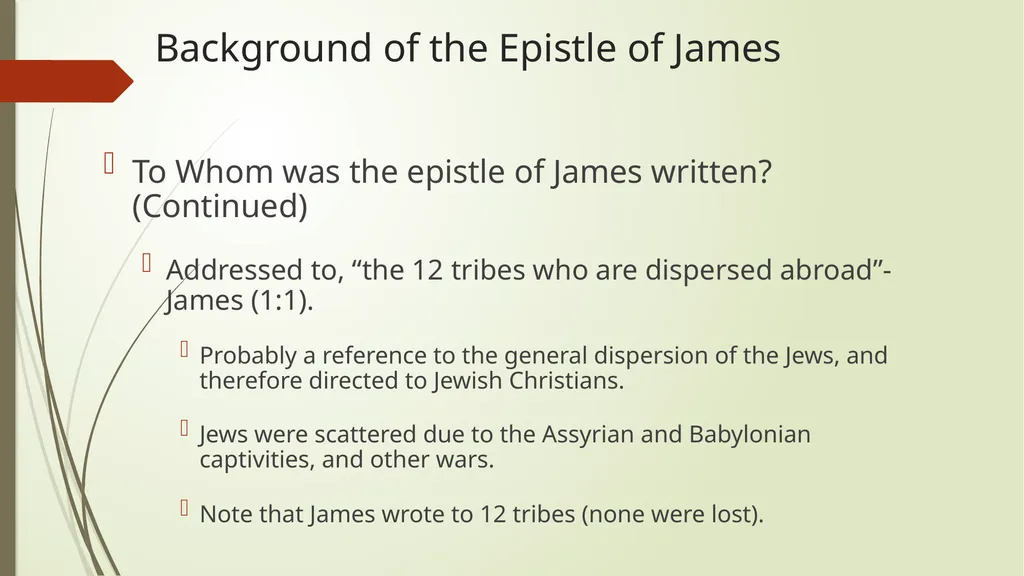
Addressed to, “the 12 tribes who are dispersed abroad”- James (1:1).
Probably a reference to the general dispersion of the Jews, and therefore directed to Jewish Christians.
Jews were scattered due to the Assyrian and Babylonian captivities, and other wars.
Note that James wrote to 12 tribes (none were lost).<br>
25
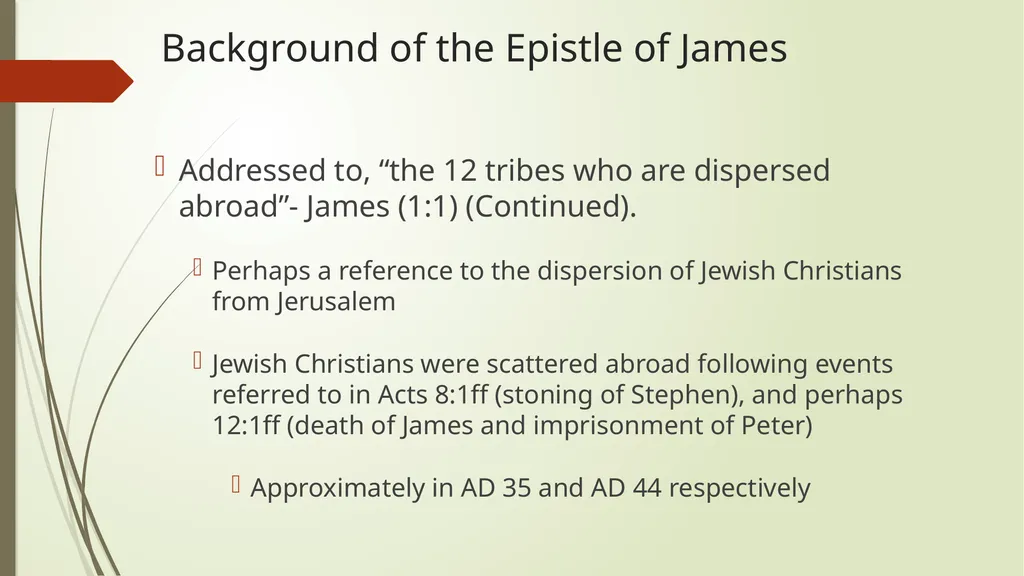
Background of the Epistle of James Addressed to, “the 12 tribes who are dispersed abroad”- James (1:1) (Continued).
Perhaps a reference to the dispersion of Jewish Christians from Jerusalem
Jewish Christians were scattered abroad following events referred to in Acts 8:1ff (stoning of Stephen), and perhaps 12:1ff (death of James and imprisonment of Peter)
Approximately in AD 35 and AD 44 respectively<br>
Perhaps a reference to the dispersion of Jewish Christians from Jerusalem
Jewish Christians were scattered abroad following events referred to in Acts 8:1ff (stoning of Stephen), and perhaps 12:1ff (death of James and imprisonment of Peter)
Approximately in AD 35 and AD 44 respectively<br>
26
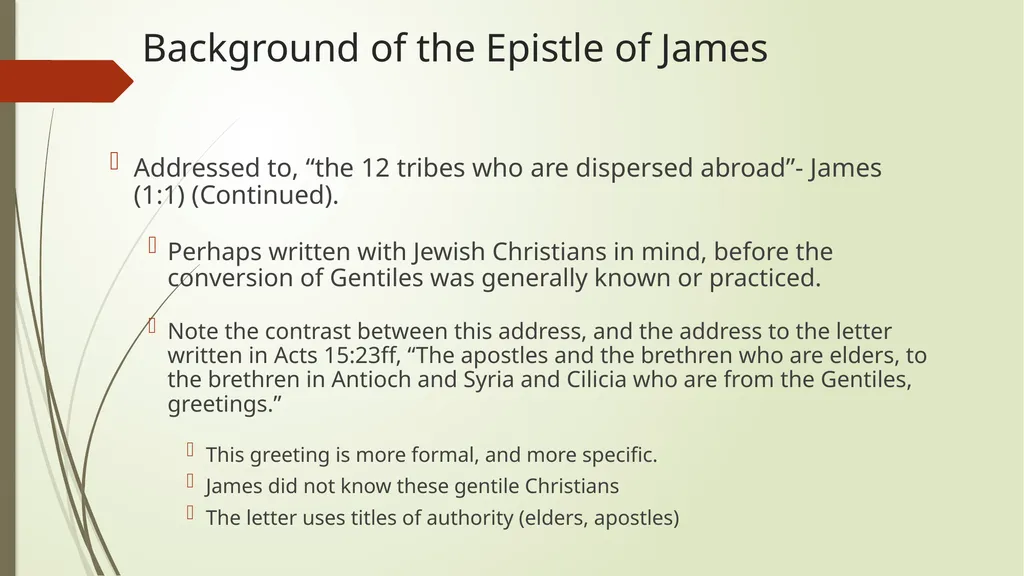
Background of the Epistle of James Addressed to, “the 12 tribes who are dispersed abroad”- James (1:1) (Continued).
Perhaps written with Jewish Christians in mind, before the conversion of Gentiles was generally known or practiced.
Note the contrast between this address, and the address to the letter written in Acts 15:23ff, “The apostles and the brethren who are elders, to the brethren in Antioch and Syria and Cilicia who are from the Gentiles, greetings.”
This greeting is more formal, and more specific.
James did not know these gentile Christians
The letter uses titles of authority (elders, apostles)<br>
27
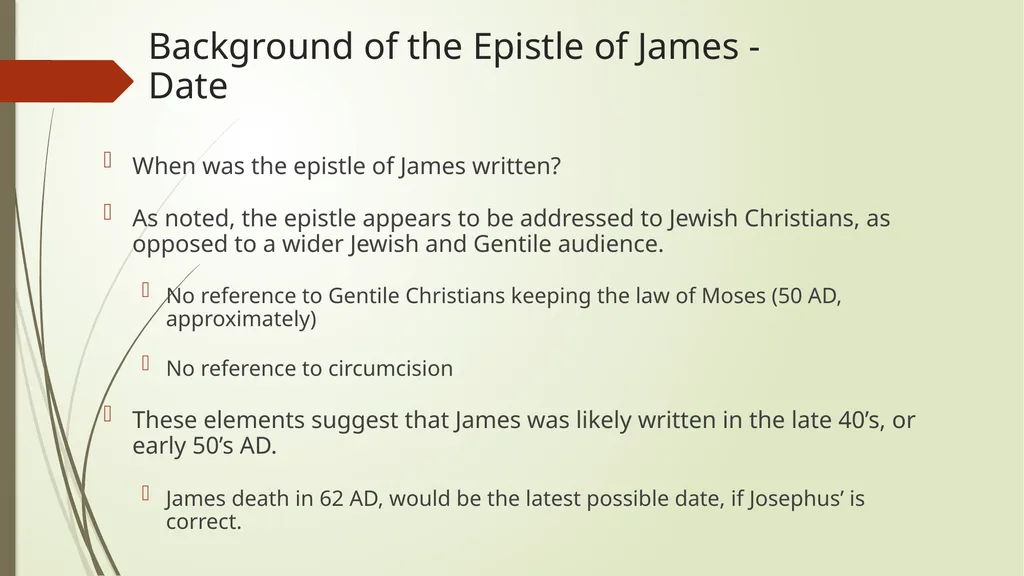
Background of the Epistle of James - Date When was the epistle of James written?
As noted, the epistle appears to be addressed to Jewish Christians, as opposed to a wider Jewish and Gentile audience.
No reference to Gentile Christians keeping the law of Moses (50 AD, approximately)
No reference to circumcision
These elements suggest that James was likely written in the late 40’s, or early 50’s AD.
James death in 62 AD, would be the latest possible date, if Josephus’ is correct.<br>
28
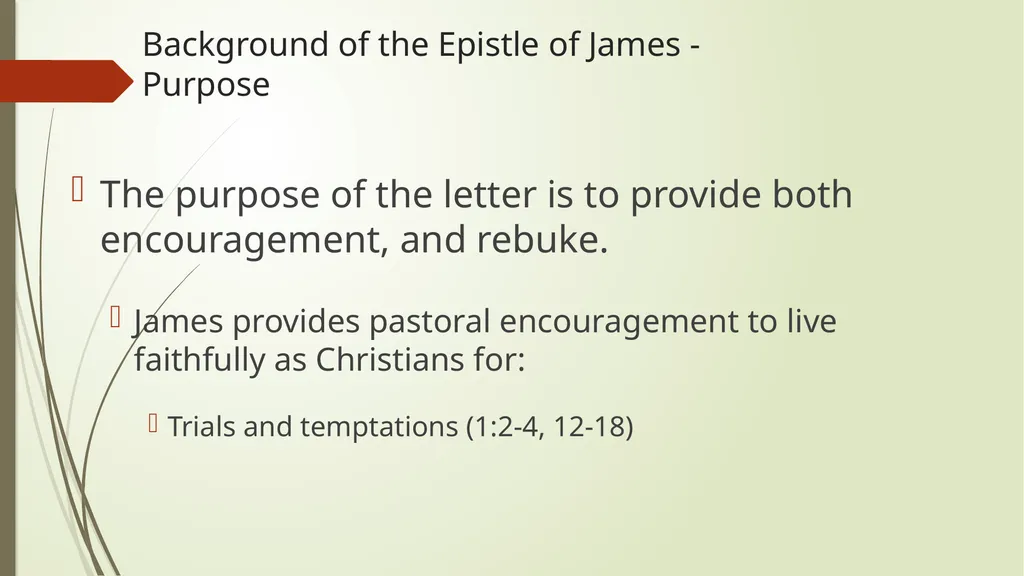
Background of the Epistle of James - Purpose The purpose of the letter is to provide both encouragement, and rebuke.
James provides pastoral encouragement to live faithfully as Christians for:
Trials and temptations (1:2-4, 12-18)<br>
James provides pastoral encouragement to live faithfully as Christians for:
Trials and temptations (1:2-4, 12-18)<br>
29
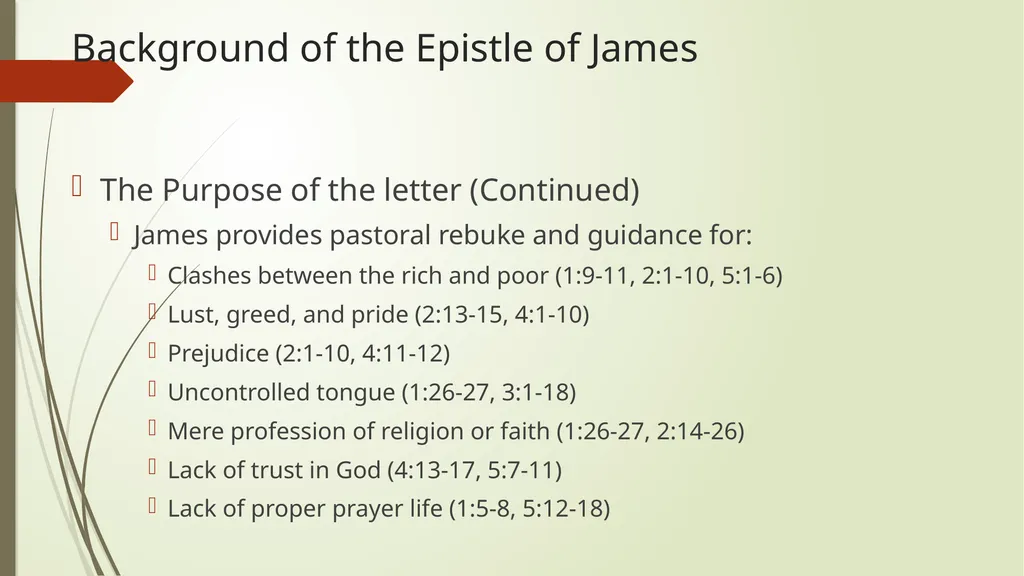
Background of the Epistle of James The Purpose of the letter (Continued)
James provides pastoral rebuke and guidance for:
Clashes between the rich and poor (1:9-11, 2:1-10, 5:1-6)
Lust, greed, and pride (2:13-15, 4:1-10)
Prejudice (2:1-10, 4:11-12)
Uncontrolled tongue (1:26-27, 3:1-18)
Mere profession of religion or faith (1:26-27, 2:14-26)
Lack of trust in God (4:13-17, 5:7-11)
Lack of proper prayer life (1:5-8, 5:12-18)<br>
30
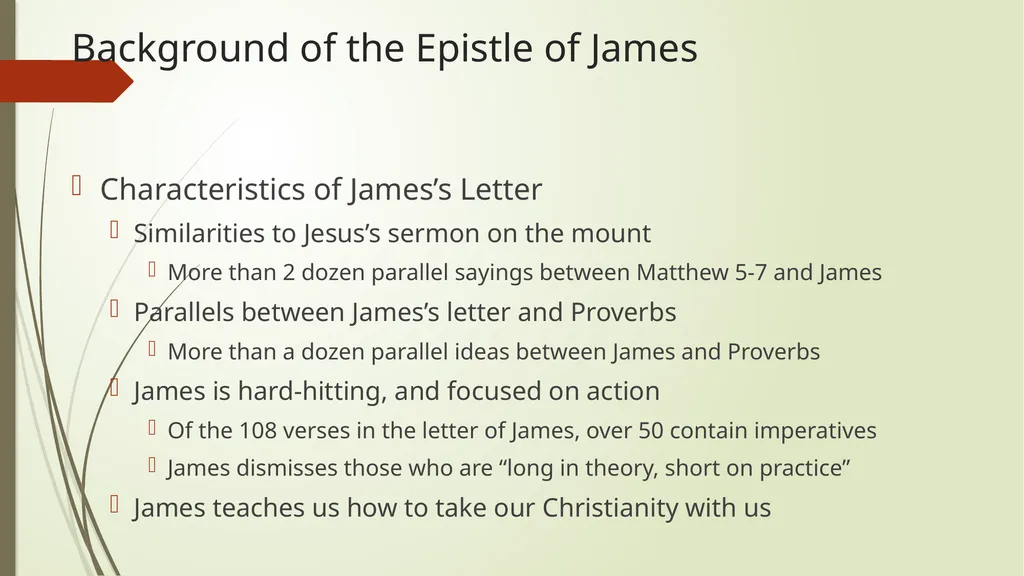
Background of the Epistle of James Characteristics of James’s Letter
Similarities to Jesus’s sermon on the mount
More than 2 dozen parallel sayings between Matthew 5-7 and James
Parallels between James’s letter and Proverbs
More than a dozen parallel ideas between James and Proverbs
James is hard-hitting, and focused on action
Of the 108 verses in the letter of James, over 50 contain imperatives
James dismisses those who are “long in theory, short on practice”
James teaches us how to take our Christianity with us<br>
31
Backup<br>
32
James and Jesus Sermon on the Mount Book of James “Whenever you face trials of any kind, consider it nothing but joy” (1:2).
“You may be mature [teleioi ] and complete, lacking in nothing” (1:4).
“Ask God . . . and it will be given you” (1:5).
“Be doers of the word, and not merely hearers” (1:22).
“Has not God chosen the poor in the world . . . to be heirs of the kingdom?” (2:5).
“Whoever keeps the whole law but fails in one point has become accountable for all of it” (2:10). Sermon on the Mount “When people revile you and persecute you and utter all kinds of evil against you . . . rejoice and be glad” (5:11–12).
“Be perfect [teleioi ] . . . as your heavenly Father is perfect” (5:48).
“Ask, and it will be given you” (7:7).
“Everyone then who hears these words . . . and acts on them will be like a wise person” (7:24).
“Blessed are the poor in spirit, for theirs is the kingdom of heaven” (5:3).
“Whoever, then, relaxes one of the least of these commandments . . . shall be called least in the kingdom of heaven” (5:19).<br>
33
James and Jesus Sermon on the Mount Book of James “Judgment will be without mercy to anyone who has shown no mercy” (2:13).
“What good is it . . . if you say you have faith, but do not have works? Can faith save you?” (2:14).
“Can a fig tree . . . yield olives, or a grapevine figs?” (3:12).
“A harvest of righteousness is sown in peace for those who make peace” (3:18).
“Friendship with the world is enmity with God” (4:4).
“Purify your hearts” (4:8). Sermon on the Mount “Blessed are the merciful, for they will receive mercy” (5:7).
“Not everyone who says to me, ‘Lord, Lord,’ will enter the kingdom of heaven, but only the one who does the will of my Father” (7:21).
“Are grapes gathered from thorns, or figs from thistles?” (7:16).
“Blessed are the peacemakers, for they will be called children of God” (5:9).
“You cannot serve God and wealth” (6:24).
“Blessed are the pure in heart” (5:8).<br>
34
James and Jesus Sermon on the Mount Book of James “Who, then, are you to judge your neighbor?” (4:12).
“Your riches have rotted, and your clothes are moth-eaten; your gold and silver have rusted” (5:2–3).
“Do not grumble against one another, so that you may not be judged” (5:9).
“Do not swear, either by heaven or by earth or by any other oath, but let your ‘Yes’ be yes and your ‘No’ be no” (5:12). Sermon on the Mount “Do not judge, so that you may not be judged” (7:1).
“Do not store up for yourselves treasures on earth, where moth and rust consume and where thieves break in and steal” (6:19).
“Do not judge, so that you may not be judged” (7:1).
“Do not swear at all, either by heaven . . . or by the earth. . . . Let your word be ‘Yes, Yes’ or ‘No, No’” (5:34–37).<br>
35
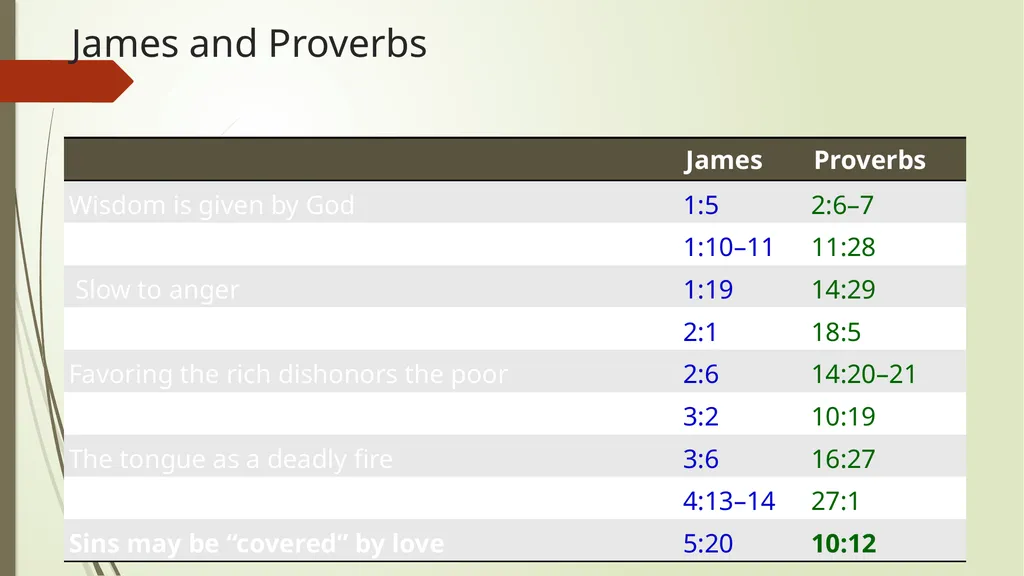
James and Proverbs<br>