
The Value of Speech-Language Pathology in the
SB
Published · 38 slides · 0 views

1 / 1
Description
The Value of Speech-Language Pathology in the Skilled Nursing and Long-term Care Settings Inservice Presentation Agenda About Speech-Language Pathologists (SLPs) What SLPs do Who SLPs help Where SLPs work When to consult an SLP Swallowing
Related Topics
Share
Embed code
Download this presentation From Below
"The Value of Speech-Language Pathology in the" is the property of its rightful owner. Permission is granted to download and print the materials on this website for personal, non-commercial use only, and to display it on your personal computer provided you do not modify the materials and that you retain all copyright notices contained in the materials. By downloading content from our website, you accept the terms of this agreement.
Presentation Transcript
01
The Value of Speech-Language Pathology in the Skilled Nursing and Long-term Care Settings Inservice Presentation<br>
02
Agenda About Speech-Language Pathologists (SLPs)
What SLPs do
Who SLPs help
Where SLPs work
When to consult an SLP
Swallowing
Disorders
Assessments
Cognition, Speech, Language, and Voice<br>
What SLPs do
Who SLPs help
Where SLPs work
When to consult an SLP
Swallowing
Disorders
Assessments
Cognition, Speech, Language, and Voice<br>
03
Agenda (cont’d) Restorative Nursing Programs
How SLPs Impact PDPM
Improving Quality and Compliance
Additional Resources
References
This template is consensus-based, is provided as a resource for ASHA members, and does not represent official ASHA policy.<br>
How SLPs Impact PDPM
Improving Quality and Compliance
Additional Resources
References
This template is consensus-based, is provided as a resource for ASHA members, and does not represent official ASHA policy.<br>
04
What SLPs Do The SLP’s role is to help patients with the following functions:
communication
thinking
swallowing
SLPs evaluate and treat patients based on individual needs and goals.<br>
communication
thinking
swallowing
SLPs evaluate and treat patients based on individual needs and goals.<br>
05
Who SLPs help SLPs are commonly consulted when patients have:
neurological conditions—like stroke, Parkinson’s disease, or dementia
medical/surgical events—like head/neck surgery or intubation
chronic conditions—like chronic obstructive pulmonary disease (COPD)
developmental or congenital conditions—like cerebral palsy<br>
neurological conditions—like stroke, Parkinson’s disease, or dementia
medical/surgical events—like head/neck surgery or intubation
chronic conditions—like chronic obstructive pulmonary disease (COPD)
developmental or congenital conditions—like cerebral palsy<br>
06
Where SLPs work SLPs can work in a variety of health care settings:
hospitals (acute care)
acute rehabilitation
skilled nursing facilities (SNFs)
long-term care (LTC)
long-term acute-care hospitals (LTACHs)
home health
outpatient rehabilitation<br>
hospitals (acute care)
acute rehabilitation
skilled nursing facilities (SNFs)
long-term care (LTC)
long-term acute-care hospitals (LTACHs)
home health
outpatient rehabilitation<br>
07
When to Consult an SLP Refer a patient to an SLP when a patient tells you—or you see for yourself—that they are having trouble with communication, cognition, or swallowing.
Use a referral guideline or a screening tool to identify when a comprehensive speech-language pathology evaluation may be indicated.
For example, see ASHA’s SLP Health Care Referral Guidelines.<br>
Use a referral guideline or a screening tool to identify when a comprehensive speech-language pathology evaluation may be indicated.
For example, see ASHA’s SLP Health Care Referral Guidelines.<br>
08
Normal Swallowing Normal swallowing occurs when the food or liquid is moved from the mouth down the esophagus without complications.
The two videos below demonstrate what normal swallowing looks like :
Normal Swallow
Lateral-View Swallow Study Using MBSS/VFSS<br>
The two videos below demonstrate what normal swallowing looks like :
Normal Swallow
Lateral-View Swallow Study Using MBSS/VFSS<br>
09
Understanding Swallowing and Dysphagia Dysphagia is a swallowing disorder, which can lead to any of the following conditions:
malnutrition
dehydration
aspiration pneumonia
compromised general health
chronic lung disease
choking
death
Adults with dysphagia may also experience less interest or enjoyment, embarrassment, and/or isolation related to eating or drinking.<br>
malnutrition
dehydration
aspiration pneumonia
compromised general health
chronic lung disease
choking
death
Adults with dysphagia may also experience less interest or enjoyment, embarrassment, and/or isolation related to eating or drinking.<br>
10
How is Swallowing Assessed? Swallowing assessments include the following components:
The Clinical Swallow Evaluation (CSE)—also called the “bedside evaluation.”
Instrumental assessments—including the following:
MBSS/VFSS = Modified Barium Swallow Study / Videofluoroscopic Swallowing Study
FEES = Fiberoptic Endoscopic Evaluation of Swallowing
Without imaging procedures like MBSS and FEES, it is insufficient to infer specific information related to laryngeal, pharyngeal, or upper esophageal anatomy and physiology required to develop effective treatment options (Garand et al., 2020).<br>
11
Clinical Swallow Evaluation (CSE) The CSE includes the following components:
medical chart review
screening of cognition and communication
oral-motor exam
positioning for feeding
food and liquid trials, as appropriate<br>
medical chart review
screening of cognition and communication
oral-motor exam
positioning for feeding
food and liquid trials, as appropriate<br>
12
Instrumental MBSS/VFSS MBSS/VFSS is an imaging procedure that
evaluates swallowing anatomy and function and
screens esophageal structure and function.
MBSS/VFSS
is completed by the SLP and the radiologist or radiology technician* and
requires access to a radiology suite—thus, often requiring transportation to an off-site facility. *Depending on state regulations as well as payer and facility policies.<br>
13
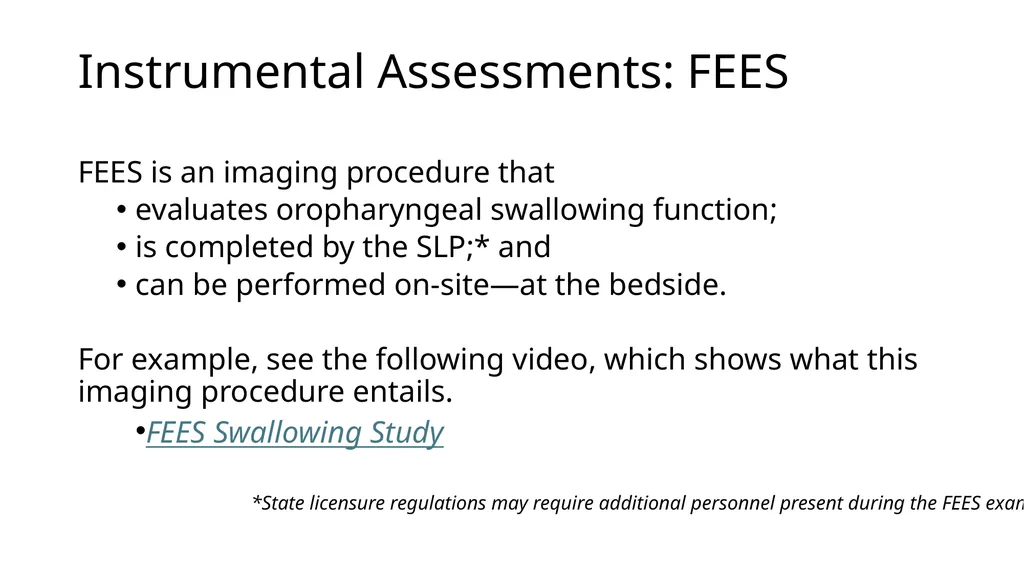
Instrumental Assessments: FEES FEES is an imaging procedure that
evaluates oropharyngeal swallowing function;
is completed by the SLP;* and
can be performed on-site—at the bedside.
For example, see the following video, which shows what this imaging procedure entails.
FEES Swallowing Study *State licensure regulations may require additional personnel present during the FEES exam.<br>
14
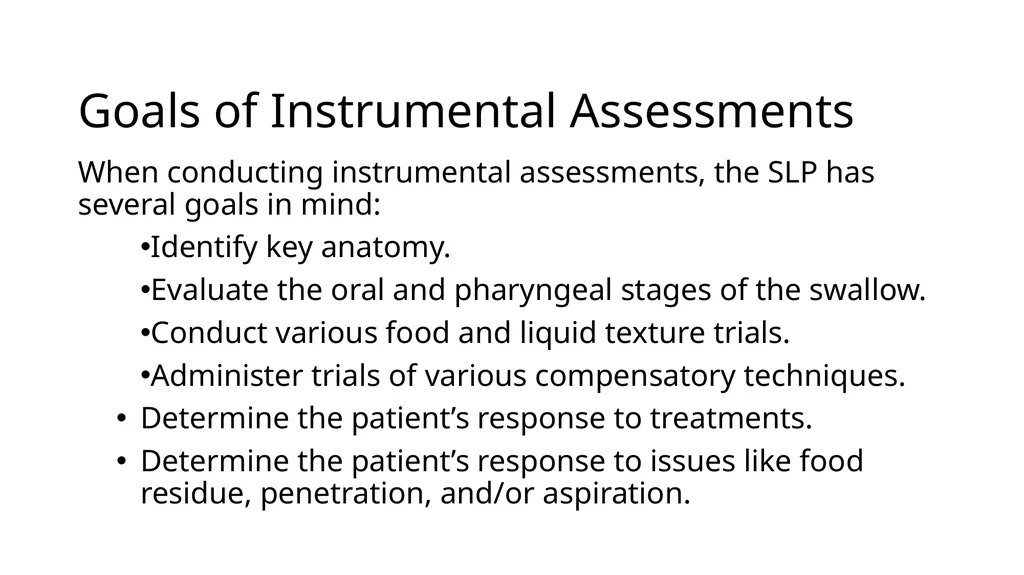
Goals of Instrumental Assessments When conducting instrumental assessments, the SLP has several goals in mind:
Identify key anatomy.
Evaluate the oral and pharyngeal stages of the swallow.
Conduct various food and liquid texture trials.
Administer trials of various compensatory techniques.
Determine the patient’s response to treatments.
Determine the patient’s response to issues like food residue, penetration, and/or aspiration.<br>
15
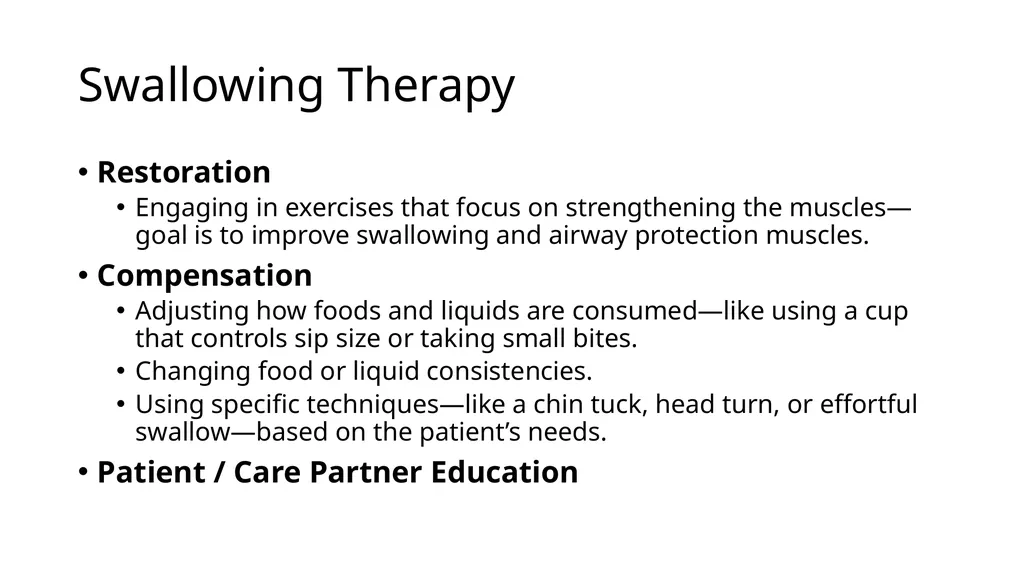
Swallowing Therapy Restoration
Engaging in exercises that focus on strengthening the muscles—goal is to improve swallowing and airway protection muscles.
Compensation
Adjusting how foods and liquids are consumed—like using a cup that controls sip size or taking small bites.
Changing food or liquid consistencies.
Using specific techniques—like a chin tuck, head turn, or effortful swallow—based on the patient’s needs.
Patient / Care Partner Education<br>
16
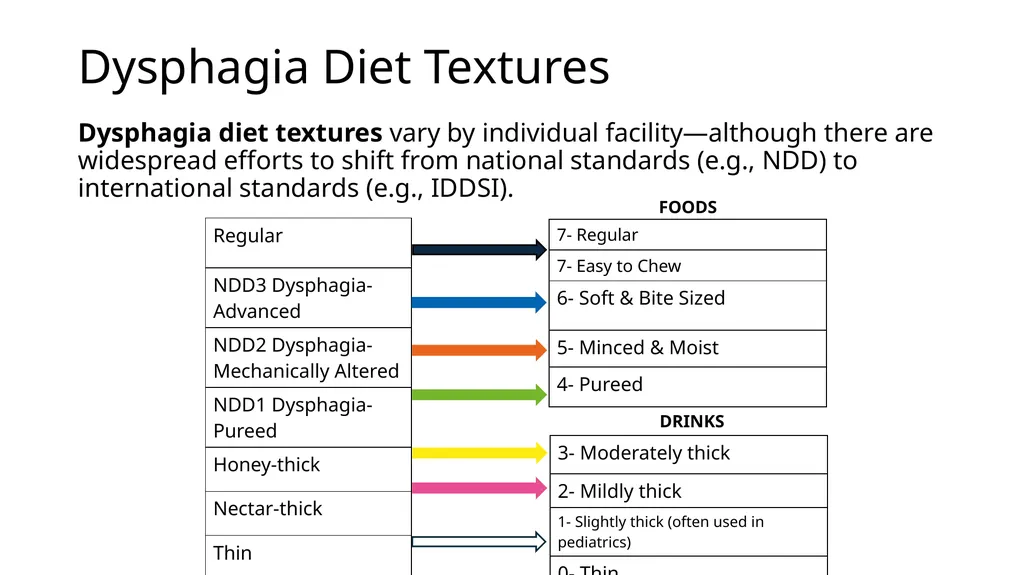
Dysphagia Diet Textures Dysphagia diet textures vary by individual facility—although there are widespread efforts to shift from national standards (e.g., NDD) to international standards (e.g., IDDSI). FOODS DRINKS<br>
17
International Dysphagia Diet Standardisation Initiative (IDDSI) The IDDSI framework is designed to avoid the confusion created by variable terminology and definitions to describe modified diets around the world.
The goal is to improve safety and care for all individuals with dysphagia.<br>
The goal is to improve safety and care for all individuals with dysphagia.<br>
18
Thickened Liquids Without instrumental assessments (MBSS/FEES), SLPs cannot determine:
How thickened liquids compare to thin liquids when swallowed
If there’s aspiration with any texture
Which strategies might best improve swallowing safety and efficiency
Thickened liquids may help some patients with swallowing, but they can also cause problems like decreased fluid intake and other health issues if the thickener is aspirated.
Thickened liquids are recommended based on individual needs.
SLPs consider the patient’s overall health, preferences, and current research to before making recommendations and obtains informed consent from the patient or decision-maker.<br>
19
Cognition Changes in thinking skills, including
memory,
attention,
problem solving, and
executive functioning.
The following conditions may impact cognition:
stroke
dementia
traumatic brain injury (TBI)
Parkinson’s disease<br>
memory,
attention,
problem solving, and
executive functioning.
The following conditions may impact cognition:
stroke
dementia
traumatic brain injury (TBI)
Parkinson’s disease<br>
20
Cognition (cont’d) SLPs help with screening, assessment, diagnosis, and treatment of cognitive difficulties.
Cognitive treatment may include
trying to restore function;
trying to compensate with things like environmental changes and visual aids; and
providing education to patients and their care partners.<br>
Cognitive treatment may include
trying to restore function;
trying to compensate with things like environmental changes and visual aids; and
providing education to patients and their care partners.<br>
21
Speech Speech disorders can be developmental or acquired and include:
Dysarthria
Apraxia of speech
Speech disorders may occur alongside other conditions, like aphasia or cognitive difficulties.<br>
Dysarthria
Apraxia of speech
Speech disorders may occur alongside other conditions, like aphasia or cognitive difficulties.<br>
22
Speech (cont’d) SLPs can help improve speech using these methods:
strategies like adjusting loudness or changing the rate of speech
prompts and cues for accuracy and efficiency
care partner training to support effective communication
augmentative and alternative communication (AAC)—using gestures, communication boards, or speech devices, if indicated<br>
strategies like adjusting loudness or changing the rate of speech
prompts and cues for accuracy and efficiency
care partner training to support effective communication
augmentative and alternative communication (AAC)—using gestures, communication boards, or speech devices, if indicated<br>
23
Language Many conditions can affect language skills, including these:
stroke
TBI
dementia
multiple sclerosis (MS)
intellectual disability (ID)
SLPs help patients with language by doing the following things:
Teaching communication strategies.
Finding the best way to communicate with each specific patient—like speaking, writing, or using AAC.
Training care partners to support the patient’s language skills.<br>
24
Voice Voice disorders are changes to the quality, pitch, or loudness of a person’s voice—which may make it hard for that person to communicate.
SLPs can help patients to try and restore and/or compensate in treatment.<br>
SLPs can help patients to try and restore and/or compensate in treatment.<br>
25
Restorative Nursing Programs The Centers for Medicare & Medicaid Services (CMS) defines restorative services as follows:
“Nursing interventions that promote the resident’s ability to adapt and adjust to living as independently and safely as possible. This concept actively focuses on achieving and maintaining optimal physical, mental, and psychosocial functioning.” (Centers for Medicare & Medicaid Services [CMS], 2024)<br>
“Nursing interventions that promote the resident’s ability to adapt and adjust to living as independently and safely as possible. This concept actively focuses on achieving and maintaining optimal physical, mental, and psychosocial functioning.” (Centers for Medicare & Medicaid Services [CMS], 2024)<br>
26
Restorative Nursing Programs SLPs provide training and education to nursing teams to establish restorative nursing programs.
Speech-language pathology–focused restorative nursing programs may address speech, language, cognition, voice, and/or swallowing.<br>
Speech-language pathology–focused restorative nursing programs may address speech, language, cognition, voice, and/or swallowing.<br>
27
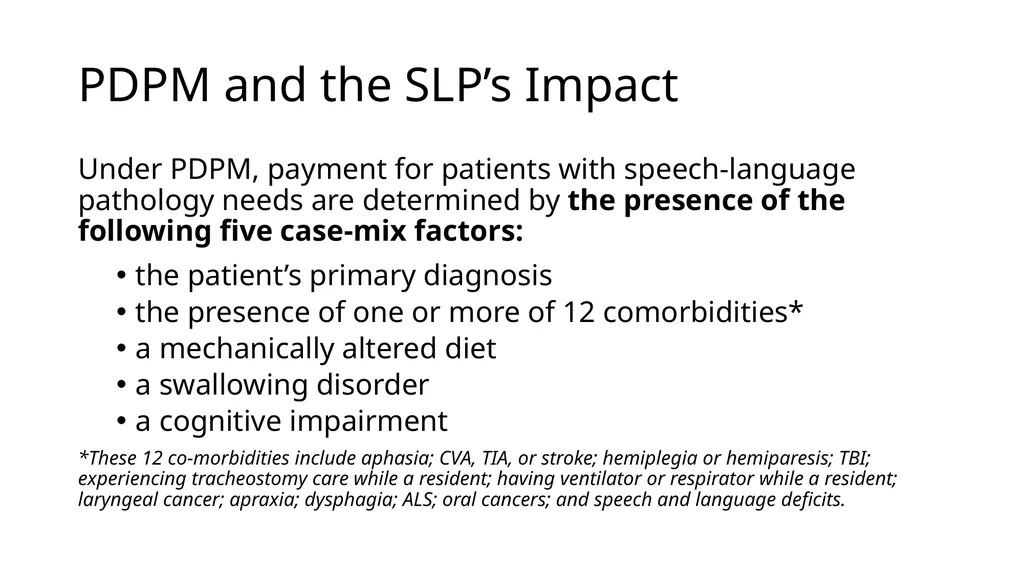
PDPM and the SLP’s Impact Under PDPM, payment for patients with speech-language pathology needs are determined by the presence of the following five case-mix factors:
the patient’s primary diagnosis
the presence of one or more of 12 comorbidities*
a mechanically altered diet
a swallowing disorder
a cognitive impairment
*These 12 co-morbidities include aphasia; CVA, TIA, or stroke; hemiplegia or hemiparesis; TBI; experiencing tracheostomy care while a resident; having ventilator or respirator while a resident; laryngeal cancer; apraxia; dysphagia; ALS; oral cancers; and speech and language deficits.<br>
28
Identifying and Coding Patient Needs SLPs can help to
identify patients who need skilled speech-language pathology services and
provide accurate, complete coding for reimbursement of (1) diagnoses and (2) co-morbidities.
Improved coding accuracy provides Medicare with more complete data on the conditions that SLPs treat—which can support advocacy efforts to improve payment policy changes.<br>
29
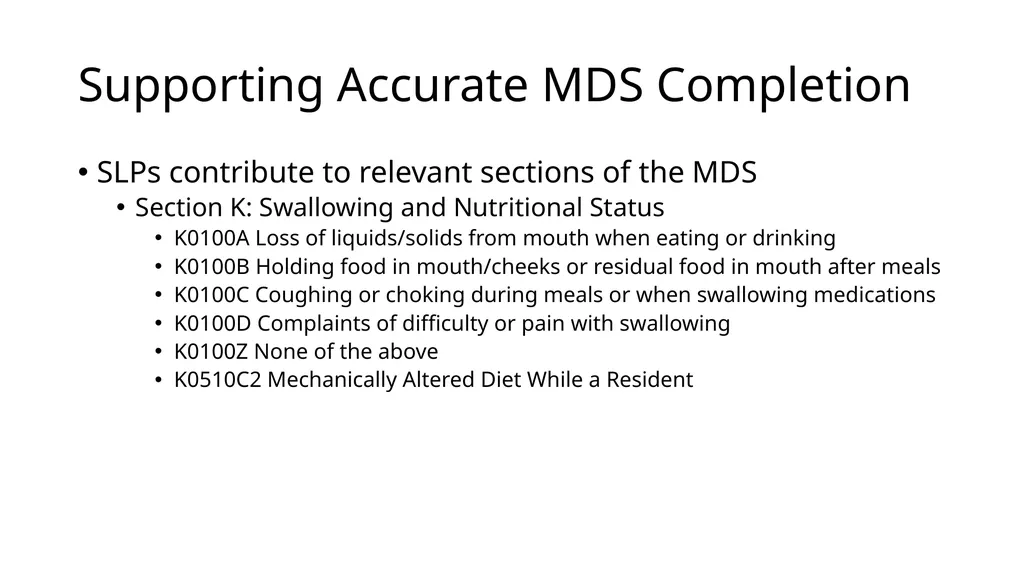
Supporting Accurate MDS Completion SLPs contribute to relevant sections of the MDS
Section K: Swallowing and Nutritional Status
K0100A Loss of liquids/solids from mouth when eating or drinking
K0100B Holding food in mouth/cheeks or residual food in mouth after meals
K0100C Coughing or choking during meals or when swallowing medications
K0100D Complaints of difficulty or pain with swallowing
K0100Z None of the above
K0510C2 Mechanically Altered Diet While a Resident<br>
30
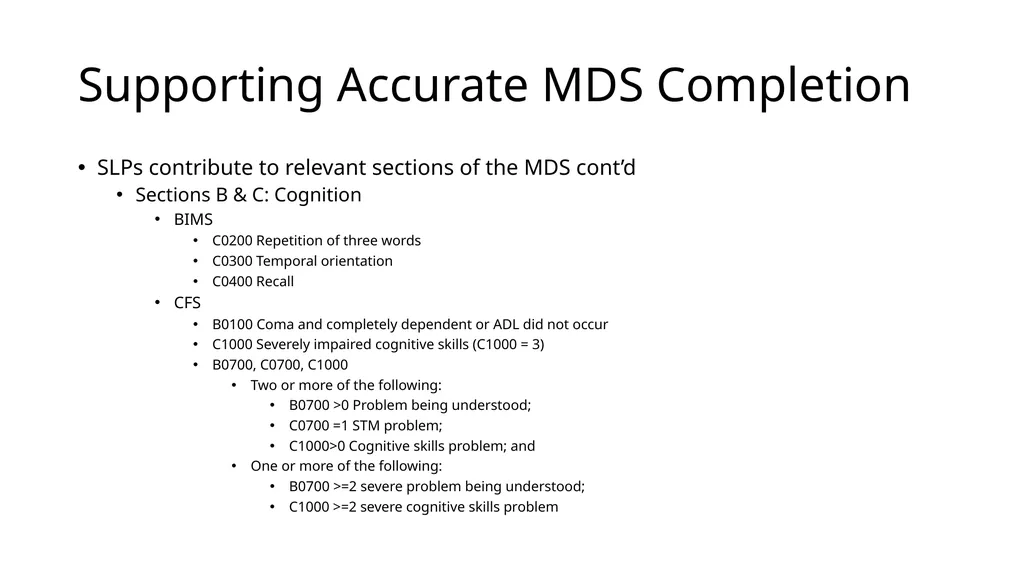
Supporting Accurate MDS Completion SLPs contribute to relevant sections of the MDS cont’d
Sections B & C: Cognition
BIMS
C0200 Repetition of three words
C0300 Temporal orientation
C0400 Recall
CFS
B0100 Coma and completely dependent or ADL did not occur
C1000 Severely impaired cognitive skills (C1000 = 3)
B0700, C0700, C1000
Two or more of the following:
B0700 >0 Problem being understood;
C0700 =1 STM problem;
C1000>0 Cognitive skills problem; and
One or more of the following:
B0700 >=2 severe problem being understood;
C1000 >=2 severe cognitive skills problem<br>
31
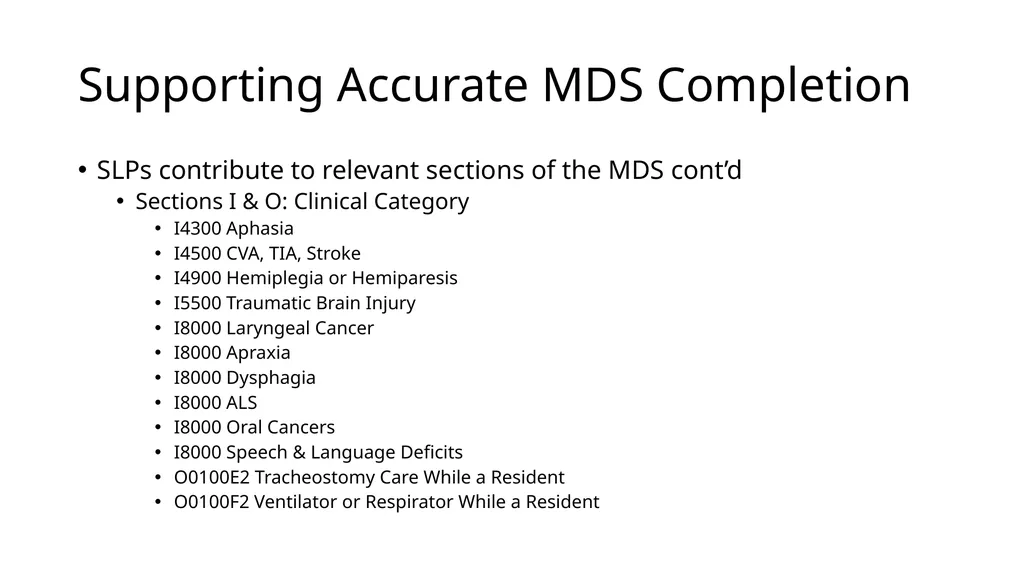
Supporting Accurate MDS Completion SLPs contribute to relevant sections of the MDS cont’d
Sections I & O: Clinical Category
I4300 Aphasia
I4500 CVA, TIA, Stroke
I4900 Hemiplegia or Hemiparesis
I5500 Traumatic Brain Injury
I8000 Laryngeal Cancer
I8000 Apraxia
I8000 Dysphagia
I8000 ALS
I8000 Oral Cancers
I8000 Speech & Language Deficits
O0100E2 Tracheostomy Care While a Resident
O0100F2 Ventilator or Respirator While a Resident<br>
32
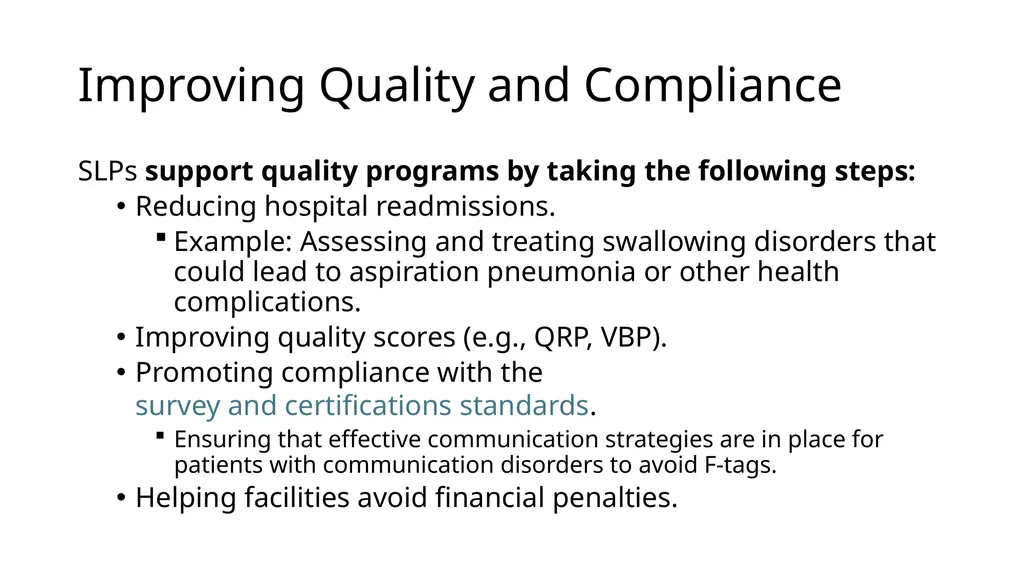
Improving Quality and Compliance SLPs support quality programs by taking the following steps:
Reducing hospital readmissions.
Example: Assessing and treating swallowing disorders that could lead to aspiration pneumonia or other health complications.
Improving quality scores (e.g., QRP, VBP).
Promoting compliance with the survey and certifications standards.
Ensuring that effective communication strategies are in place for patients with communication disorders to avoid F-tags.
Helping facilities avoid financial penalties.<br>
33
Interdisciplinary Team Support SLPs offer interdisciplinary team support in the following ways:
Educate and support the care team in effective communication for patients who have communication and/or cognitive difficulties.
Identify facility-wide concerns related to the clinical areas of speech-language pathology and collaborate with the care team to improve through a Quality Assurance Performance Improvement (QAPI) project
Present in-services and provide training to their colleagues, educating them on the various areas in which SLPs can help.<br>
34
Questions? Email healthservices@asha.org and let us know how we can support you.<br>
35
Additional Resources ASHA Resources
Speech-Language Pathologists in Health Care Settings
Practice Portal
Contains comprehensive information about evaluation and treatment considerations on topics including adult dysphagia, aphasia, acquired apraxia of speech, cultural responsiveness, dementia, dysarthria, head and neck cancer, telepractice, TBI, and voice disorders.
Evidence Maps
A searchable online tool designed to assist clinicians with making evidence-based decisions.
Flexible Endoscopic Evaluation of Swallowing (FEES)
Videofluoroscopic Swallow Study (VFSS)
International Dysphagia Diet Standardisation Initiative<br>
36
Additional Resources ASHA Resources (cont’d)
What SLPs Need To Know About the New Medicare SNF Payment Model
Demonstrating the Value of Speech-Language Pathology Services in the PDPM
PDPM Advocacy
PDPM Brings Opportunities for Skilled Nursing Facilities
The Role of the SLP in Maintaining Compliance with Medicare Survey and Certification Standards for Skilled Nursing Facilities
Communication Access<br>
37
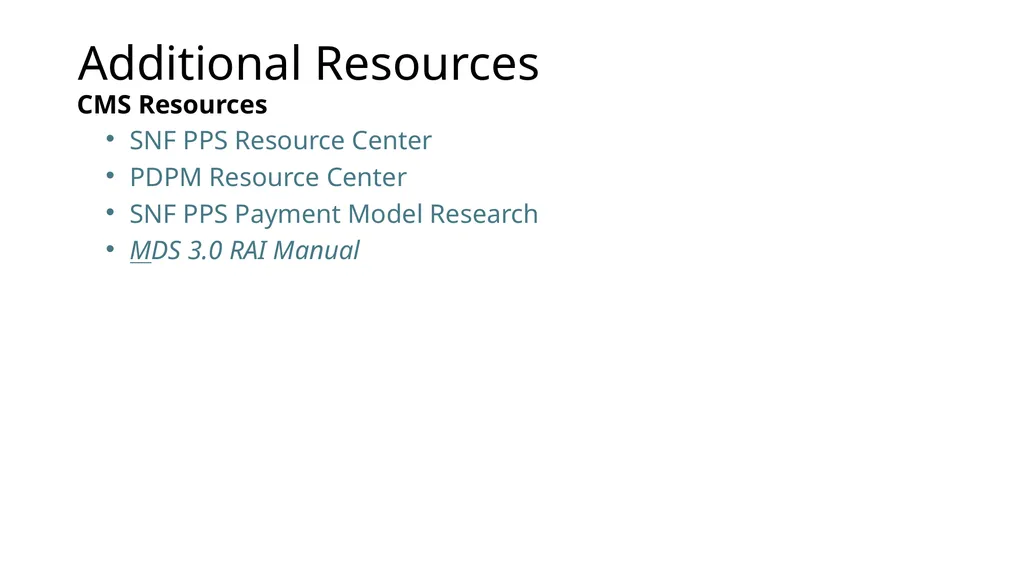
Additional Resources CMS Resources
SNF PPS Resource Center
PDPM Resource Center
SNF PPS Payment Model Research
MDS 3.0 RAI Manual<br>
SNF PPS Resource Center
PDPM Resource Center
SNF PPS Payment Model Research
MDS 3.0 RAI Manual<br>
38
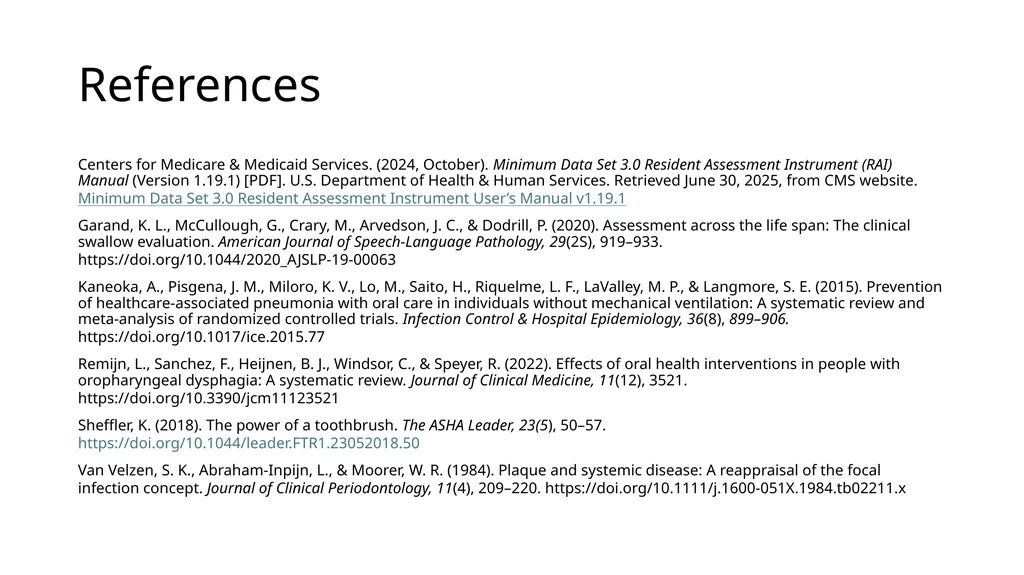
References Centers for Medicare & Medicaid Services. (2024, October). Minimum Data Set 3.0 Resident Assessment Instrument (RAI) Manual (Version 1.19.1) [PDF]. U.S. Department of Health & Human Services. Retrieved June 30, 2025, from CMS website. Minimum Data Set 3.0 Resident Assessment Instrument User’s Manual v1.19.1
Garand, K. L., McCullough, G., Crary, M., Arvedson, J. C., & Dodrill, P. (2020). Assessment across the life span: The clinical swallow evaluation. American Journal of Speech-Language Pathology, 29(2S), 919–933. https://doi.org/10.1044/2020_AJSLP-19-00063
Kaneoka, A., Pisgena, J. M., Miloro, K. V., Lo, M., Saito, H., Riquelme, L. F., LaValley, M. P., & Langmore, S. E. (2015). Prevention of healthcare-associated pneumonia with oral care in individuals without mechanical ventilation: A systematic review and meta-analysis of randomized controlled trials. Infection Control & Hospital Epidemiology, 36(8), 899–906. https://doi.org/10.1017/ice.2015.77
Remijn, L., Sanchez, F., Heijnen, B. J., Windsor, C., & Speyer, R. (2022). Effects of oral health interventions in people with oropharyngeal dysphagia: A systematic review. Journal of Clinical Medicine, 11(12), 3521. https://doi.org/10.3390/jcm11123521
Sheffler, K. (2018). The power of a toothbrush. The ASHA Leader, 23(5), 50–57. https://doi.org/10.1044/leader.FTR1.23052018.50
Van Velzen, S. K., Abraham-Inpijn, L., & Moorer, W. R. (1984). Plaque and systemic disease: A reappraisal of the focal infection concept. Journal of Clinical Periodontology, 11(4), 209–220. https://doi.org/10.1111/j.1600-051X.1984.tb02211.x<br>