04
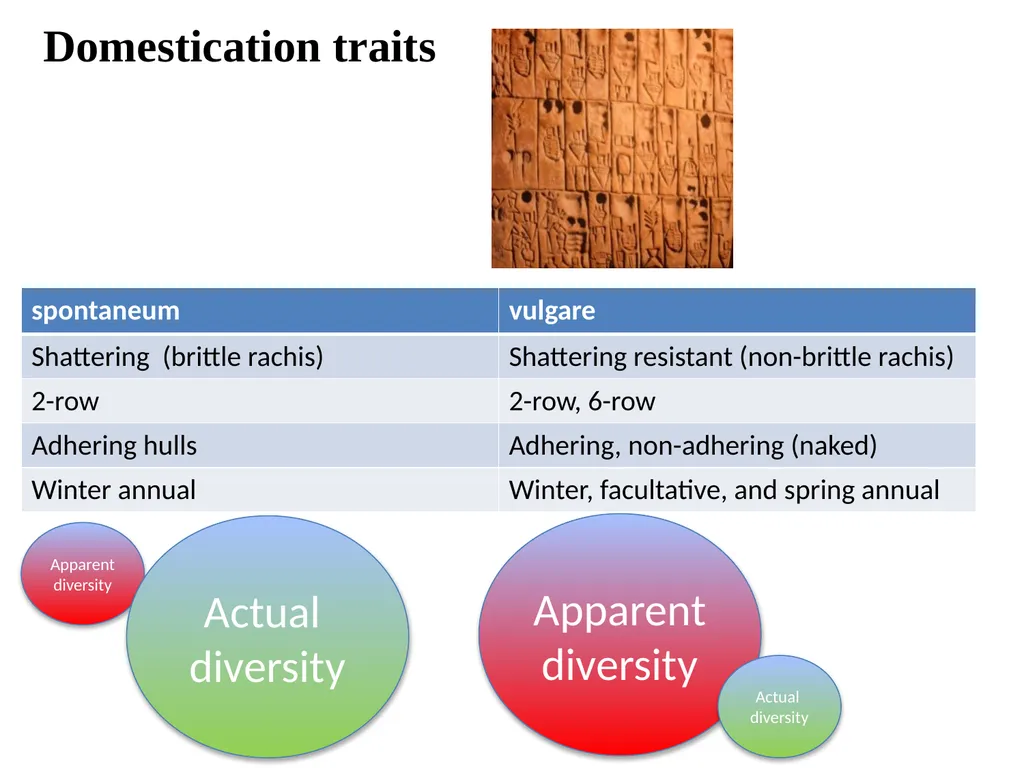
Domestication traits Apparent diversity Apparent diversity Actual diversity Actual diversity<br>
05
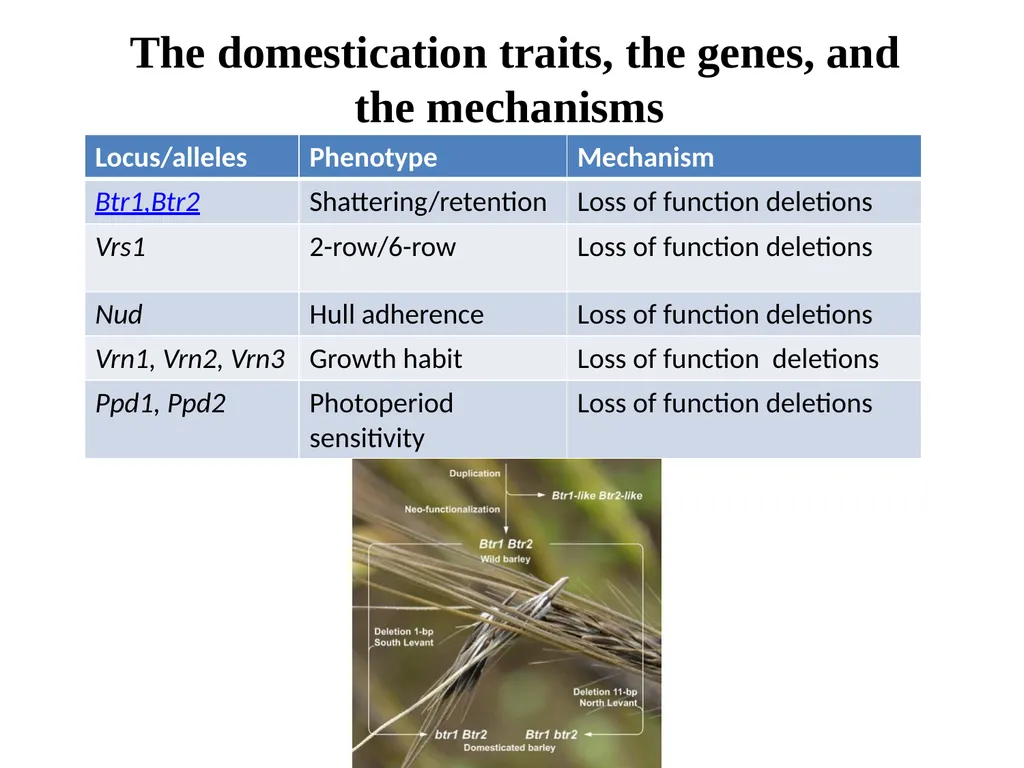
The domestication traits, the genes, and the mechanisms<br>
06
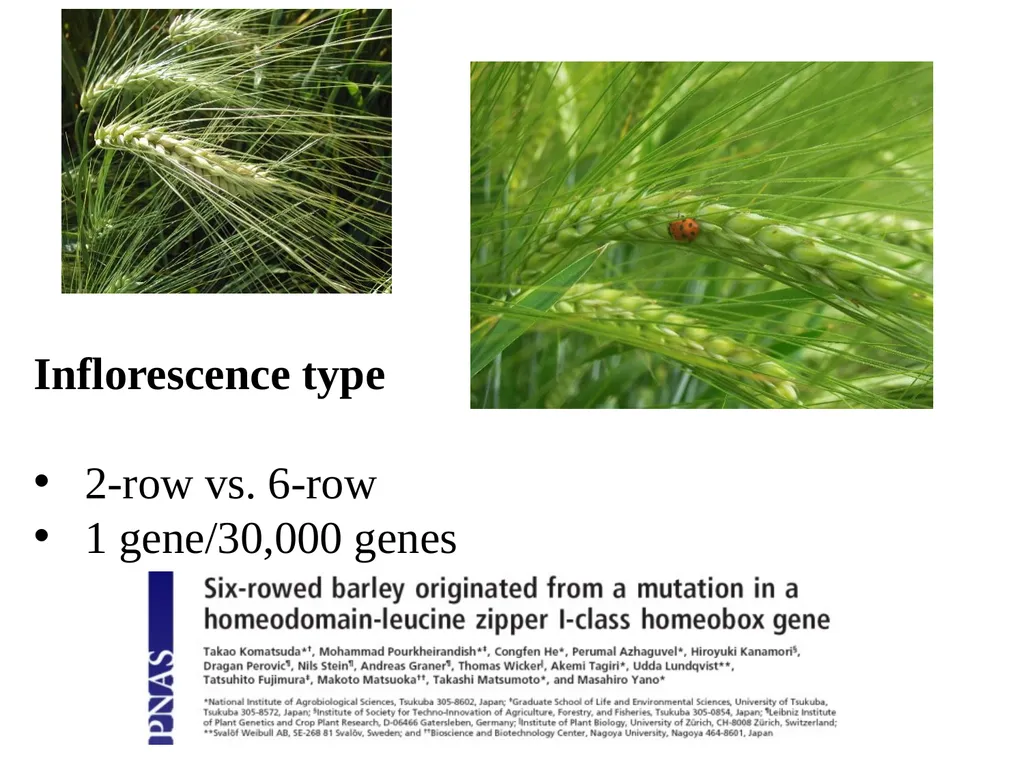
Inflorescence type
2-row vs. 6-row
1 gene/30,000 genes<br>
07
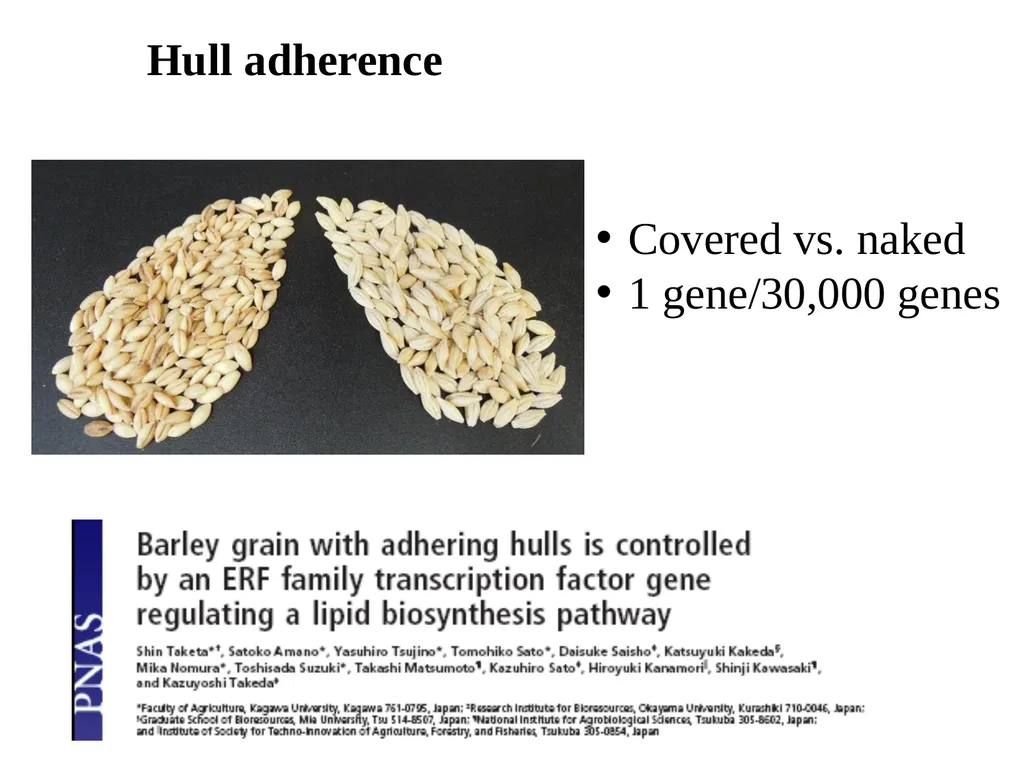
Hull adherence Covered vs. naked
1 gene/30,000 genes<br>
08
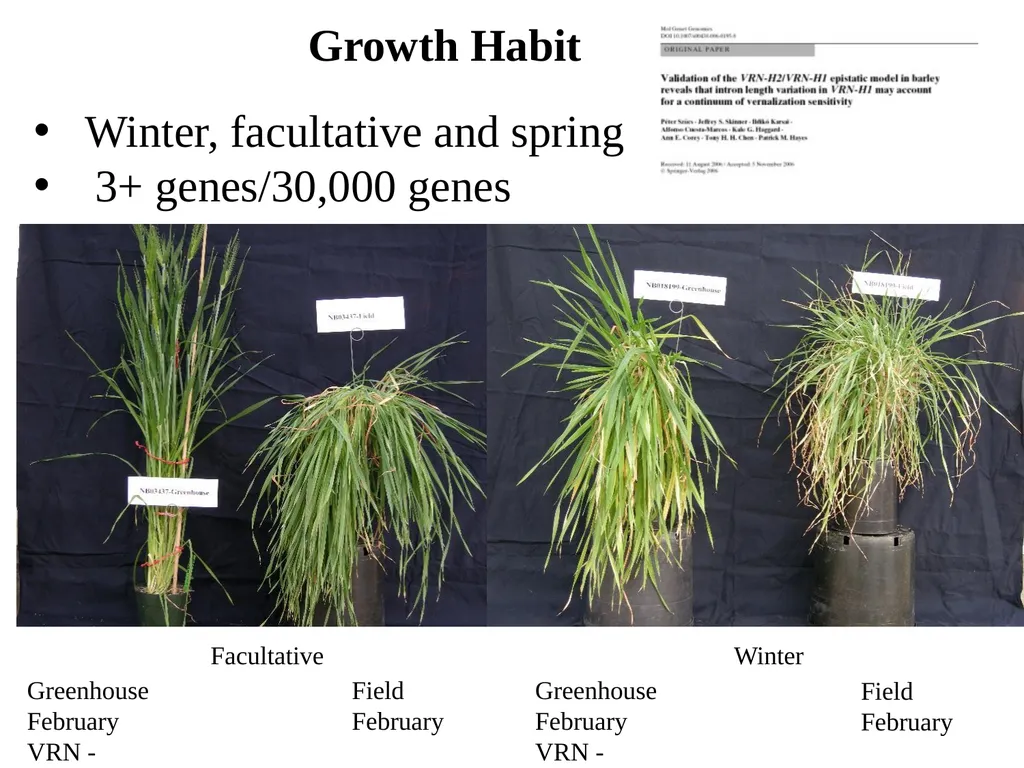
Growth Habit Winter, facultative and spring
3+ genes/30,000 genes Greenhouse February
VRN - Field
February Facultative Greenhouse February
VRN - Field
February Winter<br>
09
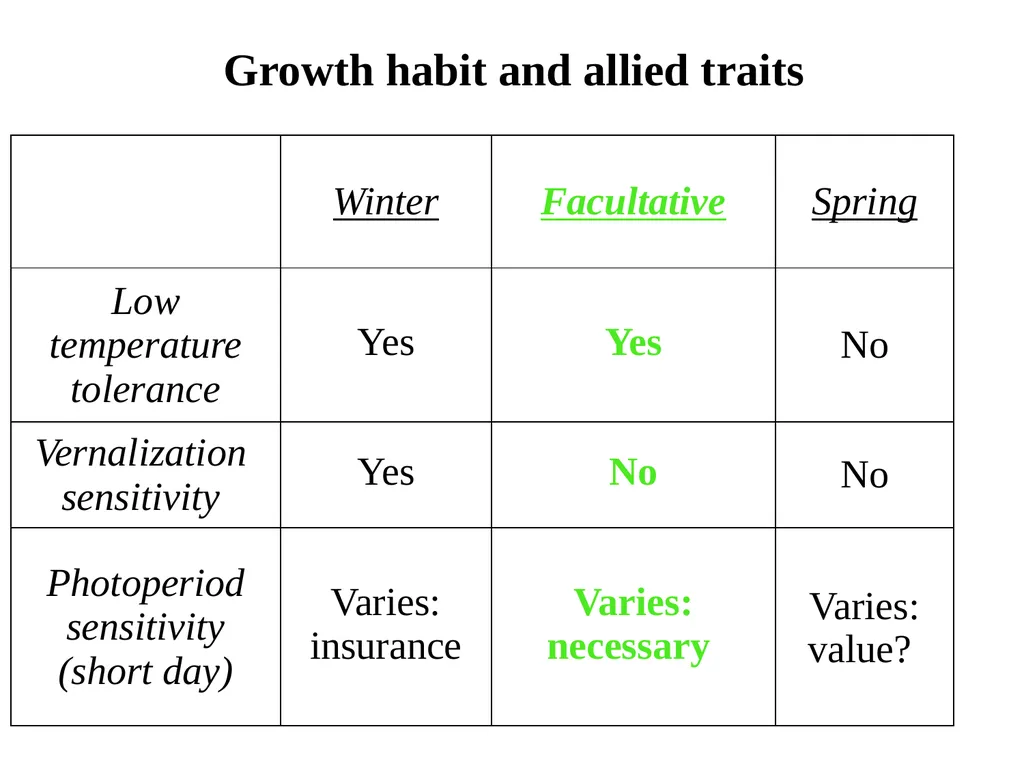
Growth habit and allied traits<br>
10
Facultative growth habit –
a tool addressing challenges of climate change
Plant in fall and cold tolerant
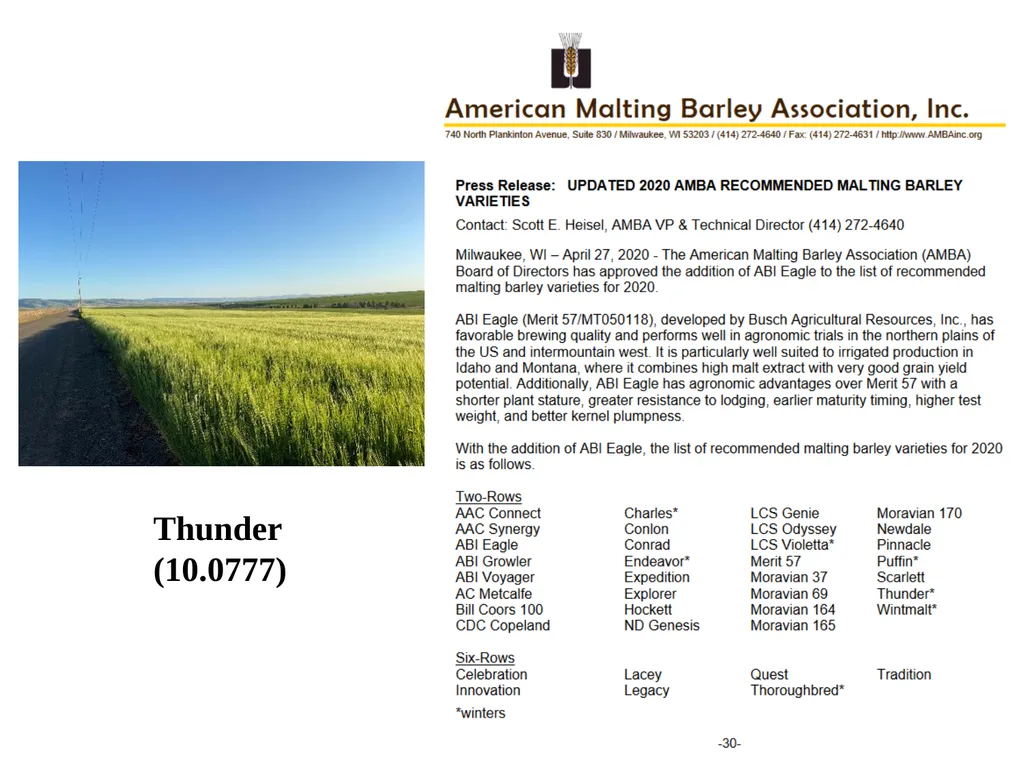
Plant in spring and no vernalization required Fall planted Thunder (left) and Lightning (right) Corvallis, OR 2020<br>
11
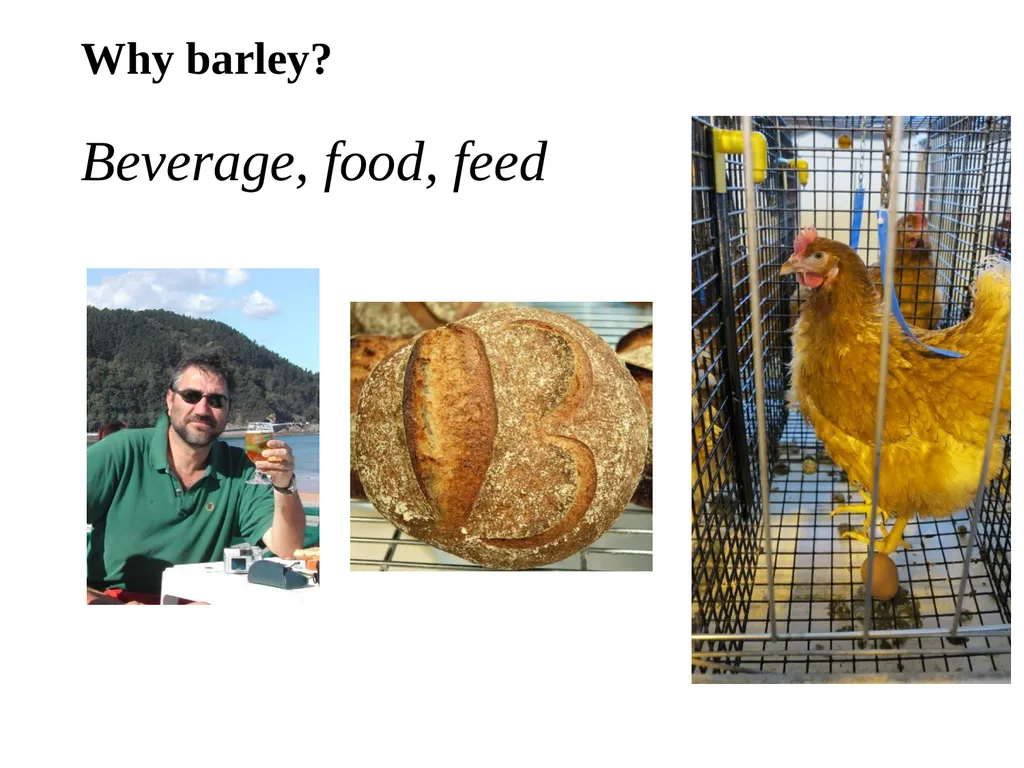
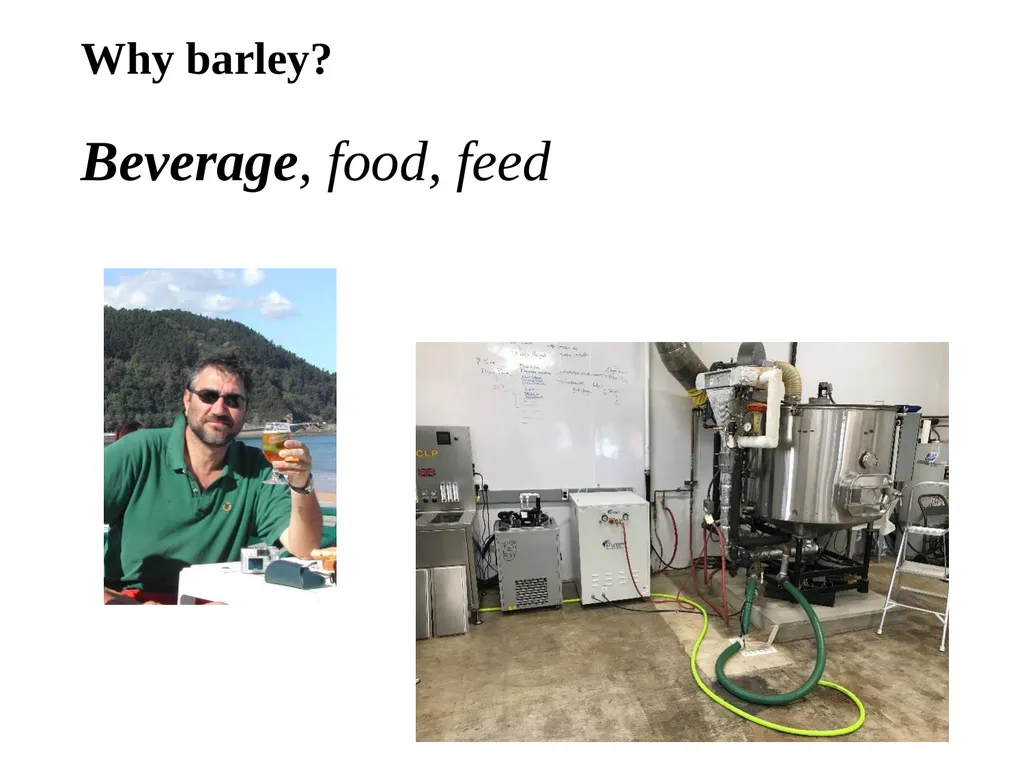
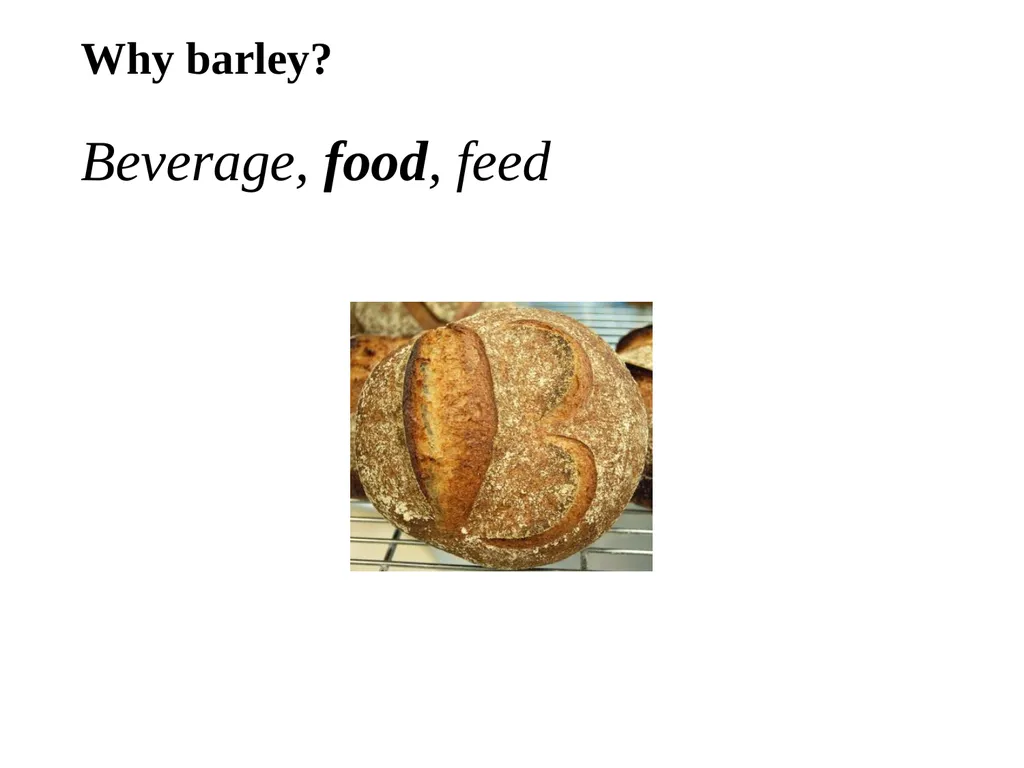
Why barley?
Beverage, food, feed<br>
12
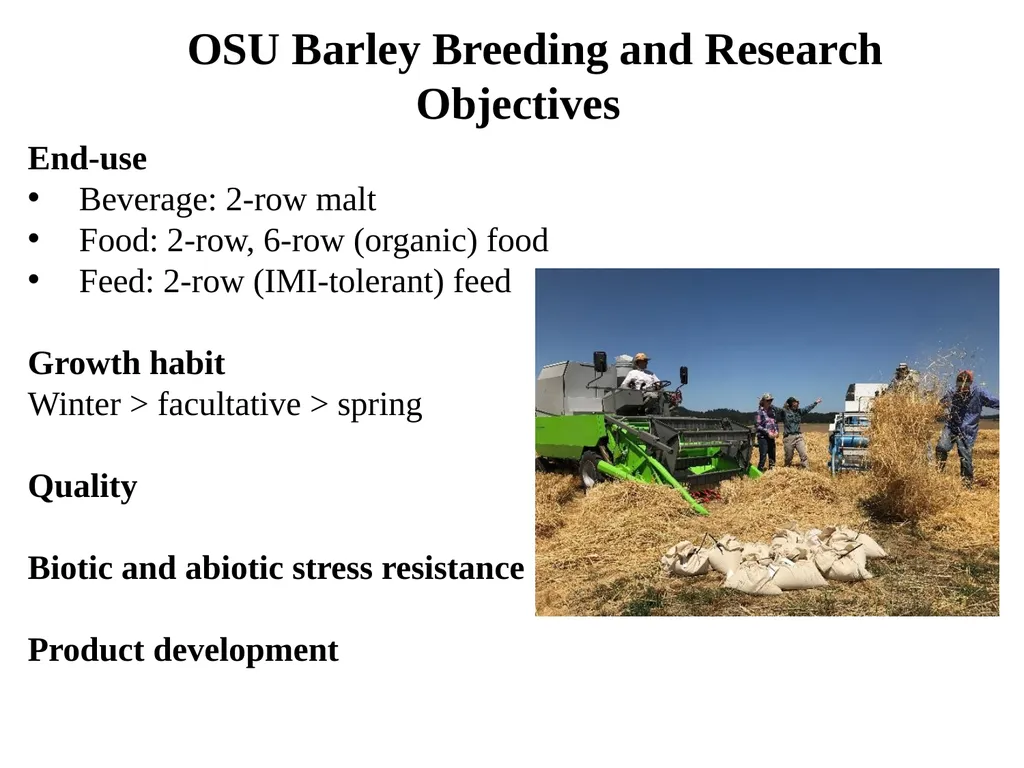
OSU Barley Breeding and Research Objectives End-use
Beverage: 2-row malt
Food: 2-row, 6-row (organic) food
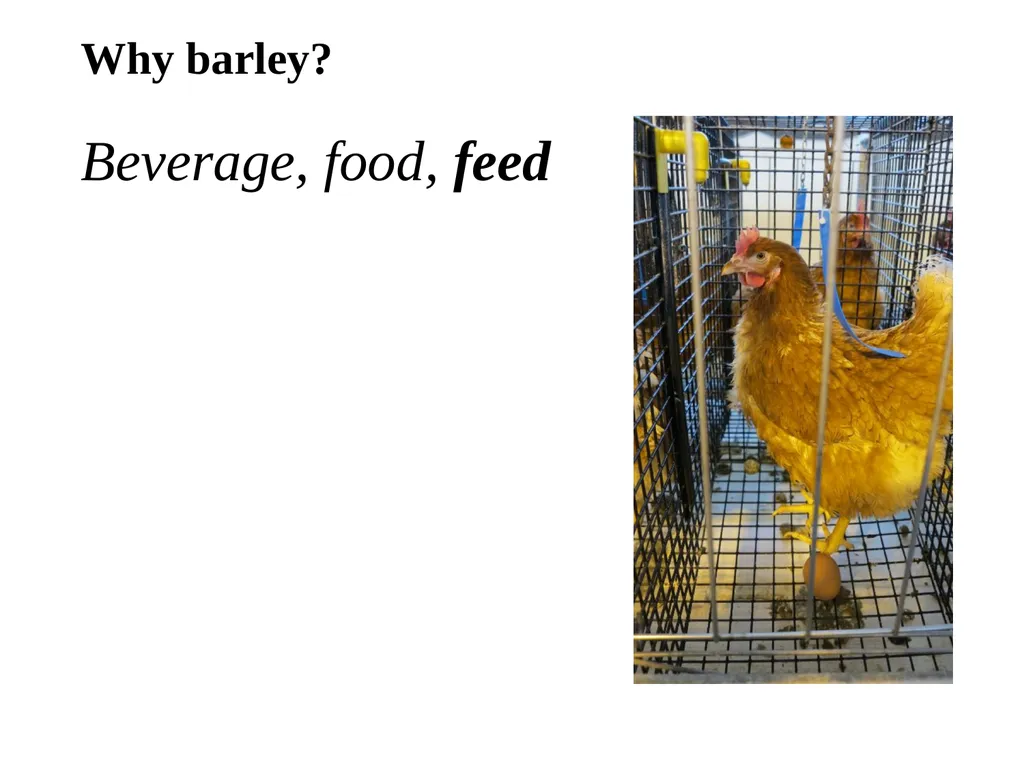
Feed: 2-row (IMI-tolerant) feed
Growth habit
Winter > facultative > spring ��Quality
Biotic and abiotic stress resistance�
Product development<br>
13
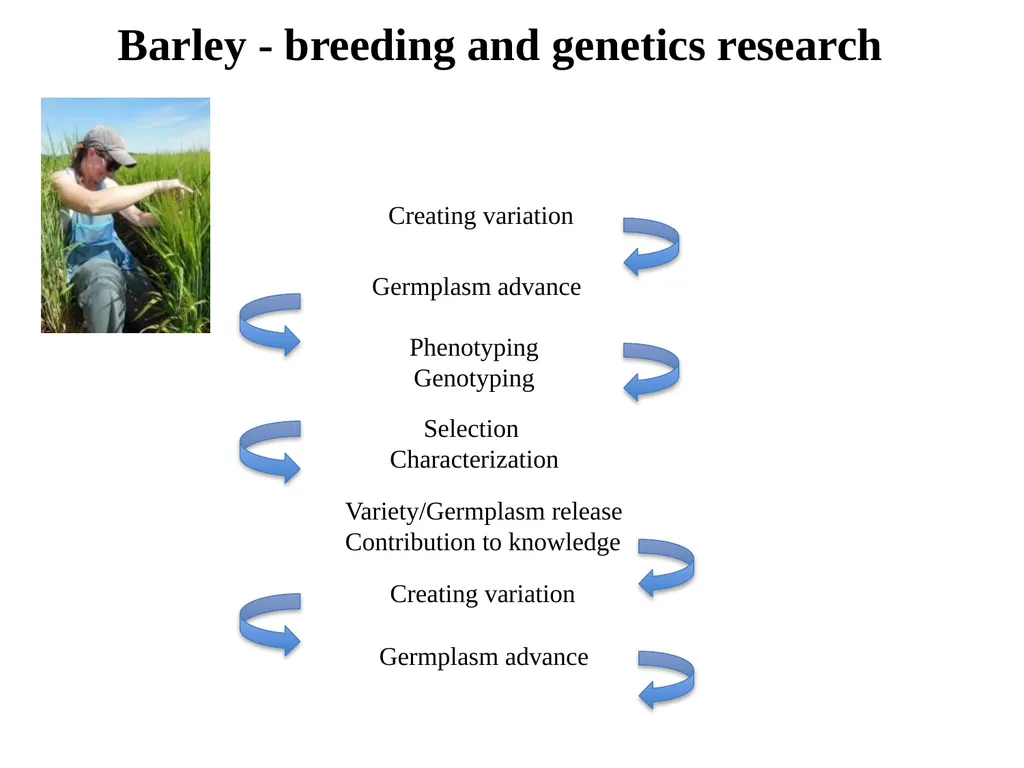
Barley - breeding and genetics research Phenotyping
Genotyping Selection
Characterization Germplasm advance Creating variation Variety/Germplasm release
Contribution to knowledge Germplasm advance Creating variation<br>
14
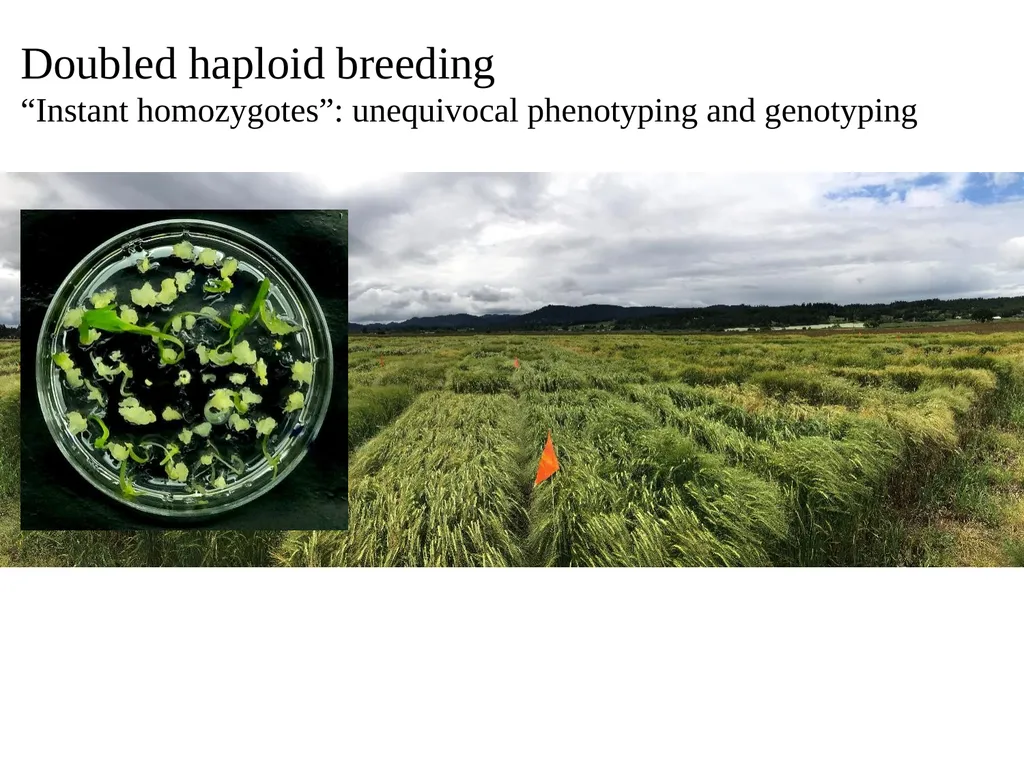
Doubled haploid breeding
“Instant homozygotes”: unequivocal phenotyping and genotyping<br>
15
Why barley?
Beverage, food, feed<br>
16
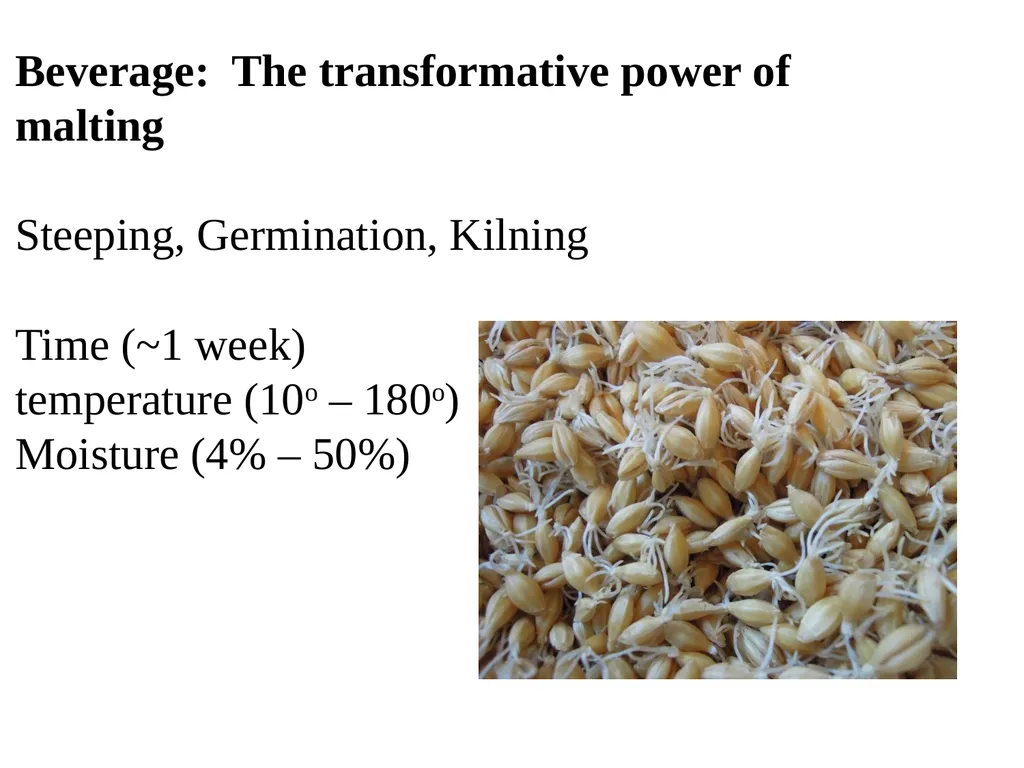
Beverage: The transformative power of malting
Steeping, Germination, Kilning
Time (~1 week)
temperature (10o – 180o)
Moisture (4% – 50%)<br>
17
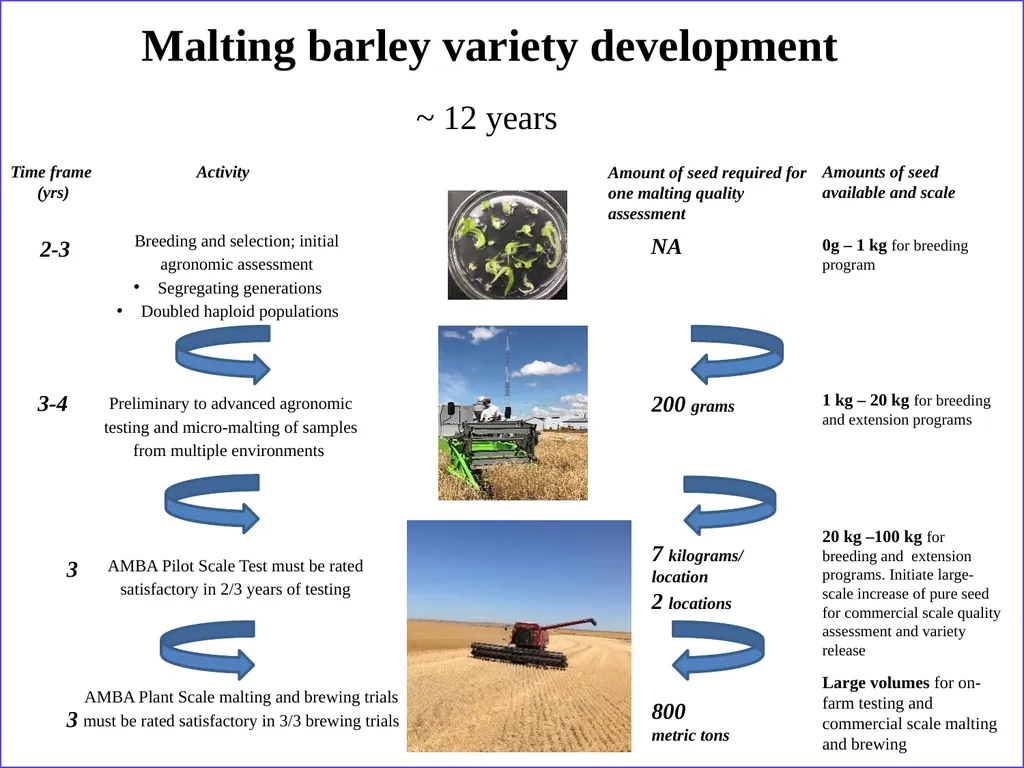
~ 12 years 2-3 3-4 3 3 Time frame
(yrs) Activity Breeding and selection; initial agronomic assessment
Segregating generations
Doubled haploid populations Preliminary to advanced agronomic testing and micro-malting of samples from multiple environments AMBA Pilot Scale Test must be rated satisfactory in 2/3 years of testing AMBA Plant Scale malting and brewing trials must be rated satisfactory in 3/3 brewing trials Amount of seed required for one malting quality assessment Amounts of seed available and scale NA 200 grams 7 kilograms/
location
2 locations 800
metric tons 0g – 1 kg for breeding program 1 kg – 20 kg for breeding and extension programs 20 kg –100 kg for breeding and extension programs. Initiate large-scale increase of pure seed for commercial scale quality assessment and variety release Large volumes for on-farm testing and commercial scale malting and brewing Malting barley variety development<br>
19
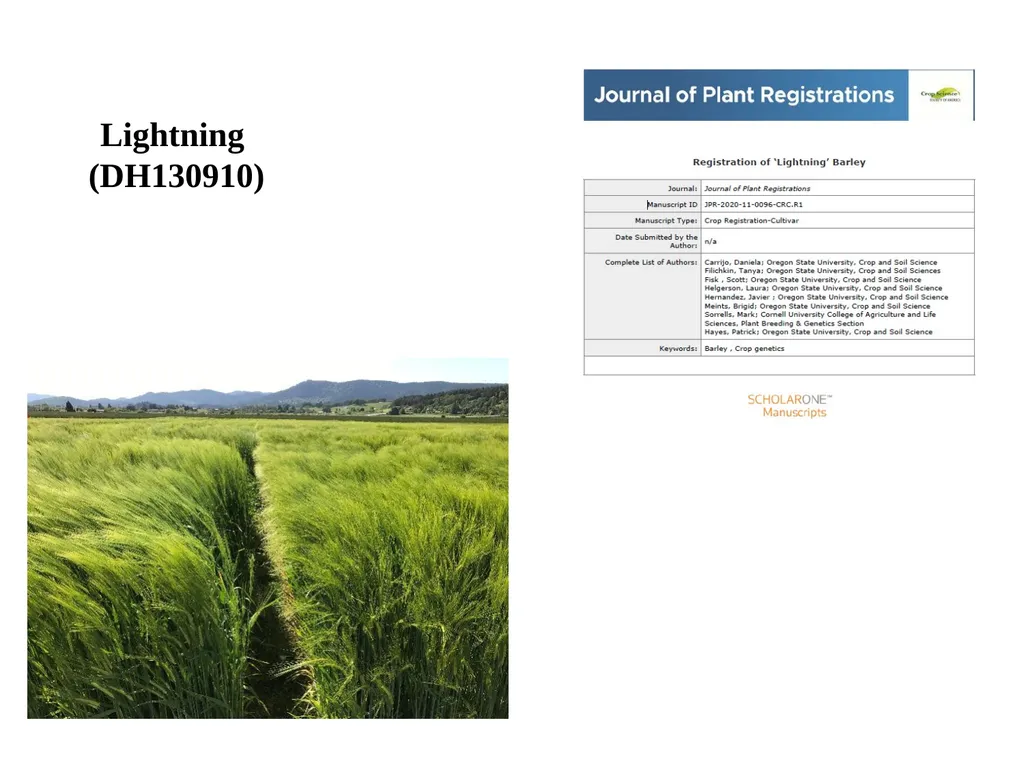
Lightning
(DH130910)<br>
20
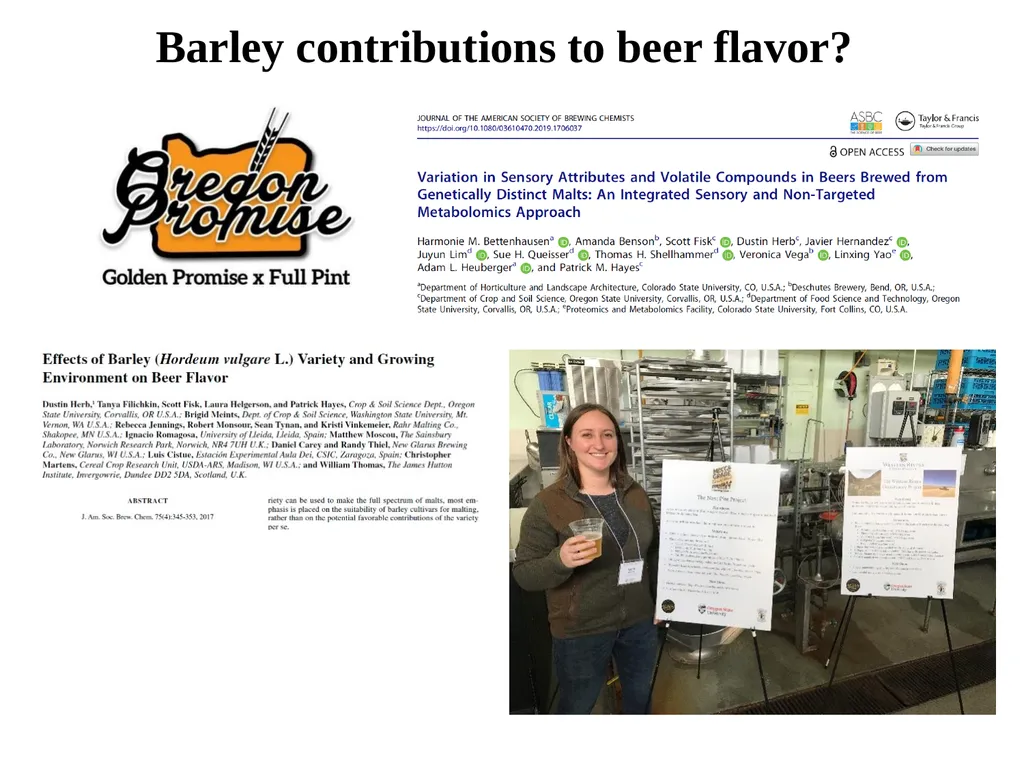
Barley contributions to beer flavor?<br>
21
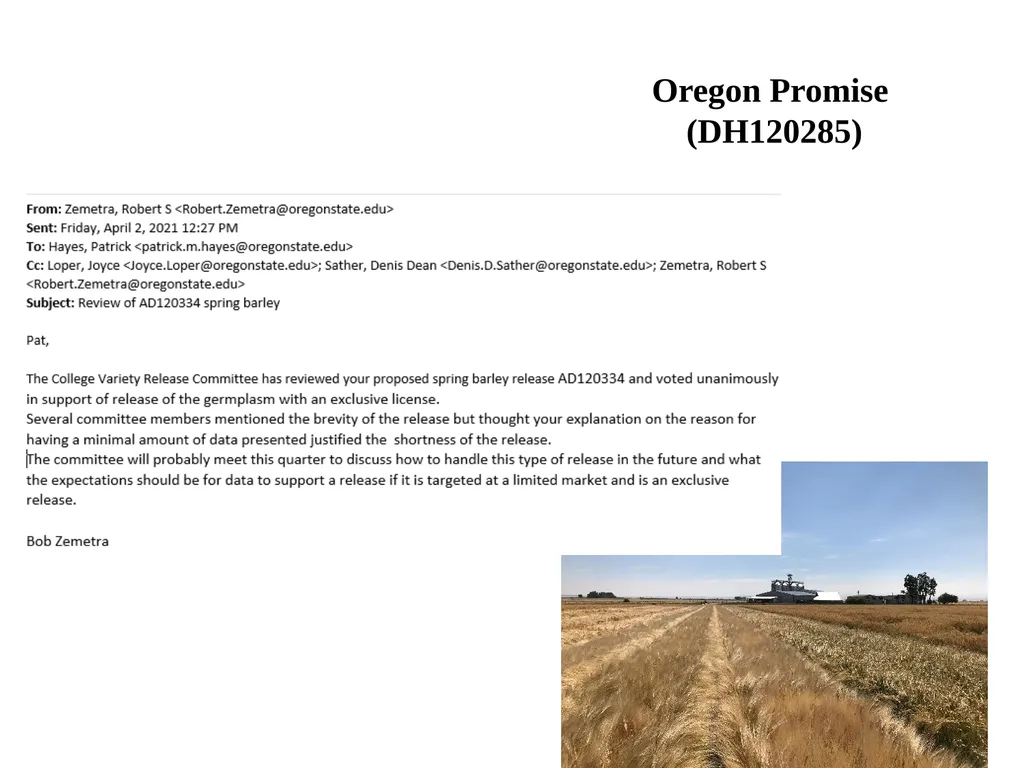
Oregon Promise
(DH120285)<br>
22
Why barley?
Beverage, food, feed<br>
24
Why barley?
Beverage, food, feed<br>
25
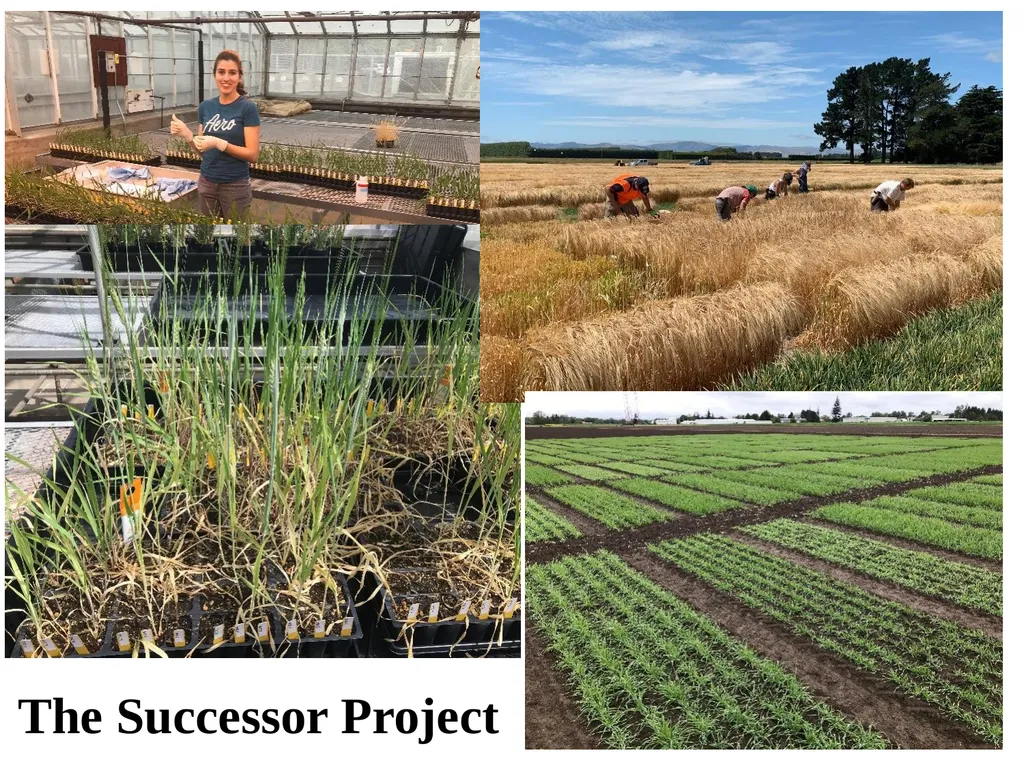
The Successor Project<br>
26
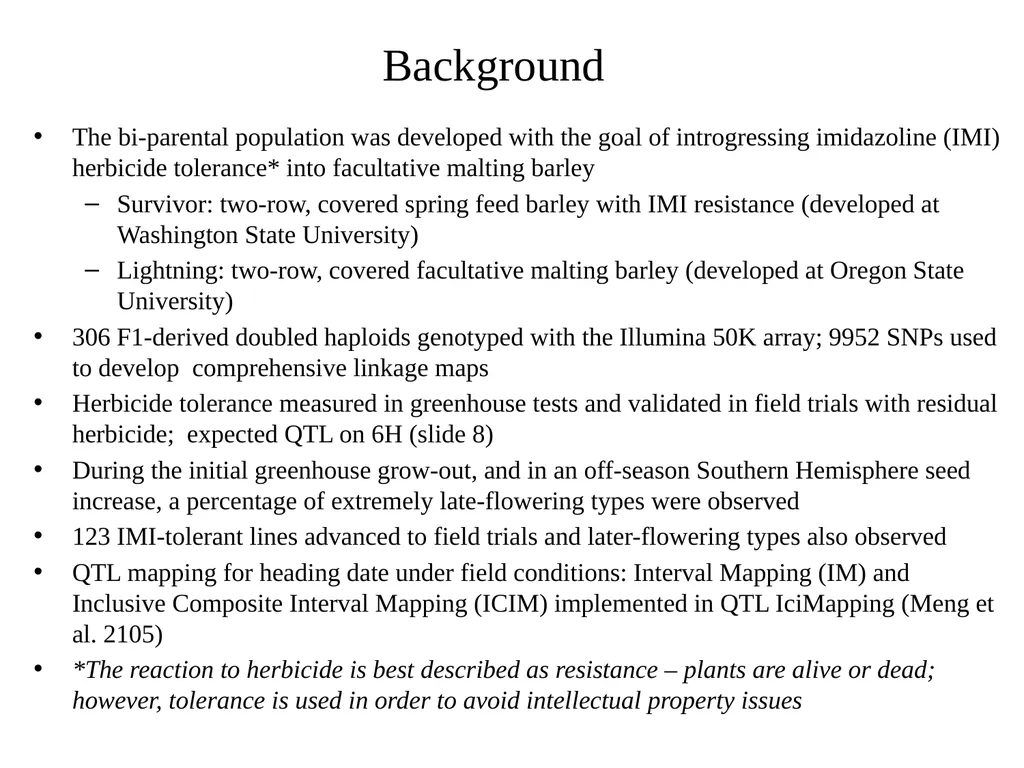
Background The bi-parental population was developed with the goal of introgressing imidazoline (IMI) herbicide tolerance* into facultative malting barley
Survivor: two-row, covered spring feed barley with IMI resistance (developed at Washington State University)
Lightning: two-row, covered facultative malting barley (developed at Oregon State University)
306 F1-derived doubled haploids genotyped with the Illumina 50K array; 9952 SNPs used to develop comprehensive linkage maps
Herbicide tolerance measured in greenhouse tests and validated in field trials with residual herbicide; expected QTL on 6H (slide 8)
During the initial greenhouse grow-out, and in an off-season Southern Hemisphere seed increase, a percentage of extremely late-flowering types were observed
123 IMI-tolerant lines advanced to field trials and later-flowering types also observed
QTL mapping for heading date under field conditions: Interval Mapping (IM) and Inclusive Composite Interval Mapping (ICIM) implemented in QTL IciMapping (Meng et al. 2105)
*The reaction to herbicide is best described as resistance – plants are alive or dead; however, tolerance is used in order to avoid intellectual property issues<br>
27
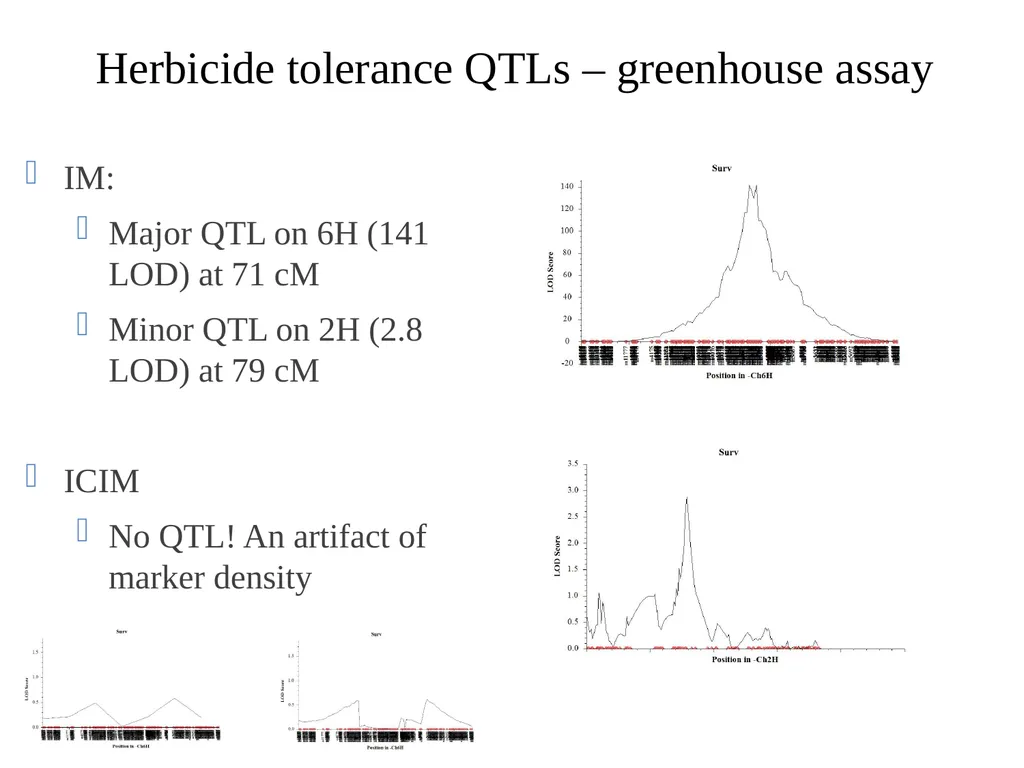
Herbicide tolerance QTLs – greenhouse assay IM:
Major QTL on 6H (141 LOD) at 71 cM
Minor QTL on 2H (2.8 LOD) at 79 cM
ICIM
No QTL! An artifact of marker density<br>
28
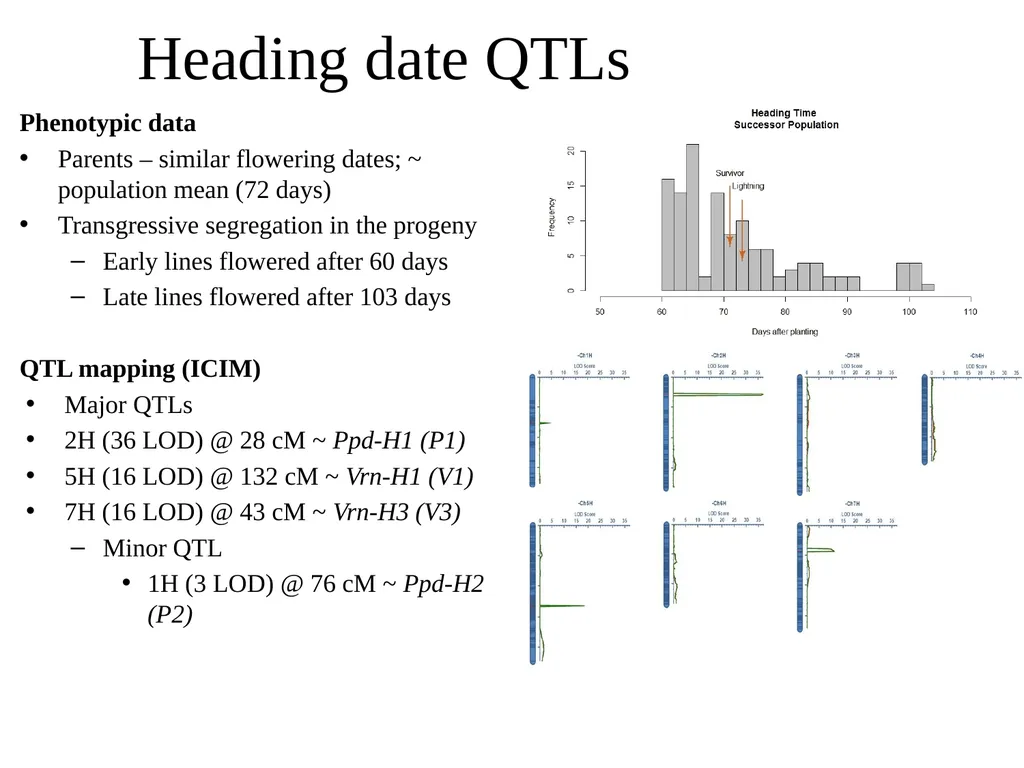
Heading date QTLs Phenotypic data
Parents – similar flowering dates; ~ population mean (72 days)
Transgressive segregation in the progeny
Early lines flowered after 60 days
Late lines flowered after 103 days
QTL mapping (ICIM)
Major QTLs
2H (36 LOD) @ 28 cM ~ Ppd-H1 (P1)
5H (16 LOD) @ 132 cM ~ Vrn-H1 (V1)
7H (16 LOD) @ 43 cM ~ Vrn-H3 (V3)
Minor QTL
1H (3 LOD) @ 76 cM ~ Ppd-H2 (P2)<br>
29
Haplotypes B B B B PPD-H2 60
61
62 PPD-H1 vrn-H1 VRN-H3 ppd-H1 100
101
102
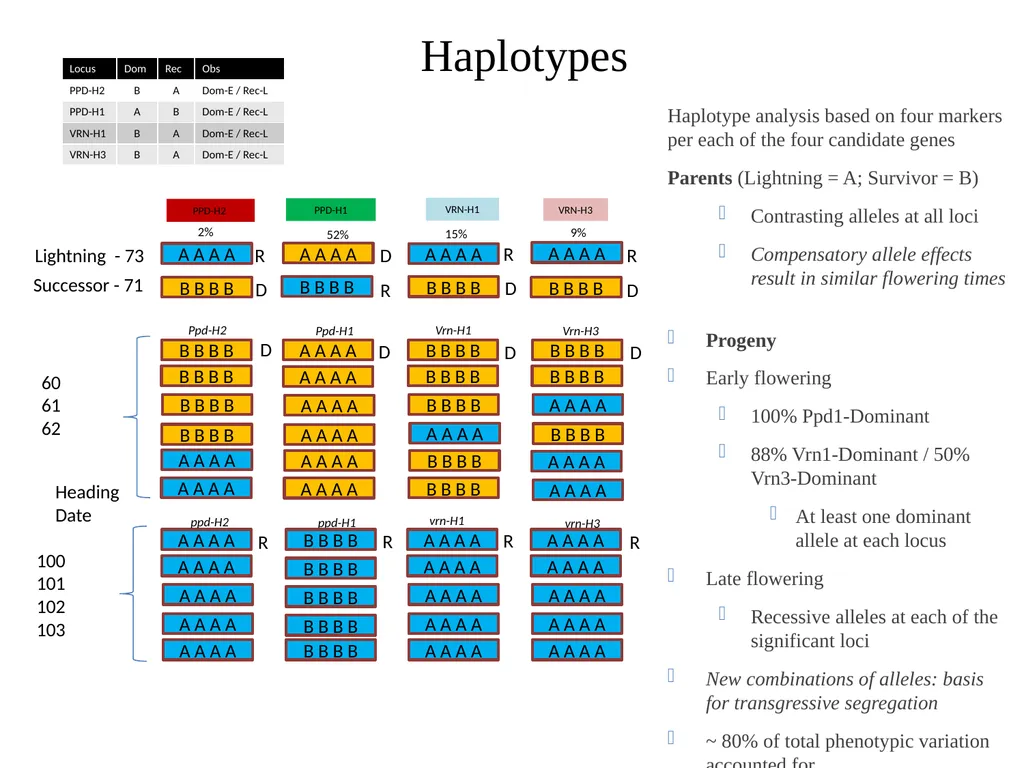
103 A A A A A A A A A A A A A A A A A A A A B B B B B B B B A A A A B B B B B B B B B B B B B B B B B B B B B B B B A A A A A A A A A A A A A A A A A A A A B B B B A A A A B B B B B B B B B B B B A A A A A A A A A A A A A A A A A A A A B B B B B B B B B B B B A A A A A A A A A A A A B B B B A A A A A A A A A A A A A A A A A A A A A A A A A A A A VRN-H1 vrn-H3 D D D D R R R R 52% 2% 15% 9% 2% Haplotype analysis based on four markers per each of the four candidate genes
Parents (Lightning = A; Survivor = B)
Contrasting alleles at all loci
Compensatory allele effects result in similar flowering times
Progeny
Early flowering
100% Ppd1-Dominant
88% Vrn1-Dominant / 50% Vrn3-Dominant
At least one dominant allele at each locus
Late flowering
Recessive alleles at each of the significant loci
New combinations of alleles: basis for transgressive segregation
~ 80% of total phenotypic variation accounted for Heading
Date ppd-H2 Vrn-H1 Ppd-H1 Vrn-H3 Ppd-H2<br>
30
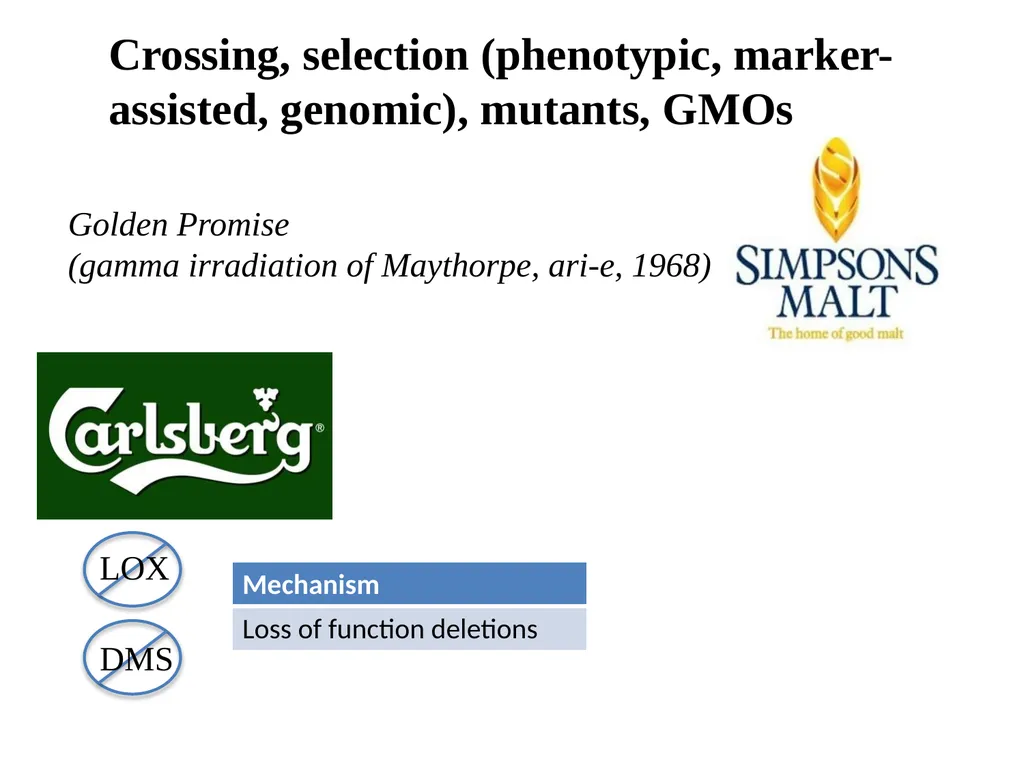
Crossing, selection (phenotypic, marker-assisted, genomic), mutants, GMOs Golden Promise
(gamma irradiation of Maythorpe, ari-e, 1968) LOX DMS<br>
31
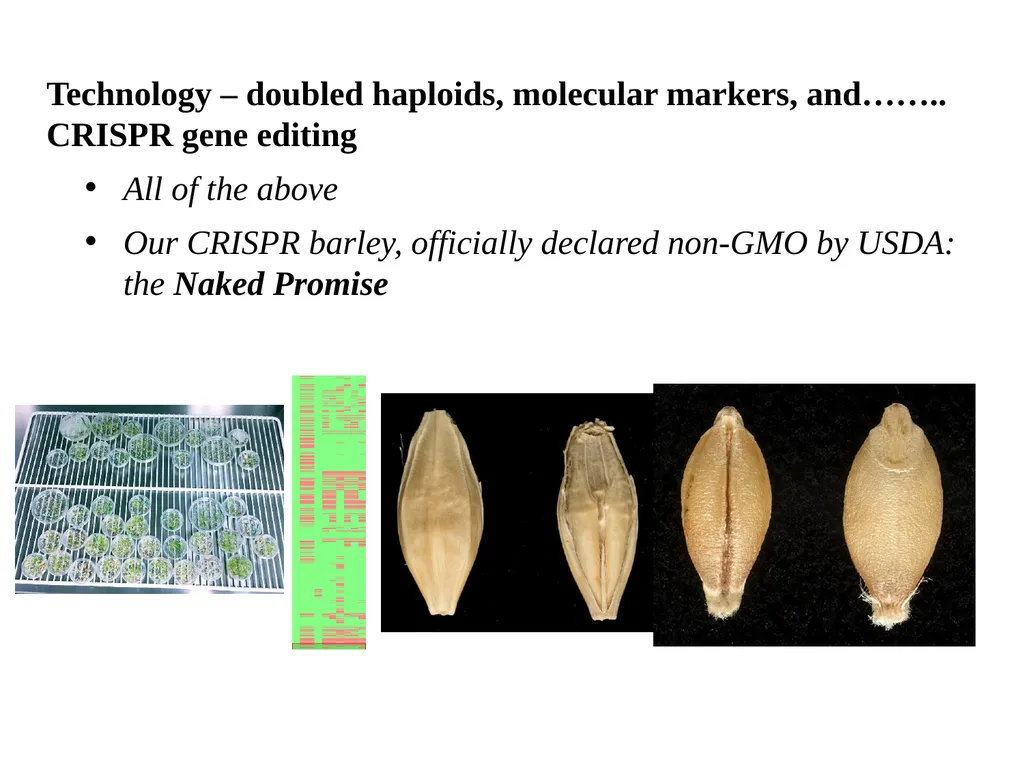
Technology – doubled haploids, molecular markers, and…….. CRISPR gene editing
All of the above
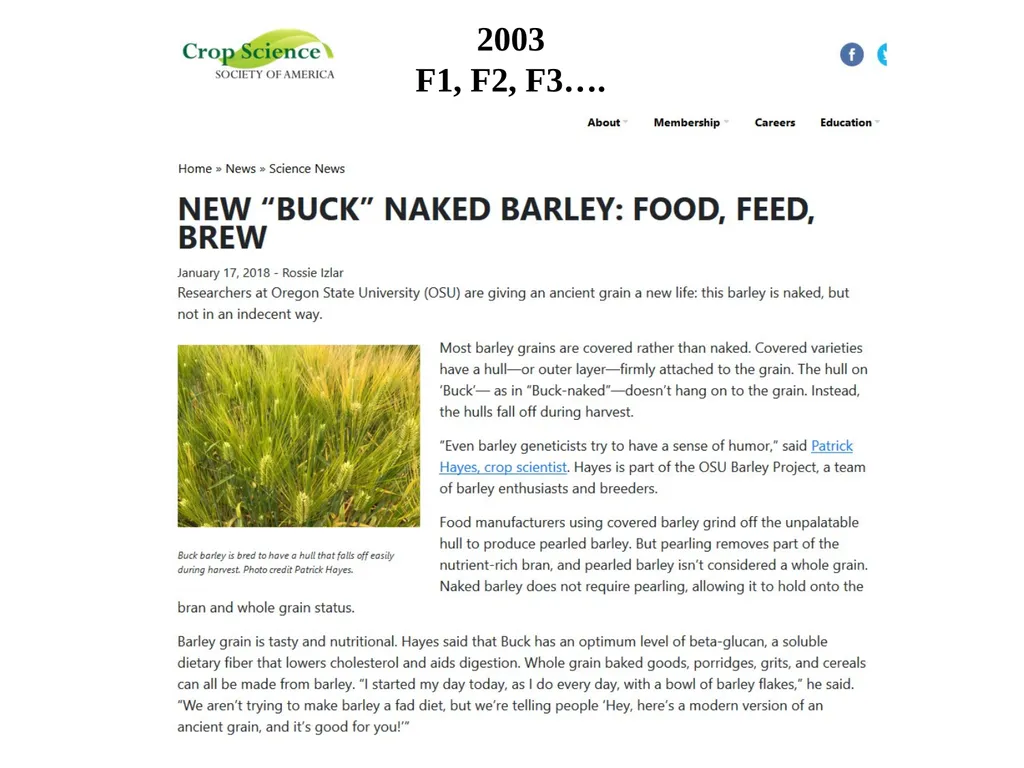
Our CRISPR barley, officially declared non-GMO by USDA: the Naked Promise<br>
32
https://barleyworld.org/sites/barleyworld.org/files/final_osu_barley_zine.pdf<br>
33
Of what potential value is Hordeum spontaneum to barley breeders today and tomorrow?
Speculate on why so many domestication traits, and traits of value to modern plant breeding, are loss of function mutations.
Describe the advantages of facultative growth habit and identify one essential precaution for widespread deployment of the trait.
Why is the role of barley malt in brewing the principal reason for the persistence of barley as a crop throughout much of the world?
How might the OSU barley breeding program accelerate the development of malting barley varieties?
Do the possible contributions of barley to beer flavor merit research? Barley questions<br>