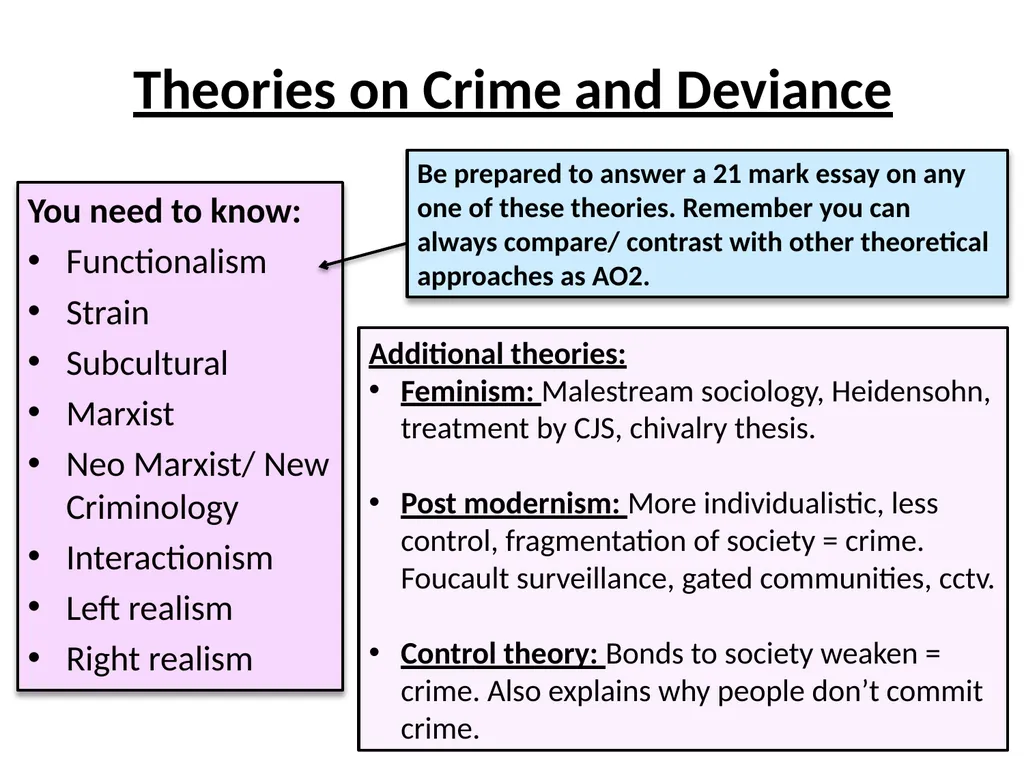
Theories on Crime and Deviance You need to know: Functionalism Strain Subcultural Marxist Neo Marxist New Criminology Interactionism Left realism Right realism Additional theories: Feminism: Malestream sociology, Heidensohn, treatment by
"Theories on Crime and Deviance You need to know:" is the property of its rightful owner. Permission is granted to
download and print the materials on this website for personal, non-commercial use only, and to display it
on your personal computer provided you do not modify the materials and that you retain all copyright
notices contained in the materials. By downloading content from our website, you accept the terms of this
agreement.
Presentation Transcript
01
Theories on Crime and Deviance You need to know:
Functionalism
Strain
Subcultural
Marxist
Neo Marxist/ New Criminology
Interactionism
Left realism
Right realism Additional theories:
Feminism: Malestream sociology, Heidensohn, treatment by CJS, chivalry thesis.
Post modernism: More individualistic, less control, fragmentation of society = crime. Foucault surveillance, gated communities, cctv.
Control theory: Bonds to society weaken = crime. Also explains why people don’t commit crime. Be prepared to answer a 21 mark essay on any one of these theories. Remember you can always compare/ contrast with other theoretical approaches as AO2.<br>
02
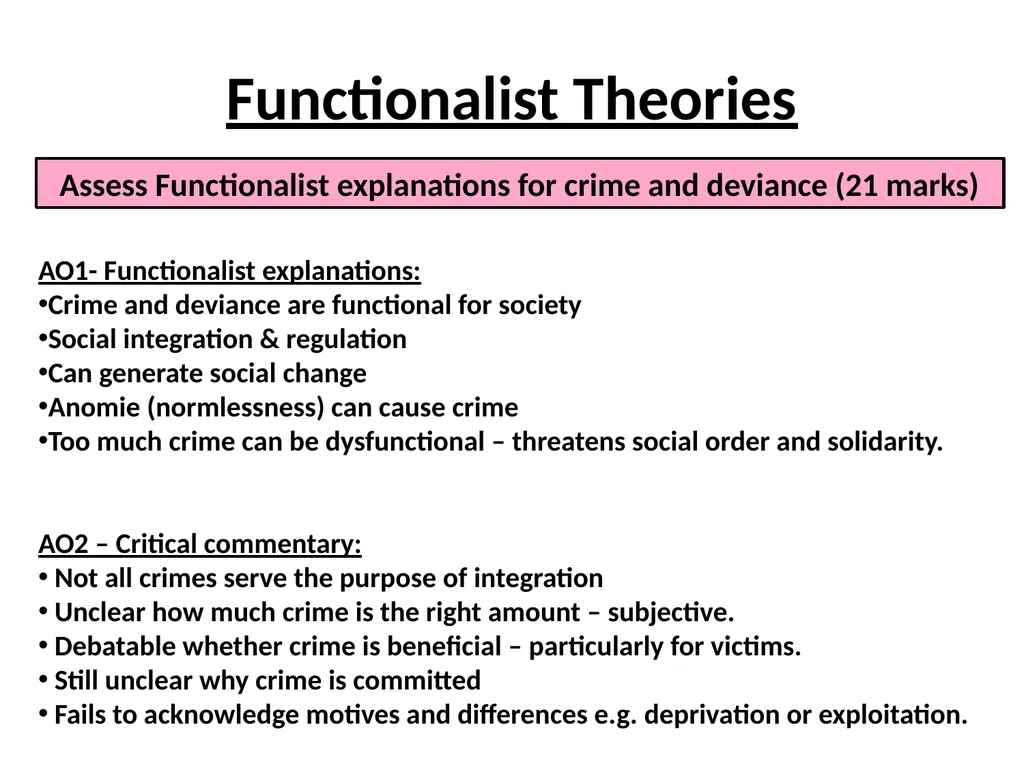
Functionalist Theories Assess Functionalist explanations for crime and deviance (21 marks) AO1- Functionalist explanations:
Crime and deviance are functional for society
Social integration & regulation
Can generate social change
Anomie (normlessness) can cause crime
Too much crime can be dysfunctional – threatens social order and solidarity.
AO2 – Critical commentary:
Not all crimes serve the purpose of integration
Unclear how much crime is the right amount – subjective.
Debatable whether crime is beneficial – particularly for victims.
Still unclear why crime is committed
Fails to acknowledge motives and differences e.g. deprivation or exploitation.<br>
03
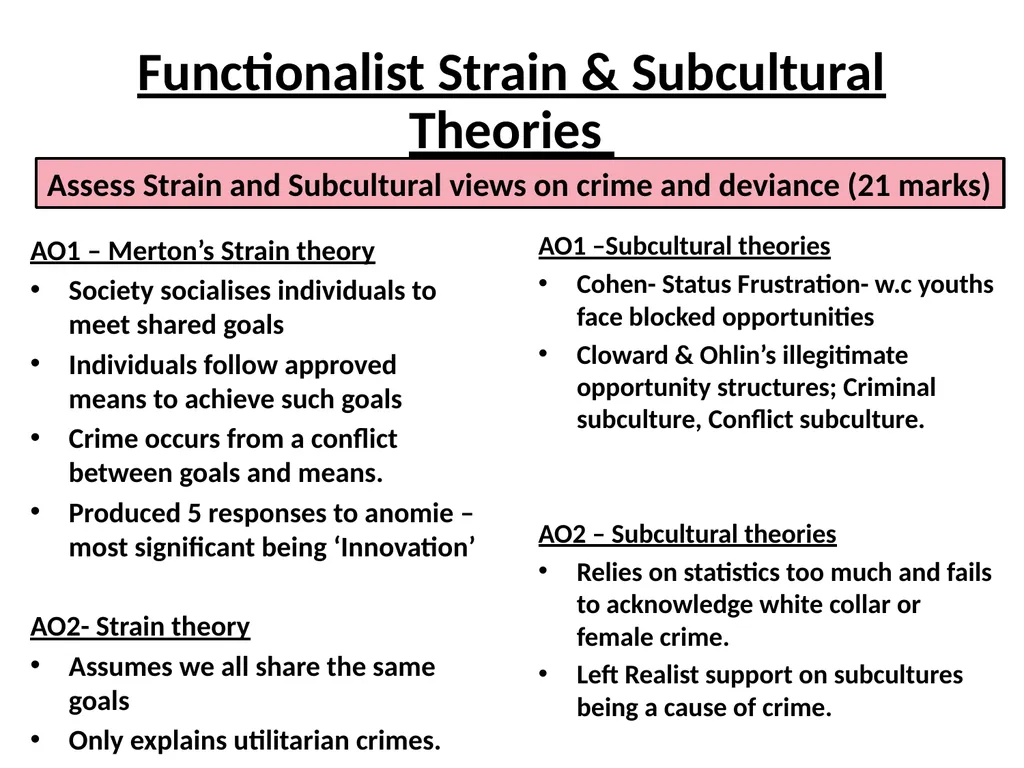
Functionalist Strain & Subcultural Theories AO1 – Merton’s Strain theory
Society socialises individuals to meet shared goals
Individuals follow approved means to achieve such goals
Crime occurs from a conflict between goals and means.
Produced 5 responses to anomie – most significant being ‘Innovation’
AO2- Strain theory
Assumes we all share the same goals
Only explains utilitarian crimes. Assess Strain and Subcultural views on crime and deviance (21 marks) AO1 –Subcultural theories
Cohen- Status Frustration- w.c youths face blocked opportunities
Cloward & Ohlin’s illegitimate opportunity structures; Criminal subculture, Conflict subculture.
AO2 – Subcultural theories
Relies on statistics too much and fails to acknowledge white collar or female crime.
Left Realist support on subcultures being a cause of crime.<br>
04
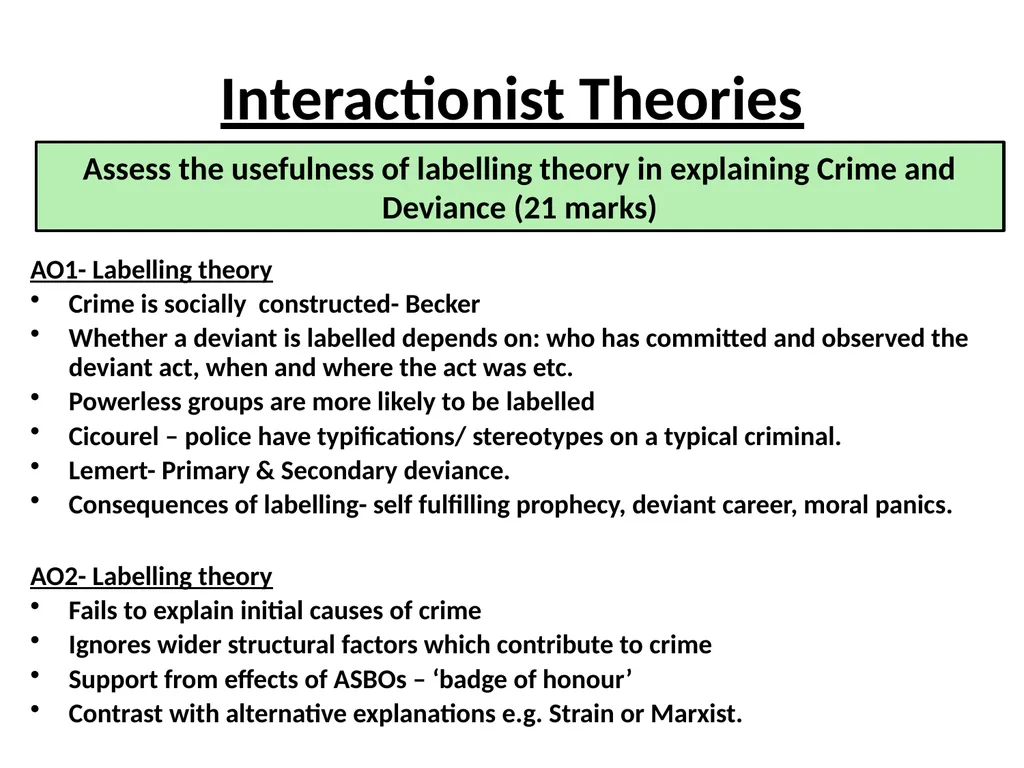
Interactionist Theories AO1- Labelling theory
Crime is socially constructed- Becker
Whether a deviant is labelled depends on: who has committed and observed the deviant act, when and where the act was etc.
Powerless groups are more likely to be labelled
Cicourel – police have typifications/ stereotypes on a typical criminal.
Lemert- Primary & Secondary deviance.
Consequences of labelling- self fulfilling prophecy, deviant career, moral panics.
AO2- Labelling theory
Fails to explain initial causes of crime
Ignores wider structural factors which contribute to crime
Support from effects of ASBOs – ‘badge of honour’
Contrast with alternative explanations e.g. Strain or Marxist. Assess the usefulness of labelling theory in explaining Crime and Deviance (21 marks)<br>
05
Marxist Theories AO1- Marxist views on capitalism contributing to crime
AO2- Support/ Criticisms/ Alternative views. Assess the view that crime and deviance are the result of capitalism (21 marks)<br>
06
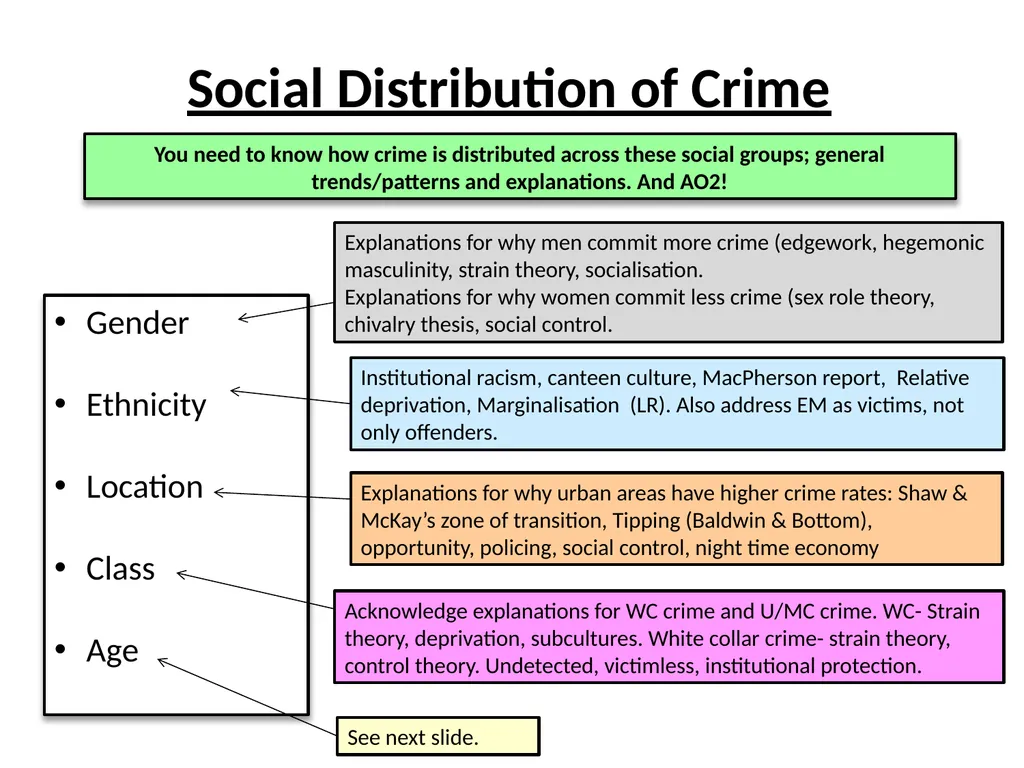
Social Distribution of Crime You need to know how crime is distributed across these social groups; general trends/patterns and explanations. And AO2! Gender
Ethnicity
Location
Class
Age Explanations for why men commit more crime (edgework, hegemonic masculinity, strain theory, socialisation.
Explanations for why women commit less crime (sex role theory, chivalry thesis, social control. Institutional racism, canteen culture, MacPherson report, Relative deprivation, Marginalisation (LR). Also address EM as victims, not only offenders. Explanations for why urban areas have higher crime rates: Shaw & McKay’s zone of transition, Tipping (Baldwin & Bottom), opportunity, policing, social control, night time economy Acknowledge explanations for WC crime and U/MC crime. WC- Strain theory, deprivation, subcultures. White collar crime- strain theory, control theory. Undetected, victimless, institutional protection. See next slide.<br>
07
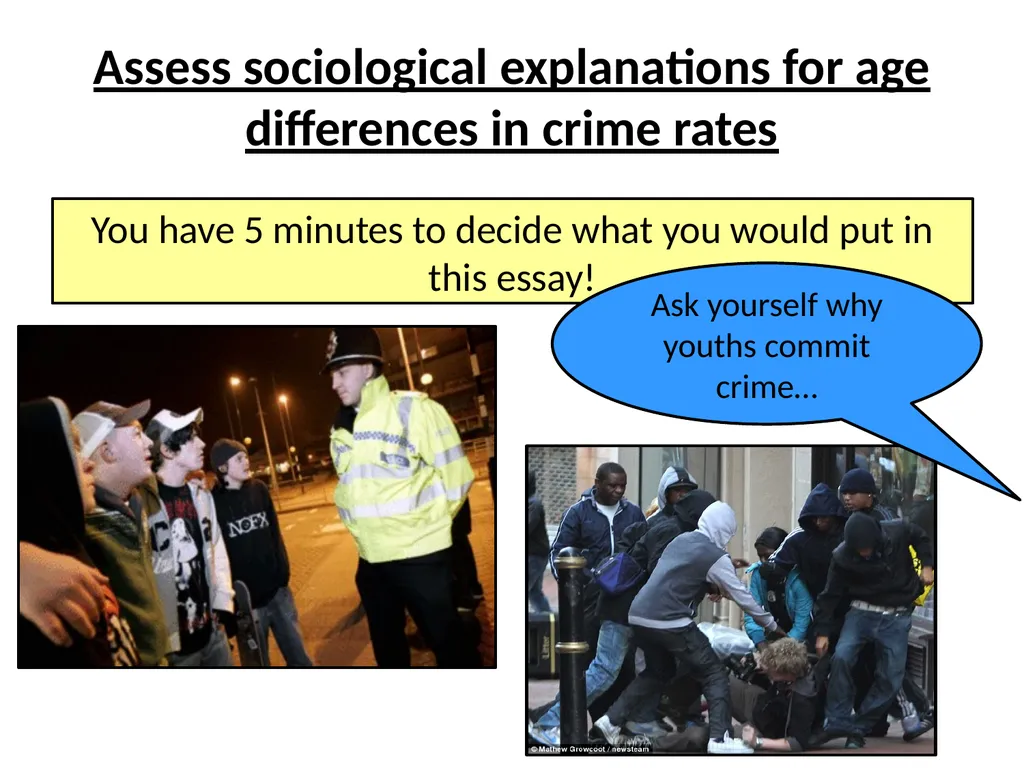
Assess sociological explanations for age differences in crime rates You have 5 minutes to decide what you would put in this essay! Ask yourself why youths commit crime…<br>
08
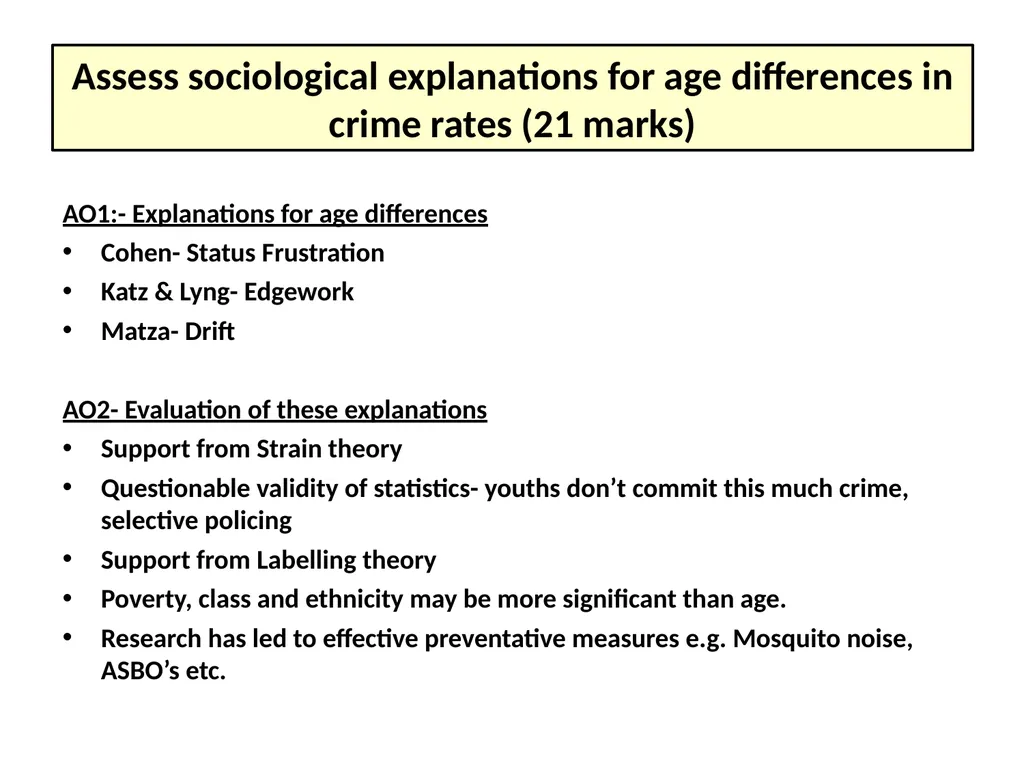
Assess sociological explanations for age differences in crime rates (21 marks) AO1:- Explanations for age differences
Cohen- Status Frustration
Katz & Lyng- Edgework
Matza- Drift
AO2- Evaluation of these explanations
Support from Strain theory
Questionable validity of statistics- youths don’t commit this much crime, selective policing
Support from Labelling theory
Poverty, class and ethnicity may be more significant than age.
Research has led to effective preventative measures e.g. Mosquito noise, ASBO’s etc.<br>
09
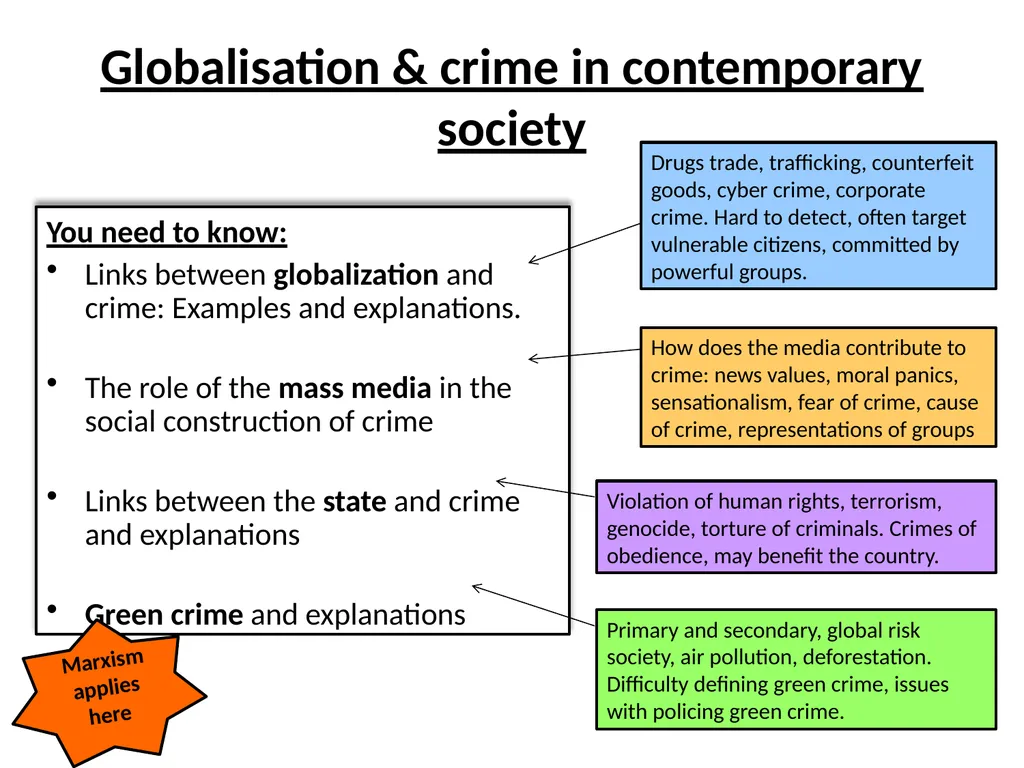
Globalisation & crime in contemporary society You need to know:
Links between globalization and crime: Examples and explanations.
The role of the mass media in the social construction of crime
Links between the state and crime and explanations
Green crime and explanations Drugs trade, trafficking, counterfeit goods, cyber crime, corporate crime. Hard to detect, often target vulnerable citizens, committed by powerful groups. How does the media contribute to crime: news values, moral panics, sensationalism, fear of crime, cause of crime, representations of groups Violation of human rights, terrorism, genocide, torture of criminals. Crimes of obedience, may benefit the country. Primary and secondary, global risk society, air pollution, deforestation. Difficulty defining green crime, issues with policing green crime. Marxism applies here<br>
10
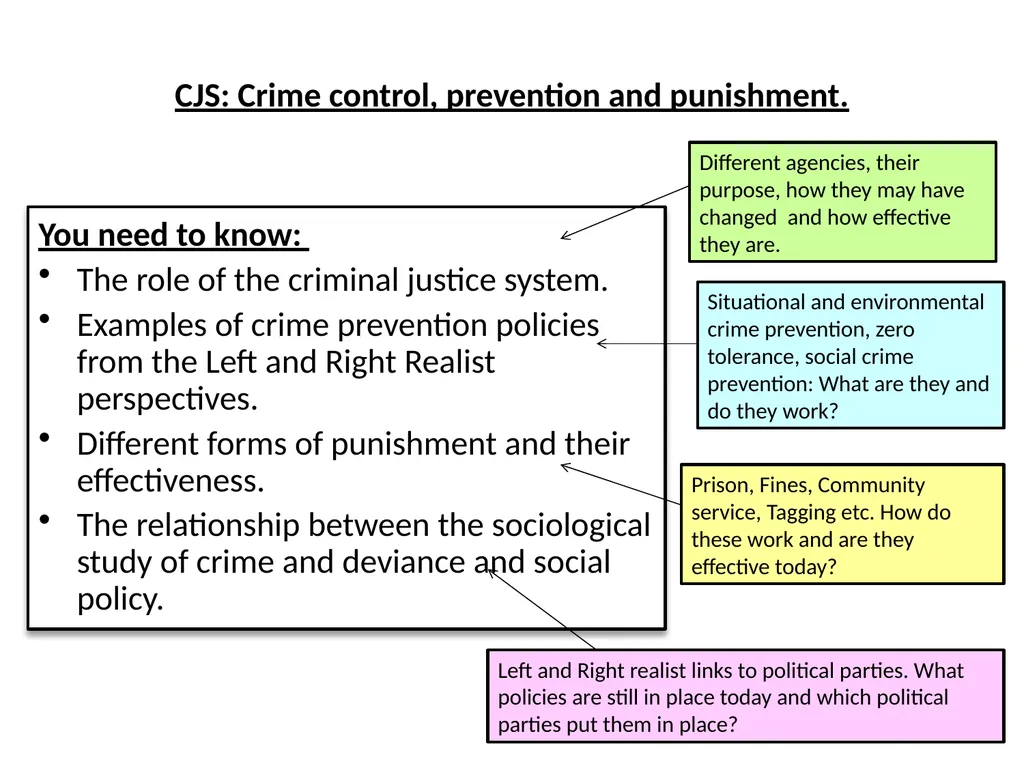
CJS: Crime control, prevention and punishment. You need to know:
The role of the criminal justice system.
Examples of crime prevention policies from the Left and Right Realist perspectives.
Different forms of punishment and their effectiveness.
The relationship between the sociological study of crime and deviance and social policy. Different agencies, their purpose, how they may have changed and how effective they are. Situational and environmental crime prevention, zero tolerance, social crime prevention: What are they and do they work? Prison, Fines, Community service, Tagging etc. How do these work and are they effective today? Left and Right realist links to political parties. What policies are still in place today and which political parties put them in place?<br>