
Theory and Practice of Counseling and
SB
Published · 26 slides · 0 views

1 / 1

Description
Theory and Practice of Counseling and Psychotherapy TENTH EDITION Gerald Corey Cengage Learning Chapter 6 Existential Therapy Existential Psychotherapy (slide 1 of 2) Best described as a philosophical approach that influences a counselors
Related Topics
Share
Embed code
Download this presentation From Below
"Theory and Practice of Counseling and" is the property of its rightful owner. Permission is granted to download and print the materials on this website for personal, non-commercial use only, and to display it on your personal computer provided you do not modify the materials and that you retain all copyright notices contained in the materials. By downloading content from our website, you accept the terms of this agreement.
Presentation Transcript
01
Theory and Practice of Counseling and Psychotherapy
TENTH EDITION Gerald Corey
Cengage Learning<br>
Cengage Learning<br>
02
Chapter 6 Existential Therapy<br>
03
Existential Psychotherapy
(slide 1 of 2) Best described as a philosophical approach that influences a counselor’s therapeutic practice
Asks deep questions about the nature of the human being and of anxiety, despair, grief, loneliness, isolation, and anomie
Deals centrally with the questions of meaning, creativity, and love Theory and Practice of Counseling and Psychotherapy - Chapter 6 (1)<br>
Asks deep questions about the nature of the human being and of anxiety, despair, grief, loneliness, isolation, and anomie
Deals centrally with the questions of meaning, creativity, and love Theory and Practice of Counseling and Psychotherapy - Chapter 6 (1)<br>
04
Existential Psychotherapy
(slide 2 of 2) Common questions/sources of existential angst for clients
“Why am I here?”
“What do I want from life?”
“What gives my life purpose?”
“Where is the source of meaning for me in life?” Theory and Practice of Counseling and Psychotherapy - Chapter 6 (2)<br>
“Why am I here?”
“What do I want from life?”
“What gives my life purpose?”
“Where is the source of meaning for me in life?” Theory and Practice of Counseling and Psychotherapy - Chapter 6 (2)<br>
05
Basic Dimensions of the
Human Condition (slide 1 of 2) The capacity for self-awareness
The tension between freedom and responsibility
The creation of an identity and establishing meaningful relationships Theory and Practice of Counseling and Psychotherapy - Chapter 6 (3)<br>
The tension between freedom and responsibility
The creation of an identity and establishing meaningful relationships Theory and Practice of Counseling and Psychotherapy - Chapter 6 (3)<br>
06
Basic Dimensions of the
Human Condition (slide 2 of 2) The search for meaning
Accepting anxiety as a condition of living
The awareness of death and nonbeing Theory and Practice of Counseling and Psychotherapy - Chapter 6 (4)<br>
Accepting anxiety as a condition of living
The awareness of death and nonbeing Theory and Practice of Counseling and Psychotherapy - Chapter 6 (4)<br>
07
The Capacity for Self-Awareness The greater our awareness, the greater our possibilities for freedom
Awareness is realizing that:
We are finite—time is limited
We have the choice to act or not to act
Meaning is not automatic—we must seek it
We are subject to loneliness, meaninglessness, emptiness, guilt, and isolation Theory and Practice of Counseling and Psychotherapy - Chapter 6 (5)<br>
Awareness is realizing that:
We are finite—time is limited
We have the choice to act or not to act
Meaning is not automatic—we must seek it
We are subject to loneliness, meaninglessness, emptiness, guilt, and isolation Theory and Practice of Counseling and Psychotherapy - Chapter 6 (5)<br>
08
Freedom and Responsibility We do not choose the circumstances into which we are born, but we create our own destiny through our choices
Freedom implies that we are responsible for our lives, for our actions, and for our failures to take action
Freedom and responsibility go hand in hand; assuming responsibility is a basic condition for change Theory and Practice of Counseling and Psychotherapy - Chapter 6 (6)<br>
Freedom implies that we are responsible for our lives, for our actions, and for our failures to take action
Freedom and responsibility go hand in hand; assuming responsibility is a basic condition for change Theory and Practice of Counseling and Psychotherapy - Chapter 6 (6)<br>
09
Identity and Relationship
(slide 1 of 2) Identity is “the courage to be”– we must trust ourselves to search within and find our own answers
Our great fear is that we will discover that there is no core, no self
Being existentially “alone” helps us to discover our authentic self Theory and Practice of Counseling and Psychotherapy - Chapter 6 (7)<br>
Our great fear is that we will discover that there is no core, no self
Being existentially “alone” helps us to discover our authentic self Theory and Practice of Counseling and Psychotherapy - Chapter 6 (7)<br>
10
Identity and Relationship
(slide 2 of 2) Balancing aloneness and relatedness helps us develop a unique identity and live authentically in the moment
At their best our relationships are based on our desire for fulfillment, not based on deprivation
Relationships based on deprivation tend to be clinging and symbiotic Theory and Practice of Counseling and Psychotherapy - Chapter 6 (8)<br>
At their best our relationships are based on our desire for fulfillment, not based on deprivation
Relationships based on deprivation tend to be clinging and symbiotic Theory and Practice of Counseling and Psychotherapy - Chapter 6 (8)<br>
11
The Search for Meaning A distinctly human characteristic is the struggle for a sense of significance and purpose in life
Logotherapy can provide the conceptual framework for helping clients find meaning in their lives
Meaninglessness in life can lead to emptiness and hollowness; an “existential vacuum” Theory and Practice of Counseling and Psychotherapy - Chapter 6 (9)<br>
Logotherapy can provide the conceptual framework for helping clients find meaning in their lives
Meaninglessness in life can lead to emptiness and hollowness; an “existential vacuum” Theory and Practice of Counseling and Psychotherapy - Chapter 6 (9)<br>
12
Anxiety: A Condition of Living (slide 1 of 2) Yalom’s four givens of existence create anxiety
Existential anxiety is normal - life cannot be lived, nor can death be faced, without anxiety
Neurotic anxiety, of which we typically are unaware, is anxiety about concrete things that is out of proportion to the situation Theory and Practice of Counseling and Psychotherapy - Chapter 6 (10)<br>
Existential anxiety is normal - life cannot be lived, nor can death be faced, without anxiety
Neurotic anxiety, of which we typically are unaware, is anxiety about concrete things that is out of proportion to the situation Theory and Practice of Counseling and Psychotherapy - Chapter 6 (10)<br>
13
Anxiety: A Condition of Living (slide 2 of 2) A healthy view of anxiety
Anxiety can be a stimulus for growth as we become aware of and accept our freedom; it can be a catalyst for living authentically and fully
We can blunt our anxiety by creating the illusion that there is security in life
If we have the courage to face ourselves and life we may be frightened, but we will be able to change Theory and Practice of Counseling and Psychotherapy - Chapter 6 (11)<br>
14
Awareness of Death and Nonbeing Death gives significance to living; it is necessary to think about death if we are to think significantly about life
Our awareness of death is the source of zest for life and creativity
We can turn our fear of death into a positive force when we accept the reality of our mortality Theory and Practice of Counseling and Psychotherapy - Chapter 6 (12)<br>
Our awareness of death is the source of zest for life and creativity
We can turn our fear of death into a positive force when we accept the reality of our mortality Theory and Practice of Counseling and Psychotherapy - Chapter 6 (12)<br>
15
Goals of Existential Psychotherapy (slide 1 of 2) Assisting clients in moving toward authenticity and learning to recognize when they are deceiving themselves
Helping clients face anxiety and engage in action that is based on creating a meaningful existence
Helping clients to reclaim and reown their lives; teaching them to listen to what they already know about themselves Theory and Practice of Counseling and Psychotherapy - Chapter 6 (13)<br>
Helping clients face anxiety and engage in action that is based on creating a meaningful existence
Helping clients to reclaim and reown their lives; teaching them to listen to what they already know about themselves Theory and Practice of Counseling and Psychotherapy - Chapter 6 (13)<br>
16
Goals of Existential Psychotherapy (slide 2 of 2) Schneider and Krug (2010) identify four aims of therapy:
To help clients become more present to themselves and others
To assist clients in identifying ways they block themselves from fuller presence
To challenge clients to assume responsibility for designing their present lives
To encourage clients to choose more expanded ways of being in their daily lives Theory and Practice of Counseling and Psychotherapy - Chapter 6 (14)<br>
17
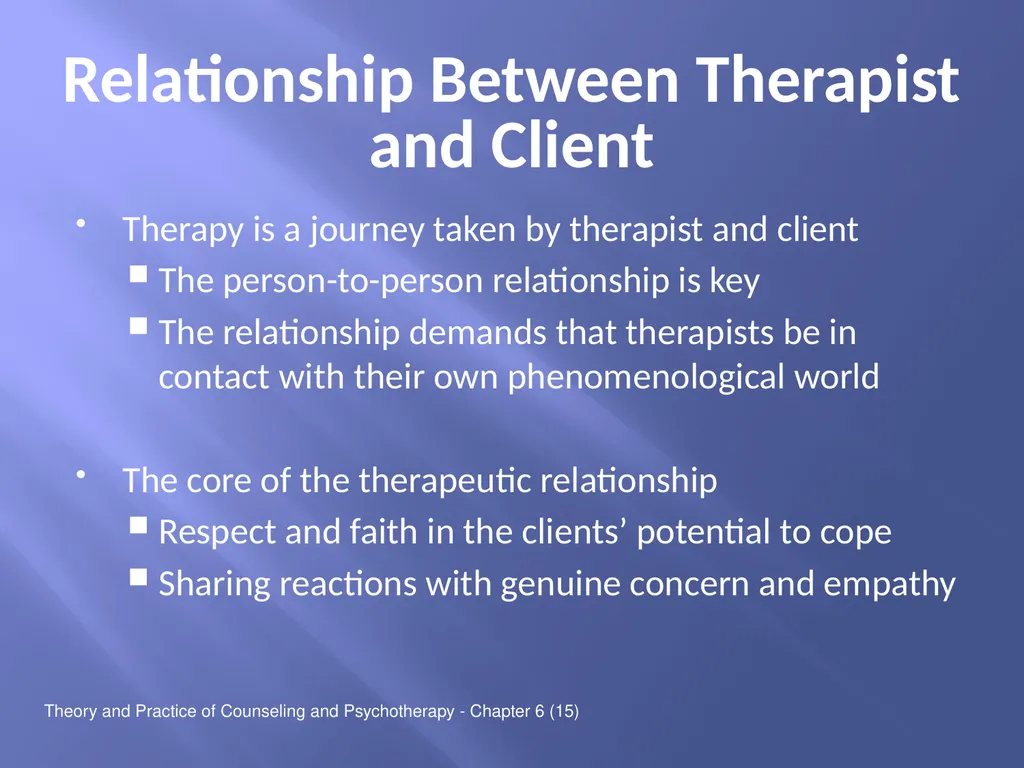
Relationship Between Therapist and Client Therapy is a journey taken by therapist and client
The person-to-person relationship is key
The relationship demands that therapists be in contact with their own phenomenological world
The core of the therapeutic relationship
Respect and faith in the clients’ potential to cope
Sharing reactions with genuine concern and empathy Theory and Practice of Counseling and Psychotherapy - Chapter 6 (15)<br>
18
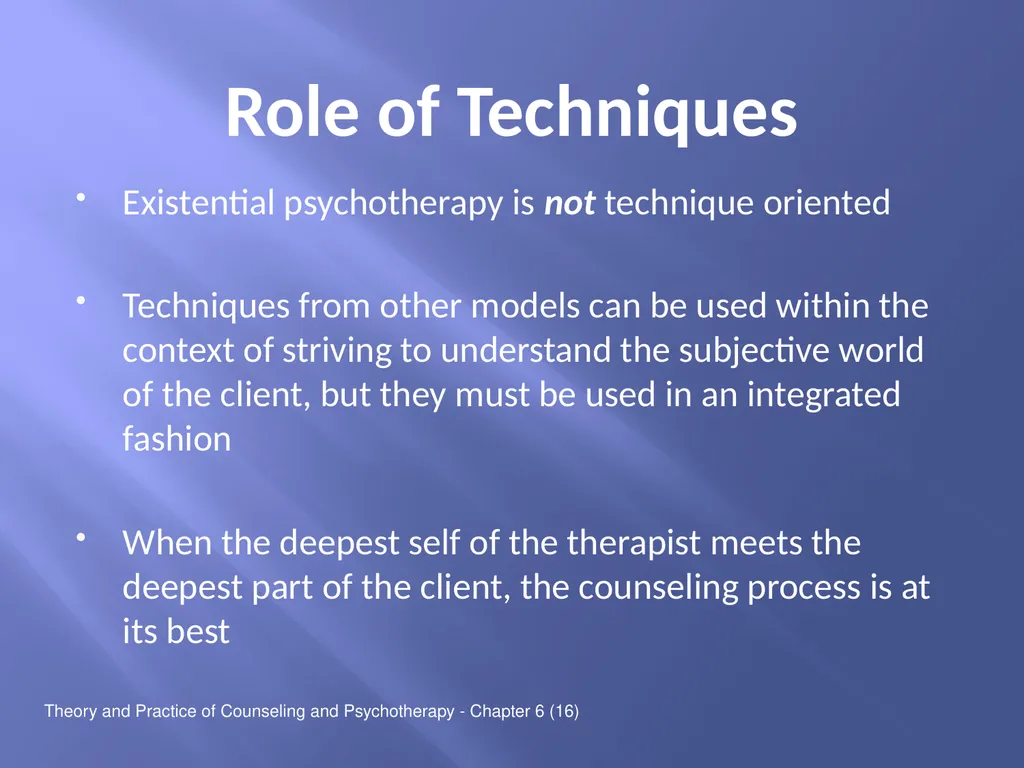
Role of Techniques Existential psychotherapy is not technique oriented
Techniques from other models can be used within the context of striving to understand the subjective world of the client, but they must be used in an integrated fashion
When the deepest self of the therapist meets the deepest part of the client, the counseling process is at its best Theory and Practice of Counseling and Psychotherapy - Chapter 6 (16)<br>
19
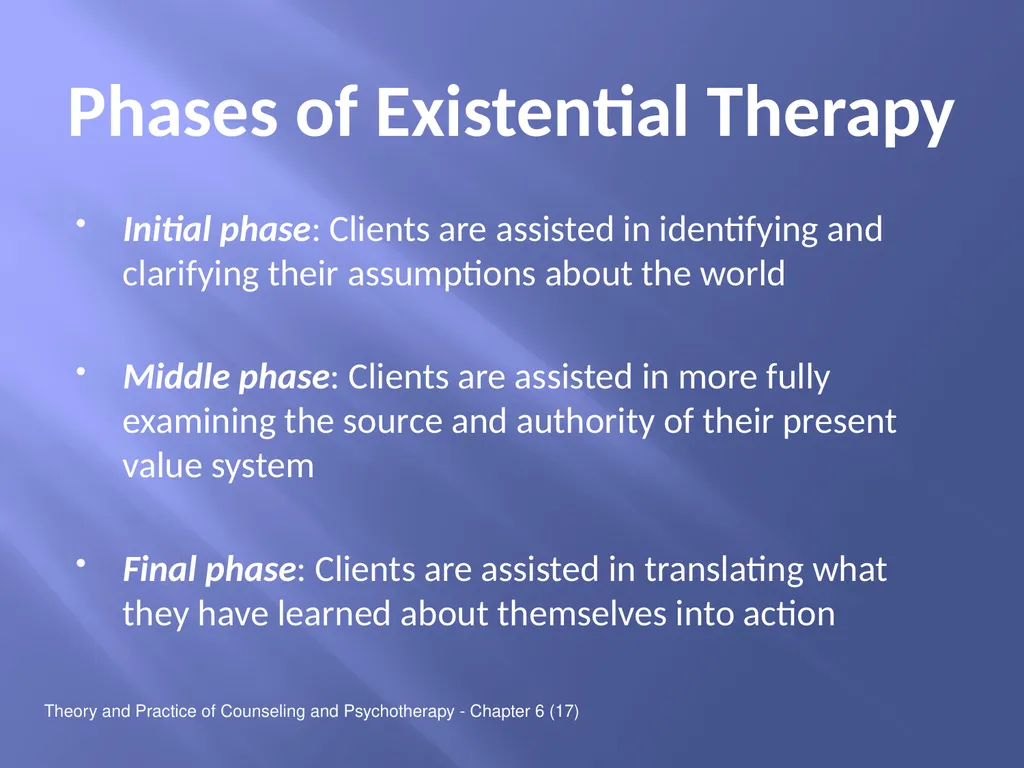
Phases of Existential Therapy Initial phase: Clients are assisted in identifying and clarifying their assumptions about the world
Middle phase: Clients are assisted in more fully examining the source and authority of their present value system
Final phase: Clients are assisted in translating what they have learned about themselves into action Theory and Practice of Counseling and Psychotherapy - Chapter 6 (17)<br>
Middle phase: Clients are assisted in more fully examining the source and authority of their present value system
Final phase: Clients are assisted in translating what they have learned about themselves into action Theory and Practice of Counseling and Psychotherapy - Chapter 6 (17)<br>
20
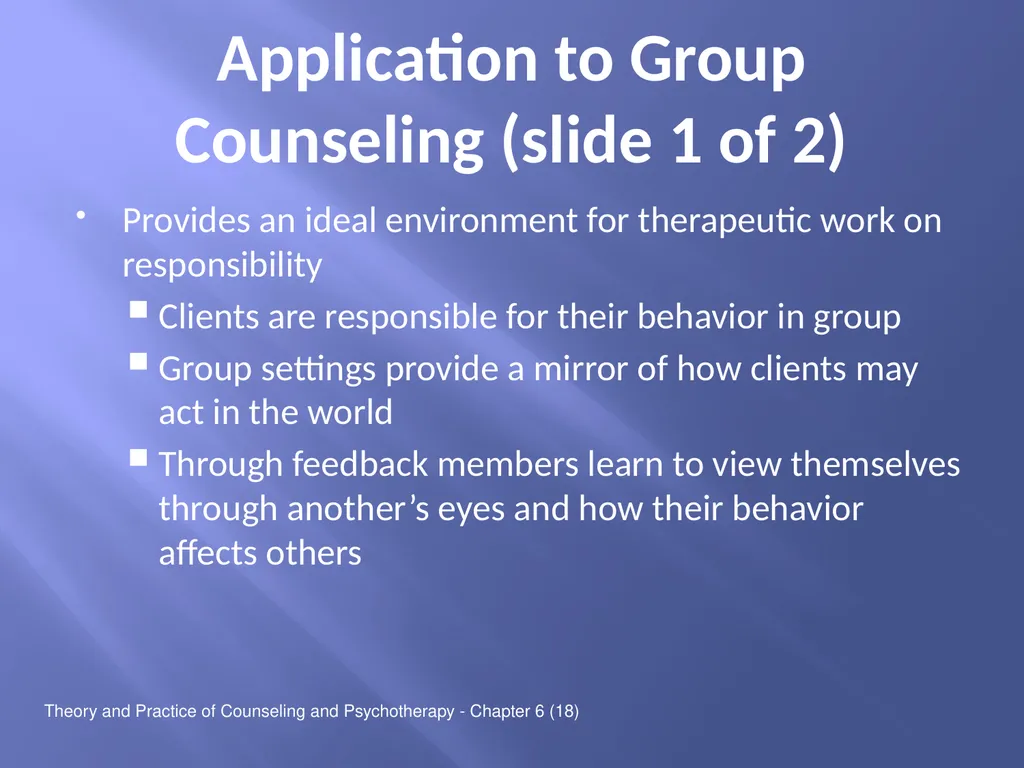
Application to Group Counseling (slide 1 of 2) Provides an ideal environment for therapeutic work on responsibility
Clients are responsible for their behavior in group
Group settings provide a mirror of how clients may act in the world
Through feedback members learn to view themselves through another’s eyes and how their behavior affects others Theory and Practice of Counseling and Psychotherapy - Chapter 6 (18)<br>
21
Application to Group Counseling
(slide 2 of 2) Builds interpersonal skills
Creates an opportunity to relate to others in a meaningful and authentic way
Provides an opportunity to explore the paradoxes of existence
Reduces avoidance of universal existential concerns because not addressing these themes diminishes one’s engagement with life Theory and Practice of Counseling and Psychotherapy - Chapter 6 (19)<br>
22
Strengths from a Diversity Perspective It does not dictate a particular way of viewing or relating to reality
It has a focus on universality, and on the human experiences that transcend the boundaries that separate cultures
It considers the degree to which behavior is influenced by social and cultural conditioning Theory and Practice of Counseling and Psychotherapy - Chapter 6 (20)<br>
It has a focus on universality, and on the human experiences that transcend the boundaries that separate cultures
It considers the degree to which behavior is influenced by social and cultural conditioning Theory and Practice of Counseling and Psychotherapy - Chapter 6 (20)<br>
23
Limitations from a Diversity Perspective Approach may be excessively individualistic and insensitive to social factors that cause problems; however, this is beginning to change
Social injustices may lead clients to feel patronized or misunderstood if the therapist too quickly conveys that they have choice in improving their lives
Some clients may prefer more concrete direction Theory and Practice of Counseling and Psychotherapy - Chapter 6 (21)<br>
Social injustices may lead clients to feel patronized or misunderstood if the therapist too quickly conveys that they have choice in improving their lives
Some clients may prefer more concrete direction Theory and Practice of Counseling and Psychotherapy - Chapter 6 (21)<br>
24
Contributions of Existential Therapy Existentialists have contributed a new dimension to the understanding of death, anxiety, guilt, frustration, loneliness, and alienation
Its emphasis on the human quality of the therapeutic relationship is a strength
The key concepts of the existential approach can be integrated into most therapeutic schools Theory and Practice of Counseling and Psychotherapy - Chapter 6 (22)<br>
Its emphasis on the human quality of the therapeutic relationship is a strength
The key concepts of the existential approach can be integrated into most therapeutic schools Theory and Practice of Counseling and Psychotherapy - Chapter 6 (22)<br>
25
Limitations of Existential Psychotherapy (slide 1 of 2) The individualistic focus may not fit within the world views of clients from a collectivistic culture
The focus on self-determination may not fully account for real-life limitations of those who are oppressed and have limited choices
Some clients prefer a more directive approach to counseling Theory and Practice of Counseling and Psychotherapy - Chapter 6 (23)<br>
The focus on self-determination may not fully account for real-life limitations of those who are oppressed and have limited choices
Some clients prefer a more directive approach to counseling Theory and Practice of Counseling and Psychotherapy - Chapter 6 (23)<br>
26
Limitations of Existential Psychotherapy (slide 2 of 2) Some practitioners may view existential concepts as lofty and elusive
Some practitioners may lack the level of maturity, life experience, and intensive training required to be effective
The approach does not focus on specific techniques, making treatments difficult to standardize and study empirically Theory and Practice of Counseling and Psychotherapy - Chapter 6 (24)<br>