
This existence of ours is as transient as autumn
CM
Published · 47 slides · 0 views

1 / 1








Description
This existence of ours is as transient as autumn clouds. To watch the birth and death of beings is like looking at the movements of a dance. A lifetime is like a flash of lightning in the sky; rushing by, like a torrent down a steep
Related Topics
Share
Embed code
Download this presentation From Below
"This existence of ours is as transient as autumn" is the property of its rightful owner. Permission is granted to download and print the materials on this website for personal, non-commercial use only, and to display it on your personal computer provided you do not modify the materials and that you retain all copyright notices contained in the materials. By downloading content from our website, you accept the terms of this agreement.
Presentation Transcript
01
This existence of ours is as transient as autumn clouds. To watch the birth and death of beings is like looking at the movements of a dance. A lifetime is like a flash of lightning in the sky; rushing by, like a torrent down a steep mountain.
— Gautama Buddha<br>
— Gautama Buddha<br>
02
Navigating Grief and Suicide as a Behavioral Health Provider Elizabeth Schandelmeier, LCSW, APHSW-C, FT<br>
03
Objectives<br>
04
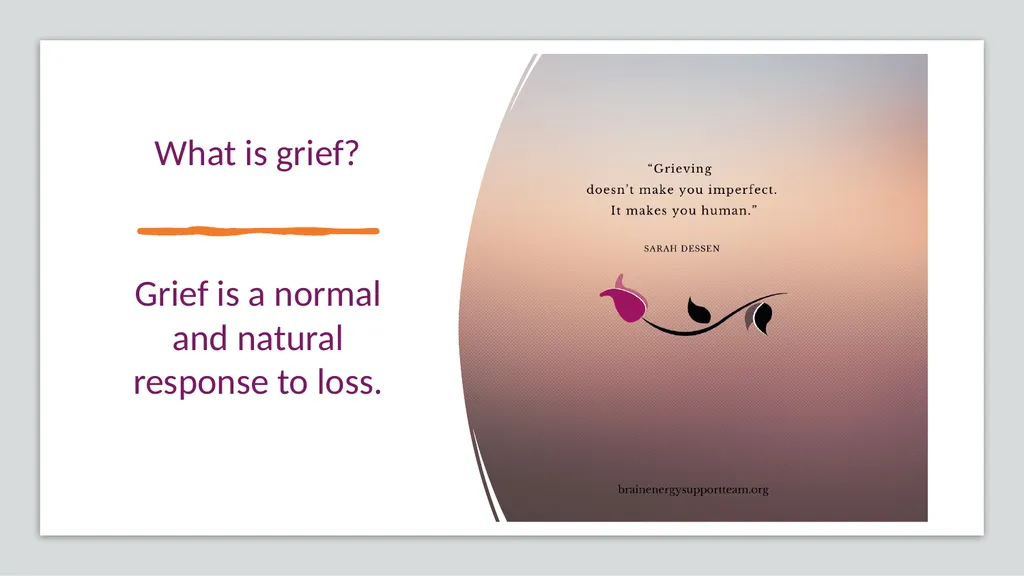
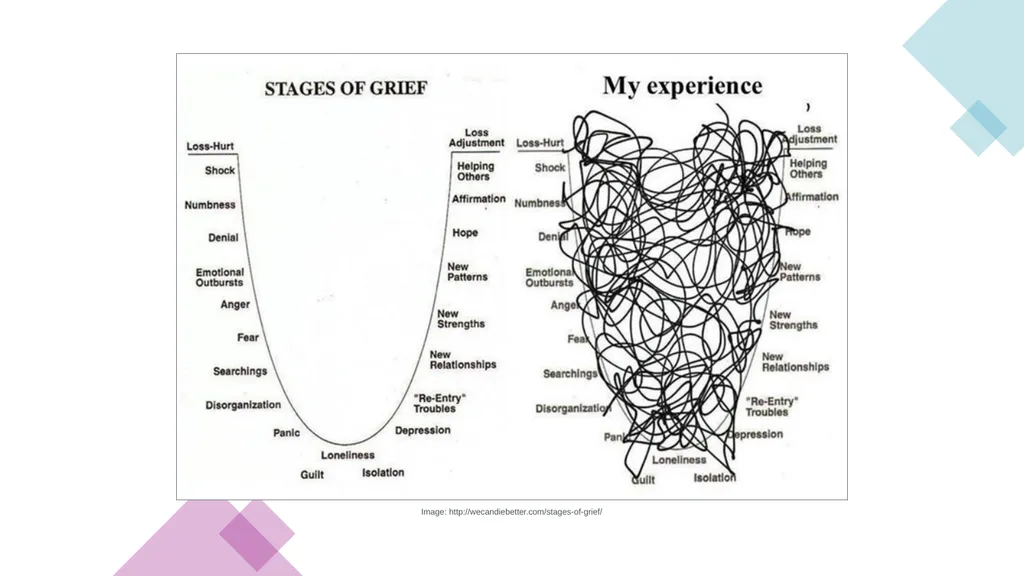
Grief is a normal and natural response to loss. What is grief?<br>
05
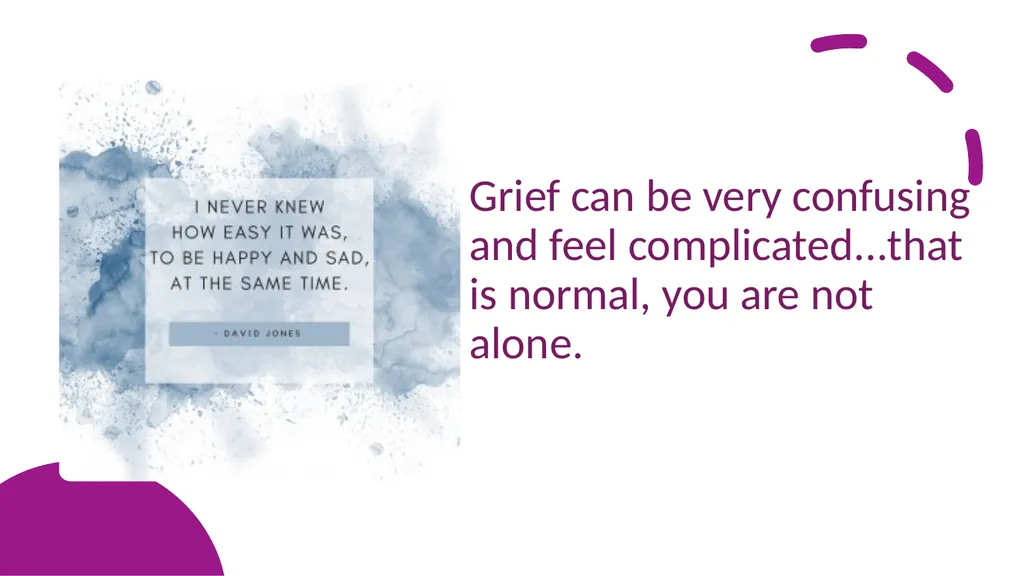
Grief can be very confusing and feel complicated...that is normal, you are not alone.<br>
06
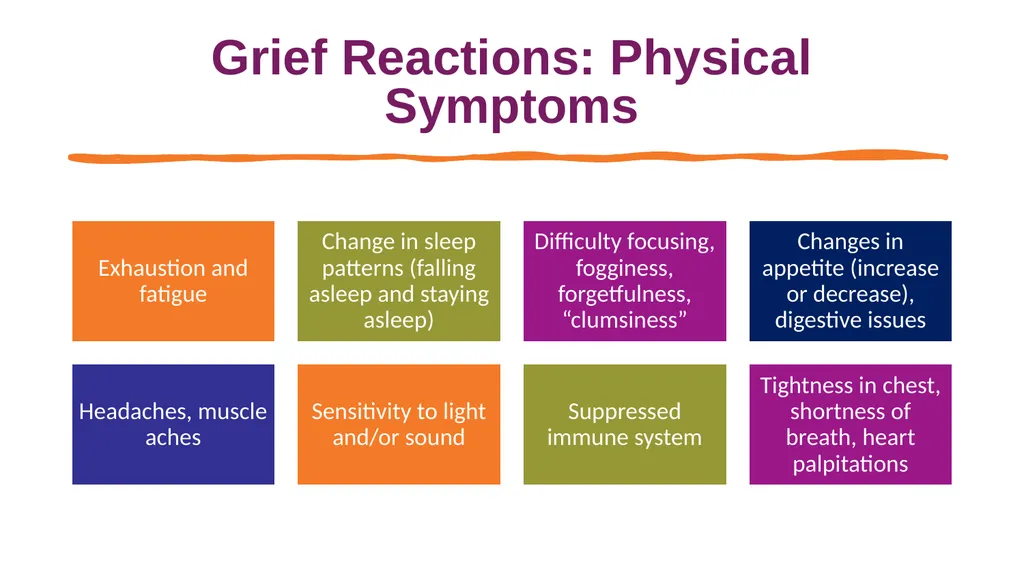
Grief Reactions: Physical Symptoms<br>
07
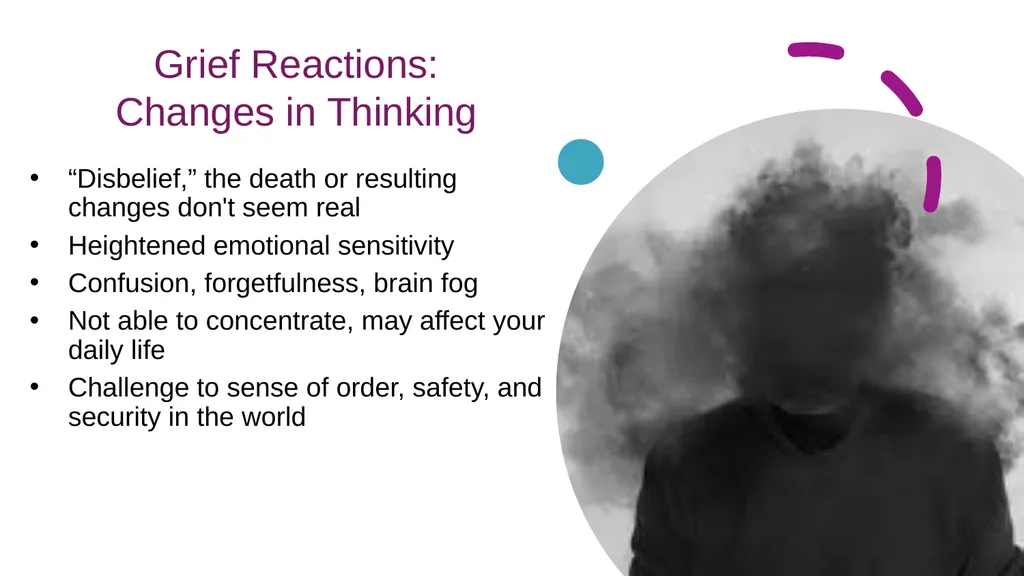
Grief Reactions: Changes in Thinking “Disbelief,” the death or resulting changes don't seem real
Heightened emotional sensitivity
Confusion, forgetfulness, brain fog
Not able to concentrate, may affect your daily life
Challenge to sense of order, safety, and security in the world<br>
Heightened emotional sensitivity
Confusion, forgetfulness, brain fog
Not able to concentrate, may affect your daily life
Challenge to sense of order, safety, and security in the world<br>
08
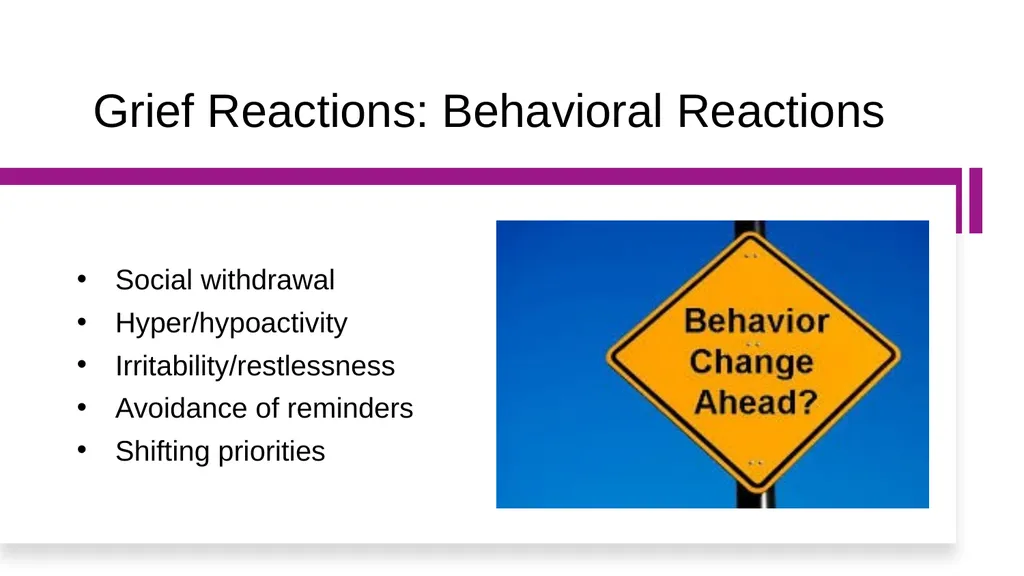
Grief Reactions: Behavioral Reactions Social withdrawal
Hyper/hypoactivity
Irritability/restlessness
Avoidance of reminders
Shifting priorities<br>
Hyper/hypoactivity
Irritability/restlessness
Avoidance of reminders
Shifting priorities<br>
09
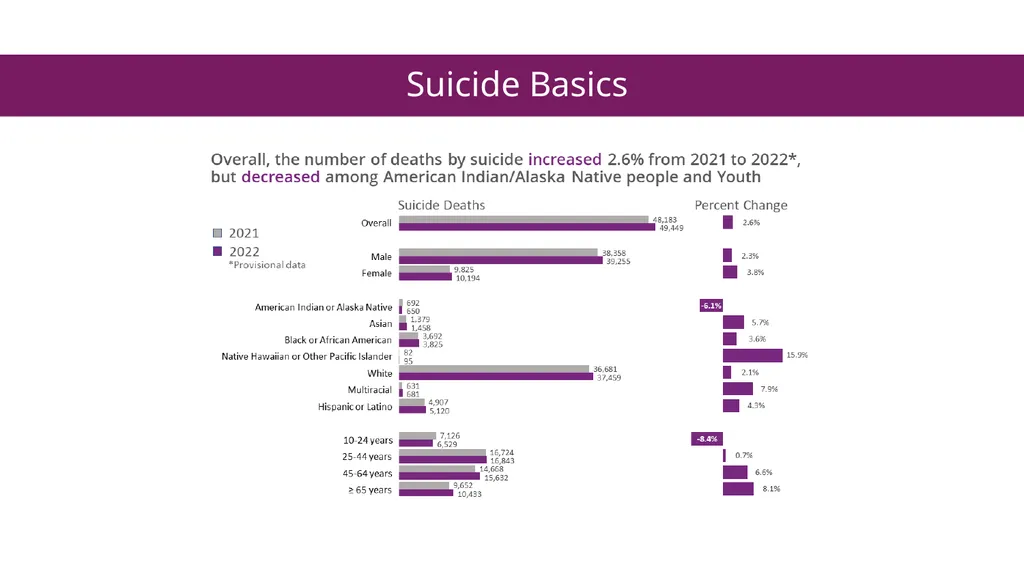
Suicide Basics<br>
10
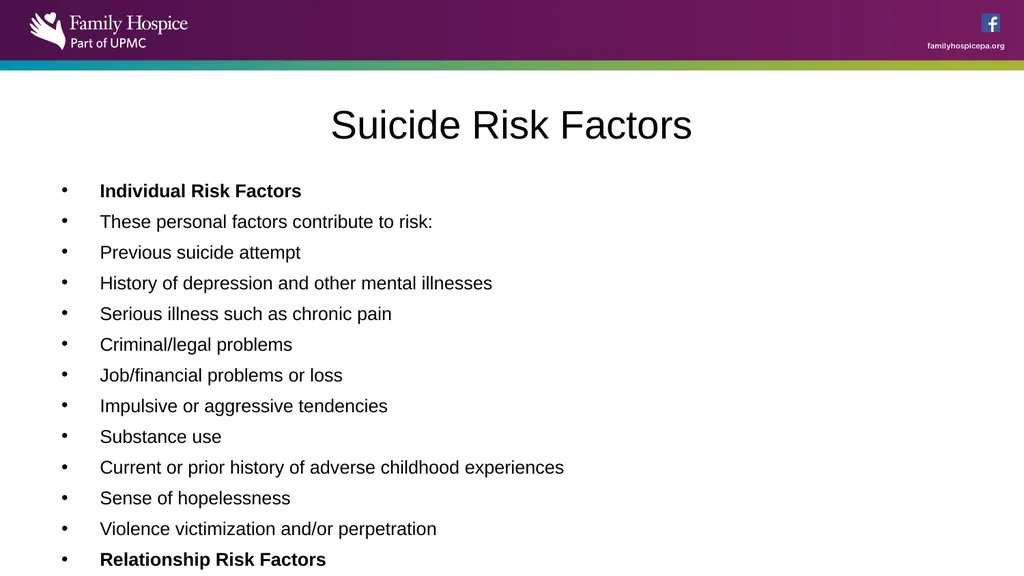
Suicide Risk Factors Individual Risk Factors
These personal factors contribute to risk:
Previous suicide attempt
History of depression and other mental illnesses
Serious illness such as chronic pain
Criminal/legal problems
Job/financial problems or loss
Impulsive or aggressive tendencies
Substance use
Current or prior history of adverse childhood experiences
Sense of hopelessness
Violence victimization and/or perpetration
Relationship Risk Factors
These harmful or hurtful experiences within relationships contribute to risk:
Bullying
Family/loved one’s history of suicide
Loss of relationships
High conflict or violent relationships
Social isolation
Community Risk Factors
These challenging issues within a person’s community contribute to risk:
Lack of access to healthcare
Suicide cluster in the community
Stress of acculturation
Community violence
Historical trauma
Discrimination
Societal Risk Factors
These cultural and environmental factors within the larger society contribute to risk:
Stigma associated with help-seeking and mental illness
Easy access to lethal means of suicide among people at risk
Unsafe media portrayals of suicide<br>
11
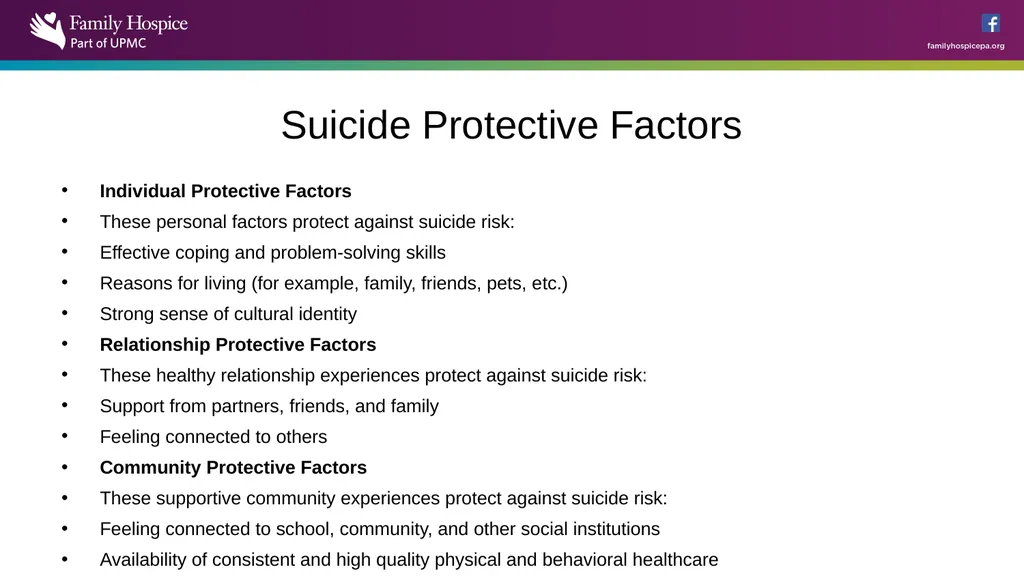
Suicide Protective Factors Individual Protective Factors
These personal factors protect against suicide risk:
Effective coping and problem-solving skills
Reasons for living (for example, family, friends, pets, etc.)
Strong sense of cultural identity
Relationship Protective Factors
These healthy relationship experiences protect against suicide risk:
Support from partners, friends, and family
Feeling connected to others
Community Protective Factors
These supportive community experiences protect against suicide risk:
Feeling connected to school, community, and other social institutions
Availability of consistent and high quality physical and behavioral healthcare
Societal Protective Factors:
These cultural and environmental factors within the larger society protect against suicide risk:
Reduced access to lethal means of suicide among people at risk
Cultural, religious, or moral objections to suicide<br>
12
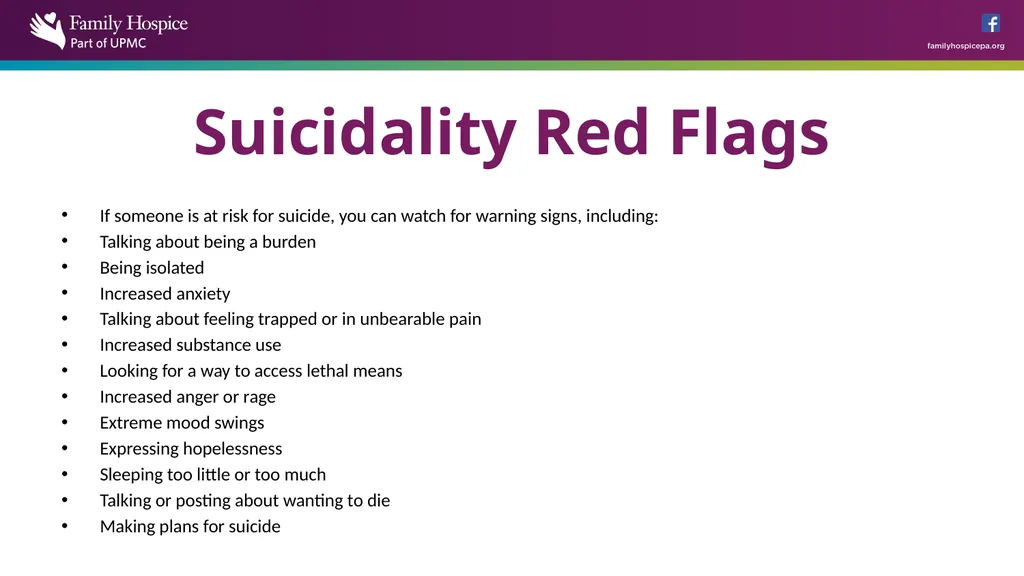
Suicidality Red Flags If someone is at risk for suicide, you can watch for warning signs, including:
Talking about being a burden
Being isolated
Increased anxiety
Talking about feeling trapped or in unbearable pain
Increased substance use
Looking for a way to access lethal means
Increased anger or rage
Extreme mood swings
Expressing hopelessness
Sleeping too little or too much
Talking or posting about wanting to die
Making plans for suicide<br>
13
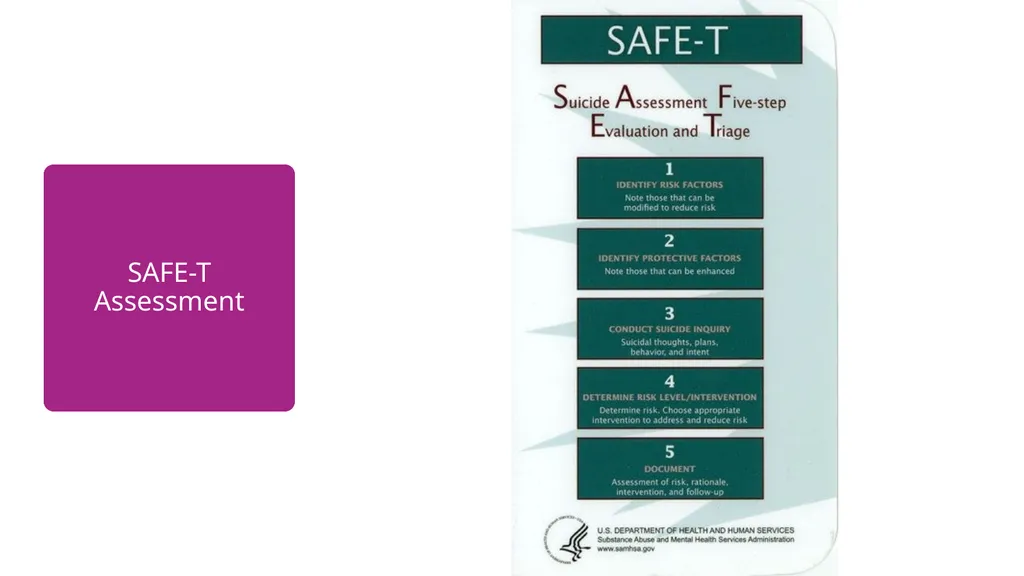
SAFE-T Assessment<br>
14
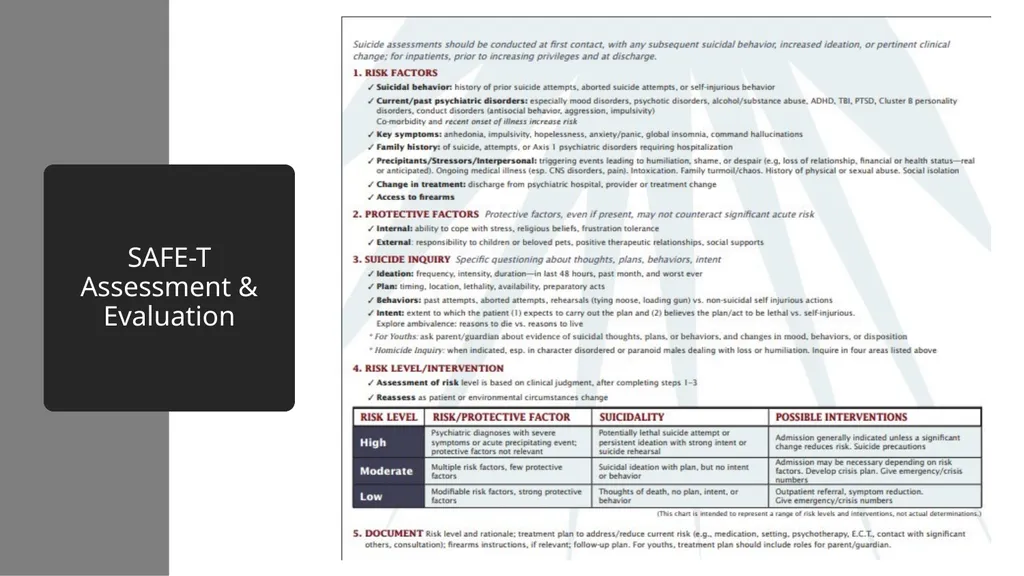
SAFE-T Assessment & Evaluation<br>
15
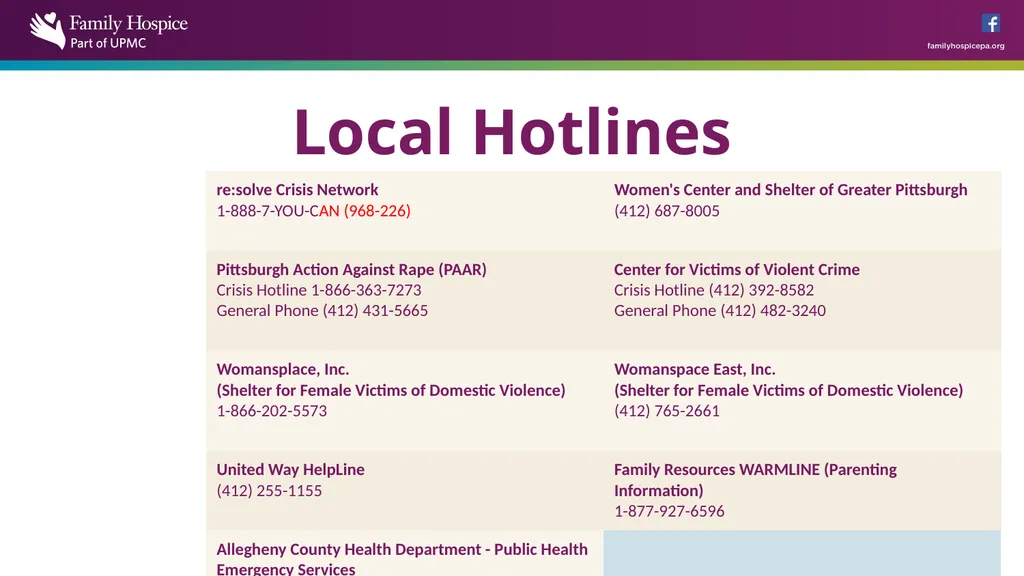
Local Hotlines<br>
16
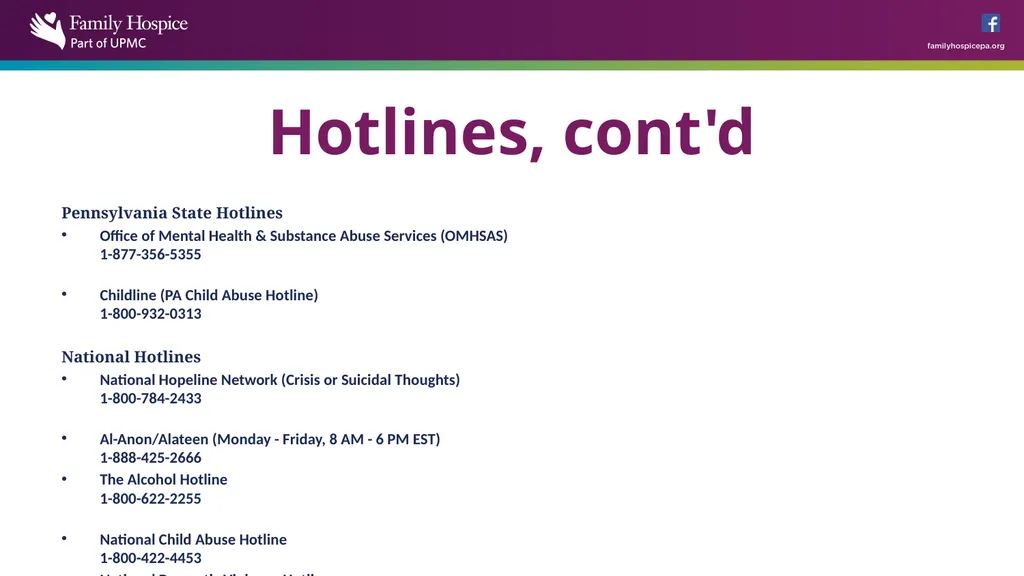
Hotlines, cont'd Pennsylvania State Hotlines
Office of Mental Health & Substance Abuse Services (OMHSAS) 1-877-356-5355
Childline (PA Child Abuse Hotline) 1-800-932-0313
National Hotlines
National Hopeline Network (Crisis or Suicidal Thoughts) 1-800-784-2433
Al-Anon/Alateen (Monday - Friday, 8 AM - 6 PM EST) 1-888-425-2666
The Alcohol Hotline 1-800-622-2255
National Child Abuse Hotline 1-800-422-4453
National Domestic Violence Hotline 1-800-799-SAFE (7233)
National Victim Center (Victims of Violent Crimes) 1-800-394-2255
Gay & Lesbian National Hotline (Monday - Friday, 4 PM - 12 AM EST; Saturday, 12 PM - 5 PM EST) 1-888-843-4564
National Health Information Center 1-800-336-4797
National Poison Control 1-800-222-1222
National Suicide Prevention Lifeline 1-800-273-TALK (8255)
RAINN (Rape Abuse & Incest National Network) 1-800-656-HOPE (4673)<br>
17
Grief and Suicide: Special Considerations Traumatic Grief
Underlying condition (mental health/medical)
Immediate action may be appropriate
Language (died from or by suicide)<br>
Underlying condition (mental health/medical)
Immediate action may be appropriate
Language (died from or by suicide)<br>
18
Grief and Suicide: Special Considerations Traumatic aftermath
sudden, sometimes violent, unexpected
survivors may need to deal with the police or handle press inquiries
recurring thoughts of the death/circumstances
may develop post-traumatic stress disorder (PTSD)
Stigma, shame, and isolation
stigma attached to mental illness
many religions specifically condemn the act as a sin
survivors may be reluctant to acknowledge or disclose the circumstances of such a death
family differences over how to privately or publicly discuss the death undermine a family's ability to provide mutual support.
Mixed emotions
victim and "perpetrator" are one
feelings anger, rejection, and abandonment may be particularly acute
Need for reason, the "why", the "what ifs"
Increased risk for survivors<br>
19
Grief and Suicide: Supporting Clients TALKING POINTS
Ask clients what they know and how they feel
Give accurate information about suicide
Do not talk about the method
Avoid blaming and scapegoating
Address anger: one can be angry at someone’s behavior and still care deeply
Address feelings of responsibility
Encourage help-seeking behavior and self-care<br>
20
Grief and Suicide: Group Settings Discourage speculation/rumors/gossip
Do not provide details
Protect the client’s privacy – confidentiality regulations continue to apply even after the death of a patient
Focus on remembering the client, discussing feelings and reactions, and promoting help seeking behavior
Validate the feelings of the group – mixed reactions, fears of “being next,” signs of traumatic stress
Gently redirect conversations with irrelevant or potentially hurtful statements
Emphasize that there is always help available when someone needs it.
Provide immediate individual response immediately to any client who appears to be especially impacted by the news
Pay attention to clients who might be at increased suicide risk<br>
21
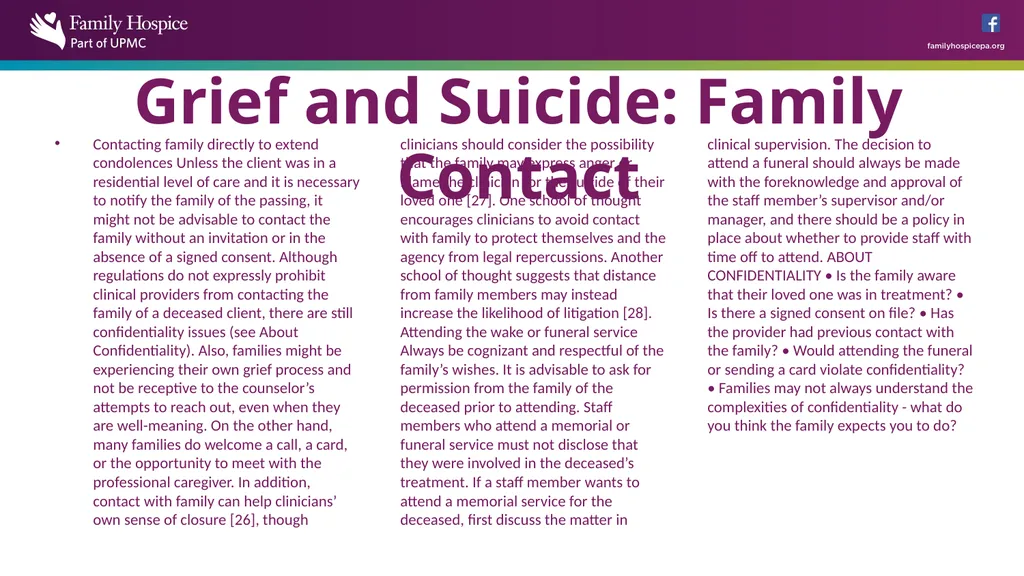
Grief and Suicide: Family Contact Contacting family directly to extend condolences Unless the client was in a residential level of care and it is necessary to notify the family of the passing, it might not be advisable to contact the family without an invitation or in the absence of a signed consent. Although regulations do not expressly prohibit clinical providers from contacting the family of a deceased client, there are still confidentiality issues (see About Confidentiality). Also, families might be experiencing their own grief process and not be receptive to the counselor’s attempts to reach out, even when they are well-meaning. On the other hand, many families do welcome a call, a card, or the opportunity to meet with the professional caregiver. In addition, contact with family can help clinicians’ own sense of closure [26], though clinicians should consider the possibility that the family may express anger or blame the clinician for the suicide of their loved one [27]. One school of thought encourages clinicians to avoid contact with family to protect themselves and the agency from legal repercussions. Another school of thought suggests that distance from family members may instead increase the likelihood of litigation [28]. Attending the wake or funeral service Always be cognizant and respectful of the family’s wishes. It is advisable to ask for permission from the family of the deceased prior to attending. Staff members who attend a memorial or funeral service must not disclose that they were involved in the deceased’s treatment. If a staff member wants to attend a memorial service for the deceased, first discuss the matter in clinical supervision. The decision to attend a funeral should always be made with the foreknowledge and approval of the staff member’s supervisor and/or manager, and there should be a policy in place about whether to provide staff with time off to attend. ABOUT CONFIDENTIALITY • Is the family aware that their loved one was in treatment? • Is there a signed consent on file? • Has the provider had previous contact with the family? • Would attending the funeral or sending a card violate confidentiality? • Families may not always understand the complexities of confidentiality - what do you think the family expects you to do?<br>
22
Grief and Suicide: Supporting Colleagues TIPS FOR CONDUCTING A SUCCESSFUL INSTITUTIONAL DEBRIEFING ✓ ✓ ✓ ✓ ✓ ✓ ✓ Keep the conversation factual and the tone non-accusatory: it is important to not place staff on the defensive. Ask open-ended questions: this encourages staff to contribute more to the conversation. Keep things simple: debriefings answer the “who, what, when, where” of a patient death. Avoid going into details of the death, and avoid sharing suspicions or spreading rumors. Keep the meeting short: a debriefing should take between 30 minutes to an hour. As you prepare for debriefing, identify your own feelings and reactions and understand that the person communicating the news sets the tone for subsequent communications. Be prepared for a wide range of reactions, including no reaction at all.<br>
23
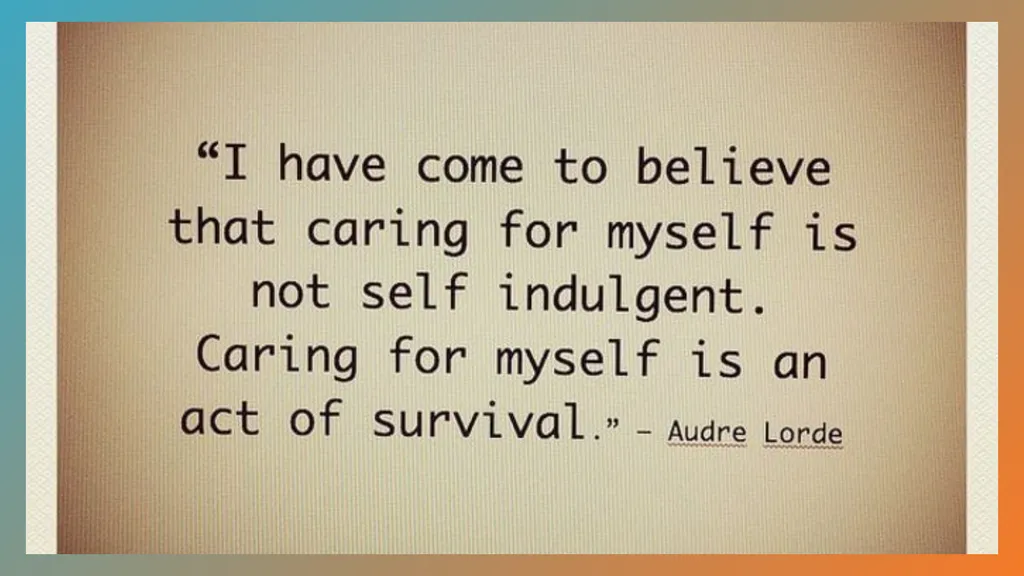
Grief and Suicide: Supporting Yourself<br>
24
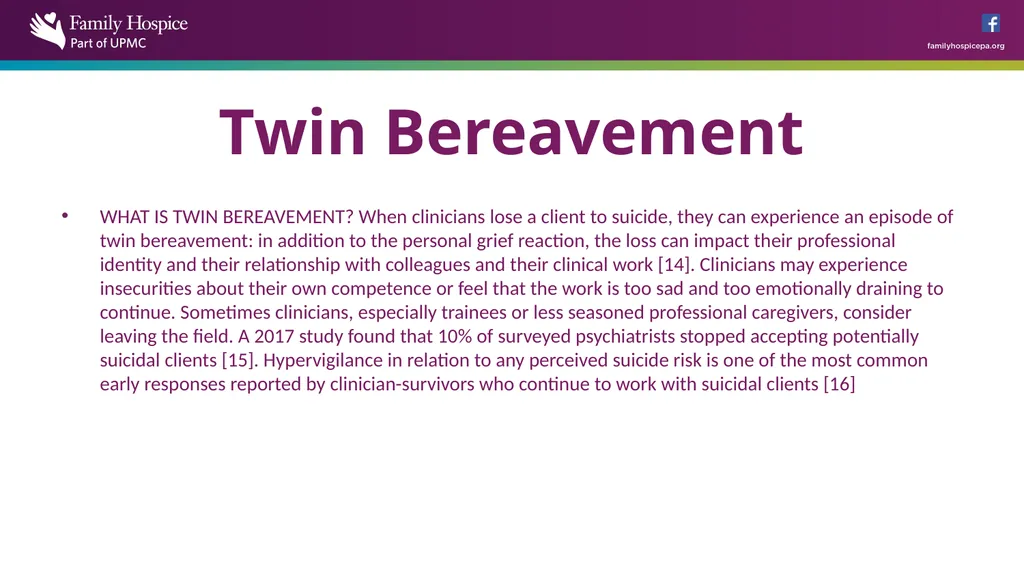
Twin Bereavement WHAT IS TWIN BEREAVEMENT? When clinicians lose a client to suicide, they can experience an episode of twin bereavement: in addition to the personal grief reaction, the loss can impact their professional identity and their relationship with colleagues and their clinical work [14]. Clinicians may experience insecurities about their own competence or feel that the work is too sad and too emotionally draining to continue. Sometimes clinicians, especially trainees or less seasoned professional caregivers, consider leaving the field. A 2017 study found that 10% of surveyed psychiatrists stopped accepting potentially suicidal clients [15]. Hypervigilance in relation to any perceived suicide risk is one of the most common early responses reported by clinician-survivors who continue to work with suicidal clients [16]<br>
25
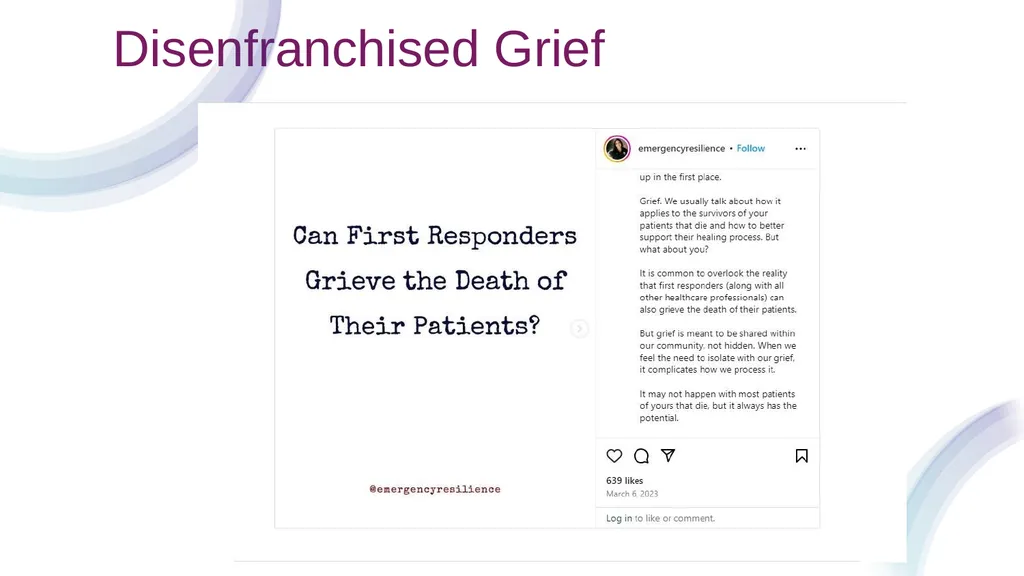
Disenfranchised Grief<br>
26
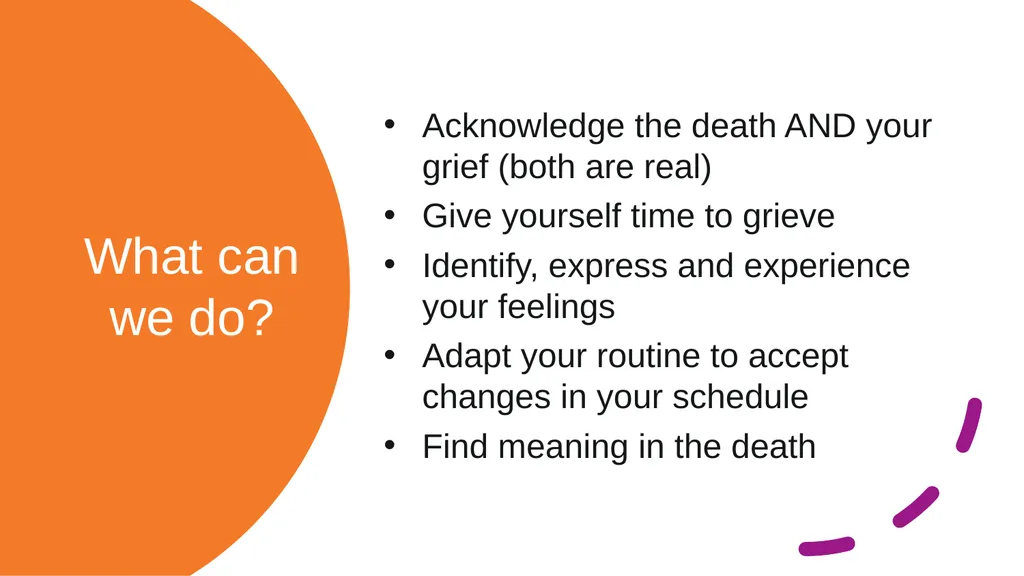
What can we do? Acknowledge the death AND your grief (both are real)
Give yourself time to grieve
Identify, express and experience your feelings
Adapt your routine to accept changes in your schedule
Find meaning in the death<br>
Give yourself time to grieve
Identify, express and experience your feelings
Adapt your routine to accept changes in your schedule
Find meaning in the death<br>
27
Grief and Suicide: Memorials Contacting family directly to extend condolences Unless the client was in a residential level of care and it is necessary to notify the family of the passing, it might not be advisable to contact the family without an invitation or in the absence of a signed consent. Although regulations do not expressly prohibit clinical providers from contacting the family of a deceased client, there are still confidentiality issues (see About Confidentiality). Also, families might be experiencing their own grief process and not be receptive to the counselor’s attempts to reach out, even when they are well-meaning. On the other hand, many families do welcome a call, a card, or the opportunity to meet with the professional caregiver. In addition, contact with family can help clinicians’ own sense of closure [26], though clinicians should consider the possibility that the family may express anger or blame the clinician for the suicide of their loved one [27]. One school of thought encourages clinicians to avoid contact with family to protect themselves and the agency from legal repercussions. Another school of thought suggests that distance from family members may instead increase the likelihood of litigation [28]. Attending the wake or funeral service Always be cognizant and respectful of the family’s wishes. It is advisable to ask for permission from the family of the deceased prior to attending. Staff members who attend a memorial or funeral service must not disclose that they were involved in the deceased’s treatment. If a staff member wants to attend a memorial service for the deceased, first discuss the matter in clinical supervision. The decision to attend a funeral should always be made with the foreknowledge and approval of the staff member’s supervisor and/or manager, and there should be a policy in place about whether to provide staff with time off to attend. ABOUT CONFIDENTIALITY • Is the family aware that their loved one was in treatment? • Is there a signed consent on file? • Has the provider had previous contact with the family? • Would attending the funeral or sending a card violate confidentiality? • Families may not always understand the complexities of confidentiality - what do you think the family expects you to do?<br>
28
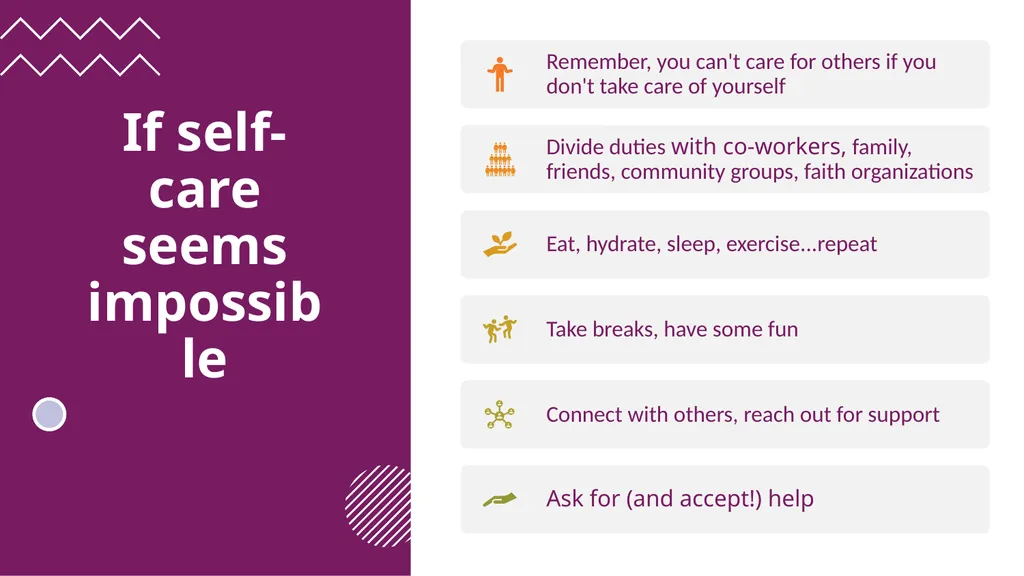
If self-care seems impossible<br>
29
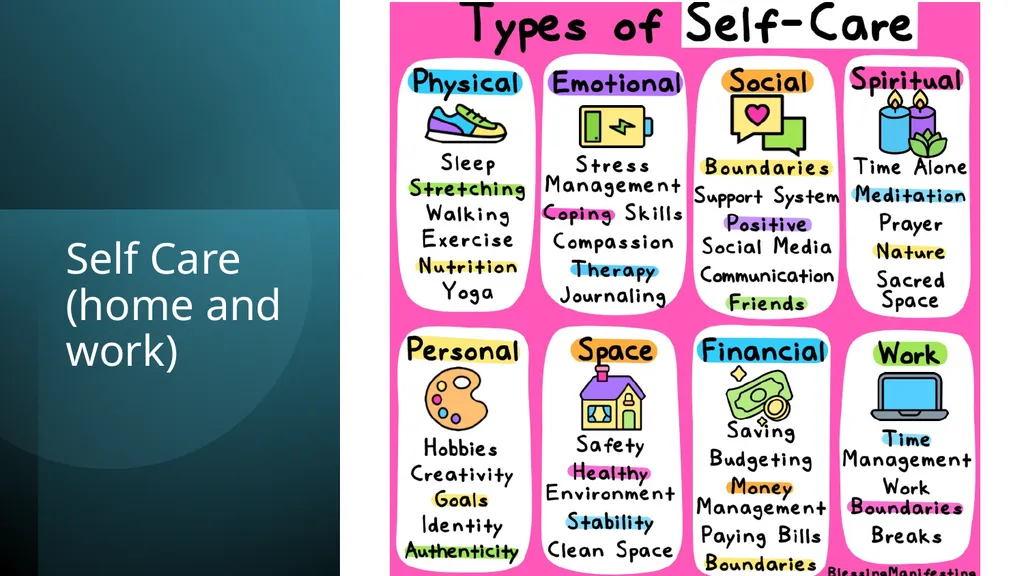
Self Care
(home and work)<br>
30
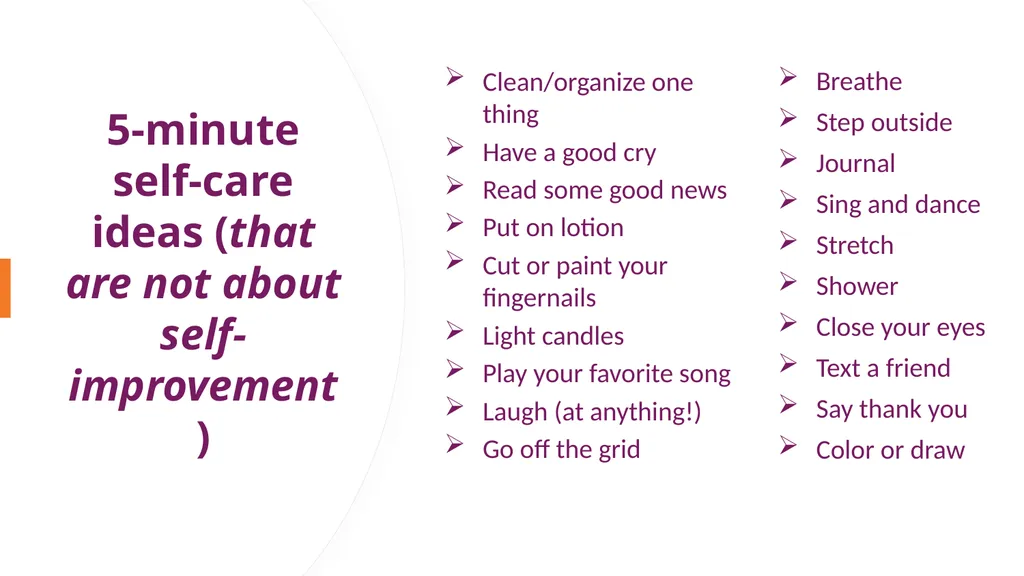
5-minute self-care ideas (that are not about self-improvement) Clean/organize one thing
Have a good cry
Read some good news
Put on lotion
Cut or paint your fingernails
Light candles
Play your favorite song
Laugh (at anything!)
Go off the grid Breathe
Step outside
Journal
Sing and dance
Stretch
Shower
Close your eyes
Text a friend
Say thank you
Color or draw<br>
Have a good cry
Read some good news
Put on lotion
Cut or paint your fingernails
Light candles
Play your favorite song
Laugh (at anything!)
Go off the grid Breathe
Step outside
Journal
Sing and dance
Stretch
Shower
Close your eyes
Text a friend
Say thank you
Color or draw<br>
31
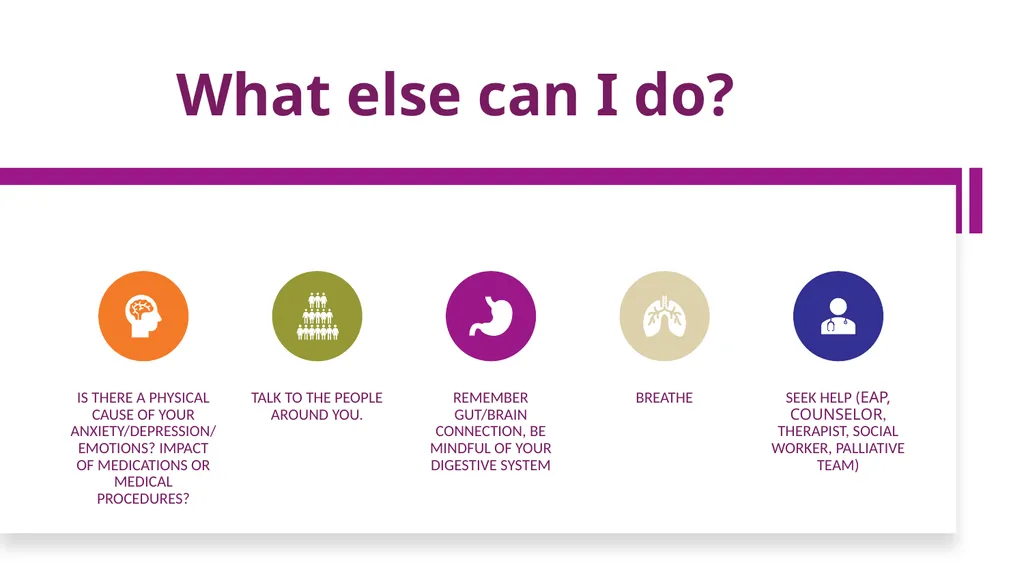
What else can I do?<br>
32
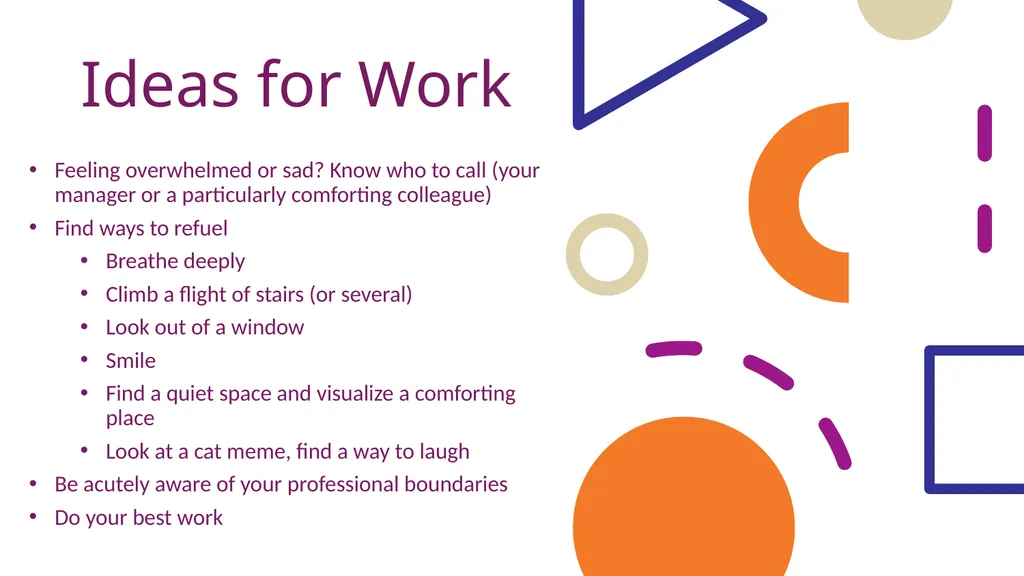
Ideas for Work Feeling overwhelmed or sad? Know who to call (your manager or a particularly comforting colleague)
Find ways to refuel
Breathe deeply
Climb a flight of stairs (or several)
Look out of a window
Smile
Find a quiet space and visualize a comforting place
Look at a cat meme, find a way to laugh
Be acutely aware of your professional boundaries
Do your best work<br>
Find ways to refuel
Breathe deeply
Climb a flight of stairs (or several)
Look out of a window
Smile
Find a quiet space and visualize a comforting place
Look at a cat meme, find a way to laugh
Be acutely aware of your professional boundaries
Do your best work<br>
33
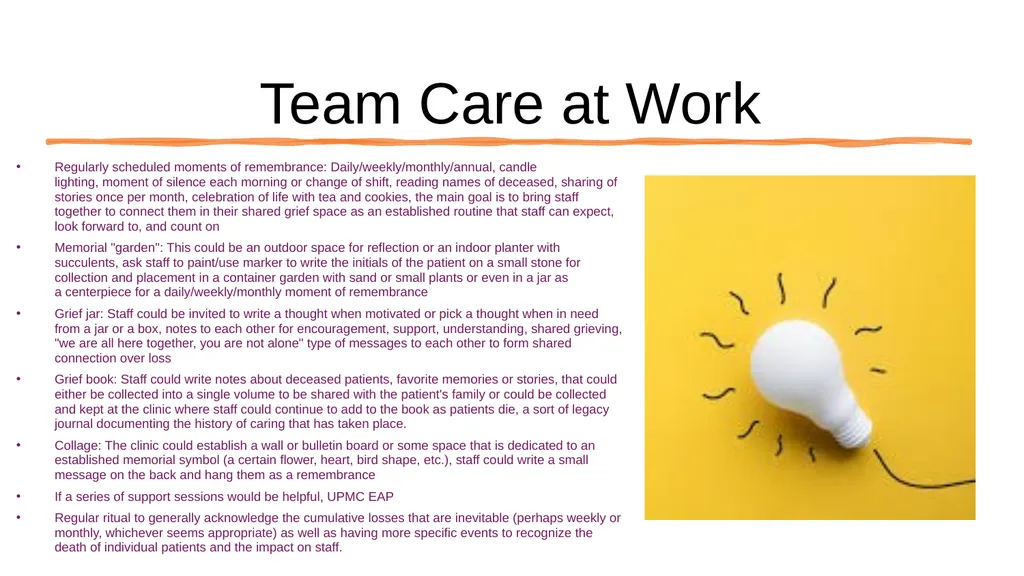
Team Care at Work Regularly scheduled moments of remembrance: Daily/weekly/monthly/annual, candle lighting, moment of silence each morning or change of shift, reading names of deceased, sharing of stories once per month, celebration of life with tea and cookies, the main goal is to bring staff together to connect them in their shared grief space as an established routine that staff can expect, look forward to, and count on
Memorial "garden": This could be an outdoor space for reflection or an indoor planter with succulents, ask staff to paint/use marker to write the initials of the patient on a small stone for collection and placement in a container garden with sand or small plants or even in a jar as a centerpiece for a daily/weekly/monthly moment of remembrance
Grief jar: Staff could be invited to write a thought when motivated or pick a thought when in need from a jar or a box, notes to each other for encouragement, support, understanding, shared grieving, "we are all here together, you are not alone" type of messages to each other to form shared connection over loss
Grief book: Staff could write notes about deceased patients, favorite memories or stories, that could either be collected into a single volume to be shared with the patient's family or could be collected and kept at the clinic where staff could continue to add to the book as patients die, a sort of legacy journal documenting the history of caring that has taken place.
Collage: The clinic could establish a wall or bulletin board or some space that is dedicated to an established memorial symbol (a certain flower, heart, bird shape, etc.), staff could write a small message on the back and hang them as a remembrance
If a series of support sessions would be helpful, UPMC EAP
Regular ritual to generally acknowledge the cumulative losses that are inevitable (perhaps weekly or monthly, whichever seems appropriate) as well as having more specific events to recognize the death of individual patients and the impact on staff.<br>
34
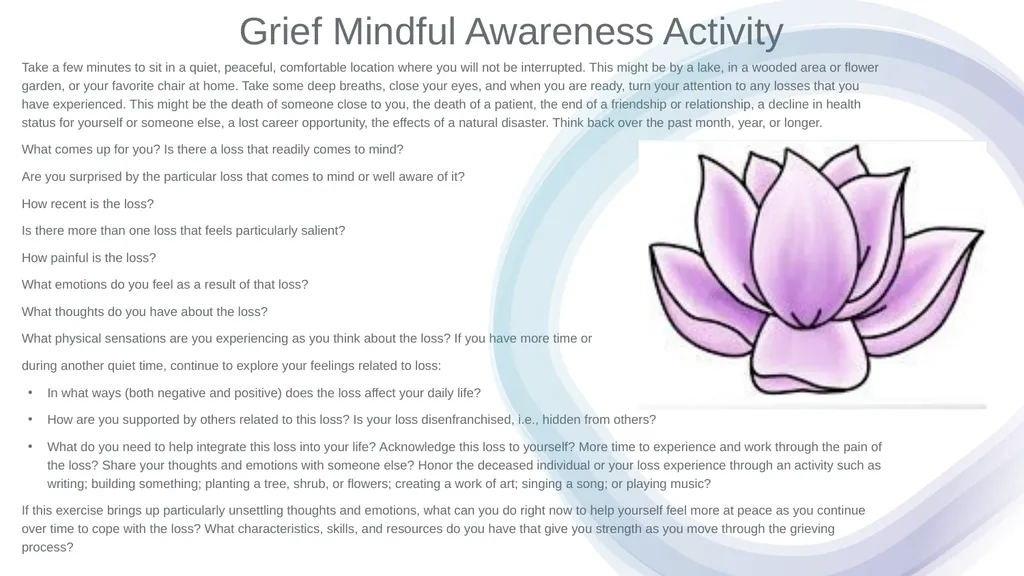
Grief Mindful Awareness Activity Take a few minutes to sit in a quiet, peaceful, comfortable location where you will not be interrupted. This might be by a lake, in a wooded area or flower garden, or your favorite chair at home. Take some deep breaths, close your eyes, and when you are ready, turn your attention to any losses that you have experienced. This might be the death of someone close to you, the death of a patient, the end of a friendship or relationship, a decline in health status for yourself or someone else, a lost career opportunity, the effects of a natural disaster. Think back over the past month, year, or longer.
What comes up for you? Is there a loss that readily comes to mind?
Are you surprised by the particular loss that comes to mind or well aware of it?
How recent is the loss?
Is there more than one loss that feels particularly salient?
How painful is the loss?
What emotions do you feel as a result of that loss?
What thoughts do you have about the loss?
What physical sensations are you experiencing as you think about the loss? If you have more time or
during another quiet time, continue to explore your feelings related to loss:
In what ways (both negative and positive) does the loss affect your daily life?
How are you supported by others related to this loss? Is your loss disenfranchised, i.e., hidden from others?
What do you need to help integrate this loss into your life? Acknowledge this loss to yourself? More time to experience and work through the pain of the loss? Share your thoughts and emotions with someone else? Honor the deceased individual or your loss experience through an activity such as writing; building something; planting a tree, shrub, or flowers; creating a work of art; singing a song; or playing music?
If this exercise brings up particularly unsettling thoughts and emotions, what can you do right now to help yourself feel more at peace as you continue over time to cope with the loss? What characteristics, skills, and resources do you have that give you strength as you move through the grieving process?<br>
35
Cultural Considerations
Grief is a common denominator...the expression of grief is not. Collective, community, family, or individual experience
Language to describe loss
Support providers (family, friends, faith and religious community/leaders, therapist)
Sense of familial duty or sacrifice
Faith, spirituality, philosophy, or atheism/agnosticism
Access to resources
Views on loss/dying/death and what comes next
Norms about how to express grief (stoic, emotional)
Outward expression may differ from internal experience<br>
36
Cultural Considerations
Grief is a common denominator...the expression of grief is not. Collective, community, family, or individual experience
Language to describe loss
Support providers (family, friends, faith and religious community/leaders, therapist)
Sense of familial duty or sacrifice
Faith, spirituality, philosophy, or atheism/agnosticism
Access to resources
Views on loss/dying/death and what comes next
Norms about how to express grief (stoic, emotional)
Outward expression may differ from internal experience<br>
Language to describe loss
Support providers (family, friends, faith and religious community/leaders, therapist)
Sense of familial duty or sacrifice
Faith, spirituality, philosophy, or atheism/agnosticism
Access to resources
Views on loss/dying/death and what comes next
Norms about how to express grief (stoic, emotional)
Outward expression may differ from internal experience<br>
37
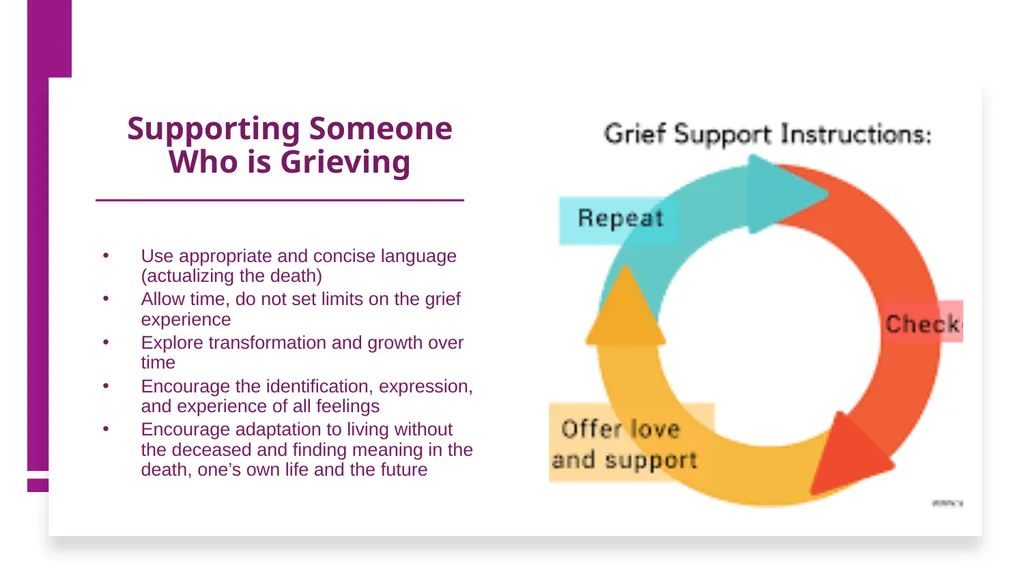
Supporting Someone Who is Grieving Use appropriate and concise language (actualizing the death)
Allow time, do not set limits on the grief experience
Explore transformation and growth over time
Encourage the identification, expression, and experience of all feelings
Encourage adaptation to living without the deceased and finding meaning in the death, one’s own life and the future<br>
Allow time, do not set limits on the grief experience
Explore transformation and growth over time
Encourage the identification, expression, and experience of all feelings
Encourage adaptation to living without the deceased and finding meaning in the death, one’s own life and the future<br>
38
Recognize Potential Communication Barriers Cultural misunderstandings, including language, family system/structure, decision-making process, accepted medical strategies/expectations, bias (perceived or otherwise)
Denial or disagreement
Emotion, including fear, guilt, and injustice
Education level, health literacy, previous experience with medical system
Language, including use of medical jargon or technical terms
Access to resources, especially those that may result in barriers to treatment or support
Other underlying issues<br>
39
Interventions and Strategies Normalize the grief experience
Listen, sometimes it is helpful to be quiet
Be compassionate and empathetic, remember that this is the person’s experience to live with
Use an informed biopsychosocial, strengths-based approach to empower the person to ask for help
Customize interventions to the person’s background, gender, resources, and needs (as defined by the person)
Consider coping style, personality, previous losses, access to and availability of support resources, as well as medical, psychiatric, and trauma history<br>
40
Interventions and Strategies Cont'd Be mindful of timing (assistance too early/too late reduces effectiveness)
Develop follow-up that is appropriate to the needs of the bereaved and follows best practices (programs with cut-offs are less effective than those with less frequent and longer term contact)
Use initial contact to develop rapport and provide psychoeducation allowing the bereaved to take the lead
Develop a strategy for identifying and engaging “high-risk” mourners<br>
41
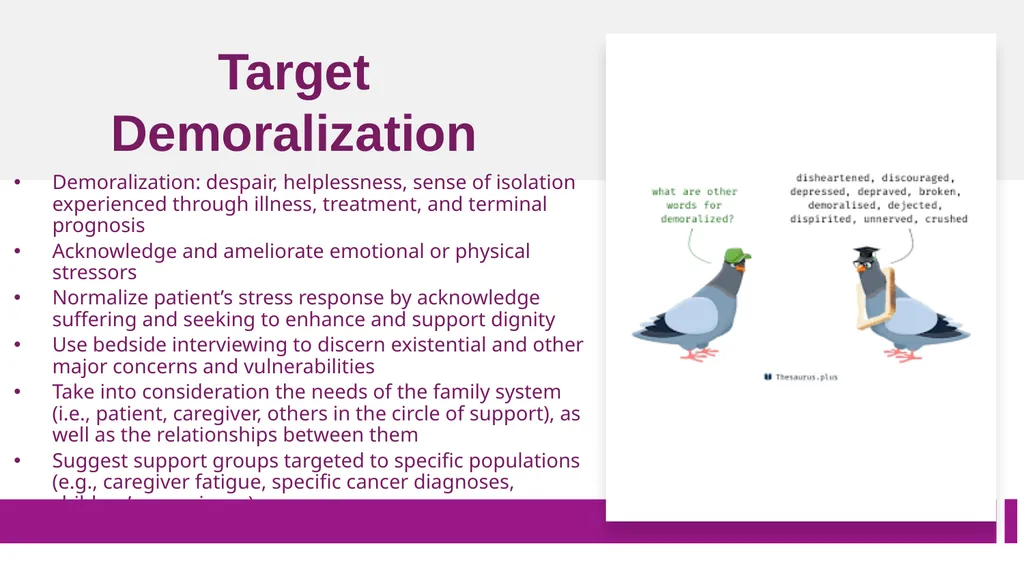
Target Demoralization Demoralization: despair, helplessness, sense of isolation experienced through illness, treatment, and terminal prognosis
Acknowledge and ameliorate emotional or physical stressors
Normalize patient’s stress response by acknowledge suffering and seeking to enhance and support dignity
Use bedside interviewing to discern existential and other major concerns and vulnerabilities
Take into consideration the needs of the family system (i.e., patient, caregiver, others in the circle of support), as well as the relationships between them
Suggest support groups targeted to specific populations (e.g., caregiver fatigue, specific cancer diagnoses, children’s experience)<br>
42
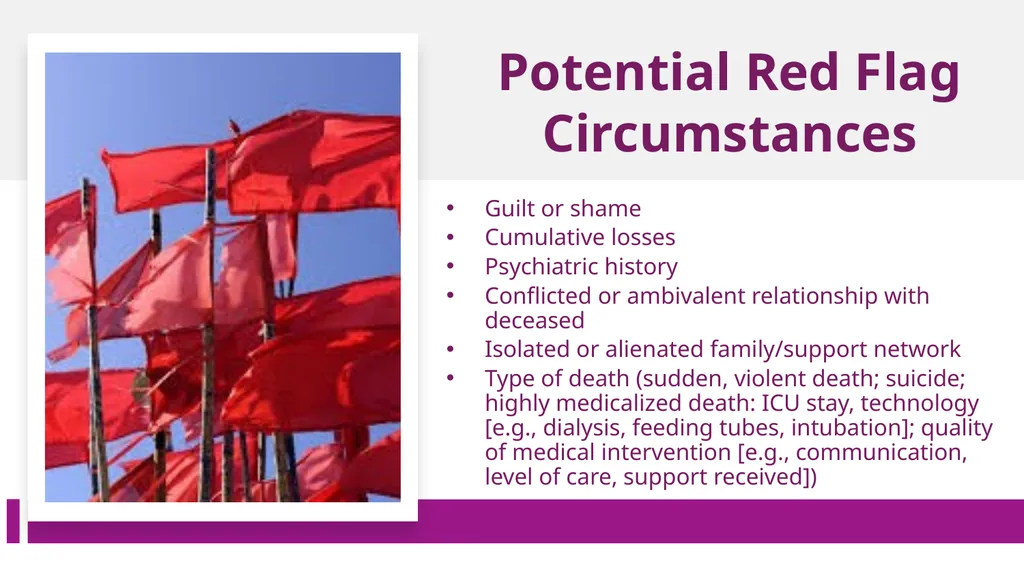
Potential Red Flag Circumstances Guilt or shame
Cumulative losses
Psychiatric history
Conflicted or ambivalent relationship with deceased
Isolated or alienated family/support network
Type of death (sudden, violent death; suicide; highly medicalized death: ICU stay, technology [e.g., dialysis, feeding tubes, intubation]; quality of medical intervention [e.g., communication, level of care, support received])<br>
43
What can I say? Ask about their person and their story
“I don’t know”
“I am here to do X,Y,Z”, be concrete
Use empathetic and supportive statements
Validate their feelings
Nothing – just listen<br>
“I don’t know”
“I am here to do X,Y,Z”, be concrete
Use empathetic and supportive statements
Validate their feelings
Nothing – just listen<br>
44
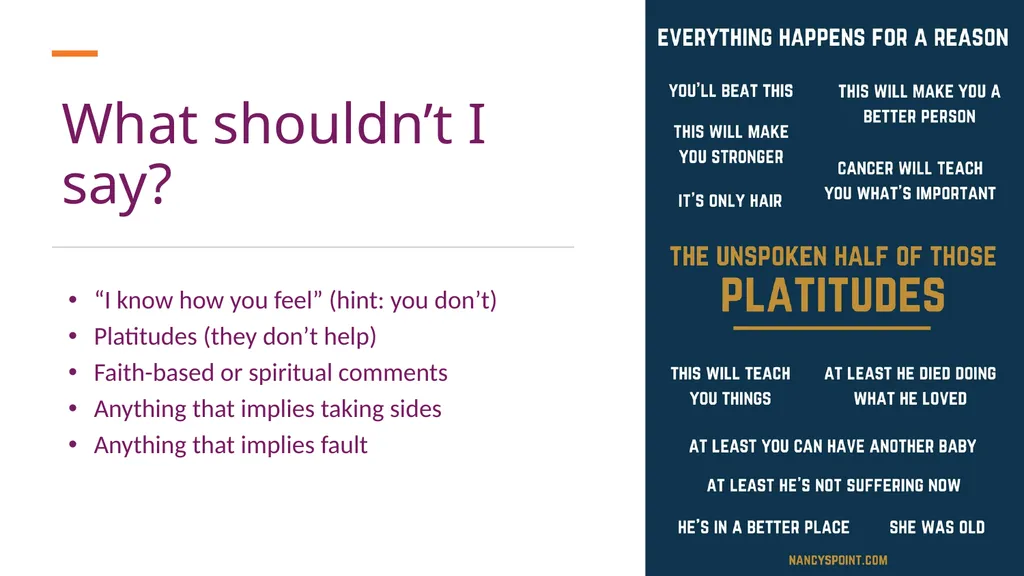
What shouldn’t I say? “I know how you feel” (hint: you don’t)
Platitudes (they don’t help)
Faith-based or spiritual comments
Anything that implies taking sides
Anything that implies fault<br>
Platitudes (they don’t help)
Faith-based or spiritual comments
Anything that implies taking sides
Anything that implies fault<br>
45
48<br>