TIA FISHER Ive had more than twenty different jobs, from artists model to TV presenter to English teacher. Its been great, but Ive never enjoyed my work as much as I do now, scribbling away at the next book, visiting schools and
"TIA FISHER “I’ve had more than twenty different" is the property of its rightful owner. Permission is granted to
download and print the materials on this website for personal, non-commercial use only, and to display it
on your personal computer provided you do not modify the materials and that you retain all copyright
notices contained in the materials. By downloading content from our website, you accept the terms of this
agreement.
Presentation Transcript
01
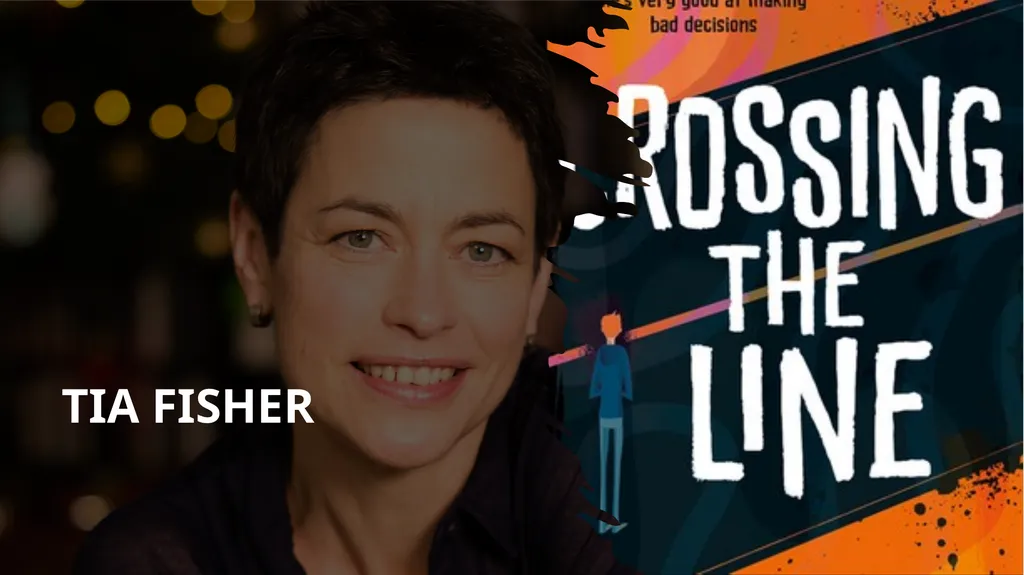
TIA FISHER<br>
02
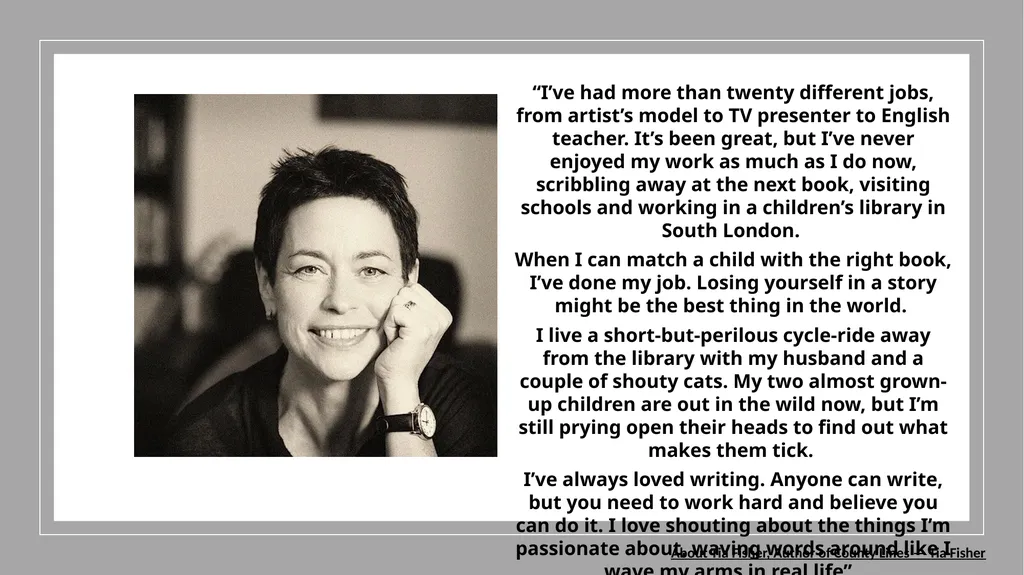
“I’ve had more than twenty different jobs, from artist’s model to TV presenter to English teacher. It’s been great, but I’ve never enjoyed my work as much as I do now, scribbling away at the next book, visiting schools and working in a children’s library in South London.
When I can match a child with the right book, I’ve done my job. Losing yourself in a story might be the best thing in the world.
I live a short-but-perilous cycle-ride away from the library with my husband and a couple of shouty cats. My two almost grown-up children are out in the wild now, but I’m still prying open their heads to find out what makes them tick.
I’ve always loved writing. Anyone can write, but you need to work hard and believe you can do it. I love shouting about the things I’m passionate about, waving words around like I wave my arms in real life”. About Tia Fisher, Author of County Lines — Tia Fisher<br>
03
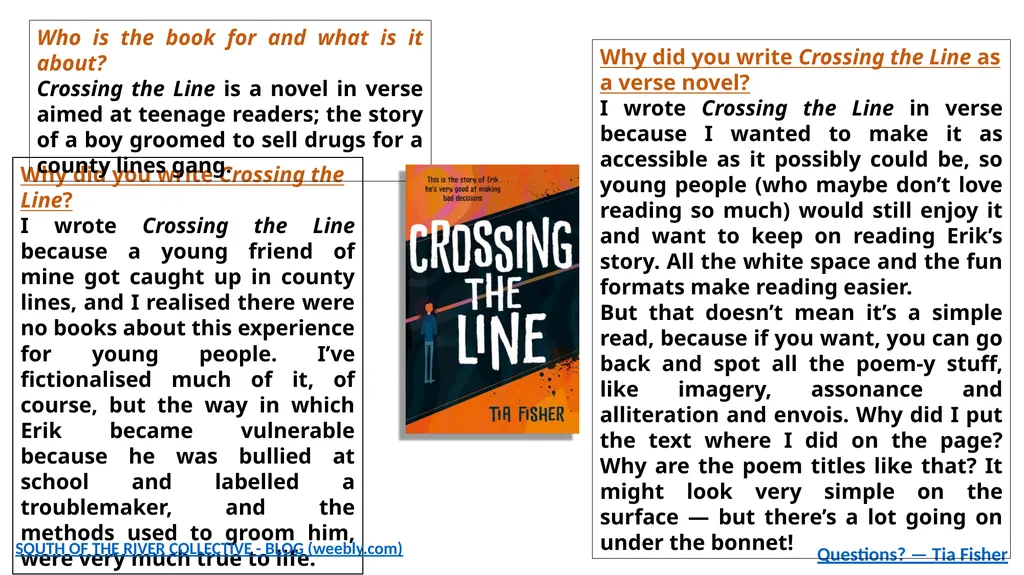
Why did you write Crossing the Line?
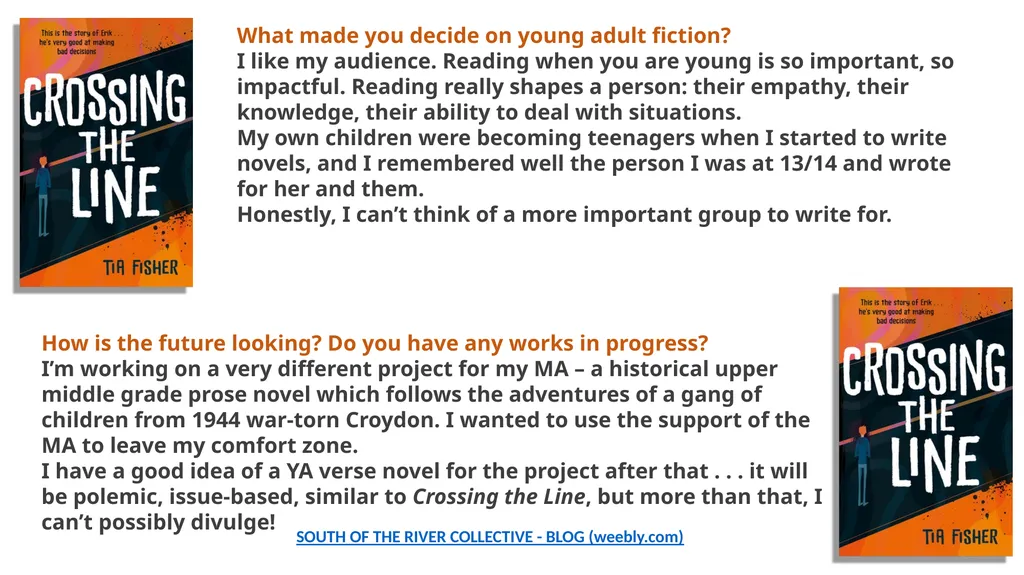
I wrote Crossing the Line because a young friend of mine got caught up in county lines, and I realised there were no books about this experience for young people. I’ve fictionalised much of it, of course, but the way in which Erik became vulnerable because he was bullied at school and labelled a troublemaker, and the methods used to groom him, were very much true to life. Questions? — Tia Fisher Why did you write Crossing the Line as a verse novel?
I wrote Crossing the Line in verse because I wanted to make it as accessible as it possibly could be, so young people (who maybe don’t love reading so much) would still enjoy it and want to keep on reading Erik’s story. All the white space and the fun formats make reading easier.
But that doesn’t mean it’s a simple read, because if you want, you can go back and spot all the poem-y stuff, like imagery, assonance and alliteration and envois. Why did I put the text where I did on the page? Why are the poem titles like that? It might look very simple on the surface — but there’s a lot going on under the bonnet! Who is the book for and what is it about?
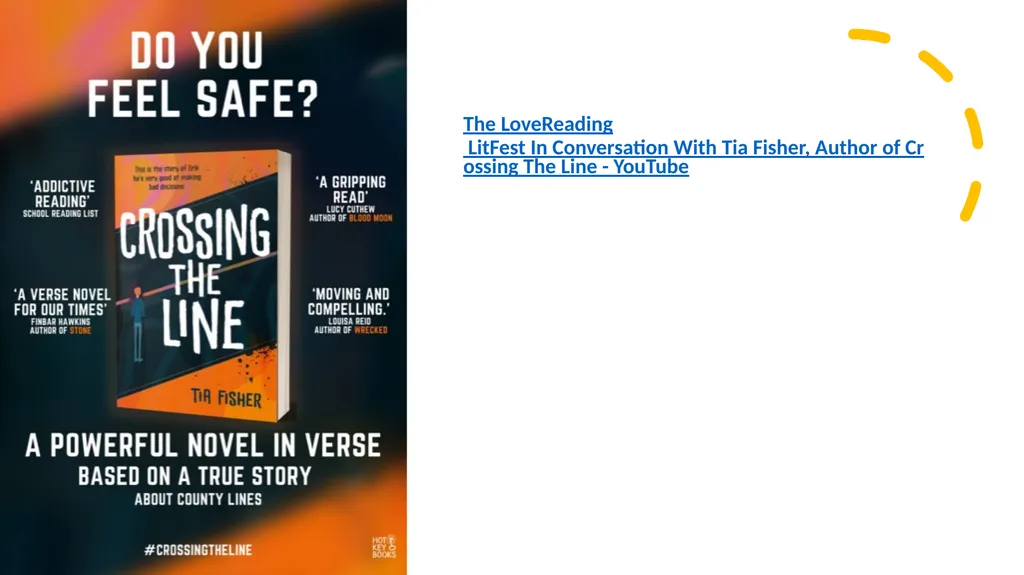
Crossing the Line is a novel in verse aimed at teenage readers; the story of a boy groomed to sell drugs for a county lines gang. SOUTH OF THE RIVER COLLECTIVE - BLOG (weebly.com)<br>
04
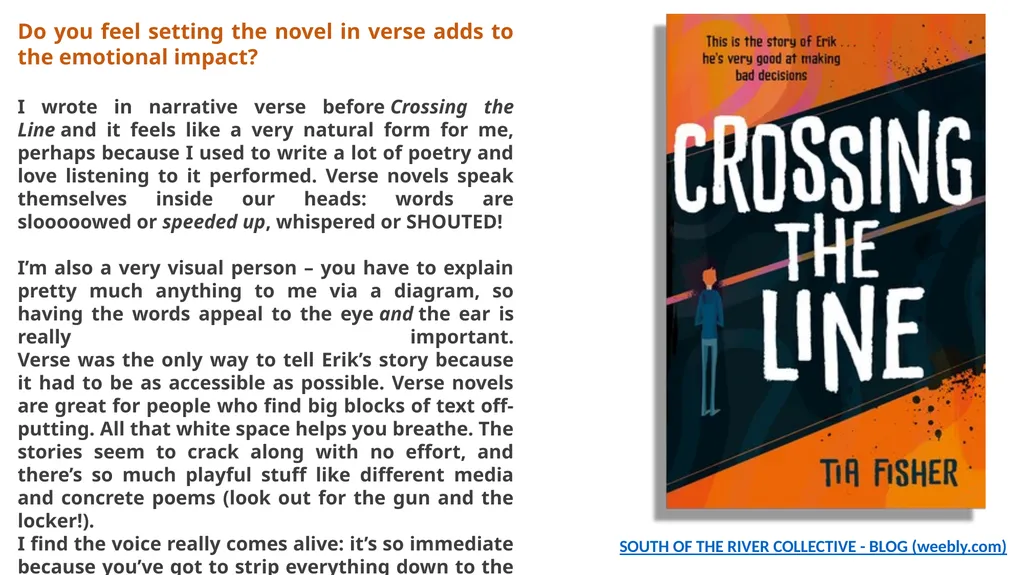
SOUTH OF THE RIVER COLLECTIVE - BLOG (weebly.com) Do you feel setting the novel in verse adds to the emotional impact?
I wrote in narrative verse before Crossing the Line and it feels like a very natural form for me, perhaps because I used to write a lot of poetry and love listening to it performed. Verse novels speak themselves inside our heads: words are slooooowed or speeded up, whispered or SHOUTED!
I’m also a very visual person – you have to explain pretty much anything to me via a diagram, so having the words appeal to the eye and the ear is really important. Verse was the only way to tell Erik’s story because it had to be as accessible as possible. Verse novels are great for people who find big blocks of text off-putting. All that white space helps you breathe. The stories seem to crack along with no effort, and there’s so much playful stuff like different media and concrete poems (look out for the gun and the locker!). I find the voice really comes alive: it’s so immediate because you’ve got to strip everything down to the essence of your character. You can offer these little nuggets of imagery and you’ve always got the end lines of a poem to cut across everything that came before, like a sucker punch.<br>
05
What made you decide on young adult fiction? I like my audience. Reading when you are young is so important, so impactful. Reading really shapes a person: their empathy, their knowledge, their ability to deal with situations.
My own children were becoming teenagers when I started to write novels, and I remembered well the person I was at 13/14 and wrote for her and them.
Honestly, I can’t think of a more important group to write for. How is the future looking? Do you have any works in progress? I’m working on a very different project for my MA – a historical upper middle grade prose novel which follows the adventures of a gang of children from 1944 war-torn Croydon. I wanted to use the support of the MA to leave my comfort zone. I have a good idea of a YA verse novel for the project after that . . . it will be polemic, issue-based, similar to Crossing the Line, but more than that, I can’t possibly divulge! SOUTH OF THE RIVER COLLECTIVE - BLOG (weebly.com)<br>
06
The LoveReading LitFest In Conversation With Tia Fisher, Author of Crossing The Line - YouTube<br>