Tooth Fusion By Bushra Meraj Histology Embryology Section D218 Professor Billelo What is tooth fusion? Tooth fusion is the union of two normally separated tooth germs into one large wide crown (false macrodontia) Fusion may be complete or
"Tooth Fusion By Bushra Meraj Histology &" is the property of its rightful owner. Permission is granted to
download and print the materials on this website for personal, non-commercial use only, and to display it
on your personal computer provided you do not modify the materials and that you retain all copyright
notices contained in the materials. By downloading content from our website, you accept the terms of this
agreement.
Presentation Transcript
01
Tooth Fusion By Bushra Meraj
Histology & Embryology
Section D218
Professor Billelo<br>
02
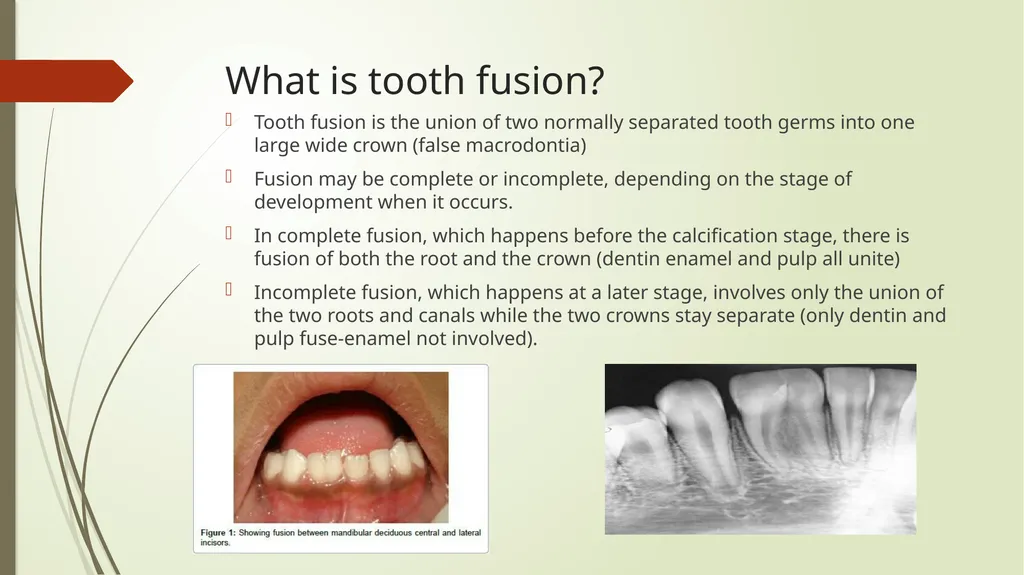
What is tooth fusion? Tooth fusion is the union of two normally separated tooth germs into one large wide crown (false macrodontia)
Fusion may be complete or incomplete, depending on the stage of development when it occurs.
In complete fusion, which happens before the calcification stage, there is fusion of both the root and the crown (dentin enamel and pulp all unite)
Incomplete fusion, which happens at a later stage, involves only the union of the two roots and canals while the two crowns stay separate (only dentin and pulp fuse-enamel not involved).<br>
03
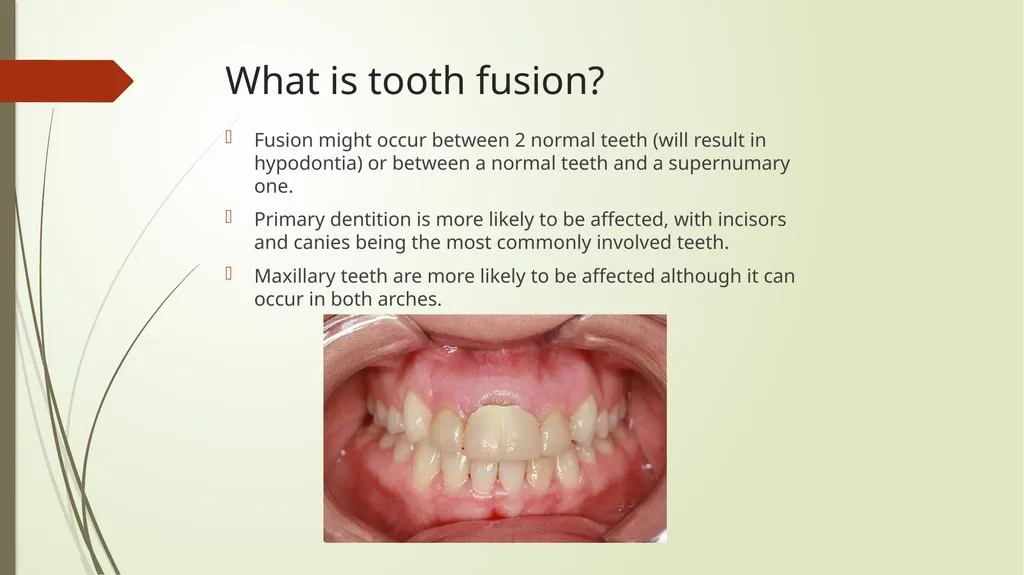
What is tooth fusion? Fusion might occur between 2 normal teeth (will result in hypodontia) or between a normal teeth and a supernumary one.
Primary dentition is more likely to be affected, with incisors and canies being the most commonly involved teeth.
Maxillary teeth are more likely to be affected although it can occur in both arches.<br>
04
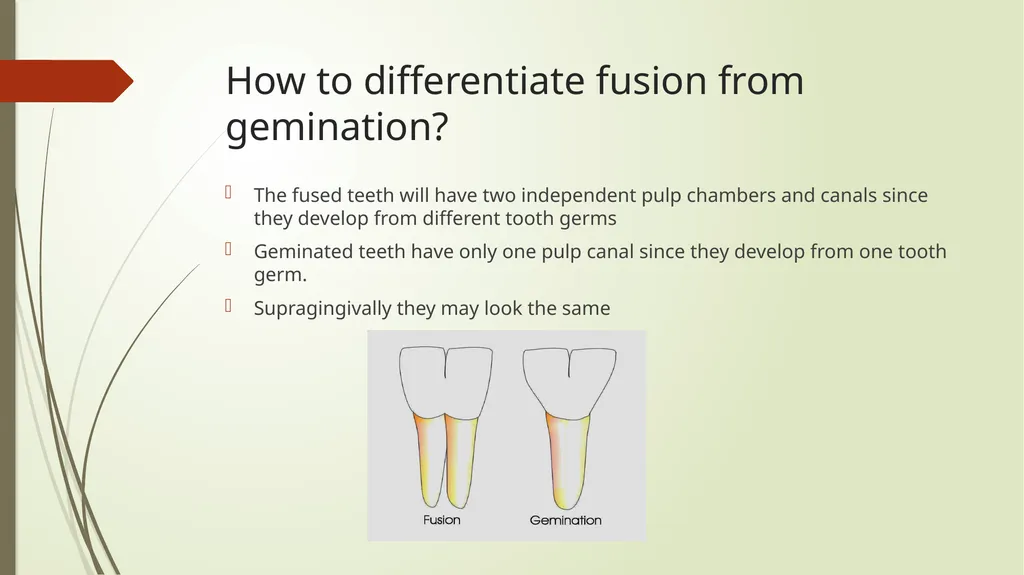
How to differentiate fusion from gemination? The fused teeth will have two independent pulp chambers and canals since they develop from different tooth germs
Geminated teeth have only one pulp canal since they develop from one tooth germ.
Supragingivally they may look the same<br>
05
Possible causes of fusion Physical pressure/force can cause increased pressure between developing tooth germs
Trauma to the affected tooth
Tetrogenic effects of certain medications (thalidomide for viral infections)
Increased use of certain vitamins (Vitamin A)
Genetic predisposition-tends to run in families
Racial difference-certain races more prone to developing fused teeth<br>
06
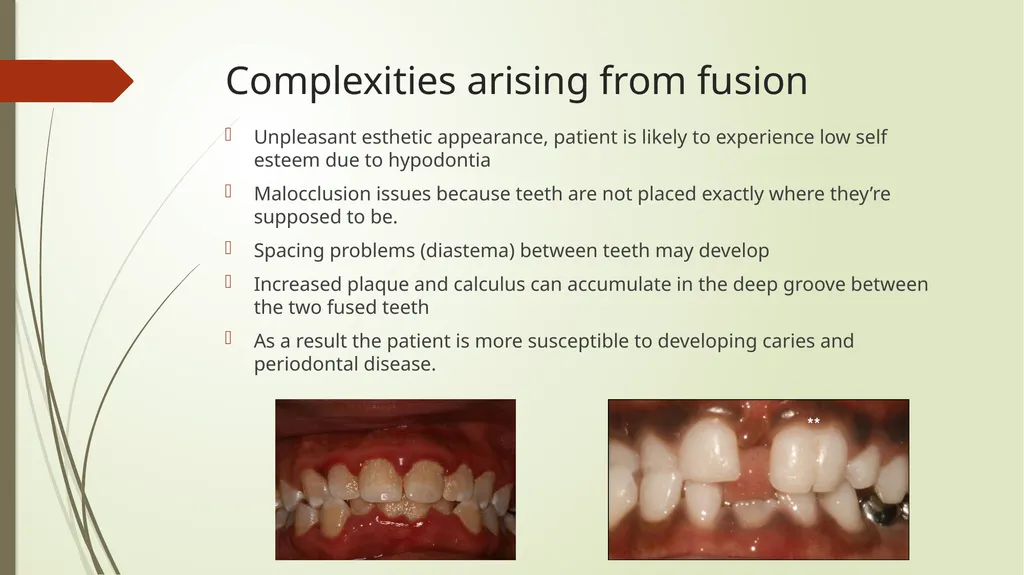
Complexities arising from fusion Unpleasant esthetic appearance, patient is likely to experience low self esteem due to hypodontia
Malocclusion issues because teeth are not placed exactly where they’re supposed to be.
Spacing problems (diastema) between teeth may develop
Increased plaque and calculus can accumulate in the deep groove between the two fused teeth
As a result the patient is more susceptible to developing caries and periodontal disease.<br>
07
Treatment Treatment usually varies depending on the patient’s age, the size and location of his fused teeth as well as the health of his other teeth and gingiva.
If the patient is young or the fused teeth are not very large/problematic, the dentist may decide to keep the fused teeth untouched.
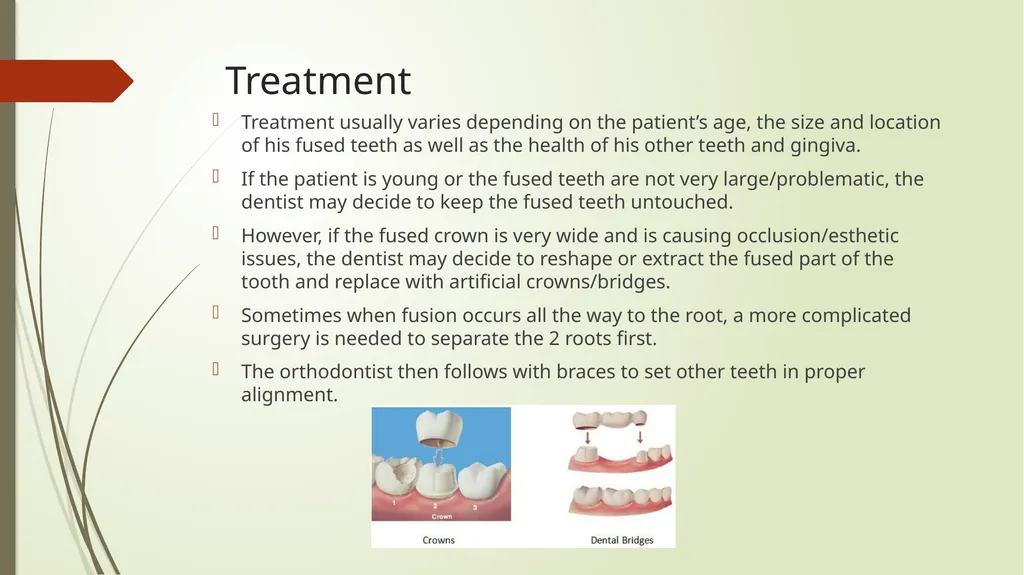
However, if the fused crown is very wide and is causing occlusion/esthetic issues, the dentist may decide to reshape or extract the fused part of the tooth and replace with artificial crowns/bridges.
Sometimes when fusion occurs all the way to the root, a more complicated surgery is needed to separate the 2 roots first.
The orthodontist then follows with braces to set other teeth in proper alignment.<br>
08
Role of dental team It is the priority of the dental team to teach affected individuals self confidence esp since the anomaly occurs in anterior teeth and affects one’s smile.
We should teach the patient how to practice good dental hygiene (brushing twice and flossing daily) since the deep groove in fused teeth is more likely to accumulate plaque and bacteria.
Dental care providers should encorage such patients to visit the dentist more frequently for cleaning and preventive treatments since they are more likely to develop caries and periodontal disease. If they do develop such problems, referals to specialist should be provided.
Lastly, make sure to treat affected individuals with compassion and kindness so they will be more likely to keep up with their dental visits and practice good oral hygiene at home.<br>
09
Resources What is tooth fusion and gemination? 20 Oct 2012 https://askanorthodontist.com/braces/what-is-tooth-fusion-gemination
Ferguson, Matthews. Tooth fusion. 10 May 2017. https://en.m.wikipedia.org/wiki/Tooth_fusion
Fehrenbach, Margaret and Tracy Popowins (2016). Illustrated Dental Embryology Histology and Anatomy. 4th Edition. Maryland Heights, Missouri Ellen Sanders.
Shrivastav, Sandhya and Tijare, Manisha. Fusion/Double Teeth. Journal of Indian Academy of Oral Medicine and Radiology. July-Sept 2011 1, 2, 3 pgs 5468-5470.<br>