TRANSCRIPTION TRANSCRIPTION The process of copying genetic information from one strand of the DNA into RNA is termed as transcription. Here also, the principle of complementarity governs the process of transcription, except the adenosine
"TRANSCRIPTION TRANSCRIPTION The process of copying" is the property of its rightful owner. Permission is granted to
download and print the materials on this website for personal, non-commercial use only, and to display it
on your personal computer provided you do not modify the materials and that you retain all copyright
notices contained in the materials. By downloading content from our website, you accept the terms of this
agreement.
Presentation Transcript
01
TRANSCRIPTION<br>
02
TRANSCRIPTION
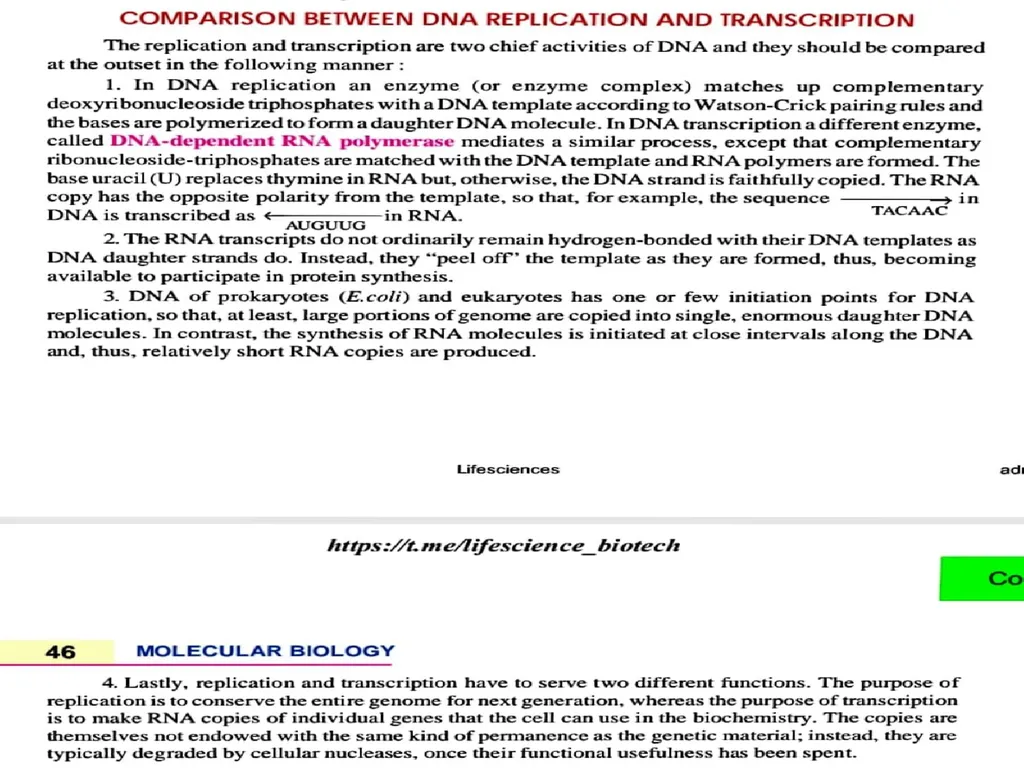
The process of copying genetic information from one strand of the DNA into RNA is termed as transcription. Here also, the principle of complementarity governs the process of transcription, except the adenosine complements now forms base pair with uracil instead of thymine. However, unlike in the process of replication, which once set in, the total DNA of an organism gets duplicated, in transcription only a segment of DNA and only one of the strands is copied into RNA. This necessitates defining the boundaries that would demarcate the region and the strand of DNA that would be transcribed.<br>
03
First, if both strands act as a template, they would code for RNA molecule with different sequences, and in turn, if they code for proteins, the sequence of amino acids in the proteins would be different. Hence, one segment of the DNA would be coding for two different proteins, and this would complicate the genetic information transfer machinery. Second, the two RNA molecules if produced simultaneously would be complementary to each other, hence would form a double stranded RNA. This would prevent RNA from being translated into protein and the exercise of transcription would become a futile one.<br>
04
Transcription Unit
A transcription unit in DNA is defined primarily by the three regions in the DNA:
(i) A Promoter
(ii) The Structural gene
(iii) A Terminator<br>
05
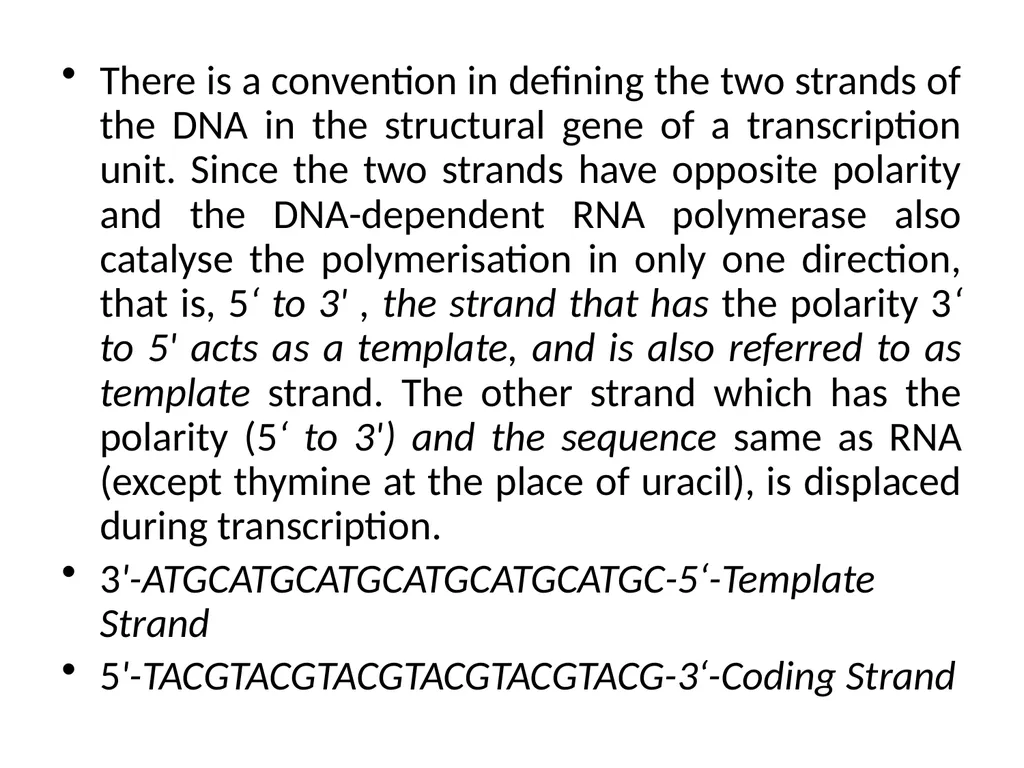
There is a convention in defining the two strands of the DNA in the structural gene of a transcription unit. Since the two strands have opposite polarity and the DNA-dependent RNA polymerase also catalyse the polymerisation in only one direction, that is, 5‘ to 3' , the strand that has the polarity 3‘ to 5' acts as a template, and is also referred to as template strand. The other strand which has the polarity (5‘ to 3') and the sequence same as RNA (except thymine at the place of uracil), is displaced during transcription.
3'-ATGCATGCATGCATGCATGCATGC-5‘-Template Strand
5'-TACGTACGTACGTACGTACGTACG-3‘-Coding Strand<br>
06
The promoter and terminator flank the structural gene in a transcription unit. The promoter is said to be located towards 5'-end (upstream) of the structural gene.
It is a DNA sequence that provides binding site for RNA polymerase, and it is the presence of a promoter in a transcription unit that also defines the template and coding strands.
By switching its position with terminator, the definition of coding and template strands could be reversed.
The terminator is located towards 3'-end (downstream) of the coding strand and it usually defines the end of the process of transcription.
There are additional regulatory sequences that may be present further upstream or downstream to the promoter. Some of the properties of these sequences shall be discussed while dealing with regulation of gene expression.<br>
07
Transcription Unit and the Gene:
A gene is defined as the functional unit of inheritance. Though there is no ambiguity that the genes are located on the DNA, it is difficult to literally define a gene in terms of DNA sequence.
The DNA sequence coding for tRNA or rRNA molecule also define a gene.
However by defining a cistron as a segment of DNA coding for a polypeptide, the structural gene in a transcription unit could be said as monocistronic (mostly in eukaryotes) or polycistronic (mostly in bacteria or prokaryotes).
In eukaryotes, the monocistronic structural genes have interrupted coding sequences – the genes in eukaryotes are split. The coding sequences or expressed sequences are defined as exons.
Exons are said to be those sequence that appear in mature or processed RNA. The exons are interrupted by introns. Introns or intervening sequences do not appear in mature or processed RNA<br>
08
Types of RNA and the process of Transcription
In bacteria, there are three major types of RNAs: mRNA (messenger RNA), tRNA (transfer RNA), and rRNA (ribosomal RNA).
All three RNAs are needed to synthesise a protein in a cell. The mRNA provides the template, tRNA brings aminoacids and reads the genetic code, and rRNAs play structural and catalytic role during translation.
There is single DNA-dependent RNA polymerase that catalyses transcription of all types of RNA in bacteria. RNA polymerase binds to promoter and initiates transcription (Initiation).
It uses nucleoside triphosphates as substrate and polymerises in a template depended fashion following the rule of complementarity.
It somehow also facilitates opening of the helix and continues elongation. Only a short stretch of RNA remains bound to the enzyme. Once the polymerases reaches the terminator region, the nascent RNA falls off, so also the RNA polymerase. This results in termination of transcription.<br>
09
The RNA polymerase is only capable of catalysing the process of elongation. It associates transiently with initiation-factor (s) and termination-factor (r) to initiate and terminate the transcription, respectively.
Association with these factors alter the specificity of the RNA polymerase to either initiate or terminate.
In bacteria, since the mRNA does not require any processing to become active, and also since transcription and translation take place in the same compartment (there is no separation of cytosol and nucleus in bacteria), many times the translation can begin much before the mRNA is fully transcribed.
Consequently, the transcription and translation can be coupled in bacteria.<br>
10
In eukaryotes, there are two additional complexities –
(i) There are at least three RNA polymerases in the nucleus (in addition to the RNA polymerase found in the organelles). There is a clear cut division of labour. The RNA polymerase I transcribes rRNAs (28S, 18S, and 5.8S), whereas the RNA polymerase III is responsible for transcription of tRNA, 5srRNA, and snRNAs (small nuclear RNAs). The RNA polymerase II transcribes precursor of mRNA, the heterogeneous nuclear RNA (hnRNA).
(ii) The second complexity is that the primary transcripts contain both the exons and the introns and are non-functional. Hence, it is subjected to a process called splicing where the introns are removed and exons are joined in a defined order.
hnRNA undergoes additional processing called as capping and tailing. In capping an unusual nucleotide (methyl guanosine triphosphate) is added to the 5'-end of hnRNA.
In tailing, adenylate residues (200-300) are added at 3'-end in a template independent manner. It is the fully processed hnRNA, now called mRNA, that is transported out of the nucleus for translation. The split-gene arrangements represent probably an ancient feature of the genome.<br>