
Treatment Approaches: Childhood Apraxia of Speech
TG
Published · 36 slides · 0 views

1 / 1



Description
Treatment Approaches: Childhood Apraxia of Speech (CAS) NSW EBP PHONOLOGY GROUP Leaders: Elise Baker Bronwyn Carrigg Presenters: Louise Petersen Lauren Hamill Best external evidence Best internal evidence (from client factors
Related Topics
Share
Embed code
Download this presentation From Below
"Treatment Approaches: Childhood Apraxia of Speech" is the property of its rightful owner. Permission is granted to download and print the materials on this website for personal, non-commercial use only, and to display it on your personal computer provided you do not modify the materials and that you retain all copyright notices contained in the materials. By downloading content from our website, you accept the terms of this agreement.
Presentation Transcript
01
Treatment Approaches: Childhood Apraxia
of Speech (CAS) NSW EBP PHONOLOGY GROUP
Leaders: Elise Baker & Bronwyn Carrigg
Presenters: Louise Petersen & Lauren Hamill<br>
Leaders: Elise Baker & Bronwyn Carrigg
Presenters: Louise Petersen & Lauren Hamill<br>
02
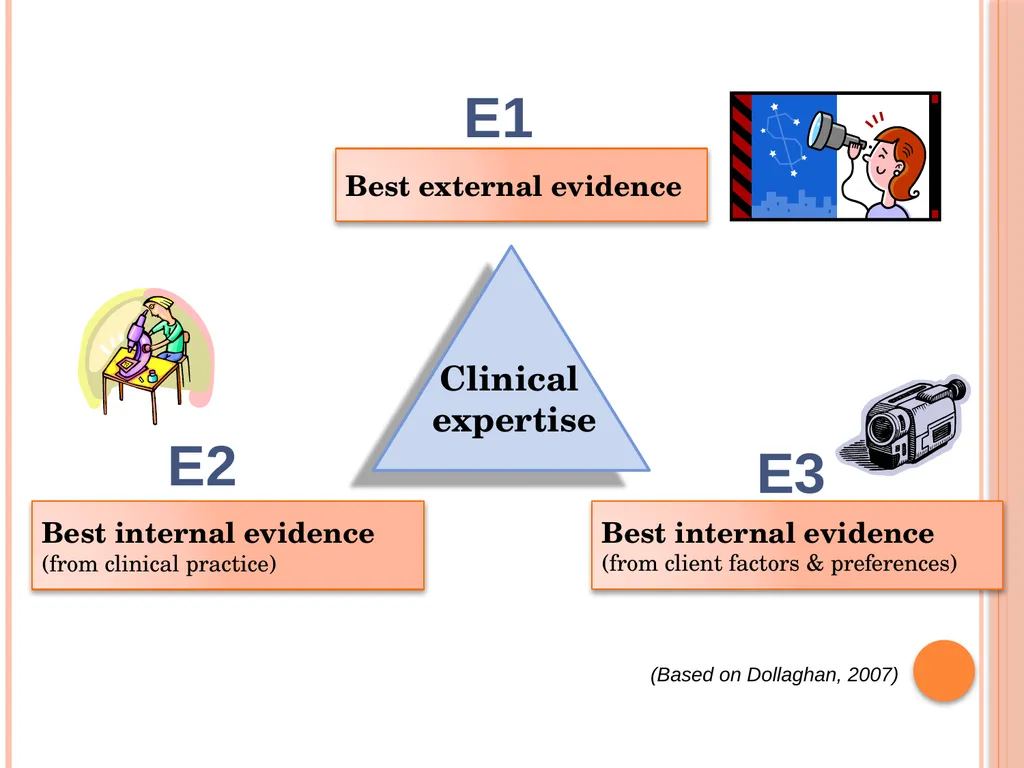
Best external evidence Best internal evidence
(from client factors & preferences) Best internal evidence
(from clinical practice) Clinical
expertise E1 E2 E3 (Based on Dollaghan, 2007)<br>
(from client factors & preferences) Best internal evidence
(from clinical practice) Clinical
expertise E1 E2 E3 (Based on Dollaghan, 2007)<br>
03
Childhood Apraxia of Speech (CAS) Childhood apraxia of speech (CAS) is a neurological childhood (pediatric) speech sound disorder, in which the precision and consistency of movements underlying speech are impaired in the absence of neuromuscular deficits (e.g. abnormal reflexes, abnormal tone). CAS may occur as a result of known neurological impairment, in association with complex neurobehavioral disorders of known or unknown origin, or as an idiopathic neurogenic speech sound disorder. The core impairment in planning and/or programming spatiotemporal parameters of movement sequences results in errors in speech sound production and prosody.
ASHA (2007)<br>
ASHA (2007)<br>
04
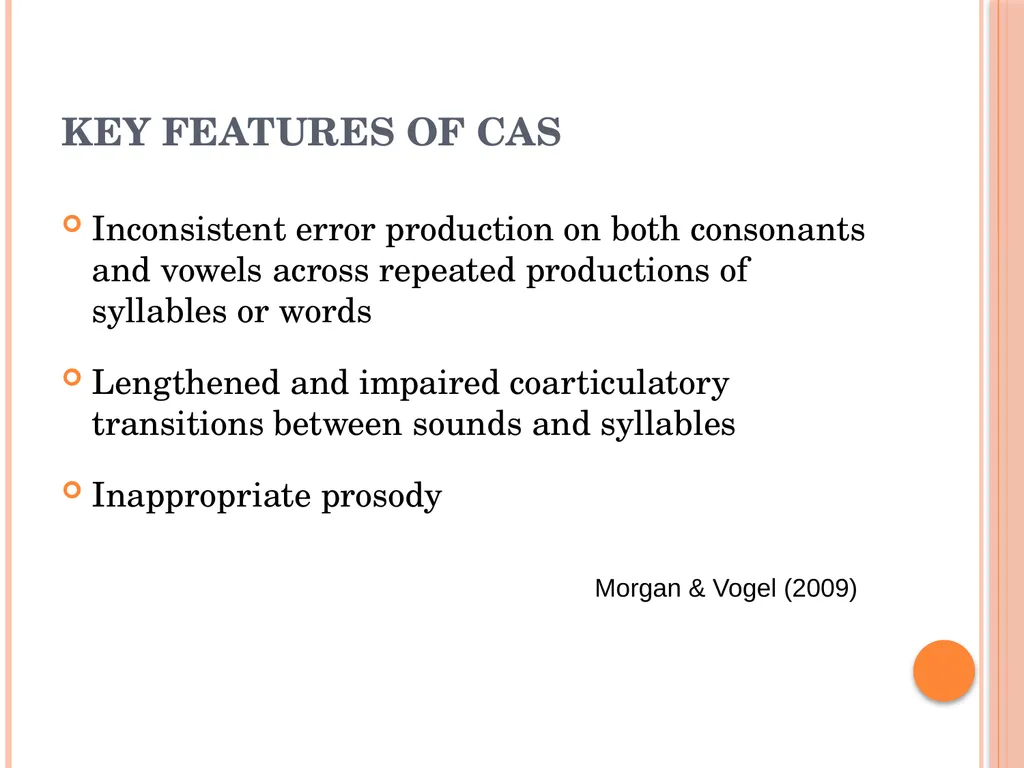
KEY FEATURES OF CAS Inconsistent error production on both consonants and vowels across repeated productions of syllables or words
Lengthened and impaired coarticulatory transitions between sounds and syllables
Inappropriate prosody
Morgan & Vogel (2009)<br>
Lengthened and impaired coarticulatory transitions between sounds and syllables
Inappropriate prosody
Morgan & Vogel (2009)<br>
05
So, what is the nature of the evidence-base for treatment of CAS?<br>
06
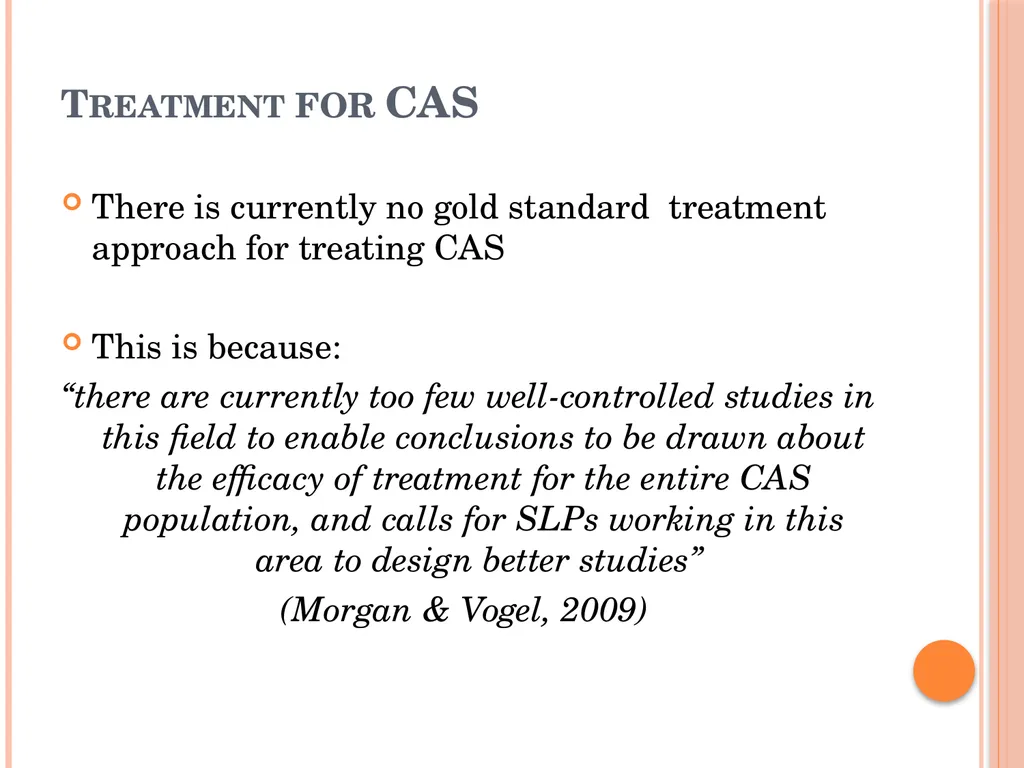
Treatment for CAS There is currently no gold standard treatment approach for treating CAS
This is because:
“there are currently too few well-controlled studies in this field to enable conclusions to be drawn about the efficacy of treatment for the entire CAS population, and calls for SLPs working in this area to design better studies”
(Morgan & Vogel, 2009)<br>
This is because:
“there are currently too few well-controlled studies in this field to enable conclusions to be drawn about the efficacy of treatment for the entire CAS population, and calls for SLPs working in this area to design better studies”
(Morgan & Vogel, 2009)<br>
07
SO, WHAT EVIDENCE IS AVAILABLE? Lower level studies, usually based on one or a few children.
This year, we have critically appraised 10 studies.
An overview of the principles that underscore the treatment approaches helps to understand the nature of the evidence.<br>
This year, we have critically appraised 10 studies.
An overview of the principles that underscore the treatment approaches helps to understand the nature of the evidence.<br>
08
GENERAL PRINCIPLES
(STRAND, 2012) The goal or the focus of the treatment of CAS is to improve the individual’s ability to assemble, retrieve, and execute motor plans for speech. The focus or target of treatment is the movement vs. the sound.
Practice should focus on making those movement transitions, in the context of speech.
At first, the clinician will provide maximum support by providing visual, tactile and auditory models, fading those cues over time
Because the goal of treatment is to improve movement accuracy, a number of approaches are grounded in the principles of motor learning<br>
09
PRINCIPLES OF MOTOR LEARNING (PML)
(BASED ON MAAS ET AL., 2008) What is Motor Learning?
A process of acquiring the capability for producing skilled action
It occurs as a result of experience and practice
It is influenced by a variety of factors
These factors are thought to make a difference in therapy<br>
A process of acquiring the capability for producing skilled action
It occurs as a result of experience and practice
It is influenced by a variety of factors
These factors are thought to make a difference in therapy<br>
10
Principles of Motor Learning (PML)
(based on Maas et al., 2008) Motor Performance - How the movement is
performed during training, within the session
Motor Learning - how the movement is
performed at another time (i.e., generalization)
Precusors to Motor Learning:
Motivation and Attention
Pre-Practice
Remembering for CAS to consider:
Rate
Prosody
Practice and feedback conditions!<br>
performed during training, within the session
Motor Learning - how the movement is
performed at another time (i.e., generalization)
Precusors to Motor Learning:
Motivation and Attention
Pre-Practice
Remembering for CAS to consider:
Rate
Prosody
Practice and feedback conditions!<br>
11
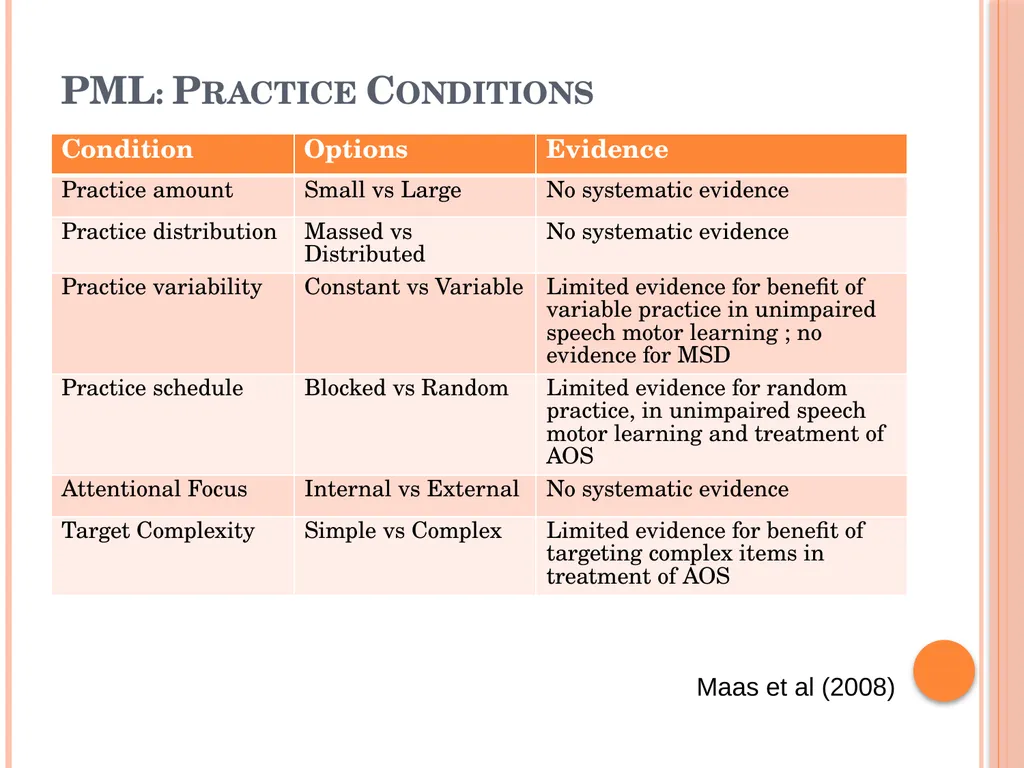
PML: Practice Conditions Maas et al (2008)<br>
12
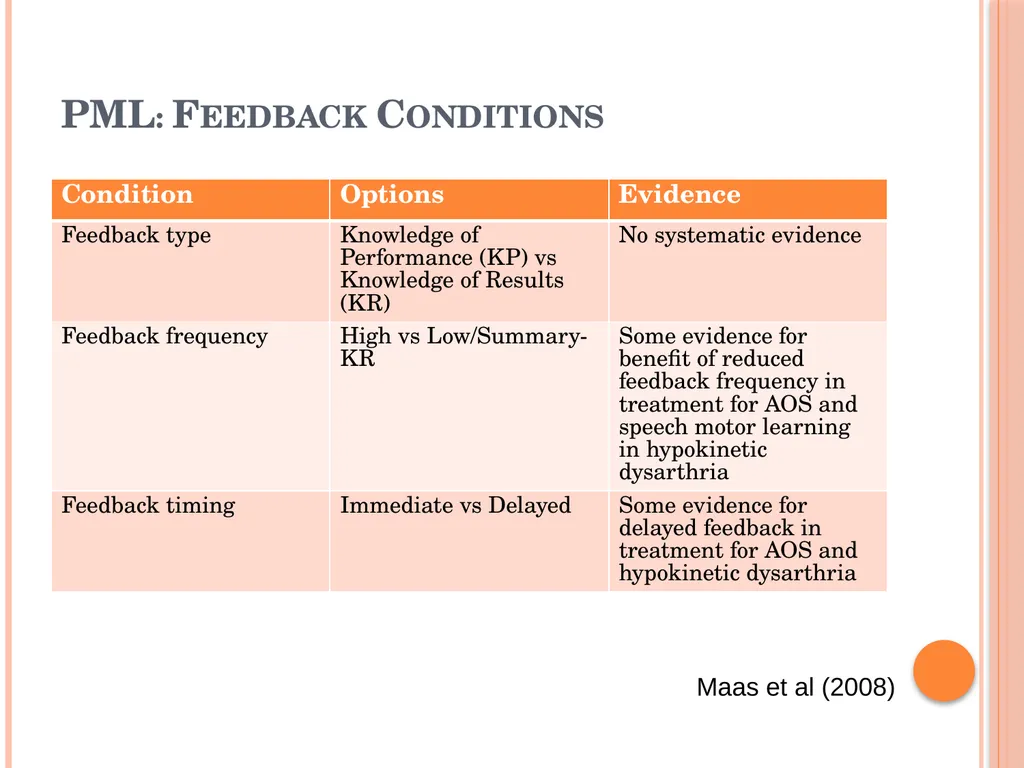
PML: Feedback Conditions Maas et al (2008)<br>
13
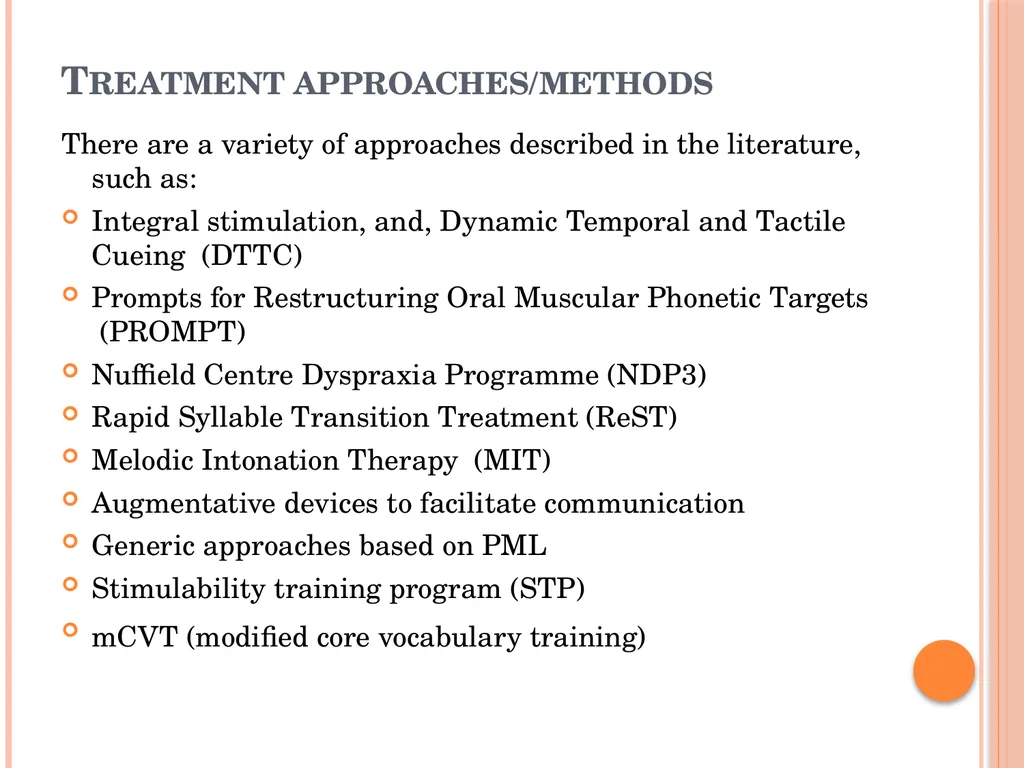
Treatment approaches/methods There are a variety of approaches described in the literature, such as:
Integral stimulation, and, Dynamic Temporal and Tactile Cueing (DTTC)
Prompts for Restructuring Oral Muscular Phonetic Targets (PROMPT)
Nuffield Centre Dyspraxia Programme (NDP3)
Rapid Syllable Transition Treatment (ReST)
Melodic Intonation Therapy (MIT)
Augmentative devices to facilitate communication
Generic approaches based on PML
Stimulability training program (STP)
mCVT (modified core vocabulary training)<br>
14
Brief description of Integral Stimulation and Dynamic Temporal and Tactile Cueing (DTTC)<br>
15
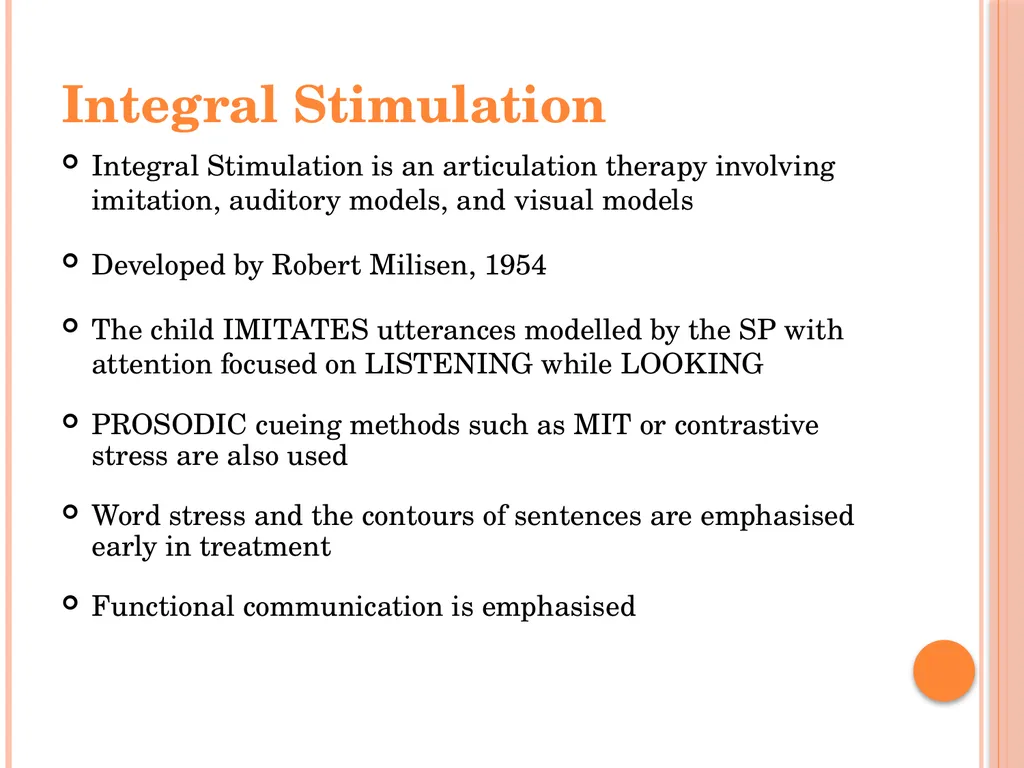
Integral Stimulation Integral Stimulation is an articulation therapy involving imitation, auditory models, and visual models
Developed by Robert Milisen, 1954
The child IMITATES utterances modelled by the SP with attention focused on LISTENING while LOOKING
PROSODIC cueing methods such as MIT or contrastive stress are also used
Word stress and the contours of sentences are emphasised early in treatment
Functional communication is emphasised<br>
16
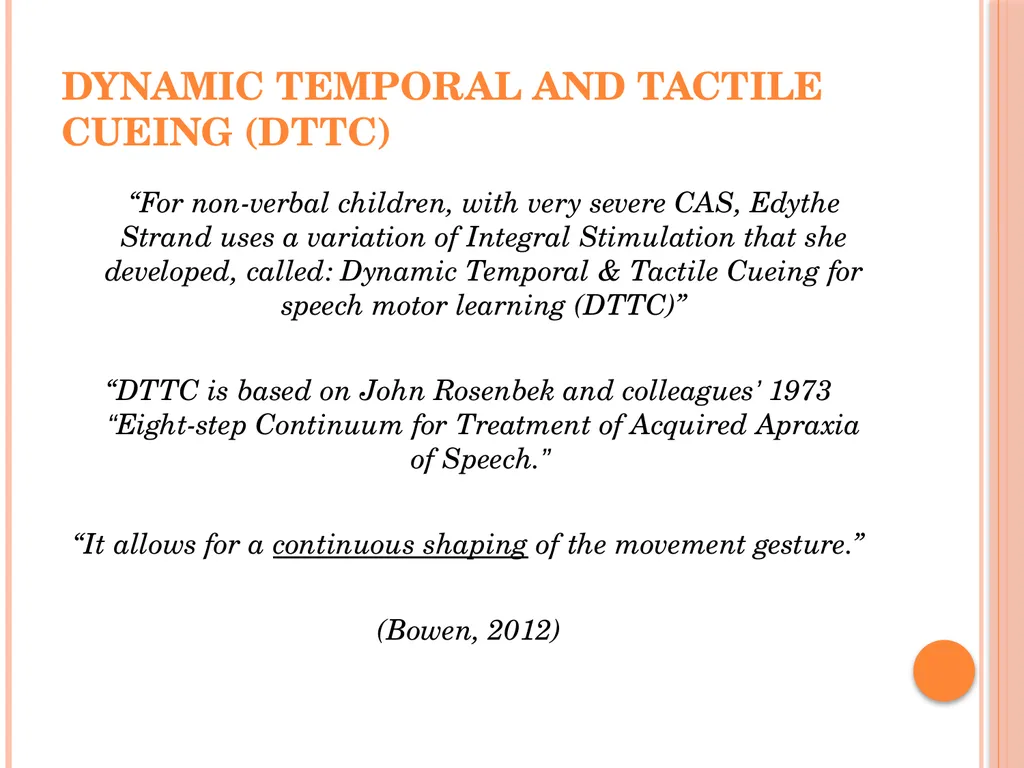
DYNAMIC TEMPORAL AND TACTILE CUEING (DTTC) “For non-verbal children, with very severe CAS, Edythe Strand uses a variation of Integral Stimulation that she developed, called: Dynamic Temporal & Tactile Cueing for speech motor learning (DTTC)”
“DTTC is based on John Rosenbek and colleagues’ 1973 “Eight-step Continuum for Treatment of Acquired Apraxia of Speech.”
“It allows for a continuous shaping of the movement gesture.”
(Bowen, 2012)<br>
“DTTC is based on John Rosenbek and colleagues’ 1973 “Eight-step Continuum for Treatment of Acquired Apraxia of Speech.”
“It allows for a continuous shaping of the movement gesture.”
(Bowen, 2012)<br>
17
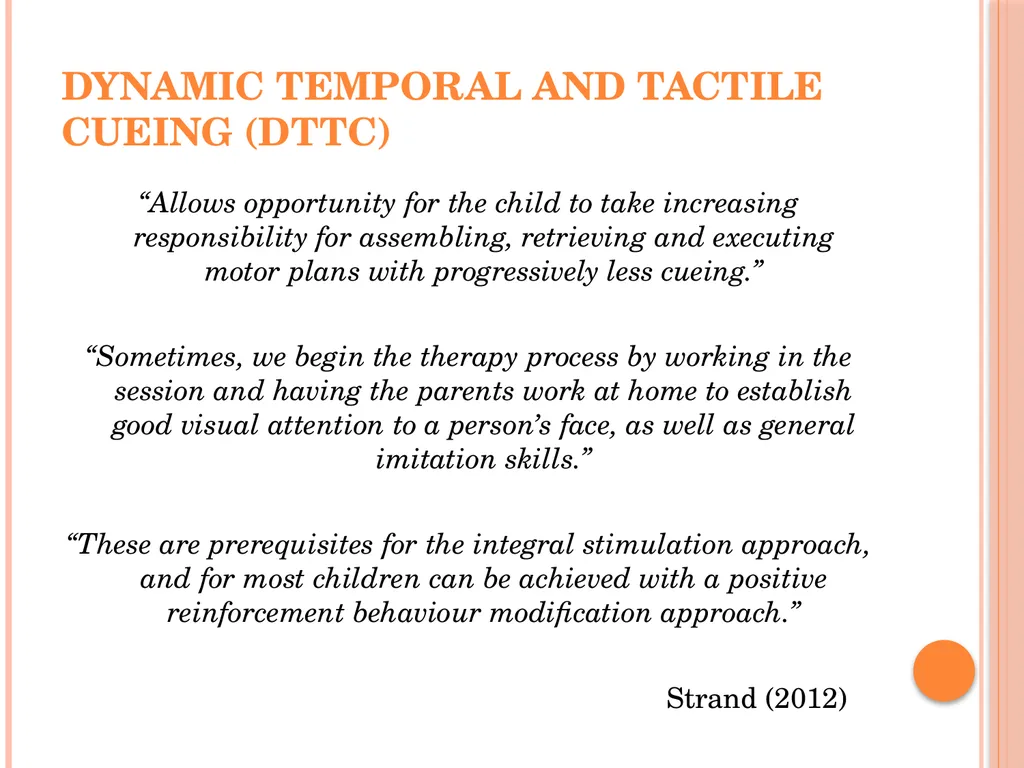
DYNAMIC TEMPORAL AND TACTILE CUEING (DTTC) “Allows opportunity for the child to take increasing responsibility for assembling, retrieving and executing motor plans with progressively less cueing.”
“Sometimes, we begin the therapy process by working in the session and having the parents work at home to establish good visual attention to a person’s face, as well as general imitation skills.”
“These are prerequisites for the integral stimulation approach, and for most children can be achieved with a positive reinforcement behaviour modification approach.”
Strand (2012)<br>
18
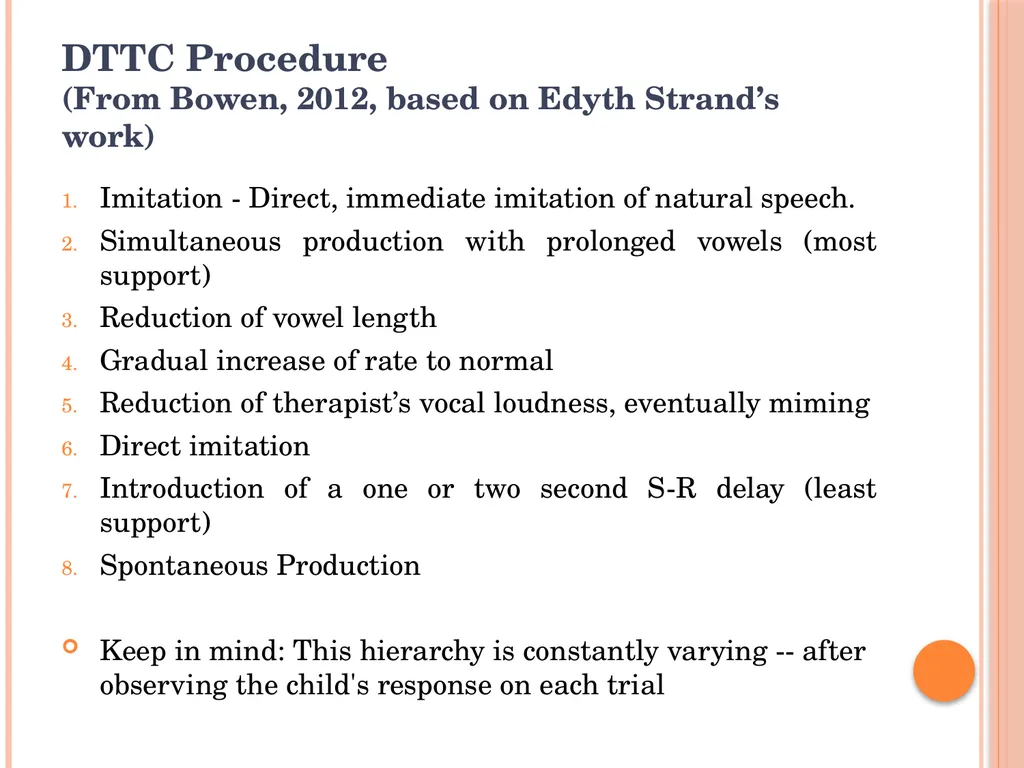
DTTC Procedure
(From Bowen, 2012, based on Edyth Strand’s work) Imitation - Direct, immediate imitation of natural speech.
Simultaneous production with prolonged vowels (most support)
Reduction of vowel length
Gradual increase of rate to normal
Reduction of therapist’s vocal loudness, eventually miming
Direct imitation
Introduction of a one or two second S-R delay (least support)
Spontaneous Production
Keep in mind: This hierarchy is constantly varying -- after observing the child's response on each trial<br>
19
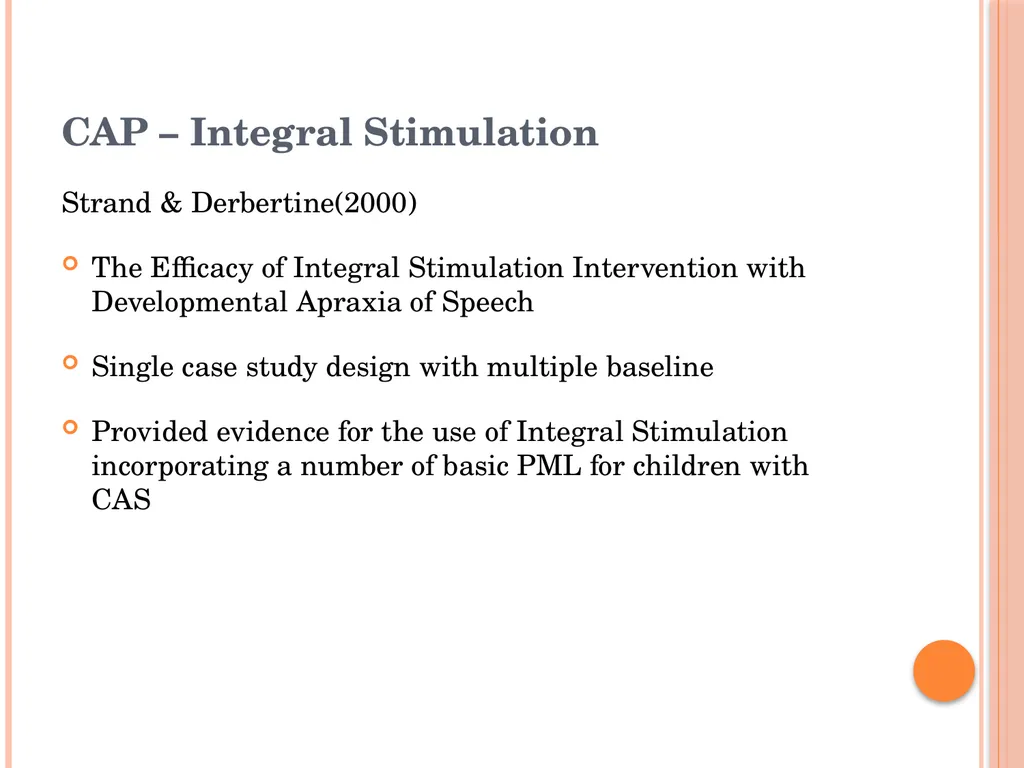
CAP – Integral Stimulation Strand & Derbertine(2000)
The Efficacy of Integral Stimulation Intervention with Developmental Apraxia of Speech
Single case study design with multiple baseline
Provided evidence for the use of Integral Stimulation incorporating a number of basic PML for children with CAS<br>
The Efficacy of Integral Stimulation Intervention with Developmental Apraxia of Speech
Single case study design with multiple baseline
Provided evidence for the use of Integral Stimulation incorporating a number of basic PML for children with CAS<br>
20
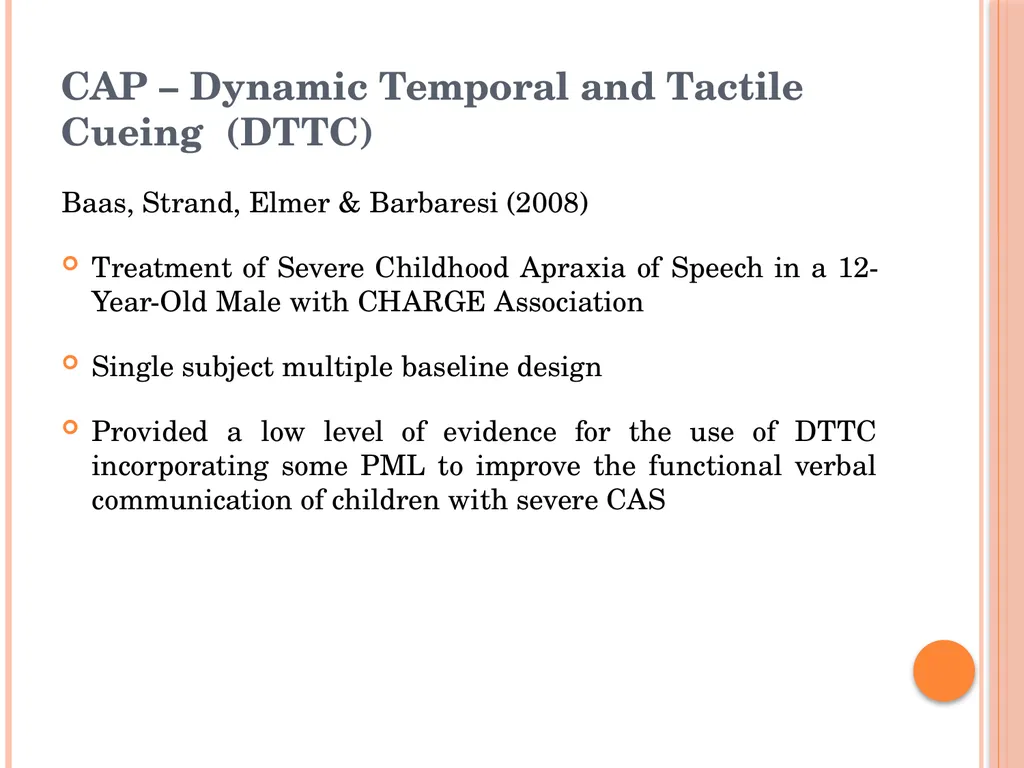
CAP – Dynamic Temporal and Tactile Cueing (DTTC) Baas, Strand, Elmer & Barbaresi (2008)
Treatment of Severe Childhood Apraxia of Speech in a 12-Year-Old Male with CHARGE Association
Single subject multiple baseline design
Provided a low level of evidence for the use of DTTC incorporating some PML to improve the functional verbal communication of children with severe CAS<br>
Treatment of Severe Childhood Apraxia of Speech in a 12-Year-Old Male with CHARGE Association
Single subject multiple baseline design
Provided a low level of evidence for the use of DTTC incorporating some PML to improve the functional verbal communication of children with severe CAS<br>
21
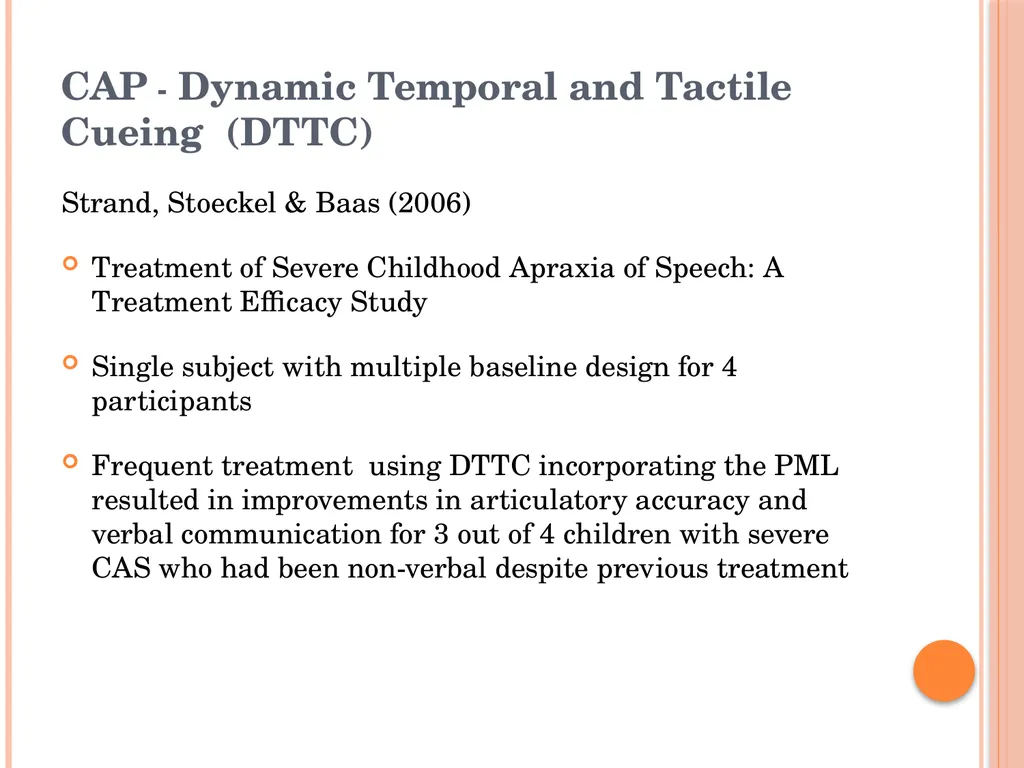
CAP - Dynamic Temporal and Tactile Cueing (DTTC) Strand, Stoeckel & Baas (2006)
Treatment of Severe Childhood Apraxia of Speech: A Treatment Efficacy Study
Single subject with multiple baseline design for 4 participants
Frequent treatment using DTTC incorporating the PML resulted in improvements in articulatory accuracy and verbal communication for 3 out of 4 children with severe CAS who had been non-verbal despite previous treatment<br>
22
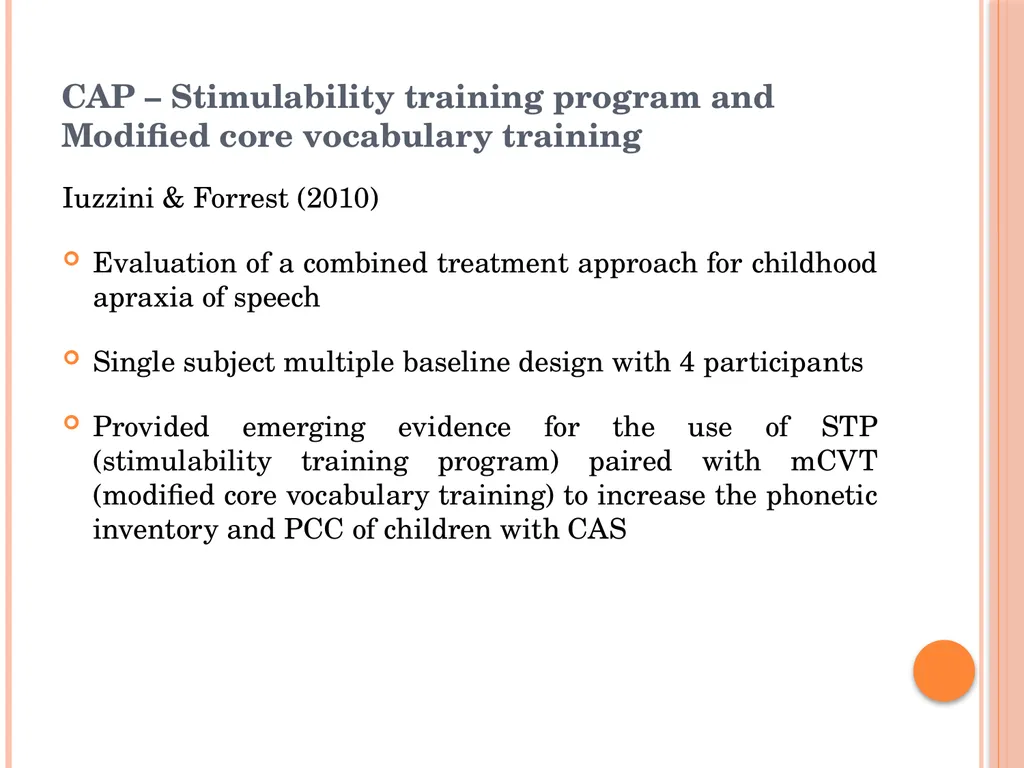
CAP – Stimulability training program and Modified core vocabulary training Iuzzini & Forrest (2010)
Evaluation of a combined treatment approach for childhood apraxia of speech
Single subject multiple baseline design with 4 participants
Provided emerging evidence for the use of STP (stimulability training program) paired with mCVT (modified core vocabulary training) to increase the phonetic inventory and PCC of children with CAS<br>
23
CAP – MIT and Touch-cues Martikainen & Korpilahti (2011)
Intervention for childhood apraxia of speech: A single case-study
Single case study multiple baseline design
A combination of MIT & Touch-Cue Method(TCM) intervention led to improved vowel and consonant production in a single case. However, further research is required.<br>
Intervention for childhood apraxia of speech: A single case-study
Single case study multiple baseline design
A combination of MIT & Touch-Cue Method(TCM) intervention led to improved vowel and consonant production in a single case. However, further research is required.<br>
24
CAP – Rapid Syllable Transition Treatment (ReST) Ballard, Robin, McCabe & McDonald (2010)
A Treatment for Dysprosody in Childhood Apraxia of Speech
Single subject multiple baseline design for 3 siblings
Targeted treatment using PML was effective in improving the production of SW vs WS stimuli and generalised to untreated stimuli, but minimal changes were seen in production of real words<br>
25
CAP – Practice condition:
high or low dose? Edeal & Gildersleeve-Neumann (2011)
The Importance of Production Frequency in Therapy for Childhood Apraxia of Speech
Single subject alternating AB design with 2 participants
Frequent and intense practice of speech targets results in more rapid responses to treatment. Retention and transfer were greater for speech sounds that were practised 100-150 times per session than for speech sounds that were practised 30-40 times per session (ie: higher dose was better)<br>
26
CAP - Feedback condition:
high vs low frequency feedback? Maas, Butalla & Farinella (2012)
Feedback Frequency in Treatment for Childhood Apraxia of Speech
Alternating treatment and multiple baseline single subject design with 4 participants
Findings were mixed - unclear whether low or high frequency feedback is more effective for children with CAS
Provided support for the efficacy of integral stimulation treatment for children with CAS<br>
27
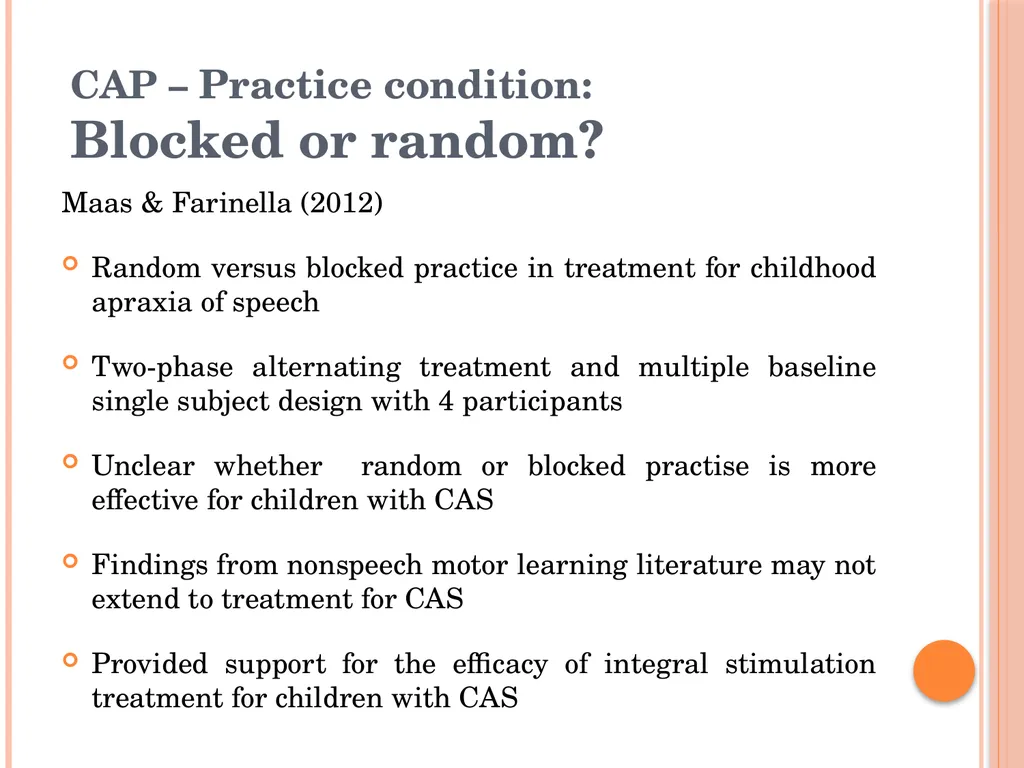
CAP – Practice condition:
Blocked or random? Maas & Farinella (2012)
Random versus blocked practice in treatment for childhood apraxia of speech
Two-phase alternating treatment and multiple baseline single subject design with 4 participants
Unclear whether random or blocked practise is more effective for children with CAS
Findings from nonspeech motor learning literature may not extend to treatment for CAS
Provided support for the efficacy of integral stimulation treatment for children with CAS<br>
28
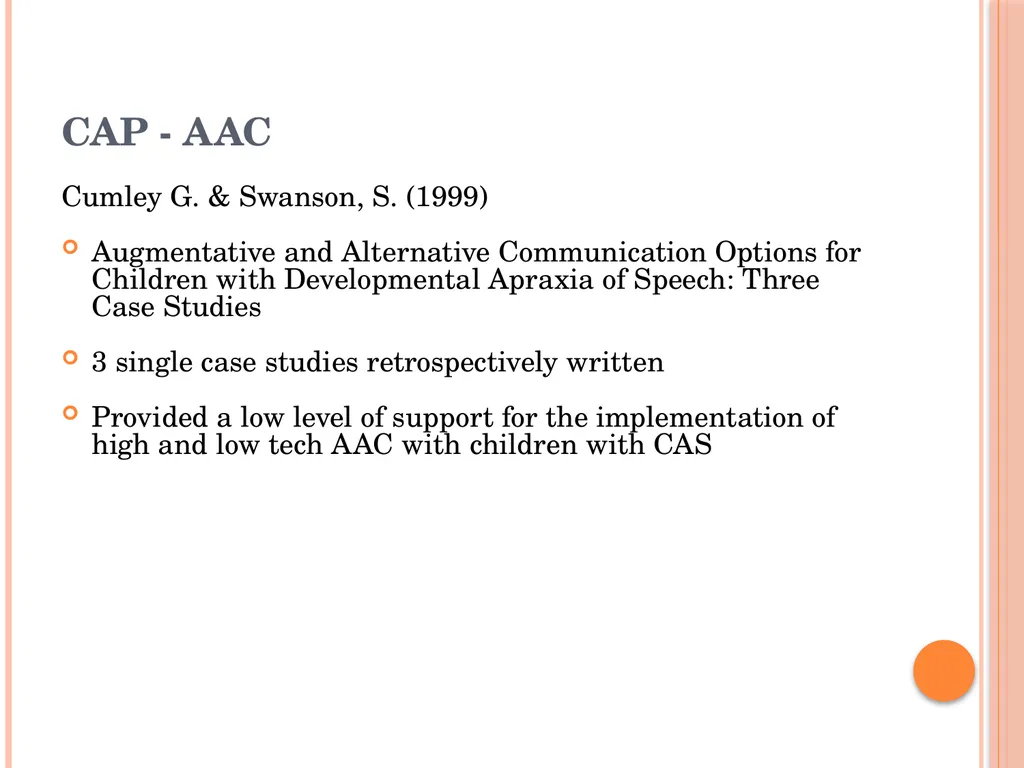
CAP - AAC Cumley G. & Swanson, S. (1999)
Augmentative and Alternative Communication Options for Children with Developmental Apraxia of Speech: Three Case Studies
3 single case studies retrospectively written
Provided a low level of support for the implementation of high and low tech AAC with children with CAS<br>
Augmentative and Alternative Communication Options for Children with Developmental Apraxia of Speech: Three Case Studies
3 single case studies retrospectively written
Provided a low level of support for the implementation of high and low tech AAC with children with CAS<br>
29
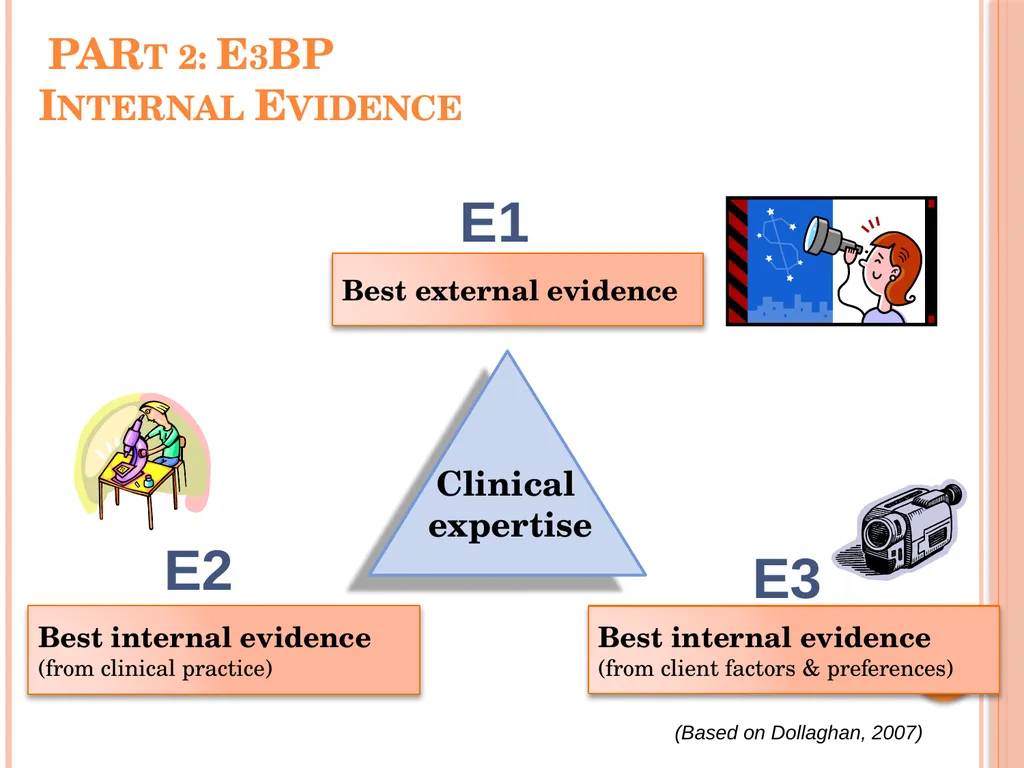
Best external evidence Best internal evidence
(from client factors & preferences) Best internal evidence
(from clinical practice) Clinical
expertise E1 E2 E3 (Based on Dollaghan, 2007) PARt 2: E3BP Internal Evidence<br>
(from client factors & preferences) Best internal evidence
(from clinical practice) Clinical
expertise E1 E2 E3 (Based on Dollaghan, 2007) PARt 2: E3BP Internal Evidence<br>
30
EBP Phonology E3BP Trial
( still in process) Look at which principles you have been given
Select two clients with a speech impairment – one for each principle
Select a treatment goal for each client to trial
Clarify and compare your results with others from your workplace
Take data (including generalisation data)
Complete the one page questionnaire<br>
Select two clients with a speech impairment – one for each principle
Select a treatment goal for each client to trial
Clarify and compare your results with others from your workplace
Take data (including generalisation data)
Complete the one page questionnaire<br>
31
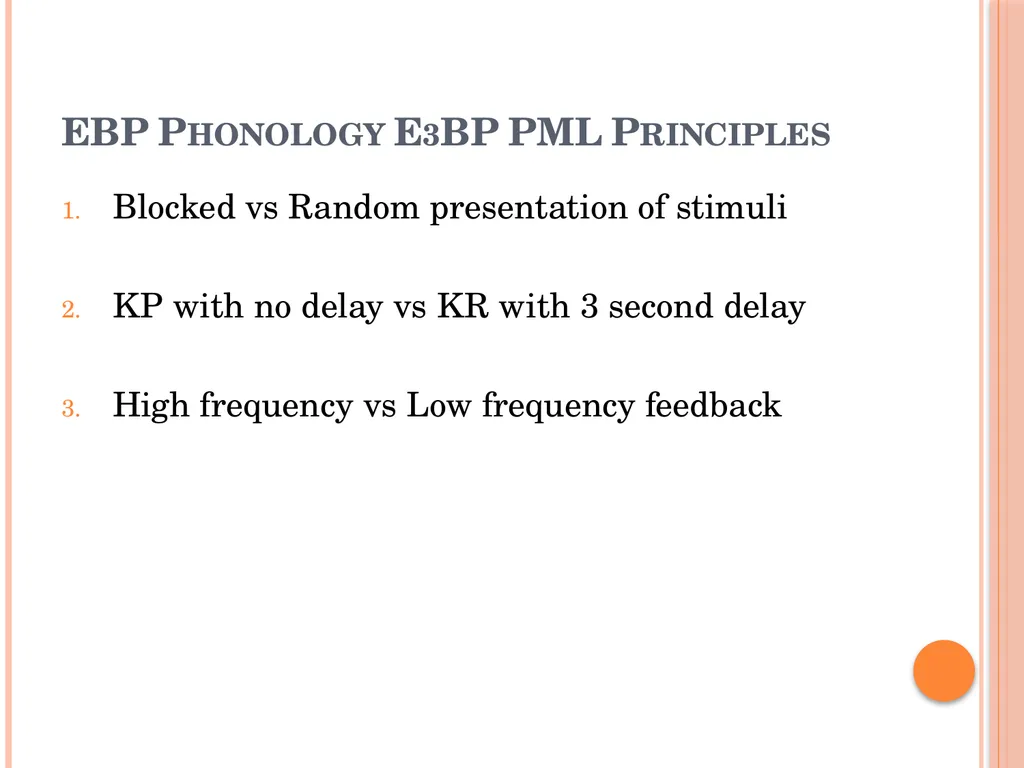
EBP Phonology E3BP PML Principles Blocked vs Random presentation of stimuli
KP with no delay vs KR with 3 second delay
High frequency vs Low frequency feedback<br>
KP with no delay vs KR with 3 second delay
High frequency vs Low frequency feedback<br>
32
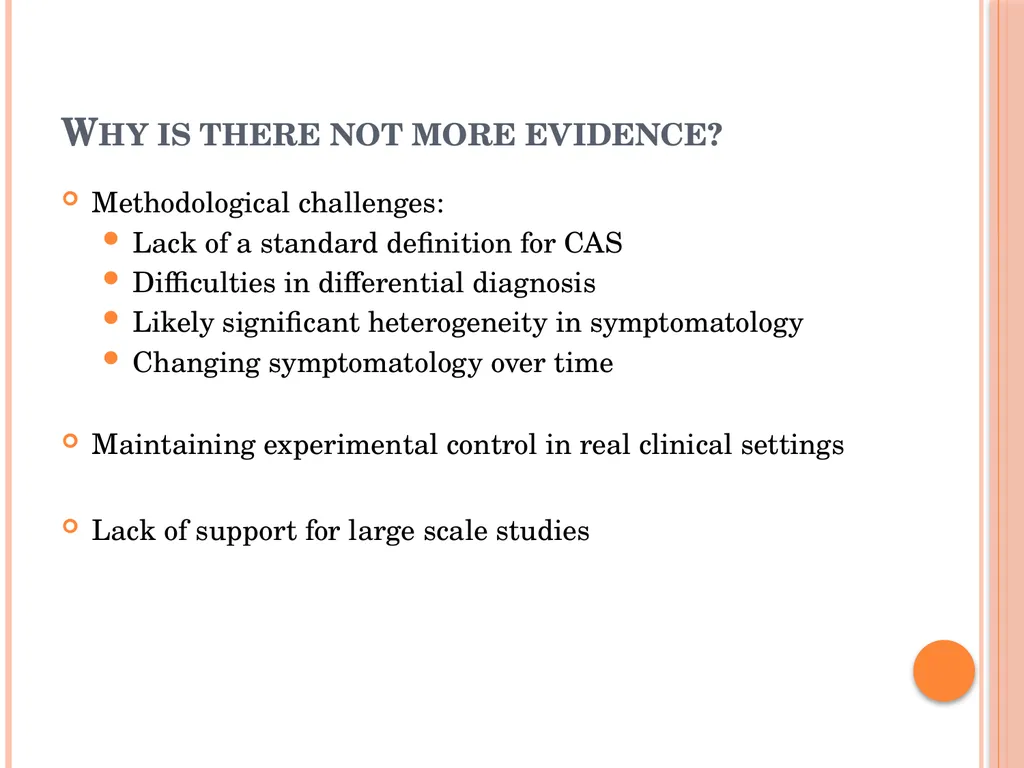
Why is there not more evidence? Methodological challenges:
Lack of a standard definition for CAS
Difficulties in differential diagnosis
Likely significant heterogeneity in symptomatology
Changing symptomatology over time
Maintaining experimental control in real clinical settings
Lack of support for large scale studies<br>
Lack of a standard definition for CAS
Difficulties in differential diagnosis
Likely significant heterogeneity in symptomatology
Changing symptomatology over time
Maintaining experimental control in real clinical settings
Lack of support for large scale studies<br>
33
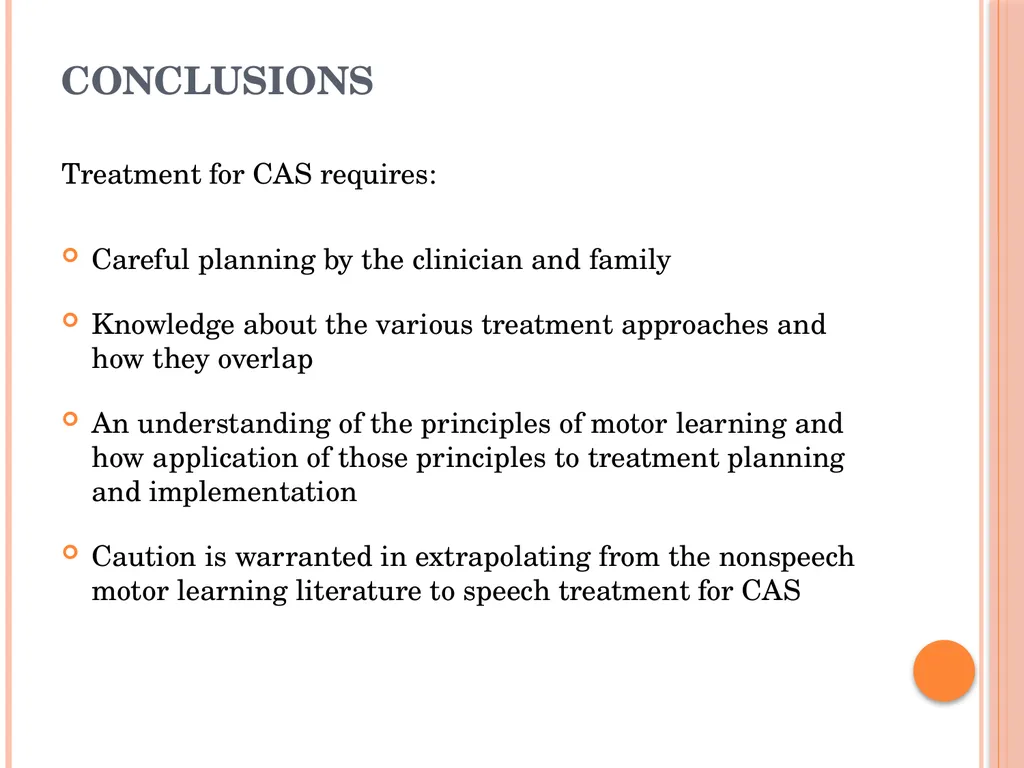
CONCLUSIONS Treatment for CAS requires:
Careful planning by the clinician and family
Knowledge about the various treatment approaches and how they overlap
An understanding of the principles of motor learning and how application of those principles to treatment planning and implementation
Caution is warranted in extrapolating from the nonspeech motor learning literature to speech treatment for CAS<br>
34
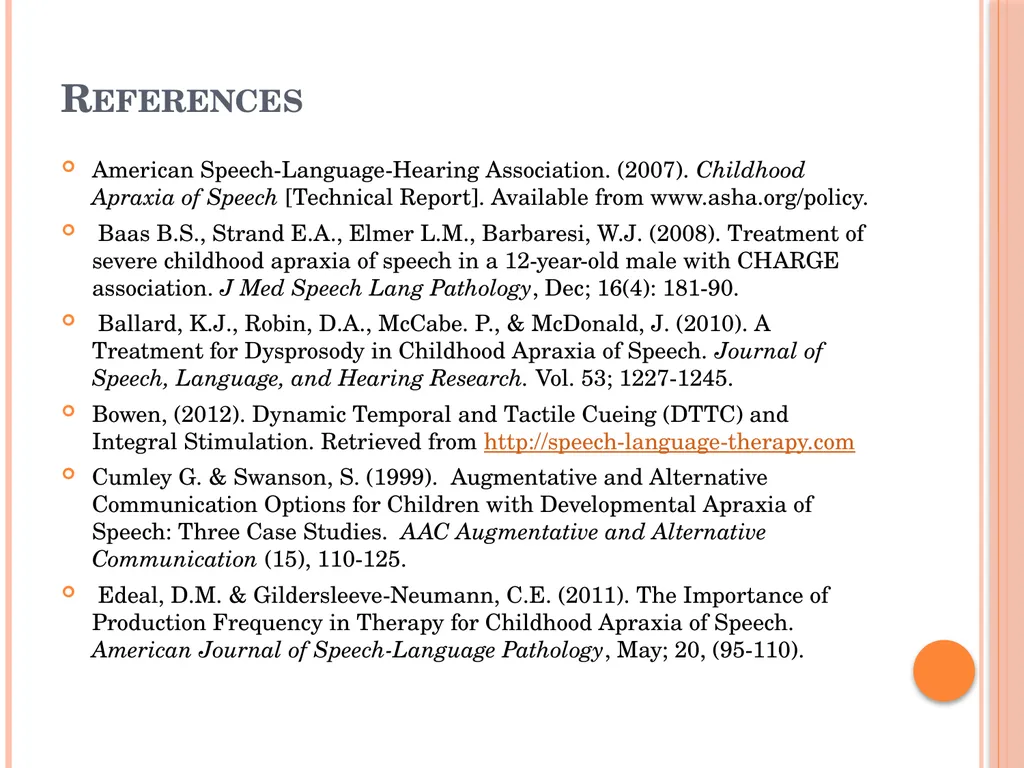
References American Speech-Language-Hearing Association. (2007). Childhood Apraxia of Speech [Technical Report]. Available from www.asha.org/policy.
Baas B.S., Strand E.A., Elmer L.M., Barbaresi, W.J. (2008). Treatment of severe childhood apraxia of speech in a 12-year-old male with CHARGE association. J Med Speech Lang Pathology, Dec; 16(4): 181-90.
Ballard, K.J., Robin, D.A., McCabe. P., & McDonald, J. (2010). A Treatment for Dysprosody in Childhood Apraxia of Speech. Journal of Speech, Language, and Hearing Research. Vol. 53; 1227-1245.
Bowen, (2012). Dynamic Temporal and Tactile Cueing (DTTC) and Integral Stimulation. Retrieved from http://speech-language-therapy.com
Cumley G. & Swanson, S. (1999). Augmentative and Alternative Communication Options for Children with Developmental Apraxia of Speech: Three Case Studies. AAC Augmentative and Alternative Communication (15), 110-125.
Edeal, D.M. & Gildersleeve-Neumann, C.E. (2011). The Importance of Production Frequency in Therapy for Childhood Apraxia of Speech. American Journal of Speech-Language Pathology, May; 20, (95-110).<br>
35
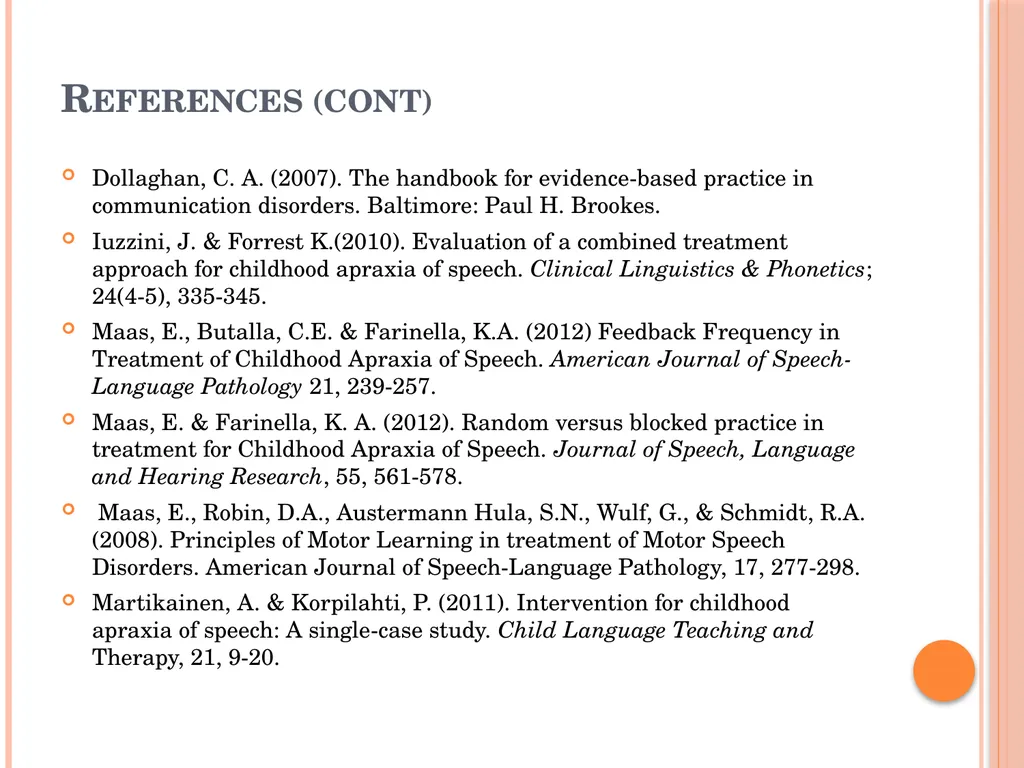
References (cont) Dollaghan, C. A. (2007). The handbook for evidence-based practice in communication disorders. Baltimore: Paul H. Brookes.
Iuzzini, J. & Forrest K.(2010). Evaluation of a combined treatment approach for childhood apraxia of speech. Clinical Linguistics & Phonetics; 24(4-5), 335-345.
Maas, E., Butalla, C.E. & Farinella, K.A. (2012) Feedback Frequency in Treatment of Childhood Apraxia of Speech. American Journal of Speech-Language Pathology 21, 239-257.
Maas, E. & Farinella, K. A. (2012). Random versus blocked practice in treatment for Childhood Apraxia of Speech. Journal of Speech, Language and Hearing Research, 55, 561-578.
Maas, E., Robin, D.A., Austermann Hula, S.N., Wulf, G., & Schmidt, R.A. (2008). Principles of Motor Learning in treatment of Motor Speech Disorders. American Journal of Speech-Language Pathology, 17, 277-298.
Martikainen, A. & Korpilahti, P. (2011). Intervention for childhood apraxia of speech: A single-case study. Child Language Teaching and Therapy, 21, 9-20.<br>
36
REFERENCES (CONT) Morgan, A.T. & Vogel, A.P. (2009). A Cochrane review of treatment for childhood apraxia of speech. European Journal of Physical and Rehabilitation Medicine. Mar;45(1):103-10.
Strand, E. (2012, April 6). Management of CAS [PowerPoint slides]. Brigham Young University, Provo UT.
Strand, E., Stoeckel., R., & Baas, B. (2006). Treatment of Severe Childhood Apraxia of Speech: A Treatment Efficacy Study. Journal of Medical Speech Pathology, 14, 297-307.
Strand, E.A.,and Debertine, P.(2000) The efficacy of integral stimulation intervention with developmental apraxia of speech. Journal of Medical Speech Pathology. 8 (4), 295-300.<br>